

1606 Jahangir received false reports on Guru Arjan’s blessing Khusrau.
1848 Maharani Jind Kaur exiled and sent to Banaras prison.
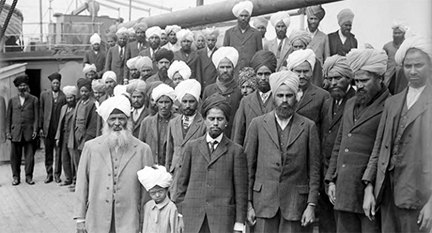
1914 Guru Nanak Jahaz (Koma gata Maru) reached Vancouver port, Canada. However, it was forced to return to India. KOMA GATA MARU: Punjabis traveling to foreign land in search of better jobs were being discriminated against at the begining of 20th century. The Canadian government had issued prohibition against their entry and the British ships had refused to accept any Punjabi travelers. The Canadian law stated, for the purpose of preventing immigration from india and other countries, that only those passengers could land in Canada who travelled on a through ticket without any break in journey from their land of birth. However, no company provided such a service between the Indian and Canadian ports. As a result, many Punjabis were stranded for months in Hong Kong, unable to get tickets for their final destination, Canada.
24th May
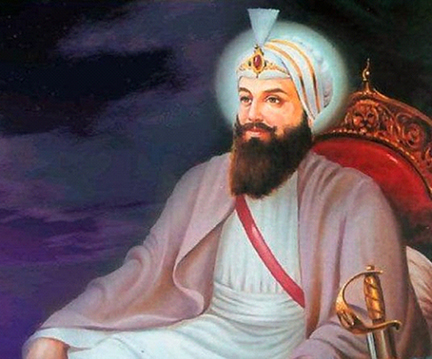
1606 Guru Arjan Dev reached Lahore for martyrdom in protection of the Dharam. For 6 days he suffrede emmense tortures. At the time of martyrdom, Sai Mia Meer and a priest from Puratgal, Saint Jaerom Jaevier witnessed the martyrdom.
1710 Baba Banda Singh Bahadur enters Sirhind city.
1960 Master Tara Singh and hundreds of Sikhs arrested.
25th May
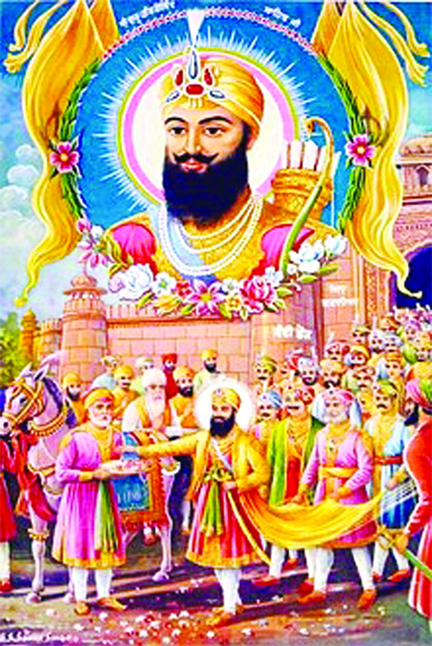
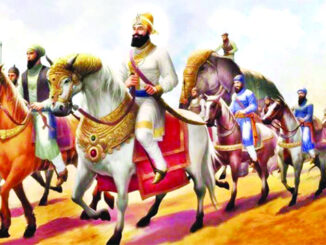
1606 GUR GADHI, Patshahi Sixth, Guru Har Gobind Ji. Pattshahi sixth, Guru Har Gobind Sahib Ji, ascended to Guruship of GurSikhism. Just after the martyrdom of Guru Arjan Dev, Baba Budha anointed Hargobind as the sixth Guru of the Sikhs. Guru Arjan had sent to Hargobind, five paisas and a coconut through a messenger. baba Budha put those in front of Hargobind and applied a ’tilak’ (saffron mark) on his forehead, bowed to him and declared him to be the next Guru of the Sikhs. The Guru then asked baba Budha to adorn him with a sword. Baba Budha who had not handled a sword before, tied it on the wrong side of the Guru. On realising his mistake he wanted to move it to the right side, but the Guru said not to remove that sword, but instead to put another one on the right side, which Baba Budha did. Thus the Guru wore two swords simultaneously. He declared that one sword represented ‘Piri’ (spirituality) or Bhakti) while the other represented ‘Miri’ (Temporality or Shakti). He told his followers that in the Guru’s house spiritual and temporal powers would be combined. He declared that his rosary would be the sword-belt and he would wear the emblem of royality on his turban. Further he instructed the Sikhs to keep a sword and a horse and always recite the name of God from their lips.
1675 Kashmiri Panditsi, led by Kirpa Ram, arrive in Anandpur Sahib to ask Guru Tegh Bahadhur for help in preserving Hindu dharam.
26th May
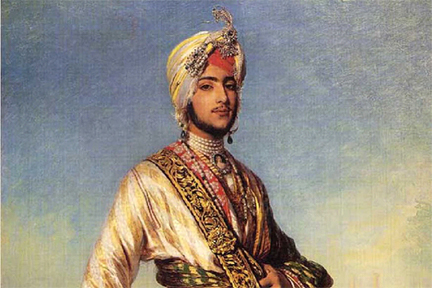
1886 Maharaja Dalip Singh reentered Sikh faith. He received Khande Di Pahul (Amrit) on May 26, 1886 at Aden. Earlier, on On March 8, 1853, Maharaja Dalip Singh was formally admitted into the Christian Church with water brought from Ganges nearby at his own private dwelling house. The service was conducted by the Rev. M.W. Jay, with Dr. John S. Login, Mrs. Login, Colonel Alexander and Mr. Guise signing the Baptism register as witnesses.
1960 Morcha initiated for seeking Punjabi Subha.
1984 The last meeting was held between Akalis and Indira Gandhi.The last meeting was held between Akalis and Indira Gandhi regime. Several such meetings preceded this meeting. However, by now it became abundantly clear that this was in fact a drama. The government had planned an attack on Darbar Sahib for several months. Russian KGB and even British Intelligence was guiding the invasion of Darbar Sahib.
1988 The President of India issued an ordinance banning the Sikh fundamentals of Miri-Piri (Cohesive oneness of Religion and Politics). An integral part of the Sikh religion Miri-Piri is the most fundamental to Sikh religion. This ordinance (which later became law) meant that the Sikhs shall have to adopt only that part of their religion which the Hindu majority will allow. This was the final blow to the Sikh nation which made the professing of their religion under the subjugation of the Hindu regime.
1996 Atal Bihari Vajpayee, in his capacity as Prime Minister of India, visited Sri Harmandir Sahib, Amritsar and apologized to the Sikhs for the following two abominations committed by the Government of India.
27th May
1710 Baba Banda Singh Bahadur announces the establishment of Sikh rule in a heavy Diwan organized in Sirhind city.
1921 The Governor of Punjab arrested Sardul Singh Caveesher for spearheading the non-cooperation resolution at SGPC meeting of May 11, 1921. This meeting was really a confrontation that once again demonstrated the majority of the radicals in the SGPC.
28th May
1922 A meeting is called at Kaulgarh by Karam Singh Gargaj group to reform the Jholichuks.
1948 SGPC came under the control of Congress Sikhs.
29th May
1606 Martyrdom, Fifth Patshah, Guru Arjan Dev Ji.
Guru Arjan Dev (1563-1606) Guru Arjan, the ‘Prince of Martyrs’ and the ‘Prophet of Peace’, proffered his precious life to nurture the glory that was to be the Sikh Panth. The Fifth Master’s life was marked by divine bliss and sublime sacrifices, born of a sweet acceptance of God’s Will. Gifted with a quintessential poetic afflatus, and immeasurable imaginative sympathies, the Guru gave the movement of Sikhism a definite direction, perspective and program. He made the new faith coeval or coextensive with the whole gamut of existence and raised its exquisite edifice on values for which there is neither death nor change.
Guru Arjan Dev adorned the sacred throne of Guru Nanak from Sept. 1, 1581 to May 30, 1606. Born at Goindwal on April 15, 1563, he was the youngest and noblest son of Guru Ram Das and Mata Bibi Bhani. On 23 Hadh sunmat 1636, he married Ganga Devi, daughter of Krishan Chand of Mau village. He had an innate poetic sensibility which was exquisitely displayed in the epistles that he sent to his father from Lahore. They are deeply expressive of the pangs of separation and the exuberance of Love. The Fourth Master’s decision to make Guru Arjan his spiritual heir was bitterly opposed by Prithvi Chand who contended that being the eldest son, he alone was entitled to the Guruship. Thus, he could never reconcile himself to his younger brother’s installation as Guru. Under Guru Arjan Dev the Sikh movement registered great progress. In sunmat 1645, he cemented the Santokhsar sarovar. Further, the Guru not only completed the construction of the Sarovars started at ‘Guru Ka Chak’ by his predecessor but also constructed two more Sarovars. He had the Harmandar built in the middle of Amritsar Sarovar and invited a celebrated Muslim divine, Mian Mir, to lay its foundation stone in sunmat 1645. Remarkable for its architectural and aesthetic beauty and unique in its conception, the temple with its four doors symbolizes the inborn equality of all mankind.

Be the first to comment