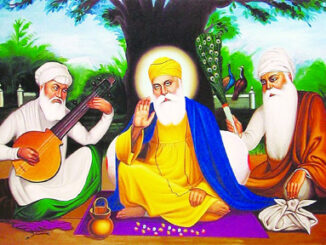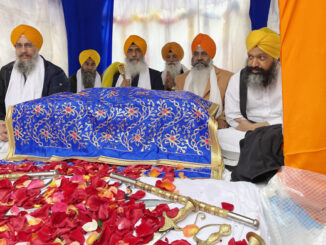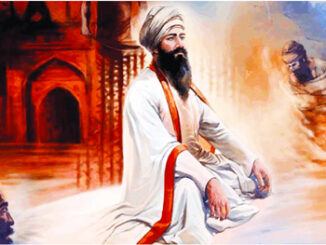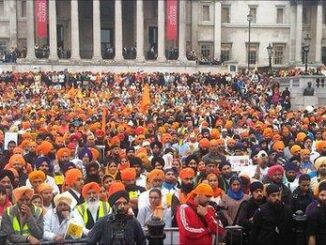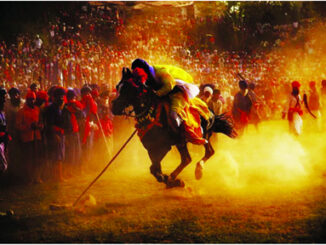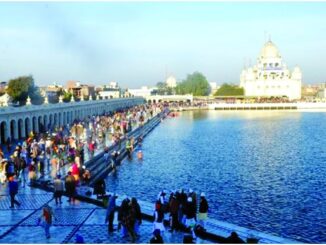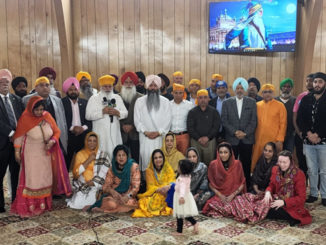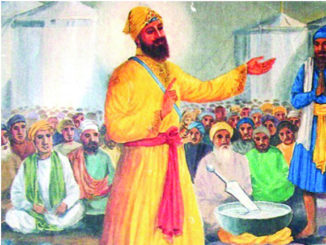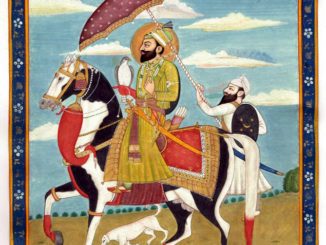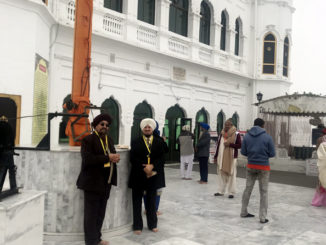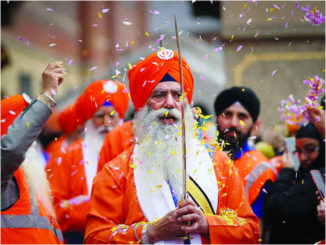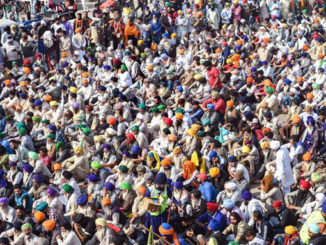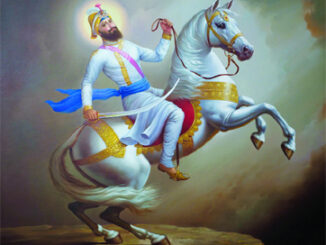
Guru Gobind Singh Sahib, the 10th master of the Sikhism, was born on 7th day of the month of POH, samvat 1723, (22nd December, 1666 AD ) at Patna Sahib in Bihar. Guru ji was a great revolutionary whose greatest achievement was the creation of the Khalsa Panth on Baisakhi Day of 1699 at Anandpur Sahib in Punjab. Guru ji was a linguistic familiar with many languages Iike, Persian, Arabic, Sanskrit as well as his native Punjabi. Guru ji codified Sikh law,wrote martial poetry and music ,fought many battles and won. Guru ji wrote the renowned holy Granth called the Dasam Granth.The noted prayers included in this Granth are Jaap Sahib, Chandi Di Vaar, Tav-Prasad Savaiye, Zafarnamah, Bachittar Natak, Akal Ustat, Chaupai Sahib and more.
Guru Gobind Singh Sahib Ji was a revolutionary prophet who practiced his spiritual ideals to counter the forces of tyranny and injustice. Tyranny in all its forms – social, political, and religious was to be countered and annihilated. A state which could not provide basic human rights, social justice, equality and religious freedom was to be opposed. A God oriented person, owed primary allegiance to God, truth, conscience and morality. Guru Gobind Singh was concern were universal, integrated and without any boundaries. The martyrdom of Guru ji’s father, mother, four sons and hundreds of followers for the lofty ideals of freedom, justice and righteousness were unique in the annals of human history. Guru Gobind Singh Ji ignited that spark in human nature that inspired mankind to build lives of compassion, love and commitment to justice and also to suffer and make sacrifices for the cause of righteousness.
Sir J. D.Cunningham, the noted author of the book “, History Of The Sikhs”,wrote about Guru Gobind Singh Sahib Ji as under:
A living spirit possess the whole Sikh people and the impression of Guru Gobind Singh Ji has not only elevated and attired the constitution of their minds but has operated materially and given amplitude to their physical frames ,”The Khalsa ideals transformed the life, outlook and aspirations of the people and imparted a new direction to Indian history”.
In the words of Gurudev Rabindra Nath Tagore, “Guru Gobind Singh Ji appeared on the Indian National scene with the message of militarism of the community for the defence of social equality and religious freedom. In order to execute his plan, Guru Gobind Singh Sahib Ji unified the Sikhs, taught them how to face any crisis calmly and boldly and generated a new hope and confidence “.
Guru Gobind Singh Sahib Ji came to reside Anandpur Sahib along with his parents, when he was a child of 7 years old. After some years, a deputation of Kashmiri Pandits came to Anandpur Sahib and met his father, the 9th Sikh Guru, Shree Guru Tegh Bahadur Sahib ji. They narrated the cruel acts of Mughal rulers towards the Hindu community and sought Guru Ji’s help. Guru Tegh Bahadur Ji became silent and was absorbed in deep thoughts. Guru Gobind Singh ii,who was, at that time, a child of just 9 years of age, asked his father about the reason for his silence. Guru Tegh Bahadur Ji explained that these helpless people from Kashmir had no one to protect their Dharma. The sacrifice of a great and brave soul was needed.The child, Guru Gobind Singh Ji, immediately Said ,”Who can be more brave and greater than you? Please have mercy on them and do what is necessary to protect “Hindu Dharma “.
Guru Tegh Bahadur Ji was pleased to hear this and went to Delhi to sacrifice his life only to save the Hindu Dharma. The Mughal emperor Aurangzeb asked Guru Ji to either embrace Islam or face death.Guru Tegh Bahadur ji replied, “My religion is most dear to me. I am not afraid of death ” At this, Aurangzeb ordered the execution of Guru Tegh Bahadur Ji.
Guru Ji was to be beheaded at the Main Bazar of Chandni Chowk, Delhi.At the Chandni Chowk in Delhi, where the great Gurudwara Sri Sisganj Sahib stands today, was the place chosen for Guru Ji’s execution. Guru Tegh Bahadur Ji died a hero’s death. Guru ji’s execution only strengthened the resistance against Aurangzeb’s religious fanaticism. When Guru Gobind Singh was told that no one came forward to protest because of the fear of death, Guru Ji declared that he would lay the foundation of the Khalsa Panth and would train it in such a way that it’s members would be ready to sacrifice everything for the right cause.
Guru Gobind Singh Ji’s creation of Khalsa Panth in 1699 AD , on the Baisakhi day at Anandpur Sahib was an event of world significance. Noted historian Arnold Tonybee has called it the precursor and forerunner of Lennin’s communist party two centuries later in the history, an idealistic minority fighting with the weapons of adversity in the name of God , for the sake of majority.
Guru ji baptised the 5 chosen Sikhs by administering Amrit ,prepared by a double edged sword,sweetened by dissolving “Battashas ” in to the water, to them.They were called as the five chosen loved ones, Panj Pyare.
They were given the surname of Singh, and were called as Khalsa, the army of lord God:
“Khalsa Akalpurkh Ki Fauj,
Pargatiyo Khalsa,
Parmatam Ki Mauj!’
(KHALSA is the army of the eternal God raised by him out of his pleasure)
Guru ji held his Chosen five in so high esteem that he knelt before them and asked them to initiate himself into the Khalsa Panth in the same manner as he had done them. Guru ji was then administered Amrit in the same way and was given the surname Singh (Previously Guru ji’s name was Gobind Rai)
The Khalsa, with God’s light shining within was meant to be a global society. They were not to form a separate denomination as that was totally against the Guru Ji concept of universal brotherhood. The creation of the Khalsa Panth was a crowning event of Guru Gobind Singh ji’s life. Ideologically, the creation of the KHALSA PANTH aimed at a well balanced combination of the ideals of Bhakti and Shakti, of moral spiritual excellence and militant valour and heroism of the highest order. They were expected to salute one another with words,
“Wahe Guru Ji Ka Khalsa
Wahe Guru Ji Ki Fateh!”
This was meant to remind that they were knighted as God’s soldiers to carry out his mission and that victory was theirs.
But the Khalsa, the ‘Singhs”, were not to be merely soldiers. It was imperative that they must at the same time be saints deeply devoted to God, singing his hymns as composed by Sikh Gurus, observing the daily religious discipline prescribed in Rahit Maryaada of the Khalsa Panth and bearing a high moral character. Guru Gobind Singh Ji, though, was a matchless warrior, always remained a Saint at heart.Guru ji was a Saint who had dedicated himself to God,a God intoxicated philosopher Guru ji was a sincere lover of mankind who wanted to see all manmade differences created by barriers of formal religion and social distinctions brought in by caste, to be oblitered from the society.
Guru ji left for his heavenly abode on October 7th, 1708 at a place, Naded, in Maharashtra due to a conspiracy hatched against him by Nawaab Wazir Khan of Punjab. Guru ji,before leaving for his heavenly abode, declared that the Sikh community be guided by the decisions of “Panj Piayrey”, the chosen five, chosen from among the devotees. Guru ji handed over the stewardship of the Sikh Panth, the Sikh way of life, to holy Guru Grant Sahib Ji .Those, who wished to seek God ,can find him in the holy Guru Grant Sahib. Ji.
In conclusion, it can be said that Guru Gobind Singh Sahib Ji, the son of martyred Guru Tegh Bahadur Ji, the great grandson of 5th Sikh Guru, Shree Guru Arjan Dev Ji, who also attained martyrdom at Lahore .(Guru Arjan Dev Ji was martyred for compiling the 1st official version of the holy scripture called the Adi Granth, which later was expanded in to the holy Guru Granth Sahib Ji.), laid at the altar of Almighty, all that that he could call his own, his father, mother, his four sons and even his entire life for the freedom of all including those who considered themselves his enemy.
The man and his philosophy
A divine messenger, a warrior, a poet, and a philosopher, Guru Gobind Singh molded the Sikh religion into its present shape, with the institution of the Khalsa fraternity, and the completion of the sacred scripture, the Guru Granth Sahib, in the final form that we find today. Before leaving his mortal body in 1708, Guru Gobind Singh decreed the Guru Granth Sahib as the next and perpetual Guru of the Sikhs.
It may not be out of context to consider that throughout the chronicles of human history, there has been no individual who lived a life more inspirational than Guru Gobind Singh. He is variously revered as Sarbans Dani (the merciful donor, who sacrificed his all), Mard Agamra (man without any parallels), Shah-e-Shahenshah (emperor of emperors), Bar do Alam Shah (ruler of both worlds), amongst others.
It is said that after the martyrdom of his father, Guru Teg Bahadur, the tenth Master declared that he would create such a Panth (community/society), which would challenge the tyrant rulers in every walk of life to restore justice, equality and peace for all of mankind. Via institution of the Khalsa in 1699, Guru Gobind Singh Ji infused the dual spirit of a saint and a soldier in the minds and hearts of his followers to fight oppression in order to restore righteousness (Dharma) and to uplift the down-trodden people in this world.
As a prophet, the Guru is unique. His teachings are very scientific and most suitable for all times. Unlike many other prophets he never called himself God or ‘the only son of God.’ Instead he called all people the sons of God sharing His Kingdom equally. For himself he used the word ‘slave’ or servant of God.
A splendid Divine Light shone in the darkness of the night. Pir Bhikan Shah a Muslim mystic performed his prayers in that Easterly direction (instead of towards the West, contrary to his daily practice), and guided by this Divine Light, he travelled with a group of his followers until he reached Patna Sahib in Bihar. It was here that Gobind Rai was born to Mata Gujri. It is said that Pir Bhikan Shah approached the child and offered two bowls of milk and water, signifying both the great religions of Hinduism and Islam. The child smiled and placed his hands on both bowls. The Pir bowed in utter humility and reverence to the new Prophet of all humanity.
Gobind Rai was born with a holy mission of which he tells us in his autobiography “Bachitar Natak” (Wonderous Drama). In it Guru Ji tells us how and for what purpose he was sent into this world by God. He states that before he came into this world , as a free spirit he was engaged in meditation in the seven peaked Hemkunt mountain.
Early Life
Gobind Rai’s father, Guru Teg Bahadur, the Ninth Guru, was then travelling across Bengal and Assam. Returning to Patna in 1670, he directed his family to return to the Punjab. On the site of the house at Patna in which Gobind Rai was born and where he spent his early childhood now stands a sacred shrine, Sri Patna Sahib Gurdwara, Bihar.
Gobind Rai was escorted to Anandpur (then known as Chakk Nanaki) on the foothills of the Sivaliks where he reached in March 1672 and where his early education included reading and writing of Punjabi, Braj, Sanskrit and Persian. He was barely nine years of age when a sudden turn came in his life as well as in the life of the community he was destined to lead.
Kashmiri Brahmins come to Anandpur
Early in 1675, a group of Kashmiri brahmins under the leadership of Pandit Kirpa Ram, mad in desperation by the religious fanaticism of the Mughals General, Iftikar Khan, (he had threatened them with forced conversion to Islam) visited Anandpur to seek Guru Teg Bahadur’s advice. Aurangzeb had ordered the forced conversion of all Hindus and thought that if the respected Kashmiri brahmans accepted Islam, others in the country would be easily converted. They had been given six months to decide or suffer the consequences. Time was running out!
As the Guru sat reflecting what to do, young Gobind Rai, arriving there in company with his playmates, asked why he looked so preoccupied. The father, as records Kuir Singh in his Gurbilas Patshahi 10, replied, “Grave are the burdens the earth bears. She will be redeemed only if a truly worthy person comes forward to lay down his head. Distress will then be expunged and happiness ushered in.” “None could be worthier than you to make such a sacrifice,” remarked Gobind Rai in his innocent manner. Guru Teg Bahadur advised the brahmins to return to their village and tell the authorities that they would accept Islam if Guru Teg Bahadur could first be persuaded to do so.
Soon afterwards the Guru with a few followers proceeded to the imperial capital, Delhi. After watching the tortured deaths of three of his followers he, as well, refused to convert and was beheaded on November 11, 1675. The 13 year old Gobind Rai, ordained as the next Guru before his father departed Anandpur, was formally installed as Guru Gobind Singh on the Baisakhi day of March 1676. In the midst of his engagement with the concerns of the community, he gave attention to the mastery of physical skills and literary accomplishment. He had grown into a comely youth spare, lithe of limb and energetic.
He had a natural genius for poetic composition and his early years were assiduously given to this pursuit. The Var Sri Bhagauti Ji Ki, popularly called Chandi di Var. written in 1684, was his first composition and his only major work in the Punjabi language. The poem depicted the legendary contest between the gods and the demons as described in the Markandeya Purana. The choice of a warlike theme for this and a number of his later compositions such as the two Chandi Charitras, mostly in Braj, was made to infuse martial spirit among his followers to prepare them to stand up against injustice and tyranny.
For the first 20 years or so of his life, Guru Gobind Singh lived peacefully at Anandpur practicing arms and exercises to complete his training as a soldier.
He also studied Persian and Sanskrit and engaged 52 poets to translate the Hindu epics. Stories of ancient heroes were translated into Punjabi in order to create the martial spirit among the Sikhs. The Guru also wrote several compositions including Jaap Sahib, Akal Ustat and Sawayas during this period. He also established a Gurdwara at Paonta Sahib on the banks of the river Jamna.
Stay at Paonta Sahib
Much of Guru Gobind Singh’s creative literary work was done at Paonta he had founded on the banks of the River Yamuna and to which site he had temporarily shifted in April 1685. Poetry as such was, however, not his aim. For him it was a means of revealing the divine principle and concretizing a personal vision of the Supreme Being that had been vouchsafed to him. His Jap Sahib, Swayas and the composition known as Akal Ustat are in this tenor.
Through his poetry he preached love and equality and a strictly ethical and moral code of conduct. He preached the worship of the One Supreme Being, deprecating idolatry and superstitious beliefs and observances. The glorification of the sword itself which he eulogized as Bhagauti was to secure fulfillment of God’s justice. The sword was never meant as a symbol of aggression, and it was never to be used for self-aggrandizement. It was the emblem of manliness and self-respect and was to be used only in self-defence, as a last resort.
Martial training
During his stay at Paonta, Guru Gobind Singh availed himself of his spare time to practice different forms of manly exercises, such as riding, swimming and archery. His increasing influence among the people and the martial exercises of his men excited the jealousy of the neighbouring Rajput hill rulers who led by Raja Fateh Chand of Garhwal collected a host to attack him. But they were worsted in an action at Bhangam, about 10 km north-east of Paonta, in September 1688. Soon thereafter Guru Gobind Singh left Paonta Sahib and returned to Anandpur. The Guru and his Sikhs were involved in a battle with a Mughal commander, Alif Khan, at Nadaur on the left bank of the Beas, about 30 km south-east of Kangra, in March 1691.
Describing the battle in stirring verse in Bachitra Natak, he said that Alif Khan fled in utter disarray “without being able to give any attention to his camp.” Among several other battles that occurred was the Husain battle (20 February 1696) fought against Husain Khan, an imperial general, which resulted in a decisive victory for the Sikhs.
Following the appointment in 1694 of the liberal Prince Muazzam (later Emperor Bahadur Shah) as viceroy of north-western region including Punjab, there was however a brief respite from pressure from the ruling authority. In Sambat 1756 (1699 A.D), Guru Gobind Singh issued directions to Sikh sangats or communities in different parts not to acknowledge masands, the local ministers, against whom he had heard complaints. He asked the Sikhs to send their offerings directly to Anandpur.
The Masands
The Guru received various complaints against the priests, masands who robbed the poor Sikhs and misappropriated the collections. Guru Sahib abolished this order and severly punished the miscreants. Hereafter, the faithful were to bring their offerings directly to the Guru at the time of the annual Vaisakhi fair. The Guru wanted to create a strong self-respecting community. He inspired the Sikhs with courage and heroism and a life of simplicity and hard work. He started an arms factory at Anandpur in order to manufacture swords and lances needed for his soldiers. Once when the Brahmins insisted that he should offer worship to goddess Durga in order to seal victory, he agreed and kept up the farce till nothing came out of it. At the crucial moment, the Guru unsheathed his sword exclaiming, “The sword is the Durga which will give us victory over our enemies.
Sikhs, he instructed, should come to Anandpur straight without any intermediaries. The Guru thus established direct relationship with his Sikhs. The institution of the Khalsa was given concrete form on 30 March 1699 when Sikhs had gathered at Anandpur in large numbers for the annual festival of Baisakhi.
Creation of the Khalsa
An open air diwan was held in Kesgarh Sahib at Anandpur. The Guru drew his sword and in a thundering voice said, “I want one head, is there any one who can offer me?”
This most unusual call caused some terror in the gathering and the people were stunned. There was dead silence. The Guru made a second call. Nobody came forward. There was still more silence. On the third call there raised Daya Ram, a khatri of Lahore who said, “O true king, my head is at your service.”
The Guru took Daya Ram by the arm and led him inside a tent. A blow and thud were heard. Then the Guru, with his sword dripping with blood, came out and said, “I want another head, is there anyone who can offer?” Again on third call Dharam Das, a Jat from Delhi came forward and said, “O true king! My head is at thy disposal.” The Guru took Dharam Das inside the tent, again a blow and thud were heard, and he came out with his sword dripping with blood and repeated, “I want another head, is there any beloved Sikh who can offer it?”
Upon this some people in the assembly remarked that the Guru had lost all reason and went to his mother to complain. Mohkam Chand, a calico priner/tailor of Dwarka (west coast of India) offered himself as a sacrifice. The Guru took him inside the tent and went through the same process. When he came out, he made a call for the fourth head. The Sikhs began to think that he was going to kill all of them.
Some of them ran away and the others hung their heads down in disbelief. Himmat Chand, a cook of Jagan Nath Puri, offered himself as a fourth sacrifice. Then the Guru made a fifth and the last call for a fifth head. Sahib Chand, a barber of Bidar (in central India), came forward and the Guru took him inside the tent. A blow and thud were heard.
The last time he stayed longer in the tent. People began to breathe with relief. They thought may be the Guru has realised “his mistake” and has now stopped.
The panj pyare
The Guru now clad his five volunteers in splendid garments. They had offered their heads to the Guru, and the Guru had now given them himself and his glory. When they were brought outside, they were in the most radiant form. There were exclamations of wonder and the sighs of regret on all sides. Now people were sorry for not offering their heads.
Since the time of Guru Nanak, Charan Pauhal had been the customary form of initiation. People were to drink the holy water which had been touched or washed by the Guru’s toe or feet. The Guru proceeded to initiate them to his new order (Khande di Pauhal) by asking the five faithful Sikhs to stand up. He put pure water into an iron vessel or Bowl (Batta of Sarbloh) and stirred it with a Khanda (two edged small sword). While stirring the water with Khanda, he recited Gurbani (Five Banis- Japji, Jaap Sahib, Anand Sahib, Swayas, and Chaupai). Sugar crystals called ‘Patasas’ which incidently the Guru’s wife, Mata Sahib Kaur, had brought at that moment, were mixed in the water.
Amrit Sanchar
The Guru then stood up with the sacred Amrit (nectar) prepared in the iron bowl. Each of the five faithful, by turn, each kneeling upon his left knee, looked up to the Master to receive the divine amrit. He gave five palmfuls of Amrit to each of them to drink and sprinkled it five times in the eyes, asking them to repeat aloud with each sprinkle, “Waheguru Ji ka Khalsa, Waheguru Ji Ki Fateh.” (This means: Khalsa belongs to God and all triumph be to His Name) Then he anointed with five sprinkles in the hair.
In this way Amrit was administered to the five faithful from the same bowl. After that he asked them to sip Amrit from the same bowl to signify their initiation into the casteless fraternity of the Khalsa. All the five faithful were baptized in this way by the Guru who then called them the ‘PANJ PYARE’ or Five Beloved Ones.
He gave them the appellation of Singhs (Lions) and they were named from Daya Ram to Daya Singh, Dharam Das to Dharam Singh, Mohkam Chand to Mohkam Singh, Himmat Chand to Himmat Singh, and Sahib Chand to Sahib Singh. The Guru then addressed them as the supreme, the liberated ones, pure ones and he called them The Khalsa.
Guru asks for Amrit
After the Guru had administered Amrit to his Five Beloved Ones, he stood up in supplication and with folded hands, begged them to baptize him in the same way as he had baptized them. He himself became their disciple (Wonderful is Guru Gobind Singh, himself the Master and himself the disciple). The Five Beloved Ones were astonished at such a proposal, and represented their own unworthiness, and the greatness of the Guru, whom they deemed God’s Vicar upon earth. They asked him why he made such a request and why he stood in a supplicant posture before them. He replied,” I am the son of the Immortal God. It is by His order I have been born and have established this form of baptism. They who accept it shall henceforth be known as the Khalsa. The Khalsa is the Guru and the Guru is the Khalsa. There is no difference between you and me. As Guru Nanak seated Guru Angad on the throne, so have I made you also a Guru. Wherefore administer the baptismal nectar to me without any hesitation.” Accordingly the Five Beloved Ones baptized the Guru with the same ceremonies and injunctions he himself had employed.
The rise of the Khalsa
The Guru was then named Gobind Singh instead of Gobind Rai. Guru Gobind Singh was the first one to take Amrit from the Khalsa, the Five Beloved Ones. About 80,000 men and women were baptized within a few days at Anandpur. “The creation of the Khalsa was the greatest work of the Guru. He created a type of superman, a universal man of God, casteless and country less. The Guru regarded himself as the servant of the Khalsa. He said, “To serve them pleases me the most; no other service is so dear to my soul.” The Khalsa was the spearhead of resistance against tyranny.” (Miss Pearl, S. Buck)
The creation of the Khalsa created a sense of unity among the Sikhs and their supporters. This unity and the resulting perceived strength in the Sikhs did not go well with the local rulers. The continuous gatherings at Anandpur sahib and the presence of many thousands of the congregation, some armed with fierce weapons caused anguish with the surrounding hill Rajas. These developments most alarmed the caste ridden Rajput chiefs of the Sivalik hills. They perceived the Sikhs as lower caste beings who had posed no danger to their authority. However, the creation of the Khalsa changed that. Firstly, it disturbed their system of discrimination and division; secondly, they could see that the forces of the Guru were becoming dangerous in number and in armaments.
Siege of Anandpur
They hence rallied under the leadership of the Raja of Bilaspur, in whose territory lay Anandpur, to forcibly evict Guru Gobind Singh from his hilly citadel. Their repeated expeditions during 1700-04 however proved abortive. The Khalsa forces were too strong to be dealt with by the hill Rajas. They at last petitioned Emperor Aurangzeb for help. In concert with contingents sent under imperial orders by the governor of Lahore and those of the faujdar of Sirhind, they marched upon Anandpur and laid a siege to the fort in May 1705.
Over the months, the Guru and his Sikhs firmly withstood their successive assaults despite insufficient amounts of food resulting from the prolonged blockade. While the besieged (Sikhs) were reduced to desperate straits, the besiegers (governor of Lahore) too were exhausted at the courage of the Sikhs. At this stage the besiegers offered, on Oath (promise) of the Qur’an, safe exit to the Sikhs if they quit Anandpur. At last, the town was evacuated during a night of December 1705. But as the Guru and his Sikhs came out, the hill monarchs and their Mughal allies set upon them in full fury.
Sikhs tricked by the Mughals
In the ensuing confusion many Sikhs were killed and all of the Guru’s baggage, including most of the precious manuscripts, was lost. The Guru himself was able to make his way to Chamkaur, 40 km southwest of Anandpur, with barely 40 Sikhs and his two elder sons. There the imperial army, following closely on his heels, caught up with him. His two sons, Ajit Singh (born. 1687) and Jujhar Singh (born. 1691) and all but five of the Sikhs fell in the action that took place on 7 December 1705. The five surviving Sikhs commanded the Guru to save himself in order to reconsolidate the Khalsa.
Tag: Sikhs
-

Guru Gobind Singh: The Saint Soldier and founder of Khalsa Panth
-

Guru Nanak: The First Master of Sikhs
The founder of the Sikh faith, Guru Nanak, was born on April 15, 1469, in the Western Punjab village of Talwandi. He was born to a simple Hindu family. His father Mehta Kalian Das was an accountant in the employment of the local Muslim authorities. From an early age Guru Nanak made friends with both Hindu and Muslim children and was very inquisitive about the meaning of life. At the age of six he was sent to the village school teacher for schooling in reading and writing in Hindi and mathematics. He was then schooled in the study of Muslim literature and learned Persian and Arabic. He was an unusually gifted child who learned quickly and often question his teachers. At age 13 it was time for Guru Nanak to be invested with the sacred thread according to the traditional Hindu custom. At the ceremony which was attended by family and friends and to the disappointment of his family Guru Nanak refused to accept the sacred cotton thread from the Hindu priest. He sang the following poem;
“Let mercy be the cotton, contentment the thread, Continence the knot and truth the twist. O priest! If you have such a thread, Do give it to me. It’ll not wear out, nor get soiled, nor burnt, nor lost. Says Nanak, blessed are those who go about wearing such a thread” (Rag Asa)
As a young man herding the family cattle, Guru Nanak would spend long hours absorbed in meditation and in religious discussions with Muslim and Hindu holy men who lived in the forests surrounding the village. Thinking that if bound in marriage Guru Nanak might start taking interest in household affairs a suitable match was found for him. At age 16 he was married to Sulakhani daughter of a pious merchant. Guru Nanak did not object as he felt that married life did not conflict with spiritual pursuits. Guru Nanak was happily married, he loved his wife and eventually had two sons Sri Chand in 1494 and Lakshmi Chand three years later. Now that he had a family of his own Guru Nanak was persuaded by his parents to take a job as an accountant in charge of the stores of the Muslim governor of Sultanpur Daulat Khan Lodi. Guru Nanak agreed and was joined by his family and an old Muslim childhood friend Mardana, a musician by profession. Guru Nanak would work during the days, but early in the mornings and late at nights, he would meditate and sing hymns accompanied by Mardana on the rabab ( a string instrument). These sessions attracted a lot of attention and many people started joining the two.
Early one morning accompanied by Mardana, Guru Nanak went to the river Bain for his bath. After plunging into the river, Guru Nanak did not surface and it was reported that he must have drowned. The villagers searched everywhere, but their was no trace of him. Guru Nanak was in holy communion with God. The Lord God revealed himself to Guru Nanak and enlightened him. In praise of the Lord, Guru Nanak uttered;
“There is but One God, His name is Truth, He is the Creator, He fears none, he is without hate, He never dies, He is beyond the cycle of births and death, He is self illuminated, He is realized by the kindness of the True Guru. He was True in the beginning, He was True when the ages commenced and has ever been True, He is also True now.” (Japji)
These words are enshrined at the beginning of the Sikh Holy Scriptures, the Guru Granth Sahib. Guru Nanak did not believe in a Trinity of Gods, or the belief that God can be born into human form.
After three days Guru Nanak appeared at the same spot from where he had disappeared. He was no longer the same person he had been, there was a divine light in his eyes and his face was resplendent. He remained in a trance and said nothing. He gave up his job and distributed all of his belongings to the poor. When he finally broke his silence he uttered “There is no Hindu, no Muslim”. Daulat Khan asked what he meant when he said to Guru Nanak, “Perhaps the Hindus were no longer Hindus but the Muslims remain devout to their faith.” Guru Nanak replied,
“Let God’s grace be the mosque, and devotion the prayer mat. Let the Quran be the good conduct. Let modesty be compassion, good manners fasting, you should be a Muslim the like of this. Let good deeds be your Kaaba and truth be your mentor. Your Kalma be your creed and prayer, God would then vindicate your honour.” (Majh)
Guru Nanak was thirty years old at this time in 1499. The next stage of his life began with extensive travels to spread the message of God. Accompanied by his Muslim rabab player Mardana for company, Guru Nanak undertook long journeys to convey his message to the people in the form of musical hymns. Guru Nanak choose this medium to propagate his message because it was easily understood by the population of the time. Wherever he traveled he used the local language to convey his message to the people. He traveled throughout the Indian Subcontinent and further east, west, and north to spread his mission. Wherever he went he set up local cells called manjis, where his followers could gather to recite hymns and meditate.
Once when Guru Nanak came to the small town of Saidpur in West Punjab he choose to stay there with Lalo, a low caste carpenter. At the same time the local chief of the town Malik Bhago, who was quite wealthy and a very proud man was holding a feast to which all holy men were invited. When Malik Bhago found out that Guru Nanak would not attend his feast but instead partook of the simple fare of his host Lalo, he was quite angry and had the Guru brought to him for questioning. When asked why he didn’t join in the feast, the Guru sent for the meal served by Malik Bhago and also some of the simple meal served by Lalo. Holding these in separate hands he squeezed them, blood appeared out of the rich food of Malik Bhago, while milk oozed out of Lalos simple fare. Malik Bhago was put to shame and realized that his riches had been amassed by exploiting the poor, while what Lalo offered was the milk of hard earned honest work.
Another time while camped out at a town during the rainy season, several devotees would come to the Guru on a regular basis. One of them while on the way to see the Guru, came across a prostitute and was allured by her. Thereafter he would leave home on the pretext of going to see the Guru, but instead visited the prostitute. A few days later his friend who daily came to pay homage to the Guru was pricked by a thorn, while his neighbor, who visited the prostitute, found a gold coin in the street. The incident bewildered the Guru’s devotee who came every day religiously. He mentioned it in the morning prayer meeting where Guru Nanak heard it and was amused. He told the Sikh;
“Your friend was destined to come across a treasure but due to his evil ways, it has been reduced to a single coin. While on the account of your past karma you were to have been impaled with a stake, but having reformed yourself, you have been let off with the mere prick of a thorn.” (Janamsakhi)
When the Guru visited Kurukshetra in Haryana, a big fair was being held at the holy tank to celebrate the solar eclipse. There were a large number of pilgrims all over the country. On his arrival at the fair, Guru Nanak had Mardana cook them a meat dish of a deer presented to them by one of his followers. Upon finding that meat was being cooked on the holy premises, a large angry crowd gathered in anger to attack the Guru for what they thought amounted to sacrilege (Bhai Mani Singh, Gyan Ratnavali, pg. 123). Upon hearing the angry crowd Guru Nanak responded;
“Only fools argue whether to eat meat or not. They don’t understand truth nor do they meditate on it. Who can define what is meat and what is plant? Who knows where the sin lies, being a vegetarian or a non- vegetarian?” (Malhar)
When Guru Nanak stopped at Hardwar a pilgrimage center on the Ganges river he found a large gathering of devotees. They were taking ritual baths in the holy river and offering water to the sun. When the Guru asked “Why do you throw water like that?” The pilgrims replied that they were offering it to their ancestors. Guru Nanak upon hearing this started throwing water in the opposite direction towards the west. When the pilgrims asked him what he was doing?. Guru Nanak replied “I am sending water to my farm which is dry”. They asked, “How will water reach you crops so far away?”. Guru Nanak replied, “If your water can reach your ancestors in the region of the sun, why can’t mine reach my fields a short distance away?” The pilgrims realized their folly and fell at the Gurus feet.
On an eastern journey Guru Nanak visited Gorakhmata where he discussed the true meaning of asceticism with some yogis;
“Asceticism doesn’t lie in ascetic robes, or in walking staff, nor in the ashes. Asceticism doesn’t lie in the earring, nor in the shaven head, nor blowing a conch. Asceticism lies in remaining pure amidst impurities. Asceticism doesn’t lie in mere words; He is an ascetic who treats everyone alike. Asceticism doesn’t lie in visiting burial places, It lies not in wandering about, nor in bathing at places of pilgrimage. Asceticism is to remain pure amidst impurities. (Suhi)
After his first long journey, Guru Nanak returned home after twelve years of propagating his message. He then set out on a second journey traveling as far south as Sri Lanka. On his return north he founded a settlement known as Kartarpur (the Abode of God) on the western banks of the Ravi river. Guru Nanak would one day settle down here in his old age. It was also here that he met a young devotee who would later go on to serve five of the following Gurus, Baba Buddha (the revered old one). On his third great journey Guru Nanak traveled as far north as Tibet. Wherever Guru Nanak traveled he always wore a combination of styles worn by Hindu and Muslim holy men and was always asked whether he was a Hindu or Muslim. Guru Nanak visited Sheikh Ibrahim the muslim successor of Baba Farid the great Sufi dervish of the twelfth century at Ajodhan. When asked by Ibrahim which of the two religions was the true way to attain God, Guru Nanak replied; “If there is one God, then there is only His way to attain Him, not another. One must follow that way and reject the other. Worship not him who is born only to die, but Him who is eternal and is contained in the whole universe.”
On his fourth great journey in life Guru Nanak dressed in the blue garb of a Muslim pilgrim traveled to the west and visited Mecca, Medina and Baghdad. Arriving at Mecca, Guru Nanak fell asleep with his feet pointing towards the holy Kabba. When the watchman on his night rounds noticed this he kicked the Guru, saying, “How dare you turn your feet towards the house of God”. At this Guru Nanak woke up and said, “Good man, I am weary after a long journey. Kindly turn my feet in the direction where God is not.” When pilgrims and the holy men of the shrine gathered to hear Guru Nanak and question him, he sang in Persian;
“I beseech you, O Lord! pray grant me a hearing. You are the truthful, the great, the merciful, and the faultless Creator. I know for certain, this world must perish, And death must come, I know this and nothing else. Neither wife, nor son, nor father, nor brothers shall be able to help. I must go in the end, none can undo what is my fate. I have spend days and nights in vanity, contemplating evil. Never have I thought of good; this is what I am. I am ill-starred, miserly, careless, short-sighted, and rude. But says Nanak, I am yours, the dust of the feet of your servants.” (Tilang)
While in Baghdad contradicting the Muslim priests views that their were only seven upper and as many lower regions Guru Nanak shouted out his own prayer saying,
“There are worlds and more worlds below them and there are a hundred thousand skies over them. No one has been able to find the limits and boundaries of God. If there be any account of God, than alone the mortal can write the same; but Gods account does not finish and the mortal himself dies while still writing. Nanak says that one should call Him great, and God Himself knows His ownself.” (Japji)
In 1916 a tablet with the following inscription was uncovered in Baghdad, “In memory of the Guru, the holy Baba Nanak, King of holy men, this monument has been raised anew with the help of the seven saints.” The date on the tablet 927 Hijri corresponds to A.D. 1520-1521.
On his return journey home he stopped at Saidpur in western Punjab during the invasion of the first Mughal Emperor Babar. On seeing the extent of the massacre by the invaders, Mardana asked Guru Nanak why so many innocent people were put to death along with those few who were guilty. Guru Nanak told Mardana to wait under a banyan tree and after a while he would return to answer his question. While sitting under the tree Mardana was suddenly bitten by an ant. In anger Mardana killed as many ants as he could with his feet. Guru Nanak said to him, “You know now Mardana, why do the innocents suffer along with the guilty?”
Guru Nanak and Mardana were both taken prisoner by the Mughal’s. While in jail Guru Nanak sang a divine hymn about the senseless slaughter of the innocents by the Mughal invaders. Upon hearing it the jailer reported it to his king. Babar sent for the Guru and upon hearing him realized that Guru Nanak was a great religious figure. He asked for the Gurus forgiveness and set him free offering him a pouch of hashish. Guru Nanak refused saying the he was already intoxicated with the love and name of God.
After having spent a lifetime of traveling abroad and setting up missions, an aged Guru Nanak returned home to Punjab. He settled down at Kartharpur with his wife and sons. Pilgrims came from far and near to hear the hymns and preaching of the Master. Here his followers would gather in the mornings and afternoons for religious services. He believed in a castless society without any distinctions based on birthright, religion or sex. He institutionalized the common kitchen called langar in Sikhism. Here all can sit together and share a common meal, whether they were kings or beggars.
While working the fields one day in 1532 Guru Nanak was approached by a new devotee who said, “I am Lehna,” Guru Nanak looked at him and replied, “So you have arrived Lehna – the creditor. I have been waiting for you all these days. I must pay your debt.” (“Lehna” in Punjabi means debt or creditor.) Lehna was a great devotee of the Hindu God Durga. One day having hearing about Guru Nanak and his teachings, he decided to visit and see the Guru for himself. Once Lehna met Guru Nanak he left his previous beliefs and became an ardent disciple of the Guru. Lehna’s devotion to Guru Nanak was absolute, when he was not working on the farm, he would devote his spare time to the contemplation of God. Over time he became Guru Nanak’s most ardent disciple. Guru Nanak put his followers to many tests to see who was the most faithful. Once while accompanied by Lehna and his two sons Guru Nanak came across what looked like a corpse covered with a sheet. “Who would eat it?” asked Guru Nanak unexpectedly. His sons refused, thinking that their father was not in his senses. Lehna though agreed and as he removed the cover he found that it was a tray of sacred food. Lehna first offered it to Guru Nanak and his sons and then partook of the leftovers himself. Guru Nanak on seeing this replied;
“Lehna, you were blessed with the sacred food because you could share it with others. If the people use the wealth bestowed on them by God for themselves alone or for treasuring it, it is like a corpse. But if they decide to share it with others, it becomes sacred food. You have known the secret. You are my image.” (Janamsakhi)
Guru Nanak then blessed Lehna with his ang (hand) and gave him a new name, Angad, saying “you are a part of my body”. Guru Nanak placed five coins and a coconut in front of Guru Angad and then bowed before him. He then had Bahi Budhha anoint Angad with a saffron mark on his forehead. When Guru Nanak gathered his followers together for prayers he invited Angad to occupy the seat of the Guru. Thus Guru Angad was ordained as the successor to Guru Nanak. Feeling his end was near, the Hindus said we will cremate you, the Muslims said we will bury you. Guru Nanak said; “You place flowers on either side, Hindus on my right, Muslims on my left. Those whose flowers remain fresh tomorrow will have their way.” He then asked them to prey and lay down covering himself with a sheet. Thus on September 22, 1539 in the early hours of the morning Guru Nanak merged with the eternal light of the Creator. When the followers lifted the sheet they found nothing except the flowers which were all fresh. The Hindus took theirs and cremated them, while the Muslims took their flowers and buried them.
Thus having spread the words of reform throughout his lifetime, Guru Nanak successfully challenged and questioned the existing religious tenants and laid the foundations of Sikhism. -

Sikhs Take out an Impressive Parade in New York City
It’s a celebration of birth of Khalsa

New York City Mayor Eric Adams joined the parade as the Guest of Honor. Deputy Commissioner of International Affairs Dilip Chauhan is seen on the extreme left. I.S. Saluja
NEW YORK (TIP): Despite rain, Sikh men, women and children in thousands thronged New York City to participate in the annual Sikh Day Parade, April 29. It is a day of the birth of Khalsa, the pure Sikhs. It was on the day of Vaisakhi in 1699 that the Tenth Master of the Sikhs, Shri Guru Gobind Singh Ji created Khalsa, the pure among the Sikhs. The Master (Guru) enjoined upon his Sikhs to fight for basic human rights and against all kinds of injustice, oppression and tyranny. Which made them a martial community. During the British rule of India, the Sikh soldiers were recognized for their valor and the most Victoria Crosses, the highest gallantry award were won by them. In independent India, Sikhs have proved time and again they are the sword arm of the country.
The Sikhs number more than 30 million and are present in every part of the world. Their adventurous spirit has taken them far and wide in search of greener pastures. They created a great impression of themselves as honest and hardworking people. Many Sikhs have won laurels in various fields in countries across the world. The Sikh religion-Sikhism is one of the five major religions of the world. Sikhs believe in unity of mankind and seek good of all. On or around the day of Vaisakhi, which usually falls in the middle of April, Sikhs organize parades and prayers to celebrate their birth. In New York, as elsewhere, every year, thousands of Sikhs gather to celebrate the day. Unconfirmed estimates suggested presence of over 5000 Sikh men, women and children in the parade this year. Over the years, the size of parade has grown, with non-Sikhs also joining in the parade.
The Sikh Day Parade is more a religious affair than a mere social gathering. That is why, the parade is led by the Living Guru of the Sikhs- The Holy Guru Granth Sahib in whose presence a perfect decorum and an atmosphere of spirituality is maintained. On display at the parade were Sikh history, culture and traditions, as also the Sikhs’ holy places. Various forms of Sikh martial art were displayed by the young and not so young.
Many bands, including the NYPD band participated. NYPD Desi officers also were part of a contingent.
A conference was a part of the celebrations where community leaders spoke about their religion and the community. A few politicians and officials also attended the parade and the conference.
A community kitchen (Langar) proved to be a great attraction, with people enjoying many delectable dishes absolutely free. Sikhs are the only community in the world who have the unique tradition of langar. In every Sikh temple, food is provided free to everyone without any discrimination on any basis. The park at 23rd Street was a great place for people to sit in and enjoy the food which was served free to all.

A contingent of NYPD police officers in the parade. 
The huge crowds, following their Guru, at the Parade in Manhattan on April 29. -

All about Sikhs and Sikhism
The word Sikh (pronounced “sickh”) means ‘disciple’ or ‘learner.’ The Sikh religion was founded in Northern India in the fifteenth century by Guru Nanak Dev Ji and is distinct from Islam and Hinduism. Sikhism is monotheistic and stresses the equality of all men and women. Sikhs believe in three basic principles; meditating on the name of God (praying), earning a living by honest means as well as sharing the fruits of one’s labor with others. Sikhism rejects caste and class systems and emphasizes service to humanity.
Turbans are worn to cover our long hair and with respect to God. Learn to recognize a Sikh turban. Sikhs have unshorn hair, beards and moustaches. The Sikh faith teaches us the humanitarian principles of freedom, equality, and justice – the same principles this great democracy is founded on. There are about 25 million Sikhs in the world. Sikhs have been in the United States for over 100 years. Sikhism recognizes the universal truths that underlie all human endeavors, religions and belief systems. The universal nature of the Sikh way of life reaches out to people of all faiths and cultural backgrounds, encouraging us to see beyond our differences and to work together for world peace and harmony.
History and Beliefs
The almost 25 million Sikhs worldwide constitute the fifth largest religion in the world. Despite almost a million Sikhs living in North America (USA and Canada), Sikhs are often confused as Arabs or Muslims. Sikhs arrived in North America in 1897 and played a pivotal role in the opening of the West and construction of the Panama Canal in 1904. In 1906, Sikhs established their first gurdwara, or place of worship, in the United States. 700,000 Americans and Canadians are Sikh and nearly every major city has a Sikh place of worship and community center.
The Sikh faith is five hundred years old. Guru Nanak, the founder of Sikhism, taught a message of love. He spoke of a universal God, common to all mankind, not limited to any religion, nation, race, creed, color, or gender. The Sikh religion is strictly monotheistic, believing in one supreme Creator, free of gender, absolute, all-pervading, and eternal. Sikhism views lfe not as a fall from grace, but a unique opportunity to discover and develop the divinity in each of us. Human rights and justice form a cornerstone of Sikh belief, and Sikh history features countless examples of Sikh Gurus and their followers making tremendous sacrifices for the cause of religious freedom and justice. More recently, Sikhs have been some of the most highly decorated soldiers of the British armed services during both World Wars. They played a significant role in the memorable battles of El Alamein in the Burma-China front and also in the allied assault in Italy. In India’s struggle for independence from the British, over two-thirds of all the Indians who were sentenced to life imprisonment or death were Sikh. This is in spite of the fact that Sikhs form less than two percent of India’s population
The Sikh Identity
In 1699, the tenth and last living Sikh Guru, Guru Gobind Singh, summoned his followers to the town of Anandpur in Punjab; over 80,000 came. According to history, Guru Gobind Singh appeared before his people, flashed a naked sword, and demanded a head. He repeated his call until five Sikhs volunteered. These five individuals came from different parts of India and from different castes. To these five, and subsequently to many others on that historic day, Guru Gobind Singh bestowed a new discipline, a creed to his Sikhs. The Guru initiated these five in the new order of the Khalsa and then, in a dramatic and historic gesture, they in turn initiated him. On that day, he gave the Sikhs a unique identity which includes five articles of faith:
– Unshorn hair as a gift of God and Guru and a mark of Sikh identity
– A small comb for the hair
– A steel bracelet which signifies a reality with no beginning and no end, and is also symbolic of a Sikh’s commitment to the ideals of his faith, much as wedding ring might indicate fealty and identity
– A sword indicative of resolve and commitment to justice, and
– Knee-length breeches in keeping with the disciplined life-style of a Sikh
For the past 300 years, male Sikhs have been easily recognized by their long unshorn hair covered with a turban. Notably, in traditional Indian society only males of high caste or the elite, ruling class wore turbans. In requiring all Sikhs to don turbans, Guru Gobind Singh envisioned all individuals as noble. Sikh women adhere to the same life style, symbols, rules and conduct, but relatively few choose to wear turbans. Young Sikh boys, instead of wearing a turban, often cover their uncut hair, which is tied in a top-knot, with a simple piece of fabric.
Along with the aforementioned physical identifiers, Guru Gobind Singh went further in distinguishing Sikhs. In Indian society, an individual’s name reveals one’s caste and social status. Guru Gobind Singh freed Sikhs from the rigid caste system by ordering all Sikh males adopt the surname “Singh,” meaning a lion, and women use the surname “Kaur” meaning princess, thus shedding their caste identity. Each year, Sikhs worldwide commemorate and celebrate the historic events of Vaisakhi 1699 as a milestone in Sikh history when Guru Gobind Singh decreed the formation of the Khalsa and fashioned the nation of Sikhs.
The Sikh Scripture
Guru Gobind Singh also decreed an end to the line of Gurus in human form. The writings of the earlier Gurus were collated along with those of Hindu and Muslim spiritual figures whose teachings strongly resonated with Sikh beliefs. This collection of writings is known as Guru Granth Sahib, a uniquely ecumenical and eclectic collection of spiritual writings. For Sikhs, Guru Granth Sahib is the repository of all spiritual knowledge and authority. In temporal matters all authority rests with the Sikh community worldwide acting democratically and in mindful prayer with an awareness of the spiritual heritage which is embodied in the Guru Granth. Sikhs revere the ten Gurus, Guru Nanak to Guru Gobind Singh, because they delivered the divine word of the one, timeless God. The word “Guru” acquires, therefore, a very special meaning for Sikhs. It is reserved only for the ten Gurus who gave us the divine message and to this message contained in the Guru Granth Sahib.
The Gurdwara
The Sikh place of worship, or Gurdwara, is more than a place of worship. It has historically served as a refuge for the homeless and the destitute. Gurdwaras usually display the Nishan Sahib, a saffron-colored triangular flag bearing the khanda, the symbol of the Sikh faith. Visitors, irrespective of their religion, are offered shelter, comfort, and food. The prerequisites for entering a Gurdwara are removing shoes and covering one’s head with a handkerchief, scarf, or other cloth.
In a Gurdwara, no special place or seat may be reserved or set aside for any dignitary, as all are considered equals. The service consists of singing of the liturgy, as well as the exposition of Sikh history, tradition, and theology. Non-Sikhs are always welcome. Sikh gurdwaras all over the world usually run free community kitchens, which provide meals to all. These kitchens are run and funded by volunteers. In traditional Indian society, people of high and low caste were rigidly segregated. To combat this social problem, the Sikh community kitchen, or langar, requires everyone to sit side by side and eat together, thereby teaching the concept of equality by shattering all barriers of caste and class. Every major city in the United States and Canada has Sikh gurdwaras and they are open to all.
The Sikh Way of Life
Sikhism is a practical religion and Sikhs are a pragmatic people. The emphasis is on a leading a worldly, successful life as a householder and a contributing member of society, but with the mind attuned to an awareness of God. Sikhism rejects all distinctions based on caste, creed, gender, color, race, or national origin. For Sikhs, God is not found in isolation or by renouncing the world, but is attained as an active family member and member of one’s community. The word “Sikh” means student. Therefore, a Sikh is and remains a student of the meaning of life. The core values of Sikhism are derived from three equally important tenets: an honest living and an honest day’s work, sharing with others what God and life have given, and living life fully with an awareness of the divine within each of us. Sikhism enunciates a philosophical concept termed Miri-Piri, which means living a life with an active, strong sense of commitment to the world and humanity, governed and directed by a strong foundation and underpinning of spirituality. Thus, the Sikh ideal is to strike a perfect balance and integration of these two states of existence.
In matters that affect the Sikh community, Sikhs have throughout history followed a simple but effective mechanism whereby individual voices are heard and decisions reflect the current state of knowledge, information and technology. In all such matters, and in honor of the first five Sikhs who heeded the call of Guru Gobind Singh in 1699, the voice of the community is channeled through five initiated Sikhs selected and authorized to resolve issues and speak as the voice of the community. Sikhs believe that God and Guru pervade the congregation when five Sikhs act in mindful prayer. Decision making, thus, becomes a collective process. Sikhs do not have a priestly hierarchy with its associated ecclesiastical authority.
Source: Sikhnet -

Guru Tegh Bahadur: The ninth master of Sikhs
Guru Tegh Bahadur ji is the ninth Master of the Sikhs who sacrificed his life to secure the right to practice one’s chosen faith. His birth anniversary in 2023 falls on April 11. Guru Tegh Bahadur, the ninth Sikh Guru, is often venerated as the ‘Protector of Humanity’ (Srisht-di-Chadar) by the Sikhs. Known as a great teacher, Guru Tegh Bahadur was also an excellent warrior, thinker, and poet, who wrote detailed description of the nature of God, mind, body, and physical attachments among other things spiritual. His writings are housed in the sacred text, ‘Guru Granth Sahib,’ in the form of 116 poetic hymns. He was also an avid traveler and played a key role in setting up preaching centers throughout the Indian subcontinent. During one such mission, he founded the town of Chak-Nanki in Punjab, which later became a part of Punjab’s Anandpur Sahib. In 1675, Guru Tegh Bahadur was forced by the then Mughal Emperor Aurangzeb to give up his faith and convert to Islam. When he refused, the Sikh Guru was beheaded on November 24, 1675, in Delhi.
Early Life
Guru Tegh Bahadur was born Tyag Mal on April 1, 1621, in Amritsar, Panjab. He was born to the sixth Sikh Guru, Guru Hargobind, and his wife, Mata Nanaki. As a child, Tyag Mal learnt Sanskrit, Hindi, and Gurmukhi from the revered Sikh scholar, Bhai Gurdas. While horsemanship and archery was taught to him by Baba Buddha ji, Guru Hargobind taught him swordsmanship.
When Tyag Mal was just 13 years old, he accompanied his father to a battle against the Mughals, who had laid siege to Kartarpur. Thanks to Guru Hargobind and Tyag Mal, Kartarpur was successfully defended by the Sikhs. For exhibiting great valor and military skills in the battle, Guru Hargobind bestowed upon his son the title ‘Tegh Bahadur,’ which literally means ‘brave sword wielder.’ Tyag Mal henceforth came to be known as Tegh Bahadur.
In 1632, Tegh Bahadur got married to Mata Gujri. By now, Tegh Bahadur had begun to spend much of his time in meditation and had gradually secluded himself. In 1644, Guru Hargobind asked Tegh Bahadur to move to a village, Bakala, along with his wife and his mother. The next two decades saw Tegh Bahadur spend most of his time meditating in an underground room in Bakala, where he would later be recognized as the ninth Sikh Guru. During his stay in Bakala, Tegh Bahadur traveled extensively and even visited Delhi to meet Guru Har Krishan, the eighth Sikh guru.
Guruship
In 1664, Guru Har Krishan’s health was badly affected by smallpox, which ultimately led to his death on March 30, 1664. While on his death bed, Guru Har Krishan was asked who would be his successor to which he simply uttered the words ‘Baba’ and ‘Bakala,’ which implied that the next Guru would be found in Bakala. When the word about the next Sikh Guru spread, many imposters settled down in Bakala and claimed to be the next Guru for monetary and other trivial gains. This led to confusion among the Sikhs as it made the task of finding the real Sikh Guru very difficult.
Meanwhile, a wealthy trader named Baba Makhan Shah Labana had once been caught in a powerful storm, which had almost capsized his ship. During the incident, Baba Makhan Shah felt helpless and hence prayed to God that he would offer 500 gold coins to the Guru, should he be saved from the storm. After being saved miraculously, Baba Makhan Shah went in search of Guru Har Krishan, when he was informed about the passing of the Guru. He was also informed that Guru Har Kishan had professed that the next Guru will be found in Bakala.
When Baba Makhan Shah Labana arrived in Bakala on August 1664, he was surprised to see as many as 22 imposters claiming to be the ninth Sikh Guru. Baba Makhan Shah recalled his prayer and then started giving away two Dinars to every imposter. As expected, all the imposters walked away happily after receiving two Dinars. Baba Makhan Shah, who was disappointed for not having met the real Guru, was taken to Tegh Bahadur on August 10, 1664. Upon seeing Tegh Bahadur, Baba Makhan Shah placed two Dinars before him, for which Tegh Bahadur replied by saying, ‘why two when you pledged 500?’ Upon hearing those words, Baba Makhan Shah placed 500 gold coins before Tegh Bahadur and started yelling with excitement, ‘Guru ladho re’ (I have found the Guru). Henceforth, Tegh Bahadur was declared as the ninth Sikh Guru.
Works
Guru Tegh Bahadur started traveling to various parts of the country in order to preach the teachings of the first Sikh Guru, Guru Nanak. He also started spreading the message of Sikhism, while helping those in need. In 1664, Guru Tegh Bahadur visited Kiratpur thrice for three different reasons. During his first visit on August 21, 1664, the Guru met with Bibi Rup, the daughter of the seventh Sikh guru, who was mourning the death of her father as well as that of her brother. The second visit was prompted by the death of Bassi, the mother of the seventh Sikh guru, Guru Har Rai. The third visit marked the end of a long journey through the northwestern Indian subcontinent.
On one of his visits to Bilaspur, Guru Tegh Bahadur met with Rani Champa of Bilaspur, who offered him a piece of land. The Guru insisted on paying her 500 rupees for the land, where he founded a city called Anandpur Sahib.
Some of Guru Tegh Bahadur’s works are added in the ‘Guru Granth Sahib’ and cover a range of topics, including nature of God, mind, body, physical attachments, etc. In 1672, the Guru traveled through the North-West Frontier, where the persecution of non-Muslims was at its peak.
Execution
When the then Mughal Emperor Aurangzeb forced the Brahmin scholars of Kashmir to convert to Islam, the Brahmins approached Guru Tegh Bahadur for a solution. The Guru sent them back with a message to Aurangzeb, which stated that the Mughal emperor could convert the Brahmins if he succeeds in converting Guru Tegh Bahadur. A few days after his proclamation, Guru Tegh Bahadur was arrested along with a couple of his followers, namely Bhai Mati Das and Bhai Dayal Das. When the trio refused to convert to Islam despite being tortured, Aurangzeb ordered their execution. While Mati Das was sawn to death, Dayal Das was cast into a huge cauldron of boiling water. On November 24, 1675, Guru Tegh Bahadur was beheaded in Delhi for standing up against the Mughal ruler.
Impact of the Execution
Post Guru Tegh Bahadur’s execution, the Sikhs became more resilience than ever. Many Sikh temples were built in the memory of Guru Tegh Bahadur and his deceased followers. ‘Gurdwara Sis Ganj Sahib’ was built in Chandni Chowk, where the Guru was executed. After his execution, the severed head of the Guru was taken back to Punjab by one of his followers named Bhai Jaita. After cremating his head, another Sikh temple was built there. The Guru’s sacrifice continues to remind the followers of the Sikh religion to stay true to their faith.
Legacy
Upon Guru Tegh Bahadur’s execution, his son Gobind Singh became the tenth Sikh Guru and came to be known as Guru Gobind Singh. Guru Tegh Bahadur’s execution left an indelible impression on Guru Gobind Singh, who was just nine years old at that time. As a result, Guru Gobind Singh organized the Sikh group in such a way that it eventually became a distinct and symbol-patterned community. Also, the Sikhs began to focus more on aspects like bravery and self-defense, which gave rise to the ‘Khalsa.’
A number of places, including educational institutions and hospitals have been named after Guru Tegh Bahadur. While many of these places are located in Punjab, there are several places in other parts of India, which have been named after Guru Tegh Bahadur. While Maharashtra has several educational institutions named after him, places like New Delhi and Uttar Pradesh too, have a number of schools and colleges that have been named after the great Sikh Guru.
Source: CultureIndia
-

Four reasons the Sikhs are hurting. And it’s not about the K-word
‘Causes’ of anger are dera threat to Sikhism, incarceration of ‘Bandi Singhs’, inaction in sacrilege cases, & ‘if BJP-RSS want Hindu Rashtra, what’s wrong with Sikh Rashtra?’

By Shekhar Gupta There are two most important similarities between the mood in Punjab today and at the peak of the earlier crisis in the early 1980s. The first similarity is the good one. If you walk around Punjab and ask a random sample of Sikhs if they believe in creating a state separate from India — or what is loosely called Khalistan — the chances are that a very, very large majority will say no. It will be unanimous unless you run into an oddball.
Many may even ask you to get your head examined. The fact is — although many in these new nationalist times elsewhere in the country might find it difficult to believe it — that’s how it was in the Bhindranwale era too.
The second similarity is the tough one. You ask the very same people who laugh at the fantasy of a nation separate from India if they think Sikhs are victims of multiple, serious, and egregious injustices, and the answer — you’d be surprised from how many — will be yes. That’s precisely how it was in that past.
The sense of injustice is, and was, righteous and deep. The line you heard then was the same as what you’d hear now: that the Sikhs are victims of dhakka or grave injustice.
The ‘causes’ of the current anger and alienation are broadly four: sectarian deras (let’s say seminaries-cum-permanent congregations) as an existential threat to Sikhism, the continued incarceration of ‘Bandi Singhs’ (imprisoned Sikhs, as in the nine convicted on terror and assassination charges and held on long jail sentences). Third, that those guilty of sacrilege at Sikh shrines and for alleged desecration haven’t been caught or punished. And the fourth is a rhetorical one, that if the BJP and RSS say they’re building a Hindu Rashtra, what’s wrong with a Sikh Rashtra?
Each one of these has nuances and arguments. And while I know it’s easy to respond to these with irritation and anger, it won’t serve any purpose. In fact, if we accept that there is a challenge in Punjab today, any realistic progress can only be made if the rest of the country, especially the government and the ruling party, engage with this sense of grievance. This is no call for appeasement. Just that debate and an open mind never hurt anybody.
Two of these four, impunity for perpetrators of sacrilege, and deras, are to be read together. The larger fear, as in the 1980s, is that Sikhism is greatly threatened by ‘blasphemers’ pretending to be Sikh Gurus. In the past, the target was the Nirankari sect, now it is the heads of the deras. The first targeted attacks in the past were aimed at the leaders of the Nirankari sect, including its chief.
Now the anger is with the various new babas who claim to be religious teachers but are seen by the devout Sikh as packaging themselves as modern-day Gurus. This is blasphemy in Sikhism. They are seen to dress and turn out like the Gurus and attract vast populations of Sikhs into their fold.
The foremost of these is the rape/murder convict Gurmeet Ram Rahim Insan. The last three words of his name were added hurriedly as he faced heat from devout Sikhs for pretending to be a Guru. That’s why the suffixes of a Hindu and a Muslim name to assert a secular view, and Insan (human being) to deny any claim to divinity.
On the ground, however, it makes no difference. His followers are increasing, his deras are being run as if he isn’t missing. And is he missing at all, in spite of his conviction and sentencing for rape and murder? These are the questions the Sikhs ask with a sense of hurt and anger.If he’s guilty of rape and murder, how does he seem to get more time out of jail on parole than inside? How does he get these long spells of parole as any election in the region, especially in Haryana, approaches? And so many political leaders, especially of the BJP, paying obeisance to him. The widespread belief among the Sikhs is that his followers were responsible for the incidents of ‘sacrilege’ and his political clout is the reason no government — Akalis, Congress, or AAP — has dared to catch and punish the guilty. He owns transferable vote banks.
You want to know how strong this sentiment is, think about the recent lynchings — including one in the Golden Temple — of people caught by the devotees on mere suspicion of sacrilege. The once formidable Punjab Police have drawn as much of a blank in catching and punishing those guilty of these lynchings as in the earlier ‘sacrilege’ incidents. Of course, you haven’t seen any popular revulsion among devout Sikhs or the clergy at the lynchings.
An added feature of the same insecurity that others are creeping in to convert Sikhs to other faiths and sects is the new wave of Christian evangelism. The most recent fight Amritpal Singh picked was with Christian pastors, who pushed back with protests. A lot of Sikhs, especially from the Scheduled Castes, patronize these new churches just like many more go to the deras. In each case, it is seen as a threat to traditional Sikhism. Just how popular these churches and pastors are becoming, you can read in this fine story by Chitleen Sethi. What triggers the Sikh conservatives even more is the fact that many of these pastors still dress in traditional Sikh attire.
For any political party or coalition ruling Punjab, it would’ve been easier to handle these if the state, or more precisely its electorate, was as homogenous as many outsiders think it is. The state is a bit less than 60 per cent Sikh (2011 census). Among the Sikhs also, there are wide divisions. The most dominant and visible class and caste, Jatt Sikhs, make up barely 20 per cent of the total population. The state also, counterintuitively, has the largest percentage of Dalits of any state in the country, at almost 33 per cent. Or one in three. They are the ones among whom evangelists — whether of the deras or Christianity — find the most purchase. The third grievance, over what is called the ‘Bandi Singh’ issue, needs a close look. Again, we might all benefit from reading this story Chitleen had written explaining the problem.
Briefly, however, this is about just nine prisoners, serving time for about 25-32 years after conviction on terror charges. Six of them were convicted for the assassination of then Punjab chief minister Beant Singh on 31 August, 1995. The remaining three were convicted for terror bombings.
These include Beant Singh’s assassin Balwant Singh Rajoana, who told journalists outside a dental clinic where he had been taken for treatment that he doesn’t even want to be released. Among the bombers, the most prominent is Devinder Pal Singh Bhullar, convicted for the 11 September 1993 bombing in Delhi where the Congress’s Maninderjeet Singh Bitta survived, albeit with a battered body, and nine others died. His death sentence was commuted to life by the Supreme Court. A campaign has raged for more than a year now for their release.
While it is true that even the Sikh clergy and the SGPC hailed Beant Singh’s assassins, and that the Akali Dal keeps fielding Rajoana’s sister as a candidate in elections, Sikhs you speak with won’t by and large go into whether what they did was right or wrong. They ask a more searching question.
Rajiv Gandhi, they say, was assassinated at around the same time. His convicted assassins, serving life sentences, have been released on compassionate grounds. Why is this compassion reserved only for non-Sikhs? No political leader in Punjab has the intellect or spine to engage with the protesters on this. On the other hand, they’ve been trying to set the ‘Bandi Singh’ protesters against Amritpal Singh’s support base. That’s some political ‘genius’, isn’t it!
The last point: If Modi, the BJP and the RSS can proudly say that India is a Hindu Rashtra, why can’t we have a Sikh nation? It will bring us back to the old point: the deep BJP/RSS belief that the Sikhs are Hindus who look different and follow one of the many ways of prayer and worship in Hinduism, so why should they complain. That’s a fundamental misreading, and serious errors of judgement flow from it. Muslims aren’t the only fellow Indians triggered by the talk of a Hindu Rashtra.
(Republished from The Print, March 25, 2023 )
(The author is Editor-in-Chief and Chairman, The Print) -
Sikh History This Week- March 3, 2023, to March 9, 2023
3rd March

1644 Sixth Patshah, Guru Hargobind Ji departed from this planet at Kirtapur. This is the actual date of Joti Jot, although it is observed on a different date by Guru Khalsa Panth.
1762 Ahmad Shah Abdali, upon reaching Lahore, displays the heads of Sikhs by hanging them on doors and walls.
1921 Speaking at Shaheedi Diwan, Gandhi sought to integrate the Gurudwara reform movement into the national movement against colonialism. He wanted them “to dedicate their martyrdom to Bharat mata and belive that the Khalsa can remain free only in a free India.” With this event Ghandhi, in his immitable style took politics into religion which the Central Sikh League, a political organisation, had carefully avoided by leaving the reform movement to the SGPC. Ghandhi was a “Hindu holy man with political cloak” in quest for power. Siks weren’t immediately taken in. However, the damage had been done. Gandhi had sown the seeds of division in the Tat Khalsa which sprouted only a few months later.
1923 Dacoity at Jamser railway station ius committed by the Babbar Akalis.
1924 3rd Shahidi Jatha of 500 valiant Akali Satyagrahies, led by Sardar Santa Singh of Chuck No. 133, Sargodha, courted arrest at Jaito.
1947 Muslim League asked to form government in the Punjab. Sikh leaders met in the chamber of Assembly, Lahore. A mammoth crowd raised provocative slogans. At this point, Master Tara Singh came out, unleashed his sword and said “we shall lay down our lives but won’t concede Pakistan.” With this, it became famous that Master Tara Singh had cut off the Pakistan Flag. In actuality, Master Tara Singh did not tear any flag. However, being a fiery speaker, it was perceieved that he did.
4th March
1716 Marked the killing of Sikhs in Delhi, under the protection of Sarabrah Khan. 100 Sikhs were killed on the first day.
1953 Akali led government of PEPSU province dismissed without any ground.

1988 Jasbir SIngh Rode, a nephew of Jarnail Singh Bhindrawalae, who had been nominated as the Chief Granthi of Sri Akal Takhat, was won over by Rajiv Gandhi, while he was in jail. Under a secret agreement he was released on this day. He tried to confuse the Sikh masses as planned but the Sikh nation rejected him in the same manner as Ragi Darshan Singh. He called a meeting of Sarbat Khalsa at Talwandi Sabo on APril 13, 1988. Even this congregation declated that the Sikh nation would not compromise its freedom.
5th March
1716 Marks the begining of systematic execution of 740 Sikh soliders. After their surrender at the fort of Gurdas Nangal, Banda Singh Bahadhur, the valiant Sikh General and his 740 solidiers were taken to Delhi. From Mar. 5 through Mar. 11, these solidiers along with Banda Bahadhur were executed in groups of 100. They were given the option to adopt Islam and escape execution. However, each one of these solidiers refused the offer and instead willingly accepted shahadet with unflinching faith and fortitude.
1748 Khalsa Panth gathered at Anandpur Sahib for Holla Mehla observations and resolved to gather in Amritsar for Vaisakhi celebrations.
1892 The foundation stone for Khalsa College, a Shiromani education institution for Sikhs, was laid in Amritsar by J.B. Loyal. Prof. Gurmukh Singh was instrumental its establishment after more than a decade of tireless efforts. The College Council was controlled by its Vice-President Sit Attar Singh Bhadaur with Jawahar Singh serving as General Secretary.
1921 Gurudwara Sach Khand (Chuharkana) Sahib was forcibly taken over and brought under the control of SGPC.
1948 Khalsa Panth gathered at Anandpur Sahib for Holla Mehla observations and resolved to gather in Amritsar for Vaisakhi celebrations.
1955 Punjabi Suba Conference was held at Patiala.
1971 Elections to Indian Lower House were held. Akali Dal won 1 of the 13 Punjab seats.
6th March
1752 The cooperation between Sikhs and Mir Mannu snapped as a result of Kaura Mal’s death. This was evident from action during Abdali’s third invasion. The Sikhs under the patronage of Diwan Kaura Mal, a Khulasa Sikhs, had cooperated with Mir Mannu. henceforth, Mir Mannu as a nominee of Afghans pursued the policy of extirpating Sikhs. If nothing else, their women and children were taken to Nakhas, Lahore, in hundreds, and were subjected to gruesome torture and martyred. In 18 months, he killed about 30,000 Sikhs. The peasentry crushed, because of the Afghan depredations and roving provincial troops in search of the Sikh families, joined the Khalsa fold in large numbers who offered them protection.
1752 Diwan Kodha Mal, also known as Mitha Mal, died while fighting in Lahore.
1834 Peshawar occupied by Sikhs. Ranjit Singh sent a force under Hari Singh Nalwa, Ventura and Court under nominal command of Prince Nau Nihal Singh. Pathan chiefs sent their families away as they were aware of the duplicity Of Shah Shujah and Ranjit Singh’s intention to occupy Peshawar. They agreed to enhance the tribute but the Sikh army occupied Peshawar on the pretext that the Prince wanted to see the town and the Pathan chiefs left the city. Hari Singh Nalwa was appointed Governor of Peshawar along with the Governorship Of Hazara. British did not appreciate Sikh occupation of Peshawar. Sikh coins struck from Peshawar.
1921 Gurudwara Manak Sahib was forcibly taken over and brought under the control of SGPC.

7th March
1921 Gurudwara Tham Sahib was forcibly taken over and brought under the control of SGPC.
1959 SGPC at its general meeting accepted the announcement of Sri Damdama Sahib as Guru Khalsa Panth’s fifth Takhat.
1966 The formation of Punjabi Suba was declared.

1966 On the occasion of Hola Mohalla festival at Takhat Sri Kesgarh, Sri Anandpur Sahib, Khalsa Panth declared that all Hindi letters from the official boards, signs, and milestones be obliterated throughout the state and the Sikhs removed all those.
8th March
1644 Patshahi Seventh, Sri Guru Har Rai Sahib Ji, ascended to Guruship. Guru Hargobind had five sons, three of whom had died during his life time. Of the two who had survived him, SUraj Mal, born in 1617, was a worldly man, with only a moderate interest in religion, and Tegh Bahadhur, born in 1621, was a recluse. So by the command of Guru hargobind, the young Har Rai, grandson of the Guru, who was fourteen years old, was anointed as the seventh Guru of the Sikhs. The ceremony was performed by Baba Bhana, son of Baba Budha. Just before his death, Guru Hargobind put five paisas and a coconut before Har Rai, bowed to him and Baba Bhana put on his forehead the saffron mark and declared him to be the seventh Guru of the Sikhs.
1758 Sikhs attacked Lahore. Taemur escaped to Kabul. Adina Begh became the new Governor and initiated atrocities against Sikhs.

1853 Maharaja Dalip Singh coverted to Christianity. Christian missionaries had spread their network to Lahore, Amritsar and other parts of the Punjab after its annexation. They saw hopeful signs of conversion of the Sikhs and made them a special target.
9th March
1783 Sikh forces, under Jassa Singh Ahluwalia and Baghel Singh attacked Delhi and ransacked Houz Khaas after breaking the Mori Gate. Sabzi Mandi, Malkagunj and Pahari Dhiraj areas were plundered. Sikhs set up their headquarters at Majnu Tilla, out-skirts of Delhi. During this attack the Sikh forces captured Delhi. Sardar Baghel Singh returned to Punjab only after getting some major concessions for the Sikhs, raising Kesri Flag on Red Fort and constructing seven historical Gurudwaras connected with Sikh Gurus, including Sis Ganj and Rakab Ganj as memorials to the martydom of Sri Guru Tegh Bahadhur.
-

Hola Mohalla- the Sikh festival of display of martial prowess
Falling on the second day of the month of Chet, which usually comes in March as per the Gregorian calendar, Hola Mohalla is all about exploring the essence of Punjabi culture.
Organized at a grand scale in Anandpur Sahib in Punjab, this festival takes people on a fun-packed ride of heritage, glorifying the Sikh Culture.
Mohala is a word that is usually used to describe a cheerful procession. And Hola Mohalla primarily implies to be a form of an army column that is accompanied by the war drums, standard-bearers, and much pomp and show.
Hola Mohalla was first organized by the tenth guru of the Sikhs, Guru Gobind Singh Ji. It is believed that the main purpose of organizing this festival was to fundamentally strengthen the Sikh Community with fair use of military exercises and mock battles. Daredevil acts like bareback horse-riding by the warriors, standing upright simultaneously on two speeding horses to even tent pegging are a few common acts on display during this Indian festival.
Hola Mohalla truly depicts the bravado of Sikh men through mock fighting of the Sikh warriors, which they have showcased in the battlefields over history.
Meaning of “Hola Mohalla”
The word “Hola” is a masculine form of feminine sounding “Holi” and is more likely to have evolved from word “halla” which implies a military charge. “Mohalla” is derived from an Arabic word mahalla, implying a colony, in this case an army procession. Thus, when combined together, the words “Hola Mohalla” mean “the charge of an army.”
When is Hola Mohalla Celebrated?
The dates of Hola Mohalla celebrations are based on the traditional lunar calendar of Sikhism, known as “Nanakshahi calendar”. The festival commences on the second day of Chett month, which is also the first month of Nanakshahi calendar.
The festival of Hola Mohalla usually coincides or differs by a day with holi celebrations in the Gregorian calendar month of March. Holi is celebrated in the Phalgun month of Hindu calendar and the celebration falls on the first day of lunar month Chett.
Hola Mohalla History
The festival of Hola Mohalla was founded by the 10th Guru of Sikhism – Guru Gobind Singh. The history of Hola Mohalla dates back to 1699, when Guru Gobind Singh formed the Khalsa Panth, which is a warrior community of Sikhs. Khalsa was formed by the Guru to wage war against the atrocities and conversion philosophy of Mughal emperor Aurangzeb.
The legend has it that in 1699 Guru Gobind Singh asked the sikhs to gather at Anandpur on the day of Vaisakhi, an annual spring harvest festival celebrated in Punjab. It was on this day that the Guru appointed “Panj Pyares” and called them as the first Khalsa in Sikh traditions.
Subsequently, in the following year of 1701 on 7th March, Guru Gobind Singh initiated a new tradition of mock battles and poetry at the Lohgarh fort in Anandpur Sahib. Since then the festival of Hola Mohalla is being annually celebrated at Anandpur Sahib and has also spread to other Gurudwaras like Kirtarpur Sahib in Rupnagar district and is also replicated in the Gurudwaras around the world.
Hola Mohalla at Anandpur Sahib
Though the festivities of Hola Mohalla last for three days, people start gathering at Anandpur Sahib, a week before the main festival. The festival at Anandpur Sahib is specially celebrated as a display of war skills and velour of the Sikh community.
Huge colorful procession is organized in which Sikh warriors display their skills of sword fighting, horse riding, martial arts, tent pegging and other daring activities like standing on two galloping horses, riding a bareback horse etc. The Akali warriors also known as Nihang and Khalsa warriors are main participants in mock battles.
Apart from the mock battles, religious processions are also held, giving the people a deep insight into the Sikh religion. Sikhs as well as people of different faith from around the world gather at Ananadpur Sahib to witness the grand festival of Hola Mohalla. Nihangs riding on horseback, spray gulal at the audiences. Religious sermons are organized at various durbars in Anandpur Sahib.
A huge fair is set up at Anandpur Sahib with various stalls for children and elderly. Stalls sell all type of weapons replica – swords, daggers, spear etc and also local delicacies. Another attraction of Hola Mohalla at Anandpur Sahib is the make shift tent houses for the performers and the people coming from far places.
The festival concludes on the third day with a huge procession by Nihang warriors followed by hundred of Sikh pilgrims. The procession is headed by the Panj Pyare and originates from Takht Sri Keshgarh Sahib, one of the five panch takhts (religious thrones) of Sikhism.
The procession then passes through other Gurudwaras – Quila Anandgarh, Mata Jitoji and Lohgarh Sahib, before terminating at Takht. Langars are organized at Gurudwaras as well as other locations for the visitors. Villagers too volunteer for organizing langar as community service.
Hola Mohalla Celebration around the Globe
The festival of Hola Mohalla is celebrated in other Gurudwaras of India and the Gurudwaras across the world as well. Religious sermons and poetry are recited. Stories of valor of Guru Gobind Singh and other religious Gurus are told to the devotees. The procession at Anandpur Sahib is also replicated at other places as well, with Sikh warriors displaying their battle skills.
Hola Mohalla is also celebrated in the countries having good presence of Sikh Diaspora. The celebrations are usually marked by recitation of Guru Grant Sahib and story of Guru Gobind Singh and other religious gurus of Sikhs.
Significance of Hola Mohalla
Hola Mohalla gives a chance to the Sikh community to reaffirm their faith in religious customs and beliefs along with remembering their religious Gurus. The festival is a kind of tribute to Guru Gobind Singh who formed Khalsa warrior community to fight back invaders, and provide protection to the vulnerable, poor, oppressed and needy.
People belonging to other religions and cultures get to know Sikh religion and admire their unity and war skills. The festival of Hola Mohalla also signifies unity in diversity as it is a huge congregation of not only Sikhs but also millions of various faiths and religions. People belonging to different religions and castes enjoy the festivities and dine at the langars (community feast) together.
-

Utah State Senate passes resolution honoring the Sikh community
- Before Utah, 15 other states, including New Jersey and Pennsylvania, have recognized the Sikh community for their services
SALT LAKE CITY (TIP): The Utah State Senate unanimously passed a resolution highlighting the history and significant contributions of the Sikh community.
The resolution, which was passed last week, appreciated the Sikhs for their humanitarian services, despite receiving hate and facing oppression for their faith worldwide.
“The Senate unanimously passed H.J.R (House Joint Resolution) 4, a resolution highlighting the history and significant contributions of the Sikh community. We were joined by members of Utah’s Sikh community as well as those from India and other parts of the world,” a tweet from the Utah Senate read.
The resolution was moved by Representative Angela Romero and Senator Luz Escamilla from Salt Lake City.
It noted Sikhism as one of the largest religions in the world focused on “loving service to humanity,” but has for long faced “oppression and discrimination throughout the world”.
“The state of Utah seeks to further the diversity of its community and afford all residents the opportunity to better understand, recognize, and appreciate the rich history and shared experiences of Sikhs to enforce laws for access to equal opportunity of humans, irrespective of their caste, creed, color, or appearance,” the resolution stated.
Before Utah, 15 other states, including New Jersey and Pennsylvania, have recognized the Sikh community for their service. In December, Utah became the 15th state in the US to include information about Sikhism, Sikh practices, and traditions in their schools’ social studies syllabi.
Sikhism is the fifth largest religion in the world and the community has contributed to American society for over 125 years in the fields of civil rights, politics, agriculture, engineering, and medicine.
(Source: IANS )
-
Sikh History This Week- January 27 to February 2
27th January

1682 Janam Din Baba Deep Singh Ji. Known as Deepaa in his childhood, he was born on 14 Magh Sunmat 1737 to mother Mata Jeeonee and father Bhai Bhagtoo at Paahoowind, Amritsar. He is remembered as one of the most revered martyrs of Sikh history.
1846 Anglo-Sikh war was fought at village Aliwal, Tehsil Jagraon. The Sikhs suffered severe losses due to internal dissensions.
1921 Gurudwara Sudhar Dal was named Akali Dal and Sarmukh Singh Jhabal was elected its first President. This body was to serve as a central body controlling and directing various Akali Jathas that had mushroomed from mid-1920.

1923 The Kar-Sewa of Amritsar Sarowar was initaited. All participant Sikh sangats gathered at Gurdwara Sri Putali Sahib to do their ardas before proceeding for kar-sewa at Sri Harmandie Sahib.
1983 Akali members of Parliament and Assembly resigned in support of Sikh’s righteous demands.
28th January
1520: Guru Baba Nanak Dev in the course of his udasis (travels) arrived at Mecca, the Centre of Islam, accompanied with his GurSikh Bhai Mardana. Here he convinced the Hajies and other dignitories that God is omnipresent. His abode is not confined to Mecca alone. He preached the Message of Universal love and brotherhood.

1757: Baba Aalla Singh and Sardar Chadhat Singh together attacked the forces of Abdali and rescued the Hindu women that were being forcibly taken from their residence. The Sikh forces safely returned each women to her rightful home.
29th January
The Babbar Akali conspiracy case, Supplementary I, was brought before the committing magistrate.
1925 14th Shahidi Jatha of 500 valiant Akali Satyagrahies, led by Saradar Darshan Singh Pheruman courted arrest upon reaching Gangsar, Jaito.
1928 All Party Sikh Conference held at Amritsar.
1970 Indira Ghandhi announced the so-called award on Chandigarh. It was to be given to Punjab in exchange for 114 villages to Haryana. It was like buying a white elephant to save the life of Fateh Singh. Though Fateh Singh would not have died even otherwise; a coward, as he was.
1976 Articles of Organization for the Sikh Dharma Brotherhood were promilgated.
1986 The the Panthic Committee, appointed by Sarbat Khalsa on Jan. 26, 1986, announced the Declaration of Independence, from Sri Akal Takht Sahib, Amritsar.
1989 The US Congress condemns India for its prosecution of the Sikhs. The Congressmen expressed their sympathies for the Sikh national cause and condemned Indian Nazism.
30th January
1850: Bhai Maharaj Singh was deported to Calcutta from Jalandhar.

1855: Baba Dayal Singh Nirankari passed away.
1892 Lal Singh, a Bar Student charged with an offence, insisted to give his evidence on oath by saying: I am a Sikh. I have a religion. When he was examined on solemn affirmation and not oath, the matter went up in appeal. It was held by Justice Hawkins that it was wrong to let Lal Singh make a solemn affirmation instead of taking an oath. Wills, Charles, Lawrence, and Wright JJ all concurred.
31st January
1630 Seventh Patshash, Guru Har Rai Ji came to this planet. He was born at Kirtapur in the house of Baba Gurditta, eldest son of Guru Hargobind, and Mata Nihal Kaur. He was the second grandson of Guru hargobind, the first being Baba Dhir Mal. Today is the actual date of birth, although it is observed on a different date by Guru Khalsa Panth (Please NOTE the contention on the actual date. Some have suggested Jan. 16, 1630.)
1922 The management of Gurudwara Guru Ka Bagh was handed over to the Sikhs after a long agitation.

1927 Saint Attar Singh passed away.
1st February

1998 The British Army announced a revolutionary dress code, which is aimed to allow it Sikh members wear their traditional dresses. The Sikhs will be able to carry a miniature version of the kirpan in their wallets. They would also be permitted to wear army-issue special design knee-length underpants.
2nd February
1534 Bibi Bhani Ji, was born at Basarkae.

1807 Maharaja Ranjit Singh attacked Kasur, as Quitbuddin had sided against him in the battle of Bhasin. Qutbuddin was caught while fleeing. However, he was pardoned with a jagir at Mamdot. Kasur was annexed to Lahore Darbar. Pasrur town was also annexed.
1958 Sikhs held a Protest March in Delhi against numerous acts of the sacrilege of their Gurdwaras by the Hindus.
-

Maghi Mela at Muktsar
Maghi is the occassion when Sikhs commemorate the sacrifice of forty Sikhs, who fought for Guru Gobind Singh, the tenth Sikh master.
Maghi, Makara Sankranti, the first day of the month of Magh. The eve of Maghi is the common Indian festival of Lohri when bonfires are lit in Hindu homes to greet the birth of sons in the families and alms are distributed. In the morning, people go out for an early-hour dip in nearby tanks.
For Sikhs, Maghi means primarily the festival at Muktsar, a district town of the Punjab, in commemoration of the heroic fight of the Chali Mukte, literally, the Forty Liberated Ones, who laid down their lives warding off an attack by an imperial army marching in pursuit of Guru Gobind Singh.
Mela Maghi, held at the holy city of Sri Muktsar Sahib each year in January, or the month of Magh according to Nanakshahi calendar is one of the most important melas (fairs) of India and the most important of all religiously significant gatherings of the Sikhs.
Etymologically, mukta from Sanskrit mukt means ‘liberated, delivered, emancipated,’ especially from the cycle of birth and death. Mukti (liberation, emancipation) in Sikhism is the highest spiritual goal of human existence, and mukt or mukta is the one who has achieved this state of final beatitude. Mukta, also means a pearl, and the word would thus signify a title or epithet of distinction. It was probably in this sense that the five Sikhs, who on 30 March 1699 received the vows of the Khalsa immediately after the first five Panj Piare (q.v.), were blessed with the title mukta, plural mukte.
The term Chali Mukte is also used sometimes for the martyrs whom were attacked by a huge army, which had been in pursuit of the 40 Sikhs, their Guru and the two older Sahibzadas since the evacuation of Anandpur by Guru Gobind Singh during the night 5-6 December. Encircled and hopelessly outnumbered at Chamkaur on 7 December, they engaged the enemy in small sorties throughout the day. Two of those sorties were led by their Guru’s two oldest sons the Sahibzadas.
The Guru had previously created the Khalsa making his men his equal. Now Sri Guru Gobind Singh Ji told the survivors of his plan to challenge his attackers the next morning joining his sons, the Sahibzadas, in Sach Khand. The five remaining Singhs were Bhai Dharam Singh, (the two remaining Panj Pyare), Bhai Man Singh, Bhai Sangat Singh and finally Bhai Sant Singh. They begged Guru Ji to escape, they said, “At Kesgarh Sahib we watched you beseeching the five beloved ones to initiate you with Amrit. You had said then, I am of the Khalsa, and the Khalsa is mine. Today we ask in the capacity of the Khalsa beseeching you to leave Chamkaur and escape to a safer place.”
Guru Saheb had no choice now but to accept their demands. It was decided that Guru Ji, Man Singh and the two Panj Pyare would leave the fort and that they would dress Sant Singh to look like Guru Ji because he had an uncanny resemblence to Guru Saheb. Guru Ji killed the few soldiers that were on watch. Then they left in the pitch dark the Guru clapped his hands three times saying “PeerÚ Hind Rahaavat” (“The “Peer” of India is Leaving”).
They all shouted Sat Sri Akal and scattered in different directions. The mughals who couldn’t see where anyone was, ended up killing several of their own while Guru Ji and the three Sikhs escaped.
Wazir Khan, the faujdar of Sirhind, denied the next day of the prize he had so eagerly and treacherously hounded, must have been furious. He would soon release that fury on the Guru’s remaining sons and their grandmother who, betrayed by their old family cook Gangu, soon fell into his hands back at Sirhind.
While there is no unanimity over the names of the martyrs of Sri Muktsar Sahib and Chamkaur Sahib, the five Muktas who comprised the first batch of Sikhs to receive amrit at the hands of the Panj Piare are given in Rahitnama by Bhai Daya Singh as Ram Singh, Fateh Singh, Deva Singh, Tahil Singh and Isar Singh. No other details of these five are available except that an old manuscript of Bhai Prahlad Singh’s Rahitnama is said to contain a note associating Ram Singh and Deva Singh with the village of Bughiana, Tahil Singh and Isar Singh with Dall-Van and Fateh Singh with Kurdpur Mangat.
According to Bhai Chaupa Singh, his Rahitnama or code of conduct was drafted by muktas. The text is said to have received Guru Gobind Singh’s approval on 7 Jeth 1757 Bk / 5 May 1700. It appears that the title of mukta was bestowed subsequently also on persons other than the original five. The number of muktas is recorded variously in old Sikh texts. For instance, Kesar Singh Chhibbar, Bansavallnama Dasan Patshahlan Ka, mentions 14, and Kuir Singh, gurbilas Patshahi X, 25.
But the muktas universally celebrated in the Sikh tradition are the forty martyrs of Sri Muktsar Sahib who earned this title by sacrificing their lives for the Guru and who redeemed their past apostasy of having disowned their Guru and deserted him, when driven to desperation by the prolonged siege of Anandpur by the Rajput hill chiefs and Mughal forces by having their disclaimer torn by the Guru.
Sikhs celebrate the Maghi with an end to end recital of the holy Guru Granth Sahib and religious rituals in all the Sikh Gurudwaras. On the eve of Maghi falls the common Indian festival called the Lohri when bonfires are lighted in Hindu homes and alms are also distributed. . however The largest assembly, however, takes place at Muktsar (Punjab) where big fairs are organized and pilgrims take a holy dip in the sacred waters of sarovar and also visit several shrines. A mahala or big march of pilgrims from the main shrine to gurdwara Tibbi Sahib, sacred to Guru Gobind Singh, concludes the three-day celebration.
-
Guru Nanak: The first master of the Sikhs
Guru Nanak was the founder of Sikhism, one of the youngest religions. Guru Nanak became the first Sikh Guru and his spiritual teachings laid the foundation on which Sikhism was formed. Considered a religious innovator, Guru Nanak travelled across South Asia and Middle East to spread his teachings. He advocated the existence of one God and taught his followers that every human being can reach out to God through meditation and other pious practices. Interestingly, Guru Nanak did not support monasticism and asked his followers to lead the life of honest householder. His teachings were immortalized in the form of 974 hymns, which came to be known as ‘Guru Granth Sahib,’ the holy text of Sikhism. With more than 20 million followers, Sikhism is one of the important religions in India. Nanak was born in a middle-class Hindu family and raised by his parents, Mehta Kalu and Mata Tripta in Talwandi on 15th April 1469. However, Sikhs now celebrate this auspicious event each year on the full moon day in November.He spent most of his childhood with his older sister, Bebe Nanaki, as he was fond of her. As a child, Nanak went on to astound many with his intelligence and his interest towards divine subjects. For his ‘upanayana’ ritual, he was asked to wear the sacred thread, but Nanak simply refused to wear the thread. When the priest insisted him, a young Nanak took everyone by surprise by asking for a thread that is sacred in every sense of the word. He wanted the thread to be made of mercy and contentment, and wanted continence and truth to hold the three sacred threads together.
In 1475, Nanak’s sister got married to Jai Ram and moved to Sultanpur. Nanak wanted to stay with his sister for a few days and hence went to Sultanpur and started working under the employer of his brother-in-law. During his stay in Sultanpur, Nanak would go to a nearby river every morning in order to bathe and meditate. One fine day, he went to the river as usual but did not return for three days. It is believed that Nanak went deep inside the forest and stayed there for three days. When he returned, he looked like a man possessed and did not utter a word. When he finally spoke, he said, “There is no Hindu and no Musalman.” These words were the beginning of his teachings which would culminate in the formation of a new religion.
Sikhism
Nanak then came to be known as Guru Nanak (teacher) as he travelled far and wide to spread his teachings. He founded Sikhism, one of the youngest religions, through his teachings. The religion emphasizes on the importance of leading a spiritual life without embracing monasticism. It teaches its followers to escape the clutches of ordinary human traits, such as lust, rage, greed, attachment and conceit (collectively known as the ‘Five Thieves’). Sikhism is a monotheistic religion, which believes that God is shapeless, timeless and invisible. It also teaches the concepts of worldly illusion (Maya), Karma, and liberation. Some of the key practices of Sikhism are meditation and the recitation of Gurbani, the hymns composed by the Gurus. The religion also advocates justice and equality and urges its followers to serve mankind.
Teachings
Among the many philosophical foundations laid by Guru Nanak, his characterization of God is most recognizable. It forms the opening lines of Guru Granth Sahib. The translation is as follows:
– There is but One God, The Supreme Truth; The Ultimate Reality, The Creator, Without fear, Without enemies, Timeless is His image, Without Birth, Self Created, By His grace revealed.
– Guru Nanak’s teachings can be found in the Sikh scripture Guru Granth Sahib, as a vast collection of revelatory verses recorded in Gurmukhi. Guru Nanak describes the dangers of the Egotism and calls upon devotees to engage in worship through the word of God. The word of God, cleanses the individual to make such worship possible. Guru Nanak warned against hypocrisy and falsehood saying that these are pervasive in humanity. Through popular tradition, Guru Nanak’s teaching is understood to be practised in three ways:
– VAND CHHAKKNA: Sharing with others, helping those with less who are in need
– KIRAT KARNA: Earning/making a living honestly, without exploitation or fraud
– NAAM JAPNA: Chanting the Holy Name and thus remembering God at all times (ceaseless devotion to God)
– Guru Nanak put the greatest emphasis on the worship of the Word of God (Naam Japna). The crux of his teaching was
– “Equality of Humans” without distinction of caste or creed. Guru Nanak preached against discrimination and prejudices due to race, caste, status, etc. He didn’t only preached these concepts he also took practical steps to acheive it. He started the institution of langar, where people have to sit together to eat without any distinction.
– Guru Nanak believed in equality of men and women. He elevated the position of women by spreading this message: “From woman, man is born; within woman, man is conceived; to woman he is engaged and married. Woman becomes his friend; through woman, the future generations come. When his woman dies, he seeks another woman; to woman he is bound. So why call her bad? From her, kings are born. From woman, woman is born; without woman, there would be no one at all. O Nanak, only the True Lord is without a woman.” Besides rejecting the Hindu caste system, idolatry, and ritualism, Guru Nanak preached universal equality. In consistence with his message of equality, Guru Nanak scorned those who considered women to be evil and inferior to men by asking: Why should we call her inferior, when it is she who gives birth to great persons?
Guru Nanak’s Journeys
Guru Nanak was determined to spread the message of the God. He was saddened by the plight of mankind as the world was fast falling prey to the wickedness of Kaliyug. Hence, Guru Nanak decided to travel across the subcontinent to educate the people. It is said that he undertook five journeys (udasis) in his lifetime. Before beginning his first journey, Guru Nanak is believed to have visited his parents to explain them the importance of his journeys. During his first journey, Guru Nanak covered most parts of present day India and Pakistan. This journey lasted for seven years and is believed to have taken place between 1500 and 1507 AD. In his second journey, Guru Nanak visited most parts of present day Sri Lanka. This journey too, lasted for about seven years.
In his third journey, Guru Nanak travelled through the difficult terrains of the Himalayas and covered places like Kashmir, Nepal, Tashkand, Tibet and Sikkim. This journey lasted for about five years and took place between 1514 and 1519 AD. He then travelled to places like Mecca and most parts of Middle East in his fourth journey. This lasted for about three years. In his fifth and final journey, which lasted two years, Guru Nanak focused on spreading the message within the region of Punjab. He was accompanied by Bhai Mardana in most of his journeys. Though the authenticity of these journeys is challenged by scholars, it is believed that Guru Nanak spent 24 years of his life in his journeys, covering a staggering distance of 28,000 kilometers by foot.
Contributions to Humanity
Guru Nanak’s preaching came at a time when there were conflicts between various religions. Mankind was so intoxicated with pride and ego that people had started fighting against each other in the name of God and religion. Hence, Guru Nanak began his teachings by saying that there are no Hindus and no Muslims. This implies the fact that God is one and that He is only seen differently through various religions. Guru Nanak’s teachings, although not intended, contributed to the unity of Hindus and Muslims to an extent. He also emphasized on the importance of equality of mankind. He condemned slavery and racial discrimination and said that all are equal.
Guru Nanak is one of the most important religious figures to have contributed to women empowerment in India. Guru Nanak appealed to his followers to respect women and to treat them as their equal. He said a man is always bound to women and that without women there would be no creation on earth. He also restored the faith in God by saying that the Creator is deeply involved in what man is trying to achieve on earth. While most of the major religions including the sects of Hinduism and Buddhism advocated monasticism in order to achieve salvation, Guru Nanak came up with a religion that supports the lifestyle of an average householder. Most importantly, he also taught his followers the methods to attain salvation while leading a normal life within the society. He, in fact, stressed on the importance of leading life with one’s family members. Not only did he teach his ideals, but he also served as a living example. When Guru Nanak left for the heavenly abode, nine other Gurus followed his teachings and continued to spread his message.
Last years
Through his teachings, Guru Nanak had become extremely popular among both the Hindus and the Muslims. His ideals were such that both communities found it ideal. They both claimed Guru Nanak to be one of their own and needless to say, Guru Nanak’s ardent followers who called themselves the Sikhs (disciples) were also in the race along with the Hindus and the Muslims. According to the legend, when Guru Nanak approached his final few days, a debate between Hindus, Muslims, and the Sikhs arose as to who should be given the honor to perform the last rites. While Hindus and Sikhs wanted to cremate the mortal remains of their Guru as per their custom, the Muslims wanted to perform the last rites according to their beliefs. When the debate failed to conclude amicably, they decided to ask Guru Nanak himself as to what needs to be done. When they all approached him, Guru Nanak asked them to bring flowers and lay them next to his mortal remains. He asked the Hindus and the Sikhs to place their flowers on the right side of his body and the Muslims to place theirs on the left. He said that the honor of performing the last rites would go to the party whose flowers remain fresh for a night. When Guru Nanak breathed his last, the religious communities followed his instructions. When they came back the next morning to see whose flowers remained fresh, they were surprised to see that none of the flowers had wilted, but the biggest surprise was that Guru Nanak’s mortal remains had disappeared and all they could see in place of his body were fresh flowers. It is said that the Hindus and the Sikhs picked up their flowers and buried it, while the Muslims did the same with their flowers.
Guru Nanak Jayanti celebrations
Celebrations start in Gurudwaras two days prior to the day of Guru Nanak Jayanti. A 48-hour non-stop recitation of the Guru Granth Sahib , called Akhand Path, is held. A day before Guru Nanak’s birthday, a procession called Nagarkirtan is organised. The procession is led by five men, referred to as the Panj Pyare, holding the Sikh triangular flag, Nishan Sahib. The holy Guru Grant Sahib is placed in a palanquin during the procession. People sing hymns in groups and play traditional musical instruments and also display their martial art skills. The joyful procession passes through streets decorated with flags and flowers.
Langar
Originally a Persian word, Langar translates as ‘an almshouse’ or ‘a place for the poor and needy’. In the Sikh tradition, that is the name given to a community kitchen. The concept of Langar is to provide food to anyone in need – irrespective of their caste, class, religion or gender – and always welcome them as the Guru’s guest. It is said that Guru Nanak, when he was a child, was given some money and told to visit the market by his father to do ‘Sacha Sauda’ (a good bargain). His father was a well-known trader of his village and wanted young Nanak to learn the family business when he was just 12 years old. Instead of doing a worldly bargain, the Guru instead bought food with the money and fed a large group of saints who had been hungry for days. That is what he said was the “true business”. On Guru Nanak Jayanti, the processions and celebrations are followed by a langar arranged at Gurudwaras by volunteers.
Sikhism and community service
In recent times, we have seen many gurdwaras come forward and provide food and shelter to those in need. Whether in India or abroad, wherever the need arises, the Sikh community can be seen helping people out in the best ways possible.
-

50 Sikhs’ religious headgear confiscated along Mexican border
WASHINGTON, D.C. (TIP): US authorities are investigating claims of human rights activists that turbans of nearly 50 Sikh asylum seekers were confiscated after they were detained along the Mexican border, according to media reports. According to human rights activists, nearly 50 Sikh migrants have had their religious headgear taken away by Border Patrol agents recently. “We take allegations of this nature very seriously,” Customs and Border Protection (CBP) Commissioner Chris Magnus was quoted as saying in a statement to media on Wednesday, August 3
Magnus said the agency immediately began taking steps to address the allegations after they were raised in June.
“Our expectation is that CBP employees treat all migrants we encounter with respect. An internal investigation has been opened to address this matter,” he said.
Earlier this week, the American Civil Liberties Union (ACLU) wrote to the CBP Commissioner, urging officials to stop confiscating the turbans of Sikh asylum-seekers.
“We write to inform you of ongoing, serious religious-freedom violations in the Yuma Border Patrol Sector, where your agents are confiscating turbans from Sikh individuals during asylum-processing,” the ACLU wrote to CBP Commissioner Magnus on Monday, August 1, media reported.
“In the last two months alone, our organizational partners in Arizona have documented nearly 50 cases of asylees arriving from Yuma who reported that their religious headwear had been taken by US Customs and Border Protection (CBP) and never returned or replaced,” the letter added. However, the letter did not mention the nationalities of the Sikh migrants. Lawyer Vanessa Pineda, of the ACLU of Arizona, told the BBC that no proper explanation had been given about what – if any – security concerns a turban could raise.
She said it is part of a wider situation where the personal property of migrants is being confiscated and disposed of without explanation or replacement. “It’s just not acceptable,” she said, adding that the authorities should find another alternative and to stop this. “It’s dehumanizing,” Pineda said.
The ACLU noted in its letter that it was not the first time it had raised concerns over Sikhs’ turbans being taken away, saying it had raised a similar issue in March 2019 to the CBP and others.
-

An Interfaith Vaisakhi Parade to spread the message of Humanity, Peace and Love
HICKSVILLE, NY (TIP): A middle aged Sikh priest Bhai Bhupinder Singh, head priest at Gurdwara Shaheedan in Hicksville took an initiative to organize an Interfaith Parade to celebrate the birthday of the Sikhs who are also known as Khalsa. The Tenth Master of the Sikhs Guru Gobind Singh created an order and named it Khalsa which means pure, on the day of Vaisakhi in 1699. In just over 400 years, Sikhism is the youngest and the fifth largest religion of the world. Its around 30 million followers can be found all over the world.
The Indian Panorama asked Bhai Bhupinder Singh what the idea was behind organizing an Interfaith Vaisakhi Day Parade , he said the Sikhs believe in Equality, Fraternity, Liberty and Brotherhood of humanity. The idea is to share these values with brethren from other faiths. It is an attempt to spread the message of Humanity, Peace and Love around the world. He appealed to people from all faiths to be part of the historic event and spread the message of oneness of humanity . The first ever Interfaith Vaisakhi Parade on Sunday, May 1, 2022 will start at 12.15 PM from Gurdwara Shaheedan located at 18 W Nicholai Street, Hicksville, 11801. The colorful floats in the parade will depict messages of various faiths. Free food will be served all along the route of the parade.
-

Sikhs Sue Marine Corps Over Restrictions on Beards
The Marine Corps says it needs uniformity, especially during boot camp, and that beards pose risks. Sikhs say the rules are arbitrary and needlessly burden religious liberty.
WASHINGTON, D.C. (TIP): A Marine artillery captain named Sukhbir Singh Toor has been on a mission over the past year to become the first Sikh in the United States Marine Corps allowed to openly practice his religion while in uniform. During that time he has won a string of victories against the strict dress standards of the Marine Corps, and he can now wear the beard, long hair and turban required of a faithful Sikh while on duty. But recently, the Marine Corps dug in, refusing to allow him or any other Sikh to wear a beard on a combat deployment or during boot camp, saying that beards would hinder the corps’s ability to function and put lives at risk.
On Monday, Captain Toor and three other Sikhs sued the Marine Corps in U.S. District Court for the District of Columbia, saying the corps’s refusal to grant a religious waiver is arbitrary and discriminatory, and violates the constitutional right to free exercise of their religion.
“I just want to move on, so I can do my job,” Captain Toor, 27, said in an interview from his base in Twentynine Palms, Calif., before the suit was filed. “There is no reason I should have to sacrifice my faith in order to serve my country.” Joining him in the lawsuit are three prospective Marine recruits who have been told they must shave their beards and cut their hair for boot camp, where all Marines receive basic training, and only afterward would be able to apply for a religious exemption.
The lawsuit is emblematic of the larger struggle the tradition-bound military faces in trying to attract personnel in an increasingly diverse nation, while preserving practices that took root when its ranks were almost entirely white, male and Christian. At issue is the long-simmering tension between constitutional guarantees of individual rights and the military’s need to maintain an effective fighting force that at times must impinge on those rights. The back and forth over religion has been evolving since at least 1981, when an Orthodox rabbi serving in the Air Force sued the service over the right to wear a skullcap. Current law requires that the military not restrict individual exercise of religion except when a “compelling government interest” is at stake, and in those cases, to use the “least restrictive means” possible.
What counts as a compelling government interest, or as the least restrictive means, is at the center of the case.
The Marine Corps declined to comment on the lawsuit. In prior administrative decisions concerning Sikh turbans and beards, Marine leaders have cited two interests it said were compelling. One is uniform appearance in the ranks, which the corps argues is crucial to good order and discipline.
“Uniformity is more than the mere outward expression of unity with the team; it is a tool that constantly reminds each Marine of the team to which they are committed and a signal to other Marines of the depth of that commitment,” the Marine Corps said in response to Captain Toor’s first request for an accommodation in June. Tampering with that commitment, it warned, could cost lives.
Second, the Marine Corps has said, beards might hinder Marines’ physical ability to do their duties by keeping them from safely wearing gas masks.
That is why Captain Toor and other Sikhs currently cannot wear beards when deployed in any of 39 countries that are considered potentially hostile, including Algeria, Israel, Turkey, Uganda and Cuba. Col. Kelly Frushour, a Marine spokeswoman, said the risks in foreign deployments could change rapidly. “Accordingly, Marines in a combat zone must be prepared to don a gas mask at any time with little or no notice,” she said.
In their suit, the Sikhs counter that the Marine Corps routinely deploys men to combat zones who have permission to wear beards because of medical conditions or because they are part of Special Operations units. And the corps’s beard rules would require the Sikhs to shave even in countries where the risk of chemical attack is so low that Marines deployed there are not equipped with gas masks. The Army made similar safety arguments against a Sikh soldier in 2015 but relented in 2016 after the soldier sued. About 100 Sikhs currently serve in the Army and Air Force wearing full beards and turbans, and many have been deployed to combat zones. In interviews, they have reported no issues. The American military now grants more religious exemptions to uniform and grooming standards than ever before, allowing hijabs for Muslim women, long hair for a small Christian sect, and beards for a few practicing Norse Heathens. But the Marine Corps has for generations fought changes after other branches embraced them. It was the last service branch to allow Black men to enlist, and it balked at a 2015 mandate to allow women to serve in combat.
In the case of the Sikhs, the Marine Corps has dug in over more than just practical considerations. It also says beards and turbans are a potential threat to a more abstract concept of unity.
The 13 weeks of boot camp are the crucible where ordinary citizens are turned into Marines, taking away nearly all individual identity — phones, personal clothes, hair styles and even the word “I”: Drill instructors force recruits to refer to themselves only as “this recruit.”
“This transformative period sets the foundation for further service by breaking down individuality and training recruits to think of their team first,” the Marine Corps wrote in February when it denied an accommodation for one of the prospective Sikh recruits, Aekash Singh. “Uniformity is a key component of this process. Consequently, limiting exceptions during this transformative process constitutes the least restrictive means to further the government’s compelling interests.”
Mr. Singh and two other prospective recruits, Jaskirat Singh and Milaap Singh Chahal, declined to be interviewed. In a statement, they said: “We remain ready to meet the high mental and physical standards of the Marine Corps because we want to serve our country alongside the best. We cannot, however, give up our right to our religious faith while doing so.”
In the suit filed on Monday, their lawyers argued that the Marine Corps routinely allows other recruits into boot camp who do not fit homogeneous appearance standards. Women are allowed to keep their long hair during training, and the corps recently loosened restrictions on tattoos, allowing recruits to have ink covering everything but their hands, head and neck.
The corps said the change in the tattoo policy was meant “to balance the individual desires of Marines with the need to maintain the disciplined appearance expected of our profession.” The Sikhs say in their lawsuit that “it is perverse to claim that respecting ‘the individual desires of Marines’ to have full-body tattoos is consistent with mission accomplishment, but that respecting Marines’ desires to be faithful to God is somehow risky.”
Giselle Klapper, a civil rights attorney with an advocacy group, the Sikh Coalition, who is one of the lawyers representing the plaintiffs, said that the coalition tried for more than a year to negotiate a solution with Marine Corps leaders, but that the corps had been unreceptive.
She predicted that her clients would prevail, as Sikhs have in the other service branches, but said she was disappointed that they had to take the issue to court. “We feel we have run out of other options,” she said. “People’s lives have been put on hold. How long do they have to wait?”
-

The Creation of Khalsa
Following the death of Teg Bahadur, Guru Gobind Singh (1666-1708), the most important of all the Gurus with the exception of Guru Nanak, assumed leadership of the Sikhs. Gobind Rai, whose name was altered to Gobind Singh possibly at the time of the creation of the Khalsa, was born in Patna, the only child of Guru Teg Bahadur. At the age of five he was brought to Anandpur and educated in Sanskrit and Persian and in the arts of poetry and warfare. His father’s execution in Delhi by Aurangzeb must have made a deep impression on the child. For several years after his succession as Guru, he continued his education in the Shiwalik Hills. He grew to manhood as the ruler of a small Shiwalik state, participating in various wars against other Shiwalik chieftains and demonstrating a particular delight in the sport of hunting.
According to Sikh tradition, on Baisakhi Day late in the 17th century (1699), a fair was held at Anandpur, and all Sikhs were ordered to attend. The Guru remained concealed until the celebrations were at their height, when he suddenly appeared from a tent carrying a drawn sword and demanding the head of one of his loyal followers.
At once the crowd became silent, wondering what had happened. The Guru repeated the command, and eventually Daya Singh volunteered and was taken behind a screen to be dispatched. Gobind Singh then reappeared, his sword dripping blood, and demanded a second victim. He too was escorted behind the screen, and again the sound of the sword could be heard. In this manner five loyal Sikhs agreed to die for their master. When he had apparently dispatched the fifth, the screen was removed, and all five were seen to be very much alive. At their feet lay five slaughtered goats. The five volunteers became the Panj Piare, the “Cherished Five,” who had proved that their loyalty was beyond question.
Guru Gobind Singh explained that he desired the Panj Piare to be the beginning of a new order, the Khalsa (“the Pure,” from the Persian khalisah, also meaning “pure”). The masands (many of whom had become quarrelsome or corrupt) would be eliminated, and all Sikhs, through their initiation into the Khalsa, would owe allegiance directly to the Guru. Gobind Singh then commenced the amrit sanskar (“nectar ceremony”), the service of initiation for the Panj Piare. When the rite was concluded, the Guru himself was initiated by the Panj Piare. The order was then opened to anyone wishing to join, and Sikh tradition reports that enormous crowds responded.
It should be noted that, contrary to the belief of many Sikhs, some central features of the present-day Khalsa did not exist in Gobind Singh’s time. For example, although the Guru required that those initiated into the Khalsa carry arms and never cut their hair (so that at least the men would never be able to deny their identity as Khalsa Sikhs), the wearing of the “Five Ks”-kes or kesh (uncut hair), kangha (comb), kachha (short trousers), kara (steel bracelet), and kirpan (ceremonial sword)-did not become an obligation of all Sikhs until the establishment of the Singh Sabha, a religious and educational reform movement of the late 19th and the early 20th century.
The Sikh wedding ceremony, in which the bride and groom walk around the Guru Granth Sahib, is also a modern development, having replaced the essentially Hindu rite, in which the bride and groom walk around a sacred fire, by the Anand Marriage Act of 1909. The names Singh (“Lion”) for Sikh males and Kaur (“Princess”) for Sikh females, formerly adopted upon initiation into the Khalsa, are now bestowed to all Sikhs in a birth and naming ceremony (see below Rites and festivals). All of these changes have been incorporated into the Rahit, the Sikh code of belief and conduct, which reached nearly its final form in the early 20th century.
Guru Gobind Singh believed that the forces of good and evil in the world sometimes fall out of balance. When the forces of evil become too great, Akal Purakh intervenes in human history to correct the balance, using particular human individuals as his agents. In Gobind Singh’s time the forces of evil, represented by the Mughals under Aurangzeb, had gained the ascendance, and it was Gobind Singh’s task, he believed, to right the balance. In the service of this mission, the Sikhs were justified in drawing the sword. He expressed this conviction in Zafar-nama (“Epistle of Victory”), a letter that he addressed late in life to Augangzeb. Soon after the creation of the Khalsa, the Guru was attacked by other Shiwalik chieftains in league with the Mughal governor of the town of Sirhind. In 1704 he was compelled to withdraw from Anandpur, losing two of his four sons in the battle that followed. The two remaining sons were taken prisoner and delivered to the governor of Sirhind, who cruelly executed them by bricking them up alive. The fate of these two children has remained an agonizing tale for Sikhs ever since. From Anandpur, Guru Gobind Singh escaped to southern Punjab, where he inflicted a defeat on his pursuers at Muktsar. He then moved on to Damdama, remaining there until 1706 and, according to tradition, occupying himself with the final revision of the Adi Granth. When Aurangzeb died in 1707, Gobind Singh agreed to accompany Aurangzeb’s successor, Bah?dur Sh?h, to southern India. Arriving at Nanded on the banks of the Godavari River in 1708, he was assassinated by agents of the governor of Sirhind.
Source: Britannica.com
-

PM Greets Sikhs on Khalsa Sajna Divas
NEW DELHI (TIP): Prime Minister Narendra Modi on Thursday, April 14, greeted people, particularly Sikhs, on the occasion of Khalsa SaajnaDiwas, which marks the anniversary of the beginning of Khalsa Panth. The Tenth Guru of the Sikhs, Shri Guru Gobind Singh had created Khalsa on the day of Vaisakhi in 1669 and given his followers a distinct identity. Modi tweeted, “Greetings to everyone, especially the Sikhs on the special occasion of Khalsa Saajna Diwas. The Khalsa Panth motivates countless people across the world. Inspired by it, Sikhs have distinguished themselves globally in diverse fields.”
(With inputs from PTI)
-

Guru Gobind Singh Sahib ji sayeth “Acknowledge Entire Humanity as One Race”

Amarjit Singh Anand Commemorating the 356th Sacred Anniversary of his Blessed Advent in the city of Patna, State of Bihar in India, the disciples of Guru Gobind Singh Sahibji offer homage to the multi-dimensional Prophet, the Beacon-of-Light, who strictly proclaimed an injunction upon his followers thus: “I am an insignificant slave of the Primordial-Being. Those who worship me as GOD shall have to endure hell”.
Hewas a Visionary, Saint, Scholar, Poet, Philosopher, Warrior, Connoisseur & Patron of artistes and skilled warriors. Guru Gobind Singh Ji sacrificed his parents, spouse and 4 minor sons, at the altar of upholding human dignity and Freedom of Faith/Religion & Right to Expression. Guru Gobind Singh Ji mastered many languages including Sanskrit, Urdu, Hindi, Braj, Gurmukhi and Persian. He also learned martial arts to become adept in combat. In his 42-year sojourn on this planet, he authored several poetic compositions like ‘Akaal-Ustat’ (Pristine-Praise of the Timeless One). The Great Guru accomplished all of this while remaining mindful of his Divine Assignment of steadfastly being the Defender of Human Rights of the populace. Hence, he did not shirk his duty, when he was pulled into fighting 16 battles against the overpowering might of the Mughal Emperor of India, who was equipped with a massive army and large arsenals. Although he braved several acts of betrayal, treachery, deception, jealousy from various quarters, yet his utmost trust in ONENESS of humanity brought him loyalty from both sides, all of the Divine-conscious and conscientious Muslims and Hindus, when they sacrificed their life, fighting against tyrannical oppressive forces of darkness.

Takht Shri Patna Sahib. Guru Gobind Singh ji was born here on December22, 1666. He was anointed Guru, when he was merely 9, by his predecessor and father, Guru Tegh Bahadur Ji, when the latter marched towards Delhi, to voluntarily court arrest, in support of the Kashmiri Pundits who were being forced by the Mughal emperor, to give up their religion or to face death. Guru Tegh Bahadur Ji was, then, martyred by being beheaded, after witnessing the torturous martyrdom of his three disciples, Bhai Mati Das Ji, Bhai Sati Das Ji and Bhai Dayal Das Ji. This was a turning point in Indian history, which led to another historic event. On the day of Vaisaakhi in 1699, Guru Gobind Singh Ji formalized the martial institution of ‘The Order of The Khalsa’, the valiant force, making it mandatory for all Sikhs to wear a turban and to retain unshorn hair and beard.

The creation of Khalsa on the day of Vaisaakhi in 1699 proved to be a turning point in the history of Hindustan (India). In our contemporary world, the Khalsa-panth (Pathway) or ‘The Way of Life’ is what The Guru gave to the Sikh community, which constitutes a large part of the global diaspora where several Sikhs are the influencers, being in positions of authority, as Parliamentarians and officials in government, in U.S.A., Canada, U.K., Australia, New Zealand, Malaysia, Singapore amongst other nations. In numbers, Sikhism is the 5th largest religion in the world, with some 28 million adherents.
The Sacred Utterances of the Tenth-Divine-Sovereign includethe poetic Zafar-Nama (The Epistle of Victory) as a voluminous letter to the tyrant Aurangzeb, who felt such immense remorse upon reading it, that he died, soon thereafter. This communication clearly said that the Mughal Emperor did not behave as behoves a Sovereign ruler.
The Guru wrote: “The Lord is One and His Word is True. The Victory is of the Lord. Aurangzeb, you’ve been pretending to be a devout and pious Muslim, whilst in reality, you are a liar who committed a blasphemous act by swearing on the Oath of Holy Quraan, which oath was falsified by your treacherous and devious actions like attacking my forces, who were promised safe passage, if we vacated the Fort of Anandpur Sahib. Furthermore, you ought to be castigated for the execution of my two minor sons, who were bricked alive in Sirhind”.
Guru Gobind Singh Sahibji authored the ‘Resplendent-Drama’ or Play (Bachitar or Vichitra Naatak) a poetic-autobiography about the time on the Hemkunt range of mountains, where he was immersed in meditation, merged in Communion with The Divine. Thence, he was Commanded by The Almighty Majesty to assume the human-frame, in the form of the 10th Embodiment on The Spiritual Throne of The Divine Preceptor, Guru Nanak Sahibji, in order to thwart the nefarious designs of tyrannical forces. Bachitar-Natak is part of the ‘Dasam Granth’, the Sacred Texts written by the 10th Guru. One stanza reads thus: “I have come into this mortal-world for this purpose. The Supreme Lord has sent me for the propagation of Righteousness, everywhere, and to seize and destroy the sinful and the wicked. I have taken birth for this purpose, let all holy men understand this. I have come to disseminate Divine Religion. I am committed towards the protection of saints; and for annihilating all the tyrants”.
Shri Daulat Rai Ji, a prominent figure in the Arya-Samaj sect of Hindusism, wrote a book ‘Sahib-E-Kamaal’ Guru Gobind Singh, the Spiritual-Master par excellence. It is dedicated to Guru Gobind Singh’s life, his noble thought and his mission so that the populace at large could have a just view of the Guru’s greatness.”

Mai Bhaago, the brave soldier who inspired the 40 deserters to return to the Guru and fight alongside of him against the Mughal forces. At the battle of Muktsar Sahib, he was rejoined by his 40 Sikhs, who had earlier deserted him. They were inspired by a brave lady Mai Bhaago Ji to return to the battlefield. Travelling through Gwalior, The Guru was headed towards The Deccan area, at the invitation of Aurangzeb who wanted to apologize. The Guru was forgiving and went ahead, considering that the Mughal Emperor was almost double his age. En-route, The Guru got news that Aurangzeb had died.
Finally, Guru Gobind Singh Ji decided to terminate human-Guruship and so he passed on the mantle to The Scripture, at Nanded, where Gurdwara Takht Hazoor Sahib attracts devotees and pilgrims, from all over the world. Now, The Scripture, Sri Guru Granth Sahib was anointed as the Eternal-Guru in 1708, when Guru Gobind Singh Ji realized his mission was accomplished and it was time to shed the mortal-frame. As a mark of humility, he did not include his Sacred Verses in Sri Guru Granth Sahib, as he opined, he was not evolved up to the level of 6 Gurus and 35 Hindu & Sufi Muslim Saints, whose compositions are enshrined therein.

Takhat Sachkhand Sri Hazur Abchal Nagar Sahib, Nanded, India- the final resting place of Guru Gobind Singh who left for heavenly abode on October 7, 1708.
The five virtues recognised in Sikhism are Sat (Truth), Santokh (Contentment), Daya (Compassion), Nimrata (Humility) and Pyaar (Love). For the Sikhs, the final goal of life is to reunite or merge with God (Mukti). The Sikh Gurus taught that to achieve this goal it was important to work hard at developing positive human qualities which lead the soul closer to God. The Gurus taught that all human beings have the qualities they need to reunite with God but they must train their minds to make the most of these qualities.In order to reach the final goal of life, Sikhs believe that they must constantly develop their love for God by developing compassion for all God’s creation. The mind of someone who is gurmukh (literally, ‘Guru facing’), is constantly focused on God at all times; while the mind of Manmukh (literally, ‘mind facing’ or “mind centred”) is full of desire, attractions, doubts, greed, etc and he or she will be full of sorrow and pain.Amongst the faithful devotees of Guru Gobind Singh Ji, several notable loyal Hindus and Muslims are respected by all Sikhs.
Bhai Nand Lal Ji (c. 1633-1713), was an eminent poet laureate in the Guru’s Darbaar. He fled from Aurangzeb’s persecution. Hakim Allah Yaar Khan Jogi, an unbiased Muslim poet/writer wrote two poems almost a century ago, one on Chamkaur, under the title Ganj-a-Shaheedan and the other on Sirhind, entitled Shaheedan -a-Wafa, in homage to the 4 minor sons of The Guru. Pir Bhikan Shah saw the Divine Light emanating from the birthplace of The Guru and started bowing in Islamic Prayer, towards the East instead of towards Mecca in the West. He visited the newly born Guru, tested him by presenting two bowls (representing Muslims & Hindus). The Guru placed his hands on both. The Pir further said that he was immensely impressed and pleased with this act of the Holy child. The Pir, his disciples and servants then returned to his home and remained a steadfast supporter of the Guru for his entire life. Pir Buddhu Shah was a Muslim-Divine whose real name was Badr ud Din, who was an admirer and ally of Guru Gobind Singh. He brought many hundreds of his followers and his family members to assist the Guru’s force. However, the Mughals executed him, after the battle, for supporting the Guru. Diwan Todar Mal Ji was a wealthy Hindu merchant of Sirhind,performed the cremation of the three martyrs: the two younger sons of Guru Gobind Singh, Gujri aged 9, Fateh Singh aged 6 and their grandmother, Mata Gujari JiThe two children were bricked alive, for refusing to renounce their faith. Their grandmother at the news of the sudden and despicable execution of the innocent youngsters. This wealthy merchant had to cover the required ground for cremation with an estimated7,800 gold coins.Baba Moti Ram Mehra Ji served edibles and milk to the two little Sahibzadas and Mata Gujri Ji. He did not conceal his act and boldly told the Nawab that it was his pious duty to serve edibles to the imprisoned innocent children and their grandmother. Hence, Baba Moti Ram Mehra, along with his family, were sentenced to death by being squeezed in a Kohlu (oil press).The Guru blessed the brother-duo, Ghani Khan and Nabi Khan with a ‘Hukamnama’: a letter of commendation stating that both of them were the “Sons of Guru Gobind Singh”.Guru Gobind Singh Ji blessed Nawab Sher Khan, Ruler of Malerkotla, for vociferously protesting against the inhuman act of bricking-alive two minor sons of The Guru. Muslim-dominated Malerkotla is the only Muslim majority city in Punjab with 68.5% residents being Muslim and the rest being Hindus, Sikhs, Jains, Christians and Buddhists. Not a single one was harmed here, during the riots erupted during the partition of India. All these noble ones have gained immortality and have become a part of Sikh history.
The Guru was an empathetic humanist to the core, a brave commanding general as well as a soldier, leading from the front. The Divine Guru Gobind Singh Ji gifted his disciples, a practical ‘Way of Life’, after sacrificing his entire familyfor Human-Rights. His unflinching resolve to stand up and to fight for Equality, Justice, Liberty, Peace and Harmonious Co-Existence which are as relevant, today, as they were over three centuries ago.
“For this purpose was I born, let all virtuous people understand. I was born to advance righteousness, to emancipate the good, and to destroy all evil-doers root and branch.” —Guru Gobind Singh.
(The author, a thinker and scholar, is a regular contributor to The Indian Panorama. He can be reached at amar1ujagar1pritam@gmail.com)
-

Our strife-torn world needs heed Guru Nanak’s Message

By Prof. I. S. Saluja As the Sikhs across the world get ready to celebrate the 552nd birth anniversary of their First Master Guru Nanak Dev Ji, it is pertinent to ask if the Great Master’s message is kept in mind while celebrating the momentous event in Gurdwaras and elsewhere. The universal message of Guru Nanak has always had relevance. It is more relevant today when the world is getting more and more strife ridden and people are taking to the path of hatred and violence, forgetting the virtues of love and peace. Guru Nanak, more than five hundred years ago, preached a philosophy that could rid the world of much of its ailments and miseries. He preached universal brotherhood. He declared that he recognized human race as one. “Maanas ki jaat sabhe eke pahchanbo”, he said.
Again, he said, “Na ko bairi, nahe bigana, sagal sang humko ban aayee” which means there are no enemies, nor strangers. I am on terms with all. Peace, harmony, love are the virtues Nanak gave value to. In fact, in recognizing human race as one, he was only taking forward the old Indian idea of “Vasudhaiva Kutumbkam” which means the whole world is a family. In Guru Nanak’s times in India, there were two major religious groups- the Hindus and the Muslims. The latter came to India as invaders and forced many Hindus to convert to Islam. There was natural hatred amongst the Hindus for their Muslim oppressors.
Guru Nanak raised his voice against the tyranny of the Muslim rulers but never became a part of the hate campaign. He had two constant companions- one a Hindu, Bala, and the other, a Muslim, Mardana. He gave out a message of love and oneness of humanity in having the two of them from rival communities. It is said when Guru Nanak left this world his body was claimed by both the Hindus and the Muslims for the last rites.
We need a Guru Nanak today. And we can find him in his teachings. The world can certainly become a better and a more beautiful place to live in if we turned to Guru Nanak for guidance on the art of living in love and peace as brethren.
Happy Guru Nanak Birth Anniversary!
-

Pakistan Hindu lawmaker submits bill seeking religious minorities to be referred to as ‘non-Muslims’
Islamabad (TIP): A Hindu lawmaker in Pakistan has submitted a bill in the lower house of Parliament seeking that religious minorities in the country be constitutionally referred to as ‘non-Muslims’ to end the discrimination and establish equality and justice for every citizen.
Keeso Mal Kheeal Das, a member of the National Assembly from the Opposition Pakistan Muslim League-Nawaz (PML-N) party, approached the National Assembly with a private member bill under rule 118 of the Rules of Procedure and Conduct of Business in the National Assembly, 2007. Called as the Constitution Amendment Act, 2021, the bill aims to end discrimination against Pakistani non-Muslims who have been also referred in the constitution as minorities. He suggested that the bill should be adopted and brought into effect immediately.
The government has not opposed the bill so far and the matter has been referred to the relevant standing committee. After it is vetted by a bipartisan committee of the house, it will be presented for voting.
Das is of the view that the inaccurate reference as minorities gives the impression of being second-class citizens.
“It is against the spirit of the Constitution, 1973, to discriminate against a large number of population by declaring them a minority, when the sacrifices of that population are remarkable in every sphere of life for the prosperity, growth and bright future of the country,” Das said in the bill.
“The word ‘Minority’ is used four times (in the constitution) while the word ‘non-Muslims’ is used 15 times, which reflects the intent of the makers of the Constitution. Therefore, the anomaly shall be omitted by substituting the word minority with the word non-Muslims,” he said. He said that the constitutional amendment will be a constructive effort to establish equality and justice for every citizen to build Pakistan as a home for everyone.
Pakistan is a predominantly a Muslim country but non-Muslims make more than 3.5 per cent of its about 220 million population.
Hindus form the biggest minority community in Pakistan.
According to official estimates, 75 lakh Hindus live in Pakistan. However, according to the community, over 90 lakh Hindus are living in the country.
The majority of Pakistan’s Hindu population is settled in Sindh province where they share culture, traditions and language with Muslim residents. They often complain of harassment by the extremists.Other minority communities include Christians, Ahmadis, Baha’is, Sikhs, Parsis and Buddhists. — PTI
-

On Religious Institutions: Sikh institutions show the way
The announcement by the Jathedar Baba Kulwant Singh ji of Takhat Hazoor Sahib, Nanded, Maharashtra, one of the four holy shrines releasing all the gold collected over the last 50 years to build hospitals and medical institutions. The objective that no ç or anybody should travel to Hyderabad or Bombay for medical studies or treatment away from the heartland is most gratifying and welcoming.
As per law and our constitution, minority religious institutions and trusts enjoy freedom from government administration with collection and income exempt from income tax. In minority educational institutions up to 50% seats can be retained for minorities while the balance is open for general admission on merits and management discretion (capitation was common once).
By certain acts of Parliament all the religious majority institutions were nationalized and taken over by government appointed trusts, mostly the biggest and most popular ones. The entire collection is property of the state government which is used for state activities.
Minority trusts have built huge land banks with all Income free from tax. This runs or expands activities.
Some even repatriate funds abroad to their controlling bodies.
One or two were canonized (sainthood) mainly for service to the poor, conversions, and huge fund transfers to parent body.
Each place of worship has a sort of target. Postings of clerics is on merit for growing the flock and the collections.
These trusts are also entitled to government grants, subsidies for relief work. Some like the Takhat Huzoor Sahib go the extra mile to use the collected funds for good of the Khalsa and all who need help. In addition to contribution by followers and well-wishers to establish Institutions that provide relief these are eligible for ongoing government grants under various relief programs including medical relief plans.
The goodwill, the community feeling, and wellbeing when visiting the well maintained and clean environs reposes faith and relieves pent up stress and thus serves its purpose to humanity.
This is something that very few majoritarian faith institutions have achieved in our own country, unlike the other faiths have done in the countries of their origin and establishment, despite being younger by several thousand years.
Society decides and follows what they believe in. Inducement and coercion were necessities for modern sects to grow their following. Sikhism is an exception that attracts by its simplicity of teaching and practice.
Nothing that all of us do not know already. We shy away from discussing religious matters or stating facts openly, despite being a democracy and avowedly secular due sensitivity towards one and all, even to a level of causing harm to one’s own belief and faith systems.
Fortunately, this tradition of not merely co-existing, but accepting the other faiths sets us apart in this galaxy of nations. This spirit needs to be universalized by all faiths by a series of self-introspection and find new directions for the future.
Hardliners and extreme ideologies will constantly derail such evolution which must be fought from within. Each one is responsible to reform their own. If helping hand is asked, then by all means do step in but not step on.
Rishi Singh
rishikant.s@gmail.com
-

Vaisakhi celebrations around the world
Most of us know that Vaisakhi celebration commemorates the anniversary of the Khalsa which was laid down by Guru Gobind Singh. Though it signifies its establishment in India, Sikh communities all around the world engage in an overwhelming festivity to mark this auspicious day.
Pakistan
The festivities of Vaisakhi are widely celebrated by the Sikhs of Western Punjab in Pakistan. The celebrations are observed on the Panja Sahib complex in Hasan Abdal, numerous Gurudwaras in Nankana Sahib and various historical sites in Lahore.
Malaysia
Earlier, Malaysia did not observe Vaisakhi to be considered as a public holiday, since the Sikh community ranked among the minorities here. However in 2013 Prime Minister Najib Razak announced that all Sikh government servants would be granted leave on the same occasion. The celebrations in Malyasia typically take place in the form of ‘open houses’.
United States
Los Angeles and Manhattan are the two primary places that epitomize Vaisakhi celebrations. The Sikhs of Manhattan offer ‘Seva’ to the community by offering food and contribute to the completion of labour oriented tasks. A full day Kirtan is also hosted at the Gurudwara which is followed by a procession.
United Kingdom
Birmingham being the largest concentration of Sikhs makes a point to celebrate this festival king size. More than one lakh people make it to the festivity at the Handsworth Park. sOther places in England that also participate include Southall, Gravesend, and Willenhall.
Canada
Canada has the most of Sikh population and the celebrations of Vaisakhi here are considered as a global phenomenon. A massive parade is observed with more than 2 lakh participants. With an array of entertaining performances, the celebrations consist of floats represented by various communities. This year a limited edition, pure silver coin is being released on April 13 in Canada, to commemorate the festival.
-

Polarization of societies

By Shyam Saran “The Right has been able to exploit the existing social, communal and sectarian fault lines to deflect attention from its complicity in the disempowerment and the immiseration of the majority. In the US, it is by deliberately sharpening the racial divide, stoking the fear of immigrants and loss of cultural identity that a figure like Trump was able to continue rewarding the corporate class with large tax cuts at the cost of the very services that could ameliorate the worsening economic status of the less-educated white minority. Recently, historian Rana Dasgupta has drawn attention to a very cynical insight offered by Lyndon Johnson, a former President: ‘If you can convince the lowest white man he’s better than the best-colored man, he won’t notice you’re picking his pocket. Hell, give him somebody to look down upon and he’ll empty his pockets for you.’

Stop the Steal. Trump supporters stormed the capitol on January 6 We see echoes of what Johnson was alluding to in our own country. Those most affected by demonetization were the already poor and those eking out a constantly threatened existence as small and medium enterprises and their unorganized workers. But millions were ready to stand in unending queues to get their paltry sums exchanged, their pain dulled by the belief that fat cats and money bags had been deprived of their ill-gotten gains. Except that they had not and many profited by turning their black money into white. Or if the lowliest Hindu is made to feel superior to the best among the Muslims in the country, perhaps he is ready to accept his dire economic situation and forget who may be really responsible for his deprivation.
There has been a sigh of relief manifest across the world as Joe Biden has succeeded to the US presidency, presaging a more predictable and more ‘normal’ conduct of domestic and external affairs under an experienced and professional administration. Biden has promised to heal a deeply divided country, to promote reconciliation and unity and to restore the democratic and liberal credentials of the US as the world’s oldest democracy. This promises to be a long haul and unlikely to be achieved during one four-year administration. He would be deemed a success if he at least manages to, as he said, ‘lower the temperature.’
The social and political polarization on display in the US is increasingly manifest in other democracies, including our own. A key causal factor is the rising inequalities of wealth and income that undermine the most powerful appeal of democracy which is egalitarianism, the equality of opportunity it promises and the fairness with which the state will treat all its citizens. As economies develop, as technology advances, there will inevitably be winners and losers. A democratic state will have to continually ensure that it is able to redistribute rising incomes and wealth in a manner that helps those left behind to retain hope in a better future, if not for themselves, then at least for their children. It is not that globalizationin itself has spawned huge inequalities, nor that inequality is inherent in increasingly arcane and specialized technological advancement. The fault lies with public policy which has failed to distribute the benefits of globalization more evenly. When the number of losers far outstrips the winners, and this state of affairs persists and even worsens, democracy will be challenged. This is what we witness in the US and in democracies across the world, India included.
There is an intriguing question, however. It is the political Left (in which I broadly include the liberal constituency) which has historically mobilized support among those who are at the lower end of the economic and social scale. In the present case, the Right and nativist forces have captured the imagination of the exploited and deprived. The Left targets the rich and the corporate sector; the Right does not pay a price for associating with this privileged minority and profiting from its generous funding. What explains this oddity? That there is an alliance between the populist and the powerful elements within the corporate sector is more than apparent. But the liberal and the Left have been unable to leverage this to mobilize support among those who are, in fact, at the receiving end of this powerful nexus. The Right has been remarkably successful in co-opting the ranks of the dejected and deprived to buttress its own power. How is this possible?
The Right has been able to exploit the existing social, communal and sectarian fault lines to deflect attention from its complicity in the disempowerment and the immiseration of the majority. In the US, it is by deliberately sharpening the racial divide, stoking the fear of immigrants and loss of cultural identity that a figure like Trump was able to continue rewarding the corporate class with large tax cuts at the cost of the very services that could ameliorate the worsening economic status of the less-educated white minority. Recently, historian Rana Dasgupta has drawn attention to a very cynical insight offered by Lyndon Johnson, a former President: ‘If you can convince the lowest white man he’s better than the best-colored man, he won’t notice you’re picking his pocket. Hell, give him somebody to look down upon and he’ll empty his pockets for you.’ Dasgupta points to an ugly truth: Sometimes people can be persuaded to ‘prize the removal of others’ rights above the preservation of their own.’
And this is what is happening in the US. Can Biden change this?
Why is the Left unable to build its constituency in the ranks of the deprived? Precisely because ideologically, it sees its role as transcending the societal fault lines and uniting around a more inclusive concept of egalitarianism.
We see echoes of what Johnson was alluding to in our own country. Those most affected by demonetization were the already poor and those eking out a constantly threatened existence as small and medium enterprises and their unorganized workers. But millions were ready to stand in unending queues to get their paltry sums exchanged, their pain dulled by the belief that fat cats and money bags had been deprived of their ill-gotten gains. Except that they had not, and many profited by turning their black money into white.
Or if the lowliest Hindu is made to feel superior to the best among the Muslims in the country, perhaps he is ready to accept his dire economic situation and forget who may be really responsible for his deprivation.
There was only one brief occasion when the current political dispensation was threatened and that was when the label of ‘suit-boot kisarkar’ struck home but then it was never built up into an alternative political narrative. The Left in our country has failed precisely because it has become defensive about its core beliefs and started flirting with the narrow inclinations of the Right, for example, by doing its own religious rituals and spouting nationalist slogans. Nor is there stomach to shine the spotlight on the nexus among the politician-bureaucracy and big business that has come to dominate governments in democracies across the world.
There are parallels between the oldest and the largest democracies in the world. Both are at critical junctures in their evolution as enlightened democracies envisaged by their respective constitutions. But I believe that the future of democracy as a political ideal may likely be determined by the trajectory that India takes in the coming years rather than the US, especially when the Chinese model of authoritarian capitalism seems to bewinning admirers across the world.
(The author is Former Foreign Secretary and senior fellow, Centre for Policy Research)