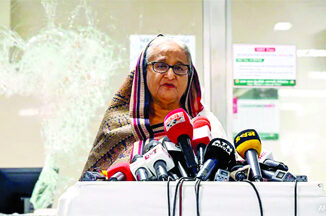
Dhaka (TIP)- A prosecutor in a special domestic tribunal in Bangladesh sought the death penalty Thursday, Oct 16, for ousted Prime Minister Sheikh Hasina in a case involving charges of crimes against humanity in a mass uprising last year that forced her to leave the country.
During the protests in July and August 2024, hundreds of people, including students, security officials and political activists, were killed in the week-long violence.
Chief Prosecutor Tajul Islam, in his closing arguments to the International Crimes Tribunal in the capital, Dhaka, also called for former Home Minister Asaduzzaman Khan to be sentenced to death because of the gravity of his crimes.
In his closing, the prosecutor left a decision on the sentence for former police chief Chowdhury Abdullah Al-Mamun up to the tribunal. Al-Mamun, who is in custody, became a state witness against Hasina and had earlier pleaded guilty.
Hasina has been in exile in India after fleeing the country on Aug. 5 last year. Khan is also believed to be in India.
More proceedings are needed to complete the trial before a verdict is rendered.
Hasina did not appoint any lawyers to represent her, and she had earlier rejected the trial process as a “kangaroo court.”
The next proceedings will be held on Monday. A state-appointed counsel for Hasina has sought a week to present his arguments.
Bangladeshi Nobel Peace Prize laureate Muhammad Yunus took over as the head of an interim government three days after Hasina’s fall. Yunus vowed to punish Hasina and banned the activities of her Awami League party.
Islam, in his argument, calls Hasina the “mastermind and principal architect” behind the crimes against humanity committed during the uprising.
The United Nations, in a February report, said up to 1,400 people may have been killed in the violence, while the country’s health adviser under the interim government said more than 800 people were killed and about 14,000 were injured.
Hasina and her party have raised questions about the figures and demanded independent investigations.
Referring to the UN figures, Islam said Thursday that if each of the 1,400 deaths were to be punished separately, Hasina should get 1,400 death sentences.
He told the tribunal that Hasina “personally ordered the killings.”
No immediate reaction from Hasina’s party was available.
Thursday’s development came as tensions mounted in Bangladeshi politics over the indictments of 25 former and serving military officials, including some former heads of a powerful military intelligence unit.
Tag: South Asia
-

Bangladesh seeks death penalty for Sheikh Hasina over protest deaths
-

Ceasefire halts deadly Af-Pakistan fighting
Islamabad (TIP)- A ceasefire along the frontier between Afghanistan and Pakistan was holding on Thursday, Oct 16, officials on both sides said, after dozens of troops and civilians were killed in cross-border clashes.
In Spin Boldak, a focal point of recent clashes on the Afghan side, an AFP journalist saw shops reopening and residents returning to homes they had fled during the fighting.
The 48-hour ceasefire was aimed at allowing time to “find a positive solution… through constructive dialogue”, according to Islamabad.
Pakistan is facing a resurgence of attacks against its security forces on its western border with Afghanistan, led by the Pakistani Taliban and its affiliates.
Around 20 civilians were killed and nearly 170 wounded on Wednesday, according to Spin Boldak’s information department spokesman Mohammad Haqmal.
The UN Assistance Mission in Afghanistan (UNAMA) reported at least 18 civilians killed and more than 350 wounded in the violence.
“Our houses were bombed, a child was wounded. I heard the plane myself,” Abdul Zahir, a 46-year-old resident, told AFP. “It’s terrifying.”
Hundreds of residents and Taliban officials attended the funeral of seven members of the same family in Spin Boldak, an AFP journalist saw.
Islamabad accuses Kabul of offering safe haven to militants who plan their frequent assaults from Afghan soil — a charge the Taliban government denies.
Pakistani officials on the northern and southern border with Afghanistan told AFP on Thursday that “no violence was reported overnight, and the ceasefire remains in effect.”
A senior security official in Peshawar told AFP: “Additional paramilitary troops have been deployed to counter potential… militant activity that could jeopardise the ceasefire.”
Shortly before the truce was announced, blasts were reported in the capital Kabul and the southern province of Kandahar province, where the Afghan Taliban’s shadowy supreme leader lives.
UN rights chief Volker Turk welcomed the ceasefire and appealed to “both parties to prevent any further harm to civilians & commit to a lasting ceasefire.”
Precision strikes
The first explosions that struck Afghanistan last week, which the Taliban blamed on Islamabad, hit while Afghanistan’s top diplomat was on an unprecedented visit to India — Pakistan’s eastern neighbor and rival.
Taliban authorities then launched an offensive at the border, prompting Islamabad to vow a strong response of its own.
Exchanges of fire from Saturday killed dozens of people, with renewed violence from Wednesday also causing civilian casualties, according to Kabul.
The Taliban government officially blamed Wednesday’s blasts in the Afghan capital on an explosion of an oil tanker and a generator.
However, Pakistani security sources said the military targeted an armed group with “precision strikes” in Kabul, as well as hitting Afghan Taliban bases in Kandahar.
There were blackouts overnight and into Thursday, Oct 6, morning in some areas of Kabul, caused by electricity cables damaged in the explosions, AFP journalists in the city said.
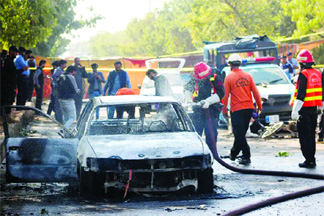
AFP journalists saw municipal workers carrying out repairs in a Kabul neighbourhood on Thursday morning, where the road was charred and apartment windows had been blown out.
At least five people were killed and 35 wounded in Wednesday’s explosions in Kabul, an Italian NGO that runs a hospital in the city said.
“We started receiving ambulances filled with wounded people, and we learned that there had been explosions a few kilometres away from our hospital,” Dejan Panic, Emergency’s country director in Afghanistan, said in a statement. The casualties suffered shrapnel wounds, blunt force trauma and burns, with 10 in critical condition, the NGO said. -
Nepal: Probe panel bars former PM Oli from travelling abroad
The commission investigating the death of 75 people during the youth-led protest in Nepal has banned former prime minister K P Sharma Oli and four former officials from travelling abroad.
The judicial enquiry commission, headed by Gauri Bahadur Karki, a retired High Court judge, wrote to the government Sunday to ensure that Oli and the four others don’t leave the country. “As they are under the purview of the investigation, they should not be leaving the capital without its prior consent,” Karki wrote. Along with Oli, the chairman of the Communist Party of Nepal (Unified Marxist Leninist), the others under investigation include Nepali Congress leader and former Home Minister Ramesh Lekhak, former chief of intelligence Hutaraj Thapa, former home secretary Gokarna Mani Duwadi and Kathmandu’s former chief district officer Chhabi Lal Rizal.
While the probe could lead to their custodial detention, it may further give a shot in the arm for a CPN-UML faction that has been demanding Oli’s resignation from the party’s leadership. While 19 people were killed in the police firing on September 7, the first day of the anti-corruption protest, at least 56 others have succumbed to their injuries since.
Prime Minister Karki has given the commission 45 days to investigate the excesses committed by the state to suppress the protest and find those responsible. -
Bangladesh’s interim regime faces global criticism over rights violations
Geneva (TIP)- Human rights activists and experts from South Asia and Europe expressed grave concern over widespread violations of human rights in Bangladesh under the interim regime of Chief Advisor Mohammad Yunus.
The remarks came during a side event held on Friday at the 60th Session of the UN Human Rights Council in Geneva.
Organised by the Centre for Gender Justice, the discussion, titled “Violations of Fundamental Human Rights, Rule of Law, and Democracy in Bangladesh,” drew attention to the deteriorating situation in the country following the ousting of elected Prime Minister Sheikh Hasina on August 5, 2024.
A short film screened at the event depicted extrajudicial killings, attacks on religious minorities, and the destruction of temples and Sufi shrines. It also highlighted how radical Islamist groups have openly threatened and lynched political activists linked to the Awami League, while media houses have come under violent attack.
The panel featured Professor Md Habibe Millat, President of the Global Center for Democratic Governance (Canada); Paulo Casaca, former Member of the European Parliament and Executive Director of the South Asia Democratic Forum (Belgium); Suhas Chakma, Director of the Rights and Risks Analysis Group (India); Natalia Sineaeva-Pankowska of the NEVER AGAIN Association (Poland); and Chris Blackburn, Founding Editor of Narrative360 (UK).
Speaking to ANI, Professor Millat reported that at least 213 Awami League leaders and activists have been killed since the interim government took power, while historic sites linked to the 1971 Liberation War have been destroyed.
He further noted a rise in mob violence, with 637 people killed in lynching incidents, and said 30 members of minority communities had been murdered.
He added that 17 churches were set on fire on Christmas Day 2024.
“Human rights violations in Bangladesh are at the highest level in the last 54 years. All populations, not just minorities, are tortured…Nobody has been spared over the last 14 months. More than 2500 cases of torture have been documented, more than 30 people of the minority community have been killed,” he said.
“As per a report, at least 637 people were killed by mob lynching…At the moment, they are trying to do a fraudulent election…So, Bangladesh needs to get back to democracy, the rule of law and justice. That’s what we are fighting for,” he added. -
Pakistan successfully test-fires Fatah-4 cruise missile
Pakistan has successfully conducted a training launch of the newly inducted and indigenously developed cruise missile ‘Fatah-4’ that can strike targets up to 750 kilometres, the army said.
The army carried out the launch of the missile with a range of 750 kilometres, Inter-Services Public Relations (ISPR), the army’s media arm, said in a statement. “Equipped with advanced avionics and state-of-the-art navigational aids, this weapon system is capable of evading enemy’s missile defence system due to terrain-hugging features and engaging targets with high precision,” the army said.
As part of the Army Rocket Force Command, Fatah-4 “will further enhance the reach, lethality and survivability of Pakistan Army’s conventional missile systems”, it said. The launch was witnessed by the chief of general staff, senior officers from Pakistan’s armed forces, scientists and engineers. -

Trump’s 20-point Gaza plan ‘not ours’: Pakistan FM Ishaq Dar
Islamabad (TIP)- Deputy Prime Minister and Foreign Minister Ishaq Dar on Friday, October 3, told the National Assembly that the 20-point Gaza peace plan unveiled by US President Donald Trump was “not ours,” while stressing there was no room for politicking on the issue, Dawn reported.
Dar, referring to his earlier press briefing in Islamabad, said: “I made it clear that the 20 points that President Trump made public are not ours. Changes were made to our draft. I have the record.” He added, “This is the end result, and there is no room for politicking.”
According to Dawn, Dar explained that eight Muslim and Arab countries Jordan, United Arab Emirates, Indonesia, Pakistan, Turkiye, Saudi Arabia, Qatar, and Egypt had engaged in a meeting with Trump on the sidelines of the 80th United Nations General Assembly session, where the US president presented his plan to halt Israel’s assault on Gaza.
Dar recounted that before the main session, foreign ministers of the eight countries convened a preparatory meeting in New York. “During the meeting, there was no other agenda. Today I am telling you the details,” he said, noting that the discussions were deliberately kept discreet.
He said that Trump responded positively and assured that his team would work with the ministers on a “workable solution.” Dar added that Trump mentioned he was scheduled to meet Israeli Prime Minister Benjamin Netanyahu soon and wanted to attempt halting the bombardment of Gaza.
“President Trump’s committee also came and open talks were held on what they wanted. They gave us a 20-point proposal,” Dar said. The foreign ministers, he explained, chose to work within that framework, amending or deleting points as needed. “We held different meetings in the next 24 hours. We were exchanging hard copies in hotel rooms,” he added.
Dawn reported that Dar described how the eight countries produced a counter-draft and sent it onward. Shortly after leaving New York, he received word that while some states wanted all eight ministers to sign, others said it was not essential. “This was a small thing in my eyes,” Dar noted. “By the time we landed at our next destination, I was told the American side had received the draft.”
When Trump later met Netanyahu on September 29, the US president announced the 20-point plan. Dar said he spoke with the Saudi foreign minister afterward, who told him some of the urgent points proposed by the eight countries were accepted, while others needed further discussion.
Quoting the Saudi minister, Dar said there were two choices: “to continue and perhaps Israel will continue its bloodshed, or we let Trump’s plan be implemented and issue a joint statement.” Dar agreed, saying, “I said you are right, we should do this,” adding that the statement was finalised on September 29.
“This was the only way to end Israel’s bombardment of Gaza when all other forums had failed. Statements will not suffice. We need practical work,” Dar said, extending his gratitude to the other states involved.
Reaffirming Pakistan’s long-held stance, Dar told the Assembly, “Pakistan’s policy on Palestine remained the same as that of Quaid-i-Azam Mohammad Ali Jinnah. There has not been any change nor will there ever be,” reiterating Islamabad’s call for an independent Palestinian state with Al Quds Al Sharif as its capital.
Dawn also reported that Dar condemned Israel’s interception of the Global Sumud Flotilla (GSF), which included former Jamaat-i-Islami senator Mushtaq Ahmad Khan. “According to our information, it is not confirmed yet, but according to our information, Khan is included in this,” Dar said, noting that Israel had detained activists after seizing 22 vessels from the fleet. -
Indian among 7 Buddhist monks killed in Sri Lanka monastery cable cart accident
At least seven Buddhist monks, including three foreign nationals, died in a cable car accident at a Sri Lankan monastery on Wednesday, Sept 24, local police told CNN. The monks were among 13 people traveling on the cable car at the Na Uyana Monastery in central Sri Lanka, which spreads over more than 5,000 acres of forest on a mountain range, Pansiyagama Police said.
The incident took place at around 9 p.m. local time (11:30 a.m. ET) on Wednesday, according to police. Of those who were killed, three were foreign nationals from India, Russia and Romania, officers said.
CNN has reached out to the foreign ministries of those countries for comment. Images from the scene of the crash show monks standing in the forest next to the cable car’s tracks. The tracks themselves are on a steep incline, and are parallel to a huge, winding set of steps. One video shows a frayed, snapped cable, then a pool of blood next to some of the cable car’s structure. Asanga Kiriwatta, a local resident, told Reuters that “the monks were thrown all over the place” in the aftermath of the accident. -

Nepal interim PM lowers legal voting age from 18 to 16 after Gen-Z protests
Kathmandu (TIP)- Nepal’s interim prime minister, Sushila Karki, announced on Thursday, Sept 25, that the minimum voting age has been lowered from 18 to 16 to boost youth’s participation in politics following recent Gen-Z protests. In her first televised address to the nation since assuming office, Karki said the decision was taken to respond to youth demands for greater representation and to encourage involvement in the upcoming parliamentary elections scheduled for 5 March.
“To find a way out of this complex situation, the government has already started preliminary work for the general election by holding the election in a free, fair and fear-free environment by March 5, after discussing with the Election Commission officials the necessary manpower, budget, election materials, security and legal arrangements. The existing election law has been amended through an ordinance to provide voting rights to the younger generation who have reached the age of 18 and to extend the voter list,” she said.
Karki said the government had recommended dissolving parliament and setting the election date immediately after she took office. She was sworn in by President Ram Chandra Paudel on 12 September, and recommended that the president call polls for 5 March 2026.
The prime minister called on citizens across the country — including voters who had been displaced or scattered — to use their franchise and to choose representatives who reflect the aspirations of younger voters.
“I would like to call on all Nepali sisters and brothers to participate enthusiastically in the upcoming elections of the House of Representatives and to select qualified people’s representatives who can represent the aspirations of the youth for change. I also call on all political parties, civil society, the media and all relevant stakeholders to actively participate in the successful conduct of free, fearless and fair elections. A peaceful environment is essential for the conduct of the elections. Therefore, I request all sisters and brothers residing in all geographical areas of the country to maintain a peaceful environment with patience,” Karki said.
NO IMPUNITY FOR THOSE RESPONSIBLE, PM SAYS
Sushila Karki said that the government is committed to taking stern action against those responsible for the death of 74 people, including students, during the Gen Z protests.
She became prime minister on September 12, ending days of political uncertainty after the ouster of Prime Minister K P Sharma Oli following violent protests by youth-led Gen Z group against his government over corruption and a ban on social media.
The unrest in the Himalayan nation was fuelled by Gen Z after the government’s decision to ban social media platforms across the country. The unrest later turned into an anti-corruption movement.
Despite the reversal of the social media ban and the resignation of Prime Minister KP Sharma Oli, protests continue to rage across Nepal. Demonstrators remained on the streets, with widespread reports of vandalism and arson. Houses and offices of several leaders and government officials were set on fire.
The situation was pathetic to an extent that the Army took over the charge of maintaining law and order.
After multiple rounds of discussions involving Gen Z leaders, President Ram Chandra Poudel and Army Chief Ashok Raj Sigdel, Sushila Karki was appointed as the interim PM of Nepal. -

Pak PM holds meeting with Bangladesh’s Yunus, Sri Lanka’s Dissanayake in New York
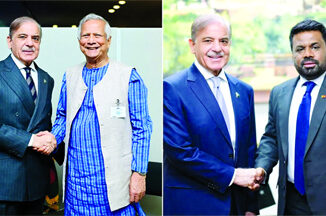
New York (TIP)- On the sidelines of the 80th United Nations General Assembly (UNGA) in New York, Pakistan’s Prime Minister Shehbaz Sharif held separate meetings with Bangladesh’s Chief Adviser Muhammad Yunus and Sri Lanka’s President Anura Kumara Dissanayake.
The discussions focused on enhancing bilateral relations and exploring avenues for increased cooperation between the nations. Specific details of the meetings have not been disclosed.
These engagements reflect Pakistan’s ongoing efforts to strengthen diplomatic ties with neighboring countries in the South Asian.
Sharif had earlier thanked US President Donald Trump for his “leadership role” in finalising a “historic” trade agreement between the two countries.
“I wish to convey my profound thanks to President Trump for his leadership role in finalisation of the historic US-Pakistan trade agreement, successfully concluded by our two sides in Washington last night,” Shehbaz Sharif said in a post on X. Sharif called it a “landmark deal” that would boost bilateral cooperation and “expand the frontiers of our enduring partnership in days to come.” -
India Sends Fresh Aid To Quake-Hit Afghanistan
India on Sept 25 said a fresh consignment of humanitarian aid for Afghanistan, following last month’s devastating earthquake, has reached Kabul.
The Ministry of External Affairs (MEA) said that the latest shipment, consisting of three container loads of relief materials, had arrived in the Afghan’s capital via the Chabahar port and was handed over to the authorities.
The consignment includes a wide range of essential items such as food supplies, water purifiers, protein powder, tin sheets, sleeping bags, hygiene kits, water storage tanks, generator sets, family tents, blankets, essential medicines, and other medical goods. In a post on social media platform X, the MEA said, “In continuation of India’s humanitarian assistance to Afghanistan in the wake of recent earthquake, 3 container loads of supplies of relief materials arrived in Kabul via Chabahar today and were handed over to Afghan authorities.” This is the third batch of Indian assistance sent to support those affected by the earthquake. The 6.0-magnitude tremor, which struck on August 31, claimed nearly 2,200 lives and displaced more than 23,000 people. -

Pak says its nuclear program can be made available to Saudi Arabia under defense pact
Dubai/Islamabad (TIP)- Pakistan’s defense minister says his nation’s nuclear program “will be made available” to Saudi Arabia if needed under the countries’ new defense pact, marking the first specific acknowledgment that Islamabad had put the kingdom under its nuclear umbrella.
Defense Minister Khawaja Mohammad Asif’s comments underline the importance of the pact struck this week between Pakistan and Saudi Arabia, which have had military ties for decades.
The move is seen by analysts as a signal to Israel, long believed to be the Middle East’s only nuclear-armed nation. It comes after Israel’s attack targeting Hamas leaders in Qatar last week killed six people and sparked new concerns among Gulf Arab nations about their safety as the Israel-Hamas war devastated the Gaza Strip and set the region on edge.
Minister’s remarks touch on nuclear program
Speaking to Geo TV in an interview late Thursday night, Asif made the comments while answering a question on whether “the deterrence that Pakistan gets from nuclear weapons” will be made available to Saudi Arabia.
“Let me make one point clear about Pakistan’s nuclear capability: that capability was established long ago when we conducted tests. Since then, we have forces trained for the battlefield,” Asif said. “What we have, and the capabilities we possess, will be made available to (Saudi Arabia) according to this agreement,” he added. The two countries signed a defense deal on Wednesday, Sept 17, declaring that an attack on one nation would be an attack on both. The International Atomic Energy Agency, with which both nations have monitoring agreements, did not immediately respond to a request for comment over the Pakistani defense minister’s remarks. Asif criticized Israel in the interview for not fully disclosing its suspected nuclear weapons program to the IAEA. -
The pact comes after Israel’s attack on Qatar
Israel has not commented on the two nations’ defense pact. Pakistan long has criticized Israel’s treatment of the Palestinians, but has not been directly involved in any war against it. And while neither nation has diplomatic ties to Israel, American officials had sought to mediate a diplomatic recognition deal involving Saudi Arabia before Hamas’ Oct. 7, 2023, attack on Israel that sparked the war.
“We have not named any country whose attack would automatically trigger a retaliatory response. Neither has Saudi Arabia named any country, nor have we,” Asif said in the interview. “This is an umbrella arrangement offered to one another by both sides: if there is aggression against either party — from any side — it will be jointly defended, and the aggression will be met with a response.” The deal came a week after the attack in Doha as Gulf Arab countries weigh how to defend themselves. Israeli attacks since Oct. 7, 2023, have stretched across Iran, Lebanon, the Palestinian territories, Qatar, Syria and Yemen.
Asked if others could join the pact, the minister added: “I can say the door is not closed to others.”
That idea was repeated by Pakistan’s Deputy Prime Minister Ishaq Dar.
“It is premature to say anything, but after this development, other countries have also expressed a desire for similar arrangements,” Dar told reporters in London in televised remarks. “Such things follow due process. Even with Saudi Arabia, it took several months to finalize.”
Pakistan and Saudi Arabia have longstanding ties
Saudi Arabia has long been linked to Pakistan’s nuclear program. Retired Pakistani Brig. Gen. Feroz Hassan Khan has said Saudi Arabia provided “generous financial support to Pakistan that enabled the nuclear program to continue, especially when the country was under sanctions.” Pakistan faced U.S. sanctions for years over its pursuit of the bomb, and saw new ones imposed over its ballistic missile work at the end of the Biden administration.
Pakistan developed its nuclear weapons program to counter India’s atomic bombs. The two neighbors have fought multiple wars against each other, and again came close to open warfare after an attack on tourists in April in Indian-controlled Kashmir. India is believed to have an estimated 172 nuclear warheads, while Pakistan has 170, according to the U.S.-published Bulletin of Atomic Scientists. Source: AP -
Blasts kill at least 11 in southwestern Pak
Separate blasts in Pakistan’s restive Balochistan province killed at least 11 people, officials said on September 19.
Militancy has been rising in mineral-rich Balochistan, which sits on the border with Afghanistan and Iran, and it has been met with a sweeping counter-terrorism crackdown.
A suicide bomber drove an explosive-laden car into a convoy of paramilitary soldiers in Dasht, on Pakistan’s southwestern tip near Iran, on Sept 18.
Two local government officials told AFP that three troops were among five people killed. The attack was claimed by separatist group the Baloch Liberation Army.
Another blast near an Afghan border crossing in the province killed six labourers on Thursday night, local government official Imtiaz Ali Baloch told AFP. Separatists have been fighting a decade-long insurgency against the Pakistan military with the aim of ending discrimination against the Baloch people. -

Nepal interim PM Sushila Karki vows to fix ‘failure’ that led to deadly Gen Z protests
KATHMANDU (TIP) -Nepal’s interim prime minister pledged on Friday, Sept 19, to fight corruption, create jobs and raise living standards in her first public comments since coming to office after youth-led protests toppled the government.
Sushila Karki said the protests – that left at least 72 people dead and forced her predecessor K.P. Sharma Oli to quit – had been triggered by frustration over growing corruption and other failings.
Authorities have said more than 2,100 people were injured in the unrest that raged for two days last week. Arson and vandalism caused extensive damage to private and public property, including the complex housing the prime minister’s office, the Supreme Court and the parliament.
“We must accept the fact that the protests took place because of the failure to fulfil the spirit and objectives of providing good governance and prosperity enshrined in the constitution,” Karki said.
She spoke on Nepal’s national day, marking the 10th anniversary of the proclamation of the constitution.
The former Supreme Court chief justice was appointed to the post last week following talks between representatives of the protesters, the president and the army chief
Karki – the first woman to lead Nepal – was tasked with holding parliamentary elections on March 5.
She said the government was committed to creating employment, raising the quality of life and increasing transparency in its work.
Losses from the damage could reach $1 billion to $1.5 billion, Kulman Ghising, minister for energy, physical infrastructure, transport and urban development, said.
Ghising visited some public buildings set ablaze in the capital Kathmandu and appealed to Nepalis at home and abroad to contribute to the reconstruction.
A Supreme Court official said some hearings were taking place in tents as most court structures, documents and IT systems were destroyed during the unrest.
Police spokesperson Binod Ghimire said officers had received more than 30,000 emails after asking the public to send in videos, photographs and other documents to help them investigate the violence. -
UN seeks $140 mln for Afghanistan
The United Nations said it was seeking $139.6 million to help half a million people affected by earthquakes that struck eastern Afghanistan, and it urged donors to set aside any reservations about the Taliban authorities.
Afghanistan’s worst earthquake in years, which struck on the night of August 31 into September 1, killed more than 2,200 people and was followed by a series of powerful aftershocks. The quakes have left tens of thousands of people homeless, with some fearing further landslides.
Colder temperatures set to arrive within weeks will mean tougher conditions for survivors in remote mountain areas, said Indrika Ratwatte, the U.N. Humanitarian Coordinator for Afghanistan.
“This is a moment where the international community must dig deep and show solidarity with a population that has already endured so much suffering,” he told a Geneva press briefing. -

‘4 million phones under govt’s radar’: Amnesty flags illegal surveillance in Pakistan
Islamabad (TIP)- Pakistan with the help of Chinese technology — is spying on millions of its citizens to curb dissent and free speech, an Amnesty International report said.
According to the report, Pakistan is using a Chinese-built internet firewall that censors social media, enabling spy agencies to monitor at least 4 million mobile phones at a time through its Lawful Intercept Management System (LIMS). The firewall, known as WMS 2.0, inspects internet traffic and can block 2 million active sessions at once.
The human rights watchdog said it reviewed licensing agreements, trade data, leaked technical files, and Chinese records linking the firewall supplier to state-owned firms in Beijing.
Amnesty said the firewall uses equipment from US-based Niagara Networks, software from Thales DIS — a unit of France’s Thales — and servers from a Chinese state IT firm. An earlier version relied on Canada’s Sandvine.
“The two monitoring systems function in tandem: one lets intelligence agencies tap calls and texts, while the other slows or blocks websites and social media across the country,” the report said.
The report further said that Pakistan is currently blocking about 650,000 web links and restricting access to platforms such as YouTube, Facebook, and X.
It also accused agencies of spying on at least 4 million mobile phones at a time through LIMS, while WMS 2.0 can block 2 million active sessions at once, Amnesty said.
Amnesty noted that its findings draw on a 2024 Islamabad High Court case filed by Bushra Bibi, the wife of former Prime Minister Imran Khan, after her private calls were leaked online.
In court, Pakistan’s defense ministries and intelligence agencies denied running or even having the capacity for phone tapping. However, under questioning, the telecom regulator admitted it had already ordered phone companies to install LIMS for use by “designated agencies.”
Crackdowns have tightened in recent years, particularly after the military broke with then Prime Minister Imran Khan in 2022. Khan was later jailed, and thousands of his party activists were detained. -

Muslim countries need to unite to stop Israeli aggression: Pakistan PM Sharif in Qatar
Islamabad (TIP)- Pakistan Prime Minister Shehbaz Sharif Thursday, Sept 11, urged Muslim countries to unite against Israeli aggression as he met the Qatari emir and expressed solidarity following Tel Aviv’s recent attacks targeting residential areas in Doha.
Shehbaz Sharif, who travelled to Qatar on a day-long visit, held a “very warm and cordial meeting” with Qatar’s Emir Sheikh Tamim bin Hamad Al Thani, according to an official statement.
“Israel’s brazen aggression in the Middle East must be stopped, and the Ummah needed unity among its ranks in the face of Israeli provocations,” Sharif said.
He conveyed Pakistan’s strongest condemnation of the Israeli attack of September 9, calling it a blatant and flagrant violation of Qatar’s sovereignty and territorial integrity, the statement said.
He said that the “leadership and people of Pakistan were deeply disturbed by this attack against the brotherly State of Qatar, which constituted a serious breach of international law,” the statement added.
Sharif appreciated Qatar’s responsible, constructive and mediatory role in efforts to bring peace in Gaza, and stressed that such acts of Israeli aggression were clearly meant to undermine regional stability and threaten ongoing diplomatic and humanitarian efforts, it added.
While reaffirming the historic, fraternal bonds between Pakistan and Qatar, Sharif stated that the two countries had proudly stood with each other through thick and thin.
It was in this spirit of brotherhood that Pakistan stood shoulder to shoulder with the Emir, the Royal Family of Qatar and with the brotherly people of Qatar during this challenging time, the statement said.
Sharif assured the Qatari leadership of Pakistan’s full solidarity and support in the face of this unjustified provocation.
He also conveyed deep sympathies on the loss of precious lives in this attack by Israel and prayed for the speedy recovery of the injured.
Sharif said that at Qatar’s request, Pakistan had requested an emergency session of the UN Security Council to discuss the recent developments in the Middle East.
He also welcomed Qatar’s decision to host an Extraordinary Arab-Islamic Summit on September 15, and said Pakistan had indicated its willingness to the OIC to co-sponsor and co-convene this Summit.
The Emir thanked the Prime Minister for his thoughtful gesture of visiting Doha to express his solidarity with Qatar at this time, it said.
Both leaders agreed to maintain close coordination in promoting regional peace, upholding international law and supporting the legitimate rights of the Palestinian people, it added.
This visit reaffirmed the deep-rooted brotherly ties between Pakistan and Qatar and their shared commitment to peace and stability in the region, the statement said.
The Prime Minister was accompanied by a high-level delegation, including Deputy Prime Minister/Foreign Minister Ishaq Dar, according to the Foreign Office (FO).
The visit was ?a gesture of solidarity and regional unity, following the recent Israeli cowardly airstrikes targeting residential areas in Doha,? the FO said.
“The visit underscores Pakistan’s unwavering support for the security and sovereignty of Qatar and its commitment to peace and stability in the Middle East,” the FO added.
Pakistan has close ties with Qatar and has already condemned the air strikes by Israel.
It was not clear if the visit was limited to solidarity or if the two sides discussed some possibility of defence cooperation to bolster the security of Qatar.
Earlier, Israel claimed to have targeted the leaders of Hamas in Doha, sparking anger and condemnation from different countries.
Qatar awoke Wednesday, Sept 10, still digging through the rubble of an Israeli attack the previous day on Hamas’ political leaders who had gathered in the capital of the energy-rich Middle East country to consider a US proposal for a ceasefire in the Gaza Strip.
Qatar’s local media hewed tightly to government statements issued after Tuesday’s attack, which killed at least six people in a Doha neighborhood that is home to foreign embassies and schools. Qatar is ruled by a hereditary emir and tightly restricts speech like other Gulf Arab nations. -
Bangladesh bars those facing serious charges from polls
Bangladesh’s interim authorities on Sept 4 approved a legal amendment that will bar anyone formally charged with crimes against humanity from seeking elected office or holding government jobs.
The change, made to the International Crimes (Tribunal) Act of 1973, introduces a fresh clause disqualifying such individuals from becoming parliamentarians, local body representatives or civil servants.
Press secretary to Chief Adviser Muhammad Yunus, Shafiqul Alam, said the provision applies the moment a chargesheet is filed under Section 9(1) of the law. “Those charged will no longer be eligible to contest polls or remain in the service of the republic,” he explained. This move follows a recommendation from the Election Commission a day earlier, which called for fugitives from justice to be barred from elections and sought to scrap the online system for filing nominations. -

No new Chinese money, yet Pakistan’s Shehbaz Sharif pushes ahead with CPEC phase 2
BEIJING (TIP)- Pakistan Prime Minister Shehbaz Sharif failed to secure funding and investments for the China-Pakistan Economic Corridor Phase-2 during his recent visit to Beijing, and he had to return to Islamabad with no new investments or mega projects and only with MoUs. A high-powered delegation led by Sharif to China did not secure any new Chinese investments as Beijing told them to seek new investments through the Business-to-Business Investment Conference, a top diplomatic source told CNN-News18.
Sharif was on a six-day visit to China to attend the Shanghai Cooperation Organisation Summit in Tianjin. He also attended the WWII Victory Day parade in Beijing.
The top source said that during the B2B Investment Conference, the Chinese investors raised security concerns with the Pakistani Prime Minister, to which Sharif admitted to the security risks in Pakistan and attempted to assure safety for Chinese investors in his country.
He also went on to announce the formal launch of CPEC 2.0 unilaterally without Chinese officials. China has not issued any statement in this regard yet.
During Sharif’s visit to China with top cabinet members, the Chinese and Pakistani companies signed $7 billion Memoranda of Understanding (MoUs) and $1.54 billion joint ventures (totaling $8.5 billion) in sectors including agriculture, electric vehicles, solar energy, health, chemical and petrochemicals, irons and steel besides others, at the Second Pakistan-China Business-to-Business B2B Investment Conference.
According to the source, Chinese investors informed Sharif about Pakistani bureaucratic hiccups and delays in the smoother operations of the investments in the country.
Addressing the security concerns of Chinese nationals in Pakistan, Sharif said that the safety of Chinese citizens is paramount for Pakistan.
Addressing concerns about Pakistan’s bureaucratic delays, the Pakistani PM assured the Chinese investors that his administration will remove all red tape hiccups in investments, the source said. -

Death toll from Afghan quake jumps to over 2,200 as aid agencies seek funds
Jalalabad (TIP)- Hundreds more bodies have been recovered from houses in mountain villages destroyed by a major earthquake in Afghanistan early this week, pushing the death toll to over 2,200, a Taliban government spokesman said Thursday, Sept 4. The shallow, 6.0-magnitude quake struck the mountainous and remote eastern part of the country late Sunday, leveling villages and trapping people under rubble. Most of the casualties have been in Kunar province, where people typically live in wood and mud-brick houses along steep river valleys separated by high mountains. Some 98 per cent of the buildings in the province were damaged or destroyed, according to an assessment issued Thursday by the Islamic Relief charity. Aid agencies said they were sorely in need of staff and supplies to tend to the region’s survivors.
Muhammad Israel said the quake unleashed a landslide that buried his home, livestock, and belongings in Kunar. All the rocks came down from the mountain,” he said. I barely got my children out of there. … The earthquake jolts are still happening. It is impossible to live there.”
Late Thursday, a 5.6-magnitude quake rattled Jalalabad in Nangarhar province, which is south of the hardest-hit Kunar province, though there were no immediate reports of casualties or damage.
Israel was staying at a UN medical camp in Nurgal, one of the worst-affected districts of Kunar. The situation is also bad for us here, we don’t have shelter and are living under open skies,” he said.
Previous estimates said some 1,400 people were killed. Taliban spokesman Hamdullah Fitrat said Thursday that the updated death toll was 2,205 and that search and rescue efforts were continuing.
Tents have been set up for people, and the delivery of first aid and emergency supplies is ongoing,” Fitrat said.
The rough terrain is hindering relief efforts. Taliban authorities have deployed helicopters and airdropped army commandos to help survivors. Aid workers have reported walking for hours to reach villages cut off by landslides and rockfall.
Funding cuts are also having an impact on the response. The Norwegian Refugee Council said it had fewer than 450 staff in Afghanistan whereas it had 1,100 in 2023, the date of the last major quake in the country. The council only had one warehouse remaining and no emergency stock.
We will need to purchase items once we get the funding but this will take potentially weeks and people are in need now, said Maisam Shafiey, the communications and advocacy advisor for the council in Afghanistan.
We have only $100,000 available to support emergency response efforts. This leaves an immediate funding gap of $1.9 million,” Shafiey said.
Dr Shamshair Khan, who was attending the injured at the UN camp in Nurgal, said his own condition had deteriorated after seeing the suffering of others.
Neither these medicines are enough nor these services, he said. These people need more medicine and tents. They need food and clean drinking water. These people are in great pain.
Qatar’s minister of state for international cooperation, Maryam bint Ali bin Nasser Al Misnad, arrived in Kabul on Wednesday to oversee the delivery of aid to earthquake victims.
She is the first female minister to visit Afghanistan on a humanitarian mission since the Taliban seized power in 2021, and the first high-ranking foreign official to travel there since the quake.
Aid organisations describe the latest disaster as a crisis within a crisis. Afghanistan was already struggling with drought, a weak economy and the recent return of some 2 million Afghans from neighbouring countries. -

Imran’s Pakistan Tehreek-e-Insaf to boycott bypolls
Jailed former PM Imran Khan’s party has decided to boycott the upcoming by-elections for national and provincial assemblies, in line with the opinion of its founder.
Several seats of the national and provincial assemblies became vacant last month after the conviction of leaders of Khan’s Pakistan Tehreek-e-Insaf (PTI) for their involvement in the May 9, 2023 riots.
A day earlier, the party’s political committee had voted 12-9 to take part in these polls. Senior party leader Asad Qaiser confirmed that in Khan’s opinion, the party should not go into by-elections. “…the government will not let our candidates win… (and) if (we) take part in the elections, it will legitimise the government’s illegal action of de-seating our legislators,” he added.
Khan also accused Army Chief Asim Munir of being power-hungry and running the worst kind of dictatorship and that he should apologise for orchestrating the said riots. -

Pakistani rape gangs exploited children in 85 areas in UK, MP’s probe finds
A private investigation led by a British lawmaker has identified “gang-based child sexual exploitation” in at least 85 areas across the UK, amid an ongoing national inquiry into grooming gangs. The investigation, set up by Independent MP Rupert Lowe, found that “rape gangs”, predominantly comprising men of Pakistani heritage, have been active for decades and “far more widespread than thought”. It also accused authorities of failing to act on the targeted abuse.
“Patterns of predominantly Pakistani males, combined with gross negligence from public bodies, are identifiable,” the inquiry said on Tuesday in a statement posted on X.
“This is one of the most comprehensive exposes of the rape gang scandal to date,” Lowe stated.
Lowe’s Rape Gang Inquiry, constituted before UK Prime Minister Keir Starmer launched a government-backed probe in June, uncovered that the rot runs deep. Both ongoing and historical cases, some dating back to the 1960s, were identified.
The probe team said the findings were based on testimony from hundreds of survivors, relatives, and whistleblowers, as well as thousands of Freedom of Information requests.
Survivors told the inquiry of being groomed as children, drugged, raped, trafficked, and threatened into silence. Many victims, often vulnerable white girls, were dismissed by officials who failed to recognise them as victims.
The statement alleged that councils and police forces repeatedly ignored red flags, allowing “rape gangs” to operate for decades with impunity.
“Our inquiry has shown that this rotting scandal is more widespread than thought — hundreds of thousands of lives have been ruined at the hands of predominantly Pakistani rape gangs,” Lowe said.
Lowe, who chairs the independent inquiry, accused the Labour government of dragging its feet on the issue despite promising urgent action.
“It is over two months since Labour promised nationwide action, yet the government has been seemingly idle,” Lowe said. “The message from survivors is clear: get on with it. There have been too many broken promises. Now is the time for action and for hard justice to be delivered by those in power.” -

Lanka SC issues notice to govt over India-backed ID project
Colombo (TIP)- Sri Lanka’s Supreme Court has issued notices to President Anura Kumara Dissanayake and the Cabinet over the India-funded Sri Lanka Unique Digital Identity (SL-UDI) programme following a petition alleging violation of fundamental rights.
The petition was filed by former minister Wimal Weerawansa, who contended that the government’s decision to proceed with the project violates fundamental rights and lacked transparency as neither Parliament nor the public had been adequately informed. During PM Narendra Modi’s visit to Colombo in April, the two sides signed an MoU on sharing India’s large-scale digital solutions to support Sri Lanka’s digital transformation drive.
The Unique Digital Identity project, backed by an Indian grant, aims to provide Sri Lankan citizens with a secure digital ID similar to India’s Aadhaar system. The petitioner claimed the project posed a threat to Sri Lanka’s national security as citizens’ biometric data could be exposed to foreign entities without adequate safeguards.
Sri Lanka seeks Chinese loans in Yuan instead of USD for infra project
In a significant shift in its external borrowing strategy, Sri Lanka’s cabinet has approved a proposal to secure the equivalent of USD 500 million in Chinese yuan from the Export-Import Bank of China to fund the long-delayed Central Expressway infrastructure project. The decision, announced on Aug 28 after a cabinet meeting chaired by President Anura Kumara Dissanayake, aims to ease pressure on the country’s limited U.S. dollar reserves while advancing a critical development corridor that has been stalled due to funding constraints.
According to government officials, opting for yuan-denominated financing will help Sri Lanka manage its foreign exchange requirements more effectively. Repayments can be made in local or yuan reserves rather than scarce U.S. dollars, providing some insulation against currency volatility.
This marks another step indeepening financial ties between Colombo and Beijing, aligning with China’s broader efforts to internationalize the renminbi. Analysts say the move reflects Sri Lanka’s growing reliance on Chinese financing to rebuild infrastructure and stabilize its economy following its 2022 sovereign debt default.
Earlier, Sri Lanka extended a 10 billion yuan (USD 1.4 billion) currency swap arrangement with China’s central bank to maintain liquidity and support trade settlement in yuan. China also played a key role in Sri Lanka’s debt restructuring efforts last year, absorbing significant financial adjustments as part of an IMF-supported bailout package. -

Floods displace nearly 250,000 people in Pak
NAROWAL (TIP) – Rescuers in boats raced to reach stranded families in Pakistan’s populous eastern Punjab province on Thursday, after three major rivers burst their banks because of heavy rain and the release of water from overflowing dams in neighbouring India.
The floods displaced nearly 250,000 people and officials said more than 1 million people were affected, with crops and businesses destroyed and many unable to leave their homes.
At least 15 people were killed a day earlier in Gujranwala district and nearby villages, according to police. Forecasters said more rain was expected on Friday.
Marriyum Aurangzeb, senior minister of Punjab province, said floods hit 1,432 villages located along the Ravi, Sutlej and Chenab rivers, affecting about 1.2 million people and displacing 248,000 others.
Nearly 700 relief and 265 medical camps have been set up in the flood-hit areas, she said, adding that food and other essential supplies are being delivered to flood-hit areas. -
Bangladesh warns media against publicising Hasina’s statements
Bangladesh’s interim government led by Muhammad Yunus has warned the country’s media houses of legal action against any future publication or dissemination of statements from former Prime Minister Sheikh Hasina, local media reported on Aug 22.
In a statement, the Bangladesh government termed airing or promoting Hasina’s remarks on television channels, news platforms or online media a violation of law, considering her conviction for genocide and crimes against humanity, United News of Bangladesh reported.
The statement said, “We are deeply concerned that some media outlets ignored the law and court rulings by broadcasting a speech by the ousted dictator on Thursday. In that speech, she made false and inflammatory claims.” “We strongly warn media personnel involved in this type of criminal propaganda. From now on, anyone who publishes or promotes Sheikh Hasina’s statements will face immediate legal action,” it added. According to the statement, Sheikh Hasina’s party Awami League has been banned in Bangladesh and under the Anti-Terrorism Act, any individual or organisation that promotes the activities or statements of its leaders can be prosecuted.