BEIJING (TIP): China has offered to invest USD 3.7 billion in Sri Lanka, stated to be the biggest-ever foreign investment in the island nation, to build a state-of-the-art oil refinery as the two countries signed a new plan to upgrade BRI cooperation during Sri Lankan President Anura Kumara Dissanayake’s state visit here.
On Thursday, Dissanayake met Chinese Premier Li Qiang and Chairman of the Standing Committee of the National People’s Congress Zhao Leji and pitched for more Chinese investment in his address to Chinese firms.
A day earlier, Dissanayake held talks with his Chinese counterpart Xi Jinping following which the two sides signed 15 agreements.
According to a press release by the Sri Lankan President’s media division, his visit marked a significant milestone by securing the largest foreign direct investment to date of USD 3.7 billion Chinese investment to build a state-of-the-art oil refinery at Hambantota.
“This significant achievement was formalised this morning with the signing of an agreement between Sri Lanka’s Ministry of Energy and Sinopec, a leading Chinese international petroleum corporation,” it said.
The refinery will have a capacity of two lakh barrels. China has secured the strategic Hambantota port in the Indian Ocean on a 99-year lease as a debt swap. It has also secured a long-term lease to build an economic zone at Hambantota.
Dissanayake incidentally was a critic of the Hambantota port deal for its long-term lease while he was in the opposition.
It was seen as a balancing act as last year India and Sri Lanka inked a deal to jointly develop 85 Word War II-era oil storage tanks at the strategic Trincomalee port in the eastern region of the country.
Asked for his reactions to Sinopec deal with Sri Lanka at a media briefing here, Chinese Foreign Ministry spokesperson Guo Jiakun said high-quality Belt and Road cooperation and exchanges and collaboration in various fields have delivered fruitful results.
“China and Sri Lanka today have a historic opportunity to build on what has been achieved and take the relationship into the next chapter. It is important to view bilateral relations from a strategic perspective and jointly build a China-Sri Lanka community with a shared future,” he said. As Dissanayake concluded his visit, his second foreign tour after his last month’s visit to New Delhi where he committed not to allow Sri Lanka’s territory to be used against the interest of India, there is no word from both sides yet. (PTI)
Nepal’s top court bars infrastructure in protected areas
Kathmandu (TIP): Nepal’s Supreme Court has scrapped controversial laws allowing hydropower and hotel projects in protected nature reserves, a lawyer said on January 16, calling it a win for the Himalayan republic’s conservationists. A fifth of Nepal’s lands are designated as protected areas. But both hydropower projects and tourism are major earners, and the government passed laws last year to allow infrastructure projects in national parks, forests and other conservation areas, except in highly sensitive zones. “The controversial decision was made with deception,” environmental advocate Padam Bahadur Shrestha, one of the petitioners challenging the changes to the law, told AFP.
“It clearly shows how our government is working just to appease investors because it lacks farsightedness.”
Shrestha said that the verdict, which was issued on Wednesday, offers “justice to preserve ecology and biodiversity”. Kathmandu has been praised worldwide for its efforts to protect wildlife, allowing it to bring several species back from the brink of local extinction, including tigers and rhinos. Nepal’s protected habitat laws have helped to triple its tiger population to 355 since 2010 and to increase one-horned rhinoceros from around 100 in the 1960s to 752 in 2021.
After decades of rampant logging, Nepal also nearly doubled its forest cover between 1992 and 2016.
“The laws should have never been passed,” said Rampreet Yadav, former chief conservation officer of Chitwan National Park, Nepal’s most important conservation area. “If development projects are allowed in protected areas, it will destroy our nature, it will destroy the habitats of animals.” Nepal is eager to develop its hydropower industry after a dam-building spree in the past two decades that has given it an installed capacity of more than 2,600 megawatts.
It signed deals with India and Bangladesh last year to export thousands of megawatts of hydroelectricity. Tourism is also a major earner for Nepal, which saw a million foreign visitors last year after a post-pandemic bounceback, with the government pumping investments into infrastructure including airports. (PTI)
Tag: South Asia
-
Beijing to invest $3.7B in Sri Lankan oil refinery as Dissanayake seeks more Chinese investments
-

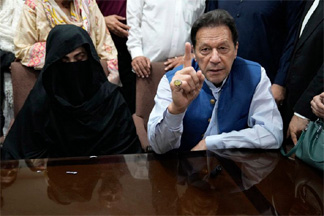
Former Pakistan PM Imran Khan, wife Bushra get prison sentence in al-Qadir Trust case
ISLAMABAD (TIP): A Pakistan court on Friday found former prime minister Imran Khan and his wife Bushra Bibi guilty of corruption in the 190 million pounds al-Qadir Trust case and sentenced them to 14 and seven years in prison respectively.
Besides jail sentences, Khan was fined Rs 1 million and Bushra Bibi half a million rupees. Failure to pay the fine will entail an additional six months of imprisonment for Khan and three months for Bibi.
The court had also ordered the confiscation of the land of Al-Qadir University set up by them.
Khan is already in jail while Bushra was arrested from the court.
Judge Nasir Javed Rana of the anti-corruption court announced the verdict that had been deferred thrice due to different reasons, last time on January 13.
The judge announced the verdict in a makeshift court set up in Adila jail.
“Today’s verdict has tarnished the reputation of the judiciary. In this case, neither I benefited nor the government lost. I don’t want any relief and will face all cases. A dictator is doing all this,” Khan was quoted as saying by his party.
The National Accountability Bureau (NAB) in December 2023 filed the case against Khan (72), Bibi (50) and six others, accusing them of causing a loss to the tune of 190 million pounds (PRs50 billion) to the national kitty.
However, Khan and Bibi have been prosecuted as all others, including a property tycoon, were out of the country.
The case revolves around allegations that an amount of PRs 50 billion, returned to Pakistan by the UK’s National Crime Agency as part of a settlement with a property tycoon, was misused.
The funds were reportedly intended for the national treasury but were allegedly redirected for the personal benefit of the businessman who helped Bibi and Khan to set up a university.
Bibi, as a trustee of the Al-Qadir Trust, is accused of benefiting from this settlement, including acquiring 458 kanals of land for Al-Qadir University in Jhelum.
The judgment comes amidst the ongoing negotiation between the government and Khan’s Pakistan Tehreek-e-Insaf (PTI) party to address the political instability in the country due to the imprisonment of Khan and several other leaders of his party.
So far three rounds of talks have been held and the PTI has presented its charter of demands in writing to the government.
Khan is facing dozens of cases after his ouster as prime minister in 2022.
He has been jailed since August 2023. (PTI) -

Pakistan’s 2024: Troubled ties with neighbours, economic woes and the Imran Khan ‘problem’
ISLAMABAD (TIP): Pakistan was haunted by political uncertainty, economic instability, a deteriorating security situation and troubled relations with neighbours in 2024. But what defined the year were not just these perennial ills but the country’s inability to tackle incarcerated former prime minister Imran Khan.
Amid political turbulence, Pakistan hosted a Shanghai Cooperation Organisation (SCO) conclave, which was also attended by External Affairs Minister S Jaishankar — the first high-ranking Indian minister in nearly a decade to visit Islamabad amid frosty ties between the two neighbours.
The last Indian foreign minister to visit Pakistan was Sushma Swaraj. She had travelled to Islamabad to attend the ‘Heart of Asia’ conference on Afghanistan in December 2015.
In his address at the SCO event, Jaishankar said, “If friendship has fallen short and good neighbourliness is missing somewhere, there are surely reasons to introspect and causes to address.”
He also said if activities across borders are “characterised” by terrorism, extremism and separatism, they are hardly likely to encourage trade, energy flows and connectivity in parallel.
His remarks were seen as directed towards Pakistan, which has troubled relations with all its neighbours.
If the year began with Iran conducting missile strikes within Pakistan in January, targeting Baloch militants, it ended with Pakistan carrying out airstrikes in Afghanistan, killing at least 46 people, including women and children, according to Afghanistan’s Taliban government.
Pakistan says the target was militants.
witnessed a series of terror attacks, particularly in troubled Balochistan and Khyber-Pakhtunkhwa provinces in 2024, among the toughest years for its security forces.
According to the details shared with Parliament by the interior ministry, 924 people were killed and 2,121 injured in 1,566 terrorism incidents in the first 10 months of the year. At least 573 dead and 1,353 injured belonged to law enforcement agencies, including the army.
On the economic front, Pakistan was on the verge of default in 2022 and only averted it due to the timely intervention by the International Monetary Fund. Prime Minister Shehbaz Sharif takes credit for pulling the country back from the brink of bankruptcy and turning around the economy.
In 2024 inflation came down to single digits, policy rates reduced from 22.5 to 15 percent, foreign exchange reserves improved, and the stock market made record gains.
But it was jailed former prime minister Imran Khan who often hogged the headlines.
In the elections in February, independent candidates backed by Khan’s party surprised everyone by winning more than 100 out of the 226 seats in a hung parliament.
And then the Pakistan Muslim League-Nawaz threw in a surprise, nominating Shehbaz Sharif as the prime ministerial candidate instead of the party supremo and three-time former premier Nawaz Sharif. As the PML-N and the Pakistan Peoples Party struck a power-sharing deal to form a coalition government led by Shehbaz, Khan’s Pakistan Tehreek-e-Insaf (PTI) decided to sit in the Opposition.
Khan was arrested in August 2023 after his conviction in a case of corruption and has remained behind bars since then.
Contrary to expectations, the former cricketer’s popularity swelled in 2024, proving right his words—uttered before he was ousted as PM in 2022 after losing a trust vote in Parliament—that he would be “more dangerous when out of power.” (PTI) -
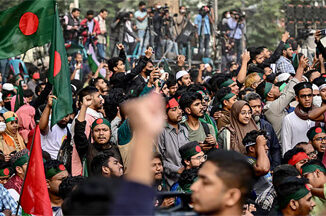
Student body wants B’desh’s ‘Mujibist’ constitution buried
Dhaka (TIP): The Anti-Discrimination Students Movement on December 29 announced that it would issue a belated Proclamation of July Uprising that seeks to “bury” Bangladesh’s 1972 constitution, calling it a “Mujibist” charter that had paved way for “India’s aggression.”
The interim government distanced itself from the “Proclamation” while former PM Khaleda Zia’s party said it was disappointed and added, if there is anything bad in the constitution, it can be amended.
The platform’s convener Hasnat Abdullah told a press conference here, “The Mujibist ‘72 constitution will be buried (in the new proclamation) in the very place where the one-point declaration was made during the July uprising.” (PTI) -
Helicopter makes emergency landing near Kathmandu after being hit by bird
Kathmandu (TIP): A helicopter en route to Kathmandu carrying five US nationals had to make an emergency landing at Banepa, 50 kilometres east of the capital, after it was hit by a bird on December 29.
The 9N-AKG chopper, belonging to the private Heli Everest airlines, was coming from Lukla, gateway to Mt Everest, when it was struck by the bird at 11 am, an official said.
The pilot managed to land the aircraft safely, the official added.
According to the airline, the helicopter was carrying five US nationals as passengers and one Nepali pilot.
Although the helicopter did not suffer any damage, it would go through a technical test before it becomes ready for another flight, the airline said. (PTI) -

Afghan forces retaliate, target Pak sites
Kabul (TIP): Afghanistan’s Defence Ministry said on December 28 that its forces hit several points inside Pakistan in retaliation for deadly airstrikes last week.
Pakistan on December 24 launched an operation to destroy a training facility and kill insurgents in Afghanistan’s eastern Paktika province. The strikes killed dozens of people, mostly women and children.
Comments from the Taliban Defence Ministry on Saturday, posted on X, said its forces targeted Pakistani points that “served as centres and hideouts for malicious elements and their supporters who organised and coordinated attacks in Afghanistan.” Ministry spokesperson Enayatullah Khwarzami gave no further information about the strikes, including how they were carried out and if there were any casualties on either side.
However, a pro-Taliban media outlet, Hurriyet Daily News, cited ministry sources as saying that the strikes killed 19 Pakistani troops and three Afghan civilians. No one from Pakistan’s Foreign Ministry was immediately available for comment. People celebrated Afghanistan’s retaliation in the country’s southeastern Khost province, according to the organiser, Rasheedullah Hamdard.
Thousands turned out to show their happiness and assure the Afghan military of their support against Pakistan. Khost neighbours Paktika, which was targeted last week.
“All of them were chanting angry slogans against this action by Pakistan, such as death to Pakistan,” Hamdard said. “All Afghans are brothers, so it is necessary that the nation and government show their pride in their blood,” he added.
Pakistani officials have accused the Taliban of not doing enough to combat cross-border militant activity, a charge the Taliban government denies, saying it does not allow anyone to carry out attacks against any country from its soil. (AP) -

Pak court indicts Imran, wife Bushra in 2nd Toshakhana case
Islamabad (TIP): A Pakistani court indicted imprisoned former Prime Minister Imran Khan and his wife on fresh charges of illegally selling state gifts on December 12, local broadcaster Geo reported.
The indictment was the latest in dozens of cases against the 72-year-old former cricket star, who has been in jail since late last year. Khan and his wife Bushra Bibi have already been granted bail in the case, which is one of a series of state treasury charges known as Toshakhana. These charges revolve around allegations that Khan and his wife illegally procured and then sold gifts worth more than 140 million rupees ($5,01,000) in state possession, which he received during his 2018-22 premiership. They have denied committing an offence.
Khan and Bibi were both handed a 14-year sentence on those charges days before a national election earlier this year, following a three-year sentence handed to him in late 2023 in another version of the same case.
However, their sentences have been suspended in appeals at the high court.
The gifts included diamond jewellery and seven watches, six of them Rolexes – the most expensive being valued at 85 million rupees. (Reuters) -

Bangladesh summons Kolkata mission head for consultations
Kolkata (TIP): Bangladesh has summoned Shikder Mohammad Ashrafur Rahman, the Acting Deputy High Commissioner in Kolkata, for urgent consultations following protests over attacks on Hindu minorities.
Rahman, who is also Minister – Political Affairs, stationed in Kolkata, has returned to Dhaka.
“Ashrafur Rahman was called for urgent consultations following ongoing protests outside our mission in Kolkata. Additionally, he will be part of the delegation during the foreign secretary-level talks between the two countries slated for next week. He will be back by the middle of this month,” a senior official of the Bangladesh Deputy High Commission in Kolkata told PTI on condition of anonymity.
The mission in Kolkata has witnessed multiple protests over the past week by political parties and religious groups condemning the reported atrocities against Hindus minorities in Bangladesh.
In a related development, the Bangladesh Assistant High Commission in Agartala, Tripura, suspended all visa and consular services on Tuesday, citing “security reasons”.
The decision followed an incident where protesters breached the mission’s premises on Monday to protest the arrest of Hindu spiritual leader Chinmoy Krishna Das in Dhaka.
Amid rising tensions, the Bangladesh foreign ministry summoned the Indian High Commissioner in Dhaka to register its protest over the vandalism at the mission in Agartala.
Indian Foreign Secretary Vikram Misri is expected to visit Bangladesh next week for the foreign secretary-level meeting, marking the first high-level interaction between the two nations since the interim government led by Muhammad Yunus assumed office on August 8, following the ouster of Sheikh Hasina as prime minister.
Relations between the two neighbours have been strained since Hasina fled to India on August 5.
The recent arrest of Das has further intensified the situation, with India expressing concerns over continued attacks on minorities, particularly Hindus, in Bangladesh. (PTI) -
Yunus regime fascist: Hasina vows justice for atrocities
Dhaka (TIP): Bangladesh’s deposed premier Sheikh Hasina has launched a fierce attack on the interim administration, accusing its Chief Adviser Muhammad Yunus of running a “fascist regime” that allows terrorists and fundamentalists to act without restraint. In a virtual address to a gathering of overseas Awami League supporters in London on Sunday, Hasina accused Yunus of being the “mastermind” behind the July-August turmoil that ousted her government and vowed to bring him and his allies to justice under Bangladeshi law.
She criticised Yunus and his interim government for their alleged persecution of religious minorities. “Since August 5, the attacks on minorities, places of worship of Hindus, Christians and Buddhists have been rampant. We condemn it. The Jamaat and terrorists are having a free run under the new regime,” she said. (PTI) -
Jalaluddin Haqqani’s brother killed in Kabul suicide blast
Kabul (TIP): The Afghan Taliban’s acting minister for refugees, Khalil Rahman Haqqani — the brother of Jalaluddin Haqqani, the founder of insurgent group Haqqani network — and six other people were killed in an explosion in the capital Kabul on December 11, his nephew said. A Taliban spokesperson said that Khalil Haqqani had been killed by the Islamic State militant group, who did not immediately claim responsibility for the attack.
The suicide bombing occurred inside the ministry, killing Khalil Haqqani, officials said. His last official photo showed him at a meeting chaired by the deputy prime minister, Mullah Abdul Ghani Baradar, earlier Wednesday. Khalil Haqqani is the uncle of Sirajuddin Haqqani, the acting interior minister who leads a powerful network within the Taliban. Haqqani was the most high-profile casualty of a bombing in Afghanistan since the Taliban returned to power and the first Cabinet member to be killed since the takeover. There was no immediate claim of responsibility for the blast. The government’s chief spokesman, Zabihullah Mujahid, said in a post on X that Haqqani’s death was a great loss and described him as a tireless holy warrior who spent his life defending Islam.
Haqqani’s killing may be the biggest blow to the Taliban since their return to power given his stature and influence, according to Michael Kugelman, director of the Wilson Centre’s South Asia Institute. It also comes at a time when the Taliban have staked their legitimacy on restoring peace after decades of war, he added.
“The killing of a top Haqqani leader inside one of its own ministries undercuts that core narrative,” he said.
Former President Hamid Karzai and Haqqani’s nephew, Anas, also paid tribute to the minister. Taliban security personnel blocked the road leading to the blast site and barred filming and photography.
Pakistan’s Foreign Minister Ishaq Dar condemned the killing as a “terrorist attack.”
“Pakistan unequivocally condemns terrorism in all its forms and manifestations,” Dar said, adding his government was in touch with Kabul. Daesh’s affiliate, a major rival of the ruling Taliban, has carried out previous attacks across Afghanistan. In early September, one of its suicide bombers in a southwestern Kabul neighbourhood killed at least six people, wounding 13 others. (Agencies) -
Imran demands probe into ‘killings’ of party workers
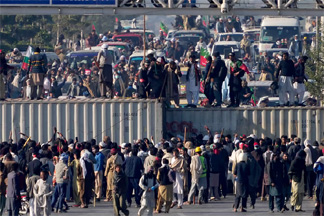
Islamabade (TIP) : Pakistan’s jailed former prime minister Imran Khan has demanded the constitution of a Supreme Court-led judicial commission to probe alleged killings of his party workers by law enforcement officers’ “direct firing” in Islamabad last week.
Khan’s PTI had launched a protest on November 24. His supporters were forcibly dispersed on the night of November 26 when they reached close to D-Chowk in Islamabad’s Red Zone, where most government buildings are located.
In a post on X, Khan said he was informed about how “peaceful protesters were directly shot” and dozens of unarmed citizens who “spoke up for the Constitution and rule of law” were killed. (PTI) -

Protests erupt in Bihar over atrocities against Hindus in Bangladesh
Patna (TIP): Processions and protest marches erupted in Bihar on December 5 in support of minority Hindus, Jains, Sikhs and Buddhists who were being subjected to torture in Bangladesh after the collapse of the Sheikh Hasina government.
The protesters have demanded immediate intervention of Prime Minister Narendra Modi to rescue the Bangladeshi Hindus.
The reports of sit-in protests and marches poured in from Nalanda, Purnea, Katihar, Rohtas, Begusarai and many other districts.
In Nalanda, a sit-in protest was organised under the aegis of Rashtriya Bharatiya Samaj. District coordinator of Rashtriya Bhartiya Samaj Satish Kumar said that the atrocities against the minorities in Bangladesh should be stopped immediately. He also demanded the unconditional release of ISKCON priest Krisha Das from jail.
In Katihar, protest marches were taken out under the banner of Sarv Hindu Samaj.
Later a delegation of Sarv Hindu Samaj met the district magistrate and handed over a memorandum addressed to President Droupadi Murmu. Similarly, protest marches were also held in Rohtas district under the aegis of Rashtriya Bharatiya Samaj.
Meanwhile, Girindra Mohan Mishra, national president of Mag Dharma Sansad, said that his organisation was ready to help 11,000 Hindus if they were evacuated from Bangladesh and brought to India.
In a statement issued on Thursday, Mishra said that he was getting information from Bangladesh about the atrocities being committed against the Hindus.
On Wednesday, union minister and Begusarai MP Giriraj Singh said the attack on Hindus in Bangladesh reflected that the interim government of the neighbouring country was in the ‘clutches’ of fundamentalists’ and sought the intervention of the United Nations in the matter. Condemning the arrest of a Hindu leader in Bangladesh, Giriraj said that such attacks were against humanity. The Bangladesh interim government is headed by Chief Adviser Muhammad Yunus. (PTI) -
Nepal, China sign BRI cooperation agreement
Kathmandu (TIP): Nepal and China on December 4 signed a much-awaited framework agreement on the multi-billion dollar Belt and Road Initiative (BRI), paving the way for enhanced economic cooperation on the projects. The BRI Cooperation Framework agreement was inked during Prime Minister K P Sharma Oli’s official visit to China — his first official visit to that country after assuming office for the fourth time. The BRI is a mega connectivity project that connects China with Southeast Asia, Central Asia, Russia and Europe.
Though Nepal and China signed the BRI agreement in 2017, not a single project has been implemented under the framework. However, the details of the agreement have not been made public. A joint statement issued by both sides on Tuesday said that “the two sides expressed their readiness to sign the MoU on building the Trans-Himalayan Multi-Dimensional Connectivity Network (THMDCN) and the framework for Belt and Road Cooperation between the two governments as soon as possible,” without specifying a distinct deadline.
“Both sides expressed their commitment to strengthening connectivity between the two countries in such areas as ports, roads, railways, aviation, power grids and telecommunication, to help Nepal transform from a land-locked country to a land-linked country,” it said. According to The Kathmandu Post newspaper, the Chinese side had removed the word “grant” proposed by the Nepali side and suggested replacing it with “investment” for projects under the BRI. (PTI) -

Pak sectarian violence: Death toll rises to 130 as clashes continue in Kurram despite ceasefire
Pakhtunkhwa (TIP): The death toll from sectarian violence in Pakistan’s restive Khyber Pakhtunkhwa province surged to 130, with at least six people killed and eight injured on December 2, as clashes in the volatile Kurram district continued for the eleventh consecutive day. The clashes between Alizai and Bagan tribes in the district started on November 22, after an attack on a convoy of passenger vans near Parachinar in which 47 people were killed a day earlier. Several passengers who had sustained grave injuries succumbed later, raising the toll in the convoy killing to 57.
Police said the situation remained tense, and violence persists despite a recent ceasefire agreement between the Sunni and Shia groups.
The six new deaths reported on Sunday brought the death toll to 130, while the total number of injured rose to 186 after eight fresh injuries were reported.
The 10-day truce brokered last week has been rendered ineffective by intermittent violence, which shows no signs of abating.
The continued violence forced the closure of the main Peshawar-Parachinar Road for travel, and commuting at the Pak-Afghan Kharlachi border has also been suspended.
The closure of the main arteries has created a scarcity of oil, food commodities and medicines in the region.
The Kurram region is also experiencing a communication blackout, with mobile and internet services suspended and educational institutions closed.
Police and other security forces personnel had been deployed in various parts of Lower Kurram, said Deputy Commissioner Javed Ullah Mehsud, adding that all-out efforts will be made for a truce in other areas today as well.
“We are hopeful for progress on a ceasefire and reopening of transport routes,” he stated.
Previous efforts to mediate peace, including a seven-day truce brokered by provincial officials in November have failed to hold.
A high-powered delegation, including Khyber Pakhtunkhwa Chief Secretary Nadeem Aslam Chaudhry and IGP Akhtar Hayat Gandapur, had also negotiated a ceasefire last weekend, but violence resumed shortly afterwards. (PTI) -

Imran supporters suspend protest; 4 die in crackdown
Islamabad (TIP): Jailed former prime minister Imran Khan’s party on November 27 formally suspended its protest here blaming the midnight crackdown by the authorities that left at least four dead and over 50 injured even as the PTI earlier claimed “hundreds” were killed in the violent clashes with security personnel.
Amid concerns about the whereabouts of Khan’s wife Bushra Bibi and Khyber Pakhtunkhwa Chief Minister Ali Amin Gandapur, – who were leading the march to Islamabad – the party said they were at Mansehra town, near Abbottabad, of the northwestern Khyber Pakhtunkhwa province.
Authorities began reopening roads and cleaning all major thoroughfares vandalised during the three-day protest by Khan’s Pakistan Tehreek-e-Insaf (PTI) party.
The midnight crackdown forced Khan’s supporters to evacuate the D-Chowk and its adjacent main business district of the capital, ending their protest, which his party described as a “massacre” under the “fascist military regime” even as police sources said about 450 protesters were arrested in the crackdown.
“In view of the government’s brutality and the government’s plan to turn the capital into a slaughterhouse for unarmed citizens, (we) announce the suspension of the peaceful protest for the time being,” Khan’s PTI said in a press release. (PTI) -
Army Chief’s Nepal visit over, but no clarity on fresh recruitment of Gorkha soldiers
Kathmandu (TIP): Chief of the Army Staff General Upendra Dwivedi on November 24 concluded his five-day official visit to Nepal to strengthen bilateral ties. However, there is no clarity on the way ahead for the fresh recruitment of soldiers from Nepal into the Indian Armed Forces that has been on hold for the past four years.
“The visit, which exceeded all stated objectives, further solidified the robust defence cooperation, cultural ties and mutual respect between the two nations. It underscored the shared commitment of the Indian and Nepali Armies to fostering peace, security and partnership in the region,” an official statement issued on Sunday read.
During his tour, described as “resoundingly successful”, Gen Dwivedi held discussions with President of Nepal Ramchandra Paudel, Prime Minister KP Sharma Oli, Defence Minister Manbir Rai and his Nepali counterpart, General Ashok Raj Sigdel, but there is no reference to the resumption of recruitment of Gorkha soldiers from Nepal in official statements or media reports.
Reports from Nepal also said Prime Minister Oli emphasised the need to further strengthen bilateral cooperation and expand ties. The Indian Army Chief’s visit came in the backdrop of strains in bilateral relations and growing Chinese interest in Nepal. This visit was preceded by the Director-General of Shashtra Seema Bal that guards the Indo-Nepal border holding talks with his counterpart in Nepal.
The recruitment of soldiers from Nepal has been suspended since 2020 following the outbreak of the Covid-19 pandemic and thereafter the introduction of the Agniveer scheme in 2021 that entails a four-year term for new recruits into the rank and file of the three services. Only 25 per cent would be absorbed into permanent service.
Nepal did not agree to the terms of the Agniveer scheme for its citizens, saying that it violated the terms of the tripartite India-Nepal-Britain Agreement in 1947. It also voiced concern over the re-employability of Gorkha soldiers after their four-year term expires.
The India-Nepal relations are steeped in history over shared economic, social and cultural affinity and military-to-military cooperation is an important element of this bond. The Nepal-India Bilateral Consultative Group on Security Issues (NIBCGSI) that meets regularly is the forum for this exchange. (TNS) -

Promote ‘peaceful coexistence’ for Hindus, ISKCON urges Bangla govt
Dhaka (TIP): The International Society for Krishna Consciousness (ISKCON) has urged the Bangladesh authorities to promote “peaceful coexistence” for Hindus in the country as it “strongly” denounced the recent arrest of the prominent community leader Chinmoy Krishna Das Brahmachari.
Das was arrested from Dhaka’s Hazrat Shahjalal International Airport on Monday as he was about to fly to Chattogram to join a rally. He was denied bail and sent to jail by the Chattogram’s Sixth Metropolitan Magistrate court in a sedition case on November 27.
In a statement on Tuesday, ISKCON Bangladesh General Secretary Charu Chandra Das Brahmachari said, “We express our serious concern and strongly denounce the recent arrest of Chinmoy Krishna Das… We also condemn the subsequent violence and attacks against Sanatanis in various regions of Bangladesh. We urge the government authorities to promote peaceful coexistence for the Sanatani community,” he said.
Underlining that Bangladesh is “our birthplace and ancestral home”, the statement urged the interim government of Bangladesh led by Chief Adviser Muhammad Yunus “to ensure justice for all and to allow every citizen to practice their religion freely in accordance with their beliefs.” (PTI) -
Dengue deaths cross 400 mark in Bangladesh
Dhaka (TIP): Bangladesh is battling its worst outbreak of dengue in years, with more than 400 deaths as rising temperatures and a longer monsoon season drive a surge in infections, leaving hospitals struggling to cope, particularly in urban areas.
At least 407 people have died from related complications in 2024, with 78,595 patients admitted to hospital nationwide, the latest official figures show. Kabirul Bashar, a zoology professor blamed shifting weather patterns due to climate change for the crises. (PTI) -

Militants kill 50, mostly Shiites, in Pakistan’s KP
Pakhtunkhwa (TIP): At least 50 people were killed and 20 others injured when several vehicles carrying passengers were targeted by militants in northwest Pakistan on November 21, officials said.
The militants ambushed the vehicles in the Kurram district of Khyber Pakhtunkhwa province bordering Afghanistan.
The vehicles were travelling in a convoy from Parachinar to Peshawar, the capital of Khyber Pakhtunkhwa when gunmen opened fire, the officials said. Rescue authorities said 50 people, including eight women and five children, and 20 others were killed in the attack.
Most of the victims belonged to the Shia community, they said.
The vehicles were ambushed in areas dominated by the Taliban, a local journalist said.
According to local media, there were over 200 vehicles in the convoy.
Khyber Pakhtunkhwa Chief Minister Ali Amin Khan Gandapur strongly condemned the attack and directed a delegation comprising the provincial law minister, lawmakers from the region, and the chief secretary to immediately visit Kurram to assess the situation and submit a comprehensive report. He also instructed relevant authorities to work on establishing a Provincial Highways Police unit to secure all roads in the volatile province. Gandapur extended condolences to the bereaved families and announced financial assistance for the families of the victims.
“Targeting innocent civilians is extremely tragic and condemnable. Those involved in this incident will not escape the grip of the law,” he said. (PTI) -
Hours after bail, Pak court sends Imran to 5-day police remand
Islamabad (TIP) : An anti-terrorism court in Pakistan on November 21 granted a five-day police remand of former prime minister Imran Khan, who was arrested formally by police hours after his bail in a corruption case was accepted.
Khan, 72, was arrested by Rawalpindi police in the New Town police station case on Wednesday night after securing bail in the second Toshakhana case and was produced before the Anti-Terrorism Court in Adiala Jail.
The police prosecution team sought a 15-day police remand but the court granted the five-day remand and ordered to continue the investigation inside the jail. (PTI) -
10 gunned down at Sufi Shrine in Afghanistan
Kabul (TIP): At least 10 people were killed in Afghanistan’s Baghlan province when a gunman opened fire on Sufis participating in a weekly ritual at a local shrine, the country’s interior ministry said on November 22. It was not immediately clear who was behind the attack. The incident took place in Afghanistan’s remote Nahrin district. After taking control in 2021, the Taliban had vowed to restore security to the war-torn nation. Attacks have continued, many of them claimed by the local arm of the militant Islamic State (IS) group. In September, 14 people were killed and six others injured in an attack claimed by Daesh in central Afghanistan. (Agencies)
-

Sri Lanka Prez opts for smaller Cabinet with fresh faces
Colombo (TIP): Sri Lankan President Anura Kumara Dissanayaka on November 18 appointed a 21-member Cabinet in the new NPP government, keeping with his pre-election promise to streamline the governance system and ease the burden on taxpayers.
The National People’s Power (NPP) has been advocating a smaller government to reduce costs for the public. Since the NPP won the presidential election in September, the government functioned with just three ministers, including the President.
As per the island nation’s Constitution, there is a provision for appointing a 30-member Cabinet.
Dissanayaka retained the finance and defence portfolios, while appointing 12 new parliament members to key positions and entrusting eight veteran members, who have served since 2000, with significant responsibilities.
Among the fresh faces in the Cabinet are five professors. Prime Minister Harini Amarasuriya, who holds the education portfolio, and Saroja Savithri Paulraj, who has the women and child affairs portfolio, are the two women members in the Cabinet. Paulraj, a minority Tamil from the Sinhala majority south, was involved in the party’s long struggle.
A significant feature of the swearing-in ceremony was Fisheries Minister Ramalingam Chandrasekaran, who took his oath in Tamil, highlighting the representation of the minority community in the new government.
The new parliament will convene on Thursday.
The NPP, led by Dissanayake, swept the parliamentary elections held on Thursday by winning a two-thirds majority. It also dominated the Jaffna electoral district — the heartland of the nation’s Tamil minority. The NPP won a near 62 per cent of the vote, 2/3rd majority of 159 seats in the 225-member Assembly.
21 members appointed
Dissanayaka retains finance, defence portfolios
12 new members, 8 veterans appointed
Five professors among fresh faces
Women members include Prime Minister Harini Amarasuriya (education), Saroja Savithri Paulraj (women and child affairs)
(Reuters) -

Sri Lanka’s leftist coalition wins landslide victory, eyes sweeping reforms
Colombo (TIP): Sri Lankan President Anura Kumara Dissanayake’s leftist coalition, the National People’s Power (NPP), secured a decisive victory in November 14 snap general election, winning 137 of the 196 directly elected seats. Local media project that the total will surpass 150 seats once proportional representation is factored in, giving Dissanayake a commanding two-thirds majority in the 225-member parliament.
This victory gives Dissanayake the power to push through his reform agenda, including plans to abolish the executive presidency. In total, the NPP secured almost 62% of the vote, or around 7 million ballots, up from 42% in the presidential election held in September. Dissanayake, a political outsider, is now poised to reshape Sri Lanka’s political landscape, having built strong support among minorities and the wider electorate.
While the clear mandate strengthens political stability, there is some uncertainty over Dissanayake’s economic policies, especially his intention to alter the terms of Sri Lanka’s $2.9 billion IMF bailout. The IMF deal has been crucial to the country’s tentative economic recovery following the 2022 crisis, which saw Sri Lanka default on its debt and its economy contract by 7.3% in 2022 and 2.3% in 2023.
Dissanayake, who has promised to reduce taxes and prioritize welfare for the country’s poor, aims to negotiate with the IMF to revise income tax targets and free up funds for social spending. However, analysts warn that revisiting the bailout terms could delay future IMF disbursements and make it harder to meet a critical fiscal target of a 2.3% primary surplus by 2025.
Despite these challenges, the NPP’s victory, with its overwhelming 62% support, signals a shift in Sri Lanka’s political culture. The opposition Samagi Jana Balawegaya, led by Sajith Premadasa, won 35 seats, while the New Democratic Front, backed by former President Ranil Wickremesinghe, secured just three seats. (Reuters) -

7 killed after car bomb accidently explodes in former stronghold of Pakistani Taliban
Peshawar (TIP) : A powerful car bomb exploded accidentally inside a house in the former stronghold of the Pakistani Taliban in northwest Pakistan, killing at least two children and five suspected militants, police said on November 15.
The explosion occurred before dawn in the city of Mir Ali, located in Khyber Pakhtunkhwa province, when a militant, identified as Commander Rasool Jan, was attempting to fit a bomb into a car at his home, said Irfan Khan, a local police official. According to Khan, the Pakistani Taliban arrived quickly at the scene and removed the bodies of the slain militants. Authorities later discovered the bodies of two children trapped in the rubble of the house, which collapsed due to the blast.
The explosion also caused significant damage to several nearby homes and injured 14 people, including women. Some of the injured are reported to be in critical condition, though further details have not been provided.
Khan speculated that the car bomb was intended for use in an attack in the region, where the Pakistani Taliban and other insurgent groups frequently target security forces using assault rifles, rockets, grenades, and suicide car bombings.
In a separate incident on Thursday, a suicide bomber riding a motorcycle set off an explosive device prematurely on a deserted road in Charsadda district, killing himself but causing no other casualties, police said.
Masood Khan, a local police official, stated that the intended target of the suicide bomber remained unclear. Bomb disposal experts and investigators are trying to determine whether the explosives were attached to the bomber’s motorcycle or if he was carrying them himself.
The Pakistani Taliban, also known as Tehrik-e-Taliban Pakistan (TTP), is a separate group from the Afghan Taliban but has been emboldened by the latter’s takeover of Afghanistan in 2021. (AP) -

Bangladesh AG wants ‘secularism’ removed from Constitution
Dhaka (TIP): Bangladesh’s top legal official has proposed to remove the words “secularism” and “socialism” from the Constitution apart from a provision prescribing capital punishment for regime change through extra-constitutional means. In his statement in the High Court during a hearing on a writ petition filed by a group of citizens, Attorney General Mohammad Asazzaman on November 14 sought to remove “secularism” and “socialism” as two of the four principles of the Constitution alongside the designation of Sheikh Mujibur Rahman as the Father of the Nation.
Sheikh Mujibur Rahman was the undisputed leader of Bangladesh but the Awami League politicised him in the party’s interest, he said, referring to the founding leader of Bangladesh who is popularly known as Bangabandhu.
The writ petition challenged the validity of the Constitution’s 15th amendment made by the now-ousted Awami League regime of deposed prime minister Sheikh Hasina in 2011 while a two-judge High Court bench issued a rule asking the interim government to come up with its stance on the matter. “As a whole, we do not want that (HC) rule to be scrapped,” the attorney general said, clarifying the government’s stance on the writ petition. (PTI)