Tag: South Asia

  • Pakistan bans weddings, shuts schools as 15K taken ill in a day after AQI reaches 604 in Lahore

    Lahore (TIP): The toxic smog, which continues to grip Lahore and other parts of Pakistan, has worsened, with the city reporting over 15,000 cases of respiratory and viral infections in just 24 hours. The majority of cases were reported at major government hospitals, including Mayo Hospital (4,000+ patients), Jinnah Hospital (3,500 patients), Gangaram Hospital (3,000 patients), and Children’s Hospital (2,000+ patients). (PTI)

  • Hindu pilgrim on way to Nankana Sahib shot dead

    Lahore (TIP): A Hindu pilgrim, who was going to attend the 555th birth anniversary celebrations of Guru Nanak Dev in Nankana Sahib, was shot dead by robbers, the police said on November 15. A native of Larkana city in Sindh province, Rajesh Kumar was going to Nankana Sahib from Lahore by a car along with his friend and brother-in-law when three robbers intercepted them on the Mananwala-Nankana Sahib Road, 60 km from Lahore.
    “The gunmen snatched Rs 4.5 lakh from the trio and Rs 10,000 from the driver. After Kumar resisted, the robbers opened fire on him and fled,” the police said. Kumar was rushed to hospital in a critical condition where he succumbed to his injuries. A case has been registered against unidentified men on the complaint of Kumar’s brother-in-law. (PTI)

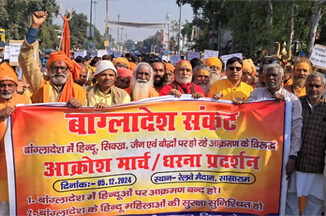
  • Hindus in Bangladesh stage major rally in Chittagong demanding minority rights

    Dhaka (TIP): On October 26, thousands from Bangladesh’s Hindu community gathered at the historic Laldighi Maidan in Chattogram (Chittagong) to express their determination to continue demonstrations until the interim government addresses their eight key demands. Organised by the Bangladesh Sanatan Jagran Manch (Unified Platform for Realising the Rights of Sanatans), this protest is one of the largest seen in months, with participants threatening to march to Dhaka if their requests remain unmet, reported The Times of India.
    The demands presented by the leaders include:
    Formation of a tribunal to expedite trials for those involved in minority atrocities.
    Appropriate compensation and rehabilitation for victims.
    Enactment of a minority protection law without delay.
    Creation of a ministry of minority affairs.
    Construction of places of worship for minorities in every educational institution.
    Establishment of prayer rooms in every hostel.
    Modernisation of the Sanskrit and Pali Education Board.
    A five-day holiday for Durga Puja.
    On Thursday, Bangladesh’s Environment Minister Syeda Rizwana Hasan had issued a statement acknowledging the demands of the Hindu community and announced the enactment of a two-day holiday for Durga Puja, marking the first time this has occurred in the country’s history.
    The backdrop of this rally included recent incidents that raised alarms about the safety of minorities in Bangladesh. This marked one of the largest gatherings by Hindu groups since the ousting of Sheikh Hasina on August 5. Despite promises of safety from the interim government, led by Nobel Laureate Muhammad Yunus since August 7, crimes against minorities—including vandalism, looting, and bodily harm—have reportedly increased. The Indian Ministry of External Affairs condemned attacks on Durga Puja pandals and thefts from Hindu temples, describing these acts as part of a “systematic pattern of desecration” and called for the protection of minority communities during the ongoing festival season. (TOI)

  • Myanmar’s civil war reshaped in past year with coordinated offensive by powerful resistance groups

    BANGKOK (TIP): Three well-armed militias launched a surprise joint offensive in northeastern Myanmar a year ago, breaking a strategic stalemate with the regime’s military with rapid gains of huge swaths of territory and inspiring others to attack around the country.
    Before the offensive, the military’s control had seemed firmly ensconced with its vast superiority in troops and firepower, and aided with material support from Russia and China. But today it is increasingly on the back foot, with the loss of dozens of outposts, bases and strategic cities that even its leaders concede will be challenging to regain.
    The military seized power from the elected government of Aung San Suu Kyi in February 2021, giving rise to intensified fighting with long-established armed groups associated with Myanmar’s ethnic minority groups, and sparking the formation of new pro-democracy militias.
    But until the launch of Operation 1027, eponymously named for its Oct. 27 start, the military, known as the Tatmadaw, had largely been able to prevent major losses around the country.
    Operation 1027 brought coordinated attacks from three of the most powerful ethnic armed groups — the Myanmar National Democratic Alliance Army, the Arakan Army and the Ta’ang National Liberation Army, together known as the Three Brotherhood Alliance — and they were able to quickly capture towns and overrun military bases and outposts along the Chinese border in northeastern Shan state. Two weeks later the Arakan Army launched attacks in its home western state of Rakhine, and since then other militia groups and PDFs have joined in around the country.
    A year later into the offensive, resistance forces now fully or partially control a vast horseshoe of territory that reaches from Rakhine state in the west, across the north, and then south into Kayah and Kayin states along the Thai border. The Tatmadaw has pulled back toward the center around the capital Naypyidaw and largest city of Yangon.
    Many expect the military to launch a counteroffensive when the rainy season soon comes to an end, bolstered with the influx of some 30,000 new troops since activating conscription in February and its continued complete air superiority. But at the same time, resistance groups are closing in on Mandalay, Myanmar’s second largest city in the center of the country. Facing threats from all around the country, “it doesn’t look like there’s any viable route back for the military to recapture any of the territory that it’s lost,” said Connor Macdonald of the Special Advisory Council for Myanmar advocacy group. (AP)

  • Pakistan begins another vaccination campaign after worrying surge in polio cases

    Pakistan begins another vaccination campaign after worrying surge in polio cases

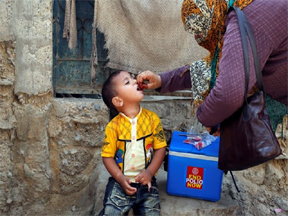
    ISLAMABAD (TIP): Pakistan began a nationwide vaccination campaign on October 28 to protect 45 million children from polio after a surge in new cases that has hampered years of efforts to stop the disease in one of the two countries where it has never been eradicated.
    Pakistan regularly launches such campaigns, but violence targeting the health workers and police assigned to escort them is common.
    Militants falsely claim the vaccination campaigns are a Western conspiracy to sterilise children.
    “The campaign is the third this year and will continue until Sunday ?in response to the alarming increase in polio cases,” said Ayesha Raza Farooq, the prime minister’s adviser for the polio eradication programme.
    “We are re-energised in our efforts to combat polio,” she said in a statement.
    During the door-to-door campaign, children younger than 5 will be vaccinated and given drops of Vitamin A supplements to enhance their immunity.
    Prime Minister Shehbaz Sharif recently met with front-line health workers, urging them to ensure no child was left unvaccinated by going door-to-door.
    Anwarul Haq, who is the coordinator of the National Emergency Operations Centre for Polio Eradication, also urged parents to fully cooperate with polio workers.
    “Polio has no cure, but it can be prevented with this readily available vaccine,” he said.
    Pakistan has recorded 41 cases across 71 districts so far this year, Farooq said.
    Most were reported from southwestern Balochistan and southern Sindh province, followed by Khyber Pakhtunkhwa province and eastern Punjab province.
    The surge in cases in new locations is worrying authorities since previous cases were from the restive northwest bordering Afghanistan, where the Taliban government in September suddenly stopped a door-to-door vaccination campaign.
    Authorities in Pakistan say the Afghan Taliban’s recent decision to stop door-to-door anti-polio campaign will have repercussions beyond the Afghan border, as people from both sides frequently travel to each other’s country. The World Health Organisation has confirmed 18 polio cases in Afghanistan this year. Pakistan and Afghanistan are the only two countries in the world where the spread of polio has never been stopped. It is one of the world’s most infectious diseases, so it continues to spread anywhere people are not fully vaccinated. In severe cases, polio can cause permanent paralysis and death. (PTI)

  • Bangladesh tribunal issues arrest warrant against ousted PM Sheikh Hasina

    DHAKA (TIP): A Bangladeshi court on October 17 ordered an arrest warrant for exiled ex-leader Sheikh Hasina, who fled to India in August after she was toppled from power by a student-led revolution. “The court has… ordered the arrest of former prime minister Sheikh Hasina, and to produce her in court on November 18,” Mohammad Tajul Islam, chief prosecutor of Bangladesh’s International Crimes Tribunal, told reporters on Thursday. Hasina’s 15-year rule saw widespread human rights abuses, including the mass detention and extrajudicial killings of her political opponents. “Sheikh Hasina was at the helm of those who committed massacres, killings and crimes against humanity in July to August”, Islam said, calling it a “remarkable day”.
    Hasina, 77, has not been seen in public since fleeing Bangladesh, and her last official whereabouts is a military airbase near India’s capital New Delhi.
    Her presence in India has infuriated Bangladesh.
    Dhaka has revoked her diplomatic passport, and the countries have a bilateral extradition treaty which would permit her return to face criminal trial.
    A clause in the treaty, however, says extradition might be refused if the offence is of a “political character”.
    Hasina’s government created the deeply contentious ICT in 2010 to probe atrocities during the 1971 independence war from Pakistan.
    The United Nations and rights groups criticised its procedural shortcomings, and it became widely seen as a means for Hasina to eliminate political opponents.
    Several cases accusing Hasina of orchestrating the “mass murder” of protesters are being probed by the court. (AFP)

  • Human induced climate change behind flooding disasters in Nepal

    Pradhan Kathmandu (TIP): World Weather Attribution, an international collaboration, has underscored the urgent need for Nepal to limit development in low-lying, riverside areas of the cities and scale up early warning and prompt action to avoid repeat of flooding disasters.
    “Climate change was responsible for the extreme three day downpours in Nepal about 10 percent more intense,” concluded the organization in its recently published report.
    The flood and landslide triggered by heavy rain in Nepal in late September caused heavy loss to the country as it claimed at least 244 lives.
    “The rainfall became 10 percent more intense by human-induced climate change,” pointed out the report.
    “Bursts of rainfall will become even more heavier, risking more destructive floods until the world replaces fossil fuels with renewable sources of energy,” warned the organization.
    “Reducing development in flood-prone areas of cities will help protect people in Nepal from future floods,” according to the report. “The explosive monsoon rainfall that hit Nepal was increased by climate change,” concludes the report.
    The flooding witnessed by Kathmandu valley had never occurred before in the past, according to eye-witnesses.
    More than 50 people were killed and property worth billions of rupees were damaged due to the heavy rainfall that hit Kathmandu recently. (PTI)

  • Nawaz Sharif calls Jaishankar visit to Islamabad a ‘good beginning’ for India-Pak ties

    Nawaz Sharif calls Jaishankar visit to Islamabad a ‘good beginning’ for India-Pak ties

    islamabad (TIP) : The visit of India’s foreign minister to Pakistan earlier this week was a “good beginning” that could lead to a thaw in relations between the two rivals, former Pakistan Prime Minister Nawaz Sharif was quoted as saying by Indian media on Friday. Indian Foreign Minister Subrahmanyam Jaishankar was in Pakistan on October 15 and 16 for a meeting of governments of the Shanghai Cooperation Organisation, with the capital city under tight lockdown. “This is how talks move forward. Talks should not stop,” Sharif, the president of the ruling Pakistan Muslim League – Nawaz (PML-N), and the brother of Prime Minister Shehbaz Sharif, told a group of visiting Indian journalists, the Indian Express newspaper reported.
    Jaishankar was among nearly a dozen leaders participating in the gathering in Islamabad, nearly a decade since an Indian foreign minister has visited amid frosty relations between the two nations.
    Jaishankar and his counterpart Ishaq Dar had an “informal interaction”, an official in Pakistani foreign ministry said on Thursday, but New Delhi denied that any sort of meeting had taken place. (Reuters)
    Pak police fire tear gas at protesting students
    Rawalpindi (TIP): Pakistani police fired tear gas and charged at student protesters who ransacked a college building October 17, as anger spread over an alleged on-campus rape.
    Tensions have been high on college campuses since reports about the alleged rape in the eastern city of Lahore went viral on social media, and protests have broken out in four cities so far.
    The latest violence started when hundreds of students demonstrated outside a campus in the city of Rawalpindi in Punjab province. They burned furniture and blocked a key road in the city, disrupting traffic, before ransacking a college building. Police responded by swinging batons and firing tear gas to disperse them, police official Mohammad Afzal said. In a statement, police said they arrested 150 students on charges of disrupting the peace.
    In Gujrat, also in Punjab, a security guard died in clashes between student protesters and police on Wednesday. The police have arrested someone in connection with the death.
    They also arrested a man who is accused of spreading misinformation on social media about the alleged rape and inciting students to violence.
    Earlier this week, more than two dozen college students were injured in clashes with police in Lahore after they rallied to demand justice for the victim, who they alleged was raped on campus at the Punjab Group of Colleges.
    Authorities, including the province’s chief minister and the college administration, denied there was an assault, as did the young woman’s parents.
    Sexual violence against women is common in Pakistan, but it is underreported because of the stigma attached to it in the conservative country. Protests about sexual violence against women are uncommon.
    Hasna Cheema, from the rights group Aurat Foundation, said neither Pakistani police nor the media were trained to handle such sensitive matters.
    “They turn things from bad to worse instead of solving them,” Cheema said.
    The Sustainable Social Development Organization said last month that there were 7,010 rape cases reported in Pakistan in 2023, almost 95 per cent of them in Punjab. (AP)

  • Our relationship with Bangladesh and Sri Lanka will remain positive, constructive: EAM Jaishankar

    Our relationship with Bangladesh and Sri Lanka will remain positive, constructive: EAM Jaishankar

    NEW YORK (TIP): External Affairs Minister S Jaishankar expressed confidence that India’s relationship with neighbours Sri Lanka and Bangladesh would continue to be “positive and constructive.”
    “I would urge you not to be deterministic about it. It’s not like India is seeking to control every political move of every neighbour. That’s not how it works. It doesn’t work, not just for us, it doesn’t work for anybody else,” Jaishankar said on September 23 during an interaction at an event titled ‘India, Asia and the World’ hosted by the Asia Society and the Asia Society Policy Institute here.
    The minister was responding to a question that India has given unconditional aid to Bangladesh and Sri Lanka but government changes there seemed to be potentially adverse for India.
    “Every country will have its own dynamics. In foreign policy, you try to read, anticipate, and then respond to it. I’m very confident at the end of it all, in our neighbourhood, the realities of interdependence or mutual benefit and our ability to get along will serve both our interests. Those realities will assert themselves. That’s been the history,” Jaishankar said.
    Jaishankar added that every few years, “something happens in our region, and people suggest that there is some kind of irretrievable situation out there. You then see the correctives beginning to manifest themselves.”
    “So, I would take it in that spirit and am quite confident that in both these cases, our relationship would continue to be positive and constructive,” the EAM continued.
    Jaishankar’s remarks came in light of the change of government in Sri Lanka and Bangladesh.
    On Sri Lanka, Jaishankar said India stepped forward when Colombo was facing a very deep economic crisis and “very frankly, when nobody else came forward.”
    “And I’m very glad we did it. We did it in a timely manner. We did it on scale. We put out USD 4.5 billion effectively,” he said, adding that the move stabilised the Sri Lankan economy.
    “The rest of it was up to them. At that time we did it, it was not like we had a political conditionality which accompanied that. We were doing it as a good neighbour who did not want to see that kind of economic meltdown at our doorstep,” the EAM said.
    Jaishankar said that what happens politically in Sri Lanka, “is for their politics to work out.”
    “At the end of the day, each of our neighbours will have their own particular dynamics. It’s not our intention to suggest that their dynamics must necessarily adhere to what we might consider as being better for us. I think this is the real world. I mean, everybody makes their choices and then countries adjust to each other and find ways of working it out,” the minister said.
    In the case of Bangladesh, he said: “It’s a little bit different. What we have done over the last decade is to do projects of various kinds, which have been good for both of us. Economic activity overall has picked up, and logistics of that region have improved.”
    Jaishankar said both countries have gained a lot out of that.
    In August, Nobel laureate Muhammad Yunus was sworn in as head of Bangladesh’s interim government after weeks-long violent protests culminated in the ouster of former prime minister Sheikh Hasina, who has since fled to India.
    Marxist leader Anura Kumara Dissanayake, 56, was on Monday sworn in as Sri Lanka’s ninth president following his victory in the Sri Lankan presidential election. (PTI)

  • IMF approves $7-billion bailout package for Pak

    IMF approves $7-billion bailout package for Pak

    Karachi (TIP): The IMF has approved a USD 7 billion new bailout package for Pakistan, authorising the immediate release of the first loan tranche of less than USD 1.1 billion to reinforce the cash-strapped country’s efforts to address the ongoing economic crisis.
    The International Monetary Fund (IMF) board met on September 25 in Washington to give a nod to the staff-level agreement with Pakistan after Islamabad promised to overhaul its agriculture income tax, transfer some fiscal responsibilities to provinces and agree to limit subsidies. It is the 25th IMF programme that Pakistan has obtained since 1958 and the sixth EFF.Pakistan will pay around 5 per cent interest rate on the loan. Prime Minister Shehbaz Sharif on Wednesday reiterated this would be Pakistan’s last IMF programme. (PTI)

  • Never followed ‘India Out’ agenda: Maldives President Muizzu

    MALE (TIP): Maldives President Mohamed Muizzu has denied having an “India Out” agenda, asserting that the island nation had a “serious problem” with the presence of foreign military on its soil.
    Muizzu, who is in the US to attend the 79th Session of the United Nations General Assembly, made the remarks on september 26 while responding to a question at Princeton University’s Dean’s Leadership Series?.
    “We have never been against any one country at any point. It’s not India Out. Maldives faced a serious problem with foreign military presence on this soil,” Maldivian news portal adhadhu.com quoted him as saying.
    “The people of Maldives do not want a single foreign soldier in the country,” Muizzu said.
    The ties between India and the Maldives came under severe strain since November last year when Muizzu, known for his pro-China leanings, took charge as Maldivian president.
    Muizzu had asked India to withdraw nearly 90 Indian military personnel operating three aviation platforms gifted by the country. India withdrew its military personnel by May 10 and replaced them with civilian personnel to operate a Dornier aircraft and two helicopters. Muizzu further stressed he had taken action against deputy ministers for insulting Prime Minister Narendra Modi on social media.
    “No one should say such a thing. I took action against it. I will not accept insulting anyone like that, whether he is a leader or an ordinary person. Every human being has a reputation,” the report quoted him as saying.
    Earlier this year, deputy ministers in Maldives’ youth ministry were suspended for derogatory social media posts against Prime Minister Modi following a backlash, with New Delhi strongly raising the matter with Male.
    The deputy ministers criticised Modi for his post on ‘X’ following his visit to Lakshadweep, inferring that it was an attempt to project the Union Territory as an alternative tourist destination to the Maldives.
    Prime Minister Modi was in Lakshadweep on January 2 and 3 to inaugurate several projects. (PTI)

  • United Nations General Assembly Overwhelmingly Adopts Historic Text Demanding Israel End Its Unlawful Presence, Policies in Occupied Palestinian Territory within One Year

    United Nations General Assembly Overwhelmingly Adopts Historic Text Demanding Israel End Its Unlawful Presence, Policies in Occupied Palestinian Territory within One Year

    UNITED NATIONS (TIP): Adopting a historic text demanding that Israel bring to an end its unlawful presence in the Occupied Palestinian Territory, no later than 12 months from the adoption of the resolution, the General Assembly , on September 18, heard speakers stake out a range of positions regarding the best way to resolve this enduring crisis.

    Adopted by a two-thirds majority in a recorded vote of 124 in favor to 14 against, with 43 abstentions, the text titled “Advisory opinion of the International Court of Justice on the legal consequences arising from Israel’s policies and practices in the Occupied Palestinian Territory, including East Jerusalem, and from the illegality of Israel’s continued presence in the Occupied Palestinian Territory” (document A/ES-10/L.31/Rev.1) welcomed that opinion, which was issued on 19 July.

    Introduced Tuesday, September17, by the Permanent Observer of the State of Palestine in an emergency special session of the Assembly, the text seeks to implement the Court’s advisory opinion (for background, see GA/12625). It sets out numerous obligations on States and international organizations, including the obligation not to recognize as legal the situation arising from the unlawful presence of Israel in the Territory. By its other terms, the Assembly decided to convene during its seventy-ninth session an international conference for the implementation of UN resolutions pertaining to the question of Palestine and the two-State solution.

    Prior to its adoption, the Assembly Secretary said that in the absence of modalities, it is not possible to estimate the potential cost implications of convening an international conference. Once modalities are known, the budgetary implications will be assessed and the Assembly advised accordingly, she said.

    The adoption was hailed by several delegates, including that of Syria, who said it is an expression of international solidarity with the Palestinian people and a global rejection of Israeli occupation. Further, it renews the United Nations’ unequivocal support for the establishment of a Palestinian State, he said. The representatives of Saint Vincent and Grenadines, Marshall Islands and Thailand also reaffirmed the Palestinian right to self-determination.

    Voicing support for the International Court of Justice, Belgium’s delegate underscored that the resolution is in keeping with its advisory opinion. Israel’s multidecade illegal occupation undermines the human rights of Palestinians and compromises any chances of a peace process in the Middle East, he said. The adoption does not mean a reduction of Israel’s security, he pointed out, adding that terrorist groups, such as Hamas, feed on oppression and hopelessness. This text offers a realistic prospect of restoring hope in a population that has been left at the mercy of extremist ideology, he said.

    The representatives of Japan, Latvia, France, Estonia, Cyprus and Monaco also underscored the need to uphold international law and the key role of the World Court. While cognizant of Israel’s security needs, Greece’s delegate said, his country nevertheless voted in favor of the text because of its principled belief that the Court’s work should be respected. Singapore’s delegate said that his delegation also voted in favor because of its respect for the Court, even though it has serious reservations about the use of the institution’s advisory jurisdiction to bypass the need for States’ consent. Calling for measures that have not been negotiated by the Israelis and Palestinians may only harden positions, he warned.

    New Zealand supported the resolution, that country’s delegate said, even though it is not perfect. The 12-month time frame set out in the resolution for Israeli withdrawal from the Occupied Palestinian Territory, is “frankly unrealistic”, she said, adding: “However, in the next 12 months, we expect Israel to take meaningful steps towards compliance with international law.” The Palestinian Authority must also take meaningful steps to ensure political and security control of the occupied territories, she said.

    However, several delegates who voted against the text said it fails to address the immense security challenges that Israel faces. The representative of the Czech Republic regretted that the text does not acknowledge Hamas’ use of the Gaza Strip as a “launching pad for its rampage of killing of Israelis while systematically using Palestinian civilians as human shields”. A negotiated agreement is the best path to fostering a better future in the Middle East, he said, as did the representatives of Argentina and Hungary.

    The speaker for Papua New Guinea said the draft demands that Israel make unilateral concessions without any reciprocal steps from the other parties involved. Such unbalanced demands will perpetuate the conflict and reinforce views that the advisory opinion proceedings may have been biased, given the Court’s sole focus on the actions of Israel, he added. He also pointed to dissenting opinions from the Court judges.

    A significant number of countries who abstained from today’s vote expressed concerns about the language in the text itself — among these the delegates of Canada, Bulgaria, Austria, Japan, Republic of Korea, Guatemala, India, Sweden, Italy, Germany, Kiribati and Costa Rica. While there is no doubt about the illegality of Israel’s occupation, the representative of Switzerland said, the one-year timeline referenced in the text for the withdrawal of Israel does not acknowledge that country’s legitimate security concerns. The representative of the United Kingdom said her delegation abstained because the text does not provide sufficient clarity to advance a negotiated solution. Stressing that the reunification of Gaza and West Bank is a fundamental step towards a two-State solution, she also expressed concern about extremist Israeli settlers.

    Australia’s delegate said: “We are concerned that, by making demands of the entire United Nations membership that go beyond the scope of the advisory opinion, the resolution distracts from what the world needs Israel to do.” His country has insisted that Israel must cease settlement activity and has sanctioned extremist Israeli settlers. “We have not supplied weapons to Israel in at least the last five years,” he added. However, Australia will continue to call out unilateral actions that it believes undermine the prospect for peace, he said, while the representative of the Netherlands pointed to reservations regarding operative paragraph 5b of the text. While it remains of utmost importance that Israel retains its ability to defend itself, this must be done in accordance with international law, including humanitarian law, she stressed.
    (Based on an UNGA Press Release)

  • BANGLADESH’S INTERIM GOVT. GIVES ARMY MAGISTRACY POWERS

    DHAKA (TIP): Bangladesh’s interim government has granted magisterial powers to the Army for two months to improve law and order in the country and prevent “subversive acts”. The Ministry of Public Administration issued a notification on the government’s decision on September 17, saying it will be applicable with immediate effect. The powers will be given to commissioned officers of the Army. The order will remain in force for the next 60 days. Section 17 of the Code of Criminal Procedure, or CrPC, which awards Army officers the status of special executive magistrates, says these officers shall be subordinate to the district magistrates, or deputy commissioners, bdnews24.com reported. This authority including arrest and dispersal of unlawful rallies has been conferred upon commissioned officers of the Army. (PTI)

  • THE TALIBAN HAVE SUSPENDED POLIO VACCINATION CAMPAIGNS IN AFGHANISTAN, THE UN SAYS

    DUBAI (TIP): The Taliban have suspended polio vaccination campaigns in Afghanistan, the U.N. said September 17. Afghanistan is one of two countries in which the spread of the potentially fatal, paralyzing disease has never been stopped. The other is Pakistan. News of the suspension was relayed to U.N. agencies right before the September immunization campaign was due to start. No reason was given for the suspension, and no one from the Taliban-controlled government was immediately available for comment. A top official from the World Health Organization said it was aware of discussions to move away from house- to-house vaccinations and instead have immunizations in places like mosques. The WHO has confirmed 18 polio cases in Afghanistan this year, all but two in the south of the country. That’s up from six cases in 2023. “The Global Polio Eradication Initiative is aware of the recent policy discussions on shifting from house-to- house polio vaccination campaigns to site-to-site vaccination in parts of Afghanistan,” said Dr. Hamid Jafari from the WHO. “Partners are in the process of discussing and understanding the scope and impact of any change in current policy.” Anti-polio campaigns in neighboring Pakistan are regularly marred by violence. Militants target vaccination teams and police assigned to protect them, falsely claiming that the campaigns are a Western conspiracy to sterilize children. (AP)

  • ‘Hilsa diplomacy’ takes a hit after change of government in Bangladesh: Report

    Dhaka (TIP): This Durga Puja season there is a shortage of Hilsa. The reason: Bangladesh, the world’s largest producer of the fish, has intensified its crackdown on the transportation of hilsa to neighbouring India, reinforcing a long-standing ban on exports.
    Farida Akhter, adviser to the Bangladesh ministry of fisheries and livestock has been quoted as saying by the BBC that the renewed effort, which came a month after a new government took office in Dhaka, is to ensure that the prized fish remains more accessible to consumers in Bangladesh.
    “The previous government would lift the ban during the Durga Puja festival. They used to call it a gift. This time I don’t think we need to give a gift because [if we do it] our people will not be able to eat the fish while it is allowed to be exported to India in large numbers,” Akhter told the BBC.
    This stand marks a clear departure from deposed former prime minister Sheikh Hasina’s renowned “hilsa diplomacy” with India, where she often allowed consignments of the fish to be transported to India during the festival season.
    Bangladesh is the leading producer of hilsa (Tenualosa ilisha), a kind of species of fish related to the herring, abundant in the Bay of Bengal and also thriving in rivers. (Agencies)

  • BSF personnel injured in cross border firing by Pakistani troops

    Karachi (TIP): A Border Security Force (BSF) personnel was injured early on September 12 when Pakistani troops opened fire on Indian positions along the border, officials told news agency PTI.
    According to Times of India, it was an incident of “unprovoked firing” from Pakistani troops targeting Indian posts in the Akhnoor area on Wednesday. The incident occurred at around 2:35 am. One BSF personnel sustained injuries in Pakistan firing and now troops are on high alert, the BSF spokesperson added.
    According to India Today, the Indian troops retaliated to the unprovoked firing from the other side of the LoC and gave a befitting reply to the Pakistani Rangers. However, there was no immediate report of any casualties or injuries on the other side.
    According to a BSF spokesperson, Indian forces are maintaining high alert and closely monitoring both the International Border and the Line of Control, PTI said. India and Pakistan, in February 2021, had reaffirmed their ceasefire agreement following which these incidents had become rare. However, last year, a BSF jawan was killed in a similar attack by Pakistani Rangers (PTI)

  • Former Bangladesh PM Khaleda Zia admitted to hospital

    Former Bangladesh PM Khaleda Zia admitted to hospital

    Dhaka (TIP): Former Bangladesh prime minister Khaleda Zia was admitted to a private hospital in the early hours of September 12, according to a media report.
    The 79-year-old Bangladesh Nationalist Party (BNP) chairperson arrived at Evercare Hospital from her Gulshan residence around 1.40 am, BNP media cell member Sayrul Kabir Khan was quoted as saying by the Dhaka Tribune newspaper.
    Her physician, Professor AZM Zahid Hossain, said the medical board has recommended several tests and she has been placed in a private cabin following her admission to the hospital. “The next course of her treatment will be determined after reviewing the test results,” he said.
    On August 21, Zia had returned home after 45-day treatment at the same hospital.
    The former prime minister, who was under house arrest for the past five years, was freed by an order of Bangladesh President Mohammed Shahabuddin on August 6.
    She was acquitted of all charges against her following the fall of the Awami League government led by her arch-rival Sheikh Hasina on August 5.
    The BNP chief has long been battling various ailments, including liver cirrhosis, arthritis, diabetes, and issues related to the kidney, lung, heart and eyes. A pacemaker was successfully installed in her chest on June 23 by a group of specialist doctors.

    Her doctors have been recommending sending her abroad since she was diagnosed with liver cirrhosis in November 2021.
    Earlier this month, Zia was acquitted in five separate cases, including one filed over allegations of celebrating a “fake birthday” and another for supporting war criminals.
    Zia served as the prime minister of Bangladesh from March 1991 to March 1996, and again from June 2001 to October 2006. (PTI)

  • Six Pakistan MPs from Imran Khan’s party held by court over new protest law

    Six Pakistan MPs from Imran Khan’s party held by court over new protest law

    ISLAMABAD (TIP): Six Pakistan MPs from jailed former prime minister Imran Khan’s party were among more than 30 people remanded in custody on september 11 under a new law restricting protests. It comes after thousands of supporters of Khan’s Pakistan Tehreek-e-Insaf (PTI) party gathered in the capital Islamabad on Sunday for a rally that was broken up with tear gas.
    The party has faced a sweeping crackdown since former cricket start Khan was jailed in August last year on a series of charges that he says are politically motivated and designed to keep him from power.
    The MPs appeared at an anti-terrorism court in Islamabad where a judge remanded them in custody for eight days, an AFP journalist witnessed.
    They are accused of violating the Peaceful Assembly and Public Order Act 2024 — passed just last week — according to a charge sheet seen by AFP in court.
    In total 34 people were named on the charge sheet as having been remanded in custody.
    PTI leader and senior lawyer Muhammad Shoaib Shaheen, who appeared in court alongside the MPs, faced a police complaint about an “attack on officials”, “armed riots” and “illegal assembly” after Sunday’s rally and was also remanded in custody.
    “I was picked up from my office around 7:30 pm,” he said at the court.
    “These small obstacles won’t hold us back. We are the soldiers of Imran Khan, and we stand with him,” he said.
    Several of the group were rounded up by police as they left the National Assembly building in the capital on Monday night, PTI’s media team said.
    Gohar Ali Khan, PTI chairman in Imran Khan’s absence, was also taken away by police but later released, he told reporters. “These are not the offences where you should charge people with terrorism legislation,” he told the media.
    Thousands of Khan supporters turned out for Sunday’s rally, the largest in the capital since February elections when rival parties formed a coalition to keep PTI from power, despite the party winning the most seats. It was the first demonstration since the government passed a new law regulating public gatherings, which it said would allow for peaceful assembly subject to reasonable restrictions.
    Political, religious and civil rights groups frequently stage sit-ins and protests in Pakistan that can see cities shut down for days.
    However, rights groups say the law is a curb on freedom of expression and it part of a continued crackdown on peaceful protests. City authorities gave permission for the demonstration to go ahead but it continued beyond the stipulated time and authorities used to tear gas to disperse crowds.
    Authorities had earlier warned of legal action “for violation of the permission”.
    Imran Khan rose to power in 2018 with the help of the military, analysts say, but was ousted in 2022 after reportedly falling out with the generals.
    A United Nations panel of experts found this month that his detention “had no legal basis and appears to have been intended to disqualify him from running for political office”.
    Several convictions against him have been overturned by the courts.
    Several members of the PTI’s social media and press team were rounded up last month and accused of “anti-state propaganda”. (AFP)

  • Nepal lifts ban on TikTok

    Nepal (TIP): Effective on Sep 13, Nepal has lifted the ban on popular social media App TikTok with some pre-conditions. Nepal had banned TikTok on November 12 last year, arguing that the social networking site was responsible for disturbing social harmony in the country, which invited widespread criticism from the general public. A notice by Nepal Telecommunication, said, “This is to notify all the Internet Service Providers and Mobile Service Providers that the ban imposed on TikTok has been withdrawn.”

  • Breaking barriers: Hindu woman makes mark in Pakistan’s police force

    Breaking barriers: Hindu woman makes mark in Pakistan’s police force

    Karachi (TIP): Pakistani actress Nimra Khan suffered a near abduction ordeal last month while waiting for her car outside a hotel in Karachi’s posh Defence Housing area. “Initially there were fingers pointed at me as well and many trivialised my incident in the media and social media platforms but the fact that DSP Manisha Ropeta handled my case helped me calm down and deal with the situation better,” she recalled.
    Nimra said speaking with an educated female police officer made her realise she was right in speaking about the incident in public. Nimra just didn’t speak with a female police officer; her case was handled by the first Hindu female officer in Sindh police, Ropeta, who has now spent two years on the force and become a name to reckon with.
    Given the fact that there are very few educated female officers in Pakistani police, Ropeta stationed as Deputy Superintendent of Police (DSP) in the Defence area has already made a big difference to the image of the police force in Sindh province. “It keeps me inspired and motivated that the reasons I joined the police force have turned out to be correct,” DSP Ropeta said.
    “I have got respect and admiration from my fellow officers and those who I supervise purely on the basis of my work. In the end, there might be some gender issues but I don’t feel out of place nor does it count for anything that I am a Hindu woman. Even today when I put on my police uniform, it is a matter of pride for me and I hope girls in our community are inspired by my story to follow in my path,” she said. In Pakistan police, there are two types of officer categories: the rankers who come through to higher positions on the basis of their experience, and those who get posted and promoted after clearing the Central Superior Services (CSS) examinations. (PTI)

  • Attacks on Hindus in Bangladesh not communal, issue ‘exaggerated’: Yunus

    Attacks on Hindus in Bangladesh not communal, issue ‘exaggerated’: Yunus

    DHAKA (TIP): Chief Adviser to Bangladesh’s interim government, Muhammad Yunus, has said the issue of attacks on minority Hindus in his country is “exaggerated” and questioned the manner in which India projected it.
    In an interview with PTI at his official residence here, Yunus said the attacks on minorities in Bangladesh are more political than communal.
    He suggested that the attacks were not communal, but a fallout of a political upheaval as there is a perception that most Hindus supported the now-deposed Awami League regime.
    “I have said this to (Prime Minister Narendra) Modi also that this is exaggerated. This issue has several dimensions. When the country went through an upheaval following the atrocities by (Sheikh) Hasina and the Awami League, those who were with them also faced attacks,” the Nobel laureate told PTI.
    The minority Hindu population faced vandalism of their businesses and properties, as well as the destruction of Hindu temples, during the student-led violence that erupted following the ouster of Prime Minister Sheikh Hasina.
    After unprecedented anti-government protests that peaked on August 5, Hasina resigned as prime minister and fled to India.
    “Now, while beating up Awami League cadres, they had beaten up Hindus as there is a perception that Hindus in Bangladesh mean Awami League supporters. I am not saying that what has happened is right, but some people are using it as an excuse to seize property. So, there is no clear distinction between Awami League supporters and Hindus,” he said.
    In his first direct contact with New Delhi last month, shortly after becoming the head of Bangladesh’s interim government, Yunus conveyed to Prime Minister Modi that Dhaka would prioritise the protection and safety of Hindus and all other minority groups.
    During the conversation, Modi reaffirmed India’s support for a democratic, stable, peaceful, and progressive Bangladesh and emphasised the importance of ensuring the safety of Hindus and other minority communities in the violence-hit country.
    Hindus, who made up 22 per cent of Bangladesh’s population at the time of the 1971 Liberation War, now constitute about 8 per cent of 170 million and have predominantly supported the Awami League, known for its secular stance.
    Describing the attacks as more political than communal, Yunus questioned the manner in which India is “propagating” them.
    “These attacks are political in nature and not communal. And India is propagating these incidents in a big way. We have not said that we can’t do anything; we have said that we are doing everything,” the Chief Adviser said.
    Prime Minister Modi, in his Independence Day address from the Red Fort on August 15, expressed hope that the situation in violence-hit Bangladesh would return to normal soon and said 1.4 billion Indians are concerned about the safety of Hindus and minorities in the neighbouring country.
    Discussing the future of India-Bangladesh relations, Yunus expressed a desire for good ties with India but insisted that New Delhi must abandon the narrative that Bangladesh will turn into another Afghanistan without Sheikh Hasina at the helm.
    “The way forward is for India to come out of the narrative. The narrative is that everybody is Islamist, BNP is Islamist, and everyone else is Islamist and will make this country into Afghanistan. And Bangladesh is in safe hands with Sheikh Hasina at the helm only.
    “India is captivated by this narrative. India needs to come out of this narrative. Bangladesh, like any other nation, is just another neighbour,” he said.
    The noted economist added, “The issue of trying to portray the conditions of minorities in such a big way is just an excuse.” (PTI)

  • Islamic State claims responsibility for suicide bombing in Kabul

    KABUL (TIP): Islamic State (IS), also known as the Islamic State of Iraq and the Levant (ISIL), the Islamic State of Iraq and Syria (ISIS) on september 3 claimed responsibility for a suicide bombing in Kabul that resulted in six people losing their lives, Al Jazeera reported.
    Notably, an explosion in Kabul on Monday killed at least six people, and injured 13 others, the Kabul police and Ministry of Interior Affairs said.
    Sharing a post on X on Monday, Khalid Zadran, Kabul police spokesman had said, “An explosion occurred in the 6th security zone of Kabul this afternoon in the area of Qala-e-Bakhtiar, which was caused by explosives carried by a person. Unfortunately, six people, including a woman, were killed and 13 others were injured in the blast. The injured were taken to hospital and investigations are underway.”
    In a Telegram post on Tuesday, ISIL (Islamic State of Iraq and the Levant) said one of its members detonated an explosive vest in the Afghan capital the previous day (Monday), targeting the Taliban government’s prosecution service.
    The bomber waited until government employees finished their shifts and then detonated the explosive in the middle of a crowd, the post said, according to Al Jazeera. ISIL claimed that the attack resulted in the deaths of more than 45 people and was revenge for “Muslims held in Taliban prisons.” Notably, the most notorious attack linked to ISIL since the Taliban takeover was in 2022 when at least 53 people, including 46 girls and young women, were slain in the suicide bombing at an education centre in a Shia neighbourhood of Kabul. For which, the Taliban officials blamed ISIL for the attack.
    A United Nations Security Council report released in January stated that there had been a decrease in ISIL attacks in Afghanistan because of “counter-terrorism efforts by the Taliban”. But the report also said that ISIL still had “substantial” recruitment in the country and that the armed group had “the ability to project a threat into the region and beyond”. While violence has decreased in Afghanistan since the Taliban’s 2021 takeover, ISIL’s affiliate in the Khorasan region – Islamic State in Khorasan Province (ISKP) – still remains active. The ISIL’s chapter spanning Afghanistan, Pakistan and Central Asia had also claimed responsibility for the March attack on the Crocus City Hall concert venue in Moscow, where over 140 people were killed, marking the deadliest attack in Russia in two decades, Al Jazeera had reported. (ANI)

  • Ex-Bangladesh Speaker, former Commerce Minister arrested in murder case

    Ex-Bangladesh Speaker, former Commerce Minister arrested in murder case

    Dhaka (TIP): Former Bangladesh Speaker Shirin Sharmin Chaudhury and ex-Commerce Minister Tipu Munshi have been arrested for the killing of a goldsmith during the recent quota reform protests that led to the ouster of the Sheikh Hasina-led government, media reports said on August 29.
    Munshi, 74, was arrested by the Rapid Action Battalion in Gulshan, Dhaka, on Wednesday night in the murder case filed in Rangpur, the Dhaka Tribune newspaper reported.
    The case was filed against 17 people, including Munshi and former speaker of Parliament Chaudhury, for the killing of Muslim Uddin Milon, a 38-year-old goldsmith.
    Besides, many unnamed people were accused in the case.
    Chaudhury, 46, served as the first female Speaker of the Bangladesh Jatiya Sangsad from April 2013 until August 2024.
    Milon was shot dead on July 19 in Rangpur during the student-led movement against a controversial quota system in government jobs, which later turned into a mass uprising that ousted 76-year-old Hasina’s Awami League government on August 5, according to The Daily Star newspaper.
    According to the case statement, when a clash broke out between students and Awami League activists during a protest in the City Bazaar area, police opened fire indiscriminately under the orders of the accused persons.
    Milon was hit by a bullet at that time and taken to Rangpur Medical College and Hospital, where he was declared dead, the report said.
    Over 230 people were killed in the incidents of violence that erupted across the country following the fall of the Hasina-led government, taking the death toll to more than 600 since the massive protest by students first started in mid-July.
    Many senior Awami League leaders, lawmakers and former ministers went into hiding following the fall of Hasina-led government.
    Munshi had also been hiding since August 5, according to the leading Bengali-language newspaper Prothom Alo.
    He became the Commerce Minister during the third consecutive term of Awami League government led by Hasina, according to the report.
    Hasina, who fled to India on August 5, is facing at least 75 cases, including murder charges, against her. (PTI)

  • Former Malaysian PM Muhyiddin Yassin charged with sedition for ‘mocking former king’

    Former Malaysian PM Muhyiddin Yassin charged with sedition for ‘mocking former king’

    Kuala Lumpur (TIP): Former Malaysian Prime Minister Muhyiddin Yassin was charged on August 27 with sedition over a speech he made that allegedly questioned the integrity of the country’s previous king.
    Muhyiddin, who led Malaysia from March 2020 until August 2021, pleaded not guilty in a court in northeast Kelantan state. According to the charge sheet, Muhyiddin made the seditious remarks last month during a by-election campaign in Kelantan.
    Nine ethnic Malay state rulers take turns as Malaysia’s king for five-year terms under the country’s rotating monarchy, which began when Malaysia gained independence from Britain in 1957. The monarchy plays a largely ceremonial role, but are revered by the nation’s majority Muslims.
    In his speech on August 14, Muhyiddin had questioned why then-King Sultan Abdullah Sultan Ahmad Shah didn’t invite him to be prime minister following a hung Parliament in November 2022. Muhyiddin had claimed he had the backing of majority lawmakers.
    Sultan Abdullah appointed then-opposition leader Anwar Ibrahim as prime minister after Anwar cobbled up support from rival parties to form a unity government.
    Sultan Abdullah from central Pahang state didn’t comment on the case. But his son issued a strong rebuke to Muhyiddin, saying his remarks were dangerous and could divide the people and cause them to lose faith in the royal institution. Muhyiddin had then denied insulting the royalty, saying that his remarks were factual. (AP)
    Imran Khan eyes Oxford University Chancellor post
    London (TIP): Pakistan’s jailed former prime minister Imran Khan has decided to enter the race to be elected the new Chancellor of the University of Oxford to “give back” to the world.
    The 71-year-old cricketer-turned-politician studied philosophy, politics and economics (PPE) at the world-famous university’s Keble College from 1972 to 1975 and also captained the university cricket team.
    He told ‘The Daily Telegraph’ from his prison cell in Rawalpindi this week that he would be a passionate advocate for the university.
    “Oxford University helped me a lot in my formative years. As Chancellor, I would passionately advocate for Oxford, championing its values of diversity, equality and inclusion, both in the UK and abroad,” said Khan in his application. (PTI)

  • Interim govt revokes ban on Bangladesh Jamaat-e-Islami

    Dhaka (TIP): Bangladesh’s interim government on August 28 revoked a ban on the right-wing Jamaat-e-Islami and its student wing Islami Chhatra Shibir, less than a month after it was imposed on the Islamist party by former prime minister Sheikh Hasina, who was forced to resign following massive protests against her government.
    “It (lifting the ban) will come under effect immediately,” the Home Ministry said in a gazette notification, noting that there was no particular evidence against the organisation.The erstwhile Awami League government led by Hasina had imposed a ban on Jamaat on August 1, 2024, accusing the Islamist party as a “militant and terrorist” organisation.
    The development came a day after Attorney General Mohammad Asaduzzaman urged the High Court to summarily reject a writ petition seeking an order on the government to ban Hasina’s Awami League as a political party and scrap its registration.
    The interim government’s law adviser, equivalent to a minister, Asif Nazrul on Wednesday told reporters he was opposed to the call for a ban on Awami League or any other political parties unless there was any strong evidence of their involvement in terrorist activities.
    The Jamaat opposed Bangladesh’s 1971 independence from Pakistan and sided with the Pakistani troops during the Liberation War. The Jamaat, founded in 1941 in undivided India, was first banned in 1972, the year Bangladesh framed its Constitution. (PTI)