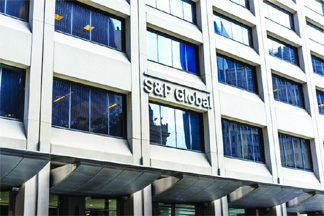
New Delhi (TIP)- After a gap of about 10 years, S&P Global Ratings has upped India’s outlook to positive from stable on robust growth prospects for next three years and public spending, and raised hopes for an upgrade in two years provided the government continues reforms and policies to keep fiscal deficit under check. While retaining India’s sovereign rating at the lowest investment grade of ‘BBB-’, S&P said it expects broad continuity in economic reforms and fiscal policies, irrespective of the election outcome.
Results of the ongoing general elections will be announced on June 4.
“India outlook revised to positive on robust growth and rising quality of Government spend,” S&P said, while affirming long-term rating at ‘BBB’. The ratings are looked at by investors as a barometer of the country’s creditworthiness and has impact on borrowing costs. Last in 2014, S&P had upped India’s outlook to stable from negative.
“Our positive outlook on India is predicated on its robust economic growth, pronounced improvement in the quality of government spending, and political commitment to fiscal consolidation. We believe these factors are coalescing to benefit credit metrics,” S&P said.
Tag: S&P
-
S&P raises outlook for India to ‘positive’
-
India to be third largest economy by 2030: S&P
Global Ratings agency S&P said India will be the world’s third-largest economy by 2030, but a major test for the country would be to unlock the ‘immense opportunity’ and become the next big global manufacturing hub. The US-based rating agency expects India to be the fastest growing major economy in the next three years, with GDP growth reaching 7% by 2026, from 6.4% projected expansion in the current fiscal. “India is set to become the third-largest economy by 2030, and we expect it will be the fastest growing major economy in the next three years. A paramount test will be whether India can become the next big global manufacturing hub, an immense opportunity,” the ratings agency said.
-

S&P affirms India’s sovereign rating; outlook stable
New Delhi (TIP)- S&P Global Ratings on Thursday , May 18, affirmed India’s sovereign rating at ‘BBB-’ with a stable outlook and said sound economic fundamentals will underpin growth over the next 2-3 years.
The stable outlook on the long-term rating reflects S&P’s view that India’s strong economy and healthy revenue growth will support its weak fiscal settings.
“S&P Global Ratings affirmed its ‘BBB-’ long-term and ‘A-3’ short-term unsolicited foreign and local currency sovereign credit ratings on India. The outlook on the long-term rating is stable,” the US-based agency said in a statement.
‘BBB-’ is the lowest investment grade rating.
“India’s economy is performing well amid challenging global conditions. We anticipate sound fundamentals to underpin growth over the next two to three years,” S&P said.
The government will likely maintain elevated fiscal deficits and a large debt stock despite ongoing consolidation efforts, it added.
Earlier this month, another global rating agency Fitch had affirmed India’s sovereign rating at ‘BBB-’ with a stable outlook, citing robust growth and resilient external finances.
Stock markets turn volatile after positive beginning
Equity benchmark indices started the trade on a firm note on Friday, May 19, amid positive trend in the global stock markets and foreign fund inflows but later turned volatile.
The 30-share BSE Sensex climbed 205.08 points to 61,636.82 in early trade. The NSE Nifty advanced 56.2 points to 18,186.15 in initial deals.
Later, both the benchmark indices turned volatile and were trading marginally lower.
The Sensex quoted 48.29 points lower at 61,383.45 and the Nifty dipped 28.30 points to 18,101.65. -
Patna HC stays Bihar caste survey, setback for Nitish
In a setback for the Opposition’s demand for a nationwide caste census and a similar exercise in states, the Patna High Court on Thursday, May 4, stayed the ongoing caste-based enumeration in Bihar, besides restricting the state government from sharing the already collected data till final orders are passed.
In an interim order on petitions challenging the Nitish Kumar-led Mahagathbandhan’s move at caste-based survey in the state, Chief Justice K Vinod Chandran and Justice Madhuresh Prasad directed the state to halt the ongoing exercise with immediate effect. The matter has now been posted for July 3. “We are of the considered opinion that the petitioners have made out a prima facie case against the continuation of the process of caste-based survey, as attempted by the state of Bihar. There is also the question raised of data integrity and security, which has to be more elaborately addressed by the state,” the court said after advocate general PK Shahi argued for the state. The move comes at a time when several Opposition parties, including the Congress, JDU, RJD, SP, DMK, BRS and the BJD, have raised the pitch for caste census amid the ruling BJP’s Hindu pitch. Three days ago, Odisha also began an OBC survey on the lines of Bihar. -

Asian markets take breather from banking turmoil, capping tumultuous week
SYDNEY (TIP)- Asian markets extended a risk rally on Wall Street on Friday to end a tumultuous week that saw a brewing banking crisis send bond yields plunging while market participants sharply lowered expectations of future interest rate hikes in Western economies. Overnight, the European Central Bank (ECB) delivered an inflation-fighting 50 basis point rate hike in line with oft-repeated guidance, with sentiment buttressed by the Swiss National Bank’s massive support for Credit Suisse Group AG, which sent the troubled lender’s shares 20% higher.
Further helping sentiment, as many as 11 U.S. banks including JPMorgan Chase & Co will deposit as much as $30 billion into First Republic Bank. Investors welcomed the move by sending the stricken lender’s stock 10% higher.
MSCI’s broadest index of Asia-Pacific shares outside Japan rose 0.9% on Friday, erasing earlier losses this week. Japan’s Nikkei climbed 0.5%. China’s bluechips increased 0.8% and Hong Kong’s Hang Seng Index surged 1.2%. S&P 500 futures eased 0.1% and Nasdaq futures were flat after major U.S. stock indices rallied hard on easing fear of a global banking crisis. Meanwhile, global central bankers on Thursday introduced what market watchers interpreted as an emerging effort to firewall the rate increases needed to fight inflation from separate efforts to calm concern about financial stability. “The ECB is trying to draw clear lines between its inflation fight and its job of maintaining financial stability. This is a theme other central banks are likely to echo,” said James Rossiter, head of global macro strategy at TD Securities.
“It is rare that financial turmoil emerges in such a high-inflation environment, and while tighter financial conditions come at a convenient time for inflation-fighting central banks, they are unlikely to believe that tighter financial conditions alone will be enough to return inflation to target.” After hiking as indicated, the ECB refrained from providing a forward guidance on future rate hikes. Euribor futures have fully priced in a quarter-point hike to 3.25% at the ECB’s next policy meeting and the possibility of another.
Markets are also back to overwhelmingly pricing in another 25 basis point hike from the U.S. Federal Reserve at its meeting next week, though there is a 20% chance of the Fed pausing instead. Two-year Treasury yields continued to climb on Friday, rising 8 basis points to 4.2137% and pulling away from a six-month low of 3.7200% touched earlier this week. Yields were, however, headed for the steepest weekly decline since February 2020 when markets were thrown into chaos by COVID-19 fear. Ten-year yields were steady at 3.5789% on Friday and were set for a weekly decline of 11 basis points.
The U.S. dollar and Japanese yen reversed some of their safe-harbour flows. The dollar index hovered at 104.38, after easing 0.3% overnight, while the yen pulled back from a one-month high to 133.47 per dollar. The euro steadied at $1.0615, after having received a boost from the ECB’s half-point hike overnight. Source: Reuters -

The Hindenburg Report on Adani conglomerate –
Uproar in Parliament, Opposition seeks JPC probe: Houses adjourned without transacting business
- RBI asks banks for details of exposure to Adani Group
- Boris Johnson’s brother quits linked firm; B’desh questions ‘expensive’ power deal
I.S. Saluja
NEW DELHI (TIP): The Hindenburg-Adani issue rocked Parliament with both Houses adjourned for the day without transacting any substantial business. The Congress-led Opposition raised allegations of irregularities against the Adani Group, demanding a probe into the matter by a Joint Parliamentary Committee (JPC) or by a sitting judge of the Supreme Court.
Both Houses were adjourned until 2 pm after presiding officers of the Lok Sabha and the Rajya Sabha rejected calls for deferment of proceedings to discuss the matter, prompting the Congress-led Opposition to demand a JPC probe or a day-to-day judicial probe headed by a Supreme Court judge. When the two Houses again met at 2 pm, the ruckus over the issue did not abate, and Parliament was adjourned for the day, a Tribune News Service report said. Leader of the Opposition in Rajya Sabha and Congress president Mallikarjun Kharge led the demand for the JPC or a Supreme Court-monitored probe, with the DMK, TMC, SP, JD(U), Shiv Sena (Uddhav), CPI(M), CPI, NCP, IUML, NC, AAP and Kerala Congress joining the issue. The decision to press for an investigation came after a meeting at Kharge’s chambers in the morning which was attended by opposition parties. Rajya Sabha Chairman Jagdeep Dhankhar had earlier said the notices were not in order, but Opposition leaders vowed to keep raising the matter till they were allowed a discussion. Kharge later told reporters that nine party leaders, including him, had given notices for adjournment of proceedings in the Rajya Sabha to discuss the issue but the proposal was rejected by Dhankhar.
Derek O’Brien of the TMC said: “Opposition leaders are being continuously harassed for no reason by the ED and the CBI. Now, the government must take action against the perpetrators of this monumental scam and ensure that they do not flee the country. The hard-earned money of millions of Indians is in peril.”
Ram Gopal Yadav of the SP said the matter was very serious as “people were being sent home by the SBI in several districts, saying that there’s no money.”
The Opposition has been alleging that public money of the LIC and SBI invested in Adani firms is in danger of sinking.
AAP’s Sanjay Singh asked: “Why is the government silent on this mega scandal? Adani is the scandal kingpin and the treasurer of the BJP. He has formed shell companies abroad, overvalued his shares and looted people’s money.”
Keshav Rao of the BRS questioned the RS Chairman’s rejection of the adjournment notices. “The Chairman says the notices are not in order. There’s no pro forma as far as adjournment notices are concerned,” he noted.
Shiv Sena (Uddhav) MP Priyanka Chaturvedi and DMK’s Kanimozhi also demanded a probe.
Meanwhile, Parliamentary Affairs Minister Pralhad Joshi said, “We have to run the House smoothly. A good Budget has been presented under the guidance of PM Modi. If they have constructive suggestions about the President’s Address, they should give. I urge them to run the House smoothly and put forth their arguments.”
Congress: Why govt mum?
Modi govt is maintaining silence on the Hindenburg report. We will not remain quiet if you cheat Indian investors, consisting of 29 crore LIC policy holders and 45 crore SBI account holders.
Meanwhile, the RBI has asked banks for details of exposure to Adani Group.
As the Reserve Bank of India (RBI) on Thursday, February 2, sought details about lenders’ exposures to the Adani Group, chairman Gautam Adani cited market volatility for the decision to withdraw the follow-on public offer (FPO) of its flagship firm Adani Enterprises. His companies continued to lose on the stock market with the cumulative rout nearing USD 108 billion in a week — one of the biggest wipeouts in India’s history.
The RBI is seeking details both from private and public banks with the total exposure to the group estimated at Rs 75,000 crore. It has also sought to know special arrangements extended to the companies such as collaterals in the form of bonds.
The National Stock Exchange (NSE) too has put shares of three group companies under the additional surveillance mechanism (ASM). The move indicates the company’s shares are in trouble and require special monitoring. In a media message, Adani claimed the fundamentals of the company were strong.
A day after Swiss lender Credit Suisse stopped accepting bonds by Adani Group companies as collaterals for margin lending, Norges Bank Investment Management from Norway followed suit. Citigroup also stopped extending margin loans against securities of the group.
Boris Johnson’s brother quits linked firm
Meanwhile, Lord Jo Johnson, younger brother of former British PM Boris Johnson, quit his non-executive directorship of a UK-based investment firm linked with the Adani Group’s now-withdrawn FPO. Johnson junior had taken the position in June last year and said he sat on the board after having been assured that the company “is compliant with its legal obligations and in good standing with regulatory bodies”.
Bangladesh questions ‘expensive’ power deal
Bangladesh too has sought a revision of a 2017 power purchase agreement with Adani Power after local media said the price was high and the issue had been earlier raised by PM Sheikh Hasina. The Bangladesh power company is seeking a 40 per cent downward revision in the price.
(Source: Agencies)
-
S&P affirms India’s rating at lowest investment grade
S&P Global Ratings has kept India’s sovereign rating unchanged at the lowest investment grade of ‘BBB-’ for the 14th year in a row, and said the government’s ability to execute additional economic reforms that spur investment and create jobs will be crucial for recovery from the current economic slowdown. S&P projected a 9.5% GDP growth in the current fiscal year that began in April and a 7.8% expansion in the following year. The GDP which shrank from $2.87 trillion in 2019-20 to $2.66 trillion in the following year is projected to expand to $3.96 trillion in 2024-25. Prime Minister Narendra Modi in 2019 envisioned making India a $5 trillion economy and a global economic powerhouse by 2024-25.
-
S&P cuts India’s FY22 growth forecast to 9.5%
New Delhi (TIP): S&P Global Ratings on Thursday, June 24, cut India’s growth forecast for the current fiscal to 9.5 per cent, from 11 per cent earlier, and warned of risk to the outlook from further waves of Covid pandemic. The agency lowered the growth outlook saying that a severe second Covid outbreak in April and May led to lockdowns imposed by states and sharp contraction in economic activity. “We forecast growth of 9.5 per cent this fiscal year from our March forecast of 11 per cent,” S&P said.
Stating that permanent damage to private and public sector balance sheets would constrain growth over the next couple of years, it projected India’s growth at 7.8 per cent in the next fiscal ending March 31, 2023.
“Further pandemic waves are a risk to the outlook given that only about 15 per cent of the population has received at least one vaccine dose so far, although vaccine supplies are expected to ramp up,” S&P said.
Indian economy contracted by 7.3 per cent in fiscal 2020-21 as the country battled the first wave of Covid, as against a 4 per cent growth in 2019-20.
GDP growth in the current fiscal was estimated to be in double digits initially, but a severe second wave of pandemic has led to various agencies cut growth projections.
Earlier this month, the RBI also cut India’s growth forecast to 9.5 per cent for this fiscal, from 10.5 per cent estimated earlier.
It said manufacturing and exports were less severely affected compared with 2020, but services were acutely disrupted. Consumption indicators such as vehicle sales fell sharply in May 2021 and consumer confidence remains downbeat. Source: PTI