
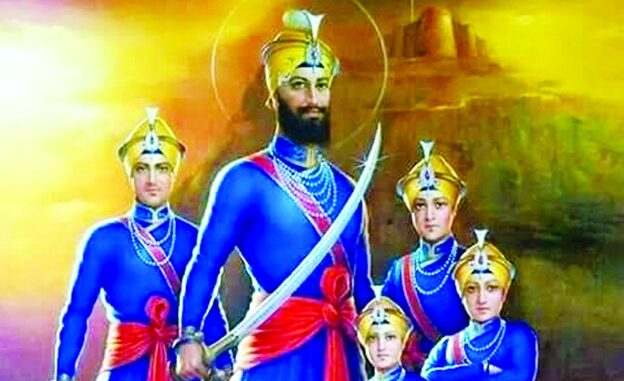

In the Sikh tradition, Shaheedi Pakhwara—literally meaning the fortnight of martyrdom—is not merely a span of dates on the calendar. It is a deeply contemplative and spiritually charged period during which the Sikh community collectively remembers some of the most defining sacrifices in its history. Observed primarily in the latter half of December, this pakhwara commemorates the martyrdoms of Guru Gobind Singh’s family members and the extraordinary sacrifices that shaped Sikh identity forever.Unlike festivals marked by celebration, Shaheedi Pakhwara is observed with solemnity, reflection, and inner resolve. It calls upon Sikhs to revisit the values for which their Gurus and Sahibzadas laid down their lives—faith, courage, righteousness, and resistance to tyranny.
The month of December occupies a unique and painful place in Sikh history. It was during this period in 1704-1705 that the Sikh Panth witnessed an unbroken chain of martyrdoms that tested the very soul of the community.
Within a span of just a few weeks: The elder Sahibzadas, Baba Ajit Singh and Baba Jujhar Singh, attained martyrdom fighting valiantly at Chamkaur Sahib.
The younger Sahibzadas, Baba Zorawar Singh (9) and Baba Fateh Singh (6), were martyred at Sirhind.
Mata Gujri, mother of Guru Gobind Singh, passed away in captivity after learning of her grandsons’ execution.
Guru Gobind Singh himself endured unimaginable personal loss while continuing to lead the Khalsa with unbroken spirit.
‘Shaheedi Pakhwara’ emerged organically in Sikh memory as a period to collectively remember this unparalleled sacrifice. Unlike festivals marked by celebration, Shaheedi Pakhwara is observed with solemnity, reflection, and inner resolve. It calls upon Sikhs to revisit the values for which their Gurus and Sahibzadas laid down their lives-faith, courage, righteousness, and resistance to tyranny.
Martyrdom of younger Sahibzadas
Few episodes in the long sweep of Indian history possess the emotional gravity, moral clarity, and civilizational significance of the martyrdom of Sahibzada Zorawar Singh and Sahibzada Fateh Singh, the younger sons of Guru Gobind Singh, the Tenth Guru of the Sikhs. Their sacrifice, sealed on December 26, 1705, was not merely an act of cruelty by a tyrannical regime; it was a defining moment when innocence confronted power, when conscience stood against coercion, and when faith revealed its highest form-fearlessness in the face of death.
The story of the Sahibzadas does not belong to one community alone. It belongs to the ethical memory of humanity. Across centuries, their martyrdom has endured as a testament to the truth that moral courage is not measured by age, and that even the smallest voices can thunder through history.
India under Aurangzeb: A climate of fear and orthodoxy
The late seventeenth century was a period of profound transformation and turbulence in the Indian subcontinent. The Mughal Empire, once known for its relative religious accommodation under rulers like Akbar, had entered an era of rigid orthodoxy under Emperor Aurangzeb. His reign was marked by the reimposition of the jizya tax, systematic destruction of temples, curtailment of non-Islamic practices, and a policy of forced conformity that deeply fractured India’s pluralistic ethos. Religious freedom, which had long been woven into India’s civilizational fabric, was under direct assault. Communities that resisted faced persecution, exile, or death. It was in this climate that the Sikh Gurus emerged as the strongest moral counterforce to imperial tyranny-not as rebels seeking political power, but as defenders of human dignity and freedom of belief.
Martyrdom of Guru Tegh Bahadur: The Moral Foundation
The roots of the Sahibzadas’ sacrifice lie in the martyrdom of their grandfather, Guru Tegh Bahadur, who was executed in 1675 for refusing to convert to Islam and for defending the religious rights of Kashmiri Pandits. His execution in Delhi marked a turning point in Indian history-it was perhaps the first recorded instance where a religious leader sacrificed his life explicitly for the freedom of another faith.
This act redefined Sikh identity. From that moment onward, resistance to injustice became inseparable from Sikh spirituality. Guru Tegh Bahadur’s martyrdom planted the seed that would later bloom into the Khalsa and ultimately into the supreme sacrifice of his grandsons.
Guru Gobind Singh: The Making of a Saint-Soldier Civilization
Ascending the Guruship at a young age, Guru Gobind Singh inherited not only spiritual leadership but an embattled legacy. He understood that piety alone could not survive unchecked tyranny. In 1699, through the historic creation of the Khalsa Panth, he reshaped Sikh society into a disciplined, fearless collective committed to justice, equality, and sacrifice.
The Khalsa was revolutionary. It erased caste distinctions, demanded moral integrity, and required absolute commitment to righteousness-even unto death. This transformation deeply unsettled the Mughal authorities and their allied hill rajas, who saw in the Khalsa a force they could neither control nor intimidate.
The Siege of Anandpur and the betrayal of sacred oaths
Repeated military campaigns were launched against Guru Gobind Singh. The prolonged siege of Anandpur Sahib subjected Sikhs to hunger, deprivation, and constant assault. Eventually, the Mughal authorities and hill chiefs swore solemn oaths-on the Quran and the cow-guaranteeing safe passage if the Guru vacated Anandpur.
Trusting the sanctity of these oaths, the Guru agreed. The assurances were broken almost immediately. Sikh caravans were attacked, families scattered, and chaos reigned. During this tragic exodus, Guru Gobind Singh’s family was separated-an event that would lead directly to one of the darkest crimes in Indian history.
Separation, refuge and betrayal
Amid the flooded currents of the Sirsa river, Mata Gujri, along with her two grandsons-Zorawar Singh (9) and Fateh Singh (6)-became separated from the Guru. Cold, exhausted, and vulnerable, they sought refuge in the home of Gangu, a former servant of the Guru’s household.
What should have been a moment of compassion became an act of treachery. Tempted by greed and fear, Gangu betrayed them to Mughal officials. The elderly grandmother and the two children were arrested and marched to Sirhind, the seat of Mughal authority in the region.
The Thanda Burj: Suffering in silence
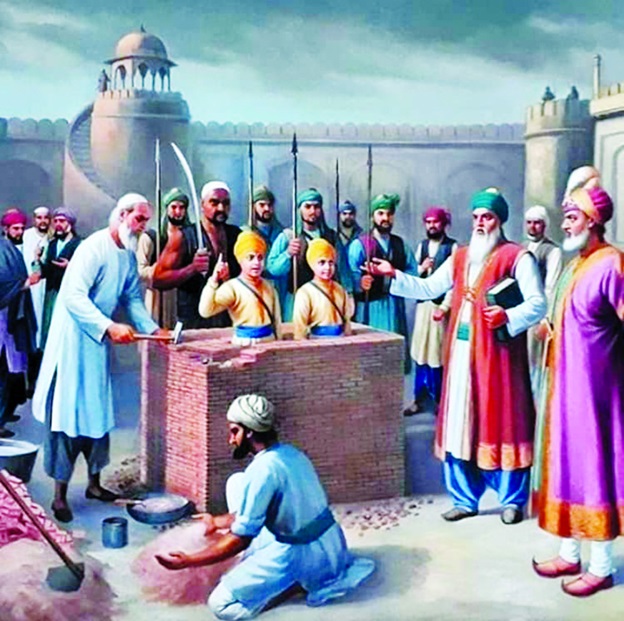
At Sirhind, Mata Gujri and the Sahibzadas were confined in the Thanda Burj, a tower designed to provide relief during summer heat but utterly exposed during winter. December winds pierced through its open structure. Food was scarce. Warm clothing was denied.
Yet, within those cold walls, something extraordinary unfolded. Mata Gujri did not allow despair to consume her grandchildren. Instead, she narrated stories of the Gurus’ sacrifices, reminding them of who they were and what they stood for. These were not tales meant to frighten children-but lessons meant to prepare souls. The Sahibzadas listened with clarity beyond their years.
The court of Wazir Khan: Innocence versus authority
When the children were produced before Wazir Khan, the Mughal governor of Sirhind, the court expected tears, fear, and submission. What it encountered instead was composure and conviction.
They were promised riches, royal status, and protection-on the sole condition that they convert to Islam. The offer was repeated. Religious scholars attempted persuasion. Threats followed. The children refused.
Their refusal was calm, articulate, and unwavering. They chose faith over life-not out of stubbornness, but out of understanding. In that moment, the court of Sirhind witnessed something it could not comprehend: spiritual sovereignty.
Bricked Alive: The ultimate act of tyranny
Enraged by their defiance, Wazir Khan ordered the unthinkable. The Sahibzadas were to be bricked alive within a wall, a punishment intended to terrorize and humiliate the Sikh community into submission.
As bricks were laid around their small bodies, Sikh tradition recounts that the wall collapsed repeatedly, as though refusing to stand upon injustice. Ultimately, when the wall could not be completed, the executioners beheaded the children.
On December 26, 1705, two young lives were extinguished-but a moral victory was sealed forever.
Mata Gujri’s final breath
When news of the execution reached Mata Gujri, the shock proved unbearable. Having endured cold, hunger, imprisonment, and the loss of her grandsons, she breathed her last soon after. Her passing is remembered not as a natural death, but as a martyrdom born of unbearable grief and spiritual surrender.
The martyrdom of the younger Sahibzadas is unparalleled in world history. It symbolizes:
– Courage beyond age
– Faith beyond fear
– Resistance without violence
– Victory without survival
They did not wield weapons, yet they defeated an empire morally. Their sacrifice exposed the emptiness of power when stripped of ethics.
Far from weakening the Sikhs, this atrocity ignited greater resolve. Within years, Banda Singh Bahadur would dismantle Mughal authority in the region, and Sirhind itself would face historical reckoning.
The Sahibzadas became the moral heartbeat of Sikh resistance-a reminder that tyranny must never go unanswered.
Shaheedi Jor Mela: Living Memory
Every year, lakhs gather at Fatehgarh Sahib for Shaheedi Jor Mela, where the martyrdom of the Sahibzadas is remembered not with despair, but with reverence and resolve. Their story is retold so it may never fade into silence.
Veer Bal Diwas: A Nation Acknowledges Its Children
In 2021, the Government of India declared December 26 as Veer Bal Diwas, marking a watershed moment in national remembrance.
Veer Bal Diwas (Day of Brave Children) is observed annually in India on December 26th to honor the supreme sacrifice of Sahibzada Zorawar Singh and Sahibzada Fateh Singh, the younger sons of Guru Gobind Singh Ji, for refusing to convert to Islam and choosing martyrdom over renouncing their faith. Declared a national observance by the Government of India in 2022, it’s a solemn day to remember their incredible bravery, commitment, and courage against tyranny, inspiring generations to uphold truth and justice.
The Elder Sahibzadas at Chamkaur: Valor Forged in Faith
At Chamkaur Sahib, history witnessed an act of courage so profound that it redefined the meaning of sacrifice in Sikh tradition.
Baba Ajit Singh, barely eighteen, and Baba Jujhar Singh, only fourteen, stood beside their father, Guru Gobind Singh, as a small band of Sikhs faced an overwhelming Mughal force numbering in the thousands. Surrounded, outnumbered, and fully aware that survival was impossible, the elder Sahibzadas did not seek escape. Instead, they sought honour in righteousness.
When the Guru asked for volunteers to step out of the besieged fortress and confront the enemy, Baba Ajit Singh was the first to rise. His decision was not impulsive bravado, but the natural expression of Khalsa training-where fearlessness is born of faith and life itself is secondary to truth. Armed with resolve and guided by the Guru’s blessing, he rode into battle and attained martyrdom after fighting with extraordinary valor.
Soon after, the fourteen-year-old Baba Jujhar Singh followed his elder brother’s path. Despite his tender age, his spirit was unyielding.
He engaged the enemy with remarkable courage, embodying the Sikh ideal that age is irrelevant when dharma calls. His martyrdom affirmed that the Khalsa is defined not by years lived, but by the strength of conviction.
The sacrifice of the elder Sahibzadas at Chamkaur symbolises the warrior ethos of Sikhism-a tradition where the sword is raised not for conquest, revenge, or hatred, but solely in defence of righteousness and justice.
Their martyrdom stands as a powerful reminder that Sikh warfare is not aggression, but resistance rooted in moral responsibility.
Together, Baba Ajit Singh and Baba Jujhar Singh demonstrated that true bravery lies not in survival at any cost, but in standing firm when truth is threatened, even if it demands the ultimate sacrifice. Their legacy continues to inspire generations, affirming that the Khalsa warrior fights not to dominate, but to protect dignity, faith, and freedom.
Sahibzada Ajit Singh Ji
Sahibzada Ajit Singh (1687-1705) was born to Mata Sunder Kaur and Guru Gobind Singh at Paonta Sahib. Sahibzada Ajit Singh and Sahibzada Jujhar Singh are remembered as ‘Vade Sahibzada’ in Sikh history. Sahibzada Ajit Singh was very intelligent, gifted with Gurbani, and agile from his childhood. At an early age, he mastered horseback riding and gun shooting. On May 23, 1699, while commanding a group of one hundred Singhs, he successfully raided the nearby village of Ranghars, who had once plundered the company of Pothohar Sikhs coming towards Anandpur Sahib. On March 15, 1700, he attacked the Gujars of Bajrur village, who once robbed the caravan of Singhs. On August 29, 1700, when the hill kings attacked the Taragarh fort, Sahibzada Ajit Singh bravely fought along with the Singhs. Similarly, in October 1700, again, the mountain forces attacked Nirmohgarh. Sahibzada took the lead, fought vigorously, and killed many hilly soldiers. Once, Dwarka Das Brahmin’s wife was taken away by the ruler of Bassi Kalan. On March 7, 1703, along with Bhai Uday Singh, Sahibzada and a group of one hundred (100) Singhs rescued the wife of the Brahmin from Basi Kalan and handed her over to the Brahmin. Sahibzada Ajit Singh spent most of his life on the land of Anandpur Sahib. In May 1705, when Anandpur Sahib was besieged by a coalition force of Hill Cheiftians and Mughal forces, he was also there. Both the elder Sahibzadas were with their father while leaving Anandpur Sahib. When forty Singhs fought a fierce battle in the fort of Chamkaur, Sahibzada Ajit Singh went to the battlefield with Singh spirit, showed his bravery, and killed many enemies. “Gur Sobha” testifies to this. Sahibzada Ajit Singh’s total age at the time of martyrdom was 18 years, 11 months, and 19 days.
Sahibzada Jujhar Singh Ji
Sahibzada Jujhar Singh (1691-1705) was born to Guru Gobind Singh and Mata Jit Kaur at Anandpur Sahib. Like his elder brother, he too was very intelligent, Gurbani-oriented, and skilled in horseback riding and archery. When Guru Sahib left Anandpur Sahib, he was also a companion. During the war of Chamkaur, he demonstrated his unwavering bravery and skill in a face-to-face fight with enemy forces. Before achieving martyrdom, he fought fiercely and killed many soldiers of the Mughal forces. Such a great personality was Guru Gobind Singh ji that before the start of the battle, he himself introduced both the Sahibzadas to the tradition of martyrdom. The Battle of Chamkaur was fought between the Khalsas and the joint forces of Mughals and hill chieftains of Shivalik Hills. It started at noon and continued until sunset. Guru Sahib has also mentioned this battle in his historical letter in Farsi, ‘Zafarnama’ or “Epistle of Victory,” addressed to Aurangzeb. The details of this battle are also found in ‘Bhattvahi Multani Sindhi”. By evening, only five Singhs were left in this battle. A council of Punj Pyares was convened and appealed Gurmata to order the Guru Sahib to leave the fort (kachi garhi) with three Singhs. The next morning, December 8, 1705, the remaining two Singhs, Bhai Sant Singh and Bhai Sangat Singh achieved martyrdom fighting the Mughal forces. Thus, the Battle of Chamkaur, fought between 40 odd Singhs and ten lacs of coalition forces led by the Mughals, remained the most unparalleled battle ever fought.



Be the first to comment