Tag: Spiti Valley

  • Spiti, a virgin paradise

    Spiti, a virgin paradise

    Long winding roads and valleys that present unforgettable glimpses of cold desert and snow-crowned mountains welcome you when you set foot into Spiti Valley. Bordered on all sides by the Himalayas, Spiti Valley, located in Himachal Pradesh, has an altitude of 12,500 feet above sea level, and gets just around 250 days of sunshine in the year, making it one of the coldest places in the country. With the thick Himalayan snow cutting Spiti off from the rest of the country for around 6 months a year, the summer months are the only time Spiti is directly accessible via motorway.

    The term Spiti means ‘The Middle Land’, as Spiti Valley separates India from Tibet. Scantily populated, Spiti is an adventure lover’s paradise, with a number of trekking trails that tourists can choose from. All of these treks start from Kaza (Spiti’s capital from where you make your base camp) to various peaks from where you can get panoramic views of the Himalayan mountains. An easy 1.5-kilometre trek along the Spiti River from Dhankar Monastery to Dhankar Lake promises gorgeous views of the villages below. The Dhankar Lake itself is a place where you can sit back and relax amidst the cool mountain air.

    How to reach?

    Travel by the preferred route from Manali isn’t possible in the snowy winters of Spiti due to closure of Rohtang Jot and Kunzum La pass. Flying to Spiti isn’t an option because there is no airport in Spiti. A few years ago, people thought of Spiti as a summer destination and very few still dare to venture out in the bone-chilling cold of the winters. The only possible way of arriving in Spiti is by the road route from Shimla through NH-22 via Kinnaur and then to Spiti.

    The road from Shimla to Kaza is open throughout the year and it is only in case of a major snowfall when the stretch from Tabo to Kaza is closed from a few hours to a few days. It is also to be noted that this route automatically affords gradual acclimatisation if the journey is broken in parts. Rohtang Jot and Kunzum La are officially closed for the season from October 15th and open around May-June.

    Shimla is an Inter-State Bus Terminal (ISBT) and has excellent connectivity to the bus stations of Rampur and Reckong Peo in Kinnaur. SUVs and other vehicles can also be rented from Shimla for the entire duration of the trip. The charges for the same may be a bit higher than in the summer months because the engine needs to be kept warm in the cold nights and extra fuel is burnt thereby. Shared taxis also ply sometimes from Rampur to Kaza.’

    Places that can and cannot be visited

    Some internal roads in Spiti are open in the winter. So it is possible to visit most places in Spiti, even in the stark cold winter. Roads to Demul, Langza, Kibber, Hikkim, Komic, Gue, Pin Valley, Nako and Chango (in Upper Kinnaur), Tabo etc may be open and accessible. It is also possible to visit Lhalung, Dhankar and Losar if the roads are not deemed too dangerous to ply on.

    It is important to know that in case of heavy snowfall, there are chances of roads being closed for a day or two or even a week which may hamper your plans. It is better to keep a buffer of a day or two in your plans as snowfall at over 4000 m can cause the road to be shut for vehicular traffic.

    The weather is bitterly cold in the high altitude villages of Spiti and the unbearable cold (sometimes -40 degrees Celsius) makes visiting the villages a difficult proposition in the winters.

    While travelling, it is advisable to keep the window panes in the vehicle closed so that there is minimal contact with the frigid air.

    Remember to always check with locals in Kaza and nearby villages about the prevailing weather and road conditions for the places you are heading to before embarking on a journey in wintry Spiti.

    Major attractions in winters

    The change in landscape means it is quite possible to think of Spiti as an entirely different land as compared to summers. There are frozen waterfalls, azure blue skies, trees devoid of leaves, pristine freezing rivers in the winter that make Spiti a more beautiful and novel experience.

    It is a good idea to first get acclimatised to the bare cold and high altitude of Kaza (3700 m) before exploring the various sites in the region. While coming from the Shimla route, the monastery of Nako coupled with a walk to the frozen or semi-frozen Nako Lake will help in acclimatisation and getting used to the cold. The oldest monastery in India, Tabo Gompa complex can be explored at leisure before making the final run to Kaza.

    Apart from these places, there are other noteworthy monasteries in Spiti, including the Sakya Gompa in Kaza, Ki Monastery, Dhankar Monastery and Dhankar Lake, Komic Gompa, Giu Monastery, Lhalung Gompa and Kungri Monastery, all being amazing experiences in the winter. Keep in mind that, depending on the amount of snow, the roads to these places may or may not be open. If the roads are closed, it is possible to trek to these villages on foot in the snow; it is advised not to trek by yourself and have a local guide or villager around.

    Major Spiti Valley attraction in the winters is the possibility of walking on the frozen Spiti and Pin rivers; keep in mind that there have been instances of people drowning in the past and any attempts are off the recommended list. A visit to high altitude Spitian village is another major attraction,; you will get to see local life and experience how it goes on in spite of the unbearable freezing temperatures.

    Reaching the village of Losar is a big upcoming attraction in Spitian winters. It is the biggest and farthest of all the Spitian villages and is a cultural delight. Locals celebrate festivals and folk dances by singing traditional Spitian songs. To revive the tradition, winters also see young men learn the art of carving Buddhist prayers on mane stones. In Kaza, locals can be seen playing the favourite Spitian game of ‘Cholo’.

    The road to Losar is almost unbelievable in the winter and the landscape is covered in a blanket of white. While the poplar trees are bare in Spiti, there may be blossoms of various colours on almond, plum, peach and apricot trees along the route in February/March. Celebrating the festivals of Dechang and Losar is another big attraction in the winters.

    Source: Happytrips

  • Spiti Valley: A virgin paradise

    Spiti Valley: A virgin paradise

    Long winding roads and valleys that present unforgettable glimpses of cold desert and snow-crowned mountains welcome you when you set foot into Spiti Valley. Bordered on all sides by the Himalayas, Spiti Valley, located in Himachal Pradesh, has an altitude of 12,500 feet above sea level, and gets just around 250 days of sunshine in the year, making it one of the coldest places in the country. With the thick Himalayan snow cutting Spiti off from the rest of the country for around 6 months a year, the summer months are the only time Spiti is directly accessible via motorway.

    The term Spiti means ‘The Middle Land’, as Spiti Valley separates India from Tibet. Scantily populated, Spiti is an adventure lover’s paradise, with a number of trekking trails that tourists can choose from. All of these treks start from Kaza (Spiti’s capital from where you make your base camp) to various peaks from where you can get panoramic views of the Himalayan mountains. An easy 1.5-kilometre trek along the Spiti River from Dhankar Monastery to Dhankar Lake promises gorgeous views of the villages below. The Dhankar Lake itself is a place where you can sit back and relax amidst the cool mountain air.

    Chandratal Lake

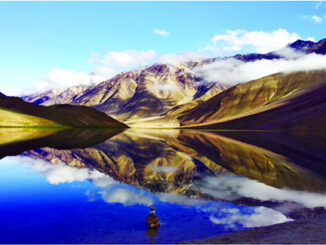
    Chandratal Lake is often referred to as one of the most beautiful lakes located at an altitude of about 4300 m in the mighty Himalayas. The stunning lake is situated on the Samudra Tapu plateau in the Lahaul region of the Lahaul and Spiti district and is the source of the Chandra River. The name “Chandra Taal” (Lake of the Moon) comes from its crescent shape. This lake is also one of two high-altitude wetlands of India that have been designated as Ramsar sites. Once a tentative residence for Tibetan traders travelling to Spiti and the Kullu valley, it attracts thousands of adventure enthusiasts.

    Legend has that the Chandratal Lake lies in the vicinity of a place from where God Indra’s chariot picked up Yudhishthira, the eldest of Pandava brothers in Mahabharata. This fact renders the lake sacred and thus, is flocked by a lot of Hindu devotees. The colour of the water of this holy lake keeps changing from reddish to orange to blue to emerald green as the day ends. Vast stretches of green meadows house the best camping sites and an array of different wildflowers during springtime. The trek from Batal to Chandratal can be quite a tedious trail, but the captivating views and charm of the place will be worth it. The sun’s light reflecting on the surface of the astounding Chandratal Lake makes it seem crystal clear.

    Key Monastery

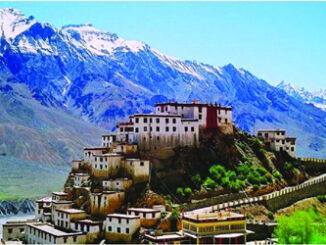
    The Key Monastery is a famous Tibetan Buddhist monastery in the Lahaul and Spiti District of India. Located at an altitude of 4,166 metres above sea level, the monastery is very close to the Spiti River in the Spiti Valley of Himachal Pradesh in India. Also known as the Kye Monastery and Ki Monastery, it is believed to have been founded by Dromton, who was a student of the famous teacher Atisha in the 11th century. It enshrines Buddha idols in the Dhyana position and has a collection of ancient books and murals.

    The stunning Key Monastery is over a thousand years old and is also the largest monastery to be found in the entire Spiti Valley. The magnificent monastery doubles up as a religious training centre for the Lamas, and about 300 lamas receive their education from here. It has a long and fascinating history attached to it: a long history that involves numerous attacks that the place had to face. Nevertheless, Kye Monastery survived and celebrated the completion of its thousand years in the year 2000 in the presence of the Dalai Lama.

    Kunzum Pass

    Kunzum Pass or Kunzum La, as it is called by locals, is one of the highest motorable mountain passes of India, located at an altitude of 4,551m above mean sea level. It serves as a gateway to the beautiful Spiti valley Via Kullu and Lahaul. It lies on the eastern Kunzum Range of the Himalayas and is at a distance of 122 km from Manali. Kunzum La offers an incredible 360-degree view of Bara- Shigri Glacier (the second longest glacier in the world), a jaw-dropping vista of Chandrabhaga Range and a spectacular view of the Spiti valley. This enthralling view makes Kunzum Pass a photographer’s dream.

    There is a 15km trek to the famous Chandratal Lake (moon lake) from Kunzum Pass. It is believed that the visitors have to stop at the temple of Goddess Kunzum Devi, on their way to the pass, to pay their respect and seek the blessing to travel safely through the rugged terrain safely. The tradition is to take a complete circle of the temple in your vehicle.

    Pin Valley National Park

    Set amidst semi-frozen rivers in the Pin Valley, the Pin Valley National Park is situated in the Cold Desert Biosphere Reserve situated in the Lahaul and Spiti District of Himachal Pradesh. The elevation of the park ranges from about 3,500 metres near Ka Dogri to more than 6,000 metres at its pinnacle. One of the fascinating facilities of its kind, the Pin Valley National Park is home to the rare species of famous Himalayan snow leopards and their prey, the Ibex. The National  Park is most famous for its incredible trek which is a delight for all its visitors.  It snows for the most part of the year rendering the trek a thrilling and adventurous expedition. However, make sure you obtain the required permits. Also, foreign nations are not allowed inside the park.

    The Pin Valley park’s core zone is sprawled across a vast area of 675 sq km while its buffer zone is extended over almost 1150 sq km. Today it is home to almost more than 20 species of flora and fauna including the endangered snow leopard which is the most significant inhabitant of Pin Valley Park. There are also Siberian Ibex, Bharal, red fox, weasel and marten that call this place their home. Several species of birds also inhabit in the region such as pika, snow cock, bearded vulture, chukor, golden eagle, griffon, Himalayan chough and raven.

    Suraj Tal

    Located at an elevation of 4950 m above the sea level, Suraj Tal Lake is considered as the 3rd largest lake in India. Situated in Spiti Valley, Suraj Tale In literal sense means, ‘The Lake of Sun God’. Just below the Baralacha pass, the stunning lake should definitely be visited while here, especially if they are into photography. The Suraj Tal, is one of the most dream-like and photogenic lakes.

    Due to the belief that a dip in the Suraj Tal lake cleanses a person of his sins, it attracts a lot of people and is therefore considered spiritual. However, the major reason that the lake has gained popularity is that it comes en-route to the famous Manali-Leh path that is popular for trekking and biking trips, that also encompasses the Baralacha-La Pass on the way. Suraj Tal is, thus, meant for people who are mostly adventurous, and religious at the same time.

              Source: Holidify.com