Tag: Sri Lanka

  • Commonwealth Day Celebrated

    Commonwealth Day Celebrated

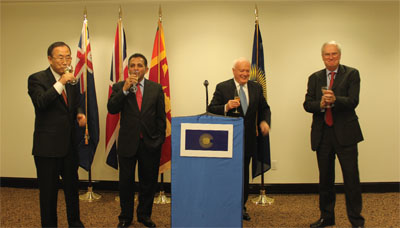
    NEW YORK (TIP): A reception to celebrate the Commonwealth Day was organized at Sri Lanka mission here on 11th March. Sri Lanka, UK and Australia cohosted the event. United Nations Secretary-General Ban Ki-Moon was among those present that included the Permanent Representative of UK Sir Mark Lyall Grant, Permanent Representative of Australia Gary Quinlan, Sri Lanka Permanent Representative Palitha Kohona, and Heads of Missions, senior UN officials and diplomats from various countries.


    img4

    The Permanent Representative of Sri Lanka, Palitha T.B. Kohona welcomed the guests in a speech and insisted on more unity among the Commonwealth Nations, “In the long run, it is tangible benefits that will keep us together. Although ideas and values are important, tangible benefits will be the glue that will bind us together as a family”. He also highlighted the challenges of “youth empowerment, women’s issues and trade and labor liberalization”.

    The Permanent Representative of Australia, Gary Quinlan, in his address spoke of the distinctive differences among the Commonwealth countries. “The Commonwealth comprises of 54 member states, of which, only 4 are developed countries. The rest are still developing”, he added. Permanent Representative of UK Sir Mark Lyall Grant read out a message from Queen Elizabeth. In her message the Queen said, “The heart of the Commonwealth lies in the striving of individuals and communities to achieve great goals”.

  • NACSAA’s ‘Thomas Jefferson’s Eternal Vigilance’ Awards Presented

    NACSAA’s ‘Thomas Jefferson’s Eternal Vigilance’ Awards Presented

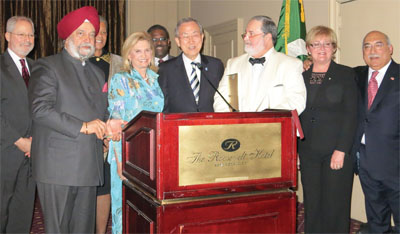
    NEW YORK (TIP): National Advisory Council on South Asian Affairs’ (NACSAA’s) “Thomas Jefferson’s Eternal Vigilance” Awards were presented to Ambassador Abdullah Hussain Haroon and Ambassador Hardeep Singh Puri on March 8, 2013, at the Roosevelt Hotel here.

    While Congresswoman Caroline Maloney presented the award to Ambassador Abdullah Hussain Haroon , Secretary General Ban Ki Moon presented the award to Ambassador Hardeep Singh Puri. Each was recognized for “for his exemplary service to humanity, unflinching dedication to freedom, the rule of law and helping ‘…form a more perfect world.’” In addition, Cong. Maloney presented Ambassador Haroon with a Congressional Record issued in his honor.

    At the event held in honor of UN Secretary General Ban Ki Moon, Ambassador Haroon spoke of the need for nations to keep talking in earnest, for as long as they are talking war is avoided. SG Ban spoke of the need to find a unified vision, with respect and friendship amongst nations, so humanity may better enjoy peace and prosperity.

    img2

    The select audience of over 130 guests was made up of members of the United Nations Security Council, Permanent Representatives, national, state and local elected officials, and dignitaries, including Congressman Gary L. Ackerman, Chef de Cabinet Susana Malcorra and Mrs. Ban. Congressman Meeks was unable to attend the event, as he was part of the official United States delegation to attend the funeral of President Hugo Chavez in Venezuela. Prior Thomas Jefferson Eternal Vigilance Award recipients include United States Assistant Secretary of State Richard Boucher, and Congressmen Gary L. Ackerman, Eliot L. Engel and inter alia, Gregory W. Meeks. NACSAA is made up of Americans with ancestry from, inter alia, Afghanistan, Pakistan, India, Sri Lanka, Nepal and/or Bangladesh.

  • Engage’ US on rights issue in UN: India To Lanka

    Engage’ US on rights issue in UN: India To Lanka

    NEW DELHI (TIP): Against the backdrop of demands by Tamil parties that India should vote against Sri Lanka at the UN on human rights, government on Wednesday, March 6 remained evasive on the stand it will take even as it asked Sri Lanka to treat it as a humanitarian issue rather than “a matter of ego”.

    With a US-sponsored resolution set to be moved on Lankan Tamils at the United Nations Human Rights Council, external affairs minister Salman Khurshid said he has asked his Lankan counterpart GL Peiris to work with the United States and report progress if any made on the issue to arrive at a draft which is “acceptable to everybody”. “Government will take a stand. As of now I have told my colleague foreign minister of Sri Lanka to engage the US. If you have moved forward (on human rights issue), you should bring that to the knowledge of the US to arrive at a consensual draft which is acceptable to everybody,” Khurshid told reporters outside Parliament. “It is a humanitarian issue.

    It is not an issue on which anybody should stand on ceremony or ego. If it is possible, speak to them directly and find a suitable and acceptable draft,” he said. His comments came against the backdrop of mounting demands by Tamil parties that India should take a tough stand against Sri Lanka and vote in favor of resolution to be moved against it. The US is set to move the new resolution against Sri Lanka at the current session of the UN Human Rights Council for its alleged war crimes, asking the country to promote reconciliation and accountability.

    The resolution will ask the government of Sri Lanka to follow through on its own commitments to its people, including implementing the constructive recommendations from the report by Sri Lanka’s Lessons Learnt and Reconciliation Commission.

  • Ajanta Caves A Legacy From The Golden Age

    Ajanta Caves A Legacy From The Golden Age

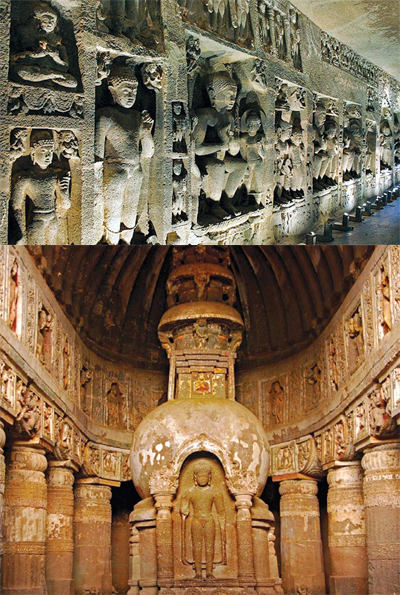
    Ajanta and Ellora are the pride of Maharashtra. The rock-cut caves of both these sites are world famous and illustrate the degree of skill and artistry that Indian craftsmen had achieved several hundred years ago. Ajanta dates from 100 B.C. while Ellora is younger by some 600 years. The village of Ajanta is in the Sahyadri hills, about 99 kms. From Aurangabad; a few miles away in a mammoth horseshoe-formed rock, are 30 caves overlooking a gorge, `each forming a room in the hill and some with inner rooms.

    Al these have been carved out of solid rock with little more than a hammer and chisel and the faith and inspiration of Buddhism. Here, for the Buddhist monks, the artisans excavated Chaityas (chapels) for prayer and Viharas (monasteries) where they lived and taught. Many of the caves have the most exquisite detailed carvings on the walls, pillars and entrances as well as magnificent wall paintings.

    These caves were discovered early in the 19th century quite by chance by a party of British Officers on manoeuvres. Today the paintings and sculptures on Buddha’s life, belonging to the more mellow and ritualistic Mahayana Buddhism period, are world famous. Copies of them were shown in the Crystal Palace exhibition in London in 1866. These were destroyed in a fire there.

    Further copies were published soon afterwards and four volumes of reproductions were brought out in 1933 by Ghulam Yazdani, the Director of Archaeology of the then Hyderabad State. Ajanta has formed an epicentre of interest for those who appreciate and are eager to know more about Indian history and art. It is a protected monument under the Archaeological Survey of India and has been listed in the World Heritage list of monuments.

    The 30 caves of Ajanta were created over a span of some 600 years. In their range of time and treatments they provide a panorama of life in ancient India and are a source of all kinds of information… hair styles, ornaments, textiles, musical instruments, details of architecture, customs etc.

    It was from this collection of classical Indian art that a particular style was formed that traveled with Buddhism to many parts of the world. Similar paintings can be seen in Sigiriya in Sri Lanka, Bamiyan in Afghanistan, temples and shrines in Tibet, Nepal, China and Japan. Royal patronage made Ajanta possible. Professional artists carried out much of the work and each contributed his own individual skill and devotion to this monumental work.

    Visitors often ask how the artist who painted the detailed frescoes and chiseled out the intricate carvings, managed to work in the dark interiors of the caves. It has been noticed that the caves are illuminated by natural light for part of the day and it is presumed that metal mirrors or sheets of white cloth were used to reflect sunlight into the inner recesses.

    Here, briefly, are some of the highlights of the caves. In the Cave 26, the sculpture is elaborate and beautiful though the painted frescoes are incomplete. The arched chapel window set in an elegantly simple façade, is repeated in an elaborate frontage in Cave 19 with its complete Chaitya and a slender votive stupa enclosing a standing Buddha at the far end. Of particular note is a sculpture of a seated Nagaraja with his consort and female attendant.

    Cave 16 is an elegant Vihara with an inscription that mentions the king and his minister who had the cave built. Here a towering Buddha sits preaching. He is flanked by attendants with fly whisks.

    There are undamaged portions of the wall paintings that are clear and vibrant in Caves 1, 2, 16 and 17. Cave I has the well known Bodhisattva Padmapani which is a wonderful portrayal of tender compassion. A gentle figure holding a lotus delicately in one hand. In the same cave is the golden figure of Avalokiteswara, elaborately adorned. The women, nymphs, princess and attendants are elegant and beautifully attired.

    Here also is a lively panel of dancing girls and musicians. In Cave 2 there is a detailed panel of Queen Maya’s dream, of the white elephant which was interpreted by royal astrologers to mean the birth of an illustrious son. The row upon row of Buddhas, can be seen in this cave. In Cave 17, there is a flying apsara in a fashionable embroidered turban and splendid jewellery.

    It is worth walking away from the caves in order to look back on to the horseshoe gorge. The ingenuous water cistern system can be seen which must have provided water for the monks and their visitors. Ajanta was on the ancient trade route leading to the coast so there must have been considerable activity and many visitors. Nobody really knows what life was like in those times and visitors can interpret the past as they wish, which is perhaps yet another secret charm of Ajanta.

  • Is Rest Doing Virat Kohli Any Good?

    Is Rest Doing Virat Kohli Any Good?

    NEW DELHI (TIP): Has the BCCI missed a trick by not including Virat Kohli in the Rest of India squad for the Irani Cup, or even the India A and Board President’s XI teams which play warm-up matches against Australia? Kohli, arguably India’s brightest new-generation batting hope, hasn’t exactly been in sparkling form this season and a stint in either of these teams could have served him well ahead of the crucial Tests against Australia. Denied match practice by the Indian cricket board, Kohli is now simulating match situations and making crucial technical adjustments ahead of the Tests by training here under long time coach Rajkumar Sharma.

    Although his ODI career so far has been spectacular – he won the ICC ODI Cricketer of the Year in 2012 – Kohli is aware that doubts remain about his ability to replicate that success in the longer format. Worryingly, his consistency has dipped across formats in recent times: since the unbeaten 128 against Sri Lanka in Colombo in July 2012, he has only two scores above 30 from nine ODIs, including the 77 not out against England in Ranchi.

    In Tests, he got a hundred against England in Nagpur but that knock came after a string of low scores. After a good series against the Kiwis last August, his sequence of scores against England read 19, 14 not out, 19, 7, 6, 20 and finally the 103 in the fourth Test. “It would have been good if he had played in some of the warm-up matches. It was BCCI’s choice. That decision had nothing to do with us,” Sharma told TOI. “Maybe the rest will do him good. Here in the academy, we are simulating Test-match situations.

    I tell Kohli about field placements, like three slips, a gully, even a forward short-leg and he has to adjust his shots accordingly. “We are also working on him leaving a lot of deliveries. Virat tends to push at the ball in ODIs but for the Tests, he has to get rid of the habit. He is a tough guy and a hard worker. He knows he needs a slight temperamentshift for Tests.

    He is focusing on staying longer at the crease, yet scoring briskly.” Former India opener Aakash Chopra, Kohli’s former teammate in the Delhi Ranji team, says the batsman must learn to deal with patches of indifferent form. “He has some technical glitches and there will be stages in his career when Kohli will go through bad form. For example, he has a short, back-andacross forward stride which makes him susceptible to balls that are pitched fuller and moving. More than the Irani Cup, where the quality of Mumbai’s bowling isn’t very good, Kohli and Gautam Gambhir both should have been played in the warmup matches.” Former India all-rounder Madan Lal agrees the BCCI didn’t give this too much thought but is hopeful Kohli will hit form against Australia. “Kohli has the right ideas. I don’t know if he needed rest.

    People groomed on the longer format find it less difficult to adjust to shorter formats. But with so much ODIs and T20 being played, younger international batsmen these days have to consciously make changes for Tests, which is not easy. So the more you play, the better it is.” Every batsman goes through bad form, but the very best can shrug it off sooner than the others. Can Kohli afford another patchy series against Australia?

  • The Republic Of India

    The Republic Of India

    The Republic of India is a large South Asian country rich in ethnic diversity,with over one billion people speaking hundreds of languages. Politically it is the world’s largest liberal democracy. The Indian economy is the fourth largest in the world, in terms of purchasing power parity, and is the world’s second-fastest growing economy. India is also the second most populated country in the world. India has grown significantly, in terms of both population and strategic importance, in the last twenty years attributed to economic reforms. Strategically located in Asia,constituting most of the Indian subcontinent,India straddles many busy trade routes. It shares its borders with Pakistan,the People’s Republic of China,Myanmar,Bangladesh,Nepal,Bhutan and Afghanistan.Sri Lanka,the Maldives and Indonesia are the nearby island nations in the Indian Ocean. Home to some of the most ancient civilisations in the world, India was formally ruled by the British for almost ninety years before gaining independence in 1947.

    Origin of India’s name:
    The official name India is derived from Sindhu, the historic local appellation for the river Indus and is the most internationally recognisable of the country. The Constitution of India and general usage also recognises Bharat as the other official name of equal status. Bharat comes from the name of an ancient Hindu king and means seeker of knowledge. The third name is Hindustan, meaning land of the Hindus (where Hindu refers to those who dwell to the right of the Indus/Sindhu river) used from the Mughal times onwards. India,a sub-continent with 5000 year old History. A civilization united by its diversity,richness of culture,the glory of past,the turbulences and triumphs. The landmarks of each era,the achievements of a change,the legacy of a regime.

    As we walk through the history,India is an amazing discovery and its history is a unique tale of the past. With the arrival of the Portuguese, French and English traders, advantage was taken of the fractured, debilitate kingdoms to colonise India. In 1857, an insurrection amongst the army sepoys ensued in the popular Revolt of 1857 against the powerful British East India Company; this mobilised resistance, though short-lasting, was caused by the widespread resentment against discriminatory policies of the British. After the revolt, the Indian independence movements started demanding complete independence. On August 15th, 1947, India was finally granted independence from British rule and became a secular republic.

    January 26 (Republic Day of India): Republic Day is one of the greatest national celebrations observed throughout the country on January 26 every year. India became Republic on the 26th Jan, 1950. The country became a sovereign democratic republic with a written constitution and an elected parliament. At the time of independence, although India was under British rule, there were 565 Princely States, big and small, ruled by powerful sovereigns who were protected by treaties of alliance with the British Crown.

    Without bringing them together, the fundamental unity of the country was not possible. This unification was accomplished by Sardar Vallabhbhai Patel, whose statesmanship helped to integrate the country into one nation. In a little less than 2 years, all the princely States became a part of the Republic of India. It was on this date in 1927 that the Indian National Congress, then fighting its nonviolent war for freedom, voted for complete independence as against ‘dominion status’. When members of the INC took the pledge to work towards a ‘sovereign democratic republic’ of India.

  • Raina, Rohit Lead India To Series Triumph

    Raina, Rohit Lead India To Series Triumph

    MOHALI (TIP): As Virat Kohli had promised before the match, the Indian team didn’t leave anything to chance and sealed the one-day series right here with a comprehensive five-wicket win over England. With this win, India have taken an unassailable 3-1 lead in the series, with one match still to play. It was apt that Ravindra Jadeja hit the winning runs on Wednesday, since his allround show throughout the series has helped the team at crucial junctures. India’s 258-run chase was powered by an unbeaten 89 (79 balls; 9×4, 1×6) from Suresh Raina, who was given the Man of the Match award.

    Raina was involved in two fifty-run partnerships, one each with Rohit Sharma (83; 93b, 11×4, 1×6) – playing a new role as opener – and skipper Mahendra Singh Dhoni. The series win will come as some relief for India in home conditions after they lost the Test series to England and an ODI series to Pakistan. India’s chase, though, was far from ideal. In the second erroneous decision of the day, umpire Steve Davis gave Gautam Gambhir out caught behind even though there was a clear gap between bat and ball. England could have had Rohit Sharma too, but Kevin Pietersen couldn’t latch on to a difficult chance at mid-off in the eighth over.

    Virat Kohli (26), after a 52-run partnership with Rohit Sharma, got out tamely, offering a return catch to James Tredwell. The English off-spinner made it four out of four against Yuvraj Singh, having accounted for him in the previous three games too, by trapping the southpaw leg before. At the other end, Rohit Sharma not only completed 2000 one-day runs but went on to score his 13th half-century. Sharma (83) was unlucky to miss out on a century, courtesy a second contentious decision by umpire Steve Davis, who adjudged him LBW though the ball appeared to be missing leg stump. Earlier, Dhoni made sure that his fast bowlers got the best use of a fresh wicket by winning the toss and electing to field. Cook hit Shami Ahmed for three boundaries in the sixth over to break the shackles, but the mounting pressure soon resulted in the wicket of Ian Bell (10), who tried to give Ishant Sharma the charge but only managed to give a skier to Bhuvneshwar Kumar at third man.

    After that Kevin Pietersen and Cook resurrected the England innings, adding 95 runs for the second wicket. Cook brought up his fifty in the 22nd over and went on to score 76 (106 balls; 13×4) but umpire Sudhir Asnani’s error of judgment ended the English skipper’s promising innings. Cook was wrapped on the pads by a quicker delivery from R Ashwin, but the ball had clearly pitched outside leg stump. England slumped to 142/4 by the 37th over but Joe Root, along with Kevin Pietersen, forged a partnership of 78 runs off 56 balls. KP, who had been unusually quiet, suddenly broke loose, hitting Ishant Sharma for 4, 4, and 6 in the 46th over before Ishant uprooted his stumps with a yorker. Root’s unbeaten 57 (45 balls; 8×4, 1×6) gave England the final impetus, but it was not enough.

    ICC ODI Championship
    Team Rating
    India 120
    England 117
    Australia 113
    South Africa 111
    Sri Lanka 110
    Pakistan 107
    West Indies 88
    New Zealand 80
    Bangladesh 78
    Zimbabwe 50
    Ireland 35
    Netherlands 16
    Kenya 11

  • Rajapaksa Names His Man As Sri Lanka’s New Chief Justice

    Rajapaksa Names His Man As Sri Lanka’s New Chief Justice

    COLOMBO (TIP): Sri Lankan President Mahinda Rajapaksa on Jan 15 appointed his cabinet’s legal adviser as the country’s new chief justice to succeed Shirani Bandaranayake, whose impeachment created much furore both inside and outside the nation. Rajapaksa sworn in new Chief Justice Mohan Peiris to replace Sri Lanka’s first woman chief justice who was impeached by the parliament in a controversial move. Peiris, a British qualified solicitor who retired in 2011 as the Attorney General was serving as the legal advisor to the Cabinet.

    He is being seen as a favourite of the government. Peiris has lobbied for Sri Lanka during the sessions of the United Nations Human Rights Council in recent years. He is also supervising the implementations of recommendations by Sri Lanka’s post war reconciliation commission (LLRC). Presidential officials said Peiris took over as the new chief justice today after the sacking of Bandaranayake following a parliamentary ratification last week of the impeachment against her. Bandaranayake’s impeachment came despite the Supreme Court’s ruling of the process against her illegal.

    She had walked out of the parliamentary investigation citing bias. National and international rights groups have severely criticised the government of Sri Lanka over the issue. Rights groups have questioned the legality of the impeachment that has pitted the judiciary against the government. In keeping with the opposition, Civil society think tank, the Centre for Policy Alternatives filed a fundamental rights petition in the Supreme Court seeking an order restraining Peiris from taking office. The legal fraternity was up in arms against the impeachment and had vowed not to cooperate with her successor.

  • Foreign Tourist Arrivals To Kerala Plummet

    Foreign Tourist Arrivals To Kerala Plummet

    KOTTAYAM,INDIA (TIP): Asharp decline inarrival of foreigntourists to Keralais causing concernin the tourismindustry. Thedeclining trendthat started a fewyears agocontinuesunabated.T. Damu,director of Taj group of hotels and resortsin Kerala, said that foreign tourist arrivalshave declined considerably because ofrecession, escalating air fare andcontinuous rains during tourist seasons.

    Peak season
    Major hotels that accommodateforeigners in Kumarakom said that thepeak season begins in October-November.They hoped that something positive wouldhappen to bring in more tourists this year.Tourism agencies and houseboat ownersare unanimous that there is already a lullin tourist activities mainly because of thedelay in issuing visa for internationaltourists and consequent cancellation oftours. Many foreign tourists coming toIndia have rescheduled their visits toneighboring countries such as Sri Lanka,Singapore, Malaysia, Thailand etc.The exorbitant rent for suites in starhotels, unethical and unaffordable taxi andauto rickshaw charges and above all themisconduct of touts and miserable hygieneproblems are theother reasons fortheir absence inGod’s own country.If a foreigner isspotted on theroad, autorickshaw driverscompete with oneanother to fleecethem.

    Domestic arrivals
    Domestic tourist arrivals are alsosagging. Usually at the beginning of theseason, the domestic visitors arrive fromother States. This year, though the seasonhas already started, the arrivals ofdomestic visitors are yet to pick upmomentum. The poor inflow is affectingthe houseboat sector.Of about 1,000 houseboats atPunnamada, only around 150 are earningthe minimum to meet the daily expenses,said Mr Anil Kumar, owner of a newhouseboat based at Kumarakom.Houseboat owners have already incurredheavy losses because of stagnation intourism sector.Another impact is reported to be the ‘goslow’ in the sale of properties at primelocations in tourist spots where large areashave been bought by leading realtors, filmstars and others, hoping for big profits laterat the time of resale. In Kumarakom, manycelebrities have bought plots for setting upholiday homes.

  • Human Rights Group Wants Tamil Students Charged Or Freed

    Human Rights Group Wants Tamil Students Charged Or Freed

    COLOMBO (TIP): A human rights group on Thursday urged Sri Lanka to formally charge or release four university students detained on allegations of terrorism for honoring Tamil Tiger rebels who died during the country’s bloody civil war. The students in the northern city of Jaffna were arrested by anti-terrorism police for lighting lamps in honor of Tamil rebels to mark their annual heroes’ day on Nov. 27. This month they were transferred to a rehabilitation center housing former Tamil Tigers.

    “Arresting four students without charge and sending them off for ‘rehabilitation’ sends a dangerous message that any Tamil can be detained arbitrarily and indefinitely,” said Brad Adams, Asia director for New York-based Human Rights Watch. “The Sri Lankan government needs to recognize that engaging in peaceful activities that conflict with the government’s views is an exercise of basic rights, not a criminal offense,” Adams said in a statement. Government soldiers defeated the rebels in 2009, ending a quartercentury bid to create an independent state for the country’s ethnic minority Tamils. Since then the government has razed rebels’ war burial grounds and prevented memorials including for civilians killed in the civil war.

    Tens of thousands of civilians were estimated to have died in just the final five months of the conflict. The Liberation Tigers of Tamil Eelam was considered one of the most ruthless and effective terrorist groups in the world, highlighted by the use of suicide bombers and child soldiers. Memorials for their fallen cadres were held every year on Nov. 27, with highlight an annual speech by the rebel leader Velupillai Prabhakaran, who was killed by government troops in the final days of the war.

    Government spokesman Keheliya Rambukwella said the students are being detained because they organized an event in honor of a banned organization. A government-appointed war commission recommended last year that war-affected civilians be allowed to organize peaceful memorials to promote post-war reconciliation. Ethnic Tamil politicians have criticized the government crackdown on memorials as a practice of double standards because memorials for those who took part in two Marxist insurrections in 1971 and 1988-89 are freely held every year. The Marxist rebels are mostly ethnic majority Sinhalese.

  • An Indian grammar for International Studies

    An Indian grammar for International Studies

    A little over three years ago I wrote in The Hindu that at a time when interest in India and India’s interest in the world are arguably at their highest, Indian scholarship on global issues is showing few signs of responding to this challenge and that this could well stunt India’s ability to influence the international system.

    As we meet here now, at the first real convention of scholars (and practitioners) of International Studies from throughout India, we can take some comfort. A quick, albeit anecdotal, audit of the study of International Studies would suggest that the last three years have been unusually productive.

    So much so, that we are now, I believe, at a veritable “tipping point” in our emergence as an intellectual power in the discipline. Hoffman, Professor of International Relations (IR) at Harvard, once famously remarked that IR was an American social science.

    The blinding nexus between knowledge and power (particularly stark in the case of IR in the United States) perhaps made him forget that while the first modern IR departments were created in Aberystwyth and in Geneva, thinking on international relations went back, in the case of the Indian, Chinese and other great civilizations, to well before the West even began to think of the world outside their living space. Having absorbed the grammar of Western international relations, and transited to a phase of greater self-confidence, it is now opportune for us to also use the vocabulary of our past as a guide to the future.

    2011 survey
    Recovery of these Indian ideas should not be seen as part of a revivalist project or as an exercise that seeks to reify so-called Indian exceptionalism. Rather, interrogating our rich past with its deeply argumentative tradition is, as Amartya Sen put it, “partly a celebration, partly an invitation to criticality, partly a reason for further exploration, and partly also an incitement to get more people into the argument.”

    In the context of international relations it offers the intellectual promise of going beyond the Manichean opposition between power and principle; and between the world of ideas and norms on the one hand, and that of statecraft and even machtpolitik, on the other. In doing so we are not being particularly subversive.

    A 2011 survey of American IR scholars by Foreign Policy found that 22 per cent adopted a Constructivist approach (with its privileging of ideas and identity in shaping state preferences and international outcomes), 21 per cent adopted a Liberal approach, only 16 per cent a Realist approach, and a tiny two per cent a Marxist approach. When academics were asked to “list their peers who have had the greatest influence on them and the discipline,” the most influential was Alexander Wendt, the Constructivist, and neither the Liberal, Robert Koehane, nor the Realists, Kenneth Waltz or James Mearisheimer.

    Mohandas Gandhi once said that “if all the Upanishads and all the other scriptures happened all of a sudden to be reduced to ashes, and if only the first verse in the Ishopanishad were left in the memory of the Hindus, Hinduism would live forever.” Let me make what may seem like another astounding claim, and which I hope, in the best argumentative tradition, will be heavily contested.

    If all the books on war and peace were to suddenly disappear from the world, and only the Mahabharata remained, it would be good enough to capture almost all the possible debates on order, justice, force and the moral dilemmas associated with choices that are made on these issues within the realm of international politics.

    Uncertainty in the region

    Beyond theory, we are faced with a period of extraordinary uncertainty in the international system and in our region. Multilateralism is in serious crisis. While the U.N. Security Council remains deadlocked on key issues, there is little progress on most other issues of global concern, be it trade, sustainable development or climate change. As academics, we cannot remain unconcerned about these critical failures.

    Our continent is being defined and redefined over time. Regions are, after all, as much shaped by the powerful whose interests they seek to advance as by any objective reality. Whatever nomenclature we adopt, and whatever definition we accept, we are faced with, what Evan Feigenbaum and Robert Manning described as two Asias: the ‘Economic Asia’ whose $19 trillion regional economy drives global growth; the “Security Asia,” a “dysfunctional region of mistrustful powers, prone to nationalism and irredentism, escalating their territorial disputes over tiny rocks and shoals, and arming for conflict.” The Asian Development Bank says that by nearly doubling its share of global GDP to 52 per cent by 2050, Asia could regain the dominant economic position it held 300 years ago.

    Yet, as several academics have pointed out “it is beset by interstate rivalries that resemble 19th century Europe,” as well the new challenges of the 21st century: environmental catastrophes, natural disasters, climate change, terrorism, cyber security and maritime issues. An increasingly assertive China that has abandoned Deng Xiaoping’s 24-character strategy of hiding its light and keeping its head low, adds to the uncertainty of the prevailing strategic environment. India’s military and economic prowess are greater than ever before, yet its ability to influence South Asian countries is less than what it was, say, 30 years ago.

    An unstable Nepal with widespread anti-India sentiment, a triumphalist Sri Lanka where Sinhalese chauvinism shows no signs of accommodating legitimate Tamil aspirations, a chaotic Pakistan unwilling to even reassure New Delhi on future terrorist strikes, are symptomatic of a region being pulled in different directions. Can our thinking from the past help us navigate through this troubled present? Pankaj Mishra, in his brilliant book, From the Ruins of Empire: the Revolt Against the West and the Remaking of Asia, describes how three 19th century thinkers, the Persian Jamal-al Din al-Afghani, Liang Qichao from China and India’s Rabindranath Tagore, navigated through Eastern tradition and the Western onslaught to think of creative ways to strike a balance and find harmony.

    In many ways, these ideas remain relevant today as well. For if Asia merely mimics the West in its quest for economic growth and conspicuous consumption, and thAlittle over three years ago I wrote in The Hindu that at a time when interest in India and India’s interest in the world are arguably at their highest, Indian scholarship on global issues is showing few signs of responding to this challenge and that this could well stunt India’s ability to influence the international system. As we meet here now, at the first real convention of scholars (and practitioners) of International Studies from throughout India, we can take some comfort. A quick, albeit anecdotal, audit of the study of International Studies would suggest that the last three years have been unusually productive. So much so, that we are now, I believe, at a veritable “tipping point” in our emergence as an intellectual power in the discipline. Hoffman, Professor of International Relations (IR) at Harvard, once famously remarked that IR was an American social science. The blinding nexus between knowledge and power (particularly stark in the case of IR in the United States) perhaps made him forget that while the first modern IR departments were created in Aberystwyth and in Geneva, thinking on international relations went back, in the case of the Indian, Chinese and other great civilizations, to well before the West even began to think of the world outside their living space. Having absorbed the grammar of Western international relations, and transited to a phase of greater self-confidence, it is now opportune for us to also use the vocabulary of our past as a guide to the future. 2011 survey Recovery of these Indian ideas should not be seen as part of a revivalist project or as an exercise that seeks to reify so-called Indian exceptionalism.

    Rather, interrogating our rich past with its deeply argumentative tradition is, as Amartya Sen put it, “partly a celebration, partly an invitation to criticality, partly a reason for further exploration, and partly also an incitement to get more people into the argument.” In the context of international relations it offers the intellectual promise of going beyond the Manichean opposition between power and principle; and between the world of ideas and norms on the one hand, and that of statecraft and even machtpolitik, on the other. In doing so we are not being particularly subversive.

    A 2011 survey of American IR scholars by Foreign Policy found that 22 per cent adopted a Constructivist approach (with its privileging of ideas and identity in shaping state preferences and international outcomes), 21 per cent adopted a Liberal approach, only 16 per cent a Realist approach, and a tiny two per cent a Marxist approach. When academics were asked to “list their peers who have had the greatest influence on them and the discipline,” the most influential was Alexander Wendt, the Constructivist, and neither the Liberal, Robert Koehane, nor the Realists, Kenneth Waltz or James Mearisheimer.

    Mohandas Gandhi once said that “if all the Upanishads and all the other scriptures happened all of a sudden to be reduced to ashes, and if only the first verse in the Ishopanishad were left in the memory of the Hindus, Hinduism would live forever.” Let me make what may seem like another astounding claim, and which I hope, in the best argumentative tradition, will be heavily contested. If all the books on war and peace were to suddenly disappear from the world, and only the Mahabharata remained, it would be good enough to capture almost all the possible debates on order, justice, force and the moral dilemmas associated with choices that are made on these issues within the realm of international politics. Uncertainty in the region Beyond theory, we are faced with a period of extraordinary uncertainty in the international system and in our region. Multilateralism is in serious crisis. While the U.N. Security Council remains deadlocked on key issues, there is little progress on most other issues of global concern, be it trade, sustainable development or climate change. As academics, we cannot remain unconcerned about these critical failures. Our continent is being defined and redefined over time. Regions are, after all, as much shaped by the powerful whose interests they seek to advance as by any objective reality.

    Whatever nomenclature we adopt, and whatever definition we accept, we are faced with, what Evan Feigenbaum and Robert Manning described as two Asias: the ‘Economic Asia’ whose $19 trillion regional economy drives global growth; the “Security Asia,” a “dysfunctional region of mistrustful powers, prone to nationalism and irredentism, escalating their territorial disputes over tiny rocks and shoals, and arming for conflict.” The Asian Development Bank says that by nearly doubling its share of global GDP to 52 per cent by 2050, Asia could regain the dominant economic position it held 300 years ago.

    Yet, as several academics have pointed out “it is beset by interstate rivalries that resemble 19th century Europe,” as well the new challenges of the 21st century: environmental catastrophes, natural disasters, climate change, terrorism, cyber security and maritime issues. An increasingly assertive China that has abandoned Deng Xiaoping’s 24-character strategy of hiding its light and keeping its head low, adds to the uncertainty of the prevailing strategic environment.

    India’s military and economic prowess are greater than ever before, yet its ability to influence South Asian countries is less than what it was, say, 30 years ago. An unstable Nepal with widespread anti-India sentiment, a triumphalist Sri Lanka where Sinhalese chauvinism shows no signs of accommodating legitimate Tamil aspirations, a chaotic Pakistan unwilling to even reassure New Delhi on future terrorist strikes, are symptomatic of a region being pulled in different directions.

    Can our thinking from the past help us navigate through this troubled present? Pankaj Mishra, in his brilliant book, From the Ruins of Empire: the Revolt Against the West and the Remaking of Asia, describes how three 19th century thinkers, the Persian Jamal-al Din al-Afghani, Liang Qichao from China and India’s Rabindranath Tagore, navigated through Eastern tradition and the Western onslaught to think of creative ways to strike a balance and find harmony.

    In many ways, these ideas remain relevant today as well. For if Asia merely mimics the West in its quest for economic growth and conspicuous consumption, and the attendant conflict over economic resources and military prowess, the “revenge of the East” in the Asian century and “all its victories” will remain “truly Pyrrhic.”e attendant conflict over economic resources and military prowess, the “revenge of the East” in the Asian century and “all its victories” will remain “truly Pyrrhic.”

  • As I See It:Welcome Change

    As I See It:Welcome Change

    One must congratulate the Government of India for taking the bold step of joining the 138 nations voting ‘Yes’ for the resolution to upgrade Palestine to a non-member observer state in the United Nations.

    What is commendable is that despite India’s recent strategic overtures to the United States and its cooperation with Israel on defense matters, India demonstrated independence and courage in voting for the Palestinians. In the past, while India made some feeble noises in spurts regarding the Palestinians’ cause and about international morality, India’s policy had seen several flip-flops and had lacked boldness. It was the usual customary dubious statements after every incident involving or affecting the Palestinians; the nature and careful wording of the official statements after the fact reflected its spineless foreign policy.

    Gladly, this time it was different. Along with the newly found courage, one hopes that the policy is backed by a firm sense of purpose. This sense of purpose should be revealed in its reaction to America’s actions in Syria, another Arab country. Barack Obama, weighed down by the difficult task of showing results in the domestic economy and particularly in the unemployment rate during his second and last term of presidency, may take cover under results in his foreign policy.

    After his tacit approval of the happenings so far in Syria, he may now plan for a stronger action to dislodge President Bashar Assad. As it is, the effects of the uprising against Assad and the suppression of the unrest by the present Syrian government have been devastating for the people of that country. There is a humanitarian crisis, as US’s ally UK’s prime minister David Cameron has said recently.

    But, it is going to be complicated further by escalating the armed conflict in that country. The first step the US and its allies may take is to deploy surface to air missiles in Turkey, thus dragging the latter into almost a war. Will India show its true mettle by advising its new strategic partner – the US – against any misadventure in Syria? If India believes in the larger issue of peace and justice, it should put it in practice by being able to prevent escalation of the Syrian conflict to Turkey and then its further spread elsewhere. After the George W Bush era, the Americans have agreed, if not very vocally, that the ‘weapons of mass destruction’ theory was a lie. The threat of biological war by Iraq was also an unfounded fear.

    Indian foreign policy had been to keep its lips zipped through the entire episode. It was neither for the Arabs nor against them. Not a good policy for a country that depended so much on the Arab world by importing oil and exporting labor force in large numbers.

    No significant help
    What India got in return was some leniency in the international nuclear power production regime and nuclear reactors that the US and its European allies anyway wanted to sell us during their recessionary times. That a highly risk-prone nuclear power production would not help our energy crunch in any significant way is another matter. Since the fall of Saddam Hussein, the Arab world has seen increasing turmoil and the western world has become bolder in its initiatives in the Arab countries.

    There is a huge room for doubt regarding the genesis of the so-called ‘Arab Spring’. Hosni Mubarak of Egypt was toppled by what seemed like a popular uprising against his rule which lasted over three decades. His replacement, Mohamed Morsi who has enacted draconian laws giving him sweeping powers, does not appear to be any messenger of democracy for the people of that country.

    The effect for the Arab region and the countries nearby has been one of some degree of destabilization. Whatever may have been the demerits of the Hosni Mubarak government, it had an influence in holding the regional countries together. Egypt had a moderating influence in a region that was moving towards increasing fundamentalism. During the entire Tahrir Square movement, India remained a mute spectator, as though a strategy of non-commitment was a prudent policy. It remains unsure even now.

    The fall of and killing of Colonel Muammar Gaddafi of Libya was another sordid saga in which, again, India practiced silence. Gaddafi may have been a dictator, but the situation that has replaced his regime is no better; Libya has not gone any farther after Gaddafi; if any, it has sunk into endless internal squabbles. India did not take any active diplomatic interest to defuse the crisis and better the prospects of the country. Arabs and now Iran are at the receiving end from the western powers that obviously have an eye on the oil resources in this part of the world. Peace, stability and prosperity of that region are in the best interests of India.

    If India does not support their cause out of a sense of helplessness, then the same sense of vulnerability will manifest when it has to deal with the border problems with China and Pakistan and several other issues with Bangladesh, Myanmar, Sri Lanka and Maldives. If an era of toughness and principled stand has indeed commenced for India as indicated in the case of the recent UN vote on Palestine, it is a significant event. India needs to be firm and focused as regards its relations with the outside world. It needs to be candid with its strategic allies like the United States.

  • China Omits India, Pak from 72-Hour Visa Free Travel

    China Omits India, Pak from 72-Hour Visa Free Travel

    The list mostly includes US and European countries but China’s neighbours in South Asia, including India, Pakistan, Bangladesh, Myanmar and Sri Lanka are missing
    BEIJING (TIP): China announced a 72-hour visa free stay in Beijing for travelers from 42 countries but India, Pakistan and the rest of South Asian nations were conspicuously missing from the list. Beijing will start a 72-hour visa-free stay policy for citizens of 45 countries from January 1 next year in a bid to increase the inflow of tourists to the Chinese capital, state-run Xinhua news agency reported. Tourists holding third country visas and plane tickets can apply for a transit without visa (TWOV) in the capital city at Beijing Capital International Airport. The list mostly includes US, European countries as well as Japan and Russia.

    All most all of China’s neighbours in South Asia, including India, Pakistan, Bangladesh, Myanmar and Sri Lanka did not figure in the list. The 45 countries were listed in accordance with the numbers of inbound overnight visitors in Beijing from 2009 to 2011, the Xinhua report said. ‘The policy may enhance the status of Beijing Capital International Airport as an international air hub, said Gao Lijia,’ a general deputy manager with the airport. The airport has seen about 7.6 million inbound and outbound foreign passengers during the first nine months in 2012 and 521,600 out of them are transit passengers, Gao said. He predicted that the policy will bring 600,000 to 800,000 transit visitors to China in 2013. To help with the transit visitors, the airport will improve service facilities in the airport including special visa-free channels, said Li Chunfang, manager with the planning and development department of the airport.

    ‘We will set up a special service zone for transit visitors in our terminals, offering drinking water and reading materials. Moreover, services including foreign currency exchange, mobile phone rental service, and left-luggage office will be provided for the convenience of tourists,’ he said. Foreign visitors are not permitted to leave Beijing to other Chinese cities during the 72 hours, and have to depart from Beijing. Visitors have to register at a police station with their visas within 24 hours of their arrival, according to the government. The 72 hours will be calculated starting from the moment visitors get their transit stay permits, said Gao Dahua, deputy director of the exit and entry administrative corps of Beijing Municipal Public Security Bureau. Beijing Capital International Airport is the only entry-exit port applicable for the policy, Gao stressed.

  • The Phenomenon: Monty Panesar

    The Phenomenon: Monty Panesar

    England raced to a famous 10-wicket win over India in the second Test after Monty Panesar finished with a career-best match haul of 11 for 210. The tourists’ series-levelling victory was achieved principally on the back of Kevin Pietersen and captain Alastair Cook’s wonderful first-innings centuries on Sunday. They merely had to complete an apparently straightforward task – and duly did so with the minimum of fuss at the Wankhede Stadium. Mudhsuden Singh Panesar, known affectionately in the game as Monty, quickly established himself as a national hero after bursting on to the scene with England in 2006. With his black patka, wide eyes and eager (if a touch hapless) fielding, he rapidly became a fan favourite. After years of limited and negative England spinners, Panesar was a revelation.

    His languid action, hard spin and natural dip deeply excited England supporters but alongside his skills was an effervescence apparent in his cherubic and unconfined celebrations at the fall of each and every wicket. Like a lamb let loose from the paddock, he cut a joyful figure. Though once considered the saviour of English spin bowling that position was usurped by the emergence of his old Northants colleague Graeme Swann. Panesar, however, remains a quality bowler and very much part of England’s plans. A Luton lad by birth he progressed through Northamptonshire’s youth teams and was picked for England Under-19s in 2000. He marked his first-class debut a year later against Leicestershire with a match haul of 8 for 131. Opportunities thereafter were limited but a fine 2005 season kick-started his career.

    He took 46 Championship wickets at 21.54, and spent part of the winter at the Darren Lehmann Academy in Adelaide. That was enough for Panesar to be picked for England’s 2006 tour of India in February. He made his Test debut at Nagpur picking up his boyhood hero, Sachin Tendulkar, as his first Test wicket and Rahul Dravid as his third. The following summer, against Pakistan, Panesar attracted national headlines, even beyond the game, by spinning England to a series win. At Old Trafford he made the most of a helpful surface with eight wickets then, at Headingley, he was England’s best bowler on a run-filled strip. The loop, guile and changes of pace outfoxed Pakistan’s toporder, including Inzamam-ul-Haq, Mohammad Yousuf and Younis Khan. In a matter of months he had elevated himself to the position of England’s senior spinner, pushing aside Ashley Giles. Yet Duncan Fletcher – ever the loyalist, rarely the risk-taker – preferred a rusty Giles for the first two Tests of the 2006-07 Ashes. England were thrashed in both but Monty got a chance in the third at Perth, becoming the first English spinner to take five at the WACA (and eight in the match). As England crashed to a humiliating 5-0 defeat, Panesar was one of the precious few to return home with their reputation intact.

    He started the 2007 summer with 23 wickets in four Tests against West Indies, which brought a career-high No. 6 ranking, but things began to go awry thereafter. He struggled in the following home series against India, and away in Sri Lanka, where he lost his confidence and misunderstood mutterings began about his lack of variety. Though he fared well in New Zealand a tough 2008 summer, where Graeme Smith swept him to distraction in South Africa’s seriesclinching win in Edgbaston, blunted his cheerful persona. He was comprehensively outperformed by a resurgent Swann during his return to India in December 2008, and again in the Caribbean, where he lost his position as England’s No. 1 spinner. The bowling lacked spark but more significantly, so did the man. Lost in a confusion of ‘expert’ opinion around him, he lost faith in his method. That trend continued in the first Test of the 2009 Ashes, where he and Swann both underperformed with the ball, claiming one wicket between them. However, by batting through to the close in a remarkable tenth-wicket stand with James Anderson, Panesar reaffirmed his cult status.

    That was as good as the summer got for him though as his bowling form slumped and he lost his central contract. By the end of 2009 the future of Panesar’s international career looked doubtful but he took control by leaving his life-long county Northamptonshire and moving to Sussex. Trusted to set his fields and take a senior role in the dressing room he rediscovered his vim. A strong 2010 season saw a return to the England squad for the Ashes win. In the 2011 winter tour to UAE he finally got his chance for England again. He returned with seven wickets in the game and 14 at 22 from his two matches against Pakistan.

  • Probe finds United Nations failed to protect civilians in Sri Lanka’s civil war

    Probe finds United Nations failed to protect civilians in Sri Lanka’s civil war

    LONDON (TIP): A leaked draft of a highly critical internal United Nations report says the global body failed in its mandate to protect civilians in the last months of Sri Lanka’s bloody civil war, the BBC reported on Tuesday. “Events in Sri Lanka mark a grave failure of the UN,” the BBC’s website quoted the report as saying. The government and Tamil rebels are accused of war crimes in the brutal conflict, which ended in May 2009. The UN’s probe into its own conduct during the last months of the conflict says the body should in future “be able to meet a much higher standard in fulfilling its protection and humanitarian responsibilities” . It points to a “systemic failure,” BBC said.The panel questions decisions such as the withdrawal of UN staff from the war zone in September 2008 after Lanka warned it could no longer guarantee their safety.

  • The United States and India: A Vital Partnership in a Changing World

    The United States and India: A Vital Partnership in a Changing World

    The issue that I’ve been asked to address today — India’s rise and the promise of U.S.-Indian partnership — is one of those rarest of Washington species, especially ten days before a Presidential election, a genuinely bipartisan policy priority. I have been fortunate to play a small role in building our relationship with India over the past five years, spanning two U.S. Administrations, including the completion of the historic civil nuclear agreement by then-President Bush and Prime Minister Singh in 2008, and the landmark visits of Prime Minister Singh to the U.S. in 2009 and President Obama to India in 2010. I just returned from another visit to New Delhi, at the end of a fascinating trip across Asia, surely the most consequential region of the world in the new century unfolding before us.

    I remember well all the questions that spun around our relationship four years ago, as the Bush Administration gave way to the Obama Administration. Would we “re-hyphenate” relations with India, and see India mainly through the prism of preoccupations in Afghanistan and Pakistan? Would we be tempted by visions of a “G-2” world, subordinating relations with India to the significance of a rising China? Would India see as clearly as others how important its role in the world was becoming, and see beyond its G-77 past to its G-20 future? Would Indians embrace the rising responsibilities that come with rising influence?

    Debates were held. Papers were written. Hands were wrung. But together we’ve largely moved beyond those honest questions and concerns. Of course some suspicions linger, and some differences persist, which is only natural. Of course we have a great deal more work to do. But there is growing confidence in both our countries about what my longtime colleague and friend, India’s National Security Advisor Shivshankar Menon, has recently described as a steady convergence of interests and values. Indians and Americans, it seems to me, understand that the only “hyphen” we will pursue with respect to our relationship is the one that links the United States and India.

    The essence of the vital partnership that we’re building lies in a simple truth. For the first time, for both of us, our individual success at home and abroad depends significantly on our cooperation.

    Progress between us won’t always be measured in dramatic breakthroughs, like President Bush’s civil-nuclear initiative, or dramatic moments, like President Obama’s declaration of support for India’s permanent membership in a reformed UN Security Council. It won’t be measured in diplomatic honeymoons which never end. It won’t be measured in some special alchemy that magically transforms strategic convergence and powerful aspirations into meaningful cooperation.

    The real measure of progress in our increasingly vital partnership will instead be steady focus, persistence, hard work, systematic habits of collaboration, and methodically widening the arc of common interests and complementary actions. With that in mind, let me highlight quickly three important dimensions of the work — and the promise — that lies ahead of us: strengthening strategic cooperation; building shared prosperity; and deepening people to people ties.

    I. Strategic Cooperation

    First, as India’s recent economic rise has expanded its role and deepened its stake in shaping the international system, we are counting on India’s rise as a truly global power — one that looks east and west, a strategic partner for economic growth, security, and the provision of public goods.

    Last December in Pune, I spoke to Indian international affairs students. I told them that the U.S.-India relationship must be a cornerstone of the Asia-Pacific century ahead. And as the world’s economic and strategic center of gravity shifts east, the United States is not the only nation emphasizing its role as a resident diplomatic, economic and military power in the Asia-Pacific. India’s distinguished former Foreign Secretary, Shyam Saran, has also observed that India’s own engagement in East Asia reflects “the concept of the Asia-Pacific, which hitherto excluded India, expanding westwards to encompass the subcontinent as its integral part.”

    India and the United States have a powerful and shared interest in an Asia-Pacific where economic interdependence drives growth and shared prosperity … where disputes are resolved peacefully… where rules are respected and patterns of political and economic behavior favor openness. So we are working to define a shared agenda to help achieve and assure those goals.

    India has shown increasing signs that it intends to build on its longstanding “Look East” policy. I came away from my recent visits to India and Burma with renewed admiration for the East-West connectivity agenda India’s leadership is advancing across Southeast Asia. India is revitalizing centuries-old commercial ties with countries to its east and making headway on an Indo-Pacific corridor through Bangladesh and Burma that connects South and Southeast Asia.
    India just hosted the Mekong-Ganga ministerial meeting and held 2+2 consultations with Japan, and next week will host the U.S. and Japan for trilateral consultations. The ASEAN-India Summit will come to New Delhi this winter. Some may dismiss India’s efforts to become more embedded in the regional diplomatic architecture of the East Asia Summit, ASEAN Regional Forum and APEC as maybe good for India’s hotel industry, but really just so many talk shops. But consider this: last week, India’s External Affairs Minister was in Brunei celebrating $80 billion in India-ASEAN trade this year — up 37% in the last year alone. We should all find talk shops as profitable as these.

    We all obviously also have to keep a very careful eye on less promising trends across the region, and the revival of old animosities that can quickly undermine the promise of economic interdependence and easy assumptions about shared prosperity. Recent frictions in both the East China Sea and the South China Sea are a sobering reminder of how fast nationalism and maximalism can rear their heads. All that should simply reinforce the interest of the U.S. and India in encouraging dialogue and diplomacy, instead of intimidation and coercion.

    Looking westward, both the United States and India have a strong interest in a peaceful, stable future for Afghanistan. The same week the U.S. and Afghanistan signed the Strategic Partnership Agreement in May, New Delhi hosted the inaugural meeting of the India-Afghanistan Partnership Council and in a few weeks President Karzai will pay a return visit to Delhi. India and the U.S. share a long-term commitment to pursue sustainable economic growth, strong democratic institutions and an Afghan-led process of peace and reconciliation — commitments reflected in the first United States-India-Afghanistan trilateral dialogue in September.

    For our part, the United States will lead a security transition in — not a departure from — Afghanistan. As Secretary Clinton has made clear, none of us can afford to repeat the mistakes that followed the Soviet exit from Afghanistan. With coalition forces drawing down, Afghanistan will need massive private investment and far greater economic linkages to its neighbors.

    India has committed more than $2 billion in development assistance to Afghanistan since 2001, building on ties that go back to the early Indus Valley civilizations. Even without direct access to India’s growing markets, Afghanistan already sends one quarter of its exports to India. Extending trade and transit agreements outward to India and Central Asia will allow Afghan traders to return to the marketplaces of Amritsar and Delhi. In June, when India hosted its own investment conference with Afghanistan, attendance far outstripped expectations, reminding us how organic these connections are. There has also been good progress on the proposed Turkmenistan-Afghanistan-Pakistan-India (TAPI) pipeline, though a great deal of work still lies ahead. The vision of a “New Silk Road” is not a single path, it is a long-term vision of economic, transit, infrastructure and human links across Asia. And India is its natural engine.

    Deeper defense and security ties have become another leading indicator of a burgeoning strategic partnership. As India’s military influence grows, our hope is that our partnership can become one of our closest in the region. We are united by our experience of tragedy and terror, shared threats in Afghanistan and a shared vision for a peaceful and open Asia-Pacific. We are proud of our robust counterterrorism cooperation, which simply didn’t exist until a few years ago — and now extends to all levels of policy and law enforcement.

    Since 2008, India has bought over $8 billion in U.S. defense equipment, up from effectively zero less than a decade ago. When we complete delivery of India’s $4 billion in C-17 aircraft, our combined fleet will represent the largest air lift capability in the world. These are indispensable assets for global response to crisis and disaster; last year’s delivery of the C-130J Hercules came just in time for rescue operations after the Sikkim earthquake. Our military services conduct some of their largest joint exercises with India, including over fifty formal engagements in the past year. As our defense relationship evolves from “buyer-seller” to co-production and joint research, we will be ambitious, and we ask India to be equally ambitious in sharing this vision of a new security partnership with the United States.

    As our partnership matures, we will continue to seek India’s help in building what Secretary Clinton has called “a global architecture of cooperation.” While it is true that the international architecture has sometimes struggled to keep up with the emergence of a rising India, it is equally true that India has sometimes bristled at the burdens of global leadership. Both need to change, and both, I would argue, are changing. As President Obama said in his 2010 address to the Indian Parliament, the United States looks forward to “a reformed UN Security Council that includes India as a permanent member.”

    But India is not waiting for a permanent seat to begin exercising leadership. The list of India’s global contributions is long and growing: deep engagement in the Global Counterterrorism Forum … tough votes at the IAEA against Iran’s failure to meet its international obligations, and a lowering of dependence on Iranian crude … election support in Egypt … and peacekeepers around the globe. In the UN Human Rights Council, India made a powerful call for enhanced efforts to achieve reconciliation and accountability in troubled Sri Lanka. While we certainly don’t agree on everything, or see eye-to-eye on every issue, what matters is that India is continuing to use its resources and standing to help others enjoy the peace, prosperity and freedom its own people have worked so hard to achieve for themselves.

    II. Shared Prosperity

    The second critical area of cooperation is economic, consistent with Secretary Clinton’s greater emphasis on economic statecraft in America’s relationships around the world. But in this case, it is also a reflection of India’s vast potential and the realization that America’s and India’s long-term economic interests are essentially congruent and mutually reinforcing.

    Each of us is eager to put to rest questions about our economic staying power. In America, we obviously have to continue to put our own economic house in order. India has seen currency devaluation and high inflation, and its economic growth has slipped. We can and must help each other grow, and prove our doubters wrong.

    India’s modernization and the lifting of hundreds of millions of its own citizens out of poverty rightly remains the focus of the Indian government. In this endeavor, India has no more important partner than the United States. Our total direct investment in India in 2000 was $2.4 billion. By 2010, it was $27 billion. By the way, over roughly the same time period, the stock of Indian direct investment in America grew from a little over $200 million to nearly $5 billion – more than a twenty-fold increase. So we have literally never been so invested in each other’s success.
    Our economic relationship is very much a two-way street. Both of us are focused on attracting growth and investment to our shores. An Indian-owned Tata factory in Ohio puts thousands of Americans to work, part of the over 50,000 jobs Indian firms have created in the United States. And the opportunities for small, medium and large American businesses in India are staggering. While it’s well-known that India is projected to be the world’s third-largest economy by 2025, what is less well-known is that 90% of India is still without broadband; that 80% of the India of 2030 hasn’t yet been built, according to McKinsey; that India plans to invest one trillion dollars on infrastructure in the next five years alone. That is why Maryland Governor Martin O’Malley visited India, and came back with $60 million in two-way business. That is why Kentucky Governor Steve Beshear visited India three times and helped bring about a $7 billion private sector energy deal. That is why Norfolk has a sister-city alliance with Kochi in Kerala that has helped Virginia export nearly $300 million in goods to India each year.

    Of course, for our companies to provide the technology and expertise to help India prosper, India’s government must create an environment that encourages growth. That is why India’s recent easing of some restrictions on Foreign Direct Investment are so promising. Indian multi-brand retail, aviation, power grid and broadcasting companies and markets will be more open to investment, technologies, and best practices from all around the world. It will be easier to bring food to market. India’s Commerce Ministry estimates these changes will create 10 million jobs for its young and growing population. As encouraging as these changes are, we all know there is more to do to bring predictability to the Indian market — for India’s sake and for the sake of our economic relations.

    Greater economic openness is not a concession to the United States. It is one of the most powerful tools India has to maintain and expand its growth. In New Delhi last week, I urged my Indian counterparts to address non-tariff barriers, favoritism for local companies, restrictions on foreign investment and intellectual property protection — because progress and predictability will only shore up India’s economic foundations.

    So will a U.S.-India Bilateral Investment Treaty. We are aiming for a high-quality agreement that expands on recent reforms to provide still greater openness to investment; strong rules to protect investors and guarantee transparency; and effective means for resolving disputes should they arise.

    So will the Infrastructure Debt Fund, a consortium of Indian and American corporations and banks — created by the U.S.-India CEO Forum to finance India’s massive investment in roads, grids, seaports, airports and all the necessary building blocks of a modern economy.

    And so will a steady supply of energy. The Civil-Nuclear Initiative still holds remarkable promise for the people of India and the United States. Without diminishing the very real and often frustrating challenges we have faced, both our governments are now engaged in realizing the practical benefits of the civil-nuclear agreement, especially reliable electricity for India’s homes and businesses. Our companies are making good headway in negotiations with their Indian counterpart to complete pre-early works agreements by the end of this year. In June, Westinghouse and India’s Nuclear Power Corporation took important early steps that will lead to Westinghouse nuclear reactors in Gujarat. We hope General Electric can follow suit. The Indian government has clearly indicated that nuclear energy will remain an important part of India’s energy equation, and we are equally committed to expanding cooperation in other areas, from wind and solar energy to natural gas and biofuels.

    Of course, there is still more we can do. If we do not seize these economic opportunities, others will, and we will fall behind. Japan, Canada and the European Union are all moving to open up trade with India. Our goal should be to think ambitiously about the opportunities we can offer our businesses — including our small business and globalized entrepreneurs — through deepened economic engagement with India.

    III. People-to-People

    As important as economic resources and capital are, India has no greater resource and no richer source of capital than its own people. That brings me to my third area of cooperation: people-to-people ties. Some might think this “soft” or besides the point with hard security issues at stake. Diplomatic and economic dialogues are critical, but they are not enough for a twenty-first century friendship like ours. As Secretary Clinton has said, our greatest friendships have never been confined to the halls of power. They live also in the aspirations and interactions of our people. The phrase “people to people” actually covers tremendous ground in our relationship: science and technology, educational exchange, civil society engagement and innovation. The organic growth of people-to-people ties is what has set the pace in our relationship for many years, and our governments are only now catching up.

    The talents of the Indian diaspora are creating wealth from Calcutta to California. At a time when Indian immigrants comprised less than 1% of America’s population, they founded more than six percent of America’s startups, and over thirteen percent of the startups in Silicon Valley that powered our economy through the 1990s. We can all be proud of the successes of Indian-Americans in the U.S. and their contributions in boardrooms, classrooms, laboratories and now in the governor’s offices of South Carolina and Louisiana.

    We support student exchanges because we know from experience that today’s participants become tomorrow’s constituents for a strong U.S.-India relationship — from business leaders like Ratan Tata, educated at Harvard and Cornell; to statesmen like India’s External Affairs Minister, SM Krishna, a Fulbright Scholar who studied at Southern Methodist University in Dallas and George Washington University just up the street.

    In 2011, we held a U.S.-India Higher Education summit to usher in a new era of government support for people-to-people ties. 100,000 Indian students study in the U.S. every year, and we created a program called “Passport to India” to increase the numbers of young people heading in the other direction to learn and serve. A common determination to educate our children is one more tie that binds America and India together.

    And when tragedy strikes, as it did last August at a Sikh Temple in Oak Creek, Wisconsin, we come together to mourn and to heal. American police officers risked their lives to stop the gunman before he could do any more harm. The President personally reached out to India and to Indian-Americans, calling the Sikh community, “a part of our broader American family” and ordered flags to be flown at half-staff at every U.S. federal building in America and every U.S. mission around the world. The First Lady went to Wisconsin to show her support in person. The powerful response to this tragedy showed the very values of tolerance that the gunman sought to threaten. These, too, are values that Indians and Americans share.

    Conclusion

    While the potential of our bilateral relationship is limitless, I want to assure you that my remarks this morning are not.

    Much is possible as we deepen strategic cooperation and strengthen our economic and people-to-people ties. But we have to tend carefully to our partnership. Further progress is neither automatic nor pre-ordained. Keeping a partnership on track between two proud, noisy democracies takes vision and steady commitment. It’s a little like riding a bike; either you keep peddling ahead, or you tend to fall over.

    I remain an optimist about what’s possible for Indians and Americans. The truth is that there has never been a moment when India and America mattered more to one another. And there has never been a moment when partnership between us mattered more to the rest of the globe. As two of the world’s leading-democracies and most influential powers, we can help build a new international order — in which other democracies can flourish, human dignity is advanced, poverty is reduced, trade is expanded, our environment is preserved, violent extremism is marginalized, the spread of weapons of mass destruction is curbed, and new frontiers in science and technology are explored. That is the moment, and the promise, which lies before us.

    (Speech delivered by US Deputy Secretary of State William J. Burns at Center for American Progress, Washington DC October 26, 2012)

  • TV STING: ICC Suspends Tainted Umpires

    TV STING: ICC Suspends Tainted Umpires

    DUBAI (TIP): The International Cricket Council (ICC) today suspended the six umpires caught in a TV sting, which alleged that they were willing to fix Twenty20 matches, pending the completion of an inquiry against them. “The International Cricket Council (ICC) and its relevant Full Member Boards have agreed not to appoint any of the umpires named in a sting operation recently conducted by India TV to any domestic or international cricket matches pending the outcome of the ongoing investigations into the allegations made,” the governing body said in a statement.

    “The officials named are not contracted by the ICC and those Boards who employ and nominate the umpires directly will conduct the investigations as a matter of urgency,” it added. The channel had shown video clips purportedly taken by their undercover reporters in which the umpires were shown to be allegedly willing to give certain decisions in exchange for money.
    Sri Lanka Cricket chief executive Ajith Jayasekara said that they are studying the tapes of the sting operation and the local anti-corruption unit will work with the ICC in the investigations.

    The channel showed video clips, purportedly taken by their undercover reporters in which the umpires were shown to be allegedly willing to give certain decisions in exchange for money. The six umpires, who are purportedly shown in the TV sting willing to fix matches, were Nadeem Ghauri and Anees Siddiqui of Pakistan, Nadir Shah of Bangladesh, and Gamini Dissanayake, Maurice Winston and Sagara Gallage of Sri Lanka.

    All of them have denied the allegations, insisting that they were trapped by the channel. Rajat Sharma, Chairman and Editor-in Chief of India TV, stood by the channel’s expose and said it was open to any inquiry or public scrutiny of their journalistic work if the authenticity of the tapes is in question.

  • KUSHINAGAR A serene Buddhist destination

    KUSHINAGAR A serene Buddhist destination

    Welcome to the land of the Buddha. A breather from most other religious destinations, which, ironically, reel under chaos, Kushinagar – the place where Gautam Buddha breathed his last – is a place where you can pray in peace or simply soak in the beauty of the architectural marvels and the natural surrounding. Situated 51 km east of Gorakhpur in Uttar Pradesh, Kushinagar is one of the four important religious destinations for Buddhists.

    This is the place where the Buddha delivered his last sermon, and died. The other three important destinations are Lumbini, Bodh Gaya and Sarnath. It’s of little surprise then that the place, which is well endowed with greenery, is flocked by tourists – both domestic and foreign – through the year, but especially so in the cooler months between October and April. It is estimated that nearly two million tourists visit Kushinagar every year. “Many tourists come to Kushinagar to pray and to pay their respect to the place where Lord Buddha delivered his last sermon and finally rested in peace. From among foreign countries, we mainly have people coming from Thailand, Japan, China, Korea, Sri Lanka and Myanmar,” said Bhadant Choudhury, a Buddhist monk at the Mahaparinirvana temple. One of the main attractions of the place, the Niravana Chaitya or the Main Stupa, was excavated by Carlleyle in 1876 and stands at a height of 2.74 metres.

    A copper vessel was unearthed at this site and it bore an inscription in ancient Brahmi, which stated that Lord Buddha’s remains had been deposited there. The Stupa was restored and its chamber was ceremoniously closed in 1927, in the presence of 16 Buddhist priests. Several gold, silver and copper plateinscriptions were deposited inside, recording the facts of discovery and identification of the monument. Right in front of the Nirvana Stupa is the Mahaparinirvana temple, which you wouldn’t want to miss – not just for religious purposes but also for the grandeur of a 6.10 metre-long statue of the Buddha in a reclining position which dates back to the fifth century and was also excavated in 1876. While it looks as if it was made of gold, the statue, which represents the dying Buddha, is made of monolith red sandstone.

    “One of the amazing things about the statue is that the facial expression of Lord Buddha seems to change when you look from different positions. If you stand in front, from an angle, it looks like he is smiling; from behind his head, it looks like he is thinking; and from his feet, it looks like he is dying,” explained Amit Kumar, a resident of Kushinagar. Sitting on the steps of the temple, Choudhury motioned to the beeline of devotees to wait for some time until a Thai delegation of 20 people inside were done with their chanting. “The foreigners travel great distances to reach this place and that too for a few days. So it doesn’t make much of a difference if the rest of us wait for a few minutes…and people really don’t mind. Everyone is patient,” he said, as other devotees sat on the steps with him, chatting with the monks. One of those waiting, Lakshmi Devi, from the neighbouring state of Bihar, said: “It’s all right if we have to wait for a little while for the foreigners…they have, after all, come from so far and are our guests. My family and I wanted to pay our respects to Lord Buddha, and we are here. What will we get by creating a fuss?” Considering the heavy flow of foreign tourists, many neighbouring countries have built their own temples near the Mahaparinirvana temple.

    Their temple complexes also have guest houses to accommodate their citizens and are again a must-see for the sheer beauty of their architecture. The Watt Thai temple, for instance, is a huge temple complex built in the Thai- Buddhist architectural fashion. The Japanese temple has a beautiful Ashta Dhatu (eight metal) statue of the Buddha which has been brought from Japan. The Linth Son Chinese temple, Myanmar temple and the Korean temple, among others, are also some must visits. Just about 400 yards from the Nirvana Stupa is the Matha Kuar shrine which has a colossal statue of the Buddha in the ‘Bhumi Sparsh Mudra’ (earth touching posture) under the ‘Bodhi tree’, carved out of a single block of stone. The inscription at the base dates it to the 10th-11th century. Also on the itinerary should be a visit to the Ramabhar Stupa which is the cremation ground of the Buddha.

    Although there is no air or rail link right to Kushinagar, it is well connected to Gorakhpur, which in turn has a railway station and an air strip. Food and accommodation are not a problem with numerous guest houses and restaurants with, predictably, names like Vipassana and Nirvana! So pack your bags for a few days of nirvana in Kushinagar!

  • JAYAWARDENE INSPIRES SRI LANKA TO SECOND WT20 FINAL

    JAYAWARDENE INSPIRES SRI LANKA TO SECOND WT20 FINAL

    Sri Lanka 139 for 4 (Jayawardene 42, Dilshan 35) beat Pakistan 123 for 7 (Hafeez 42, Herath 3-25) by 16 runs

    COLOMBO (TIP): On a crumbling, turning, brute of a pitch by Twenty20 standards, Mahela Jayawardene responded with a T20-size classic. His 42 off 36, as delightful as it was delicate, proved to be the difference between the two sides in a tight semi-final.

    It was a bitterly disappointing night for his opposite number: Mohammad Hafeez outmanoeuvred a rampant Kumar Sangakkara in a crucial moment in the first innings, he came back from a horribly slow start to his own innings, but fell on 42 with some way to go for Pakistan. It was Sangakkara who returned the favour with a superb stumping off a grubber to send Hafeez back with 48 to defend in 35 balls. Hafeez, who had just opened up with an extra-cover drive, a reverse-swept four and a punch through covers, was this close to making this his own night, but it was to be Sri Lanka’s, who won their first Twenty20 international at R Premadasa Stadium, in the process successfully adjusting to a third venue in this tournament, the most for any team. The powdery surface began to explode upon impact by the third over of the first innings.

    This was no place for average batsmen who stand there and swing from the hip. This would need a quality batsman. On turning tracks, they don’t come better than Jayawardene. With the ball turning square at times, he stayed low, swept and reverse-swept often to play with the spinners’ rhythm.

    Tillakaratne Dilshan, his opening partner, seemed to be batting on a different pitch. It was not just that Jayawardene was sweeping and reversing, it was the range of that shot, able to beat the two square fielders on either side. He connected with four reverse-sweeps, scoring 12. Then there was the regulation sweep and the lap shot. Jayawardene’s effort here was reminiscent of his hundred in the semi-final of the 50- over World Cup of 2007. Just when he was running away with this thing, he failed to connect well with a lap off Afridi, giving Pakistan their first wicket. That didn’t bring them any relief, though. Sangakkara began with a four to midwicket first ball, and later displayed a lovely chip over extra cover. Hafeez was about to get into the game now. Watching Sangakkara move too much around the crease, Hafeez pulled out before a delivery.

    When he did bowl, he bowled it wide and out of reach of the moving Sangakkara, and prised out a catch in the deep. Now, with Dilshan looking to break free, Umar Gul and Saeed Ajmal bowled three big overs. Gul got the better of Dilshan, who was looking to break free after having been nine off 18 at one point. Ajmal, who conceded 20 off his first two overs, came back with a six-run 19th over. Gul missed his yorkers by the slightest of margins in the last over, This ara Perera and Angelo Mathews took toll of it, and Sri Lanka came out confident of defending 139. Pakistan never managed any flow to their reply. Imran Nazir swung from the hip. He hit some and missed some before playing on a quick delivery from Ajantha Mendis, making it 31 for 1 after six.

    Hafeez, having a horror time with the bat, had just begun to recover in company with Nasir Jamshed when an umpiring error turned the game around. It was a slower offcutter from Mathews from over the stumps, hitting the middle stump of the left-handed Jamshed, but he was given out by Rod Tucker, despite the ball pitching outside the leg stump. In the same over, another offcutter sent Kamran Akmal back. The game had turned.

    Hafeez now began to swim against the tide. In what was now becoming a contest of the captains, Jayawardene prevailed. He had brought in Rangana Herath, who is slower in the field than most, but Herath it was who bowled the decisive over. He needed help from Sangakkara, who reacted exceptionally to a shooter, and stumped Hafeez in a flash. Shahid Afridi fell for another golden duck, and those waiting for the Umars, Akmal and Gul, to do something special were willing the lightning to strike twice. It didn’t.

  • India Knocked Out of T20 World Cup

    India Knocked Out of T20 World Cup

    COLOMBO (TIP): India is out of the ICC World Twenty20 tournament despite beating South Africa in the final match of the Super Eights stage. Compounding India’s misery, its exit ensured that great rival Pakistan qualified for the semifinal.

    In hindsight, Tuesday night’s match in Colombo was a classic, going right down to the final over with India snatching a victory by just one run. But neither team was in the mood to celebrate, as by then both had been knocked out of the competition. Pakistan’s victory over Australia in Tuesday’s earlier game meant that South Africa was already out of the tournament before the teams even took to the pitch for the national anthems.

    The Proteas looked downbeat, but there was no way they would leave Sri Lanka without a fight. India, meanwhile, had to win convincingly enough to lift its net run-rate above Pakistan’s in order to qualify for the semifinal. That goal became a little tougher after Mahendra Singh Dhoni lost the toss and his team was put in to bat – it would’ve been better to bat second under the circumstances, the Indian captain admitted. And so it proved.

    Gautam Gambhir has been about as useful as a sunroof during the monsoon, and his horrible tournament continued when he was first man out, bowled by Morne Morkel for eight. The Indian opener ended the tournament with 80 runs from five innings. And so much for the steady hand of Virat Kohli, India’s “Mr. Reliable” for the past year or more. The 23-year-old was out for just two runs after being smartly caught by A.B. de Villiers off the bowling of Jacques Kallis.

    Danger man Virender Sehwag went shortly after, following up a six with a wild slog at a Robin Peterson delivery. He missed, and was bowled for 17. India was in trouble on 36 for 3, with the demand for a high run-rate perhaps toying with the players’ minds. Rohit Sharma and Yuvraj Singh helped right the ship, scoring 25 and 21, respectively. But it was Suresh Raina, who scored 45, and Dhoni who accelerated India’s run-rate. The Indian captain has been criticized for underperforming in T20 cricket, scoring too slowly for the format, but he scored a quick 23 from 13 deliveries Tuesday night. With a total of 152 for 6, India needed to restrict South Africa to 121 runs or fewer in order to progress to the semifinal and knock Pakistan out. But South Africa eased past that target in the 17th over. The moment was greeted by huge cheers at the R. Premadasa Stadium, apparently still full of nervous Pakistani fans from the earlier game. There were moments of hope for India when South Africa came in to bat. Zaheer Khan, who hadn’t taken a single wicket so far this tournament, got off to a terrific start, claiming the scalp of the supremely talented Hashim Amla for 0 – caught Sehwag – on the second delivery of the innings. Jacques Kallis didn’t last much longer, and with South Africa on 16 for 2 there was a sense that India could do this. But Faf du Plessis soon put an end to that optimism as he smashed 65 runs off 38 balls. South Africa will surely rue not using him more at this tournament. India, meanwhile, will rue the lack of consistency that plagued its WorldT20 campaign.

    The thrashing by Australia proved decisive in spoiling its net runrate. There was another period of hope for India when South Africa was still short of the 121-run deadline. On 109 for 5, Robin Peterson was caught by Lakshmipathy Balaji, prompting wild celebrations among the Indian players. But it was not out, as Ravichandran Ashwin had bowled a noball – pretty much unforgivable for a spinner coming in on such a short run up. He bowled Peterson next delivery, but that didn’t matter either as he had a free hit. In truth, it was too late anyway. India wasn’t going to take five more South African wickets for just 12 runs. It then became a simple matter of pride. Both teams were out of the tournament, but the players were still representing their countries so would surely want to come away with a win.

    It went to the final over, with South Africa needing 14 to win with two wickets in hand. Balaji was a risky choice of bowler, and his nerves wouldn’t have been helped when Albie Morkel thumped his first delivery for six. But he bowled him next delivery, and then dismissed his younger brother Morne too, though not before he’d thrashed him for another six. South Africa came up one run short, 151 all out. There won’t be much chance for India’s fans back home to drown their sorrows, as it’s a dry day for Gandhi Jayanti, a holiday marking the anniversary of Mahatma Gandhi’s birth in 1869. Perhaps the more fickle fans out there will be quick to claim not to care about T20 cricket anyway. But we do, we surely do.

  • Sri Lanka prevail in Super Over

    Sri Lanka prevail in Super Over

    Pallekele (TIP): Tillakaratne Dilshan, who had scored 76 off 53 in regulation time, set himself under the ball at long-off, turning side ways to make sure he knew where the boundary cushions were – they were six inches from his toenails – and took the catch after the ball had passed his body and had almost entered the air space beyond the boundary.

    Had Dilshan missed that, this Martin Guptill hit off Lasith Malinga would have left New Zealand needing two off the last ball of the Super Over.

    The catch sealed Sri Lanka’s win. Such were the margins of a freak match that was tied with a freak run-out off the last ball. About 40 minutes ago, Sri Lanka were 143 for 3 after 16.3 overs, the same score that New Zealand had after 16.3.

    New Zealand would have been disappointed with the 31 they got after that, considering the start given to them by Rob Nicol, in association with Guptill and Brendon McCullum.

    With the ball, though, Southee and James Franklin pulled things back against the faltering hosts, who lost two batsmen to run-outs.

    Only 30 runs had come in 5.3 overs leading to that even point, which had put Sri Lanka under some pressure. Southee added to it with an over of yorkers to leave them needing 21 off the last two.

    Ross Taylor risked bowling Franklin, who had helped them win a similar chase recently against India. Dilshan slog-swept the first ball for a six. On the next ball, though, he took an ill-advised second and even a desperate dive couldn’t save him.

    Thisara Perera scooped Franklin for a four later in the over. At eight required from seven balls, Perera was one delivery from making Southee’s last over irrelevant, but Franklin’s slower ball arrived after he had finished his swing, and it had enough legs to tickle the bail out of its groove.

    Southee went back to bowling full and straight from round the stumps. Angelo Mathews took a single first ball, and it was time for Lahiru Thirimanne to test weak hearts. The first ball he faced, Thirimanne moved well across to the off side in an attempt to beat short fine leg. Southee stayed in the block hole, and Thirimanne managed just the single.

    Another yorker, another single for Mathews: five off three. Southee remained full, Thirmanne drove and was beaten. Advantage New Zealand. Thirimanne now dug Sri Lanka out of a hole he had partly dug.

    Again he took the incredible risk of aiming over short fine leg, Southee missed his yorker by six inches, and Thirimanne got under it. Fists were pumped both in the middle and in the dugout as soon as the ball cleared the fielder. The best New Zealand could get now was a tie. Earlier in the afternoon, Nicol had hit debutant mystery bowler Akila Dananjaya smack on the face with a straight drive, but he and McCullum did not run off the ricochet. Would things have been different had they not been such sports? That would have been the last thing on their minds when New Zealand pulled the field in to try to save that single.

    Southee surprised Thirimanne with a short ball, he bat-padded it to point, where Franklin kept a cool head and returned a gentle throw on a comfortable bounce to Taylor at the non-striker’s end. Taylor fumbled the take. He missed a dolly. Sri Lanka began to celebrate, and a disappointed Taylor shook hands with the umpires, who – just to be sure – asked for the third umpire’s help. The stumps had somehow been broken.

    The replays showed the ball had hit Taylor’s hand and bounced on to the stumps. In real time it seemed as though Taylor had broken the wicket without the ball in his hands. Technology surprised everyone, and the game went into the Super Over. Southee continued his good work in the tiebreaker, but two of his yorkers were wides.

    Even so, he had conceded just 10 off the first five balls, but Perera scooped the last delivery over short fine leg to register three crucial runs. Malinga, who had an average tournament until then, decided this was a moment as good as any to make an impact.

    He hardly missed his length with the first four balls: two, one, two byes, one. Malinga then missed his yorker by about a foot, Guptill got under it, but this was Dilshan’s night.

  • Protests against Rajapakse visit in Chennai, Madhya Pradesh; Vaiko arrested

    Protests against Rajapakse visit in Chennai, Madhya Pradesh; Vaiko arrested

    BHOPAL (TIP): The police have arrested politician Vaiko and his supporters on the border of Madhya Pardesh and Mahrashtra, about 350 kilometres away from Sanchi. They were protesting against the visit of Sri Lankan president Mahindra Rajapakse, who they say must take responsibility for alleged atrocities against thousands of Tamils in his country. Police had increased security to keep Vaiko and others from reaching Sanchi.

    Vaiko heads the MDMK, an opposition party in Tamil Nadu. The Sri Lankan President will be in Sanchi in Madhya Pradesh, 45 kilometres from the capital of Bhopal, to inaugurate a Buddhist university. Chief Minister Shivraj Singh Chouhan, who heads the state’s BJP government, had urged Vaiko to cancel his protests because he said the Sri Lankan president’s visit has no political agenda.

    In Chennai, a hundred protestors were arrested as they surrounded the Sri Lankan high commission.

    All political parties in Tamil Nadu blame the Sri Lankan defence forces for alleged human rights violations of the minority Tamil population in the last few months of the island’s civil war, which ended in 2009 with the defeat of the LTTE militants. In March, Tamil Nadu’s parties led by the DMK, which is an important constituent of the union government, pressured India to vote against Sri Lanka and support a UN resolution that asks the island’s administration to examine allegations of atrocities.

  • Sri Lanka President meets Mukherjee, Manmohan Singh

    Sri Lanka President meets Mukherjee, Manmohan Singh

    NEW DELHI (TIP): Visiting Sri Lankan President Mahinda Rajapaksa met President Pranab Mukherjee and Prime Minister Manmohan Singh on September 20 evening.

    Official sources said the meetings consisted of discussions in a restricted format, followed by delegation-level meetings.

    Each of the two meetings lasted for over 40-minutes each.

    The meetings provided an opportunity to comprehensively review all matters of mutual interest. This was the first detailed discussion of all substantive issues since June 2010, the sources said.

    The meeting between President Rajapaksa and Prime Minister Singhdiscussed the momentum of economic ties and assessed the growth of commercial relations positively.

    According to sources, President Rajapaksa thanked Dr. Singh for the Kapilavastu relics expositions, saying that over three million Sri Lankans had been able to pay their respects.

    The Sri Lankan President, who is visit the historic Buddhist site of Sanchi, said the expositions signified the strong cultural ties between the people of India and Sri Lanka.

    Prime Minister Singh, according to sources, raised the issue of devolution of powers so that the Tamil citizens of Sri Lanka can look forward to a future where they can live with dignity and respect.

    President Rajapaksa revealed that provincial elections were held in three provinces, and added that administrative and other steps are underway so as to hold elections in Northern Province.

    Dr. Singh also emphasised on the need to treat fishermen humanely in cases where they may stray across maritime boundary.

    Both agreed that it would be best for the fishermen associations of the two countries to meet and discuss these issues further.