Tag: Sri Lanka

  • A way with the world

    A way with the world

    The Prime Minister, Narendra Modi, scored most in foreign policy in his first year in power. No one anticipated Modi’s natural flair for diplomacy, to which he has brought imagination and self-assurance. Modi has been more emphatic than his predecessors in giving improvement of relations with neighbors greater priority. He invited all the SAARC leaders to his swearing-in, to signal that the decisive election victory of a supposedly nationalist party did not denote a more muscular policy towards neighbors. On the contrary, India would take the lead in working for shared regional peace and prosperity.

    Bhutan, the only neighbor that has not politically resisted building ties of mutual benefit, was the first country he visited in June, 2014. He handled his August 2014 visit to Nepal with sensitivity and finesse, and followed it up with exceptional leadership in providing immediate earthquake relief to Nepal in May, 2015. In obtaining Parliament’s approval of the land boundary agreement with Bangladesh in May, 2015, Modi showed his determined leadership again.

    He did falter with Pakistan, seemingly unsure about whether he should wait for it to change its conduct before engaging it, or engage it nevertheless in the hope that its conduct will change for the better in future. He announced foreign-secretary-level talks during Nawaz Sharif’s visit to Delhi, but cancelled them precipitately. He ordered a robust response to Pakistan’s cease-fire violations, yet sent the foreign secretary to Islamabad in March, 2015, on an unproductive SAARC Yatra. Relations with Pakistan remain in flux. In Afghanistan, President Ashraf Ghani’s tilt towards Pakistan and China has challenged the viability of India’s Afghanistan policy. Ghani’s delayed visit to India in April 2015 did not materially alter the scenario for us, but India has kept its cool.

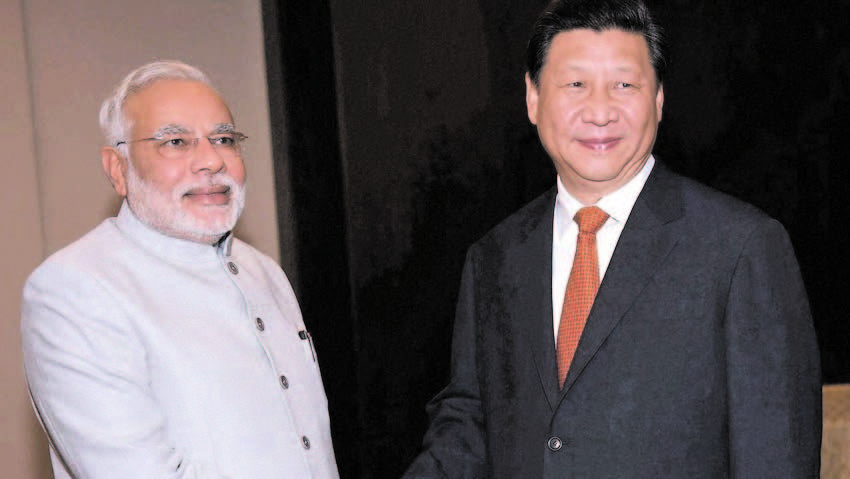
    Modi’s foreign policy premise, that countries give priority today to economics over politics, has been tested in his China policy, which received a course correction. After courting China economically, Modi had to establish a new balance between politics and economics. President Xi’s visit to India in September, 2014, was marred by the serious border incident in Ladakh. Modi showed a sterner side of his diplomacy by expressing serious concern over repeated border incidents and calling for resuming the stalled process of clarifying the Line of Actual Control. During his China visit in May, Modi was even more forthright by asking China to reconsider its policies, take a strategic and long-term view of our relations and address “the issues that lead to hesitation and doubts, even distrust, in our relationship”. He showed firmness in excluding from the joint statement any reference to China’s One Road One Belt initiative or to security in the Asia-Pacific region. The last minute decision to grant e-visas was puzzling, especially as the stapled visa issue remains unresolved. The economic results of his visit were less than expected, with no concrete progress on reducing the huge trade deficit and providing Indian products more market access in China. The 26 “agreements” signed in Shanghai were mostly non-binding MoUs involving the private sector and included the financing of private Indian companies by Chinese banks to facilitate orders for Chinese equipment.

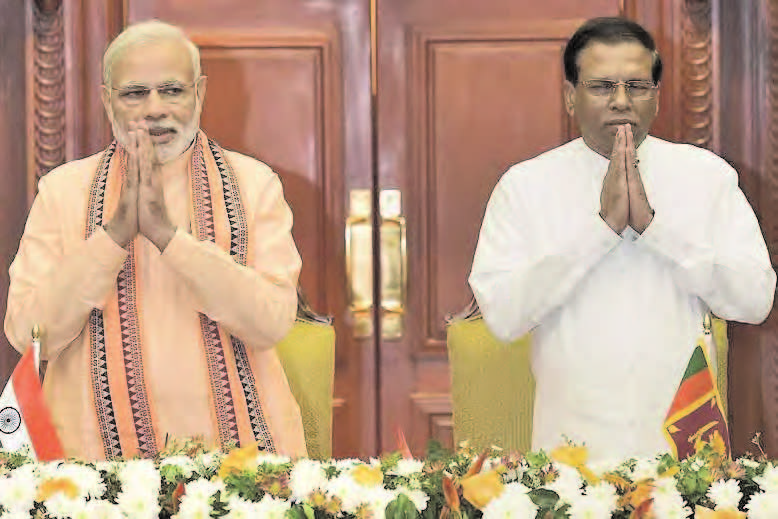
    Modi’s visit to Seychelles, Mauritius and Sri Lanka in March, 2015, signified heightened attention to our critical interests in the Indian Ocean area. Modi was the first Indian prime minister to visit Seychelles in 33 years. His visit to countries in China’s periphery in May, 2015, was important for bilateral and geopolitical reasons. During his visit to South Korea the bilateral relationship was upgraded to a “special strategic partnership’, but Korea nevertheless did not support India’s permanent membership of the United Nations Security Council. Modi’s visit to Mongolia was the first by an Indian prime minister to a country whose position is geopolitically strategic from our point of view.

    Belying expectations, Modi moved decisively towards the United States of America on assuming office. He set an ambitious all-round agenda of boosting the relationship during his September, 2014, visit to Washington. In an imaginative move, he invited Obama to be the chief guest at our Republic Day on January 26, 2015. To boost the strategic partnership with the US, he forged a “breakthrough understanding” on the nuclear liability issue and for tracking arrangements for US-supplied nuclear material. Progress on the defense front was less than expected with four low-technology “pathfinder” projects agreed under the defense technology and trade initiative. The important US-India joint strategic vision for the Asia-Pacific and Indian Ocean region, issued as a stand-alone document, high-lighted the growing strategic convergences between the two countries, with China in view. A special feature of Modi’s September, 2014, US visit was his dramatic outreach to the Indian community, which has since then become a pattern in his visits abroad, whether in Australia, Canada or Beijing. No other prime minister has wooed the Indian communities abroad as Modi has done.

    President Putin’s visit to India in December, 2014, was used to underline politically that Russia remains India’s key strategic partner. Modi was effusive in stating that with Russia we have a “friendship of unmatched mutual confidence, trust and goodwill” and a “Strategic Partnership that is incomparable in content”. He was careful to convey the important message that even as India’s options for defense cooperation had widened today, “Russia will remain our most important defense partner”. Civilian nuclear cooperation with Russia got a boost with the agreement that Russia will build “at least” ten more reactors in India beyond the existing two at Kudankulam. All this was necessary to balance the strengthened strategic understanding with the US and its allies.

    Modi bolstered further our vital relations with Japan, which remains a partner of choice for India. Shinzo Abe announced $35 billion of public and private investment in India during Modi’s visit to Japan in September 2014, besides an agreement to upgrade defense relations.

    Modi’s visit to France and Germany in April, 2015, recognized Europe’s all-round importance to India and was timely. He rightly boosted the strategic partnership with France by ensuring concrete progress in the key areas of defense and nuclear cooperation by announcing the outright purchase of 36 Rafale jets and the MoU between AREVA and L&T for manufacturing high-technology reactor equipment in India. Modi’s bilateral visit to Canada in April, 2015, was the first by an Indian prime minister in 45 years. Bilateral relations were elevated to a strategic partnership and an important agreement signed for long-term supply of uranium to India.

    Relations with the Islamic world received less than required attention during the year, although the Qatar Emir visited India in March, 2015, and the political investment we made earlier in Saudi Arabia aided in obtaining its cooperation to extract our people from Yemen. Gadkari went to Iran in May, 2015, to sign the important agreement on Chabahar. Modi did well to avoid any entanglement in the Saudi-Iran and Shia-Sunni rivalry in West Asia. He met the prime minister of Israel, Benjamin Netanyahu, on the sidelines of the UN general assembly meeting in September, last year, to mark the strength of India-Israel ties. So, Modi’s handling of India’s foreign policy in his first year is impressive. He has put India on the map of the world with his self-confidence and his faith in the nation’s future.

  • Singapore Appoints Indian Origin Businessman as Envoy to Sri Lanka

    Singapore has appointed an Indian-origin businessman as its non-Resident High Commissioner to Sri Lanka, the Foreign Ministry announced today.

    S Chandra Das served as Singapore’s Ambassador to the Republic of Turkey, resident in Singapore, from 2006 to 2015.

    He had also previously served as Singapore’s Trade Representative from 1970 to 1972 in the USSR, the former Soviet Union.

    Mr Das was a Member of Parliament from 1980 to 1996 and is currently the Managing Director of NUR Investment and Trading private limited of Singapore as well as a director of a number of other companies.

    Das is married to Rosie Pillai and they have two children.

    The ministry also announced the appointment of Chua Thai Keong as Singapore’s High Commissioner to the Republic of South Africa.

    Chua has previously served as Singapore’s Ambassador to the Republic of Korea (with concurrent accreditation to Mongolia) from September 2006 to December 2010 and Singapore’s Non-Resident Ambassador to Chile from April 2014 to May 2015.

  • A FORTHRIGHT MODI IN CHINA

    A FORTHRIGHT MODI IN CHINA

    During his China visit, Prime Minister Modi has been unusually forthright in speaking about the problems that hold back the India-China relationship. He probably feels that his desire to strengthen ties with China being so clear, he has earned the confidence of the Chinese leaders enough to be able to pinpoint India’s concerns about some aspects of China’s policies that we find difficult to digest. This is a new approach Modi has fashioned. Our earlier approach has been to soft pedal differences, avoid airing them in public and pretend they are more manageable than they actually are. There has been a tendency also to explain China’s behaviour to ourselves by becoming their spokespersons to our own people, and in the process accept some of the blame for the problems that endure.

    Modi is following a different tack, that of creating consciousness in the Chinese public that China has a responsibility of addressing outstanding issues if it wants the bilateral relationship to move forward and bring about the Asian century that its leadership visualises. This is a more self-confident approach. Whether this more robust attitude will produce the results we want is not certain. China is used to such exhortations by the US, which, unlike our case, are also backed by US power. Yet, China both bends and defies to the degree necessary to manage the relationship with the US, but without changing its fundamental course of building its national power and commensurately raising the level of its strategic challenge to the US. In other words, China does not get cowed down, nor is willing to yield on essentials even when its policies do not make sense always in the light of its own self-interest as seen by external observers.

    Prime Minister Modi interacts with people at the India China business forum  (Photo courtesy: Twitter/PIB)
    Prime Minister Modi interacts with people at the India China business forum (Photo courtesy: Twitter/PIB)

    Whatever the caveats, Modi is moving the Chinese out of their present comfort zone and dealing with China with greater self-assurance which cannot but have some impact on how it treats India in the future. This is a new balance that Modi is establishing between leveraging economically the China connection for India’s development and not losing politically by diffidence in mentioning differences that endure. There are some indications that China believes that of all the partners that India is wooing for investments, it is the one best placed to meet India’s needs, especially in modernising its poor infrastructure. In other words, India’s choices are limited and this gives China a strong hand to play even in the economic field. Modi is implicitly making China reexamine its assumptions

    By choice or consequence, Modi is linking the economic to the political by his double messaging in Beijing. On the one hand, the joint statement issued during the visit explicitly says that outstanding differences, including on the boundary question, should not be allowed to come in the way of continued development of bilateral relations. On the other, Modi stressed in his joint press conference with Chinese premier Li Keqiang that China needed to “reconsider its approach on some of the issues that hold us back from realising the full potential of our partnership” and “take a strategic and long term view of our relations”. This suggested that the long term relationship could be either jeopardised or impeded if China continued with its present approach. It is interesting that in asking China to think long term he summarily debunked the widely accepted myth that China thinks not years but decades ahead in policy making. Standing alongside Li Keqiang, Modi reiterated the “importance of clarification of the Line of Actual Control”, a point he had made in Xi’s presence during the latter’s September visit to India, and “tangible progress on issues relating to visa policy (stapled visa issue, no doubt) and trans-border rivers”. He also alluded to “some our regional concerns” (undoubtedly China’s policies in our neighbourhood, especially in Pakistan). It is clear that Modi raised all these issues in his private conversations with Xi and Li Keqiang, as otherwise publicly mentioning them in the latter’s presence would have seen as a form of political ambush by the Chinese premier. Modi’s intention was obviously to make public his political expectations from China in the years ahead.

    Modi expatiated further on these points in his address at the Tsinghua University. He put more pressure on the Chinese government by stating publicly that if the two countries “have to realise the extraordinary potential of our relationship, we must also address the issues that lead to hesitation and doubts, even distrust, in our relationship”. This is extraordinary plain speaking. He spoke of trying “to settle the boundary question quickly” in a way that does “not cause new disruptions”- an allusion no doubt to China’s unreasonable demands in the eastern sector. This amounts to, again, asking the Chinese publicly to rethink its posture on the package deal on the border. To remove “a shadow of uncertainty” that “hangs over the sensitive areas of the border region” because “neither side knows where the Line of Actual Control is in these areas”, he recalled his proposal to resume the process of clarifying the LAC
    “without prejudice to our position on the boundary question”. This is a via media he is seeking between, on the one hand, stabilising the border and eliminating periodic stand-offs that damage the political relationship and make headway in other areas that much more difficult and, on the other, a permanent solution to the boundary question. It is doubtful whether China would accept this option that was always open. indeed, China was committed to this process but abandoned it favour of the Special Representatives (SR) mechanism. It is unclear, moreover, how the LAC clarification process and the SR mechanism can proceed simultaneously.

    Voicing concerns about China’s increased engagement “in our shared neighbourhood”, Modi, in his Tsinghua address, called for “deeper strategic communication to build mutual trust and confidence” so as to “ensure that our relationships with other countries do not become a source of concern to each other”. In talking of “shared neighbourhood” Modi is talking about South Asia and not the western Pacific, and this is significant. To strengthen our international cooperation, he frontally sought China’s support for India’s permanent membership of the UN Security Council and India’s membership of export control regimes like the Nuclear Suppliers Group. This was unusual as such a public appeal does not normally come from his elevated position. A prime Minister should not seen as a supplicant. Anyhow, by stating all this, Modi has, in a sense, laid out the political agenda of the relationship in the years ahead from his side, which if not achieved in some measure in a reasonable time frame can become a source of criticism and could even make the economic agenda with China even more controversial as a one-sided strategic compromise.

    The joint statement and the Tsinghua speech contain some notable formulations, omissions and iterations, some curious, many positive and a few negative. If the India relationship was for president Obama a defining one for the 21st century, the joint statement notes, as a rhetorical balance, that the “India-China relations are poised to play a defining role in the 21st century in Asia and, indeed, globally”. A China that supposedly rejects an equal status for India accepts in the joint statement that the two countries are “major poles in the global architecture”. On the boundary question, the old, cliched language is repeated and the emphasis remains on improved border management. No mention is made to China’s self-serving One Road One Belt
    (OBOR) initiative to which Xi attaches much importance, and which figured prominently in his recent Pakistan visit. Our neighbours like Sri Lanka and Nepal would have particularly noted this omission. Significantly, the joint statement contains no reference to security in the Asia-Pacific region, unlike in September 2014, which suggests a failure to agree on language on this sensitive issue. Maritime cooperation too does not figure in it, which suggests difficulties in drafting the joint statement.

    We have again thanked China’s Foreign Ministry and the government of “the Tibetan Autonomous Region of the People’s Republic of China” for facilitating the Kailash Manasarovar Yatra. It would have been sufficient to have simply thanked “China” in September 2014 and now, but the Chinese obviously press us to include formulations that recognise TAR as part of the PRC in our joint statements- a practice that was discontinued by the UPA government in the face of China’s increasingly strident claims on Arunachal Pradesh. These offensive claims unfortunately continue and therefore do not justify such politically one-sided gestures by us. Maybe we think this is too sensitive a subject for us to reticent about and to keep the relationship on even keel we feel we can keep giving China comfort over Tibet even when China cynically uses Tibet to make outlandish territorial claims on us. This gesture could also have been a quid pro quo for the stronger formulation on terrorism in the joint statement that could not have pleased Pakistan (though it should be noted that the statement refers not to “cross-border terrorism” which is a formulation India uses to accuse Pakistan, but to “cross border movement of terrorists” which has a different connotation), as well as the separate joint statement on Climate Change that fully reflects India’s position and assumes importance in the context of the Climate Change summit in Paris where the effort would be to isolate India and use the US-China agreement to that end. The question though remains how India will reconcile its commitment to work closely with the US to make the Paris Conference a success with the enunciation of a common position with China which conflicts with the basic US approach.

    The reference in the joint statement to the “commonalities” in the approach of the two countries to global arms control and nonproliferation is puzzling as it conflicts with reality and whitewashes China’s historical and current proliferation activities in Pakistan. To have China in return “note” our aspirations to join the NSG, is an altogether insufficient reason to make this concession and lose a political card against China and Pakistan. Opening ISRO to China through a Space Cooperation Outline (2015-2020) Cooperation may also seem premature to some, given the actual state of India-China relations.

    In his Tsinghua speech, Modi noted pointedly that while both countries seek to connect a fragmented Asia, “there are projects we will pursue individually”, which implies cold shouldering China’s idea of linking our Mausam and Spice Route projects with OBOR. Progress in the BCIM (Bangladesh, China, India, Myanmar) Economic Corridor is mentioned in the joint statement, despite the danger of opening up our inadequately nationally integrated northeast to more economic integration with China. Why Modi mentioned this corridor again in his university speech is unclear, but then, having participated in the joint working group discussions on the project for some time now, it might have been tactically difficult to close the door on it abruptly.

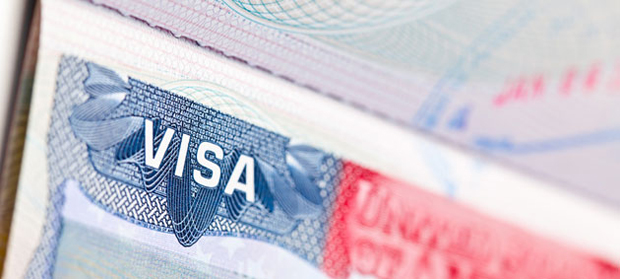
    That Modi himself announced at the last minute at Tsinghua the grant of e-visas to the Chinese after the Foreign Secretary had told the media earlier that no decision had been taken, raises questions about policy making, especially as the stapled visa issue remains unresolved. Of course, enhanced economic engagement requires easier visas and to that extent such a decision can be seen as pragmatic, but we have given up a valuable card touching upon sovereignty issues without sufficient return. No wonder the Chinese Foreign Minister was delighted by this gift from the Prime Minister.

    The driving force behind Modi’s wooing of China being trade and investment, the progress achieved on that front was of principal interest in terms of outcomes. Here, the results have been less than expected. In a sense this was to be expected as too little time had elapsed between Xi’s visit to India and Modi’s visit to China to produce dramatic results. The $20 billion of investment five years promised by Xi would take time to materialise under any circumstances, but more so in the case of China as it has so far invested little in the country, its investors have limited experience of working in India, its leaders are looking for preferential treatment and want a better understanding of the legal conditions. The joint statement largely repeats what was said in September 2014 during Xi’s visit on taking joint measures to alleviate the problem of deficit and cooperate in providing Indian products more market access in China. The language is very noncommittal and it is left to the India-China Joint Economic Group to work on these issues. It was agreed that the next meeting of the Strategic Economic Dialogue, co-chaired by Vice Chairman of NITI Aayog of India and Chairman of NDRC of China, will be held in India during the second half of 2015. On the other hand, China’s economic interests in India are treated more concretely, with satisfaction expressed with the progress achieved in the Railway sector cooperation including the projects on raising the speed on the existing Chennai-Bengaluru-Mysore line, the proposed feasibility studies for the Delhi-Nagpur section of high speed rail link, the station redevelopment planning for Bhubaneswar & Baiyappanahalli, heavy haul transportation training and setting up of a railway university.

    Although 24 agreements were signed during the visit and the number is impressive, in reality the most significant one relates to the opening of our respective consulates in Chengdu and Chennai and space cooperation. There is no economic agreement of note that figures in the list. Surprisingly, the joint statement contains no reference to the two industrial parks that China will be setting up in India, even if it were to merely record some progress in implementing this initiative. Even the figure of $20 billion of Chinese investments in India in the next 5 years- if nothing but for its positive optical effect- is not mentioned this time. No doubt 26 “agreements” were signed during the visit to Shanghai- mostly MOUs involving the private sector that have no binding value- in the areas of renewable energy, power, steel etc. These are sectors in which China is either already strongly present in India or is a global player as in the case of solar power. Its aim would be to capture the Indian market in what would be a highly fecund area for Chinese business given India’s massive plans in developing the solar power sector. A point to consider is whether the unfettered entry of Chinese firms would suffocate Indian enterprise in the renewable industry sector as has happened in the power and telecom sectors. Even financing of private Indian companies by Chinese banks has been put on the positive ledger in projecting the results of Modi’s visit, even though all that is meant is that China will lend money to Indian companies to buy more Chinese products and only add to the burgeoning trade deficit between the two countries. That these MOUs, if and when implemented ( many are in the form of intentions only) are potentially worth $ 22 billion is a PR exercise, which all countries resort to in order to embellish the economic “success” of visits by their leaders abroad, and can therefore be excused as standard diplomatic practice.

    All in all, the China challenge for India has not been reduced by Modi’s visit. On the contrary, Modi has highlighted the political challenges ahead, as China has remained reticent on the points raised by him. Modi is to be commended for largely making the right points during the visit. There were some slippages, but this was perhaps inevitable because China holds the stronger hand. The attempt always is to enlarge the areas of real or potential convergences rather than get bogged down over contentious issues and create a situation where it becomes difficult to issue any meaningful joint statement. The problem in the India-China case is that we are not strategic partners in reality and yet claim that we are. At the end of the day, making the right points and winning them the are two different things.

    As for personal chemistry between Xi and Modi, it would have been better if Xi too had avowed publicly that the two had a “plus one” friendship, otherwise the psychological advantage is with the side that remains silent. Let us also note personal chemistry can have a short shelf life in the face of hard political and strategic realities. Obama and Xi have had a shirtsleeves meeting in Palm Springs in California in 2013, Bush read Putin’s soul in Slovenia in 2001 and Obama had hamburgers with Medvedev in Washington in 2010, but these get-to-know informal meetings intended to create a personal rapport do not help resolve issues beyond a point. It remains though that both Xi and Li Keqiang made unprecedented personal gestures to Modi.

    (The author is a former Foreign Affairs Secretary and Dean, Centre for International Relations and Diplomacy, Vivekananda International Foundation. He can be reached at sibalk@gmail.com)

    (British English)

  • India at 100 on human capital index, Finland leads pack

    GENEVA (TIP): India has been ranked at a lowly 100 position on the global Human Capital Index, which measures countries on development and deployment of human capital.

    Finland has topped the 124-nation list. India is ranked lower than all its BRICS peers — Russia, China, Brazil and South Africa – – and smaller neighbours like Sri Lanka, Bhutan and Bangladesh. But Pakistan follows at 113.

    In the top 10 of the list, compiled by the World Economic Forum (WEF), Finland is followed by Norway, Switzerland, Canada, Japan, Sweden, Denmark, the Netherlands, New Zealand and Belgium. WEF said the list has been compiled on the basis of 46 indicators about “how well countries are developing and deploying their human capital, focusing on education, skills and employment”. “It aims to understand whether countries are wasting or leveraging their human potential,” it added.

    On India, the report said that although the educational attainment has improved markedly over different age groups, its youth literacy rate is still only 90 per cent, well behind the rates of other emerging economies.

  • Sri Lanka arrests 54 Indian fishermen

    COLOMBO (TIP): As many as 54 Indian fishermen have been arrested by the Sri Lankan Navy for allegedly poaching in island’s waters off the coast of Kankesanturai and Talaimannar in the north.

    Sri Lankan Naval spokesman commander Indika Silva said that 21 fishermen were arrested and five boats were seized at Kankesanturai while the rest of them on another five boats were arrested at Talaimannar last night. They were being brought to respective fisheries inspection offices for further action, Silva said.

    Indian fishermen will be shot if they cross border, says Sri Lankan PM Ranil Wickramesinghe The arrests came ahead of announcement of the dates for the direct fisher community talks between India and Sri Lanka. Sri Lanka had released some 86 Indian fishermen last week as a goodwill gesture towards the visit of Prime Minister NarendraModi, the first Indian leader to visit Sri Lanka since 1987.

  • Sri Lankan lawmakers protest bribery summons for ex-leader

    COLOMBO (TIP): A protest staged by lawmakers backing former Sri Lankan President Mahinda Rajapaksa ran into a second day after the country’s bribery commission summoned the ex-leader and his brothers to explain their actions while in power.

    The protesters said on April 22 that the summons was an affront to the brothers who were instrumental in ending a 26-year civil war.

    Rajapaksa was asked to appear before the commission to explain why he gave a ministerial position last year to an opposition leader soon after he defected to support Rajapaksa’s presidential re-election campaign. Rajapaksa’s rivals say handing out the ministerial position was a bribe.

    His brothers, former Economic Development Minister Basil Rajapaksa and former Defense Secretary Gotabhaya Rajapaksa, were also summoned over allegations of financial irregularities.

  • SRI LANKA’S SIRISENA meets China’s Xi Jinping

    SRI LANKA’S SIRISENA meets China’s Xi Jinping

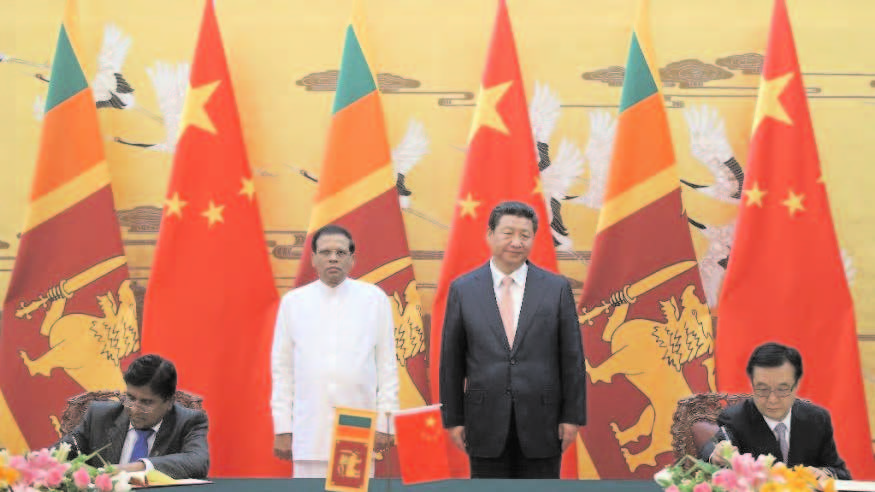
    BEIJING (TIP): Sri Lanka’s new president held talks March 26 with Chinese leader Xi Jinping amid a push to recalibrate his predecessor’s strongly pro-China policies and a review of major Chinese projects in the island nation.

    Maithripala Sirisena and Xi reaffirmed longstanding ties between their countries at the start of their meeting at the Great Hall of the People in central Beijing. The talks kicked off Sirisena’s first visit to the Asian giant since taking office in January and follow his recent trip to neighbor and Chinese rival India.

    In opening remarks, Xi said China considers Sri Lanka a strategic partner and wants to ”again promote and elevate the China-Sri Lanka relationship to fulfill an important purpose.” ”China has always placed Sri Lanka in an important diplomatic position in region,” Xi said before reporters were ushered from the room.

    The two sides were likely to discuss a$1.5 billion China-funded port city project in Colombo which Sirisena’s government suspended pending scrutiny of environment impacts and alleged corruption. Sirisena’s administration has also ordered reviews of all China-funded projects.

    Sirisena’s surprise election presented a diplomatic challenge to Beijing as it seeks to expand its political and economic influence in the Indian Ocean region.

    China enjoyed close ties with his predecessor Mahinda Rajapaksa, under whom a raft of Chinese-backed projects sailed through the approval process with few questions.

    China was a trusted supplier of weapons in Rajapaksa’s crushing of ethnic Tamil separatists and backed Sri Lanka against allegations at the United Nations of human rights abuses in the civil war. In his visit last year, Xi won support from Sri Lanka and neighboring Maldives for a new maritime ”Silk Road,” seen as a way of encircling India and controlling port access along sea lanes linking the energy-rich Persian Gulf and economic centers in eastern China.

    In contrast, Sirisena wants to balance Sri Lanka’s China ties against those with India and chose New Delhi for his first official visit. This month, Prime Minister Narendra Modi became the first Indian leader to visit Sri Lanka in 28 years.

    The massive Colombo port project, backed by the major Chinese state-owned company China Communications Construction Co., has become a particular concern for India. That’s largely due to recent visits to Sri Lanka by Chinese navy ships and submarines and the possibility that China could own outright part of the artificial land on which the development is to be built.

    Asked Wednesday about the project’s suspension, Chinese foreign ministry spokeswoman Hua Chunying said China expects Sri Lanka will ”keep it in mind its own profound interest, promote the practical cooperation and properly deal with the related project between the two countries.”

  • SMART MOVES – Modi Government on US & China

    SMART MOVES – Modi Government on US & China

    [vc_row][vc_column][vc_column_text]

    “The Modi government will face the test of managing closer strategic relations with the US, which are in part directed against China, and forging closer ties with China that go against this strategic thrust, besides the reality that China has actually stronger ties with the US than it can ever have with India, though the underlying tensions between the two are of an altogether different order than between India and the US.”


    [/vc_column_text][/vc_column][/vc_row][vc_row][vc_column width=”1/2″][vc_column_text]

    [quote_box_center]China[/quote_box_center] 

    Prime Minister Modi has been quick to court both US and China. His first overtures were to China, prompted no doubt by his several visits there as Chief Minister of Gujarat, Chinese investments in his home state and his general admiration for China’s economic achievements. Beyond this personal element, many in the government and corporate sectors in India believe that our politically contentious issues with China, especially the unresolved border issue, should be held in abeyance and that economic cooperation with that country should be expanded, as India can gain much from China’s phenomenal rise and the expertise it has developed in specific sectors, especially in infrastructure. It is also believed that China, which is now sitting over $4 trillion of foreign exchange reserves, has huge surplus resources to invest and India should actively tap them for its own developmental needs. In this there is continuity in thinking and policy from the previous government, with Modi, as is his wont, giving it a strong personal imprint.

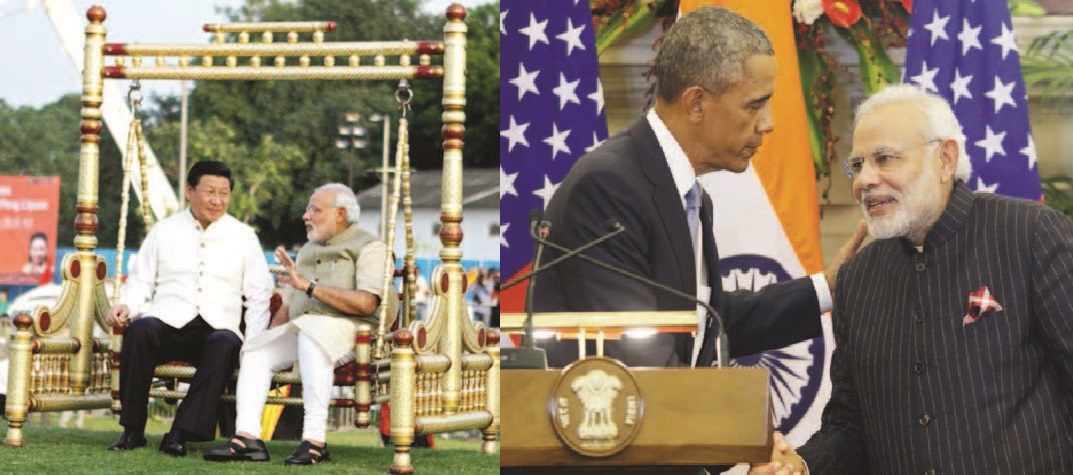
    The first foreign dignitary to be received by Modi after he became Prime Minister was the Chinese Foreign Minister, representing the Chinese President. This was followed by up by his unusually long conversation on the telephone with the Chinese Prime Minister. Our Vice-President was sent to Beijing to celebrate the 60th anniversary of the Panchsheel Agreement even though China has blatantly violated this agreement and India’s high level diplomatic endorsement of it only bolsters Chinese diplomacy, especially in the context of China-created tensions in the South China and East China Seas. Modi had occasion to meet President Xi Jinxing in July at the BRICS summit in July 2014, and this was followed up by the Chinese President’s state visit to India in September 2014, during which the Prime Minister made unprecedented personal gestures to him in an informal setting in Ahmedabad.

    The dramatics of Modi’s outreach to the Chinese aside, his objectives in strengthening economic ties with China, essentially imply a consolidation of the approach followed in the last decade or so, with some course correction here and there. In this period, China made very significant headway in our power and telecom sectors, disregarding obvious security concerns associated with China’s cyber capabilities and the links of Chinese companies to the Chinese military establishment. Many of our top companies have tapped Chinese banks and financial institutions for funds, and this has produced a pro-Chinese corporate lobby in our country. This lobby will obviously highlight the advantages of economic engagement over security concerns. The previous Prime Minister followed the approach of emphasizing shared interests with China rather than highlighting differences. The position his government took on the Depsang incident in May 2013 showed his inclination to temporize rather than confront. Externally, he took the line, which Chinese leaders repeated, that the world is big enough for India and China to grow, suggesting that he did not see potential conflict with China for access to global markets and resources. Under him, India’s participation in the triangular Russia-India-China format (RIC) and the BRICS format continued, with India-originated proposal for a BRICS Development Bank eventually materializing. Indian concerns about the imbalance in trade were voiced, but without any action by China to redress the situation. India sought more access to the Chinese domestic market for our competitive IT and pharmaceutical products, as well as agricultural commodities, without success. Concerns about cheap Chinese products flooding the India market and wiping out parts of our small-scale sector were voiced now and then, but without any notable remedial steps. The Strategic Economic Dialogue set up with China, which focused primarily on the railway sector and potential Chinese investments in India, did not produce tangible results.

    The Manmohan Singh government, despite China’s aggressive claims on Arunachal Pradesh and lack of progress in talks between the Special Representatives on the boundary issue as well as concerns about China’s strategic threats to our security flowing from its policies in our neighborhood, especially towards Pakistan and Sri Lanka, declared a strategic and cooperative partnership with that country. During Manmohan Singh’s visit to China in September 2013, we signed on to some contestable formulations, as, for example, the two sides committing themselves to taking a positive view of and supporting each other’s friendship with other countries, and even more surprisingly, to support each other enhancing friendly relations with their common neighbors for mutual benefit and win-win results. This wipes off on paper our concerns about Chinese policies in our neighborhood. We supported the BCIM (Bangladesh, China, India, Myanmar) Economic Corridor, including people to people exchanges, overlooking Chinese claims on Arunachal Pradesh and the dangers of giving the Chinese access to our northeast at people to people level. The agreement to carry out civil nuclear cooperation with China was surprising, as this makes our objections to China-Pakistan nuclear ties politically illogical. We also agreed to enhance bilateral cooperation on maritime security, which serves to legitimize China’s presence in the Indian Ocean when China’s penetration into this zone poses a strategic threat to us.

    As a mark of continuity under the Modi government, during President Xi Jinxing’s September 2014 visit to India, the two sides agreed to further consolidate their Strategic and Cooperative Partnership, recognized that their developments goals are interlinked and that their respective growth processes are mutually reinforcing. They agreed to make this developmental partnership a core component of their Strategic and Cooperative Partnership. The India-China Strategic Economic Dialogue was tasked to explore industrial investment and infrastructure development.

    To address the issue of the yawning trade imbalance, measures in the field of pharmaceuticals, IT, agro-products were identified and a Five-Year Development Program for economic and Trade Cooperation to deepen and balance bilateral trade engagement was signed. Pursuant to discussions during the tenure of the previous government, the Chinese announced the establishment of two industrial parks in India, one in Gujarat and the other in Maharashtra, and the “Endeavour to realize” an investment of US $ 20 billion in the next five years in various industrial and infrastructure development projects in India, with production and supply chain linkages also in view. In the railway sector, the two sides the two sides agreed to identify the technical inputs required to increase speed on the existing railway line from Chennai to Mysore via Bangalore, with the Chinese side agreeing to provide training in heavy haul for 100 Indian railway officials and cooperating in redevelopment of existing railway stations and establishment of a railway university in India. The Indian side agreed to actively consider cooperating with the Chinese on a High Speed Rail project. In the area of financial cooperation, the Indian side approved in principle the request of the Bank of China to open a branch in Mumbai.

    The Modi government has agreed to continue defense contacts, besides holding the first round of the maritime cooperation dialogue this year, even though by engaging India in this area it disarms our objections to its increasing presence in the Indian Ocean area, besides drawing negative attention away from its policies in the South China Sea as well as projecting itself as a country committed to maritime cooperation with reasonable partners. The joint statement issued during Xi Jinxing’s visit omitted any mention of developments in western Pacific, though it contained an anodyne formulation on Asia-Pacific. This becomes relevant in view of the statements on Asia-pacific and the Indian Ocean region issued during President Obama’s visit to India in January 2015.

    Our support, even if tepid, continues for the BCIM Economic Corridor. On our Security Council permanent membership, China continues its equivocal position, stating that it “understands and supports India’s aspiration to play a greater role in the United Nations including in the Security Council”. It is careful not to pronounce support for India’s “permanent membership”. During Foreign Minister Sushma Swaraj’s visit to China for the RIC Foreign Ministers meeting, China has maintained its equivocation, although the press has wrongly presented the formulation as an advance. China is openly opposed to Japan’s candidature in view of the sharp deterioration of their ties. In India’s case, it avoids creating a political hurdle to improved ties by openly opposing India’s candidature. “A greater role” could well mean a formula of immediately re-electable non-permanent members, of the kind being proposed by a former UN Secretary General and others.

    On counter-terrorism lip service is being paid to cooperation. On Climate Change, the two countries support the principle of “equity, common but differentiated responsibilities and respective capabilities”, although the US-China agreement on emission reduction targets has created a gap in Indian and Chinese positions, with the Modi government deciding to delink itself from China in international discussions to follow.

    In diplomacy, once concessions or mistakes are made, retrieval is very difficult unless a crisis supervenes. The Modi government, for reasons that are not too clear, repeated the intention of the two countries to carry out bilateral cooperation in civil nuclear energy in line with their respective international commitments, which has the unfortunate implication of India circumscribing its own headroom to object to the China-Pakistan nuclear nexus, besides the nuance introduced that China is observing its international commitments in engaging in such cooperation. The calculation that this might make China more amenable to support India’s NSG membership may well prove to be a mistaken one. Surprisingly, stepping back from the Manmohan government’s refusal towards the end to make one-sided statements in support of China’s sovereignty over Tibet when China continues to make claims on Indian territory, the new government yielded to the Chinese ruse in making us thank the “Tibetan Autonomous Region of the People’s Republic of China” as well as the Chinese Ministry of Foreign Affairs – as if both are independent of the Chinese government- for facilitating the Kailash Mansarovar Yatra and opening the new route through Nathu La, even though this is not the  most rational route because it involves a far longer journey, made easier of course by much better infrastructure. On receiving the flood season hydrological date the Chinese have stuck to their minimalist position.

    On the sensitive border issue, the disconnect between the joint statement which repeats the usual cliches and the serious incident in Chumar coinciding with Xi’s visit was obvious. China’s double game of reaching out to India- with greater confidence now as the gap between it and India has greatly widened and it has begun to believe that India now needs China for its growth and development goals- and staging a provocation at the time of a high level visit, continues. This is a way to remind India of its vulnerability and the likely cost of challenging China’s interests, unmindful that its conduct stokes the already high levels of India’s distrust of that country. It went to Modi’s credit that he raised the border issue frontally with XI Jinping at their joint press conference, expressing “our serious concern over repeated incidents along the border” and asking that the understanding to maintain peace and tranquility on the border “should be strictly observed”. He rightly called for resuming the stalled process of clarifying the Line of Actual Control (LAC). While this more confident approach towards China is to be lauded, we are unable to persuade China to be less obdurate on the border issue because we are signaling our willingness to embrace it nonetheless virtually in all other areas.

    That Modi mentioned “India’s concerns relating to China’s visa policy and Trans Border Rivers” while standing alongside Xi Jinping at the joint press conference indicated a refreshing change from the past in terms of a more open expression of India’s concerns. With regard to Bangladesh-China-India-Myanmar Economic Corridor that China is pushing hard, Modi rightly added a caveat by declaring that “our efforts to rebuild physical connectivity in the region would also require a peaceful, stable and cooperative environment”. He also did not back another pet proposal of Xi: the Maritime Silk Road, which is a re-packaged version of the notorious “string of pearls” strategy, as the joint statement omits any mention of it.

    Even as Modi has been making his overall interest in forging stronger ties with China clear, he has not shied away from allusions to Chinese expansionism, not only on Indian soil but also during his visit to Japan. After President Obama’s visit to India and the joint statements on South China Sea and Asia-Pacific issued on the occasion which can be construed as directed at China, Foreign Minister Sushma Swaraj’s recent visit there acquired more than normal interest in watching out for indications of China’s reaction. Her call on Xi Jinping was projected, quite wrongly, as going beyond normal protocol, when in actual fact the Chinese Foreign Minister gets access to the highest levels in India during visits. Swaraj seems to have pushed for an early resolution of the border issue, with out-of-the-box thinking between the two strong leaders that lead their respective countries today. Turning the Chinese formulation on its head, she called for leaving a resolved border issue for future generations.

    That China has no intention to look at any out-of-the-box solution- unless India is willing to make a concession under cover of “original thinking”- has been made clear by the vehemence of its reaction to Modi’s recent visit to Arunachal Pradesh to inaugurate two development projects on the anniversary of the state’s formation in 1987. It has fulminated over the Modi visit over two days, summoning the Indian Ambassador to lodge a protest, inventing Tibetan names for sub-divisions within Arunachal Pradesh to mark the point that this area has been under Tibetan administrative control historically. The Chinese Vice-Foreign Minister arrogantly told our Ambassador that Modi’s visit undermined “China’s territorial sovereignty, right and interests” and “violates the consensus to appropriately handle the border issue.” China is making clear that it considers Arunachal Pradesh not “disputed territory” but China’s sovereign territory. It is also inventing a non-existent “consensus” that Indian leaders will not visit Arunachal Pradesh to respect China’s position. There is a parallel between China’s position on the Senkakus where it accuses the Japanese government to change the status quo and inviting a Chinese reaction, and its latest broadside against India. This intemperate Chinese reaction casts a shadow on Modi’s planned visit to China in May and next round of talks between the Special Representatives (SRs) on the boundary question. If without a strong riposte these planned visits go ahead we would have allowed the Chinese to shift the ground on the outstanding border issue even more in their favor. It would be advisable for our Defense Minister to visit Tawang before Modi’s visit. A very categorical enunciation of our position that goes beyond previous formulations should be made by the Indian side. The Chinese position makes the SR talks pointless, as the terms of reference China is laying down cannot be agreed to by our side.

    [/vc_column_text][/vc_column][vc_column width=”1/2″][vc_column_text]

    [quote_box_center]UNITED STATES[/quote_box_center] 

    Prime Minister Modi, contrary to expectations, moved rapidly and decisively towards the US on assuming office. He confounded political analysts by putting aside his personal pique at having been denied a visa to visit the US for nine years for violating the US law on religious freedoms, the only individual to be sanctioned under this law. The first foreign visit by Modi to be announced was that to the US. Clearly, he believes that strong relations with the US gives India greater strategic space in foreign affairs and that its support is crucial for his developmental plans for India.

    To assess the Modi government’s policies towards the US, the results of his visit to Washington in September 2014 and that of Obama to India in January 2015 need to be analyzed, keeping in mind the approach of the previous government and the element of continuity and change that can be discerned.

    The joint statement issued during his US visit set out the future agenda of the relationship, with some goals clearly unachievable, but the ambitions of the two countries were underscored nonetheless. It was stated that both sides will facilitate actions to increase trade five-fold, implying US-China trade levels, which is not achievable in any realistic time-frame. They pledged to establish an Indo-US Investment Initiative and an Infrastructure Collaboration Platform to develop and finance infrastructure. An agreement on the Investment Initiative was signed in Washington prior to Obama’s visit to India, but bringing about capital reforms in India, which the Initiative aims at, is not something that can be realized quickly. India wants foreign investment in infrastructure and would want to tap into US capabilities in this broad sector, but the US is not in the game of developing industrial corridors like Japan or competitively building highways, ports or airports. Cooperation in the railway sector was identified, but it can only be in some specific technologies because this is the field in which Japan and China are competing for opportunities in India, whether by way of implementing high speed freight corridors or building high speed train networks in the country. India offered to the U.S. industry lead partnership in developing three smart cities, even if the concept of smart cities is not entirely clear. Some preliminary steps seem to have been taken by US companies to implement the concept. The decision to establish an annual high-level Intellectual Property (IP) Working Group with appropriate decision-making and technical-level meetings as part of this Forum was done at US insistence as IPR issues are high on the US agenda in the context of contentious issues that have arisen between the US companies and the Indian government on patent protection, compulsory licensing and local manufacturing content requirements.

    In his joint press briefing with Obama, Modi raised IT related issues, pressing Obama’s support  “for continued openness and ease of access for Indian services companies in the US market”, without obtaining a reaction from  the latter then or later when Obama visited India. On the food subsidy versus trade facilitation stand off in the WTO, Modi maintained his position firmly and compelling the US to accept a compromise. Modi’s firmness on an issue of vital political importance to India showed that he could stand up to US pressure if the country’s interest so demanded. He welcomed “the US defense companies to participate in developing the Indian defense industry”, without singling out any of the several co-development and co-production projects offered by the US as part of the Defense Technology and Trade Initiative (DTTI). Clearly, it was too early to conclude discussions on the US proposals before his September visit.

    The more broad based reference in the joint statement to India and the US intending to expand defense cooperation to bolster national, regional and global security was, on the contrary, rather bold and ambitious, the import of which became clearer during Obama’s January visit. While bolstering such cooperation for national security makes sense, regional security cannot be advanced together by both countries so long as the US continues to give military aid to Pakistan, which it is doing even now by issuing presidential waivers to overcome the provisions of the Kerry-Lugar legislation that requires Pakistan to act verifiably against terrorist groups on its soil before the aid can be released. As regards India-US defense cooperation bolstering global security, securing the sea lanes of communication in the Indian Ocean and the Asia-Pacific region is the obvious context. It was decided to renew for 10 years more the 2005 Framework for US-India Defense Relations, with defense teams of the two countries directed to “develop plans” for more ambitious programs, including enhanced technology partnerships for India’s Navy, including assessing possible areas of technology cooperation.

    The US reiterated its commitment to support India’s membership of the four technology control regimes: the Nuclear Suppliers Group (NSG), the Missile Technology Control Regime (MTCR), the Wassenaar Agreement and the Australia Group, with Obama noting that India met MTCR requirements and is ready for NSG membership, but without setting any time-tables. An actual push by the US in favor of India’s membership has been lacking because of issues of nuclear liability and administrative arrangements have remained unresolved until now and the US has wanted to use their resolution as a leverage. US support for India’s membership of these export control organizations was reiterated during Obama’s January visit, but how quickly the US will move remains unclear even after the political resolution of outstanding nuclear issues.

    The US at one time described India as a lynchpin of its pivot or rebalance towards Asia. The underlying motivation behind the pivot and US interest in drawing India into this strategy is China, though this is not stated publicly in such open terms. India has been cautious about the US pivot towards Asia as its capacity and willingness to “contain” Chinese power has been doubted because of the huge financial and commercial interdependence forged between the two countries. India seeks stable and economically productive relations with China and has wanted to avoid the risk of being used by the US to serve its China strategy that raises uncertainties in the mind of even the US allies in Asia. However, under the Modi government, India has become more affirmative in its statements about the situation in the western Pacific and the commonalities of interests between India and the US and other countries in the Indo-Pacific region. The government has decided to “Act East”, to strengthen strategic ties with Japan and Australia, as well as Vietnam, conduct more military exercises bilaterally with the US armed forces as well as naval exercises trilaterally with Japan. Modi has spoken publicly about greater India-US convergences in the Asia-Pacific region, to the point of calling the US  intrinsic to India’s Act East and Link West policies, a bold formulation in its geopolitical connotations never used before that suggested that India now viewed the US as being almost central to its foreign policy initiatives in both directions.

    On  geopolitical issues, India showed strategic boldness in the formulations that figured in the September joint statement. These laid the ground for more robust demonstration of strategic convergences between the two countries during Obama’s visit later. The reference in September to the great convergence on “peace and stability in the Asia Pacific region” was significant in terms of China’s growing assertiveness there. The joint statement spoke of a commitment to work more closely with other Asia Pacific countries, including through joint exercises, pointing implicitly to Japan and Australia, and even Vietnam. In this context, the decision to explore holding the trilateral India-US-Japan dialogue at Foreign Minister’s level- a proposition that figured also in the India-Japan joint statement during Modi’s visit there- was significant as it suggested an upgrading of the trilateral relationship at the political level, again with China in view.

    On the issue of terrorism and religious extremism, India and the US have rhetorical convergence  and some useful cooperation in specific counter-terrorism issues, but, on the whole, our concerns are  inadequately met because US regional interests are not fully aligned with those of India. The September joint statement called for the dismantling of safe havens for terrorist and criminal networks and disruption of all financial and tactical support for networks such as Al Qaeda, Lashkar-e-Taiba, Jaish-e-Mohammad, the D-company and the Haqqanis, but the Taliban were conspicuously omitted from the list. In any case, such statements against Pakistan-based terrorist groups have been made before but are ignored  by Pakistan in the absence of any real US pressure on it to curb Hafiz Saeed or credibly try Lakhvi despite repeated joint calls for bringing those responsible for the Mumbai terrorist massacre to justice.

    We had a paragraph on Iran in the joint statement in Washington, clearly at US insistence, which the Iranians would have noted with some displeasure. The Modi government is also willing to accommodate the US on Iran within acceptable limits. While the US supports India’s permanent membership of the UN Security Council, the support remains on paper as the US is not politically ready to promote the expansion of the Council.

    At Washington, India and the US agreed on an enhanced strategic partnership on climate change issues, and we committed ourselves to working with the US to make the UN Conference on Climate Change in Paris in December this year a success. This carried the risk of giving a handle to the US to ratchet up pressure to obtain some emission reduction commitments from India, encouraged  diplomatically by the US-China agreement.

    The unusually strong personal element in Modi’s diplomacy towards the US came apparent when during his Washington visit he invited Obama to be the chief guest at our Republic Day on January 26, 2015- a bold and imaginative move characteristic of his style of functioning. That this unprecedented invitation was made was surprising in itself, as was its acceptance by Obama at such short notice. Modi and Obama evidently struck a good personal equation, with the earlier alienation supplanted by empathy. Obama made the unprecedented gesture of accompanying Modi to the Martin Luther King Memorial in Washington, perhaps taking a leaf from the personal gestures made  to Modi in Japan by Prime Minister Abe.

    On the occasion of Obama’s January visit, Modi has moved decisively, if somewhat controversially, on the nuclear front, as this was the critical diplomatic moment to work for a breakthrough to underline India’s commitment to the strategic relationship with the US, which is the way that US commentators have looked at this issue. While in opposition the BJP had opposed the India-US nuclear agreement, introduced liability clauses that became a major hurdle in implementing the commitment to procure US supplied nuclear reactors for producing 10,000 MWs of power, and had even spoken of seeking a revision of the agreement whenever it came to power. During Obama’s  visit, the “breakthrough understandings” on the nuclear liability issue and that of administrative arrangements to track US supplied nuclear material or third party material passing through US supplied reactors, became the highlight of its success, with Modi himself calling nuclear cooperation issues as central to India-US ties. The supplier liability issue seems to have resolved at the level of the two governments by India’s decision to set up an insurance pool to cover supplier liability, as well as a written clarification through a Memorandum of Law on the applicability of Section 46 only to operators and not suppliers. On the national tracking issue the nature of the understanding has left some questions unanswered; it would appear that we have accepted monitoring beyond IAEA safeguards as required under the US law. However, the larger question of the commercial viability of US supplied reactors remains, a point that Modi alluded to in joint press conference. On the whole, whatever the ambiguities and shortfalls, transferring the subject away from government to company level to eliminate  the negative politics surrounding the subject is not an unwelcome development.

    For the US, defense cooperation has been another touchstone for the US to measure India’s willingness to deepen the strategic partnership. While the significant progress expected to be announced under the DTTI during Obama’s visit did not materialize, some advance was made with the announcement of four “pathfinder” projects involving minor technologies, with cooperation in the area of aircraft engines and aircraft carrier technologies to be explored later. The government has already chosen for price reasons the Israeli missile over the Javelin that was part of the several proposals made to India under the DTTI. As expected, the India-US Defense Framework Agreement of 2005 was extended for another 10 years, without disclosing the new text. It is believed  that India is now more open to discussions on the three foundational agreements that the US considers necessary for transfer of high defense technologies to India.

    The US-India Joint Strategic Vision for the Asia-Pacific and Indian Ocean Region signed during the visit is a major document which in the eyes of some reflects India’s move away from the shibboleths of the past associated with nonalignment and the obsession with strategic autonomy. Issuing a separate document was intended to highlight the growing strategic convergences between the two countries, with full awareness of how this might be interpreted by some countries, notably China. It affirms the “importance of safeguarding maritime security and ensuring freedom of navigation and overflight throughout the region , especially in the South China Sea”, while calling also on all parties to avoid the threat or use of force and pursue resolution of territorial and maritime disputes through all peaceful means in accordance with international law, including the Law of the Sea Convention. It speaks, in addition, of India and the US investing in making trilateral countries with third countries in the region, with Japan and Australia clearly in mind. This is a direct message addressed to China, reflecting less inhibition on India’s part both to pronounce on the subject and do it jointly with the US, irrespective of Chinese sensibilities. Some Chinese commentary has criticized this effort by the US to make India part of its containment strategy, without taking cognizance of how India views China’s maritime strategy in the Indian Ocean involving its strategic investments in Sri Lanka, Maldives, Pakistan and other countries. In the joint statement issued during  Obama’s visit, the two sides noted that India’s Act East Policy and the US rebalance to Asia provided opportunities to the two countries to work closely to strengthen regional ties, in what amounted to an indirect endorsement of the US pivot to Asia.

    Obama’s visit also demonstrated the consolidation of the good personal rapport established between him and Shri Modi, with embraces and first name familiarity- possibly overdone on Modi’s part- walk in the park and talk over tea, all of which boosted the prime minister’s personal stature as a man comfortable and confident in his dealings with the world’s most powerful leader on the basis of equality. This personal rapport should assist in greater White House oversight over the Administration’s policies towards India, which experience shows greatly benefits the bilateral relationship.

    Counter-terrorism is always highlighted as an expanding area of India-US cooperation because of shared threats. The joint statement in Delhi spoke dramatically of making the US-India partnership in this area a “defining” relationship for the 21st century. Does this mean that the US will share actionable intelligence on terrorist threats to us emanating from Pakistani soil? This is doubtful. The continued omission of the Afghan Taliban from the list of entities India and the US will work against is disquieting, as it indicates US determination to engage the Taliban, even when it knows that it is Pakistan’s only instrument to exert influence on developments in Afghanistan at India’s cost. The subsequent refusal of the US spokesperson to characterize the Taliban as a terrorist organization and preferring to call it an armed insurgency has only served to confirm this.

    On trade, investment and IPR issues, the two sides will continue their engagement with the impulse given to the overall relationship by the Obama-Modi exchanges. On a high standard Bilateral Investment Treaty the two sides will
    “assess the prospects for moving forward”, which indicates the hard work ahead. On the tantalization agreement the two will “hold a discussion on the elements requires in both countries to pursue” it, a language that is conspicuously non-committal. On IPRs there will be enhanced engagement in 2015 under the High Level Working Group.

    On climate change, we reiterated again the decision to work together this year to achieve a successful agreement at the UN conference in Paris, even when our respective positions are opposed on the core issue of India making specific emission reduction commitments. While stating  that neither the US nor the US-China agreement put any pressure on India, Modi spoke in his joint press conference about pressure on all countries to take steps for the sake of posterity. While  finessing the issue with high-sounding phraseology, he has left the door open for practical compromises with the US.

    As a general point, hyping-up our relations with the US is not wise as it reduces our political space to criticize its actions when we disagree. The previous government made this mistake and the Modi government is not being careful enough in this regard. Obama’s objectionable lecture to us at Siri Fort on religious freedom and his pointed reference to Article 25 of our Constitution, illustrates this. He showed unpardonable ignorance of Indian history and Hindu religious traditions in asking us to “look beyond any differences in religion” because “nowhere in the world is it going to more necessary for that foundational value to be upheld” than in India. To say that “India will succeed so long as it is not splintered around religious lines” was a wilful exaggeration of the import of some recent incidents  and amounted to playing the anti-Hindutva card by a foreign leader prompted by local Christian and “secular” lobbies. Reminding us of three national cinema and sport icons belonging only to minority religions- when their mass adulation is unconnected to their faith- was to actually encourage religiously fissured thinking in our society. On return to Washington Obama pursued his offensive line of exaggerating incidents of religious intolerance in India. On cue, a sanctimonious editorial also appeared in the New York Times. The government could not attack Obama for his insidious parting kick at Siri Fort so as not to dim the halo of a successful visit and therefore pretended that it was not directed at the Modi team. The opposition, instead of deprecating Obama’s remarks, chose to politically exploit them against Modi, as did some Obama-adoring Indians unencumbered by notions of self-respect.

    While giving gratuitous lessons on religious tolerance to the wrong country Obama announced $1 billion civil and military support to Pakistan that splintered from a united India because of religious intolerance in 1947 and has been decimating its minorities since. Obama has also invited the Chinese president to visit the US on a state visit this year, to balance his visit to India and the “strategic convergences” reached there on the Asia-Pacific region. Obama’s claim that the US can be India’s “best partner” remains to be tested as many contradictions in US policy towards India still exist.

    The Modi government will face the test of managing closer strategic relations with the US, which are in part directed against China, and forging closer ties with China that go against this strategic thrust, besides the reality that China has actually stronger ties with the US than it can ever have with India, though the underlying tensions between the two are of an altogether different order than between India and the US.

    [/vc_column_text][/vc_column][/vc_row]

  • Navy has right to shoot anyone who intrudes: Lankan PM

    COLOMBO (TIP): Sri Lanka’s Prime Minister Ranil Wickremasinghe has again said that his country’s navy has the right to shoot anyone who intrudes into its territorial waters, notwithstanding India’s forthright disapproval.

    “The Lankan navy has the right to shoot in any part of the country if anyone enters territorial waters, this is nothing new,” he told NDTV, two days after his Indian counterpart Narendra Modi’s trip to the island nation.

    Ahead of Prime Minister Modi’s visit, Wickremasinghe had told a Tamil news channel, “If someone tries to break into my house, I can shoot. If he gets killed… Law allows me to do that,” drawing India’s ire.

    Wickremasinghe said Modi’s trip to the country was a “successful visit”.

    The two nations are trying to resolve the fishermen issue, he said.

    The main issue, Wickremasinghe said, was bottom trawling and it has to stop. “That has been acknowledged by all sides,” he said.

    Modi, during his Sri Lanka visit had discussed the fishermen’s issue – a major irritant in bilateral ties – with President Mithripala Sirisena, and said this complex question involves livelihood and humanitarian concerns on both sides.”This complex issue involves livelihood and humanitarian concerns on both sides. We should handle it from this perspective. At the same time, we need to find a long term solution to this issue,” Modi had said.

  • Lankan govt may lift ban on Tamil diaspora groups

    COLOMBO (TIP): Sri Lankan government on Wednesday said it may lift the ban on Tamil diaspora groups imposed by the previous Mahinda Rajapaksa regime to achieve reconciliation with the minority community.

    Foreign minister Mangala Samaraweera told the Parliament that the government may lift the ban on Tamil diaspora groups imposed by the previous Rajapaksa regime.

    Samaraweera said that building national reconciliation was important and Sinhala, Tamil or Muslim diaspora groups have a role to play in taking Sri Lanka forward as a nation.

    Tamils voted in large numbers for President Maithripala Sirisena to defeat the pro-Sinhala Rajapaksa in the January 8 polls.

    Sirisena today said Prime Minister Narendra Modi’s call to implement the 13th Amendment would be taken up after the next parliamentary election and asserted that finding a solution to the vexed Tamil issue remains a priority for his government.

  • Sri Lanka as Indian Ocean pivot

    Sri Lanka as Indian Ocean pivot

    Prime Minister Modi should be congratulated for his bold decision to visit Sri Lanka for a bilateral visit, after Rajiv Gandhi in 1987. Perhaps, Modi has no internal political pressures or coalition objections that had prevented earlier bilateral visits to Sri Lanka.

    Having made a breakthrough, Modi should now build a strong partnership with Sri Lanka in achieving long-term national interests of India. Such an approach will have to accommodate the voices and sentiments of its federating units, but not get blackmailed by the latter. In this context, both his visit to Sri Lanka and the earlier visit of the new Sri Lankan President to India a few weeks back, provide a breakthrough, but not a substantial base to erect a bilateral superstructure.

    India needs big-ticket items; openings such as visa and custom relaxation, constructing a university stadium and a rail link are important but not grandiose. Both capitals require a strategic edifice that would chart the course. In cricket parlance, both countries should look for a Virat Kohli or Kumara Sangakkara and not a Ravindra Jadeja or Thisara Perera. The latter form a useful contribution in bits and pieces, but do not become a platform for the course of a match.

    New Delhi for long has allowed bilateral relations as the primary vehicle of interaction between India and Sri Lanka -both at political and economic levels. Sri Lankan Tamils and the Indian fishermen had become New Delhi’s pivot towards Sri Lanka.

    Unfortunately, the previous governments also allowed the bilateral issues and domestic opposition to dictate in not building a larger partnership with Sri Lanka.

    Today, the rise of the Indian Ocean provides an opportunity for New Delhi to build such a strategic partnership, outside bilateral relations. Geographically the Indian Ocean has become strategic; concepts and issues such as the Indo-Pacific, maritime security and safety of sea lanes of communication, along with new groupings, exercises and dialogues such as the Indian Ocean Naval Symposium, Milan, Indian Ocean Regional Association and the Indian Ocean Dialogue highlight the new reality and potential.

    Not just the Indian Ocean, but the entire maritime Asia is an important geography today. US, China, Japan, Australia and the EU – all are extremely interested in the Indian Ocean for economic and security reasons. India has a natural advantage in this region, and with a partnership, should not only aim to exploit the Indian Ocean, but the entire “Maritime Asia”.

    India can play a major role in the Indian Ocean, with Sri Lanka as its pivot. Situated a few miles away from the major shipping lanes of the Indian Ocean, Sri Lanka and its ports, especially Colombo and Hambantota, are strategically located. Perhaps, the Chinese understood this and invested billions of dollars in two projects in the Hambantota deep sea port and the now controversial Colombo Port City.

    While India pursues Afghanistan and Myanmar as its gateway to Central Asia and Southeast Asia respectively, and made substantial investments, there has been no similar approach in the South. On the maritime side, Sri Lanka does occupy a crucial position in the Indian Ocean and could become New Delhi’s pivot and gateway.

    Elsewhere, in the late 1990s, a few countries came together to establish an “Arctic Council” to discuss issues relating to sustainable development and environmental protection, along with studying climate change, shipping and exploration of oil and gas. Since Modi has renewed India’s approach towards SAARC emphasizing on regional cooperation with “all or some” of the countries, and has already established a BBIN network involving Bangladesh, Bhutan and Nepal, similar sub-regional cooperation can be pursued in the Indian Ocean.

    With Sri Lanka and Maldives, India can lead a “SIM Council on the Indian Ocean” focusing on similar issues relating to the Arctic Council such as maritime economy, shipping, climate change etc, and leading to sustainable and inclusive development of the Indian Ocean. While we have made enormous leaps in the space research, our investments and outputs on marine research remain primitive.

    Narendra Modi during his address in the Sri Lankan Parliament highlighted the importance of the “ocean economy” holding “enormous promise for both” the countries. The Joint Task Force on Ocean Economy is an important measure in this context, but both countries have to move forward and expand substantially. From marine economy to maritime tourism, the Indian Ocean remains absolutely untapped.

    While there have been numerous proposals to link India and Sri Lanka through tourism circuits, linking the port cities for maritime tourism would reap rich dividends. Imagine Cruise Liners linking Goa and Kochi in the western coast of India with Cox Bazaar in Bangladesh through the port cities in Sri Lanka and the eastern coast of India!

    Maritime disaster management in the Indian Ocean is another subject, where the proposed SIM Council could undertake substantial research and share experiences in managing it. Marine biology and the biodiversity of the Indian Ocean can become a part of a scientific agenda for the SIM Council.

    As the initiative expands, other countries could be brought in. It could expand beyond South Asia and link with West Asia and Southeast Asia. In fact, such an initiative could go well up to East Asia and Australia, with the Indian Ocean becoming the Centre of action.

    Outside the SIM Council idea, with a few countries in the Indian Ocean such as Sri Lanka and Maldives, New Delhi can project an “Asian Sea Lane” with support from the World Bank and/or Asian Development Bank.

    There have been two similar projects at the Asian level – the Asian Highway and the Asian Railway, supported by the international institutions. Asian Sea Lane can be projected as a maritime extension of the above two projects. India cannot pursue such a big project on its own or along with Colombo and Male. It needs huge financial support; while China may have the ability to build its own Maritime Silk Road, India will need the support of financial institutions and partner countries. From Japan to the EU, and from ADB to WB, such support can be sought for building infrastructure.

    Let there be a “Colombo Dialogue” that would bring countries for an initial discussion and provide a platform to discuss the larger idea. In fact, such a democratic platform leading to the creation of an Asian Sea Lane will even help address larger issues and make the process transparent. This will also help India devise its own strategy on the models of the Chinese Maritime Silk Road.

    Finally, India will have to move away from a strategy of “do this and don’t do this” vis-a-vis Sri Lanka. The Sri Lankan Tamil situation and the presence of China undermining India’s position certainly are substantial for New Delhi; but both the issues should not be allowed to overwhelm the bilateral relations.

    Modi has started off well with Sri Lanka. He has addressed the bilateral issues without undermining the interest of any particular party. He has signed a few agreements on what could be considered as harmless small-ticket items. Now he has to build large partnerships and establish a few big-ticket items. New Delhi has to be seen as an equal partner by Colombo and a constructive neighbor by the Sri Lankans; that will provide a larger leverage for India in addressing its own bilateral concerns.

  • De Villiers ensures South Africa make last eight

    De Villiers ensures South Africa make last eight

    WELLINGTON (TIP): South Africa cruised to a straightforward 146-run win over the United Arab Emirates Thursday to secure a World Cup quarterfinal berth and seal second place in Pool B behind India.

    The Proteas never looked troubled against the amateurs, setting a 342-run target after being sent into bat then bowling the UAE out for 195.

    Captain AB de Villiers continued his dominant form with a man-of-the-match performance to smash 99 off 82 balls, while Farhaan Behardien contributed a rollicking 64 from 31.

    The dashing right-hander, however, also became only the third batsman in World Cup history to be dismissed on 99 — the other two being Australia’s Adam Gilchrist (2003) and another South African JP Duminy (2011).

    Seamer Vernon Philander (2-34) also made a successful return from injury, with South Africa’s only negative the continued poor form of opening bat Quinton de Kock (26).

    The win, which sets up a likely quarterfinal clash with Sri Lanka in Sydney next Wednesday, will help erase memories of South Africa’s shock loss to Pakistan in their previous Pool B outing.

    De Villiers said the pre-tournament favourites were confident going into the final eight, despite losses to India and Pakistan in the group stages.

    “I’m extremely happy, it’s never a given that you’re going to make the quarterfinals in the World Cup,” he said.

    “It’s a huge opportunity for us as a team. We’ve got a lot of people back home who we represent and this is the position we want to be in, representing them in a quarter-final knock-out match. We’re very excited.”

    The result leaves the UAE winless at the tournament, with their final chance to snatch a victory coming against the West Indies in Napier on Sunday.

    UAE captain Mohammad Tauqir surprisingly opted to bowl first on a pitch that appeared perfect for batting, with the decision paying early dividends when Hashim Amla miscued a pull shot to depart on 12.

    De Kock and Rilee Rossouw made the most of some wayward bowling in a 68-run partnership, with Rossouw the aggressor as de Kock tried to play himself into form.

    But the youngster’s woes continued when he nicked an edge to the keeper on 26, leaving him with an average of under eight from his six innings at the tournament.

    Rossouw (43) followed three overs later, deceived by a slower ball from Tauqir that he scooped straight back to the bowler.

    South Africa were looking unexpectedly shaky at 96 for three and it could have been worse, with David Miller and de Villiers both surviving early scares.

    They made the most of their reprieves to bring up 100 off 99 balls, with de Villiers notching his 45th one-day international half century.

    Miller fell just short of his own half century, clean bowled by Mohammad Naveed on 49 attempting a pull shot.

  • INDIA, SRI LANKA SIGN 4 PACTS DURING MODI VISIT

    INDIA, SRI LANKA SIGN 4 PACTS DURING MODI VISIT

    COLOMBO (TIP): India and Sri Lanka on March 13 signed four bilateral pacts — agreement on visa, customs, youth development and building Rabindranath Tagore memorial — during Prime Minister Narendra Modi’s first tour to the island country.

    Modi’s visit to Sri Lanka is the first stand alone bilateral tour by an Indian Prime Minister since 1987.

    “I am delighted to be in Sri Lanka,” PM Naredra Modi said.

    “India is ready to help Trincomalee become a petroleum hub,” PM Narendra Modi said at the joint press meet with Lankan President M Sirisena.

    Prime Minister Narendra Modi said that fishermen’s issue between India and Sri Lanka has both livelihood and humanitarian dimensions and it will take some time to reach an amicable solution on this.

    “We will cooperate in developing a Ramayana trail in Sri Lanka and a Buddhist Circuit in India,” Modi said.

    “Our trade has seen impressive growth over the past decade,” the PM said.

    PM Modi also said that India will extend visa-on-arrival to Lankan citizens.

    The PM said that he was eagerly looking forward to early commencement in the Sampur coal power project in Sri Lanka.

  • War crimes inquiry likely soon: Sri Lanka president

    War crimes inquiry likely soon: Sri Lanka president

    LONDON (TIP): A domestic inquiry into alleged war crimes committed during the Sri Lankan civil war may be set up in less than a month, President Maithripala Sirisena said on his trip to Britain. He, however, said the investigation won’t involve international observers or UN officials.

    Sirisena, who took over office in January after defeating Mahinda Rajapaksa, said he was committed to reconciliation. “We expect to begin a new journey to promote reconciliation, cohabitation, brotherhood and friendship among the people of Sri Lanka, and to win over international opinion on these issues,” he said in London.

    On May 20, 2009, the Sri Lankan government had declared an end to more than two decades of armed conflict with the Liberation Tigers of Tamil Eelam, who were seeking a separate homeland for Tamils in the north and east of the country. The UN estimates 40,000 civilians were killed in the last five months of the conflict.

    Britain had earlier backed a call for an international investigation into the massacres in Sri Lanka. Saying that the international community has a duty to act, Britain had said it “will be using its position on the UN Human Rights Council to actively press for an international investigation given the lack of a credible domestic accountability process to date”. It had issued a warning that in the absence of an independent investigation in sexual crimes carried out by government forces in Lanka, “pressure would mount for an international investigation including from the UK”.

    Britain recently offered help to Sri Lanka to clear deadly landmines and explosive remnants of war from the Tamil-dominated former war zone in northern Sri Lanka.

  • Neighbors, now not distant

    Neighbors, now not distant

    Prime Minister Narendra Modi has done well by focusing on Seychelles, Mauritius and Sri Lanka for diplomatic engagement, something that was long awaited. It has been 28 years since an Indian PM made a stand-alone visit to Sri Lanka, and 34 since Seychelles received the head of Indian Government. There is no doubt that India has long-standing historical and cultural relations with these nations, but in the world of real-politic, it seemed that China managed to get a toe-hold in the region that India regards as its sphere of influence.

    The UPA did start the process of building bridges, but Modi’s focus on neighboring countries has certainly taken the engagement to a new level. Diplomacy, however, is more than visits, and thus the slew of agreements signed during the Prime Minister’s visits will help to further strengthen ties. An aggressive Indian role, including providing military and economic assistance, is needed to counter Beijing’s deep pockets and a long-standing desire to further strengthen its bases in the Indian Ocean. The 21st-century maritime Silk Road project is another iteration of the “string of pearls” strategy that China has long pursued, with varying degree of success. It found a temporary toe-hold in Sri Lanka, where a Chinese submarine docked in a Chinese-owned terminal in Colombo, and it has a major interest in Pakistan’s Gwadar port, both of which caused concern among Indian strategic analysts.

    Modi has received a rousing welcome in Seychelles, where he held talks with President James Alexis Michel and in Mauritius, where he was chief guest at Mauritius’s 42nd National Day celebrations and interacted with Prime Minister Sir Anerood Jugnauth. His visit to Sri Lanka, where he will hold talks with the top leadership in Colombo and also visit Jafana, is also expected to improve ties with a strategic neighbor. The diplomatic initiative has started well. India’s strengthening its involvement with neighbors who are not separated, but bound by an ocean, should yield rich dividends in the future.

  • China says ‘Mausam’ can be linked to ‘One Belt One Road’

    NEW DELHI (TIP): As Prime Minister Narendra Modi braces to firm up New Delhi’s bid to countervail Chinese President Xi Jinping’s “One Belt One Road” initiative, Beijing has now suggested that India’s own efforts to deepen engagements in the Indian Ocean and Central Asia could rather be linked to that of China.

    “The One Belt One Road initiatives can also be linked with India’s ‘Spice Route’ and ‘Mausam’ projects, thus forming a new starting point and a new bright spot in China-India cooperation,” Le Yucheng, China’s Ambassador to India, said.

    He was addressing journalists and foreign and strategic affairs analysts on the occasion of the Lunar New Year of China recently. His remark came just a few days ahead of Modi’s proposed visit to four Indian Ocean nations –Mauritius, Seychelles, Sri Lanka and Maldives – later this month.

    The prime minister’s tour to the four nations is likely to give a give a fillip to “Project Mausam”, which is intended to boost New Delhi’s engagements with countries in the Indian Ocean, invoking India’s ancient maritime links with them. The initiative is ostensibly a bid to countervail China’s “21st Century Maritime Silk Road” project. New Delhi has also called for revival of the ancient “Spice Route”, which once linked southern India with Europe. Xi has been articulating the idea of a “21st century Maritime Silk Road” reviving economic connectivity between the Pacific and Indian Oceans and linking China’s coastline with south-east Asia, the Gulf and the eastern coast of Africa. He has also been proposing a “Silk Road Economic Belt” reviving the ancient link between China and the Mediterranean through Central Asia. Beijing’s new plan to spread its tentacles further in the Indian Ocean region and Central Asia caused unease in New Delhi, which is already wary of China’s strategic assets encircling India. Though Xi had elicited endorsements from Sri Lanka and Maldives to his “21st century Maritime Silk Road” plan just ahead of his last visit to India, Modi had remained non-committal on supporting the proposal.

  • Reprieve for Sri Lanka as UN rights council defers report on violations till Sept 15

    ZURICH (TIP): Sri Lankan President Sri Lanka Maithripala Sirisawa got the good news that his country has been given a six-month reprieve by the UN Human Rights Council during his visit to India this month. The UN Human Rights long-awaited report on alleged human rights violations in Sri Lanka during the LTTE conflict during the former Rajapaksa government would be published in September instead of March 2015 to give the new government time.

    This will be relief also for India, which had been voting against the previous Sri Lanka government, and supporting the US in its resolutions in the Human Rights Council, but now wants better relations with Sri Lanka under a new regime.

    The reprieve followed request by the Maithripala government to the US to repair relations after his victory in January elections. Sri Lanka’s other allies, China and Pakistan, are also members of the rights council.

    The US had sponsored resolutions against Sri Lanka in the Human Rights Council in 2012, 2013, 2014, during the Sri Lanka war under the Rajapaksa government. India had then worked hard behind scenes to temper these. Under pressure from the DMK, the UPA government voted against Sri Lanka and for the US resolution in 2012 and 2013, even though the DMK had just withdrawn support.

  • WORLD CUP: CHRISTCHURCH WELCOMES THE WORLD

    WORLD CUP: CHRISTCHURCH WELCOMES THE WORLD

    CHRISTCHURCH (TIP): The traffic stopped all around the city and everyone on the streets looked up at the night sky which was bathed in a riot of colours.

    As fireworks lit the skyline, the Kiwi leg of the 2015 World Cup was officially thrown open and this southern city of New Zealand, which has turned a disaster into an opportunity, embraced it with open arms.

    The opening ceremony wasn’t about grandeur or glamour quotient, it was purely about bringing the cricket world together in a city which is still trying to come to terms with the earthquake which ripped it apart four years back.

    The beautiful Hagley Park was thrown open to the public for a party and how well they responded! The twilight sky , the chilly breeze, the aroma of delicious fried lamb and the flowing beer – the setting couldn’t have been more exciting and enchanting.

    There was a crowd of close to 20,000 but there was no jostling for space, no frisking of the police, no long queues – the opening ceremony was all about welcoming the world home.

    indigenous Maori tradition wasn’t forgotten; constant references to the worldbeating rugby team kept coming up, but space was made for every participating nation.

    “You can have every nation, but the maximum colour is invariably India’s,” Emma, a New Zealand tourism volunteer said, just as the Indian performance got over.

    New Zealand Cricket came up with an interesting idea of setting up platforms for all the seven hosting cities and there was an ambassador for each. There couldn’t have been anyone better than Richard Hadlee to be Christchurch’s ambassador and the greatest New Zealand cricketer of all times thanked ICC for allocating the opening game to Christchurch.

    “This generation of cricketers is far better than we were. The game has gone to a different level and we can expect a fantastic World Cup,” Hadlee said.

    The four teams currently in the country -New Zealand, Sri Lanka, South Africa and Zimbabwe – were all represented by their captains. The Kiwis and the Lankans of course had the full squad on the stage.

    The mike moved on from one skipper to the other and all of them spoke about their teams and the chances. While McCullum spoke about keeping the consistency going, De Villiers said he wouldn’t mind breaking his own ODI world record of scoring the fastest ODI century.

  • Sri Lanka bans alleged killer of Rajiv Gandhi from travelling abroad

    Sri Lanka bans alleged killer of Rajiv Gandhi from travelling abroad

    COLOMBO (TIP): A Sri Lankan court on Thursday barred former Tamil Tiger rebel leader Kumaran Pathmanathan, wanted by India in connection with the assassination of Rajiv Gandhi, from travelling abroad, a lawyer said.

    Rajiv Gandhi was prime minister when he was killed in May 1991 by a suicide bomber at a public meeting in Tamil Nadu.

    Pathmanathan, who became leader of the Liberation Tigers of Tamil Eelam (LTTE) in 2009, after their defeat by the Sri Lankan army, is also on Interpol’s most wanted list on charges including arms smuggling and criminal conspiracy.

    “The Court of Appeal issued an order to the Controller of Emigration and Immigration to prevent him leaving the country,” said Sunil Watagala, a lawyer who had sought Pathmanathan’s arrest.

    Pathmanathan had been the LTTE’s chief arms procurer and run its global fund-raising network as it fought to carve out a separate state for minority Tamils in Sri Lanka.

    Former president Mahinda Rajapaksa’s government captured him in Southeast Asia in August 2009 and brought him to Sri Lanka. Pathmanathan then began cooperating with the government, and was released in 2012.

    The coalition headed by Sri Lanka’s new president, Maithripala Sirisena, pledged before his election victory last month to take legal action against Pathmanathan if it won.

    Janatha Vimukthi Peramuna (JVP), a Marxist party that had backed Sirisena for president, then filed a petition seeking Pathmanathan’s arrest.

  • A BENEVOLENT LAW ABUSED – Racketeers use SIJS to make big money

    A BENEVOLENT LAW ABUSED – Racketeers use SIJS to make big money

    [vc_row][vc_column width=”2/3″][vc_column_text]

    It has been said the crooks will always find creeks to enter any system in the world. And when the system is welcoming and benevolent, the infiltration is much easier. Special Immigrant Juvenile Status law (Please read the article below by eminent attorney Anand Ahuja on page 6) was enacted with a humanitarian objective to provide protection to those minors who are victims of domestic abuse. Over the years, the law stands abused. It has become a booming business in many countries to push young boys and girls, mainly boys (77%), in to the United States territory and make them take advantage of SIJS.

    The Indian Panorama Investigative team came across quite a few people in Queens and Long Island in New York who are part of the thriving racket to smuggle in young boys and girls from India. The reports received by us indicate that it is a big business in many South Asian countries, in particular, India, Sri Lanka and Pakistan as also in many other countries across the world. We were taken for a shock to get to know how elaborate the racket’s dragnet is, which involves agents in countries from which the young people are sent, agents at the Mexican side of the US border who help them cross over in to the United States, agents in the US who manage a guardian for the boy/girl and so on so forth. All this involves huge money. In India, the price to send a young boy or a girl in to USA is anywhere between $80,000 to $100,000.

    Another shocking revelation was the involvement of church in this racket. During our talk with some who are involved in the racket told us, on condition of anonymity, that at least, one    priest from a Christian Church in New York and a Sikh priest from a Sikh Gurudwara in Arizona are actively involved in running the racket. The authorities do not suspect the priests of any wrong doing and the latter take advantage of it. Our source told us that the Christian Priest who is based in New York and comes from Punjab, India, visits his home state in India to “recruit” the youth who want to come to USA. It was pointed out to us that the pries has been making regular trips for the job. He arranges the incoming youth’s stay and finds him a guardian. Interestingly, all the young people who come here and come to have guardians, work and stay elsewhere, not necessarily with their guardians. The person agreeing to be a guardian to a youth is offered a payment of between $5000.00 to$10,000. The attorney’s fees is anywhere between $3000.00 and $5000.00. We were also told about two attorneys whose services the priest utilizes regularly. Also, there are some attorneys who specialize in such cases. The gentleman who offered to be guardian to a young man confided in us that the young man had disappeared and that he had to report the disappearance to the court.

    The malaise is much deeper and goes beyond simple monetary racket. It has serious implications for America’s security. With ISIS and Al Qaeda stepping up recruitment of young people from all over the world, USA is threatened as never before because of such soft laws  which allow easy infiltration in to the country. Our source, on condition of anonymity, told us that he had come to know that the enemies of USA are all set to push in young people in to USA to carry out their agenda in America, which is to harm the country in every way.

    A thorough investigation by the US administration  agencies concerned in to the racket and  the possible infiltration of enemies of USA in to the country, taking advantage of the benevolent soft humanitarian laws needs to be  done sooner than later. And the earlier, the better.

    [/vc_column_text][/vc_column][vc_column width=”1/3″][vc_column_text]

    (National Juvenile Justice Network)  (The Pew Charitable Trusts: May 9, 2013)

    Hundreds of thousands of youth (under age 18) attempt to enter the U.S. every year. Some come with their families, others alone, either of their own will seeking jobs, protection and family reunification or they are smuggled into the country for sweatshop labor or sexual exploitation. The exact number of children who attempt to enter the country is unknown. In 2005 granted legal permanent resident (LPR) status to 175,000 children under 14 years of age and to 196,000 youth ages 15 to 24. Twenty thousand youth ages 17 and under were accepted as refugees and 2,000 were granted asylum in the same year. Customs and Border Protection (CPB) apprehended almost 122,000 juveniles in the U.S. in 2004. Of this total, 84.6 percent were released back to Mexico, or in rare cases to Canada.

    [/vc_column_text][vc_column_text]

    (The Migrationist: August 8, 2013)

    Each year, thousands of unaccompanied alien children
    (UACs) risk harrowing journeys and travel alone to seek refuge in the United States. These children come from all over the world for many reasons, including to escape persecution in their home countries, to reunify with family members and to look for a better life. In recent years, the U.S. government has had roughly 6,000-8,000 of these children in its care and custody each year. While these children may be as young as infants, most (approximately 70 percent) have been between the ages of 15 and 17. -Women’s Refugee Commission

    [/vc_column_text][/vc_column][/vc_row]

  • Sri Lanka to probe high-profile assassinations

    Sri Lanka to probe high-profile assassinations

    COLOMBO (TIP): Sri Lanka’s new government on January 20 said it will reopen probes into unresolved high-profile assassinations, including that of two Tamil lawmakers, which took pace during the decade-long rule of former president Mahinda Rajapaksa.

    Spokesman and minister Rajitha Senaratne said the newly-elected government of President Maithripala Sirisena will open up the murders cases which took pace during the regime of his controversial predecessor.

    These include the murders of Nadaraja Raviraj, a Tamil MP from Jaffna, Joseph Pararajasingham, another Tamil MP from the eastern province, Lasantha Wickrematunga, the editor of the Sunday Leader newspaper and Jeyaraj Fernandopulle, a former Rajapaksa minister.

    “We know who did them, we have all the information,” Senaratne said.

    Raviraja and Pararajasingham were popular Tamil MPs from the main Tamil party, TNA. They were killed during the height of Rajapaksa’s military campaign which ended the LTTE’s separatist campaign in 2009.

    Wickrematunga, the editor of the pro-opposition Sunday Leader was murdered after he ran a series of anti-Rajapaksa articles.

    The investigations on all these were stalled or abandoned without credible conclusions.

    The Sri Lankan military finally crushed the LTTE militants in May 2009, ending the 30-year civil war fought for an independent state for ethnic minority Tamils. The UN says between 80,000 to 100,000 people were killed in the brutal conflict.

  • TOO MANY HOLES IN 2015 ODI WORLD CUP FORMAT

    TOO MANY HOLES IN 2015 ODI WORLD CUP FORMAT

    NEW DELHI (TIP): A close look at the format of the 2015 ODI World Cup shows a series of lacunae. Much of the tournament will be played for largely inconsequential games. That apart, the teams playing the last group games will enjoy unfair advantage over their rivals.

    Here’s a more detailed analysis of the format:.
    How and why the pool stage is of little importance

    The teams are divided into two groups of seven countries each. In Pool A, there’s Australia, England, Sri Lanka, New Zealand, Bangladesh, Afghanistan and Scotland. In Pool B, we have South Africa, India, Pakistan, West Indies, Zimbabwe, Ireland and UAE. All teams play each other in their respective groups. Four teams from both pools proceed to the quarters.

    Obviously, the tournament has been designed to ensure that the big guns don’t get knocked out early.

    Take India, for instance. Even if the Men in Blue lose three of the six group games to South Africa, Pakistan and West Indies, they can still qualify for the quarters by defeating the minnows: Zimbabwe, UAE and Ireland. The same is true for the other three biggies. An upset can never be ruled out in ODI cricket but can you imagine any of the four minnows totalling more points at the end of the group stage than the Big Boys?

    It’s a similar story in Pool A too. Bangladesh might pull off the odd upset butlack the muscle to finish among the top four. Few would wager a bet on Australia, England, Sri Lanka and New Zealand not making to the next stage. One wonders if the early exit of cash-cow India and Pakistan in 2007 has something to do with this format. The truth is that for the top eight teams, the real tournament begins only at the knock-out stage starting on March 18. That’s almost five weeks after the 2015 ODI World Cup commences on Feb 14. Wow!

    What’s the incentive to win a game or top the group?

    There is one motivation, though, for every team to win every match at the group stage. As per rules, “If a quarterfinal is tied, abandoned or if the match is a no result, then the team that finished in the higher position in the Pool stage shall proceed to the semifinals.” Similarly, “if a semifinal is tied, abandoned or if the match is a no result, then the team that finished higher in the Pool stage shall proceed to the final.”

    The possibility of an abandoned tie cannot be entirely ruled out. In 1992, rain played a key role in South Africa’s tragic exit. A Super Six format after the group stage, as in 1999 and 2003, could have created a far more competitive event.

    Unfair advantage to teams playing last game at the group stage

    Since all teams are not playing the last group game on the same day, it is entirely possible that those playing the last group match can plan who they are going to face. For example, Pakistan are scheduled to play the last match in Group B (Match No. 42) against Ireland. The 1992 champions will know the number of points and run rates of their rivals before they step on the field. It is possible for them to play the game accordingly and choose a rival of their choice in the next stage. At the moment, this seems to be a trivial point. On March 17, it could become a major talking point, if the points tally and run rates of top teams in Group B run close. Football has eliminated such a possibility by playing all last group games together. Cricket is yet to learn.

    The real World Cup begins only in the knock-out stage

    That’s when the first two quarterfinalists meet on March 18 in Sydney. The seven games – four quarters, two semis and one final – played over the next 12 days is all that really matters in terms of consequence. This is a format dark horses will love. The larger question, therefore, is: why such an elaborate tamasha over six weeks?

    Even the football World Cup involving 32 countries and 64 games is held over a month. Why does a World Cup involving just 14 countries and 49 games need six weeks?

  • Rajapaksa concedes defeat in Sri Lanka’s historic elections

    Rajapaksa concedes defeat in Sri Lanka’s historic elections

    COLOMBO (TIP): Sri Lankan President Mahinda Rajapaksa on Friday, January 9 morning conceded defeat in presidential elections held on Thursday, even as trends showed a clear victory for united opposition candidate Maithripala Sirisena.

    Sirisena was leading with 18,25,014 (51.62 %) votes and Rajapaksa was trailing him with 16,76,242 (47.23 %) votes at 7am on Friday.

    Rajapaksa left the presidential residence, Temple Trees, “respecting the people’s verdict,” an official spokesperson said.

    Rajapaksa assured a smooth transition of power. He reportedly had a meeting with UNP leader and former Prime Minister Ranil Wikramasinghe.

    The counting of votes started at 5 pm on Thursday. Sirisena got a huge support from the minority dominant north, east, and northern west provinces. Tamil majority Northern Province largely voted for him.

    While Sirisena secured 2,53,574 votes in Jaffna district, Rajapaksa got only 74,454 votes. Similarly, Sirisena secured 80.5 percent votes in Vanni, and Rajapaksa secured only 19.5 percent of votes there. Sirisena was leading in country’s capital Colombo also.

  • Sri Lanka mudslides kill 9

    Sri Lanka mudslides kill 9

    COLOMBO (SRI LANKA) (TIP): At least nine people have been killed in mudslides triggered by heavy rains in the central hills of Sri Lanka.

    Disaster-response officials say more than 60,000 people have been evacuated and 3,000 homes destroyed as floods and mudslides covered many parts of the Indian Ocean island in the last four days.

    Pradeep Kodippili, a spokesman at the state disaster management center, says nine people were killed in the Badulla district on Friday. Another eight have been injured and two are missing.

    It is a monsoon season in some parts of Sri Lanka, but many other areas not normally affected are also experiencing non-seasonal rain.

  • A decade later, Asia remembers tsunami victims with tears, prayers

    A decade later, Asia remembers tsunami victims with tears, prayers

    BANDA ACEH, INDONESIA (TIP): Tearful memorials were being held on Friday across tsunami-hit nations for the 220,000 people who perished when giant waves decimated coastal areas of the Indian Ocean a decade ago. On December 26, 2004 a 9.3-magnitude earthquake off Indonesia’s western tip generated a series of massive waves that pummelled the coastline of 14 countries as far apart as Indonesia, Thailand, Sri Lanka and Somalia. Among the victims were thousands of foreign tourists enjoying Christmas in the region, carrying the tragedy of an unprecedented natural disaster into homes around the world.

    A chorus singing the Indonesian national anthem opened the official memorial at a 20-acre park at Banda Aceh — the main city of the province closest to the epicentre of the massive quake —which bore the brunt of waves towering up to 115 feet.

    “Thousands of corpses were sprawled in this field,” Indonesian Vice-president Jusuf Kalla told the crowd of several thousand — many among them weeping.

    “Tears that fell at that time… there were feelings of confusion, shock, sorrow, fear and suffering. We prayed. And then we rose and received help in an extraordinary way. Help came from Indonesia and everyone else, our spirits were revived,” he said, hailing the outpouring of aid from global donors.

    Mosques held prayers across the province while people visited mass graves — where many of the country’s 170,000 tsunami dead rest. But a Red Cross display of hundreds of salvaged ID documents and bank cards, also served as grim reminder that many victims simply vanished. In southern Thailand, where half of the 5,300 dead were foreign tourists, a smattering of holidaymakers gathered at a memorial park in the small fishing village of Ban Nam Khem, which was obliterated by the waves. As the ceremony began, survivors recounted stories of horror and miraculous survival as the churning waters, laden with the debris of eviscerated bungalows, cars and boats, swept in without warning, killing half of the village’s inhabitants.

    Swiss national Raymond Moor said he noticed something was amiss when he saw a white line on the horizon rushing towards the beach where he and his wife were having breakfast. “I told my wife to run for her life… it wasn’t a wave but a black wall,” he said, describing being caught up in the water moments later like “being in a washing machine”.