Tag: Sri Lanka

  • Fifty Shades of Saffron

    Fifty Shades of Saffron

    On December 11, 2014, when the U.N. General Assembly adopted June 21 as the International Day of Yoga, as recommended by Prime Minister Narendra Modi, India rejoiced. Never mind that the day before was the first Human Rights Day under his watch; this crept by unnoticed.

    At the SAARC Summit, Mr. Modi declaimed, “As we seek to build bridges to prosperity, we must not lose sight of our responsibility to the millions living without hope.” He was, as always, matchless as a kathakar, an artiste whose fabulous retelling of fables reinforces them in the minds of the faithful as fact. But while his performances have zero defects, on the lives of the multitudes hanging on to his words, believing in them and daring to hope, they have had zero effect so far, because the responsibility of which the Prime Minister spoke is usually ignored.

    In 1990, the U.N. launched the Human Development Report based on the challenging predicate that “people are the real wealth of a nation.” How wealthy are we really? After two decades of rapid GDP growth, we bestride SAARC like a colossus doing the splits, one foot splayed eastward to keep China out, the other westward to keep Pakistan down. We loom like a giant among midgets, but on every parameter that measures equity in development, there is little to choose between us and our neighbors.

    The Human Development Index (HDI) for 2014 ranks us at 135 among 187 countries; Sri Lanka at 73 did way better than us, and we were shadowed by Bhutan at 136, Bangladesh at 142, Nepal at 145 and Pakistan at 146. The fact that India was a stable democracy, as the others were not, that our economy had galloped along, as theirs had not, had made very little difference to the lives of our citizens.

    Within the HDI, the Gender Inequality Index which measures three critical parameters – reproductive health, women’s empowerment and their participation in the labor market – is particularly important because it shows how a society treats its more vulnerable half. Sri Lanka at 75 is well ahead of us, but so is Nepal at 98, Bhutan at 102 and Bangladesh at 115. India is in lock-step with Pakistan, both ranked at 127. The Criminal Law Amendment Act, which brought in far-reaching measures to protect women, is now almost two years old; sadly, it has made little difference.

    Depth of deprivation

    My five years on the National Human Rights Commission were a humbling experience. In 2009, we had 82,000 complaints, in 2013, a lakh. A five-member Commission could not possibly do justice to more than a fraction of these. We dismissed 60 per cent of complaints in limine, or at the outset, 11 per cent with directions to officials to act (but never had the time to check if they did) and transferred 6 per cent to the State Human Rights Commissions, which were mostly ramshackle.

    Our investigative visits to rural India were dives into the darkness that contained the mass of the iceberg of which the complaints coming to us were only the tip. In a country still largely illiterate, a terrible violation of human rights in itself, very few knew the NHRC existed. Those who did wondered if it would be able to help; many thought it would not. For every complaint that came to us, a hundred did not, but since so many were on systemic problems affecting entire communities, they brought home to us the range, depth and persistence of discrimination and deprivation in India. The two are often linked, and that is the real cause of worry with our new dispensation. The poorest and the most vulnerable – women, Scheduled Tribes, Scheduled Castes and Muslims – suffer because the social bias against them is rooted in Hindu belief and practice, and still so strong that the laws meant to protect them are impotent. Even under a secular government, public servants would plead with the NHRC that there would be law and order problems if they tried to implement these. The danger now is that under a government so overtly Hindu, these practices will flourish even more. The hate speeches of Cabinet members signal where this could lead us.

    “Discrimination and deprivation are often linked to one another, and that is the real cause of worry with our new dispensation”

    Mr. Modi wants his party to be careful with their words, but there are fifty shades of saffron around, most of it strident. He wants civil servants to be sensitive, but they always are, to the wishes of the powers that be. He wants the police to be SMART, but they already are, reporting to the National Crime Records Bureau that in 2013 there were only two incidents of human rights violations by their personnel. The same year, 33,753 complaints to the NHRC, a third of the total received, were against the police, detailing how they preyed on those they should protect.

    In Mr. Modi’s defense, these are national problems he has inherited, not created, but Gujarat is the template he holds up to the rest of India, and there are a range of impartial reports that show how cavalier it has been about the lives of the State’s people. A 2013 Lancet study found that among the 11 rich States, Gujarat had done the worst in bringing down the mortality rate of children under five, one of the Millennium Development Goals. The Census established that the sex ratio in Gujarat has declined from 934 in 1991 to 920 in 2001 to 918 in 2011. Not surprisingly, the NCRB data shows a high incidence of crimes against women. So too, the data shows, are crimes against Scheduled Castes, at levels higher than in the other developed States: Maharashtra, Punjab and Tamil Nadu. The ASER/Pratham Reports on Education show low percentages of students in Standard V who could read a Standard II text, and could do divisions. That is not a model to copy.

    Dreadful cost

    Despite what he said in Kathmandu, Mr. Modi’s record as Gujarat Chief Minister shows that his sights are set on prosperity, not on “the millions living without hope.” ‘Make in India’ is his priority, and there the signs are ominous. A few weeks back, ASSOCHAM issued an advertisement which announced, “Repeal of archaic laws is the need of modern times…ASSOCHAM has identified 105 laws for review, which can promote a better regulatory framework for successfully actualizing Mr. Modi’s vision of ‘Make in India’.” These include 43 laws that protect human rights and safeguard labor welfare, including the Bonded Labor System (Abolition) Act, Protection of Forest Rights Act, Inter-State Migrant Workers Act, Child Labor (Prohibition and Regulation) Act, and the Minimum Wages Act. If these are the voices he listens to, development will come at a dreadful cost.

    India’s governments have so far pursued development with a human face. Vast social welfare programs protect those whom the market forces savage, but these are riddled with huge problems. For instance, hardly any materials go into the rural employment guarantee projects, but each year material costs claimed are well over 20 per cent of its budget. A survey done for the NHRC showed that 60 per cent of the allocation for the Integrated Child Development Services was being stolen. The list goes on. The answer does not lie in jettisoning these programs, but in making them work better. Without them, rural India will empty out.

    Our Prime Minister’s many admirers believe that Sardar Patel’s mantle has descended on him. Vallabhbhai Patel made India, Narendra Modi can unmake it. But with his extraordinary talents, integrity and ability, our Prime Minister can also be the making of India, and make India, all of India, proud. That should be his tribute to his idol, not the monstrous statue of the Sardar now rising in Gujarat like a prelapsarian Ozymandias.

    By Satyabrata Pal

  • A TRIBUTE TO PHIL HUGHES PHIL HUGHES’ PASSING AWAY A reminder of life’s uncertainty

    A TRIBUTE TO PHIL HUGHES PHIL HUGHES’ PASSING AWAY A reminder of life’s uncertainty

    You didn’t have to know Australian batsman Phil Hughes to be shaken by the news of his death after a twoday battle in hospital upon being hit by a cricket ball in a Sheffield Shield game at the Sydney Cricket Ground. The world of cricket – players, coaches and other support staff, match officials, administrators, media persons and fans alike – will be united in grief. Over the past two days, there was hope that the kiss of life that Dr Orchard gave Hughes on the hallowed cricket pitch on Tuesday would have worked in his favour.

    There was expectation that Hughes’ will to battle for life would be as strong as the determination that fetched him two hundreds in just his second Test. There was faith that the doctors would help him pull through. It took but a moment – and a text message from a friend in Australia – for those positive emotions, fuelled by an outpouring of prayers by the cricket world at large, to change to shock. Of course, the wise have told us that death is the most certain event in one’s life. But such philosophy is of little consolation when the end comes as an accident with tragic overtones.

    More so, if the victim is in the flush of youth. Surely, 25 is no age to die. Surely, a blow received on the cricket field is not a reason to be dead. There is no doubt that Hughes’ death will cloud the impending Test series between Australia and India. You can expect players from both sides to have a grave demeanour for quite some time. As we pick up the pieces and try to move on, the players will be the most challenged by paradoxical needs to be aggressive and yet sombre; combative and yet intensely serious. We have seen the spectre of death loom over cricket and the world of sport -New Zealand left Sri Lanka because of a bomb blast outside the team hotel in Colombo in 1987. England played in Mumbai in 1993 weeks after serial bomb blasts. Six years ago, England returned after a short break caused by a terrorist attack in Mumbai.

    Other grim memories come flooding back.

    A strange scorecard entry: ‘Abdul Aziz absent dead’ from the Qaid-E-Azam Trophy final in Karachi in 1959. The decline of Hyderabad batsman CL Jaikumar after what seemed to be a good start to a first-class career after he was felled by a Robin Singh bouncer in a 1990 Ranji Trophy game in which he had made 169 in the first innings and was on 42 in the second. But the worst recall is that of former India opener Raman Lamba’s death in February 1998. One can feel the shivers down the spine when thinking of a dark, cold, rainy night when Lamba’s body was brought to Delhi from Dhaka.

    Instead of walking through the arrival hall, he returned in a coffin in the cargo terminal with a few family and friends in attendance. Hughes’ death has lessons, not the least being the establishment of emergency response teams at venues. Perhaps, with greater monies coming in to cricket, the international centres should go beyond from having an ambulance on stand-by to exploring possibilities of instituting a medical centre within the premises so that no time is lost in providing the best aid to an injured player. May the world of cricket grieve together as one but long may the game remain beautiful as we have known it.

    For it is but a reflection of the lives we live, a heady mix of pain and pleasure, agony and ecstasy, joyous and grim and all that lies between. But, above all, may Phillip Joel Hughes’ soul find lasting peace

  • Citing trade, Beijing seeks bigger role

    Citing trade, Beijing seeks bigger role

    KATHMANDU (TIP): The shadow of China seeking a greater role in the South Asian Association for Regional Cooperation (SAARC) and its presence in the eight-member grouping could not be missed here as the 18th Summit got underway. Over the past few days, reports emerged about Beijing pushing the envelope on the issue and today leaders from Bangladesh, Maldives, Pakistan and Sri Lanka advocating a greater role for observers in the regional grouping. SAARC has Australia, China, European Union, Japan, South Korea, Mauritius, Mynamar and the USA as observers and since 2007 have been invited to attend the summit meeting.

    Today as the summit opened, Pakistan Prime Minister Nawaz Sharif emphasised the importance of SAARC observers and the benefit the grouping can draw from its interactions with them. “We should build on convergences and minimise divergences and most of all seek to augment complimentaries for the greater good of the people of the region”, he said. Similar sentiments were expressed by leaders of Bangladesh, Maldives and Sri Lanka. While none of them mentioned China, on his part Deputy Foreign Minister of China Liu Zhenmin, who participated, underscored the role Beijing was playing in the region and prepared for a larger role.

    He mentioned that while China’s trade in the countries of the region stood at $150 billion, the country has $ 30 billion investments in the pipeline, clearly underscoring the economic muscle of Beijing. While New Delhi has not made any move to counter it, India maintained that the priority among member-countries of SAARC should be to ensure cooperation among the eight countries instead of seeking to expand the grouping in a horizontal direction.

  • SAARC SUMMIT: ENERGY PACT SEALED, ROAD AND RAIL PACTS ON ANVIL

    SAARC SUMMIT: ENERGY PACT SEALED, ROAD AND RAIL PACTS ON ANVIL

    KATHMANDU (TIP): The 18th SAARC Summit concluded on November 27 in this scenic Nepalese capital with the eight South Asian nations signing a pact on energy cooperation and adoption of the Kathmandu Declaration that called for deeper regional cooperation in core areas of trade, investment, finance, energy, infrastructure and connectivity.

    The two-day South Asian Association for Regional Cooperation summit started on a discordant note on November 26 with Pakistan blocking three proposed agreements. But it ended on a bright and positive note on Thursday with the eight countries signing the Saarc Framework Agreement on Energy Cooperation and promising to sign two other deals — the SAARC Motor Vehicles Agreement for the Regulation of Passenger and Cargo Vehicular Traffic, and the SAARC Regional Agreement on Railways — within three months. The energy agreement will enable greater cooperation in the power sector among South Asian countries.

    It is expected to improve power availability in the entire SAARC region and would facilitate integrated operation of the regional power grid. According to the Kathmandu Declaration adopted at the closing ceremony Thursday, the summit decided to accelerate the process of creating free trade in the region and formulation and implementation of projects, programmes and activities of SAARC in a prioritised, focused and result-oriented manner. Similarly, the summit also agreed to launch regional and sub-regional projects in the agreed areas of cooperation, especially in the area of poverty alleviation, infrastructure building, connectivity and energy.

    Strengthening the SAARC Development Fund, effective implementation of the SAARC Action Plan on Poverty Alleviation with a view to making South Asian free from poverty and hunger and enhancing regional connectivity through building and upgrading roads, railways, waterways infrastructure, energy grids, communications and air links, was also agreed on. The declaration called for combating terrorism in all its forms and manifestations and having effective cooperation among the member states for preventing the trafficking of people, arms and drugs and exploitation of children for forced labour.

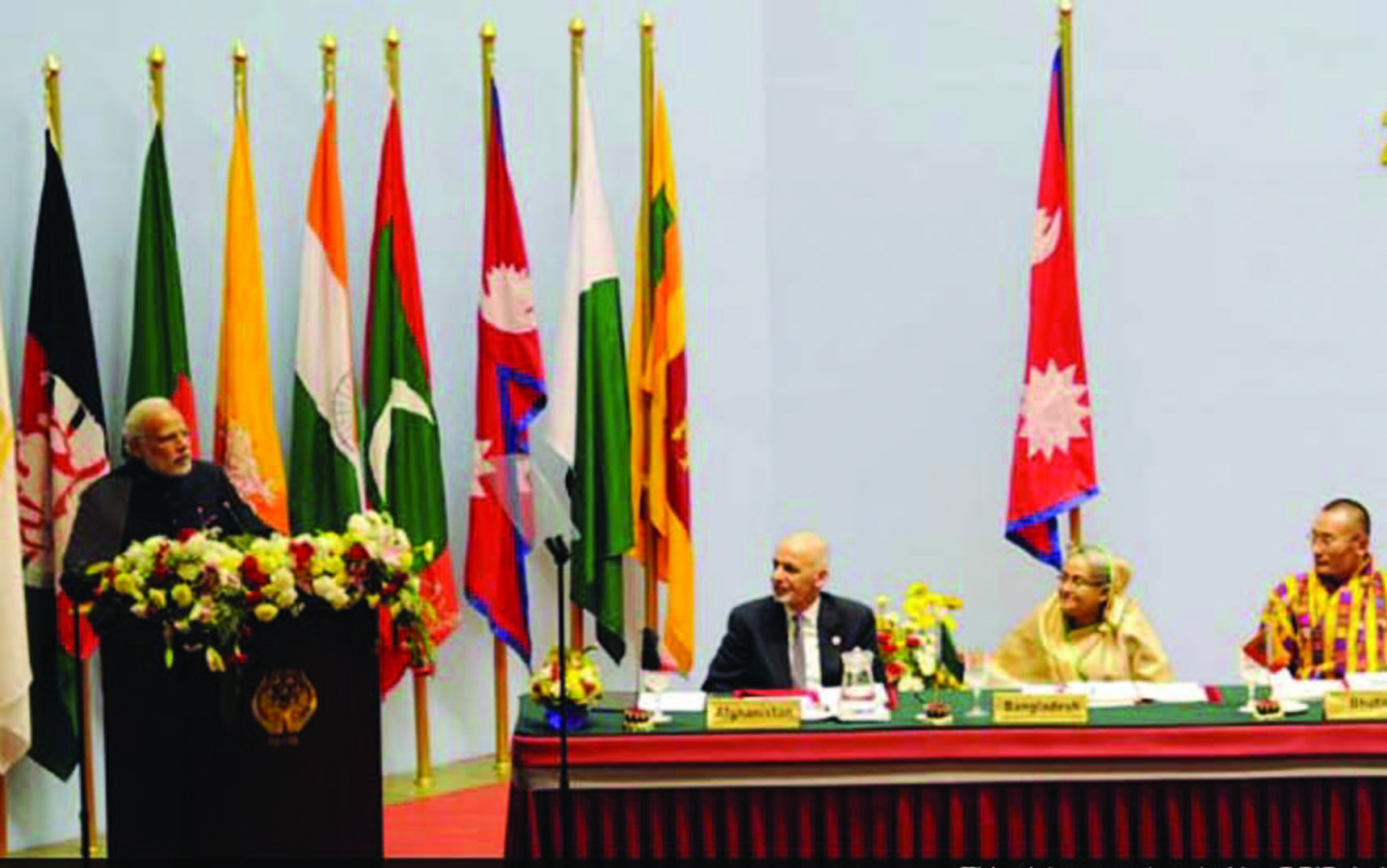
    Increasing agricultural productivity and ensuring food and nutritional security is also the part of the Kathmandu Declaration. Providing quality education, eliminating illiteracy, providing vocational education and training, and making South Asia an attractive common tourist destination by promoting public-private partnership, are also mentioned in the declaration. In the opening ceremony on Wednesday, Indian Prime Minister Narendra Modi, who was the cynosure of all eyes, exhorted the eight SAARC member states nations to “walk in step” as he proposed a slew of measures, including ease for business travel, a level playing field in trade, and initiatives in healthcare and tourism.

    He referred to terrorism, especially the 26/11 Mumbai terror attack, in which 10 Pakistani terrorists unleashed mayhem in India’s commercial capital in 2008. “Today, as we remember the horror of the terror attack in Mumbai in 2008, we feel the endless pain of lost lives. Let us work together to fulfill the pledge we have taken to combat terrorism and trans-national crimes,” he said, without naming Pakistan. Urging for seamless connectivity in the region, Modi said “for India, our vision for the region rests on five pillars — trade, investment, assistance, cooperation in every area, and contacts between our people”. “There is a new awakening in South Asia; a new recognition of inter-linked destinies; and a new belief in shared opportunities,” he said. Host of the summit, Nepal Prime Minister Sushil Koirala, said that SAARC would focus on connectivity, security and eradicating extreme poverty.

    While Bangladesh Prime Minister Sheikh Hasina sought implementation of the SAARC free trade agreement (FTA) that was signed nearly a decade ago, Pakistan’s Nawaz Sharif called for a dispute-free South Asia. Afghan President Ashraf Ghani asserted that his country would not endanger regional security. While Maldivian President Abdulla Yameen sought a common SAARC platform on climate change, Bhutan’s Prime Minister Tshering Tobgay called for greater integration among South Asian countries to bolster growth. Sri Lanka President Mahinda Rajapaksa called for a common voice among South Asian nations on international issues and cooperation on eradicating terrorism. The heads of state and government also held bilateral meetings on the sidelines of the summit.

    After having met Nepal Prime Minister Koirala soon after his arrival here on Tuesday, Prime Minister Modi met his Bangladeshi and Bhutanese counterparts Hasina and Tobgay, and later the presidents of Afghanistan, Sri Lanka and Maldives — Ghani, Rajapaksa and Yameen. Though there was no meeting scheduled between the Indian Prime Minister and Pakistan’s Sharif, the two eventually greeted and informally spoke with each other at the retreat organised for the delegates at the Dhulikhel hill resort near Kathmandu on Thursday. Modi and Sharif shaking hands on the podium in the closing ceremony was the lasting image of the summit.

  • Lankan minister accuses IPKF of rape during LTTE war

    Lankan minister accuses IPKF of rape during LTTE war

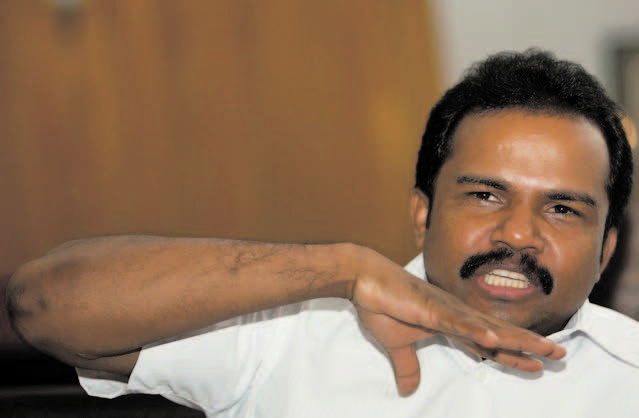
    COLOMBO (TIP): A Sri Lankan minister on November 12 accused the Indian Peace Keeping Force (IPKF) of raping Tamil women during the LTTE war. The 48-year-old Vinayagamurthi Muralitharan alias Karuna, who was a former LTTE leader and now a deputy minister in the Mahinda Rajpaksa government, told the parliament that the IPKF who conducted peacekeeping operations in Sri Lanka between 1987 and 1990, had raped several Tamil women while also killing Tamil’s. “There is evidence for that,” Muralitharan, who was then the LTTE’s feared eastern leader said.

    The IPKF was invited into north and eastern Sri Lanka in terms of the Indo- Lanka Accord of 1987. Karuna brokeaway from the LTTE in 2004 to form his own movement and later his own political party. He was later allied with Rajapaksa’s ruling coalition to become a deputy minister. He was also appointed a Vice President of the dominant party in the ruling coalition, Sri Lanka Freedom Party (SLFP). Meanwhile, the opposition United National Party (UNP) said that Karuna, a terrorist leader has become a senior member of the SLFP.

    Karuna warned the UNP saying he will not hesitate to reveal a lot of information which will cause the main opposition party much embarrassment if they continued to raise allegations against him. In his speech in the parliament he praised the Sri Lankan Navy of preventing poaching in Lankan waters by Indian fishermen. He accused former President Ranasinghe Premadasa of strengthening the LTTE by giving the rebels more weapons.

    Muralitharan said that around 1989 only 350 LTTE cadres remained in the outfit but it eventually grew in numbers as a result of the actions of Premadasa. “He gave 5000 weapons to the LTTE. That 300 changed into 6000 in 3 months,” he said. The Deputy Minister also accused the Tamil National Alliance (TNA) of attempting to scuttle the peace by promoting the UN led investigation on Sri Lanka

  • ROHIT’S RECORD 264 LEADS SRI LANKA THRASHING

    ROHIT’S RECORD 264 LEADS SRI LANKA THRASHING

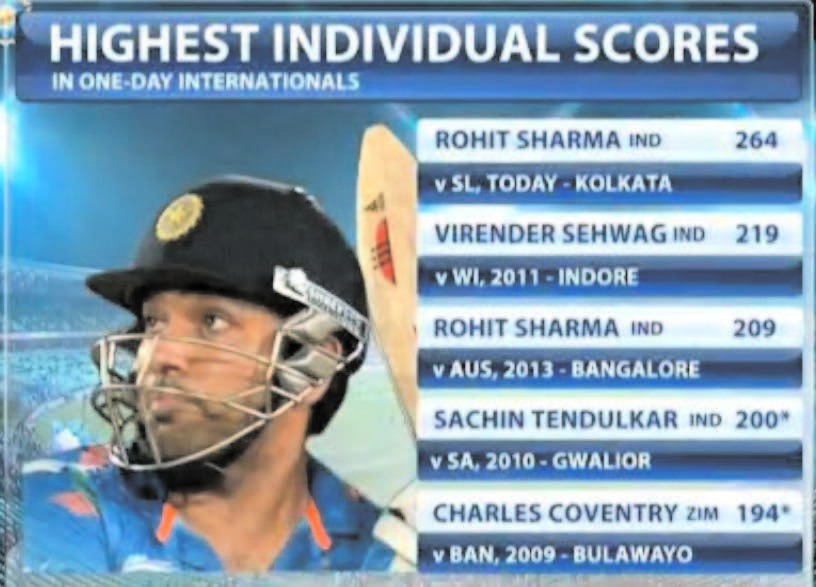
    India have all the reasons to feel good about batting ahead of their upcoming tour of Australia after Rohit Sharma, playing his first international match since August on account of finger and shoulder injuries, scored his second double hundred (264 off 173 balls) to help India thrash Sri Lanka for the fourth time running in the five-game series at Kolkata’s Eden Gardens on Thursday.

    Rohit, after becoming the first batsman to score two double hundreds, also broke Virender Sehwag’s record of highest individual score of 219 as India posted a mammoth 404 in pursuit of which the Sri Lankans could only manage 251 all out in 43.1 overs. In the previous games of the series, Shikhar Dhawan, Ajinkya Rahane, Suresh Raina, Virat Kohli, Ambati Raidu all were among the runs but India still needed Rohit – one of their big batting hopes – to get some confidence before the gruelling Australian tour gets underway later this month.


    23


    Standin captain Kohli’s comments on Rohit on the eve of the match that “if a player like him gets going he can be the X factor in a tournament like the World Cup. When he gets going, he can bring those big runs and win the match for you” echoed at the hallowed Eden Gardens in front of thousands of Indian fans as the 27-year-old hit a record 33 boundaries to go with nine sixes. Looking at his score, one might think that he was in his zone from the first ball but that wasn’t the case. In the first half of his innings, he was sluggish struggling to meet the ball properly.

    Rohit, who took Dhawan’s place for this match, was lucky to get a reprieve on four when Thisara Perera dropped a simple catch at third man off the bowling of Angelo Mathews. His discomfort could be gauged from the fact it took him 22 balls to pick up his first boundary and then 72 balls for a fifty. However, once past fifty, Rohit upped the ante big time with his next four fifties coming off just 28, 25, 26 and 15 balls. India, for the second time in series after the Cuttack game, took the batting Powerplay a bit earlier than usual and made 57 runs from 29-34 overs. Rohit had plenty of support from Kohli (66 off 64 balls, 33rd fifty), after Ajinkya Rahane and Ambati Rayudu contributed 28 and 8 respectively, and both added 202 in 25.5 overs.

    Kohli’s run-out, resultant of a misunderstanding on the second run, was the only blemish of that partnership. Suresh Raina got out cheaply for 11 but Rohit continued his assault, adding 128 in 9.4 overs runs with Robin Uthappa (16*) before falling off the last ball of the innings. India scored 129 in the last 10 overs. The Sri Lankan bowlers had a nightmarish outing with Nuwan Kulasekera, Shaminda Eranga, Sekkuge Prasanna and Ajantha Mendis returning 2/89 ( 9 overs), 1/77 (10 overs), 0/70 (10 overs) and 0/70 (7 overs) respectively. The visitors’ hopes of a remote win were dashed in the first ten overs thanks to Umesh Yadav and Stuart Binny whose strikes left the Sri Lankans gasping for breath at 48 for 4.

    After that the match became academic as Mathews’ men only played to reduce the margin of defeat. Mathews and Lahiru Thirimanne added 118 runs and then, after Akshar Patel had Mathews stumped for 75, Thirimanne (59) put on 52 with Thisara (29) to blow away fears that it could be their worse defeat than their 183-run thrashing at Taunton in 1999 – their biggest loss in terms of runs against India. Encouraged by a big total, Indian bowlers Umesh (2/38), Binny (2/55), Patel (2/51) and Dhawal Kulkarni (4/34) plied their trade with a lot of freedom. However, it wasn’t a good day for debutant legspinner Karn Sharma who took some pounding and returned with figures of 0/64. The last game of the series will be played in Ranchi on Sunday.

    Brief scores: India 404/5 (Rohit 264, Kohli 66; Kulasekara 2/89) beat Sri Lanka (Mathews 75, Thirimanne 59; Kulkarni 4/33) by 153 runs

  • Lankan minister accuses IPKF of rape during LTTE war

    Lankan minister accuses IPKF of rape during LTTE war

    COLOMBO (TIP): A Sri Lankan minister on Wednesday accused the Indian Peace Keeping Force (IPKF) of raping Tamil women during the LTTE war. The 48-year-old Vinayagamurthi Muralitharan alias Karuna, who was a former LTTE leader and now a deputy minister in the Mahinda Rajpaksa government, told the parliament that the IPKF who conducted peacekeeping operations in Sri Lanka between 1987 and 1990, had raped several Tamil women while also killing Tamil’s. “There is evidence for that,” Muralitharan, who was then the LTTE’s feared eastern leader said. The IPKF was invited into north and eastern Sri Lanka in terms of the Indo- Lanka Accord of 1987. Karuna brokeaway from the LTTE in 2004 to form his own movement and later his own political party.

    He was later allied with Rajapaksa’s ruling coalition to become a deputy minister. He was also appointed a Vice President of the dominant party in the ruling coalition, Sri Lanka Freedom Party (SLFP). Meanwhile, the opposition United National Party (UNP) said that Karuna, a terrorist leader has become a senior member of the SLFP. Karuna warned the UNP saying he will not hesitate to reveal a lot of information which will cause the main opposition party much embarrassment if they continued to raise allegations against him.In his speech in the parliament he praised the Sri Lankan Navy of preventing poaching in Lankan waters by Indian fishermen. He accused former President Ranasinghe Premadasa of strengthening the LTTE by giving the rebels more weapons. Muralitharan said that around 1989 only 350 LTTE cadres remained in the outfit but it eventually grew in numbers as a result of the actions of Premadasa.

  • Pope Francis may declare Sri Lanka’s first Roman Catholic saint

    Pope Francis may declare Sri Lanka’s first Roman Catholic saint

    COLOMBO (TIP): Pope Francis may make a 17th century priest Sri Lanka’s first Roman Catholic saint during his trip next year, making good on his promise to give Asia more saints as models for the faithful, Sri Lankan and Vatican officials said on October 23. Francis plans to visit the island nation from January 13- 15 and then travel onto the Philippines to meet with survivors of Typhoon Haiyan. The archbishop of Colombo, Cardinal Malcolm Ranjith, said he hoped that the Vatican would give final approval to the sainthood case of India-born Reverend Joseph Vaz so that Francis himself could celebrate the canonisation Mass at Colombo’s Galle Face Green. “We are hopeful,” Ranjith said. Vaz was born in Goa, India, in 1651 but chose to work in Sri Lanka amid persecution of Catholics by Dutch colonial rulers, who were Calvinists. Vaz is credited with having revived the Catholic faith in the country, using disguises and learning the local Sinhala and Tamil languages to meet secretly with underground Catholics. He died in 1711.

  • Five Indian fishermen get death term in Lanka

    Five Indian fishermen get death term in Lanka

    COLOMBO/NEW DELHI (TIP): Five Indian fishermen were given death penalty by a Sri Lankan court on October 30 for alleged drug trafficking, invoking a sharp reaction from India which took up the matter with Sri Lanka and said it would appeal to a higher court against the judgment. The five Indians – Emerson, P Augustus, R Wilson, K Prasath and J Langlet –were among a group of eight people sentenced to death by the Colombo High Court. The other three were Sri Lankan nationals.

    The eight were apprehended by Sri Lankan Navy near Delft Island on the Palk Strait on November 28, 2011. They were accused of narcotics smuggling. Sri Lankan Navy claimed that the group of drug smugglers had pretended to be fishermen, when they were caught and handed over to police. The Tamil Nadu fishermen, however, claimed innocence right from the beginning of the trial. “The Government of India through the High Commission of India, Colombo and the Consulate General of India, Jaffna has been extending all possible consular assistance to them,” the MEA spokesperson said.

    After the Colombo High Court verdict, New Delhi asked the Indian High Commission in Colombo to help them appeal against the verdict in a higher court there. India also took up the issue with the Sri Lankan government through diplomatic channels, both in New Delhi and Colombo. Syed Akbaruddin, spokesperson of the Ministry of External Affairs, said the government was committed to helping the TN fishermen. He said India’s High Commissioner to Sri Lanka, Yash Sinha, was in touch with the island nation’s Foreign Minister G L Peiris after the court pronounced its judgment.

  • E-VISA SYSTEM LIKELY TO BE ROLLED OUT NEXT

    E-VISA SYSTEM LIKELY TO BE ROLLED OUT NEXT

    NEW DELHI (TIP): The Government will roll out by next week the muchawaited electronic-visa system for tourists from select countries including US and Japan. Home minister Rajnath Singh along with tourism minister Sripad Naik will unveil the first phase of e-visa system for tourists from two dozens countries including US and Japan at a function here shortly, a senior Tourism Ministry official said.

    While Australia is likely to be accorded the e-visa facility during Prime Minister Narendra Modi’s visit Down Under, some countries belonging to BRICS and African region are likely to be announced in the first phase. The e-visa is expected to give a big boost to the foreign tourist arrivals in the country. While in January about 4.95 lakh foreign tourists arrived in India, there were a total of 51.79 lakh during January-September this year. All the arrangements including the software for this system is ready now and will be operational at nine international airports including Delhi, Mumbai, Chennai, Kolkata, Hyderabad, Bengaluru, Kochi, Thiruvananthapuram, and Goa.

    The official said though there are certain issues yet to be resolved for the Goa Airport, the Government has decided in principle to extend it to Goa as well. According to the official, about 25 countries including the 13 countries which are currently having the Visaon- Arrival (VoA) facility in India to be covered under e-visa regime. US, Japan, South Korea, Thailand, Vietnam, the Philippines, Singapore are among the countries which will be given e-visa facility in the first phase. Barring a few countries like Pakistan, Sudan, Afghanistan, Iran, Iraq, Nigeria, Sri Lanka and Somalia, all 180 countries will be covered under e-visa regime in phases, the official said.

    He said China is definitely on the list of countries to be provided e-visa facility, but not in the first list. China is a big-thrust market for India and Tourism Ministry has taken various steps to woo maximum Chinese tourists. While the Incredible India website is being translated into the Chinese language and an infoline will also be established in that language. Besides guides are being trained in Chinese language to help tourists from that country. In order to get e-visa, one would need to apply in the designated website along the required fees. They would be granted an electronic version of the visa within 96 hours.

  • Gift of Life (New Delhi) India

    Gift of Life (New Delhi) India

    20 percent of infant mortality is due to Congenital Heart Diseases (CHD). Poor children have no access to quality medical care and cannot afford high cost of surgery. 3000 children (India, Uganda, Kenya, Sudan, El Salvador, Sri Lanka, Nepal, Pakistan) benefited from GOL India New Delhi project alone. PRID Rtn Sushil Gupta (Advisor), PDG Ravi Bhooplapur (Chair) and Dr AC Peter (National Coordinator) monitor this life saving project. Rotary (Delhi NCR) Gift of Life Trust is auxiliary. This project was launched in New Delhi India in July 2005. Our partner hospitals are Escorts, NHI and PCH in Delhi. PRID Jackson Hsieh, D3460 to D3520 are also MG Donors. Children were given medicine, food and accommodation, conveyance etc. free of cost. Rotarians visit the children in the hospital and offer motherly care. Past and current RI Presidents, TRF Trustee, Ministers, Ambassadors etc visited the project. This is truly an international peace project signifying “service above self”

  • Sri Lanka military to return jewellery to Tamil civilians

    Sri Lanka military to return jewellery to Tamil civilians

    COLOMBO: Sri Lankan military has identified 2,377 “legitimate claimants” to handback a considerable stock of gold and jewellery it seized in the final battle against the LTTE more than five years ago. Rejecting accusations levelled against it by the Tamil diaspora, the Lankan military on Tuesday said it has invited the rightful owners to contact the civil coordinating offices in the former Liberation Tigers of Tamil Eelam (LTTE) regions to receive their items on verification of ownership. The military said a considerable stock of gold jewellery had been recovered from the Tamil Eelam Banks and Eelam Pawning Centres run by the LTTE.

  • WORLD CELEBRATES DIWALI with prayers, bright lights and fireworks

    WORLD CELEBRATES DIWALI with prayers, bright lights and fireworks

    WASHINGTON (TIP): The five-day Indian festival – Diwali – symbolic of victory of good over evil was celebrated , from October 22 , the world over with great enthusiasm Amid chanting of Vedic mantras and lighting of the traditional ‘diya’ by US Secretary of State John Kerry, Diwali was celebrated for the first time at the State Department. “As the days grow shorter, the Diwali reminds us that spring always returns – that knowledge triumphs over ignorance, hope outlasts despair, and light replaces darkness.

    Diwali is a time for the revitalization of mind and spirit,” said Kerry who was joined by India’s Ambassador S Jaishankar. “It affords a chance to reflect on how we can bring light to others. It is an opportunity for us all, regardless of our own traditions, to renew a shared commitment to human dignity, compassion, and service – and it is a commitment, I think, at the heart of all great faiths,” he said. Some 300 guests, including a large number of eminent Indian-Americans and envoys from other South Asian countries, were present to celebrate Diwali for the first time at the State Department’s historic Benjamin Franklin room, which was lit with many small diyas and candles.

    The top Indian-American US officials, including Assistant Secretary of State for South and Central Asia Nisha Desai Biswal and USAID Administrator Raj Shah, were also present. “We worked hard to prove that we were, in fact, natural partners, which I believe we are. We are two optimistic nations who believe that history doesn’t shape us, but that we have the power to shape history. And that spirit of hope and optimism is really at the center of the Diwali celebration,” Kerry said and greeted people with Saal Mubarak. The guests were served the traditional Indian dishes – including sweet dishes like Jalebi, Gulab Jamun, different varieties of burfi, kaju katli and kheer. Some of the dishes were in fact were made inside the State Department kitchen, while other dishes were procured from a popular Indian restaurant in Washington DC.

    It was also one of the rarest occasions that no alcohol was served. It was all soft drinks, juices and not to miss the traditional mango ‘lassi’. In Birmingham, UK, Bhangra music filled the air as hundreds of people flocked to Diwali celebrations in Birmingham. Food stalls and dancing also entertained families as they turned out in their droves for Soho’s Festival of Lights.

    It was the first time the event had been staged after being organized by the newly-formed Soho Road BID. The BID is home to 560 predominantly independent businesses stretching from Holyhead Road to Soho Hill – with an estimated local population of 250,000. BID manager Craig Bucky said: “We were so excited to be able to run our first community event. “It’s been a lot of hard work and determination but it was a great celebration that the community can be proud of.” BID chairman Dipak Patel said that more events were in the pipeline in a bid to improve the area.

    “The long-term strategy is to make Soho Road an exciting place to work and live,” he said. Diwali was celebrated with enthusiasm and vigor in Sri Lanka, the land where the epic happened. Distribution of misri and lighting a lamp was a traditional fix. Locals offer prayers along the beach. In Thailand, Diyas or lamps made of banana leaves with candles and incense were placed in the river to float. People greeted each other and distributed sweets. Diwali was celebrated with full aplomb in Malaysia. Even the locals indulged in the festivities wholeheartedly. Diwali is an official holiday in Malaysia. People invite each other to their homes and celebrate it with their friends and family.

    The Hindu community of Malaysia constitutes about 8% of its total population. The community celebrates it under the name of Hari Diwali. Nepal is a multi ethnic land with diversity in culture. Nepal celebrated Diwali with bright lights, gift exchanges, fireworks, and elaborate feasts to welcome Lakshmi, the goddess of light and wealth. Diwali in Nepal is known as Tihar. In Australia, Diwali was celebrated publicly amongst the people of Indian origin and the local Australians in Melbourne.

    The cultural kaleidoscope of India was depicted as Indians in Melbourne showcased Indian art, culture, style, traditions and food via various activities, seminars, festivals, fairs and events. Diwali was also celebrated in Guyana, Fiji, Mauritius, Myanmar, Singapore, Trinidad & Tobago, Indonesia, Japan, Thailand and Africa, among the Hindus across the world.

  • Shinzo Abe becomes first Japanese PM to visit Sri Lanka in 24 years

    Shinzo Abe becomes first Japanese PM to visit Sri Lanka in 24 years

    COLOMBO (TIP): Shinzo Abe on October 12 became the first Japanese prime minister to visit Sri Lanka in 24 years, on the second leg of a South Asian tour that sought to assert Tokyo’s interest in a region where it has ceded influence to China. Abe was greeted by Sri Lankan President Mahinda Rajapaksa at Colombo’s international airport, where a new passenger terminal will be built with the help of a $330 million Japanese development loan.

    The two leaders struck “a new partnership between maritime countries” that reflects Japan’s interest in keeping open shipping lanes that supply oil and liquefied natural gas from the Middle East to feed its energydependent economy. “The president and I shared the view on building friendly ties and partnership between the two maritime countries,” Abe said after the meeting. Asian great-power diplomacy has stirred into life since the rise to power of Indian nationalist Narendra Modi, who announced his intent to play an active role on the world stage by inviting regional leaders to his inauguration in May.

    Abe comes to India’s backyard after hosting Modi for summit talks that yielded a Japanese pledge to invest $34 billion in India and launched a “special, strategic global partnership” to deepen security cooperation. The Japanese premier pre-empts Chinese President Xi Jinping, who travels to India and Sri Lanka later this month. “They (the Japanese) are aware that we are beholden to China’s influence in many ways, so they would like to counter that,” Nanda Godaga, a retired Sri Lankan diplomat who follows Japanese foreign policy, said before Abe’s visit.

    China has financed the construction of a $500 million port terminal for Colombo as part of efforts to build a ’21st-century maritime silk road’, but Tokyo plays down any notion that Asia’s two largest economies are entering a geopolitical contest. “We are not going to become a big superpower … we have a lot of investment in China,” Abe’s spokesman, Kenko Sone, told a briefing in the Bangladeshi capital Dhaka on Sunday morning. “We have some difficulties with them but we prefer to solve those issues through discussions.” In Bangladesh on Saturday, Abe followed up on commitments for Japanese business to invest 600 billion yen ($5.7 billion) in infrastructure projects, and won Dhaka’s support for Tokyo’s bid for a temporary seat on the United Nations Security Council.

  • New Zealand official’s ‘Indian radio’ remark stirs race row

    New Zealand official’s ‘Indian radio’ remark stirs race row

    MELBOURNE (TIP): A New Zealand immigration official sparked a race row after rejecting a woman’s visa application for a job, saying New Zealanders are unlikely to hear Indian radio. The case came to light after immigration lawyer Ramya Sathiyanathan received an email from the immigration officer with regard to a visa application for a job which a client was offered. It was in papers and with Indian station Radio Tarana. The immigration officer objected to the employer saying genuine attempts were not made to recruit locals workers as New Zealanders are unlikely to hear Indian radio. “I was shocked by the racist statement,” Sathiyanathan,who is from Sri Lanka said. Area manager Michael Carley said the remark was made in context of the employer having to prove they had made attempts to recruit New Zealanders

  • Sri Lankan President Mahinda Rajapaksa appoints Tamil leader as deputy minister

    Sri Lankan President Mahinda Rajapaksa appoints Tamil leader as deputy minister

    COLOMBO(TIP): Sri Lankan President Mahinda Rajapaksa today on October 10 appointed senior Tamil parliamentarian V S Radhakrishnan as a Deputy Minister, a move aimed at wining the support of the community ahead of his third re-election bid.

    The President’s office announced the swearing-in of Radhakrishnan, a member of the Upcountry People’s Front (UPF), as the Deputy Minister of Botanical Gardens and Public Recreation.

    A senior parliamentarian of the Ceylon Workers Congress (CWC), Radhakrishnan contested the 2010 General Election under the ruling United Peoples Freedom Alliance (UPFA) ticket from Nuwara Eliya District, and came second in preference votes.

    The CWC is the large trade union cum political party in the central hill districts. It represents the larger section of the Indian Tamil population in the central districts of Nuwara Eliya and Badulla.

    The CWC support enabled the Rajapaksa’s ruling coalition UPFA to win the Uva (south eastern) provincial council election held on September 20. However, the ruling coalition suffered a significant loss in votes in the face of a stiff challenge posed by the main opposition UNP.

    Ahead of the Uva election, Rajapaksa rewarded two more allies representing the Tamil community with similar deputy ministerial positions.

    Sri Lanka President is widely believed to call a snap presidential election in a bid to win his third term.

  • Featured: He CAME, he SPOKE, he CONQUERED

    Featured: He CAME, he SPOKE, he CONQUERED

    NEW YORK (TIP): Yes, it is Narendra Modi, Prime Minister of India. All Indian Americans are familiar with that name, for good or for bad, mostly for good, though.

    Modi was in New York from September 26 to 29th afternoon, before he left for Washington to enjoy the hospitality of US President Barack Obama in the evening and a bilateral talk the next day, before flying back to India.

    Much before he arrived in the US, Indian Americans had set out to give him a hero’s welcome. A trusted friend of Modi, Dr. Bharat Barai, was tasked with arranging a massive community reception to Modi which he did, with the help and cooperation of a devoted band of people. It was a colossal effort to have around 20,000 people come to Madison Square Garden to give a rousing reception to Modi, an icon for many, particularly from his community and place, Gujarat, a state which he governed with appreciable growth for around 12 years.

    And why not! Modi was coming as Prime Minister of India to a country which had denied him a Visa since 2005 for his alleged role in not preventing killings of people from a particular community in Gujarat when he was the chief minister of that state in 2002. His admirers here gloated that US had no option but to welcome him now that he was coming to the United Nations as India’s Prime Minister, whose party had got a massive support of the people of India and was catapulted in to power, with total command over government, without having to depend on allies’ support as was the case when Atal Behari Vajpayee formed a BJP led government in 1999 which lasted its full term of 5 years, to 2004.

    So, here was a man who represented a democratic country -the largest democracy in the world- with 1.25 billion people. How could the US ignore Modi whose country was poised to become an Asian giant and the second largest economic power in the world by 2050? No way! So, Obama invited Modi over to the White House for a private dinner. It was another matter that the invited dignitary was fasting on account of Hindu festival of Navratras and he would not eat. By the way, Modi has been observing Navratra fasts for the past 40 years, insiders said.

    So, Prime Minister Narendra Modi arrived on September 26. He was given a rousing welcome at the JFK airport in New York. My good friends, Narain Kataria, Arish Sahani and Jagdish Sewhani arranged to have a large number of people gather at the airport to give a warm welcome to Modi. So, we had the chant of “Modi, Modi” which surely pleased the man, given to showmanship, which explains his admiration for film actors, like Amitabh Bachchan, and of course, some others.

    And while in New York, Prime Minister of India, Narendra Modi left no one in doubt that he was a better performer than any in the world. A perfect juggler, a consummate magician, a pied piper of India.

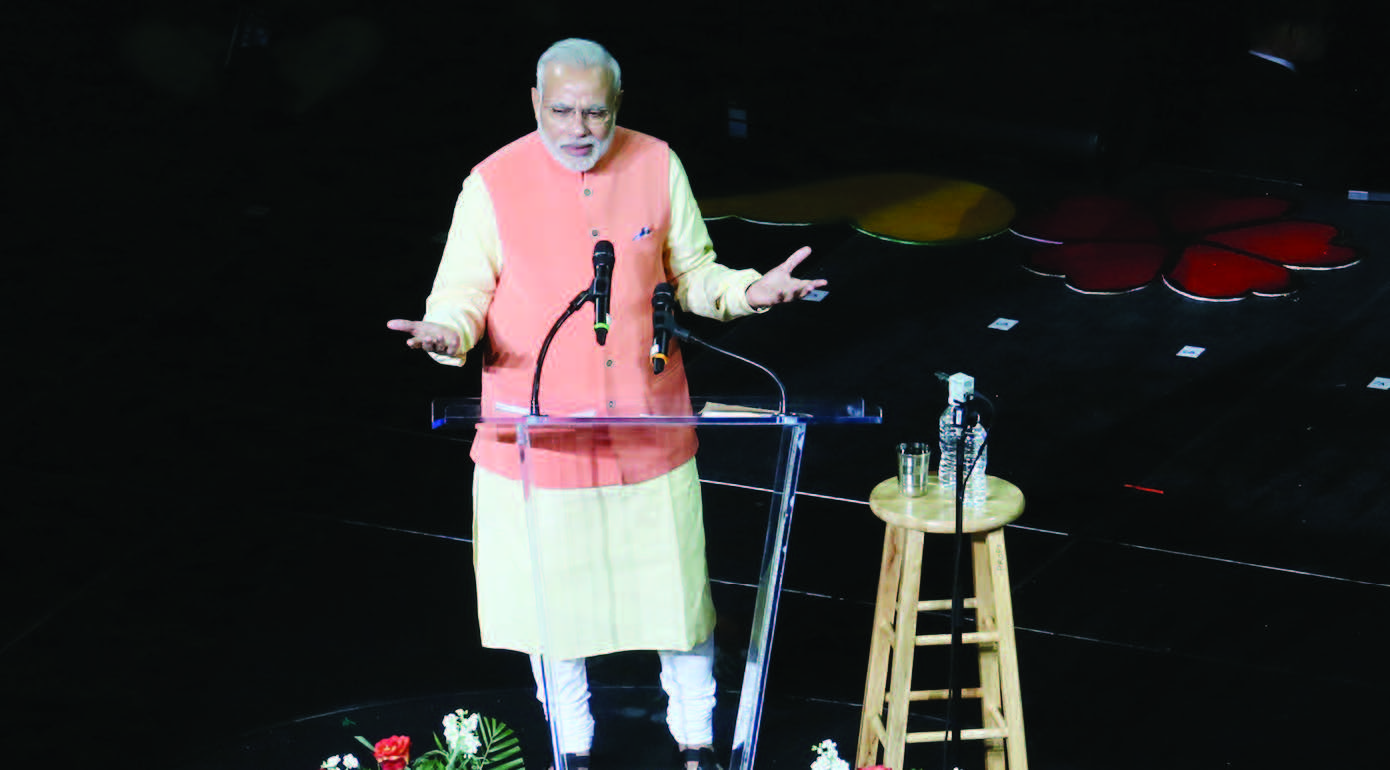
    I found many acknowledging Modi’s felicity of expression which allowed him to connect with people immediately. He speaks in the language and diction that people at all levels commonly understand. He relies on simple words and home truths to deliver his ideas home. Again, he has mastered the art of delivery. His body language is extremely expressive and impressive. During the more than 90 minutes speech he delivered at the Madison Square Garden on September 28th, not a soul could have looked at the watch. Not one could have yawned, out of boredom. None would have thought of anything but what Modi was saying. The eyes of all remained fixed on the man in the center of the arena. Such was the grip of the man. And whatever he said seemed to come straight out of his heart. He pumped into his speech his heart, his mind and his vocal cords-delivering the “very best”.

    Now see what he said. First, India can and will achieve the greatness that it once had. Second, we have a huge human resource capital in the form of a young India, with 60% of population under the age of 35. No other country in the world has such human resource. Third, we have brains. Example, our scientists succeeded in the Mars mission in the first attempt itself, a feat which even US could not perform. Modi took pride in mentioning that India’s Mars mission cost peanuts when compared with the money spent by countries like USA on similar missions.

    Yes, we can. But how can we do it? He did offer Namo Mantra for that. He spoke of the defects in the system in the country and said the system that stood in the way of quick progression had to be demolished. He spoke of the futile, cumbersome and irrelevant laws which needed to be consigned to dust bin. He spoke of the massive investment required for development. And he invited Indian Americans as also the whole world to come and invest in India. Also, he gave a call to “make in India”.

    Modi was particularly appreciative of the Sikhs, in his speech. He spoke of the great sacrifices the Sikh Gurus had made. He also recalled the sacrifices of the Sikhs in the freedom struggle of India. He spoke of the brave Sikh soldiers in the Indian armed forces and said the nation is proud of the Sikhs who have always stood by their motherland, come what may.

    Modi simply created a vision. He came up with ideas that won attention and admiration of many. He wove dreams that all would love to own. He assured the gathering of around 20,000 at the famous Madison Square Garden which somebody christened as “Modison” Square Garden that India was on a fast track to development. Then he made some announcements to please the locals, too. He told them he was taking care to ensure there is no harassment at the airports in India of Indian Americans visiting India. He also said he knew of problems with getting visas. He said there will be no delays any more in obtaining a visa. Also, he said the clubbing together of OCI and PIO was being worked out and soon the problems arising out of OIC/PIO will be over. He also announced visa on arrival for US nationals on the pattern of some 9 countries whose citizens are entitled to get tourist visa on arrival in India. Surely, the local crowd was pleased.

    The magician Modi wielded his wand for more than 90 minutes and left the gathering charmed and captivated. Yes, he came, he spoke , he conquered the hearts of Indian Americans who had come from far and near to have his darshan and hear him speak. But before he left, the gathering burst in to Modi chant, just as it had when he had arrived. And, believe me, Modi must have enjoyed the chant. The “Modi” chant must have been music to his years.

    During the course of his stay in New York from 26th September to 29th September afternoon, Modi attended a large number of events, met a number of people from all walks of life which included world leaders, his counterparts from neighboring countries Sri Lanka and Nepal, US lawmakers and officials, captains of business and industry, community leaders, religious leaders and eminent people- both Indian Americans and others, and discussed a variety of issues.

    We bring our readers here a few pictures of Modi’s New York visit. All pictures have been provided by The Indian Panorama special photo journalist Mohammed Jaffer.

    Modi pays homage to victims of 9:11 at the 9:11 memorial at ground zero on September 27th 2014.

    Prime Minister Modi speaking at Global Citizens Festival at Central Park in NYC on 27th September, 2014

    Modi addresses the 69th United Nations General Assembly. He called for a relentless fight against terrorism and the Security Council

    Madison Square Garden on September 28

  • Lanka backs China’s sea ‘Silk Route’

    Lanka backs China’s sea ‘Silk Route’

    COLOMBO: Chinese President Xi Jinping won Sri Lanka’s support on Tuesday for a proposed maritime “Silk Road” linking China with Europe, and helped launch billion-dollar power plant and port city projects funded by his government. Xi, the first Chinese leader to visit Sri Lanka in 28 years, and President Mahinda Rajapaksa oversaw the signing of 27 agreements in areas including highways and the construction of a joint coastal and marine research centre. They also agreed to start negotiations on a free trade agreement. Before departing for India on sept 17, Xi planned to help launch Colombo Port City, being constructed on an artificial island off Colombo with $1.4 billion in Chinese loans.

  • Shinzo Abe becomes first Japanese PM to visit Sri Lanka in 24 years

    Shinzo Abe becomes first Japanese PM to visit Sri Lanka in 24 years

    COLOMBO (TIP): Shinzo Abe on Sept 10 became the first Japanese prime minister to visit Sri Lanka in 24 years, on the second leg of a South Asian tour that sought to assert Tokyo’s interest in a region where it has ceded influence to China. Abe was greeted by Sri Lankan President Mahinda Rajapaksa at Colombo’s international airport, where a new passenger terminal will be built with the help of a $330 million Japanese development loan.

    The two leaders struck “a new partnership between maritime countries” that reflects Japan’s interest in keeping open shipping lanes that supply oil and liquefied natural gas from the Middle East to feed its energydependent economy. “The president and I shared the view on building friendly ties and partnership between the two maritime countries,” Abe said after the meeting. Asian great-power diplomacy has stirred into life since the rise to power of Indian nationalist Narendra Modi, who announced his intent to play an active role on the world stage by inviting regional leaders to his inauguration in May.

    Abe comes to India’s backyard after hosting Modi for summit talks that yielded a Japanese pledge to invest $34 billion in India and launched a “special, strategic global partnership” to deepen security cooperation.

  • A Benevolent Law Abused

    A Benevolent Law Abused

    Racketeers use SIJS to make big money

    By I.S. Saluja & The Indian Panorama Investigative Team

    Number of Undocumented Children Who Cross U.S. Border Alone Has Tripled

    (The Pew Charitable Trusts: May 9, 2013)

    Each year, thousands of unaccompanied alien children (UACs) risk harrowing journeys and travel alone to seek refuge in the United States. These children come from all over the world for many reasons, including to escape persecution in their home countries, to reunify with family members and to look for a better life. In recent years, the U.S. government has had roughly 6,000-8,000 of these children in its care and custody each year. While these children may be as young as infants, most (approximately 70 percent) have been between the ages of 15 and 17. – Women’s Refugee Commission

    (The Migrationist: August 8, 2013)

    Hundreds of thousands of youth (under age 18) attempt to enter the U.S. every year. Some come with their families, others alone, either of their own will seeking jobs, protection and family reunification or they are smuggled into the country for sweatshop labor or sexual exploitation. The exact number of children who attempt to enter the country is unknown. In 2005, the U.S. granted legal permanent resident (LPR) status to 175,000 children under 14 years of age and to 196,000 youth ages 15 to 24. Twenty thousand youth ages 17 and under were accepted as refugees and 2,000 were granted asylum in the same year. Customs and Border Protection (CPB) apprehended almost 122,000 juveniles in the U.S. in 2004. Of this total, 84.6 percent were released back to Mexico, or in rare cases to Canada.

    (National Juvenile Justice Network)

    It has been said the crooks will always find creeks to enter any system in the world. And when the system is welcoming and benevolent, the infiltration is much easier. Special Immigrant Juvenile Status law (Please read the article below by eminent attorney Anand Ahuja) was enacted with a humanitarian objective to provide protection to these minors who are victims of domestic abuse.

    Over the years, the law stands abused. It has become a booming business in many countries to push young boys and girls, mainly boys (77%), in to the United States territory and make them take advantage of SIJS.

    The Indian Panorama Investigative team came across quite a few people in Queens and Long Island in New York who are part of the thriving racket to smuggle in young boys and girls from India. The reports received by us indicate that it is a big business in many South Asian countries, in particular, India, Sri Lanka and Pakistan as also in many other countries across the world.

    We were taken for a shock to get to know how elaborate the racket’s dragnet is, which involves agents in countries from which the young people are sent, agents at the Mexican side of the US border who help them cross over in to the United States, agents in the US who manage a guardian for the boy/girl and so on so forth. All this involves huge money. In India, the price to send a young boy or a girl in to USA is anywhere between $80,000 to $100,000.

    Another shocking revelation was the involvement of church in this racket. During our talk with some who are involved in the racket told us, on condition of anonymity, that at least, one priest from a Christian Church in New York and a Sikh priest from a Sikh Gurudwara in Arizona are actively involved in running the racket. The authorities do not suspect the priests of any wrong doing and the latter take advantage of it.

    Our source told us that the Christian Priest who is based in New York and comes from Punjab, India, visits his home state in India to “recruit” the youth who want to come to USA. It was pointed out to us that the pries has been making regular trips for the job. He arranges the incoming youth’s stay and finds him a guardian. Interestingly, all the young people who come here and come to have guardians, work and stay elsewhere, not necessarily with their guardians.

    The person agreeing to be a guardian to a youth is offered a payment of between $5000.00 to $10,000. The attorney’s fees is anywhere between $3000.00 and $5000.00. We were also told about two attorneys whose services the priest utilizes regularly. Also, there are some attorneys who specialize in such cases. The gentleman who offered to be guardian to a young man confided in us that the young man had disappeared and that he had to report the disappearance to the court.

    The malaise is much deeper and goes beyond simple monetary racket. It has serious implications for America’s security. With ISIS and Al Qaeda stepping up recruitment of young people from all over the world, USA is threatened as never before because of such soft laws which allow easy infiltration in to the country. Our source, on condition of anonymity, told us that he had come to know that the enemies of USA are all set to push in young people in to USA to carry out their agenda in America, which is to harm the country in every way.

    A thorough investigation by the US administration agencies concerned in to the racket and the possible infiltration of enemies of USA in to the country, taking advantage of the benevolent soft humanitarian laws needs to be done sooner than later. And the earlier, the better.

    Special Immigrant Juvenile Status

    Throughout its history, the United States has been a refuge for oppressed people from around the world. The Pilgrims, the Quakers, the Amish, and countless others came to this country in centuries past, while in the more recent past immigrants have been Cubans, Jews, Southeast Asians, and others.What those diverse people shared was a belief that America could offer them refuge from government oppression. The United States has always been at the forefront of protection issues, and traditionally has granted sanctuary to victims of human rights abuses from around the world.

    This refuge or protecting in the USA, however, is not limited to victims of political oppression but also is available to those who are victims of domestic violence and abuse specially minors.With an objective to provide protection to these minors who are victims of domestic abuse, Congress, in 2008, enacted a new statute, the William Wilberforce Trafficking Victims Protection Reauthorization Act of 2008, (TVPRA 2008).

    The statute expands the definition of Special Immigrant Juvenile so that more children can qualify for the status, provides greater protections from aging out, removes additional grounds of inadmissibility to lawful permanent residence, and requires the US government to process the cases within 180 days for those undocumented youth who qualify for SIJS.

    The Trafficking Victims Protection and Reauthorization Act has expanded the definition of Special Immigrant Juvenile Status (SIJS) to allow undocumented immigrant youth to petition for legal status based on abuse, neglect, or abandonment by one or both parents. SIJS waives unlawful entry, working without authorization, status as a public charge, and certain immigration violations. Once a minor receives SIJS, he/she will be able to adjust his/her status to that of a lawful permanent resident, obtain work authorization, and eventually apply for U.S. citizenship.

    To be eligible under SIJS, one must be (a) under 21 at the time of filing, (b) Currently must be unmarried, and (c) Must be present in the United States. Further, SIJS visa program is different from other types of visas in that it requires coordination with a state family or Surrogate court. Special Immigrant Juvenile Status has two prong tests. First, the minor has to engage in a custody/adoption proceedings in the Family or Surrogate’s Court in the county where he/she resides.

    As part of this proceeding, the court is to find minor’s eligibility for SIJS. Besides a guardianship petition, it is also possible to file a petition requesting an order though a custody, neglect, adoption, permanency hearing for children in foster care etc., proceeding. An order from a Family Court or Surrogate Court granting custody/adoption is a pre-requisite to applying for SIJS status. On February 5, 2014, the New York Appellate Division, Second Department, stated that New York State Family Courts do in fact have the authority to appoint a natural parent to be the guardian of his or her own children.

    The court explained that under the Surrogate’s Court Procedure Act, any person may petition for guardianship of an infant. SCPA §1703. Therefore, the court reasoned that since the statute does not impose any limitations, appointment of guardianship may also be granted to a natural parent. The court’s reasoning was based upon prior decisions involving contests for guardianship between a natural parent and a relative or nonrelative of a child, where the natural parent has been named as the guardian or co-guardian of the child.

    Matter of Revis v. Marzan (100 AD 3d 1004); Matter of Justina S. (180 AD 2d 641). One is to keep in mind that a state Family court and/or Surrogate court that grants custody/adoption petition does not make any immigration decision. After receiving this order from the Family or Surrogate’s Court, one has to go through the second stage, i.e., the one is to then apply to the United States Citizenship and Immigration Service (USCIS) for SIJS. Though USCIS one will get SIJS that would bestow upon the child lawful permanent residence and work authorization.

    Whether one receives one’s special immigrant juvenile visa and green card concurrently or applies for an adjustment of status after your SIJ application is approved, one generally receives most of the same rights and privileges as other lawful permanent residents. If the petition is approved and the child becomes a lawful permanent resident, he or she will have access to financial aid for college, be able to work legally, be eligible for some public benefits, and be able to apply for US citizenship five years after becoming a permanent resident.

    However; one is to keep in mind that the granting of SIJ status is based on allegations of abuse, abandonment or neglect by the applicant’s parents, a person who receives a green card or even ultimately citizenship through the SIJ program cannot petition for a green card on behalf of those parents. Moreover, SIJ program participants cannot petition on behalf of their siblings until they become U.S. citizens through naturalization. “Immigration law is extremely complicated-and with children, more so,” says Lenni Benson, a New York Law School professor and director of Safe Passage, a nonprofit that provides legal assistance to immigrant children in the state.

    Since expertise in both the family law and immigration law is required for SIJS, therefore, it’s better to retain the services of a competent attorney for these cases.

    (The author, an Attorney at Law, is licensed to practice law in the States of New York, Connecticut, Virginia, United States Court of Appeals for the Federal Circuit, U.S. Tax Court, U.S. District Court; Southern District of NY, U.S. District Court; Eastern District of NY. He works as an attorney with Anand Ahuja Associates, Attorneys at Law and International Business Consultants, 76 North Broadway Suite # 2000, Hicksville, NY 11801. He can be reached at anandesq@hotmail.com or on phone nos. (516) 502-3262, and (718) 850-1952. )

  • Sri Lanka rape doctor to be executed

    Sri Lanka rape doctor to be executed

    COLOMBO (TIP): A Sri Lankan doctor has been sentenced to death for raping and murdering a patient at a hospital near Colombo. Dr Indika Sudharsana Balage was found guilty of killing the young woman, a garment factory worker, at the hospital in the town of Negombo in 2007.

    He was convicted of strangling the 23-year-old before throwing her body from a sixth-floor window.Hundreds of people are on death row in Sri Lanka. The country’s last execution was in 1976. Dr Balage’s victim, Chamila Dissanayake, was at the hospital following an operation. A janitor saw Dr Balage dragging a body on the hospital’s sixth floor and testified against him in court, reports say. Ms Dissanayake’s family said they were happy that justice had been done, reports BBC Sinhala’s Saroj Pathirana.

  • ONAM- the biggest festival of Kerala

    ONAM- the biggest festival of Kerala

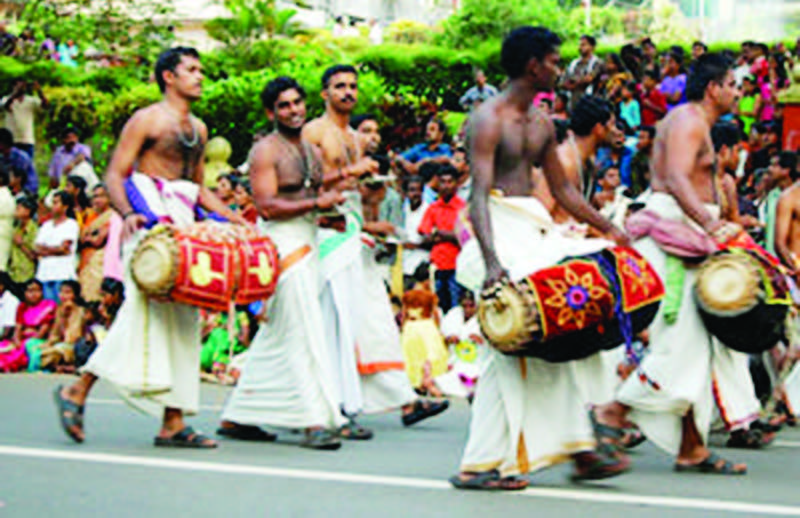
    Onam is celebrated in the beginning of the month of Chingam, the first month of Malayalam Calendar (Kollavarsham). There are actually four days of Onam. The most important day of Onam (known as Thiru Onam) is the second day. Festivities actually commence around 10 days before this day (on Atham), with the preparation of floral arrangements (pookalam) on the ground in front of homes. This year Thiru Onam is on September 7. (Atham was on August 29).

    ONAM is like a Dream!

    Kerala is known for its enchanting beauty. The swaying palms, the sky kissing hills, the sun-bleached plains, the lush paddy fields, the placid lakes, the shimmering lagoons, all make it a veritable paradise on earth. I often hear the phrase ‘God’s on country’ as Kerala is often characterized. We are all too familiar with the legend behind the festival. For the sake of the young people, let me briefly state two versions of the story. Maveli, the king Mahabali, the legendary king who was unjustly pushed down into the Nether world by Vamana, the fifth ‘avatar’ of Vishnu.


    25
    Thiruvathira is a popular folk dance performed by women at Onam


    It is said that, there was perfect equality, peace and happiness in his kingdom. No one dared to lie or cheat. However, gods grew envy at his acts of benevolence and growing popularity. After the banishment, Mahabali was given the special privilege to visit his subjects once a year. Historians give a different twist to the legend. According to them, Mahabli, who was a Buddhist, defeated by Hindu kings from Narmada (currently Maharashtra) in the North.

    Subsequently, they conquered the land and sent him into exile in Ezahm which is currently known as Sri Lanka. It was believed that permission was granted to Mahabali to come and visit his subjects during the period when they traditionally celebrated Sravanolsavam. Therefore, for Keralites, it may be a symbolic description of the Aryan invasion and the imposition of its culture on the native Dravidian populace of Kerala.


    26
    Snake boat races are popular attractions during Onam celebrations. The most famous snake boat race that’s held during Onam celebrations is the Aranmula carnival, along the Pampa River


    Regardless, Onam is a grand harvest festival which is celebrated with flowers, sumptuous feasts, and swings under mango trees. Onam represents the spirit of Kerala transcending the people of Kerala the world over to an enchanting mood of thanksgiving, idyllic pleasure and music and dance. People irrespective of religion celebrate Onam with traditional gaiety and fervor. It is stated that where there is a Keralite there will be Onam.

    Now the celebration is extended to the Diaspora, Mahabali needs to travel around the globe to visit all his subjects. Onam embodies the message of basic goodness of man who is selfless in his deeds towards fellow man. It is also about a dream; it is a dream about peace and tranquility in the world. It is dream about economic well-being and resource sharing; it is a dream about love and brotherhood, it is a dream about high ethics and morals; and it is a dream about human justice and preservation of nature.

    Great men in history dreamed before they embarked on a course to achieve them. Mahatma Gandhi had a dream. He set out to gain freedom for the 300 million Indians from the colonial rule and slavery. He mobilized and motivated the masses through non-violent protests which eventually gained the long cherished independence. Fulfilling own dream was fraught with dangers. He paid the ultimate price with his own life to preserve what he dreamed about.

    Jawaharlal Nehru had a dream which was set out in the preamble of the Indian constitution: to setup a secular republic with equal rights for everyone with freedom to think and speak and freedom to worship; to build a democratic society which fights fascism and communism; to promote equal opportunity and justice for the common man and independence in International relations. Today, that dream is being challenged by the forces of communalism which would like turn India on a path towards Hindutva.

    It is quite a surprise to see that this divisive philosophy are tacitly endorsed by some in our own community who enjoy the secular freedom in this country yet, want to deny the same freedom to others who live in India The great Martin Luther King who emulated the non-violent method which Gandhi has pioneered had a dream of his own. He had a dream to deliver his people from the slavery and second-class status – We are all too familiar with his ‘I have a dream’ speech. – ‘I have a dream that one day this nation will rise up and live out the true meaning of its creed. We hold these truths to be self-evident that all men are created equal ‘With the voting rights acts in 1964, his dreams were come to fruition.

    Yes, there are continuing challenges faced by the black community at the social level which may require further attention. America as a nation had a dream as well. When the pilgrims took the boat and landed on the Plymouth seeking religious freedom, their dream was to develop the most democratic, secular and prosperous society based on capitalism. They seemed to have accomplished that by making America a superpower, second to none, economically and militarily.

    Yet there are great challenges ahead of this nation as it is falling victim to a valueless culture which could eat away the core of the principles on which this nation was founded. Yes, there are challenges; however, we all need to dream as individuals, as a society and as a nation. For many of us the dream of prosperity is only half of the puzzle. We might have accomplished them. We may be still missing that spiritual and moral dimension which made Kerala once a land of prosperity, justice and brotherhood.


    27
    A colorful float that’s part of the Onam Pulikkali festivities


    All of us should have clear goals in life. This is a non-optional component of a spiritually healthy life. You can see from many of these examples I have elicited, there Is a close connection between dreams or in other words, goalorientation and motivation and fulfillment? The lack of those dreams is a big reason why so many of us are unmotivated in our tasks. It is said that performance is equal to motivation and ability. The component motivation requires expectancy and that is where the dream fits in. If it is motivating, it has to be making progress and accomplishing something.

    This week as we celebrate Onam, let us once again become nostalgic. Let Onam transcends our thoughts and process. Above all, it remains a dream. Attainable or not it symbolizes human yearnings; which keep the dreams alive. It motivates us to go on. Bible says, without vision, people perish; keep dreaming and let the spirit of Onam burn within us forever. Happy Onam to everyone

    (The author is a former Chief Technology Officer, United Nations)

  • INDIA ROAR BACK TO FORM IN FAMILIAR FORMAT

    INDIA ROAR BACK TO FORM IN FAMILIAR FORMAT

    Raina’s 100 and Jadeja’s 4 for 28 set up a massive 133-run win over England in the 2nd ODI.

    India 304 for 6 (Raina 100, Dhoni 52, Rohit 52, Woakes 4-52) beat England 161 (Jadeja 4-28) by 133 runs

    CARDIFF (TIP): The Tests have departed into the folder marked “Red Ball Disasters”; India’s intention is now to stage a party to help them forget what has gone before. One game into the Royal London ODI series, the outlook has been transformed. They look empowered again. Raina made precisely 100 of 75 balls. (AP)Raina made precisely 100 of 75 balls. (AP)Suresh Raina, ignored for the Test series, had the undamaged mindset to fill the role of party compere as he played with an exuberance rarely seen from India during their mauling in the Test series, proceeding with a cheerful vigour to make 100 from 75 balls, his first ODI century for four years.


    England’s response was dire, resulting in their second-heaviest defeat against India, in terms of runs. They can console themselves that people tend to lose interest when games are decided by Duckworth-Lewis calculations, but a passing stranger wandering down the banks of the Taff and armed only with an abacus could have concluded that this was a trouncing. India have happy memories of Cardiff: they have made 300-plus here three times, the only side to do so, and beat South Africa and Sri Lanka here during their Champions Trophy success last summer.


    England did not get a look in as Ravindra Jadeja, whose leftarm spin has repeatedly tormented them in the limited-overs game, just needed to turn in a routine shift to yield 4 for 28. At the end, Ravi Shastri, imposed for the series as emergency team director, applauded seriously and shook hands with men in suits. With ODIs predominating in the months ahead, England have a much-anticipated chance to develop a new brand of one-day cricket. On this evidence, they should call it “Careworn”. Faced by a slightly rejigged target of 295 in 47 overs, they survived the new ball convincingly enough – 54 on the board by the 11th over – but then five wickets tumbled for 31 in 12 overs as all their old doubts resurfaced.


    Alastair Cook cobbled together some sort of form during the Test series to protect his captaincy but that is a long way removed from discovering the dash needed in the oneday game. He played in Alex Hales’ shadow, making 19 in 33 balls, before he fell lbw to Mohammed Shami, manufacturing a leg-side shot. Ian Bell’s leave alone saw him bowled second ball later in the over. No immediate retort then from the top-order players who Graeme Swann, a former team-mate has said will leave England’s World Cup challenge stillborn.


    Batting under the lights looked a more onerous proposition than when Raina sallied forth earlier in the day, particularly when Bhuvneshwar Kumar brought one back to bowl Joe Root, but it was England’s deficiencies against spin bowling in midinnings that were most galling for them as a deteriorating position left them unwilling to hit through the infield. Hales had unfurled some flowing off-side drives – his trademark – during a debut innings of 40, but a top-edged sweep against Jadeja silenced him. Jadeja’s extra bounce also fooled Jos Buttler into poking a furtive catch into the off side.


    With light drizzle in the air, Eoin Morgan’s stretching sweep at R Ashwin lobbed to deep square leg. For England, the collapse could hardly have been more disheartening. Up on a rainspattered balcony, the coach Peter Moores checked his notes and Cook checked his fingernails. Neither offered a solution. At least Ben Stokes, whose average of 1.8 in his last 10 England innings was barely credible, could find a score of 23 faintly consoling. And James Tredwell hit his first ODI six – off Jadeja, too. Driftwood in a sea of despond. There were also troubles for England with the ball.


    Chris Jordan delivered 12 wides in a return of 0 for 73, five of them in a single Powerplay over, as a lack of rhythm that had been apparent during the Test series turned into something more ghoulish in the 50-over format. Jordan, shaking his head and perspiring heavily, looked perplexed. It was another bad moment on that England balcony as David Saker, the bowling coach, scratched his teeth in concern. But it was Raina, carefree even by his standards, who smash-and-grabbed the match for India.


    This was his first ODI hundred for 95 innings, stretching back to a tri-nation tournament in Bangladesh, when he made 106 against Sri Lanka in Dhaka in 2010. England’s quartet of right-arm pace bowlers offered an unvaried challenge, although the offspinner Tredwell had a rewarding outing considering his difficult season during which he was loaned out by Kent to Sussex. He was dismissed the ball after he had reached his century, making room to flay Chris Woakes through the off side but picking out James Anderson on the cover boundary. Woakes, despite conceding 20 from one over as Raina took charge, somehow returned 4 for 52.


    Raina, unsurprisingly considering his lack of cricket, had a few streaky moments early on. Early boundaries included an unattractive leg-side swipe at Tredwell and an uncertain edge against Anderson, and he was fortunate to escape Tredwell’s lbw appeal on 17 but, as the floodlights cut through a murky South Wales day, he became electrified. England conceded 62 in the Powerplay between 35 and 40 overs – 42 of them in 16 balls to Raina. He withdrew his front leg to loft Woakes straight for six and then top-edge over the ropes to assert that his luck was in. For Virat Kohli, though, there was no release from a miserable summer.


    After an unproductive Test series, in which he made only 134 runs at 13.40, the opportunity beckoned for Kohli to reassert himself in the one-day series, but he fell third ball for nought as he tried to come down the pitch to crash Woakes over the off side and plopped the ball into the hands of Cook at mid-off. India began nervously.


    It took only two deliveries for them to be reminded of their deficiencies in the Test series as Anderson curved an outswinger past Rohit Sharma’s outside edge. Rohit and Shikhar Dhawan twice survived after running mix-ups; Woakes had Dhawan caught at the wicket. But Rohit found an ally in Ajinkya Rahane in a third-wicket stand of 91 in 16 as England’s back-up seamers failed to maintain the pressure on the sort of dibblydobbly day that would have made Ravi Bopara, a controversial omission from England’s squad, a useful man to have around.

  • Sri Lanka to refuse entry to UN investigators: President

    Sri Lanka to refuse entry to UN investigators: President

    COLOMBO, SRI LANKA (TIP): Sri Lanka will not grant visas to UN investigators probing war crimes allegedly committed during the island’s decades-long separatist conflict, President Mahinda Rajapakse said on August 19. “We will not allow them into the country,” said Rajapakse, who is under international pressure to cooperate with the UN-mandated investigation.

    Sri Lanka has refused to accept the authority of the UN Human Rights Council which voted in March to probe allegations that the military killed 40,000 civilians in the final months of the separatist war, which ended in 2009. But it is the first time that Rajapakse has said UN investigators will not be allowed into the country, effectively barring them from face-to-face access to Sri Lankans wanting to testify in the probe. Rajapakse said however that his government was cooperating with all other UN agencies.

    “We are saying that we do not accept it (the probe). We are against it,” he told Colombo-based foreign correspondents at his official residence. “But when it comes to other UN agencies, we are always ready to fully cooperate and fully engage with them,” he said. UN secretary general Ban Ki-moon and other leaders have urged Colombo to cooperate with the UNHRC after ending a prolonged separatist war that pitted ethnic minority Tamil rebels and the largely Sinhalese army in a drawn out ethnic war.

    Outgoing UN rights chief Navi Pillay earlier this month suggested that her investigators looking into allegations of mass killings may not have to travel to Sri Lanka at all. She said there was a “wealth of information” outside the country. Her remarks prompted allegations from Sri Lanka’s foreign ministry that her probe was on a “preconceived trajectory” and that her “prejudice and lack of objectivity” were unfortunate.

  • Basics very much in Indian economy’s favor

    Basics very much in Indian economy’s favor

    INDIA’S JOURNEY TO DEVELOPMENT AND CHALLENGES

    The economy of India is the tenthlargest in the world by nominal GDP and the third-largest by purchasing power parity (PPP).The country is one of the G-20 major economies, a member of BRICS and a developing economy that is among the top 20 global traders according to the WTO.

    India was the 19th-largest merchandise and the 6th largest services exporter in the world in 2013. India’s economic growth slowed to 4.7% for the 2013-14 fiscal year, in contrast to higher economic growth rates in 2000s. However, India’s decisive election outcome has created the potential for further structural reform that could result in a near 7 per cent GDP growth rate over the coming decade, and bank capital injections could enable banks to facilitate funding for that growth.


    32


    This would have meaningful implications for India’s fixed income markets. It is believed that the next decade for India’s foreign exchange (FX) and fixed income markets will be marked by policy-driven reforms driving accelerated growth with increasing market liberalization. Recent figures already appear more encouraging than the dynamics that have been supporting stagflationary recession conditions: The country’s balance of payments has improved, spurred by FX depreciation and the Reserve Bank of India’s (RBI’s) non-conventional measures. The growth outlook has turned moderately positive, helped by a global recovery; and bad loan formation, even at state-owned banks, may now be moderating.


    33


    The narrative for Indian markets began to brighten even before the elections. Following the second stage of India’s economic liberalization and the foreign direct investment (FDI) reforms initiated in September 2012, foreign investment will likely be a major contributor to a jump in private investment. However, despite liberal FDI limits, it has remained moderate, constrained, in part, by administrative hurdles. As the obstacles are reduced, we expect FDI to lead an investment boom over the next decade, similar to China’s mid-1990s experience. We project FDI will rise to an average of 2.5 per cent of GDP (FY2014-24) from an average of 1.5 per cent of GDP (FY2008-14). We believe such foreign capital flow will lend significant support to India’s balance of payments trajectory.

    Improving public health

    Health care services in India have undergone a vast change over the past few decades and encompass the entire nation. The industry is expected to supersede China by 2030 in terms of population expansion. Hence, it becomes one of the essential duties of the state to raise the nutrition level, the standard of living of the people together with improving public health.

    Health care Industry of India The rapidly increasing health care industry of India is one of country’s largest sectors, both in terms of revenue and employment. It has been estimated that the healthcare industry of India is will grow by & 40 billion. The continuous increase in the population of India is considered one of the principal reasons for the growth in the healthcare industry of India. The rise in the infectious as well as chronic degenerative diseases has contributed to the rise in the healthcare sector of India. Additionally, because of diseases like AIDS and several lifestyle diseases of India, the healthcare sector of India will have a constant growth.

    In spite of the fact that the Indian healthcare industry is rapidly expanding, healthcare infrastructure in India is very poor. A noticeable percentage of India suffers from poor standard of healthcare services. Most of the healthcare facilities of India provided by the various healthcare services are limited and of low standard. In order to understand the current status of the healthcare services in India, it is important to know about the different healthcare services found in the country.

    Public health services, essential public health services, preventive health services, mental healthcare services, home health services, magellen health service and school health services are some of the healthcare services found in India. Companies providing Health Insurance in India The various companies providing health insurance policies in India can also be put under the healthcare services of India. Some of the companies that provide health insurance coverage in India are Appollo DKV Insurance Company Ltd., Bajaj Alliance General Insurance Co. Ltd., Birla Sun Life Insurance, Aviva Life Insurance and the like.

    Points to note

    1).It has been found out that while the private health services have been rising for meet the needs of the rich citizens and foreigners, public health services in India are lagging behind and suffering in a major way.

    2).It has also been found out that less than 1% of the GDP is spent on the public health care services in India.

    3).Surveys made throughout India points out that 65% of the Indian population cannot access to modern medicines.

    4).In addition, a number of drugs and even many diagnostic tests are still unavailable in the public health care sector of India.

    5).Most of the hospitals, one of the prime healthcare services in India, are located in the urban areas, thereby making it almost impossible for the rural people to access.

    Indian industry sees green shoots of manufacturing growth
    A green shoots of revival have started to appear in the manufacturing sector, which is critical for job creation, with a majority of segments likely to post higher output, according to industry bodies. The survey conducted by CII-Ascon for the April-June quarter indicates positive growth in important sectors like consumer durables including the vehicle industry and white goods industry, which recorded a growth of 5- 10 per cent, leading to improvement in the overall industry growth.

    The FICCI survey found that eleven out of fourteen sectors are likely to show improvement in production during the second quarter (Jul-Sept) of the current fiscal. Over 64 per cent respondents are not likely to hire additional workforce in the next three months, though this proportion is less than that of the previous quarter (75 per cent), indicating improvement in hiring outlook in coming months.

    The survey gauges the expectations of manufacturers for Q2 for fourteen major sectors namely textiles, capital goods, metals, chemicals, cement, electronics, automotive, leather and footwear, machine tools, FMCG, tyre, textile machinery and more. Responses have been drawn from 392 manufacturing units from both large and small and medium (SME) segments with a combined annual turnover of over Rs 4 lakh crore.

    An upturn in demand condition is also reflected in the improved order books of the manufacturers, said Ficci survey. While only 36 per cent respondents reported higher order books for the April-June quarter in the last survey, 43 per cent respondents reported higher order books for July-September quarter.

    Foreign relations
    Soon after the 2014 Lok Sabha election results declared a thumping victory for the BJP-led NDA government, Prime Minister Narendra Modi invited the heads of all the SAARC countries including Pakistan, Bangladesh, Sri Lanka, Nepal, Maldives, Bhutan and Afghanistan, for his oath-taking ceremony, sending a major diplomatic signal to the global community.

    Credited with being a focused administrator, Modi signalled that his decisive win would reshape India’s foreign relations and leverage the diaspora to increase investments, business opportunities and better relations. Modi went on to choose neighbouring country Bhutan over others for his first foreign visit.

    “I will follow the (foreign) policies of the Vajpayee-led NDA government, and that also applies to the relationship with the United States. I don’t think a decision taken by any individual or one event should impact the overall policy,” Modi said in an interview. The winds of change were clearly being felt at home and abroad.


    29


    SAARC: A refocus on the neighbourhood
    For the first time, leaders of all South Asian Association Regional Corporation (SAARC) countries were invited for the swearing-in ceremony of an Indian Prime Minister. The presence of all seven countries, Pakistan Prime Minister Nawaz Sharif, Afghanistan President Hamid Karzai, Sri Lanka President Mahinda Rajapaksa, Bhutan Prime Minister Tshering Tobgay, Maldives President Abdulla Yameen Abdul Gayoom, Nepal Prime Minister Sushil Koirala, Speaker of Jatiyo Sangshad in Bangladesh Shirin Sharmin Chaudhury, was a welcome step towards strengthening India’s relations with the SAARC countries. However, political parties in Tamil Nadu voiced their displeasure at Sri Lanka’s president Mahinda Rajapaksa attending the ceremony and held demonstrations against him.


    30


    Bhutan visit: Asserting influence in South Asia
    PM Narendra Modi’s maiden foreign trip to Bhutan was intended to show that in the new scheme of things, the neighbourhood enjoys high priority. Inaugurating Bhutan’s Supreme Court building that was built with India’s assistance, Modi also laid the foundation stone of the 600MW Kholongchu Hydro-electric project, a joint venture between the two countries.

    He also proposed to hold a joint sports festival between Bhutan and north-eastern states of India, doubling scholarships for Bhutanese students in India and establishing e-libraries in 20 districts in Bhutan Though his faux pas of referring to Bhutan as Nepal while addressing the Bhutan Parliament caused some embarrassment, Modi went ahead to say that “when Bhutan calculates its happiness quotient, having a friend in India is also a major factor.”

    Meet with Pakistan Prime Minister Nawaz Sharif: Picking up the threads
    Relations between India and Pakistan have always been tense, but differences between the two countries had escalated after the 26/11 Mumbai terror attack. Modi’s invitation to Pakistan’s Prime minister Nawaz Sharif for his oath ceremony was seen as an attempt at cooperation rather than confrontation, which was reciprocated by his Pakistani counterpart.

    In their first meeting, Modi pressed for confidence-building measures, peace and security as well as enhancing bilateral trade, sending a positive message among the people of both the countries. Modi struck a pragmatic note with Sharif, underlining India’s concerns on terrorism and urging his Pakistani counterpart to crack down on militants and speed up trial of the 2008 Mumbai attack suspects.

    Sharif also responded to the meeting positively, accepting the fact that the two countries must strive for better cooperation. In the interaction which was widely seen as an “icebreaker”, the leaders also decided that their foreign secretaries would be in touch and discuss a way forward on talks that had been suspended since January 2013.

    BRICS Summit: New inroads
    Pushing for better international governance, Narendra Modi said he favoured an open, rule-based, international trading regime which is critical for global economic growth. Modi’s first BRICS summit saw significant inroads towards the establishment of the New Development Bank and though the headquarters of the bank is slated to be in China, its first President will be from India.

    Addressing the BRICS leaders, Modi also pressed for zero tolerance towards terrorism. He also met Chinese President Xi Jinping and both addressed the need for a solution to the boundary question. Further, Modi also favoured broadening the strategic partnership with Russia in nuclear, defence and energy sectors and invited President Vladimir Putin to visit the Kudankulam atomic power project during his trip in December.

    India poised to make further progress on UN’s development goals
    India has made progress on different indicators such as health and nutrition under the UN’s Millennium Development Goals and is expected to improve further upon them. “There has been progress in all the indicators and further progress is expected to be made in the remaining period up to 2015,” Planning Minister Rao Inderjit Singh had said recently.

    Challenges
    As far as India is concerned, 8 MDGs with 12 targets are relevant which are sought to be achieved during the period 1990 to 2015, the minister said. MDGs are international development goals that UN member states and numerous international organizations, including India, have agreed to achieve by the year 2015.

    Eradicating poverty
    These include eradicating extreme poverty and hunger; achieving universal primary education; promoting gender equality; reducing the child mortality rate and ensuring environmental sustainability. The minister’s said India had achieved the MDG target regarding poverty eradication. India had to halve the proportion of people whose income is less than one dollar a day between 1990 and 2015.

    In 1990, India had 47.8 per cent such poor people and thus the proportion of this population is to be reduced to 23.9 per cent. However, India’s poverty ratio was 21.92 per cent for 2011-12. Similarly, India has to half the proportion of people who suffer from hunger by 2015 to 26 per cent. However, the latest figure for 2004-05 reveal that the percentage of such population was 40 per cent.

    Education: Improving enrolment ratio
    In the education sector, India has to improve the net enrolment ratio in primary schools to 100 per cent by 2015. The country achieved 99.89 per cent enrolment in primary education in 2011-12. The proportion of pupils starting grade 1 who reach grade 5 was 86.05 per cent in 2011- 12 against the target of 100 per cent. The literacy rate in India was 61 per cent in 1990. It went up to 86 per cent in 2017-08.

    The ratio of girls to boys in primary education was 0.73 in 1990 which went up to 1.01 in 2011-12. Similarly the ratio of literate women to men (15-25 years) was 0.67 in 1990, which was 0.88 in 2007-08. MDGs target for both ratios is 1. The mortality ratio among children under the five-year age was 126 per 1,000 live births in 1990 which was brought down to 52 in 2012. The MDGs target is 42 for that.

    Infant mortality ratio
    The infant mortality ratio was 80 per 1,000 live births in 1990 which was brought down to 42 in 2012 against the MDGs target of 27. The proportion of one year old children immunized against measles was 42.2 per cent in 1990 which was improved to 74.1 per cent against targeted 100 per cent coverage.

    Similarly, the maternal mortality ration per 1,00,000 live births was 437 in 1990 which was brought down to 178 by 2011-12 against targeted 109 by 2015.