Tag: Stanly Johny

  • A multipolar world with bipolar characteristics

    A multipolar world with bipolar characteristics

    The three great powers understand that the world is no longer organized around a single center of authority

    By Stanly Johny

    As 2025 draws to a close, a highlight is that the United States has undertaken its largest troop mobilization in the Caribbean in decades. Its Navy has deployed its most advanced aircraft carrier, along with fighter jets, amphibious vessels, attack submarines and tens of thousands of troops, as it intensifies its pressure on Venezuela in an effort to force President Nicolás Maduro from power.

    The Trump administration’s National Security Strategy (NSS), released in early December 2025, identifies Latin America and the Caribbean as a strategic priority. Reviving the 19th century Monroe Doctrine, the document asserts that the U.S. must deny influence or control by outside powers (read China) in Latin America and ensure that the Western Hemisphere remains under American political, economic and military influence.

    The push to reinforce American primacy in Latin America coincides with U.S. President Donald Trump’s waning interest in Europe, another long-standing U.S. sphere of influence. Since the end of the Second World War, the U.S. has served as Europe’s primary security guarantor. If Washington kept western Europe together through a tightly knit alliance during the Cold War, it expanded this security umbrella to eastern Europe after the disintegration of the Soviet Union, creating a large transatlantic bloc. Under Mr. Trump, however, the U.S. is no longer interested in shouldering the burden of European security — a position explicitly articulated in the NSS. Why is America, at a moment when Russia and China are seeking to overturn the U.S.-built and U.S.-led security and economic order, stepping back from Europe while moving to consolidate its influence in the Western Hemisphere?

    It is difficult to discern a cohesive doctrine in Mr. Trump’s foreign policy, marked by the President’s impulses and unpredictability. Yet, even these impulses, this unpredictability and his ideological orientation rooted in Christian nationalism and America’s might cannot ignore the structural shifts reshaping the international order. Mr. Trump is not the ‘President of peace’ that he claims to be — he has already bombed six countries, even if he has stopped short of a full-scale war.

    At the same time, Mr. Trump, despite his rhetoric about American military and economic dominance, recognizes that he no longer lives in a unipolar world. His reluctant aggression and strategic recalibration are reflections of the changes now taking shape in the global balance of power.

    Three great powers

    When the Soviet Union disintegrated in 1991, a new order emerged with the U.S. at its center. There was no other great power positioned to challenge American primacy. The unipolar moment, however, has since passed. While future historians may better identify the precise point of rupture, one such moment was Russia’s annexation of Crimea in 2014. The ensuing conflict in eastern Ukraine, the tepid western response, and Russia’s ability to endure despite sanctions reinforced the limits of the ‘rules-based order’.

    The end of unipolarity, however, does not mean the end of American dominance. The U.S. remains, and will remain, for the foreseeable future, the world’s pre-eminent military and economic power. What has changed is that Washington is no longer the sole great power shaping geopolitical outcomes. China and Russia now occupy that space as well, deepening what Realist thinkers describe as the inherently anarchic nature of the international system.

    During the Cold War, the Soviet Union was America’s principal rival, and in the 1970s, Washington reached out to China to exploit fissures within the communist bloc. Today, the U.S. identifies China as its principal and systemic challenger. This, in turn, leaves open the possibility of a reset in ties with Russia — an idea embraced by Mr. Trump’s MAGA (Make America Great Again) ideologues, who frame Russia as part of a shared ‘Christian civilization’.

    The reigning power versus the rising power

    The U.S. faces a unique challenge in China. The Soviet economy, in its prime in the early 1970s, reached about 57% of the U.S. GDP, before it began slowing down. China’s economy, now the world’s second largest, already amounts to about 66% of the U.S. economy. China continues to grow at a faster pace, steadily narrowing the gap.

    As China’s economic power expands, it is being converted into military capability (it has already built the world’s largest Navy, by number of ships). Like other great powers, Beijing is seeking to establish regional hegemony and global dominance. So, a prolonged contest between the U.S., the reigning power, and China, the rising power, appears unavoidable. The situation is comparable to 19th century Europe, when a rising imperial Germany threatened to upstage Britain during Pax Britannica, unsettling the ‘Concert of Europe’.

    Russia is the weakest link among the three powers. It is a relatively smaller economy with a shrinking sphere of influence. But Russia’s nuclear arsenals, expansive geography, abundant energy and mineral resources and its demonstrated willingness to use force to achieve its strategic objectives keep it in the great power constellation. From Moscow’s perspective, the country drifted into the wilderness in the 1990s before announcing its return in 2008 with the war in Georgia. Since then, it has sought to rewrite the post-Soviet security architecture in Europe. As the West, having expanded the North Atlantic Treaty Organization into the Russian sphere of influence, responded to Vladimir Putin’s war in Ukraine with sweeping sanctions on Russia and military support for Kyiv, Moscow moved ever closer to China. Russia and China have found common ground in opposing the western ‘rules-based order’ — Russia thinks that the order denies it its rightful place in the world and seeks to revise it accordingly, while China, by contrast, as Rush Doshi argues in The Long Game, wants to replace it with a China-centric order. 

    Fluid multipolarity

    All three great powers today understand that the world is no longer organized around a single center of authority. In that sense, the world is already multipolar. But unlike the post-Second World War and post-Cold War transitions, the structures of the new order have yet to fully emerge. During the Cold War, the world was divided into two ideological blocs and two largely separate economic systems. Today, China lacks the kind of satellite state networks that characterized the 20th century superpowers, while the U.S. is reassessing the sustainability of its alliance frameworks, including its commitment to Europe.

    Russia, with its own great power ambitions, is wary of being seen as a Chinese ally irrespective of its close strategic partnership with Beijing. This opens a window for a Washington-Moscow reset. But the war in Ukraine remains a stumbling block. Russia may not want to challenge America’s global leadership, but it certainly wants to re-establish its primacy in its sphere of influence.

    Thus, there are three great powers with divergent interests that are pulling the global order in different directions, rendering the emerging multipolarity fluid rather than as a structured system akin to the post-Second World War order. This also means that middle powers, including superpower allies such as Japan and Germany, and autonomous actors such as India and Brazil, would continue to hedge their bets.

    Mr. Trump wants Europe to shoulder greater responsibility for its own security, reset relations with Russia and reassert American primacy in its immediate neighborhood even as Washington prepares for a prolonged great power competition with China. The idea is to return to the classic offshore balancing. Even if Mr. Trump fails in executing it, future American Presidents may not be able to ignore the shifts that he has initiated. Russia, for its part, seeks to carve out a sphere of influence. China aims to preserve its close strategic partnership with Russia to keep the Eurasian landmass within its orbit, while establishing regional hegemony in East and Southeast Asia — moves that would cement its status as a long-term superpower, much as the U.S. did by asserting its hegemony in the Western Hemisphere in the 19th century, and across the Atlantic in the 20th century. In this fluid landscape, Russia has emerged as the new ‘swing great power’ between the two superpowers, paradoxically lending the emerging multipolar order a distinctly bipolar character.

    (Stanly Johny is editor with The Hindu. Article republished courtesy The Hindu) 

  • Israel has failed to solve the Persian puzzle

    Israel has failed to solve the Persian puzzle

    The 12-day conflict has not destroyed Iran’s nuclear capabilities; this is a war that is far from over

    “In Game of Thrones, the Red Wedding was not the end of House Stark. When Arya Stark, the younger sister of Robb Stark, extracts revenge for the Red Wedding by orchestrating a massacre at House Frey, she declares: “You didn’t slaughter every one of the Starks. That was your mistake. You should have ripped them all out, root and stem.” The 12-day war did not destroy the Iranian regime. Nor did it tear out the Iranian nuclear programme, root and stem. Beneath its rhetoric of victory, Israel, which is now asking the international community to stop Iran from getting a nuclear bomb, knows this all too well. It will only grow more paranoid, closely monitoring Iran’s every move, while Tehran replenishes its arsenal, readying itself to fight another day. This war is far from over.”

    By Stanly Johny

    The wedding of Edmure Tully and Roslin Frey at The Twins in the northern riverlands is one of the most consequential events in Game of Thrones. Known as the Red Wedding, it is the setting for the massacre of Robb Stark, King in the North and Lord of Winterfell, along with his pregnant wife, his mother, and most of his banner-men. This brutal betrayal shattered the Starks’ military power and ended their bid for independence from the Iron Throne, reshaping the political landscape of Westeros, the fictional continent in the series. When Israeli fighter jets began bombing Iran, in the early hours of June 13, 2025, Israeli generals reportedly dubbed a part of the operation as the ‘Red Wedding’ — a pointed reference to what they wanted to achieve in the strike.

    Israel’s primary target was Iran’s nuclear facilities. But Israel knew that if it started a war, Iran — a country many times its size and armed with thousands of ballistic missiles — would strike back. So there were three targets — Iran’s nuclear facilities, nuclear scientists and the leadership of Iran’s armed forces. Much like House Frey slaughtered the banner-men and the leaders of House Stark, Israel had the aim of wiping out Iran’s military command, believing that it would cripple Tehran’s military response. Israel had pulled off a similar strategy in the past. On June 5, 1967, it launched a massive air strike against Egypt’s air force, causing much damage to it on the ground. Egypt never recovered from the initial blow, and Israel claimed a sweeping victory over Egypt, Jordan and Syria in just six days. But in June 2025, the outcome was different.

    Operational success

    From an operational standpoint, Israel’s attack can be seen as a success. Israel had been preparing for a strike on Iran’s nuclear programs for years, a plan that gained momentum after the October 7, 2023 attack by Hamas. Israel, which immediately launched a war against Hamas in Gaza, eventually expanded it to a mini-regional war that was aimed squarely at Iran. It dealt a blow to Hezbollah. It bombed the Iranian embassy in Damascus in April 2024, and killed several Iranian commanders in Syria. Its relentless bombings in Syria expedited the collapse of Bashar al-Assad’s regime. The return of Donald Trump to the White House further hardened Israel’s resolve to test the military option.

    On June 13, while Tehran was still engaged in talks with the Trump administration, Israel struck Iran’s Natanz and Isfahan nuclear facilities, killed at least 10 nuclear scientists, and assassinated many top commanders. Executing such a complex operation in a vast country about 2,000 kilometers away was no small feat. Yet, the problem for Israel was that this operational success failed to deliver the desired strategic outcome. For Israel, which has established credible deterrence against the surrounding conventional Arab armies, Iran has always remained a puzzle. Despite its sanctions-hit economy and enduring hostility from the West, Iran managed to build a wide network of influence in the region through non-state actors, while developing an advanced ballistic missile programme and pursuing its nuclear ambitions.

    Israel had long nurtured the idea of regime change in Iran — if the Islamic Republic falls, Israel’s last remaining conventional threat in West Asia would vanish. Israel prefers a weaker, broken-up Iran, much like today’s Iraq, Libya, Syria or Lebanon, which would set the stage for a unipolar West Asia that is dominated by Israel and the U.S. The post-October 7 wars substantially weakened Iran’s allies in the region. Still, Iran, with its ballistic missiles and nuclear programme, remained a rebel counterweight to Israel.

    In the early days of the 12-day war, Mr. Netanyahu declared that Israel’s operation “could certainly” lead to regime change, insisting that “Iran is very weak”. He also urged the Iranians to “to act, to rise up” against the “evil regime”. During the war, Israel killed at least 30 Iranian security chiefs, threatening to disrupt the entire chain of command. But the Iranian government and the military recovered with remarkable speed, with the Islamic Revolutionary Guard Corps taking the lead in mounting a counter-attack. Iran launched a sustained campaign of drones and ballistic missile strikes that exposed vulnerabilities in Israel’s much-vaunted, multi-layered, American-assisted defense systems. Within days, Mr. Netanyahu was forced to turn to Washington for help.

    That help came on June 21 when U.S. President Donald Trump ordered U.S. air strikes on three Iranian nuclear sites, including Fordow, the most heavily fortified facility. Mr. Trump, however, was not interested in a long war with Iran. After the strikes, he claimed that Iran’s nuclear facilities had been “obliterated”, declared victory and announced a ceasefire between Israel and Iran. Mr. Netanyahu had no choice but to accept the ceasefire, with the Iranian government still standing with much of its capabilities.

    Strategic labyrinth

    Early assessments by the U.S. intelligence community claimed that Iran’s nuclear programme had not been destroyed by U.S. strikes, but set back by “a few months”. Even if the nuclear facilities were destroyed, there is no certainty that Iran’s stockpile of highly enriched uranium and all advanced centrifuges have been destroyed. There were reports, based on European intelligence assessments, that Iran had dispersed its enriched uranium well before the Israeli-American strikes. According to Rafael Mariano Grossi, head of the International Atomic Energy Agency, Iran has the industrial and technological capacity to resume enriching uranium in a few months.

    This leaves Israel in a strategic labyrinth. The Iranian state refused to flinch throughout the war despite the heavy blows it suffered. The air strikes failed to destroy Iran’s nuclear programme, let alone its nuclear capabilities. Third, the war exposed Israel’s over-reliance on the U.S., in both defense and offence, which was not the case in 1967 when Israel claimed its biggest victory.

    Survival of the weak

    Even though Mr. Trump joined the war on behalf of Israel, there is a clear distinction between the American and the Israeli approaches towards the Persian puzzle. Israel’s ultimate objective is regime change but it does not have the resources or the capabilities to achieve regime change. The U.S. does not want a nuclear Iran, but it does not want to get entangled in another prolonged war in West Asia either. Mr. Trump’s own MAGA (Make America Great Again) base was revolting against America’s intervention in Iran.

    For Iran, the Israeli-American attack was another Mosaddegh moment — a reminder of the 1953 Central Intelligence Agency-backed coup that toppled its elected Prime Minister Mohammad Mossadegh. Iran once made a deal with the U.S. and other world powers over its nuclear programme, only to see it torn up by President Trump in his first term. When Tehran returned to talks with Washington again, it ended up facing an Israeli-American war instead. Iran is now racing to rebuild its military capabilities and restore deterrence. Iran’s leaders will also find a greater incentive than ever to pursue a nuclear weapon as many in Iran today argue that if Tehran had possessed a bomb, like North Korea, Israel and the U.S. would not have dared launch this war.

    In Game of Thrones, the Red Wedding was not the end of House Stark. When Arya Stark, the younger sister of Robb Stark, extracts revenge for the Red Wedding by orchestrating a massacre at House Frey, she declares: “You didn’t slaughter every one of the Starks. That was your mistake. You should have ripped them all out, root and stem.” The 12-day war did not destroy the Iranian regime. Nor did it tear out the Iranian nuclear programme, root and stem. Beneath its rhetoric of victory, Israel, which is now asking the international community to stop Iran from getting a nuclear bomb, knows this all too well. It will only grow more paranoid, closely monitoring Iran’s every move, while Tehran replenishes its arsenal, readying itself to fight another day. This war is far from over. 

    (Stanly Johny is the international affairs editor at The Hindu)

  • A West Asia under Donald Trump

    A West Asia under Donald Trump

    With Joe Biden leaving behind a broken region, it remains to be seen whether Donald Trump can look at the larger strategic picture

    By Stanly Johny

    One of the key foreign policy issues to have plagued Joe Biden’s single-term presidency was Israel’s war on the Palestinians in Gaza. Before the October 7, 2023 attack by Hamas in Israel, his administration seemed confident about its West Asia policy. Mr. Biden wanted to expand the Arab-Israel normalisation process, which was initiated by his predecessor, Donald Trump, through the 2020 Abraham Accords. Saudi Arabia and Israel were in an advanced stage of normalising ties. The Palestine question had been pushed to the margins of regional politics. But October 7 overhauled the status quo.

    Mr. Biden immediately offered his full support for Israel, which launched a retaliatory war in Gaza. The Biden administration’s approach was largely two-pronged: support Israel’s war in Gaza, while beginning diplomatic measures to prevent the conflict from escalating into an all-out regional war. But what Mr. Biden got after a year was a disastrous, unending war in Gaza, sullying America’s reputation, and a widening conflict in West Asia, dragging the United States deeper into it. Over the past year, more than 43,000 Palestinians have been killed in Gaza. The war also expanded to Lebanon when, on October 1, Israel launched its fourth invasion of the neighbouring country. The conflict has also triggered a shooting match between Israel and Iran. Mr. Biden was accused of being complicit in “Israel’s genocide” against the Palestinians, and his diplomatic efforts to prevent the conflict from widening in West Asia proved ineffectual. This means Donald Trump, the next President of the U.S., is going to inherit a West Asia, traditionally a backyard of American influence, on fire.

    Make no mistake. Mr. Trump is not an Israel-sceptic. Pro-Israel policies defined his West Asia policy during his first term in office. It was Mr. Trump who moved America’s embassy to Jerusalem. It was Mr. Trump’s administration that recognised Israel’s illegal annexation of Syria’s Golan Heights. And it was Mr. Trump who withdrew the U.S. unilaterally from the Iran nuclear deal, despite United Nations certification that Iran was fully compliant with the terms of the 2015 agreement. And even the Abraham Accords, which brought Israel and Arab nations, the two pillars of America’s West Asia policy together, were aimed at building a combined stronger alliance against Iran, the common foe of the U.S. and Israel. Mr. Trump had unveiled a ‘peace plan’ for Israel-Palestine in 2020, but it had been rejected outright by the Palestinian leadership, saying it was heavily in favour of Israel.

    So, Mr. Trump is unlikely to take a strong moral position against Israel’s war in Gaza. During the campaign, he had also made it clear that he strongly stood for Israel’s victory in the ongoing wars in West Asia. Yet, Israel’s disastrous multi-front wars would pose critical foreign policy challenges to Mr. Trump.

    The first problem he would face is what Mr. Biden faced in October 2023. Mr. Biden was ready to overlook criticisms of genocide against Israel, but he did not want an all-out war in West Asia, which the Americans believe are not in their interests. He called for a ceasefire in Gaza but refused to exert any meaningful pressure on the Benjamin Netanyahu government. According to an analysis by Brown University, the Biden administration spent $17.9 billion on military assistance to Israel in a year from October 2023. Mr. Biden wanted to insulate the war in Gaza from the larger conflict in West Asia, but he failed to do so. Mr. Trump, likewise, might support Israel in the war on Gaza or against Hezbollah, but he would not like the U.S. being drawn into a regional war, mainly for two reasons.

    First, Mr. Trump’s base is against the U.S. getting stuck in West Asia’s forever wars. His Vice-President-elect J.D. Vance has repeatedly slammed America’s wars in the region, particularly the 2003 Iraq invasion. Mr. Trump would like to focus on further strengthening America’s conventional capabilities and bring China, its most powerful conventional rival, into the pulpit of his foreign policy. A war with Iran would not serve this purpose.

    Second, one of Mr. Trump’s key campaign promises was to fix the cost of living crisis. If there is a larger war with Iran, which could affect energy supplies through the Strait of Hormuz that connects the Persian Gulf to the Arabian Sea, the inflationary pressure will only get enhanced. For political, economic and strategic reasons, a wider war in West Asia would not be in the interest of a Trump administration either.

    But what is to be seen is whether Mr. Trump can look at the larger strategic picture and take corrective measures to restore America’s position in West Asia. Mr. Biden is leaving behind a broken region where Israel is going rogue with American support. Granted, America still remains the most powerful country in the region and its Arab allies are still sticking to America’s leadership, despite many grievances. But Israel’s unending, disproportionate wars have damaged America’s reputation. Worse, it has brought the region to the brink of an all-out war. Mr. Trump has to be more assertive in bringing the wars in Gaza and Lebanon to an end at the earliest if he wants to restore stability in the region. If he continues the Biden policies, topped up by his own pro-Israeli impulses which were on display during his first presidency, West Asia will fall further into chaos.
    (The author is an editor with The Hindu. He can be reached at stanly.johny@thehindu.co.in)

  • A year of war on Gaza

    A year of war on Gaza

    A year later, the Hamas attack and the Israeli invasion of Gaza have taken West Asia to a wider, deeper and deadlier regional conflict with more actors.

    “The war has changed the region in many ways. It ended the regional status quo where the Palestine question was pushed to a corner. World powers had given up on finding a solution to the Palestine question. Israel continued its violent military occupation of the West Bank and the blockade of Gaza. The attack brought the Palestine issue to the fore of West Asia’s geopolitics. The violence that followed the Hamas attack emboldened the old argument that peace and stability could not be established in West Asia as long as the Palestine question remains unresolved.”

    By Stanly Johny

    A year ago, this day (October 8) Hamas launched an unprecedented cross border attack in Israel from Gaza. At least 1,200 people were killed and 250 taken hostage. Israel immediately launched a retaliatory war. A year later, the Hamas attack and the Israeli invasion of Gaza have taken West Asia to a wider, deeper and deadlier regional conflict with more actors. Before the Hamas attack, the region appeared to be on a different course. In 2020, four Arab countries reached normalization agreements with Israel. Saudi Arabia and Israel were in an advanced stage of normalizing ties. The U.S., which was brokering the Saudi-Israel talks, proposed an ambitious infrastructure project aimed at connecting India with Europe through the Persian Gulf, Jordan and Israel. This led to Jake Sullivan, the U.S. National Security Adviser, saying that “the Middle East is quieter than it has been in decades”. But now, as I write in this oped in today’s (October 08, 2024) The Hindu, West Asia (Middle East) is deadlier than it has been for decades.

    The war has changed the region in many ways. It ended the regional status quo where the Palestine question was pushed to a corner. World powers had given up on finding a solution to the Palestine question. Israel continued its violent military occupation of the West Bank and the blockade of Gaza. The attack brought the Palestine issue to the fore of West Asia’s geopolitics. The violence that followed the Hamas attack emboldened the old argument that peace and stability could not be established in West Asia as long as the Palestine question remains unresolved.

    The war has also put a brake on the Israel-Arab normalization process. If Saudi Arabia was in an advanced stage of normalizing ties with Israel in September 2023, today, the Kingdom says normalization is not possible without a clear path towards the creation of a Palestinian state “based on the 1967 border and East Jerusalem as its capital”. This doesn’t mean that Arab-Israeli ties would move to enmity. Arab countries have voiced concerns and criticisms about Israel’s war on Gaza, but have stopped short of taking any hard policy decisions that would antagonize Israel. For example, all Arab-Israel peace agreements, except the normalization deal with Sudan, a country which is at war with itself, are still standing. But there are impediments in taking the relationship to the next level or formalizing ties between Saudi Arabia and Israel, given the anger towards Israel on the Arab street.

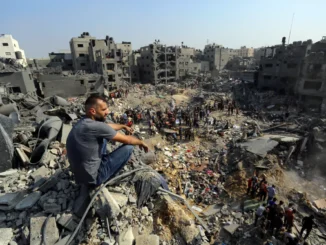
    While Hamas re-regionalized the Palestine issue and scuttled the Saudi-Israeli normalization, it had to pay a heavy price for its murderous attack in Israel. The retaliatory war Israel launched on Gaza has turned the enclave, sandwiched between the Mediterranean Sea and Israel proper, more or less uninhabitable. Israeli troops have killed nearly 42,000 Palestinians in 12 months, a vast majority of them women and children. Nearly 100,000 Palestinians were wounded, while almost the entire population of Gaza (2.3 million) have been displaced. Israel has also stepped up its attacks in the West Bank. It carried out multiple raids in Jenin and launched an airstrike in Tulkaram. Global calls for a ceasefire were ignored. Palestinians see no end to the war and continue to pay a heavy price.

    But the war also exposed the security vulnerabilities of the state of Israel, despite the aggressive face it is putting up in the region. The Hamas attack itself was a huge intelligence and security failure. Israel was caught off guard when Hamas militants strode into the border and started attacking communes and security sites. And when Israel went into Gaza, it said it wanted to destroy Hamas and secure the release of the hostages. Gaza laid to siege by Israeli troops, which controls even the flow of food aid trucks into the enclave. But a year later, Israel is yet to defeat Hamas, let alone destroying it. More than 100 hostages are still in Hamas’s captivity. The war on Gaza led to Hezbollah opening “a support front”, firing rockets into northern Israel, “in solidarity with the Palestinians”. Both Hamas and Hezbollah are backed by Iran. Israel took the war to Iran by bombing the Iranian embassy in Damascus. Iran retaliated with ballistic and cruise missiles.

    Today, Israel is fighting a multi-front war. It continues to fight in Gaza where Hamas is resurfacing in areas which Israel once said were cleared of the militants. In Lebanon, it dramatically escalated the war on Hezbollah, by killing its leader, Hassan Nasrallah, and launching an invasion—its fourth invasion of the country. And Israel is preparing to hit Iran in retaliation for the October 1 Iranian ballistic missiles attack on Israel. West Asia is at an inflection point. Israel is fighting a multi-layered conflict. It is yet to win the war in Gaza. It has launched an invasion of Lebanon. And a regional crisis is unfolding with Iran. What Israel is trying to do is to establish escalation dominance, like it did in 1967, and neutralize its enemies using great fire power. However, unlike in 1967, Israel’s enemies include a host of non-state actors. It is to be seen whether Israel’s scorched earth tactics and its escalation strategy would provide the Jewish country the long-term security it seeks or trap it in a conflict loop.
    (Stanley Johny is opinion writer with The Hindu. Source: The Hindu)

  • West Asia on edge as fears of Iran’s retaliation loom

    West Asia on edge as fears of Iran’s retaliation loom

    The U.S. Embassy in Jerusalem told American citizens in Israel that the “security environment remains complex” in Israel

    NEW YORK (TIP): West Asia continued to stay on edge on April 12 amid fears of an imminent attack by Iran targeting Israel in retaliation against the April 1 air strike on Iran’s consular annex in Damascus, Syria, with several countries, including India, the U.S. Russia and France issuing travel and security alerts to their citizens, The Hindu’s reporter Stanly Johny reported from Jerusalem.

    Iran’s Supreme Leader Ayatollah Ali Khamenei has vowed to punish the “evil regime” of Israel after the attack on the consular building in which Mohammad Reza Zahedi, a high-ranking commander of the Quds Force, the elite foreign operational wing of Iran’s Islamic Revolutionary Guard Corps, was assassinated. Iran and Syria immediately blamed Israel for the strike. Israel has neither confirmed nor dismissed its role in the attack.

    “The question is not if but when. The Supreme Leader, the government and senior military leaders have all warned that a response is coming. Iran cannot back off this time,” a strategic analyst based in Tehran with close links to the regime told The Hindu on the phone, requesting anonymity.

    On Thursday, Iran’s Foreign Minister Hossein Amir-Abdollahian reiterated that Iran’s response was necessary. “When the Israeli regime completely violates the immunity of individuals and diplomatic places in violation of international law and the Vienna Conventions, legitimate defense is a necessity,” Mr. Abdollahian told his German counterpart Annalena Baerbock in a phone call, Iran’s Mehr news agency reported.

    “Had the UN Security Council condemned the Zionist regime’s reprehensible act of aggression on our diplomatic premises in Damascus and subsequently brought to justice its perpetrators, the imperative for Iran to punish this rogue regime might have been obviated,” Iran’s mission to the United Nations wrote on X. on Thursday, April 11.

    In Israel, political leaders as well as military and diplomatic officials said they were ready for any scenario. Asked if it was Israel that carried out the attack, Michael Ronen, head of South and Southeast Asia Division at Israel’s Ministry of Foreign Affairs, said: “They say Israel carried out the strike. Well, I don’t know. What I can say is that Israel is ready for any response from Iran.”

    American media reported on Friday, April 12, citing U.S. and Iranian sources that an Iranian attack could come within the next 48 hours. Mr. Khamenei is considering different options, from launching direct air strikes on Israel from Iran to attacking Israeli assets in the region either directly or through proxies, according to these reports. Israeli leaders have warned that they will strike inside Iran if the origin of the attack is Iran.

    “Iran is the source of all problems in the Middle East. Hamas, Houthis, Hezbollah and the Islamic Jihad… What do all these terrorist entities have in common? Iran is the godfather of all of them,” Yossi Zilberman, deputy spokesperson of the MFA, told The Hindu here. “Iran is the puppeteer. Unless Iran is reined in, there won’t be peace in the Middle East,” he said.

    Israel has frozen all leaves for combat units “in accordance with the situational assessments” and drafted reservists to strengthen for air defenses. The IDF has also scrambled the GPS system, which could be used to misguide incoming weapons. On Thursday, those who turned on their GPS in Tel Aviv found that their location was shown in Beirut. In the northern settlement of Tefen in the Upper Galilee region, the GPS showed the location was Syrian Golan.

    The U.S. Embassy in Jerusalem on Friday told American citizens in Israel that the “security environment remains complex” in Israel. U.S. government employees and their family members were asked not to travel “outside the greater Tel Aviv, Jerusalem, and Be’er Sheva areas until further notice.” India’s Ministry of External Affairs advised Indians not to travel to Iran and Israel until further notice. “All those who are currently residing in Iran or Israel are requested to get in touch with Indian Embassies there and register themselves,” it said.

    ( Source: The Hindu. Stanly Johny was in Israel as part of a media delegation)

  • Change and continuity in India’s Palestine policy

    Change and continuity in India’s Palestine policy

    India’s historical policy towards Palestine has been evolving, but a permanent fix to the Palestine question should not be lost sight of

    By Stanly Johny

    Historically, India has been a firm supporter of the Palestine cause. And even when India’s relationship with Israel flourished in the past three decades, New Delhi has maintained a careful balance between its new partnership and historical commitment towards Palestine. In recent years, there have been questions on whether India is abandoning this balance and tilting towards the Jewish state in a changing West Asia, where even Arab nations have been ready to sidestep the Palestine question for better bilateral ties with Israel.

    Immediately after the October 7 Hamas attack in Israel, in which at least 1,200 people, mostly civilians, were killed, Prime Minister Narendra Modi in a post on X, said he was “deeply shocked by the news of [the] terrorist attack”. He said, “We stand in solidarity with Israel at this difficult hour.”

    Mr. Modi, who became the first Indian Prime Minister to visit Israel in 2017, has a good personal chemistry with Israel Prime Minister Benjamin Netanyahu. Supporters of Mr. Modi and the Bharatiya Janata Party (BJP) hardly conceal their admiration towards Israel’s aggressive security model. On October 26, barely three weeks after the Hamas attack, India abstained from a vote at the United Nations General Assembly (UNGA) that called for an “immediate, durable and sustainable humanitarian truce” in Gaza. India explained its stand by saying that there was no explicit condemnation of the October 7 “terror attack in the resolution”. All these factors suggested that India’s historical policy towards Palestine was undergoing a paradigm shift.

    Evolving approach
    India’s Palestine policy has evolved over the years. When the UN General Assembly voted on a resolution to partition Palestine into a Jewish state, an Arab state and an international city (Jerusalem) in November 1947, India, along with Pakistan and the Arab bloc, voted against it. Prime Minister Jawaharlal Nehru had compared the settler Zionists in historical Palestine to the Muslim League of undivided India. His position was that India, having gone through the horrors of Partition, should not support the partition of Palestine. But when the state of Israel was declared in May 1948, India swiftly adopted a pragmatic line: in 1950, it recognized Israel, but stopped short of establishing full diplomatic relations. Throughout the Cold War, India, an advocate of Third World autonomy, was one of the most vocal supporters of the Palestine cause.

    After it established full diplomatic relations with Israel in 1992, bilateral ties between New Delhi and Tel Aviv began to deepen and broaden (today, Israel is one of India’s major defense and technology partners). But India publicly maintained its support for “a negotiated solution, resulting in a sovereign, independent, viable and united State of Palestine, with East Jerusalem as its capital, living within secure and recognized borders, side by side at peace with Israel, as endorsed in the Arab Peace Initiative, the Quartet Road map and relevant UNSC Resolutions” — this means that India supported the creation of a Palestine state with East Jerusalem as its capital and based on the 1967 borders.

    This position has evolved further after Mr. Modi became Prime Minister. In February 2018, when he visited Ramallah in the occupied West Bank, he called for dialogue to find a permanent solution to the crisis, but stopped short of saying anything on the status of Jerusalem or borders. It does not mean that India supports Israel’s claim over the whole of Jerusalem (New Delhi voted against the U.S. decision to recognize Jerusalem as Israel’s capital), but it will not talk about the contentious issues such as the capital and border any more, while remaining a partner of Israel and a supporter of the two-state solution. Realpolitik displaces the moral content of India’s Palestine policy.

    After October 7
    A close analysis of India’s voting record at the UN, post-October 7, and the statements made by the Ministry of External Affairs (MEA) suggests that this position of balancing has not changed. It is neither a strong moral critic, like Brazil or South Africa, of the way Israel is conducting the war, nor a mute spectator or enabler of Israel, like the United States or the United Kingdom.

    A few days after Mr. Modi’s tweet declaring solidarity with Israel over the “terror attack”, the MEA stated that India backed “a sovereign, independent viable state of Palestine”. After its first abstention, there were at least four votes at the UNGA on Israel.

    On November 12, 2023, India voted in favor of a resolution that condemned Israeli settlements “in the occupied Palestinian territories, including East Jerusalem and the occupied Syrian Golan”. Two weeks later, New Delhi voted in favor of another resolution that expressed “deep concern” over Israel’s continuing occupation of Syria’s Golan Heights. On December 12, India supported a resolution that called for “an immediate humanitarian ceasefire”. And on December 19, it voted for the Palestinian right to self-determination.

    The voting record speaks for itself. One cannot have a two-state solution if Israeli settlements continue in Palestinian territories. And the only path towards a solution is diplomacy, not war, as there is no balance of power between Israel, the mightiest military in West Asia, and the Palestinian militants. So, in essence, if one supports the two state-solution, there should be a call for an immediate end to violence, support dialogue, condemn settlements and, in principle, back Palestinian right to self-determination. This is what India has done, unlike the U.S., which claims to be supporting the two-state solution while voting against all resolutions at the UN and refusing to back the ceasefire call.

    India’s interests
    The support for the Palestine cause, even if limited, is rooted in tangible national interests. Israel’s ongoing offensive in Gaza, which has killed over 30,000 people, wounded some 70,000 and displaced nearly 90% of Gaza’s population of 2.3 million, is one of the gravest humanitarian tragedies of the 21st century. Israel, despite this rogue behavior, manages to avoid the wrath of the international laws and system mainly because of the unconditional support it enjoys from the U.S. But America’s support for Israel and Tel Aviv’s disregard for Palestinian lives and international laws have created strong reactions in the Global South. South Africa took Israel to the International Court of Justice, while Brazilian President Luiz Inácio Lula da Silva accuses Israel of committing “genocide” in Gaza. China has repeatedly called for a ceasefire, while Russia is hosting different Palestinian factions, including Hamas.

    India, which aspires to be a leader of the Global South, cannot ignore these voices and sentiments. That is why External Affairs Minister S. Jaishankar said at the Munich Security Conference last month that Israel “should be and should have been mindful of the civilian casualties in Gaza”, which is India’s sharpest criticism of the Israel war till now.

    The October 7 attack and Israel’s retaliatory war have also turned the strategic clock in the region back. Before October 7, India was gearing up to work in the post-Abraham Accords strategic reality through its cooperation with the Arabs, Israelis and Americans. But further Arab-Israel reconciliation is now on hold. The U.S.’s reputation stands as tarnished as that of Israel. If Saudi-Israel normalization is not taking place, the India-Middle East-Europe Economic Corridor (IMEC) will have to wait. If the crisis persists and Houthis continue to target vessels in the Red Sea, it would create lasting economic pains for India. A prolonged war in Gaza would also enhance risks of a wider conflict in the region, involving Iran, Israel and America, who are all India’s partners. An immediate end to the war, restoration of order and stability in West Asia and a permanent fix to the Palestine question are as much in India’s interests as anybody else’s in West Asia. This should be the guiding core of India’s Act West policy.
    (Stanly Johny is an editor with The Hindu)