Tag: Suhasini Haidar

  • A year of dissipating promises for Indian foreign policy

    A year of dissipating promises for Indian foreign policy

    New Delhi confronts challenges that concern economic and energy security, global strategic stability, and regional security

    By Suhasini Haidar

    The year 2025 began as one of considerable promise for Indian foreign policy. After 2024, a year that was dominated by national elections and political recalibration, Prime Minister Narendra Modi was expected to resume active diplomacy, with a full calendar of bilateral visits and multilateral engagements. Relations with the United States were expected to be reset under the second term of the Trump administration, continuing from Donald Trump’s first term. Long-running Bilateral Trade Agreement (BTA) negotiations with partners such as the United States, the United Kingdom, Australia, New Zealand and the European Union (EU) seemed imminent, with commitments to complete them by the end of the year.

    Across the geopolitical divide, a new engagement appeared to be taking shape with China after years of a stand-off along the Line of Actual Control (LAC), especially after Mr. Modi’s visit to China. Economic ties with Russia were also at a high point: India’s oil imports from Russia had surged to $52 billion, with U.S. and EU sanctions pressure having eased. Regionally, the government attempted to repair frayed relationships by reaching out to the Yunus administration in Bangladesh with a visit, in December 2024, by the Foreign Secretary, Vikram Misri, sending External Affairs Minister S. Jaishankar to Pakistan (October 2024), engaging the Taliban leadership in Dubai (January 2025), and preparing for regional visits from Nepal, Sri Lanka, and others. Five years after the Balakot strikes and the reorganization of Jammu and Kashmir, New Delhi was also projecting confidence in its security posture and its deterrent capacity for terrorism from Pakistan.

    However, many of those expectations for 2025 dissipated by the end of the year. India’s foreign policy planners found themselves wrestling with profound challenges across four interconnected domains: economic security, energy security, global strategic stability and regional security.

    Economic and energy security
    Instead of resetting India-U.S. ties, 2025 proved to be the most difficult year of this century. Actions by the Trump administration on tariffs, immigration and sanctions pushed trust levels back by decades. Washington’s decision to levy a steep 25% reciprocal tariff on Indian goods hit key labor-intensive sectors such as apparel, gems and jewelry, and seafood. This followed from the Trump first term, where India’s Generalized System of Preferences (GSP) trade privileges were withdrawn.

    To compound matters, the U.S. introduced a 25% surcharge on Indian imports of Russian oil, effectively making India the most heavily tariffed trading partner. Even if a forthcoming BTA softens the blow, the losses in contracts mean that factory-line closures and the retrenchment of workers remain. Immigration restrictions, particularly on H-1B visas, further undermined remittances, a key pillar of India’s foreign exchange inflows. Of all the trade deals on the anvil, India signed FTAs with the U.K., Oman and New Zealand. But the big prizes that leaders had committed to signing in 2025, with the U.S. and the EU, are still pending.

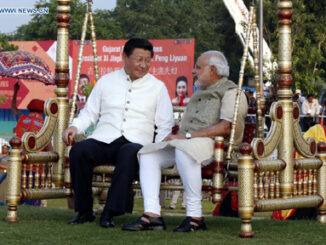
    Ties with China and Russia remained tenuous despite the iconic photo-moment of Mr. Modi-President Xi-President Putin holding hands at the Shanghai Cooperation Organization Summit (September 2025) and the Modi-Putin bear hug on the tarmac of New Delhi airport earlier this month. While India-China flight-visa-pilgrimage links were restored, more fundamental security guarantees for the LAC were not. Neither have economic investment regulations been removed. The hours-long detention of an Indian air passenger from Arunachal Pradesh at Shanghai (November 2025) has raised new concerns.

    After three years of resisting western pressure over Russian Ural energy imports, New Delhi appeared to bend, after a new wave of U.S. sanctions. Whether India will be compelled to zero out its Ural imports — similar to how it halted Iranian and Venezuelan oil imports under U.S. pressure in the past — remains uncertain, but the choice carries economic and reputational costs. The India-Russia summit, that ended without any major agreements in strategic spheres such as defense, energy, nuclear and space cooperation, disappointed all the hype preceding it.

    Global and regional security
    A central challenge for Indian strategists in 2025 has been the rise in global unpredictability. In its 2017 National Security Strategy (NSS), Washington identified China and Russia as “revisionist powers” seeking to undermine U.S. influence and global stability. In contrast, the 2025 NSS presents a softened, more ambiguous stance — avoiding direct mentions of China’s aggression in the South China Sea and toward Taiwan, and treating Russia with more caution than criticism. The 2017 NSS hailed India’s rise as a “leading global power” and “major defense partner”, but the 2025 version offers only a limited articulation of India’s role, primarily in the context of Indo-Pacific security and critical minerals. Given the short shrift to traditional U.S. allies in Europe and Asia, any deeper alignment with Washington, as had earlier been envisaged, seems risky now. Mr. Trump’s references to his meeting with Xi Jinping as a potential “G-2” only intensify concerns about India’s position in the Asian power balance.

    At the same time, global acceptance of the Gaza and Ukraine peace proposals — both of which critics argue favor the aggressors — signals a weakening of the international rules-based order. China’s rollout of a framework for “Global Governance” reflects its ambition to shape an alternative international architecture. For India, this requires serious thought about its own vision for a future global order, especially as the UN’s failures at controlling conflict grow.

    India’s immediate neighborhood, which initially appeared stable in early 2025, became more volatile as the year progressed. The terror attack in Pahalgam (April) was a grim reminder that even with the security crackdown in Jammu and Kashmir and past cross-border operations in 2016 and 2019, threats remain embedded. That terrorists came hundreds of kilometers inside the Valley to carry out the killings and escaped should merit serious introspection. India’s retaliatory Operation Sindoor was militarily effective, but New Delhi’s diplomatic campaign following the strike encountered setbacks. While countries condemned the terror attack, few openly supported India’s cross-border response. Persistent questions — particularly regarding speculation about the loss of Indian jets — damaged India’s credibility, as the government neither confirmed nor denied the reports.

    Complicating matters were claims that other countries supported Pakistan’s military actions. While India set aside concerns over China’s role in Pakistan Air Force strikes, ties with Türkiye and Azerbaijan have nose-dived. The announcement of a Saudi-Pakistan mutual defense pact was an additional blow to India’s regional calculus.

    Mr. Modi’s declaration of a “new normal” after the Pahalgam attack led to international worries over rapid escalation of the next conflict in South Asia. India’s restrained handling of the Delhi blasts conspiracy (November 2025) eased some of those worries, but the broader issue remains: how will New Delhi respond to the next major attack, especially with Pakistan’s political landscape increasingly shaped by the ultra-hawkish Field Marshal Asim Munir?

    The 2024 regime-change protests in Bangladesh and the 2025 Gen-Z demonstrations in Nepal have created fragile transitional governments, reducing predictability in India’s periphery. With elections in both countries scheduled for early 2026, New Delhi must prepare to engage with new leadership that is not necessarily positively disposed to it. With Bangladesh in particular, the end of the year has seen relations at their lowest ebb yet. The elections in Myanmar, on December 28, will be held on the Junta’s terms, despite New Delhi’s best attempts at fostering talks with the deposed NUG members and to ask for the more humane treatment of Aung San Suu Kyi.

    Lessons for 2026
    Several lessons from 2025 stand out clearly. India must recognize the limits of performative diplomacy — warm embraces, highly publicized summits and symbolic gestures such as awards and leaders driving together in the same car do not necessarily translate into tangible gains. Performative aggression — threats to isolate or boycott countries only mean something if other countries join in. The government was sensible in shifting its projection of India as “Vishwaguru” (global teacher) during the G-20 year in 2023 to “Vishwamitra” (global friend). But it must now avoid slipping into the narrative of a “Vishwa-victim”, blaming all others — American sanctions, Chinese maneuvering, Pakistan’s machinations, or the “ingratitude” of neighboring states — for its disappointments.

    New Delhi must stop being blind to its own double standards too — concerns over the lynching of a minority member in Bangladesh can only ring true only if the Modi government is prepared to condemn and stop similar attacks on minorities in India. The same is true for concerns about democracy and inclusive elections in the neighborhood. If rising Islamism in the region is an issue, then how does the government sanguinely sup with the Taliban? In 2026, with a world turning increasingly transactional, India can only bring up principles if it follows them consistently, regardless of whether they pertain to ties with geopolitical powers, or its own neighbors.
    (The author is an editor with The Hindu. They can be reached at
    suhasini.h@thehindu.co.in)

  • Blame not the messenger in India’s diplomacy

    Blame not the messenger in India’s diplomacy

    India’s tough message on terrorism and Pakistan will find more takers if it plays to its advantage it being a secular, stable and rule-abiding democracy

    By Suhasini Haidar

    History and literature are replete with references to not ‘shooting the messenger’ for bringing bad news. In Shakespeare’s Antony and Cleopatra, the Egyptian queen assaults a messenger and threatens to have him “whipped with wire and stewed in brine, smarting in ling’ring pickle”, for bringing her the news that the Roman General Mark Antony has married another. “I that do bring the news made not the match,” the messenger replies, before making a hasty exit. Over the past two months, India’s ‘diplomatic messengers’ too have faced an ire that is unprecedented — criticized not for the message they bring, but for failing to convey effectively enough, the message New Delhi has sent out after Operation Sindoor (May 7-10, 2025).

    Criticism of Indian diplomacy

    Public commentary that is critical of the Ministry of External Affairs and its missions has focused broadly on three counts. First, that India received condolences and statements condemning the Pahalgam terror attack from all quarters, but not the kind of unequivocal support, especially from the neighborhood, for retaliatory strikes on Pakistan, of the kind seen in 2016 (post-Uri) and 2019 (post-Pulwama). In 2016, Bangladesh, Bhutan, Afghanistan, Sri Lanka and the Maldives backed India’s decision to stay away from the South Asian Association for Regional Cooperation summit in Pakistan after the Uri attack. In 2019, global solidarity with India forced even China to back a United Nations Security Council (UNSC) terror designation for Jaish-e-Mohammad chief Masood Azhar. Earlier, in 2008, there was international consensus in India’s favor after the Mumbai attacks, when Hafiz Saeed and a number of Lashkar-e-Taiba terrorists were designated by the UNSC, and Pakistan was put on the Financial Action Task Force (FATF) grey list for the first time. Instead, this time, unfavorable comparisons have been made to Pakistan for the lines of support it received from China, Turkiye, Azerbaijan, Malaysia and the Organisation of Islamic Cooperation (OIC).

    Second, the perception is that Pakistan has scored some diplomatic wins, despite widespread global understanding that Pakistan uses terrorists as state proxies. In April, Pakistan, a non-permanent member of the UNSC, managed to amend the resolution on Pahalgam to delete any reference to The Resistance Front (TRF), that claimed responsibility for the heinous attack.

    Earlier this month, Pakistan was chosen as chair of the Taliban Sanctions Committee and vice-Chair of the Counter-Terrorism Committee at the UNSC, and secured loans from the International Monetary Fund and Asian Development Bank despite New Delhi’s opposition. Next was the White House’s lunch invitation to Pakistan Army chief (now Field Marshal) General Asim Munir, despite the belief in India that his “jugular vein” speech was a virtual green signal for the Pahalgam attack. In July, as Security Council President for the month, Pakistan will try to schedule meetings on the India-Pakistan conflict and Kashmir, even as India accelerates efforts to designate the TRF at the UNSC, and place Pakistan on the FATF greylist. India’s diplomats will be tested again.

    The third aspect pertains to United States President Donald Trump, who, despite official denials from India, has chosen to muddy the narrative of how the May 10 ceasefire was achieved, hyphenating India and Pakistan in more than a dozen public statements, and offering to mediate on Kashmir. His latest iteration of the comments this week, just hours after a telephone conversation with Prime Minister Narendra Modi, and just before his meeting with Gen. Munir, was possibly the most blatant. Thus far, Mr. Trump’s statements, post-ceasefire, have not had a single word on the scourge of terrorism itself, showing just far apart the understanding between Delhi and Washington is at this time.

    A flurry of diplomacy does not seem to have moved the needle on these criticisms. After Operation Sindoor, special delegations of Members of Parliament and former diplomats travelled to 32 countries. The most time (six days) was spent in the United States. After the G-7 meet, Mr. Modi has meetings ahead with BRICS leaders. External Affairs Minister S. Jaishankar is visiting the U.S. for the Quad Foreign Ministers Meeting soon, after several visits to European capitals recently. The government had not essayed such a campaign after the 2016 or 2019 actions against Pakistan, indicating that it too feels that diplomatic efforts by the Ministry of External Affairs and missions abroad have been found wanting and need bolstering.

    But much as the messenger in Shakespeare says, India’s diplomats do not decide the message that India wishes to send after Operation Sindoor, and cannot be held responsible for its resonance. It is necessary for the government to study the contents of that message, the shift in geopolitical narratives and in how India is perceived, in order to build a more realistic assessment of how far international diplomacy can ensure the outcomes New Delhi desires vis-à-vis Pakistan.

    The ‘new normal’

    With reference to the content of the message, Mr. Modi’s three-pronged “New Normal” has raised eyebrows in some capitals. The first prong — ‘Any act of terror is an act of war’ — lowers the threshold for future conflicts, passing the trigger for Indian strikes into the hands of any terrorist, acting on orders on their own. The second — ‘India will not bow to nuclear blackmail’ — is not necessarily new, but has been left unarticulated thus far because it gives the appearance of a heightened nuclear risk for the region. The third — India will not distinguish between state and non-state actors henceforth — sends out an escalatory message, indicating that the next terror attack could well invoke ‘Armageddon’, rather than the controlled four day conflict in Operation Sindoor. While India’s partners have not asked for evidence of Pakistan’s links to Pahalgam, they look askance at other aspects — like why India has been unable to trace the terrorists responsible yet.

    Next, it is necessary to note that global shocks in the past few years have changed how the world views India’s tough messaging. Take for example, a growing number of statements by Indian Ministers about “taking back Pakistan occupied Kashmir” by force if necessary. These make many of India’s interlocutors uncomfortable, given the current number of conflicts over territorial aggression underway, from West Asia to Ukraine to the South China Sea. In the light of Israel’s retaliation for the October 7, 2023 terror attacks, few wish to give any state a free hand for “retribution”. New Delhi’s refusal to criticize Russia for its invasion of Ukraine in 2022 and to raise its oil imports from Russia in the face of sanctions, lost it some support in the western world, especially Europe. The Modi government’s silence on Israel’s devastation of Gaza has also been met with disappointment in the Global South.

    India, as Mr. Modi told Mr. Trump this week, views terrorism emanating from Pakistan, “not as a proxy war, but as a war itself”. India’s diplomats have been left explaining why their stock responses that “this is not an era of war” and that “dialogue and diplomacy” are the only way forward do not apply to India and Pakistan. Thus, it may be necessary for New Delhi to rethink how it frames its message in view of these changes, notwithstanding the global double standards inherent in the expectations from India.

    Democracy in decline

    Finally, there is need for introspection over how the Modi government’s image itself has altered in the world since 2019, leading to diplomatic challenges on a number of fronts. These range from concerns abroad over laws such as the Citizenship (Amendment) Act, the amendment of Article 370, Internet bans and summary arrests in different parts of the country, and accusations against Indian government agents of involvement in transnational killings in the U.S. and Canada. Questions over the broader decline in democracy and the status of minorities within India have also increased in the past few years. India’s delegations abroad (Operation Sindoor) had to field some of those questions during their travels.

    India’s right to defend itself from decades of Pakistan-backed, trained and funded terrorists is unassailable. But carrying a tough message on terror is easier for the diplomats tasked with the role, if in a strife-roiled world, the government plays to India’s advantages, and what differentiates it from Pakistan — as a secular, stable, pluralistic, rule-abiding democratic and economic power.

    (The author is an editor with The Hindu. She can be reached at suhasini.h@thehindu.co.in)

  • India’s place in Russia-Ukraine peace-making

    India’s place in Russia-Ukraine peace-making

    There are indications that New Delhi is engaging with all parties and developing its role as an interlocutor but there are the ‘ifs, ands, or buts’

    By Suhasini Haidar

    Two years after the Government of India held that “Europe’s problems are not the world’s problems” to distance New Delhi from the theatre of the Russia-Ukraine war, speculation about its determination to help resolve the war has gained traction. Prime Minister Narendra Modi’s visits to Moscow and Kyiv, a possible meeting with Ukrainian President Volodymyr Zelenskyy at the United Nations next week and with Russian President Vladimir Putin at the BRICS Summit next month, as well as the travels of National Security Adviser Ajit Doval and External Affairs Minister S. Jaishankar all point in this direction.

    The fact that Mr. Modi “briefed” United States President Joseph Biden in a phone call after the Ukraine visit, and Mr. Doval told Mr. Putin that he had been tasked to “brief” him about the visit as well when he met him in St. Petersburg last week indicate that India is engaging with all parties and developing its role as an interlocutor.

    The question then is how far does Mr. Modi’s plan to play peacemaker stretch? And where can India’s role be most effective?

    India’s role, the full picture
    India’s advantages and reasons for playing such a role are many — it is one of the few countries that is engaging both sides of the geopolitical schism over Ukraine, i.e., the West as well as the Eurasian leadership. India’s long-held beliefs on non-alignment and strategic autonomy, which the Modi government has largely carried forward during the war with its abstention votes at the UN and refusal to accept western sanctions, help its image as an “honest broker” or mediator.

    India is an important voice for the Global South and it succeeded in ensuring its G-20 presidency focused on war outcomes such as energy and food security that matter to the developing world rather than the war itself. As a result, the increase in India’s intake of Russian oil, leading to a six-fold increase in bilateral trade, has been projected as an assertion of its principles rather than profiteering.

    In his third term, Mr. Modi would no doubt like to build a global legacy, much like India’s first Prime Minister Jawaharlal Nehru was able to do by mediating between the USSR and Austria for the withdrawal of Soviet troops in exchange for a policy of neutrality, or by India leading international efforts and UN commissions on wars in Korea, Vietnam and Cambodia.

    If it does essay such a role, the government would need a thorough assessment of the situation, beginning with a study of the state of war in Ukraine. Russian troops remain entrenched in about a sixth of territory of the country for more than two years now, while Ukrainian forces are successfully holding the line outside of these areas. This indicates that any change in the status quo could come only from a massive escalation in the war. Mr. Zelenskyy’s move to occupy Russian territory in Kursk was a novel tactic, but was perhaps only meant to be used as a bargaining chip or “leverage” as the Ukrainian President put it, in future negotiations. As he heads to New York next week, Mr. Zelenskyy will be seeking a further escalation: western permissions for the long-range Storm Shadow missiles, and Army Tactical Missile Systems (ATACM) for airstrikes deep inside Russia, which he believes is receiving lethal weaponry from Iran and North Korea. Mr. Putin has said in no uncertain terms that if the West clears the request, it would be a declaration of direct war between the North Atlantic Treaty Organization and Russia. An alternative outcome could also arise from the U.S. elections on November 5 — a win for former U.S. President Donald Trump may mean the U.S. curtails its expenditure in support of Ukraine, seen positively by Mr. Putin, and more sobering for Ukraine and Europe, while a win for U.S. Vice-President Kamala Harris will indicate continuity in the U.S.’s support.

    An offering that would have to stand out
    Second, New Delhi would need to offer its own proposal for conflict resolution or de-escalation taking into account that there are already a number of proposals in the arena, all of which have been rejected by one side or the other. Mr. Putin and Mr. Zelenskyy have rejected each other’s proposals, that involve giving up territory on the ground. Mr. Putin rejected the Bürgenstock Communiqué, that India also disassociated from, which dwelt on the issues of nuclear safety, humanitarian access and the exchange of prisoners.

    Mr. Zelenskyy recently rejected the six-point Brazil-China joint proposal that proposed the same measures towards a path of “de-escalation”. China has, in the past year successfully brokered agreements between Iran and Saudi Arabia and Hamas and Fatah. Hungary too, a country with access to both sides, made a ceasefire proposal which has been rejected by Ukraine.

    Summing up India’s position in Berlin last week, Mr. Jaishankar listed a four-point principle: This is not the era of war; there are no solutions on the battlefield; Russia must be at the table for talks; and India is concerned and engaged to find a resolution to the conflict. While these principles are incontrovertible, they are by no means a concrete proposal, and India will need to work on a more comprehensive vision of its path to peace.

    The next step would be to study what India’s role would be. During their conversation, Mr. Zelenskyy told Mr. Modi that India is simply too large and important a country to seek a role as “messenger” between Moscow and Kyiv. In any case, recent rounds of prisoner exchanges between the two countries make it amply clear that there are enough channels to relay information between them.

    A larger role would imply India serving as a mediator or even the host for a summit between the two sides, although given India’s recusal from the Swiss Peace Summit outcome, may be a task left to one of the Gulf Cooperation Council countries that have been a part of the process thus far. Whatever the decision, this is an exercise that will require India to use its heft, diplomatic goodwill and other resources apart from intensified travel by officials, Ministers and the Prime Minister focused on discussing solutions to the Russia-Ukraine war.

    Consistency would be the key word
    At a time when the government is dealing with internal conflicts including Manipur, revving up the economy through international engagement, regional turbulence and a host of other important issues, it could justifiably question the need to spend its resources on this conflict. Externally, when civilian casualties from Israel’s bombardment of Gaza or from the civil war in Sudan are far more than those estimated to be non-military casualties in the Russia-Ukraine conflict, the question over which conflict India chooses to intervene in poses a challenge. In addition, India will be judged on the consistency of its message- if “dialogue and diplomacy” are indeed the “only way forward”, then it is difficult to account for the Modi government’s refusal to consider an opening with Pakistan, for example.

    Eventually, the balance of the pull and push factors will decide how far New Delhi will go as a peace-maker in the war that has consumed Europe and the U.S. for more than 30 months. As a country of considerable consequence in the world, one that straddles the West and the east, the Global North and South, and as the only country that is member of both the Quad (Australia, India, Japan, United States) and BRICS, India is uniquely positioned. The critical element is the timing of its foray into a field that has, thus far, only seen failure. As the late Israeli interlocutor Abba Eban once said in words that are as true for the conflict he attempted to resolve as they are for the Russia-Ukraine war: “History teaches us that men and nations only behave wisely once they have exhausted all other alternatives.”

    (The author is an editor with The Hindu. She can be reached at suhasini.h@thehindu.co.in)

  • A long-drawn test for India’s diplomatic skills

    A long-drawn test for India’s diplomatic skills

    Walking the tightrope seems to have paid off for India, but the multilateral challenges it faces will multiply

    “While India’s attempts at being a “balancing force” (as a senior official put it) are playing out much more visibly, it is also setting off a trend — many countries in South East Asia and the Global South, not to mention countries such as Saudi Arabia, the United Arab Emirates, Turkey and Israel, are managing their ties with the West without joining its stand on Ukraine or sanctions. France’s latest reiteration of “Strategic Autonomy” after French President Emmanuel Macron’s visit to Beijing indicates that even the western coalition has its fissures on this point. Clearly, autonomous strategy or multi-alignment has paid off for India in this critical year.”

    By Suhasini Haidar

    As Prime Minister Narendra Modi embarks on a week-long journey to Japan, Papua New Guinea and Australia from May 19, a number of substantive global issues are on the anvil in his discussions with leaders of the G-7 outreach in Hiroshima, Japan, as well as during his travels from there, with bilateral issues taking a back seat to India’s position in the multilateral sphere. These mandate a very careful balance between the two ends of an increasingly polarized world that has been blown apart after the Russian war in Ukraine. This is also a world that looks uneasily at facing the geopolitical challenge from China, worries over trade access, supply chain reliability, and food and energy security.

    Although the Quad Summit (Australia, India, Japan, U.S.) due to be held in Sydney has been cancelled in the wake of U.S. President Joe Biden’s domestic troubles, all four Quad leaders will meet on the sidelines of the G-7. Following this foray with the Indo-Pacific “coalition of democracies”, Mr. Modi will be in Washington in June for a state visit — a rare honor accorded by the U.S. President, that has been reserved for only two Indian leaders in the past, President Sarvepalli Radhakrishnan (1963) and Prime Minister Manmohan Singh (2009). This visit will be marked by many strategic forays to bring India-U.S. ties closer.

    Almost immediately after his return, Mr. Modi will need to pivot to the opposing coalition however, hosting the Shanghai Cooperation Organisation (SCO) Summit scheduled for July 3-4, where he is expected to receive China’s President Xi Jinping, Russia’s President Vladimir Putin, the Pakistan Prime Minister Shehbaz Sharif, leaders of central Asian states, the soon-to-be added SCO members, the President of Iran, Ebrahim Raisi, and the President of Belarus, Alexander Lukashenko, and other guests.

    The world of the SCO
    The composition of the SCO, which includes those being inducted as observers such as Myanmar, gives the impression of it being a largely anti-western grouping, with practically every country sanctioned by the West as a part of it. With the SCO, a grouping that represents most of the world’s population, GDP growth, and energy reserves, India has comfort in its common stand against unilateral sanctions such as those against Russia.

    A lesson or two may also be learnt from the Shanghai Cooperation Organisation Council for Foreign Ministers (SCO-CFM) held in Goa earlier this month, where India’s bilateral relations with mainly Pakistan, but China and even Russia, were allowed to overshadow more substantive multilateral outcomes. This is of particular annoyance to Central Asian countries, that have always insisted that no bilateral issues are brought up at the SCO, lest it go the way of the other regional South Asian grouping, the South Asian Association for Regional Cooperation (SAARC). A week after the SCO summit, Mr. Modi will pivot back to the European Union, as chief guest at France’s national “Bastille day” parade; visits to other European capitals are likely. August will see yet another turn, with the BRICS summit in South Africa. Mr. Modi will engage with the leaders of Russia, China, Brazil and South Africa on an alternative BRICS payment mechanism to the dollar-dominated international system, along with other ideas on the agenda seeking to build a counter-narrative to the U.S.-European Union combine. In September, as Mr. Modi hosts every global leader at the G-20 summit in Delhi, his diplomatic skills will be tested again — not since 2010 have leaders of all permanent members of the UN Security Council visited Delhi in the same year, let alone at the same time.

    Striking a balance
    The timing of these engagements is no accident; nor is it explained by India’s traditional adherence to the principle of non-alignment. If anything, Mr. Modi has consistently refused to attend Non-Aligned Movement in-person summits thus far, and has preferred his own version of “multi-directional engagements”. In 2017, the same year that India took part in reviving the Quad in the face of overt belligerence from Beijing, India also joined the SCO as a full member, agreeing to host the summit this year. New Delhi also exchanged places with both Italy and Indonesia in order to host the G-20 in 2023. If it is hosting the two major summits in the same year, it is by choice, not coincidence.

    It is to India’s credit that it continues to maintain this balance, and is being courted by countries across the global divide, even as it seeks to hold out against two nuclear-armed land neighbors at its frontiers. Mr. Modi has even managed to maintain India’s “sweet spot” without needing to follow Indonesian President Joko Widodo’s example in travelling to Kiev, or inviting Ukraine’s President Volodymyr Zelenskyy and its Foreign Minister Dmytro Kuleba to address the G-20, in order to strike a balance on the war.

    While India’s attempts at being a “balancing force” (as a senior official put it) are playing out much more visibly, it is also setting off a trend — many countries in South East Asia and the Global South, not to mention countries such as Saudi Arabia, the United Arab Emirates, Turkey and Israel, are managing their ties with the West without joining its stand on Ukraine or sanctions. France’s latest reiteration of “Strategic Autonomy” after French President Emmanuel Macron’s visit to Beijing indicates that even the western coalition has its fissures on this point. Clearly, autonomous strategy or multi-alignment has paid off for India in this critical year.

    Disturbing the balance
    There are a few unlikely “black swan” events that could jolt India off its careful tightrope walk and force a rethink of its policies one way or the other. A sudden success for Ukraine in its much-delayed, upcoming spring offensive, for example, would require New Delhi to reconsider its unalloyed ties with Moscow. Any major aggression by China across any part of the Line of Actual Control would be another such event requiring a strategic overhaul. India may also be forced to rethink if Russia turns more belligerent over the payment problem or withhold supplies of defense hardware to India under pressure from China. Equally, any decision by the U.S. and Europe to “force a choice” on India: to go forward with unilateral sanctions for the increase in Russian oil inflows processed at the Rosneft-owned refinery in Gujarat, or through the old threat of Countering America’s Adversaries Through Sanctions Act-Related Sanctions (CAATSA) for India’s acquisition of the Russian S-400 missile systems. In the absence of these ‘at present unlikely’ scenarios, India is likely to continue to try to work its interests on both sides of the geopolitical fence.

    India’s tasks ahead will be made more difficult if New Delhi fails to ensure at the SCO summit in July or during the BRICS summit in August, that Moscow and Beijing accede to a consensus on a joint communique at the G-20 summit in September. The U.S.-led G-7 bloc seems sanguine in allowing the differences in text to continue, suggesting that the “two outliers” can be ignored, or even omitted from the group. For India, tasked with forging a consensus, which has accompanied every G-20 summit in the past, the failure to issue a joint statement would be an ignoble distinction. Given the high stakes involved, the next 100 days will decide whether India can retain its reputation in forging a fair balance between its conflicting interests across the global divide, while remaining a gracious and successful host as the world comes home for the G-20.

    (The author is an editor with The Hindu. She can be reached at suhasini.h@thehindu.co.in)

  • The Kashmir Outreach and the Afghan Storm

    The Kashmir Outreach and the Afghan Storm

    Indian Government’s J&K moves may be part of a more complex regional game involving India’s security interests

    By Suhasini Haidar

    The Government’s repeated assertion that its August 5 decision on J&K was an “internal one” has also been put to a rigorous test. Despite considerable exertions by the Ministry of External Affairs and its missions worldwide, J&K has now been discussed in more capitals, including the U.S. Congress, Parliaments in the United Kingdom, the European Union (EU) and the Nordic countries, than ever before.

    Two years after its dramatic decision to reorganize Jammu and Kashmir (J&K), the Government appears to be rethinking some of the objectives it announced then as Prime Minister Narendra Modi engages the erstwhile State’s former leadership to discuss the future of the political process there. Mr. Modi and Home Minister Amit Shah had spoken of three specific objectives in the move to amend Article 370 on August 5, 2019, apart from ending terrorism and violence in J&K: flooding the region with development initiatives and investment from other parts of the country; reclaiming those parts of the territory now occupied by Pakistan and China (Pakistan Occupied Kashmir, or PoK, and Aksai Chin), and ending the rule of political “dynasties” in J&K — that they claimed had held the progress of the State hostage — in favor of a “Naya Kashmir” polity. Above all, the Government underlined, as External Affairs Minister S. Jaishankar undertook a series of visits abroad to explain its nuances, the decision was purely an “internal” one, and did not affect India’s ties with any other country.

    Objectives and reality

    While two years may not be long enough to truly judge the success of its intentions, particularly given the impact of the novel coronavirus pandemic, it is certainly fair to say the Government has failed to make headway with most of those objectives. Incidents of terrorism and violence have no doubt decreased since 2019, but that has come at the cost of massive privations to the people in the name of security. More than 5,000 people were arrested, the longest Internet shutdown in any democracy was instituted for 213 days, and the deployment of troops still remains at peacetime highs. The plight of the ordinary Kashmiri, battling daily intimidations from security forces, the closure of schools and online education for their children, and diminishing sources of income, can only be imagined. Attempts to convince investors that this is a lasting peace have floundered thus far, and while the Government claims it has more than 400 memoranda of understanding from businesses nationwide promising to invest in the Union Territory, this can only be tested once the money actually comes in, given the state of the national economy, even prior to the pandemic.

    Border situation

    Mr. Shah’s claim in Parliament that his government was willing to “sacrifice lives” to ensure the return of Pakistan Occupied Kashmir and Aksai Chin, appears a much more difficult proposition in the face of the Chinese aggression at the Line of Actual Control (LAC) since April 2020. Chinese actions, and the failure of military and diplomatic talks to ensure the restoration of status quo ante have been coupled with the growing threat perception, articulated by the Indian Army Chief, that any future conflict at the LAC would need to account for a two-front “situation” with Pakistan at the Line of Control as well, and vice versa. Even the United States is unlikely to countenance any military maneuver involving PoK now, given its proximity to the Afghanistan theatre, and the U.S.’s pullout and the increasing strength of the Taliban will add to the risk calculus in Delhi against such actions.

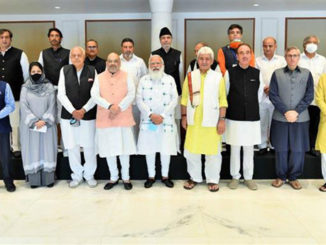
    Finally, the outreach to 14 leaders from J&K, many of whom were arrested for months, indicates that the Government’s plan for a “Naya Kashmir” polity is not drastically different from the previous polity — that the Home Minister referred to derisively as the “Gupkar Gang” — despite intervening attempts at building a new party (Apni Party), sidelining the main parties during consultations and even promoting “District Development Councillors” as the new Kashmiri leadership during meetings with foreign diplomats.

    Hardly an ‘internal’ issue

    The Government’s repeated assertion that its August 5 decision on J&K was an “internal one” has also been put to a rigorous test. Despite considerable exertions by the Ministry of External Affairs and its missions worldwide, J&K has now been discussed in more capitals, including the U.S. Congress, Parliaments in the United Kingdom, the European Union (EU) and the Nordic countries, than ever before, while several delegations of EU parliamentarians, Ambassadors and United Nations diplomats have been escorted to the valley to elicit their approval for the situation there. It is ironic that countries which were openly supportive of the Modi government’s military action in PoK in 2016 after the Uri attack, and of the Balakot strikes by the Indian Air Force in Pakistan after the Pulwama attack in 2019, have even so, chosen to be so critical of a political and internal move. In addition, the J&K dispute has been discussed at least three times at the UN Security Council, which had not touched the issue since 1971.

    Dialogue with Pakistan

    What is more galling is the notion that the decision to engage the previous leadership, to discuss the restart of a political process and the reversal of the August 5 decision to downgrade the State to a Union Territory, comes not from domestic considerations alone. In the past few months, it has been made clear that a backchannel dialogue between India and Pakistan is discussing assurances on J&K that would enable a broader bilateral dialogue. Pakistan too has climbed down considerably from its previous demands of plebiscite and UN resolutions to Pakistan Prime Minister Imran Khan’s more recent statements that he would be willing to talk if there was a reversal in some of the August 5 steps, or if the Modi government proffers a “roadmap” on J&K. Even Pakistan’s insistence on the restoration of Article 370 was a turnaround from the days when it rejected the Article’s validity. Both the downturn in Pakistan-backed violence in Jammu-Kashmir as well the softening of rhetoric suggest a flexibility borne out of international pressure as well as the sustained threat of a (Pakistan) blacklisting by the Financial Action Task Force. Such compromises by hawkish establishments in Delhi and Islamabad (and Rawalpindi) do not come from an internal rethink by themselves, and it would seem obvious that external prompting from the U.S., keen to complete its Afghanistan pullout and its negotiations with the Taliban, as well as nudges from Saudi Arabia, Qatar and the United Arab Emirates, of the kind publicly referred to by the UAE envoy as “mediation”, have been at work as well. The recent disclosure by the Qatari special envoy that Indian officials have engaged the Taliban leadership in Doha is also part of that matrix. The Government’s decision to shut down operations at two of its Afghanistan consulates, in Jalalabad and Herat, which was earlier described as a temporary move due to the novel coronavirus pandemic, is clearly linked to safety concerns in the phase after the U.S. pullout.

    The U.S. factor

    In the broader geopolitical context, as the drumbeats to a U.S.-China confrontation grow louder, India’s global strategies will be further put to test. The U.S.’s expectations of cooperation from India to its East, on China and the Indo-Pacific, have clearly not been commensurate with New Delhi’s expectations that America would reduce India’s threats to its west, from Afghanistan and Pakistan. Instead, it would seem, the Government’s attempts to sever the Gordian knot in Jammu and Kashmir with its moves two years ago, are being drawn into a more complex game of regional dominoes, where India’s security interests are increasingly in play.

    (The author is a columnist with The Hindu)