Tag: Sundar Pichai

  • Nowhere people of a nowhere world

    Nowhere people of a nowhere world

    THE GREAT GAME: The message from New Delhi is that those who break the law deserve the punishment they get

    “Former Foreign Secretary Shyam Saran calls it “uncivilized behavior on the part of the US.” Except, civility and good manners are already casualties of Naya America’s foreign policy. The manner in which Trump is overhauling the Middle East — Gaza, Palestine, Jordan — is unprecedented. India is keeping quiet because the hyper-realist policies that it has been propagating for some time now you only get involved when you are directly affected. And you are not directly affected in Gaza, Palestine and Jordan.”

    By Jyoti Malhotra

    February is fast turning out to be the cruelest month, with apologies to TS Eliot, on India’s foreign policy calendar.

    In the east, Bangladeshi lumpen youth, with no connection to either memory or even a desire for history, danced to the Bollywood song, “munni badnam hui,” as they participated in the burning of Bangabandhu Sheikh Mujibur Rahman’s home in Dhaka. Indians watched, horror-struck, at the hammer blow to what was once a glorious chapter in the lives of both countries — and couldn’t help asking, What now?

    And in the West, questions abound as PM Narendra Modi prepares to fly to the US to meet President Trump, barely days after 104 Indian nationals, shackled and cuffed, were deported back home. Another 487 are on their way. A sense of disquiet persists on whether the PM’s decision to go to the US in these circumstances is the right one.

    Many would say, yes of course. The India-US relationship remains the most important foreign policy relationship, notwithstanding Russia’s help with slashing the price of oil these recent post-Covid years. In support of this argument, a trade roadmap is on the cards when the PM visits, as is the likely announcement of India opening up the civil nuclear sector (after 17 years), while talk of Delhi buying more US defense equipment is gaining ground.

    Which is why External Affairs Minister S Jaishankar has travelled to the US thrice in the last four months, in September, December and January, so as to make the Modi-Trump meeting count. He has put out that the PM will be only one of the three leaders to have met Trump in his first month in power — Israel’s Netanyahu, Japan’s Ishiba and India’s Modi.

    Unfortunately, barely a week before Modi lands in DC, the news has not been very complimentary. Pictures of young Indian men in second-hand jeans and cheap Chinese shoes shuffling towards a US military plane because they have chains on their feet has sent waves of shock and awe across Punjab, if not the rest of the country.

    This, of course, is exactly what Trump wants. He wants to send the message to the world that he’s not interested in the great unwashed landing up at America’s doors — talented, skilled and accomplished brigades on H1-B visas are just fine.

    Nor does he seem to have time for saving face. If the Indian PM is coming to see you in a week, you should no longer expect that the news is good on the eve of your visit. Trump has already rewritten the rules of the world order in the few weeks he’s been around.

    Former Foreign Secretary Shyam Saran calls it “uncivilized behavior on the part of the US.” Except, civility and good manners are already casualties of Naya America’s foreign policy. The manner in which Trump is overhauling the Middle East — Gaza, Palestine, Jordan — is unprecedented. India is keeping quiet because the hyper-realist policies that it has been propagating for some time now you only get involved when you are directly affected. And you are not directly affected in Gaza, Palestine and Jordan.

    As for the 104 deportees, including women, who were shackled during their flight home earlier this week, the message from New Delhi is that those who break the law deserve the punishment they get. The US Border Patrol described them as “aliens,” and so they are.

    And yet, as Jaishankar spoke in Parliament on the deported Indians, admitting on record that he was “being bureaucratically correct,” one couldn’t help wondering what his predecessor, the late Sushma Swaraj, would have said when confronted with India’s present predicament — witnessing the humiliation of its poor and unskilled masses being rightfully punished for doing a very stupid thing.

    Sushma Aunty had so stirred the bureaucratic consciousness of the toughened bureaucrats of the Ministry of External Affairs (MEA) that they were forced to be kinder to the bluest-collar workers across the world. Reforms were ordered for the protection of emigrants, laws were toughened for those wanting to work abroad, immigration agents were forced to fall in line. Not that she cleaned up the entire system, but she certainly tried. She knew her fellow citizens were more often than not on the wrong side of the foreign law in question, but she demonstrated compassion. She offered them a hanky to cry when they got caught after knowingly breaking the rules.

    The current Modi government, instead, is throwing the rule book at these people. Moreover, the MEA is pointing out, these Punjabi folk who can spend Rs 45 lakh chasing the American dream are not exactly poor. Of course, the MEA is right. These 104 men and women knowingly bought that one-way ticket to Amreeka, well aware that the “dunki route” is what it was. And still they went. Problem is, they will still go if they get a chance, if only because they need to pay the loan their families took to send them to the US.

    But back to Modi and Trump and the importance of the India-US relationship. Apart from the fact that the PM seems keen on making that early connection with the President, the fact remains that both countries are increasingly invested in each other. From intelligence-sharing to defense and technology partnerships, via military foundational agreements that have been signed over the last 25 years — an alphabet soup called GSOMIA, LEMOA, COMCASA, BECA — India is so closely integrated with the US that it would not be far wrong to describe it as an “informal ally.”

    Some would say, why not? There are as many as 5 million US citizens of Indian origin, a hugely influential group. We celebrate them all. We wallow in the appreciation of Sundar Pichai and Satya Nadella and Indra Nooyi and Ajay Banga, as if they were part of our immediate family.

    The problem arises when the Punjabis from Doaba, the Haryanvis from Kaithal and the Gujaratis from Gandhinagar bomb this pretty picture — wearing handcuffs and all. What is worse is that no one, except their immediate families, want to own these Indians. The nowhere men and women of a nowhere world.
    (Jyoti Malhotra is Editor-in-Chief of The Tribune group of newspapers. She has been a journalist for 40 years, working in print, TV and digital, both in English and Hindi media, besides being a regular contributor on BBC Radio. She is deeply interested in the conflation between politics and foreign policy. Her X handle is @jomalhotra Insta handle @jomalhotra Email: jyoti.malhotra@tribunemail.com)

  • Pichai on OpenAI launching ChatGPT 4o one day prior to Google I/O 2024

    Pichai on OpenAI launching ChatGPT 4o one day prior to Google I/O 2024

    OpenAI launched ChatGPT 4o, a new AI model that will power ChatGPT chatbot, just a day before Google developer’s conference. ChatGPT 4o will be available for free, the Sam Altman-led AI start-up said. But was the day for the reveal chosen specifically to taunt Google?
    Google CEO Sundar Pichai said that “one event happened over a day, does not matter over time.” He explained, “my perspective, this inflexion point we are on with AI, the opportunity that I see, you want to zoom out, the fact that one event happened over a day, does not matter over time.”
    He added, “As a company, we have been investing in it over a long time. We are developing state of art models and working to deploy them to billions of people in a way where we can make a difference in their lives. And to me, that’s the North Star, that’s our mission. We stay focused on that.”
    Sundar Pichai was also asked about the possibility of OpenAI violating Google’s terms and conditions. He said, “Look, I think it’s a question for them to answer. I don’t have anything to add. We do have clear terms of service. And so, you know, I think normally in these things we engage with companies and make sure they understand our terms of service. And we’ll sort it out.”
    This comes after it was reported that OpenAI may be violating terms and conditions to train its AI models.

  • Sundar Pichai’s strict missive to Google employees: ‘This is a workplace, not…’

    Sundar Pichai’s strict missive to Google employees: ‘This is a workplace, not…’

    Washington (TIP)- Sundar Pichai said that employees need to be more focused “in how we work, collaborate, discuss and even disagree.” The message came in a blog post by the Google CEO following nine employees of the company being arrested for staging sit-in protests. The employees were protesting against the company working closely with Israel after which another 28 employees were fired in connection to the protests.
    Sundar Pichai said that the company has a culture of vibrant, open discussion “that enables us to create amazing products and turn great ideas into action”. Emphasizing that it is important to preserve this culture, he said, “Ultimately we are a workplace and our policies and expectations are clear: this is a business, and not a place to act in a way that disrupts coworkers or makes them feel unsafe, to attempt to use the company as a personal platform, or to fight over disruptive issues or debate politics.”
    “When we come to work, our goal is to organize the world’s information and make it universally accessible and useful. That supersedes everything else and I expect us to act with a focus that reflects that,” he added.
    Chris Rackow, head of security at Google, also sent a stern message to employees saying that every employee should know how to conduct themselves in a workplace. He said, “If you’re one of the few who are tempted to think we’re going to overlook conduct that violates our policies, think again.”
    Alphabet-owned Google has announced a significant internal reorganisation aimed at accelerating its advancements in artificial intelligence (AI) and strengthening its position in the tech industry. The move involves consolidating various teams responsible for AI development, Android, and hardware products.
    In a statement released on Thursday, Google revealed plans to merge its Research and DeepMind divisions’ teams focusing on building AI models. This consolidation aims to streamline AI development efforts, facilitating closer collaboration between research and practical application teams.
    Furthermore, Google will relocate its Responsible AI teams from the Research division to DeepMind. This shift aims to ensure that AI models are developed with safety considerations from the outset, aligning with global concerns about AI ethics and regulation.
    The consolidation comes in the wake of the successful development of Google’s advanced AI model, Gemini, by the DeepMind team. Gemini, unveiled last year, boasts capabilities to process various data formats, including video, audio, and text. However, Google faced criticism following inaccuracies in historical image generation, prompting a pause in certain image generation functionalities.

  • Indian-origin CEOs who made headlines in 2023

    Indian-origin CEOs who made headlines in 2023

    Microsoft CEO Satya Nadella’s much-talked-about coup by hiring OpenAI’s Sam Altman shone the spotlight on how a good leader can make the best out of a difficult situation. The lesson in leadership was admired by global business leaders. Like Nadella, other Indian-origin CEOs made headlines in 2023, here’s a breakdown of some of them.
    Satya Nadella, Microsoft
    After OpenAI CEO Sam Altman was abruptly fired by the company board, Microsoft CEO Satya Nadella pounced on the opportunity to bring him aboard. He announced that Altman and OpenAI co-founder Greg Brockman will be joining Microsoft to head a new advanced AI research team. Later, as events unfolded, Sam Altman was reinstated as the CEO of OpenAI. Responding to the development, Nadella told Bloomberg TV it doesn’t matter where Altman ends up working — because “irrespective of where Sam is, he’s working with Microsoft.” The tech giant is an investor in OpenAI, pouring $10 billion into the AI startup.
    Sundar Pichai, Alphabet

    Alphabet and Google CEO Sundar Pichai made headlines for the layoffs in the company and for the antitrust trial between Google and Fortnite developer Epic Games, which has accused the internet search giant of abusive, monopolistic practices via its app store. Pichai asserted that Google does not intentionally stifle competition when it came to the multiple rounds of layoffs in the company, Pichai stated, “Clearly it’s not the right way to do it. I think it’s something we could have done differently for sure.”
    Vishal Garg, Better.com
    The Better.com CEO made headlines in 2021 by laying off 900 employees over a Zoom call. In 2022, the company gave its employees in India the option to quit voluntarily and accepted over 900 resignations. Continuing the trend, in 2023, Vishal Garg laid off its entire real estate team and shut down the unit, according to a report by TechCrunch. In an interview with the publication, Garg said he underwent a lot of leadership training to rebuild the trust within and outside the company.
    Shantanu Narayen, Adobe
    The Adobe CEO recently made headlines after the company shelved its $20 billion cash-and-stock deal for cloud-based designer platform Figma, stating that there was “no clear path” for approvals from antitrust regulators in the European Union and the UK. Shantanu Narayen also made news when he did not agree with Infosys founder Narayan Murthy that young Indians should work 70 hours a week for the sake of the country’s development. “People should do what they want without taking the victim mentality –that I am being told what to do,” he said.
    Ajay Pal Banga, World Bank

    Indian-origin Ajay Banga made headlines earlier this year after being announced as the World Bank president. In May, the World Bank’s 25-member executive board elected Banga to a five-year term as president. Earlier in his career, Banga also led Mastercard as its COO and CEO. In 2016, he was also conferred with the Padma Shri for his contribution to trade and industry.
    Arvind Krishna, IBM
    As employers and employees tussle with the return to office mandate, IBM CEO Arvind Krishna made news after he issued a warning to his employees that remote work can hurt their career prospects, especially for managerial roles. The IIT Kanpur alumnus said he is not asking anyone to come back to the office now, but “We encourage you to come in, we expect you to come in, we want you to come in.”
    Parag Agrawal
    The former CEO of Twitter, now X, made headlines after Elon Musk released his autobiography. In it, Parag Agrawal’s ex-boss said that he lacked leadership qualities. Musk revealed that he met Agrawal over dinner before he bought Twitter and concluded that he did not have “leadership quality”. “He’s a really nice guy. What Twitter needs is a fire-breathing dragon and Parag is not that,” Musk reportedly said after meeting with Agrawal.

  • Google, Meta, Amazon hiring low-paid H1B workers after US layoffs: report

    Google, Meta, Amazon hiring low-paid H1B workers after US layoffs: report

    According to a report, Google swiftly filed H1B visa applications for international H1B hires, including software engineers, consultants, researchers, and various other roles, just a month after Sundar Pichai’s announcement of the company’s plan to cut 12,000 jobs.

    SAN FRANCISCO (TIP): Even as global tech giants are carrying out mass layoffs, several top Silicon Valley companies are reportedly looking to hire lower-paid tech workers from foreign countries. Google, Meta, Amazon, Microsoft, Zoom, Salesforce and Palantir have applied for thousands of H1B worker visas this year, according to a US Department of Labor data, reported independent investigative journalist Lee Fang.

    Ironically, thousands of workers on H1B visa, including Indians, have been affected by the layoffs in the United States, with many taking to social media to share the news and seek new opportunities.

    Just a month after Sundar Pichai announced Google’s plan to cut 12,000 jobs around the world in January, the company filed applications for H1B visas to hire software engineers, analytical consultants, user experience researchers and other roles from outside the United States, with several requests aimed for new Google employees to join in August, the report states. Google parent Alphabet owned Waymo too has reportedly filed similar H1B applications to hire engineers. Meta has laid off nearly 25 per cent of its estimated workforce in just a few months in what CEO Mark Zuckerberg has called the company’s “year of efficiency” as the US tech sector continues to downsize. Amazon CEO Andy Jassy in March laid out a plan to cut 9,000 more jobs from the online retail giant’s workforce, following the 18,000 that were axed in January.

    The layoffs account for a smaller percentage of Amazon’s total workforce, which ran up to 1.5 million people in December 2022, than the cuts seen at some other tech giants.
    Jassy told workers that the extra layoffs were necessary as the company seeks to downsize after years of hiring, particularly during the coronavirus pandemic when people turned to the internet for shopping.

    In January, Microsoft said it would eliminate 10,000 jobs, almost 5 per cent of the global workforce, as it braces for a potential recession. In an email to employees, CEO Satya Nadella said, “While we are eliminating roles in some areas, we will continue to hire in key strategic areas.

    (Source: Money Control)

  • Indian American Neal Mohan set to head YouTube

    Indian American Neal Mohan set to head YouTube

    Susan Wojcicki steps down as CEO of YouTube

    NEW YORK (TIP): Indian-American Neal Mohan will be the new YouTube CEO, as current head Susan Wojcicki has announced to step down after 25 years at the Google-owned company.

    Currently chief product officer, Mohan became part of Google, the parent company of YouTube, in 2008. He is a Stanford graduate and earlier worked with Microsoft.

    Mohan and Wojcicki have worked together for nearly 15 years. He became YouTube’s chief product officer in 2015.

    “Today, after nearly 25 years here, I’ve decided to step back from my role as the head of YouTube and start a new chapter focused on my family, health, and personal projects I’m passionate about,” Wojcicki said in a blog post late on Thursday. She has agreed with Sundar Pichai to take on an advisory role across Google and Alphabet. “This will allow me to call on my different experiences over the years to offer counsel and guidance across Google and the portfolio of Alphabet companies,” she added.

    Wojcicki managed marketing, co-created Google Image Search, led Google’s first Video and Book search, as well as early parts of AdSense’s creation, worked on the YouTube and DoubleClick acquisitions, served as SVP of Ads, and for the last nine years, was the CEO of YouTube. “I took on each challenge that came my way because it had a mission that benefited so many people’s lives around the world: finding information, telling stories and supporting creators, artists, and small businesses,” she noted.

    “Mohan will be the SVP and new head of YouTube. I’ve spent nearly 15 years of my career working with Mohan, first when he came over to Google with the DoubleClick acquisition in 2007 and as his role grew to become SVP of Display and Video Ads,” said Wojcicki.

    He has set up a top-notch product and UX team, played pivotal roles in the launch of some of the biggest products, including YouTube TV, YouTube Music and Premium and Shorts, and has led the Trust and Safety team.

    Mohan ensured that “YouTube lives up to its responsibility as a global platform”. “With all we’re doing across Shorts, streaming, and subscriptions, together with the promises of AI, YouTube’s most exciting opportunities are ahead, and Mohan is the right person to lead us,” said Wojcicki.
    (Source: IANS)

  • Google introduces AI service ‘Bard’ to compete with ChatGPT

    Google introduces AI service ‘Bard’ to compete with ChatGPT

    Google has unveiled its new artificial intelligence (AI) service ‘Bard’ to compete against OpenAI’s ChatGPT, which is now opened up to “trusted testers” before the company makes it “more widely available to the public in the coming weeks”. Bard is an “experimental conversational AI service” which is powered by Language Model for Dialogue Applications (LaMDA), Google CEO Sundar Pichai said in a blogpost on.

    The tool aims to combine the depth of the “world’s knowledge with the power, intelligence and creativity of our large language models”. It uses data from the web to provide fresh, high-quality responses.

    “Bard can be an outlet for creativity, and a launchpad for curiosity, helping you to explain new discoveries from NASA’s James Webb Space Telescope to a 9-year-old, or learn more about the best strikers in football right now, and then get drills to build your skills,” Pichai explained.

    The tech giant is initially releasing it using LaMDA’s lightweight model version. This much smaller model requires significantly less computing power, allowing the company to scale to more users, resulting in more feedback.

    Google will combine the external feedback with its own internal testing to make sure that Bard’s responses “meet a high bar for quality, safety and groundedness in real-world information”, Pichai mentioned.

                    Source: IANS

  • ‘India is a part of me’: Google and Alphabet CEO Sundar Pichai

    ‘India is a part of me’: Google and Alphabet CEO Sundar Pichai

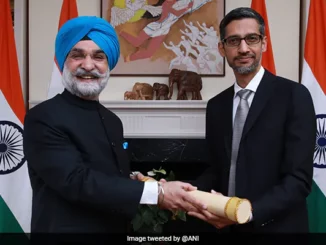
    WASHINGTON, D.C. (TIP):  Indian-American Sundar Pichai was awarded the Padma Bhushan for 2022 in the Trade and Industry category. The Madurai-born Pichai was named one of the 17 awardees earlier this year.

    He received India’s third-highest civilian award in the presence of his close family members in San Francisco on Friday, December 2. “I am deeply grateful to the Indian government and the people of India for this immense honor. It is incredibly meaningful to be honored in this way by the country that shaped me,” 50-year-old Pichai said while accepting the award from India’s Ambassador to the US, Taranjit Singh Sandhu. “India is a part of me. I carry it with me wherever I go. (Unlike this beautiful award which I will keep somewhere safe),” he said.

    “I was fortunate to grow up in a family that cherished learning and knowledge, with parents who sacrificed a lot to make sure I had opportunities to explore my interests,” Pichai said. India’s Consul General in San Francisco, T V Nagendra Prasad, was also present during the event. Sandhu said that Pichai represented the limitless possibilities of technology for transformation. “He has been making commendable efforts towards making digital tools, and skills accessible to across various segments of the society in different parts of the globe,” he said.

    Recalling Prime Minister Narendra Modi’s vision of technology that combines 3Ss – speed, simplicity and service, Sandhu hoped that Google would make full use of the digital revolution happening in India. Pichai said that it had been amazing to return to India many times over the years to see the rapid pace of technological change.

    The innovations created in India are benefitting people around the world – from digital payments to voice technology, he said. “I look forward to continuing the great partnership between Google and India, as we work together to bring the benefits of technology to more people,” he said. Businesses are seizing the opportunities for digital transformation, and more people have access to the internet than ever before, including in rural villages, Pichai said. “Prime Minister Modi’s Digital India vision has certainly been an accelerator for that progress and I’m proud that Google continues to invest in India, partnering with governments, businesses, and communities over two transformative decades,” he said. “Every new technology that arrived at our doorstep made our lives better. And that experience put me on a path to Google, and the chance to help build technology that improves the lives of people all over the world,” he said.

    Pichai said he sees so much opportunity ahead. On India taking over the G20 presidency, Pichai said: “It’s an amazing opportunity to build consensus on strengthening the global economy by advancing an internet that is open, connected, secure, and works for everyone. That’s a goal we share, and are committed to advancing with you.” India formally assumed the G20 Presidency on Thursday. “I am grateful for the opportunity to do this work together and bring the benefits of technology to more people,” Pichai said. Google this year added 24 new languages to its translation service using a new advancement in machine learning. Eight of them are languages native to India. “It means so much to see how people can access information and knowledge in their preferred language, and see the world open up to them in new ways. That’s why I continue to be so optimistic about technology, and why I believe India can and must continue to lead,” he added.

    (Source: PTI )

  • Former President Donald Trump announced he is suing Facebook, Twitter and Google

    Former President Donald Trump announced he is suing Facebook, Twitter and Google

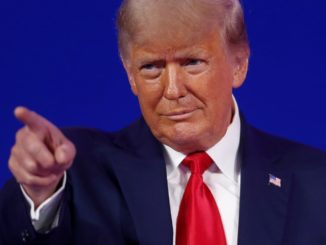
    WASHINGTON (TIP): Former President Donald Trump took his fight with three massive tech companies to court, filing lawsuits that legal experts say are all but guaranteed to fail – even as they rally Republican voters, fundraisers and donors. Trump revealed Wednesday, July 7,  that he is suing Facebook, Twitter and Google, as well as their respective CEOs Mark Zuckerberg, Jack Dorsey and Sundar Pichai, in class-action lawsuits.

    Trump, who has a history of threatening legal action but not always following through, made the announcement at his golf club in Bedminster, New Jersey, alongside two leaders from the America First Policy Institute, the pro-Trump nonprofit group that is supporting the lawsuits.

    Shortly after the news conference wrapped, Trump’s political entities started sending out fundraising messages that touted the lawsuits in their appeals for money. One such text message, written as if it were coming from Trump himself, includes a link to his joint fundraising committee Save America, which also raises money for other Republican political initiatives. The lawsuits were unveiled just over a month after Facebook decided to uphold Trump’s ban from using the platform until at least January 2023. Twitter, Trump’s preferred social media outlet throughout his one term in office, permanently banned him on the heels of the Jan. 6 invasion of the Capitol by a mob of his supporters. The lawsuit against Pichai also names as a defendant YouTube, the video-sharing website bought by Google in 2006. YouTube indefinitely banned Trump in January. “We’re not looking to settle,” Trump told reporters at Bedminster when asked about the lawsuits. “We don’t know what’s going to happen but we’re not looking to settle,” he said. The three related lawsuits, filed in federal court in Florida, allege the tech giants have violated plaintiffs’ First Amendments rights. The suits want the court to order the media companies to let Trump back on their platforms. They also want the court to declare that Section 230 of the Communications Decency Act, a piece of legislation that stops tech companies from being held liable for what users post on their platforms, is unconstitutional. As president, Trump railed against Section 230 and repeatedly called for its repeal. He even tied the issue to a crucial round of stimulus checks at the height of the coronavirus pandemic, as well as the passage of an annual defense spending bill. Legal experts doubt whether Trump’s latest attack on big tech companies will succeed.

  • “India deserves our attention right now”: Sundar Pichai

    “India deserves our attention right now”: Sundar Pichai

    SAN JOSE (TIP): Witnessing the “heartbreaking” Covid-19 crisis in India amid a deadly second wave, Google’s Indian American CEO Sundar Pichai would like other US companies to also come forward to help in a coordinated way.

    “India deserves our attention right now,” Pichai told media Wednesday, April 28 discussing how his company is responding and what others can similarly do to lend support.

    Pichai, who became head of Google’s parent company Alphabet in 2019, and Microsoft’s Indian American CEO Satya Nadella publicly pledged Monday, April 26 to help battle the surge of coronavirus cases.

    “The situation there is dire, and it’s been heartbreaking to see. I think the worst is yet to come,” he said on witnessing the unfolding crisis in India from afar.”

    “Being here, seeing the attention here, I realize at the highest levels from President (Joe) Biden, Secretary (of State Antony) Blinken — there’s been focus on seeing how we can help India and the other countries being affected.”

    “From our side, we really focused on providing the most helpful information,” he said noting there are 600 million people connected to the internet and they’re looking for information about vaccine and testing.

    “So, working with the Ministry of Health in India, making sure we can get the right information on the ground has been a big focus for us.”

    “As for us partnering with NGOs and public health organizations to get the messaging out,” Pichai said, “It’s important that people are able to stay home and mask and stay safe. So, we’re helping get the message out in partnership.”

    Other companies can similarly take their expertise where they “can and being ready to help in a coordinated way is going to be helpful,” he said. “The second, it’s very possible to provide cash and other resources to organizations on the ground I think can make a big difference.”

    Asked about vaccine supply and a possible intellectual property waiver, Pichai said he was more involved in the conversations around providing raw materials, supply access so India can begin manufacturing its vaccines.

    “I’m not familiar enough around the issues around IP to weigh in on them” he said. “I was encouraged by the AstraZeneca doses to India.

    “This pandemic will involve us tackling it globally. The US, we’re very fortunate. We need to work hard to make sure we can get access to vaccine supply around the world as soon as possible,” Pichai said.

    On Indian Prime Minister Narendra Modi’s handling of the pandemic, Pichai said, “If you look around the world, Covid has been humbling in the sense that, when you think you’re on top of it, there can be a surge back.”

    “I think encouraging good public safety measures and paying attention to crisis is the only thing you can do in the short term. That’s the effort I’m seeing,” he said adding, “As a company, we stand by ready to help.”

    Commenting on recent take-down requests from the Modi government over critical pandemic posts on Twitter, Facebook, Pichai said, “Normally we do comply with local laws, particularly in democratic countries which through their norms and processes have passed laws.”

    “I think one of India’s strengths is a deeply rooted democratic tradition, based in freedom of expression and allowing for diversity of viewpoints,” he said. “That’s a strength.”

    “We haven’t had any requests,” Pichai said, In the past we’ve been able to work constructively with governments around the world, and we’ll continue that approach here.”

  • Facebook blocks Australians from accessing news on platform

    Facebook blocks Australians from accessing news on platform

    Canberra (TIP): Facebook announced on Thursday, February 17,  that it has blocked Australians from viewing and sharing news on the platform because of proposed laws in the country to make digital giants pay for journalism.

    Australian publishers can continue to publish news content on Facebook, but links and posts can’t be viewed or shared by Australian audiences, the US-based company said in a statement.

    Australian users cannot share Australian or international news.

    International users outside Australia also cannot share Australian news.

    “The proposed law fundamentally misunderstands the relationship between our platform and publishers who use it to share news content,” Facebook regional managing director William Easton said.

    “It has left us facing a stark choice: attempt to comply with a law that ignores the realities of this relationship, or stop allowing news content on our services in Australia. With a heavy heart, we are choosing the latter,” Easton added.

    The announcement comes a day after Treasurer Josh Frydenberg described as “very promising” negotiations between Facebook and Google with Australian media companies.

    Frydenberg said after weekend talks with Facebook CEO Mark Zuckerberg and Sundar Pichai, chief executive of Alphabet Inc and its subsidiary Google, he was convinced that the platforms “do want to enter into these commercial arrangements”.

    Frydenberg said he had had a “a constructive discussion” with Zuckerberg after Facebook blocked Australian news.

    “He raised a few remaining issues with the Government’s news media bargaining code and we agreed to continue our conversation to try to find a pathway forward,” Frydenberg tweeted.

    But communications Minister Paul Fletcher said the government would not back down on its legislative agenda.

    “This announcement from Facebook, if they were to maintain this position, of course would call into question the credibility of the platform in terms of the news on it,” Fletcher told Australian Broadcasting Corp.