Perseverance has drilled a sample from a rock that could go on to provide answers to questions the rover came in search of on Mars.
The 24th rock core taken by the rover is believed to have been awash in water for an extended period in the distant past, and could have been part of an ancient beach that once adorned the Red Planet.
“To put it simply, this is the kind of rock we had hoped to find when we decided to investigate Jezero Crater. Nearly all the minerals in the rock we just sampled were made in water; on Earth, water-deposited minerals are often good at trapping and preserving ancient organic material and biosignatures,” Ken Farley, project scientist for Perseverance said.
Named after Yellowstone National Park’s iconic landmark, “Bunsen Peak,” the rock of approximately 5.6 feet wide and 3.3 feet high intrigued scientists as they observed it with the rover.
Its prominent stature amidst the terrain and unique texture piqued their curiosity, especially its vertical face, providing a clear cross-section for analysis and less dust accumulation for instruments. “The rock can even tell us about Mars climate conditions that were present when it was formed,” says Farley.
Before extracting a sample, Perseverance used its SuperCam spectrometers and the X-ray spectrometer PIXL to scan the rock’s composition.
Tag: SuperCam
-
Perseverance finds rock that could answer why the rover came to Mars
-

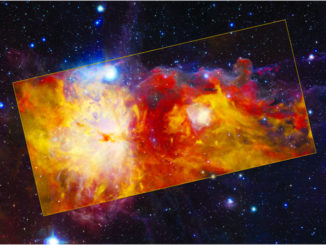
European Southern Observatory releases new image of Orion’s Flame Nebula
The European Southern Observatory has released a new image of Orion’s Flame Nebula. Named NGC 2024, the Flame Nebula is a large star-forming region located in the Orion constellation situated about 1,400 light-years from Earth. The Orion constellations is easily visible high in the night sky. You can spot Orion’s “belt” consisting of three bright blue stars. The image was taken using the ESO-operated Atacama Pathfinder Experiment (APEX), located in the Atacama Desert. The team used radio waves to capture the fiery picture.
Former ESO astronomer Thomas Stanke and his team used the new SuperCam instrument at APEX to make the observations. “As astronomers like to say, whenever there is a new telescope or instrument around, observe Orion: there will always be something new and interesting to discover!” says Dr Stanke in a release.
The results of his observations are now accepted for publication in the journal Astronomy & Astrophysics.
In addition to the Flame Nebula, the team also observed reflection nebulae Messier 78 and NGC 2071.
A reflection nebula is created when light from a star is scattered by nearby dust clouds. In 2018, Hubble’s Near Infrared Camera and Multi-Object Spectrometer (NICMOS) captured a colorful image of M78. The team also found a new small, spherical cloud to the north of NGC2071 and named it the ‘Cow Nebula’ globule. Studying nebulae can help astronomers understand how stars form and evolve during its lifetime.
-

Indian American engineer Vishnu Sridhar playing key role in NASA’s Mars rover mission
NEW YORK (TIP):Vishnu Sridhar, an Indian American engineer, who is playing a key role in NASA’s mission to Mars, says rover Perseverance’s SuperCam will now analyze the Red Planet’s terrain the rover cannot reach.
Landing safely on Mars on Feb. 18 after traversing nearly 300 million miles, the rover is now set to perform its most exciting work in the next few weeks, says Sridhar, 27, the lead systems engineer for the SuperCam.
The SuperCam is an instrument designed to scan rocks and minerals—from up to 20 feet away—to determine their chemical makeup.
“NASA missions are obviously trying to explore and answer the fundamental questions,” Queens native Sridhar told ABC7 News channel in a conversation with meteorologist Lee Goldberg.
“Perseverance is also trying to seek that, and eventually answer the question, was there life on Mars, was their life outside, Earth,” he said.
“We’re going to be taking more images of Mars, we’re going to be shooting lasers with the SuperCam instrument, we’re going to be recording audio with our microphone. And eventually, soon in near future, we are going to deploy our helicopter, and do the first powered flight on Mars,” Sridhar said.
It’s important that the mission is happening despite the Covid pandemic, he said. “It was definitely a tough period for us during Covid and for everyone else around the globe.”
“And that’s why I love the name of Perseverance because we persevered through the pandemic and there was a paradigm shift, we learned a lot how to do engineering remotely,” he said.
“And we went through all that we learned and now we are successful on Mars and it’s a great achievement for humankind.”
While growing in Rego Park, Queens, Sridhar was awed at the airplanes that would take off from nearby LaGuardia airport, according to New York Media.
As a high-school student, he sent a weather balloon up 100,000 feet and got a taste of the vastness of space — so much left unexplored, unseen by human eyes.
His grandfather, a civil engineer who built trains and dams in India, also inspired him.
“Growing up, I was always fascinated by airplanes living close to two giant airports like LaGuardia and JFK, and I just naturally liked science fiction and technology growing up. And I also loved and enjoyed building things,” he told media
“One of the key events that sparked my interest in space and exploration was watching National Geographic. The Carl Sagan TV show Cosmos, too—that really sparked my interest in human exploration and exploring our solar system.”
“I was also attracted to engineering and the STEM field because of my grandfather. He was a civil engineer in India. He built the second largest dam in India, and he has built trains that are still operational.”
“Unlike him, I didn’t want to work on stuff that’s beneath our atmosphere. I kind of wanted to be different, so I started pursuing aerospace engineering,” Sridhar told media.
Asked if there was a particular turning point, Sridhar said, “One of our high school projects involved sending a weather balloon up to about 100,000 feet.”
“I put in a couple instruments — an altitude pressure sensor, and a camera. It was so high that you could see the curvature of the Earth and the darkness of space.”
“That really opened my eyes and connecting the dots with the science TV shows from my youth made me interested in pursuing and following NASA missions.”
Asked about his own role in the mission, Sridhar said, “SuperCam has a microscopic-level camera that can take minute, high-resolution images of rocks that the geologists on Earth can analyze and study.
“But it also has built in lasers and spectrometers [for chemical analysis]. When it fires its laser, it can basically detect the chemical composition and the mineral makeup of the different rocks,” he told Media.
“And it’s scanning the rocks in fine detail—each point is as small as the tip of a pencil. It can look at samples that are 20 feet away.”
“There was a lot of testing involved and development over the last three years,” Sridhar said. “Summer 2019 was when instruments came in from France and Los Alamos and when we physically integrated SuperCam with the Perseverance rover.”
“That’s something I will cherish for the rest of my life…to have touched and worked on a piece of hardware that’s on its way to Mars,” he further told the media.