Tag: Supreme Court India

  • Supreme Court nulls electoral bonds scheme, seeks info on donors

    Supreme Court nulls electoral bonds scheme, seeks info on donors

    February 15, 2024

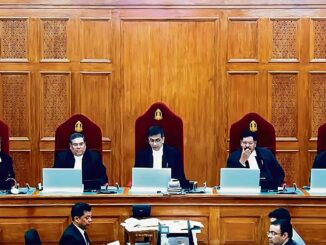
    NEW DELHI (TIP): Ahead of the 2024 Lok Sabha elections, the Supreme Court on Thursday, February 15,  declared “unconstitutional” the electoral bonds scheme that allowed individuals and companies to make unlimited anonymous donations to political parties. Noting that voters have right to know, a five-judge Constitution Bench led by CJI DY Chandrachud said the scheme violated Article 19(1)(a) of the Constitution, which guaranteed right to freedom of speech and expression and included right to information within its ambit.

    “We are of the opinion the information about funding to a political party is essential for a voter to exercise their freedom to vote in an effective manner. The electoral bonds Scheme and the impugned provisions to the extent that they infringe upon the right to information of the voter by anonymizing contributions through electoral bonds are violative of Article 19(1)(a) (right to freedom of speech and expression),” the Bench said. The Beach, which also included Justices Sanjiv Khanna, BR Gavai, JB Pardiwala and Manoj Misra, said the disclosure of information regarding electoral bonds was necessary to identify corruption and quid pro quo transactions in governance. “Such information is also necessary for exercising an informed vote,” it added.

    The top court ordered the State Bank of India to stop issuing electoral bonds immediately and submit all details by March 6 to the Election Commission which shall make all donations public by March 13. All electoral bonds within the 15-day validity period shall be returned by political parties to the purchasers, it added.

    Justice Khanna delivered a separate but concurring judgment. Welcoming the verdict, petitioner Association for Democratic Reforms’ counsel Prashant Bhushan said: “This is a salutary judgment which will enhance our democratic process.” The Constitution Bench also declared unconstitutional amendments made to the Representation of the People Act (RPA), 1951, the Income Tax Act, 1961, and the Companies Act, 2013, through the Finance Act, 2017, to facilitate introduction of the scheme.

    Earlier, political parties had to declare all contributions more than Rs 20,000 with no exceptions, and maintain a record of all donations exceeding Rs 20,000 for tax purposes. In a financial year, companies could contribute a maximum of 7.5% of their average net profits from the preceding three years. The amendments did away with the restrictions to allow political parties to receive funds through electoral bonds.

    Introduced through the Finance Act, 2017, an electoral bond is a bearer instrument like a promissory note which can be purchased by an Indian citizen or an Indian company whose identity would remain secret from everybody except the SBI from whom it has to be purchased. Once purchased, the buyer can give it to a political party, which could encash it using its bank account.

  • Supreme Court reserves verdict on same-sex marriage

    Supreme Court reserves verdict on same-sex marriage

    After 10 days of marathon arguments, the Supreme Court on Thursday, May 11, reserved its verdict on petitions seeking legal validation of same-sex marriage. A five-judge Constitution Bench headed by Chief Justice DY Chandrachud reserved its judgment after hearing arguments from senior advocates AM Singhvi, Raju Ramachandran, KV Viswanathan, Anand Grover and Saurabh Kirpal on behalf of the petitioners; Attorney General R Venkataramani, Solicitor General Tushar Mehta for the Centre and senior counsel Kapil Sibal for Jamiat-Ulama-i-Hind. The Bench has already made it clear that it would not get into the personal laws of various religious communities and would only examine the Special Marriage Act, 1954, to consider the petitioners’ prayer.
    The Centre, some of the states, certain Hindu, Muslim and Christian organisations have opposed the petitions. The governments of Assam, Andhra Pradesh and Rajasthan have the petitions, citing public opinion and adverse implications on the social and family system. On behalf of the Government of Madhya Pradesh, senior counsel Rakesh Dwivedi has opposed the petitions seeking recognition for same sex marriage.
    The Bench is expected to deliver the verdict after the summer vacation.