Tag: Sushma Swaraj

  • Reset of a policy of equidistance

    Reset of a policy of equidistance

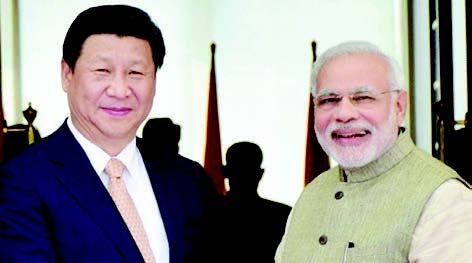
    Soon after Prime Minister Narendra Modi took office, an Indian TV channel held a discussion on likely foreign policy reorientation. When the doyen of South Asian Studies, Stephen Cohen, was asked in which direction Mr. Modi would tilt -the U.S. or China – without hesitation he replied, “China,” adding, “because it is the Asian century.” Mr. Modi hosted Chinese President Xi Jinping last year but despite the fanfare preceding the visit, there was little to suggest any strategic overlap. Alas, Mr. Cohen was proved wrong after the Modi-Obama Joint Vision Statement reflected a sharp, strategic congruence. Mr. Modi has reset the United Progressive Alliance (UPA) government’s policy of equidistance between the U.S. and China and dropped the political refrain that India will not contain China.


    Choosing friends and allies

    In New Delhi last year, at a seminar, the former U.S. Ambassador to India, Robert D. Blackwill, posed the question: “How can New Delhi claim strategic autonomy when it has strategic partnerships with 29 countries?” After the latest Modi-Obama vision statement, even less so. Strategic autonomy and no military alliances are two tenets of India’s foreign policy. Quietly, India has converted strategic autonomy to strategic interconnectedness or multi-vectored engagement. When the Indo-Soviet Treaty of Peace, Friendship and Cooperation 1971 was signed, Mrs Indira Gandhi had requested the Soviet Union to endorse India’s Non-Aligned status, so dear was the policy at the time. That multifaceted treaty made India a virtual ally of the Soviet Union. Russia inherited that strategic trust and has leased a nuclear submarine, provided high-tech weapons to all three Services including technology for nuclear submarines and aircraft carriers. At the BRICS meeting in Brazil last year, when asked a question, Mr. Modi said as much: “If you ask anyone among the more than one billion people living in India who is our country’s greatest friend, every person, every child knows that it is Russia.” 

    On the other hand, differences over foreign policy with the U.S. are many including over Syria, Iran, Russia, BRICS and the Shanghai Cooperation Organisation (SCO). These policy irritants will not go away. The vision statement highlights (at the U.S.’s insistence) that both countries were on the same page in ensuring that Iran did not acquire nuclear weapons. The tongue-lashing by Mr. Obama to Mr. Putin over his bullying small countries has certainly embarrassed Mr. Modi who was himself disingenuous by inviting the leader of Crimea as a part of the Putin delegation in 2014, which deeply offended the Americans.

    What Mr. Obama and Mr. Modi easily agreed on was China’s “not-peaceful rise” which could undermine the rule-based foundations of the existing international order. So, Mr. Modi became a willing ally to stand up to China. The synergisation of India’s Act East Policy and U.S. rebalancing to Asia is intended to ensure that China does not cross red lines including the code of conduct at sea. The two theatres of action where freedom of navigation and overflight have to be ensured were identified as Asia-Pacific especially the South China Sea and, for the first time, the Indian Ocean Region.

    This is a veiled riposte to Chinese assertiveness in the South China Sea. Mr. Modi had earlier mooted the revival of the Quad, an enlarged format for naval exercises between India, the U.S., Japan and Australia. When it was mooted earlier in 2006, it was shot down by China. Underlying the strategic centrality of the Indian Ocean Region is the realisation that the existing India-China military imbalance across the high Himalayas can be offset only in the maritime domain where India has the initiative. Beijing realises that teaching India a lesson in 1962 was only a tactical success because territorial claims on Arunachal Pradesh got delegitimised after the unilateral withdrawal and worse, pushed India into the U.S.’s arms.


    Defence ties

    The rise of India which will punch to its weight under a new self-confident leadership pursuing a policy of multi-engagement is a manifest U.S. strategic goal. Defence has been the pivot around which India-U.S. relations were rebuilt, starting in 1991 with the Kicklighter Plan (Lt.Gen. Kicklighter of the U.S. Pacific Command) who initiated the multilayered defence relations which fructified in 1995 into the first Defence Framework Agreement. It was renewed in 2005 and now for the second time this year, the difference though is that for the first time, the vision statement has provided political and strategic underpinnings to the agreement. What had also been lacking until now was trust and the extent to which India was prepared to be seen in the American camp. Just a decade ago, while contracting for the Hawk trainer aircraft with the U.K., India inserted a clause that “there will be no US parts in it.” This followed the Navy’s sad experience of the U.S. withholding spare parts for its Westland helicopters. Such misgivings have held up for a decade the signing of the three “alphabet- surfeit” foundational defence agreements of force-multiplication. But we have moved on and purchased $10 billion of U.S. high-tech military equipment and another $10 billion worth will soon be contracted. The most elaborate defence cooperation programme after Russia is with the U.S.


    Dealing with China

    What made Mr. Modi, who visited China four times as Chief Minister, change his mind on the choice of the country for primary orientation was the jolt he received while welcoming President Xi Jinping to Gujarat last year. Mr. Xi’s delegation was mysteriously accompanied by a People’s Liberation Army (PLA) intrusion in Ladakh which did not yield ground till well after he had left. A similar affront preceded the 2013 visit of Premier Li Keqiang, making routine the PLA’s bad habits. While the UPA government had made peace and tranquillity on the Line of Actual Control (LAC) a prerequisite for consolidation of bilateral relations, border management rather than border settlement had become the norm. Seventeen rounds of Special Representative talks on the border yielded little on the agreed three-stage border settlement mechanism. It was therefore path-breaking when Mr. Modi during the Joint Statement asked Mr. Xi for a clarification on the LAC -the process of exchanging maps that had failed in the past and led to the ongoing attempt at a political solution skipping marking the LAC. Clearly, we have moved full circle in calling for a return to that process. Foreign Minister Sushma Swaraj, who was in Beijing this month, sought an out-of-the-box solution for the border, in which category LAC clarification will not figure. Mr. Modi is determined not to leave resolution of the border question to future generations as Chinese leaders have persistently counselled. 

    Mr. Modi, in Japan last year, expressed concerns over “expansionist tendencies.” 

    Chinese scholars I met in Beijing last year said that conditions for settling the territorial dispute were not favourable because the border is a very complicated issue, entailed compromise and had to take public opinion along. And most importantly, strong governments and strong leaders were needed for its resolution.

    While Mr. Xi did promise last year investments worth $20 billion, the fact is that, so far, Chinese investments in India do not exceed $1.1 billion. Mr. Xi’s dream of constructing continental and maritime Silk Roads are intended to complement the String of Pearls in the Indian Ocean Region, bypassing choke points like the Malacca Straits as well as neutralising the U.S. rebalancing to Asia.


    Risks and opportunities

    How will India walk the tightrope between the U.S. and China, given that the U.S. is about 13,000 kilometres away and Beijing exists cheek by jowl, peering over a disputed border and with a whopping $40 billion in trade surplus? China’s reaction to the vision statement has been to warn India against U.S. entrapment. Operationalising the strategic-security portions of the vision statement will not be easy, especially as India has no independent role in the South China Sea. Once the euphoria over the Obama-Modi statement dissipates, ground reality will emerge. Instigating Beijing, especially in the South China Sea will have costs like having to deal with the full frenzy of the PLA on the LAC with most likely ally, Pakistan lighting up the Line of Control (LoC) – the worst case two-front scenario.

    Given Mr. Modi’s growth and development agenda, for which he requires the U.S., China, Japan and others, he cannot afford to antagonise Beijing. The U.S. is vital for India’s rise and a hedge to China. So, New Delhi will necessarily be on a razor edge. In any realisation of the Asian century, while China and India are likely key players, Washington will be large and looming, making a geostrategic ménage à trois.

  • China backs bigger role for India, Brazil at UNSC

    China backs bigger role for India, Brazil at UNSC

    BEIJING (TIP): China said it respects the aspirations of India and Brazil to play bigger roles at the UN Security Council, while keeping mum on Japan’s candidature.

    About the Indian and Brazilian applications to become permanent members, China respects the willingness of the two countries to play a bigger role in the UN body, Foreign Ministry spokesperson Hua Chunying said.

    Hua, however, told reporters that Beijing would like to reach a “broadest consensus through diplomatic means” on UNSC reform.

    She was replying to a question whether Beijing backs Brazil to become a permanent member of the UNSC in the backdrop of China and Russia supporting India’s candidature at a recent Russia, India, China (RIC) foreign ministers meeting here.

    The joint statement after the meeting attended by External Affairs Minister Sushma Swaraj said: “Foreign Ministers of China and Russia reiterated the importance they attached to the status of India in international affairs and supported its aspiration to play a greater role in the United Nations.”

    Hua said China pays high attention to the desire of Brazil to play bigger role in the UNSC.

    India along with Brazil, Germany and Japan together staked their claims for permanent membership of the UNSC as part of a larger reform of the United Nations.

    While China has backed India for a bigger role at the UN, it has expressed reservations in the past over Japan becoming a permanent member in view of the political and historical issues between the two countries.

    China-Japan ties have deteriorated following a row over the Senkaku Islands in the East China Sea, and also over some history-related issues.

    In December 2013, Japanese Prime Minister Shinzo Abe visited the Yasukuni Shrine — which honours not only the nation’s 2.5 million war dead but also 14 Class-A war criminals from World War II.

  • GUEST COMMENT – BUILDING BRIDGES

    GUEST COMMENT – BUILDING BRIDGES

    External Affairs Minister Sushma Swaraj’s visit to China has created a positive atmosphere. President Xi Jinping met her in an unusual departure from protocol. China joined Russia in recommending India’s membership to the Asia-Pacific Economic Cooperation. On its part, India endorsed the launch of the China-led Free Trade Area of the Asia-Pacific initiative. Swaraj’s high-level delegation included the new Foreign Secretary, S Jaishankar, an old China hand, who was also intimately involved with US President Barack Obama’s successful visit to New Delhi. He evidently tackled some of the misgivings that Beijing had. Swaraj and her Chinese counterpart Wang Yi have sorted out certain issues, including the modalities for opening a second route for the Kailash-Manasarovar Yatra in Tibet and India’s conditional support to China’s Maritime Silk Route initiative. Beijing, however, must be sensitive to Indian sensibilities about its increasing military presence in the Indian Ocean. Swaraj also raised the issue of resolving the long-standing border dispute, instead of “bequeathing” it to future generations. The National Security Adviser Ajit Doval, who is India’s Special Representative on the issue, is expected to go to China later and take the matter further.


    Prime Minister Narendra Modi is expected to visit China in a few months, and the Foreign Minister’s visit is a preparatory one, to settle issues and manage agendas. The setting up of the “contact group” that will discuss pending issues and find solutions is a positive move, which may yield results, just as it did before President Obama’s trip. President Xi Jinping’s visit to India soon after the Modi government was sworn in was seen as underwhelming, but now there is fresh impetus for China to build better relations with India. President Obama’s visit and the joint statement issued thereafter caused some concern in Beijing. Indian diplomats are well positioned to ask for an expeditious resolution of the various issues. The mood is right, and the Prime Minister’s forthcoming visit to Beijing may well become an occasion for both the countries to pragmatically build alliances. The engagement between high-level delegations bodes well for the future.

  • India’s envoy to the US Dr. S Jaishankar is the new Foreign Secretary

    India’s envoy to the US Dr. S Jaishankar is the new Foreign Secretary

    NEW DELHI (TIP): In a surprise move, Foreign Secretary Sujata Singh resigned eight months before her term was to end. Her place has been taken by Dr Subrahmanyam Jaishankar, India’s envoy to the United States. Dr. Jaishankar took charge of his new assignment on January 29.


    Sujata Singh is the first Foreign Secretary to be removed unceremoniously after Rajiv Gandhi removed AP Venkateswaran 28 years ago in 1987.


    From all accounts, Prime Minister Narendra Modi had been unimpressed with Singh and her work, and had made no secret of it in the past months. There had been talk of a change for some time, but Foreign Minister Sushma Swaraj is said to have wanted Singh to stay on.


    The decision was finally taken to remove her after the Obama visit. Jaishankar was earlier needed in Washington to lay the groundwork for what Modi wanted to be two back-to-back headline-grabbing summits.


    Jaishankar’s appointment promises sweeping changes to the ministry of external affairs. In the past six months, no ambassadorial appointments have been cleared by the government. The MEA had sent in recommendations but they were not cleared by the PMO, partly because the PM wanted to make the changes at the helm first.


    A slew of ambassadorial and joint secretary changes are waiting to be made which are now likely to go through. Among the first decisions will be to appoint a successor to Jaishankar in


    Washington DC. In the first week of February, he will preside over the first heads of mission meeting called during the NDA government. He is expected to get a freer hand in MEA because the PM believes he can take out-of-the-box decisions.

  • PRAVASI BHARATIYA DIVAS 2015

    PRAVASI BHARATIYA DIVAS 2015

    The 13th edition of Pravasi Bharatiya Divas is being organized at Gandhinagar, Gujarat from January 7 to 9, 2015. It is the first time that PBD has gone to Gujarat.

    The PBD 2015 is dedicated to Mahatma Gandhi, the greatest non-resident Indian who on January 9, 1915 had come back to India from his pravas.

    To connect India to its vast overseas diaspora and bring their knowledge, expertise and skills on a common platform, the PBD Convention – the flagship event of Ministry of Overseas Indian Affairs (MOIA), Government of India is organized from 7th-9th January every year since 2003.

    Pravasi Bharatiya Divas (PBD) is celebrated on 9th January every year to mark the contribution of Overseas Indian community in the development of India. January 9 was chosen as the day to celebrate this occasion since it was on this day in 1915 that Mahatma Gandhi, the greatest Pravasi, returned to India from South Africa, led India’s freedom struggle and changed the lives of Indians forever.

    PBD conventions are being held every year since 2003. These conventions provide a platform to the overseas Indian community to engage with the government and people of the land of their ancestors for mutually beneficial activities. These conventions are also very useful in networking among the overseas Indian community residing in various parts of the world and enable them to share their experiences in various fields.

    During the event, individuals of exceptional merit are honored with the prestigious Pravasi Bharatiya Samman Award to appreciate their role in India’s growth. The event also provides a forum for discussing key issues concerning the Indian Diaspora.

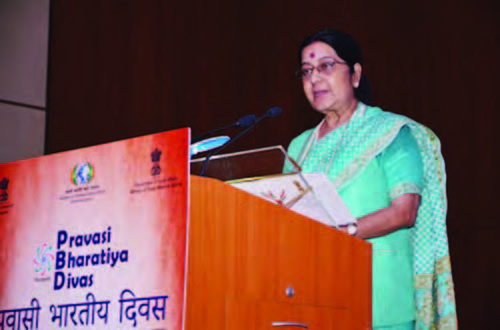
    Inaugurating the Youth Pravasi Bharatiya Divas (PBD) at Mahatma Mandir in Gandhinagar on January 7, Sushma Swaraj, Union Minister for External Affairs and Overseas Indian Affairs exhorted the Indian youth diaspora to ‘connect, celebrate and contribute’ to the transformational change being witnessed in India in the making of ‘Ek Bharat, Shreshth Bharat’.

    Sushma said, “The Indian youth diaspora can become ambassadors of the ‘new’ India as “you have retained a bit of India in your heart and each one of you have a bit of ‘Bharat’ in you.”

    PRAVASI BHARATIYA DIVAS 2015 1

    The Minister said that Youth PBD was not just about interacting with the young people of this country but has emerged as an important platform for the diaspora to discover and nurture their roots.

    She appealed to the youth to connect with the young generation of Indians – over 50% of the Indian people were under 25 years. Youth PBD, she said, was an occasion to celebrate India’s traditions, art and culture, even as the country strives to empower its youth with technology.

    “What excites the world today is India’s growth story,” Swaraj said and pointed to the government’s success in bringing about a complete transformation of the business sentiment in the country. This, she added, was the outcome of the numerous steps undertaken by the government to improve the ease of doing business.

    Swaraj said the diaspora could contribute significantly to the development of India through programs such as ‘Make in India’, ‘Digital India’, creation of smart cities and other physical infrastructure.

    Prime Minister Narendra Modi, on January 8, announced a string of facilities for expatriate Indians that seek to free them of regulations on their arrival to India and within the country.

    Inaugurating the 13th Pravasi Bharatiya Divas (PBD), organized by the Ministry of Overseas Indian Affairs (MOIA) in partnership with the Ministry of Youth Affairs & Sports and the Government of Gujarat, the Prime Minister said life time visa will now be granted to PIO cardholders and as a mark of respect to them, the regulation requiring them to visit a police station to verify their credentials once every week, has been scrapped.

    Modi said while the PIO and OCI cards have been merged, allowing similar facilities to either cardholder, electronic authorization of visa has commenced, apart from extending the facility of visa on arrival from 43 countries. In addition, the Pravasi Bharatiya Centre will be operational in Delhi soon. The Prime Minister said engaging with the pravasis was not a one-way street; “not everything should be seen in terms of pounds or dollar” he said, adding that overseas Indians need to be given unstinted support so that they feel enthusiastic in contributing to India’s development.

    The Prime Minister suggested that an online quiz competition could be started from the PBD platform on ‘Bharat ko Jano’ for teams of young people worldwide. This would help project India’s development effort in the right perspective. The competition, he said, could be conducted round the year so that the campaign for knowing India becomes a global movement.

    Modi urged the pravasis to actively participate in the government’s ambitious ‘Clean Ganga’ initiative by sharing their expertise in technology, innovations, ideas and resources. “There are opportunities for all along the river – in agriculture, water transport, city development and village rejuvenation and even adventure sports,” the Prime Minister said.

    On the occasion of the centenary of Mahatma Gandhi’s return to India from South Africa, the Prime Minister released Rs 25 and Rs 5 commemorative stamps and Rs 100 and Rs 10 coins.

    The Chief Guest at the PBD, Donald R. Ramotar, President of the Republic of Guyana, said India’s has seen a transformational change in recent years. The time has come arrived for India to demonstrate its mature political leadership to guide other developing countries, participate more actively in internal forums, look outwards for channelizing investments to other countries and strengthen air and maritime links with the rest of the world.

    He assured Guyana’s commitment to India’s pursuit of reform of the UN Security Council and expressed total support for India’s candidature for a permanent seat in an expanded Security Council.

    Maite Nkoana-Mashabane, Minister of International Relations and Cooperation, Republic of South Africa, the Guest of Honour, pointed out that the political, economic and cultural bonds between South Africa and India were strong. These were cemented by the community of Indians in South Africa, the second largest outside India. The bonds must be further strengthened by addressing the triple challenges of poverty, unemployment and under-development.

    She stressed the need for closer cooperation between the two countries in the fields of IT, healthcare and renewable energy and expressed confidence that India would support South Africa in its development efforts. Sushma Swaraj, Union Minister for External Affairs and Overseas Indian Affairs, emphasized that successful and politically influential diaspora is an asset to India. She called upon the diaspora to pursue a mutually rewarding participation in developing India.

    Anandiben Patel, Chief Minister of Gujarat, said that the new economic and social initiatives launched by the Central Government have unleashed a new wave of enthusiasm among the people. The pravasis with the sincere hard work had raised India’s image internationally, while keeping the links with the land of their origin alive.

    The three- day kumbh of the NRIs has attracted NRIs from all parts of the world. For most Gujaratis abroad it is a welcome visit home.

  • Excesses of Hindutva hotheads

    Excesses of Hindutva hotheads

    There is urgent need to restrain those making provocative and poisonous statements, says the author.

    All through his campaign that brought him spectacular victory in the parliamentary poll, Prime Minister Narendra Modi had concentrated on only “development” and “good governance” and avoided any item on the Hindutva agenda that could have upset the pluralist Indian society. Unfortunately, however, even then he did absolutely nothing to silence or even restrain those of his irresponsible supporters belonging to the Sangh parivar who made provocative, polarizing and even poisonous statements.

    For instance, at an early stage, Giriraj Singh, a Bhumihar leader of Bihar, declared that all those who opposed Mr. Modi in any way would have “no place in India” and must therefore “go to Pakistan”. Mr. Modi said not a word about this preposterous pronouncement. All that Rajnath Singh, then the BJP president and now Union Home Minister, did was to “disassociate his party” with Mr. Giriraj Singh’s statement. No wonder there followed a spate of equally absurd and dangerously divisive observations.


    49


    The head of the BJP unit in Uttar Pradesh, Laxmikant Bajpai, and the five-time MP, Yogi Adityanath, discovered that the Muslims were engaged in “love jihad” – a campaign to lure Hindu women into marriage or romance and then “forcibly” convert them to Islam. Mr. Bajpai stated that of the rapes taking place “99 per cent were committed by Muslims”. As for Amit Shah, Mr. Modi closest confidant and soon to be the party president, the Election Commission was constrained to deny him permission to hold public rallies.

    This ban was withdrawn only after Mr. Shah had apologized to the Commission and assured it that he would say anything that was “unacceptable”. On none of these disconcerting episodes Mr. Modi said a word during his powerful oration on all other subjects under the sun. Sadly, most people’s hope that what had been permitted during the election would be quietly disallowed after the BJP-led government had settled down has turned into a dupe. The bitter stand-off between the ruling party, on the one hand, and nine Opposition parties, including the Congress, that have a clear majority in the Rajya Sabha, on the other, that led to the disruption of the Upper House for several days could be the foreshadow of the shape of things to come.

    The sequence of events was distressingly sordid. A 47-year-old, firsttime BJP MP, Sadhvi Niranjan Jyoti – who was recently made a Minister of State, together with Mr. Giriraj Singh – had delivered an election speech in a Delhi suburb as the national capital is due to have assembly elections. Pontifically she told her audience that the choice before them was clear: They could elect a government of “Ramzadas” (children of Lord Ram) or that of “Haramzadas” which really means “b******s” but the BJP propagandists translated it as “illegitimate” to dilute the vulgarity. Inevitably there was a wave of outrage.

    When the matter exploded in Parliament, as it was bound to, the Prime Minister chose to stay away. Some senior cabinet ministers told the House that at a party meeting Mr. Modi had “strongly disapproved of the language used” whereupon the sadhvi offered an apology of sorts. This, declared the BJP leaders magisterially, was the “end of the matter”. The Opposition in both Houses, but particularly that in the Rajya Sabha where the saffron party is in a minority, demanded that Mr. Modi should come to the House to explain his position. He took three days to do so and declared that discussion was all over.

    An easily avoidable disruption of the Rajya Sabha followed. For, the determined Opposition gave up its initial demand for the sadhvi’s resignation or dismissal and asked for only a resolution to denounce the use of foul language by everybody in politics. The government contemptuously rejected this. In the end a “consensus statement,” appealing to all MPs “to maintain civility at all costs in public discourse” settled the bitter dispute.

    The crowning irony is that just when Vice-President Hamid Ansari, who is also the Chairman of the Rajya Sabha, was reading out the consensus document, a former BJP minister, Swami Chinmayanand was publically using the H-word in relation to, of all people, Imam Bukhari of Jama Masjid for advertising his association with a foreign place, Bukhara. Far more shocking was what so senior and experienced a leader as Foreign Minister Sushma Swaraj, who was earlier leader of the Opposition in the Lok Sabha, did only a few hours earlier. She strongly advocated that the Gita should be declared the “National Scripture” of India.

    Remarkably, even before anyone from religions other than Hinduism could speak, vigorous opposition to Swaraj’s demand came from Tamil Nadu, ironically from the BJP’s allies. One of them, MDMK leader Vaiko, simultaneously announced that he was ending the alliance. He accused the Centre of working against Tamil Nadu and suggested that the Dravidian forces should unite to fight the “Sanskritisation” of cultural and social spheres. He added that “Hindutva will not be allowed to gain a foothold in Tamil Nadu”. PMK’s founder S. Ramadoss, who is still an ally of the BJP, also came out against Swaraj’s idea and stated that “apart from “cultural imposition” the Modi government had “hardly come out with any constructive programs in the last six months”. The BJP would be making a grave mistake if it underestimates the Tamil sentiment. Those who did so in 1965 over the official language issue paid a very heavy price.

    At that time even Prime Minister Shastri did not dare to go to the trouble-spot. Only Indira Gandhi had the necessary courage. Finally, it cannot be overlooked that while Mr. Modi has full control on his government he is either unwilling or unable or both to discipline the wrongdoers among other members of the Sangh parivar who seem determined to build up a Hindu rashtra by hook or by crook. They enjoy the protection of the Rashtriya Swyamsevak Sangh (RSS) of which the BJP is only the political face.

    (The author is a Delhi-based political commentator.)

  • BJP TO ROLL OUT BIG GUNS FOR ASSEMBLY POLLS

    BJP TO ROLL OUT BIG GUNS FOR ASSEMBLY POLLS

    NEW DELHI (TIP): With Dussehra over, BJP will get into campaign mode for the Haryana and Maharashtra assembly polls on a war footing.

    Prime Minister Narendra Modi and his senior ministers will have little time for anything else, criss-crossing the two states over the next two weeks, addressing rallies. BJP plans to hold at least four big rallies a day in each state till campaign ends for the October 15 polls.

    Modi will begin his charge on Saturday morning from Karnal in Haryana and move to Maharashtra to address three rallies in Beed, Aurangabad and Mahalakshmi (Mumbai). The PM will address 8-10 rallies in Haryana and around 22 in Maharashtra.

    Two senior ministers — home minister Rajnath Singh and external affairs minister Sushma Swaraj — will be all over Haryana on Saturday, holding four rallies each in the state. Singh will be at Radaur, Kalayat, Julana and Jakholi Rai while Swaraj will address rallies in Kalka, Thanachhapar, Shahbad and Gohana. Singh will address about 15 rallies in each state.

    The party has decided to have Swaraj, who belongs to Haryana, focus on the state where BJP is contesting on its own and is aiming to replace the Congress government. Similarly, road transport minister Nitin Gadkari has been asked to concentrate on Maharashtra, his home state, where BJP is contesting without its 25-year-old partner Shiv Sena this time.

    Swaraj is scheduled to address about 22 rallies in Haryana and will be in Maharashtra only for a day on October 6, attending three rallies. She will take a break from campaigning as she is travelling abroad between October 8 and 10. Gadkari is expected to address about 36 rallies in Maharashtra.

    Party veteran L K Advani will address six rallies in Maharashtra and two in Haryana, while Murli Manohar Joshi will address two rallies in Maharashtra and one in Haryana.

    Urban development minister M Venkaiah Naidu is slated to spend four days in Maharashtra and two in Haryana. Other ministers who will address a few rallies in both states are chemical and fertilizer minister Ananth Kumar, HRD minister Smriti Irani and social justice minister Thawar Chand Gehlot. Party chief Amit Shah will address about 15 rallies in each state.

    The party has roped in all its chief ministers to ensure its good governance campaign is showcased. Goa CM Manohar Parikkar will focus on Maharashtra while Madhya Pradesh CM Shivraj Singh Chouhan will spare three days for Maharashtra and one for Haryana. Rajasthan CM Vasundhara Raje has three days in Maharashtra and two days in Haryana, Chhattisgarh CM Raman Singh and Gujarat CM Anandiben Patel will each spend two days in Maharashtra. On an average, the chief ministers will address three rallies a day, party vice-president M A Naqvi said.

    Not to forget its star power, BJP has roped in actor-turned-MPs Hema Malini, Vinod Khanna and Shatrughan Sinha to campaign in both states.

  • Talks with Pak only if it responds properly: Rajnath

    Talks with Pak only if it responds properly: Rajnath

    NEW DELHI (TIP): Days after minister for external affairs Sushma Swaraj indicated that doors were not closed for India-Pak talks, home minister Rajnath Singh on September 11 said talks between India and Pakistan could be resumed if the neighbouring country “responds properly”. “If Pakistan responds properly, talks can be held,” he told media on his visit to the India-Pak border in Gujarat. Singh was asked whether there was any possibility of resuming the stalled dialogue between New Delhi and Islamabad. Singh said India wants to improve its relations with Pakistan. “Neighbour is a neighbour.

    Friend can be changed but neighbour cannot be changed. We also want that our relations with our neighbour improves,” he said. Meanwhile, Singh inaugurated the integration of Border Security Force (BSF) with Gujarat government’s Bhaskaracharya Institute for Space Applications and Geo informatics (BISAG) project on Saptember 11 at BSF Camp, Bhuj. The home minister was briefed about the details and utility of BISAG and need for dedicated, encrypted channel for Para Military Forces. Singh addressed BSF Jawans live through BISAG and interacted with them. Few of the jawans telephonically made requests regarding increase of Air Courier services in North East region and Jammu and Kashmir and regarding time bound promotions. One of the jawans also asked for giving one-rank-onepension to BSF also. The Union home minister assured them that he would look into the matter.

  • PM ‘JAN DHAN’ YOJANA LAUNCHED; 1.5 CRORE BANK ACCOUNTS OPENED IN A DAY

    PM ‘JAN DHAN’ YOJANA LAUNCHED; 1.5 CRORE BANK ACCOUNTS OPENED IN A DAY

    NEW DELHI (TIP): Prime Minister Narendra Modi on Aug 28 launched his government’s mega scheme ‘Jan Dhan Yojana’, declaring that it was aimed at eradicating financial untouchability by providing bank accounts to the poor. On the inaugural day, a record 1.5 crore bank accounts were opened across the country, the largest such exercise on a single day possibly anywhere in the world.

    Unveiling the scheme within 100 days of forming the new government, Modi said, it will cover 7.5 crore people by January 26, 2015, who will be provided zero-balance bank account with RuPay debit card, life insurance cover of Rs 30,000 in addition to accidental insurance cover of Rs 1 lakh. Later the account holders will be provided an overdraft facility of up to Rs 5,000. “If Mahatma Gandhi worked to remove social untouchability, if we want to get rid of poverty, then we have to first get rid of financial untouchability.

    We have to connect every person with the financial system. And for that this programme has been given impetus,” he said, adding, “when a bank account is opened, it’s a step towards joining economic mainstream.” Modi recalled the bank nationalization of 1969 with the avowed objective of spreading the reach of financial system to the doorsteps of poor. “But I regret to say that after 68 years of independence, not even 68 per cent of population is covered by the banking system,” he said.

    The scheme was simultaneously launched at multiple places by 20 chief ministers, several Union ministers, including information minister Prakash Javadekar at Pune, law minister Ravi Shankar Prasad at Chennai, external affairs minister Sushma Swaraj at Bhopal, home minister Rajnath Singh at Lucknow and HRD minister Smriti Irani at Surat. There were in all 600 programmes and 77,852 camps on the opening day to open bank accounts. Modi said history has been created in the banking system with opening of over 1.5 crore account in a day.

    Besides, a record has been created by providing 1.5 crore accidental insurance covers of Rs 1 lakh. The Prime Minister described the occasion as a festival to celebrate the liberation of the poor from a poisonous cycle (“Vish-chakra se gareebon ki aazaadi ka parv”). “Banks have assured me they will do this work before January 26. Those who oppen accounts by January 26, 2015 over and above the the Rs 1 lakh accident, they will be given life insurance cover of Rs 30,000.

    This will help the poor family,” he said. In the third phase, he said, these account holders would also be provided micro-pension facility. “I believe when a person opens a bank account then he or she takes the first step to get connected with the economic system. Today the 1.5 crore family who got connected with the economic system this will give a boost to the economy,” he said. Going forward, he can avail Rs 5,000 loan from the bank, the Prime Minister said, adding, this facility would be available after six months of opening of the bank account.

    Expressing satisfaction at a number of records being broken today, the Prime Minister said the nationwide success of the enrolment drive today would give confidence not just to the officials of the department of financial services and banking sectors, but also to officers across the Union government, that they can successfully achieve the goals that they set for themselves. “Never before would insurance companies have issued 1.5 lakh accident insurance policies in a single day. Never before in economic history would 1.5 lakh bank accounts have been opened in a single day. “Never before has the government of India organized a programme of such scale — over 77,000 locations — with the participation of so many chief ministers, Union ministers, government and bank officials,” the Prime Minister said.

  • Advani, M M Joshi axed from BJP parliamentary board

    Advani, M M Joshi axed from BJP parliamentary board

    NEW DELHI (TIP): The generational shift in BJP was complete on August 26 with its founders Atal Bihari Vajpayee, L K Advani and Murli Manohar Joshi being dropped from the BJP parliamentary board, the highest decision-making body headed by BJP president Amit Shah, which has the stamp of Prime Minister Narendra Modi all over now.

    In a token gesture, ailing Vajpayee along with Advani and Joshi, for long the BJP’s ‘Trimurti’, now figure in the new five-member ‘margdarshak mandal’ (guiding group) after being associated with the party for nearly four decades. Three-time Madhya Pradesh chief minister Shivraj Singh Chouhan and party general secretary J P Nadda are the new entrants to the BJP parliamentary board which was reconstituted by newly-appointed chief Amit Shah. The two have also been included in BJP’s central election committee, which decides on the party candidates to be fielded in elections.


    42
    MM Joshi


    The 12-member parliamentary board chaired by Shah now has Modi, Rajnath Singh, Arun Jaitley, Sushma Swaraj, Venkaiah Naidu, Nitin Gadkari, Ananth Kumar, Thawarchand Gehlot, Shivraj Singh Chouhan, Jagat Prakash Nadda and Ramlal as its members. New BJP president Amit Shah initiated the changes after consultations with top BJP leaders and Prime Minister Narendra Modi. For the two veterans, who were not considered for positions of power in the new saffron regime because they were over 75 years, this will be a far more significant blow.

    For Advani, the exclusion from the board is part of a procession of setbacks that the veteran has suffered since he was overruled on whether Narendra Modi should be projected as the party’s PM candidate. The leadership had also shrugged aside the argument of Advani’s loyalists that he should be sponsored for the post of Lok Sabha Speaker. “When a generational shift has taken place and when need for accommodating fresh energy and ideas has finally been recognized, we need to make room for others who are more in tune with the requirements of the changed times,” a senior party leader said.

  • US snooping on BJP unacceptable, SUSHMA TELLS KERRY

    US snooping on BJP unacceptable, SUSHMA TELLS KERRY

    NEW DELHI (TIP):
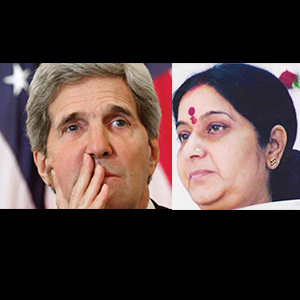
    Alarmed by the disclosure last month that US authorities spied on BJP when it was not in power, foreign minister Sushma Swaraj raised the issue with visiting secretary of state John Kerry on July 31 saying this was totally unacceptable to India. India had registered a protest with senior US diplomats after the disclosure which was based on documents provided by whistleblower Edward Snowden but officials said Swaraj took up the issue with Kerry to drive home the point that there was anger in the country over alleged snooping by the National Security Agency (NSA). “I told Secretary Kerry that this was completely unacceptable to us as India and US are friendly countries.

    Friends don’t snoop on each other,” Swaraj told reporters after the 5th India-US strategic dialogue and what was also the first high-level engagement between the two countries after the Narendra Modi government took over. In his response, Kerry sought to assuage India’s concerns as he said President Barack Obama had undertaken a unique and unprecedented exercise to review all intelligence activities carried out by US agencies. He also said the US valued its relations with India and also the partnership between the two countries in counter-terror operations. “We don’t discuss intelligence matter publicly.

    But we value sharing of information regularly on counter-terrorism with India. US President Barack Obama clearly articulated that we fully respect and understand feelings expressed by Indian nationals,” Kerry said. The two leaders discussed all issues cutting across trade, energy, climate change, security and counter-terror operations. On the controversy over India’s stand at WTO over trade facilitation, Kerry expressed hope that a compromise deal would be worked out.

    According to documents leaked by Snowden, BJP figured in the list of non-US political parties — along with Lebanon’s Amal which has links with Hezbollah, Egypt’s Muslim Brotherhood and the Pakistan Peoples Party — which were spied on by the NSA after an official authorization by the US government. In fact, Swaraj’s predecessor Salman Khurshid too had mentioned the issue of snooping on the Indian embassy in the US to Kerry last year but later seemed to defend it saying it was actually not snooping and that such information was used by the US to prevent serious terror strikes.

    It was also discovered last year that India was the fifthmost- tracked country by US agencies which used a clandestine “data-mining programe” to monitor worldwide internet data. A joint statement issued later said that faced with a common threat from terrorism, including in South Asia, the two leaders committed to intensify efforts to “combat terrorism, proliferation of WMDs, nuclear terrorism, cross-border crime and address the misuse of the internet for terrorist purposes, in compliance with respective laws.”

    On terrorism, the two leaders reiterated their condemnation of terrorism in all its forms and reaffirmed their commitment to eliminating terrorist safe havens and infrastructure, and disrupting terrorist networks including al-Qaida and the Lashkar-e-Taiba. “The leaders called for Pakistan to work toward bringing the perpetrators of the November 2008 Mumbai attacks to justice,” said the statement. The two leaders welcomed the continuation of the Counter-Terrorism Joint Working Group process, sustained exchanges of senior experts, and the upcoming meeting of the Working Group in 2014.

  • UPROAR IN LS OVER VAIDIK-SAEED MEET

    UPROAR IN LS OVER VAIDIK-SAEED MEET

    Govt has nothing to do with it: Jaitley Leader of the upper House and finance minister Arun Jaitley said for India, Saeed was a terrorist and indeed involved in terrorism against India. Government had nothing to do with “directly, indirectly or even remotely” with any journalist meeting Saeed.


    NEW DELHI (TIP): The Congress and other Opposition parties kept up the pressure in the Lok Sabha on July 17 over RSS leader Indresh Kumar’s defence of journalist Ved Pratap Vaidik’s meeting with Jamaat-ud-Dawa (JuD) chief Hafiz Saeed, compelling External Affairs Minister Sushma Swaraj to make a second statement on the subject in one week. Swaraj told the Lok Sabha that the Indian High Commission in Pakistan was unaware of Vaidik’s meeting with Hafiz Saeed. “The Indian High Commission has categorically stated that it did not know about this meeting.


    Therefore, the question about the High Commission facilitating it does not arise,” Swaraj said. Her Ministry, she said, made enquires after Vaidik, “told some news channels that the High Commission knew about the meeting.We had then sought a report from the High Commission.” Her clarification came after Congress and other Opposition MPs almost brought the House to a halt on the issue. Vedprakash Vedic, a senior aide of Baba Ramdev, who is also a journalist, recently met the alleged 26/11 mastermind in Lahore recently.


    However, Vaidik said he had consented to meet the Jamaat-ud-Dawa boss purely at the behest of a journalist friend from Pakistan. “When I was in Pakistan, the media criticism of Hafiz Saeed in India came up for discussion. It was then that a Pakistani journalist asked me if I would like to meet Saeed in person. I agreed and a call was immediately made to fix the meeting,” he said, denying any other motive to his appointment with the mostwanted terrorist. Refuting allegations that he had met Saeed as an envoy of the Narendra Modi government, Vaidik said his interface with the Jamaat-ud-Dawa boss was driven only by journalistic considerations.


    “I would like to tell Congress, which is alleging that I met him on behalf of the government, to attack the Modi regime directly rather than train its guns from my shoulders”. “I am a known name in Pakistan. My writings and articles are translated and reproduced in Pakistani media. In my 55 years of journalistic career, I have not declined to meet anyone. I have met Maoist leaders and LTTE leaders including Prabhakaran,” said Vaidik. “I wanted to analyse Saeed’s mind and know why he committed heinous crimes against India,” he added.


    He denied being part of the Vivekananda International Foundation, with which IB chief Ajit Kumar Doval was earlier associated. This has been alleged as the reason why he was chosen to play the government’s ‘envoy’ to reach Saeed. “I have never been associated with the government and do not look at such association in the future. I am an independent journalist who is free to meet anyone,” he said.

  • UK fights for Britons killed in Gujarat riots

    UK fights for Britons killed in Gujarat riots

    LONDON (TIP): Britain has asked India to speed up action against the killers of three Britons murdered during the 2002 anti-Muslim riots in Gujarat. Foreign secretary William Hague made the request while raising British concerns about the delay in justice for the three during his recently-concluded India visit. “The Foreign Secretary raised this case during his call on Foreign Minister Sushma Swaraj, the appropriate person to raise consular issues with,” said a foreign office spokesperson. “The foreign secretary raised our concern about the delays in taking forward these cases and undertook to follow up with more detail in writing. Mrs Swaraj took note of our concerns.” British brothers Saeed and Shakil Dawood were killed along with their friend, Mohammed Aswat. They were among over 1,000 people, mostly Muslims, killed in the riots.

    The three men of Gujarati origin were visiting the state as tourists when they were killed. The remains of the three are yet to be returned even after 12 years. Six men were initially charged with the murders. But they were released on bail and a number of key witnesses turned hostile. The Dawood family is running a campaign to get justice for them. “Whilst returning from an excursion trip to see the Taj Mahal, their (the trio’s) adventure turned into a nightmare. Within hours of crossing the Gujarat border, a roadblock, manned by a well-organized mob fuelled by religious hatred, stopped the British tourists,” the family said in a statement.

    The mob circled the jeep and asked the occupants their religious identity. “The tourists answered they were British citizens and were Muslims. The hired driver was then dragged out of the jeep and attacked with sticks and killed on the spot,” the statement said. “His body was then thrown back into the vehicle and set alight. In the meantime, the British tourists were chased to a nearby farm. Mohammed Aswat and Imran were stabbed and left to dead.

    Imran miraculously survived and he recalls Saeed and Shakil pleading with the mob to spare all their lives.” The family said it has endured this terrible tragedy and their grief is compounded by the lack of serious Indian police investigation. “The family has had to visit the crime scene themselves, find vital clues and collate forensic evidence including the charred remains of bodies,” the statement said.

  • India ready to extradite Nur Hossain

    India ready to extradite Nur Hossain

    DHAKA (TIP): India has agreed to send back Nur Hossain, the prime suspect in a multiple-murder case in Bangladesh, foreign minister AH Mahmood Ali told parliament on July 2. Replying to a query from Jatiya Party member Pir Fazlur Rahman, the minister said: “The matter was discussed during the recent visit of Indian foreign minister Sushma Swaraj. The Indian government has agreed to extradite him.”

    Hossain and his two accomplices were arrested June 15 from an apartment at Baguiati, close to Kolkata’s Netaji Subhas Chandra Bose International Airport, bdnews24.com reported. A councillor in Bangladesh’s Narayanganj and prime accused in the murder of seven people, Hosain has been booked under the Arms Act and Foreigners Registration Act for illegal trespass into Indian territory without valid travel documents and for illegal possession of a weapon.

    All three are currently in police custody. Hossain’s arrest was made nearly one and a half months in India after the seven murders in Narayanganj that shook the country. Nazrul Islam, a city councillor, senior lawyer Chandan Kumar Sarkar and five others were abducted April 27.

    Their decomposed bodies were recovered from the Shitalakhyya river several days later. Hossain went off the radar after the families of the victims alleged he orchestrated the abductions and murders. Bangladesh sought the help of the Interpol May 22 to nab him, but it had also informed India to check out reports that Hossain had slipped into Kolkata. After his arrest, the Bangladesh government began the process to bring him back from Kolkata under the extradition treaty.

  • India to relax tourist visa norms for Bangladeshi nationals

    India to relax tourist visa norms for Bangladeshi nationals

    NEW DELHI (TIP): Ministry of External Affairs (MEA) spokesperson Syed Akbaruddin on Thursday said that India would relax tourist visa norms for Bangladeshi nationals below 13 and above 65 years of age. He also said that India is still working on the issue of visa on arrival and has not yet arrived on a holistic policy to approach the entire issue. “There is no proposal for visa free entry of Bangladesh nationals to India.

    The issue of visa on arrival is something that we in India are working through in the sense that we are in some way apart of coming towards a final holistic policy on how we will approach this entire issue; who will be eligible, under what circumstances and for what duration,” said Akbaruddin. He further said that the present visa regime provides for one year multiple entry tourist visas. “At this stage as far as visa on arrival is concerned India as a general approach to this issue is still somewhere away in taking the decision.

    As and when we take a decision on these things surely we will consider various countries and Bangladesh as a friendly neighbor this issue will be considered also Bangladesh along with other countries. At this stage we are not there yet,” he added. Earlier today External Affairs Minister (EAM) Sushma Swaraj had visited Dhaka upon the invitation of her Bangladeshi counterpart Abul Hassan Mahmood Ali. She had also met Bangladesh Prime Minister Sheikh Hasina and handed her a personal letter from Prime Minister Narendra Modi stating invitation to come to India, and also to chart the way ahead for bilateral relations.

  • CHINA-PAK NUCLEAR PROLIFERATION

    CHINA-PAK NUCLEAR PROLIFERATION

    India should counter the challenge diplomatically

    “India has passively not taken up its concerns about the China- Pakistan missile and nuclear collaboration strongly with Beijing. This challenge surely needs to be more seriously addressed and countered, both diplomatically and strategically”, says the author.

    While explaining the rationale for Pakistan’s nuclear weapon program, its then Prime Minister Z.A. Bhutto noted that while the Christian, Jewish and Hindu civilizations had nuclear weapons capability, it was the Islamic civilization alone that did not possess nuclear weapons.

    He asserted that he would be remembered as the man who had provided the Islamic civilization with full nuclear capability. Bhutto’s views on Pakistan’s nuclear weapons contributing to the capabilities of the Islamic civilization were shared by Pakistan’s senior nuclear scientist Sultan Bashiruddin Mehmood who, along with his colleague Chaudhri Abdul Majeed, was detained shortly after the terrorist strikes of 9/11.

    They were both charged with helping Al Qaida acquire nuclear and biological weapon capabilities. Two other Pakistan scientists, Suleiman Asad and Al Mukhtar, wanted for questioning about their links with Osama bin Laden, disappeared after it was claimed that they had gone to Myanmar.

    The original sinner in nuclear proliferation, however, is not Pakistan, but China. Director of the Wisconsin Project of Arms Control Gary Milhollin has commented: “If you subtract China’s help from the Pakistani nuclear program, there is no Pakistani nuclear program”.

    There is evidence, including hints from Bhutto’s prison memoirs, that suggest that China initially agreed to help Pakistan develop nuclear weapons when Bhutto visited Beijing in 1976. It is now acknowledged that by 1983 China had supplied Pakistan with enough enriched uranium for around two weapons and the designs for a 25- Kiloton bomb. Chinese support for the Pakistan program is believed to have included a quid pro quo in the form of Pakistan providing China the designs of centrifuge enrichment plants.

    Interestingly, thanks to China, Pakistan acquired nuclear arsenal at least five years before India decided to cross the nuclear threshold. China’s assistance to Pakistan continued even after Beijing acceded to the NPT. When Pakistan’s enrichment program faced problems in 1995, China supplied Pakistan 5,000 ring magnets.

    China has subsequently supplied Pakistan with unsafeguarded plutonium processing facilities at Khushab. There is also evidence that China has supplied Pakistan with a range of nuclear weapons designs with the passage of time. While the nuclear weapons designs supplied by Dr A.Q. Khan to Libya were of a Chinese warhead tested in the 1960s, the nuclear warheads tested by Pakistan in 1998 were of a different design According to Thomas Reed, a former Secretary of the US Air Force, who was closely associated with the US nuclear weapons establishment and Dan Stillman, a US nuclear expert who had extensive interactions with his Chinese counterparts a Pakistani derivative of the Chinese CHIV-4 nuclear bomb was tested by Pakistan in China on May 26, 1990.

    This was eight years before India’s 1998 tests that validated its nuclear weapons. Reed stated that while in China, Stillman had noted that his stay at the Shanghai Institute of Nuclear Research “also produced a first insight into the extensive hospitality extended to Pakistani nuclear scientists during the late 1980s time period”.

    Reed has disclosed that “in 1982, China’s Premier Deng Xiao Ping began the transfer of nuclear technology to Pakistan”. Moreover, after warmly welcoming Prime Minister Rajiv Gandhi in Beijing in 1988, Deng commenced missile collaboration with Pakistan, with the supply of short range Hatf 2 missiles. This was followed up by assistance to manufacture Shaheen 1 (750 km range) and Shaheen 2 (range 1500-2000 km), at Fatehjang.

    China has thus not only provided Pakistan assistance for manufacturing nuclear weapons, but also for missiles which can target population centres across India. Not satisfied with providing nuclear weapons designs, knowhow and modern uranium enrichment centrifuges, China soon found that Pakistan’s arsenal would become more potent if it included lighter plutonium warheads, both for easier mating with the Chinese designed ballistic missile and for development of tactical nuclear weapons.

    Pakistan and China adopt a parallel approach on nuclear and missile proliferation in the Islamic world. Saudi Arabia’s Defence Minister, Prince Sultan, was given unprecedented access to Pakistan’s nuclear weapons facilities in Kahuta in March 1999. Shortly thereafter Dr. A.Q. Khan paid a visit to Saudi Arabia at the invitation of Prince Sultan in November 1999.

    Khan’s visit was followed by a visit to Pakistan’s nuclear facilities by Saudi scientists who had been invited by him to visit Pakistan. Given these developments and the fact that China had supplied long-range CSS 2 Saudi missiles to Saudi Arabia in the past, there is interest about the precise directions that nuclear and missile collaboration of Pakistan, China and Saudi Arabia could take. Pakistan could, for example, justify the deployment of nuclear weapons and missiles on Saudi soil.

    It is not without significance that the Chairman of Pakistan’s Joint Chiefs of Staff Committee, Gen Khalid Shamim Wynne, who handles its nuclear arsenal, was received at a high level in Saudi Arabia. Similarly, while Pakistan provided the designs of nuclear centrifuges to Iran over two decades ago, China is known to have been on the forefront of transfer of ballistic missile knowhow and technology to Tehran.

    The issue of Beijing issuing stapled visas for Indian nationals from Arunachal Pradesh visiting China was raised by External Affairs Minister Sushma Swaraj during the recent visit of Chinese Foreign Minister Wang Yi by pointedly calling on China to adopt a “One India” policy.

    While the Chinese provide stapled visas for Indian nationals from Arunachal Pradesh and oppose international funding for projects in Arunachal Pradesh and J&K, they warmly and officially welcome high functionaries from PoK, Gilgit and Baltistan. Members of China’s Peoples’ Liberation Army (PLA) have in recent years been involved in large numbers in building roads and tunnels in Gilgit/Baltistan. The construction work is said to be for a transportation corridor linking China to Arabian Sea at the Port of Gwadar.

    But tunnels across high mountains slopes are also ideal locations for nuclear weapon silos. India has passively not taken up its concerns about the China-Pakistan missile and nuclear collaboration strongly with Beijing. This challenge surely needs to be more seriously addressed and countered, both diplomatically and strategically.

  • RAJNATH TO SIT NEXT TO PM IN LOK SABHA

    RAJNATH TO SIT NEXT TO PM IN LOK SABHA

    NEW DELHI (TIP): Home minister Rajnath Singh will sit next to Prime Minister Narendra Modi, occupying the seat left conspicuously vacant, when Parliament meets for the budget session on July 7. The seat allocation seems in keeping with the home portfolio being seen as next in seniority to the PM though there is no hard and fast rule to the effect. Singh’s seating does not necessarily reflect the “number 2” slot which many believe is largely irrelevant with Modi leading a BJP group that commands a clear majority in Lok Sabha.

    The seat next to Modi was occupied by BJP veteran L K Advani on the day the 16th Lok Sabha met on June 4 but remained vacant thereafter. In the UPA regimes, Pranab Mukherjee as defence, and later finance minister, was seen as number 2 before he became President. Thereafter, the slot informally went to former defence minister A K Antony. It was only in 2012 that a cabinet secretariat order said the cabinet committee on political affairs – under the senior-most minister – would consider any emergent situation in the PM’s absence.

    In fact, when former PM Manmohan Singh went for a cardiac bypass in 2009 just ahead of Republic Day, ceremonial duties were divided between Mukherjee and Antony. As per indications, with Rajnath Singh being allotted the seat, other seats on the NDA front bench will be allotted to external affairs minister Sushma Swaraj, food minister Ram Vilas Paswan and Advani. The front row in the second segment of seats on the treasury side can accommodate one more minister. It could be former BJP president and transport minister Nitin Gadkari.

  • Govt on overdrive to rescue Indians trapped in Iraq

    Govt on overdrive to rescue Indians trapped in Iraq

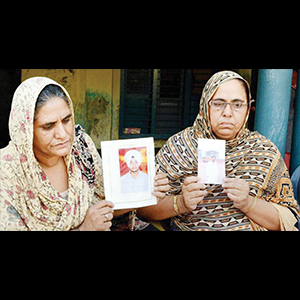
    NEW DELHI (TIP): The new government led by Prime Minister Narendra Modi on Thursday, June 19 scrambled to secure the release of 40 Indians being held in war-torn Iraq but asserted it was doing its “very best” to ensure their safety in the strife-torn country. While the ministry of external affairs said that it had information on the location where the Indians are being held captive, external affairs minister Sushma Swaraj — who met families of some of the abducted Indians – said the government would leave no stone unturned to free the Indian workers. The mass abductions have arguably presented the new government with the first big challenge since it assumed power last month. Most of the abducted Indians, working for a Turkish construction company, hail from Punjab though a few are from Himachal Pradesh and Uttar Pradesh.

    “I am personally mulling over all options. The government is making all kinds of efforts. We are not leaving any stone unturned,” Swaraj told reporters. “I am personally supervising this…I want to assure the families that the government and I will try our very best… make every effort,” she added. The government has already dispatched a former ambassador to Baghdad to coordinate rescue efforts in Iraq where large parts have been overran by Sunni insurgents. External affairs ministry spokesperson Syed Akbaruddin said during briefing, “We do have an understanding of the location (of the workers).

    Given that the matter is underway, at this stage, I will not be able to share details of their location and what Iraqi authorities have shared with us”. Punjab chief minister Parkash Singh Badal and his Himachal Pradesh counterpart Virbhadra Singh appealed to the Centre to ensure the safe return of the abducted Indians. Badal has said he is willing to pay a ransom to gain the freedom of the workers from Punjab. Earlier in the day, Sushma Swaraj met a delegation of families of seven of the abducted Indians.

    “The 40 men are safe… When the situation normalises, we will try to get them released,” she told the delegation accompanied by Badal. Himachal chief minister Virbhadra Singh said that the government has so far learnt that at least eight persons hailing from different parts of the state are missing in Iraq. “We are concerned about the safety of the all Himachal employed in Iraq,” he added. Official sources said, at least 16 residents of Haryana are believed to be stranded in strife-torn Iraq.

    Tamil Nadu chief minister J Jayalalithaa also sought the Prime Minister’s personal intervention to secure safety of 46 Indian nurses, including six from the state, trapped in Iraq. In Jammu, the family-members of Rajesh Kumar, 34, informed that his phone is switched off for the last one week. “We are constantly trying but his phone is switched-off for one week. It has never happened before,” a sobbing Reema, his wife, said. Eight migrants from Gorakhpur and Deoria in Uttar Pradesh are feared stuck in the Iraq turmoil.

  • NO ROOM FOR LK ADVANI IN PARLIAMENT HOUSE

    NO ROOM FOR LK ADVANI IN PARLIAMENT HOUSE

    NEW DELHI (TIP): When former deputy prime minister LK Advani reached his office in Parliament during the lunch-break, he was confronted with a humiliating situation. The plaque with his name at the door of the room allotted to him in the 15th Lok Sabha – which said that he is acting chairman of the National Democratic Alliance or the NDA – had been removed.

    The 86-year-old leader was forced to sit in the BJP’s parliamentary party office during the recess, in a room earmarked for the party’s deputy leader. Gopinath Munde, who was killed in an accident on Tuesday, held the post of deputy leader in the previous Lok Sabha, while his counterpart in the Rajya Sabha was Ravi Shankar Prasad, who is now a Cabinet Minister in the Narendra Modi government.

    The room that Mr Advani sat in for the last five years is the NDA chairman’s room. Former prime minister Atal Bihari Vajpayee, who has been ill and out of politics for many years now, continues to remain NDA chairman. Mr Advani was designated acting chairman of the alliance in 2004, after the alliance conceded power to the UPA. Advani’s name-plate, said sources, was removed yesterday, a move which is being viewed as a sure-fire signal that he will no longer hold the post of acting chairman of the NDA.

    The BJP leader had to shift to the room earmarked for Mr Vajpayee in 2009 after his party elevated Sushma Swaraj to the post of Leader of the Opposition in the Lok Sabha. Advani had also held that post since 2004. Advani was the BJP’s prime ministerial candidate in 2009. Last year, when the party decided to project Narendra Modi for PM, Mr Advani had staged public sulks in protest.

    In March, he told his party colleagues that he wanted to contest the Lok Sabha polls from Bhopal, and not Gandhinagar, a seat held by him five times in the past. He feared that the BJP’s Gujarat unit would punish him for opposing Mr Modi’s elevation as the party’s prime ministerial face. He was eventually persuaded to contest from Gandhinagar. Advani won the seat by a whopping margin of 4.83 lakh votes.

    LOK SABHA SETS RECORD AS 510 MEMBERS TAKE OATH ON A SINGLE DAY

    This is the first time that so many members have taken oath on a single day.

    Attired in spotless white kurta-pyjama, the Prime Minister was the first to take oath amid thumping of desks. He took the oath in Hindi in the name of God and he was followed by BJP veteran LK Advani and Congress president Sonia Gandhi.

    Then came the turn of panel of Chairmen- PA Sangma, BS Engti and Arjun Charan Sethi – senior members so that they could sit in the Speaker’s chair to conduct proceedings by turn to assist the Protem Speaker Kamal Nath. This was followed by oath-taking by the members of the council of ministers.

    The country’s unity in diversity was on full display as the House boasting of over 300 first timers, including Modi, saw a festive atmosphere. With many donning traditional dress and head gears, most members took oath in their mother tongue. Some ministers, including Sushma Swaraj, did it in Sanskrit.

    On June 4, the only member who had taken oath was Protem Speaker Kamal Nath before President Pranab Mukherjee in Rashtrapati Bhavan. With the results of Lok Sabha elections bringing in a new political era, it was a scene different from the one witnessed by the House in the last ten years.

    The BJP, which for the first time won a majority on its own with 282 members, occupied slightly more than half the House, accompanied by its allies which accounted for more than 50 members.

  • Kerry speaks with the new Indian External Affairs Minister Sushma Swaraj

    Kerry speaks with the new Indian External Affairs Minister Sushma Swaraj

    WASHINGTON (TIP): US secretary of State John Kerry, May 29, connected with his Indian counterpart, the new external affairs minister Sushma Swaraj, after the two were reportedly finding it hard to zero in on a mutually convenient time to converse.

    When the conversation did take place, there was no read-out of the engagement in Washington but New Delhi said the two leaders discussed reenergizing ties and getting back on track towards enhancing trade and economic ties to the $500 billion target from its current $100 million.

    Swaraj also briefed Kerry on India’s engagement with the SAARC countries including Pakistan, and both are looking forward to meeting each other, Indian officials were quoted as saying. There was no word on dates for Kerry’s visit to New Delhi or Swaraj’s trip to Washington DC although the two sides are slated to hold a “strategic dialogue” in summer.

  • VETERANS MAY GET PLUM PORTFOLIOS IN MODI GOVT

    VETERANS MAY GET PLUM PORTFOLIOS IN MODI GOVT

    NEW DELHI: The lack of experienced players in NDA ranks seems to have opened up the prospect of BJP veterans landing important portfolios in the incoming Modi government. Sources said while there was uncertainty about the chances of former party president Murli Manohar and leader of opposition in the outgoing LS Sushma Swaraj getting ministries which are part of the Cabinet Committee on Security, the situation has perked up somewhat because of what is being referred to as BJP’s “poor bench strength”.

    Sources said while Swaraj could be considered for the ministry of external affairs, Joshi may be entrusted with the crucial defence portfolio. BJP chief Rajnath Singh and leader of opposition in Rajya Sabha Arun Jaitley continue to be seen as the frontrunners for the two other CCS ministries — home and finance, in that order. Party circles also expect former telecom and disinvestment minister Arun Shourie to get an important portfolio.


    24
    Rajnath Singh

    There are indications that in keeping with his thrust on “lean” government, Modi may begin with a mid-sized team. Party sources said a smaller team will be adequate, given the PM’s plan to reduce the size of the government by clubbing ministries with overlapping responsibilities and by even doing away with those which seen as edundancies. Even as odds seemed to have improved for Swaraj and Joshi to get important portfolios, uncertainty continued to hang over whether L K Advani, another veteran who opposed Modi’s anointment as PM candidate, will get to be Speaker.


    25
    Sushma Swaraj

    BJP sources said Advani had expressed interest in the constitutional post which is supposed to be autonomous of the political executive and, therefore, not a subordinate to the PM. However, the leadership is yet to make up its mind, with the experience of the resistance to Modi from Advani partisans only rendering the call that much more difficult.

  • Running scared? Chidambaram opts out of Lok Sabha battle, Congress fields his son

    Running scared? Chidambaram opts out of Lok Sabha battle, Congress fields his son

    NEW DELHI (TIP): Finance minister P Chidambaram has opted out of the Lok Sabha contest, with Congress announcing his son Karthi as the candidate from Sivaganga constituency in Tamil Nadu. Kirit Patel will take on BJP patriarch LK Advani in Gandhinagar in Gujarat.

    The passing of baton in Sivaganga caps the intense speculation on Chidambaram’s candidature in the wake of Congress’s bleak prospects in the state owing to its failure to find an ally. Congress fought the last two elections with DMK and reaped a rich tally, disproportionate to its weak organizational muscle in the state.

    The leg-up for the GenNext extends to another of the state’s political family. Mohan Kumaramangalam, son of former Union minister Rangarajan Kumaramangalam, is the rookie to contest from Salem. In what may have the making of an interesting contest, Laxman Singh has been named from Vidisha to take on leader of opposition in Lok Sabha Sushma Swaraj in Madhya Pradesh. Singh is a former MP and the brother of AICC general secretary Digvijay Singh.

    Congress announced sitting MPs Ramesh Kumar and Mahabal Mishra from South Delhi and West Delhi, a decision which means that all seven party MPs from the capital would be taking the field in the Lok Sabha polls. The names of Kumar and Mishra were held back in the earlier list which gave the go ahead to five other MPs, raising the possibility of their being replaced. However, the party leadership has settled for the status quo, finding that any attempt to change the candidate would skew the caste balance it wants in its representation in the apital.

    The reprieve for the two comes after Congress mulled possible options to sitting MPs. The Central Election Committee of the party had taken exception to the routine manner in which the MPs were recommended for renomination and had asked the Delhi managers to submit a panel of possible candidates. Union health minister and senior Congress leader Ghulam Nabi Azad would contest from Udhampur in Jammu and Kashmir. He replaces MP Lal Singh Chaudhary. Congress has also replaced Paranjayadityasinh Parmar from Panchmahals in Gujarat with Ramsingh Parmar.

    Paranjayaditya is the son-in-law of Congress general secretary Digvijay Singh and his nomination in the previous list of candidates had sparked unrest, leading to clarification from the state leadership that it was an oversight. Rajya Sabha MP and former union minister Mani Shankar Aiyer will contest from Mayiladuthurai that he represented in Lok Sabha before losing in 2009. Expelled JD(U) MP Purnmasi Ram will be the Congress candidate from Gopalganj reserved seat in Bihar. Also, Congress’s Tsering Samphel will contest from Ladakh seat in J&K.

  • YEDDYURAPPA OFFERS UNCONDITIONAL MERGER WITH BJP

    YEDDYURAPPA OFFERS UNCONDITIONAL MERGER WITH BJP

    NEW DELHI (TIP): Saffron rebel and former Karnataka CM B S Yeddyurappa has offered to merge his Karnataka Janata Paksha unconditionally with the BJP, tempting the party leadership with the promise to deliver bulk of the 28 seats in the state to Narendra Modi. Yeddyurappa’s offer has been conveyed to the party leadership and has reopened the debate on what it should do with the Lingayat strongman who played a key role in the party’s rise in Karnataka and whose revolt majorly contributed to the embarrassing defeat in the assembly elections in the state which was not long ago considered to be the BJP’s bridgehead for south India. Yeddyurappa had earlier indicated that he would join the NDA and prefer an alliance with the BJP to re-conversion. BJP sources confirmed that the fresh overture has enhanced the prospect of the return of Yeddyurappa, who was removed as CM because of corruption charges, to the fold any day after December 8 when the results of the five state polls will be out. Yeddyurappa’s trusted associate Lehar Singh refused to confirm that he had conveyed the former CM’s offer to party leaders, but did indicate that the latter was ready for a “nostrings- attached” return.

    Asked whether KJP would prefer to return to the BJP, Singh said, “A merger will be in the interest of both parties as it will ensure a smooth synergy and boost the chances of BJP repeating its performance in the last Lok Sabha elections when it won 19 of the 28 Lok Sabha seats.” Asked specifically, he denied Yeddyurappa will seek positions for himself, his sons and his associates in exchange for the homecoming. “Yeddyurappa is not hankering for posts either for himself, members of his family or his associates. He has always held Modiji in high regard and his admiration for BJP’s PM candidate did not diminish even after he had to leave the party in unfortunate circumstance,” Singh, who has been Yeddyurappa’s emissary to Delhi and is known for channeling the Lingayat chieftain’s views, said. A significant section among the party brass had always seemed comfortable with the idea of Yeddyurappa’s return, but was chary of advocating the viewpoint forcefully for the fear of annoying veteran L K Advani and the former CM’s known opponent, Ananth Kumar. Sources in the party also said leader of opposition in Lok Sabha Sushma Swaraj was not too enamoured with the idea of KJP’s merger. However, sources said Yeddyurappa’s unconditional offer may tip the scales in favour of blending; especially in view of the party’s objective to retake the Centre.

    Sources said those opposed to Yeddyurappa’s return could not refute the argument of the party benefiting from the merger, but always cited the fear of the strongman seeking to extract a stiff price to justify their stance. Party sources count Karnataka as the only state with a significant number of Lok Sabha seats where Congress, based on its convincing win in the assembly elections, stands to improve its score in the 2014 Lok Sabha elections. BJP tacticians feel the losses that the BJP seems set to suffer can be averted by joining forces with Yeddyurappa whose KJP polled over 9.9% votes against BJP’s 19% in the assembly elections, stacking the odds against the saffron party when it was reeling under a heavy burden of incumbency in any case. Going by assembly elections, Congress will win 22 seats against two for BJP and four for JD(S) if the terrain remains the same for the Lok Sabha polls. If the votes of BJP, Yeddyurappa and B S Sriramulu, another saffron rebel who polled 2% of the assembly vote, are added, then the saffron outfit will overtake Congress in 11 LS constituencies while Congress will be ahead in 14. Though the assembly elections can’t be replicated, party strategists say the idea that they will gain is unquestionable. They also feel that the alliance route will not deliver goods because the two sides can not be expected to have a perfect understanding on seat sharing and will, thus, leave open the possibility of sabotage.

  • THE LEGEND WHO WAS HIS OWN VOICE

    THE LEGEND WHO WAS HIS OWN VOICE

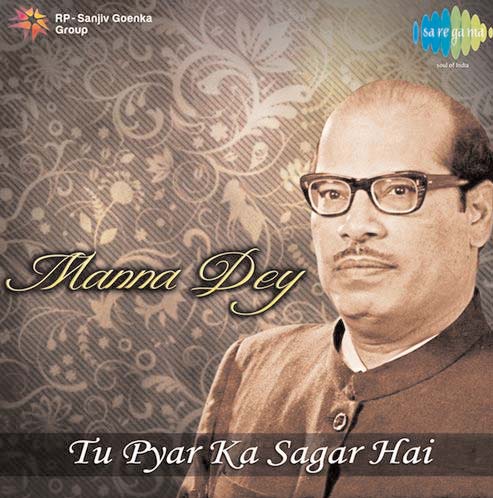
    Irony was the constant refrain of Manna Dey’s life. A world happy to sway to jingles could not always appreciate the steeped-in-classicism kalaam of Manna Da. Not blessed with the rare yodelling skills of Kishore Kumar or the soaked-in-romance style of Mohammed Rafi, there were a few things Manna Dey could do which his contemporaries could not aspire to. He could whip up a Lagi chunari mein daag, or Aayo kahan se Ghanshyam with such ease that he made a mockery of all predictions of the songs being difficult or challenging. Music directors Shankar-Jaikishen, indeed Mohammed Rafi too, felt he was the best choice when it came to songs with classical leanings. Manna Da though wanted to break the stereotype, ready at a moment’s notice to improvise, to innovate. He could dish out Aao twist karein too but the Hindi film world gave him only occasional opportunities to show his range, always keen to tap into his classical reservoir. In some ways, he remained an under-valued genius, the Dadasaheb Phalke Award notwithstanding. His voice was never associated with any hero, his name never doing the rounds of any music director’s camp for all songs of a movie; he charted his own path. A man most humble who did his own grocery purchases, he, however, was not happy about being the voice of Mahmood in Padosan. The song, Ek chatur naar, a kind of a singing contest in which he shared the baton with Kishore Kumar, was filmed on Sunil Dutt and Mahmood with Manna Da’s voice being used for the comedian. It left him unimpressed and he had to be persuaded to allow the song to be used in the film. Yet the same Manna Da once refused to sing with Pandit Bhimsen Joshi out of reverence for Pandit ji.

    The song in question, Ketki gulab juhi had Bhimsen’s character losing to Manna Da’s character in the film Basant Bahar. So Manna Da lost to Kishore Kumar in Padosan and defeated Bhimsen Joshi a decade before that! Ketki gulab juhi, however, was the not the biggest hit from Basant Bahar. That honour went to Sur na saje kya gaoon main”, where again only Manna Da could have done justice to all the ebbs and crests of music. Sur na… was picturised on Bharat Bhushan, a fine case of Manna Da singing for the hero, otherwise though his voice continued to be used for non-heroes. Another memorable case being Yaari hai imaan mera in Zanjeer, which was lipsynced by Pran, not the hero Amitabh Bachchan. The ironies did not leave Manna Da there. Mukesh was generally regarded as the voice of RK Films. Yet Manna Da gave some of his best songs for Raj Kapoor in films like Chori Chori, Shree 420 and even Bobby. In Chori Chori he gave us superhits like Aaja sanam madhur chandni mein hum and Ye raat bheegi bheegi while Rafi had to make do with the now forgotten “All line clear”. Born in 1919, he started as a music assistant in 1942. The following year he got his first whiff of public appreciation with songs of Ramrajya. It was, however, not until Upar gagan vishal in Mashaal (1950) that he began to be taken seriously as a solo singer. By the time he left youth, he was an accomplished performer, a diligent artiste who toiled endlessly yet never compromised on his music.

    In a delicious irony of life, Manna Da, who was never taken to be voice of any romantic hero of the era – the likes of Dev Anand, Shammi Kapoor and Rajesh Khanna used Kishore Kumar and Rafi’s voice – managed to give us two ultimate romantic songs for people young, and those young at heart. His Pyar hua iqrar hua hai pyar se phir kyun darta hai dil from Shree 420 (1955) was used in an advertisement campaign to promote contraceptives some 40 years after it became a chartbuster. If this song was an ode to love young and fearless, his number in Waqt was all about love that has withstood the test of tide and time. The song Ae meri Zohra Jabeen under the baton of music director Ravi, was a mischievous blend of seasoned love with innocent pranks with both Balraj Sahni and Achala Sachdev doing a wonderful job on the screen. Little appreciated, but Manna Da was a constant factor in the films of V. Shantaram; his songs of Do Ankhen Barah Haath and Navrang have scarcely been forgotten. His voice which could encapsulate almost all shades of life was used for patriotic as well as devotional songs. The irony could not have been greater – at one time Manna Da was ready to quit the country when an article by Rupayan Bhattacharya in a Kolkata daily compelled him to change his mind. And in the industry cine-goers hardly thought beyond Rafi or Mahendra Kapoor when it came to patriotic songs. Yet Manna Da gave us Ae mere pyare watan in Kabuliwala. Similarly, he lent his voice to the ever soothing Tu pyar ka sagar hai, a song from Seema, which the faithful play in praise of the Almighty. His voice had the haunting quality of a companion left behind.

    It could also have a tinge of a friend extolling you to march on. The two examples being provided by songs of Safar and Shor, where he sang Nadiya chale chale re dhara and Jeevan chalne ka naam — the latter being one of the few songs he sang with Mahendra Kapoor. Interestingly, he sang more than 50 songs with Rafi and 100 songs each with Lata Mangeshkar and Asha Bhonsle. Memorable as his songs were in Hindi cinema, Manna Da, who, for all his accomplishments, lived a humble life, sang in many Indian languages — notably Bengali, Assamese, Gujrati and Malayalam. His non-film albums too made a mark in the market, Yeh Awaara Raatein being truly remarkable. In ‘live’ shows too, he was peerless. Always holding the audience captive with his mastery over the medium. For many years, he confined himself to his residence in Bangalore, venturing out but rarely. Old age did not allow him to grace Kolkata on the opening day of IPL-VI, which was a disappointment for all, notably for Manna Da too as he was a keen student of the game. He had deep interest in soccer as well, being among a handful of artistes in cinema whose interests went beyond movies. His departure leaves a vacuum nobody will dare attempt to fill. But as Manna Da himself sang Chalat musafir, it is time for the second innings of the journey called life. History might appreciate him better.

    BOLLYWOOD MOURNS LEGEND’S DEATH
    Amitabh Bachchan: Manna Dey, stalwart of the music world, passes away. Flooded with memories and his songs. In particular his rendition of Madhushala. RIP… Prayers and condolences to loved ones and family! Strange how we connect events of our life with his songs! At work but shall keep a minutes silence, in Manna Dey’s memory on set before we start…
    Mahesh Bhatt: Manna Dey passes away. His voice shall linger forever.R.I.P.
    Manoj Bajpayee: Manna Dey is no more! A great singer! Lets pray for him! My condolences to his family! His music will live for 1000 yrs. RIP.
    Kailash Kher: Manna Dey, the legend is no more, and his contribution to music and films is unmatchable, RIP. Transformed from physical to divine, prayers.
    Sunidhi Chauhan: Heartbroken at Manna Da’s shocking demise.
    Vishal Dadlani: The world is a darker place, as one of the greatest musical lights to ever shine, has left us. May the immortal Manna De-saab rest in peace.
    Shekhar Ravjiani: The legend is no more… But he’ll forever live in our hearts through his songs and his
    voice. RIP Sir Manna Dey.
    Madhur Bhandarkar: Manna da, a legendary singer with a golden voice, that ruled our hearts for decades, will be missed by all. Zindagi kaisi hai paheli haye.
    SHABANA AZMI: Manna Dey had a unique voice. He will live on through his songs Ai Meri Zohra Jabeen/ dil ka haal suney dilwala/ poocho na kaise maine RIP.
    KUNAL KOHLI: Manna Dey, last of the greats, along with Kishore, Rafi and Mukesh, passes away.RIP.’ek chattur naar’ to ‘ae mere pyaare watan’ what a range.
    Shaan: From Rock n roll to pure classical to melancholy to slapstick… no one like Manna Da! Long live Manna Dey!
    Shreya Ghoshal: Zindagi kaisi hai paheli, Puchho na kaise, ek chatur naar, aao twist karein, aaja sanam madhur.. Such versatility and command over all genres. Rest in peace Manna Dey saab.. You and your voice are immortal.. Your songs will continue to inspire millions forever..
    Shankar Mahadevan: Zindagi … Kaisi hai paheli haaye .. Kabhi toh hasaaye … Kabhi ye rulaaye .. Manna da … Bless us!
    Anupam Kher: Manna Dey was one of the first legendary singers I heard live on stage in Shimla. He was gentle and calm. Just like his voice. Will miss him. RIP.
    Paoli Dam: ‘Coffee house er shei adda ta aaj aar nei’… the legend passes away! Manna Dey… RIP.
    Ashoke Pandit: Sad to hear about the demise of Manna Dey. A geart singer and a great human being. RIP.
    Sushma Swaraj: My respectful homage to the memory of the great singer Manna Dey
    Harsha Bhogle: Oh no. Such terrible news to get up to. Manna Dey no more? Less melody in the world.

  • President seeks clarifications on ordinance protecting convicted lawmakers

    President seeks clarifications on ordinance protecting convicted lawmakers

    NEW DELHI (TIP): President Pranab Mukherjee has sought clarifications from senior Cabinet ministers on the justification for bringing an ordinance that allows convicted lawmakers to hold on to their seats in Parliament and state legislatures. The President, who was forwarded the ordinance cleared by the Cabinet on Tuesday, sought clarifications separately from home minister Sushil Shinde, parliamentary affairs minister Kamal Nath and law minister Kapil Sibal. The inquiry came against the backdrop of demands from the BJP, the Left, the Aam Aadmi Party and civil society activists that the President reject the ordinance. Government sources sought to play down the President’s queries, saying that as a stickler for norms, he was doing due diligence and may approve the ordinance after meeting the AAP delegation on Friday.

    Ordinances are meant for urgent situations during the periods when Parliament is not in session. Opposition and others have argued that in this instance, there is no urgency except the government’s anxiety to save RJD boss Lalu Prasad from a possible setback in a Ranchi court which is trying him for complicity in the fodder scam. The politically crucial judicial order is set for Monday. The government strongly supported the ordinance disregarding growing concern within its own ranks that the ordinance would boomerang on the Congress at a time when it’s already facing heat over corruption, particularly in urban areas. A BJP delegation led by L K Advani and comprising Leaders of Opposition in the two Houses, Sushma Swaraj and Arun Jaitely, earlier called on President to urge him to reject the Ordinance. “The Indian government is trying to dilute this (convicted lawmakers) decision of the Supreme Court.

    It should realize that the ordinance is against the Constitution,” Advani told reporters after meeting the President.With the debate escalating, finance minister P Chidambaram questioned the BJP’s opposition to the ordinance, saying the main opposition party was changing its stand. He cited the case of a BJP minister in Gujarat who continued to hold office despite being convicted. “Mr Bokhiria is minister of mines and belongs to the BJP. He has been convicted for a period of three years,” Chidambaram told reporters.