Tag: Swami Vivekananda

  • Swami Vivekananda Jayanti: National Youth Day and the awakening of a nation

    Swami Vivekananda Jayanti: National Youth Day and the awakening of a nation

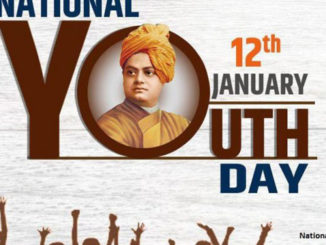
    National Youth Day is observed every year on January 12, marking the birth anniversary of Swami Vivekananda-one of India’s greatest spiritual thinkers, reformers and global ambassadors of Hindu philosophy. Revered as a true luminary of modern India, Vivekananda is credited with introducing the Western world to the depth, rationality and universality of Hinduism and Vedanta, while simultaneously inspiring generations of Indian youth to rise with confidence, courage and character.
    In recognition of his extraordinary faith in young minds, the Government of India declared his birth anniversary as National Youth Day in 1984, and the observance formally began in 1985. The day serves not merely as a tribute, but as a reminder of Vivekananda’s timeless call to youth-led nation-building.
    Early Life: Narendranath Dutta and the Seeds of Greatness
    Swami Vivekananda was born as Narendranath Dutta on January 12, 1863, coinciding with the auspicious festival of Makar Sankranti, in an affluent and culturally refined Bengali family in Calcutta (now Kolkata). He was one of eight children born to Vishwanath Dutta, a successful attorney and influential personality, and Bhuvaneshwari Devi, a deeply religious woman whose spiritual temperament left a profound impression on her son.
    From a young age, Narendranath displayed exceptional intelligence, curiosity and fearlessness. While his father exposed him to rational thinking, Western ideas and liberal values, his mother nurtured in him a strong spiritual foundation rooted in devotion, discipline and moral strength.
    Education, Intellect and Physical Vigor
    At the age of eight, in 1871, Narendranath was enrolled at Ishwar Chandra Vidyasagar’s Metropolitan Institution, and later studied at Presidency College in Calcutta. A brilliant student, he was deeply influenced by Western philosophy, Christianity and modern science, while simultaneously exploring Indian scriptures.
    What set Vivekananda apart was the breadth of his intellect. On one hand, he immersed himself in sacred Hindu texts such as the Bhagavad Gita, Upanishads and Vedas; on the other, he studied Western philosophers and thinkers like David Hume, Herbert Spencer, John Stuart Mill and Immanuel Kant. This rare synthesis of Eastern spirituality and Western rationalism would later define his worldview.
    Equally important to him was physical strength. Narendranath was passionate about music-both vocal and instrumental-and actively participated in sports, including gymnastics, wrestling and bodybuilding. He firmly believed that a strong body was essential for a strong mind, a message he later emphasized repeatedly to Indian youth.
    Spiritual Quest and Inner Conflict
    Although raised in a religious household, Narendranath’s exposure to diverse philosophies led him to question orthodox beliefs and even the existence of God. At times, he leaned towards agnosticism, yet he could never completely deny the presence of a supreme reality.
    In 1880, he joined Keshab Chandra Sen’s Nava Vidhan and became associated with the Sadharan Brahmo Samaj, led by Keshab Chandra Sen and Debendranath Tagore.
    The Brahmo Samaj emphasized monotheism and rejected idol worship, which resonated with his rational temperament. However, his inner questions remained unresolved.
    Meeting Sri Ramakrishna: A Spiritual Turning Point
    During this period of intense spiritual turmoil, Narendranath first heard about Sri Ramakrishna Paramahamsa from William Hastie, the Principal of Scottish Church College. Intrigued, he eventually met Ramakrishna at the Dakshineshwar Kali Temple.
    Narendranath posed a question he had asked many spiritual leaders before:
    “Have you seen God?”
    Ramakrishna’s reply was immediate and disarmingly simple:
    “Yes, I have. I see God as clearly as I see you-only in a much deeper sense.”
    This answer profoundly impacted Narendranath. He began visiting Dakshineshwar regularly, and under Ramakrishna’s guidance, many of his doubts gradually dissolved. Ramakrishna’s teachings of universal religion, divine love and direct spiritual experience reshaped his understanding of God and life.
    Hardship, Renunciation and Acceptance of the Guru
    After the sudden death of his father, the Dutta family plunged into severe financial distress. In desperation, Narendranath approached Ramakrishna, requesting him to pray to Goddess Kali for material relief. Ramakrishna, however, asked him to pray himself.
    Standing before the deity, Narendranath found himself unable to ask for wealth or comfort. Instead, he prayed for conscience, strength and renunciation. This moment marked his spiritual awakening and the beginning of his ascetic journey. He fully accepted Sri Ramakrishna as his Guru, surrendering himself to the spiritual path.
    From Disciple to Monk
    In 1885, Sri Ramakrishna was diagnosed with throat cancer and shifted to Calcutta and later to Cossipore. Vivekananda and other disciples devoted themselves to nursing him. On August 16, 1886, Ramakrishna attained Mahasamadhi, leaving behind a spiritual legacy that would soon transform India.
    Before his passing, Ramakrishna taught his disciples that service to humanity is the highest form of worship. After his demise, fifteen disciples, including Narendranath, took shelter at Baranagar in North Calcutta, which later became known as Ramakrishna Math. In 1887, they formally took vows of monkhood. Narendranath became Swami Vivekananda, meaning “the bliss of discerning wisdom.”
    Parivrajak: Walking Through India’s Soul
    Vivekananda soon left the monastery to embark on a nationwide journey on foot, known as Parivrajaka Sannyasa. Traveling across villages, towns and princely states, he witnessed India’s poverty, social injustice, caste discrimination and spiritual decline firsthand.
    This journey awakened in him a deep resolve: India’s regeneration lay in uplifting the masses through education, spiritual strength and self-confidence.
    World Parliament of Religions,
    Chicago (1893)
    Determined to represent India and his Guru’s teachings, Vivekananda set out to attend the World’s Parliament of Religions in Chicago. Despite financial hardships and initial setbacks, he eventually took the stage on September 11, 1893.
    His opening words-
    “Sisters and Brothers of America”-
    earned him a thunderous standing ovation.
    Through his speeches, Vivekananda introduced the world to Vedanta, religious tolerance, universal brotherhood and spiritual humanism, firmly placing India on the global spiritual map.
    He spent nearly two and a half years in the United States, founding the Vedanta Society of New York, and later traveled to the United Kingdom, spreading Vedantic philosophy.
    Ramakrishna Mission: Service as Spiritual Practice
    Upon returning to India in 1897, Vivekananda founded the Ramakrishna Mission on May 1, 1897, at Belur Math near Calcutta. Rooted in Karma Yoga, the Mission aimed to serve the poor, sick and distressed as a form of worship.
    Its activities included:
    – Schools and colleges
    – Hospitals and healthcare services
    – Disaster relief and rehabilitation
    – Spiritual education through seminars and conferences
    The Mission remains a living embodiment of Vivekananda’s vision of practical spirituality.
    Philosophy and Teachings
    Vivekananda’s teachings were grounded in Sri Ramakrishna’s spiritual realizations and his own interpretation of Advaita Vedanta. He believed that:
    – The ultimate goal of life is freedom of the soul
    – All religions are valid paths to the same truth
    – Strength, fearlessness and service are essential virtues
    His clarion call to youth-
    “Arise, awake, and stop not till the goal is reached”-
    continues to inspire millions.
    Mahasamadhi: A Life Fulfilled
    Swami Vivekananda once predicted that he would not live beyond forty. On July 4, 1902, at the age of 39, he passed away while meditating, attaining Mahasamadhi. He was cremated on the banks of the River Ganga, leaving behind a legacy that transcends time.

    National Youth Day: A Living Legacy
    National Youth Day is more than a remembrance-it is a call to action. Swami Vivekananda’s life stands as a beacon for India’s youth, urging them to combine knowledge with character, strength with compassion, and faith with reason.
    Even today, his words echo with urgency and hope, reminding the nation that the future belongs to fearless, enlightened and selfless youth.
    National Youth Day celebrations
    Across schools, colleges and universities, the day begins with special assemblies, lectures and interactive sessions highlighting the life, philosophy and teachings of Swami Vivekananda. Students participate in debates, essay-writing competitions, quizzes and speeches that focus on leadership, character-building and social responsibility. These programs aim to make Vivekananda’s ideas relevant to contemporary challenges faced by young people.
    At the national and state levels, the Ministry of Youth Affairs and Sports, along with various youth organizations, holds youth conventions, leadership programs and National Youth Festivals around January 12. These events bring together young participants from different regions, encouraging cultural exchange, innovation and a spirit of unity. The celebrations often feature discussions on education, employment, entrepreneurship and civic responsibility.
    Cultural expression plays an important role in the observance. Dance, music, drama and street plays depicting episodes from Vivekananda’s life or conveying his message of universal brotherhood and service are staged in educational institutions and public spaces. Exhibitions displaying photographs, books and archival material related to his life and teachings are also organized, allowing people to engage with his legacy in a visual and accessible way.
    In keeping with Vivekananda’s emphasis on physical and mental strength, yoga sessions, meditation programs and fitness activities are widely conducted on National Youth Day. Public parks, campuses and community centers host group yoga practices and mindfulness sessions, reinforcing the idea that a strong body and a focused mind are essential foundations for personal and national growth.
    Community service forms the moral core of the celebrations. Inspired by Vivekananda’s belief that service to humanity is the highest form of worship, many youth groups and institutions organize blood donation camps, cleanliness drives, tree plantation programs, free medical camps and rural outreach initiatives. These activities encourage young people to translate ideals into action and develop a sense of social commitment.
    The Ramakrishna Mission and its centers across India and abroad observe National Youth Day with special prayers, spiritual discourses and youth conventions. Belur Math, the headquarters of the Mission, becomes a focal point for reflections on Vivekananda’s teachings, particularly his vision of harmonizing spirituality with social service.
    In recent years, National Youth Day has also expanded into the digital space, with educational institutions, government bodies and youth organizations sharing inspirational quotes, videos, webinars and online discussions on social media platforms. These digital initiatives help carry Vivekananda’s message to a wider, tech-savvy audience.
    Observed on January 12 each year, National Youth Day ultimately serves as a day of reflection, inspiration and renewal. It reminds India’s youth of Swami Vivekananda’s enduring call to rise above fear, build character and dedicate themselves to the service of society-affirming his timeless belief that the future of the nation rests in the hands of awakened and empowered young minds.

  • Relevance of Swami Vivekananda as Youth Icon in Modern Time

    Relevance of Swami Vivekananda as Youth Icon in Modern Time

    Swami Vivekananda, a spiritual leader, had a deep insight into modern education and spiritual learning; in simple words, he emphasized the blending of modern education with Indian spirituality.
    Vivekananda was a firm believer in education as a tool for human advancement. His speeches and writings are replete with references to the plight of the masses as a result of the denial of literacy and education to them. He was particularly shocked by the degree of ignorance and superstition prevalent in rural regions due to a lack of literacy and education. He was also harshly critical of the educational system, citing its western slant and a lack of focus on the development of mental capacity and moral character in its students. In addition, he advocated for the universalization of literacy, development, and mass education. He desired a comprehensive reorientation of the educational system to make it an integrated man-making and character-building system, with a focus on national pride, love for the masses, self-confidence, strength, and will power, and cultivation of the intellect rather than simple recollection.
    Swami Vivekananda’s scheme of youth education is comprehensive education that aims to develop body, mind and soul from a socio-economic perspective, which destroys inequality between men and women, casteism and communalism, ethnic and sub-national, regionalism and national differences. When he speaks of ‘body’, he lays stress on physical training, good living conditions, a balanced diet, in a word, complete satisfaction of all physical hunger. All of this is possible only when the youth are employed and earning a stable income. For this, youth need to develop agriculture with the help of Western technology, and the promotion of small-scale and cottage industries with the use of financial assistance from the state to become “Atmanirbhar”.
    Youth must have sound mental health, “Be strong my young friends, that is my advice to you. You will be nearer to heaven through football than through the study of the Gita”. This line reflects a story when a young lad visited Swamiji and asked him to teach meditation. He says, go and play, do some physical exercise, and then I will teach you. He always promotes the physical well-being of youth, as it’s a focus proverb – healthy mind stays in a healthy body. He wants youth to be as soft as Krishna playing the flute and as masculine as Hanuman.
    Vivekananda believes in the dispersion of positive thoughts and values among the youths; he says: “If you can give them positive thoughts, then people will grow up to be a man and learn to stand on their own legs”.
    That’s why in the present time, it is necessary to empower the weakest, most neglected and degraded societies’ youth so that they can contribute to nation-building. Only positive education can do that; however, if seen in the name of empowerment, youths are divided into all sorts of instruments that promote negative thought processes (hatred and enmity between different groups) that are baked inside the universities and schools. As a result, it creates disharmony and conflict, so youth must try to believe in solidarity and cohesion.
    Swamiji says, “Religion deals with the truths of the metaphysical world just as chemistry, and the other natural sciences deal with the truths of the physical world”. Youth should try to read and learn basics from ‘The book of Nature’, i.e. Chemistry and Physics. In modern times youth are often ignorant of technological sciences too as they are busy reading the wrong book, i.e. ‘The book of passing marks’. At the same time, techno-geek youth are often ignorant of religion and its dimensions. They too read the wrong books, i.e. ‘The book without interior knowledge’. The book from which religiosity can be learned is the youth’s mind and heart.
    While speaking of ‘mind’, Swamiji laid stress on discipline, fearlessness, passion for helping others, commitment to human and social values and a continuous effort to realise oneself through social service and meditation. The final stage of education lies in the elevation of the body and mind up to the ‘soul’ when there is the realization of ‘Universal Unity’. So physical and mental stages of the educational curriculum end in the spiritual step. This spiritualism is the final identity of a layman and woman and not that of a monk and seer only. So it is ‘Practical Vedanta’. We notice a two-way dynamic process here: One, is essentially inward, and the other is entirely social. This blending of the two in a harmonious fashion has been possible through a synthesis of religion and philosophy.
    Character Education
    Education is a building block of character. It is not gathering or absorbing knowledge; it is the encapsulation of good values. Character imparts wisdom which results in attaining enlightenment. And the goal of life should be unselfishness and living for others. Life is all about sacrifice. He always connects to youths by: “This life is short, the vanities of the world are transient, but they alone live who live for others, the rest are more dead than alive”. Our life is merely a collection of good or bad habits; these habits enterprise characters as a personality that societies continuously monitor and reflect an impression of oneself. In the 21st century, the modern economic and education system has created an environment of stress, so inculcating one good thought and habit, rather than having dozens of thoughts, and trying to implement it in one’s own life is the best method of achieving enlightenment.
    Right Education
    Right education is critical for youths, as we have been colonised for more than 200 years, creating a mindset of slavery. Swamiji says during his interaction: “Getting by heart the thoughts of others in a foreign language and stuffing your brain with them and taking some universities degree, you consider yourself educated”. As rote learning and sluggish thinking do not produce the mind that a developing nation requires. Such educated youth are a burden on society. They even cannot earn a decent living for themselves and their family. Unskilled youth start depending on the government dole, and the process of man-making gets hampered.
    Science and Religion
    Swami Vivekananda always mentions that: “Science is nothing but the finding of unity”. Once science reaches the state of unity, further progress would stop as it would have reached its goal. ‘Chemistry’ would not progress further when it has discovered a single element out of which others can be made. Progress of ‘Physics’ stops when it finds a single source of energy out of which all the others are made; the manifestation of science and religion becomes unity when the manifestation of unity will discover the ‘God’; who is the only ‘divine’, living in the universe of mortals. The one who is constant in a mortal and ever-changing world is only “Him”. The One “Him” who is the only soul out of which all souls are made the concept of universal religion takes place. Any mischievous manifestations of “Him” will be disastrous for youth and the nation.
    After accumulating the above-mentioned qualities comes a part of religion. Once a youth is physically strong and emotionally intense, then they can preserve the realisation of universal religion where Vedanta and the evolution of peaceful religion can be promoted. This religion is distinct from dogmas, rituals and misconceptions of knowledge. Swamiji believes in religious pluralism with scientific temperament, where Western understanding of science is taught in college and religion at home, society and religious institutions. However, he never wants youth to convert to another religion, and practice the path of Dharma from the eyes of Vedanta.
    Thus, education is a man-making process rather than a life-destroying enterprise; with the right education, characters are built, which help to counter bad habits. For youth, education is not only the development of character but also develops leadership qualities and personalities.
    The youth must advocate for the entire development of physical, mental, emotional, leadership qualities and religiosity which was once the idea of the education system of Vishwaguru. The principle of ‘Vasudhaiva Kutumbakam’, with the blending of modern technology and man-making, must be focused on youth to contribute to nation-building.
    Source: Indica Today

  • Swami Vivekananda

    Swami Vivekananda

    The birth anniversary of Swami Vivekananda, which falls on January 12, is celebrated across India as National Youth Day, to honor one of the greatest philosophers and spiritual leaders. It also marks his ideas on how the young should participate in the modern world while upholding their values

    Swami Vivekananda was a Hindu monk and one of the most celebrated spiritual leaders of India. He was more than just a spiritual mind; he was a prolific thinker, great orator and passionate patriot. He carried on the free-thinking philosophy of his guru, Ramakrishna Paramhansa forward into a new paradigm. He worked tirelessly towards betterment of the society, in servitude of the poor and needy, dedicating his all for his country. He was responsible for the revival of Hindu spiritualism and established Hinduism as a revered religion on world stage. His message of universal brotherhood and self-awakening remains relevant especially in the current backdrop of widespread political turmoil around the world. The young monk and his teachings have been an inspiration to many, and his words have become goals of self-improvement especially for the youth of the country. For this very reason, his birthday, January 12, is celebrated as the National Youth Day in India.

    National Youth Day

    The birth anniversary of Swami Vivekananda is celebrated across India as National Youth Day, to honour one of the greatest philosophers and spiritual leaders. It also marks his ideas on how the young should participate in the modern world while upholding their values. The decision to celebrate Vivekananda’s birthday as National Youth Day was taken in 1984, and it was first marked on January 12, 1985.

    The government had then said that the philosophy of Swamiji and the ideals for which he lived and worked “could be a great source of inspiration” for the Indian youth.

    The day is marked all over India at schools and colleges, with processions, speeches, music, youth conventions, seminars, Yogasanas, presentations, competitions in essay-writing, recitations and sports every year. But due to the ongoing coronavirus pandemic and the schools being shut, most of the events will be held in virtual mode.

    Early Life and Education

    Vivekananda was one of the eight children of Vishwanath Dutta and Bhuvaneshwari Devi. His father Vishwanath was a successful attorney with considerable influence in society. Narendranath’s mother Bhuvaneshwari was a woman endowed with a strong, God-fearing mind who had a great impact on her son.

    As a young boy, Narendranath displayed sharp intellect. His mischievous nature belied his interest in music, both instrumental as well as vocal. He excelled in his studies as well, first at the Metropolitan institution, and later at the Presidency College in Calcutta. By the time he graduated from the college, he had acquired a vast knowledge of different subjects. He was active in sports, gymnastics, wrestling and body building. He was an avid reader and read up on almost everything under the sun. He perused the Hindu scriptures like the Bhagvad Gita and the Upanishads on one hand, while on the other hand he studied western philosophy, history and spirituality by David Hume, Johann Gottlieb Fichte and Herbert Spencer.

    Spiritual Crisis and Relationship with Ramkrishna Paramhansa

    Although Narendranath’s mother was a devout woman and he had grown up in a religious atmosphere at home, he underwent a deep spiritual crisis at the start of his youth. His well-studied knowledge led him to question the existence of God and for some time he believed in Agnosticism. Yet he could not completely ignore the existence of a Supreme Being. He became associated with Brahmo Movement led by Keshab Chandra Sen, for some time. The Bramho Samaj recognised one God unlike the idol-worshipping, superstition-ridden Hinduism. The host of philosophical questions regarding the existence of God roiling through his mind remained unanswered. During this spiritual crisis, Vivekananda first heard about Sri Ramakrishna from William Hastie, the Principal of the Scottish Church College.

    Earlier, to satisfy his intellectual quest for God, Narendranath visited prominent spiritual leaders from all religions, asking them a single question, “Have you seen God?” Each time he came away without a satisfying answer. He put forward the same question to Sri Ramkrishna at his residence in Dakshinewar Kali Temple compounds. Without a moment’s hesitation, Sri Ramakrishna replied: “Yes, I have. I see God as clearly as I see you, only in a much deeper sense.” Vivekananda, initially unimpressed by the simplicity of Ramkrishna, was astonished with Ramakrishna’s reply. Ramakrishna gradually won over this argumentative young man with his patience and love. The more Narendranath visited Dakshineshwar, the more his questions were answered.

    Spiritual Awakening

    In 1884, Naredranath underwent a considerable financial distress due to the death of his father as he had to support his mother and younger siblings. He asked Ramakrishna to pray to the Goddess for the financial welfare of his family. On Ramakrishna’s suggestion he himself went to the temple to pray. But once he faced the Goddess he could not ask for money and wealth, instead he asked for ‘Vivek’ (conscience) and ‘Bairagya’ (reclusion). That day marked the complete spiritual awakening of Narendranath and he found himself drawn to an ascetic way of life.

    Life of a Monk

    During the middle of 1885, Ramakrishna, who had been suffering from throat cancer, fell seriously ill. In September 1885, Sri Ramakrishna was moved to Shyampukur in Culcutta, and a few months later Narendranath took a rented villa at Cossipore. Here, he formed a group of young people who were ardent followers of Sri Ramakrishna and together they nursed their Guru with devoted care. On 16 August 1886, Sri Ramakrishna gave up his mortal body.

    After the demise of Sri Ramakrishna, around fifteen of his disciples including Narendranath began to live together in a dilapidated building at Baranagar in North Calcutta, which was named Ramakrishna Math, the monastic order of Ramakrishna. Here, in 1887, they formally renounced all ties to the world and took vows of monkhood. The brotherhood rechristened themselves and Narendranath emerged as Vivekananda meaning “the bliss of discerning wisdom”.

    The brotherhood lived off on alms donated voluntarily by patrons during holy begging or ‘madhukari’, performed yoga and meditation. Vivekananda left the Math in 1886 and went on a tour of India on foot as a ‘Parivrajak’. He travelled the breadth of the country, absorbing much of the social, cultural and religious aspects of the people he came in contact with. He witnessed the adversities of life that the common people faced, their ailments, and vowed to dedicate his life to bring relief to these suffering.

    Lecture at the World Parliament  of Religions

    During the course of his wanderings, he came to know about the World Parliament of Religions being held in Chicago, America in 1893. He was keen to attend the meeting, to represent India, Hinduism and his Guru Sri Ramakrishna’s philosophies. He found assertion of his wishes while he was meditating on the rocks of Kanyakumari, the southernmost tip of India. Money was raised by his disciples in Madras (now Chennai) and Ajit Singh, Raja of Khetri, and Vivekananda left for Chicago on May 31, 1893 from Bombay.

    He faced insurmountable hardships on his way to Chicago, but his spirits remained as indomitable as ever. On 11 September 1893, when the time came, he took the stage and stunned everyone with his opening line “My brothers and sisters of America”. He received a standing ovation from the audience for the opening phrase. He went on to describe the principles of Vedanta and their spiritual significance, putting Hinduism on the map of World Religions.

    He spent the next two and a half years in America and founded the Vedanta Society of New York in 1894. He also travelled to the United Kingdom to preach the tenets of the Vedanta and Hindu Spiritualism to the western world.

    Death

    Swami Vivekananda had predicted that he will not live till the age of forty. On July 4, 1902, he went about his days’ work at the Belur Math, teaching Sanskrit grammar to the pupils. He retired to his room in the evening and died during meditation at around 9. He is said to have attained ‘Mahasamadhi’ and the great saint was cremated on the Banks of river Ganga.

  • The multifaceted persona of Swami Vivekananda

    The multifaceted persona of Swami Vivekananda

    By Amarjit Singh Anand

    Vivekananda, original name Narendranath Datta, Datta also spelled Dutt, (born January 12, 1863, Calcutta [now Kolkata]—died July 4, 1902, near Calcutta), Hindu spiritual leader and reformer in India who attempted to combine Indian spirituality with Western material progress, maintaining that the two supplemented and complemented one another. His Absolute was a person’s own higher self; to labor for the benefit of humanity was the noblest endeavor. -Encyclopedia Britannica

    Early Life and Education

     The Young Vivekananda 

    Born Narendranath Dutta, into an affluent Bengali family in Calcutta, Vivekananda was one of the eight children of Vishwanath Dutta and Bhuvaneshwari Devi. He was born on January 12, 1863, on the occasion of Makar Sankranti. Father Vishwanath was a successful attorney with considerable influence in society. Narendranath’s mother Bhuvaneshwari was a woman endowed with a strong, God-fearing mind who had a great impact on her son. As a young boy, Narendranath displayed sharp intellect. His mischievous nature belied his interest in music, both instrumental as well as vocal. He excelled in his studies as well, first at the Metropolitan institution, and later at the Presidency College in Calcutta. By the time he graduated from the college, he had acquired a vast knowledge of different subjects. He was active in sports, gymnastics, wrestling and body building. He was an avid reader and read up on almost everything under the sun. He perused the Hindu scriptures like the Bhagvad Gita and the Upanishads on one hand, while on the other hand he studied western philosophy, history and spirituality by David Hume, Johann Gottlieb Fichte and Herbert Spencer.

    He did his schooling at Ishwar Chandra Vidyasagar’s Metropolitan Institution (1871). Then he attended Presidency University (Kolkata) and General Assembly’s Institution (Scottish Church College, Kolkata). Swami Vivekananda died at an early age of 39 years on July 4, 1902, due to rupture in the blood vessel of his brain. His disciples say that he attained Mahasamadhi (the act of consciously and intentionally leaving one’s body at the moment of death) while meditating.

    Swamiji was never married, as He considered all women to be the manifestation of the Divine Mother of the Universe. All women were his Mother in that sense. When Swami Vivekananda went to America, a woman expressed his desire to marry him. When Swami Vivekananda asked the woman about the reason for her intention. Then the woman said she was very fascinated with the wisdom of Swamiji and wished for such a wise child from him. On this, Swamiji told the woman that since she is fascinated only by his wisdom, there is no problem. Swami Vivekananda said “I understand your wish. It will take a long time to get married and bring a child into this world and then to know whether he is intelligent or not. There is no guarantee that this would happen. Instead, I can give you a suggestion to fulfill your wish immediately. You accept me as your child. In this way, you will become my mother and thus your desire to have a wise child like me will also be fulfilled”.

    Spiritual Crisis and Relationship with Ramkrishna Paramhansa

    Although Narendranath’s mother was a devout woman and he had grown up in a religious atmosphere at home, he underwent a deep spiritual crisis at the start of his youth. His well-studied knowledge led him to question the existence of God and for some time he believed in Agnosticism. Yet he could not completely ignore the existence of a Supreme Being. He became associated with Brahmo Movement led by Keshab Chandra Sen, for some time. The Bramho Samaj recognized one God unlike the idol-worshipping, superstition-ridden Hinduism. The host of philosophical questions regarding the existence of God roiling through his mind remained unanswered. During this spiritual crisis, Vivekananda first heard about Sri Ramakrishna from William Hastie, the Principal of the Scottish Church College.

    Earlier, to satisfy his intellectual quest for God, Narendranath visited prominent spiritual leaders from all religions, asking them a single question, “Have you seen God?” Each time he came away without a satisfying answer. He put forward the same question to Sri Ramkrishna at his residence in Dakshinewar Kali Temple compounds. Without a moment’s hesitation, Sri Ramakrishna replied: “Yes, I have. I see God as clearly as I see you, only in a much deeper sense.” Vivekananda, initially unimpressed by the simplicity of Ramkrishna, was astonished with Ramakrishna’s reply. Ramakrishna gradually won over this argumentative young man with his patience and love. The more Narendranath visited Dakshineshwar, the more his questions were answered.

    Spiritual Awakening

    In 1884, Naredranath underwent a considerable financial distress due to the death of his father as he had to support his mother and younger siblings. He asked Ramakrishna to pray to the Goddess for the financial welfare of his family. On Ramakrishna’s suggestion he himself went to the temple to pray. But once he faced the Goddess he could not ask for money and wealth, instead he asked for ‘Vivek’ (conscience) and ‘Bairagya’ (reclusion). That day marked the complete spiritual awakening of Narendranath and he found himself drawn to an ascetic way of life.

    Life of a Monk

     Vivekananda, the monk 

    During the middle of 1885, Ramakrishna, who had been suffering from throat cancer, fell seriously ill. In September 1885, Sri Ramakrishna was moved to Shyampukur in Culcutta, and a few months later Narendranath took a rented villa at Cossipore. Here, he formed a group of young people who were ardent followers of Sri Ramakrishna and together they nursed their Guru with devoted care. On 16 August 1886, Sri Ramakrishna gave up his mortal body. After the demise of Sri Ramakrishna, around fifteen of his disciples including Narendranath began to live together in a dilapidated building at Baranagar in North Calcutta, which was named Ramakrishna Math, the monastic order of Ramakrishna. Here, in 1887, they formally renounced all ties to the world and took vows of monkhood. The brotherhood rechristened themselves and Narendranath emerged as Vivekananda meaning “the bliss of discerning wisdom”. The brotherhood lived on alms donated voluntarily by patrons during holy begging or ‘madhukari’, performed yoga and meditation. Vivekananda left the Math in 1886 and went on a tour of India on foot as a ‘Parivrajak’. He travelled the breadth of the country, absorbing much of the social, cultural and religious aspects of the people he came in contact with. He witnessed the adversities of life that the common people faced, their ailments, and vowed to dedicate his life to bring relief to these suffering. Vivekananda says “knowing God is a deep human necessity. Those who deny this fact have been proven wrong. Therefore, so long as there is fear of death in the world, there shall be faith in God. The concept of God is a fundamental element in the human constitution. In the Vedanta, Sat-chit-ananda (Existence-Knowledge-Bliss) is the highest concept of God”.

    Swami Vivekananda was a Hindu monk, a spiritual leader and reformer in India who attempted to combine Indian spirituality with Western material progress, maintaining that the two supplemented and complemented one another. To him, The Absolute was a person’s own higher self; and to labor for the benefit of humanity was the noblest endeavor. Born on January 12, 1863 in Calcutta, he died July 4, 1902 near Calcutta). His original name was Narendranath Datta.

    Swami Vivekananda on The Philosophy of Life.

    He was a youth icon who was well respected even by much older wiser people. He says everyone has a philosophy to apply in their life. Due to lack of proper education and consequent ignorance about whether such chosen philosophy is good or not, many people go astray. Many are not inquisitive and so remain content with their situations, howsoever crude or selfish. Then, some philosophies may not be adaptable in modern times and some may be too far-fetched, thereby unattainable.The majority set sensual pleasures as their goal. Some would do anything to gain position, power, name, fame, and so on because they think these are the greatest objectives to attain. Each group has a set of arguments to justify their views. However, we are shown by sages and saints that the path to express our infinite possibilities and reach a state that is universally valued and respected. Swamiji says “The lives of Buddha, Mahavira, Christ, Sri Ramakrishna, and many other great persons have demonstrated this truth”.

    While conducting a ‘Bhakti-Yoga’ class in New York, on 20th of January 1896, Swamiji narrated the incidents pertaining to Guru Nanak Sahebji whereby Guruji emphasized upon the paramount significance of mindful honest prayer, when the Guru visited the Arabic world and exposed the hypocrisy during the prayer service led by preachers.

    Swami Vivekananda and his 1893 Lecture

    https://www.artic.edu/swami-vivekananda-and-his-1893-speech

     Swami Vivekananda in Chicago in 1893 with the handwritten words “one infinite pure and holy—beyond  thought   beyond qualities I bow down to thee” 

    Swami Vivekananda burst upon the global stage because of his famed speech on September 11, 1893, at the first World Parliament of Religions in Chicago. In his groundbreaking speech to the 1893 World’s Parliament of Religions, he introduced Hinduism to America and called for religious tolerance and an end to fanaticism. He was the chief disciple of the 19th-century mystic Ramakrishna and the founder of Ramakrishna Mission. Swami Vivekananda is also considered a key figure in the introduction of Vedanta and Yoga to the West and is credited with raising the profile of Hinduism to that of a world religion. 

    Speech delivered by Swami Vivekananda

     Swami Vivekananda at the first World Parliament of Religions in Chicagoon September 11, 1893,

    Sisters and Brothers of America, it fills my heart with joy unspeakable to rise in response to the warm and cordial welcome which you have given us. I thank you in the name of the most ancient order of monks in the world, I thank you in the name of the mother of religions, and I thank you in the name of millions and millions of Hindu people of all classes and sects.

    My thanks, also, to some of the speakers on this platform who, referring to the delegates from the Orient, have told you that these men from far-off nations may well claim the honor of bearing to different lands the idea of toleration. I am proud to belong to a religion which has taught the world both tolerance and universal acceptance. We believe not only in universal toleration, but we accept all religions as true. I am proud to belong to a nation which has sheltered the persecuted and the refugees of all religions and all nations of the earth. I am proud to tell you that we have gathered in our bosom the purest remnant of the Israelites, who came to Southern India and took refuge with us in the very year in which their holy temple was shat­tered to pieces by Roman tyranny. I am proud to belong to the religion which has sheltered and is still fostering the remnant of the grand Zoroastrian nation. I will quote to you, brethren, a few lines from a hymn which I remember to have repeated from my earliest boyhood, which is every day repeated by millions of human beings: “As the different streams having their sources in different paths which men take through different tendencies, various though they appear, crooked or straight, all lead to Thee.”

    The present convention, which is one of the most august assemblies ever held, is in itself a vindication, a declaration to the world of the wonderful doctrine preached in the Gita: “Whosoever comes to Me, through whatsoever form, I reach him; all men are struggling through paths which in the end lead to me.” Sectarianism, bigotry, and its horrible descen­dant, fanaticism, have long possessed this beautiful earth. They have filled the earth with vio­lence, drenched it often and often with human blood, destroyed civilization and sent whole nations to despair. Had it not been for these horrible demons, human society would be far more advanced than it is now. But their time is come; and I fervently hope that the bell that tolled this morning in honor of this convention may be the death-knell of all fanaticism, of all persecutions with the sword or with the pen, and of all uncharitable feelings between persons wending their way to the same goal.

     New Path to Perfection

    Great saints and prophets have taught that becoming divine or perfect is the highest goal of human life. All have declared that humankind is heir to immortal life, infinite knowledge, love, and bliss. Though this is very much true according to the Indian ethos, it is also echoed by other great personalities, as Christ says: “Be ye therefore perfect, as your Father which is in heaven is perfect”.

    This goal of perfection is attained gradually after realizing the futility of lower goals such as sense enjoyment and socioeconomic power. We see that people once addicted to sensual pleasures become, by middle age, disillusioned and disappointed with those so-called pleasures. Similar is the case with those who run after wealth and power. Therefore, the wise ones counsel us against the pursuit of temporal goals: “Be spiritual; realize that you are divine and you will attain the highest perfection by knowing that you are spiritually immortal, possessing infinite knowledge and bliss.’ They also declare that this goal is achievable and open to everyone. They boldly proclaim that there is no other way to blessedness than consciously choosing and struggling to actualize our real nature. And this spiritual struggle is described in the Upanishads: ‘As difficult as impassable as a razor’s edge,’ and ‘this soul is not attained by the weak”. This struggle is more adventurous, thrilling, and inspiring than the conquest of external nature.

    Guided by his Master Sri Ramakrishna, he traversed this difficult path of discipline and prolonged struggles, and showed us its validity. Swamiji expressed this through a unique philosophy of life that promised us peace and happiness in temporal life, as well as lasting spiritual peace and joy.

      Swami Vivekananda in Kashmir  

    Swamiji wanted his monastic brothers to educate the masses of India in secular and spiritual matters. He writes in a famous letter of 1894 from the US to his brother disciples at the Alambazar monastery: ‘I am giving you a new idea. If you can work it out, then I shall know you are men and will be of service. … get together a number of poor, indigent folk … teach them astronomy, geography, etc., and preach Sri Ramakrishna to them.’ 4 Centuries of suppression and exploitation had rendered people helpless. Now, instead of depending on petty rulers and kings or the British to do something, Swamiji wanted the regeneration of India for the people and by the people. He first wanted to eradicate poverty through technical and other secular education, which had to go along with the instilling of spiritual culture, the backbone of India since ancient times. Swami Vivekananda speaks about teaching history, geography, astronomy, and modern social sciences in order to awaken the Indian masses. He knew that individual happiness rests on the happiness of others, and awakening people was the first step towards an all-round national development. His ‘new idea’ was far ahead of even the much later communist movements in some parts of the world, which failed because they could not understand the spiritual dimension of the human being. His novel idea was initially not well received by his own brother disciples! But Swami Vivekananda, a born leader, was charting a new path for humanity while spiritually extending the old ideal of ‘bahujana hitaya bahujana sukhaya; for the good of the many, for the happiness of the many’. In a poignant letter written to the Maharaja of Mysore he says: ‘My noble Prince, this life is short, the vanities of the world are transient, but they alone live who live for others, the rest are more dead than alive’. Spiritual life, in the hands of Swamiji, was made proactive and practical through service of the Atmaa in all.

    Swamiji wanted a healthy exchange of ideas between the East and the West. Western technology must be used to uplift the poor masses, and values cherished by the orient for thousands of years taught to the West in exchange. He spoke of mass education going from door to door using the magic lantern, maps, charts, and so on. Today primary education in India, after all these years, is a right and a reality. Unfortunately, the gap between the rich and the poor has not been bridged, but a big start has been made for the poor to rise and stop being exploited. We also need to effectively use all the technological developments such as electronic media, computers, and the Internet to bring the masses into the mainstream. Swamiji was always positive and modern in his approach, and his followers will also have to be so. Distance education can be used to ‘reach the unreached’, even in remote forest and hill tribes and communities.

     Spiritual Awakening:Need of the Hour

     The Spiritual Vivekananda 

    Swamiji wanted to eradicate poverty, but he wanted even more the eradication, through spiritual awakening, of selfishness, disunity, jealousy, and corruption, which can happen. These stumbling blocks of human progress could be neutralized by propagating the character, teachings, and religion of Sri Ramakrishna, who preached the divinity of humankind, of the universe, and the harmony of all religions. ‘This’, Swamiji said, ‘is the only spiritual practice, the only worship, this verily is the means, and this the goal’.

    Swamiji’s call for a national consciousness was unique. In his essay ‘Aryans and Tamilians’, he showed the essential unity of the nation and refuted the Aryan invasion theory. He said that the whole of India was of one race only, called Aryan in the North and Dravidian in the South, both originating from the race that inhabited India from prehistoric times.Next, he wanted to arouse the dormant spiritual consciousness of the nation through the repropagation of moksha, spiritual freedom, and the temporal ideal of intellectual and economic development based on dharma. He wanted everyone to strive for one’s self-realization through service, renunciation, and sacrifice. This path would lead to concentration, meditation, and realization, which the rishis of old attained through years of tapasya, austerities. Therefore, Swamiji exhorted: ‘They had hundreds of Rishis in ancient India. We will have millions—we are going to have, and the sooner every one of you believes in this, the better for India and the better for the world’. Sainthood, that is, the ideal of an all-round development of the personality can be attained by keeping before us the fourfold goals of human life: righteousness (dharma) wealth (artha) sensual pleasure (kaam) and emancipation (moksh). This quest can transform the powers of the body and the mind into healthy channels of expression, helping thus to reduce distortions arising from selfishness.

    Dharma, Artha, and Kama : Artha and Kama are interconnected. Wealth enables one to enjoy pleasures through the senses; pleasures in turn create the need for more wealth. Thus, a circle is created of wealth leading to enjoyment, and thirst for more enjoyment leading to more wealth. But the thirst for enjoyment has to be controlled for the following two reasons: (i) The senses have their limitations and therefore overstretching them brings in diseases and premature death; and (ii) sense enjoyment invariably leads to possessiveness and selfishness affecting others’ freedom. Therefore, these clashes and struggles would not be conducive to happiness.

     Who is to control this thirst for enjoyments? The individual has to do it through his or her own conscience. There is no other way. Dharma should form the basis for the acquisition of wealth and enjoyment. The modern argument that there is no need for dharma or values in procuring wealth or enjoyment seems absolutely shallow. Besides, one soon learns the harsh truth that wealth and enjoyment destroys oneself. The Bhagavadgita says that God incarnates again and again to guide humanity along the lines of a new dharma to suit a new age. Such an avatara has come again in the form of Sri Ramakrishna. In a glorious tribute to his Master, Swamiji declares: ‘Sri Ramakrishna, the fulfilment of the Indian sages, the sage for the time, one whose teaching is just now, in the present time, most beneficial. And mark the divine power working behind the man. The son of a poor priest, born in an out-of-the-way village unknown and unthought of, today is worshipped literally by thousands in Europe and America, and tomorrow will be worshipped by thousands more. Who knows the plans of the Lord!’.

    By glorification of the human being, Swamiji reiterates that one’s caste is not a barrier for the highest secular or religious achievement. This is also the message of the Mahabharata, which says that neither birth, sacraments, ancestry, or studies make a person dvija, twice born, but character and conduct alone does. Swamiji describes how we can achieve happiness in this world: ‘Man thinks foolishly that he can make himself happy, and after years of struggle finds out at last that true happiness consists in killing selfishness’ (1.84). This happiness can be at the physical, mental, moral, or spiritual level, the durability and intensity increasing at each succeeding level. This happiness is directly proportional to freedom, and spiritual joy is the highest because it gives freedom.

    Food, Education, and Happiness : Food is an important aspect of human happiness. Swamiji advises us: ‘Certain regulations as to food are necessary; we must use that food which brings us the purest mind’. But fanaticism regarding choice of food—vegetarian, non-vegetarian, vegan, or ‘vegetarian’—should be eschewed. The food that one is habituated to from one’s childhood should be good for that aspirant, though after an increase of spirituality that too changes accordingly. Education plays a vital role in making a person happy. Hence Swamiji often called good education ‘man-making’, because it promoted a person’s all-round growth: physical, intellectual, emotional, moral, and spiritual. He defined education as ‘the manifestation of perfection already in man’.An educated person should develop a strong will power, which comes from the power of knowledge and emotions coming together. This will power should guide one along the right path, to work efficiently, and achieve the maximum with a minimal expenditure of energy. Education should make people good-natured, kind, philanthropicand courageous to fight for just causes.

     As the whole of creation has issued out of the supreme Soul, and the jiva is a part of this supreme Soul, a person has the knowledge of everything ‘hidden within one’s mind’. Education is ‘uncovering’ this dormant knowledge. This concept of education, as an inside-out manifestation, gives everyone the opportunity and hope to reach very high, provided one struggles hard enough. Proper education develops an enlightened society in which, necessarily, the majority have to be householders. Swamiji speaks about how men and women can live happily in their families: ‘The householder is the basis, the prop, of the whole society. A good householder is expected to earn well and spend well. Swamiji calls this a ‘worship’, equivalent to a monastic’s spiritual practices, because behind both is the same virtue of self-surrender and self-sacrifice, prompted by the feeling of devotion to God and to all that is his. Again, the householder has to be a person of character. Swamiji says: ‘Chastity is the first virtue in man or woman’. The husband should look upon all other women as his mother, daughter, or sister. The wife has the greater responsibility of bringing back a wayward husband through the power of her love and chastity.

    A householder should behave towards his or her family members as a ‘nurse’ in a rich man’s house, believing that all of them are not one’s own but really God’s! A householder, to his enemies, must be a hero; he must resist them and never talk of non-resistance. To his friends and relatives he should be gentle. He should eschew bad habits like gambling, company of the wicked, and soon and struggle to earn a good name. The householder’s life is a training in selflessness, service, sacrifice, and renunciation, to become ‘a sannyasin without a garb’ and quickly attain moksha.

    Ethics : Morality in both individual life and social life is mostly based on fear of societal censure. But Vivekananda gave a new theory of ethics and new principle of morality based on the intrinsic purity and oneness of the Atman.Ethics, according to Vivekananda was nothing but a code of conduct that helps a man to be a good citizen. He said we should be pure because purity is our real nature, our true divine Self or Atman.Similarly, we should love and serve our neighbors because we are all one in the Supreme Spirit known as Paramatma or Brahman.

    Religion : One of the most significant contributions of Swami Vivekananda to the modern world is his interpretation of religion as a universal experience of transcendent Reality, common to all humanity.This universal conception frees religion from the hold of superstitions, dogmatism, priest craft and intolerance.He believed that every religion offered a pathway to the eternal supreme – supreme freedom, supreme knowledge, supreme happiness.This can be accomplished by realizing one’s Aatma as part of Paramaatma.

    Education : Swami Vivekananda laid the greatest emphasis on education for the regeneration of our motherland.According to him, a nation is advanced in proportion as education is spread among the masses.He said that our process of education should be such that it helps the students to manifest their innate knowledge and power.He advocated a man-making character-building education.He said that education must make the students self-reliant and help them face the challenges of life. He was highly critical of the so-called educated who do not care for the poor and downtrodden.

    He was in complete agreement with the methods and results of modern science. He did not discard reason in favor of faith. He recognized intuition or inspiration as a higher faculty than reason. But the truth derived from intuition had to be explained and systematized by reason.

    Though growth of Nationalism is attributed to the Western influence but Swami Vivekananda’s nationalism is deeply rooted in Indian spirituality and morality.His nationalism is based on Humanism and Universalism, the two cardinal features of Indian spiritual culture.Unlike western nationalism which is secular in nature, Swami Vivekananda’s nationalism is based on religion which is life blood of the Indian people.The basis of his nationalism are:deep concern for masses, freedom and equality through which one expresses self, spiritual integration of the world on the basis of universal brotherhood. “Karmyoga” a system of ethics to attain freedom both political and spiritual through selfless service.His writings and speeches established motherland as the only deity to be worshiped in the mind and heart of countrymen.

    Youth Icon A Message to Youth 

    Swamiji believed that if our youth is determined, there can be nothing impossible for them to achieve in the world. He urged youth to have dedication to the cause to attain success. Pursuing a challenge with utmost dedication is really the road to success, for our youth. His birthday on January 12 is celebrated as National Youth Day and the week commencing from that day is known as the National Youth Week. As part of National Youth Week celebrations, the Government of India holds the National Youth Festival every year. The youth festival aims to propagate the concept of national integration, spirit of communal harmony, brotherhood, courage and adventure amongst the youth by exhibiting their cultural prowess in a common platform.

    Swami Vivekananda belonged to the 19th century, yet his message and his life are more relevant today than in the past and perhaps, will be more relevant in future. Persons like Swami Vivekananda do not cease to exist with their physical death – their influence and their thought, the work which they initiate, go on gaining momentum as years pass by, and ultimately, reach a fulfilment which they envisaged.

    (Amarjit Singh Anand is a thinker and writer. He is a regular contributor to The Indian Panorama. He can be reached at amar1ujagar1pritam@gmail.com)

  • Remembering Swami Vivekananda: The idol of the youth

    Remembering Swami Vivekananda: The idol of the youth

    Vivekananda’s birthday, January 12, is celebrated in India as National Youth Day

    National Youth Day is observed on January 12 every year, i.e., on the birthday of Swami Vivekananda– a true luminary and credited with enlightening the western world about Hinduism. An ardent disciple of Sri Ramakrishna Paramhansa, Vivekananda played a key role in revival of Hinduism in India. He is well known for his famous 1893 Chicago speech. In 1984, the Government of India declared his birth date as National Youth Day and it is being celebrated since 1985.
    Vivekananda childhood name was Narendranath Dutta, belonged to an affluent Bengali family in Calcutta. He was one of the eight children of Vishwanath Dutta and Bhuvneshwari Devi. On the occasion of Makar Sankranti he was born on 12 January, 1863. His father was an attorney and an influential personality in the society. Vivekananda’s mother was a woman who has faith in God and has a great impact on his son.
    At the age of eight in 1871 Vivekananda was enrolled at Ishwar Chandra Vidyasagar’s Institution and later at the Presidency College in Calcutta. He was exposed to Western philosophy, Christianity and science. He had interest in music both instrumental as well as vocal. He was active in sports, gymnastics, wrestling and body building. He was also fond of reading and till the time he had completed his graduation from the college he had acquired a vast knowledge of various subjects. Do you know on the one hand he read Hindu scriptures like Bhagvad Gita and the Upanishads and on the other hand western philosophies and spirituality by David Hume, Herbert Spencer etc.
    He had grown up in a religious family but studied of several religious books and knowledge led him to question the existence of God and some time he believed in Agnoticism. But he could not completely deny the fact about the supremacy of God. In 1880, he joined Keshab Chandra Sen’s Nava Vidhan and also became a member of Sadharan Brahmo Samaj led by Keshab Chandra Sen and Debendranath Tagore.
    Brahmo Samaj recognised one God unlike idol-worship. Several questions were running in the mind of Vivekananda and during his spiritual crisis he first heard about Shri Ramakrishna from William Hastie, the Principal of the Scottish Church College. He finally met Shri Ramakrishna Paramhansa at Dakshineshwar Kali Temple and Vivekananda asked him a question, “Have you seen God?” which he had asked so many spiritual leaders but was not satisfied. But when he asked from Ramakrishna, he gave such a simple answer that “Yes, I have. I see God as clearly as I see you, only in a much deeper sense”. After this Vivekananda started visiting Dakshineshwar and got several answers of the questions that were in his mind.
    When Vivekananda’s father died, whole family faced financial crisis. He went to Ramakrishna and asked him to pray for his family but Ramakrishna refused and told Vivekananda to pray himself in front of Goddess Kali. He could not ask for wealth, money but instead of it he asked for conscience and reclusion. That day he was marked with spiritual awakening and a way of ascetic life was started. This was the turning point in his life and accepted Ramakrishna his Guru.
    In 1885, Ramakrishna developed throat cancer and was transferred to Calcutta and then later to a garden house in Cossipore. Vivekananda and other disciples of Ramakrishna took care of him. On 16 August, 1886, Shri Ramakrishna gave up his mortal body. Narendra was taught that the service to men was the most effective worship of God. After the demise of Ramakrishna, fifteen of his disciples including Narendranath began to live together at Baranagar in North Calcutta, which was named as Ramakrishna Math. In 1887, all the disciples took vows of monkhood and Narendranath emerged as Vivekananda that is “the bliss of discerning wisdom.” All of them performed yoga and meditation. Further, Vivekananda left the math and decided to tour whole India on foot which was came to be known as ‘Parivrajak’. He saw several social, cultural and religious aspects of the people and also saw what common people faced in their daily life, their sufferings etc.
    World Parliament of Religions
    When he came to know about the World Parliament that was organised in Chicago, America. He was keen to attend the meeting, to represent India and his Guru’s philosophies. After various troubles, he attended the Religious meeting. On 11 September, 1893, he came up on the stage and stunned everyone while saying “My brothers and sisters of America”. For this he received a standing ovation from the audience. He described the principles of Vedanta, their spiritual significance etc.
    He stayed around two and half years in America itself and founded the Vedanta Society of New York. He also travelled to United Kingdom to preach the philosophies, spiritualism and principles of Vedanta.
    Ramakrishna Mission
    Around 1897, he returned to India and reached Calcutta where he founded Ramakrishna Mission on 1 May, 1897 at Belur Math. The goals of the mission were based on the Karma Yoga and its main objective was to serve the poor and suffering or disturbed population of the country. Several social services are also performed under this mission like establishing schools, colleges and hospitals. Teachings of Vedanta were also provided through conference, seminars and workshops, rehabilitation work across the country.

    Let us tell you that Vivekananda’s teachings were mostly based on the Ramakrishna’s spiritual teachings of Divine manifestations and his personal internalisation of the Advaita Vedanta Philosophy. According to him, the ultimately goal of life is to achieve the freedom of soul and that encompasses the entirely of one’s religion.
    Death
    He predicted that he will not live till the age of 40. Therefore, on 4 July, 1902, he died while doing meditation. He is said to have attained ‘Mahasamadhi’ and was cremated on the Banks of river Ganga.