Tag: Taj Mahal

  • FULBRIGHT INDIA AWARD GOES TO SETON HALL UNIVERSITY’S ASSISTANT PROVOST

    FULBRIGHT INDIA AWARD GOES TO SETON HALL UNIVERSITY’S ASSISTANT PROVOST

    (center – in red blouse) Mary Kate Naatus, Ph.D. meets with faculty and students at Janki Devi Memorial College (for Women), Delhi University. (Photo Credit : shu.edu)
    Mary Kate Naatus at the Taj Mahal, India (Photo Credit: Courtesy shu.edu)
    • By Mabel Pais

    MARY KATE NAATUS, Ph.D., (shu.edu/profiles/naatusma), assistant provost and dean of Continuing Education and Professional Studies (shu.edu/continuing-education) at Seton Hall University was chosen as one of ten senior United States university administrators to participate in an immersive two-week program under the Fulbright-Nehru Education Administrators Seminar in India in March 2025.

    This prestigious seminar, granted by the U.S. Department of State and the Fulbright Foreign Scholarship Board, recognizes Naatus’s commitment as a distinguished higher education administrator to advancing international education and fostering global partnerships.

    The IEA (International Education Administrators) Fulbright-Nehru Seminar, designed and administered by the U.S.-India Educational Foundation, provided U.S. higher education leaders with immersive exposure to India’s higher education system. Organizers explained, “This unique opportunity brought together higher education leaders from across the United States to explore India’s academic landscape, fostering meaningful dialogue on potential collaborations.” The cohort visited approximately 14 universities and colleges in Mumbai, Coimbatore and Delhi. The administrators engaged with Indian academic leaders, administrators and education experts, delving into the latest trends and developments in Indian higher education.

    Katia Passerini, Ph.D. (shu.edu/provost/passerini-biography), Seton Hall provost and senior executive vice president, said, “Mary Kate exemplifies Seton Hall’s commitment to fostering a global mindset and creating opportunities for cross-border collaboration. Her participation in the Fulbright-Nehru Seminar strengthens our university ties with Indian institutions and furthers our mission of preparing students to be leaders in a globally interconnected world.”

    Naatus highlighted that the program connects senior U.S. higher education administrators with Indian universities, private-sector leaders and government agencies to explore India’s higher education landscape and provide insight into academic structures, policy frameworks and cultural dynamics to foster global collaboration.

    Through site visits and discussions in Mumbai, Coimbatore and Delhi, participants explored India’s evolving higher education landscape and identified avenues for international collaboration. Key institutional visits included the Indian Institute of Technology Delhi, Kumaraguru College of Technology (Coimbatore), Tata Institute of Social Sciences (Mumbai) and O.P. Jindal Global University (Sonipat, Haryana – Delhi National Capital Region). The U.S.-India Educational Foundation’s meticulous planning ensured that participants gained deep insights into India’s government policies, educational priorities and opportunities for partnership, ranging from virtual exchanges and student mobility to joint research and degree programs.

    “The insights I gained from this prestigious Fulbright Seminar will directly inform Seton Hall University’s ongoing efforts to expand academic collaborations with Indian institutions, attract top international students and foster a globally connected campus. These initiatives align with the university’s broader strategy to develop joint academic programs, enhance faculty research partnerships and strengthen cross-cultural learning opportunities,” Naatus noted. “Seton Hall University looks forward to building on the relationships forged through this Fulbright experience and deepening its commitment to internationalization, with India as a key partner in its global engagement strategy.”

    Mary Kate Naatus, Ph.D

    Naatus is an accomplished professional with a diverse background in education, business and global service. Her faculty role at Seton Hall University is professor, Department of Marketing (shu.edu/marketing), Stillman School of Business (shu.edu/business). Her current research interests include socially responsible marketing, business education, social media and small business marketing. Prior to her arrival at the university in January 2023, she served as professor and dean of the Guarini School of Business at Saint Peter’s University.

    The Fulbright Program

    Learn more about the Fulbright Program at fulbrightprogram.org

    The U.S.-India Educational Foundation

    Learn more about the Foundation, visit usief.org.in

    Seton Hall University

    One of the country’s leading Catholic universities, Seton Hall University has been developing students in mind, heart and spirit since 1856. Home to over 10,000 undergraduate and graduate students and offering more than 90 rigorous majors, Seton Hall’s academic excellence has been singled out for distinction by The Princeton Review, U.S. News & World Report and Bloomberg Businessweek.

    Seton Hall’s 58-acre main campus is located in the quaint town of South Orange, New Jersey, only 14 miles from Manhattan. The University’s nationally ranked School of Law is located in nearby Newark, N.J. Our new Interprofessional Health Sciences (IHS) campus, situated in the towns of Clifton and Nutley, N.J., opened in July 2018. The IHS campus houses Seton Hall’s College of Nursing and School of Health and Medical Sciences, as well as the Hackensack Meridian School of Medicine.

    (Mabel Pais writes on Education, Business, The Arts and Entertainment, Social Issues, Health and Wellness, Spirituality, and Cuisine)


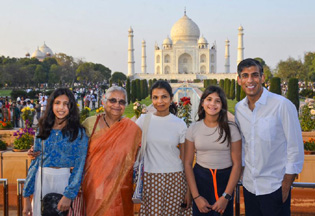
  • Indian Origin Former British PM Rishi Sunak visits Taj Mahal with family:  Sunak is on a two-day visit to Agra

    Indian Origin Former British PM Rishi Sunak visits Taj Mahal with family: Sunak is on a two-day visit to Agra

    NEW DELHI (TIP): Former British prime minister Rishi Sunak visited the Taj Mahal on Saturday, February 15, along with his daughters, wife and mother-in-law Sudha Murty. The family spent around one-and-a-half hour at the iconic monument. Sunak is on a two-day visit to Agra. The senior conservation assistant from the Archaeological Survey of India at the Taj Mahal confirmed that Rishi Sunak and his family enjoyed their visit. Both Sunak and his wife left a personal note of appreciation in the visitor’s book.

    ACP, Taj Security, Areeb Ahmed said, “Rishi Sunak and his family were provided top-tier security throughout their visit. The Taj Mahal was shown to them under strict security measures, in collaboration with the CISF.”
    (Source: PTI)

  • Agra: The land of Taj Mahal

    Agra: The land of Taj Mahal

    A walk through history, Agra is the mystical abode of all things past. Though magnificence of the Taj Mahal attracts tourists to Agra from all over the world, this city is also peppered with forts, tombs and mausoleums that make for an attractive itinerary. Nicknamed Baby Taj, the tomb of Itimad-ud-Daulah is worth a visit. A visit to the ruined city of Fatehpur Sikri, Agra Fort, and Akbar’s Tomb also deserve a place in your itinerary. Fatehpur Sikri built by Emperor Akbar requires you to keep aside a day for visit. The Agra Fort should be explored for its antiquity and display of architectural finesse. A city of dualities, Agra has also been quietly undergoing a metamorphosis of its own as new hipster neighbourhoods are cropping up throughout its length and breadth. Besides the Taj Mahal, tourists also flock to the Mehtab Bagh, which is neatly aligned with the Taj, for an enchanting view of the iconic monument on full moon nights.
    TAJ MAHAL
    The Taj Mahal is considered by many, to possess architectural beauty unsurpassed by any other structure in the world. Constructed over a period of 22 years, employing twenty thousand workers, it was completed in 1648 C.E. and costed a whopping 32 million Rupees. Built entirely of white marble, it almost seems to glow in the moonlight, with the shimmering Jamuna river situated just across. The Muslim emperor Shah Jahan built this monument in the memory of his wife Mumtaz, whose grave is housed within the premises at the lower chamber. The grave of Shah Jahan was added to it later. The Taj stands tall and regal on a raised, square platform, forming an unequal octagon with its four truncated corners. The architecture uses the interlocking arabesque concept, where each element is singular in its entirety, but integrates seamlessly with the whole. The central dome spans 58 feet in diameter and soars to a height of 213 feet. It is flanked on four sides by smaller domed chambers, and four slender minarets rising to a lower height of 162.5 feet. The entire mausoleum is decorated with an inlaid design of flowers and calligraphy using precious gems like agate and jasper, and the main archways are carved with passages from the Holy Qur’an.
    MEHTAB BAGH
    Originally built by Emperor Babur as the last in a series of 11 parks bordering the Yamuna’s east bank, this Mughal garden was conceived before even the Taj Mahal. Although it fell into disrepair owing to a flood in 1652 AD, it was reconstructed and restored to its former glory in 1996, and is now one the best spots to take in stunning views of the Taj Mahal. The gardens surrounding the Taj Mahal are perfectly aligned with Mehtab Bagh, and a large octagonal pool at the heart of the garden offers a perfect reflection of the Taj in the moonlight. Translating to mean ‘Moonlight Garden’, this is where Mehtab Bagh gets its name from.
    FATEHPUR SIKRI
    Fatehpur Sikri is a town located about 40 kilometres from Agra, and has been given the status of a World Heritage site by UNESCO. Founded in 1569 by the Mughal emperor Akbar, this was the Mughal capital from 1571 to 1585, during which the empire reached its pinnacle of success. The site was chosen to honour the Sufi saint Salim Chishti and the city within was built to honour the birth of his child, Salim. The construction of this walled city took almost 15 years to complete, and the complex included several royal palaces, a harem, courts and a mosque. The buildings have been made from red sandstone and have been designed in keeping with Persian architectural concepts, although the overall style is Mughal.
    AKBAR’S TOMB
    Sikandra Complex containing Akbar’s tomb is one of Agra’s architectural marvels. Work on it was started by Akbar in 1605, and was completed by his son jehangir after his death. Using various different styles of architecture, this beautiful and imposing tomb is located amidst a gorgeous garden, and has been constructed using red sandstones and glossy white marble inlaid in geometric patterns. The huge courtyard is entered through a stunning gateway, and features three-storey minarets in each. The tomb of Mariam Zamani, Akbar’s Christian Wife from Goa and King Jehangir’s mother, is placed nearby.
    AGRA FORT
    Aside from the Taj Mahal, Agra has one of the finest Mughal forts in India, the Agra Fort. A massive red sandstone structure located on the banks of the Yamuna River, construction on the fort was started in 1565 by the Mughal Emperor Akbar, and further additions in white marble were subsequently made up till the reign of his grandson Shah Jahan. Originally built for military purposes, it was later used as a palace, and eventually even served as a prison where Shah Jahan was confined for 8 years by his son Aurangzeb, who seized power in 1658. The fort runs along a length of 2.5 kilometres within enclosed walls, it encompasses several exquisite palaces such as the Shah Jahani Mahal, Jahangiri Mahal, Khas Mahal, audience halls named Diwan-i-Am and the Diwan-i-Khas, a Fish Pavilion, the Nagina Masjid, Garden of Grapes and the Pearl Mosque. A world heritage site, it is a testament to architecture which deserves a visit.
    ITIMAD-UD-DAULA’S TOMB
    Nicknamed the Baby Taj, the exquisite tomb of Mizra Ghiyas Beg was the precursor to the Taj Mahal. Built between 1622 and 1628, it is located along the banks of the Yamuna and was built by the Mughal queen Noor Jahan, wife of Emperor Jehangir, to commemorate her parents. It is an architectural marvel located at the heart of the well known and scenic Persian Garden. The tomb has been elegantly designed and finished in the most beautiful architectural style laid in yellow marble with black and white marble inlay. A similar tomb was later built by Noor Jahan for her husband near Lahore in Pakistan.