Tag: Tajikistan

  • Former Secretary General Ban Ki-moon, three veteran diplomats honored with 2023 Diwali ‘Power of One’ Awards at UN

    Former Secretary General Ban Ki-moon, three veteran diplomats honored with 2023 Diwali ‘Power of One’ Awards at UN

    “The ideals of Diwali are the ideals of UN Charter” : Chair of Diwali Foundation USA Ranju Batra

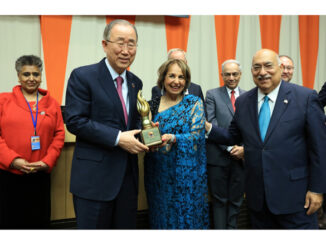
    UNITED NATIONS (TIP): Former UN Secretary General Ban Ki-moon and three veteran diplomats were honored with the annual ‘Diwali Power of One Awards’, hailed as the ‘Oscars of diplomacy’, for their selfless efforts to “help form a more perfect, peaceful, and secure world for all”. The former UN chief was honored with the Lifetime Achievement Award at the 2023 Diwali Stamp — The Power of One Award ceremony organized by the Diwali Foundation USA. The other awardees for the year 2023 are former permanent representative of Bosnia and Herzegovina to the UN Ambassador Mirsada Colakovic, former permanent representative of South Korea to the UN Ambassador Kim Sook and 72nd UN General Assembly president and EU Special Representative for the Belgrade-Pristina Dialogue Miroslav Lajcak. They were honored at a special ceremony held in the UN Headquarters on Monday, December 11.

    Former Secretary General Ban Ki-moon addressing the gathering after receiving the award. Seen, among others, are India’s Permanent Representative to the United Nations, Ambassador Ruchira Kamboj ( extreme left) , Ranju Batra (4th from left), and Ravi Batra (behind Mr. Ban Ki-moon) (Photo : Mohammed Jaffer / SnapsIndia)

    Ban commended the work and “forward-thinking vision” of the Diwali Foundation USA “for advancing vital light in a world of increasing darkness”.

    Ban said the world of today “seems fractured like never before” as he cited the COVID-19 pandemic, climate crisis and regional conflicts, particularly “regional crisis as we see today in the Middle East and Ukraine”.

    “But it is exactly at times such as these that the work of the United Nations is indispensable. The United Nations and its pursuit of peace, human rights and sustainable development exemplifies the values and principles that we should all espouse to replicate,” he said. Ban was the eighth Secretary-General of the United Nations, serving two terms as the world’s top diplomat from January 2007 to December 2016.

    He said that as the world moves into 2024 and beyond, “we share a common destiny illuminated by peace, sustainability and prosperity. Let us work together and expand our unified efforts to realize this shared destiny for all. This is your political responsibility and for me, my moral responsibility as a former Secretary General” and as an awardee of the Power of One honor.

    India’s Permanent Representative to the UN Ambassador Ruchira Kamboj, in her address to the event attended by UN diplomats, envoys, civil society members and policy experts, said that Diwali is a celebration that holds a very special place in the hearts of over a billion Indians across the globe.

    Diwali “is more than just a festival. It is a sentiment that embodies the triumph of light over darkness, knowledge over ignorance and hope over despair”, she said.

    Kamboj said, “as we light the lamps of Diwali, let us remember that every small light, no matter how small, can make a significant difference in dispelling the shadows”.

    Sri Lanka’s Permanent Representative to the UN Ambassador Mohan Pieris said “Deepawali has become truly a secular festival in the world, since its message is not exclusively restricted to any religious creed.

    “This festival has united the global community with the central message that we need more than ever the humanistic ideals to engage the inglorious wars, which are bleeding the innocence of humanity,” he said.

    Pieris underscored that for the world to have peace, it is important that the whole world must be united to save the higher ideals of humanity, which have evolved since the millennium in various religious traditions.

    Chair of Diwali Foundation USA Ranju Batra, who had spearheaded efforts for over seven years to get a commemorative ‘Forever Diwali’ stamp issued by the US Postal Service in 2016, said: “Diwali is a message of peace.” She said her journey for the Diwali stamp is seen as a “metaphor of peace and harnessing its power to promote excellence in diplomacy. The ideals of Diwali are the ideals of UN Charter”.

    She noted that the 2023 Power of One awardees have clearly demonstrated that “one person can make a difference”. The Diwali stamp celebration is not of a religion or nation but of the spirit of harmonious inclusiveness and cross-cultural understanding that all religions deserve, she said.

    Eminent Indian-American attorney and Chair of National Advisory Council South Asian Affairs and moderator of the award ceremony Ravi Batra said the UN transcends borders and boundaries.

    “The need to acknowledge excellence is critical, generally, but in diplomacy, which is on life support in today’s world, it is essential and that’s how these awards are – the Power of One,” he said, adding that they honor “world class diplomats who have changed the world by what they did”.

    Awardees and organizers of Power of One Awards (Photo : Mohammed Jaffer / SnapsIndia)

    Hailed as the ‘Oscars of Diplomacy’, the awards are presented to former Permanent Representatives or former high-level members of the UN Secretariat or member state, or soon to be “former”, who have “toiled selflessly to help form a more perfect, peaceful and secure world for all”.

    The 2023 Award ceremony was co-organized by the Diwali Foundation USA and Delegation of the European Union to the United Nations, and the Permanent Missions of Chile, Eritrea, Georgia, India, Kazakhstan, Kiribati, Morocco, Oman and Sri Lanka to the United Nations. The co-sponsors included the Permanent Mission to the United Nations of Albania, Armenia, Austria, Azerbaijan, Belarus, Bhutan, Cyprus, France, Germany, Ghana, Hungary, Iraq, Israel, Kuwait, Kyrgyzstan, Malaysia, Mexico, Nepal, Philippines, South Korea, South Africa, Spain, Tajikistan, Thailand, Turkiye, Turkmenistan, Ukraine, United Kingdom, United States, Uzbekistan, Vietnam and Palestine, and International Atomic Energy Agency (IAEA-NY) among others.

    Diwali Foundation USA was established in 2017 to promote a peaceful and consensus-based process to achieve societal “good, as befits the high hopes and ideals of humanity enshrined in the United Nations Charter”.

    The Foundation established ‘The Power of One’ awards to celebrate and highlight the important work done in a peaceful manner, especially at the United Nations.

    Previous honorees include former UN assistant secretary general and deputy executive director of UN Women, Lakshmi Puri, former UK Ambassador to the UN, Matthew Rycroft, former permanent representative of Georgia to the UN, Kaha Imnadze, and former permanent representative of Grenada to the UN Keisha McGuire.
    (Source: PTI)

    The traditional lamp lighting . Mr. & Mrs. Ban Ki-moon with organizers of Power of One Award lighted the lamp. (Photo : Mohammed Jaffer / SnapsIndia)
  • Pakistan yet to confirm India’s invitation to SCO meet

    NEW DELHI (TIP): With the ongoing Shanghai Cooperation Organisation (SCO) presidency, India has been hosting various meetings and also inviting all members, including Pakistan. However, Pakistan has skipped these meetings, barring once which it attended virtually last week (the Chief Justice meeting) but only after Pakistan downgraded its participation.
    India has sent an invite to Pakistan for the Foreign Ministers meet that would be held on May 4 in Goa but hasn’t got a response yet. Invites have also been sent to them to attend the Home Ministers’ meet and National Security Adviser (NSA) meetings on March 29 and Defence Ministers’ meeting on March 27.
    Pakistan’s foreign ministry spokesperson, regarding their participation in the foreign ministers meet, had earlier said that the country would revert to the invitation in time before the event.
    Earlier in January, Pakistan was the only country among the eight Shanghai Cooperation Organisation members that had not sent any entry for the SCO film festival that took place in Mumbai. Other members had sent 57 entries. The eight-member SCO includes India, Russia, China, Kazakhstan, Kyrgyzstan, Tajikistan, Uzbekistan and Pakistan. While Afghanistan, Belarus, Iran and Mongolia are SCO observers and Armenia, Azerbaijan, Cambodia and Nepal are SCO dialogue partners.
    From the outset, the SCO presented itself as a bulwark against “terrorism, separatism and extremism”, a language that sought to capitalise on the global counter-terrorist consensus of the 9/11 era, as well as reflecting real concerns in Beijing about threats to Chinese Communist Party power.
    However, India is part of the four-nation security Quad that includes the US, Australia, Japan and India. (ENS)

  • Conflict reflects wider global rivalries

    Conflict reflects wider global rivalries

    It is evident that both Russia and the US have done little to end the conflict in Ukraine. India has offered to join efforts to resolve the crisis amidst western concerns over an emerging Russia-China understanding on the road ahead. The US has rejected Chinese offers of mediation.

    “It is evident that both Russia and the US have done little to end the conflict in Ukraine. India has offered to join efforts to resolve the conflict amidst western concerns over an emerging Russia-China understanding on the road ahead. The US has rejected Chinese offers of mediation. Moreover, Russia will not agree to any solution which involves it losing control of its vital and historical access to the sea in Crimea. There should also be restoration of peace and harmony between Russians and Ukrainians living in southern Ukraine. It would be helpful if access to the port city of Odessa remains open for use internationally.”

    By G Parthasarathy

    Following years of inept and confused leadership by the then President Mikhail Gorbachev, the Soviet Union fell apart, resulting in its former constituent republics attaining full independence on December 26, 1991. An interesting aspect of this collapse was that large numbers of Russians continued living in virtually all erstwhile Soviet republics. Thousands of Russians still remain in their old homes, and the Russian language remains widely spoken in virtually every former Soviet republic.

    Erstwhile Soviet republics have, however, enhanced cooperation with other neighbors. Interestingly, the predominantly Muslim ones – Kazakhstan, Kyrgyzstan, Tajikistan and Uzbekistan – are members of the Shanghai Cooperation Organisation, while Azerbaijan is a dialogue partner. Historical ties with Russia, even today, play an important role across Central Asia. Russia’s western neighbors generally see greater benefit of cooperation with prosperous countries of western Europe, ranging from France and Germany to Norway, Sweden and Finland.

    Russia has no reason to object to the Soviet Union’s former European Republics (on its northern and western borders) seeking closer ties with their European neighbors, including France and Germany. Its genuine concerns arise when these neighbors enter into military alliances with the US and NATO. The principal aim of the US role in NATO is perceived as being aimed at ‘surrounding and containing’ Russia.

    The recent escalation of tensions in Europe has arisen from the sudden regard and affection of US President Joe Biden for the leadership of the young and relatively inexperienced Ukrainian President Volodymyr Zelenskyy. What has, thereby, emerged in recent years has been Ukraine’s growing security ties with the US. This has resulted in Ukraine being provided sophisticated weapons intended to give Kyiv the capabilities to challenge Russian land and maritime security interests, and pursue its own territorial ambitions on its southern shores.

    The main territorial dispute between Russia and Ukraine over the Crimean Peninsula continues. Crimea has been ruled by the Russian Black Sea Fleet since 1783. It has, thus, historically been under Russian, and not Ukrainian sovereignty, for well over two centuries now. Moreover, while Russia has sought unfettered access to the port of Odessa, it has not succeeded in this effort. But, it would be sensible if Black Sea ports are used by both countries, which do ultimately share an interest in maritime trade.

    This is particularly important for crucial wheat supplies from Ukraine and Russia to West Asia and Africa. Odessa has also been, for long, the most well-located port for India’s trade with both Ukraine and Russia. Any peace solution would naturally have to bear in mind the reality that under no circumstances will Russia agree to compromise its crucial national interests in Crimea. Moscow also has a natural interest in strengthening its historical access to the Black Sea port of Odessa.

    Tensions between Ukraine and Russia flared up when Zelenskyy was elected President of Ukraine in 2019. Zelenskyy believed that he could assert his independence from Russia through close ties with the Biden administration. During his visit to Washington in 2021, he signed a joint declaration with President Biden; it was laced with strong anti-Russian rhetoric. The joint declaration said: “Unwavering commitment to Ukraine’s sovereignty, independence and territorial integrity within its internationally recognized borders, including Crimea, and extending to its territorial waters in the face of Russian aggression.” This was an assurance of support to Ukraine for actions which would undermine Russia’s access to the sea in Crimea. This was accompanied by rapid transfer of sophisticated US military hardware to Ukraine.

    Russian President Vladimir Putin ordered his troops into southern Ukraine in February 2022 with the evident objective of seizing the cities of Luhansk and Donetsk by declaring them independent states. He, thereby, established Russia’s control over areas where the Russians are well positioned.

    There are an estimated 7.7 million Russians in Ukraine, which has a total population of 43.3 million. The Russian population resides predominantly in six southern areas of Ukraine which control Russia’s access to the sea in Crimea. The Russian Black Sea Fleet has historically been Russia’s gateway to the Black Sea, the Sea of Azov and the Mediterranean Sea.

    The poorly planned Russian military response that followed the Biden-Zelenskyy declaration, combined with massive US and NATO arms assistance to Ukraine, has threatened the historical and only Russian access to its southern seas. Russia had expected that it would rapidly take over large tracts of Ukraine, especially in Russian-dominated parts of southern Ukraine — from Crimea to Odessa. Fierce Ukrainian resistance, bolstered by arms support from the US and its NATO allies, blocked Russia’s moves westwards. More importantly, Russian positions in southern Ukraine remain under constant attack.

    Over 14 million Ukrainians have been displaced so far, with seven million now in neighboring countries. Casualties on both sides are estimated at around 3,00,000 killed or wounded. Worse still, there is substantial reason to believe the allegations, reinforced by writings of veteran American investigative journalist Seymour Hersh, that in September 2022, the Biden administration destroyed two undersea oil pipelines carrying Russian gas. This was a gross violation of the international law that requires a thorough investigation.

    It is evident that both Russia and the US have done little to end the conflict in Ukraine. India has offered to join efforts to resolve the conflict amidst western concerns over an emerging Russia-China understanding on the road ahead. The US has rejected Chinese offers of mediation. Moreover, Russia will not agree to any solution which involves it losing control of its vital and historical access to the sea in Crimea. There should also be restoration of peace and harmony between Russians and Ukrainians living in southern Ukraine. It would be helpful if access to the port city of Odessa remains open for use internationally.

    (The author is Chancellor, Jammu Central University & India’s former High Commissioner to Pakistan)

  • Fighting Terrorism is at the Top of the Agenda at the SCO Summit

    Fighting Terrorism is at the Top of the Agenda at the SCO Summit

    In the capital of Kazakhstan, Astana, a meeting of the defense ministers of the member countries of the Shanghai Cooperation Organization (SCO) was held on June 7. At the meeting, the members of the delegations made a number of statements concerning both the situation in Syria and the fight international terrorism in general.

    First of all, all the representatives agreed that Indian and Pakistani membership that will become true tomorrow, June 8, will enhance SCO’s security capabilities. Referring to international problems, the SCO participants concurred that the terrorism in a short time turned into the biggest threat to the global security. At the same time, all the members of the delegations noticed that the situation is aggravating with every passing day by numerous local conflicts in the world and by inability of the Western countries to overcome differences, to form a common and united front against this evil and to work together to build a bastion against terrorism.

    In this regard, the Syrian issue has become a key topic of the agenda during the meeting. The SCO-countries gave the highest priority to the question. A detailed briefing session was held for new Member States (India and Pakistan) on the common attitude of the participating countries to the key crisis in the Middle East. As it was noted at the meeting, it is in the Syrian Arab Republic the main forces of the Islamic State are concentrated. It was also stated that the Syrian Arab army coordinating its activities in order to ensure the success operations undermined in the end the potential of the IS fighters and Syria has been “at the forefront of fighting international terrorism” for a long time.

    Special attention was paid to the creation of de-escalation areas in Syria, which could contribute to ending the civil war and thus intensifying efforts to combat ISIS and Al-Nusra. The representatives of SCO-Member countries also noticed that practical steps are being taken to implement the agreements reached at the moment. The priority tasks, namely ensuring the monitoring of all the commitments undertaken, as well as creating conditions for the restoration of the destroyed infrastructure were also highlighted.

    The countries of the Shanghai Cooperation Organization agreed to provide support to each other in Syria and to exchange military experience in conducting counter-terrorism operations. Interaction within the SCO in the future was decided to focus on identifying and anticipating any terrorist activities.

    Inside Syria Media Center’ experts reasonably assume that the Member states will need to create joint effective managing tools to stop penetration of terrorism and radicalism into the SCO’s area of responsibility. A fair guess would be that the special attention would be paid to an operative exchange of the information available on the activities of terrorist groups.

    Such a summit is clearly useful for Syria from the point of view of practicality. People in Syria hope the talks will equip the SCO-members better to meet the challenges of terrorism. Syria needs support to be able to tackle the difficulties and to take the steps necessary for a just and lasting peace.

    SUMMARY: To be noted is that the Shanghai Cooperation Organization (SCO), or Shanghai Pact, is a Eurasian political, economic, and military organization which was founded in 1996 in Shanghai by the leaders of China, Kazakhstan, Kyrgyzstan, Russia, Tajikistan, and Uzbekistan. These countries, except Uzbekistan, had been members of the Shanghai Five, founded in 1996; after the inclusion of Uzbekistan in 2001, the members renamed the organization. On 10 July 2015, the SCO decided to admit India and Pakistan as full members. India and Pakistan signed the memorandum of obligations on 24 June 2016 at Tashkent, thereby starting the formal process of joining the SCO as the full members. Now in Astana the countries are going to become full members.

    The meeting of the SCO-defense ministers takes place once a year and the heads of the military departments have the opportunity both to share their views on the events taking place in the world and to work out a common strategy. In addition, it is possible to hold bilateral meetings to discuss in detail the plans of military cooperation on the margins of the meeting.