Tag: Tesla

  • Tesla annual deliveries fall for first time as incentives fail to drum up demand

    Tesla annual deliveries fall for first time as incentives fail to drum up demand

    Tesla reported its first fall in yearly deliveries on Thursday as lucrative year-end incentives for the Elon Musk-led EV maker’s aging line up and the new Cybertruck pickup failed to lure customers wary of high borrowing costs.
    Shares of the company fell about 6%. Musk had earlier predicted “slight growth” in 2024 deliveries and offered a range of promotions including interest-free financing and free fast-charging to boost sales.
    But reduced European subsidies, a shift in the United States toward lower-priced hybrid vehicles and tougher competition especially from China’s BYD hurt Tesla.
    Analysts at Morgan Stanley said Tesla’s aging models and higher availability of cheaper alternatives overshadowed the company’s increased promotional activities.
    Amid the slowdown in demand for EVs, Musk has pivoted his focus on building a self-driving taxi business that is expected to boost Tesla’s value.
    He also backed President-elect Donald Trump with millions of dollars in campaign donations and analysts expect easier regulations from the new administration to help Tesla in the long run.
    But with self-driving technology still under development and years away from commercialization, analysts have said Tesla would have to rely on its promised cheaper versions of current cars and the success of Cybertruck to achieve Musk’s target of 20% to 30% sales growth in 2025.
    The truck, known for its futuristic design, has been showing signs of weakness in demand.
    Tesla is yet to disclose the delivery numbers for its Cybertruck. The company said on Thursday it handed over 471,930 Model 3 and Model Y vehicles and 23,640 units of other models, including the Model S sedan, Cybertruck and Model X premium SUV.
    Overall, Tesla handed over 495,570 vehicles in the three months to Dec. 31, missing estimates of 503,269 units, according to 15 analysts polled by LSEG. It produced 459,445 vehicles in the period, down about 7% from a year ago.
    Deliveries for 2024 totaled 1.79 million, 1.1% lower than a year ago and below estimates of 1.806 million units, according to 19 analysts polled by LSEG.
    Tesla’s 2024 deliveries were ahead of rival BYD, which reported a 12.1% rise in sales of battery-electric vehicles to 1.76 million in 2023, thanks to competitive prices and a stronger push into Asian and European markets.
    TRUMP BET
    Tesla shares are coming off a strong 2024, in which they rose more than 60% after the election of Trump with strong support from Musk.
    Musk has said he plans to leverage his promised role as a government-efficiency czar under the Trump administration to advocate for a federal approval process for autonomous vehicles to replace the current state-specific laws, which he described as “incredibly painful” to navigate.
    Tesla’s Autopilot and “Full Self-Driving” technologies, which are not yet fully autonomous, have been under scrutiny due to lawsuits, US traffic safety regulator probe and a Department of Justice criminal investigation. The key concern is whether Tesla may have overstated the self-driving abilities of its vehicles.
    Tesla is also under pressure from legacy automakers. Its October registrations in Europe fell 24%, due to a tight race from Volkswagen Group, whose Skoda Enyaq SUV dethroned Tesla’s Model Y as the best-selling EV in the region, according to data research firm JATO Dynamics.
    Trump’s team is considering ending the $7,500 tax credit for consumer EV purchases, a move that could worsen the slowing shift to EVs in the US, Reuters reported in November.

  • Tesla begins hunt for sites to build car factory in India: Report

    Tesla begins hunt for sites to build car factory in India: Report

    Tesla is looking to set up a big factory in India and is sending over a team to scout for possible locations, reported The Financial Times.
    The team is expected to arrive this month to look for the factory’s location. The Elon Musk owned electric vehicle (EV) manufacturer is planning to spend between $2 billion and $3 billion on the factory.
    The team from Tesla will look at different states in India. They’re focusing on places like Maharashtra, Gujarat, and Tamil Nadu. These states already have many car factories. This development comes at a time when there’s not as much demand for electric cars, and there’s a lot of competition. Due to this, Tesla didn’t sell as many cars as people thought they would in the first three months of this year. Last month, India decided to lower the taxes on some electric cars made by companies that agree to invest at least Rs 3,700 crore and start making cars in India within three years.
    Tesla has been trying to get into the Indian market for a while now. But the Indian government said they wanted Tesla to make cars in India, not just sell them here.
    The EV manufacturer has been talking to Indian government officials for about a year now. And last June, Musk even met with the Prime Minister Narendra Modi.
    In July last year, Tesla said they wanted to build a factory in India to make a car that costs around Rs 17,30,000. They also asked for taxes to be lower on more expensive models that they want to sell in India, according to a report from Reuters.

  • Tesla shares plunge to wipe out $73 billion in market value, after dour earnings call

    Tesla shares plunge to wipe out $73 billion in market value, after dour earnings call

    London (TIP)- Shares in Tesla plunged as much as 11% after the market opened Thursday, wiping $73 billion off the company’s market value hours after it warned of slowing growth in electric car sales and an existential threat from Chinese rivals. In an earnings presentation Wednesday, the world’s most valuable automaker said its sales growth this year “may be notably lower” than last as it continued developing the “next-generation” vehicle, likely a lower-priced model.
    While it reported a sizeable 38% increase in deliveries last year compared with 2022, Tesla had previously targeted a 50% annual growth rate averaged over several years.
    Tesla’s (TSLA) financial results for the last quarter also disappointed, with adjusted earnings per share down 40% from a year earlier, and revenue, which rose 3% to top $25 billion, coming in below market forecasts.
    It was the second straight quarter the company fell short of earnings forecast by analysts, following a string of better-than-expected results stretching back to the start of 2021.
    The stock doubled in price during the course of 2023, but those gains came in during the first half of the year and Tesla shares were off to a weak start in 2024, falling 16% before Wednesday’s earnings report. The stock is currently trading at its lowest level since April last year. January 25th intraday losses were comparable to an unusually large one-day fall of 11.4% in late December 2022. At the time, investors were worried about the outlook for Tesla’s sales and profitability, as well as the health of the US economy.
    Tesla’s fourth-quarter earnings also revealed profits under pressure. The firm’s operating margin almost halved to 8.2% from the same period in 2022, driven partly by an increase in costs related to the production of the Cybertruck pickup. The new model went into production at the end of 2023.
    Dan Ives, an analyst with market research firm Wedbush, said Tesla’s earnings call provided investors with “minimal answers” to the company’s shrinking margins.

  • Indian-origin Vaibhav Taneja named Tesla CFO

    Indian-origin Vaibhav Taneja named Tesla CFO

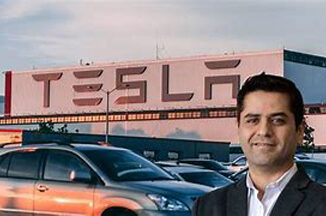
    SACRAMENTO (TIP): Indian-origin Vaibhav Taneja has been named Tesla’s new Chief Financial Officer as the previous finance chief Zachary Kirkhorn announced his decision to step down, the automaker said in a company filing on Monday, August 7. Taneja, 45, was appointed Tesla CFO in addition to his current role as Chief Accounting Officer (CAO) of the US-based electric car major on Friday after Kirhorn, Tesla’s Master of Coin and finance chief for the last four years, stepped down from the post.
    Kirkhorn’s 13-year tenure with the Elon Musk-led American EV giant was described as one of “tremendous expansion and growth” in the company filing.
    “Tesla thanks Mr. Kirkhorn for his significant contributions. Mr. Kirkhorn will continue to serve Tesla through the end of the year to support a seamless transition,” it said.
    “This morning Tesla announced that I’ve stepped down from my role as Chief Financial Officer, succeeded by our Chief Accounting Officer, Vaibhav Taneja,” Kirkhorn said in a LinkedIn post.
    “Being a part of this company is a special experience, and I’m extremely proud of the work we’ve done together since I joined over 13 years ago. As I shift my responsibilities to support this transition, I want to thank the talented, passionate, and hard-working employees at Tesla, who have accomplished things many thought (were) not possible. I also want to thank Elon for his leadership and optimism, which has inspired so many people,” he said. Taneja has served as Tesla’s CAO since March 2019 and as the Corporate Controller since May 2018. He served as the Assistant Corporate Controller between February 2017 and May 2018, and from March 2016, served in various finance and accounting roles at SolarCity Corporation, a US-based solar panel developer acquired by Tesla in 2016.
    Before that, Taneja was employed at PricewaterhouseCoopers in both India and the US between July 1999 and March 2016, the company filing said.

  • Tesla Power in pact with IOC to sell batteries

    Tesla Power USA on Thursday inked a pact with Indian Oil Corporation (IOC) to sell and service batteries at the firm’s petrol pumps. It will enable Tesla Power to sell and service batteries at over 36,000 petrol pumps across India, the US-based firm said. “To start with, Tesla Power USA batteries will be available at the select IOC fuel pumps in the Delhi-NCR region,” it added.

  • Elon Musk’s 20 Million Tesla Sales Goal By 2030 Driven By Battery Technology

    Elon Musk’s 20 Million Tesla Sales Goal By 2030 Driven By Battery Technology

    The secret behind Elon Musk’s goal of selling 20 million Tesla’s a year by 2030 lies in its pioneering battery technology. The good news is that by using bigger cells and a new process to dry-coat electrodes, Tesla could halve the cost of a Model Y battery, saving more than 8% of the car’s U.S. starting price, battery experts with ties to the company said. The bad news is that it’s only halfway there, according to 12 experts close to Tesla or familiar with its new technology. That’s because the dry-coating technique used to produce the bigger cells in Tesla’s 4680 battery is so new and unproven the company is having trouble scaling up manufacturing to the point where the big cost savings kick in, the experts told Reuters.

    “They just aren’t ready for mass production,” said one of the experts close to Tesla. Still, the gains Tesla has already made in cutting battery production costs in the past two years could help boost profits and extend its lead over most electric vehicle (EV) rivals. Musk’s promised improvements in battery cost and performance are seen by investors as critical to Tesla’s quest to usher in an era where it can sell a $25,000 EV for a profit – and stand a better chance of hitting its 2030 targets.

    Battery systems are the most expensive single element in most EVs, so making lower-cost, high-performance packs is key to producing affordable electric cars that can go toe to toe with combustion-engine rivals on sticker prices.

    Tesla is one of only a handful of major automakers that produce their own EV batteries and by manufacturing Model Y cells at U.S. plants, the SUV will remain eligible for U.S. tax credits when many rival EVs may no longer qualify.

    Among the 12 battery experts Reuters spoke with, nine have close ties to Tesla and three of the nine have examined Tesla’s new and old battery technology inside and out through teardowns.

                    Source: Reuters

  • Tesla cars can now scan for potholes to avoid damage

    Electric vehicle company Tesla has confirmed that its vehicles can now scan for rough roads, like potholes, to help avoid them damaging the vehicles by adjusting the suspension. In a new 2022.20 software update, the automaker wrote about a new feature of the “Tesla Adaptive Suspension” system, reports the auto-tech website Electrek. “Tesla Adaptive Suspension will now adjust ride height for an upcoming rough road section. This adjustment may occur at various locations, subject to availability, as the vehicle downloads rough road map data generated by Tesla vehicles,” the company was quoted as saying. This is the first confirmation of the Tesla vehicle fleet scanning the roads to evaluate its conditions. For now, it is not about Autopilot, or Full Self-Driving (FSD) Beta, navigating around those “rough road sections”, but Tesla adapting the suspension for those conditions, the report said. This feature is only going to be available in Tesla vehicles with adaptive suspension, like the new Model S and Model X Back in 2020, CEO Elon Musk said that Tesla Autopilot is eventually going to detect potholes and make mini-maps to remember them and avoid them. However, currently, Tesla Autopilot is not quite there yet, but it can be now seen as the first confirmation that Tesla’s fleet of vehicles is looking for them or more “rough road sections” in general.

  • Tesla’s job cut may save up to $1 billion yearly operational costs: Report

    San Francisco (TIP)- While tech billionaire Elon Musk recently said that Tesla would be reducing its salaried headcount by 10 per cent, a Goldman Sachs analyst says it can provide the company up to $1 billion in annual operating expenses (OPEX) savings — the company’s day-to-day expenses.
    Recently, Musk had noted that his electric vehicle company would be reducing its salaried headcount by 10 per cent as the company has become overstaffed in some areas.
    This initiative, at least according to Goldman Sachs analyst Mark Delaney, could translate into $0.225-$1 billion in annual OPEX savings, reports Teslarati.
    In a message to Tesla employees, Musk noted that while the company is reducing its headcount by about 10 per cent, staff working on key projects such as vehicle and battery production, as well as solar installations, would be unaffected by the layoffs. Hourly headcount will also be increasing.
    “Tesla will be reducing salaried headcount by 10 per cent, as we have become overstaffed in many areas. Note, this does not apply to anyone actually building cars, battery packs, or installing solar. Hourly headcount will increase,” Musk wrote in his email.
    In later comments, Musk further clarified that Tesla plans to increase its total headcount over the next 12 months, though the number of paid employees won’t likely change much.
    “Total headcount will increase, but salaried should be fairly flat,” Musk wrote.
    Delaney weighed in on Musk’s statements. According to the analyst, Musk’s comments suggest that Tesla plans to limit cost growth and not reduce its OPEX at all. This, in turn, should result in some savings for the electric vehicle maker. “Musk’s comments on Twitter of salaried headcount being fairly flat suggest the company’s plan is to limit cost growth and not reduce OPEX overall,” Delaney said.
    “Our base case assumption is for OPEX, including SBC to rise by an average of about $255 million per quarter from 2Q22 through 4Q22, by $1.9 bn in 2022 YoY, and by $2.6 billion in 2023 YoY. Each $100 million of OPEX is about $0.06-$0.08 of EPS,” Delaney added. Source: IANS

  • Tesla puts India entry plan on hold after deadlock on tariffs

    Tesla puts India entry plan on hold after deadlock on tariffs

    Tesla Inc has put on hold plans to sell electric cars in India, abandoned a search for showroom space and reassigned some of its domestic team after failing to secure lower import taxes, three people familiar with the matter said.

    The decision caps more than a year of deadlocked talks with government representatives as Tesla sought to first test demand by selling electric vehicles (EVs) imported from production hubs in the US and China, at lower tariffs.

    But the Indian government is pushing Tesla to commit to manufacturing locally before it will lower tariffs, which can run as high as 100% on imported vehicles. Tesla had set itself a deadline of February 1 to see if its lobbying brought a result, the sources with knowledge of the company’s plan said. When Narendra Modi’s government did not offer a concession, Tesla put on hold the plans to import cars into India, added the sources, who sought anonymity because the deliberations were private. Source: Reuters

  • Tesla named ‘most trusted’ brand developing fully-autonomous vehicles

    Tesla named ‘most trusted’ brand developing fully-autonomous vehicles

    Elon Musk-owned electric vehicle company Tesla was recently named the “most-trusted” brand in the pursuit of fully-autonomous vehicles, according to a new study. The study surveyed consumer perception regarding fully-autonomous vehicle technology, reports Teslarati. Fifty-six total automotive brands were options for consumers to pick in the study, a release from AutoPacific, who performed the study, said. Tesla topped the list, earning 32 per cent of the votes, beating out Toyota with 19 per cent and BMW with 18 per cent. “With 32 per cent of consumers, Tesla claims the crown for being the most trusted brand for developing safe and reliable fully-autonomous vehicles,” the study said. “This likely can be credited to much more ‘buzz’ surrounding the automaker’s pricey and controversial Full-Self Driving driver assistance tech in which current Tesla owners are able to sign up as volunteers and help demo the Level 2 semi-autonomous hands-free capability for Tesla’s own R&D efforts,” it added.

    Source: IANS

  • India, Tesla in ‘weird stalemate’ on tax cut demands with no investment pledge

    India, Tesla in ‘weird stalemate’ on tax cut demands with no investment pledge

    New delhi (TIP)- Tesla is desperate to import and sell its electric vehicles in India and has for nearly a year lobbied officials in New Delhi to reduce tariffs, which the company’s billionaire CEO Elon Musk says are among the highest in the world. But Indian official sources said they have been unconvinced by Tesla’s lobbying as the company has not yet shared any firm plan to invest in the country, something that would be in line with Prime Minister Narendra Modi’s “Make in India” vision to boost local manufacturing and create jobs.

    A third person with direct knowledge of Tesla’s thinking said the discussions with the Indian government have reached a “weird stalemate situation”.

    “Things are not moving ahead (for Tesla),” said the person.

    The sources declined to be identified as the discussions are private.

    The apparent deadlock could upset the electric carmaker’s ambitions for the South Asian country as it was pinning hopes on lower import taxes to make its cars more affordable and the business viable.

    Currently, India levies an import tax of as high as 100 percent on electric vehicles which have a so-called landing cost – a car’s price plus inbound shipping charges – of $40,000 (roughly Rs. 30 lakh) or more.

    This would make India the most expensive market for Tesla cars in the world, putting them well out of reach for most Indian consumers. The third source said Tesla has told officials it is open to sourcing more auto components locally and eventually moving towards manufacturing, but the government sources have indicated they want firm commitments. “If they do not want to invest anything here, how is that model going to work,” said one senior Indian government official, who added that a cut in the import duty was “highly unlikely” anytime soon.

    Tesla did not respond to a request for comment. PM Modi’s office and India’s ministries of finance and industries, which are all reviewing Tesla’s demands, did not respond to a request for comment.   Source: Reuters