Tag: Thailand

  • India, APEC and the US

    India, APEC and the US

    The major focus during the Asia Pacific Economic Cooperation (APEC) meeting in Manila, Philippines on November 18th and 19th would be on the Paris terror attacks though it is a trade promotion group that does not delve into security issues. The regional tensions in the South China Sea would be coming to some sort of attention indirectly despite Chinese efforts to block any discussion.  The issue of enlarging the membership and India’s pending membership application will most probably again be relegated to the background. Both China and the US will raise their pitch to sell their version of free trade blocks. China will try to sell its proposal for the Free Trade Area for Asia-Pacific (FTAAP) which excludes India and the US will do the same for the Trans-Pacific Partnership (TPP) which currently excludes China. Prime Minister Narendra Modi had raised the issue of Indian membership in the APEC with President Barack Obama in January 2015, when Obama visited India as the guest of honor for India’s Republic Day parade. President Obama expressed verbal support for India’s membership in the APEC at that time.


    The APEC was initially floated in 1989 by an Australian initiative and had 12 founding member economies: Australia, Brunei Darussalam, Canada, Indonesia, Japan, Korea, Malaysia, New Zealand, the Philippines, Singapore, Thailand and the United States. In 1991, China, Hong Kong, China and the Chinese Taipei (Taiwan) joined the APEC as a regional package. Mexico and Papua New Guinea followed in 1993. Chile was allowed to join the APEC in 1994.  Peru, Russia and Viet Nam joined the APEC in 1998, taking its full membership to 21 economies. The group acts with consensus in making decisions. APEC is more a trade promotion group and its recommendations are not binding on the member economies.


    The APEC’s mission statement reads: “Our primary goal is to support sustainable economic growth and prosperity in the Asia-Pacific region. We are united in our drive to build a dynamic and harmonious Asia-Pacific community by championing free and open trade and investment, promoting and accelerating regional economic integration, encouraging economic and technical cooperation, enhancing human security, and facilitating a favorable and sustainable business environment. Our initiatives turn policy goals into concrete results and agreements into tangible benefits.”


    The APEC put a moratorium on new memberships in 1997 for a period of 10 years though India’s membership application was pending. The moratorium was extended for another three years in 2007. However, for inexplicable reasons the APEC economies have not bothered to deal with the issue of further enlargement.  Especially India’s application for the membership has been pending with the APEC for last 20 years without approval. Every year since 2010, India has been looking expectantly for the APEC to consider India’s application for membership but nothing concrete has materialized owing to passive obstruction and stonewalling.


    Mainly, two arguments are used against India’s membership that India is not part of Asia-Pacific region and that India has proved to be an obstacle during negotiations in various international trade reforms/regimes. India had bargained tough during the Doha round and the Bali round of the WTO negotiations. Both these arguments are fallacious and self-serving. One fails to understand where countries like Thailand and Brunei have either land or sea borders with the Pacific Ocean? Or being a member of the ASEAN qualifies these two countries for the APEC membership! One also needs to ask a rhetoric question if India is an Asian country or not?  India is not located on the moon! Since the concept of Asia-Pacific has already been substituted by a larger strategic concept of the Indo-Pacific, there is no reason to continue to withhold India’s membership of the APEC on geographical grounds alone. Without India’s participation, there is no Indo-Pacific economy and hence no Asia-Pacific economy!


    India introduced market reforms initially in 1991 when China was allowed to join as a member. India has gradually introduced more market reforms & liberalization and that is the reason India applied for the membership of the APEC. It is true that Indian economy was largely socialistic prior to 1991 but so were China’s, Russia’s and Vietnam’s. Indian membership of the APEC would provide an incentive to continue further deeper economic liberalization. India has been a founding member of the WTO as well as of its previous incarnation of the GATT (General Agreement on Trade and Tariffs) since its inception. Interestingly, Russia is a part of the APEC since 1998 though it still does not qualify for the WTO membership as a market economy. China was allowed to join the WTO only in year 2000 despite being a member of the APEC since 1991. There seems to be some sort of unstated cooperation between both the US and China to continue to go slow on India’s membership of the APEC.

    A number of US based analysts have exhorted the US to champion India’s cause in the APEC for membership as a step toward eventual inclusion in the TPP.  Kevin Rudd, the former Australian PM and head of the CII-Asia Society Task Force  opined that the APEC misses much by not having India on board. Clarifying that APEC is not a free-trade body, Rudd said, “APEC is not a platform for market access negotiations, or a trade negotiating forum, but voluntary association of economies”. We, in India, can understand China’s reflexive and habitual pattern of opposition to India’s membership for any international arrangement with strategic implications because China is an adversary and a strategic threat. India does not perceive the US as an adversary in the post-cold war scenario. In fact, Pew Research on public opinion has consistently shown Indian public considering the US as one of the most  friendly nations.


    The US Deputy Assistant Secretary of State and Senior Official for the APEC Matt Matthews on November 2nd 2015 dampened cold water on India’s membership by categorically stating that it is not on the agenda of the APEC meeting in Manila in Philippines, on November 18 and 19. He further stated: “I do not believe there is any active consideration within APEC for expanded membership in the current time”. When reminded that President Obama had “supported” India’s desire for membership of the APEC during his 2015 visit to India on Republic Day, Matthews said the US had so far only welcomed “India’s interest” in joining the APEC. “It is important to be careful and accurate about describing President’s comment. President welcomed India’s interest in the APEC. That speaks for itself. We welcome India’s examination of APEC. We have not entered [into any] discussion about it. I do not believe India is formally pressing for actual membership now in APEC,” he said.


    India needs to hold the US to its words. The US must stop playing word games like China. The US expects too many unilateral concessions from India without delivering anything in return. The US, after signing the civil nuclear deal in 2005 and after ratifying the same in 2008, has not been able to shepherd India’s membership of the NSG, the MTCR, The Australia Group and the Wassenaar arrangement. The US has also made verbal promises to support India’s permanent membership of the UNSC. However, there is no concrete effort or will to make it implemented into reality despite a lot of rhetoric from the US. The proof of the US goodwill should reflect in active and actual support for India’s membership for the most benign of these international arrangements. Being an active member of the APEC will help India transform its domestic economy into full-fledged market economy. It will also prepare India for additional economic reforms so to obtain eventual membership of the RCEP or the TPP or the FTAAP.


    India and the US have had a legacy of trade disputes within the WTO. US trade representatives have invoked the Special 301 Priority Foreign Country designation for India. If the US continues to show a pattern of passive indifference and obstruction to India’s membership of the APEC while using the flowery rhetoric akin to China, India may have to utilize more aggressive marketing and trading strategies. Let it be known to everyone including the US that trade wars and denial of market access is as a detrimental as a hot war in the modern context. If you don’t support us, you are against us in our pursuit of market access. Since India and the US have now formalized an annual Strategic and Commercial dialogue, perhaps, the US performance in its active support to India’s membership of the APEC needs to be carefully monitored annually. Preferential trade access to Indian market for the US must be made contingent upon US behaviors towards India’s membership in the APEC and other free trade groups.

    To paraphrase and plagiarize Carla Anderson Hills, the former US trade representative: We (India) will be ready to open the APEC and other trade-blocks with a crowbar if necessary, but with a Namaste if possible!


    (The author is President, The Council for Strategic Affairs, New Delhi, India, an independent and privately funded Indian think-tank. He can be contacted at adityancsa@gmail.com)

  • Gangster Chhota Rajan says never surrendered, wants to return to India

    Gangster Chhota Rajan says never surrendered, wants to return to India

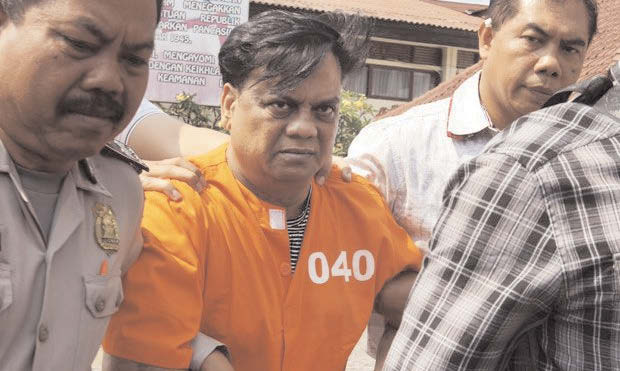
    BALI/MUMBAI (TIP): Underworld don Chhota Rajan, who has been arrested after being on the run for over two decades, claimed on October that he did not surrender and wants to return to India.

    There is intense speculation that the arrest of the gangster, who is wanted in over 75 heinous crimes ranging from murder, extortion to smuggling and drug trafficking, was part of a “deal” with Indian security agencies.

    “I never surrendered. I want to go back to India. Don’t want to go to Zimbabwe,” the one-time trusted aide of terrorist and crime boss Dawood Ibrahim told reporters.

    Rajan, one of India’s most wanted gangsters, was arrested in  Indonesia’s tourist destination Bali on a Red Corner Notice issued by Interpol after eluding law enforcement agencies for over two decades.

    Of these 75 cases, Rajan is facing four cases under Terrorist and Disruptive Activities (Prevention) Act (TADA), one under Prevention of Terrorism Act (POTA) and over 20 cases under the stringent Maharashtra Control of Organised Crime Act
    (MCOCA).

    Indian security agencies are likely to send a team of officials to Bali to bring back the gangster who has been in custody since Sunday.

    The sources are tight-lipped about the arrangements to bring him back because of security concerns arising out of his fierce rivalry with underworld don Dawood Ibrahim and his gang.

    They said agencies are working on more than one plan to bring back 55-year-old Rajan, once known as Dawood’s right hand man, factoring various permutations and combinations.

    Rajan was traveling with the identity of Mohan Kumar with passport number G9273860 when he was apprehended at the airport in Bali, after arriving there on a Garuda Indonesia flight GA715, by the Indonesian Police on a tip-off from Australian authorities, they said.

    The sources said Rajan was in touch with various police officials for the past six months seeking a passage to return to India as he feared for his life in Australia from Chhota Shakeel, a henchman of Dawood.

    In 2000, there was an attempt on his life when Dawood’s men tracked him down to a hotel in Bangkok but he managed a dramatic escape through the hotel’s roof.

    According to serving and former police officers, who have dealt with the Mumbai underworld, arrest of Rajan is a major success and his questioning is expected to shed light on hitherto unknown facts related to cases linked to his syndicate.

    Chhota Rajan assets worth over Rs 4,000 crore, claims Mumbai police

    Mumbai Police officials estimate Chhota Rajan’s current net worth to be in the range of Rs 4,000-5,000 crore. Fifty per cent of the investments are in India, especially in Mumbai and its satellite towns, they say. “According to our reports, Rajan owns a hotel in China, a few jewellery shops in Singapore, Thailand and a hotel in Jakarta. He has also invested in diamond trade in African countries, especially Zimbabwe,” said a senior Mumbai Police official.

    Sources claimed that Rajan tried to strike a deal with some officials from Zimbabwe to seek refuge in that country.

    But Zimbabwe did not want to be seen giving refuge to anyone who was wanted in India. “We found that he asked for Z-plus protection which was denied by them,” claimed the official.

    “The officials with whom Rajan negotiated promised to provide the best of health facilities but refused to extend security cover. Rajan suspected that he would eventually be tracked by the Dawood gang, and did not want to be attacked when he was at his weakest — while undergoing  dialysis for kidney failure,” said a source.

  • VK Singh sparks row with ‘dog’ remark on Dalit deaths, apologizes

    VK Singh sparks row with ‘dog’ remark on Dalit deaths, apologizes

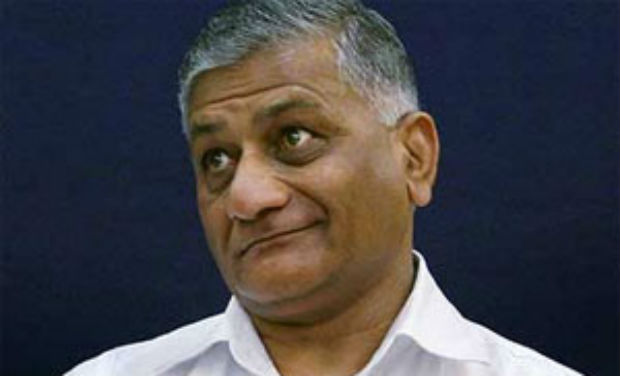
    NEW DELHI (TIP): BJP’s run of controversial statements continues with minister of state V K Singh’s ill-phrased comment that the government cannot be held responsible if a stone is thrown at a dog – in the context of the murder of two dalit children in Faridabad – inviting a storm of criticism from opposition parties. Though Singh tried to initially defend his remarks, by late evening he apologized for them. Sources said his fuller apology came after BJP chief Amit Shah spoke to him.

    “I will be very clear on this that in case, because of this mixing up of two things, which someone else has done, if somebody’s feelings have been hurt, I am apologizing for it. Because some people have created a totally different picture altogether, which was never there. I had no intention of hurting anybody. Because of this imaginative linking of somebody if somebody’s feelings have been hurt, I apologize whole-heartedly,” Singh told ANI before flying to Thailand on a ministerial assignment.

    The opposition pounced on Singh’s comments and demanding he be sacked. The issue resonated in Bihar as well where RJD chief Lalu Prasad came down heavily on the minister and BJP at a time when the NDA feels a significant section of dalits are finally moving towards it. Singh’s made the controversial remarks when he was in Ghaziabad, the constituency he represents in the Lok Sabha.

  • Stolen diamond found in woman’s intestine

    BANGKOK (TIP): The good news for the Chinese visitor to Bangkok was that a doctor had successfully removed a foreign object from her large intestine that could have damaged her digestive system. The bad news -It was a 10 million baht ($278,000) diamond the woman was accused of stealing from a jewelry fair, adding a piece of rock-hard evidence to the case against her. Police colonel Mana Tienmaungpak said on Sunday that authorities got to the bottom of the theft when a doctor wielding a colonoscope and the medical equivalent of pliers pulled the 6-carat gemstone from the large intestine of the woman alleged to have filched it, after nature and laxatives failed to get it out. The woman, identified as 39-year-old Jiang Xulian, and a Chinese man were arrested on Thursday night at Bangkok’s Suvarnabhumi Airport on their way out of Thailand on the basis of surveillance video from the fair just outside Bangkok, where earlier that day the duo allegedly switched a fake stone for the real one after asking to inspect it. The suspects initially denied involvement, but X-rays showed a gem-like object in the woman’s intestine, and she then confessed. If convicted, the two face up to three years in prison, according to police. Mana, the chief investigator for the case, said the woman agreed to Sep 10 delicate operation after being told the gemstone risked injuring her.

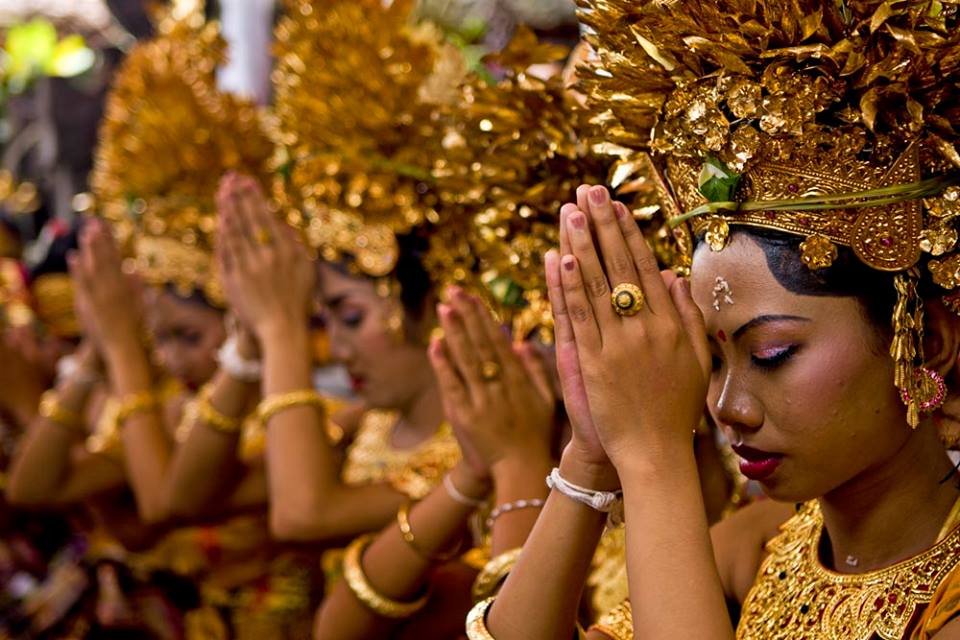
  • Thailand to hold rites of five religions for blast victims

    BANGKOK (TIP): Thailand on August 20 said it will hold religious rites from five different faiths, including Hinduism and Sikhism, in memory of the 20 people who were killed in the devastating bombing at the popular Lord Brahma temple here.

    Bangkok Metropolitan Administration (BMA) will hold Buddhist, Christian, Islamic, Sikh and Hindu rites at the Ratchaprasong Intersection where the open air shrine is located early tomorrow, said Supranee Satayaprakorb, director of the BMA’s Culture, Sports and Tourism Department.

    Meanwhile, repairs to Brahma statue which was slightly damaged in Monday’s bomb blast will begin soon.

    Department inspectors from the Office of the Traditional Arts examined the damage to the shrine and statue this week and estimated repairs would take about two weeks.

    The explosion that killed 20 people and wounded 123 caused minor damage to the Brahma statute, said Bovornvet Rungrujee, director-general Fine Arts Department.

    The inspection has found the blast impacted the figure in 12 places. Only the chin was broken and a glass window at the shrine was damaged, Rungrujee said.

    It is not necessary to move the statue from the shrine. Craftsmen will start repairs on Monday, he added.

    Plaster will be used to patch the statue’s face and other damaged parts.

    Brahma temple, one of the most popular tourist attractions in Bangkok, was reopened yesterday for worshipers and tourists three days after the blast rocked the shrine.

  • US Team with two Indian Americans win International Mathematical Olympiad after 21 years

    US Team with two Indian Americans win International Mathematical Olympiad after 21 years

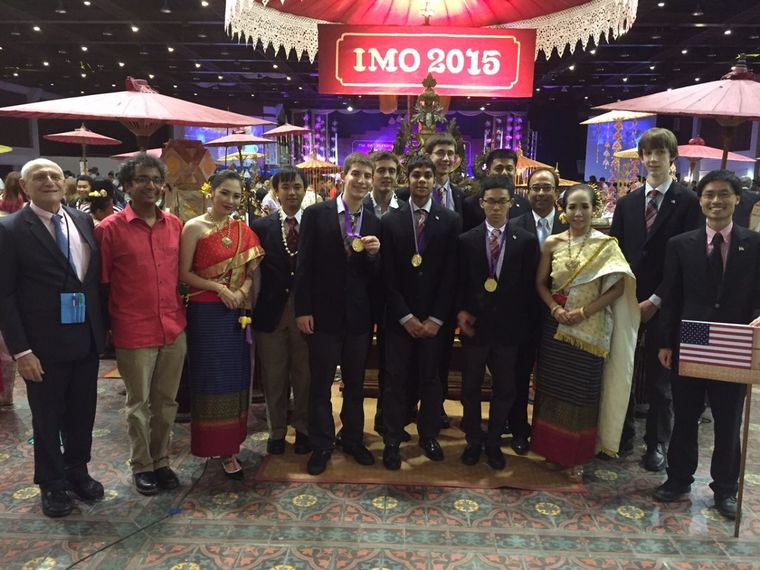
    The United States is number one in math after 21 years. A six-person team of young adult Americans Team USA led by Carnegie Mellon professor Po-Shen Loh bested teams from China, South Korea, and more to win the 2015 International Mathematical Olympiad (IMO) held in Thailand this month which was hailed as the “hardest ever” competition by The Guardian.

    The White House even tweeted, “Go Team USA! America took first place in the International Mathematical Olympiad for the first time since 1994,” with an attached photo of a letter of congratulations from President Barack Obama.

    Indian Americans Shyam Narayanan, 17, and Yang Liu, 18, were part of the six-member team that rose to the top at the IMO, a feat that hasn’t been accomplished by the U.S. team since 1994.

    Narayanan’s parents are of Indian origin while Liu’s father is Indian  and his mother is chin ease.

    Members of the U.S. team included Ryan Alweiss, Allen Liu, Yang Liu, Narayanan, and David Stoner, all of whom were awarded gold medals; and Michael Kural, who earned a silver medal, just one point away from the gold.

    According to the Mathematical Association of America (MAA), the competition involves six problems taken in sets of three during 4.5 hour sessions (held across two days)—no calculators. Each team member attempts the problems, and team totals are based on the number of points each individual scores. The US earned 185 to take the gold while China earned runner-up honors with 181. It’s the US’s fifth victory overall. China has the most competition wins with 19 all-time, including winning four of the last five competitions heading into the 2015 edition.

  • Indian American Professor R Paul SIngh named World Agriculture Prize laureate

    Indian American Professor R Paul SIngh named World Agriculture Prize laureate

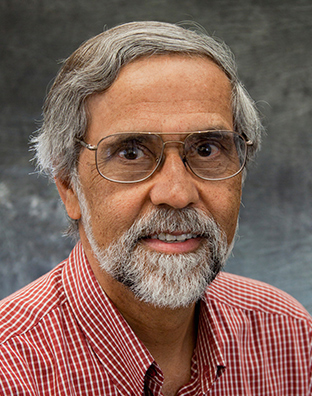
    Indian American Professor Emeritus R. Paul Singh who has held dual appointments in the departments of Biological and Agricultural Engineering and of Food Science and Technology at the University of California, Davis, has been named as the 2015 Global Confederation for Higher Education Associations for Agriculture and Life Sciences World Agriculture Prize laureate.

    The award was announced at the annual GCHERA conference, held June 24-26 at the Holy Spirit University of Kaslik, Jounieh, Lebanon. Formal presentation of the award will take place Sept. 20, during a ceremony at Nanjing Agricultural University, Jiangsu Province, China.

    “I’m deeply humbled and honored, upon receiving news of this award,” Singh said. “I’m proud of my students, postdoctoral fellows and visiting scientists for their numerous contributions to our research program. I’m also indebted to my UC Davis colleagues for their consistent support, which has allowed me to pursue my research and teaching activities in food engineering.”

    Singh earned a bachelor’s degree in agricultural engineering at India’s Punjab Agricultural University, then a master’s degree and Ph.D. at the University of Wisconsin-Madison and Michigan State University, respectively. He joined the UC Davis faculty one year later, in 1975.

    “For over four decades, Professor Singh’s work as a pioneer in food engineering has been improving lives the world over,” said UC Davis Chancellor Linda P.B. Katehi. “This prestigious, and well-deserved, honor is a testament to the importance of his research, and UC Davis is tremendously honored to call him a member of our faculty.”

    Singh became recognized for a body of research in areas such as energy conservation, freezing preservation, postharvest technology and mass transfer in food processing. His research on airflow in complex systems helped design innovative systems for the rapid cooling of strawberries, and his studies on food freezing led to the development of computer software that is used to improve the energy efficiency of industrial freezers. Under a NASA contract, his research group created food-processing equipment for a manned mission to Mars.

    He has helped establish and evaluate food-engineering programs at institutions throughout the world, including in Brazil, India, Peru, Portugal and Thailand. As of June 2015, his 115 video tutorials have been viewed more than 150,000 times by individuals from 193 countries.

    In recent years, his research focused on the physical mechanisms responsible for the digestion of foods in the human stomach, with an eye toward developing the next generation of foods for health.

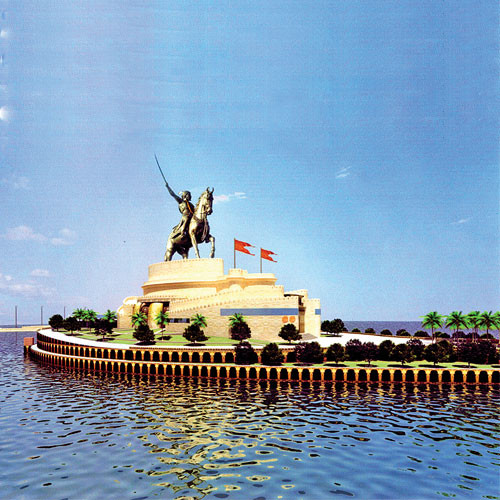
  • Statue of Shivaji in Arabian Sea by 2019- Maharashtra CM Phadnavis

    Statue of Shivaji in Arabian Sea by 2019- Maharashtra CM Phadnavis

    NEW YORK (TIP): Chhatrapati Shivaji’s statue, off the coast of Mumbai in Arabian Sea will come up by 2019. Devendra Phadnavis, Maharashtra Chief Minister, disclosed it to The Indian Panorama Chief Editor Prof. Indrajit S Saluja in a meeting the latter had with him in New York on June 29.

    Phadnavis visited June 29 the Liberty Island to see the Statue of Liberty, a colossal neoclassical sculpture in New York Harbor, to commemorate liberty, fraternity and equality. Maharashtra will have, by 2019, a colossal statue of Shivaji in the Arabian Sea, off the coast of Mumbai, to commemorate the golden period of rule of the Maratha King, who had fought relentlessly against the attempts of the Mughal emperors to enslave the people of Maratha region. Shiva Ji is regarded as a great warrior in the true Indian tradition and is ranked with the greatest heroes of Indian history, like Maharana Pratap and Guru Gobind Singh. The height of the latest tribute to the Maratha king will be 200 meter, making it taller than the Statue of Liberty, which is 93 meter.

    The Congress-led Democratic Front government in Maharashtra had first made an announcement on Shivaji memorial in 2004. The decision to install the statue was taken by the Congress government in August, 2009. It was to come up on a 16-hectare bedrock in the Arabian Sea. The Navy had opposed the project citing restrictions on construction in the Coastal Regulatory Zone.

    Planned on the lines of the Statue of Liberty in New York and the Swami Vivekananda Rock Memorial in Kanyakumari, the Shivaji statue is to be located off the Marine Drive. The government had then approved the design submitted by Bensley Design Studios, Thailand and Team One Architects, Mumbai. The government had also approved   a sum of INR50 crore for the memorial in 2009-10 and budgeted INR300 crore more the next year. A museum of the Maratha king is to be a part of the project.

    The then Chief Minister of Maharashtra Prithviraj Chavan had claimed that the statue would be the world’s tallest, twice the size of the Sardar Patel statue championed by Prime Minister Narendra Modi in Gujarat. However, the project had remained dormant in view of environment ministry sitting over it.

    When the BJP led NDA government came to power at the center in 2014, the project was expeditiously cleared. The Environment ministry okayed, on December 4, 2014 Shivaji statue in Arabian Sea. Union Minister of State for Environment and Forest Prakash Javadekar said the clearance has been given and a notification for the same would be out soon. “The issue of having a statue of Shivaji Maharaj, which was pending for the last few years, has been sorted out. The chief minister of Maharashtra (Devendra Phadnavis) had discussion with me a few days back and I had assured him to expedite the process soon.

    “We have given clearance for the issue and a notification would be out by Friday night,” Javadekar had then told a news conference in New Delhi.

  • China says ‘Golden Triangle’ source of most dangerous drugs

    BEIJING (TIP): China says Southeast Asia’s lawless `Golden Triangle’ region remains the overwhelming source of the heroin and methamphetamine used in the country.

    A Cabinet report on China’s drug situation released Wednesday underscores the threat posed by the region incorporating parts of Laos, Myanmar and Thailand, despite efforts at cross-border cooperation.

    It said that 90% of the 9.3 tons of heroin and 11.4 tons of methamphetamine seized in 2014 came from the area that borders China’s southern province of Yunnan.

    The report is the government’s first comprehensive look at drug use in China, where synthetic drugs such as methamphetamine and ketamine have overtaken heroin in popularity. It said China has about 3 million registered drug users, but estimates of those who have tried drugs run as high as 14 million.

  • Bangladesh to set up courts to try people smugglers

    DHAKA (TIP): Bangladesh is moving to set up seven special courts across the country to try people smugglers charged with trafficking desperate migrants to Southeast Asia on rickety boats, a minister said on May 28.

    Law and justice minister Anisul Huq said a court would be established in each of the country’s provinces following a recent spike in trafficking of Bangladeshis and Rohingya from neighbouring Myanmar.

    “There will be seven tribunals to try traffickers,” Huq told AFP by phone, without giving a timeline for them to start operating.

    The move comes after Prime Minister Sheikh Hasina on Sunday slammed the country’s economic migrants, calling them “mentally sick” for fleeing in search of jobs, and accusing them of hurting the country’s image.

    Hasina called on authorities to halt the flow of migrants and take action against human traffickers.

    An official also said on Wednesday that Bangladesh planned to relocate thousands of Rohingya refugees, who are sheltering in two camps in the southeastern district of Cox’s Bazar, to Hatiya island in the Bay of Bengal.

    Bangladesh’s police and border forces have launched a crackdown on the smugglers in recent weeks after the discovery of mass graves of migrants in Thailand.

    Authorities have shot dead at least five suspected traffickers and arrested more than 100 others.

    Hundreds of trafficking cases have also been piling up in the lower courts since Bangladesh enacted an anti-human trafficking law in 2012 which stipulates the death penalty for the worst offenders.

    Southeast Asia is currently battling an exodus of boat people fleeing persecution and poverty.

  • Over 120 killed in Thailand during Songran festival

    BANGKOK (TIP): Over 120 people have been killed and 1,281 injured in Thailand as thousands began their annual journey to their hometowns to celebrate the three-day water festival of Songkran heralding the Thai New Year.

    The water festival, which officially began today, started Friday evening as Thais took trains, planes, cars and bikes to head home to their parents and families, resulting in several road accidents which have so far claimed 121 lives.

    Bangkok and the northern town of Chiangmai are favourite destinations of foreign tourists who have come to take part in the festival. Life comes to a standstill in several countries in the region including Myanmar, Laos and Cambodia where the festival is celebrated. Instead of oil, talcum powder mixed in water is used and splashed at people. So far 1,281 injured in traffic accidents. Meanwhile, almost 2,000 policemen are keeping a watch around the backpacker haven of Khaosan and Silom area in downtown where Songkran revellers gather to celebrate.

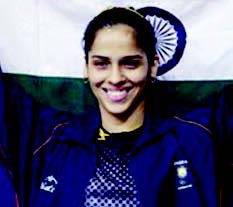
  • Saina Nehwal is World No. 1 badminton player

    Saina Nehwal is World No. 1 badminton player

    NEW DELHI (TIP): Indian ace Saina Nehwal’s ascent to the top of women’s badminton was
    officially confirmed on Thursday, April 2, with the release of the latest rankings by the game’s international governing body.

    In becoming the first Indian woman shuttler to attain the number one spot in world rankings, Saina took over the reins from China’s Li Xuerui, who slipped to third with Spain’s Carolina Marin claiming the second position.

    Saina, who had clinched the India Open Super Series title on March 29, was already assured of the top spot after her closest challenger for the position, Carolina, lost in the semifinals.

    Saina thus becomes only the second Indian overall to be world number one after Prakash Padukone had the distinction of being the numero uno men’s badminton player.

    Rising women’s shuttler PV Sindhu held her ninth position.

    Saina, who shuttled past former world champion Ratchanok Intanon of Thailand 21-16, 21-14 in the summit clash at the Siri Fort Sports Complex had said: “I think the consistency with which I am playing is great. I reached three finals in last two months and it is not easy.””Titles makes me hungry. Next I hope to win more and more titles, I hope to be fit and injury free. This result will motivate me to win more titles.”

    The London Olympic bronze-medallist has won a staggering 14 international titles in her glorious career and most recently became the first Indian woman to make the finals of the prestigious All England Championships in Manchester.

    In the men’s category, India Open Super Series winner Kidambi Srikanth stayed at the fourth spot with China’s Chen Long leading the rankings chart.

  • Rally in demand of Hindu Holidays on Friday 10 April

    In demand for Hindu Holidays in NYC schools, multiple Hindu groups in NYC will hold a ‘Grand Rally’ in front of City Hall on Friday, 10th April 2015 at 12 noon. The organizers are mostly Bangladeshi groups and had requested all other groups from any country to join.

    Organizers are expecting a huge crowd from at least 2 dozens organizations and requested everybody to join with their banner. The organizers planned to handover a memorandum to the Mayor on the same day.  

    Organizer Sitangshu Guha informed that they had sent memorandams to almost all city council members which stated that, NYC is home to about 1 million Hindus who are the immigrants  from India, Bangladesh, NepalSri LankaBhutan, Indonesia, Thailand, Malaysia, Afghanistan, the Caribbean (TrinidadGuyanaSuriname), Fiji, South Africa and African continent,  and other countries; and their descendants, followed by the thousands of American adherents of the ISKCON movement (the Hare Krishna group). It added, Hindu holidays are traditionally marked by various cultural festivities and spiritual retreats that promote and celebrate human excellence. Moreover, Hinduism propagates self-awareness and fosters tolerance, healing, and peaceful coexistence. The memorandum also pointed out that, when the city schools are closed on holidays of other faiths, not doing so on the Hindu holidays is akin to discrimination. 

    For more info: Sitangshu Guha  guhasb@gmail.com; & 646-696-5569; Shyamal Chakraborty 917-415-9261; Sushil Saha 646-454-1882; Suvo Roy 646-463-9282 & Pradip das 718-674-4545. Pradip Malaker 646-479-5275

  • By 2050, Hindus will become the world’s third largest population: Study

    By 2050, Hindus will become the world’s third largest population: Study

    WASHINGTON (TIP): Hindus will become the world’s third largest population by 2050, while India will overtake Indonesia as the country with the largest Muslim population according to a new study. According to the Pew Research Center’s religious profile predictions assessed data released on Thursday, the Hindu population is projected to rise by 34 per cent worldwide, from a little over 1 billion to nearly 1.4 billion by 2050.

    By 2050, Hindus will be third, making up 14.9 per cent of the world’s total population, followed by people who do not affiliate with any religion, accounting for 13.2 per cent, the report said.

    The people with no religious affiliation currently have the third largest share of the world’s total population.

    Muslims are projected to grow faster than the world’s overall population and that Hindus and Christians are projected to roughly keep pace with worldwide population growth, the report said.

    “India will retain a Hindu majority but also will have the largest Muslim population of any country in the world, surpassing Indonesia,” it said.

    “Over the next four decades, Christians will remain the largest religious group, but Islam will grow faster than any other major religion,” according to the report.

    The report predicted that by 2050 there will be near parity between Muslims (2.8 billion, or 30 per cent of the population) and Christians (2.9 billion, or 31 per cent), possibly for the first time in history.

    There were 1.6 billion Muslims in 2010, compared to 2.17 billion Christians.

    “The number of Muslims will nearly equal the number of Christians around the world,” it added.

    If the trend continues, Islam will be the most popular faith in the world after 2070, it said.

    By 2050, Muslims will make up about 10 per cent of the Europe’s population, up from 5.9 per cent in 2010.

    Over the same period, the number of Hindus in Europe is expected to roughly double, from a little under 1.4 million (0.2 per cent of Europe’s population) to nearly 2.7 million (0.4 per cent), mainly as a result of immigration, it said.

    In North America, the Hindu share of the population is expected to nearly double in the decades ahead, from 0.7 per cent in 2010 to 1.3 per cent in 2050, when migration is included in the projection models. Without migration, the Hindu share of the region’s population would remain the same.

    Buddhism is the only faith that is not expected to increase its followers, due to an ageing population and stable fertility rates in Buddhist countries, such as China, Japan and Thailand.

    The projections considered fertility rates, trends in youth population growth and religious conversion statistics.

  • India spank Singapore 10-0, to face Thailand in HWL R2 semis

    NEW DELHI (TIP): Vandana Katariya scored four goals, including a hat-trick as India continued its impressive run and spanked lowly Singapore 10-0 to storm into the semifinals of the Hero FIH Women’s World League Round 2 on March 12.

    Vandana (17th minute, 48th, 56th, 57th) scored four field goals, while Poonam Rani (4th), Navjot Kaur (6th), Anupa Barla (19th), Deepika (32nd), Rani Rampal (35th) and Jaspreet Kaur (51st) also registered their names in the scoresheet to steamroll the hapless Singapore girls in the one-sided quarterfinal encounter at the floodlit Major Dhyan Chand National Stadium.

    In other quarterfinals of the day, Malaysia defeated Ghana 2-0, Thailand got the better of Kazakhstan 4-3 in a thrilling encounter, while Poland thrashed Russia 4-2.

    In the first quarterfinal of the day, Malaysia scored two goals through a penalty corner conversion by Norazlin Sumantri (3rd minute) and Hanis Onn (25th) to progress to the last four round.

    Later in the day, the Thai girls put up a spirited show to eke out a narrow win over Kazakhstan.

    For Thailand, Boonta Duangurai (10th), Kanyanut Nakpolkrung (21st), Tikhamporn Sakunpithak (41st) and Sirikwan Wongkeaw (47th) were the goal scorers while Kazakhstan’s goals came from the sticks of Natalya Sazontova (22nd), Vera Domashneva (26th) and Irina Dobrioglo (50th).

    In the third last eight match between Poland and Russia, the Polish girls raced to a 4-0 lead through goals from Oriana Walasek (6th), Natalia Wisniewska (27th), Marlena Rybacha (40th) and Magdalena Zagajska (49th) before Russia pulled two back from the sticks of Marina Fedorova (55th) and Kristina Shumilina (59th).

    While India will face Thailand in the first semifinal on Saturday, Poland will be up against Malaysia in the other last four round match.

  • HONDA CEO TO STEP DOWN AMID AIR BAG CRISIS

    HONDA CEO TO STEP DOWN AMID AIR BAG CRISIS

    TOKYO (TIP): Honda Motor Co hurt by falling sales and embroiled in a crisis over defective air bags is replacing its CEO.

    The Japanese automaker said on Tuesday that Takanobu Ito, its president and chief executive officer since 2009, will step aside in June and be succeeded by longtime executive Takahiro Hachigo.

    The unexpected decision follows the recalls of more 6.2 million Honda vehicles in the US and millions of others elsewhere equipped with air bags made by Japan’s Takata Corp.

    The air bags have inflators that can explode, expelling shards of metal and plastic. At least six deaths and 64 injuries have been linked to the problem worldwide.

    At a press conference the 61-year-old Ito said it was his own decision to step down. He has been at Honda since 1978, when he joined the company as a chassis engineer.

    “I believe Honda needs to become one strong team in order to overcome challenges and the team requires a new, youthful leadership,” Ito said, according to a transcript provided by Honda. Hachigo is 55.

    Other automakers use the Takata air bags, but Honda has the most exposure and is spending heavily on the recalls. The company has lowered its full-year profit forecast to $4.6 billion from $4.8 billion.

    Honda is also facing civil penalties and lawsuits over the issue. In January, the US fined the company $70 million, which was the largest civil penalty levied against an automaker, for not reporting to regulators some 1,729 complaints that its vehicles caused deaths and injuries and for not reporting warranty claims.

    Amid the crisis, Honda lowered its global vehicle sales forecast for the full year to 4.45 million vehicles from 4.6 million. Its US sales grew just one per cent last year as plummeting gas prices hurt demand for its lineup of small cars such as the Civic.

    Earlier this month, Ito scrapped Honda’s goal of selling 6 million vehicles per year by 2017, saying the company needed to focus on quality instead of on sales targets.

    Stephanie Brinley, a senior analyst with IHS Automotive, said Ito’s six-year tenure as Honda’s chief is in line with Honda’s past three CEOs.

    Ito’s tenure was largely a successful one, Brinley said. Between 2009 and 2014, Honda’s global sales grew 28.5 per cent. He encouraged a focus on sportier cars, like the upcoming Acura NSX, and returned Honda to Formula 1 racing. He also expanded Honda’s global manufacturing footprint with new plants in Mexico, Brazil, Thailand, Indonesia, India and China.

  • Sikhs For Justice  holds protest demonstration at Thai Consulate

    Sikhs For Justice holds protest demonstration at Thai Consulate

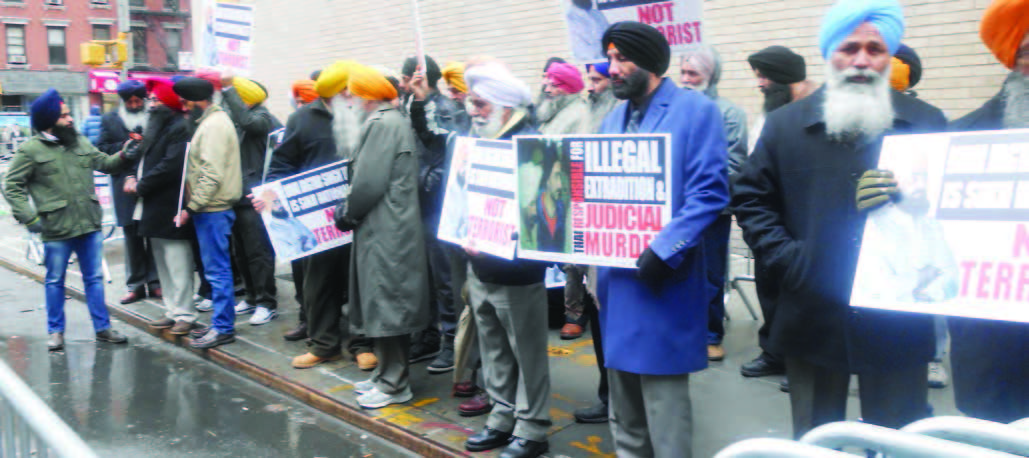
    NEW YORK CITY (TIP): A human rights advocacy group, Sikhs For Justice, organized a protest demonstration in front of Thailand Consulate in New York City, February 9. They were protesting the extradition to India of Jagtar Singh Tara, who the government of India wanted in connection with the murder of Beant Singh, a chief minister of the State of Punjab.

    About 40 demonstrators, mainly from New York and New Jersey participated.

    The protest was organized to demand from Thai government that it ask government of India to restore the custody of Jagtar Singh Tara to Thai government.

    The memorandum that SFJ submitted to Thai Consulate said, “Extradition of Jagtar Singh Tara, a Sikh nationalist, violated Thai Extradition act and UN Convention against torture. It further requested the PM of Thailand to reverse January 6 extradition order.

    Protesters who shouted slogans of Khalistan Zindabad, carried placards which read  Khalistan Zindabad and Tara’s Extradition is illegal.

    The demonstration continued for two hours during which time speeches were made by SFJ President Avtar Singh Pannu, legal advisor to SFJ, Attorney Gurpatwant Singh Pannun  and a few others.

    A representative of demonstrators was allowed to enter the Thai Consulate to submit a memorandum addressed to the Prime Minister of Thailand.

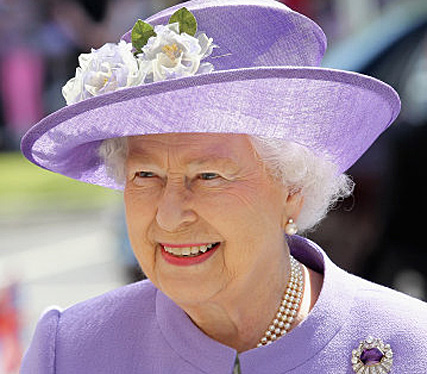
  • Britain’s Queen Elizabeth II now world’s oldest monarch

    Britain’s Queen Elizabeth II now world’s oldest monarch

    LONDON: Britain’s Queen Elizabeth II is now the world’s oldest monarch after the death of King Abdullah of Saudi Arabia.


    King Abdullah of Saudi Arabia who was 2 years older than the Queen died earlier this week on 23rd January 2015.


    She is one of eight octogenarian ruling monarchs of the world, with others including the King of Thailand and the Emperor of Japan.


  • World Economy Past and future tense

    World Economy Past and future tense

    A Financial crash in Russia; falling oil prices and a strong dollar; a new gold rush in Silicon Valley and a resurgent American economy; weakness in Germany and Japan; tumbling currencies in emerging markets from Brazil to Indonesia; an embattled Democrat in the White House. Is that a forecast of the world in 2015 or a portrait of the late 1990s?

    Recent economic history has been so dominated by the credit crunch of 2008-09 that it is easy to forget what happened in the decades before. But looking back 15 years or so is instructive-in terms of both what to do and what to avoid.

    Then, as now, the United States was in the vanguard of a disruptive digital revolution. The advent of the internet spawned a burst of innovation and euphoria about America’s prospects. By 1999 GDP was rising by more than 4% a year, almost twice the rich-country average. Unemployment fell to 4%, a 30-year low. Foreign investors piled in, boosting both the dollar and share prices. The S&P 500 index rose to almost 30 times earnings; tech stocks went wild.

    The optimism in America stood in stark contrast to gloom elsewhere, as it does today. Japan’s economy had slipped into deflation in 1997. Germany was “the sick man of Europe”, its firms held back by rigid labor markets and other high costs. Emerging markets, having soared ahead, were in crisis: between 1997 and 1999 countries from Thailand to Brazil saw their currencies crash as foreign capital fled and dollar-denominated debts proved unpayable.

    Eventually, America ran into trouble too. The tech-stock bubble burst in early 2000, prompting a broader share price slump. Business investment, particularly in technology, sank; and as share prices fell, consumers cut back. By early 2001 America, along with most of the rich world, had slipped into recession, albeit a mild one.

    America the powerful

    Inevitably the parallels are not perfect. The biggest difference is China, a bit-part player in 1999 and now the world’s second-biggest economy, contributing disproportionately to global growth. But there are three trends at work that destabilized the world economy then and could do the same now.

    The first is the gap between America, where growth is accelerating, and almost everywhere else, where it is slowing. In the late 1990s Larry Summers, then the US deputy treasury secretary, warned that the world economy was “flying on one engine”. For 2015 The Economist’s panel of forecasters expects 3% growth in America, compared with 1.1% in Japan and the euro area. China’s growth rate may fall to around 7%.

    Americans can comfort themselves that, as in the late 1990s, the optimism gap is partially warranted. Jobs are being created in their country faster than at any time since 1999, cheap petrol has buoyed consumer spending and business investment has picked up. But the news is not all good: cheaper oil could tip plenty of America’s shale producers into bankruptcy in 2015, while a stronger dollar and weakness abroad will hurt exporters-just as they did 15 years ago. Britain, the other Anglosphere champion, may also be clobbered by the euro zone’s woes.

    The second worrying parallel with the late 1990s is the dismal outlook for the rich world’s two other big economies. Germany’s growth rate has tumbled to around 1% and there is a deeper malaise caused by years of underinvestment, a disastrous energy policy and a government that is too obsessed by its fiscal targets to spend money and too frightened of its voters to push through the sort of structural reforms that Gerhard Schröder implemented in 2003. Meanwhile Japan has repeated the error it made in 1997-thwarting its escape from stagnation with a premature rise in consumption tax.

    The third echo of the 1990s is the danger in emerging markets. Back then the problem was fixed exchange rates and hefty foreign debt. Now the debts are lower, the exchange rates float and most governments have built up reserves. Still, there are growing signs of trouble, especially in Russia. But other commodity exporters also look vulnerable, especially in Africa. Oil accounts for 95% of Nigeria’s exports and 75% of its government revenue. Ghana has already gone to the IMF for support. In other countries the danger lies in the corporate sector. Many Brazilian firms are heavily indebted in dollars. A rash of corporate defaults may prove less spectacular than Asia’s sovereign-debt crises in the 1990s, but they will make investors nervous and push up the dollar.

    Fear the hangover

    Add all this up and 2015 seems likely to be bumpy. Bears will bet that a surging dollar coupled with euro-zone torpor and a few emerging-market crises will eventually prompt a downturn in America. On the plus side, stock markets do not look as frothy as they did in the 1990s: the price/earnings ratio of the S&P 500 is 18, not far above its historical average. Although many big tech firms are investing recklessly, most have decent balance-sheets . And the global financial system is less leveraged and hence less vulnerable to contagion. In 1998 Russia’s default felled LTCM, a big American hedge fund. Such knock-on effects are less likely today.

    But if the world economy does stumble, restoring stability will be harder this time round because policymakers have so little room for maneuver. Back in 1999 the Federal Reserve’s policy rate was around 5%, leaving plenty of scope for cutting when the economy slowed. Nowadays interest rates all over the rich world are close to zero.

    The political scene is also different, and not in a good way. At the end of the 1990s most people in the rich world had enjoyed the fruits of the boom: median American wages rose by 7.7%in real terms in 1995-2000. Since 2007, by contrast, they have been flat in America, and have fallen in Britain and much of the euro zone. All over the rich world voters are already grumpy with their governments, as polling numbers and their willingness to vote for protest parties show. If they are squeezed next year discontent will turn to anger. The economics of 2015 may look similar to the late 1990s, but the politics will probably be rather worse.

    By James G Rickards

    The world economy in 2015 will carry troubling echoes of the late 1990s
    Economist, Jim Rickards explains the coming economic crisis in 2015.
    (The author is an American lawyer. He is a regular commentator on finance, and is the author of The New York Times bestseller Currency Wars: The Making of the Next Global Crisis, published in 2011, and The Death of Money: The Coming Collapse of the International Monetary System, published in 2014)

    (Source: The Economist)

  • A decade later, Asia remembers tsunami victims with tears, prayers

    A decade later, Asia remembers tsunami victims with tears, prayers

    BANDA ACEH, INDONESIA (TIP): Tearful memorials were being held on Friday across tsunami-hit nations for the 220,000 people who perished when giant waves decimated coastal areas of the Indian Ocean a decade ago. On December 26, 2004 a 9.3-magnitude earthquake off Indonesia’s western tip generated a series of massive waves that pummelled the coastline of 14 countries as far apart as Indonesia, Thailand, Sri Lanka and Somalia. Among the victims were thousands of foreign tourists enjoying Christmas in the region, carrying the tragedy of an unprecedented natural disaster into homes around the world.

    A chorus singing the Indonesian national anthem opened the official memorial at a 20-acre park at Banda Aceh — the main city of the province closest to the epicentre of the massive quake —which bore the brunt of waves towering up to 115 feet.

    “Thousands of corpses were sprawled in this field,” Indonesian Vice-president Jusuf Kalla told the crowd of several thousand — many among them weeping.

    “Tears that fell at that time… there were feelings of confusion, shock, sorrow, fear and suffering. We prayed. And then we rose and received help in an extraordinary way. Help came from Indonesia and everyone else, our spirits were revived,” he said, hailing the outpouring of aid from global donors.

    Mosques held prayers across the province while people visited mass graves — where many of the country’s 170,000 tsunami dead rest. But a Red Cross display of hundreds of salvaged ID documents and bank cards, also served as grim reminder that many victims simply vanished. In southern Thailand, where half of the 5,300 dead were foreign tourists, a smattering of holidaymakers gathered at a memorial park in the small fishing village of Ban Nam Khem, which was obliterated by the waves. As the ceremony began, survivors recounted stories of horror and miraculous survival as the churning waters, laden with the debris of eviscerated bungalows, cars and boats, swept in without warning, killing half of the village’s inhabitants.

    Swiss national Raymond Moor said he noticed something was amiss when he saw a white line on the horizon rushing towards the beach where he and his wife were having breakfast. “I told my wife to run for her life… it wasn’t a wave but a black wall,” he said, describing being caught up in the water moments later like “being in a washing machine”.

  • It’s advantage Saina as Wangs knocked out

    It’s advantage Saina as Wangs knocked out

    Hong Kong Open:

    HYDERABAD (TIP): Is Saina Nehwal cruising towards another Super Series title? Even as the third seeded Indian broke no sweat to get past unseeded Bei wen Zhang of the USA 21-16, 21-13 the women’s singles of the Hong Kong Open witnessed major upsets in Kowloon on Thursday. Little-known players ousted top seed Shixian Wang and second seed Wang Yihan.

    The Chinese star shuttlers suffered unexpected defeats for the second week in succession. While Yihan lost to 23- year-old Malaysian Tee Jing Yi, Shixian suffered a three-game loss against compatriot Xin (F) Liu 16-21, 21-9, 15-21. Former world champion Ratchanok Intanon of Thailand was also shown the door by China Open finalist Akane Yamaguchi of Japan 21-19, 19- 21, 19-21. The exit of all these top guns and the absence of world No. 1 makes Saina, who moved to No. 4 on Thursday, as the overwhelming favourite to win the title. Making it a double delight for India, China Open men’s singles champion Kidambi Srikanth also made it to the quarters.

    Srikanth defeated Tanongsak Saensomboonsuk of Thailand 21-19, 23-21 in the second round. However, PV Sindhu looked clueless in her three-game loss against Nozomi Okuhara of Japan 17-21, 21 13, 11-21. “It was a little tough. I was actually leading in both the games but then he came back and I had to fight really hard for those crucial points,” Srikanth said. In the first game Srikanth was leading 14-5 before Saensomboonsuk caught him up at 14-14 but the Guntur lad moved ahead to 19-16 before securing the game at 21-19. In the second game Saensomboonsuk troubled Srikanth forcing the Indian to save a game point at 20-21. But Srikanth managed to sneak past the Thai by securing three straight points. The 21-yearold will now face Wei Nan of Hong Kong in the quarters.

  • Venezuelan crowned transgender beauty queen in Thailand contest

    Venezuelan crowned transgender beauty queen in Thailand contest

    PATTAYA (TIP): A 22-year-old Venezuelan was crowned “Miss International Queen” on November 7 night at a beauty contest that bills itself as the world’s largest and promotes the rights of transsexuals and transvestites. Isabella Santiago beat 21 contestants from 18 countries to win the title and prize money of $12,500 at a glittering pageant in the Thai resort town of Pattaya. The winner of the 2014 contest can also opt for free cosmetic surgery. Santiago, who wore a shimmery white evening gown, laughed and said “Sleep!” when asked about her plans after the win. “When on stage, she is so elegant and that’s why the judges’ decision was unanimous,” said Seri Wongmontha, one of the pageant’s judges. The contest, in its tenth year, was held at the Tiffany’s nightclub famous for its transvestite cabaret. Like other beauty pageants, contestants for “Miss International Queen” paraded in their national costumes, evening gowns and swimsuits. Miss USA Samira Sitara told Reuters TV that participating in the contest was a “dream come true”, and this was the first time she was coming out publicly after being encouraged by friends. “You know what, this is life and you can’t run away from the past. I can’t hide it anymore,” she said.

  • E-VISA SYSTEM LIKELY TO BE ROLLED OUT NEXT

    E-VISA SYSTEM LIKELY TO BE ROLLED OUT NEXT

    NEW DELHI (TIP): The Government will roll out by next week the muchawaited electronic-visa system for tourists from select countries including US and Japan. Home minister Rajnath Singh along with tourism minister Sripad Naik will unveil the first phase of e-visa system for tourists from two dozens countries including US and Japan at a function here shortly, a senior Tourism Ministry official said.

    While Australia is likely to be accorded the e-visa facility during Prime Minister Narendra Modi’s visit Down Under, some countries belonging to BRICS and African region are likely to be announced in the first phase. The e-visa is expected to give a big boost to the foreign tourist arrivals in the country. While in January about 4.95 lakh foreign tourists arrived in India, there were a total of 51.79 lakh during January-September this year. All the arrangements including the software for this system is ready now and will be operational at nine international airports including Delhi, Mumbai, Chennai, Kolkata, Hyderabad, Bengaluru, Kochi, Thiruvananthapuram, and Goa.

    The official said though there are certain issues yet to be resolved for the Goa Airport, the Government has decided in principle to extend it to Goa as well. According to the official, about 25 countries including the 13 countries which are currently having the Visaon- Arrival (VoA) facility in India to be covered under e-visa regime. US, Japan, South Korea, Thailand, Vietnam, the Philippines, Singapore are among the countries which will be given e-visa facility in the first phase. Barring a few countries like Pakistan, Sudan, Afghanistan, Iran, Iraq, Nigeria, Sri Lanka and Somalia, all 180 countries will be covered under e-visa regime in phases, the official said.

    He said China is definitely on the list of countries to be provided e-visa facility, but not in the first list. China is a big-thrust market for India and Tourism Ministry has taken various steps to woo maximum Chinese tourists. While the Incredible India website is being translated into the Chinese language and an infoline will also be established in that language. Besides guides are being trained in Chinese language to help tourists from that country. In order to get e-visa, one would need to apply in the designated website along the required fees. They would be granted an electronic version of the visa within 96 hours.

  • WORLD CELEBRATES DIWALI with prayers, bright lights and fireworks

    WORLD CELEBRATES DIWALI with prayers, bright lights and fireworks

    WASHINGTON (TIP): The five-day Indian festival – Diwali – symbolic of victory of good over evil was celebrated , from October 22 , the world over with great enthusiasm Amid chanting of Vedic mantras and lighting of the traditional ‘diya’ by US Secretary of State John Kerry, Diwali was celebrated for the first time at the State Department. “As the days grow shorter, the Diwali reminds us that spring always returns – that knowledge triumphs over ignorance, hope outlasts despair, and light replaces darkness.

    Diwali is a time for the revitalization of mind and spirit,” said Kerry who was joined by India’s Ambassador S Jaishankar. “It affords a chance to reflect on how we can bring light to others. It is an opportunity for us all, regardless of our own traditions, to renew a shared commitment to human dignity, compassion, and service – and it is a commitment, I think, at the heart of all great faiths,” he said. Some 300 guests, including a large number of eminent Indian-Americans and envoys from other South Asian countries, were present to celebrate Diwali for the first time at the State Department’s historic Benjamin Franklin room, which was lit with many small diyas and candles.

    The top Indian-American US officials, including Assistant Secretary of State for South and Central Asia Nisha Desai Biswal and USAID Administrator Raj Shah, were also present. “We worked hard to prove that we were, in fact, natural partners, which I believe we are. We are two optimistic nations who believe that history doesn’t shape us, but that we have the power to shape history. And that spirit of hope and optimism is really at the center of the Diwali celebration,” Kerry said and greeted people with Saal Mubarak. The guests were served the traditional Indian dishes – including sweet dishes like Jalebi, Gulab Jamun, different varieties of burfi, kaju katli and kheer. Some of the dishes were in fact were made inside the State Department kitchen, while other dishes were procured from a popular Indian restaurant in Washington DC.

    It was also one of the rarest occasions that no alcohol was served. It was all soft drinks, juices and not to miss the traditional mango ‘lassi’. In Birmingham, UK, Bhangra music filled the air as hundreds of people flocked to Diwali celebrations in Birmingham. Food stalls and dancing also entertained families as they turned out in their droves for Soho’s Festival of Lights.

    It was the first time the event had been staged after being organized by the newly-formed Soho Road BID. The BID is home to 560 predominantly independent businesses stretching from Holyhead Road to Soho Hill – with an estimated local population of 250,000. BID manager Craig Bucky said: “We were so excited to be able to run our first community event. “It’s been a lot of hard work and determination but it was a great celebration that the community can be proud of.” BID chairman Dipak Patel said that more events were in the pipeline in a bid to improve the area.

    “The long-term strategy is to make Soho Road an exciting place to work and live,” he said. Diwali was celebrated with enthusiasm and vigor in Sri Lanka, the land where the epic happened. Distribution of misri and lighting a lamp was a traditional fix. Locals offer prayers along the beach. In Thailand, Diyas or lamps made of banana leaves with candles and incense were placed in the river to float. People greeted each other and distributed sweets. Diwali was celebrated with full aplomb in Malaysia. Even the locals indulged in the festivities wholeheartedly. Diwali is an official holiday in Malaysia. People invite each other to their homes and celebrate it with their friends and family.

    The Hindu community of Malaysia constitutes about 8% of its total population. The community celebrates it under the name of Hari Diwali. Nepal is a multi ethnic land with diversity in culture. Nepal celebrated Diwali with bright lights, gift exchanges, fireworks, and elaborate feasts to welcome Lakshmi, the goddess of light and wealth. Diwali in Nepal is known as Tihar. In Australia, Diwali was celebrated publicly amongst the people of Indian origin and the local Australians in Melbourne.

    The cultural kaleidoscope of India was depicted as Indians in Melbourne showcased Indian art, culture, style, traditions and food via various activities, seminars, festivals, fairs and events. Diwali was also celebrated in Guyana, Fiji, Mauritius, Myanmar, Singapore, Trinidad & Tobago, Indonesia, Japan, Thailand and Africa, among the Hindus across the world.

  • Top Indian challengers @ 2014 Asian Games

    Top Indian challengers @ 2014 Asian Games

    KILLER PUNCH: Mary Kom (boxing)


    12


    The Manipuri police officer is now a household name across the country. The five-time World Champion has got little left to prove, after punching her way to the bronze medal in London, but Mary Kom is still determined to add more medals to her collection. At a time when her biopic is raking in the moolah at the box office, Mary will be keen to recapture the golden moments in the ring at the Incheon Games. By topping the trials, after missing the selection for the CWG, the mother-of-three now guns for another triumph. In the 2010 edition, she won the bronze in flyweight.

    FEATHER TOUCH: PV Sindhu (badminton)


    15


    The teenager goes into the Asiad as a strong contender to end the Chinese dominance, along with her more illustrious teammate Saina Nehwal. PV Sindhu recently became the first Indian to win two medals in consecutive World Championships. Though her World Cup conqueror Carolina Marin won’t be there in Incheon, the Chinese, Chinese Taipei and Thailand shuttlers will be out in full strength to make her job tougher.

    SHARP SHOOTER: Jitu Rai (shooting)


    13


    The Nepal-born sharp shooter is literally on fire as he has shot down most of the medals that came his way this season. It began with a double at the World Cup in Maribor, Slovenia in June. The 26-year-old pistol shooter from the 11 Gorkha regiment created history when he won medals in both the 10m and 50m events. Then came the Commonwealth Games and Rai easily asserted his supremacy. The World Championships followed and the Indian was again bang on target settling for the silver and a quota place between a Korean and a Japanese who will again challenge him at the Asaid.

    BULL’S EYE: Deepika Kumari (archery)


    16


    The Tata Academy product is showing signs that she has finally got over the crushing defeat at Lord’s in the 2012 Olympics. Deepika Kumari went into the Games as one of the top medal contenders in recurve competition but went out in the preliminary round itself, crashing under the weight of expectations. The 20-year-old once again starts as a strong medal contender after showing great form in the recent World Cups. The three-time World Cup Finals silver medallist is peaking at the right time and will be keen to make amends after missing out on a bronze at Guangzhou.

    MR HERCULES: Vikas Gowda (athletics)


    17


    If there is one athlete who should get constant backing from the government then it’s this Mysore-born discus thrower, and that too just for his unwavering dedication. Vikas Gowda has trained his sights on the Rio Olympics and success at the Asian Games will only add to his confidence levels. The recent success at the Glasgow CWG shut out his critics and they are now backing him for the Asiad gold. At Incheon, Vikas, who is topping the Asian list with a throw of 65.62m, will face competition from two Iranians and one Chinese. However, exposure in the Diamond League circuit will surely help him produce the winning throw.

    MUSCLE MAN: Yogeshwar Dutt (wrestling)


    14


    In the absence of Sushil Kumar, London Olympics bronze medalist Yogeshwar Dutt will be India’s trump card in wrestling. The 31-year-old Haryana wrestler proved his form at the Glasgow CWG powering past his opponents, including in the final, with ease to bag the gold. It will be Yogeshwar’s second attempt at the Asiad after winning a bronze in the Doha Games in 2006. The Asian Championship winner in 2012 knows that Incheon will pose a much tougher competition with grapplers lining up from Iran, Japan and Korea. Yogeshwar has skipped the World Championships to focus on the Asiad gold.