Tag: The Golden City

  • Jaisalmer: The Golden City

    Jaisalmer: The Golden City

    Jaisalmer, a mesmerizing destination nestled in the heart of the Thar Desert, is a jewel in the crown of Rajasthan. Often referred to as the “Golden City,” Jaisalmer captivates visitors with its sandstone architecture, picturesque landscapes, and rich cultural heritage. The city is adorned with lakes, ornate Jain temples and havelis.
    One of the standout attractions in Jaisalmer is the magnificent Jaisalmer Fort, a UNESCO World Heritage Site and one of the largest fully preserved fortified cities in the world. Constructed using golden-yellow sandstone, the fort seems to blend seamlessly with the surrounding desert, earning it the moniker “Sonar Quila” or the Golden Fort. Inside, visitors can explore narrow winding lanes, intricately carved havelis, and the imposing Maharaja’s Palace.
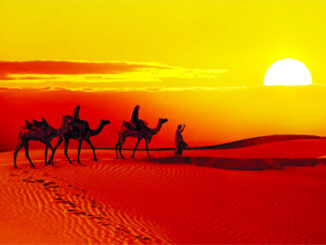
    The havelis of Jaisalmer, such as Patwon Ki Haveli and Salim Singh Ki Haveli, showcase the city’s opulent architectural heritage. These grand mansions boast exquisite carvings, delicate balconies, and intricate facades, providing a glimpse into the affluent lifestyle of the merchants who once inhabited them. The Gadisar Lake, a historic water reservoir surrounded by temples and ghats, adds a tranquil touch to the vibrant city. The Jain Temples within the fort premises showcase stunning architecture and intricate marble work. A camel safari in the vast expanses of the Thar Desert is an essential Jaisalmer experience. The golden dunes, changing hues during sunrise and sunset, create a magical setting for an unforgettable adventure. Camping under the star-studded desert sky adds to the allure of the desert safari. Jaisalmer, like other cities in Rajasthan, celebrates its cultural vibrancy through festivals like the Desert Festival. This three-day extravaganza showcases the rich folk culture of Rajasthan, featuring traditional music, dance, camel races, and vibrant processions.
    Desert National Park
    Most national parks in India boast of dense forests and large water bodies, this one is an exception. Although one may not see a tiger or rhino, spotting wildlife that calls the desert their home is a thrill in itself. Keep your eyes out for hares, foxes, the blackbuck, the endangered Great Indian Bustard, Russell’s viper and several migratory birds in the winter months.
    Jaisalmer Fort
    What sets it apart is that unlike most forts in Rajasthan, locals inhabit this one. One can shop, eat and sightsee while strolling through it. What is unusual to see though is the large number of ‘Free Tibet’ banners that dot shops.
    Longewala
    JP Dutta’s Border (1997) was a hit at the box office. And while most believe it is a work of fiction, a visit to Longewala – on the road to Tanot – will prove otherwise. Border Security Force (BSF) officers stationed here show you the well that was poisoned by Pakistanis in the 1971 war, an enemy tank and crane still there and a memorial to those who sacrificed their lives for the country.
    Border
    The Indo-Pak border lies less than 20 km from Tanot. Though not as famous as the Wagah Border, one can see the last Indian pillar and the Pakistani outpost from here. Visitors, however, are not allowed after sunset. One also needs prior approvals from the BSF to go there. Interestingly, Jaisalmer’s proximity to Pakistan is also visible in the local markets with paan masala from across the border sold openly in shops.
    Bada Bagh
    Other points of interest you could also head to are Patwaon-Ki-Haveli, Thar Heritage Museum, Maharaja’s Palace, Gadisar Lake (with boating) and Vyas Chhatri.
    Kuldhara
    Rajasthan may be famous for India’s most haunted spot, Bhangarh, but you could get a dose of the eerie in Jaisalmer too. According to legend, an entire community vanished overnight 200 years ago at a place close to Jaisalmer. Though there are several tales on the reason behind their sudden disappearance, today all that remains – as proof of their existence – is the abandoned village of Kuldhara. What’s more, according to locals, the villagers left behind a curse bringing death to anyone who tried to inhabit it.
    Tanot Mata’s Temple
    This serene spot lies about 120 km from Jaisalmer. It is the last village before the Indo-Pak border. What makes it unique is that the BSF maintains it. They took over the day-to-day functioning after bombs dropped by Pakistan in the vicinity of the temple in the 1965 did not explode. In fact, they now lie on display within the temple premises.

  • Jaisalmer: The Golden City

    Jaisalmer: The Golden City

    Jaisalmer is a prominent tourist spot located in the northwestern state of Rajasthan in India. It is known as the ‘golden city’ due to its golden dunes and castles clad in golden honey sandstone. Jaisalmer is adorned with lakes, ornate Jain temples and havelis. Climb onto the camel saddle and make your way through this desert to camp under the starry night sky for an unforgettable experience.
    The Jaisalmer Fort stands as a citadel with narrow alleys inhabited by people for generations and shops selling colourful handicrafts.
    Jaisalmer is a town, and to reach the Sand Dunes, travellers have to take a jeep safari followed by a camel ride. Thus, Jaisalmer is an amalgamation of exotic Indian desert culture, heritage and adventure.
    Jaisalmer Fort
    Jaisalmer Fort, nestled on the golden sands of Thar Desert, is not just a fort but a mini-town with houses, temples, shops, and restaurants. A UNESCO World Heritage Site, it falls under the category of ‘Hill Forts of India’. Built in 1156, Jaisalmer Fort gets its name from the former Bhati Rajput ruler Rao Jaisal. More than three thousand people live within the fort walls with multiple entrance gates on the path up top, the last of which directs you to the popular public square named Dashera Chowk. The fort stands at an impressive height of 250 ft. and is surrounded by 30 ft. tall walls. Owing to its altitude, it offers a stunning and panoramic view of Jaisalmer city draped in golden yellow!
    One of the largest forts in the world, Jaisalmer Fort is located on the southern edge of the city and is popularly known as ‘Sonar Qila’ or ‘Golden Fort’. It is a massive structure exhibiting its aesthetic beauty. The walk through the labyrinthine lanes is an experience worth having. Jaisalmer Fort was initially named ‘Trikut Garh’ since it was triangular in shape and was also built over the Trikuta Hills. ‘Sonar Qila'(Golden Fort) as it is locally referred to, houses almost quarter of Jaisalmer’s population inside the complex.
    Desert Safari
    Jaisalmer is frequented by tourists for its large stretches of desert sand. Popular Desert Safaris in Jaisalmer takes place in Sam Sand Dunes. A Jeep takes you to a point near Sam Sand Dunes (around 45km from the city) from where the camel ride starts and lasts for around 90 minutes. You will also stop by at a few attractions on your way.
    The safaris can be done in the morning or in the evening followed a delicious meal alongside a musical dance program that showcases the local culture of Rajasthan. If you don’t wish to indulge in this experience and want to go for a off-beat experience, there are a few operators like Trotters that will take you to Khuri Sand Dunes. The meal will be modest and the tent will be pitched for you making it perfect for stargazing.
    Gadisar Lake
    On the outskirts of Jaisalmer in the arid state of Rajasthan lies the beautiful Gadisar Lake, which sits like an oasis in the heart of a desert. Back in the middle ages, there were no canals or irrigation system or other scientific methods to bring water to the arid regions of Rajasthan. This reservoir was built by Raja Rawal Jaisal keeping in mind the need of his people. Located close to the fort of Jaisalmer, the lake is an easy respite from the hot and dry desert climate. Gadisar Lake offers scenic and picturesque views of the lake and the adjacent fort, especially when the eastern sky is blood red and the sun rises, striking its rays on the top floors of Jaisalmer Fort.
    Whether you like to spend some quiet time by yourself or have fun with your family, Gadisar Lake has a handful of experiences to offer. You can go boating in the lake or simply enjoy a walk around the embankment. If winter is your time of visit, you might just be lucky enough to see beautiful exotic migratory birds flocking in and around the lake from the nearby bird sanctuary of Bharatpur.
    Patwon ki Haveli
    Also known as the Mansion of Brocade Merchants, Patwon Ki Haveli is a famous tourist attraction in Jaisalmer, Rajasthan. At first glance from the narrow street it faces, one would see several windows and balconies with intricate carvings, and once inside, they would get to witness the grandeur of the Haveli. It is a cluster of five small havelis built by a rich trader in the 19th Century. Locals also refer the haveli as Kothari’s Patwa Haveli. The five havelis were built for the family and together, the entire complex forms the largest mansion in the city. It still possesses an ample number of artefacts and stonework that give a glimpse into the regal lifestyle of the Patwa family. It is one of three havelis that are deemed impressive in the city. The building comes under the Archaeological Survey of India, and it is recognized as a renowned architectural as well as a historical site.
    Sam Sand Dunes
    Sam Sand Dunes in Jaisalmer is an offbeat natural tourist destination in Rajasthan right in the middle of the Thar Desert. Right in the middle of the historical forts and colourful markets, Sam Sand Dunes are among the best and most authentic in the country, some rising as tall as 30-60 metres tall. Lying around 40-42 kilometres from the golden city of Jaisalmer, the dunes are located over calm and undulating stretches of golden yellow sand stretching for around 2 kilometres along the borders of the Jaisalmer Desert National Park. Travellers often come here to witness the dramatic and sunrise and sunsets. You can also gain a close insight into the culture and tradition of Rajasthan with dances and musicals that are staged around the campfires at night.
    Jain Temples
    Situated in the Jaisalmer Fort, Jain Temples in Jaisalmer are a must-visit while you are in the city. The temples, though ancient, have a high religious significance and ancient knowledge attached to them. Built in the Dilwara style that is famous all over the world for its architecture, these temples are dedicated to Rikhabdevji and Shambhavdev Ji, the famous Jain hermits known as ‘Tirthankaras’. Being a significant pilgrimage spot, the Jain Temples are truly a treasure of the Jaisalmer city and a fun place to be at for all those tourists who are interested in history and religion. All the seven temples are connected to each other and are built using the same golden-yellow Jaisalmeri stone.

  • Jaisalmer: The Golden City

    Jaisalmer: The Golden City

    Jaisalmer is a prominent tourist spot located in the northwestern state of Rajasthan in India. It is known as the ‘golden city’ due to its golden dunes and castles clad in golden honey sandstone. Jaisalmer is adorned with lakes, ornate Jain temples and havelis. Climb onto the camel saddle and make your way through this desert to camp under the starry night sky for an unforgettable experience.
    The Jaisalmer Fort stands as a citadel with narrow alleys inhabited by people for generations and shops selling colourful handicrafts.
    Jaisalmer is a town, and to reach the Sand Dunes, travellers have to take a jeep safari followed by a camel ride. Thus, Jaisalmer is an amalgamation of exotic Indian desert culture, heritage and adventure.
    JAISALMER FORT
    Perched on top of a small hill, this large fort makes for a mesmerising sight. Also known as the Golden Fort, it is surrounded by a 30 foot high wall, and has over 99 bastions and some imposing gateways or pols. It has been inhabited for centuries, and encloses houses, handicraft shops, palaces, temples, hotels and restaurants, connected by cobble stone paths.
    The main square here is called the Dussehra Chowk, while the main palace is the Rajmahal. This seven-storey building was the residence of the former rulers. Its façade is embellished with stone carvings, while its interior houses the Jaisalmer Fort Palace Museum and Heritage Centre. The rooftop offers panoramic views of the city.
    JAIN TEMPLES
    This set of seven Jain temples lies inside the walls of the Jaisalmer Fort. They are connected to each other, and are all adorned with intricate carvings of mythological and dancing figures. These yellow sandstone temples were built between the 12th and the 16th centuries. They are dedicated to various tirthankaras. The largest of them, the Parsvanath Temple, is dedicated to the 22nd tirthankara.
    PATWON-KI-HAVELI
    This ornate haveli is among the most splendid in Jaisalmer. It consists of a set of five houses, which were built by five Jain merchant brothers in the 19th century. Their exterior is covered with intricate carvings. Inside, some of the walls are decorated with paintings and mirror work. The buildings comprise of a set of rooms, constructed around a central courtyard. There’s also a shop selling embroidered textiles and brocades.
    SAM SAND DUNES
    These shifting white sand dunes, located close to the village Sam, are a great way to explore the Thar desert. They are located 45 kilometres from Jaisalmer. The best way to explore the desert is through camel rides. The dunes look especially picturesque at sunset and sunrise.
    You can also stay here overnight to enjoy the campfires and folk music and dance performances held every evening. Rajasthan Tourism Development Corporation runs the Sam Dhani Resort on a hillock in front of the dunes. It has cottages and tents, which are perfect for a peaceful retreat.
    SALIM SINGH-KI-HAVELI
    This haveli was built by Salim Singh, the prime minister of Jaisalmer in the 19th century. Its most eye-catching feature is its beautiful arched roof with carved brackets shaped like peacocks, and pretty balconies below it. The haveli is also distinct because it’s been constructed entirely of stone, without the use of cement or mortar. A part of the haveli is still occupied, but it’s worth a visit primarily for its exquisitely designed exterior.
    BADA BAGH
    This garden, located on the outskirts of Jaisalmer, contains the cenotaphs of the Rajpur rulers. These are pyramidal and domed in shape, and have beautiful carved ceilings and equestrian statues of the rulers. Each chhatri also has inscribed tablets recording the death of the Maharawals. There’s also a set of windmills nearby, which make for a picturesque sight. There are several other attractions close to Bada Bagh. Amar Sagar consists of a beautifully-carved Jain temple located on the banks of a water reservoir. Lodhurva, the former capital of the Bhatti Rajputs, is now in ruins but it still has magnificent Jain temples with a gorgeous gateway. The main temple contains several beautiful sculptures and a silver image of Parsvanath, the 23rd tirthanakara.
    GADSISAR LAKE
    The beautiful rainwater lake is surrounded by numerous temples and pavillions, and offers magnificent views of Jaisalmer Fort. It was built by Maharawal Gadsi in the 14th century, and used to be the major source of drinking water for the city of Jaisalmer. It attracts water birds in winter and is a popular spot for bird watching, picnics and boating. There’s a lovely gateway called Tillon ki prol near the lake, built by a royal courtesan named Tillon.
    NATHMAL-JI-KI-HAVELI
    This 19th century haveli was built by two architect brothers, who designed their sections independently but with remarkable harmony. It has a beautifully carved exterior, while the interior is decorated with miniature paintings. Two yellow sandstone elephant figures guard the entrance to the haveli. There is no entry fee, but the family living here sells paintings and knick-knacks to tourists.