

Nearly 3,000 people died in the attacks. But even that number does not adequately communicate what happened.
Every victim represented a separate life.
There were people who had arrived at work minutes earlier.
There were people aboard the four aircraft.
There were firefighters who climbed into the burning towers.
There were police officers directing evacuations.
There were paramedics.
There were people who happened to be visiting.
There were people who were making telephone calls when the buildings collapsed.
There were families waiting at home.
The 9/11 Commission recorded more than 2,600 deaths at the World Trade Center, 125 at the Pentagon and 256 people aboard the four aircraft.
The statistics were overwhelming.
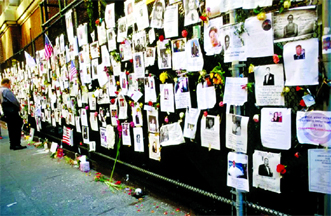
New York therefore began telling the story through faces.
THE WALLS OF MISSING PEOPLE
In the days following the attacks, New York became covered in photographs.
The faces of the missing appeared on walls, street poles and shop windows.
Families hoped against hope.
Some believed their loved ones might still be alive.
Hospitals were checked.
Telephone calls were made.
Names were circulated.
The city became a gigantic search effort.
Eventually, the hope gave way to mourning.
The photographs remained.
They were a reminder that the people killed on September 11 were not simply a number.
They had birthdays.
They had favorite foods.
They had children.
They had friends.
They had unfinished plans.
Some had left home that morning without saying goodbye because they expected to return that evening.
They never did.
THE FIREFIGHTERS WHO CLIMBED UP
Perhaps no image better captures the courage of September 11 than that of firefighters moving upward through the World Trade Center while thousands of civilians were moving downward.
The firefighters did not know how unstable the buildings had become.
They did not know whether the towers would remain standing.
They knew only that people needed help.
Hundreds of emergency personnel died.
The losses were devastating for the New York Fire Department, police department and emergency services.
The heroes of 9/11 were not mythical figures.
They were ordinary workers who happened to face an extraordinary emergency.
Some made final telephone calls.
Some left voice messages for family members.
Some were last seen entering the towers. Their stories became part of New York’s collective memory.
THE SILENCE AFTER THE ATTACKS
The physical attacks ended that morning.
The psychological attack continued.
For days, commercial aircraft remained grounded.
The familiar sound of planes disappeared from American skies.
Airports became quiet.
Passengers were stranded.
Government buildings remained under heightened security.
Rumors circulated about possible additional attacks.
People wondered whether schools were safe.
Whether shopping centers were safe.
Whether public buildings were safe.
Whether another aircraft could be hijacked.
The country had entered a state of uncertainty.
In New York, smoke continued rising from Ground Zero.
In Washington, the Pentagon was damaged and partially burning.
Across the United States, television networks remained focused almost entirely on the attacks.
There was no ordinary news cycle.
There was only 9/11.



Be the first to comment