Tag: The Indian Panorama

  • Rich Tributes paid to the Younger Sahibzadas Zoravar Singh ji and Fateh Singh ji  on Veer Bal Divas

    Rich Tributes paid to the Younger Sahibzadas Zoravar Singh ji and Fateh Singh ji on Veer Bal Divas

    NEW YORK CITY (TIP): The Consulate General of India on Thursday, December 26, paid rich tributes to the younger Sahibzadas of Guru Gobind Singh—Sahibzada Zorawar Singh and Sahibzada Fateh Singh—who were bricked alive on the orders of the Mughal governor of Sirhind for refusing to renounce their faith and convert to Islam. The solemn commemoration was held as part of Veer Bal Divas, a day declared by the Government of India to honor the extraordinary courage, sacrifice, and moral fortitude of the Sahibzadas.

    Group photo of the participants with Consul General, Binaya Pradhan, at Veer Baal Diwas photo exhibit organized by the Indian Consulate in New York City. (Photo : Jay Mandal/On Assignment)

    Continuing its tradition of commemorating the supreme sacrifice of the Sahibzadas through art and culture, the Consulate General of India once again organized a photo exhibition depicting the martyrdom of the Sahibzadas of Guru Gobind Singh as part of the Veer Bal Divas observances this year.

    Young visitors to the Veer Bal Divas speak with Prof. Indrajit Saluja, Chief Editor of The Indian Panorama (Photo : Jay Mandal/On Assignment)

    The exhibition showcased a poignant collection of paintings portraying the courage, steadfast faith, and ultimate sacrifice of the younger Sahibzadas—Sahibzada Zorawar Singh and Sahibzada Fateh Singh—who were bricked alive at Sirhind for refusing to convert to Islam. The artworks, rendered in diverse styles, vividly captured the historical tragedy as well as the timeless values of bravery, sacrifice, and resistance to oppression.

    The exhibition drew a steady stream of visitors from the Indian diaspora and the wider community. Among the prominent visitors was the Gatka team led by Sardar Daler Singh, whose presence underscored the living martial and spiritual traditions inspired by Sikh history. Members of the Gatka team spent considerable time viewing the artworks and interacting with organizers, appreciating the role of visual art in educating younger generations about the legacy of the Sahibzadas.

    Consulate officials noted that exhibitions such as these serve as a powerful medium to connect history with contemporary audiences, especially youth born and raised overseas. “Through paintings, history speaks directly to the heart,” an official observed, adding that the annual exhibition has become an integral part of the Consulate’s Veer Bal Divas programming.

    Veer Baal Diwas photo exhibit organized at the Indian Consulate in New York City. (Photo : Jay Mandal/On Assignment)

    Visitors described the exhibition as moving and educative, praising the Consulate’s effort to blend remembrance with cultural outreach. The exhibition reinforced the message that the sacrifice of the Sahibzadas remains a universal symbol of moral courage, religious freedom, and the triumph of conscience over coercion.

    Speaking on the occasion, Consul General of India in New York, Ambassador Binaya Srikanta Pradhan recalled the defining moment in Sikh history when the two young sons of Guru Gobind Singh chose death over submission, standing firm in their beliefs despite severe coercion. “Their martyrdom is not merely a Sikh legacy; it is a universal testament to courage, conscience, and the inviolable right to faith,” he said, adding that Veer Bal Divas is observed to inspire younger generations to uphold ethical values and moral courage in the face of injustice.

    Consul, Community Affairs, Tsewang Gyaltson welcomed the visitors to the photo exhibition and answered their questions about the photo exhibits.

    Addressing the gathering, a former President of Gurdwara Baba Makhan Shah Lobana in New York, Sardar Daler Singh movingly narrated the inspiring story of the Sahibzadas, highlighting their exceptional courage, unwavering faith, and fearless defiance of oppression despite their tender age. He said the martyrdom of Sahibzada Zorawar Singh and Sahibzada Fateh Singh remains one of the most powerful examples of moral strength and spiritual resilience in world history, and continues to inspire generations of Sikhs to stand by truth and righteousness.

    A particularly heartening aspect of the event was the enthusiastic participation of young boys and girls who had accompanied Sardar Daler Singh. Several of them engaged in thoughtful interaction with Prof. Indrajit Singh Saluja, Chief Editor of The Indian Panorama, sharing their understanding of the martyrdom of the Sahibzadas and reflecting on the lessons of bravery, sacrifice, and faith they had drawn from the exhibition and the narrations.

  • With Today’s Technology, Eliminating Childhood Blindness is not too Ambitious: Dr V.K. Raju

    By Indrajit Singh Saluja 
    The Indian Panorama is conferring Life Achievement Honor on the world-renowned eye surgeon and humanitarian Dr V.K. Raju. In the run-up to the Gratitude Gala of  the weekly paper, he gave an exclusive interview to Prof Indrajit Singh Saluja, its Chief Editor and Publisher. Excerpts:

    Indrajit Saluja, Chief Editor, The Indian Panorama: Rotary International secured a world without polio. Now you and your Eye Foundation of America are working to eliminate needless childhood blindness in the world. But isn’t it an ambitious mission?

    Dr V.K. Raju:  With today’s technology and resources, it is not ambitious. Let me tell you why I have chosen to focus on childhood blindness. Let’s say a 67-year-old becomes blind. He or she has only a few years to live. But if a child becomes blind, he lives for seven decades without vision. We can catch them early and treat them and make them productive members of society for decades.

    As per the World Bank, 80% of our learning is through vision. Nelson Mandela said education is the greatest equalizer. But for want of a pair of glasses, which costs Rs 200-300 in India, the kids’ learning is affected and they become a burden to themselves, the family, and society as a whole.

    Malnutrition is said to be one of the causes of childhood blindness in developing countries.  

    Dr Raju: On this front, India has done incredibly well in the last 30-40  years. But still, overall nutrition is not good among rural people of low socio-economic strata, especially children. So, if you want to see a world without childhood blindness, first you have to tell the governments in the world to provide proper nutrition to children.

    What inspired you to start the Eye Foundation of America?

    Dr Raju: I was working in London and went to India for a holiday. A farmer came to show me his eyes. I did not have any equipment then. So, in 1977, I held my first eye camp in Vijayawada. After seeing so many children born with congenital cataracts, next year I took along a surgical instrument (Ocutome), but faced problems with the customs. On advice of friends, we started Eye Foundation of America for credibility.

    India gave me a stellar medical education almost for free and paying back like this is no big deal. We are fortunate to do this work.

    Each award and honor, Dr Raju says, means more opportunity to do even more work and serve people.

    Being a Rotarian, do you think you can bring Rotary International to support your mission?

    Dr Raju: They already are great supporters of my foundation and our hospitals in Andhra Pradesh. More and more people and Rotary clubs would join in South India and in Vijayawada where I work year after year. Leadership and cooperation are the road to success, as President Jimmy Carter said in his book ‘Global Health’ and whom I have fortunately met.

    Tell us about your Goutami eye hospital.

    Dr Raju:  Goutami is in Rajahmundry district in Andhra Pradesh. It is the flagship of the Eye Foundation of America with about 14 peripheral centers. Outreach is very important in India, where 65% of people still live in villages.  Goutami has a wing exclusively for children. At Goutami, we never turn down a patient. Our model is, we see 60% of the patients  almost for free or subsidized and 40% are paying patients. 

    Besides India, which other countries have you gone in?

    Dr Raju: We have worked in 30 countries, most recently in Guatemala. In some places we supply educational material, in some, we do clinical work, in still others we support their programs as in Ghana. This year-end we are going to South Africa.

    Guatemala is the 30th country to which Dr Raju has spread his work. His visits there were facilitated by India’s Consul General to the country, Manoj Kumar Mohapatra (extreme right in group photo) and Prof Indrajit Saluja.

    What led you to Guatemala?

    Dr Raju: Prof Saluja, you are the one who made that project happen through the Indian Consul General there, Amb. Manoj Kumar Mohapatra. You were there when we screened the patients in Guatemala City. We went back with another colleague of mine last November and performed eye surgeries. Amb. Mohapatra was very helpful.

    I saw you examine 500 people at five locations in Guatemala. How many screenings and surgeries EFA has done so far?

    Dr Raju: Almost 4 million people have been screened as outpatients in the peripheral hospitals and clinics and at least 350,000 operations have been done already.

    For this colossal work, how are you able to manage funds?

    Dr Raju: For the first 16 years, our Foundation did not have a fundraiser. Now we do. Last year we raised $800,000. Here I must tell the story of Srinu Maddula. I brought him here from Vijayawada for a corneal transplant about 35 years ago when he was a toddler. He went on to finish his doctorate in pharmacy from Rutgers. Now he feels that what the eye foundation did for him, he should do more for it.

    For community service projects, help comes unexpectedly. You introduced me to Blitz India editor Deepak Dwivedi and Sandeepp Saxena and they introduced me to Lord Swaraj Paul and Lord Loomba in England. I was honored at the House of Lords, and we set up a chapter of our foundation there. 

    What are the main causes of blindness?

    Dr Raju: The most common visual problem is cataract, which is clouding of the lens of the eye. Cataract is not a disease. It can develop with age. Left untreated, cataract leads to blindness. Today very easy and successful surgeries are available to remove cataracts. You don’t need to stay in the hospital, you go home the same day.

    The other eye problem is glaucoma. It is caused by high eye pressure damaging the nerve connecting the eye to the brain. So, one should get checked for glaucoma every two years after the age of 40.

    With diabetes, if you get regular eye exams, you won’t lose sight.

    What is your advice to my readers about keeping eyes in good condition?

    Dr Raju: If your general health is good, your eye health will be good too. So, eat right, exercise, and do everything in moderation. Protect the eyes with sunglasses when you spend a lot of time outdoors. Cataract development, if at all, will be slow then.

     Is your daughter Dr. Leela Raju, your natural successor?

    Dr Raju: Absolutely. She is very much part of the foundation work and capable of running the show once I’m gone.

    Dr Leela Raju, also an ophthalmologist, accepted the award last year from AIA (Association of Indians in America), NY chapter, on behalf of her father. She is fully invested in his work.

    You have been conferred so many awards and honors, now another one by The Indian Panorama, how do you feel?

    Dr Raju:  Each honor means more opportunity to continue and do even more work and serve people. Yet, as we say in the Indian ethos, I am only nimitta matra (a medium) for whatever good I am able to do.

    Dr Raju learnt from President Jimmy Carter that leadership and cooperation are the road to success. He has also interacted with US Senator Joe Manchin from his state, West Virginia.
  • FIA and Indian American community held a commemorative celebration to mark the historic announcement of Garba’s Inclusion in UNESCO’s Intangible Cultural Heritage List

    FIA and Indian American community held a commemorative celebration to mark the historic announcement of Garba’s Inclusion in UNESCO’s Intangible Cultural Heritage List

    TIMES SQUARE, NY CITY (TIP): Times Square reverberated with the beats and music of ‘Garba’ as members of the Indian-American community performed the traditional Gujarati dance at the iconic New York City destination to celebrate its inclusion in UNESCO’s cultural heritage list.
    FIA NY-NJ-CT-NE along with support from a host of community organizations and Consulate General of India NY, held a commemorative garba celebration at the ‘Crossroads of the world’, – Times Square. The celebration marked the recent inclusion of Garba as an Intangible Cultural Heritage.

    Garba, considered to be among the oldest forms of group dance and longest dance festival spanning 9 nights (Navratri) is a very popular group folk dance form in key states of India including Gujarat, Maharashtra and Rajasthan. It has gained sensational liking among the overseas Indian diaspora in countries like the UAE (Dubai), USA, UK, Australia, Canada and many others. This historic, prestigious and distinguished milestone Tag of Intangible Cultural Heritage of Humanity was announced during UNESCO’s 18th session in Kasane, Botswana on December 6th 2023. The leading organization for this initiative, the Federation of Indian Associations NY-NJ-CT-NE (FIA) extended an open invitation to the entire Indian American community to join in this momentous celebration at Times Square, NYC which was supported by Consulate General of India NY. Free transportation, complimentary refreshments and participation certificates shall be provided for all performing attendees. The event was a spectacular showcase of the rich cultural heritage of Gujarat as attendees donned traditional Garba attires. The vivid colors and intricate designs of their attire were a sight to behold, and one could feel the energy and pride emanating from them as they represented their culture on a global platform. The atmosphere was electric with excitement and anticipation, and it was clear that everyone was thoroughly enjoying themselves.

    In addition to the Federation of Indian Associations NY-NJ-CT-NE, the event was made possible through the support and collaboration of esteemed partner organizations, including the Consulate General of India, New York, GANA, BJANA, Siddhivinayak Temple USA, Times Group, Aaj Tak, The Indian Panorama, EBC Radio, The South Asian Times, AUM Dance Academy, Parikh WorldWide media, TV Asia, ITV gold, World BB TV, New India Abroad, The Indian Eye, Radio Zindagi, and Radio Dil.

  • Indian media in America faces challenges and opportunities

    Publishers and editors reveal how they have been coping and the business strategies they have adopted.

    By Parveen Chopra
    Founder, ALotusInTheMud.com
    Founding Editor, The South Asian Times

    In 2020, India Abroad, known as the gold standard in ethnic newspapers in America, closed operations after 50 years in circulation. In 2022 New India Abroad was started by a different team.
    That tells you the story of Indian media in America. Down and up. Resilience and renewal. Learning and adapting.
    The downturn for all journalism – not just Indian ethnic media – has been caused by the ever-growing digital revolution. The 2008 economic meltdown was bad for the media too. Covid years were worse. Now, social media is the new villain in the journalism story. Many storied newspapers in the US have closed or curtailed operations.
    Indian ethnic media has been more vulnerable because of a lack of promoters with deep pockets for sustaining operations and a dearth of committed journalists doing quality work to keep readers engaged. Surprisingly, the big media houses from India have not ventured here.
    The need for quality journalism to serve the Indian community is greater than ever. For one, the community is growing – their numbers increased from about 3 million in 2010 to more than 4.5 million as per the 2020 census. Indian Americans make headlines as achievers in the US media and are referred to as a model minority.
    But being new immigrants, the community cannot let its guard down. Knowledge is power. It is the job of community media to bring to the notice of their readers issues that need collective action. And, becoming their voice, take their issues to officials and lawmakers concerned. For example, they need to keep hammering the US Congress to resolve the monstrous green card backlog for Indians.
    A new, combustible case is Washington state passing a law (now under consideration in California) banning discrimination based on caste, a practice allegedly extended here from India. Some Hindu groups condemned the move as anti-Indian. The community papers should be explaining the implications of the bill and build a consensus – for or against.
    Surely, all regions of the US with large Indian populations have community newspapers. But most of them have mainly ended up as aggregators compiling news and features available freely. In contrast, New York-based India Abroad once spawned editions in other diaspora countries and a news agency.
    India Abroad, under publisher Gopal Raju, even made press freedom history. They published a story linking megastar Amitabh Bachchan’s brother, Ajitabh Bachchan, to kickbacks in a defense deal. Ajitabh sued in London and won 40,000-pound damages in 1990. Raju fought the enforcement at home. US legacy media including The New York Times filed briefs in Raju’s support. Raju won.
    Unfortunately, declining ad revenue while honor-bound to keep printing copies to serve its 20,000+ paid subscribers made the paper a hot potato eventually.
    One contemporary of India Abroad was India West, a paper with big circulation on the West Coast. Its aging owners, Bina and Ramesh Murarka, shut it down when Covid struck.
    Today, a new opportunity has arisen for the Indian media. With the greater visibility of South Asians in many spheres of American life, it is time to tell their story to the mainstream. But to achieve that you need some gumption and broader vision.  Indian Americans are well-educated and high earners. Rightly leveraged, this market can support a vibrant media.
    So, what is blocking that from happening, and what is the way forward? Publishers and editors responded to reveal how they have been coping and the business strategies they have adopted.

    Business models in the mix

  • TURBAN DAY celebrated with much enthusiasm at Times Square, New York

    • 2000+ Turbans tied on people to educate about the significance of the Turban
    A group of turbaned happy young ladies at Times Square Turban Day festival on May 6.
    A turbaned Chuck Schumer with organizers.

    NEW YORK CITY (TIP): Ritu Saluja told The Indian Panorama that “Turban is a Sikh’s crown and stands for Equality, Justice, and Humanity. We celebrated Turban Day this year on May 06 at Times Square, as an expression of Sikh faith and commitment to serve humanity. The purpose of organizing this event every year is to bring awareness among all citizens about Turban and its value in Sikh faith.” Tanu Singh added : “Considering the unfortunate discrimination and hate crimes faced by Sikhs who wear or tie turbans, we believe that it is more important than ever to break down barriers between different communities. This event represents a unique opportunity to tackle these issues and unite people in the spirit of respect and education.”

    The turban is an integral part of Sikh identity and has been worn by Sikhs for centuries. It not only represents the core values of our faith, but also signifies the responsibility to protect the rights of all individuals, regardless of their background, race, or religion. By participating in Turban Day, people who might not know can learn more about the importance of the Sikh turban.

    A young lady looks into a mirror as a Sikh police officer ties a turban on her head.

    To support this event and Sikh community in America, Senator Chuck Schumer of New York took to the stage and shared his views on how Sikh community has always been an integral part of the American society “We love the Sikh community, and it is a beautiful community. We welcome you as New Yorker’s and as Americans. You work hard, you believe in family, you have a great faith, and you help build and create our great community” He mentioned about passing the Asian Anti Hate crime bill to prosecute any action of hate, bigotry, and violence. He showed his solidarity to the Sikh community by wearing the Turban and shook a leg to famous Punjabi music.

    A bemused young turbaned kid in a pram holds a book on Turban.

    Besides tying more than 2000 colorful turbans on any fellow human coming from any background, skin color, religion and status, there were multiple artists from the Sikh community showcasing their culture and heritage.

    Young musicians from the Sikh Symphony California performed 31 ragas in 13 different taals (beats) using multiple Indian classical string instruments such as sitar, rabab, taus and tabla.

    A turbaned mother and her turbaned child pose for a photograph.

    Musician Biba Singh performed some popular numbers and multiple artists performed Bhangra and folk dance Gidda bringing attendees together to dance and enjoy music. Famous Bollywood artist Manmeet Singh (actor/writer/director) had a message for everyone “For a Sikh the Turban represents love, hard work and humility. When seen from away, for anyone in distress it indicates that they can come to a Sikh and seek help and support and no matter what the situation is they will be assisted”

    Turban Day at Times Square is organized by Turban Day Inc. and is the largest turban tying event in the world.
    “We have been running this event since 2016 and have tied more than 20,000 turbans over the years with the goal of educating more people. We firmly believe that knowledge and understanding are the most effective tools for combatting discrimination and building bridges between communities”, said Ritu Saluja.
    For any further queries contact:
    Tanu Singh or Ritu Saluja at contact@turbanday.org
    Follow us on:
    https://turbanday.org/
    https://www.instagram.com/sikhsofny/
    https://www.youtube.com/@TurbanDay

    Senate Majority Leader Chuck Schumer said of the Sikh community : “We love the Sikh community, and it is a beautiful community.”
    Young musicians from the Sikh Symphony California performed 31 ragas in 13 different taals (beats)
    Artists performing Bhangra.
    Milling crowds spilling enthusiasm.
    A rare distinction: Guinness Book record for “the most turbans tied in 8 hours”.
  • The Indian Panorama Publisher-Editor Prof. Saluja Turns 80

    The Indian Panorama Publisher-Editor Prof. Saluja Turns 80

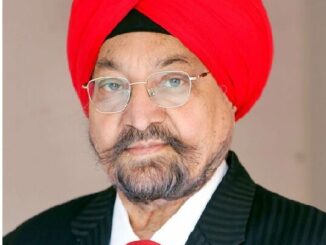
    HICKSVILLE, NY (TIP): The 17-year-old English language  weekly The Indian Panorama publisher and editor Prof. Indrajit Singh Saluja turns 80 today. The family decided to celebrate the day with Thanksgiving prayers at Gurdwara Guru Nanak Darbar in Hicksville.

    Prof. Saluja expressed his gratitude to his family, friends, patrons, and advertisers and readers of The Indian Panorama for their immense love and cooperation, and pledged to remain “ever truthful” in his journalistic obligations.

  • The Indian Panorama Editor Indrajit S. Saluja among Top Indian Americans honored as Jewels of India

    The Indian Panorama Editor Indrajit S. Saluja among Top Indian Americans honored as Jewels of India

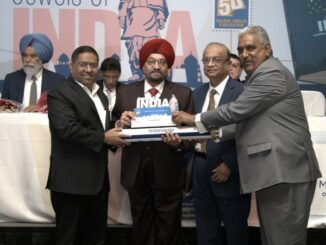
    Former President of India Shri Ram Nath Kovind released the  book  “Jewels of India” featuring 75 “Jewels”

    Parveen Chopra

    NEW YORK CITY (TIP):  It was a superb celebration of India and the Indian diaspora. In a glittering, power-packed event organized  by Maneesh Media here on January 28, 2023, none other than the former President of India, Shri Ram Nath Kovind, congratulated 75 leading Indian Americans as the Jewels of India and released the lavishly mounted coffee table book profiling them.

    Lauding the achievements and contributions to society of the Indian diaspora and of Indian Americans in particular, were Hon. Randhir Jaiswal, Consul General of India in New York, MR Rangaswami, founder of Indiaspora, Dr Bharat Barai, oncologist and co-author of Modi@20: Dreams Meet Delivery, and Dr Kiran C Patel, a top philanthropist.

    Shri Ram Nath Kovind, former President of India addressed the gathering via satellite. He congratulated 75 leading Indian Americans as the Jewels of India and released the lavishly mounted coffee table book profiling them. (Photo / Maneesh Media)
    Dignitaries on the dais with the book “Jewels of India” (Photo/ Maneesh Media)

    Seated on the dais alongside those illustrious people were Chandmal Kumawat, Founder and Chairman of Maneesh Media; distinguished guests Dr Santosh Kulshrestha Kumar, Founder President, International University of Vedic Wellness; Haridas Kotahwala, Chairman of Navika Group of Companies; and Darshan Singh Bagga, real estate tycoon. At the standing room only event the massive coffee table book, Jewels of India in America, was released simultaneously in the ballroom as well as by Honorable Ram Nath Kovind in India, who spoke live via video link from Kochi. The book contains profusely illustrated profiles of 75 leading Indian American personalities, out of which about 25 were present in person to receive the honors from Consul General Jaiswal and other distinguished guests.

    Notable honorees included Naveen Shah, CEO of Navika group; Vijaydev Ratanjee Mistry,  first trustee of the charitable foundation of his family that made a fortune in the hat business; Dr Vivek Lall, CEO, General Atomics Global Corporation, CA; Raj Gopal Asava, Founder, Hunger Mitao, TX; Kailash N Jhalani, President, Prompt Gem Importers; Dr Manbir Singh, Medical Director, McFarland Singh Medical Clinic, CA; Mohamad Faroqui, Founder, Print Early & New York Banner Stands; Dr Samin K Sharma, Director, Cardiovascular Clinical Institute Mount Sinai Hospital, NYC; Prof Indrajit Singh Saluja, Editor-Publisher of The Indian Panorama; and Sparsh Shah, a child prodigy, rapper and motivational speaker.

    Patrons, Sponsors and Supporters included Foundation for Global Understanding, International University of Vedic Wellness, Indiaspora, Bulk Petroleum, Vijaydev Ratanjee Mistry Family Trust, Vardhamana Charitable Foundation and Print Early.

    With the Jewels of India in America Part 2 (part 1 was released 10 years ago) Maneesh Media also celebrated its 50th publication over a proud journey of 23 years. All of their publications have been often released and endorsed by top dignitaries such as US Presidents, Indian President, Vice President, Prime Ministers and have reached the Indian community across the world. With offices in New York, Toronto and Jaipur, Founder Chandmal Kumawat is ably supported by his 3 sons, Maneesh Media directors Manish, Abhishek and Siddharth. Manish and Siddharth were at hand managing the event on January 28 which also celebrated India’s Republic Day. Siddharth gave a vote of thanks.

    A group photo of awardees with dignitaries.
    Some awardees had left by the time the group photo was announced. . (Photo : Maneesh Media)

    Entertaining the 250+ guests in the overflowing ballroom at the Mandarin Oriental premier 5-star hotel in the heart of Manhattan were plumed showgirls, Arya Dance Academy’s Bollywood performances, and Sparsh Shah belting out a patriotic song and a rap-raga fusion number.

    (Parveen Chopra is founder of alotusinthemud.com, wellness and spirituality web magazine. He can be reached at editor@alotusinthemud.com)