

The deaths of Muslim women wearing burqas would have served as a powerful reminder that the terrorists showed no regard even for people belonging to their own religious community.

My wife and I were attending the wedding of Bachi Karkaria’s son at a Parsi Agiary in Colaba on the evening of November 26, 2008. On our way home, we took the usual route past the Oberoi Hotel. I remember being struck by an eerie silence that seemed to prevail over the city. Something felt amiss. I remarked to my wife that I feared the underworld gangs might have come out onto the streets.
I cannot recall precisely when news of the terrorist attacks began reaching us, but it soon became clear that Mumbai, the city of my birth, was experiencing something it never experienced before.
Ten terrorists, belonging to a Pakistan-based organization, had arrived by sea. The possibility of such an attack had reportedly been communicated earlier to the Mumbai Police Commissioner. Precautions had been taken and security had been strengthened at the Taj Mahal Palace and Oberoi hotels. However, as weeks and months passed without any incident, the police gradually relaxed their vigilance. The hotels too felt that the security arrangements were unsettling their guests.
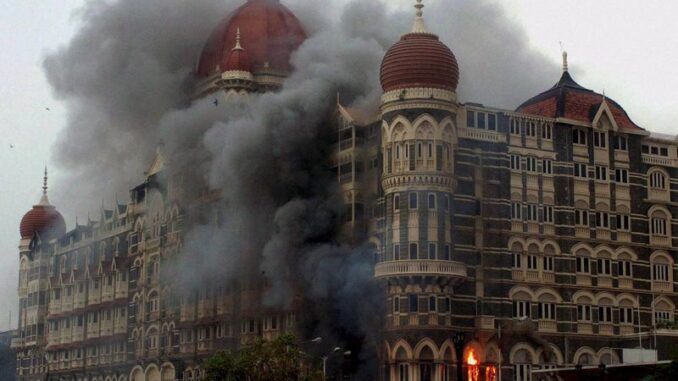
My wife and I were frequent visitors to the National Centre for the Performing Arts (NCPA), where my good friend Kushroo Suntook has long been a prominent figure. It subsequently emerged that 10 terrorists had landed on the Mumbai coast, adjoining the NCPA. Their targets had been carefully selected. These included Leopold Café, popular with foreign visitors; the Taj Mahal Palace and Oberoi hotels; and Chabad House, a Jewish establishment frequented by Jewish visitors from abroad.
The attacks on the Taj and the Oberoi attracted particular attention because of their international clientele. When the terrorists struck, the police were taken by surprise. Small groups of attackers entered the two hotels and unleashed a reign of terror. The Police Commissioner, Hasan Gafoor, took charge near the Oberoi while his second-in-command was directed to focus on the Taj.
It was incidental that Hasan Gafoor was a Muslim IPS officer heading the Mumbai Police at the time. I had known him since he was 12 years old. His father had been the District Magistrate of Sholapur in 1962, when I was posted there as the Police Superintendent. Some of my Muslim friends were delighted that a member of their community had been entrusted with such an important responsibility.
They sought my opinion of him. I distinctly remember telling them that I could vouch for his integrity, but that I would be worried if an untoward incident occurred during his tenure as Hasan was always uncertain about his own decisions. Unfortunately, the terrorist attack came during his tenure as commissioner.
Looking back, I believe the police leadership had been placed in an exceptionally difficult position. Intelligence inputs from the Intelligence Bureau (IB) and the Research and Analysis Wing (RAW) had indicated the possibility of a sea-borne attack and security precautions had been taken at the two hotels. But when nothing happened for a considerable period, vigilance diminished. The tragedy demonstrated how dangerous it can be to allow the passage of time to dull the urgency of a credible security warning.
One of the greatest tragedies of that night was the loss of three outstanding police officers. Hemant Karkare, Chief of the Anti-Terrorism Squad (ATS), rushed to confront the terrorists, but was killed. Ashok Kamte, a young IPS officer serving as Deputy Commissioner of Police in the Eastern Region and grandson of Namdev Rao Kamte, the first Inspector General of Police of the erstwhile Bombay state, also responded to the unfolding crisis.
Although he was not directly responsible for the area, he put on his uniform and rushed to the scene. He, too, was killed near the Cama Hospital. They were joined by Vijay Salaskar, a highly regarded officer of the Mumbai Police, who also lost his life that night.
For me, the most traumatic aspect of 26/11 was the loss of these promising officers. They represented the best traditions of the police service and had much more to contribute to the state and the country.
The terrorists had divided themselves into three groups, attacking Leopold Café, Chabad House, the Taj and the Oberoi. Two of them subsequently made their way to Chhatrapati Shivaji Maharaj Terminus (CSMT), where they indiscriminately fired at passengers waiting to board trains.
Among those killed were Muslim women wearing the burqa. I remember wondering why photographs of these innocent victims were not prominently displayed at the station. Their deaths would have served as a powerful reminder that the terrorists had shown no regard even for people belonging to their own religious community.
The terrorists displayed ruthlessness and a willingness to sacrifice their own lives. Nine of the 10 were eventually killed. The sole survivor, Ajmal Kasab, was captured alive at Girgaum Chowpatty, largely due to the extraordinary courage and sacrifice of Assistant Sub-Inspector Tukaram Omble, who laid down his life while overpowering him.
The encounters at Cama Hospital and elsewhere also demonstrated the courage of officers like Sadanand Date, now the DGP of the state, but then Additional Commissioner of Police, Central Region, who confronted the terrorists despite the formidable odds.
It was painfully evident that the Mumbai Police did not then possess a specialized force adequately equipped to deal with an attack of this nature. The authorities had to seek assistance from New Delhi and the National Security Guard (NSG) was flown in.
One important consequence of the tragedy was the strengthening of Mumbai’s counter-terrorism capabilities. The Anti-Terrorism Squad and other specialized arrangements were subsequently strengthened, giving the police greater capacity to respond to such threats.
Most Mumbaikars became aware of the attacks only the following morning. Those living in South Mumbai, however, had experienced the terrifying reality as it unfolded. Citizens were shocked, anxious and deeply disturbed.
Yet Mumbai displayed its familiar resilience. Its people gradually came to terms with what had happened, although the city would never quite be the same again. The attacks had changed not only the way citizens perceived their own security but also the way the police and the administration had to prepare for threats of this magnitude.
For me, November 26, 2008 remains a night of personal recollection, professional reflection and sorrow.
(Julio Ribeiro is a retired IPS officer who has served as the DGP of Punjab and Gujarat and the ambassador to Romania)



Be the first to comment