
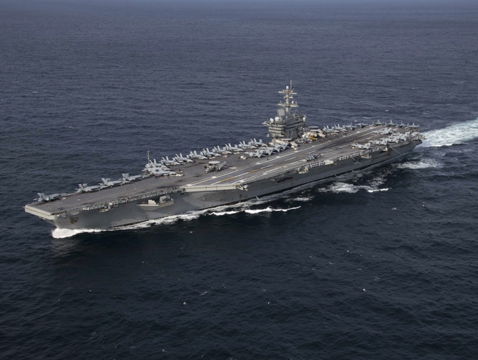


The USS Abraham Lincoln has seen better days. The nuclear-powered aircraft carrier docked in Thailand on Wednesday after 286 grueling days at sea—the bulk of which were spent in the Middle East supporting the U.S. war against Iran—and it’s covered in rust.
The Lincoln is now receiving repairs as its crew members enjoy some much-deserved R&R. The condition of the Lincoln, while not unexpected after a prolonged deployment, is an unsettling metaphor for both the state of the Iran war and the U.S. military more broadly at the moment.
The Iran war has left the U.S. military overextended, pulling vital resources and personnel away from other regions and priorities. And much like the war itself, the carrier’s deployment lasted far longer than the Trump administration expected or planned.
The 5,000 sailors and Marines aboard reportedly faced a range of challenges, from food shortages to sewage issues. The indefinite timeline surrounding their deployment also apparently (and quite understandably) had a detrimental effect on the mental health of some personnel aboard, leading family members to raise grave concerns. Multiple crew members reportedly attempted to jump overboard.
Their hardships can’t be divorced from the fact that they’re serving under an administration that has struggled to define its goals in the Iran war from the start. As retired Gen. Joseph Votel, the former Central Command chief, told John in July, “The military has done exactly what has been asked of them, and they’ve done that to the best of their ability,” but it’s been challenging “to appreciate what the long-term strategic objectives” are in the war.
Directionless. The Iran war reignited this week after a lull in fighting (for the umpteenth time), and this cycle appears to be poised to continue so long as the Trump administration refuses to change course in a significant way (or cut its losses).
This means that the U.S. military will keep using up already dwindled stockpiles of key munitions, and tens of thousands of U.S. troops will continue to be deployed in the region.
The Wall Street Journal reported that Defense Secretary Pete Hegseth is extending Middle East troop deployments into 2027, despite reported warnings from top military leaders that the prolongment of large-scale operations is unsustainable.
Pentagon problems. Meanwhile, there’s trouble on the home front as Hegseth’s controversial approach to leadership—and his efforts to consolidate power and ensure loyalty—continues to push key Pentagon figures out.
In one of the highest-profile departures under Hegseth’s tenure to date, Army Secretary Dan Driscoll resigned on Monday. Driscoll met with Trump at the White House ahead of his resignation. A U.S. official briefed on the meeting, who requested anonymity to discuss internal conversations, told SitRep that Driscoll used that meeting to present his concerns to Trump about the Army’s future and direction under Hegseth’s leadership. Driscoll also told Trump that Hegseth’s firing of several top generals made it difficult to implement the changes within the Army that Driscoll wanted, the official added.
Driscoll’s wartime exit has led congressional Democrats and even some Republicans to call for Hegseth’s resignation. GOP Sen. Thom Tillis wrote in a post on X that he’s “never witnessed more inept management” of the military, describing Hegseth as “intimidated by competence” while urging Trump to “find a new leader at the Pentagon who will retain and empower our military talent rather than diminish it.”
Though many in Washington are convinced that Hegseth is no longer (or never was) the man for the job, Trump has apparently not given up on him just yet. But with Trump’s polling numbers in the gutter amid the unpopular Iran war, it could become increasingly difficult for the president to overlook the dysfunction and negative press engulfing the Pentagon under Hegseth.
(Source: FP)


Be the first to comment