Tag: Tibet

  • New Nepal quake cuts off China-Nepal highway

    BEIJING (TIP) : Chinese authorities are trying to reopen a section of China-Nepal highway which was blocked by 40,000 cubic meters of debris in the latest 7.3-magnitude temblor that struck Nepal.

    Over 120 police officers together with 18 excavators are cleaning the debris on the 13-km section between Zham Township and Zham Port in Tibet, as the segment has caved in at nine points, Liu Guorong, head of the operation, was quoted as saying by state-run Xinhua news agency.

    Early this morning, Chinese reporters saw rocks falling from the mountain along the blocked road due to aftershocks, the report said.

    The fresh earthquake has killed 65 people in Nepal and one person in Tibet.

    Another section of the China-Nepal highway between Zham Port and Kathmandu, the Nepalese capital, was cut off by the 7.9-magnitude quake that jolted Nepal on April 25.

    Two weeks later, Chinese armed police helped reopen it. The previous temblor had claimed over 8,000 lives in Nepal and left 26 dead in southwest China’s Tibet.

  • Beijing pulls up PLA over India’s swift rescue operations

    Beijing pulls up PLA over India’s swift rescue operations

    BEIJING (TIP): The Indian military’s swift evacuation of thousands of Indians from earthquake-hit Nepal has put China’s PLA on the defensive with questions raised as to why its efforts to rescue stranded Chinese nationals did not match those of India.

    The media in China has questioned why air force planes were not deployed to airlift over 8,000 Chinese, many of whom are still stranded in Nepal.

    In a rare comparison of India’s military with the People’s Liberation Army (PLA), the world’s largest, Chinese defence spokesman Geng Yansheng was on Thursday confronted with the question at a briefing as to why the military did not use planes to airlift stranded Chinese when India had done so to ferry its nationals.

    There is considerable annoyance in China over the slow process of airlifting of Chinese tourists as well as workers employed in various Beijing-funded projects in Nepal as the task was given to a number of civilian airlines. There were also reports of some airline companies demanding heavy fares, but they were subsequently denied.

    Besides airlifting thousands of its citizens, the Indian Air Force also transported about 170 foreign nationals from 15 countries to India. Several others were also transported through special buses from across the border to Bihar.

    Defending the move to use civilian aircraft, Geng said “Whether to use military aircraft to transport people from a disaster area — this is to be decided by various factors.”

    He said that after the earthquake, the Chinese government had organized a number of civilian commercial flights to evacuate Chinese citizens stranded in Nepal. He added that soon after the quake, three helicopters from Tibet flew in food and water to a number of Chinese employees working on a hydel project and some of them were even airlifted.

    India’s quick response to send search and rescue teams besides relief supplies has been reported by sections of the Chinese media, while China too dispatched rescue teams and planes with supplies, by which time the Indian presence on the ground had swelled. Earlier, the Chinese foreign ministry had played down reports of competition with India to assist quakehit Nepal and offered to work with New Delhi “positively” in the relief efforts to help the Himalayan nation overcome the crisis.

  • Alarm bells for India? China plans to build rail link with Nepal through Mt Everest

    Alarm bells for India? China plans to build rail link with Nepal through Mt Everest

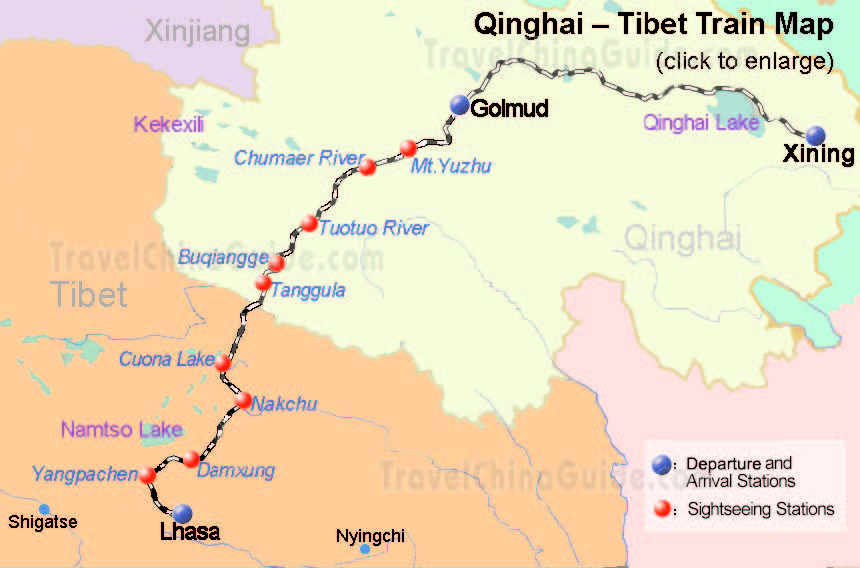
    BEIJING (TIP): China is planning to build a tunnel under Mount Everest, called Qomolangma in Tibetan, as part of its plan to extend its rail link to Nepal, the state run China Daily said on April 9.

    “The line will probably have to go through Qomolangma so that workers may have to dig some very long tunnels,” railway expert Wang Mengshu told China Daily.

    He said that the changes in elevation along the line were remarkable and added that the speed of trains on the proposed Nepal line would be restricted at 120 km per hour because of the difficult mountain terrain.

    China picking major infrastructure deals in Nepal

    This is the first time a tunnel plan has been revealed to reach Nepal. China had earlier discussed extending the Qinghai-Lhasa line to the Nepalese border without digging a tunnel.

    Sources said the idea was to find a short route to Nepal for accessing the vast Indian market. Besides, China might be trying to involve Nepal for its Bangladesh-China-India-Myanmar (BCIM) project because New Delhi has shown little enthusiasm for this corridor, sources said.

    “If the proposal becomes a reality, bilateral trade, especially in agricultural products, will get a strong boost, along with tourism and people-to-people exchange,” Wang said.

    The Nepal rail project, which has been taken up at Kathmandu’s request, will be completed by 2020, China Daily quoted a Tibetan official as saying. The project was discussed during the visit of Chinese foreign minister Wang Yi to Kathmandu in December, according to Nepalese reports.

    In August last year, China completed a 253-km long railway line extending the Lhasa line to Xigaze, the second biggest city of Tibet which is closer to the Nepalese border.

    In another move involving India’s neighborhood, China is likely to sign a deal to help Pakistan build a natural gas pipeline to Iran. The contract is expected to be signed during president Xi Jinping’s upcoming visit to Islamabad.

  • GUEST COMMENT – BUILDING BRIDGES

    GUEST COMMENT – BUILDING BRIDGES

    External Affairs Minister Sushma Swaraj’s visit to China has created a positive atmosphere. President Xi Jinping met her in an unusual departure from protocol. China joined Russia in recommending India’s membership to the Asia-Pacific Economic Cooperation. On its part, India endorsed the launch of the China-led Free Trade Area of the Asia-Pacific initiative. Swaraj’s high-level delegation included the new Foreign Secretary, S Jaishankar, an old China hand, who was also intimately involved with US President Barack Obama’s successful visit to New Delhi. He evidently tackled some of the misgivings that Beijing had. Swaraj and her Chinese counterpart Wang Yi have sorted out certain issues, including the modalities for opening a second route for the Kailash-Manasarovar Yatra in Tibet and India’s conditional support to China’s Maritime Silk Route initiative. Beijing, however, must be sensitive to Indian sensibilities about its increasing military presence in the Indian Ocean. Swaraj also raised the issue of resolving the long-standing border dispute, instead of “bequeathing” it to future generations. The National Security Adviser Ajit Doval, who is India’s Special Representative on the issue, is expected to go to China later and take the matter further.


    Prime Minister Narendra Modi is expected to visit China in a few months, and the Foreign Minister’s visit is a preparatory one, to settle issues and manage agendas. The setting up of the “contact group” that will discuss pending issues and find solutions is a positive move, which may yield results, just as it did before President Obama’s trip. President Xi Jinping’s visit to India soon after the Modi government was sworn in was seen as underwhelming, but now there is fresh impetus for China to build better relations with India. President Obama’s visit and the joint statement issued thereafter caused some concern in Beijing. Indian diplomats are well positioned to ask for an expeditious resolution of the various issues. The mood is right, and the Prime Minister’s forthcoming visit to Beijing may well become an occasion for both the countries to pragmatically build alliances. The engagement between high-level delegations bodes well for the future.

  • Communist officials in Tibet punished for helping Dalai Lama

    Communist officials in Tibet punished for helping Dalai Lama

    BEIJING (TIP): Investigators have found that 15 Communist Party officials in Tibet joined underground Tibetan independence organizations, provided intelligence to the Dalai Lama and his supporters or participated in activities deemed harmful to China’s security, a party agency said on January 28.


    The publicizing of party officials supporting Tibetan separatism was highly unusual and suggested continuing unrest in the Himalayan region, which has had a heavy security presence since a wave of riots and protests against Chinese rule in 2008. The involvement was uncovered last year during an investigation of a small group of party officials, according to a statement from the Communist Party Disciplinary Commission of Tibet posted on its website. Fifteen officials received unspecified punishment for violating party and political discipline, the commission said.


    It was not immediately clear why the cases were announced this week. The commission’s statement gave no details of the groups that the party members joined, the intelligence they provided or other activities that would have harmed national security. Calls to party representatives in Tibet were not answered, and the discipline commission’s phone number was not publicly available.


    Journalists’ access to Tibet is tightly restricted and all information from the region is extremely difficult to confirm. While details such as the name of the officials punished were not provided, it is likely they were ethnic Tibetans who traditionally practice a form of Tantric Buddhism of which the Dalai Lama is the spiritual leader.


    Ethnic minorities, including Tibetans and Muslim Uighurs from the neighboring Xinjiang region, make up about 6 percent of the Communist Party’s 86 million members. They are recruited to fill posts at various levels as a key component of the party’s united front policy, although the top party official in provinces and regions such as Tibet is always a member of China’s overwhelming majority Han ethnic group.

  • India, China Vow Cooperation: Sign 12 Agreements in Delhi

    India, China Vow Cooperation: Sign 12 Agreements in Delhi

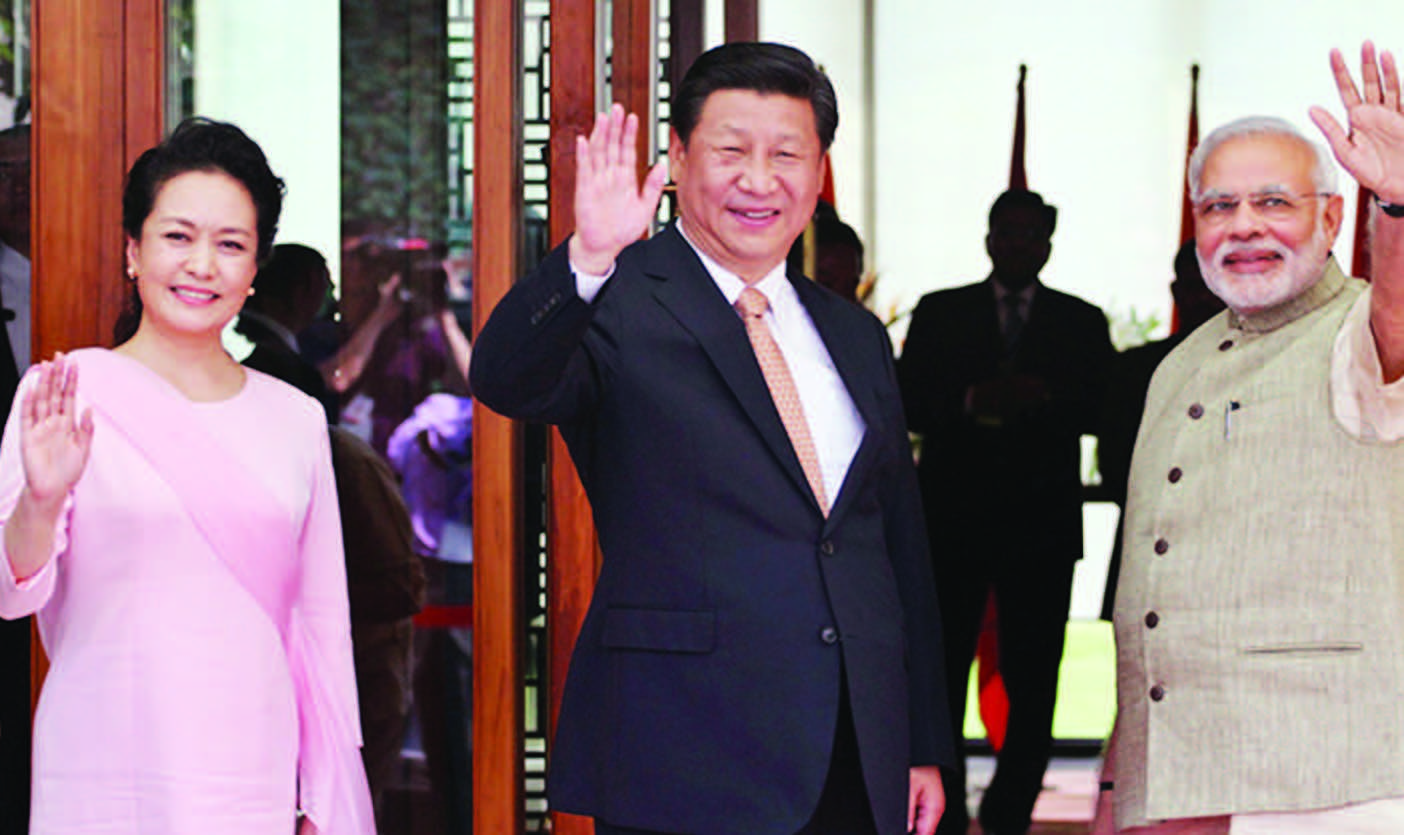
    NEW DELHI (TIP): India and China have signed 12 agreements in Delhi, one of which will see China investing $20bn in India’s infrastructure over five years. At a news conference with Chinese President Xi Jinping, India’s PM Narendra Modi said “peace on the border” was important for progress. Talks came as India accused China of fresh territorial incursions in Ladakh.

    China is one of India’s top trading partners but they vie for regional influence and dispute their border. Mr Modi and Mr Xi made separate statements at the end of their talks in Delhi on Thursday, September 18.

    Under the investment plans, China pledged to:
    ● Help bring India’s ageing railway system railway system up-to-date with high-speed links and upgraded railway stations.
    ● Set up industrial parks in Gujarat and Maharashtra.
    ● Give more market access to India to products, including pharmaceuticals and farm products. Both sides also focused on increasing cooperation in trade, space exploration and civil nuclear energy. Mr Modi called for an early settlement on the disputed common border between the two countries and said the “true potential of our relations” would be realized when there was “peace in our relations and in the borders”.

    There have been reports in the Indian media of Chinese troops trying to construct a temporary road into Indian territory across the Line of Actual Control (the de facto boundary) in the disputed Ladakh region over the past week. Mr Xi said he was committed to working with India to maintain “peace and tranquility” on the border. “China-India border issue is a problem which has troubled both sides for long… As the area is yet to be demarcated, there may be some incidents,” he said.

    The border dispute is an old one, dating back to 1914 when Britain, India’s former colonial power, signed an agreement with Tibet making the McMahon Line the de-facto border between the two countries. China has always rejected this. Both sides also claim each other’s territory – India, the Aksai Chin region of Kashmir and China refuses to recognize Ladakh and Arunachal Pradesh as part of India. There have been several incursions of Chinese troops across the border in these areas which have been highlighted by the Indian media. Diplomats from both sides, however, play down these transgressions.

    The simple fact is that there are differing perceptions on where the border lies – what India believes is Chinese troops crossing into their territory is seen by Beijing as the exact reverse: Indian troops occupying Chinese land. It is extremely unlikely that these confrontations will lead to an outright conflict or even sour ties between the two countries. But they do reflect the suspicion and distrust that exist on both sides of the border. Mr Xi began his visit in Gujarat, the homestate of Mr Modi, on Wednesday, before heading to Delhi.

    China has pledged to upgrade India’s ageing railway tracks On Wednesday, the two sides signed several agreements, including one to set up a Chinesebacked industrial park in Gujarat. Indian and Chinese companies have also signed preliminary deals worth more than $3bn (£1.8bn) in aircraft leasing and telecoms, among other sectors. Despite the continuing tensions, trade between India and China has risen to almost $70bn (£43bn) a year, although India’s trade deficit with China has climbed to more than $40bn from $1bn in 2001-2002.

  • China snubs Dalai Lama, says it can appoint his successor

    China snubs Dalai Lama, says it can appoint his successor

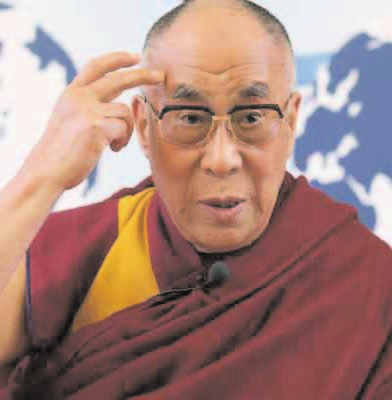
    BEIJING (TIP): Rejecting the Dalai Lama’s views on ending the system of reincarnated Tibetan spiritual head, the Chinese government on September 11 said it will preserve the centuries old tradition among Tibetan Buddhists, saying it has the powers to appoint the next Dalai Lama. “The title of the Dalai Lama is conferred by the Chinese government,” said Chinese foreign ministry spokesperson Hua Chunying.

    China had a “set religious procedure and historic custom”, she said. “The 14th Dalai Lama has ulterior motives and is seeking to distort and negate history, which is damaging the normal order of Tibetan Buddhism,” Hua told reporters at a briefing. The Dalai Lama, 79, recently told German newspaper Welt Am Sonntag that the tradition of the spiritual and temporal head of the Tibetans could end with him. He said Tibetan Buddhism wasn’t dependent on a single person.

    He had earlier said he won’t be reborn in China if Tibet wasn’t free and that no country, including China, had the right to choose his successor “for political ends”. The Dalai Lama’s latest statement about an end to the tradition appears to have hurt the officially atheist Communist Party’s plans to maintain peace and order in Tibetan-speaking areas, which is spread across five Chinese provinces. “China follows a policy of freedom of religion and belief, and this includes respect to and protection of Tibetan Buddhism,” Hua said.

    In Tibetan Buddhism, senior-most Lamas can take years to identify a child deemed a reincarnation of the previous Dalai Lama. The search is usually limited to Tibet. But there is fear in China that the next Dalai Lama may be identified from some born in a country other than Tibet or China, and possibly the US, which might further complicate the situation.

    The reincarnation debate first surfaced in 1995 after the Dalai Lama named a boy in Tibet as the reincarnation of the previous Panchen Lama, the second highest figure in Tibetan Buddhism, The boy has not been seen since although government officials say he is growing up like a normal Chinese kid. China chose another boy and appointed him the Panchen Lama. The Panchen Lama occasionally makes statements supportive of Beijing’s policy on religious affairs.

  • SOUTH AFRICA DENIES VISA TO DALAI LAMA FOR THIRD TIME

    SOUTH AFRICA DENIES VISA TO DALAI LAMA FOR THIRD TIME

    CAPE TOWN (TIP): For the third time in a row, South Africa has refused to grant a visa to the Dalai Lama for attending World Summit of Nobel Peace Laureates here next month, fearing that the Tibetan spiritual leader’s trip would jeopardize relations with China.

    The Dalai Lama’s representative in South Africa, Nangsa Choedon, said that Department of International Relations and Co-operation officials had informed her over phone that the Tibetan spiritual leader would not be granted a visa, the Independent Online reported. “For now the Dalai Lama has decided to cancel his trip to South Africa,” Choedon said. Choedon, however, said that her office was yet to receive a written confirmation from the South African government.

    She said the Dalai Lama, who lives in India, had applied for visa in New Delhi on August 27. The summit, an annual gathering, is being held in Cape Town for the first time, with the arrangements being made by a local committee formed by foundations representing four South African peace laureates – Anglican Archbishop Desmond Tutu, Nelson Mandela, FW de Klerk and Albert Luthuli. The refusal could provoke a boycott of the 14th annual peace summit to be held from October 13 to 15 as some Nobel Peace Laureates have told Tutu they will not come if the Dalai Lama is not permitted to enter the country.

    “I have heard that if the Dalai Lama is not allowed into the country, other invited guests have said they will not come,” Tutu’s spokesman Roger Friedman was quoted as saying by Independent Online. Cape Town mayor Patricia de Lille, who is to host the event, said she had instructed city officials to write to the government to establish whether the Dalai Lama had been denied a visa. “We have not heard from them yet, but I will not give up hope that our government will not humiliate the Dalai Lama again,” De Lille said.

    China accuses the Dalai Lama of campaigning for Tibet’s independence and regularly uses its economic and political might to put pressure on governments around the world to prevent contacts with him. It is the third time in five years that 79- year-old Dalai Lama had to cancel his visit to South Africa because of a failure to secure a visa. In 2009, a peace conference in Johannesburg, arranged to highlight the World Cup in South Africa, was cancelled because the Dalai Lama was refused a visa.

  • CHINA OFFERS REWARD FOR MIXED MARRIAGES IN RESTIVE XINJIANG

    CHINA OFFERS REWARD FOR MIXED MARRIAGES IN RESTIVE XINJIANG

    BEIJING (TIP): A city in China’s Muslim-majority Xinjiang is offering cash rewards and welfare benefits for marriages between minority ethnic groups and majority Hans to promote unity in the province hit by Islamic militancy. Xinjiang’s Qiemo county government announced an annual cash reward of 10,000 yuan (US$ 1,627) for five years for mixed marriage couples besides welfare benefits but skeptics argued that it may not work.

    “We are no longer publicising the policy, but we will still go ahead with it,” an official from the county’s government office told state-run Global Times. The policy offers family members of mixed marriage couples privileged access to housing, education, employment and welfare benefits. Ninety per cent of these couples’ medical expenses after insurance fees will be covered by the local government.

    Their children will also be exempted from school fees within the county until high school, while an annual 5,000 yuan scholarship will be given to those who reach university. Their parents will also be eligible for housing and medical benefits if their marriage lasts longer than three years. The scheme was announced as Xinjiang witnessed a spate of attacks, which China blames on the East Turkestan Islamic Movement, an al- Qaida backed outfit fighting for independence of the province.

    “The intention of the policy is good, but it has to be carefully implemented,” said Li Xiaoxia, a professor with the Xinjiang Academy of Social Sciences. “It might end up strengthening ethnic identity and create social pressure on (mixed-race) families,” he said. Li said such mixed marriages are rare in Xinjiang and are not likely to spread.

    The new move, mirroring similar cash incentives offered in Tibet, is believed by some to be a measure to ease social conflicts amid increasing incidence of terrorist attacks in the region. However, analysts believe the policy will remain limited to the single county and is unlikely to spread across Xinjiang. “I put a call into a Xinjiang official immediately after I heard the news, and he said he disapproves of the policy,” said Pan Zhiping, a research fellow with the Xinjiang Academy of Social Sciences.

    “Marriage is a personal freedom and cannot be encouraged using money. We should not stop mixed marriages, but neither should we encourage them (through policy),” Pan said.

  • INDIA DEPLOYS AKASH MISSILES IN NORTHEAST

    INDIA DEPLOYS AKASH MISSILES IN NORTHEAST

    NEW DELHI (TIP):
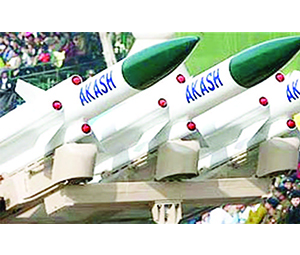
    India has begun deploying six Akash surface-to-air missile (SAM) squadrons in the northeast to deter Chinese jets, helicopters and drones against any misadventure in the region. Earlier, India based its most potent Sukhoi-30MKI fighters at Tezpur and Chabua. Indian Defence ministry sources on Thursday, August 21 said IAF has started getting deliveries of the six Akash missile squadrons, which can “neutralize” multiple targets at 25-km interception range in all-weather conditions, earmarked for the eastern theatre.

    “IAF has deployed the first two Akash squadrons at the Mirage-2000 base in Gwalior and Sukhoi base in Pune. The next six squadrons, as approved by the Cabinet Committee on Security, are to guard against any threat from the northern borders,” said a source. This long-delayed but finally successful induction of the Akash systems, developed by DRDO and manufactured by defence PSU Bharat Dynamics, has also led to scrapping of the protracted discussions to develop the ‘Maitri’ short-range SAMs with France at a cost of around Rs 30,000 crore.

    The Akash deployment in the northeast is in tune with the overall plan to progressively achieve “meaningful and credible deterrence” against China along the 4,057-km Line of Actual Control (LAC). While the Indian Navy is currently better placed to take on Chinese warships in the Indian Ocean, the stark military asymmetry with the People’s Liberation Army along the LAC, both in firepower as well as infrastructure, has long worried the Indian security establishment.

    The steps being taken now to “deter” China range from development of the over 5,000-km Agni-V inter-continental ballistic missile to raising of the new Army XVII Mountain Strike Corps with over 90,000 soldiers at a cost of Rs 64,678 crore. Then, there is also the border military infrastructure development plan for another Rs 26,155 crore, as reported by TOI earlier. IAF, on its part, has deployed Sukhoi squadrons at Tezpur and Chabua in the eastern sector as well as Bareilly in the middle sector of the LAC.

    Both Tezpur and Chabua are also getting their second Sukhoi squadrons, with IAF having inducted over 200 of these 272 fighters contracted from Russia for over $12 billion. The force has also re-activated advanced landing grounds (ALGs) at Nyoma and Daulat Beg Oldie in eastern Ladakh as well as Vijayanagar situated at the tri-junction of India, China and Myanmar in the Changlang district of Arunachal. Similar work is underway at other eastern sector ALGs like Pasighat, Mechuka, Walong, Tuting and Ziro.

    The new XVII Corps, which will fully be in place by 2018-2019, will give India muchrequired “quick-reaction ground offensive punch” for the first time against China. All this is considered crucial since China can rapidly deploy 21 fighter squadrons against India with its eight operational airbases in Tibet Autonomous Region (TAR) and some others just north of it.

    Moreover, the extensive road and rail links created in TAR ensure Chinese soldiers enjoy numerical superiority against Indian forces in a 3:1 ratio. China, incidentally, has been conducting major exercises with its J-10, Sukhoi-27UBK and Sukhoi-30MKK fighters in the high-altitude Qinghai-Tibet plateau in recent times.

  • NEPAL LANDSLIDE: Death toll touches 156, search called off

    NEPAL LANDSLIDE: Death toll touches 156, search called off

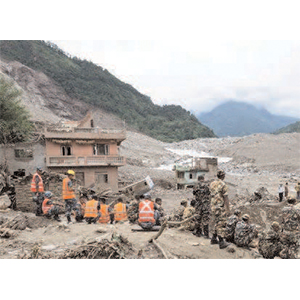
    KATHMANDU: Nepal government on Wednesday declared dead the 123 people missing in the country’s worst landslide in over a decade, taking the death toll from the disaster to 156, as the search for the bodies buried under the debris was called off. The landslide, triggered by heavy rains, hit Sindhupalchowk district on Saturday after the Sunkoshi river, which flows across the border into Bihar as the Kosi river, was blocked creating an artificial lake near Nepal-Tibet border.

    Chief district officer Gopal Parajuli confirmed that all 123 missing in the landslide were dead on the basis of data submitted by local people. “The missing persons were declared dead after the nature of the site showed no possibilities of finding the bodies,” said Parajul. He said rescue work has been called off for the time being as the deployment of heavy machinery and earth pullers may trigger more landslides. Earlier, 33 were pulled out from the rubble laid bare by Nepal’s worst landslide in over a decade.

    Police and army personnel carried out search and rescue operations for the past five days to locate the missing persons. They drained out water from the artificial lake using controlled explosions. About 5,000 people across 11 districts have been affected due to the landslide; more than 1,000 have been displaced. Over 60 houses in three villages were swept away and dozens of other structures damaged.

    The government has distributed Rs 40,000 as relief to the families of dead and missing in the disaster. Those whose houses were damaged were given Rs 5,000. Eighteen people were rescued by Nepal Army. The district has been evacuated and some 600 stranded tourists, including Indian nationals, have been moved to safer locations. In July 2002, over 150 people were killed when multiple mudslides struck two villages in the eastern district of Khotang.

  • Of Bullet Trains and Boundary Disputes

    Of Bullet Trains and Boundary Disputes

    “While economic cooperation with China is mutually beneficial, India must review its approach to border issues with the Asian giant. It should insist that the dispute be resolved in accordance with 2005 Guiding Principles”, says the author.

    Addressing an election rally in Arunachal Pradesh on February 22, Mr Narendra Modi called on China to shed its “mindset of expansionism”. Mr Modi averred: “Arunachal Pradesh is an integral part of India and will remain so. No power can snatch it from us. I swear in the name of this soil that I would never allow this State to disappear, breakdown, or bow down. China should shed its expansionist mindset and forge bilateral ties with India for peace, progress and prosperity of both nations”. This message was reinforced with the appointment of Mr Kiren Rijiju from Arunachal Pradesh as Minister of State for Home Affairs.

    China made the predictable noises, with Prime Minister Li Keqiang congratulating Mr Modi on his appointment and President Xi Jinping sending his Foreign Minister Wang Yi to meet Mr Modi, with a personal message of greetings. Did these gestures signal any substantive change in China’s policies, either on its outrageous territorial claims on Arunachal Pradesh, or the continuing intrusion of its troops across the Line of Actual Control? The answer is clearly in the negative. Just on the eve of Vice President Hamid Ansari’s visit to the Middle Kingdom, China published yet another official map depicting the entire State of Arunachal Pradesh as its territory.

    While the UPA Government had claimed that new “mechanisms” had been agreed upon to curb cross border intrusions, the intrusions continued. Given these developments the NDA Government should carefully consider reviewing and reorienting existing policies on China. Any talk of more robust military responses to Chinese adventurism is illadvised. The NDA Government has unfortunately inherited a situation where India’s armed forces are inadequately equipped and lacking in numbers. It would take a minimum of five years before the armed forces are adequately equipped and manned, to be able to present a more selfconfident response to Chinese adventurism.

    New Delhi should, however, now reorient its diplomacy, by taking note of the fact that Chinese assertiveness and aggression is directed not only against India, but towards all its maritime neighbors, with unilateral declarations on delineation of its maritime boundaries. Just as China’s claims on Arunachal Pradesh have no legal or historical basis, its claims on its boundaries with all its maritime neighbors, are in violation of the UN Convention on the Laws of the Seas. China has used force to seize disputed Islands claimed by the Philippines and Vietnam and to explore for offshore oil and gas.

    Tensions with Japan are escalating, because of China’s claims to the Senkaku Islands, controlled by Japan since 1894. China’s unilateral declaration of an Air Defence Identification Zone beyond its borders has been rejected by South Korea and Japan. Its territorial claims on its maritime borders face challenges from South Korea, Taiwan, Japan, Vietnam, Philippines, Brunei, Malaysia and Indonesia. Yet another major source of concern has been the Chinese policy of strategic containment of India, primarily based on enhancing Pakistan’s nuclear weapons, missile, maritime, air power and army capabilities.

    This is an issue which India inexplicably and rarely, if ever, highlights either bilaterally, or internationally. This policy of strategic containment through Pakistan has been reinforced by China’s readiness to provide weapons and liberal economic assistance to all of India’s neighbors in South Asia. Worse still, bending to Chinese pressures, India has periodically avoided proposed joint military exercises with Japan and the US. A measured response to Chinese containment would be for India to step up military cooperation with Vietnam, including supply of Brahmos cruise missiles which can enable Vietnam to counter Chinese maritime bullying.

    This would be an appropriate answer to China’s unrestrained military relationship with Pakistan. Given the fact that Russia is a major arms supplier to Vietnam, President Vladimir Putin’s concurrence can surely be obtained for such missile supplies to Vietnam. Russia has, after all, given its concurrence to China’s supply of Russian designed advanced RD 93 fighter aircraft engines to Pakistan. Will growing trade relations with China soften its approach to border claims, or its strategic containment of India, as some in India appear to believe? Bilateral trade with China today amounts to around $66 billion, with India facing a growing trade deficit, currently of around $29 billion.

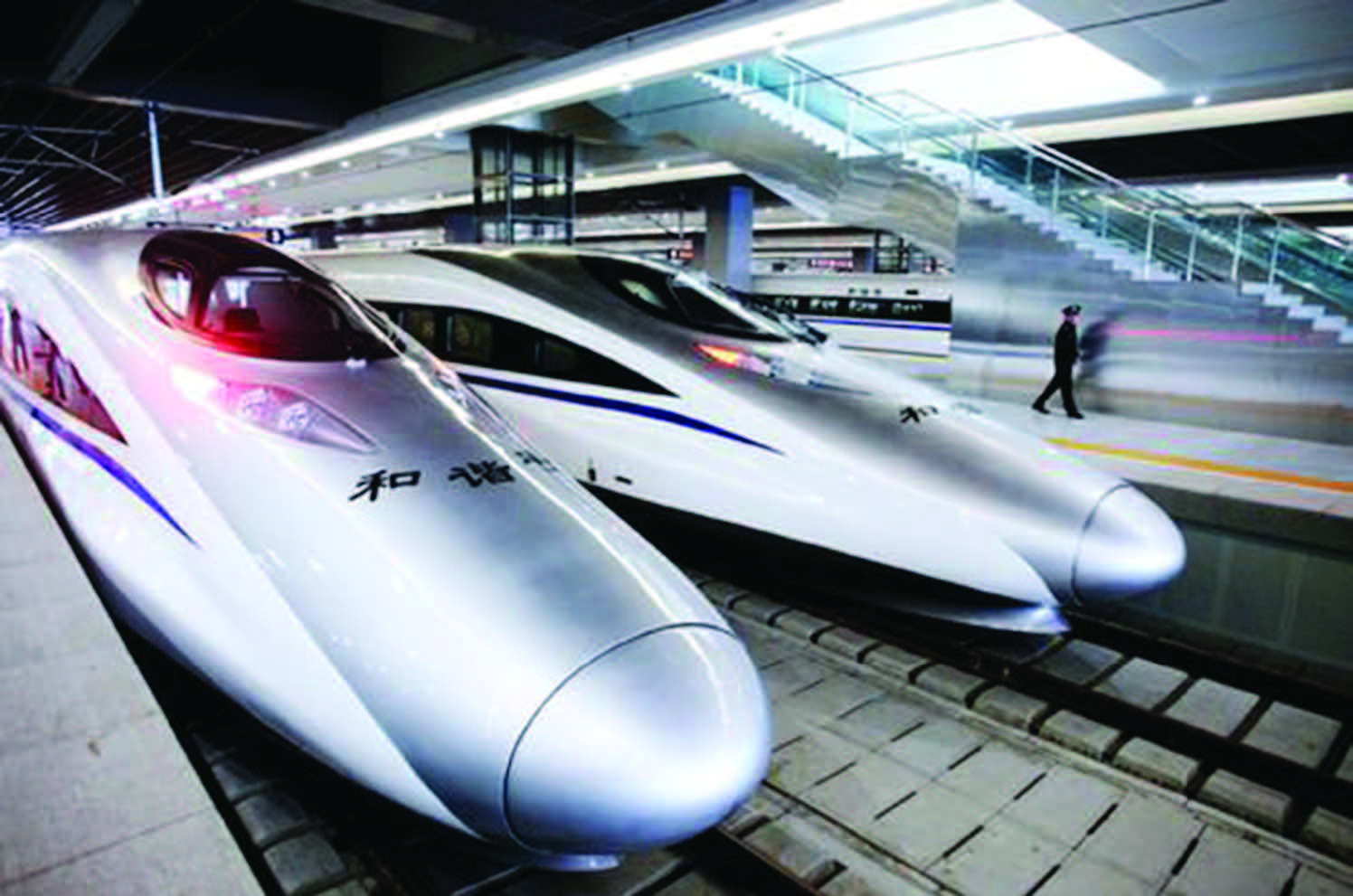
    China’s annual bilateral trade with Japan amounts to $314 billion and that with South Korea $235 billion. China is also the largest trade and investment partner of Vietnam. Both Japan and South Korea also have substantial investment ties with China. Despite this, China has remained unyielding on its territorial claims on these countries, not hesitated to use force and threatened to cut its investment ties with Vietnam, after recent tensions. To believe that China will embark on a path of reason on border issues, because it sells us a few bullet trains and invests in infrastructure in India would be, to put it mildly, naïve.

    On the contrary, India needs to ensure that unrestricted, duty-free access of Chinese products, in areas like energy and electronics, does not adversely affect indigenous development and production, or undermine energy, communications and cyber security. While dialogue, economic cooperation and interaction with China in forums like the BRICS and the G20 are mutually beneficial, there is need to review our approach to border issues with China. It is evident that China has no intention of exchanging maps specifying its definition of the Line of Actual Control, either in Ladakh, or Arunachal Pradesh. India should now insist that the border issue has to be resolved in accordance with the Guiding Principles agreed to in 2005.

    The boundary has to be along “well defined and easily identifiable natural geographic features”. Secondly, any border settlement should “safeguard due interests of their settled populations in the border areas”. Proceeding according to these Guiding Principles enables India to reinforce its claims that the border lies along the Karakoram Range in Ladakh and the McMahon Line in Arunachal Pradesh. Given China’s agreement to safeguard the “interests of settled populations,” its claims to Arunachal Pradesh are untenable.

    Moreover, with the Dalai Lama now clarifying he no longer seeks an independent Tibet, India should not hesitate to state that it hopes the Tibet issue is settled in accordance with the 17 point 1951 agreement between the Chinese authorities and the Dalai Lama. This agreement acknowledges Chinese “sovereignty” in Tibet, while respecting the freedom of religion and the “established status, functions and powers of the Dalai Lama”.

  • Beas tragedy: Two more bodies found, 16 still missing

    Beas tragedy: Two more bodies found, 16 still missing

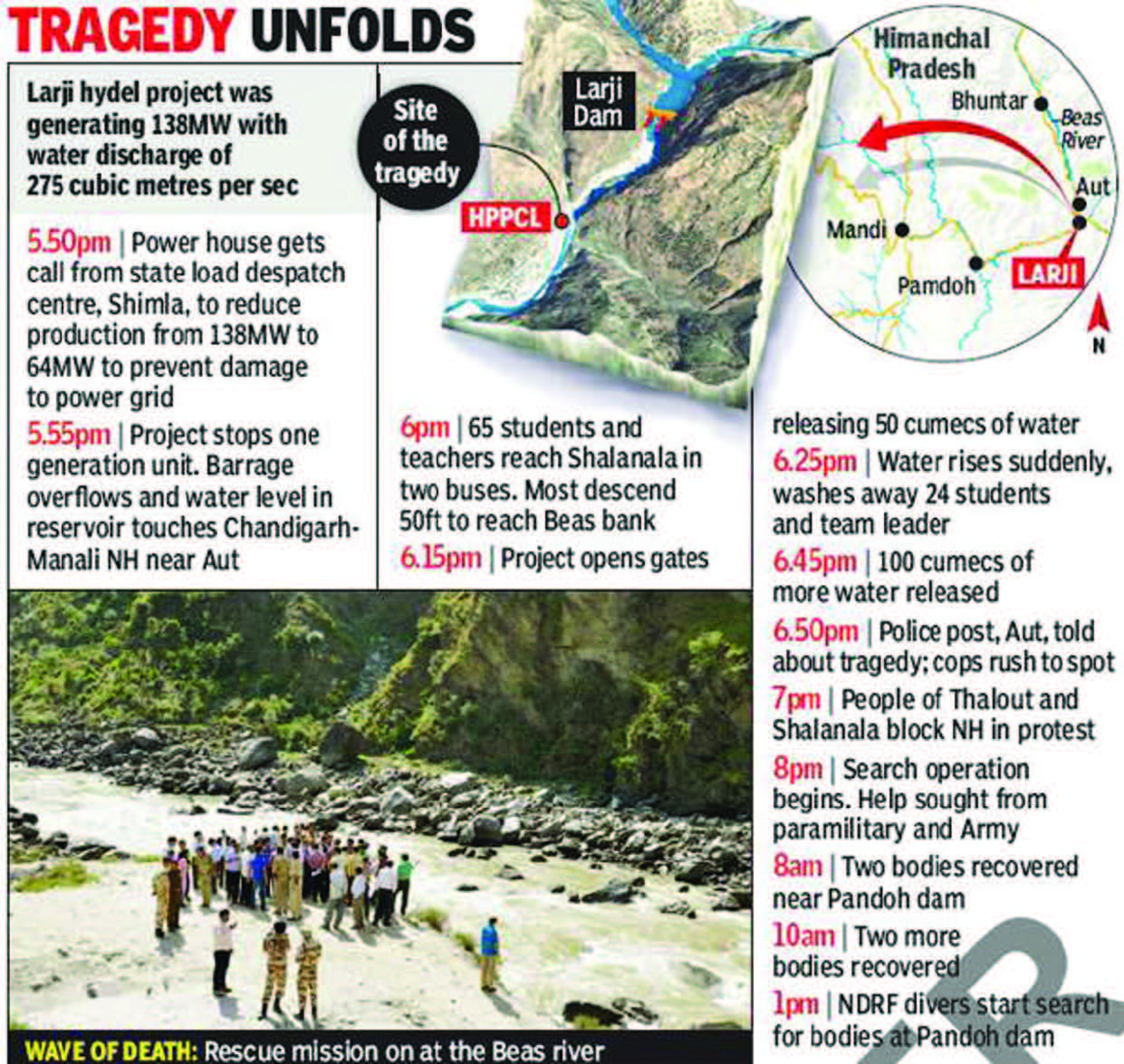
    PANDOH (TIP): The rescue team fished out two more bodies of students of the Hyderabadbased VNR Vignana Jyothi Institute of Engineering and Technology from the Beas river at Pandoh on June 12. According to certain media reports, the bodies were recovered by the joint rescue team of the National Disaster Response Force (NDRF), Sashastra Seema Bal (SSB), Indian Tibet Border Police (ITBP), police and local divers.

    With this, the total number of bodies recovered so far has reached eight. However, there was no trace till Thursday evening of the remaining 16 students who were washed away in flash flood in the Beas river, caused due to the sudden release of water from Largee Dam on Sunday evening. The bodies recovered on June 12 have been identified as T Upendra, son of Tallada Srinivas of Khammam district of Telangana, and Gonoor Arvind Kumar, son of G Vinod Kumar of Vanasthali Puram of Hyderabad.

    Gonoor’s maternal uncle Shridhar identified the dead body of his nephew. The rescue team recovered Upendra’s body from 500 meter ahead of the incident site at Thalout and Gonoor’s body was recovered from Rainsnala area, nearly 1 kilometer away from the site. Police later sent the two bodies for post mortem at the zonal hospital in Mandi. The incident occurred at around 6 pm on June 8 when the students, six of them girls, were clicking pictures on the banks of the river. They were on their way from Shimla to the resort town of Manali for an excursion. A sudden release from the reservoir of the Larji dam led to a surge in the water level in the river which is feared to have swept away the students.

  • SOUTH INDIA’S GOLDEN TRIANGLE IN HILLS

    SOUTH INDIA’S GOLDEN TRIANGLE IN HILLS

    TRAVELOGUE

    If there is a paradise down south, it is in its own Golden Triangle in the hills. The regions of Coorg in Karnataka, the Nilgiris in Tamil Nadu and Wayanad in Kerala form one contiguous landscape offering all that a traveller could ask for: Lush green forests, wildlife, great people, man-made attractions, breathtaking landscapes, tea and coffee estates and temperate climate all year round. You can seamlessly drive between these regions on beautiful mountain roads.

    Join Elephants in their ‘Bathrooms’ in Dubare, Coorg So what if Dubare is like a pet elephant facility? The camp is home to elephants of all ages, from babies to granddaddies. At around 9, they come out of their quarters and head for the water pool for their daily bath.

    Be careful when they come down: some amble, but some run. You don’t want to be in the way. You can watch them from the sides, and step into the water and give them a scrub yourself. Of course, elephants don’t know the difference between a bathtub and a toilet seat – they allow their poop to drop where they are. You can be sure you are stepping on some.

    Dubare is a nice place to hang around all day long – lounge in the shade when done with elephants, take a boat ride, go bird spotting, read a book or just picnic with some music from your iPod. Life will look wonderful.

    Reaching for the Clouds in Talacauvery, Coorg Located about 42 kms (26 miles) from Madikeri, Talacauvery is said to be the origin of the Cauvery river. Of course, you really don’t see any visible signs there: a spring feeding water into a holy tank in a temple complex there is said to be the origin.

    The temple is dedicated to Goddess Caveriamma and Lord Agastheeswara. A dip in the tank, especially on holy days, is considered auspicious by Hindus. A 407-step steep climb from the temple takes you atop the hill where you are supposed to get views of the surrounding mountain ranges – I only got to see the anatomy of clouds. Yes, I was literally standing inside one or many – I could not tell where one ended and another started.

    Chikmagalur, Karnataka – Coffee first grown here in India Raindrops are falling on my head…and I am having coffee on the road in Chikmagalur – where coffee was first grown in India.


    13

    About 350 years ago when a seer is believed to have smuggled a few seeds from Mecca in Arabia. At the twilight hour, surrounded by forests and coffee estates, in mountain country with its cool, crisp air – it is heaven on Earth. Depending upon when you go, you can enjoy the coffee blossoms – or the picking season. The whole countryside is one you would want to build a cottage and spend the rest of your life in.

    A Thriving Tibetan Community in Bylakuppe in Coorg If you want a flavour of Tibet and Buddhism, drop by at Bylakuppe – supposedly the second largest Tibetan settlement outside of Tibet after Dharamsala up North. It is located about 6 kms from Kushalanagara in Coorg. Over 30,000 Tibetans and 7,000 monks have made it to their homes since 1961.

    The stunning Namdroling Nyingmapa Monastery here is the largest teaching center of Nyingmapa – a lineage of Tibetan Buddhism – in the world. Check in to get a flavour of Tibetan shopping, food, lifestyle, dressing, culture, festivals and religion.

    The Nilgiri Mountain Railway: A Toy Train you must Ride Wheeeee! I am on a toy train ride. Starting from Ooty or Ootacamund, now officially renamed Udagamandalam, going downhill all the way to Mettuppalayam in Tamil Nadu. And it figures in UNESCO’s World Heritage List.

    The train passes through some picturesque tea estates, the Nilgiris mountains, villages and towns with some retaining their old world charm – and skies with changing colours. The train negotiates 208 curves, 13 tunnels and 250 bridges. A few years back, a diesel engine was introduced for the leg between Coonor and Ooty – it is a treat watching the process of changing to a steam locomotive at Coonor or vice versa. Book in advance to ensure a seat.

    Walk Through the Tea Estates of the Nilgiris What is more refreshing than a cuppa of tea? A walk in the tea estates – especially those that cover the rolling hills of the Nilgiris.

    Step out before the first light, and watch the colours of the ground and skies change around you. Birds chirp Good Morning to you and the cool air rejuvenates your skin and soul.

    On the Trail of Tigers and Elephants in Bandipur, Karnataka The Bandipur National Park in Karnataka is one of the many reserves in this region. And home to tigers, elephants and many other animals and birds. In fact, the forests all merge into one another, and into human habitats and roads. You can commonly expect to see herds of elephants on the highways. Don’t miss out on safaris when in this part of the country.

    A Temple Festival, Circus and Fair in Wayanad Everyone loves a festival in these parts. I attended one at the Valliyoorkavu temple on the outskirts of Mananthavady in Wayanad. Attended by tribal folk from surrounding areas, it was a long night of prayers, folk dances, processions, food, shopping, circus and fairground rides.

    Roads leading to it are marked with processions from all directions – converging at the temple from early evening onwards. Processions comprise musicians, dancers including a few in masks, elephants, priests and devotees walking along, some with lit oil lamps. It is fun – and religious – for all in one big celebration.

    Kuruva Island in Wayanad The evergreen forested Kuruva island (called Kuruvadweep locally) lying in one of the tributaries of Kabini river in Wayanad seems a popular picnic spot. Rightfully so. A cluster of islands that emerge or submerge with water levels, and home to a variety of birds, butterflies and orchids, you can choose to be with the crowds or find your own solitude.

    We hiked in extreme humidity on a warm, sunny day through rice fields and forests to eventually reach the local tribal temple – very serene setting, and the simplicity of the temples is what attracts you. Despite new houses, many a lifestyle remains unchanged. Women were dressed as they always have been, water is drawn from wells and farming is the main occupation. The fields were planted with rice, and ginger harvested recently was being sorted manually.

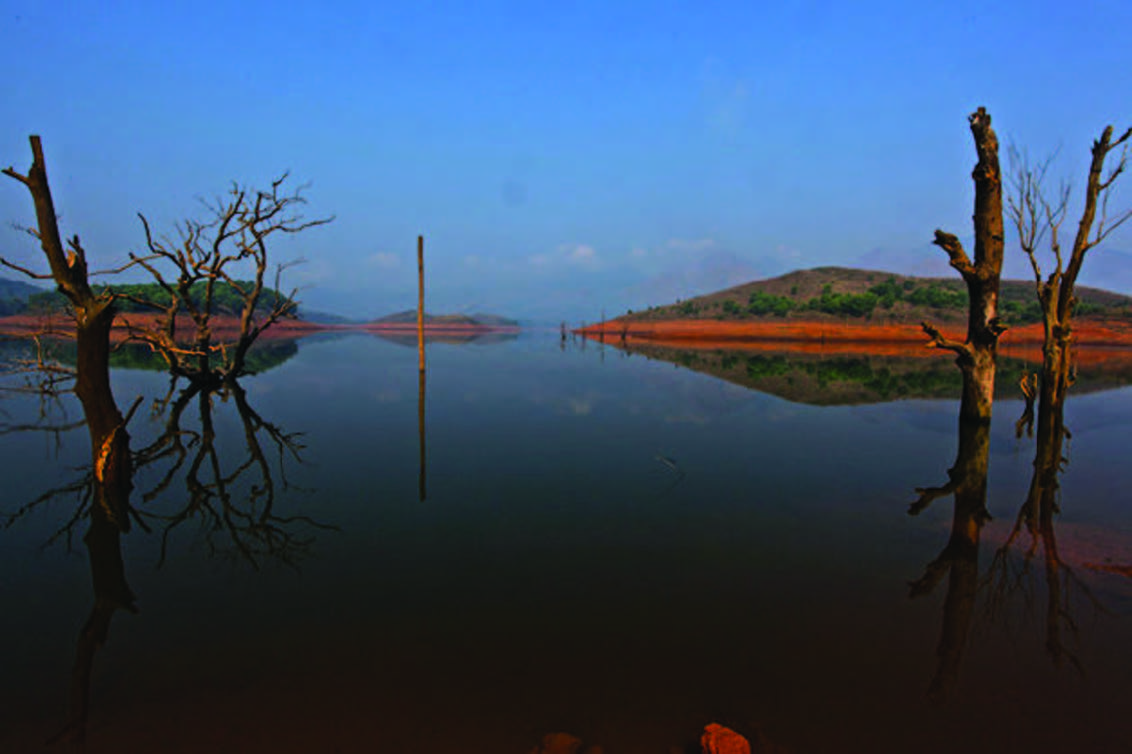
    Banasura Reservoir, Wayanad, Kerala – A sight to behold The Banasura Sagar dam in Wayanad is the largest earth dam in India. Without getting into technicalities or its environmental impact (if any), I would say it has resulted in creating some stunning features.

    The resulting reservoir is a large water body whose water level rises dramatically during the monsoons. Sprouting throughout are islands created when the reservoir submerged surrounding areas. And coming through are trees shorn of any leaves; they paint a ghostly image when it is misty and around sunset. A good place to film a horror flick.

  • 2014 Guru Nanak Interfaith Prize for Bhai Sahib Mohinder Singh Ahluwalia and The Rev. Dr. Katharine Rhodes Henderson

    2014 Guru Nanak Interfaith Prize for Bhai Sahib Mohinder Singh Ahluwalia and The Rev. Dr. Katharine Rhodes Henderson

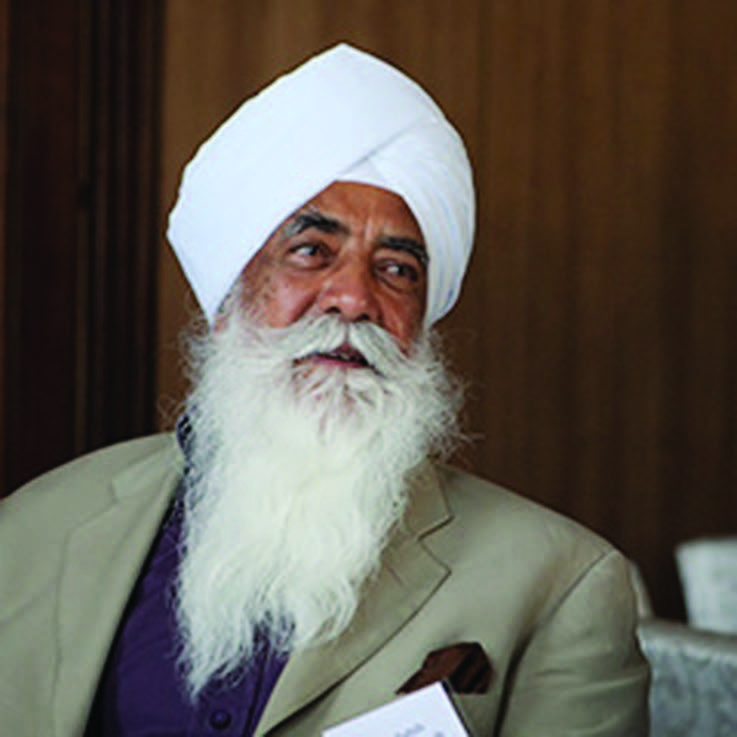
    NEW YORK (TIP): Bhai Sahib Mohinder Singh Ahluwalia, Chairman, Guru Nanak Nishkam Sewak Jatha and The Rev. Dr. Katharine Rhodes Henderson, President, Auburn Theological Seminary have been selected for the 2014 Guru Nanak Interfaith Prize. The award will be given away at a special function on April 8, 2014.

    Bhai Sahib Mohinder Singh Ahluwalia is chairman of the Guru Nanak Nishkam Sewak Jatha in Birmingham, United Kingdom, a faith-based charitable organization. A visionary Sikh faith leader, he serves on the University of Birmingham Community Advisory Board and is patron of the United Religions Initiative and a member of the European Council of Religious Leaders (World Council of Religions for Peace). He is also a supporter of the Council for a Parliament of the World’s Religions (CPWR) and Globalization for the Common Good, and a senior member of The Elijah Interfaith Institute.

    He holds honorary doctorates from the University of Central England for service to the community and from the University of Birmingham for support of work in education, faith and divinity. He has had extensive experience in the multidisciplinary fields of housing, town planning, roads, water supply, sanitation and conservation work, and has been an agent of change in the fields of engineering, faith propagation, charity work, education and research. He worked as a civil engineering professional and housing executive for 20 years, providing aid to Zambia under the technical jurisdiction of the UK’s Overseas Development Administration (ODA), now called the Department for International Development (DFID).

    The Rev. Dr. Katharine Rhodes Henderson is president of Auburn Theological Seminary, a seminary rooted in Christian tradition with multi-faith commitments, which prepares bold and resilient leaders who can bridge religious divides, build community, pursue justice, and heal the world. Raised in Louisville, Kentucky, Dr. Henderson earned a Master of Divinity at Union Theological Seminary in New York City and a doctorate at Teachers College, Columbia University. She is ordained in the Presbyterian Church (U.S.A.) and is the author of God’s Troublemakers: How Women of Faith Are Changing the World (Continuum, 2006). She is an internationally known religious leader who has been featured in The Washington Post, The New York Times, Los Angeles Times, and Crain’s New York Business, and on MSNBC’s Melissa Harris- Perry and NPR’s On the Media.

    Dr. Henderson participated in a United Nations panel on the global culture of peace, and she attended a White House session on human trafficking. She also led efforts to create MountainTop, a summit of nearly 100 faith leaders to promote cooperation and catalyze the multi-faith movement for justice. As the founder of Sikhism, Guru Nanak taught that we discover our oneness with humanity by exploring the differences that separate us. The Guru Nanak Interfaith Prize recognizes and supports the efforts of those individuals and organizations who work to advance that vision. According to Guru Nanak, religions are paradoxical. They help us to discover and cultivate what is best and most hopeful about one another and the world that sustains us. And yet, they often spark conflict and violence.


    9
    The Rev. Dr. Katharine Rhodes Henderson, President, Auburn Theological Seminary who has been selected for the 2014 Guru Nanak Interfaith Prize, is the first woman recipient of the award.

    The Guru Nanak Interfaith Prize is based on the conviction that religious dialogue helps to minimize religious conflict by cultivating awareness that we each view the world from the limitations of our own traditions, and we have much to learn from the traditions of others. The Guru Nanak Interfaith Prize was established with a gift from the family of Sardar Ishar Singh Bindra and Sardarni Kuljit Kaur Bindra, prominent Sikh- Americans living in Brookville, New York. In September 2000, the Bindra family endowed the Sardarni Kuljit Kaur Bindra Chair in Sikh Studies at Hofstra University in honor of the family’s matriarch.

    The Guru Nanak Interfaith Prize is an expression of Sardar Ishar Singh Bindra’s longstanding dedication to interfaith harmony. The Guru Nanak Interfaith Prize in the amount of $50,000 is awarded biannually to an individual or organization chosen by a distinguished panel of judges. The goal of this award is to enhance awareness of the critical role of religious dialogue in the pursuit of peace as well as to provide direct support for the furtherance of such activities. His Holiness the 14th Dalai Lama of Tibet, Tenzin Gyatso, was named the first winner of the Guru Nanak Prize in 2008 in recognition of his many years of promoting interfaith dialogue and understanding around the world. Others who received the prize include 2010: Rabbi Arthur Schneier and Religions for Peace in 2010 and Dr. Eboo Patel in 2012.

    Award Criteria
    A panel of judges composed of religious leaders, academics and individuals known for their commitment to interfaith dialogue will consider the recent and career accomplishments of nominees. Award recipients will have demonstrated extraordinary leadership, courage and a capacity for inspiring in others a willingness to embrace the vulnerability that is the key to true religious dialogue. Eligibility: Any living individual or organization that the nominator believes has contributed to the promotion of constructive dialogue and/or relations between faith communities. Criteria: The committee invites nominators to consider a wide-range of activities. A nominee may, for example, have organized members of different faith communities to work toward a common goal; produced a work of art or literature that contributes to or publicizes the importance of interfaith dialogue; or uses a position of authority or power to bring faith communities together. Nominees may be designated on the basis of a single contribution or a lifetime of contributions.

  • Modi’s Stance on Foreign Policy Remains a Mystery

    Modi’s Stance on Foreign Policy Remains a Mystery

    Modi has made some stray remarks on foreign affairs, but they should be seen more as obiter dicta rather than a considered judgment.

    Little interest has been shown domestically about possible new orientations in foreign policy under a Modi-led NDA government. Modi’s single-minded focus on the development agenda has dominated political and media discourse, barring, of course, the 2002 Gujarat riots. The slowdown of the economy, the negative investor sentiment, price rise, corruption, the perceived lack of leadership have been issues of public concern, not foreign policy. Modi has been a state leader, with no stint in Delhi, and hence a relatively unknown entity for foreign interlocutors except those who have traveled to Gujarat for business reasons.

    Economic focus
    For our foreign partners who see India’s economic rise as opening up enormous prospects for their own economies by way of trade and investment and who are disappointed by India’s lacklustre economic performance under UPA II because of slowdown of reforms, indecision and delays in implementation, Modi’s economic agenda is alluring. But they are equally interested in assessing the possible differences in foreign policy between a possible Modi-led government and the UPA governments.

    Modi has been a state leader, with no stint in Delhi, and hence a relatively unknown entity for foreign interlocutors except those who have traveled to Gujarat for business reasons. Moreover, because he has been politically boycotted by western countries until recently for human rights reasons, the opportunities to assess him through personal contact have been that much less available. China and Japan, who have received him in their countries, have been wiser in this regard. Modi has not been grilled on foreign policy issues either by the opposition or the media. He has made some stray remarks on foreign affairs, but they should be seen more as obiter dicta rather than a considered judgment.

    His view, for instance, that the Ministry of External Affairs should focus on “trade treaties” rather than strategic issues may fit in with his “development” focus, but would get revised when faced with the reality of India’s challenges once in power at the Centre. If his meaning was that our missions should give priority to commercial/economic work, that would be unexceptionable in the context of economic performance increasingly determining a country’s international role and influence. Towards Pakistan, one hopes, Modi will not be counseled to adopt a soft face in order to attenuate his anti-Muslim image, both at home and abroad.

    The economic argument should not be exaggerated though, as our most severe external challenges are driven not by economics but politics, relating to our territorial integrity, the threats to us from terrorism and religious extremism, the nuclear dangers emanating from nuclear collaboration between China and Pakistan which the West tolerates despite its readiness to take military action to stop proliferation in Pakistan’s neighborhood, and China’s attempts to politically and strategically box us in the subcontinent while simultaneously eroding our influence there by its deep incursions into our neighborhood. If China and Pakistan have been hostile to us for decades it is not on account of economic issues. India’s role in the Indian Ocean has a major strategic aspect that goes beyond ensuring the safety of the sea lanes of communication for trade flows.

    Status Quo
    How much the foreign policy of former Prime Minister Vajpayee, who enjoys an iconic status within and even without the BJP, will guide that of an hypothetical Modi-led government is a pertinent question. If Vajpayee’s decision to take a plunge on the nuclear question was an act of strategic defiance, he was also a man of dialogue who made major overtures to US, China and Pakistan. With a strong nuclear card in his hand, his strategy of building a relationship with the US “as a natural ally” made sense, as did his outreach to China to explore the possibility of resolving the border issue on a political basis. His conciliatory approach towards Pakistan, however, seemed based less on a cold power calculus and more on inchoate hopes and sentimentalism. Prime Minister Manmohan Singh built on Vajpayee’s policy on all these fronts, pointing to the essential continuity of our foreign policy under governments of different political complexions.

    The ‘Next Steps in the Strategic Partnership’ under Vajpayee led to the nuclear deal under Manmohan Singh; the Special Representatives mechanism with China set up under Vajpayee has been the principal platform for political engagement with China on the vexed border issue under his successor; the obsession to have a dialogue with Pakistan under Vajpayee continued its confusing course after him. In visiting the Arunachal border with Tibet and vowing not to yield an inch of Indian territory, Modi has sent an important signal to Beijing.Is there a major course correction in foreign policy that a Modi-led NDA government would need to make? Tough stance Not really, as our geo-political compulsions, our economic needs and our security calculus dictate our fundamental foreign policy choices, with limited wiggle room available.

    We need a stable relationship with all power centers. Despite the difficulties of dealing with the US, our economic and people-to-people links with it are of key importance. The US has treated Modi with gross political ineptitude, giving him, if he becomes Prime Minister, room to extract a price for engaging him, though it is clear that his relationship with Obama will be uncomfortable. China’s Xi Jinping has already indicated his desire to visit India later this year. In visiting the Arunachal border with Tibet and vowing not to yield an inch of Indian territory, Modi has sent an important signal to Beijing. A visit to Tawang before Xi’s visit would change our psychological equation with China by boosting national morale.

    Towards Pakistan, one hopes, Modi will not be counseled to adopt a soft face in order to attenuate his anti-Muslim image, both at home and abroad. Pakistan will construe this as the “taming” of Modi without cost. Because uncertainties in Afghanistan and religious radicalization sweeping Pakistan could aggravate India’s terrorism problem, the new government should be in no hurry to resume the dialogue with Pakistan even if the bait of MFN is offered as a tactical move. Whether or not a Modi-led government changes the course of our foreign policy, because of the perception that he is strong and decisive leader will be a foreign policy forcemultiplier in itself.

  • NEHRU RESPONSIBLE FOR 1962 WAR DEBACLE: REPORT

    NEHRU RESPONSIBLE FOR 1962 WAR DEBACLE: REPORT

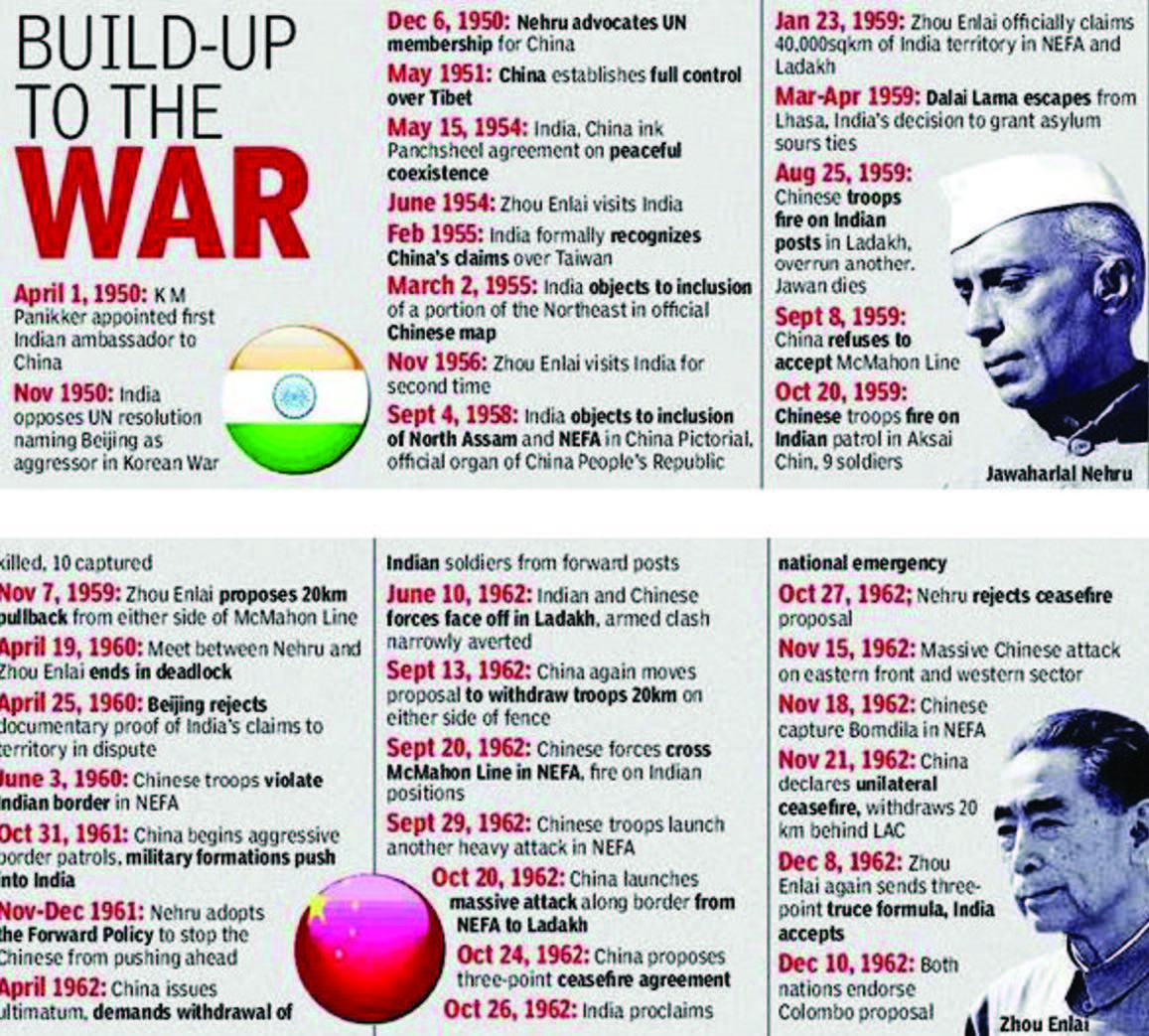
    NEW DELHI (TIP): The conventional narrative in India about the 1962 war has largely revolved around portraying the Chinese as the unbridled “aggressors”, who ripped apart the nascent “Hindi- Chini bhai-bhai” construct forever. The reality is slightly different.

    True, China was nibbling away at what India perceived to be its territory both in Ladakh and North-East Frontier Agency (NEFA), as Arunachal Pradesh was then called, to consolidate its hold on Tibet. But what provoked Mao-led China to launch a full-blown military invasion into India on October 20, 1962 was the Nehru government’s ill-conceived and poorly executed Forward Policy, set in motion almost a year ago in November-December 1961.

    Already smarting from the Dalai Lama’s escape to India in early 1959 and the bitter exchanges over the Mc-Mahon Line, which it considered to be a “legacy of British imperialism”, China decided to teach India “a lesson” it would never forget through the one-month war. The Henderson Brooks-P S Bhagat report on the 1962 military debacle, kept firmly under lock and key by the Indian government for the last 50 years, makes it clear the “unsound” Forward Policy — directing Indian troops to patrol, “show the flag” and establish posts “as far forward as possible” from the then existing positions —”precipitated matters”, sources say.

    The sources, who have accessed the classified report, say the ill-timed Forward Policy “certainly increased the chances of conflict” at a time when India was militarily ill-prepared in Ladakh and NEFA, with China much better placed in terms of forces, equipment and logistics in both the sectors. The report apparently holds that the Forward Policy was based on the “flawed premise”, primarily driven by the then all-powerful Intelligence Bureau director B N Mullik, that “the Chinese would not react to our establishing new posts and that they were not likely to use force against any of our posts even if they are in a position to do so”.

    This gravely erroneous assumption, given credence by a complicit Army headquarters despite being in direct contrast to an earlier military intelligence “appreciation” that the Chinese “would resist by force any attempts to take back territory held by them”, percolated down to all levels of command to usher in “a sense of false complacency”. What compounded matters was the “appalling” and “disastrous” military leadership and its decision-making, ignoring the advice of commanders on the spot. First, the Army headquarters paid no heed to the quantum of forces required to implement the Forward Policy. Both Ladakh and NEFA had “a minimum requirement” of an additional infantry division (over 12,000 troops) each, with necessary airlift and logistical backing, to somewhat re-address the imbalance with China, as had been reinforced by war games conducted earlier in 1960.

    But no fresh induction of troops ever materialized. So, the report reportedly notes, while the Forward Policy may have been “politically desirable”, the Army simply did not have the wherewithal to implement it. The Western Command, for instance, had held that the Forward Policy should be kept “in abeyance” till there were enough Indian troops in Ladakh and that China should not be “provoked” into an armed clash. But the Army HQ disregarded all this. Neither did it strengthen Ladakh, nor reduce tensions with China. With the “probes forward” underway, the Army established 60 posts in sectors like Demchok, Chushul, Daulat Beg Oldi, Changla and Rezengla of Ladakh by July 1962, further stretching its already meagre resources there.

    Many of these “very weak, far-flung and uncoordinated” posts had barely 10 soldiers each. Similar was the story in NEFA. Instead of strengthening the “defence line”, forces were frittered away in “pennypackets” in forward areas. Tawang, for instance, had just a depleted brigade, while China had two divisions in the sector. Similarly, Bomdila had only one battalion. Thus, as in Ladakh, in NEFA too, the Army was hardly in a position to adopt the Forward Policy. That it was adopted proved that the “higher direction of war” was “faulty”, based as it was more on preconceived notions that China would not react rather than sound military judgment, say sources. React the Chinese certainly did. Drafted by then commander of the Jalandhar-based 11 Corps Lt-Gen T B Henderson Brooks, who was assisted by Brigadier P S Bhagat, this “operational review” details at great length how the outnumbered and out-gunned Indian Army was first complacent, then collapsed and finally panicked and fled under the Chinese onslaught.

    The report’s mandate was restricted to reviewing the Army operations but the covering note on it by Gen J N Chaudhari, who took over as Army chief after the war, did criticise then defence minister V K Krishna Menon’s continuous meddling in military matters. The report itself is sharply critical of the role played by Lt-General B M Kaul — a distant relative of Nehru and Menon’s favourite — first as chief of general staff at the Army headquarters and then as commander of the hastily raised IV Corps at Tezpur just before the Chinese invasion.

    The report holds that the “lapses” by Lt-Gen Kaul and his “handpicked officers” were “inexcusable” and “heinous”, say sources, adding they should not have allowed themselves to be “pushed” into a military adventure without requisite forces and proper planning. The 4th Infantry Division in NEFA, for instance, was neither militarily prepared nor mentally adjusted to fight the Chinese. When the Chinese troops reached its gate, there was total confusion that ultimately ended in panic and flight. “Senior commanders” — like the 4th Infantry Division commander Major-General A S Pathania in NEFA — “let down the units” under their command, held the report.

  • Spain’s National Court issues ill-advised warrants against China’s former President Jiang Zemin and Prime Minister Li Peng

    Spain’s National Court issues ill-advised warrants against China’s former President Jiang Zemin and Prime Minister Li Peng

    Having been involved in cases dealing with Alien Tort Statute and Torture Victims Protection Act, I have a thought or two for consideration. Nations should be wary of passing laws that have extra-territorial reach as Chief Justice Roberts forcefully explained in the Kiobel case in April 2013.

    I would argue that the presumption against extra-territoriality is a ferocious watchdog of every nation’s sovereignty, no less than an army watching the border. After all, where one nation’s border ends, another’s begins (leaving aside the high seas and the poles). To allow otherwise, invites retaliatory reciprocity. While humanitarian concerns are touching to the soul and who doesn’t love the Buddhists, every nation must decide what’s more important that its sovereignty.

    Under law, if one nation can reach conduct in another country, what’s to stop that other country from doing likewise – the Achilles Heel of law – leading to chaos, not order. The Tibet issue is a matter for diplomacy or war. Squatters need to be evicted – perhaps when there is a court with binding jurisdiction on all countries, then law will suffice (but with such a court will come loss of sovereignty).

  • Vikas Khanna Launches Himalayan Cook Book ‘Return to the Rivers’

    Vikas Khanna Launches Himalayan Cook Book ‘Return to the Rivers’

    NEW YORK (TIP): Vikas Khanna, an award-winning Michelin-starred Indian chef, restaurateur, filmmaker, humanitarian and the host of the TV show Master Chef India along with Lake Isle Press, launched his new book “Return to the Rivers” at an exclusive event on Tuesday, January 28 at Junoon Restaurant in New York City.

    Return to the Rivers boasts nearly 500 pages, and 100 full-color photographs of plated dishes, exotic travel experiences, and personal and thoughtful musings that preserve the traditions, values and simple gifts that the Himalayan people bestowed upon Khanna. Speaking at the launch event, in a personal interview Khanna said: The inspiration of the book came from within and it was the journey he had to take to explore himself.

    His spiritual and culinary journey through the Himalayan heartland brought foodies and travel enthusiasts some of the best recipes and culture from northern India, Bhutan, Nepal, Tibet and western China. Also 60% of his book revolves around vegetarians. Khanna’s book explores a wide variety of cultural delicacies, as it is organized by Street Foods; Soups and Noodles; Grains; Vegetables; Fish; Poultry, Eggs and Cheese; Meats; Breads; Condiments; Desserts; and Beverages.

    There’s even a section dedicated to the ever popular Momo, and the many ways in which to fold these iconic little dumplings. An exclusive evening Reception followed that evening at Junoon, attended by over 100+ people including several Media outlets. Guests enjoyed hand crafted appetizers and drinks while getting their books individually personalized from the author himself. The event was sponsored by Junoon Restaurant and organized by Jitin Hingorani of ZINGO Media.

    About the Author
    Born in India, Vikas Khanna learned to cook from his grandmother and opened his own catering company at a young age of seventeen. After apprenticing under the most renowned chefs of India, he moved to the United States in 2000 and has worked his way up to be one of New York City’s top-rated chefs. He was named one of StarChef’s “Rising Stars” in 2010 and is currently the Executive Chef of the Michelinstarred restaurant Junoon. Known to many as the host of MasterChef India and FOX Traveller’s Twist of Taste, Vikas is equally recognized for his humanitarian work with SAKIV, New York Chefs Cooking for Life and his documentary film series about food and religion, Holy Kitchens. Vikas currently resides in New York City.

  • US China envoy who oversaw embassy drama to resign

    US China envoy who oversaw embassy drama to resign

    BEIJING (TIP): The US ambassador to China, who oversaw diplomatic dramas and gave refuge to a Chinese activist who escape from house arrest, is to resign, he said in a statement on November 20. Gary Locke, the first Chinese-American to hold the post, will step down early next year to “rejoin my family” in his hometown of Seattle, after two-and-a-half years of “immense and rewarding challenge”. Locke, whose grandfather immigrated to America from the southern province of Guangdong, arrived in Beijing in August 2011, standing out among the Western diplomatic corps because of his ethnicity. He quickly gained a reputation in China as a humble dignitary — in stark contrast to many Chinese officials — after being seen carrying his own luggage and travelling in a regular car.

    In February 2012 a diplomatic drama erupted when senior Chinese official Wang Lijun fled to the US consulate in the southwestern city of Chengdu from his powerful boss Bo Xilai, then head of the nearby metropolis of Chongqing. Wang soon left the premises to be dealt with by Chinese authorities and was last year sentenced to 15 years in prison. A few months later, Locke handled a tougher diplomatic standoff when blind rights activist Chen Guangcheng escaped house arrest in the eastern province of Shandong and sought refuge at the US embassy in Beijing. After days of tense negotiations involving then US secretary of state Hillary Clinton, Chen and his family were allowed to go to the US.

    The US ambassador garnered attention again in June 2013 by visiting Tibet, where rights groups complain of Chinese suppression of the ethnic minority, claims that Beijing denies. Authorities closed off the area in 2008 after deadly riots and Locke arrived amid a string of Tibetan self-immolations that have gathered pace since 2009 in the region and nearby provinces. In his brief statement, Locke mentioned visiting Tibet and meeting human rights lawyers as measures that “advanced American values”.

    A former commerce secretary, he also touted his promotion of American businesses in China and Chinese investment in the US. China’s foreign ministry spokesman Hong Lei said that Locke had “made positive efforts to promote exchanges and cooperation between China and the US”. “We appreciate that,” he added. State department spokeswoman Jen Psaki praised Locke’s “successful tenure” and said he had “devoted enormous personal energy to opening Chinese markets to American companies, promoting Chinese tourism and business travel to the United States and advocating greater respect for human rights.”

    She denied that his departure after only two and a half years in the job “reflects anything” about US-China ties, adding that the process would begin to find a “qualified and talented replacement.” Locke had replaced former envoy Jon Huntsman, a fluent Mandarin speaker, who spent less than two years in the post before leaving to launch an unsuccessful bid to be the 2012 Republican presidential nominee. On China’s popular microblog networks, which followed Locke’s tenure keenly, users expressed mixed views on his departure. “Farewell and don’t come again” said one poster, while another said: “He’s a good man.” Several cited Beijing’s notorious pollution as a possible reason for his departure, with one declaring: “Trust me, he’s leaving for the sake of his family’s health.”

  • 86 stranded tourists rescued near Mt Everest

    86 stranded tourists rescued near Mt Everest

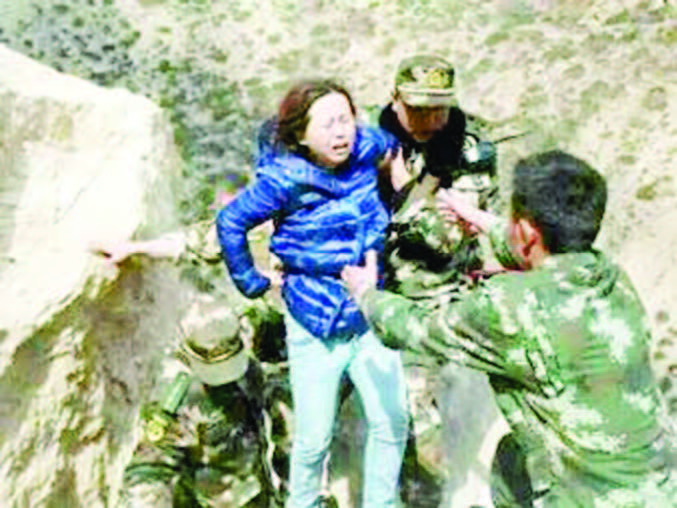
    BEIJING (TIP): Chinese rescuers have safely evacuated 86 tourists, including 13 foreigners, who were trapped in heavy snow at the north base camp of Mount Everest in central Tibet. The government of Tibet Autonomous Region said that 78 tourists, who had been stranded at the camp, were safely moved to a nearby hotel. A total of 86 tourists were initially trapped at the camp but Monday evening report said eight of them had left Rongbuk, the world’s highest monastery located at an altitude of 5,100 metres. The tourists included 13 foreigners mainly Australian and Dutch citizens, state-run Xinhua news agency reported. The tourists were about to go downhill after sightseeing at the base camp of the Mt Everest known in Tibet as Mout Qomolangma when a snowstorm blocked the roads. The local government said they had mobilized more than 40 rescuers and machinery to clear the way.

  • INDIA’S RELATIONS WITH NEIGHBOURING COUNTRIES

    INDIA’S RELATIONS WITH NEIGHBOURING COUNTRIES

    India has formal diplomatic relations with most nations; it is the world’s second most populous country, the world’s most-populous democracy and one of the fastest growing major economies. With the world’s seventh largest military expenditure, ninth largest economy by nominal rates and third largest by purchasing power parity, India is a regional power, a nascent great power and a potential superpower. India’s growing international influence gives it a prominent voice in global affairs.

    The Economist magazine argues, however, that underinvestment in diplomacy and a lack of strategic vision have minimised India’s influence in the world. India is a newly industrialised country, it has a long history of collaboration with several countries and is considered one of the leaders of the developing world along with China, Brazil, Russia and South Africa (the BRICS countries). India was one of the founding members of several international organisations, most notably the United Nations, the Asian Development Bank, G20 industrial nations and the founder of the Nonaligned movement.

    India has also played an important and influential role in other international organisations like East Asia Summit, World Trade Organisation, International Monetary Fund (IMF), G8+5 and IBSA Dialogue Forum. Regionally, India is a part of SAARC and BIMSTEC. India has taken part in several UN peacekeeping missions and in 2007, it was the secondlargest troop contributor to the United Nations. India is currently seeking a permanent seat in the UN Security Council, along with the G4 nations.

    Relations with PakistanDespite historical, cultural and ethnic links between them, relations between India and Pakistan have been plagued by years of mistrust and suspicion ever since the partition of India in 1947. The principal source of contention between India and its western neighbor has been the Kashmir conflict. After an invasion by Pashtun tribesmen and Pakistani paramilitary forces, the Hindu Maharaja of the Dogra Kingdom of Jammu and Kashmir, Hari Singh, and its Muslim Prime Minister, Sheikh Abdullah, signed an Instrument of Accession with New Delhi.

    The First Kashmir War started after the Indian Army entered Srinagar, the capital of the state, to secure the area from the invading forces. The war ended in December 1948 with the Line of Control dividing the erstwhile princely state into territories administered by Pakistan (northern and western areas) and India (southern, central and northeastern areas). Pakistan contested the legality of the Instrument of Accession since the Dogra Kingdom has signed a standstill agreement with it.

    The Indo-Pakistani War of 1965 started following the failure of Pakistan’s Operation Gibraltar, which was designed to infiltrate forces into Jammu and Kashmir to precipitate an insurgency against rule by India. The five-week war caused thousands of casualties on both sides. It ended in a United Nations (UN) mandated ceasefire and the subsequent issuance of the Tashkent Declaration. India and Pakistan went to war again in 1971, this time the conflict being over East Pakistan.

    The large-scale atrocities committed there by the Pakistan army led to millions of Bengali refugees pouring over into India. India, along with the Mukti Bahini, defeated Pakistan and the Pakistani forces surrendered on the eastern front. The war resulted in the creation of Bangladesh. In 1998, India carried out the Pokhran-II nuclear tests which was followed by Pakistan’s Chagai-I tests. Following the Lahore Declaration in February 1999, relations briefly improved. A few months later however,Pakistani paramilitary forces and Pakistani Army, infiltrated in large numbers into the Kargil district of Indian Kashmir.

    This initiated the Kargil conflict after India moved in thousands of troops to successfully flush out the infiltrators. Although the conflict did not result in a full-scale war between India and Pakistan, relations between the two reached all-time low which worsened even further following the involvement of Pakistan-based terrorists in the hijacking of the Indian Airlines IC814 plane in December 1999. Attempts to normalise relations, such as the Agra summit held in July 2001, failed.

    An attack on the Indian Parliament in December 2001, which was blamed on Pakistan, which had condemned the attack[105] caused a military standoff between the two countries which lasted for nearly a year raising fears of a nuclear conflict. However, a peace process, initiated in 2003, led to improved relations in the following years. Since the initiation of the peace process, several confidence-buildingmeasures (CBMs) between India and Pakistan have taken shape. The Samjhauta Express and Delhi–Lahore Bus service are two of these successful measures which have played a crucial role in expanding people-to-people contact between the two countries.

    [106] The initiation of Srinagar–Muzaffarabad Bus service in 2005 and opening of a historic trade route across the Line of Control in 2008 further reflects increasing eagerness between the two sides to improve relations. Although bilateral trade between India and Pakistan was a modest US$1.7 billion in March 2007, it is expected to cross US$10 billion by 2010. After the Kashmir earthquake in 2005, India sent aid to affected areas in Pakistani Kashmir & Punjab as well as Indian Kashmir.

    The 2008 Mumbai attacks seriously undermined the relations between the two countries. India alleged Pakistan of harboring militants on their soil, while Pakistan vehemently denies such claims. Relations are currently hampered since India has sent a list of 40 alleged fugitive in various terror strikes to Pakistan, expecting them to be handed over to India. Pakistan, on the other hand, has declared that it has no intentions whatsoever of carrying out their extradition. The August 2013 attack by the Pak army on the LoC killed five Indian army men,which further strained the relations between the two nations.

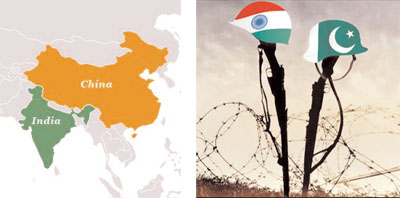
    China Despite lingering suspicions remaining from the 1962 Sino-Indian War and continuing boundary disputes over Aksai Chin and Arunachal Pradesh, Sino-Indian relations have improved gradually since 1988. Both countries have sought to reduce tensions along the frontier, expand trade and cultural ties, and normalise relations. A series of high-level visits between the two nations have helped improve relations. In December 1996, PRC President Jiang Zemin visited India during a tour of South Asia.

    While in New Delhi, he signed with the Indian Prime Minister a series of confidence-building measures for the disputed borders. Sino-Indian relations suffered a brief setback in May 1998 when the Indian Defence minister justified the country’s nuclear tests by citing potential threats from the PRC. However, in June 1999, during the Kargil crisis, then-External Affairs Minister Jaswant Singh visited Beijing and stated that India did not consider China a threat. By 2001, relations between India and the PRC were on the mend, and the two sides handled the move from Tibet to India of the 17th Karmapa in January 2000 with delicacy and tact.

    In 2003, India formally recognised Tibet as a part of China, and China recognised Sikkim as a formal part of India in 2004. Since 2004, the economic rise of both China and India has also helped forge closer relations between the two. Sino-Indian trade reached US$36 billion in 2007, making China the single largest trading partner of India. The increasing economic reliance between India and China has also bought the two nations closer politically, with both India and China eager to resolve their boundary dispute.

    They have also collaborated on several issues ranging from WTO’s Doha round in 2008 to regional free trade agreement. Similar to Indo-US nuclear deal, India and China have also agreed to cooperate in the field of civilian nuclear energy. However, China’s economic interests have clashed with those of India. Both the countries are the largest Asian investors in Africa and have competed for control over its large natural resources. India and China agreed to take bilateral trade up to US$100 billion on a recent visit by Wen Jiabao to India.

  • ‘Unprecedented Freedom’ In Tibet, Xinjiang: China To United States

    ‘Unprecedented Freedom’ In Tibet, Xinjiang: China To United States

    WASHINGTON (TIP) : China said on July 11 that its Tibetan and Uighur minorities enjoyed happiness and “unprecedented” freedom as it hit back at US criticism by urging Washington to examine its own record. “China has made important progress on human rights.

    People in various regions in China including Xinjiang and Tibet are enjoying happier lives and they are enjoying unprecedented freedoms,” State councilor Yang Jiechi said in a joint press appearance after two days of US-China talks. “We hope the United States will improve its own human rights situation on the basis of mutual respect and non-intervention in each other’s internal affairs,” he said.

    The US state department in its annual human rights report said that conditions had deteriorated in Tibetan areas and Xinjiang. More than 110 Tibetans have set themselves alight since 2009 to protest what they see as China’s harsh rule. Overseas groups said Chinese forces opened fire Saturday on Tibetans who celebrated the birthday of their exiled spiritual leader, the Dalai Lama. Xinjiang, a vast northwestern region of China, has seen periodic unrest as the largely Muslim Uighur community complains of discrimination and a lack of rights at the hands of members of China’s majority Han community.

    Deputy Secretary of State William Burns said that the United States spoke out about the treatment of Tibetans and Uighurs as the two countries held wideranging annual talks, the Strategic and Economic Dialogue. “The goal of this conversation was to emphasize the importance of human rights to our bilateral relationship,” Burns said at the joint press appearance.

    “We firmly believe that respect for universal rights and fundamental freedoms will make China more peaceful, more prosperous and ultimately more secure,” he said. Burns was filling in for secretary of state John Kerry, who officials said raised human rights among other issues during the first day of talks before he returned to Boston where his wife has been hospitalized.

  • Shed Illusions On China

    Shed Illusions On China

    India’s appeasement policy won’t help
    It is high time the PMO and the MEA gathered courage to speak on the South China Sea and the issues having a bearing on national security, particularly in forums like the East Asia Summit, with the same clarity as the Defense Minister did.

    During the past month China inflicted a national humiliation on India by intruding 19 kilometers across what has been the traditional border between Ladakh and Tibet since the 17th century and forcing India to not only pull back from its own territory in the Daulat Beg Oldi sector, but also to dismantle defense structures in the Chumar sector.

    China has consistently refused to define where the so-called “Line of Actual Control” lies and acted aggressively when it finds Indian defenses neutralize its tactical and strategic advantages by pushing its claims westwards and well beyond what its own maps had earlier depicted. Moreover, apart from violating all past agreements on the Ladakh-Tibet border, China’s territorial claims also violate the provisions of the Wen Jiabao – Manmohan Singh Agreement of 2005 on the guiding principles for a border settlement which state: “The (Sino-Indian) boundary should be along well defined and easily identifiable geographical features, to be mutually agreed upon”.

    India’s claims, based on historical data, also fulfill the provisions of the 2005 agreement as they set the western borders up to the Indus river watershed, with the Karakoram mountains forming the natural boundary. After being militarily humiliated, India chose to subject itself to diplomatic ridicule in the joint statement issued after the visit of Premier Li Keqiang.

    While the joint statement paid lip service to the 2005 guiding principles, there was no mention of the need for defining the LAC in accordance with these guiding principles. Unless we do this and insist on China furnishing its version of the LAC, the Chinese will continue to stall and obfuscate while placing our forces in an untenable position along the borders, with India meekly agreeing to pull down any defenses the Chinese demand.

    Worse still, India agreed to accept some ridiculous and one-sided provisions which are clearly detrimental to its national interests. The most astonishing provision of the joint statement was the sentence: “The two sides are committed to taking a positive view and support each other’s friendship with other countries”. This, in effect, was an endorsement of Chinese policies of “low cost containment” of India.

    Over the past three decades China has provided Pakistan designs for its nuclear weapon, allowed the use of its territory in 1990 by Pakistan for testing nuclear weapons, upgraded Pakistan’s enrichment centrifuges, provided unsafeguarded plutonium production and reprocessing facilities and violated its commitment to the MTCR, by providing Pakistan wherewithal for manufacturing medium and long-range ballistic and cruise missiles.

    China is also Pakistan’s largest arms supplier, providing equipment ranging from JF 17 fighters and T 90 tanks to modern frigates. General Musharraf had made it clear just after the visit of then Chinese Premier Zhu Rongji that the Gwadar port being built with Chinese assistance would be made available to China if there were tensions with India. Moreover, does our ill-advised endorsement of the nature of Sino-Pakistani collusion not suggest an endorsement of Chinese growing presence in POK and the Northern Areas of Gilgit-Baltistan? As the Chinese government mouthpiece, The Global Times, mockingly observed: “India must accept and adapt to the enviable friendship between China and Pakistan.

    China cannot scale down this partnership merely because of India’s feelings!” On May 28 President Rajapakse of Sri Lanka signed a “strategic cooperation partnership” agreement with President Xi Jinping in Beijing, in which the two sides agreed to strengthen defense cooperation while jointly cracking down on the “three challenges of terrorism, separatism and extremism” and expanding cooperation on “international and regional affairs”.

    Virtually every South Asian leader choosing to challenge India, ranging from President Waheed in the Maldives to Begum Khaleda Zia in Bangladesh and Prachanda in Nepal, has received a warm welcome at the highest levels in Beijing. Moreover, China is bent on blocking India’s entry into forums like the Nuclear Suppliers Group. Worse still, India grandiosely agreed to support a Chinese role in the Gulf of Aden, without getting similar Chinese endorsement for its maritime and energy interests in the South China Sea, most notably for its exploration projects in the Phu Khanh Basin off the coast of Vietnam.

    Interestingly, while commissioning the first squadron of carrier-based Mig 29 aircraft on May 13, the Defense Minster, Mr. A.K. Antony, asserted that there should be freedom of navigation in the South China Sea, adding that while India is not a party to disputes there, it believes that these disputes should be settled according to the UN Convention of the Law of the Seas (UNCLOS). Mr. Antony added the protection of the sea lanes of communications is imperative for India’s trade, commerce and economic development.

    Sadly, such clarity on Indian interests is not evident in other parts of South Block. Moreover, Mr. Antony believes that there can be no “miracles” in the development of India-China relations and has no intention of either taking up residence in Beijing or waxing eloquent on the serenity and tranquility surrounding Tiananmen Square! New Delhi has to understand that the appeasement of an assertive China is a recipe for global and regional marginalization.

    Given China’s territorial claims, which have expanded from just Tawang, to the entire state of Arunachal Pradesh and its activities in PoK, India should not merely stop voicing the inane mantra that “Tibet is an Autonomous Region of China,” but make it clear that we did not invite the Dalai Lama to India. We would be happy if he reached an agreement to return to Tibet, with China respecting the provisions of the 17-point agreement it signed with the Tibetans in 1951. Moreover, apart from acquiring berthing facilities for the Navy in Vietnam, India would be well advised to provide Vietnam the ability to protect its maritime interests by the supply of Brahmos cruise missiles, much in the manner that China provides Pakistan ballistic and cruise missiles.

    On river waters, India is well placed to work with lower riparian states in the Mekong basin and, indeed internationally, to isolate China on its refusal to engage in prior consultations on projects on the Brahmaputra river. It is also high time the PMO and the MEA gathered courage to speak on the South China Sea and issues having a bearing on national security, particularly in forums like the East Asia Summit, with the same clarity as the Defense Minister, instead of appearing apologetic, weak and vacillating. The statements made and cooperation envisaged when the Prime Minister visited Japan are a good beginning.

  • The Dragon Covets the Arctic

    The Dragon Covets the Arctic

    China’s lust for oil, minerals, rare earths, fish and desire for an alternative northern sea route boils the Arctic Geopolitics!
    Iceland is a small, sparsely populated island nation with a population of only 320,000 and area of 40,000 square miles. It is the only member of the NATO that does not have an army of its own. Icelandic banks were part of the 2008 global financial crisis and meltdown when they exposed the Icelandic government of huge financial risks by indulging in risky loans and speculative foreign currency transactions without having enough liquidity and capital reserves. The fiscal crisis led to a former Icelandic prime minister losing his job and being hauled to court of law for not supervising the banks enough. In an international capitalistic, mercantile system, if Iceland were a company, it was “sitting duck” for outright purchase and acquisition. Fortunately, foreigners are not allowed to buy any property or real estate in Iceland and need a special permit. And here comes the Peoples’ Republic of China, rich with $ 3.4 trillion in foreign exchange reserves in its kitty.

    It has built a palatial embassy in Reykjavik, Iceland worth $250 million with only 7 accredited diplomats. China is negotiating a free trade area with Iceland, the first with any European nation. Former Chinese Prime Minister Wen Jiabao even paid a state visit to Iceland for two full days in 2012. Other Chinese ministers and officials have also been very active in Iceland with bilateral visits and cultural events. In 2010, Huang Nubo, a “poetry loving” Chinese billionaire and former communist party official visited Iceland to meet his former classmate Hjorleifur Sveinbjornsson, a Chinese translator with whom he had shared a room in 1970s in the Peking University. He expressed his intense love for poetry and put up $ one million to finance Iceland-China Cultural Fund and organized two poetry summits, the first one in Reykjavik in 2010 and the second one in Beijing in 2011.

    Last year (2012), Huang Nubo and his Beijing based company, the Zhongkun group offered to buy 300 sq km of Icelandic land ostensibly to develop a holiday resort with a golf course. This Chinese billionaire wanted to pay $7million to an Icelandic sheep farmer to take over the land and build a $100 million 100-room five star resort hotel, luxury villas, an eco-golf course and an airstrip with 10 aircrafts.

    A state owned Chinese bank reportedly offered the Zhongkun group a soft loan of $ 800 million for this project. The deal was blocked by the Icelandic Interior Minister who asked many pertinent questions but reportedly got no answers. Huang would not take no for an answer and has submitted a revised bid for leasing the land for $ one million instead of outright purchase. He makes an unbelievable assertion that there is a market demand for peace and solitude: “Rich Chinese people are so fed up of pollution that they would like to enjoy the fresh air and solitude of the snowy Iceland”. The current Icelandic government, a leftof- center coalition has given this proposal a cold shoulder.

    But, with elections due in April 2013 in Iceland, China is hoping for a more sympathetic government to approve the project. Iceland looks like an easy bird of prey for the wily red Dragon with insatiable appetite. China is showing generosity to another poor and sparsely populated, self-governing island of Greenland by offering investments in mining industry with proposal to import Chinese crews for construction and mining operations. Greenland is rich in mineral deposits and rare earth metals. China wants Greenland to provide exclusive rights to its rare earth metals in lieu of the fiscal investments. Under one such proposal, China would invest $2.5 billion in an iron mine and would bring 5000 Chinese construction and mining workers whereas the population of the capital of Greenland, Nuuk is only 15000.

    Arctic Council Membership:
    There are eight members of the Arctic Council that includes Canada, Denmark (including Greenland), Finland, Iceland, Norway, Russia, Sweden and the USA. All these eight countries have geographic territories within the Arctic Circle. It was constituted in 1996 as an intergovernmental body but has evolved gradually from a dialogue forum to a geo-political club and a decision making body. There are continuing territorial disputes in Arctic Circle. Ownership of the Arctic is governed by the United Nations Convention of the Law of the Sea, which gives the Arctic nations an exclusive economic zone that extends 200 nautical miles from the land. Member countries signed their first treaty on joint search and rescue missions in 2011. A second treaty on cleaning up oil spills is being negotiated. The group established its permanent secretariat at Tromso, Norway in January 2013.

    Arctic Melting and Opening of Newer Sea Lanes:
    With global warming becoming a reality, the Arctic ice has started to melt rapidly opening the northern sea-lanes that were frozen earlier. In summer of 2012, 46 ships sailed through the Arctic Waters carrying 1.2 million tonnes of cargo. There are legal questions about the international status of the northern sea lanes.

    China’s Lust for Arctic Resources:
    The Arctic has 13% of the world’s undiscovered oil and 30% of gas according to the US Geological Survey. Greenland alone contains approximately one tenth of the world’s deposits of rare earth minerals. China which already has a monopoly on world’s rare earth metal trade wants to continue controlling this global trade. China piously claims that the Arctic resources are the heritage of the entire mankind while insisting that the South China sea is its exclusive sovereign territory. In 2004, China set up its first and the only Arctic scientific research station, curiously named “Yellow River Station” on the Svalbard Island of Norway.

    China, so far, has sent 6 arctic expeditions. China plans to build more research bases. In 2012, the 170- meters long ice-breaker “Snow Dragon” (MV Xue Long) became the first Chinese Arctic expedition to sail along the Northern Sea Route into the Barente Sea. Incidentally, as early as 1999, this 21000 metric ton research ice-breaker Xue Long had docked in the Canadian North-Western territory unexpectedly. China is building another 120-meter long ice-breaker with the help of Finland while the Polar Research institute in Shanghai trains scientists and other personnel for Arctic expeditions.

    China’s Previous Use of Deception:
    There is no mandarin character for word transparency. China has been known to use duplicity and deception since the Art of War was written by Sun Tzu. China’s rhetoric of “peaceful and harmonious rise” and hegemonic behavior are predictably diametrically opposite to each other. China’s use of deception to camouflage its intentions in geopolitical matters is not surprising. While China joined the NPT in 1991, it provided 50 kg of highly enriched uranium to Pakistan, provided that country with a nuclear weapon design and supervised Pakistan’s first nuclear test at the Chinese nuclear testing site of Lop Nur.

    China purchased in 1998 an unfinished aircraft carrier from Ukraine after the break-up of Soviet Union ostensibly for developing a floating casino. The same “floating casino” is now China’s first aircraft carrier projecting Chinese naval and maritime power in the South China Sea. China’s Application in Arctic Council Membership: China currently has an ad hoc observer status with Arctic Council. China’s application for permanent observer-ship was denied by Norway in 2012 owing to bilateral dispute over awarding of Nobel peace prize to China’s Liu Xiabo in 2010. China still has a pending application to be decided in May 2013 Arctic Council summit in Sweden when Canada takes over the chair for the next two years. With a permanent observer status, China would get full access to all Arctic Council meetings. Permanent observers do not have voting rights in the council but can participate in deliberations.

    China is trying to distinguish itself from the rest of the applicants as a “Near Arctic State” on the perniciously clever but fallacious grounds that the northernmost part of China in the province of Manchuria (the Amur river) is only one thousand miles south to the Arctic circle. The fallacy is that Manchuria was a separate, independent country that was annexed by China after the Communist take-over. Manchus had ruled over China for centuries during the reign of Manchu dynasty and last Chinese Emperor Pu Yi was actually the last Manchu emperor. Chinese ownership and annexation of Manchuria (Manchu-Kuo) is still not settled. A disputed territory cannot be used by China to make a geo-political claim for being a “Near Arctic State”.

    Other Pending Applications:
    Other countries or non-state actors with pending applications for permanent observer-ship status include Japan, South Korea, India, Singapore, European Union, and non-state actors like Greenpeace and the International Association of Oil and Gas Producers. All these applications will be decided one way or the other in May 2013. The vote has to be unanimous for acceptance and how the US and Russia will vote is the crucial issue. In the past, Norway had vetoed China’s membership application. Some of the Arctic Council members may not approve European Union’s application because of EU’s penchant for restrictive and narrow rulings. Whereas Sweden, Canada, Iceland and Denmark may support China’s application, there are doubts about Norway, Russia and the US. Russia is currently the most vociferous member of Arctic Council that has serious reservations in expanding the Arctic club.

    Strategic Issues:
    China has voracious appetite for new territories and has been seeking new frontiers for the last three hundred years with Inner Mongolia, Manchuria, Xinjiang and Tibet. China’s list of “core issues” is ever-expanding, starting with Taiwan and Tibet. China has included the whole the South China Sea and its islands as a core issue. China is aggressively claiming sovereignty on these islands based on historical maps and manufactured mythological evidence. China has now a license from the UN for deep sea bed mining for minerals in the Indian Ocean and has developed naval bases in Indian Ocean and Arabian Sea ports. If China manages to get a toehold in Arctic Circle, its behavior will become as belligerent in Arctic as it is in the South China Sea. It might claim sovereignty over the whole of the Northern route sea lanes based on “historical evidence”. If in 22nd century, China decides that the Arctic Circle is its core national issue, one would be seeing Chinese aircraft carriers in the Arctic Sea and Chinese nuclear powered submarines in the Barente Sea along with military bases with “Chinese characteristics” in the Iceland and Greenland.