Tag: Tibet

  • Ajanta Caves A Legacy From The Golden Age

    Ajanta Caves A Legacy From The Golden Age

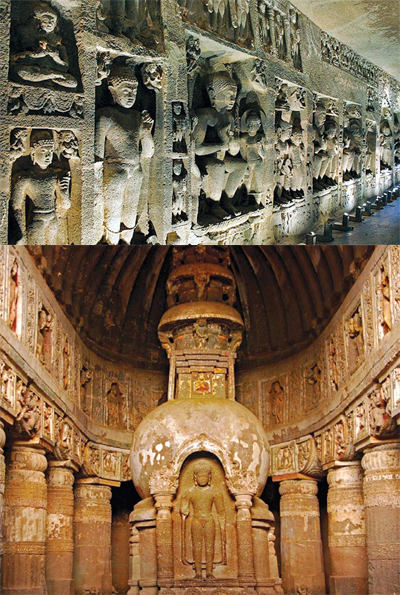
    Ajanta and Ellora are the pride of Maharashtra. The rock-cut caves of both these sites are world famous and illustrate the degree of skill and artistry that Indian craftsmen had achieved several hundred years ago. Ajanta dates from 100 B.C. while Ellora is younger by some 600 years. The village of Ajanta is in the Sahyadri hills, about 99 kms. From Aurangabad; a few miles away in a mammoth horseshoe-formed rock, are 30 caves overlooking a gorge, `each forming a room in the hill and some with inner rooms.

    Al these have been carved out of solid rock with little more than a hammer and chisel and the faith and inspiration of Buddhism. Here, for the Buddhist monks, the artisans excavated Chaityas (chapels) for prayer and Viharas (monasteries) where they lived and taught. Many of the caves have the most exquisite detailed carvings on the walls, pillars and entrances as well as magnificent wall paintings.

    These caves were discovered early in the 19th century quite by chance by a party of British Officers on manoeuvres. Today the paintings and sculptures on Buddha’s life, belonging to the more mellow and ritualistic Mahayana Buddhism period, are world famous. Copies of them were shown in the Crystal Palace exhibition in London in 1866. These were destroyed in a fire there.

    Further copies were published soon afterwards and four volumes of reproductions were brought out in 1933 by Ghulam Yazdani, the Director of Archaeology of the then Hyderabad State. Ajanta has formed an epicentre of interest for those who appreciate and are eager to know more about Indian history and art. It is a protected monument under the Archaeological Survey of India and has been listed in the World Heritage list of monuments.

    The 30 caves of Ajanta were created over a span of some 600 years. In their range of time and treatments they provide a panorama of life in ancient India and are a source of all kinds of information… hair styles, ornaments, textiles, musical instruments, details of architecture, customs etc.

    It was from this collection of classical Indian art that a particular style was formed that traveled with Buddhism to many parts of the world. Similar paintings can be seen in Sigiriya in Sri Lanka, Bamiyan in Afghanistan, temples and shrines in Tibet, Nepal, China and Japan. Royal patronage made Ajanta possible. Professional artists carried out much of the work and each contributed his own individual skill and devotion to this monumental work.

    Visitors often ask how the artist who painted the detailed frescoes and chiseled out the intricate carvings, managed to work in the dark interiors of the caves. It has been noticed that the caves are illuminated by natural light for part of the day and it is presumed that metal mirrors or sheets of white cloth were used to reflect sunlight into the inner recesses.

    Here, briefly, are some of the highlights of the caves. In the Cave 26, the sculpture is elaborate and beautiful though the painted frescoes are incomplete. The arched chapel window set in an elegantly simple façade, is repeated in an elaborate frontage in Cave 19 with its complete Chaitya and a slender votive stupa enclosing a standing Buddha at the far end. Of particular note is a sculpture of a seated Nagaraja with his consort and female attendant.

    Cave 16 is an elegant Vihara with an inscription that mentions the king and his minister who had the cave built. Here a towering Buddha sits preaching. He is flanked by attendants with fly whisks.

    There are undamaged portions of the wall paintings that are clear and vibrant in Caves 1, 2, 16 and 17. Cave I has the well known Bodhisattva Padmapani which is a wonderful portrayal of tender compassion. A gentle figure holding a lotus delicately in one hand. In the same cave is the golden figure of Avalokiteswara, elaborately adorned. The women, nymphs, princess and attendants are elegant and beautifully attired.

    Here also is a lively panel of dancing girls and musicians. In Cave 2 there is a detailed panel of Queen Maya’s dream, of the white elephant which was interpreted by royal astrologers to mean the birth of an illustrious son. The row upon row of Buddhas, can be seen in this cave. In Cave 17, there is a flying apsara in a fashionable embroidered turban and splendid jewellery.

    It is worth walking away from the caves in order to look back on to the horseshoe gorge. The ingenuous water cistern system can be seen which must have provided water for the monks and their visitors. Ajanta was on the ancient trade route leading to the coast so there must have been considerable activity and many visitors. Nobody really knows what life was like in those times and visitors can interpret the past as they wish, which is perhaps yet another secret charm of Ajanta.

  • Britain’s Hat-Tip Towards Honest History

    Britain’s Hat-Tip Towards Honest History

    PM Cameron’s admission of colonialshame, while short of an apology orreparations to the heirs of thoseslaughtered, is welcome by all who insistthat history must be honest and not a tool ofadded insult to those who were victims ofpast crimes, “monstrous” or otherwise.The rule of law abandoned “trial bycombat” in favor of “trial by jury,” so thatright, not might, prevail.

    In a social mediaconnectedworld the “governed” require oftheir respective governments to be “for thepeople,” and every government is charged, ifit is to survive, to strip away false denials ofpast misconduct and help history becomehonest. That core issue, honest history, is apostulatic foundation to the rule of law,mutual respect in the comity of nations and”…to form a more perfect world.”

    In Asiaalone, we see the continuing damage ofdishonest history from the “disputedislands” between Japan and China,uncompensated “Korean Comfort Women,”Tibet, Kashmir, and the list goes on.I salute PM Cameron’s genuine remorseon behalf of a nation, as he seeks to havethe sun re-shine on the British isles. Finally,I have felt that the “strategic partnership”between our nation and India needed to bere-calibrated up to a “special relationship.

    “I’m jealous that PM Cameron hasannounced his intentions to do so before we,the United States do, and accordingly I callupon Secretary of State John Kerry, whoselegacy has added greatness waiting to berecorded in history as he seeks to re-engagethe Middle East peace process, to cause a”special relationship” between the UnitedStates and the Sub-Continent.”

    Ravi Batra
    Chair, National Advisory Council onSouth Asian Affairs (NACSAA)
    Cell: 914 882 6382

  • 70 Held In Crackdown Against Self-Immolation Protests In Tibet

    70 Held In Crackdown Against Self-Immolation Protests In Tibet

    BEIJING (TIP): Stepping up itscrackdown against self-immolation protestsin Tibet, China has detained 70 suspects fora string of suicides in November last year,coinciding with the once-in-a-decadeleadership change in China’s rulingCommunist Party.A total of 70 people have been detainedby the police in Huangnan of northwestChina’s Qinghai Province in connectionwith a string of self-immolations that haveoccurred since November 2012, state-runXinhua news agency quoted a senior policeofficer as saying today.

    Lyu Benqian, deputy chief of theQinghai Provincial Public SecurityDepartment, said 12 of the suspects wereofficially arrested over the self-immolationcases in the Huangnan TibetanAutonomous Prefecture.The self-immolation cases wereinfluenced by the separatism of the DalaiLama clique, as the Dalai Lama has prayedfor self-immolators and Tibetan separatistsoverseas flaunt them as “heroes”, he said.

    There was a big spurt in selfimmolationswith 23 such cases reported inNovember last year, the highest in onemonth apparently to coincide with the 18thParty Congress to elect a new leadership.About 95 to 100 Tibetans have so farcommitted suicide in the recent monthsprotesting Chinese rule in Tibet and callingfor the return of the Dalai Lama from exilein India.So far China has convicted sevenpersons, including a Buddhist monk, whowas given a two-year suspended deathsentence.

    “Some of the victims (of self-immolation)were frustrated and pessimistic in life, andthey wanted to earn respect by selfimmolation,”Lyu said while analysing themotive for the action.Last night, China’s state-run televisionaired a documentary accusing theDharamsala-based Tibetan Youth Congress(TYC) of orchestrating the incidents.The half-an-hour documentary, second byCCTV, has also accused the Tibetan serviceof the Voice of America (VOA) of passingon coded messages to some of the contactsin Tibet at the instance of Dalai Lamasupporters.

  • Brahmaputra Dams : Ensure India’s Interests Are Not Hit, China Told

    Brahmaputra Dams : Ensure India’s Interests Are Not Hit, China Told

    NEW DELHI (TIP): Alarmed over reports suggestingthat China proposed to construct three more dams onriver Brahmaputra in Tibet, India today asked Beijing toensure that the interests of downstream states were notharmed by any activities in upstream areas.Talking to reporters here, MEA spokesman SyedAkbaruddin said India continued to carefully monitorall developments on the Brahmaputra and has conveyedits “views and concerns” to the Chinese authorities,including at the highest levels.

    “As a lower riparian state with considerableestablished user rights to the waters of the river, Indiahas conveyed its views and concerns to the Chineseauthorities, including at the highest levels of theGovernment of the People’s Republic of China. Indiaurges China to ensure that the interests of downstreamstates are not harmed by any activities in upstreamareas,” he said.He was responding to a query regarding Chinaapproving construction of three more dams onBrahmaputra river in Tibet in addition to the one beingbuilt.

    A document approved by the Chinese Cabinet recentlymentioned three dams to be built at Dagu, Jiacha andJiexu on Brahmaputra, according to Indian officials inBeijing. The document listing projects to be completedin China’s 12th five year plan made a passing referenceto the three dams without any details, they said. Indiahas not been informed about the move so far.

  • SIKKIM beckons you

    SIKKIM beckons you

    Sikkim, a mountainous region in the eastern Himalayas, has 600 species of birds, or about half of the over 1200 species to be found in India. Perched between Nepal in the west, Bhutan in the east, and Tibet( China) in the north, Sikkim is 7300 square miles in area and contains Mount Khangchendzonga, the third-highest peak in the world. Formerly a kingdom, since 1975 it has been a tiny land -locked province to India.

    Sikkim, with its rich biodiversity, has 150 lakes ranging in altitude from 200 meters to almost 8000 meters. Besides birds, Sikkim has 4000 species of flowering plants, making it a botanist’s paradise. It has 600 species of orchids, and 40 species of rhododendrons. With the introduction of eco-tourism, including serious birding, Sikkim has begun to focus on enterprise-based conservation.

    BIRD WATCHING
    Sikkim is considered a hot spot of biodiversity in the Himalayas. Sikkim is rich in avifauna and is considered to be a birdwatchers paradise. Its avian population extends to almost 550 species. The climate varies between the tropical heat of the valleys and the alpine cold of the snowy regions.

    The altitudinal zones of vegetation range from tropical, sub tropical, temperate to Alpine. In some places only 10 Kms in a direct line separate the warm valleys from perpetual snow.

    The telescoping of terrain has created marked altitudinal zonation in the humidity, rainfall, climate and vegetation. This factor is responsible for the great variety and abundance of the resident bird life, making this area arguably one of the richest areas of its size anywhere in the world.

    PLACES TO SEE
    The terrain of Sikkim, being rugged, is not conducive to agriculture and even industrialization here is not updated. So the bulk of the economy of the state of Sikkim is shared by the tourism industry of the place.

    There are some fabulous places to see in Sikkim, making it one of the most frequented tourist destinations in the north eastern part of India.

    The variety of sightseeing spots in Sikkim ranges from parks to lakes, monasteries to political buildings, from sanctuaries to research institutes. Some of the places to see in Sikkim are:
    ENCHEY MONASTERY:
    This most important ‘stupa’ of Buddhism, a 200 years old monumental building is the seat of the Nyigma order.
    RUMTEK DHARMA CHAKRA
    CENTER: Built in 1960 by the 16th Gyalwa Karmapa, it is a replica of the original Kagyurpa Monastery in Tibet.
    TSOMGO LAKE: Home of Brahmini and other migratory ducks, it is situated at an altitude of 1200 ft. NATHULA PASS: It is situated on the Indo-Chinese border, hale a day’s ride from Gangtok.
    HIMALAYAN ZOOLOGICAL PARK: Covering 205 hectares, this park houses barking deers, bears, red pandas and a variety of Himalayan birds. The park also exhibits hundreds orchids and flowers.
    SIKKIM RESEARCH INSTITUTE OF TIBETOLOGY: This is an internationally acclaimed center of Buddhism and Tibetan studies.
    PELLING: Located about 4 hours ride from Gangtok, this place has some voluminous waterfalls.
    WHITE HALL: 5 minutes from Gangtok, it was built in 1932 to commemorate the first Political Officer of Sikkim.
    TASHI VIEW POINT: This spot presents a scenic view of the majestic Kanchenjunga and other surrounding hills. Apart from these beautiful spots, there are other sightseeing spots in Sikkim.
    They are:
    1)Hanuman Tok
    2)Ganesh Tok
    3)Shri Nalanda Institute for Higher
    Buddhist Studies
    Water Garden
    Jawaharlal Nehru Botanical Garden
    Sa-Ngor-Chotshog Center
    Ridge Park, Deer Park
    Do-Drul Chorten
    Government Institute of Cottage Industry
    Saramsa Garden
    Menmecho Lake
    Fambong La Wildlife Sanctuary and many more to make Sikkim a tourist’s nirvana

  • Inder Kumar Gujral A Gentle Statesman Prime Minister

    Inder Kumar Gujral A Gentle Statesman Prime Minister

    Born on the 4th of December in 1919, in the district headquarter town of Jhelum in the then Rawalpindi division of pre-1947 united Punjab, former Prime Minister of India Shri Inder Kumar Gujral died just four days short of turning ninety three on October 30, 2012.

    Throughout his long eventful life, he remained a very decent and gentle human being. He never ruffled any feathers. His father Avtar Narain Gujral, a freedom fighter, and mother Pushpa Gujral were both very suave and soft spoken individuals and social workers. Academically Inder Kumar Gujral was a very bright student. He completed his education up to 10th standard from his native place Jhelum. For his college education he moved to Punjab’s capital of Lahore, from where he graduated in arts.

    While studying in Lahore, he inculcated love and affinity for Urdu/Persian as a language and developed special interest in Urdu poetry and became an ardent listener of “Ghazals. He especially liked the voices of Kundan Lal Saigal, Mallika Pukhraj, Mehdi Hassan and Begum Akhtar.While studying in Lahore, he came in contact with some freedom fighters and some left leaning student activists. He was always considerate towards the poor and the under privileged and this tendency brought him into the fold of the Communist Party of India for some time.

    In 1947, India attained its hard fought independence from the British Raj, which resulted in painful partition of the province of Punjab. Ugly riots of unseen dimensions erupted thereafter and a lot of humanity was massacred for no reason or rhyme. Inder Kumar Gujral’s parents entered India through the bloody Lahore – Amritsar corridor and finally settled in Jalandhar, but Inder Kumar Gujral himself, along with his wife traveled all the way to Karachi, from where they sailed to Bombay. From Bombay they came by train to New Delhi, where they virtually starved at the railway station for three days and nights.

    Eventually Inder Kumar Gujral settled in New Delhi, but maintained a strong bond with his parental place of residence in Jalandhar. Mrs. Indira Gandhi liked Mr. Gujral’s uncommon humility and intellectual brilliance. She made him the union minister for information and broadcasting during early nineteen seventies. As a minister Mr. Gujral strengthened the Urdu Service of All India Radio with high powered medium-wave transmitters located at Rajkot and Jalandhar. He streamlined all the language services to the neighboring countries like Pakistan, Bangladesh, Tibet, China, Afghanistan, the Middle-East and Iran.

    He was also instrumental in taking first steps towards expansion of government owned television services in several important areas away from New Delhi. Under his able stewardship, government television was successfully introduced in Bombay, Amritsar and Srinagar and several other projects all over India were planned, which included the establishment of a modern television studio complex for the state of Punjab in Jalandhar. After the promulgation of national internal emergency in 1975, Mrs. Indira Gandhi took away the portfolio of information and broadcasting from I.K. Gujral.

    She sent him to Moscow as India’s Ambassador to the Soviet Union. This was a very important assignment. His stay in Moscow was instrumental in furtherance of Indo-Soviet cooperation. When Mrs. Indira Gandhi lost power in the general elections of 1977, her successor Morarji Desai did not replace him and kept him in his Moscow assignment throughout his own two year long tenure. After P.V. Narsimha Rao’s scandal ridden five year tenure was over in 1996, the Congress was badly defeated.

    Even the main opposition the Bharatiya Janata Party could not win enough seats to form a government on its own. At that time a coalition government under the banner of united front government headed by Deve Gowda of Karnataka was formed in New Delhi. It was supported by the Congress from outside. Mr. Gujral served as the Union Minister of External Affairs of India.

    Within ten months the patience of Congress ran out and Dewe Gouda was shown the door. He was replaced by his most gentle foreign minister, a suave and humble parliamentarian Inder Kumar Gujral. During his scandal free but not too long prime ministerial tenure in 1997, Mr. Gujral improved India’s relations with all the neighboring countries including Pakistan, China and Bangladesh.

    Unfortunately his term was also abruptly cut short. As the Prime Minister I.K. Gujral did a lot for Punjab. He wrote off entire loan obtained by the Government of Punjab to fight militancy during the eighties and nineties. He strengthened the broadcasting services in Punjab by strengthening the existing medium-wave transmitters with high powered ones. He wanted to establish an international airport in Punjab, which could serve the needs of the Punjabi diaspora spread all over the world.

    His desire was to establish this airport on the Jalandhar – Kapurthala Highway. But land was too expensive in that area. Eventually he agreed to let the existing Rajah Sansi Airport on the outskirts of Amritsar to be upgraded to an international airport. For Jalandhar, however he did a lot. As prime minister he took personal interest to sanction money for a lot of road over rail bridges.

    In Kapurthala, he sanctioned the establishment of an ultra-modern high tech science city, which is now the biggest tourist attraction of Kapurthala and the Bist Doab region.

    For the past few months in 2012, he was not keeping good health. When he breathed his last on Friday November 30, the entire nation was plunged into mourning for a departed gentle statesman. A seven day mourning has been ordered by the Government of India.

    During this periods, the national flag of India will fly all over the world at half mast.We salute Inder Kumar Gujral for what he was and what he stood for.

  • as i see it Changed Scenario

    as i see it Changed Scenario

    Fifty years ago, China launched a massive invasion along the border springing a surprise in India, the US and elsewhere in the world. While the golden jubilee of this incident has refreshed painful memories in India as can be seen in news and views expressed in various Indian media, it is not the same scenario in China. Chinese are not celebrating the victory over India. But China has been watching India and its domestic and foreign affairs very closely.

    What all happened about fifty years ago are not dead history. In fact, in international relations 50 years can be considered a very short duration. A brief journey to the past reminds that India-China friendship had begun to develop cracks by mid-1950s. India’s earlier recognition of Chinese suzerainty over Tibet failed to please China in the wake of Tibetan uprising that culminated in Dalai Lama and his tens of thousands of followers seeking asylum in India.

    Fifty years later, one finds that Tibet issue not only remains alive but also now and then hits the global headlines-a development quite irritating for China.

    The US declaration of support to Tibetan ‘self-determination,’ supply of weapons to and training of Tibetan guerrillas by the Central Intelligence Agency had blinded the Chinese to acute political differences between India and the US and rather had convinced the Chinese leadership that India and the US were conspiring against China. Today, Dalai Lama’s presence in India and his acceptability in political circles in Washington are resented by the Chinese government.

    Fifty years ago, the United States followed a declared policy of containment of China. China, on the other hand, supported wars of “national liberation” by communist groups and was virulently anti-imperialist-more than the former Soviet Union that, unlike China, believed in “peaceful co-existence.”

    India adopted a policy of constructive engagement of China for Asian cooperation and to keep the imperialist forces at bay from the Asian continent. The US at this time detested Nehru’s non-alignment and his leadership of the newly independent countries.

    Significantly, even China abhorred India’s leadership of the Third World. The US disliked India’s softness for international communism, including Chinese communists, and China considered India’s non-alignment not-hard-enough against the imperialists. Still worse, China viewed India to be a lackey of US-led western imperialists!

    Strategic partner

    Fifty years later, American suspicion of India and Chinese views on India has not qualitatively changed much. Despite a growing strategic partnership and closer defense ties with India, some Americans view India as an unreliable strategic partner and others view with suspicion Indian concept of “strategic autonomy.”

    Those in Washington who think that India can be a better counterweight to a growing Chinese hegemony feel disappointed to see rising China-India trade and investment ties and diplomatic coordination on international issues, such as climate change and trade negotiations.

    Others who consider ‘strategic autonomy’ mantra as a redefined ‘non-alignment’ oppose closer defense and security ties between the US and India, particularly sharing of defense technology and selling of sophisticated weapons to India.

    However, the mainstream Chinese perception of Indo-US relations in recent years is not very positive. Some believe that India’s economy is a third of Chinese economy and India cannot win a conventional war against China.
    Consequently, India has developed nuclear weapons and is building defense ties with the US. Indo-US defense ties, growing stronger by years, are viewed as aimed at China. Chinese perception of Obama’s ‘pivot to Asia’ strategy, where India finds a place, veers between critical to outright disapproval.

    In addition, around the time, India and China went to war, the world viewed China and India as two competing models of growth for the Third World. In fact, the crushing defeat of India in the war was viewed by many as rejection of Indian model as well. Some argued that one of China’s motivations for going to war was to destroy the Indian model
    Today, once again there is talk of “Beijing consensus” and “Mumbai consensus”. The two countries are large, populous, old civilizations and among the fastest growing economies of the world. There is talk in the international community about the Chinese and the Indian model of growth. Such talks have assumed added significance after the American economic downturn and the Eurozone crisis.

    When Japanese investment in China got affected by the ongoing spar over the Diaoyu/Skenkaku islands, some analysts in China have begun to argue that Japanese investment will now move to other emerging economies, including India. They think that it would be a Japanese strategy (read US-Japan strategy) to slow Chinese economic growth! Before long, growth in Indo-US economic cooperation may be viewed in similar ways.

    What is different after 50 years since the 1962 war is, however, equally significant. Both China and India are nuclear weapon powers. If China has enormously engaged the US in economic field, US-India defense ties have transformed the paradigm of their relations. China can be rest assured that this complex web of triangular ties will force the US to adopt a non-aligned strategy in any future conflict (not necessarily war) between two Asian giants.

    (The author is a Tagore Chair professor at Yunnan University, China)

  • AS I SEE IT – China thrives in soft corner with two-track U.S. strategy

    AS I SEE IT – China thrives in soft corner with two-track U.S. strategy

    The U.S. strategy long has been geared against the rise of any hegemonic power in Asia and for a stable balance of power. Yet, as its 2006 national security strategy report acknowledges, the United States also remains committed to accommodate “the emergence of a China that is peaceful and prosperous and that cooperates with us to address common challenges and mutual interests.”

    Can U.S. policy reconcile these two seemingly conflicting objectives? The short answer is yes.

    The U.S., in fact, has played a key role in China’s rise. One example was the U.S. decision to turn away from trade sanctions against Beijing after the 1989 Tiananmen Square massacre and instead integrate that country with global institutions – a major decision that allowed China to rise. Yet, paradoxically, many in the world today see China as America’s potential peer rival.

    Often overlooked is the fact that U.S. policy has a long tradition of following a China-friendly approach.
    In 1905, for example, President Theodore Roosevelt – who hosted the Japan-Russia peace conference in Portsmouth, New Hampshire, after the war between the two countries – argued for the return of Manchuria to Manchu-ruled China and for a balance of power in East Asia. The Russo-Japanese War actually ended up making the U.S. an active participant in China’s affairs.

    After the Communists seized power in China in 1949, the U.S. openly viewed Chinese Communism as benign and thus distinct from Soviet Communism. In more recent decades, U.S. policy has aided the integration and then ascension of Communist China, which began as an international pariah state.

    It was the U.S. that helped turn China into the export juggernaut that it has become by outsourcing the production of cheap goods to it. Such manufacturing resulted in China accumulating massive trade surpluses and becoming the principal source of capital flows to the U.S.

    America’s China policy has traversed three stages. In the first phase, America courted the Mao Zedong regime, despite its 1950-51 annexation of Tibet and its domestic witch hunts, such as the “Let a Hundred Flowers Bloom” campaign. Disappointment with courtship led to estrangement, and U.S. policy then spent much of the 1960s seeking to isolate China.

    The third phase began immediately after the 1969 Sino-Soviet bloody military clashes, as the U.S. actively sought to take advantage of the open rift between the two communist states to rope in China as an ally in its anti-Soviet strategy.

    Even though the border clashes were clearly instigated by China, as the Pentagon later acknowledged, Washington sided with Beijing. That helped lay the groundwork for the China “opening” of 1970-71 engineered by Henry Kissinger, who had no knowledge of China until then.

    Since the 1970s, the U.S. has followed a conscious policy to aid China’s rise – a policy approach that remains intact today, even as Washington seeks to hedge against the risks of Chinese power sliding into arrogance. The Carter White House, in fact, sent a memo to various U.S. departments instructing them to help in China’s rise.

    In the second half of the Cold War, Washington and Beijing quietly forged close intelligence and other strategic cooperation, as belief grew in both capitals that the two countries were natural allies. Such cooperation survived the end of the Cold War. Even China’s 1996 firing of missiles into the Taiwan Strait did not change the U.S. policy of promoting China’s rise, despite the consternation in Washington over the Chinese action.

    If anything, the U.S. has been gradually withdrawing from its close links with Taiwan, with no U.S. Cabinet member visiting Taiwan since those missile maneuvers. Indeed, U.S. policy went on to acknowledge China’s “core interests” in Taiwan and Tibet in a 2009 joint communiqué with Beijing.

    In this light, China’s spectacular economic success – illustrated by its emergence with the world’s biggest trade surplus and largest foreign-currency reserves – owes a lot to the U.S. policy from the 1970s, including Washington’s post-Tiananmen decision not to sustain trade sanctions.

    Without the significant expansion in U.S.-Chinese trade and financial relations since the 1970s, China’s economic growth would have been much harder.

    From being allies of convenience in the second half of the Cold War, the U.S. and China have emerged as partners tied together by close interdependence. America depends on Chinese trade surpluses and savings to finance its supersized budget deficits, while Beijing relies on its huge exports to the U.S. both to sustain its economic growth and subsidize its military modernization.

    By plowing two-thirds of its mammoth foreign-currency reserves into U.S. dollar-denominated investments, Beijing has gained significant political leverage.

    China thus is very different from the adversaries the U.S. has had in the past, like the Soviet Union and Japan. U.S. interests now are so closely intertwined with China that they virtually preclude a policy that seeks to either isolate or confront Beijing. Even on the democracy issue, the U.S. prefers to lecture some other dictatorships rather than the world’s largest and oldest-surviving autocracy.

    Yet it is also true that the U.S. views with unease China’s not-too-hidden aim to dominate Asia – an objective that runs counter to U.S. security and commercial interests and to the larger U.S. goal for a balance in power in Asia.
    To help avert such dominance, the U.S. has already started building countervailing influences and partnerships, without making any attempt to contain China. Where its interests converge with Beijing, the U.S. will continue to work closely with it. American academic John Garver, writing in the current issue of the Orbis journal, sees a de facto bargain between Washington and Beijing in the vast South Asia-Indian Ocean Region (SA-IOR): “Beijing accepts continuing U.S. pre-eminence in the SA-IOR in exchange for U.S. acceptance of a gradual, incremental and peaceful expansion of Chinese presence and influence in that region.”

    For the U.S., China’s rising power helps to validate U.S. forward military deployments in the Asian theater, keep existing allies in Asia, and win new strategic partners. An increasingly assertive China indeed has proven a diplomatic boon for Washington in strengthening and expanding U.S. security arrangements in Asia.

    South Korea has tightened its military alliance with the United States, Japan has backed away from a move to get the U.S. to move a marine airbase out of Okinawa, Singapore has allowed the stationing of U.S. Navy ships, Australia is hosting U.S. Marine and other deployments, and India, Vietnam, Indonesia and the Philippines, among others, have drawn closer to the U.S.

    The lesson: The rise of a muscle-flexing power can help strengthen the relevance and role of a power in relative decline.

    Let us not forget that barely a decade ago, the U.S. was beginning to feel marginalized in Asia because of several developments, including China’s “charm offensive.” It was worried about being shunted aside in Asia.
    Today, America has returned firmly to the center-stage in Asia, prompting President Barack Obama to declare his much-ballyhooed “pivot” toward Asia. To lend strategic heft to the “pivot,” the U.S. is to redirect 60 percent of its battleships to the Pacific and 40 percent to the Atlantic by 2020, compared to the 50-50 split at present.

    Despite the “pivot,” the U.S. intends to stick to its two-track approach in Asia – seek to maintain a balance of power with the help of its strategic allies and partners, while continuing to accommodate a rising China, including by reaching unpublicized bargains with it on specific issues and Asian subregions.

    Brahma Chellaney is a prolific writer. He has authored “Asian Juggernaut” (HarperCollins) and “Water: Asia’s New Battleground” (Georgetown University Press).

  • China calls Arunachal Pradesh ‘southern Tibet’

    China calls Arunachal Pradesh ‘southern Tibet’

    NEW DELHI (TIP): China “illegally” refers to Arunachal Pradesh as south Tibet and claims around 90,000 sq km of Indian territory there, Rajya Sabha was informed on August 30. “China disputes the international boundary between India and China in the eastern sector and claims approximately 90,000 sq km of Indian territory in the state of Arunachal Pradesh,” Minister of state for external affairs E Ahamed said in written reply. “China illegally refers to Arunachal Pradesh as ‘southern Tibet’ he said.

    The minister said China has been told that Arunachal Pradesh is an integral and inalienable part of India. India, China to discuss CBMs India and China are expected to discuss revival of their ‘hand-in-hand’ exercise and more confidence building measures during the three-day visit of Chinese defense minister General Liang Guanglie starting September 2 in Mumbai. During the first visit by a Chinese defense minister in last seven years, the two sides will discuss ways of strengthening their defense ties, ministry officials said. The two sides will also discuss holding of the exercise ‘Hand-in-Hand’ in China next year, they said.

    Guanglie will hold discussions with defense minister A K Antony on the last day of his visit. The bilateral exercises had started in 2007 but were put on hold after a series of hiccups in the defense ties between the two sides. The first exercise was held in Kunming in 2007 in China whereas the second was held in India at Belgaum in 2008. After the denial of visa to the then Northern Army Commander Lt Gen B S Jaswal by the Chinese in 2010, India froze all bilateral defense exchanges with Beijing. Though the defense exchanges have started now, there are still some problems as China declined to issue visa to an IAF officer belonging to Arunachal Pradesh.

  • India for freedom of navigation in South China Sea

    India for freedom of navigation in South China Sea

    NEW DELHI (TIP): Ahead of Chinese Defence Minister Liang Guanglie’s visit, New Delhi Thursday reiterated that Arunachal Pradesh was an integral part of India and backed freedom of navigation in South China Sea, a territory claimed by Beijing and other countries. China disputes the international boundary between India and China in the eastern sector and claims approximately 90,000 sq km of Indian territory in Arunachal Pradesh. China illegally refers to this region as ‘Southern Tibet’, Minister of State for External Affairs E. Ahamed told parliament. He was responding to a question by Rajya Sabha BJP MP Ravi Shankar Prasad whether China considered Arunachal Pradesh as the southern part of Tibet. “The fact that Arunachal Pradesh is an integral and inalienable part of India has been clearly conveyed to the Chinese side,” Ahamed said. The Chinese defence minister will be in India this week. Issues such as the Sino-Indian border, confidence building between the armed forces of the two countries and maritime cooperation are expected to be discussed. In a separate question , Ahamed underlined that India was not a party to the dispute over sovereignty over areas of South China Sea. ‘Sovereignty over areas of South China Sea is disputed between many countries in the region. India is not party to the dispute,’ Ahmed said in a written reply. ‘The government has said it supports freedom of navigation, right of passage and access to resources in accordance with accepted principles of international law and these should be respected by all,’ he said. He added that India wants that all these sovereignty issues should be resolved by the countries in accordance with international laws and practices.
