Tag: TikTok

  • Prepare to remove TikTok from app stores: US lawmakers to Google, Apple

    Prepare to remove TikTok from app stores: US lawmakers to Google, Apple

    WASHINGTON, D.C. (TIP): Two influential US lawmakers, including Indian-American Raja Krishnamoorthi, have asked Google and Apple to remove TikTok from their app stores ahead of a potential ban on the video-sharing platform next month. A bill signed by President Joe Biden into law in April requires China-based ByteDance, which owns TikTok, to divest from it by January 19 or face a US ban.

    Ahead of the January 19 deadline, House Select Committee on the Chinese Communist Party (CCP) Chair John Moolenaar and Ranking Member Krishnamoorthi on Friday wrote to Apple CEO Tim Cook, Google CEO Sundar Pichai and TikTok CEO Shou Chew. The lawmakers asked Cook and Pichai to prepare to remove TikTok from their play stores by January 19. In their letter to the TikTok CEO, they urged Chew to “immediately execute a qualified divestiture”.

    All three letters come after the DC Circuit Court’s 3-0 opinion that upheld the Protecting Americans from Foreign Adversary Controlled Applications Act.

    In the letters to Cook and Pichai, the lawmakers said, “Today, we sent a letter to TikTok highlighting that Congress has provided ample time—233 days and counting—for the company to take the necessary steps to comply with the law and pursue a divestment that protects US national security.”

    “As you know, without a qualified divestiture, the Act makes it unlawful to provide services to distribute, maintain, or update such foreign adversary-controlled application (including any source code of such application) by means of a marketplace (including an online mobile application store) through which users within the land or maritime borders of the United States may access, maintain, or update such application.

    “Under US law, (Apple and Google) must take the necessary steps to ensure it can fully comply with this requirement by January 19, 2025,” they wrote.

  • Australia becomes 1st country to ban social media for under-16s

    Sydney (TIP) : Australia on November 28 approved a social media ban for children aged under 16 after an emotive debate that gripped the nation, setting a benchmark for jurisdictions around the world with one of the toughest regulations targeting Big Tech.

    The law forces tech giants from Instagram and Facebook owner Meta to TikTok to stop minors logging in or face fines of up to A$49.5 million ($32 million). A trial of methods to enforce it will start in January with the ban to take effect in a year.
    A number of countries have already vowed to curb social media use by children through legislation, but Australia’s policy is the most stringent.
    FACEBOOK AND INSTAGRAM-OWNER META SPOKESPERSON: “Naturally, we respect the laws decided by the Australian Parliament. However, we are concerned about the process which rushed the legislation through while failing to properly consider the evidence, what industry already does to ensure age-appropriate experiences, and the voices of young people.
    “The task now turns to ensuring there is productive consultation on all rules associated with the Bill to ensure a technically feasible outcome that does not place an onerous burden on parents and teens and a commitment that rules will be consistently applied across all social apps used by teens.”
    SUNITA BOSE, MANAGING DIRECTOR, AUSTRALIAN DIGITAL INDUSTRY GROUP, DIGI
    “It’s cart before horse… We have the bill but we don’t have guidance from the Australian government around what are the right methods that a whole host of services subject to this law will need to employ.”
    SARAH HANSON-YOUNG, GREENS PARTY SENATOR: “This is a rubbish Bill, it has no substance and it doesn’t even take place for another 12 months. It’s also obvious that the people who have drafted and fought for the particular elements of this Bill actually have no idea how young people engage with the internet. This is boomers trying to tell young people how the internet should work.”
    “Given the potential for these laws to significantly interfere with the rights of children and young people, the Commission has serious reservations about the proposed social media ban.”
    “There are arguments for and against the introduction of a social media ban for under-16s. While a ban may help to protect children and young people from online harms, it will also limit important human rights.” (Reuters)

  • U.S. Treasury Secretary heads to China to talk trade, anti-money laundering and Chinese ‘overproduction’

    U.S. Treasury Secretary heads to China to talk trade, anti-money laundering and Chinese ‘overproduction’

    Janet Yellen will hold with finance leaders and Chinese state officials in Guangzhou and Beijing

    WASHINGTON, D.C. (TIP): U.S. Treasury Secretary Janet Yellen is headed to a China determined to avoid open conflict with the United States, yet the world’s two largest economies still appear to be hashing out the rules on how to compete against each other.

    There are tensions over Chinese government support for the manufacturing of electric vehicles and solar panels, just as the U.S. government ramps up its own aid for those tech sectors. There are differences in trade, ownership of TikTok, access to computer chips and national security — all of them a risk to what has become a carefully managed relationship.

    The 77-year-old Yellen, a renowned economist and former Federal Reserve chair, laid out to reporters the issues that she intends to raise with her Chinese counterparts during her five-day visit. Ms. Yellen is headed to Guangzhou and Beijing for meetings with finance leaders and state officials. Her engagements will include Vice Premier He Lifeng, Chinese Central Bank Governor Pan Gongsheng, former Vice Premier Liu He, leaders of American businesses operating in China, university students and local leaders.

    Ms. Yellen, speaking to reporters Wednesday, April 3, during a refueling stop in Alaska en route to Asia, said her visit would be a “continuation of the dialogue that we have been engaged and deepening” ever since U.S. President Joe Biden and Chinese President Xi Jinping met in 2022 in Indonesia. She noted that it would be her third meeting with China’s vice premier.

    Ms. Yellen recently accused China of flooding global markets with heavily subsidized green energy products, possibly undercutting the subsidies the U.S. has provided to its own renewable energy and EV sector with funds provided by the Democrats’ Inflation Reduction Act. She said she intends to repeat her concerns to Chinese officials that they’re flooding the global market with cheap solar panels and EVs that thwart the ability of other countries to develop those sectors.

    “We need to have a level playing field,” Ms. Yellen told reporters. “We’re concerned about a massive investment in China in a set of industries that’s resulting in overcapacity.”

    Ms. Yellen didn’t rule out taking additional steps to counter Chinese subsidies in the green energy sectors, adding, “It’s not just the United States but quite a few countries, including Mexico, Europe, Japan, that are feeling the pressure from massive investment, in these industries in China.”

    The Treasury secretary’s travels come after Mr. Biden and Mr. Xi held their first call in five months on Tuesday, meant to demonstrate a return to regular leader-to-leader dialogue between the two powers. The leaders discussed Taiwan, artificial intelligence and security issues.

    The call, described by the White House as “candid and constructive,” was the leaders’ first conversation since their November summit in California, which renewed ties between the two nations’ militaries and enhanced cooperation on stemming the flow of deadly fentanyl and its precursors from China.

    Still, it appears to be difficult for the two countries to strike a balance between competition and antagonism.

    For instance, Mr. Xi last week hosted American CEOs in Beijing to court them on investing in China. Meanwhile, Mr. Biden last August issued an executive order that instructed an inter-agency committee, chaired by Ms. Yellen, to closely monitor U.S. investment in China related to high-tech manufacturing.

    Jude Blanchette, a China expert at the Center for Strategic & International Studies, said, “the Biden administration’s efforts over the last year to stabilize the relationship are clearly working, but the main friction points all remain unresolved and will likely challenge the relationship for the foreseeable future.”

    “For the time being, a managed rivalry’ might be the best we can hope for, given the potentially catastrophic consequences of the relationship really going off the rails,” he said.

    Ms. Yellen last week said China is flooding the market with green energy that “distorts global prices,” and plans to tell her counterparts that Beijing’s increased production of solar energy, electric vehicles and lithium-ion batteries poses risks to productivity and growth to the global economy.

    China began to broaden its presence in the global economy more than two decades ago, exporting cheap goods that appealed to U.S. consumers at the expense of factory jobs in many of those consumers’ hometowns. Research by the economists David Autor, David Dorn and Gordon Hanson into what’s known as the “China Shock” led to the steady demise of many factory towns, and in some cases led to greater political discontent.

    Still, some experts see a benefit in an economic showdown to produce green products.

    Shang-Jin Wei, a professor of Chinese business at Columbia University, says that a subsidy war could ultimately help consumers in both countries buy more climate-friendly products, which is an aim of the Biden administration.

    “In contrast, a U.S. tariff on EV imports could raise the price of EVs in the U.S. and is therefore counterproductive for the purpose of inducing a green transition.”

    Ms. Yellen’s trip will run from April 4 to 9. It’s intended as a follow-up to Ms. Yellen’s travel to China last July, which resulted in the launch of a pair of economic working groups between the two nations’ finance departments to ease tensions and deepen ties.

    But this visit falls in an election year, where tough talk on China has increased by Democrats and Republicans — who criticize Chinese ownership of popular social media app TikTok, the nation’s censorship and human rights record and hold a deep mistrust over recent acts of espionage such as hacking and the use of a spy balloon.

    Scheherazade S. Rehman, a professor of International Business and Finance and International Affairs at George Washington University, said while “it’s an election year, so all the rhetoric is going to be sharper, the U.S and China are in a symbiotic trading relationship and ultimately need each other.”

    China is one of the United States’ biggest trading partners, and economic competition between the two nations has increased in recent years. Yellen stressed Wednesday that the United States has no interest in decoupling from China.

    China’s support of Russia as it continues its invasion of neighboring Ukraine is another issue that will come up during the meetings. As the U.S. and its allies sanction Russian officials and entire sectors of the Russian economy, like banking, oil production and manufacturing, trade between China and Russia has increased.
    (Agencies)

  • US House passes bill to ban TikTok

    US House passes bill to ban TikTok

    WASHINGTON, D.C. (TIP): The US House of Representatives on Wednesday passed a bill to ban Chinese social media app Tiktok, which is very popular among kids, in the United States.

    India was the first country to ban TikTok in 2020 after it became public knowledge that the popular Chinese social media platform was being used for gathering personal data and spying on others.

    Passed by the House by 352 to 65 votes, the bill now heads to the US Senate for it to be sent to the White House for the President to sign it into law. While 197 Republican lawmakers voted for the measure and 15 against, on the Democratic side, 155 voted for the bill and 50 against. The bill, “Protecting Americans From Foreign Adversary Controlled Applications Act”, was co-authored by Indian American Congressman Raja Krishnamoorthi, a Democrat, and Congressman Mike Gallaghe from the Republican party.

    “This bill is not a ban and it is not about TikTok. It is about ByteDance…a 100 per cent owner of TikTok. ByteDance is controlled by the Chinese Communist Party. In fact the editor-in-chief of ByteDance is the secretary of the Chinese Communist Party cell embedded at the very highest ranks of the company,” Krishnamoorthi said.

    He said the bill ensures that ByteDance divests itself of the vast majority of the ownership at TikTok. “Our intention is for TikTok to continue to operate but not under the control of the CCP,” Krishnamoorthi said.

    Former vice president Mike Pence said the passage of this legislation demonstrates that appeasement to Communist China is over, allowing TikTok to continue operating in the United States while under CCP control is simply unacceptable. “The Senate must take up this legislation as soon as possible and send it to President Biden’s desk. AAF will never falter in our commitment to confronting China at home and abroad, the American government must not falter now,” he demanded.

    Former House Speaker Nancy Pelosi said the overwhelming and bipartisan passage of the bill is a strong statement of the Congress’s commitment to the security of the country and privacy of the data. “Let me be clear: this legislation is not a ban on TikTok. I join my colleagues in recognising the platform’s entertainment, educational and entrepreneurial value, especially among younger people. Instead, this legislation would strengthen TikTok: keeping Americans’ data and control of the algorithm out of the hands of a foreign adversary.

    “In doing so, we protect against surveillance and influence operations that are hallmarks of the Chinese Communist Party (CCP),” she said.

    Repressed communities in China – from the Uyghurs to Tibetans to the people of Hong Kong, and others – are telling us that their stories of their suffering are being blocked or misrepresented on TikTok, Pelosi said.

    “At the same time, the CCP is spreading propaganda to cover up its heinous abuses. We cannot allow Beijing to bury the truth of its abysmal record on human rights,” Pelosi said, and urged the Senate to bring companion legislation to a vote as quickly as possible.

    “The Senate will review the legislation when it comes over from the House,” said Senate Majority Leader Chuck Schumer. House Foreign Affairs Committee Chairman Michael McCaul said CCP-controlled TikTok is an enormous threat to US national security and young Americans’ mental health. “This past week demonstrated the Chinese Communist Party is capable of mobilising the platform’s users to a range of dangerous, destabilising actions. The Senate must pass this bill and send it to the president’s desk immediately,” he said.

    Senate Select Committee on Intelligence Chairman Mark R Warner and Vice Chairman Marco Rubio said they are united in their concern about the national security threat posed by TikTok – a platform with enormous power to influence and divide Americans whose parent company ByteDance remains legally required to do the bidding of the Chinese Communist Party.

    “We were encouraged by today’s strong bipartisan vote in the House of Representatives, and look forward to working together to get this bill passed through the Senate and signed into law,” the two Senators said.

  • YouTube adds TikTok-like features to Shorts

    Google’s YouTube is enhancing its Shorts platform, the competitor to TikTok with new features. One such feature being rolled out by YouTube is the experimentation with live video previews in a user’s Shorts feed, similar to how TikTok displays live videos. With the new addition, viewers can click on the preview to watch the livestream and explore other live videos within the feed. This move also includes creator monetization features like paid chatting and memberships. By placing live videos in more prominent positions within the app, YouTube aims to help creators reach a broader audience with their Shorts content, says a report by The Verge. This strategy aligns with TikTok’s emphasis on using live videos to drive product sales, target specific audiences, and host engaging virtual events.
    YouTube plans to gradually roll out full-screen live videos over the next few months.
    Furthermore, the company is introducing new tools for creating YouTube Shorts videos. The platform is reportedly testing features that allow users to create short-form videos from horizontal YouTube clips, enabling zooming and cropping of the original video.
    Shorts creators will also benefit from a new suggestions feature that automatically extracts the audio clip and effect used in a video they want to recreate. This functionality is similar to features found on TikTok and Meta’s Reels. YouTube’s version will identify the audio from the same time stamp as the clip being replicated.

  • US tells China’s ByteDance to sell TikTok or get ready for a ban

    US tells China’s ByteDance to sell TikTok or get ready for a ban

    New york (TIP)- The fight between the U.S. and China over TikTok reached an inflection point on Wednesday when the Biden administration demanded that ByteDance, the social media app’s Chinese owners, sell off its stakes in the app or get ready for a possible ban. The Committee on Foreign Investment in the U.S., or CFIUS, told TikTok that ByteDance must divest its ownership of the company, the Wall Street Journal reported. U.S. officials have been concerned about Americans’ data on TikTok for years, particularly in relation to China’s national security laws, which forces companies to turn over data if the government requests it. It’s the first time the Biden administration has threatened to ban TikTok, echoing the position of former President Donald Trump.
    TikTok, meanwhile, told the Wall Street Journal that forcing Chinese owners to sell their stakes in the company wouldn’t eliminate national security concerns and maintained that its $1.5 billion plan to safeguard U.S. data via an agreement with Oracle was the best solution. Under TikTok’s plan, called “Project Texas,” all data on American users would be stored in the U.S. TikTok’s traffic is currently routed through Oracle’s servers, the social media app states, and in the future, Oracle engineers will be able to inspect TikTok’s source code.
    The company said it was disappointed in CFIUS’ decision.
    “If protecting national security is the objective, divestment doesn’t solve the problem: a change in ownership would not impose any new restrictions on data flows or access,” TikTok spokeswoman Brooke Oberwetter told the Journal in a statement. “The best way to address concerns about national security is with the transparent, U.S.-based protection of U.S. user data and systems, with robust third-party monitoring, vetting, and verification, which we are already implementing.” The Journal states that 60% of ByteDance is owned by global investors, 20% by employees, and 20% by its founders.

    Source: Gizmodo

  • Google searches for ‘Naatu Naatu’ skyrocket 1,105 percent after Oscar feat

    Google searches for ‘Naatu Naatu’ skyrocket 1,105 percent after Oscar feat

    Online searches for ‘Naatu Naatu’ on Google skyrocketed by a whopping 1,105 per cent worldwide after the super-hit song from the Telugu blockbuster ‘RRR’ won the Best Original Song at the 95th Academy Awards.
    The finding by Japanese online casino guide 6Takarakuji, after sifting through Google Search trend data, revealed that online interest for ‘Naatu Naatu’ multiplied over 10 times the average volume, just hours after the Telugu-language film swept the Oscar award. “The Indian song has become a popular sensation on TikTok, with 52.6 million views since its release in March last year,” the findings showed. The song presents a high-tempo rhythm and a dance battle between the legendary revolutionaries and their colonial masters.
    “History was made during this year’s Oscars ceremony, as aNaatu Naatu’ became the first song from an Indian film to win in the Best Song category,” said a spokesperson for 6Takarakuji.
    The song won over the likes of music legends such as Lady Gaga and Rihanna, which is a testament to the song’s huge popularity, as highlighted by the huge spike in this data.
    “During the Oscars ceremony, the electrifying live performance of the song by singers Rahul Sipligunj and Kaala Bhairava received a standing ovation from the crowd, and this historic win will give ‘RRR’ and ‘Naatu Naatu’ some well-deserved exposure,” the spokesperson added.
    Bhairava and Rahul were on cloud nine after meeting Rihanna on the sidelines of the 95th Academy Awards.
    Bhairava shared a picture taken with the nine-time Grammy Award winner. Sipligunj and choreographer Prem Rakshith were also seen with the superstar singer.
    Prime Minister Narendra Modi also congratulated music director M.M. Keeravani and lyricist Chandra Bose after their song won the prestigious Oscar award. Source: IANS

  • European Commission bans TikTok on official devices

    BRUSSELS (TIP): The European Commission has banned TikTok on official devices used by staff amid concerns over data protection, a spokesperson told AFP on February 23.
    The ban also means European Commission staff cannot use the Chinese-owned video-sharing app on personal devices including phones that have official apps installed, the spokesperson said, confirming a report by news website Euractiv. Employees must remove the app as soon as possible and should do so by March 15. TikTok, whose parent company ByteDance is Chinese, has faced increasing Western scrutiny in recent months over fears about how much access Beijing has to user data.
    The United States last year banned the app from federal government devices, and some US lawmakers are trying to prohibit TikTok from operating in the United States. Last month, the Dutch government reportedly advised public officials to steer clear of the app over similar concerns. In November, TikTok admitted some staff in China can access the data of European users. TikTok chief executive Shou Zi Chew was in Brussels last month for talks with EU officials during which they warned TikTok to ensure the safety of European users’ data. (AFP)

  • Four Indian American lawmakers appointed members of key US House panels

    Four Indian American lawmakers appointed members of key US House panels

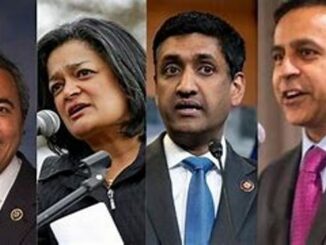
    WASHINGTON, D.C. (TIP): Four prominent Indian American lawmakers — Pramila Jayapal, Ami Bera, Raja Krishnamoorthi and Ro Khanna — have been appointed members of three key House panels, reflecting the growing influence of the community in US politics.

    Congresswoman Jayapal has been named Ranking Member of the powerful House Judiciary Committee’s panel on Immigration, making her the first immigrant to serve in a leadership role for the subcommittee.

    Jayapal, 57, representing the 7th Congressional District of Washington State succeeds Congresswoman Zoe Lofgren to serve on the Subcommittee on Immigration Integrity, Security, and Enforcement, a media release said.

    “As the first South Asian woman elected to the US House of Representatives and one of only two dozen naturalized citizens in Congress, I am honored and humbled to serve as the Ranking Member of the House Subcommittee on Immigration Integrity, Security, and Enforcement,” said Jayapal.

    “I came to this country when I was 16, alone, and with nothing in my pockets. After 17 years on an alphabet soup of visas to become a US citizen, I was lucky enough to have the opportunity to live the American Dream, a dream that is out of reach for too many immigrants today,” she said.

    “It is extremely meaningful to me that I will now be in this position to better move the needle and re-center our broken immigration system around dignity, humanity, and justice. As I step into this role, I would also like to thank Representative Lofgren for her years of dedicated leadership on the Subcommittee, and look forward to continuing to work with her,” Jayapal said.

    Bera, 57, has been appointed as a member of a powerful US House committee handling intelligence-related matters.

    The House Permanent Select Committee on Intelligence is charged with providing oversight of the country’s intelligence activities, including the Central Intelligence Agency (CIA), Office of the Director of National Intelligence (DNI), National Security Agency (NSA), as well as military intelligence programs.

    “I am honored to be appointed by Leader (Hakeem) Jeffries to serve on the House Intelligence Committee, which plays a crucial role in ensuring the safety and national security of the United States,” Bera said.

    A six-time Congressman, Bera represents the sixth Congressional District of California.

    “At a time of increased threats, both at home and abroad, I take seriously this new role and the responsibility entrusted to me to protect and defend American families,” he said.

    “With my decade of experience working on critical national security issues, I look forward to working with Committee members from both sides of the aisle to ensure our intelligence agencies are operating effectively to keep our nation safe,” Bera said.

    Bera also serves on the House Foreign Affairs Committee and the House Science, Space and Technology Committee.

    During the 117th Congress, Bera served as Chair of the House Foreign Affairs Subcommittee on Asia, the Pacific, Central Asia, and Nonproliferation, where he spearheaded Congressional efforts to strengthen ties with Indo-Pacific allies and partners to advance the US economic and security interests.

    Krishnamoorthi has been made Ranking Member of a newly created House committee on China that will investigate various aspects of Chinese behavior, its threat being posed to the US and the world.

    US House of Representatives Minority Leader Jeffries on Wednesday announced the appointment of Krishnamoorthi as Ranking Member of the House Select Committee on the Strategic Competition Between the United States and the Chinese Communist Party (CCP). Another Indian American Congressman Ro Khanna has also been made a member of this new committee, formed in the 118th Congress by Republican House Speaker Kevin McCarthy for the specific purpose of investigating and developing policy to address the United States’ economic, technological and security competition with the Chinese Communist Party.

    Krishnamoorthi, 49, is the four-term Congressman representing the eight Congressional districts of Illinois, while Khanna, 46, is the four-term lawmaker representing the 17th Congressional district of California.

    “I am grateful to Leader Jeffries for appointing me to serve as Ranking Member on the House Select Committee on the Strategic Competition Between the United States and the Chinese Communist Party,” said Krishnamoorthi.

    “The Chinese Communist Party poses serious economic and security threats to the United States and to democracy and prosperity across the globe, illustrated by its threats against Taiwan’s democracy, its weaponization of TikTok, and its theft of hundreds of billions of dollars’ worth of American intellectual property,” he said.

    “I look forward to working with my colleagues in both parties on this committee to counteract the CCP’s escalating aggression and ensure that our nation is prepared to overcome the economic and security challenges that the CCP presents to our country,” Krishnamoorthi said.

    He said it was important to protect the interests of the American people.

    “That said, at a time when anti-Asian hate and violence are on the rise, it’s essential that this committee focuses its vital work on protecting all Americans from the threat posed by the CCP, while avoiding dangerous rhetoric that fuels the types of xenophobia that have endangered members of the Asian American and Pacific Islander community,” Krishnamoorthi said.

    Krishnamoorthi is also a senior member of the House Permanent Select Committee on Intelligence. He is also the lead Democrat on Averting the National Threat of Internet Surveillance, Oppressive Censorship and Influence, and Algorithmic Learning by the Chinese Communist Party Act (ANTI-SOCIAL CCP Act), which protects Americans by blocking and prohibiting all transactions from any social media company in, or under the influence of, the People’s Republic of China (PRC) and several other foreign adversaries.

    In the 117th Congress, he led bipartisan legislation that was signed into law, called the Gathering and Reporting Assessments Yielding Zero Overlooked Nefarious Efforts (GRAY ZONE) Act, which requires the Director of National Intelligence (DNI) to produce a National Intelligence Estimate on different aspects of grey zone activities — actions that fall between ordinary statecraft and open warfare — that the PRC employs.

    Krishnamoorthi was also the lead Democrats on the bipartisan Transparency for Malign Chinese Investments in Global Port Infrastructure Act, which requires the DNI to study and report to Congress information related to Chinese global investments in port infrastructure.

  • YouTube adds TikTok-style live rings to show when someone is streaming

    YouTube adds TikTok-style live rings to show when someone is streaming

    Google-owned video-streaming giant YouTube is adding a new indicator to show when a channel is live streaming on the platform. The feature would make it easier to find live content. The new update will display a ring with the word “Live” on it around a channel’s profile picture when they are live streaming. “Really focused on making it easier for users to find live streams on YouTube, so we are rolling out the Live ring feature on mobile. YouTube creators streaming live will now have a ring around the channel avatar and clicking on it will take you directly to the livestream,” Neal Mohan, Chief Product Officer, YouTube, said in a statement. Currently, TikTok uses a pulsing ring effect on a channel’s profile picture to alert the user that it is live. Meanwhile, YouTube TV is finally getting support for picture-in-picture (PiP) on iPhone and iPad. Mohan said while he couldn’t share an exact date, picture-in-picture support on iOS should arrive “hopefully in the next few months” for YouTube TV users. The feature has been available to Android users for quite a while, but support for YouTube TV users on iOS is long overdue. YouTube TV is also working on expanding some other features that include surround sound, which was launched last year on a very limited subset of devices.

    Source: IANS

  • Pak court lifts ban on Chinese short video-sharing platform TikTok

    Pak court lifts ban on Chinese short video-sharing platform TikTok

    Islamabad (TIP): A top Pakistani court on July 2 withdrew its earlier decision to ban the popular Chinese short video-sharing platform TikTok for spreading immorality in the country.

    The Sindh High Court (SHC) on June 28 had asked the Pakistan Telecommunication Authority (PTA), the telecom regulator, to suspend the TikTok app on the complaint by a citizen regarding “immorality and obscenity” on the mobile app.

    During a hearing on Friday, the PTA informed that access to the app was already blocked by it but it also requested the court to review its decision and allow it to restore the services.

    The high court accepted the plea to lift the ban but it asked the PTA to expedite the process on the petitioner’s request and issue a ruling by July 5.

    PTA representatives assured the court that the appeal, seeking removal of ‘objectionable content’, will be decided upon by the court by the given date.

    The court adjourned to meet again on Monday when the PTA would share the decision it made to address the concern of the petitioner so that indecent content on the app were not uploaded.

    It was for the second time that the app has been banned this year after its suspension in March by the Peshawar High Court (PHC), which had taken action on a petition filed by several citizens.

    However, the PHC after a few weeks lifted the ban by asking the PTA to take measures so that no “immoral content” was uploaded. Last year in October, the PTA for the first time banned TikTok after receiving complaints regarding indecent and immoral content but lifted the ban after just 10 days.

    Then the app assured the PTA that it would operate as per local laws to ensure that no indecent content was uploaded. (PTI )

  • EU challenges TikTok over consumer rights breaches claim

    Brussels (TIP): The European Commission said on Friday it has given one month to the Chinese-owned video app TikTok to answer complaints from an European consumers group over its commercial practices.

    The EU’s executive arm said it has started discussions involving the platform and the national consumer authorities following an alert launched earlier this year by the European Consumer Organisation (BEUC) about alleged breaches of consumers’ rights.

    The Commission said some contractual terms in TikTok’s policies could be considered misleading and confusing for consumers, adding that concerns relating to issues including hidden marketing and advertising strategies targeting children were raised.

    In February, the BEUC filed a complaint with the European Commission and the network of consumer protection authorities against TikTok. It argued that several terms in TikTok’s Terms of Service’ are unfair and said the platform, which is particularly popular with youngsters, failed to protect children and teenagers from hidden advertising and potentially harmful content.

    “The current pandemic has further accelerated digitalisation,” said Didier Reynders, the Commissioner for Justice.

    “This has brought new opportunities but it has also created new risks, in particular for vulnerable consumers. In the European Union, it is prohibited to target children and minors with disguised advertising such as banners in videos. The dialogue we are launching today should support TikTok in complying with EU rules to protect consumers.” — AP

  • Pakistani court orders govt to ban social media app TikTok

    Peshawar (TIP): A Pakistan high court on Thursday said it would order the government to ban social media app TikTok in the country, a lawyer representing Pakistan’s telecommunications regulator said. A high court in the northwestern city of Peshawar said it was ordering the ban after a private complainant said the social media app was spreading indecent content, Jehanzeb Mehsud, who represented Pakistan Telecommunication Authority in the case, told Reuters.—Reuters