

In a Congress frequently defined by confrontation, Tom Suozzi has made cooperation a central part of his political identity. The Democratic representative from New York’s Third Congressional District argues that government must bring competing interests together to solve problems. His record provides a useful opportunity to examine what that approach means in practice: where it has produced legislative progress, where proposals remain unfinished, and how national responsibilities connect with the everyday concerns of Long Island and Queens.
Suozzi’s experience began in local government. He served as mayor of Glen Cove from 1994 through 2001 and as Nassau County executive from 2002 through 2009. First elected to Congress in 2016, he subsequently returned to the House following the February 2024 special election. An attorney and certified public accountant by training, he brings a background spanning municipal administration, county government, law and finance. That experience helps explain his emphasis on administration and negotiation alongside the larger political arguments that dominate Washington.
Today, Suozzi serves on the House Ways and Means Committee and co-chairs the bipartisan Problem Solvers Caucus. Ways and Means places him within congressional deliberations on taxation, trade and major social insurance programs. The caucus gives him a forum for working with Republicans on issues where party leaderships may struggle to agree. These positions describe responsibilities and opportunities, rather than guaranteeing outcomes. Their significance lies in the proposals advanced, the partnerships sustained and the decisions ultimately taken.
Immigration offers one of the clearest tests of his approach. It combines border control, asylum, labor needs, public safety and the treatment of people who have established lives in the United States. Each element raises difficult questions. Enforcement without attention to legal safeguards can cause serious harm; reform without workable administration can fail to earn public confidence. A durable settlement must confront those tensions rather than reduce the entire subject to campaign language.
In January 2026, Suozzi and Republican Congressman Brian Fitzpatrick renewed a request to meet President Donald Trump about immigration and border security. Their joint letter proposed securing the border, changing asylum procedures, providing legal protection for millions of immigrants and improving standards governing federal enforcement. It also called for stronger police-community relations. The document demonstrates an attempt to assemble a negotiating framework across party lines. A request for a meeting, however, is a step toward policymaking, not proof that the proposed settlement has been achieved.
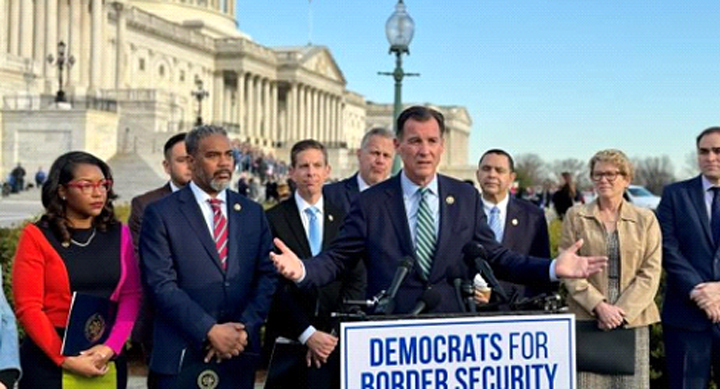
Their cooperation continued in April, when they announced the Reforming ICE and Protecting America Act. According to the announcement, the proposal combined funding for the Department of Homeland Security with reforms to Immigration and Customs Enforcement. The underlying argument was that the government should maintain essential security operations while addressing concerns about enforcement practices. The legislation should be evaluated as a proposal, with its provisions and subsequent progress examined separately. Bipartisan sponsorship establishes cooperation; enactment and implementation determine what the public ultimately receives.
There is also a concrete example of legislative progress in his work on financial fraud. On September 15, 2026, the House passed the Tax Relief for Fraud Victims Act, a bipartisan measure associated with Suozzi and Republican Congressman Max Miller. The legislation addresses the tax consequences facing people whose money has been stolen through scams. Its approach includes relief involving qualifying theft losses and retirement-account penalties. The congressional debate records members from both parties explaining why victims should receive fairer treatment under the tax code.
The distinction between House passage and a completed law matters. The verified milestone here is approval by the House; it should not be described as relief already available to every affected taxpayer. Nevertheless, the measure illustrates how a specific hardship can generate agreement across party lines. Someone who has lost savings to fraud needs clear rules and practical assistance. That problem does not become less urgent because its solution requires legislators who disagree on many other subjects to work together.
Suozzi’s tax-policy interests also include the state and local tax deduction, commonly called SALT. For residents in areas with substantial property and income taxes, the treatment of those payments on federal returns is an important household issue. House Rules Committee records show his participation in efforts to change the deduction limit during consideration of the 2025 budget legislation. Those records establish advocacy and proposed amendments. They do not justify attributing every eventual change to one member of Congress, or treating an amendment as equivalent to a final vote.
Local environmental work supplies another part of the picture. His office reported in July 2026 that six million oysters had been planted in Manhasset Bay, Hempstead Harbor and Oyster Bay using community-project funds he obtained in 2022. The reported total was divided equally among the three bays. Such projects connect federal appropriations with the condition of nearby waters. Their lasting value must be assessed through ecological results and continued stewardship, rather than the announcement alone. They also demonstrate why congressional work extends beyond the arguments seen on national television.
Other district concerns are less dramatic but directly affect daily life. In September, Suozzi’s office reported another appeal to federal transportation officials over persistent aircraft noise around Kennedy and LaGuardia airports. An intervention of that kind does not establish that the noise problem has been resolved. It identifies an issue being pursued through agencies with relevant authority. Residents can reasonably ask what response followed, which measures were adopted and whether conditions improved. Follow-through is an essential part of representation.
A balanced assessment must also recognize the limits of bipartisanship. Agreement between parties can produce a weak policy as readily as a strong one. Negotiation deserves scrutiny for what it preserves, what it concedes and who bears the consequences. Legislators must retain the freedom to oppose proposals they consider damaging. Cooperation is most useful when it improves legislation while preserving constitutional protections and public accountability. It should be judged by the quality of the work, not simply by the presence of two-party labels beside a bill.
For a district encompassing varied communities and competing priorities, representation requires both responsiveness at home and judgment in Washington. Constituents need help navigating federal institutions, while national policy requires choices about taxation, security and the proper exercise of government power. These duties overlap but are not interchangeable. A record of local advocacy cannot answer every question about national policy; a national profile cannot substitute for attending to district concerns. Evaluating a representative means examining both with the same care.
Suozzi’s record presents a politician who has repeatedly sought partners across the aisle while pursuing issues affecting his district and the country. Some efforts have reached identifiable milestones; others remain proposals or requests requiring further action. That distinction allows readers to consider his work without confusing intention with accomplishment. The larger question his approach raises is valuable beyond any individual career: whether Congress can sustain serious disagreement while still producing workable decisions. The answer depends on evidence, continued scrutiny and the practical results that Americans experience.
Public domain U.S. congressional image, as documented by Wikimedia Commons. Source: https://commons.wikimedia.org/wiki/File:TomSuozzi118thCongress.jpg


Be the first to comment