Tag: Trinamool Congress

  • Pegasus and farmers issues lead to pandemonium in Indian Parliament: Lok Sabha, Rajya Sabha adjourned

    Pegasus and farmers issues lead to pandemonium in Indian Parliament: Lok Sabha, Rajya Sabha adjourned

    • Parliamentary panel likely to question officials on Pegasus phone tapping allegations
    • Agenda of July 28 meeting is ‘Citizens’ data security and privacy’

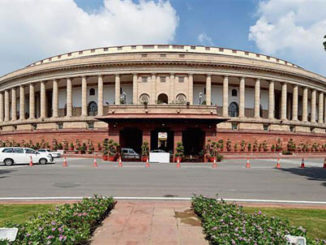
    NEW DELHI (TIP): Parliament remained disrupted on Pegasus snooping row and farmers’ issues for the third day on Thursday, July 22, with the Lok Sabha and Rajya Sabha adjourned twice first till noon and then till 2 pm.

    Opposition MPs stormed the Well, flashing placards in front of Lok Sabha Speaker Om Birla, who repeatedly asked the members to return to the seats saying the government was willing to discuss anything as per rules.

    “This is not right; this is a wrong practice. This Parliament is yours. The onus of retaining its glory is on you. If you don’t do that democracy will not be strengthened. I am ready to get discussion done on the issue that’s agitating you,” said the Speaker, but to no avail.

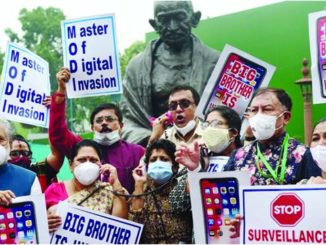
    Congress, TMC and Left parties were seen storming the Well agitating on issues of farmers and against the alleged snooping of Indian individuals using a foreign spyware.

    In Rajya Sabha too, the opposition MPs forced two adjournments and the House was adjourned within a minute of assembling at 11 am.

    Later, when the RS reassembled, the Opposition MPs continued to raise slogans against the alleged snooping controversy.

    In the ruckus, the deputy chairman sought laying of the parliamentary committee reports that could not be laid at the scheduled hour in the morning due to opposition protests.

    Soon after, he adjourned the proceedings for the day.

    When the Lok Sabha reassembled at noon after the first adjournment the government said it was ready for any discussion.

    Parliamentary Affairs Minister Prahlad Joshi said, “Rajya Sabha has already discussed Covid. Despite our assurances the opposition here is disrupting the question hour which is a right of the members. Disrupting the proceedings when government is ready for discussion is not right. Tell us on what issue you want a discussion. We will discuss.”

    Presiding officer LS Bhartruhari Mahtab urged MPs to go to their seats and allow the House to function but had to again adjourn the proceedings till 2 pm amid pandemonium.

    Later, the Lok Sabha was adjourned till Friday amid continued protests by Opposition members against the “three black farm laws”.

    The Left is seeking a JPC in the snooping row while the Congress and TMC have demanded a Supreme Court-led investigation.

    The government has denied the charges as sensational calling the reports by an international media consortium a “global conspiracy”.

    Speaking in Lok Sabha, Union IT and Communications Minister Ashwini Vaishnav had dismissed the reports as “baseless” and said that the allegations levelled just ahead of the Monsoon session of Parliament were aimed at maligning Indian democracy.

    A parliamentary panel on IT headed by Congress leader Shashi Tharoor is likely to question top government officials, including from Home Ministry, next week on allegations related to phone tapping of many using Pegasus spyware, sources said on Wednesday.

    An international media consortium has claimed that several Congress leaders including Rahul Gandhi, two union ministers, Trinamool Congress leader Abhishek Banerjee and some 40 journalists were among those whose phone numbers were listed as potential targets for hacking through the Israeli spyware which is usually supplied to government agencies.

    The Indian government and Israeli surveillance company NSO Group, which sells Pegasus spyware worldwide, have refuted the reports.

    The 32-member Parliamentary Standing Committee on Information and Technology headed by Tharoor is scheduled to meet on July 28. The agenda of the meeting is ‘Citizens’ data security and privacy’, according to the notification issued by Lok Sabha Secretariat.

    The panel, which has maximum members from the ruling BJP, has summoned officials from the Ministry of Electronics, Information and Technology and the Ministry of Home Affairs.

    Sources in the panel said the Pegasus phone tapping issue will definitely be raised in the meeting and details will be sought from the government officials.

  • Pegasus row: Storm in House, Opp says democracy in crisis

    Pegasus row: Storm in House, Opp says democracy in crisis

    New Delhi (TIP): The row over an alleged surveillance operation using the Pegasus spyware rocked Parliament  as the Opposition and some parties friendly to the ruling coalition, seeking answers from the government, disrupted proceedings in Lok Sabha and did not allow the treasury benches to transact any business for the second consecutive day — signalling that the first week of the Monsoon Session could be a washout.

    The Congress-led Opposition did, however, allow a discussion in Rajya Sabha on the Covid-19 pandemic situation — it led the debate — after the government agreed to its demand for a debate on the floor of the House ahead of a briefing outside Parliament on the Covid preparedness levels.

    There were stormy scenes in Lok Sabha where members of the Congress, Trinamool Congress and DMK raised slogans, showed placards over the alleged snooping controversy – there was an uproar over this in Rajya Sabha as well.

    They demanded a probe by a Supreme Court judge into claims that the Pegasus spyware had been used to snoop on journalists, politicians, ministers, judges and others.

    While YSRCP members raised issues like the Polavaram project and special status for Andhra Pradesh, members of the SAD and the AAP demanded that the government repeal the farm laws at the centre of an ongoing protest.

    A second list of possible targets of alleged surveillance using the Pegasus spyware, which was published Monday by digital news platform The Wire as part of a global collaborative investigation, included mobile phones of Congress leader Rahul Gandhi, TMC MP Abhishek Banerjee, political strategist Prashant Kishor, among others.

    The stage for an offensive was set before the House proceedings began Tuesday with some Opposition MPs staging a protest against the alleged snooping outside Parliament House and Congress members giving multiple adjournment motion notices on the issue in Lok Sabha and notices for discussion in Rajya Sabha.

    While Congress leader KC Venugopal gave a notice under Rule 267 in Rajya Sabha to suspend business and discuss the alleged use of the Pegasus spyware, party MPs Gaurav Gogoi and Hibi Eden gave adjournment notices in Lok Sabha.

    Eden, in his notice, said democracy is in crisis: “There are eyes and ears snooping on us everywhere. Even those holding high offices of the government, several senior Opposition leaders, constitutional authorities, reporters and activists are being spied on and their personal conversations being watched, monitored and transferred to unknown locations and people.”

    “This poses a grave problem to the unity and integrity of India and is a high concern for national security. This grave crisis of snooping into our citizens’ private life goes against the basic ethos of our Constitution whereby the fundamental right to privacy is being violated. I request the Government to constitute an inquiry into the allegations of Pegasus spying into citizens of our country.”

    When the Lok Sabha met, Opposition MPs — from the Congress, DMK, TMC, NCP, SP, BSP and YSRCP — stormed the well of the House, holding placards and raising different issues. Congress MPs were holding placards with slogans demanding the resignation of the Prime Minister and Home Minister over the alleged surveillance, and they were joined by the DMK, TMC and NCP members.

    TMC’s Saugata Roy tried to speak on the alleged use of the spyware to snoop on his party leader and colleague Abhishek Banerjee.

    Speaker Om Birla tried to take up Question Hour, but the protesting MPs shouted slogans against the government. In four minutes, Birla adjourned the proceedings until 2 pm. The House witnessed similar scenes when it met again and it was adjourned for the day at 3 pm.

    Shashi Tharoor: No need for JPC into Pegasus, IT panel will do its duty

    Ruling out a Joint Parliamentary Committee (JPC) probe into alleged surveillance using the Pegasus spyware, Congress leader Shashi Tharoor, who heads the Parliamentary Standing Committee on Information Technology, said Wednesday that the committee will “do its duty” and that the subject is “already on the mandate of my committee”.

    The House committee has called representatives of the Ministry of Electronics and Information Technology, Ministry of Home Affairs and Department of Telecommunications on July 28 to discuss citizens’ data security and privacy.

    Speaking to The Indian Express, Tharoor said there was no need to set up a JPC to look into the disclosures since the standing committee and the JPC have identical rules.

                    Source: The Indian Express

  • Journey of Bengal’s daughter to nation’s Didi

    Journey of Bengal’s daughter to nation’s Didi

    All India Trinamool Congress (AITC) supremo Mamata Banerjee, also known as Didi (elder sister in the Bengali language), sworn in as the Chief Minister of West Bengal for the third term on 5 May 2021 after she pulled off a landslide victory in the West Bengal Assembly Elections 2021. Ahead of the oath-taking ceremony, she resigned as the Chief Minister of West Bengal at Raj Bhavan in the presence of Governor Jagdeep Dhankhar (as per the practice) and took the oath of the office and secrecy again. She lost the Nandigram Assembly Constituency to Suvendu Adhikari (BJP) in 2021.

    After her separation from the Indian National Congress, she founded the All India Trinamool Congress (AITC or TMC) in 1998. She spearheaded the AITC alliance to a landslide victory in the  2011 West Bengal Assembly Elections, defeating the 34-year-old Communist Party of India (Marxist). She was a member of the West Bengal Legislative Assembly from the Bhabanipur Assembly Constituency from 2011-2021.

    Apart from serving as the Chief Minister of West Bengal, she has held key positions in the Union Cabinet such as first female Minister of Railways, first female Minister of Coal, and Minister of Human Resource Development, Youth Affairs and Sports, Women and Child Development. She has served as the Minister of Railways on two occasions. Mamata Banerjee rose to prominence after opposing the erstwhile land acquisition policies for industrialisation of the Communist government in West Bengal for Special Economic Zones at the cost of agriculturalists and farmers at Singur.

    Throughout her political career, she has maintained a publicly austere lifestyle. She can be seen dressed in a traditional Bengali saree. Though many don’t know, she is a self-taught painter and a poet. Her 300 paintings were sold for Rs. 9 crores.

    Early life, and education

    Mamata Banerjee was born in Calcutta (present-day Kolkata), West Bengal to a Bengali Hindu family to Promileswar Banerjee and Gayetri Devi. She lost her father at the age of 17 due to a lack of medical treatment.

    She attended Deshbandhu Sishu Sikhshalay and completed her senior secondary studies in 1970. She earned her Bachelor’s degree in History from Jogamaya Devi College and received her Master’s degree in Islamic history from the University of Calcutta. She further earned a degree in Education from Shri Shikshayatan College and a law degree from Jogesh Chandra Chaudhuri Law College, Kolkata. She received an honorary doctorate from the  Kalinga Institute of Industrial Technology, Bhubaneswar and an honorary Doctorate of Literature (D.Litt.) from Calcutta University.

    At the age of 15, she became involved in politics and established Chhatra Parishad Union, the student wing of the Congress (I) Party, defeating the All India Democratic Students Organisation affiliated with the Socialist Unity Centre of India (Communist).

    Political career

    She started her political career with the Indian National Congress in the 1970s. She earned huge attention from the media after dancing on the car of socialist activist and politician Jayaprakash Narayan as a protest against him. From 1976-1980, she served as the General Secretary of the Mahila Congress, West Bengal. In the 1984 General Election, she became one of the youngest parliamentarians of India, defeating veteran Communist Party politician Somnath Chatterjee, to win the Jadavpur Parliamentary Constituency in West Bengal.

    In 1984, she became the General Secretary of the Indian Youth Congress. In the 1989 General Elections, she lost her seat to  Malini Bhattacharya of the Communist Party of India (Marxist). In the 1991 General Elections, she was re-elected from Calcutta South constituency and retained this seat in 1996, 1998, 1999, 2004, and 2009 General Elections.

    During P. V. Narasimha Rao administration from 1991-1996, she held key positions in the Union Cabinet. She was appointed the Union Minister of State for Human Resources Development, Youth Affairs and Sports, and Women and Child Development.

    After indicating her resignation and protesting at a rally against the Government’s indifference towards her proposal to improve sports in the country at the Brigade Parade Ground in Kolkata, West Bengal, she was discharged of her portfolios in the year 1993.

    In 1997, Mamata Banerjee parted ways with the Indian National Congress over the difference in political views with the then West Bengal Pradesh Congress Committee President Somendra Nath Mitra. In 1998, she along with Mukul Roy founded AITC which quickly became the opposition party to the Communist Government in West Bengal.

    On 11 December 1998, she held a Samajwadi Party MP, Daroga Prasad Saroj, by the collar and dragged him out of the well of the Lok Sabha, preventing him from protesting against the Women Reservation Bill.

    In 1999, she joined BJP led NDA Government and served as the Minister of Railways. She presented her first Railway Budget in 2000 where she introduced 19 new trains for the FY 2000-2001 and fulfilled many of her promises to her home state West Bengal.

    In early 2001, after Tehelka Magazine’s exposure of Operation West End, she walked out of the NDA and allied with the Indian National Congress for the 2001 West Bengal elections and also to register her protest against senior ministers of the government over the corruption charges levelled by Tehelka.

    In September 2003, she again allied with the NDA Government and served as a Cabinet Minister without any portfolio. On 9 January 2004, took charge as the Minister of Coal and Mines and held the portfolio till 22 May 2004.

    In the 2004 General Elections, her party aligned with the BJP but lost the elections. She suffered major setbacks when the sitting mayor Subrata Mukherjee defected from her party. Her party was defeated in the 2006 West Bengal Assembly Elections. On 4 August 2006, she hurled her resignation papers at the Dy. Speaker Charanjit Singh Atwal in Lok Sabha. Banerjee was provoked by Speaker Somnath Chatterjee who rejected her adjournment motion on illegal infiltration by Bangladeshis in West Bengal on the grounds of improper format.

    On 20 October 2005, she rose to prominence after opposing the erstwhile land acquisition policies for industrialisation of the  Buddhadeb Bhattacharjee government in West Bengal for Special Economic Zones at the cost of agriculturalists and farmers at Singur.

    In November 2006, she was forcibly stopped on her way to Singur for a rally against the proposed Tata Motors car project. She reached the West Bengal assembly, protested, addressed a press conference, and announced a 12-hour shut down by her party. The MLAs of AITC vandalized the West Bengal Legislative Assembly building and a major strike was called on 14 December 2006, but no gain was registered.

    In 2007, armed police personnel stormed the rural area of Purba Medinipur district to quash protest against the then Government of West Bengal. The Government had plans to expropriate 10,000 acres (40 km2) of land for a Special Economic Zone (SEZ) to be developed by the Indonesian-based Salim Group. As per the reports, at least 14 villagers were shot dead while over 70 were wounded, leading to a large number of people protesting on the streets.

    Soon after this incident, Mamata Banerjee wrote letters to the then Prime Minister Manmohan Singh and Union Minister Shivraj Patil to stop the violence in Nandigram which she termed as ‘State-sponsored violence’ promoted by CPI(M).

    Before the 2009 General Elections, her party forged an alliance with the Congress-led  United Progressive Alliance (UPA). After the elections,  Banerjee became the Union Minister of Railways.

    Upon becoming the Union Minister of Railways for the second time, she introduced a number of non-stop Duronto Express trains connecting large cities as well as a number of other passenger trains, including women-only trains.

    As a Chief Minister

    She spearheaded the AITC alliance to a landslide victory in the 2011 West Bengal Assembly Elections, defeating the 34-year-old Communist Party of India (Marxist). She assumed the position of Chief Minister of West Bengal and has been serving the position for the third term in a row.

    She is the first and to date the only female Chief Minister of West Bengal. Soon after assuming the office, she returned the 400 acres of land to Singur farmers, set up Gorkhaland Territorial Administration and brought in many reforms in the education and health sectors.

    In a bid to improve the law and order situation in the state, she created police commissionerates at Howrah, Barrackpore, Durgapur-Asansol and Bidhannagar. The total area of Kolkata Municipal Corporation was brought under the control of the Kolkata Police.

    On 16 February 2012, she received an appreciation letter from  Bill Gates of the  Bill & Melinda Gates Foundation for achieving a full year without any reported cases of polio, stating it as a milestone not only for India but for the world as well.

    In the 2016 West Bengal Assembly Elections, her party won 211 of 293 seats. She took oath as the CM of West Bengal for the second time.

  • Police firing, stray violence in 6th phase polling; 79% turnout

    Police firing, stray violence in 6th phase polling; 79% turnout

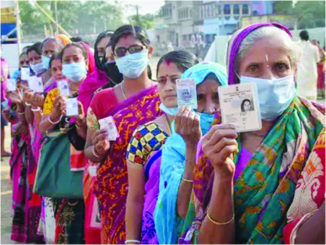
    Kolkata (TIP): Isolated incidents of violence, including police firing, were reported in the sixth phase of polling in 43 assembly constituencies of West Bengal, which recorded 79.09 per cent voter turnout on Thursday, April 22, Chief Electoral Officer (CEO) Aariz Aftab said. Seven persons, including two policemen, were injured in two incidents of violence in Bagdah and Barrackpore constituencies in North 24 Parganas district.

    ”Polling was peaceful today other than two-three incidents of violence,” the CEO said. The police fired three rounds after about 250 people attacked and injured two policemen near a booth in the Bagdah seat. The police went there after the sector officer was attacked, Aftab said.

    The police personnel, including the officer-in-charge (OC) of Bagda police station, were admitted to a hospital. Two other persons, of whom one has bullet injuries, were also hospitalised, the CEO said. ”The police had to fire three rounds in Bagdah where the sector officer was attacked. After getting this news, OC Bagdah and his team reached the spot outside booth number 35 and 36 in Ranaghat pre-primary school,” he said.

    ”The OC tried to talk to them but it led to an altercation. The mob attacked them and their vehicle. To save themselves and save the property, the police had to fire three rounds,” ADG and IGP (Law and Order) Jag Mohan said. The OC and a constable suffered cut injuries in the attack and both were hospitalised, he said.

    In another incident, three persons were injured when bombs were thrown outside a booth at Khardaha in Barrackpore constituency, Aftab said. ”They are undergoing treatment at a nearby hospital.

    Two persons have been arrested in this connection, the CEO said. The Election Commission earlier in the day dismissed allegations by the Trinamool Congress that two of its activists were injured in firing by central forces in Ashok Nagar constituency in North 24 Parganas district, an official said.

    Aftab said that at least 79.09 per cent of more than one crore voters exercised their franchise till 5 pm in the sixth phase. Polling was held between 7 am and 6.30 pm at 14,480 polling stations in 17 assembly constituencies in North 24 Parganas district, nine each in Nadia and Uttar Dinajpur districts and eight in Purba Bardhaman district.

    Among the four districts, Nadia registered the highest voter turnout of 82.67 per cent, followed by Purba Bardhaman (82.15 per cent), Uttar Dinajpur (77.76 per cent) and North 24 Parganas (75.94 per cent), Aftab added. The Election Commission has deployed 1,071 companies of central forces for the sixth phase.

    The state will witness two more phases of polling on April 26 and 29. Votes will be counted on May 2.

  • Why 5th phase of Bengal election is crucial for Mamata

    Why 5th phase of Bengal election is crucial for Mamata

    The West Bengal Assembly election is passing through its most crucial phase. Four of eight phases of the Bengal Assembly election are over. Altogether, voters have decided the fate of candidates in 135 of 294 seats. The remaining 159 will go to the polls between April 17 and 29.

    The fifth phase, polling for which will happen on Saturday, April 17, completes the most significant troika of election phases in Bengal — phases three to five for 120 seats.

    Here is how the Bengal election stands at the halfway mark:

    Phase 1: 30 seats

    Polling for the first phase took place on March 29, when 30 seats went to the polls. Of these seats, the Trinamool Congress (TMC) had won 27 in the 2016 West Bengal election. The Congress bagged two and the RSP (Left Front) one.

    The TMC had strengthened its position in 2016 over 2011 when it had won 19 of these 30 seats. The BJP drew a blank here in 2016. But it changed the election calculus in Bengal in the 2019 Lok Sabha polls. The BJP was leading in 20 of the 30 seats that voted in the first phase.

    Phase 2: 30 seats

    Another 30 seats went to the polls in the second phase on April 1. Of these seats, the TMC had won 21 in 2016, almost maintaining its 2011 figure of 22. The BJP had won one of these seats five years ago. The Congress-Left alliance bagged eight.

    In the 2019 Lok Sabha election, the TMC maintained its lead despite the BJP’s massive challenge. It took lead in 18 of the 30 constituencies that voted in the second phase of the West Bengal Assembly election. The BJP took the lead in 12.

    Nandigram voted in this phase. West Bengal Chief Minister Mamata Banerjee took a huge gamble by standing against local heavyweight and her former aide Suvendu Adhikari, who joined the BJP in December last year.

    Phase 3: 31 seats

    In the third phase, 31 seats went to the polls. This phase saw voting in areas where the TMC had enjoyed complete dominance in previous polls. In 2016, the TMC had won 29 of these seats. The Congress-Left alliance had won two, winning one seat each in Howrah and South 24 Paraganas.

    In 2011, the TMC had won 25 and the Congress-Left alliance five. The BJP drew a blank. Even in the 2019 Lok Sabha election, the TMC maintained its hegemony by taking lead in 29 of these 31 constituencies. The BJP, however, replaced the Congress-Left with lead in two other constituencies.

    The TMC’s performance in this phase and the next two phases would, to a large extent, decide whether Mamata Banerjee returns as the Bengal chief minister on May 2 or not.

    Phase 4: 44 seats

    Polling in the fourth phase of the Bengal election took place on April 10 for 44 seats. This was the phase in which Singur went to the polls. Along with Nandigram, Singur had played the catapulting role in the 2011 Bengal election in which the TMC defeated the Left Front.

    In 2011, the TMC had won 33 of these 44 seats. The party bettered its record in 2016 winning 39 of these seats. The Congress had won two and the Left Front eight.

    The BJP did not win any of these seats in 2011 but it got one in the 2015 Bengal polls. In the 2019 Lok Sabha polls, the BJP surprised the TMC in its stronghold by taking lead in 19 seats.

    The TMC was still ahead with a lead in 25 seats but it was a serious jolt to Mamata Banerjee’s party. The Congress and the Left had been pushed out of the race.

    Phase 5: 45 seats

    Bengal will vote for 45 assembly seats on Saturday. The fifth phase has the maximum number of seats going to the polls. This is a crucial phase of the 2021 Bengal Assembly election.

    The 45 assembly constituencies that vote in the next phase are the ones where the BJP collectively had more votes in the 2019 Lok Sabha election than the TMC. The BJP got nearly 45 per cent votes compared to the TMC’s 41.5 per cent. However, in terms of seats, the TMC led 23 and the BJP 22.

    In 2016, the TMC had won 32 of these seats — six more than 2011 — going to the polls in the fifth phase. The BJP drew a blank. The Congress and the Left combined won 10 seats.

    If the TMC does not crawl back to regain its lost foothold in this phase, Mamata Banerjee’s road to the Writers’ Building might be rough and bumpy.

    Phase 6: 43 seats

    Forty-three seats will go to the polls in the sixth phase. It is again a TMC-dominated region that will be voting on April 22. In 2011, the TMC had won 28 of these seats and improved its tally to 32 in 2016.

    The Congress-Left had won 11 of these seats in 2016. But the real fight is likely to be between the TMC and the BJP. They had taken a lead in 24 and 19 assembly segments, respectively during the 2019 Lok Sabha polls.

    Phase 7: 36 seats

    The final two phases of the Bengal election will see polling in 71 seats. Of the 36 seats that go to the polls on April 26 in the seventh phase, the TMC held 14 in 2016 and 17 in 2011.

    The Congress-Left alliance got the better of the TMC in 2016 on these seats as it won 22 seats here. In 2011, their combined share was 18.

    During the 2019 Lok Sabha polls, the BJP matched the TMC, sharing the lead in 16 constituencies each. In the remaining four, Congress was in the lead.

    Phase 8: 35 seats

    Among the 35 seats going to the polls in the eighth phase, the TMC had 14 in 2011 and 17 in 2016. The Congress-Left alliance won 16 of these seats in 2016 with the Congress winning 13 alone. In 2011, their combined share was 21. The Congress had back then won 14 seats.

    Of all the seats that will go to the polls in the last phase, the BJP won just one. But in 2019, the BJP secured a lead in 11 constituencies. The TMC was ahead in 19 and the Congress in five.

    Up next

    The 2019 Lok Sabha election brought a sharp change in the electoral dynamics of West Bengal.

    Going by the latest electoral output, the TMC has a tougher fight at hand in the last three phases of the Bengal election (phases 6,7 and 8). As per the trends seen in the 2019 Lok Sabha election, it led in 59 of the seats in these phases, while the BJP was close behind, leading in 46 seats. Source: India Today


    EC bars Bengal BJP chief for 24 hours for ‘inciteful remarks’

    The Election Commission of India (ECI) on Thursday, April 15,  banned Bharatiya Janata Party (BJP)’s West Bengal chief Dilip Ghosh from campaigning in the state for 24 hours for his “highly provocative and inciteful remarks” on the Sitalkuchi firing incident, in which four people were killed as polling was underway last week.

    A day after violence broke out during fourth phase of polling in Cooch Behar district on April 10, Ghosh had said at a rally in Baranagar in North 24 Parganas that “there will be Sitalkuchi in several places”.

    Four people were killed in firing by Central Industrial Security Force (CISF)?personnel in Sitalkuchi. While the ruling Trinamool Congress (TMC)?alleged the firing was unprovoked, the poll watchdog and central forces said it was in “self-defence”?as the security personnel at the polling booth were under attack by a mob.

    On Sunday, the TMC filed a complaint against Ghosh for his statement, prompting the ECI to seek his response.

    “The commission sternly warns Dilip Ghosh and advises him to desist from using such statement while making public utterances during the period when Model Code of Conduct is in force and imposes a ban of 24 hours…,” the ECI order said, adding that the “highly provocative and inciteful remarks” can “adversely impact law and order thereby adversely affecting the election process”.

    The ban for violating the Model Code of Conduct is applicable from 7pm Thursday till 7pm Friday, April 16, the order stated.

    Ghosh, when asked about the ban, said on Thursday he will take the time off campaigning to rest. “The ECI ordered whatever it thought was right. I will stay at home and take rest. I was not getting proper sleep and time to have a proper meal because of the campaigning,” he said.