
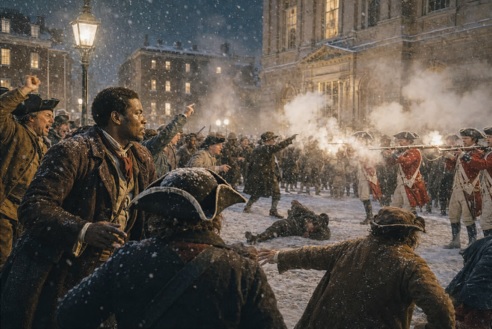

The Townshend duties of 1767 taxed imported glass, lead, paper, paint and tea. Colonists renewed boycotts, while customs enforcement intensified. British troops arrived in Boston in 1768. Their presence angered residents who viewed a standing army in peacetime as a threat to liberty. Soldiers competed with civilians for work, and street encounters became increasingly hostile. On March 5, 1770, a confrontation between townspeople and British soldiers escalated. Stones, insults and snowballs flew; soldiers fired, killing five people. Among the dead was Crispus Attucks, a sailor of African and Indigenous ancestry, later remembered as an early martyr to American liberty. Patriot leaders called the event the Boston Massacre. Paul Revere’s widely circulated engraving simplified and dramatized the confrontation, portraying disciplined soldiers deliberately firing into a helpless crowd. It was powerful propaganda. Yet colonial commitment to law also mattered: John Adams defended the accused soldiers, arguing that even unpopular defendants deserved a fair trial. Most were acquitted; two were convicted of manslaughter.
WORDS CREATE A NETWORK
Committees of correspondence shared information among towns and colonies. Newspapers reprinted arguments, letters and reports. Political vocabulary-rights, liberty, tyranny, representation and conspiracy-crossed regional boundaries. The colonies were developing an intercolonial public sphere capable of acting faster than imperial authorities.
“The crisis was fought with taxes and troops-but also with newspapers, engravings, petitions and memory.”

Be the first to comment