Tag: Trudeau

  • Mark Carney succeeds Trudeau as  prime minister of Canada

    Mark Carney succeeds Trudeau as prime minister of Canada

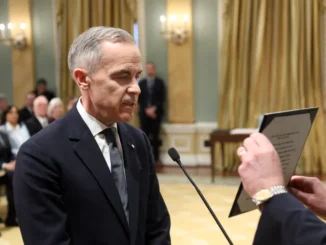
    OTTAWA (TIP): Mark Carney, an economist and political newcomer, has been sworn in as Canada’s new prime minister, and delivered remarks vowing to “never” become a part of the United States.

    He took office on Friday, March 14, just days after being elected leader of the governing Liberal Party and amid an ongoing trade war with US President Donald Trump. “We know that by building together, we can give ourselves far more than anyone else can take away,” he said after the ceremony.

    Carney replaces outgoing Prime Minister Justin Trudeau, who was in office for nine years, after a landslide victory in last week’s Liberal leadership race.

    “We will never, in any shape or form, be part of the US,” Carney told reporters in Ottawa on Friday, referring to Trump’s musings that Canada join the US as its “51st state”.

    “We are very fundamentally a different country,” he said, later adding the notion is “crazy”.

    He declined to answer questions about the timing of Canada’s next federal election – currently scheduled for October – but hinted he would move quickly to seek “as strong a mandate that is needed for the time”.

    In his first order as prime minister, Carney moved to end a policy that had been frequently attacked against by political opponents.

    He ended the consumer carbon pricing programme – a key environmental policy under Trudeau that had become deeply unpopular in recent years amid high inflation. At an afternoon cabinet meeting, Carney said his government will still take steps to fight climate change. An industrial carbon tax on large emitters remains in place.

    Canadian politics in recent months have largely been overshadowed by the trade war Trump launched after taking office in January – and with a general election on the horizon, Carney is expected to pitch himself as the candidate best equipped to take on Trump.

    He previously held roles as governor of the Bank of Canada, the country’s central bank, and of the Bank of England, and helped both countries weather major financial disruption.

    He intends to travel to the UK and France as his first foreign trip as PM next week.

    Carney said he also looks forward to speaking with Trump.

    “We respect the United States. We respect President Trump,” he said.

    “President Trump has put some very important issues at the top of his agenda.”

    Carney has promised to uphold Canada’s reciprocal tariffs on specific American goods for as long as Trump maintains 25% universal tariffs on Canadian goods not covered by the Canada-United States-Mexico Agreement (CUSMA) trade deal.

    Canada is dependent on trade with the US. Economists say it risks a recession if Trump’s tariffs are fully imposed.

    Several of Carney’s new cabinet members served under Trudeau, and in particular he kept on those who have been working directly with the Trump administration in recent months.

    They including Mélanie Joly, who remains in foreign affairs; David McGuinty, who remains in public safety; Jonathan Wilkinson, staying on as energy minister; Dominic Leblanc, who has moved from finance to trade; and François-Philippe Champagne, moved from industry to finance.

    When the federal election comes, Carney’s main rival will be Conservative leader Pierre Poilievre.

    Before the threat of tariffs, Conservatives enjoyed a 20-point lead in some election polls. Now polls are indicating a much closer race.

    Speaking after Carney on Friday, March 14, Poilievre argued that Liberals do not deserve a fourth term in office, arguing they have already had nine years to improve affordability and other issues in the country.

    “It will be the same Liberal results,” he said.

    Poilievre added that if he were to be elected prime minister, he would “face off against President Trump directly, respond with counter tariffs and take back control”.

    When Canadians next go to the polls, the Liberals will face not only the Conservatives – who are the official opposition with 120 seats in the House of Commons – but also the Bloc Quebecois, who have 33 seats, and the New Democrats (NDP), who have 24.

    Reacting to Carney’s swearing in, the leader of the NDP argued that his cabinet appointments show that there is no room for progressive Liberals under his leadership.

    Jagmeet Singh said that he had failed to create separate cabinet portfolios for minister of women, youth, or people with disabilities, and described Carney as someone who has made billionaires “very rich at the cost of workers”.
    (With inputs from agencies)

  • Trump’s mocking of Justin Trudeau spurs an animated debate about the future of US-Canada relations

    Trump’s mocking of Justin Trudeau spurs an animated debate about the future of US-Canada relations

    By Prabhjot Singh

    TORONTO (TIP): Continuous mocking by US President-Elect Donald Trump of Canadian Prime Minister Justin Trudeau has set in motion an animated debate over the future of US-Canada relations.

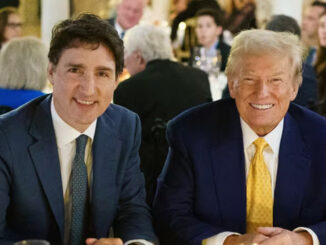
    Since the last week of November when Donald Trump joked for the first time to suggest in a lighter vein at a dinner meeting he held with Justin Trudeau that why not Canada become the 51st State, he has repeated his joke several times, the last of which was revealed through his December 10 on his Truth Social Platform.

    Politicians and social scientists are wondering at the intent of his continuous “mocking”.

    “It was a pleasure to have dinner the other night with Governor Justin Trudeau of the Great State of Canada,” said Donald Trump in his December 10 post on his Truth Social platform. He went on to add that “he is looking forward to seeing the ‘Governor’ again to continue their in-depth discussion about tariffs and trade. “The results of which will be truly spectacular for all!” added the U.S. President-elect.

    Donald Trump had in a subsequent Meet the Press programme organised by a major media channel on December 8 said “If we’re going to subsidize them, let them become a state [of the U.S.],” while jokingly threatening that the U.S. should stop “subsidizing” Canada. His repeated comments have evoked mixed reactions from Canadian politicians and social scientists.

    The latest post describing Justin Trudeau as a “governor” went public hours after Justin Trudeau spoke at a Halifax Chamber of Commerce event. Justin Trudeau was quoted as saying that Canada would retaliate against the 25 per cent tariffs threatened by Trump.

    It was Donald Trump who set the ball rolling with his Truth Social post on November 25 declaring his intent to impose tariffs on Canada and Mexico if they refuse to tighten their border security. Donald Trump was referring to large-scale infiltration into the US of “illegal aliens” from both Canada and Mexico besides the smuggling of drugs, including Fentanyl. Though the Canadian Prime Minister maintained that smuggling of both illegal immigrants and Fentanyl from Canada was inconsequential compared to the figures of Mexico and promised to strengthen the borders to effectively control the smuggling, the US President-elect mocked him.

    After his November 25 announcement threatening to impose a 25 per cent duty on all imports from Canada and Mexico, Justin Trudeau accompanied by a delegation, including a member of his Cabinet, flew to Florida to meet him at his private Mar-a-Lago club to discuss trade and border security. This is when Trump reportedly joked for the first time about Trudeau becoming the governor of a 51st U.S. state if the Canadian economy cannot survive despite its trade surplus with the United States.

    “Let us not kid ourselves in any way, shape or form: 25% tariffs on everything going to the United States would be devastating for the Canadian economy,” Trudeau said. He added that Canada will “respond to unfair tariffs in several ways, and we’re still looking at the right ways to respond, but our responses to the unfair steel and aluminium tariffs were what ended up lifting those tariffs last time.”

    After the recent post, some members of the Liberal caucus, including Cabinet ministers, were questioned by the media about the continuous tirade, though jokingly, launched by Donald Trump.

    “I am so proud of our country. I am so proud of the true north, strong and free,” said Deputy Prime Minister Chrystia Freeland during a press conference in Ottawa. “I also want to say to Canadians that our government is determined to defend the national interest.”

    Freeland would not comment on whether she takes Trump seriously on comments of making Canada a U.S. state. “That is a question really for the president-elect,” she said.

    Another Cabinet Minister to comment on the recent developments was Transport Minister and President of the Treasury Board, Anita Anand.

    While talking to media persons, she said “We have to continue to remember that Canada is a sovereign country.” Truth Social should not be used as a source for public policy, remarked Immigration Minister, Marc Miller.

    Health Minister Mark Holland said, “We cannot react to everything, we need to focus on being mature as a country and taking responsibility for the things for which we have control.”
    (Prabhjot Singh is a Toronto, Canada-based senior journalist. He can be reached at prabhjot416@gmail.com)

  • Indian – Origin Canadian Sikh MP Ramesh Sangha out of Trudeau’s party

    Indian – Origin Canadian Sikh MP Ramesh Sangha out of Trudeau’s party

    TORONTO (TIP):  Indian- Origin Ramesh Sangha, the Sikh MP from the Toronto area, has been thrown out of Prime Minister Justin Trudeau’s Liberal Party for criticizing fellow MP Navdeep Bains, who recently resigned as the country’s industry minister to spend more time with his family. In a Punjabi TV interview last week after Bains resigned, Sangha accused the outgoing minister of harboring extremist views and being pro-Khalistan. “Is he fit to be a minister?” the ousted MP said of the outgoing minister. Taking notice of his “baseless and dangerous accusations” against Bains, Prime Minister Justin Trudeau’s party threw out on Monday the Indo-Canadian MP who represents the Brampton Centre constituency in Toronto suburbs.

    “As soon as the Chief Government Whip was made aware of these accusations, he consulted with the Prime Minister, and the necessary steps were taken. As of this afternoon, Sangha has been removed from the Liberal caucus,” said a party statement. “As we have made clear time and time again, we will not tolerate conspiracy theories or dangerous and unfounded rhetoric about Parliamentarians or other Canadians,” the statement said.

    A former Indian Air Force officer from Punjab, Ramesh Sangha had in 2019 accused his own party of pandering to Khalistani separatists and harming the relationship with India, forcing Prime Minister Trudeau to deny that his party supported the separatists. “Canada’s position on a united India is unwavering and we are unanimous as a government on this issue,” the Canadian prime minister had said at that time, adding that Canadians have the freedom to peacefully express their views. Sangha, who was first elected in 2015, will now sit as an Independent MP in the House of Commons. The two-time MP came to Canada from Punjab in 1994 and established himself as a lawyer before contesting federal elections in 2015.