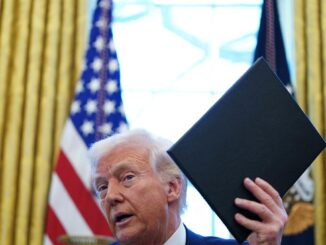
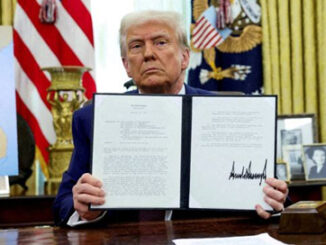
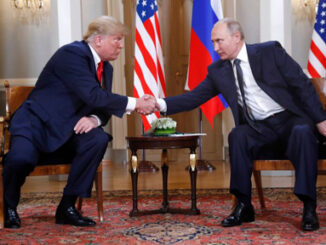
WASHINGTON D.C. (TIP): U.S. President Donald Trump on Friday, May 30, repeated his claim that he stopped India and Pakistan from fighting and told the two nations that his administration cannot trade with people who are shooting at each other.
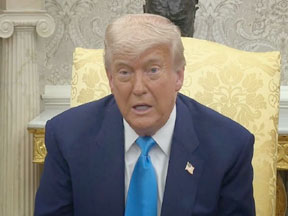
“We stopped India and Pakistan from fighting. I believe that could have turned out into a nuclear disaster,” Mr. Trump said during a press conference in the Oval Office with billionaire Tesla CEO Elon Musk, who is leaving the Trump administration after helming the Department of Government Efficiency.
Mr. Trump added that he wants to thank the “leaders of India, the leaders of Pakistan, and I want to thank my people also. We talked trade and we said, ‘we can’t trade with people that are shooting at each other and potentially using nuclear weapons’.”
Mr. Trump said that leaders in India and Pakistan are “great leaders” and “they understood, and they agreed, and that all stopped”.
“We are stopping others from fighting also, because ultimately, we can fight better than anybody. We have the greatest military in the world. We have the greatest leaders in the world,” Mr. Trump said.
About two weeks after the horrific April 22 terror attack in Pahalgam in Jammu and Kashmir in which 26 civilians were killed, India launched Operation Sindoor targeting terror infrastructure in Pakistan and Pakistan-occupied Kashmir. India and Pakistan reached an understanding on May 10 to end the conflict after four days of intense cross-border drone and missile strikes.
Indian Government sources in New Delhi have maintained that the Director Generals of Military Operations (DGMOs) of India and Pakistan reached an understanding to cease all firing and military actions on land, air, and sea, effective immediately. They said no third party was involved. Mr. Trump has repeatedly claimed that he “helped settle” the tensions between India and Pakistan and that he told the nuclear-armed South Asian neighbours that America would do a “lot of trade” with them if they stopped the conflict.
(Source: PTI)
The US is facing a slowdown owing to the fallout of Trump’s tariff policies, compounded by Moody’s unprecedented decision to downgrade its credit rating.
The big worry is the prospect of a prolonged conflict. Given the fact that Operation Sindoor has only been paused, tensions with Pakistan might flare up again. This raises the grim possibility of disruption to normal economic activity. A revival of hostilities could bring industrial and trade activities to a halt, especially in the northern and western regions.
By Sushma Ramachandran
Cross-border tensions, geopolitical headwinds and US President Donald Trump’s fast-changing tariff policies — the Indian economy is facing a slew of challenges. Yet, India continues to be viewed as an outlier in the global arena, performing better on the economic front than many other countries.
The United Nations has confirmed the perception in its latest report on the global economy. While downgrading India’s growth prospects from 6.6 per cent to 6.3 per cent for 2025, the UN still sees it as the fastest-growing major economy. In contrast, China is expected to grow by 4.6 per cent (from 5 per cent earlier), while the US is set to decelerate from 2.8 to 1.6 per cent this year. Emerging economies such as Brazil, Mexico and South Africa are also facing growth downgrades owing to factors like depressed trade and investments.
In this backdrop of a slowing world economy, India stands out. The Reserve Bank of India sounds similarly upbeat in its latest report, noting that the country is poised to surpass Japan this year to become the world’s fourth largest economy. Though it describes the outlook as one of cautious optimism, it points to easing of inflation pressures, while a normal monsoon forecast is expected to spur rural consumption.
The central bank has already downgraded its projection for the ongoing financial year to 6.5 per cent from 6.7 per cent, but it has pointed to the multiple strengths of the Indian economy. These include the fact that it is ringfenced by monetary, financial and political stability along with a congenial business environment and strong macroeconomic fundamentals.
This positive affirmation comes in the midst of global uncertainty, with the UN expecting global growth to touch only 2.4 per cent from the earlier forecast of 2.8 per cent. It attributes a dip in investments to uncertainty over trade and economic policies linked to the volatile geopolitical landscape. What is more worrying is that this is a broad-based scenario affecting both developed and developing economies. Even the US is facing a slowdown owing to the fallout of Trump’s tariff policies, compounded by Moody’s unprecedented decision to downgrade its credit rating.
As far as India is concerned, the big worry is the prospect of a prolonged conflict. Given the fact that Operation Sindoor has only been paused, tensions with Pakistan might flare up again. This raises the grim possibility of disruption to normal economic activity. A revival of hostilities could bring industrial and trade activities to a halt, especially in the northern and western regions.
Maharashtra and Gujarat, for instance, are among the most industrialized states in the country and any war-like situation could have a serious impact. Key energy installations are also located in both onland and offshore areas of these states as well as in Rajasthan. Any curbs on operations could affect energy security and thereby overall economic development. In the long run, the country is likely to rebound from any crisis as the economy’s resilience has been demonstrated in the post-Covid era as well as after facing external headwinds that have plagued most other economies. But there is bound to be a short or medium-term setback to the pace of growth. As it is, growth is set to fall from 7.1 per cent last year to 6.5 per cent in 2025-26.
Another element that could upset the applecart is the worsening of geopolitical fissures. Both the Russia-Ukraine war and the Israel-Gaza conflict continue despite peace efforts. Global supply chains may no longer be fractured as at the outset of the Russia-Ukraine war, but energy-related issues remain mired in uncertainty owing to Western sanctions. Oil prices have fallen but Western curbs on Russian energy have created logistical issues.
In West Asia, too, the problem is of logistics as trade flows through the Suez Canal have been hampered by Houthi attacks on merchant shipping. India has also had to face the brunt of higher trade costs as a result of ships opting for the longer route via the Cape of Good Hope.
Despite these headwinds, the UN report argues that resilient private consumption and strong public investment along with robust services exports will support economic growth in India. Its views have been buttressed, interestingly enough, by Moody’s, which says India is better placed to face the vagaries of trade disruptions owing to its large domestic economy and low dependence on exports. The ratings agency may have cut its growth forecast to 6.3 from 6.7 per cent, but it feels that India could benefit from higher US demand after the conclusion of the bilateral trade pact.
Neither of these institutions, however, have taken into account the full effect of Trump’s fast-changing tariff policies on the Indian economy. Much will depend on the outcome of ongoing negotiations. Their criticality cannot be downplayed as the US is India’s biggest market, accounting for 17 per cent of the total merchandise exports. The principle of reciprocity may mean that India will have to provide greater market access in areas earlier considered sacrosanct, such as agriculture and the dairy sector. It would be worthwhile to open up some selected segments where farmers’ livelihoods are not under threat. Similarly, tariffs raised in recent years can be reduced without an adverse impact as the domestic industry is strong enough in most areas to meet global competition.
The evolution of the final agreement will take some time, even as exporters continue to face an uphill task owing to recessionary conditions in world markets. The latest data shows a 9 per cent rise in exports in April, but this could be due to frontloading of shipments to avoid impending US tariff hikes.
The economy thus has to navigate multiple challenges at a time when growth needs to be brought to higher levels. If India is to avoid the middle-income trap that has constrained many developing economies, it has to move towards 8-9 per cent growth annually. It is only at this pace that the country can achieve the goal of becoming a developed economy over the next two decades. It may be a bright spot in the world right now, but the ambitions need to be even bigger.
(Sushma Ramachandran is a senior financial journalist)
WASHINGTON, D.C. (TIP): The Trump administration has moved to end Harvard’s ability to enroll international students, escalating a standoff with America’s oldest university.
Homeland Security Secretary Kristi Noem wrote on X that the administration had revoked Harvard’s “Student and Exchange Visitor Program certification as a result of their failure to adhere to the law.”
“Let this serve as a warning to all universities and academic institutions across the country,” she posted on Thursday.
Harvard called the move “unlawful” in a statement. “We are fully committed to maintaining Harvard’s ability to host our international students and scholars, who hail from more than 140 countries and enrich the University – and this nation – immeasurably,” the university responded. “We are working quickly to provide guidance and support to members of our community. This retaliatory action threatens serious harm to the Harvard community and our country, and undermines Harvard’s academic and research mission.”
The Trump administration’s decisions could affect thousands of international students who study at the university. Over 6,700 international students were enrolled at the institution last academic year, university data shows, making up 27% of its student body.
News quickly spread through the international community on campus Thursday, sparking fear and frustration among the thousands of students whose futures were suddenly in limbo. “We’re seeing a lot of confusion on this,” Sarah Davis, an Australian student receiving a graduate degree, told BBC Newshour.
“The news has come only five days before a lot of us are due to graduate the university, and this obviously is going to have a lot of very uncertain implications for whether we’re able to stay on in the United States afterwards and keep working here,” said Ms Davis, who is president of the Australia and New Zealand Caucus at the Harvard Kennedy School. “We’re all just sitting back and waiting to see whether or not we get communications about what the next steps are from the university.”
Leo Gerdén, a 32-year-old undergraduate from Sweden, remembers the day he received his admission letter to Harvard as the best day of his life. With less than a week until graduation, he didn’t imagine his time at the prestigious campus ending like this.
“International students are being used as poker chips in a battle between the White House and Harvard,” Mr Gerdén told the BBC. “It’s incredibly dehumanizing.”
The administration has launched investigations into dozens of universities across the countries and wrung concessions from other major US institutions like Columbia University in New York.
But in April, Harvard University became the most prominent institution to push back, announcing it would sue the Trump administration after it sent the school a list of lengthy demands. The White House later said the list was sent by mistake.
It has demanded Harvard change its hiring, admissions and teaching practices to help fight antisemitism on campus. It has threatened to revoke the university’s tax-exempt status and freeze billions of dollars in government grants.
Harvard earlier this year said it had taken many steps to address antisemitism, and that the government’s demands were an effort to regulate the university’s “intellectual conditions”. The standoff has continued to escalate.
In April, Noem threatened to revoke the university’s access to student visa programs if it did not comply with a sweeping records request from the administration, pertaining to international students.
In Thursday’s letter, Noem said Harvard must comply with a list of demands to have an “opportunity” to regain its ability to enroll international students.
That included providing the government with all disciplinary records for non-immigrant students enrolled at Harvard over the past five years. Noem also demanded Harvard turn over electronic records, videos, or audio of “illegal” and “dangerous or violent” activity by non-immigrant students on campus.
The notice gave Harvard 72 hours to comply. In her post on X, Noem warned that the move should “serve as a warning to all universities and academic institutions across the country.”
The Trump administration has attempted to curtail individual visas for international students, causing confusion on university campuses across the US and leading to a wave of lawsuits. In some cases, those revocations appeared to affect foreign students who participated in political protests or have had previous criminal charges, such as driving infractions. In a separate court case on Thursday, a federal judge in California blocked the Trump administration from cancelling the legal status of international students across the US while challenges to the policy play out in court. “We came here because if what America stands for: freedom of speech, academic freedom, a vibrant intellectual community,” Mr Gerdén said of his international classmates. “And now Trump is threatening all those values.”
“Without the international students, Harvard is simply not Harvard anymore,” he said.
(Source: BBC)
President Donald Trump’s recent tour of the Middle East in May 2025 has laid bare the contours of a new U.S. foreign policy—one that unapologetically prioritizes economic interests over traditional diplomatic alliances or democratic advocacy. By focusing his attention on Saudi Arabia, Qatar, and the United Arab Emirates (UAE), Trump signaled not only a departure from the post-WWII American posture of promoting liberal values but also a reconfiguration of geopolitical strategies that places commerce, investment, and military sales at the core of Washington’s engagement with the region.
This shift is neither accidental nor without precedent. It is, in fact, the natural evolution of Trump’s “America First” doctrine—now manifesting itself in the international arena as an aggressive pursuit of economic partnerships designed to bolster domestic growth, secure American industry, and entrench U.S. commercial dominance. But while this transactional approach may yield impressive short-term gains in terms of trade and defense contracts, it also raises critical questions about the ethical and strategic costs of abandoning the values that once underpinned American diplomacy.
Trump’s visit was not one of symbolic diplomacy or subtle statesmanship; it was a high-stakes business tour dressed in presidential protocol. In Riyadh, the President clinched a staggering $600 billion investment package alongside a $142 billion defense deal—underscoring Saudi Arabia’s continued strategic importance to Washington, particularly in the defense and energy sectors.
From Qatar came the announcement of a historic order: 210 Boeing jets, the largest in the company’s history, followed by a bold pledge of $1.2 trillion in U.S.-bound investment. The UAE also made its presence felt, committing over $200 billion in agreements that focus heavily on emerging sectors like artificial intelligence and clean energy—sectors where the U.S. sees both economic opportunity and global leadership potential.
What ties these agreements together is their emphasis on mutual benefit rooted in material exchange. The old model of foreign aid and conditional diplomacy has been replaced by high-value contracts and quid pro quo partnerships, transforming America’s role in the Middle East from that of ideological leader to commercial broker.
At home, the economic dividends are not insignificant. Trump has made job creation and industrial rejuvenation the cornerstone of his presidency, and these agreements—especially those in aerospace, defense, and tech—may well create or sustain hundreds of thousands of American jobs. The optics of revitalizing U.S. manufacturing through foreign capital inflows play directly into Trump’s political narrative ahead of the 2026 midterms and a likely 2028 successor race.
But the implications abroad are more complex.
By cementing deeper economic ties with Saudi Arabia, Qatar, and the UAE, Washington is doubling down on its Gulf alliances, even as its traditional partners—such as Turkey, Egypt, and even Israel—navigate their own recalibrations of foreign policy. This selective partnership risks fragmenting the region’s delicate balance of power. It also signals to allies and adversaries alike that U.S. favor can now be secured through economic alignment, not necessarily shared values.
Perhaps the most alarming aspect of this strategy is its implicit disinterest in the democratic credentials of America’s partners. Saudi Arabia remains mired in controversy over human rights violations, the silencing of dissent, and the murder of journalist Jamal Khashoggi. Qatar and the UAE have also been scrutinized for labor abuses and restrictions on civil liberties. By rewarding these governments with massive economic deals without demanding reforms, the U.S. undermines its moral authority and sends a chilling message: economic utility now trumps ethical governance.
The Gulf nations still hold considerable sway over global energy markets. With closer trade integration, the U.S. could find itself increasingly entangled in oil diplomacy that pits short-term pricing stability against long-term climate commitments. Moreover, if economic leverage becomes the primary currency of bilateral relations, these countries may also gain undue influence over U.S. policy decisions—particularly in times of global energy crises or military conflicts.
There is no denying that Trump’s approach has a clear logic: replace costly foreign entanglements with self-sustaining economic relationships. But such logic may prove short-sighted. Economic partnerships, unlike alliances built on shared democratic ideals or security frameworks, are inherently fragile. They can be renegotiated, revoked, or redirected. Should another global power—say China or Russia—offer more attractive terms to these same Gulf nations, what is to stop them from pivoting away from Washington?
Moreover, in conflating economic might with diplomatic strength, the U.S. risks alienating parts of the world where democratic aspirations remain unfulfilled or under siege. In these places, America’s past support of free media, judicial independence, and civic rights was seen not only as desirable but essential. The new model offers no such hope. It offers capital, contracts, and arms—but little in the way of moral or ideological solidarity.
Trump’s Middle East gambit is a clear indicator of where American foreign policy is headed under his renewed leadership: toward a future where financial transactions eclipse political transformations, and where statecraft becomes synonymous with deal-making. It is a bold vision, but it is also a risky one.
In the immediate term, the optics and economics may favor Trump. With hundreds of billions flowing into U.S. industries, he can rightfully claim to have reinvigorated key sectors of the American economy. But if this economic surge comes at the expense of America’s global credibility, diplomatic trustworthiness, or ethical standing, it may leave a far more dangerous legacy.
America’s greatest strength has never been merely its GDP or its military—it has been its ideals. Those ideals may not always win wars or balance budgets, but they inspire, they lead, and they endure. In treating foreign policy as a balance sheet, President Trump may be winning deals—but he may also be writing off the very values that once made American leadership worth following.
WASHINGTON, D.C. (TIP): The Trump administration is looking to suspend habeas corpus to expedite the removal of migrants who are not legally in the country without giving them the right to challenge detention, according to White House Deputy Chief of Staff Stephen Miller.
Habeas corpus is a legal procedure that allows people in custody to challenge the government’s decision to detain them before a court or judge, ensuring individuals cannot be imprisoned without due process of law.
Miller’s comment echoes efforts by the administration to use the current state of illegal border crossings to claim there is an invasion.
“Well, the Constitution is clear, and that, of course, is the supreme law of the land, that the privilege of the writ of habeas corpus can be suspended in a time of invasion. So, it’s an option we’re actively looking at. Look, a lot of it depends on whether the courts do the right thing or not,” Miller said to the press outside of the White House on Friday, May 9.
In the United States, the writ of habeas corpus is enshrined in the Constitution. There are a number of pending cases challenging the Trump administration’s deportation of migrants based on habeas claims. It’s unclear whether the idea of suspending habeas corpus is currently under serious discussion at the White House.
Trump’s executive order aims to stop what he called “biased and partisan news coverage.”
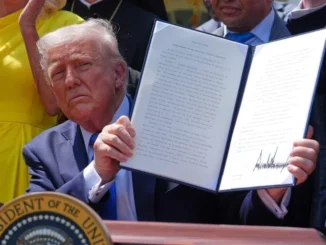
LONG ISLAND, NY (TIP): National Public Radio and PBS television stations on Long Island will no longer receive federal funding under an executive order signed late Thursday, May 1, by President Donald Trump to stop what he called “biased and partisan news coverage.”
On Long Island, that includes WLIW21 for PBS and WLIW-FM for NPR. A message on the WLIW website directed viewers and listeners to make their voices heard at the “Protect My Public Media” site. “Public media is facing multiple serious threats,” Protect My Public Media said. “The White House proposed eliminating federal funding in its annual budget request, issued an executive order to block support for PBS and NPR, and plans to claw back funding approved by Congress.”
The executive order instructs the Corporation for Public Broadcasting and other federal agencies “to cease Federal funding for NPR and PBS” and further requires that they work to root out indirect sources of public financing for the news organizations.
“Government funding of news media in this environment is not only outdated and unnecessary but corrosive to the appearance of journalistic independence,” the executive order says.
The White House, in a social media posting announcing the signing, said the outlets “receive millions from taxpayers to spread radical, woke propaganda disguised as ‘news.’”
The broadcasters get roughly half a billion dollars in public money through the Corporation for Public Broadcasting, and have been preparing for the possibility of stiff cuts since Trump’s election, as Republicans have long complained about them.
Paula Kerger, PBS’ CEO and president, said in a statement last month that the Trump administration’s effort to rescind funding for public media would “disrupt the essential service PBS and local member stations provide to the American people.”
“There’s nothing more American than PBS, and our work is only possible because of the bipartisan support we have always received from Congress,” she said. “This public-private partnership allows us to help prepare millions of children for success in school and in life and also supports enriching and inspiring programs of the highest quality.”
The Corporation for Public Broadcasting sued Trump earlier this week over his move to fire three members of its five-person board, contending that the president was exceeding his authority and that the move would deprive the board of a quorum needed to conduct business.
Just two weeks ago, the White House said it would be asking Congress to rescind funding for the CPB as part of a $9.1 billion package of cuts. That package, however, which budget director Russell Vought said would likely be the first of several, has not yet been sent to Capitol Hill.
The move against PBS and NPR comes as his administration has been working to dismantle the U.S. Agency for Global Media, including Voice of America and Radio Free Europe/Radio Liberty, which were designed to model independent news gathering globally in societies that restrict the press.
Those efforts have faced pushback from federal courts, who have ruled in some cases that the Trump administration may have overstepped its authority in holding back funds appropriated to the outlets by Congress.
While Donald Trump’s detractors believe that he has embarked on the impossible, the fact is that this is a mission that the world will need to adjust to
By T.T. Ram Mohan
“To me,” United States President Donald Trump has famously said, “tariff is the most beautiful word in the dictionary”. Mr Trump has shown that he means it. By imposing tariffs of varying degrees on a wide range of countries, he has initiated a trade war, the likes of which the world has not seen since the Second World War.
Following turbulence in the American bond market, Mr. Trump has announced a 90-day pause on tariffs on all countries except China. Hardly anybody thinks that Mr Trump will back off from tariffs for fear of visiting serious dislocation on the U.S. economy and the world at large. Trumponomics is a mission to fundamentally remake the American economy. It deserves to be taken seriously if only because the world will need to adjust to it.
First, the propositions
Trumponomics rests on a few key propositions. The first is that America needs to bring back manufacturing, lost to China and other economies over the past several decades. It needs to do so for several reasons.
Globalization and the offshoring of manufacturing in the U.S. have meant the loss of millions of jobs. Estimates of jobs losses in manufacturing vary. Stephen Miran, Chair, Council of Economic Advisers, The White House, cites a study that estimates jobs lost in manufacturing between 2000 and 2011 at two million (Stephen Miran, A User’s Guide to Restructuring the Global Trading System). Robert E. Lighthizer, who was the U.S. Trade Representative in Mr. Trump’s first term, says five million manufacturing jobs were lost in the period 2000-09.
Job losses have been concentrated in particular areas. Thriving industrial centers have been reduced to ghost towns and whole communities hollowed out. There are other social costs: homelessness, rising crime, drug abuse, and broken families. America’s services sector has absorbed a portion of those who lost jobs in manufacturing. But these are low-wage jobs. For the vast majority of American adults, manufacturing remains the sole route to a high-wage job.
Trumponomics argues that America also needs manufacturing for the purpose of national security. It cannot afford to have its defense sector rely heavily on imports of steel, aluminum, and semi-conductors. In a crisis, American military capabilities could be seriously compromised. As Mr. Trump puts it, “If you don’t have steel, you don’t have a country”.
A second key proposition of Trumponomics is that free trade is not necessarily fair trade. Imports from China are cheaper because China provides subsidies to its firms in various forms, uses slave labor to drive down costs, invests funds in state-owned technology companies, and indulges in industrial espionage and theft of intellectual property. It makes no sense to have American companies wiped out by competitors that do not adhere to the rules of a free market economy.
The third proposition is that America’s chronic trade deficits are unaffordable as the flip side is foreigners using their trade surpluses to acquire more and more American assets. In recent years, trade deficits have been of the order of $500 billion to $1 trillion a year.
Trade deficits are said to be self-correcting. When a country runs a trade deficit, the exchange rate of its currency is expected to depreciate. Exports will then rise and imports will fall, leading to a reduction in the trade deficit. Mr. Miran argues that the principle does not apply to the U.S. economy because the dollar happens to be the world’s reserve currency. Nations park much of their foreign exchange reserves in U.S. government securities. This results in an overvalued dollar.
An overvalued dollar means more imports, less exports and hence a persistent trade deficit. As Mr. Miran puts it, America runs a trade deficit not because it imports more; it imports more because it is the provider of reserve currency to the world.
Impetus for domestic manufacturing
How to restore manufacturing to the U.S. and reduce America’s trade deficit when faced with “unfair” trade and an overvalued dollar? Enter tariffs on imports. Tariffs will raise the cost of imports and cause imports to fall, thereby reducing the trade deficit. They will spur domestic manufacturing by protecting American manufacturers from import competition.
Economists fret that tariffs run counter to the principle of economic efficiency. Tariffs, they say, will spell higher costs for American consumers, an increase in the inflation rate and an inefficient manufacturing sector. Trumponomics says these concerns are based on first-round effects. Look farther and the outcomes change.
By raising the cost of imports, tariffs will result in fewer imports. A fall in imports will result in an appreciation of the dollar. If the “currency offset” to tariffs is perfect — say, a 10% tariff is offset by a 10% appreciation in the dollar — the dollar price of imports after tariffs will remain unchanged. The American consumer does not pay anything extra. Since the exporting country’s currency has weakened, it earns fewer dollars than it did earlier.
Mr. Trump has been ridiculed widely for saying that the exporting nation, and not the American consumer, will pay for U.S. tariffs. Once you take into account the currency offset to tariffs, Mr. Trump’s statement makes more sense. To be sure, if the currency offset is not perfect, there will be costs to the American consumer and an increase in the inflation rate. Mr. Miran estimates a one-time impact on the inflation rate of about 0.3-0.6 percentage points, an impact that is eminently bearable. This assumes there are no retaliatory tariffs.
Tariffs can lead on to other favorable second-round effects. As input costs rise, American manufacturers will look for ways to enhance efficiency and lower costs. Tariffs will compel American and foreign companies to move operations to the U.S. and this will enhance efficiency and output in the U.S. economy. There are signs that major U.S. companies are already making such a move.
The other ‘Trump cards’
More importantly, tariffs are but one of four elements in Trumponomics. There are three other elements: tax cuts, deregulation and more drilling of oil. Tax cuts, made possible by tariff revenues, will compensate companies for the higher costs of imports. Deregulation will drastically reduce compliance and operational costs. More drilling of oil will help lower oil prices and counter the inflationary effects of tariffs. Taken together, the four elements constitute a plausible alternative to the current economic model.
Trumponomics is driven by the principle that efficiency cannot be the sole or even overriding consideration in economic policy-making, a principle that India’s policymakers had wisely embraced decades ago. Mr. Trump’s detractors believe that he has embarked on Mission Impossible. Well, Mr. Trump does not think so. He is determined to pursue his vision of MAGA (Make America Great Again) regardless of the short-term cost to the U.S. As for the rest of the world, Mr. Trump does not particularly care.
(T.T. Ram Mohan is a former Professor at IIM Ahmedabad. He can be reached at ttrammohan28@gmail.com)
Meloni’s meeting with Trump is testing her mettle as a bridge between the EU and the United States
WASHINGTON, D.C. (TIP): President Donald Trump said Thursday, April 17 that he is in “no rush” to reach any trade deals because of the revenues his tariffs are generating, but he suggested while meeting with Italian Premier Giorgia Meloni that it would be easy to find an agreement with the European Union and others.
Trump played down the likelihood of an accelerated timeline to wrap up deals, saying any agreements would come “at a certain point.” “We’re in no rush,” said Trump, hinting that he has leverage because other countries want access to US consumers.
Meloni’s meeting with Trump is testing her mettle as a bridge between the EU and the United States. She is the first European leader to have face-to-face talks with the president since he announced and then partially suspended 20 per cent tariffs on European exports.
Meloni secured the meeting as Italy’s leader, but she also has, in a sense, been “knighted” to represent the EU at a critical juncture in the fast-evolving trade war that has stoked recession fears.
The Trump administration has belittled its European counterparts for not doing enough on national security while threatening their economies with tariffs, sparking deep uncertainty about the future of the trans-Atlantic alliance.
“We know we are in a difficult moment,” Meloni said this week in Rome. “Most certainly, I am well aware of what I represent, and what I am defending.” The EU is defending what it calls “the most important commercial relationship in the world,’ with annual trade with the US totaling 1.6 trillion euros (USD 1.8 trillion). The Trump administration has said its tariffs would enable trade negotiations that would box out China, the world’s dominant manufacturer. But Trump maintains that rivals and allies alike have taken advantage of the US on trade.
Instead of being the responsibility of individual member states, trade negotiations fall under the authority of the EU Commission, which is pushing for a zero-for-zero tariff deal with Washington.
Administration officials, in talks with the EU, have yet to publicly relent on the president’s baseline 10 per cent tariff. Trump paused for 90 days his initial 20 per cent tax on EU products so that talks could occur.
The EU has already engaged with Trump administration officials in Washington. Maroš Šefcovic, the European Commissioner for trade and economic security, said he met on Monday with Commerce Secretary Howard Lutnick and US Trade Representative Jamieson Greer.
Šefcovic said afterward on X that it would “require a significant joint effort on both sides” to get to zero tariffs and work on non-tariff trade barriers, with Trump’s team specifically objecting to Europe’s use of value added taxes.
Meloni’s margins for progress are more in gaining clarity on the Republican president’s goals rather than outright concessions, experts say.
“It is a very delicate mission,” said Fabian Zuleeg, chief economist at the European Policy Center think tank in Brussels. “There is the whole trade agenda, and while she’s not officially negotiating, we know that Trump likes to have this kind of informal exchange, which in a sense is a negotiation. So it’s a lot on her plate.” As the leader of a far-right party, Meloni is ideologically aligned with Trump on issues including curbing migration, promoting traditional values and skepticism toward multilateral institutions. But stark differences have emerged in Meloni’s unwavering support for Ukraine after Russia’s invasion in February 2022.
The two leaders are expected to discuss the war and Italy’s role in an eventual postwar reconstruction of Ukraine. Trump is expected to press Meloni to increase Italy’s defense spending, which last year fell well below the 2 per cent of gross domestic product target for countries in the NATO military alliance. Italy’s spending, at 1.49 per cent of GDP, is among the lowest in Europe.
Despite the differences on Ukraine and defense spending, Meloni is seen by some in the US administration as a vital bridge to Europe at a difficult moment for trans-Atlantic relations.
Trump is looking not only to discuss with Meloni how “Italy’s marketplace can be opened up, but also how they can help us with the rest of Europe,” according to a senior administration official who briefed reporters before the visit. The official spoke on the condition of anonymity under ground rules set by the White House.
After being the only European leader to attend Trump’s January 20 inauguration, Meloni has responded with studied restraint as abrupt shifts in US policy under Trump have frayed the US-European alliance. She has denounced the tariffs as “wrong” and warned that “dividing the West would be disastrous for everyone,” after Trump’s heated White House exchange with Ukraine’s president.
Italy maintains a 40 billion euro (USD 45 billion) trade surplus with the US, its largest with any country, fueled by Americans’ appetite for Italian sparkling wine, foodstuffs like Parmigiano Reggiano hard cheese and Parma ham, and Italian luxury fashion. These are all sectors critical to the Italian economy, and mostly supported by small- and medium-sized producers who are core center-right voters.
“All in all, I think she will focus on the very strong economic and trade relations that Italy has with the United States, not just in terms of exports, but also services and energy,” said Antonio Villafranca, vice president of the ISPI think tank in Milan. “For example, Italy could even consider importing more gas from the US.” The meeting comes against the backdrop of growing concerns over global uncertainty generated by the escalating tariff wars. Italy’s growth forecast for this year has already been slashed from 1% to 0.5% as a result.
The Trump administration has imposed tariffs on much of the world, arguing that other countries have taken advantage of the US, as evidenced by its trade deficits. But with the 90-day pause, the White House has increased Trump’s tariffs on China to 145 per cent while keep separate tariffs of as much as 25 per cent on Canada, Mexico, autos, steel and aluminum.
On Wednesday, April 16, Trump met with Japan’s chief trade negotiator, Ryosei Akazawa. Trump, on social media, summarized the meeting s achieving “Big progress!” but he did not offer any specifics.
China is simultaneously seeking to strike deals that could possibly undercut claims made by Trump that his tariffs will ultimately lead to more domestic factory jobs and stronger growth.
White House clarifies that Chinese imports will be tariffed at 145%, not the 125% rate, once other previously announced tariffs were included
WASHINGTON, D.C. (TIP): U.S. President Donald Trump on Thursday, April 10, 2025, warned of the “transition cost” from his tariff policies, as Wall Street stocks fell again over the worsening trade war with China. “There will be a transition cost, and transition problems, but in the end, it’s going to be a beautiful thing,” Mr. Trump said as he seeks to reorder the world economy by forcing manufacturers to base themselves in the United States.
Meanwhile, the White House clarified that Chinese imports will be tariffed at 145%, not the 125% rate that Mr. Trump had written about in his post on Truth Social on Wednesday, April 9, 2025, , once other previously announced tariffs were included.
Mr. Trump at his cabinet meeting expressed hope that he could get an agreement with China, though he didn’t offer any specifics on what he was seeking.
“Well, we’ll see what happens with China,” Mr. Trump said. “I would love to be able to work a deal.”
Kevin Hassett, director of the White House National Economic Council, told Fox News’ “Fox and Friends” on Wednesday, April 9, 2025 that the administration already has “offers on the table from more than 15 countries.”
Mr. Hassett said the next step will be determining exactly what Mr. Trump wants out of the negotiations.
“We have a meeting today with all the top principals where we’re going to present to the president a list of what we think his priorities might look like,” Mr. Hassett said. “And I’m sure he’s going to, you know, have his own ideas about where to move things.” U.S. stocks are diving on Thursday , April 10, 2025, and surrendering a chunk of their historic gains from the day before as Mr. Trump’s trade war continues to confuse and threaten the economy, even if its temperature has cooled a bit.
The S&P 500 was down 3.6% in afternoon trading, slicing into Wednesday’s surge of 9.5% following Mr. Trump’s decision to pause many of his tariffs worldwide. The Dow Jones Industrial Average was down 1,135 points, or 2.8%, as of 1:56 p.m. Eastern time, and the Nasdaq composite was 4.3% lower.
(Agencies)
Commerce ministry analyzing impact of US tariff on India; it’s mixed bag, not setback, says a senior government official
WASHINGTON, D.C. (TIP): The US has announced 2 percent reciprocal tariffs on India saying New Delhi imposes high import duties on American goods, as the Donald Trump administration aims to reduce the country’s trade deficit and boost manufacturing. The move is expected to impact India’s exports to the US. However, experts say that India is better-placed than its competitors who also face increased levies.
President Trump, in a historic measure to counter higher duties on American products imposed globally, announced reciprocal tariffs on about 60 countries.
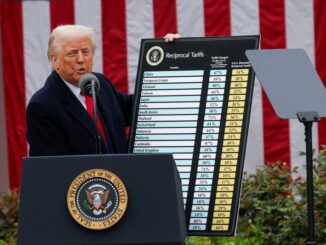
“This is Liberation Day, a long-awaited moment. April 2, 2025 will forever be remembered as the day American industry was reborn, the day America’s destiny was reclaimed, and the day that we began to make America wealthy again. We are going to make it wealthy, good, and wealthy,” Trump said in his remarks from the Rose Garden at the White House on Wednesday, April 2. He said that the United States charges other countries only a 2.4 per cent tariff on motorcycles, but Thailand and others are charging much higher rates, like 60 per cent, India 70 per cent, Vietnam 75 per cent, and others charge even higher rates.
As he announced the tariffs, he held up a chart that showed the tariffs that countries such as India, China, the UK, and the European Union charge, along with the reciprocal tariffs that these countries will now have to pay.
The chart indicated that India charged 52 per cent tariffs, including currency manipulation and trade barriers, and America would now charge India a discounted reciprocal tariff of 26 per cent. But according to the White House documents, there will be a 27 per cent duty on India.
“India, very, very tough. Very, very tough. The prime minister just left. He’s a great friend of mine, but I said, you’re a friend of mine, but you’re not treating us right. They charge us 52 per cent. You have to understand, we charge them almost nothing for years and years and decades, and it was only seven years ago, when I came in, that we started with China,” Trump said.
Describing the tariffs as a “mixed bag and not a setback”, an official in India said the commerce ministry is analyzing the impact of 27 per cent reciprocal tariffs imposed by the US on India.
According to the official, the universal 10 per cent tariffs will come into effect on all imports into the US from April 5 and from April 10, 27 per cent duty will come into play.
“The ministry is analyzing the impact of the announced tariffs,” the official said, adding there is a provision that if a country would address the concerns of the US, the Trump administration can consider reducing the duties against that nation.
India is already negotiating a bilateral trade agreement with the US. The two countries are aiming to finalize the first phase of the pact by fall (September-October) of this year. “It is a mixed bag and not a setback for India,” the official said.
Exporters’ body FIEO stated that the duties on India will undoubtedly affect domestic players but early conclusion of the trade agreement would provide relief from these tariffs.
“We have to assess the impact, but looking at the reciprocal tariffs imposed on other countries, we are in a lower band. We are much better placed compared to our key competitors such as Vietnam, China, Indonesia, Myanmar, etc. We will definitely be affected by the tariffs, but we are much better placed than many others,” Federation of Indian Export Organisations (FIEO) Director General Ajay Sahai told PTI.
From 2021-22 to 2023-24, the US was India’s largest trading partner. The US accounts for about 18 per cent of India’s total goods exports, 6.22 per cent in imports, and 10.73 per cent in bilateral trade.
With America, India had a trade surplus (the difference between imports and exports) of USD 35.32 billion in goods in 2023-24. This was USD 27.7 billion in 2022-23, USD 32.85 billion in 2021-22, USD 22.73 billion in 2020-21, and USD 17.26 billion in 2019-20.
In 2024, India’s main exports to the US included drug formulations and biologicals (USD 8.1 billion), telecom instruments (USD 6.5 billion), precious and semi-precious stones (USD 5.3 billion), petroleum products (USD 4.1 billion), gold and other precious metal jewelry (USD 3.2 billion), ready-made garments of cotton, including accessories (USD 2.8 billion), and products of iron and steel (USD 2.7 billion).
Imports included crude oil (USD 4.5 billion), petroleum products (USD 3.6 billion), coal, coke (USD 3.4 billion), cut and polished diamonds (USD 2.6 billion), electric machinery (USD 1.4 billion), aircraft, spacecraft and parts (USD 1.3 billion), and gold (USD 1.3 billion).
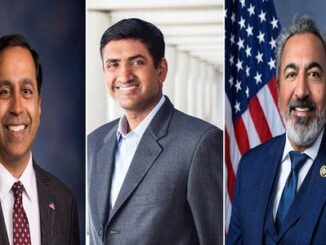
WASHINGTON, D.C. (TIP): Describing US President Donald Trump’s tariff announcements as “reckless and self-destructive,” Indian-American Congressmen on Wednesday, April 2, alleged that he is trying to destroy the country’s economy with his Liberation Day tariff, reports Lalit K Jha.
“Trump is literally trying to destroy our economy with Liberation Day. Tariffs slapped overnight. No strategy, no consultation, no Congressional input. What does this mean? Prices are going to go up,” Congressman Ro Khanna said. There is total uncertainty, he said, adding that businesses don’t know whether to invest, and the stock market is down.
Khanna alleged that Trump’s economic policies are incompetent and incoherent.
Raja Krishnamoorthi said the new tariffs announced by President Donald Trump are reckless and self-destructive.
“Donald Trump’s blanket tariffs are a tax on working families so that he can cut taxes for the wealthiest Americans. These latest so-called ‘Liberation Day’ tariffs are reckless and self-destructive, inflicting financial pain on Illinois at a time when people are already struggling to keep their small businesses afloat and put food on the table,” Krishnamoorthi said. Trump announced a 10 per cent tariff on goods imports from all countries. He also announced reciprocal tariffs on about 60 nations, which were calculated based on the nature of trade barriers the countries have in place on US goods and the size of US deficits.
“Don’t listen to Trump – these do nothing to strengthen our economy or national security. These tariffs isolate the United States on the global stage, alienate our allies, and empower our adversaries – all while forcing America’s seniors and working families to bear the brunt of higher prices,” Krishnamoorthi said.
“I urge all Americans to join me in calling on President Trump to end his disastrous tariff policies before he sends our country into a recession,” he said.
Indian-American Congressman Dr Ami Bera also slammed Trump. “Let me be clear: these tariffs will not “make America wealthy again. These costs will be passed onto YOU— the American consumer. This is not a tax cut. This is a tax hike,” he said.
“I don’t know what President Trump means by “Liberation Day” but what I do know is that across-the-board tariffs will increase costs for American families. His trade wars place a major burden on working class families at a time when Democrats and Republicans should be working together to lower costs,” Bera said.
Indian-American Congressman Suhas Subramanyam said these tariffs will raise costs on every American and actually hurt manufacturing in our country. “Small businesses and working families will suffer the most,” he said.
(Lalit K Jha is a Washington-based freelance journalist)
While the president has identified the need to do things differently, his strategy risks a slump, hitting the very Americans he claims to champion
By Martin Kettle
It would be “liberation day” in the US, the White House announced. Well, we shall see. Yet even if one puts the noise and nastiness that accompany a Donald Trump announcement to one side – in this case tonight’s pronouncement that there will be an executive order announcing “reciprocal tariffs on countries throughout the world”, a 10% tariff on the UK and 20% on the EU – the significance of the theatre is hard to miss. Whether they presage the US’s liberation, or instead the disintegration of the global trading order, Trump’s tariffs add up to an attempt to transform a badly broken economic model. And that is something that affects us all.
Trump’s announcement was awash with insult and rambling nonsense. The rest of the world had looted, raped and pillaged, had scavenged and ransacked America – shocking claims if they had come from any other US president, yet water off a duck’s back today. But the hard core was there all the same: tariffs on the whole of the rest of the world. The shutters were up.
This threatened trade war will appear to supporters – of whom there were rather fewer this week in some important US electoral contests – exactly like the Maga big bazooka he promised in his inaugural speech in January. “Instead of taxing our citizens to enrich other countries, we will tariff and tax foreign countries to enrich our citizens,” he said back then. The new tariffs turn those words into realities.
Even to Trump’s opponents, though, the tariffs should be seen as the most important piece of evidence so far that he has American workers on his agenda. Where Joe Biden tried major tax, borrow and spend programs to combat post-Covid economic precarity, Trump is deploying tariffs, ostensibly to the same purpose. There has been speculation that this will be merely tactical, to be quickly lifted or adjusted. Right now, that looks a long way off. For Trump, tariffs are not so much a negotiating tactic as a policy, a new revenue stream and a “made in the USA” commitment.
Before the announcement, markets and foreign governments were jittery. But the uncertainties have not disappeared. Listening to Keir Starmer continue to advocate a “calm pragmatic approach” does not disguise the fact that he knows, as we do, that Trump’s approach is the exact reverse. We are in a trade war now, whether we like it or not, and Trump, as the leader of the strongest economy in the world, likes it a lot because he thinks the US will win.
Things may not look so benign, however, when the rubber hits the road. It is inevitable that enthusiasm will be dulled – either among the public or in markets – when the inevitable price hikes are passed on to consumers, when inflation and the cost of mortgages begin to rise, when real wages remain flat, or when investment stalls and the US economy starts to experience a Trump slump.
All this, though, is speculation about the future, and a lot of it is for the fairly long-term future at that. It takes time for the real economic effects to be felt from a tariff wall of the kind Trump is planning. It is true that the tariffs have to be charged immediately, and that retaliatory tariffs are likely to kick in fast too. Nevertheless, it will be months, if not years, before many US companies or sectors have the confidence and the cash to invest in the way “fortress America” supporters hope. Longer still, maybe, before US car workers or farmers feel truly confident about paying down their debts and spending again.
It makes perfect sense, therefore, to emphasize the uncertainties that Trump has just unleashed. All the more so because of the man himself, as well as the policy. It is hard not to feel, yet again, that part of what drove Trump’s decision was the sheer thrill he gets from his power. He glories in the way the world hangs on his every move, as the world must when its largest economy is controlled by a grudge-bearing manchild with guns who governs by decree.
Yet step back a little and it is also apparent that Trump is acting more logically than that. He is acting, albeit in a willful and perverse manner, because the international economic model has been broken. He is responding to something real, namely a global recession that stems most immediately from the combined impact of the banking crisis of 2008-9 and the Covid pandemic of 2020. This was not something fake or imagined. Nor was it – or is it still – something felt in the US alone, but elsewhere, certainly including Europe and Britain.
The common root of today’s economic burden was the overload of debt and credit that caused the banking crash of 2008. That crash was principally confronted by spending massive amounts of public money on quantitative easing. But, just as before the crash, this was money based on credit more than on production or goods. This triggered attempts to square the circle – tax cuts in the US, austerity in Britain, pension cuts in France – which in turn provoked so-called populist responses, such as Trump’s election win in 2016, Brexit in the UK, the gilets jaunes in France. But before any of these national responses could resolve, Covid arrived, causing recessions all round, stock-market collapses and a rise in inflation.
Faced with these continuing problems, Trump’s response takes the form of tariffs. It is very uncertain whether they will work, even for the US itself. They may also trigger recessions, and the resultant tax and spend policy dilemmas elsewhere, in places such as the EU, Britain, Canada and Japan. In addition, they are likely to widen the gulf between the US and its postwar allies. While Trump talks of liberation, Germany’s new chancellor, Friedrich Merz, talks of “independence from the USA”.
Trump and Musk have ushered in the era of cataclysm capitalism. But I have a plan to counter it. In his tariffs, Trump is clutching at straws. He may divert the US’s tariff income into orthodox neoliberal tax cuts for corporations and the rich, like him. But his approach can also be seen as an illustration of the limited strategic options that today’s democratic political leaders have at their command when faced with economic recession or, worse, depression.
In a recent article in the London Review of Books, Perry Anderson has drawn an illuminating historical contrast with the post-depression 1930s. In the early 1930s, he writes, governments also followed economic orthodoxy with disastrous consequences. Back then, their failure forced the public works programs of the New Deal (and of the Nazis) and then, after emerging from the abyss of war, the postwar establishment of Keynesianism. John Maynard Keynes himself, it is worth noting, was no dogmatic free-trader and was sometimes an advocate of tariffs.
In the 2020s, governments face a comparable dilemma. They, too, have been constrained by an economic orthodoxy that is increasingly difficult to sustain. They, too, have occasionally been forced into interventionist measures such as the Covid furlough scheme.
But beyond that? Trump is no New Dealer; he is the New Deal’s sworn enemy. At least he sees the need to do things differently. But his tariffs are the opposite to the new paradigm of political economy that the democratic capitalist world so obviously and urgently craves.
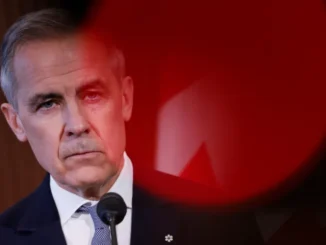
NEW YORK (TIP): World leaders have denounced United States President Donald Trump for unveiling a new tariff measure, this time aimed at the automobile industry. Canadian Prime Minister Mark Carney offered one of the most frank assessments, saying it signaled an end to the tight bonds his country and the US once enjoyed.
“We applaud the Trump administration for stepping up to end the free trade disaster that has devastated working-class communities for decades,” UAW President Shawn Fain wrote in a statement.
He blamed free-trade accords for sending US manufacturing jobs to cheaper markets abroad.
“These tariffs are a major step in the right direction for autoworkers and blue-collar communities across the country, and it is now on the automakers, from the Big Three to Volkswagen and beyond, to bring back good union jobs to the US,” Fain said. But critics warn that the tariffs will not have an immediate effect on job creation for Americans, as it will take time to build new production lines in the US.
“Donald Trump says that this will help regenerate the car-building process in the United States,” explained Al Jazeera correspondent Alan Fisher. “But, of course, if anyone is going to build a plant, it is going to take two, three, maybe four years – beyond Trump’s time in office.”
Some industry experts even predicted that the burden of tariffs could grind car manufacturing to a halt.
Flavio Volpe, the president of Canada’s Automotive Parts Manufacturing Association, explained that nearly two million automobiles constructed in Canada are made for US car companies. Those Canadian factories, meanwhile, source half of their car parts and raw materials from the US.
Volpe said that serves as an illustration of how deeply intertwined the international car industry is.
“Anything that the White House is trying to do to Canadians is going to [be done] directly to the three biggest automotive enterprises that are based in the US,” Volpe told Al Jazeera.
“The industry is likely to shut down on both sides of the border within a week,” he added.
Since the 25-percent tariffs were announced, US automaker General Motors has seen a sharp drop in its shares. It is considered one of the “Big Three” car manufacturers in the US, alongside Ford and Stellantis.
Trump has been teasing tariffs on automobile imports since the start of his second term as president.
In February, for instance, he told reporters at his Mar-a-Lago resort in Florida that the tariffs would “be in the neighborhood of 25 percent”, but he would unveil them at a later date, to give manufacturers “a little bit of a chance” to adjust.
Media reports indicated that US carmakers were worried such tariffs would disrupt their business.
At an investor conference in February, Ford CEO Jim Farley said cross-border tariffs threatened to “blow a hole in the US industry” over the long term.
Already, US trading partners have been preparing to retaliate against the tariffs, heightening a spiraling trade war.
German Chancellor Olaf Scholz, for instance, said, “The US has chosen a path at whose end lie only losers, since tariffs and isolation hurt prosperity for everyone.”
Carney likewise hinted at negative outcomes for the global economy – and a firm response from Canada.
“We will fight the US tariffs with retaliatory trade actions of our own that will have maximum impact in the United States and minimum impacts here in Canada,” Carney said.
Let’s be clear. We’re all on the same page. We won’t back down. We will respond forcefully. Nothing is off the table to defend our workers and our country.”
These reforms are not Republican or Democrat in nature—they are commonsense protections that uphold the integrity of our republic. In fact, polls show that a majority of Americans across the political spectrum support voter ID laws and stronger election oversight.
By Prof. Indrajit S Saluja
I am no admirer of President Donald Trump. I may find a hundred and one faults with the man. But for once, I have all the praise for him for his bold move aimed at restoring public trust and ensuring the sanctity of America’s electoral process.
President Donald J. Trump has issued a sweeping Executive Order focused on election integrity. This decisive action, long awaited by millions of Americans, seeks to address a growing crisis of confidence in the U.S. voting system—one that has lingered for years across party lines.
The Executive Order is not just a document of reform—it is a blueprint for securing the future of American democracy. In a world where faith in institutions is rapidly declining, the importance of credible, secure, and transparent elections cannot be overstated. President Trump’s initiative represents a clear acknowledgment that the foundation of any republic lies in the trust its citizens place in the ballot box.
A System in Need of Reform
Despite being the world’s oldest constitutional democracy, the United States has frequently found itself under fire for electoral inconsistencies. The 21st-century American election landscape has grown increasingly chaotic, marred by confusing rules, patchwork regulations, and prolonged tabulation timelines. Each election cycle brings with it a new wave of public skepticism, court challenges, and media-fueled drama. This is not a sign of a healthy democracy.
President Trump’s order directly responds to these issues by laying out a comprehensive plan to modernize, standardize, and safeguard the voting process. From voter ID mandates to transparent tabulation protocols, this Executive Order seeks to end the cycle of confusion and restore faith in our most sacred civic exercise.
Learning from Global Best Practices
Perhaps one of the most striking and commendable elements of the Executive Order is its recognition of successful electoral models abroad. In a gesture of humility and wisdom, President Trump cited examples of countries that have implemented robust, fraud-resistant systems despite larger or more complex electorates.
India, the world’s largest democracy, has long employed biometric voter ID systems to prevent impersonation and duplicate voting. Germany, known for its efficient and transparent elections, relies on paper ballots and decentralized scrutiny to eliminate tampering concerns. These countries don’t just conduct elections—they set standards. By learning from such systems, the U.S. can reclaim its global leadership in democratic governance.
It is paradoxical that while the U.S. promotes democracy around the world, it continues to tolerate electoral vulnerabilities at home. As President Trump rightly emphasized, adopting best practices from other nations is not a sign of weakness but of strength. A truly great nation evolves, learns, and leads by example.
Core Tenets of the Executive Order
At the heart of the Executive Order lies a powerful yet simple truth: every legal vote must count—and only legal votes must count. This foundational principle has too often been lost in the noise of political bickering. The order reaffirms this standard through a series of logical, necessary reforms:
Mandatory Voter ID: A national requirement for government-issued photo identification or biometric verification would bring consistency and security to the voting process. The argument that voter ID laws are burdensome is outdated and condescending—Americans already use IDs for virtually every essential function, from travel to medicine.
Ban on Unsolicited Mass Mail-In Ballots: The Executive Order recommends eliminating the practice of mailing ballots without verification. While absentee voting for those who truly need it remains protected, the new standard prioritizes oversight and accuracy over convenience.
Election Day Voting Preference: Encouraging in-person voting on Election Day reduces delays and tampering risks. While early and absentee options are necessary, the system should not be stretched to the point of dysfunction.
Transparent Tabulation and Oversight: The Executive Order calls for vote counting to be done under clear observation, with strict chain-of-custody measures for every ballot. This includes requiring all voting machines to be disconnected from the internet—a step toward eliminating digital vulnerabilities and restoring confidence.
Federal Election Integrity Commission: To ensure uniformity and compliance, the order proposes the creation of a federal commission tasked with implementing and monitoring election standards nationwide. This body would serve as a watchdog to prevent irregularities and ensure every state adheres to high standards.
These reforms are not Republican or Democrat in nature—they are commonsense protections that uphold the integrity of our republic. In fact, polls show that a majority of Americans across the political spectrum support voter ID laws and stronger election oversight.
Addressing “Illegal Vote Dilution”
One of the most groundbreaking elements of the Executive Order is its emphasis on what it terms “illegal vote dilution.” The idea is straightforward: every illegal or improperly verified vote effectively cancels out a lawful one. That’s not just a statistical error—it’s a moral failure.
For too long, election reforms have ignored this problem. The President’s directive places it front and center, rightly arguing that every eligible citizen’s voice should carry equal weight. This is not voter suppression—it’s voter protection.
When people lose confidence that their vote matters—or fear that fraudulent votes will overwhelm legitimate ones—they disengage. That is perhaps the most dangerous form of disenfranchisement. The Executive Order, by emphasizing legal protections and verifiable processes, seeks to reverse that trend.
Technology and Security Upgrades
In today’s interconnected world, no election can be considered secure without addressing cyber threats. The Executive Order also calls for vital technological reforms, including updated infrastructure, routine audits, and offline vote tabulation equipment. These proposals follow the lead of countries like France, which banned electronic voting for overseas citizens in 2017 due to hacking concerns.
In the same spirit, routine audits and paper trails are promoted not as partisan instruments, but as guarantees of credibility. An honest system does not fear oversight—it embraces it.
Critics and Their Misguided Arguments
As expected, the Executive Order has already drawn criticism from certain quarters. Some claim it will suppress votes or discourage participation. Others suggest it’s an attempt to undermine confidence in past election results. These arguments are not just misleading—they ignore the plain intent of the reform.
Requiring voter ID or banning unverified mail-in voting is no more suppressive than requiring identification to enter a federal building or fly on an airplane. The opposition to such measures is driven more by politics than by concern for voter rights.
President Trump is not relitigating the past—he is preparing the nation for the future. If anything, this Executive Order reflects a desire to move beyond the controversies of recent elections by building a process that is above reproach.
A Call for Bipartisan Support
Reforming elections should not be a partisan project. It should be a national mission. Whether Democrat, Republican, Independent, or otherwise, all Americans deserve a system that inspires confidence and ensures fairness.
President Trump has extended a hand by laying out comprehensive recommendations that prioritize transparency, fairness, and accountability. It is now the responsibility of lawmakers, state officials, and voters to engage with these reforms honestly. This is not about political victory—it’s about national integrity.
The Road Ahead: A New Standard for Democracy
If implemented in full, the Executive Order would transform the American electoral process into a global benchmark of transparency, speed, and reliability. A system where vote counting is immediate, secure, and beyond reproach. A system where voters know their ballots matter and election outcomes are respected—regardless of which side wins.
The reforms also future-proof the process against emerging threats, from cyber interference to demographic manipulation. With biometric ID, disconnected machines, and real-time audits, the risk of disruption diminishes dramatically.
President Trump’s Executive Order on election integrity is not just another policy document—it is a clarion call for democratic renewal. It invites the nation to shed complacency, confront reality, and adopt solutions that are already working around the world.
America’s strength has always come from its willingness to improve. This initiative is a testament to that spirit. It acknowledges the flaws in the current system but also provides the tools to fix them. It asks not for blind loyalty, but for patriotic cooperation.
Let us welcome this initiative not with partisanship, but with purpose. Let us elevate our standards, embrace transparency, and ensure that in every election, the will of the people—not the flaws of the system—prevails.
The time for action is now. The world is watching. And the future of American democracy depends on it.
(Prof. Indrajit S Saluja is the chief editor of The Indian Panorama. He can be reached at salujaindra@gmail.com)
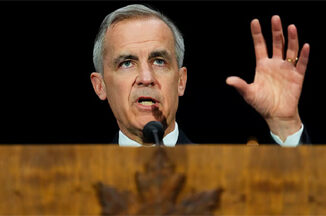
TORONTO (TIP): Canadian Prime Minister Mark Carney said Friday U.S. President Donald Trump will ultimately respect Canada’s sovereignty and be ready for comprehensive trade talks because Americans are going to suffer from Trump’s trade war. Carney said talks with Trump will not happen “until we get the respect we deserve as a sovereign nation. By the way, this is not a high bar.”
Trump kept up his near-daily attacks on Canada on Friday, repeating that the country should be the 51st state and that the U.S. keeps Canada “afloat.”
“When I say they should be a state, I mean that,” the American president said.
Carney met with Canada’s provincial leaders at the Canadian War Museum in Ottawa, where he announced relief packages for workers and businesses hurt by the trade war and announced moves to expedite resource projects. Carney, sworn in last Friday, still hasn’t had a phone call with Trump. Trump mocked Carney’s predecessor, Justin Trudeau, by calling him Governor Trudeau, but he has not yet mentioned Carney’s name.
“In the end, Americans are going to lose from American trade action and that’s one of the reasons I am confident that there will be that discussion with the appropriate amount of respect and the breadth,” Carney said. “I am ready for it anytime they are ready.”
Trump put 25% tariffs on Canada’s steel and aluminum and is threatening sweeping tariffs on all Canadian products as well as all of America’s trading partners on April 2.
Carney became Prime Minister after winning a Liberal Party leadership race triggered by Trudeau’s decision to step down earlier this year. He’s expected to trigger the process for early parliamentary elections this Sunday, with a vote expected before April 28.
The governing Liberals appeared poised for a historic election defeat this year until Trump declared a trade war and upended Canadian politics.
The almost daily attacks on Canada’s sovereignty have infuriated Canadians, who are canceling trips south of the border and avoiding buying American goods when they can. The surge in Canadian nationalism has bolstered Liberal poll numbers.
Carney said the premiers of Canada’s provinces had agreed to work on a plan to develop a national trade and energy corridor in an effort to diversify trade.
He said that could mean a oil pipeline from oil-rich Alberta to Eastern Canada. Quebec has previously opposed a pipeline, but Premier François Legault now says opinions are changing because of Trump’s threats. Carney said Quebec uses about 350,000 barrels of oil daily and 70% of that comes from the U.S.
(AP)
ANNAPOLIS, Md. (TIP): Comptroller Brooke E. Lierman, on March 14, 2025, welcomed the ruling from The Honorable Judge James K. Bredar ordering the Trump Administration to reinstate fired federal workers.
In a statement released to The Indian Panorama, Mr. Lierman said: “I applaud the U.S. District Court’s decision to issue a temporary restraining order, stopping the firings of thousands of hardworking Marylanders and requiring those previously fired employees to be reinstated. The actions of the Trump administration illegally deprived these workers of their livelihoods and has left other federal employees and their families fearful of what will come next.
“As I noted in my declaration included with Maryland Attorney General Anthony Brown’s filing, “the terminations that have occurred to date and the anticipated continuation of these terminations will cause significant decreases in Maryland’s income tax revenues, and, beyond the loss of income tax revenue, the sudden and significant increase of newly unemployed workers will have serious negative effects on Maryland’s labor market. These effects include extended periods of unemployment, downward pressure on wages, and the migration of residents out of the State.”
“I commend Attorney General Brown and the coalition of attorneys general across the nation who are working to defend the rights of our federal workforce. Their efforts remind us of the importance of our system of checks and balances that are embedded in the framework of the U.S Constitution and guard against executive branch overreach. I stand with our federal employees, many of whom call Maryland home, take pride in their service to our country, and continue to make their voices heard.”
The First Amendment of the U.S. Constitution explicitly protects the freedom of speech, ensuring that individuals, journalists, and critics can express their views without fear of government retaliation. However, during the Trump administration, there were numerous instances where these rights came under attack, raising concerns about the erosion of democracy in America. If such actions continue unchecked, the country may find itself slipping further towards oligarchy or even, as some fear, authoritarian rule.
One of the most glaring examples of the Trump administration’s assault on free speech was its relentless attack on the press. Trump labeled the media as the “enemy of the people,” a term historically associated with authoritarian regimes that seek to delegitimize critical reporting. By constantly branding news outlets like CNN, The New York Times, and The Washington Post as “fake news,” Trump attempted to discredit investigative journalism that exposed corruption and wrongdoing within his administration. His administration even barred certain journalists from press briefings, an unprecedented move that restricted their ability to report on government actions.
The White House also made direct efforts to stifle critical voices. In 2018, the administration revoked the press pass of CNN’s Jim Acosta after a heated exchange during a press conference. This action was widely condemned as an abuse of power, and a federal judge later ordered the White House to restore Acosta’s credentials. Similarly, Trump’s administration sought to silence whistleblowers who exposed misconduct, including intelligence officials who raised concerns about the Ukraine scandal, which ultimately led to Trump’s first impeachment.
Trump’s approach to social media was another battleground for free speech. While he frequently used Twitter as a tool to spread misinformation and attack critics, he also attempted to suppress dissenting voices. A federal court ruled that Trump violated the First Amendment when he blocked critics on Twitter, as his account was deemed a public forum. Despite this ruling, his administration continued to promote online censorship in ways that served its political interests.
Another major concern was the use of federal power to suppress protests. The Black Lives Matter (BLM) protests of 2020 saw some of the most aggressive crackdowns on free speech and peaceful assembly in modern U.S. history. In Washington, D.C., Trump ordered federal officers to forcibly clear Lafayette Square of peaceful demonstrators so he could stage a photo-op in front of a church. The use of tear gas, rubber bullets, and military force against protesters was condemned globally as an authoritarian tactic.
The Trump administration also targeted government employees and agencies that spoke out against its policies. For instance, the Centers for Disease Control and Prevention (CDC) and other health agencies faced political pressure to downplay the COVID-19 pandemic, leading to censorship of scientific information. Dr. Anthony Fauci, a key expert on infectious diseases, was attacked and undermined for contradicting Trump’s false claims about the virus.
The Trump administration’s threatened deportation of Mahmoud Khalil, a recent graduate of Columbia University’s School of International and Public Affairs, seems to reflect a dangerous disregard for freedom of expression – a blatant example of official censorship to curb criticism of Israel.
Khalil holds a green card, giving him permanent residence status, and is married to a US citizen. They are expecting their first child soon. Immigration agents arrested him last week in his university housing and sent him for detention from New York City to Louisiana. He had been a leader of protests against Israeli war crimes in Gaza.
These actions represent a dangerous trend: a government that seeks to suppress dissent, delegitimize the press, and use state power to silence critics is not a government committed to democracy. Such an approach aligns more with oligarchic rule, where a few powerful individuals control the state and restrict the rights of ordinary citizens. If left unchecked, this pattern of repression could pave the way for a leader who disregards democratic norms entirely and seeks to consolidate power indefinitely.
A democracy cannot function without an informed public, a free press, and open discourse. The U.S. must take proactive steps to safeguard these principles. Stronger protections for journalists, legal measures to prevent government overreach, and public vigilance against authoritarian tendencies are necessary to ensure that America does not drift further toward oligarchy or, worse, dictatorship. The warning signs have already appeared, and history has shown that once democratic freedoms are lost, they are difficult to restore. The time to act is now.
Trump has been equally unsparing and insulting to India, despite his avowed friendship with PM Modi.
“Whatever has happened thus far (the bewildering variety of utterances and actions of absurdity) under the POTUS can be compared, to an extent, with the 26-year chapter (1325-1351) of Indian history’s Delhi Durbar monarch Muhammad-bin-Tughlaq. Historians have graciously judged Tughlaq as “an amazing compound of contradictions” for making the impossible possible, even if for a fleeting moment, and then trying to unscramble the scrambled egg (like scenario) through equally fancy actions of ethereal fiction.”
By Abhijit Bhattacharyya
The President of the US (POTUS) is deeply aggrieved over what he describes as global attempts to fleece America through tariffs on US goods that are going to foreign countries. Consequently, he has taken a vow to retaliate with tariff-for-tariff in equal measure to make his mission to “Make America Great Again” (MAGA) a grand success during his tenure in the White House itself. In the process, a multi-front strategy is being implemented at battle speed, affecting the entire country and shaking large sections of the populace.
To suggest that the US today is in turmoil would be an understatement because of the unexpectedly astonishing opposition to a broad spectrum of Trump’s policy and against a few of his favorite high-profile personnel. The opposition is by no less than some people who were once either close to the POTUS or important officials implementing state policy decisions in the recent past.
The developments in the US today appear far from refreshing or reassuring to assuage the feelings of either Trump or the common people. Consequently, mission MAGA of the POTUS is creating a headache every day owing to Trump’s uncontrollable and uncontrolled lack of appropriate vocabulary. It is, thereby, putting both friends and foes alike under psychological stress. Trump thinks that his method would succeed in making people all around to kowtow to him and make them succumb to his whims and fancies during his four-year occupancy of the White House.
Not exactly. Today, the POTUS, too, needs to do some self-introspection and reflect on his acts through a full-sized mirror to reassess whether he is overstretching himself to put his pet MAGA to an acute angle of futility and resorting to an act of no return.
Psychologically, therefore, Trump has made himself an enigma; a classic case study of a grievously make-belief wounded soul who has managed to pile loads of pending unaddressed grievances during his days of being a common American, without the glitz and glamour of the official paraphernalia.
Whatever has happened thus far (the bewildering variety of utterances and actions of absurdity) under the POTUS can be compared, to an extent, with the 26-year chapter (1325-1351) of Indian history’s Delhi Durbar monarch Muhammad-bin-Tughlaq. Historians have graciously judged Tughlaq as “an amazing compound of contradictions” for making the impossible possible, even if for a fleeting moment, and then trying to unscramble the scrambled egg (like scenario) through equally fancy actions of ethereal fiction.
In fact, Trump’s every move and management style seems to be taking his unpredictably predictable course of absurdity to a new height of diplomatic embarrassment. From Panama to Canada, Denmark to Germany, each friendly state is feeling hurt, being insulted, ridiculed and snubbed by the POTUS.
Also, the growing list of impossible demands being claimed by Trump gives the impression of an urban land mafia don on the prowl to possess immovable property in prime locations.
However, one thing glitters amidst this gloom. Trump is “honestly” non-discriminatory about his indiscriminate howling at all, however mighty or muscular he/she may be, belittling or ridiculing (officially invited) foreign Heads of Government or State. Thus, all foreign dignitaries are under pressure when face to face with the POTUS, notwithstanding its being unlikely to be good news for the USA in the long run.
Thus, Trump has been equally unsparing and insulting to India, notwithstanding his avowed personal friendship with the Prime Minister, Narendra Modi. “I have exposed India on tariff,” declared a condescending Trump and followed it up with a unilateral declaration that “India has reduced tariff”.
What absurdity! No meeting, no talks, no discussion between India and America, but the ordained verdict arrives from the White House! Is it a delusion of grandeur? The gross act of the POTUS amounts to the humiliation of successive Indian establishments.
His command of demands is reaching an intolerable height, hence unacceptable to this Indian, at least. So, let Trump recall his own country’s tariff saga which put the USA on the road to prosperity.
Alexander Hamilton, the first US Treasury Secretary (1789), wanted his country to be on “firm commercial basis”. In 1791, he defended the “protection” of the local US manufacturing industry as a fundamental prerequisite. “Not only wealth, but independence and security of country were materially connected to prosperity of manufacturers.” Hamilton laid the foundation of the subsequent belief of Americans in their “manifest destiny”, whatever that means, internally or otherwise.
The US soon became a strongly protectionist country throughout the second half of the 19th century as the victorious Republicans post US Civil War, in 1865, emerged as a party of “national economic might” with a very high level of protection and very low-income tax.
The “high priest of high protection” was the Republican, William McKinley, the 25th POTUS. Before becoming President, his 1890 McKinley tariff raised import duties to an average of 49.5 per cent because he was convinced that “tariff created jobs, generated revenue for the government and preserved the US industrial power”.
Consequently, the story of US unilateralism in economics, commerce and tariffs developed a long narrative of its own. It has usually been extremely self-centered through the ages, but for the two World Wars, which turned tariff protection into free trade, owing to the mobilization of vast resources and an equally vast investment in the US’ war economics.
Trump, therefore, must stop slighting India at every step — from handcuffing its deportees to using abusive language on everything about New Delhi tariffs. Indian tariffs, good or bad, are for the 1.4 billion Indians. Let Trump deal with China, which finished the US industry, led by the Republican Nixon-Kissinger duo. Incidentally, was Kissinger right or wrong to suggest “it may be dangerous to be US’ enemy but to be US’ friend is fatal”? Is India’s US friendship destined to be fatal? Was Indira Gandhi prophetic to push back the USA in 1971?
(Abhijit Bhattacharya is a Supreme Court lawyer, ex IRS Officer, Author and Columnist, Defense and Security Analyst and a China specialist)
WASHINGTON, D.C. (TIP) : President Donald Trump has nominated Indian American official Harry Kumar, serving as Director of Government Relations in the Department of Commerce for the last four years, as Assistant Secretary of Commerce. Kumar’s name was announced by the White House in a broad list of nominees for diplomatic, defense, and administrative roles sent to the Senate for confirmation.
He previously served as Associate Director for Legislative Affairs from November 2019 to Jan 2021 during Trump’s first term. Prior to that he worked as Legislative Assistant at the U.S. Senate (Mar. 2017- Nov. 2019) and as Legislative Counsel at the U.S. House of Representatives (Apr. 2015- Mar, 2017).
Earlier, he also worked as Legislative & Policy Aide at HBW Resources LLC in Houston, Texas, where he did direct legal research and analyses on various congressional and regulatory energy initiatives affecting oil, natural gas, land-use and emissions.
Before working as an attorney at Steven S. Toeppich & Associates, PLLC, in Houston, Texas, Kumar focused on oil and energy. On a Public Policy Fellowship with Consumer Energy Alliance in Texas, he directed efforts to research and develop an assessment of Florida energy policies and assisted with legal research and analyses of Congressional energy initiatives affecting oil, natural gas, land-use and emissions.
Trump also nominated Janet Dhillon of Virginia, for the position of Director of the Pension Benefit Guaranty Corporation for a five-year term.
Dhillon, who is married to Uttam Dhillon, an American attorney and law enforcement official, previously served as Chair of the Equal Employment Opportunity Commission (EEOC), a position she was nominated for by Trump in 2019. She remained in that role until January 2021 and continued as a commissioner until her resignation in November 2022.
THE GREAT GAME: Can the PM, whose foreign policy dexterity must be applauded, take a leaf out of Virat’s book?
“Only the Chinese are standing up for now. You know what that means. That Trump has recognized that his real antagonist is Xi Jinping, not Putin. That the Chinese, no one else, have the strength and the wherewithal to take on the Americans. Perhaps that’s why Trump wants to embrace the Russian bear — he wants to wean him away from the dragon-like clasp of the Chinese leader. It’s incredible that Trump has realized this basic truth so quickly, but that it eluded the rest of Washington DC for years.”
By Jyoti Malhotra
The blow-up between Donald Trump and Volodymyr Zelensky a week ago is already a thing of the past. The world changed that Oval Office morning and the world saw the raw exercise of power. If Europe — and the Ukrainians — fulminated about the lack of grace and courtesy in the exercise of that power, perhaps they’re right. But they also know that it’s not easy to make omelets if you can’t break a few eggs.
What is amusing is that the Europeans and Britain are this shocked. The British and the French, both Security Council permanent veto powers — as well as all those other nations on the Continent trying desperately to assert themselves on the world stage — have kowtowed to the Americans at least since the end of the Second World War, riding piggyback on the strength of the American dollar.
Europe’s worst-kept secret is the barely hidden contempt the Europeans have for the ugly American – except they want their money. The most overpriced baguettes the other side of Suez are manufactured by Parisians in the summer — when Paris empties itself in anticipation of the hordes of American tourists descending upon the French capital, all looking for one or another version of A Moveable Feast a la Hemingway.
The thing about Trump & Co — JD Vance, Elon Musk and the lot — is that they have no time for what well-known journalist Shekhar Gupta calls “tanpura-setting.” Meaning, all the frills and the fuss that Europe loves so much, couched in words like “egalite” and “liberte” and even “fraternite” — although you should, dear Reader, check out France’s not-long-ago record in North Africa, especially Algeria, where even the White French were dismissively known as “pied noir” or “black feet,” because they weren’t white enough for Mainland French — is all so soul-stirring and uplifting because at the end of the day they know that the bill will be picked up by the Americans across the pond.
Well, Trump & Vance just announced that the time for all this “tanpura-setting” is over. Or, you can continue to set your tanpura, but not on our time or our cheque book. So, Ukraine is welcome to fight till the last Ukrainian, but not on American money. At least Afghanistan taught the US & Europe one thing — fighting someone else’s war doesn’t mean your boys should die for it. Perhaps that’s why they loosened their purse strings, to assuage their guilt.
Trump called out Europe’s hypocrisy that morning in the Oval Office. For three years, Europe and Canada have been encouraging Zelenskyy to fight Vladimir Putin, except, unlike in Afghanistan, they have not been willing to put their body bags where their mouths are.
It’s taken less than a week for the world to fall in line. Not just Zelenskyy, everyone else is also preparing for a Trump-led brave new world, because they know they have no other choice.
Only the Chinese are standing up for now. You know what that means. That Trump has recognized that his real antagonist is Xi Jinping, not Putin. That the Chinese, no one else, have the strength and the wherewithal to take on the Americans. Perhaps that’s why Trump wants to embrace the Russian bear — he wants to wean him away from the dragon-like clasp of the Chinese leader. It’s incredible that Trump has realized this basic truth so quickly, but that it eluded the rest of Washington DC for years.
What, then, must one make of Indian foreign policy in the Age of Trump? Clearly, the Modi government did well by going to meet Trump early, even though this happened around the same time Indians were being deported by the US President in handcuffs and chains. So, Modi swallowed the bitter pill quickly because he knew he had to — quickly get out in front, meet the American President and say your piece.
Modi’s presence in DC was also a reminder of his old slogan, “Ab ki baar, Trump Sarkar”, the stark opposite of Zelenskyy’s support for Biden.
External Affairs Minister S Jaishankar is smartly tying up the rest. That’s why he announced that India will not be in favour of a de-dollarization move, although that is exactly what India had signed up for at the China-led BRICS summit in Russia’s Kazan; before the Budget, tariffs for luxury motorcycles were brought down, because Trump had wanted that to happen in his first administration.
In short, try and please Trump, or at the very least pacify him, show him you mean no harm. You know he’s unpredictable – he has just reversed the tariffs he had set for Mexico and Canada — so get on his right side. Don’t pretend you’re non-aligned, because you’re not, nor publicly blather about your friendship as is the usual wont of insecure allies.
As for the upcoming US-Russia entente, India has just been thrown a roll of dice and come up trumps. If Modi plays this well, he can leverage India’s standing both in the West and in the East. A Trump-Putin-Modi summit is no longer out of the realm of possibility.
It follows that the Modi government should pick up some tips about the exercise of power — making friends with your enemies is far more important than with your friends, for example. If Modi wants India to become a regional power, he cannot allow the old prejudices about Pakistan to come in the way. This is far more important than the desire for people-to-people contact — although it would be wonderful to have friends from Pakistan visit for life-changing events like celebrations and marriages in Delhi — and amounts to a fundamental strategic shift in PM Modi’s world-view.
India can never be strong if it is faced by a China-Pakistan axis on either side. Why not drive a wedge between the two by making friends with your weaker, western neighbor, one with whom you also have so much more in common? Instead, India has restored the relationship with China and continues to blacklist Pakistan.
Virat Kohli, about whom the PM admirably tweets and often, showed the way some days ago when he bent over to tie the shoe-laces of the Pakistani batsman he was playing against — a calm confidence about himself, his game and his place in the world.
Can the PM, whose foreign policy dexterity must be applauded, take a leaf out of Virat’s book?
(Jyoti Malhotra is Editor-in-Chief of The Tribune group of newspapers. She has been a journalist for 40 years, working in print, TV and digital, both in English and Hindi media, besides being a regular contributor on BBC Radio. She is also interested in the conflation between politics and foreign policy. Her X handle is @jomalhotra Insta handle @jomalhotra Email: jyoti.malhotra@tribunemail.com)
WASHINGTON, D.C (TIP): US President Donald Trump has said he is “strongly considering large-scale banking sanctions and tariffs” on Russia until a “ceasefire and a final peace settlement agreement” with Ukraine is reached. His statement comes after Moscow launched a massive drone and missile attack on Ukrainian energy and gas infrastructure on Thursday.
In a post on Truth Social on Friday, Trump wrote, “Based on the fact that Russia is absolutely “pounding” Ukraine on the battlefield right now, I am strongly considering large-scale Banking Sanctions, Sanctions, and Tariffs on Russia until a Cease Fire and FINAL SETTLEMENT AGREEMENT ON PEACE IS REACHED.”
“To Russia and Ukraine, get to the table right now, before it is too late,” he added.
Meanwhile, according to Al Jazeera, Ukraine and the United States have indicated they will meet in Saudi Arabia next week to discuss a framework for ending Russia’s war.
Zelenskyy said on Thursday he would travel to Saudi Arabia on Monday for a meeting with Saudi Crown Prince Mohammed bin Salman before bilateral talks with US officials.
US envoy Steve Witkoff confirmed he would meet Ukrainian officials in Saudi Arabia, signaling that he would discuss an “initial ceasefire” and a “framework” for a longer agreement, as per Al Jazeera.
Saudi Arabia’s Ministry of Foreign Affairs said the talks would take place in the Red Sea city of Jeddah. Notably, after a fiery exchange with his Ukrainian counterpart, Volodymyr Zelenskyy, on March 1, Trump suspended military aid and intelligence sharing with Kyiv.
Trump used some strong words during his media interaction with Zelenskyy, telling the visiting leader that he “does not have the cards” and is not “acting thankful” for the support the United States has provided to Ukraine in its war with Russia, which began in February 2022.
In the explosive media interaction with Trump, Ukraine’s President had emphasized the need for security guarantees and noted that the Russian President Vladimir Putin had continued with his actions against his country even during Trump’s first term as President.
US Vice President JD Vance also expressed his disapproval of Zelenskyy’s remarks, saying it is “disrespectful to come to the Oval Office of the United States of America and attack the administration that is trying to prevent the destruction of your country.”
Trump emphasized the need for a deal to bring peace and prevent killings and told Zelenskyy, “if you didn’t have our military equipment, this war would have been over in two weeks”.
(Source: ANI)
While right-wing politicians in destination countries reap the electoral benefits of demonizing ‘illegal’ immigrants, their economies are in dire need of a cheap and docile foreign workforce.
By Christine Moliner
Since the first US military aircraft carrying 104 deported Indians landed in Amritsar on February 5, a slew of comments has emerged in the Indian media addressing the inhumane condition of the deportees’ transportation and the response (or lack of) of the Indian authorities.
Many heart-wrenching stories have been published about the infamous dunki route taken by the deportees, the sacrifice of their families, including selling land, to send them abroad. Their socio-economic profiles and reasons for migration have also been highlighted.
As a scholar who has worked for 25 years on the Sikh diaspora, I found that though interesting, these stories miss a very important point — migration is not per se a criminal activity. It has been projected as a criminal activity recently in the countries of destination of migrants. In the US, it has been done mainly since 9/11. But in Europe, the process had started earlier in the context of the dismantling of EU’s internal borders and the fortification of its external ones.
Indeed, because of the seemingly unstoppable wave of populist anti-immigrant discourse and the resultant increasingly restrictive border regimes, illegality, criminality and a sense of threat have become the dominant lens through which the state in the destination countries sees migrants from the Global South.
Let me argue here that we should apply a different lens and try to change the narrative around international migration and humanize it. To start with, we must change our terminology. Many scholars and activists promote the use of ‘undocumented’ migrants, which is a more neutral term, instead of ‘illegal’ migrants, which stigmatizes and criminalizes mobile people.
The lack of humanity and dignity during the horrendous 40-hour journey of the deportees, turbans removed, handcuffed and even leg-chained like criminals is for all to see, except for the Indian government, which seems to find not much wrong with the criminalization and dehumanization of its own citizens.
In contrast, Colombian President Gustavo Metro strongly protested against the way the deportations were carried out, stressing the need to treat the deportees with dignity and respect. Initially, he even denied entry to two US flights before backing down, when threatened by Trump of a 50 per cent rise in tariffs on Colombian imports. Among the reasons for the lack of a strong response by Delhi seems to be a bid to placate the US government and protect H-1B visas for skilled Indian migrants. This narrative of skilled (read ‘good’, ‘wanted’) vs unskilled (read ‘bad’, ‘disposable’) migrants is used in many destination countries to exploit the latter and deprive them of basic human rights.
In her book on the experience of foreign workers in Qatar (Does Skill Make Us Human? Migrant Workers in 21st Century Qatar and Beyond, Princeton University Press, 2021), US scholar Natasha Iskander argues that the notion of skill is a political tool, defining the rights foreign workers have access to.
While right-wing politicians in destination countries reap the electoral benefits of demonizing ‘illegal’ immigrants, their economies — particularly the construction, services and care sectors — are in dire need of a vulnerable foreign workforce. ‘Illegal migration’ is not a natural category. It is a political construct, an instrument that serves a purpose: of disciplining and coercing a docile and cheap immigrant labor force into accepting what sociologists call 3 Ds (dirty, dangerous, demeaning) jobs, shunned by the national population.
The hypocrisy of anti-immigrant rhetoric is probably best exemplified by none other than Trump himself. As reported by The Washington Post in 2019, his holding company, the Trump Organization, has employed for nearly two decades dozens of undocumented Latin-American construction workers at several properties owned by the company. And, guess why? Because they are cheap, hardworking and too afraid of deportations to complain about a back-breaking, harassing work.
Here, one needs to understand why ‘unskilled’ men and women from the Global South keep migrating to the Global North despite the increasingly expensive and dangerous journeys they are compelled to take due to the stringent immigration policies enforced by the destination countries.
There are multiple reasons for the life-changing decision that emigration entails. They encompass a combination of push factors (socio-economic or political conditions in the country of origin) and pull factors (what attracts people in the country of destination).
To put it bluntly, one major reason lies with the continuous economic and demographic demand for cheap migrant labor in the Global North despite the anti-immigration rhetoric. Take my own country, France. Who looks after our elderly, who cleans hotel rooms, collects garbage, builds bridges, schools, housing complexes, delivers our orders? Immigrants, of course. And, many of them irregular. They neither come to live on social benefits nor to steal the jobs of the French, as the far-right would have it.
Mobility is not a crime. It is a natural human urge. Crossing an international border shouldn’t mean losing one’s basic rights and dignity. Migrants, whether skilled or unskilled, are not criminals.
A hateful narrative dehumanizing immigrants has become all too common in many western countries. In a debate with Democrat candidate Kamala Harris, Trump went as far as to refer to Haitian refugees in Ohio as “eating the pets of the people that live there.”
Many people and advocacy groups oppose this rhetoric in the West. They argue that border enforcement policies are devastating for migrants, costly for the country of destination and ultimately ineffective because regardless of the risks, people will continue to move as they have done throughout human history.
In the case of Punjabis, mass migration was triggered and organized by the British rule to its own advantage. This colonial engineering created a deeply embedded culture of migration that no deportation, no border regime and no walls will be able to uproot.
(Christine Moliner is Associate Professor, OP Jindal Global University)
Trump also discussed the plans with Ukrainian President Volodymyr Zelenskyy. Zelenskyy is due to meet with Vice President Vance on Feb. 14.
WASHINGTON, D.C. (TIP): Following phone calls with his Russian and Ukrainian counterparts on Feb. 12, President Donald Trump announced Russia has agreed to “start negotiations immediately” to end the war in Ukraine. “I just had a lengthy and highly productive phone call with President Vladimir Putin of Russia,” Trump announced in a Feb. 12 post on Truth Social. The call marks Trump’s first known conversation with Putin since taking office.
“First, as we both agreed, we want to stop the millions of deaths taking place in the War with Russia/Ukraine.”
Speaking with reporters at the White House later on Feb. 12, Trump said he may soon meet with Putin in person in Saudi Arabia, though he didn’t provide an exact timeline for such a meeting.
So far, the Russian side has provided few additional details about the call between Trump and Putin.
In remarks carried by Russia’s state-sponsored TASS news agency, Kremlin spokesman Dmitry Peskov said the two leaders spoke for about an hour and a half.
Immediately after speaking with the Russian leader, Trump called Ukrainian President Volodymyr Zelenskyy. In another post on Truth Social, Trump said that conversation “went very well” and that Zelenskyy also wants to negotiate a peace agreement.
Treasury Secretary Scott Bessent also met with Zelenskyy in person in Kyiv on Feb. 12.
Vice President JD Vance and Secretary of State Marco Rubio will lead another U.S. delegation to meet with Zelenskyy in Germany on Feb. 14.
Putin and Trump’s phone conversation comes a day after the Trump administration secured the release of Marc Fogel, who had been held in Russia since 2021 over a marijuana possession charge.
Trump thanked his Russian counterpart for agreeing to Fogel’s release.
Announcing Fogel’s release on Feb. 11, national security advisor Mike Waltz said, “[The exchange] serves as a show of good faith from the Russians and a sign we are moving in the right direction to end the brutal and terrible war in Ukraine.”
The call between Trump and Putin also came on the same day Defense Secretary Pete Hegseth met with Ukraine’s network of international backers in Belgium. At the meeting, Hegseth reiterated the Trump administration’s calls to negotiate an end to the war.
Hegseth also pushed back on Ukraine’s ambitions to retake all of the territory it has lost to Russia throughout the war, and its wish to join NATO. Speaking with reporters on Feb. 12, Trump stood by Hegseth’s assessment of Ukraine’s war time prospects and reinforced his opposition to Ukraine joining NATO.
While Trump has called for negotiations to end the war, he has left open the possibility of continuing U.S. support for Ukraine. This week, he announced he had taken steps on an agreement in which Ukraine would trade access to its rare earth minerals in exchange for U.S. aid.
“No one wants peace more than Ukraine. Together with the U.S., we are charting our next steps to stop Russian aggression and ensure a lasting, reliable peace,” Zelenskyy said in a post on social media platform X after his conversations with Trump and Bessent.
The Ukrainian leader also announced that a document is in the works that will cover a “security, economic cooperation, and resource partnership.”
Discussions to focus on ramping up India-US cooperation in diverse fields
Joint press conference with Trump on cards
I.S. Saluja
WASHINGTON, D.C. (TIP): Prime Minister Narendra Modi arrived today in Washington, D.C. to a warm welcome. He will meet President Donald Trump during his 2-day official working visit to the US. This is Modi’s first visit to the US since the inauguration of Trump who assumed office on January 20.
In the meeting between PM Modi and Donald Trump, the two leaders are likely to broadly focus on ramping up India-US cooperation in sectors like trade, investment, energy, defense, technology and immigration.
With Mr. Trump’s tariff policy sending shockwaves across the world, PM Modi’s key priority is likely to be to pre-empt any punitive trade action by Washington against India.
Prime Minister Narendra Modi is hoping that his gifts in the form of concessions on tariffs, fresh business deals and the prospect of cooperation on China will win the U.S. President’s favor.
Mr. Trump, not yet one month into his presidency, has wielded the threat of tariffs against friend and foe alike to try to extract new trade deals, investment or law enforcement help.
India may not be an exception: Although Mr. Trump had a warm relationship with PM Modi in his first term, he has called India a “very big abuser” on trade and his levies on steel and aluminum hit India particularly hard.
Ahead of his White House meeting, PM Modi has readied promises including increased liquefied natural gas, combat vehicle and jet engine purchases, according to Indian government officials who declined to be named. It’s a “gift” for Mr. Trump, said one of the sources, who declined to be named as they previewed a private meeting.
U.S. President Donald Trump and visiting Prime Minister Narendra Modi will hold a press conference when they meet, the White House said.
“Their joint press conference with Trump is set for 1710 ET [2200 GMT],” the White House said.
Prime Minister Modi will meet Elon Musk during his visit to the United States and Starlink’s entry in the South Asian Market could be discussed during the meeting, Reuters reported, citing two people familiar with the plans. Starlink wants to start operations in India. The Indian government has backed Mr. Musk’s idea that spectrum should be assigned rather than auctioned. However, Starlink’s license application is still being reviewed.
Prime Minister Narendra Modi kicked off the series of bilateral interactions with a meeting with U.S. Director of National Intelligence Tulsi Gabbard on Wednesday, February 12. The two leaders discussed enhancing intelligence cooperation and counter-terrorism efforts.
(With inputs from agencies)
The diplomatic relationship between the United States and India has experienced significant shifts over recent years, influenced by leadership changes and evolving geopolitical dynamics. As Prime Minister Narendra Modi embarks on a two-day visit to Washington, D.C., from February 12 to 13, 2025, to meet President Donald Trump, several critical issues are poised to shape the discourse between the two nations.
During President Trump’s first term, he and Prime Minister Modi developed a notably close rapport. This camaraderie was exemplified by events such as the “Howdy Modi” rally in Houston in 2019, where Modi endorsed Trump’s leadership before a crowd of over 50,000 Indian Americans when he gave the slogan “Abki Baar, Trump Sarkaar”. However, the subsequent Biden administration saw a noticeable decline in high-profile interactions between the two leaders, leading to speculations about a cooling of personal ties.
Trade has been a cornerstone of U.S.-India relations, but it has also been a source of contention. President Trump has frequently criticized India’s trade practices, labeling the country as the “tariff king” due to its high average tariffs of 14%, which surpass those of China and Canada. In response, India has initiated measures to reduce tariffs on various U.S. products, including smartphone components and electric vehicle battery materials, aiming to improve trade relations and mitigate potential U.S. retaliatory tariffs.
Despite these efforts, the trade imbalance remains significant. In the fiscal year 2023/24, bilateral trade reached $118 billion, with India maintaining a trade surplus of $32 billion. To address U.S. concerns, India has increased imports of American oil and gas and is considering more energy imports amidst recent tariff changes favoring American products.
Defense collaboration has been a bright spot in U.S.-India relations. The U.S. has become a significant arms supplier to India, with recent deals including the sale of U.S.-made MQ-9B SeaGuardian drones and a partnership between General Electric and Hindustan Aeronautics to produce jet engines. These agreements underscore the deepening military ties between the two nations.
Both countries share a strategic interest in countering China’s influence in the Indo-Pacific region. The U.S. has advocated for a more assertive role for India within the Quad—a strategic grouping that includes the U.S., India, Japan, and Australia. However, there is speculation that President Trump may adopt a less confrontational stance toward China in his second term, potentially diminishing India’s strategic importance in U.S. regional policy.
Immigration remains a complex and sensitive topic in U.S.-India relations. The U.S. has expressed concerns over the increasing number of undocumented Indian immigrants, with over 25,000 arrests on the Mexican border recently. In response, the Modi government has announced plans to repatriate approximately 18,000 Indian nationals living illegally in the U.S. aiming to demonstrate cooperation with U.S. authorities and protect legal immigration pathways vital for Indian skilled workers.
The recent deportation of 104 Indian nationals, who were reportedly handcuffed and leg-chained during their return on a U.S. military plane, has sparked controversy and criticism within India. Opposition lawmakers have condemned the treatment of the deportees, urging the Modi government to address the issue with U.S. counterparts.
Given the multifaceted nature of U.S.-India relations, the upcoming meeting between President Trump and Prime Minister Modi is expected to cover a broad spectrum of topics.
Trade and Tariffs: Discussions will likely focus on further reducing trade imbalances, with India potentially offering additional concessions on tariffs and increasing imports of American goods.
Defense Cooperation: Both leaders may explore opportunities to expand defense ties, including potential new arms deals and joint military exercises.
Immigration: Addressing the complexities of illegal immigration and ensuring the protection of legal immigration channels for skilled Indian workers will be crucial.
Geopolitical Issues: The leaders are expected to discuss regional security concerns, including the situations in Gaza and Ukraine, as well as strategies to manage China’s influence in the Indo-Pacific.
As Prime Minister Modi and President Trump prepare for their first meeting in Trump’s second term, the dynamics of U.S.-India relations stand at a critical juncture. While past warmth between the two leaders may have cooled, the strategic imperatives of both nations necessitate a pragmatic approach to collaboration. The outcomes of this meeting will be pivotal in shaping the future trajectory of bilateral ties, with significant implications for trade, defense, and regional security.
Signup to our Newsletter!
Don’t miss out on all the happenings around the world