Tag: Trump

  • Tulsi Gabbard (and Hindutva) Have Won For The Present Moment

    Tulsi Gabbard (and Hindutva) Have Won For The Present Moment

    Gabbard’s service to India’s Hindu nationalist movement didn’t block her as Director of National Intelligence

    By Pieter Friedrich

    Last month, I sat with two FBI agents in Washington, DC for at least two hours to discuss my experiences as a victim of transnational repression by India’s Hindu nationalist (“Hindutva”) government. Along the way, I also mentioned that I was there in DC to visit U.S. Senate offices and advocate against the confirmation of former Congresswoman Tulsi Gabbard as the Director of National Intelligence. I did do that. I visited 25 Senate offices, and spoke at length with many staffers specializing in national security and intelligence areas. Every one of them was fascinated and disturbed by what I shared: that the foundation of Tulsi Gabbard’s political career was support from U.S. affiliates of the Hindutva movement.

    One staffer suggested that Gabbard’s intimacy with Hindutva ought to be examined from a counterintelligence perspective.

    I failed. Gabbard was confirmed on 12 February 2025 by a Senate vote of 52-48. Only one Republican Senator, Mitch McConnell, broke party ranks to vote against her. Others who were considered “swing votes,” such as Senators Todd Young and Lisa Murkowski, offered their “ayes.”

    Both had stood on principle to vote against Pete Hegseth as Secretary of Defense. What bought Murkowski’s vote is anyone’s guess, but Elon Musk denouncing Young as a “deep state puppet” before having a private call with him was undoubtedly the key factor in his pro-Gabbard vote.

    Gabbard’s confirmation was on the rocks for much of the time leading up to the final vote. Senators were upset about a wide range of far more mainstream issues than the Hindutva allegiance which I discussed. Most of these issues — Assad, Putin, Snowden, and more — were raised on the floor by multiple Democratic senators in the hours before the vote.

    Senators Elissa Slotkin, Dick Durbin, Chris Coons, Chuck Schumer, and others all pleaded with the Senate to vote “no” on Gabbard. Unfortunately, none of them raised the issue on which Gabbard is most vulnerable: the issue of Hindutva.

    For the past six years, I have been reporting on Hindutva influence in U.S. sociopolitics, especially elections. I reported on:

    Sri Preston Kulkarni’s campaign for U.S. Congress. He lost, catastrophically.

    U.S. Congressman Raja Krishnamoorthi. He has faced strong opposition since for his Hindutva ties.

    Ambassador (acting) Atul Keshap’s meeting with India’s RSS, the paramilitary that serves as the fountainhead of Hindutva. He resigned, prematurely.

    Michigan State Assemblywoman Padma Kuppa. She lost her campaign for Michigan State Senate.

    Ohio State Senator Niraj Antani. He lost his campaign for U.S. Congress.

    I’ve reported on much more, but the very first Hindutva-tied politician I ever reported on was Tulsi Gabbard, in a cover article for India’s Caravan magazine in August 2019. Titled “How The American Sangh Built Up Tulsi Gabbard,” it referenced the “Sangh Parivar” or “Family of Hindu Nationalist Organizations” spearheaded by the RSS, to discuss in depth how Gabbard owes her political career to them.

    As Congressman Ro Khanna, himself a Hindu, commented at the time: “Important article. It’s the duty of every American politician of Hindu faith to stand for pluralism, reject Hindutva, and speak for equal rights for Hindus, Muslims, Sikhs, Buddhist(s) & Christians.”

    My article was 18,000 words, all about Tulsi Gabbard and her ties to Hindutva. As I repeatedly said during my Senate visits last month, “Gabbard’s interactions with Assad are problematic. But if you asked me to write an article using hard facts describing her relationship with Assad, I’d be hard-pressed to give you 1,000 words. That I can give you 18,000 words on Tulsi’s relationship with Hindutva says a lot.”

    Since then, Congresswoman Tulsi Gabbard lost office as she dedicated herself to a failed campaign for the U.S. presidency. Her bizarre political gymnastics — which I recently called those of an “American chameleon” — were recently summarized as the “mystery of Tulsi Gabbard” in The New Yorker:

    “She comes from Hawaii, where she served in the state legislature and the National Guard; in those years, she campaigned against “homosexual advocacy organizations” and in favor of environmental protections. Gabbard was elected to Congress in 2012, running as a Democrat, and was made a vice-chair of the Democratic National Committee. Since then, she has left the D.N.C., because she wanted to endorse Bernie Sanders; left Congress, because she wanted to run for President; and left the Democratic Party, because she had become convinced that it is, she says, ‘led by an élitist cabal of woke warmongers.’ In August, she endorsed Donald Trump, later saying, ‘A vote for President Trump is a vote to express our deep love for our country, and our appreciation for our God-given rights and freedoms enshrined in the Constitution.’”

    These unpredictable flip-flops are best explained, in the words of The Atlantic, as a “dogged pursuit of power, or at least of proximity to power.” They represent a constant attempt to shift with the political winds, to stay relevant, and to keep close to power.

    Such desperation can only be explained by what I’ve uncovered: that Gabbard’s political career was created by U.S. affiliates of Hindutva. That Hindutva in America wants politicians in their pocket. And that, in the words of key Hindutva advocate Dr. Bharat Barai, who has given tens of thousands of dollars in campaign donations to Gabbard, “It doesn’t matter to me whether it is a Republican or Democrat.”

    Gabbard donning the colors of a foreign political party at events hosted by what would become a registered foreign agent didn’t faze those who voted for her. Gabbard’s justification of Hindu nationalism — a chauvinistic, misogynistic, xenophobic ideology — as merely “expressing pride in one’s religion” didn’t faze her Republican backers. Gabbard taking hundreds of thousands of dollars from donors who also helped to elect India’s Prime Minister Narendra Modi, then turning around and arguing, in India, that “there was a lot of misinformation that surrounded the event in 2002,” referring to the Gujarat Massacre of Muslims which Modi is accused of orchestrating and which got him banned from America, no, that did not faze anyone in the Senate from confirming her.

    Gabbard was first introduced to India’s RSS by a family friend named Michael Brannon Parker. Parker was hired by the RSS to write a book whitewashing the RSS’s 2008 massacre of Christians in the Indian state of Odisha. Asked by RSS leader Ram Madhav to introduce him to Gabbard in 2008, Parker did so.

    Then Gabbard became a member of U.S. Congress, ran for U.S. President, and eventually was confirmed as the Director of National Intelligence.

    In the meantime, Modi’s regime started assassinating critics in North America. One, successfully, in Vancouver, Canada. One, unsuccessfully, in New York City.

    Where does all of this take us?

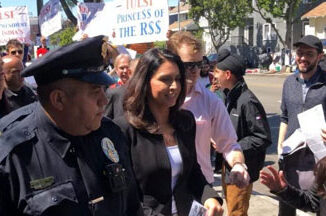
    I remember when Tulsi Gabbard was repeatedly protested in the streets during her presidential campaign over her ties to the RSS. “The princess of the R$$,” read signs.

    Today she controls my country’s intelligence services.

    For 20 years, I have joined my life with the Indian diaspora to take up concerns about the dismal human rights situation in India, especially that facing religious minorities. Under the past 10 years of Modi’s reign, India has moved from the world “largest democracy” to the world’s largest autocracy or, as some might phrase it, the world’s largest fascist nation.

    For those 20 years, I have been deeply concerned on behalf of another community about the trajectory of their nation. Today, I am deeply concerned by the direction that my own country is headed, and Tulsi Gabbard exemplifies that.

    The greatest struggle against the influence of Hindutva — a fascistic movement that has overwhelmed India — in the U.S. has failed. Hindutva is now in the innermost circles of the U.S. presidency.

    As we are led by people who insist on putting “America First,” those same people have put into power figures who will destroy America.

    As someone who intentionally made myself the most vocal opponent of Tulsi Gabbard since 2019, I am concerned but I am also doing what I can to watch my back. As a patriot, I am terrified by what her control of our nation’s intelligence means, especially when her oldest, biggest, most faithful political supporters are affiliates of the very same Hindutva movement that tried to murder American citizens on American soil. As a believer, I pledge to continue the struggle.

    And as a realist, I have hope that President Trump’s habit of repeatedly turning his back on those who were once his closest allies will soon include Tulsi Gabbard.

    (Pieter Friedrich is a freelance journalist)

  • Trump-Modi bond faces trade test in second term

    Trump-Modi bond faces trade test in second term

    Trump’s ‘America First’ trade agenda — which clashes with Modi’s ‘Make in India’ initiative — threatens to undermine India’s status as the world’s ‘back office’.

    “So far, Trump has done nothing to spare India from his frenetic push to implement his campaign promises, from raising tariffs to deporting undocumented immigrants. When the Trump administration sent more than 100 Indian nationals back to India on a military aircraft — a 40-hour ordeal — their hands and feet were shackled. Modi said nothing. In fact, far from standing up to Trump, Modi has pre-emptively slashed tariffs on US imports, hoping that this would keep India out of the “Tariff Man’s” sights. But a dissatisfied Trump, who has called India a “very big abuser” of tariffs, has not spared India from his steel and aluminum levies. He wants India to wipe out its $35-billion bilateral trade surplus by buying more oil and petroleum products, and more weapons, from the US.”

    By Brahma Chellaney

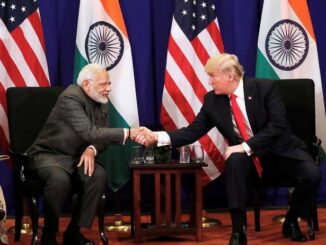
    The last time Donald Trump was president, ties between the United States and India flourished. But the bilateral relationship began to fray during Joe Biden’s presidency, owing not least to divisions over the Ukraine war. Will Indian Prime Minister Narendra Modi’s latest meeting with Trump at the White House mark the first step toward restoring this critical relationship?

    Trump has made no secret of his conviction that personal bonds between leaders can underpin stronger bilateral relationships. And he and Modi certainly share an affinity: both are nationalist politicians who love little more than to please a roaring crowd with elaborate theatrics.

    In September 2019, the two came together for a public rally in Houston, attended by 50,000 Indian-Americans and several US legislators. The following February, Trump addressed more than 1,00,000 people in Ahmedabad. “America loves India,” he declared. “America respects India, and America will always be faithful and loyal friends [sic] to the Indian people.”

    The US-India relations took a turn for the worse after Russia’s full-scale invasion of Ukraine in 2022. The Biden administration mobilized America’s allies and partners to join its campaign to punish Russia — and, ideally, compel it to change its behavior. But far from joining this effort, India stayed neutral and seized the opportunity to secure cheap Russian oil.

    There were other points of contention, as well. The Biden administration sought to weaken Myanmar’s military junta by imposing stringent sanctions on the country and sending “non-lethal aid” to rebel groups — a policy that has contributed to instability in India’s border state of Manipur. Biden also coddled Pakistan’s military-backed regime, including by approving a $450-million deal in 2022 to upgrade the country’s fleet of F-16 fighter jets.

    Similarly, Biden welcomed the interim government that Bangladesh’s military installed following the overthrow of the country’s India-friendly government last August. Bangladesh’s rapid descent into lawlessness and Islamist violence since then has raised serious security risks for India, which is already home to millions of illegally settled Bangladeshis.

    America’s approach to Sikh separatist leaders on its soil has also raised India’s hackles. Under the Biden administration, the US carried out a criminal investigation into India’s alleged involvement in supposed assassination plots against Sikh militants in the US and Canada.

    Last September, just days before Biden met with Modi in Delaware, senior White House and US intelligence officials met with Sikh separatists to assure them that they would be protected from “transnational repression”. The following month, the US charged a former Indian intelligence officer in an alleged failed plot to kill a New York-based Sikh militant, who is on India’s most-wanted list.

    Against this backdrop, it is easy to see why Trump’s victory in last November’s presidential election raised hopes in India for a reset in bilateral relations. It helps that Trump has repeatedly pledged to negotiate a quick conclusion to the Ukraine war, meaning that India’s choice not to pick a side in that conflict would no longer matter.

    A few weeks into Trump’s second presidency, however, there are reasons to doubt this rosy scenario. So far, Trump has done nothing to spare India from his frenetic push to implement his campaign promises, from raising tariffs to deporting undocumented immigrants. When the Trump administration sent more than 100 Indian nationals back to India on a military aircraft — a 40-hour ordeal — their hands and feet were shackled. Modi said nothing.

    In fact, far from standing up to Trump, Modi has pre-emptively slashed tariffs on US imports, hoping that this would keep India out of the “Tariff Man’s” sights. But a dissatisfied Trump, who has called India a “very big abuser” of tariffs, has not spared India from his steel and aluminum levies. He wants India to wipe out its $35-billion bilateral trade surplus by buying more oil and petroleum products, and more weapons, from the US.

    India is the world’s third-largest primary energy consumer, after China and the US, and the largest source of oil demand growth. That makes the country a highly attractive market for a US administration that is committed to increasing domestic oil and gas production. It also means that Trump’s commitment to pushing down oil prices, including by applying pressure on OPEC leader Saudi Arabia, would benefit India’s economy.

    But Trump has never been particularly concerned about ensuring that his trade agreements are mutually beneficial. Regarding India, his plan may well be to use the threat of tariffs to compel Modi’s government to accept the trade deal of his choosing.

    That is what he did to Japan during his first presidency. He also tried to do it to India, but failed, so he stripped India of its special trade status instead, prompting India to impose retaliatory tariffs on some US products.

    If Trump ends up slapping more tariffs, the Indian economy could slow down, at least marginally. More broadly, Trump’s “America First” trade agenda — which clashes with Modi’s “Make in India” initiative — threatens to undermine India’s status as the world’s “back office”, providing extensive IT and business services to US companies.

    Where trade is concerned, Trump treats friends and foes alike. But it matters that India is a friend — and Trump should want to keep it that way. The US-India strategic partnership helps advance the two countries’ shared interests in the Indo-Pacific region, the world’s emerging economic and geopolitical hub, including strengthening maritime security and supporting a stable balance of power. Already, the two countries are working to deepen military interoperability, and the US has overtaken Russia as India’s leading weapons supplier, new contracts show.

    As Trump and Modi build on their rapport, both should recognize that India is America’s most important partner in countering China’s hegemonic ambitions. It is thus in shared interest to restore and deepen bilateral ties, including strengthening collaboration on critical and emerging technologies, from AI to biotechnology. Warm personal relations are an added bonus.

    (Brahma Chellaney  is an Indian geostrategist and columnist. He is a professor of strategic studies at the Centre for Policy Research in New Delhi; a Richard von Weizsäcker Fellow of the Robert Bosch Academy in Berlin; and an affiliate with the International Centre for the Study of Radicalization at King’s College London)

  • Aravind Srinivas, Perplexity AI CEO, defies Musk and Trump over USAID

    Aravind Srinivas, Perplexity AI CEO, defies Musk and Trump over USAID

    Says ‘stop me if you can’ from raising $500 billion from USAID

    WASHINGTON, D.C. (TIP): Aravind Srinivas, the Indian-origin CEO of the AI search engine Perplexity AI, has challenged Tesla owner Elon Musk to “stop” him if he can from raising a significant amount of funding from the US Agency for International Development (USAID).

    “Considering raising $500B from USAID. Funding secured. Stop me if you can @elonmusk What is USAID?” Srinivas posted on X. As of midnight on Friday, February 7, “All USAID direct hire personnel will be placed on administrative leave globally, with the exception of designated personnel responsible for mission-critical functions, core leadership and specially designated programs,” the USAID website read.

    On Wednesday, hundreds of people gathered in Washington DC as part of a nationwide demonstration against the Trump administration’s decision to dismantle USAID. Before Musk called it a “criminal organization,” Trump said the US agency was “run by radical lunatics.”

    The USAID “has been run by a bunch of radical lunatics, and we’re getting them out… and then we’ll make a decision (on its future),” Trump said.

    The Trump administration has said that the agency is wasting money and has to be aligned with its policy priorities. Aravind’s post was after US President Donald Trump and Elon Musk called for shutting down the federal agency.

    Who is Aravind Srinivas?

    Aravind Srinivas is the co-founder and CEO of Perplexity AI, an AI-powered search engine backed by prominent investors, including Jeff Bezos. Perplexity AI was jointly developed by Srinivas, Andy Konwinski, Denis Yarats and Johnny Ho. Srinivas is an alumnus of IIT-Madras. He completed his Ph.D. at the University of California, Berkeley. He began his career as a research intern at OpenAI. He also worked for Google and DeepMind.

    (Source: TNS)

  • The start of the tariff war sets to hit people-to-people relations

    The start of the tariff war sets to hit people-to-people relations

    By Prabhjot Singh

    More than “tariffs,” a war of attrition set in motion by both the US Administration and the Canadian government may fuel an unending socio-economic conflict that impacts people-to-people relations between two major trade partner nations.

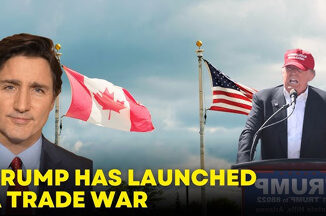
    Within hours of U.S. President Donald Trump making good on his tariff threat, declaring an economic emergency to impose a 25 per cent tariff on Canadian goods and a 10 per cent tariff on energy, including natural gas, oil, and electricity, his Canadian counterpart, Justin Trudeau, retaliated by chairing a Cabinet meeting, holding a virtual meeting with provincial and territorial premiers, and speaking with the President of Mexico, Claudia Sheinbaum, before imposing 25 per cent immediate tariffs on American goods worth $30 billion.

    Justin Trudeau announced that an additional $125 billion in duties on American products would follow in 21 days, allowing Canadian consumers and supply chains to find alternatives.

    When Justin Trudeau, who has already announced his decision to step down and not contest the ensuing federal elections, was joined by the Minister of Foreign Affairs, Mélanie Joly, the Minister of Finance and Intergovernmental Affairs, Dominic LeBlanc, and the Minister of Public Safety, David J. McGuinty while announcing the retaliatory steps.

    The White House says the tariffs are being placed on Canada until it “cooperates with the U.S. against drug traffickers and on border security.”

    “There is growing production of fentanyl in Canada, and enough fentanyl was seized at the northern border last fiscal year to kill 9.8 million Americans,” reads the statement posted to social media. “Additionally, illegal border crossings from Canada reached historic new highs every year for the last four fiscal years.”

    Free Trade Agreements (FTAs) have become part of history. Nothing will come across the borders with a duty tag on it.

    The “tariff war” is expected to impact the people-to-people relations and movements across international borders as routine or household groceries done across the border would not be exempt from the new tariff order. Imports below that sum are now allowed to cross into the United States without customs and duties.

    Hundreds of thousands of. Canadians shuttle across the international borders regularly for their routine requirements. With the “tariffs”, the vehicular movements, including those of truckers, would be adversely affected as the entry points on either side of the borders would be jammed awaiting customs clearances.

    The order signed by Trump contained no mechanism for granting exceptions, the official said, a possible blow to homebuilders who rely on Canadian lumber as well as farmers, automakers and other industries.

    The US President has been categoric in his statements that his country needs nothing from its neighbor though the United States imported 4.6 million barrels of oil daily from Canada in October last year, according to Energy Information Administration.

    Cutting across their affiliations, leaders of various Canadian political outfits, both federal and provincial, have assailed the US move.

    Ontario Premier and Progressive Conservative Leader Doug Ford, who has called for early provincial elections on this issue of the US tariffs, said in a statement that he was “extremely disappointed” by Trump’s actions, reiterating his support for a “strong and forceful response” by the federal government.

    “I wish we were not here. I wish Ontario and Canada were working together with our American friends and allies to make our two countries the richest, most successful, safest, most secure on the planet,” said Ford. “Instead, President Trump has chosen to move forward with tariffs that will only hurt America and make Americans poorer. Canada now has no choice but to hit back and hit back hard.”

    The Leader of the official Opposition party, the Conservatives, Pierre Poilievre condemned the “massive, unjust and unjustified tariffs on Canada’s already weak economy” in a press release. He reiterated his call for Parliament’s return, advocating for dollar-for-dollar tariffs, an emergency tax cut and other measures to support businesses, workers and the economy.

    A similar call has been made by NDP leader Jagmeet Singh as he has urged the federal government to protect workers as it responds to the incoming tariffs from the U.S.

    “It is urgent that the government is ready to put financial help into the hands of workers who are impacted, and that we protect as many jobs as possible with a strong commitment to buy Canadian,” he said in a statement.

    Liberal leadership candidate Mark Carney, who had been a Governor of the Bank of Canada, issued a statement, calling the tariffs a clear violation of our trade agreements which require “the most serious trade and economic responses in our history.”

    “Canada will not bow down to a bully. We won’t stand by as illegal US tariffs hurt our workers and their families. As Canadians, we need to face this challenge as one united team,” said Carney.

    “I support dollar-for-dollar retaliatory tariffs aimed where they will be felt the hardest in the United States but will have the least impact in Canada. At the same time, we need a coordinated strategy to boost investment and to support our Canadian workers through what will be a difficult moment.”

    (Prabhjot Singh is a Toronto-based award-winning independent journalist. He was celebrated by AIPS, the international body of sports journalists, for covering ten Olympics, at its centennial celebrations held at UNESCO Centre in Paris during the 2024 Olympic Games. Besides, he has written extensively about business and the financial markets, the health industry, the public and private sectors, and aviation. He has worked as a political reporter besides covering Sikh and Punjab politics. He is particularly interested in Indian Diaspora and Sikh Diaspora in particular. His work has also appeared in various international and national newspapers, magazines, and journals. He can be reached at prabhjot416@gmail.com)

  • Before Trump bilateral, PM’s France stopover to seal N-reactor deal

    Before Trump bilateral, PM’s France stopover to seal N-reactor deal

    Prime Minister Narendra Modi will be visiting France on February 10-11, a trip during which he is expected to finalise with President Emmanuel Macron a key understanding on nuclear power to have a partnership on small and advanced modular reactors.
    The PM will co-chair an artificial intelligence (AI) summit in Paris on February 10 and join a dinner hosted by Macron for the heads of state and government attending the event. He will, along with Macron, also visit Kadash, the site of an international thermal nuclear experimental reactor, said officials.
    India has already announced setting up of the Nuclear Energy Mission for research and development of small modular reactors (SMR) with an outlay of Rs 20,000 crore. At least five indigenously developed SMRs would be operationalised by 2033, Finance Minister Nirmala Sitharaman had said during her Budget speech in Parliament on February 1.
    India and France are also likely to unveil a bilateral roadmap on AI. The AI summit will also witness the presence of US Vice-President JD Vance and Chinese Vice-Prime Minister Ding Xuexiang along with other key stakeholders.
    Cooperation in defense and space would be on agenda when Modi and Macron hold a bilateral meeting, said sources. India is also looking to acquire naval fighter jets Rafale M, additional three Kalvari-class submarines and a tie-up for making a next generation engine for fighter jets. On the France visit, Foreign Secretary Vikram Misri said PM Modi and Macron would also visit the war cemetery at Marseille to pay tribute to the sacrifices made by Indian soldiers in World War 1.
    Macron would also host a dinner in honor of PM Modi, said officials. The two leaders will jointly inaugurate the newest Consulate General of India in Marseille.
    From France, the PM will head to the US on a two-day visit from February 12 to 13 where he is scheduled to meet President Donald Trump, the duo’s first bilateral after the change of guard in the White House.

  • Nowhere people of a nowhere world

    Nowhere people of a nowhere world

    THE GREAT GAME: The message from New Delhi is that those who break the law deserve the punishment they get

    “Former Foreign Secretary Shyam Saran calls it “uncivilized behavior on the part of the US.” Except, civility and good manners are already casualties of Naya America’s foreign policy. The manner in which Trump is overhauling the Middle East — Gaza, Palestine, Jordan — is unprecedented. India is keeping quiet because the hyper-realist policies that it has been propagating for some time now you only get involved when you are directly affected. And you are not directly affected in Gaza, Palestine and Jordan.”

    By Jyoti Malhotra

    February is fast turning out to be the cruelest month, with apologies to TS Eliot, on India’s foreign policy calendar.

    In the east, Bangladeshi lumpen youth, with no connection to either memory or even a desire for history, danced to the Bollywood song, “munni badnam hui,” as they participated in the burning of Bangabandhu Sheikh Mujibur Rahman’s home in Dhaka. Indians watched, horror-struck, at the hammer blow to what was once a glorious chapter in the lives of both countries — and couldn’t help asking, What now?

    And in the West, questions abound as PM Narendra Modi prepares to fly to the US to meet President Trump, barely days after 104 Indian nationals, shackled and cuffed, were deported back home. Another 487 are on their way. A sense of disquiet persists on whether the PM’s decision to go to the US in these circumstances is the right one.

    Many would say, yes of course. The India-US relationship remains the most important foreign policy relationship, notwithstanding Russia’s help with slashing the price of oil these recent post-Covid years. In support of this argument, a trade roadmap is on the cards when the PM visits, as is the likely announcement of India opening up the civil nuclear sector (after 17 years), while talk of Delhi buying more US defense equipment is gaining ground.

    Which is why External Affairs Minister S Jaishankar has travelled to the US thrice in the last four months, in September, December and January, so as to make the Modi-Trump meeting count. He has put out that the PM will be only one of the three leaders to have met Trump in his first month in power — Israel’s Netanyahu, Japan’s Ishiba and India’s Modi.

    Unfortunately, barely a week before Modi lands in DC, the news has not been very complimentary. Pictures of young Indian men in second-hand jeans and cheap Chinese shoes shuffling towards a US military plane because they have chains on their feet has sent waves of shock and awe across Punjab, if not the rest of the country.

    This, of course, is exactly what Trump wants. He wants to send the message to the world that he’s not interested in the great unwashed landing up at America’s doors — talented, skilled and accomplished brigades on H1-B visas are just fine.

    Nor does he seem to have time for saving face. If the Indian PM is coming to see you in a week, you should no longer expect that the news is good on the eve of your visit. Trump has already rewritten the rules of the world order in the few weeks he’s been around.

    Former Foreign Secretary Shyam Saran calls it “uncivilized behavior on the part of the US.” Except, civility and good manners are already casualties of Naya America’s foreign policy. The manner in which Trump is overhauling the Middle East — Gaza, Palestine, Jordan — is unprecedented. India is keeping quiet because the hyper-realist policies that it has been propagating for some time now you only get involved when you are directly affected. And you are not directly affected in Gaza, Palestine and Jordan.

    As for the 104 deportees, including women, who were shackled during their flight home earlier this week, the message from New Delhi is that those who break the law deserve the punishment they get. The US Border Patrol described them as “aliens,” and so they are.

    And yet, as Jaishankar spoke in Parliament on the deported Indians, admitting on record that he was “being bureaucratically correct,” one couldn’t help wondering what his predecessor, the late Sushma Swaraj, would have said when confronted with India’s present predicament — witnessing the humiliation of its poor and unskilled masses being rightfully punished for doing a very stupid thing.

    Sushma Aunty had so stirred the bureaucratic consciousness of the toughened bureaucrats of the Ministry of External Affairs (MEA) that they were forced to be kinder to the bluest-collar workers across the world. Reforms were ordered for the protection of emigrants, laws were toughened for those wanting to work abroad, immigration agents were forced to fall in line. Not that she cleaned up the entire system, but she certainly tried. She knew her fellow citizens were more often than not on the wrong side of the foreign law in question, but she demonstrated compassion. She offered them a hanky to cry when they got caught after knowingly breaking the rules.

    The current Modi government, instead, is throwing the rule book at these people. Moreover, the MEA is pointing out, these Punjabi folk who can spend Rs 45 lakh chasing the American dream are not exactly poor. Of course, the MEA is right. These 104 men and women knowingly bought that one-way ticket to Amreeka, well aware that the “dunki route” is what it was. And still they went. Problem is, they will still go if they get a chance, if only because they need to pay the loan their families took to send them to the US.

    But back to Modi and Trump and the importance of the India-US relationship. Apart from the fact that the PM seems keen on making that early connection with the President, the fact remains that both countries are increasingly invested in each other. From intelligence-sharing to defense and technology partnerships, via military foundational agreements that have been signed over the last 25 years — an alphabet soup called GSOMIA, LEMOA, COMCASA, BECA — India is so closely integrated with the US that it would not be far wrong to describe it as an “informal ally.”

    Some would say, why not? There are as many as 5 million US citizens of Indian origin, a hugely influential group. We celebrate them all. We wallow in the appreciation of Sundar Pichai and Satya Nadella and Indra Nooyi and Ajay Banga, as if they were part of our immediate family.

    The problem arises when the Punjabis from Doaba, the Haryanvis from Kaithal and the Gujaratis from Gandhinagar bomb this pretty picture — wearing handcuffs and all. What is worse is that no one, except their immediate families, want to own these Indians. The nowhere men and women of a nowhere world.
    (Jyoti Malhotra is Editor-in-Chief of The Tribune group of newspapers. She has been a journalist for 40 years, working in print, TV and digital, both in English and Hindi media, besides being a regular contributor on BBC Radio. She is deeply interested in the conflation between politics and foreign policy. Her X handle is @jomalhotra Insta handle @jomalhotra Email: jyoti.malhotra@tribunemail.com)

  • Turbulence awaits India in Trump zone

    Turbulence awaits India in Trump zone

    There is uncertainty over whether his MAGA push will help Make India Great Again

    “Faced with such transactionalism, it would seem, India has hedged its bets by stabilizing relations with both Russia and China. Some analysts have expressed the hope that Trump may improve relations with Russia and that would in turn enable India to retain that relationship while continuing to deal with China. Whatever the facts, the point is that it will take time before some stability returns to the US-India relationship. Indeed, this would be true even for US relations with key allies and neighbors. Everyone is waiting and watching to see how much of Trumpism is bluff and bluster and how much he means business.”

    By Sanjaya Baru

    During the US presidential election campaign, the commentariat in India was generally of the opinion that a second Trump presidency would be beneficial for India. Much hope was invested in the so-called personal chemistry and bonhomie between Prime Minister Narendra Modi and President Donald Trump. As events have unfolded over the past few weeks, it would appear that New Delhi now awaits Trump a bit nervously.

    Much has been made of Trump’s early invitation to Chinese President Xi Jinping to attend his inauguration. It took some diplomatic effort on External Affairs Minister S Jaishankar’s part to ensure that at least he received an invitation. More worrying, however, are Trump’s remarks about trade, tariffs and immigration. Along with the rest of the world, India is getting prepared for a period of turbulence in the bilateral relationship as well as in global geopolitics.

    Evan Feigenbaum, vice-president of Washington DC-based think tank Carnegie Endowment for International Peace, and a former member of the George W Bush administration, warns that Asian governments and markets should be prepared for Trump-induced turbulence. “Geopolitically, Asian governments, firms and especially markets should prepare to face a whirlwind of strategic turbulence,” says Feigenbaum.

    Jaishankar’s last air dash to Washington helped get the outgoing national security adviser, Jake Sullivan, to New Delhi. That visit sought to inject new energy into a sagging affair. During his proposed visit to Washington DC this weekend, the foreign minister will seek to inject even more energy into the relationship. Such activism draws attention to the concern with anticipated turbulence.

    In recent weeks, many within the ruling establishment in India have complained about the anti-India stratagems of the so-called American ‘deep state’, including influential individuals like George Soros. This kind of talk emanating from within the Sangh Parivar betrays nervousness in New Delhi despite the confidence exuded by diplomats and officials. At least one reason for this would be the uncertainty about the answer to a simple question — will MAGA help MIGA?

    Trump’s promise for his second presidency is primarily to Make America Great Again (MAGA). Modi’s promise to India has been MIGA — Make India Great Again. In the past, especially in the early years of the US-India strategic partnership during the tenures of President George W Bush and Prime Ministers Atal Bihari Vajpayee and Manmohan Singh, the template was that it would be in US interest to help India’s rise. It is this view, especially on the part of President Bush and his advisers that facilitated the US-India civil nuclear agreement. This view had to contend with doubts within the American establishment as to where India stood on matters of interest to the US. Doubts regarding the latter were renewed after India played footsie with Vladimir Putin following Russia’s invasion of Ukraine.

    In the United States, three schools of thought contend with each other on the US-India relationship. These can be classified as ideological, realist and transactional. The ideological school, never a decisive voice, has always placed great emphasis on the fact that India is a democracy and that its rise as a plural democracy is in the interests of the US. The West fought Soviet communism during the Cold War and now responds to Chinese authoritarianism. In both battles, the empowerment of a democratic India was viewed as a global public good.

    The realist view situates US-India relations within a global balance of power perspective that sees a stronger India as a helpful balancer against an aggressive and assertive China, at least within Asia. The fact is that US-India ties have improved over the past two decades against the backdrop of China’s rise.

    Hence, both the ideological and the realist views have contributed to an improvement in US-India relations, with the American establishment viewing India’s rise as being in its own interest and a positive development in itself. Making India Great Again suited US interests as long as India was viewed as an emerging counterforce to China.

    By contrast, the purely transactional view that Trump opted for during his first tenure has insistently asked the question, ‘what’s in it for me?’ Entering his second term Trump now asks that question with renewed vigor and force and the question is asked of the world as a whole, India included.

    The rise of transactionalism over realism means India has to show what it can do to MAGA for the US to do something to MIGA. Even though such transactionalism is associated with the first Trump presidency, it found new takers within the Biden administration after India went along with Russia in the wake of the Ukraine war. A growing number of officials within the Biden administration also became transactional and kept ticking off points as to what India was doing for or against US interests. Expect more of that going forward.

    Faced with such transactionalism, it would seem, India has hedged its bets by stabilizing relations with both Russia and China. Some analysts have expressed the hope that Trump may improve relations with Russia and that would in turn enable India to retain that relationship while continuing to deal with China. Whatever the facts, the point is that it will take time before some stability returns to the US-India relationship. Indeed, this would be true even for US relations with key allies and neighbors. Everyone is waiting and watching to see how much of Trumpism is bluff and bluster and how much he means business.

    Even as India hopes to stabilize and improve its relationship with the US, it has to be prepared for the anticipated turbulence. After all, Trump’s basic and fundamental policy objective will remain America First. The US is determined to retain its dominant global position, secure control over the trans-Atlantic alliance and ensure that allies spend more on their defense so that it can focus its resources on making its own economy more globally competitive and dominant.

    (Sanjaya Baru is a political commentator and policy analyst)

  • Has US become a most unreliable nation?

    Has US become a most unreliable nation?

    Perhaps the middle powers could take a leaf from Qatar’s book and play the mediating role to make things happen

    “As these things go, the shift of global power will have to play out before countries agree to talk — after the great powers test the limits of what they can achieve through aggression, or aggressive posturing. That is when a new modus vivendi might be thrashed out. One assumes China will manage to push the US back in the Western Pacific but not push it out altogether, and Russia will get what it seeks: a near-abroad as its zone of influence. Whether this will be a stable arrangement depends on the answers to key questions: Who will come in place of today’s rulers; can the great powers agree to live and let live; and what roles the middle powers will play?”

    By TN Ninan
    By TN Ninan

    As Donald Trump assumes office again as US President, the world is caught amidst seminal change. Since World War II, even the most powerful countries were willing to limit national sovereignty, in that they agreed for the most part to abide by global rules and cooperative action. Such rules were framed on a wide range of subjects. Not just trade and tariffs, but also nuclear arms, the law of the sea and the sanctity of national borders.

    This has changed, for two reasons. The first is the rise of China, and the accompanying shift of global power. China is not a status quo power, so it wants to shake things up and challenge the US. The second is the rise of strongmen as rulers in the great-power countries: Vladimir Putin, Xi Jinping and now Trump.

    These two developments have revived something that had more or less died out after World War II — wars of choice by the great powers, aimed at territorial conquest. The US war on Iraq served advance notice of what was to come. Three years ago, Putin invaded Ukraine. Xi seems to be preparing a Chinese assault on Taiwan. And Trump now threatens the use of force to acquire the Panama Canal and Greenland.

    This has been accompanied by other changes. A preference for unilateral action over multilateralism. A diminished role and utility for the United Nations and the World Trade Organisation, and for action to meet climate change targets. Geopolitics was always about power, but increasingly it is about power unrestrained by rules. That’s true in the South China Sea, genocide in Gaza, a huge new dam upstream of the Brahmaputra in Tibet and economic sanctions that affect non-combatant third countries.

    Underlying these is a change in mindset, from seeing interdependence and trade networks as an advantage to viewing them as vulnerability. So, we see a movement away from more than half a century of trade liberalization. Out, therefore, with globalization, in with ‘my country first’. Out with networked economies, in with self-reliance. Out with market efficiency, in with national security. This approach didn’t work well the last time it was tried, a century ago, but the lessons of history don’t seem to hold much sway.

    Perhaps the most important change is that the country that originated much of the rule-making of the past, the United States, is now the most unreliable nation on earth. A Financial Times columnist asked the other day whether America had become a rogue state. No one knows what it will do next, least of all its allies. All of this makes the world a more turbulent place, with many more uncertainties and risks than before.

    Laws and agreements reflect pre-existing power structures, and the cooperative agendas that were hammered out since World War II were made possible by the pre-eminence of a Western paradigm. And put in place by the most powerful country to emerge from the war. If that world order, so to speak, is now breaking down, we have to go back to the root cause: The threat posed to the West by the rise of China, at a speed and on a scale without precedent. The Western response — fueled by perceptions that China has not played by accepted trade rules, systematically worked to de-industrialize the West and also stolen Western technologies — has been trade sanctions, tariffs, technology denials and such.

    These may have come too late in the day. China’s industrial pre-eminence will remain unchallenged. Last year, it produced 12.6 times as much steel as the US, 22 times as much cement and three times as many cars — with whose electric models it now threatens to overwhelm the Japanese and German car markets. China’s shipyards also accounted for over half the ship output. By 2030, China’s manufacturing sector is projected to be bigger than that of the entire Western world. It is already far and away the global leader in every sunrise industry.

    These strengths are useful only if China can continue to access world markets, which are progressively sought to be denied. Yet China enjoyed a record trade surplus in 2024, approaching a trillion dollars. In several areas, it is now ahead of the West in technology. To be sure, the Chinese economy now faces serious structural problems that could undermine its continued rise. But one could argue that it is dealing with them at least as successfully as Western countries with structural problems, like the UK and Germany, even the US.

    The reality to be dealt with is that the more the West feels threatened, the quicker it has abandoned whatever rules it once played by. In the new world, it is every country for itself, and might is right. Indeed, every country’s defense budget is being raised, and one must hope that does not spur wider conflict. Even if this is avoided, the old world isn’t coming back. But can the new world agree to new rules?

    As these things go, the shift of global power will have to play out before countries agree to talk — after the great powers test the limits of what they can achieve through aggression, or aggressive posturing. That is when a new modus vivendi might be thrashed out. One assumes China will manage to push the US back in the Western Pacific but not push it out altogether, and Russia will get what it seeks: a near-abroad as its zone of influence. Whether this will be a stable arrangement depends on the answers to key questions: Who will come in place of today’s rulers; can the great powers agree to live and let live; and what roles the middle powers will play?

    Reform of today’s global institutions like the Security Council will have to be addressed. Ideally, the Council should abolish the veto and adopt the weighted voting that prevails in the European Union, the International Monetary Fund and the World Bank. This should make today’s veto countries more responsive to international opinion, and reflect the new global power reality. In trade, plurilateral arrangements are more likely than fully global trading rules. A new global compact on how to help African countries, home to most of the world’s poorest, will be essential. None of this will be easy, or the outcomes certain. Perhaps the middle powers could take a leaf from Qatar’s book and play the mediating role to make things happen.

  • Xi, Bolsanaro, Meloni Invited; Jaishankar to represent India at Trump Inauguration

    Xi, Bolsanaro, Meloni Invited; Jaishankar to represent India at Trump Inauguration

    WASHINGTON, DC / NEW DELHI (TIP): External Affairs Minister Dr. S. Jaishankar will attend the swearing-in ceremony of US President-elect Donald Trump, the Ministry of External Affairs announced on Sunday, January 12. This comes after Jaishankar received an invitation from the Trump-Vance inaugural committee.

    “On the invitation of the Trump-Vance Inaugural Committee, External Affairs Minister (EAM) Dr. S. Jaishankar will represent the Government of India at the Swearing-In Ceremony of President-Elect Donald J. Trump as the 47th President of the United States of America,” said the MEA press note.

    During his visit, Jaishankar is expected to meet with representatives of the incoming Trump administration, as well as other visiting dignitaries, the press note added.

    The press release was conspicuously silent on whether the invitation for the ceremony on January 20 was in the name of Indian Prime Minister Narendra Modi and Jaishankar would be sent instead.

    So far, foreign media reports have suggested that invitations were extended to heads of state or, in one instance, a former head of state. However, the MEA press release did not specify whether the invitation was addressed to a particular individual or if the recipient was named.

    This development comes after Jaishankar’s recent visit to the US, where he met with Trump’s choice for National Security Advisor Mike Waltz, along with talks with officials from the outgoing Biden administration, including US Secretary of State Antony Blinken. On Monday, the external affairs minister also held talks with US National Security Advisor Jake Sullivan, broadly reviewing the trajectory of India-US global strategic partnership in the last four years under the Biden administration. Sullivan was on a visit to India two weeks ahead of Trump’s inauguration as the 47th president of the US.

    The inauguration ceremony will mark the beginning of Trump’s second term as president. J.D. Vance will take oath as the vice president of the United States.

    Last month, Trump revealed that he had invited world leaders, including Chinese President Xi Jinping, to attend the inauguration of his presidential term – an unprecedented move for this American event.

    Initial reports suggested that Trump had personally extended an invitation to Jinping, sparking a sensation in the US. Throughout his campaign and after his victory, Trump had pledged to impose heavy tariffs on China, as well as on traditional allies like Canada and Mexico.

    From the outset, it was evident that President Xi would not be attending the inauguration. Earlier this week, the UK newspaper Financial Times reported that Xi plans to send a special envoy, possibly Vice President Han Zheng or Foreign Minister Wang Yi. The report also noted that Trump’s aides would prefer the envoy to be Cai Qi, a Politburo Standing Committee member who is believed to hold significantly more influence than Han or Wang.

    While much of the focus among foreign invitees was on China, reports in December also indicated that other world leaders, who were from right-wing parties, had also been invited to the inauguration.

    Argentinian President Javier Milei’s office confirmed receiving an invitation, while the Ambassador of El Salvador in Washington publicly stated that President Nayib Bukele had also been invited, according to an AP report on December 18. Notably, Milei was the first foreign leader to meet Trump after the election at his Mar-a-Lago club.

    Recently, Italian Prime Minister Giorgia Meloni expressed her intention to attend Trump’s inauguration but noted that she was reviewing her schedule before finally confirming her participation.

    Meanwhile, former Brazilian President Jair Bolsonaro wrote on X on Wednesday that he has requested the return of his passport, which he had previously surrendered during an investigation into his alleged role in a 2023 coup attempt to stay in power. Bolsonaro explained that he needed the passport to attend the upcoming inauguration ceremony.

    During Trump’s first term, Modi made a concerted effort to strengthen ties, with Trump attending the ‘Howdy Modi’ rally in Houston and hosting him at a massive stadium event in Ahmedabad. However, unlike other world leaders, India has not clarified whether a specific invitation was extended to Modi.

    India is set to host the Quad leaders’ summit later this year, with Trump expected to visit for a second time.
    (With inputs from The Wire)

  • Will Canadian woes end by the year 2024?

    Will Canadian woes end by the year 2024?

    By Prabhjot Singh

    2024 turned out to be a tumultuous year for Canada. Nothing went right. Acknowledged as one of the best countries to live in, Canada slid into one of the worst years in recent history. Its bilateral relations with India touched a new low. Before the end of the year, its long-time ally and biggest trade partner and neighbor, the USA, threatened a 25 per cent import tariff on anything Canadian.

    To top it all, the minority Liberal government was rocked by internal strife and external pressure to quit and pave the way for an advanced federal election.

    Who could better describe the country’s situation than its own Prime Minister?

    In his Christmas message Justin Trudeau gave vent to his spleen saying “For you, the holidays may be a time of big family gatherings and feasts, of gifts and celebrations. But maybe it is a very hard time. If you are grieving, worried, or alone, this can be the toughest time of the year. It can be the loneliest. So let us all check in on the people in our lives who have not had an easy time this year, and who may need us more than we know.

    “As we reflect on the past year and look to the future, let us continue to show love and kindness – to ourselves and to those in need. Let us also take a moment to thank those who give so much of themselves to make Canada the place we are proud to call home, including the brave members of our Canadian Armed Forces, the dedicated first responders and essential workers, and the countless volunteers. Thank you, to all of you.”

    How true? How precisely did he put his inner feelings in a message that normally is delivered to join festivities on the sacred occasion as he said at the beginning of his message “This is such a special time of year. It is a time to gather with loved ones, to celebrate the spirit of the season, and to give thanks for all that is good in the world.

    “For Christians, it’s a time to celebrate the birth of Jesus Christ and think about his story of kindness, forgiveness, and faith. The lessons of his life are universal, and they inspire and comfort people every time they’re told – and retold.”

    It was not at the far end of the year. Troubles for Justin Trudeau and his minority Liberal government started much earlier. He survived three no-confidence motions, thanks to unrelenting support from the fourth-largest party in the House of Commons, the New Democrats.

    Chaos in immigration, growing inflation, unemployment, rising bank rates, homelessness, longer queues outside foodbanks, an alarming increase in gun violence and continuous loss in popularity as revealed by by-elections held during the year virtually cornered Justin Trudeau and his government midway in the year. The situation was further aggravated by the accompanying political turmoil, more so after ally New Democrats Party led by Jagmeet Singh tore down its Supply and Confidence Agreement (SACA) putting the minority government in limbo.

    Things started turning sour for Justin Trudeau after the killing of a Sikh leader Hardeep Singh Nijjar outside a Gurdwara in Surrey. Since the Liberals led by Justin Trudeau never had good times with India ever since coming to power in 2015, the killing of Hardeep Singh Nijjar, which saw Justin Trudeau raising accusation fingers at India, brought to thaw the bilateral relations.

    India and Canada have enjoyed for more than a century strong people-to-people relations. These relations did not match the bilateral relations the two countries always aspired to have over the years, including good times. Instead, this unfortunate development, the killing of a Canadian on Canadian soil, suspected at the instance of a foreign hand, led to a diplomatic spat. Sizes of the diplomatic corps were shrunk leading to the temporary suspension of the counsellor and other services. Accusations and counter-accusations flew high.

    Though Prime Ministers of Canada and India met on the sidelines during various international summits, their conduct was more remorse than friendly sending wrong signals to people back home. As the issue snowballed into a controversy, Canada’s Royal Canadian Mounted Police (RCMP) came out with startling revelations suggesting the involvement of the government of India agents in the assassination of Hardeep Singh Nijjar. Better sense prevailed after an initial flare-up as both sides took to caution than aggression to gradually push the issue to the side-lines.

    As relations with India receded to the background, Canada had yet another nightmare unfold. The election of the US President, which was watched with considerable interest the world over, put the Canadians under stress. President-elect Donald Trump got into offensive mode, and his first promulgations made Canadians scurry under cover. Donald Trump accused Canada as a source of both Fentanyl and human smuggling. How serious are these problems?

    Donald Trump spared no opportunity to bash Canada for its porous borders that paved the way for the smuggling of synthetic Fentanyl. He wanted his immediate neighbors – Mexico and Canada – to act fast and stop smuggling, both Fentanyl and illegal aliens.

    Gauging the gravity of the Fentanyl accusations by the US, the leader of the Opposition in the Canadian House of Commons, Pierre Poilievre, moved a resolution urging Prime Minister Justin Trudeau to “protect our people from dangers of drugs”. Though the motion was defeated 210-121, it did evoke an animated debate before it was put to vote. The Conservative Leader held that after nine years, the NDP-Liberal Government’s radical hard drug liberalization has spread death and disorder across Canada. Since Justin Trudeau became Prime Minister, 47,000 Canadians have died of drug overdoses, representing a 200 per cent increase since 2016.

    The Common Sense Conservatives had put forward a motion in the House of Commons, calling on Trudeau to protect people from dangerous drugs. The motion also wanted to reverse the catch-and-release Bill C-5, which eliminated mandatory jail time for certain violent offenders. It also advocated for longer jail sentences for drug kingpins, besides demanding a ban on the importation of fentanyl precursors. The government should stop buying dangerous opioids which were diverted to teenagers and other vulnerable Canadians, the motion said, demanding that Canadian ports be secured against fentanyl by buying high-powered scanners and putting more boots on the ground there to stop fentanyl and its ingredients from coming into our country.

    In the 12 months ending September this year, Pierre Poilievre said, US border agents seized about 11,600 pounds of drugs entering the United States from Canada. Seizures of fentanyl doses more than tripled between 2023 and 2024, rising from 239,000 doses to 839,000. A year ago, CSIS told Trudeau that they had identified more than 350 organized crime groups actively involved in the domestic illegal fentanyl market. And just last month, the RCMP uncovered a “super lab” operating in rural British Columbia that was capable of producing 95 million lethal doses of fentanyl. Incidentally, the kingpin of this lab has been a person of South Asian descent.

    The tirade of opposition campaigns apart, attacks from within the Liberal party started mounting on the Prime Minister. A section of the Liberal caucus revolted against him asking him to go. Trudeau, however, managed to put aside the dissensions on the plea that in spite of tough resistance from the Opposition that wanted cuts on all programs, including dental care for seniors, saying he and his party were committed to working for Canadians.

    His pleas did not cut ice with many of the party dissenters. Some announced that they would not contest the ensuing election to the House of Commons, and a few others quit even their Cabinet positions to express their resentment.

    Internal strife climaxed when the Deputy Prime Minister and Finance Minister Chrystia Freeland, in her stunning resignation letter hours before she was to present her Fall Financial Report, shook the shaky Trudeau Government to its bones. The report was tabled. Left with no choice, the Prime Minister named a new Finance Minister and ordered a reshuffle of his Cabinet.

    Since Liberal MPs of South Asian descent stood by Justin Trudeau throughout his tough times, he inducted Brampton MP Ruby Sahota, to raise the number of South Asians in the 38-member Cabinet to six. She was named Minister for Democratic Institutions and Minister Responsible for the Federal Economic Development Agency for Southern Ontario.

    Within a few hours of the reshuffling of the federal Cabinet, Chandra Arya, Liberal MP from Nepean, fired a salvo asking Prime Minister Justin Trudeau to quit. He is the first Liberal MP of South Asian descent to express his dissent in the leadership of Justin Trudeau.

    Besides, four Conservative MPs of Indian descent, including Tim Uppal, Jasraj Singh Hallan, Arpan Khanna, and Shuvaloy Majumdar, who have been part of three non-confidence motions, Jagmeet Singh, Leader of the New Democrats, became the first MP of South Asian descent to ask Justin Trudeau to quit. And for the ruling Liberals, Chandra Arya is the first South Asian from the Liberal caucus to revolt against Trudeau’s leadership.

    While time and fate will decide the future of Justin Trudeau and his Liberal Government in 2025, it is the 2-million-strong South Asian community continues to await difficult and uncertain times ahead.

    Will the turn of the year bring back cheers to members of the community who proudly acclaim themselves to be “Canadians”? only time will tell.

    Meanwhile, I wish all Canadians a Happy New Year.

    (Prabhjot Singh, is a Toronto-based award-winning independent journalist, He was celebrated by AIPS, the international body of sports journalists, for covering ten Olympics at its centennial celebrations held at UNESCO Centre in Paris during the 2024 Olympic Games. Besides, he has written extensively about business and the financial markets, the health industry, the public and private sectors, and aviation. He has worked as a political reporter besides covering Sikh and Punjab politics. He is particularly interested in Indian Diaspora and Sikh Diaspora in particular. His work has also appeared in various international and national newspapers, magazines and journals.)

  • Indian Consulate’s Media Reception: An Enjoyable End of the Year Rendezvous

    Indian Consulate’s Media Reception: An Enjoyable End of the Year Rendezvous

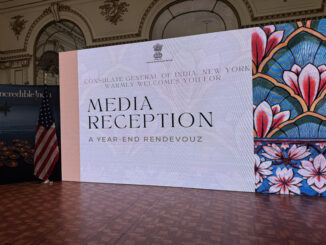
    NEW YORK CITY (TIP): The Consulate General of India in New York organized a Media Reception – “A Year-End Rendezvous” – an evening of delightful conversations, connections, and camaraderie over dinner on Thursday, December 19.
    The first of its kind media interaction initiated by the Consul General Binaya Srikanta Pradhan attracted a number of media persons from both the mainstream media and the Indian American media. Also present were a few students doing their studies in mass communication and media.

    The event celebrated the year 2024 and looked forward to 2025, highlighting interactions between the consulate and the media. The Consul General expressed gratitude for the media’s engagement and looked forward to continued collaboration.

    The informal conversation touched on various topics, including the importance of media in fostering understanding, the influence of figures like Elon Musk and Trump, and the potential of India’s auto industry. There were mentions of personal anecdotes, such as spine surgery and travel plans, and a general atmosphere of camaraderie and future prospects. The event concluded with informal discussions and good wishes for the New Year.

    Consul General Binaya Srikanta Pradhan said he looked forward to more interactions and one-on-one meetings in the next year and wished everyone a Happy New Year.

    Consul General Pradhan expressed gratitude to the Deputy Consul General Dr. Varun Jeph and Consul Press and Culture Shruti Pandey for organizing the event and for their constant engagement with the media.

    Deputy Consul General Dr. Varun Jeph thanked everyone and ended the formal part of the event.

    Dr. Varun Jeph thanked everyone and ended the formal part of the event, inviting attendees to enjoy the cocktails and starters.

    Consul Shruti Pandey compered the event

    Earlier, Consul Shruti Pandey who compered the event, welcomed the guests.

    The distinguished gathering.

    The guests left pleased with the delectable food served to them and the Happy Holidays gift from the Consulate.

  • Elon Musk is the ultimate chaos agent

    Elon Musk is the ultimate chaos agent

    With one post on X, Musk has the power to shut down the government of the most powerful nation in world history

    Much about the second rise of Trump, like that of the first, undermines or overthrows everything we thought we knew about power and politics. Trump seems to maintain his support in spite of, if not because of, his willingness to blow everything up, to flout norms of decorum and law and to engage in fabulous hyperbole that bears little grounding in reality.

    By Siva Vaidhyanathan

    Elon Musk holds no public office. He has never stood for election, passed scrutiny for appointment to public office, nor commanded a political force of any measure. He is, however, the latest star and favorite of Donald Trump, the US president-elect. So when Musk issues one of his off-the-cuff missives via his decrepit social network, X, Trump loyalists (almost all the Republicans) take him seriously.

    Yet now, suddenly, Musk has the power to shut down the government of the most powerful nation in the history of the world and depose his party’s legislative leader, the speaker of the House, Mike Johnson, a Republican lawmaker from Louisiana.

    Very early Wednesday morning, fueled by hubris and whatever else, Musk called for the US House of Representatives to reject the negotiated continuing resolution that it must pass this week to keep the federal government funded.

    “This bill should not pass,” the richest human being in the world wrote at 4.15am ET. Musk followed up for hours, using every derogatory word he could muster to describe a bill he almost certainly had not read nor understood. “Any member of the House or Senate who votes for this outrageous spending bill deserves to be voted out in 2 years!” Musk wrote Wednesday afternoon.

    Johnson spent months garnering enough votes among his divided caucus (plus Democrats, with whom he must negotiate to get such a bill passed) to send the resolution to the Democrats who control the Senate until next month and then to the president, Joe Biden. Johnson knows the failure to pass this resolution would cause great harm to 4 million federal employees and those who depend on their services right before the holidays. Farmers would go without subsidy payments. Small businesses would not get their loan payments. Kids in head start programs would have no place to go during the workday, forcing parents to take time off from work and possibly lose jobs. Active-duty military personnel would work with no December or January paychecks until Congress passes such a resolution.

    Because of this impasse, congressional Republicans might force Johnson to resign as speaker and yet another chaotic scramble for that job would ensue. Johnson is the third Republican leader since Trump first took office in 2017. Every time one resigns the factions of the Republican party generate grinding conflict. The last one, after Kevin McCarthy was ousted in 2023 after negotiating a similar agreement with Democrats, yielded a standoff and the ultimate ascension of Johnson, considered a rightwing extremist and Trump loyalist. But talking to Democrats at all now makes one unacceptable to the Trump crowd. So there is a good chance that not only will the government not function for weeks or months, it won’t even have the opportunity to come back until the Republicans can once again choose a speaker. That is not going to be easy.

    According to news reports, many Republican members of Congress took Musk’s rant seriously, and feared crossing Trump’s new buddy who allegedly will head some yet-to-be-created federal office that is supposed to ferret out waste from the federal government.

    In such an unstable political environment, with no real party discipline within Congress, figures like Musk have unprecedented influence. Being called out by someone with that much volume would be debilitating to one’s political career.

    Much about the second rise of Trump, like that of the first, undermines or overthrows everything we thought we knew about power and politics. Trump seems to maintain his support in spite of, if not because of, his willingness to blow everything up, to flout norms of decorum and law and to engage in fabulous hyperbole that bears little grounding in reality.

    Musk, who built his early reputation as a charismatic leader of upstart companies like PayPal and Tesla (neither of which he actually founded), inflated his ego faster than he inflated his wealth, merged with Trump to share these features. Years of pushing the limits of automobile and financial regulation, often breaking those limits but rarely held accountable for those abrogations, have left Musk feeling invincible yet victimized. He’s a whiner more than a winner.

    Musk is also an immigrant (who worked illegally in the United States for a time) who has turned on immigrants and a former free-speech advocate who has turned off the ability of his critics and independent journalists to find voice on his platform.

    The lesson of Musk’s effort to shut down the US government and depose the Republican House speaker is that he has no interest in building, maintaining or managing anything responsibly. We know that already from how he runs X, the company he has all-but-destroyed since being forced by a court to buy it. The only things that have kept his two significant companies afloat have been teams of well compensated lawyers and engineers who have kept federal subsidies, loans and contracts (none of which are endangered by the looming shutdown) flowing to both companies.

    Musk, like Trump, does not believe rules should apply to rich men. As long as the rest of us keep rewarding them for that, they will not be deterred and neither will the next crop of rich men. And now, with Musk mimicking Trump, we have two chaos agents tearing the basic functions of government apart while betraying and mocking the rule of law.

    This is the first test of the United States to keep functioning under this new, radical, unleashed Trump. So far, this nation is failing and falling.

    (Siva Vaidhyanathan is a professor of media studies at the University of Virginia and the author of Antisocial Media: How Facebook Disconnects Us and Undermines Democracy (Oxford University Press, 2018).)

    (Source: The Guardian)

  • Ready to meet Trump over Ukraine negotiations: Putin

    Ready to meet Trump over Ukraine negotiations: Putin

    MOSCOW (TIP): Russian President Vladimir Putin said on Thursday, December 20, that he was ready to compromise over Ukraine in possible talks with US President-elect Donald Trump on ending the war and had no conditions for starting talks with the Ukrainian authorities, a Reuters report says.

    Trump, a self-styled master of brokering agreements and author of the 1987 book “Trump: the Art of the Deal”, has vowed to swiftly end the conflict, but has not yet given any details on how he might achieve that.

    Putin, fielding questions on state TV during his annual question and answer session with Russians, told a reporter for a US news channel that he was ready to meet Trump, whom he said he had not spoken to for years.

    Asked what he might be able to offer Trump, Putin dismissed an assertion that Russia was in a weak position, saying that Russia had got much stronger since he ordered troops into Ukraine in 2022. “Soon, those Ukrainians who want to fight will run out, in my opinion, soon there will be no one left who wants to fight.

    We are ready, but the other side needs to be ready for both negotiations and compromises.” Putin said on Thursday that Russia had no conditions to start talks with Ukraine and was ready to negotiate with anyone, including President Volodymyr Zelenskyy. Zelenskyy, whose term has technically expired but who has delayed an election because of the war, would need to be re-elected for Moscow to consider him a legitimate signatory to any deal to ensure it was legally watertight, said Putin.

    ‘Pulled back Russia from edge of abyss’
    President Vladimir Putin said he had pulled Russia back from the edge of the abyss after the chaos which accompanied the fall of the Soviet Union, and had built the country into a sovereign power able to stand up for itself. He admitted there was inflation but said that Russian growth rates outstripped those of Britain.

  • Indian American Tulsi Gabbard’s historic nomination as intel chief sparks mixed reactions

    Indian American Tulsi Gabbard’s historic nomination as intel chief sparks mixed reactions

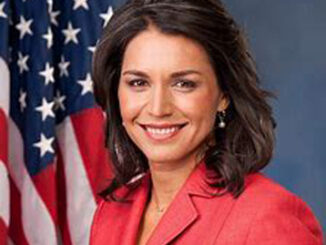
    WASHINGTON, D.C. (TIP): Tulsi Gabbard, President-elect Donald Trump’s pick to be director of national intelligence, has met key Senators at Capitol Hill and supported the Republican leader’s view on Syria amid the sudden fall of the country’s Assad rule. Hindu-American Gabbard, 43, who represented Hawaii in the House for eight years as a Democrat, met with Senators on Monday, December 9.

    “I stand in full support and wholeheartedly agree with the statements that President Trump has made over these last few days regarding the developments in Syria,” Gabbard, 43, told reporters at Capitol Hill where she met top US Senators on her nomination.

    Gabbard has faced skepticism from national security experts and lawmakers about her views on the Syrian regime, and she is likely to encounter questions during the confirmation process about her 2017 trip to Syria, where she met with then-President Bashar Assad who was ousted by rebel factions over the weekend, ending his nearly quarter-century rule, the Washington Post reported.

    President-elect Trump picked Gabbard, who left the Democratic Party in 2022, to be his director of national intelligence, a position with access to highly classified intelligence who oversees 18 spy agencies.

    She met with Republican Sens. Mike Rounds (South Dakota), James Lankford (Oklahoma) and Lindsey Graham (South Carolina). She also met with Sen. Joni Ernst (R-Iowa), according to a post on X in which she described Gabbard as a “strong and proven leader.” Ernst told reporters she anticipates meeting with her again.

    “Wonderful catching up with Tulsi Gabbard, a strong and proven leader!” Senator Ernst said after the meeting.

    “It was great to see you, my friend. Thank you for your support!” Gabbard said.
    If confirmed by the US Senate, Gabbard would be the first-ever Hindu American to head the powerful body in charge of US’ all intelligence agencies, including the CIA and FBI.

    “Good to sit down with Tulsi Gabbard, President Trump’s nominee to be the Director of National Intelligence. As a member of the Senate Select Committee on Intelligence, I am looking forward to working with her as she continues to move through the confirmation process. Excellent first meeting,” said Senator Rounds.

    “It was great to see you, Senator Rounds. Thank you for your time and the conversation today,” Gabbard said.

    In recent days, Gabbard has been praised by several other Senators.
    “Congratulations to Tulsi Gabbard on her nomination as Director of National Intelligence. Her military service and dedication to our constitutional rights make her a strong choice for this critical role. Wishing her success in leading our intelligence community,” Senator Rand Paul said.

    “LTC Tulsi Gabbard, a 20-year veteran of the US Army, is a true patriot. Tulsi has my complete support to be the next Director of National Intelligence. I’m proud to call her my friend,” said Senator Markwayne Mullin.

    Senator Lindsey Graham said he has known Congresswoman Tulsi Gabbard for many years, serving in the same Capitol Hill reserve unit.

    “While we have differences on foreign policy, I think she’s extremely bright and capable. It is a great compliment to Tulsi that President Trump wants her to be his Director of National Intelligence,” he said.

    “In this position, she will see up close the dangers we face as a nation from multiple sources. I look forward to working with her to keep America not only great but also safe,” Graham said.

    “This is a reformer who can come in, who maybe is not a part of the same Washington cocktail party circuit that people in the intel community are used to, but maybe that’s exactly what we need right now… I’m a yes on Tulsi Gabbard — absolutely,” Senator Eric Schmitt said.

    “What Tulsi Gabbard represents is a broad tent that Trump has put in place … He’s bringing Tulsi into his cabinet to achieve a specific purpose, and I look forward to supporting that,” said Senator Bill Hagerty.

    Gabbard — a Lieutenant Colonel in the US Army Reserve who saw three deployments — represented Hawaii in Congress for eight years, including as a member of the Armed Services, Homeland Security, and Foreign Affairs Committees.
    She was also co-chair of the Congressional India Caucus.
    Once a rising Democratic star, Gabbard, who represented Hawaii in Congress, arrived a decade ago in Washington, her surfboard in tow, a new generation of potential leaders. She ran unsuccessfully for president in 2020.

    The Office of the Director of National Intelligence was created after September 11, 2001, attacks to coordinate the nation’s intelligence agencies and act as the president’s main intelligence adviser.

    Gabbard met with Assad twice during the 2017 trip and was later criticized when she refused to call the brutal leader an enemy of the United States, explaining at the time that he was not one since “Syria does not pose a direct threat to the United States,” the Post reported.

    Proud of her Hindu religion, Gabbard is not Indian or of Indian heritage. She was born in 1981 in Leloaloa, American Samoa, the fourth of five children born to a Hindu mother and a Christian (Catholic) father.

    In 2018, Gabbard from Hawaii created history by not only becoming the first Hindu ever to be sworn in as a member of the US House of Representatives, but also being the first ever US lawmaker to have taken oath of office on the sacred Bhagavad Gita.

    Gabbard’s spiritual lineage is the Brahma Madhva Gaudiya Sampradaya. She is a disciple of Jagad Guru Siddhaswarupananda Paramahamsa who is disciple of AC Bhaktivedanta Swami.

    Jagad Guru Siddhaswarupananda Paramahamsa is a co-founder of the World Vaishnava Association, an umbrella organization of over 30 India-based and world-wide missions adhering to and promoting Vaishnava teachings.


  • FBI Director Christopher Wray, FBI Director since 2017, to Resign

    FBI Director Christopher Wray, FBI Director since 2017, to Resign

    WASHINGTON, D.C. (TIP): FBI Director Christopher Wray is going to resign soon, the bureau said on Dec. 11, paving the way for President-elect Donald Trump’s next nominee for the position.

    Wray, 57, told FBI employees during a town hall that he will step down when the current administration ends in January 2025, an FBI spokesperson told The Epoch Times in an email.

    “After weeks of careful thought, I’ve decided the right thing for the Bureau is for me to serve until the end of the current administration in January and then step down,” Wray told the employees.

    Story continues below advertisement

    “My goal is to keep the focus on our mission—the indispensable work you’re doing on behalf of the American people every day. In my view, this is the best way to avoid dragging the Bureau deeper into the fray, while reinforcing the values and principles that are so important to how we do our work.”

    Wray is currently serving a 10-year term that started in 2017. Trump nominated Wray during his first term in office. President Joe Biden opted to keep Wray in place during his term.

    Related Stories
    Sen. Cornyn Confident Kash Patel Will Become Next FBI Director
    12/7/2024
    Sen. Cornyn Confident Kash Patel Will Become Next FBI Director
    FBI Offers $50,000 Reward for Information on UnitedHealthcare CEO’s Killer
    12/7/2024
    FBI Offers $50,000 Reward for Information on UnitedHealthcare CEO’s Killer
    Trump has nominated Kash Patel, a former federal prosecutor, to be FBI director once he enters office again on Jan. 20, 2025.

    FBI directors require Senate confirmation.

    Trump celebrated Wray’s decision to resign, saying it will end what he described as the weaponization of the Justice Department. “We want our FBI back, and that will now happen,” Trump said in a post on his Truth Social platform, while calling for Patel’s confirmation.
    Patel also responded to the news, telling reporters on Capitol Hill, “We look forward to a very smooth transition at the FBI and I’ll be ready to go on day one.”
    Patel, 44, worked as a public defender after graduating from law school. In 2014, he transitioned into a federal prosecutor role.

    During Trump’s first term, Patel helped the U.S. House of Representatives Intelligence Committee to compile evidence showing that the FBI did not act properly when it investigated former Trump campaign aide Carter Page. Special counsel John Durham later found that FBI agents were motivated by confirmation bias in the probe, which did not establish coordination between the campaign and Russia.

    Patel later worked for the White House National Security Council. In 2020, he worked in the Office of the Director of National Intelligence. And during the final months of Trump’s first term, he was the chief of staff to acting Secretary of Defense Christopher Miller.

    Trump said when announcing his choice to lead the FBI, “Kash will work under our great Attorney General, Pam Bondi, to bring back Fidelity, Bravery, and Integrity to the FBI.”
    Patel told The Epoch Times after being selected, “We will restore integrity, accountability, and equal justice to our justice system and return the FBI to its rightful mission: protecting the American people.”
    Story continues below advertisement

    Wray clerked for a federal judge after graduating from Yale Law School. He went on to serve as a federal prosecutor before being appointed to head the U.S. Department of Justice’s Criminal Division under President George W. Bush.

    The FBI in 2022 executed a search warrant on Trump’s home in Florida, in one of two federal cases brought against the former president. Trump said he did nothing wrong. Prosecutors closed the cases after Trump won the November election. Trump and many other Republicans have repeatedly criticized the FBI, alleging that its actions have been fueled by partisanship. Wray told a House panel in 2023 that he has been a Republican his whole life and has not acted with bias.

    “The idea that I am biased against conservatives seems somewhat insane to me, given my own personal background,” he said at the time.

    (Source: Reuters )

  • United States on the Way to Becoming an Oligarchic State

    United States on the Way to Becoming an Oligarchic State

    By Prof. Indrajit S Saluja
    By Prof. Indrajit S Saluja

    Over the past several decades, there has been growing concern among political analysts, economists, and the public at large about the shifting dynamics of governance in the United States. The country, long heralded as the bastion of democracy, appears to be transitioning into an oligarchic state – nation where power is concentrated in the hands of a wealthy few. This transformation is being driven by the intertwining of economic and political power, with billionaire businessmen exercising unprecedented control over both spheres.

    The United States has witnessed a dramatic rise in economic inequality. According to a 2023 report by Oxfam, the top 1% of Americans now control approximately 34% of the nation’s wealth, while the bottom 50% collectively own just 2.5%. Billionaires like Elon Musk, Jeff Bezos, and Warren Buffett not only dominate the economy but also exert considerable influence over public policy. Their vast financial resources enable them to lobby for legislation that protects their interests, often at the expense of the broader public.

    One illustrative example is the 2017 Tax Cuts and Jobs Act, which significantly reduced corporate tax rates from 35% to 21%. While proponents argued that these cuts would stimulate economic growth, the primary beneficiaries were large corporations and the ultra-wealthy. An analysis by the Institute on Taxation and Economic Policy found that the richest 5% of Americans reaped the bulk of the benefits, while middle- and low-income households saw minimal relief.

    Moreover, the wealth of billionaires has skyrocketed during times of crisis. During the COVID-19 pandemic, U.S. billionaires saw their collective wealth increase by over $1 trillion between March 2020 and March 2021, even as millions of Americans lost their jobs and struggled to make ends meet. This stark contrast underscores the growing chasm between the economic elite and the rest of the population.

    The influence of billionaires is not limited to the economic realm; it has increasingly permeated the political landscape. Billionaire-backed super PACs (political action committees) and dark money groups have become critical players in elections, effectively allowing the ultra-wealthy to shape political outcomes. The 2010 Citizens United v. FEC Supreme Court decision, which allowed unlimited corporate and individual spending in elections, has further entrenched this power dynamic.

    For instance, in the 2020 election cycle, billionaire Sheldon Adelson and his wife Miriam contributed over $218 million to Republican candidates and causes. On the Democratic side, Michael Bloomberg spent nearly $1 billion of his own fortune on his presidential campaign and to support Democratic candidates. This trend raises questions about whether elected officials are accountable to their constituents or to the deep-pocketed donors who fund their campaigns.

    The revolving door between business and government further blurs the line between public service and private interests. High-ranking officials often transition seamlessly between corporate boardrooms and government offices, ensuring that policies remain favorable to the business elite. The appointment of former Goldman Sachs executives to key positions in government during multiple administrations exemplifies this phenomenon.The recent actions of the president-elect have amplified concerns about the United States’ drift toward oligarchy. By signaling a preference for appointing family members, friends, and loyalists to high-ranking government positions, the president-elect appears to prioritize personal loyalty over merit and public service.

    One controversial example is the nomination of a relative as an ambassador, raising questions about the qualifications and motivations behind such appointments. Similarly, the nomination of the president-elect’s son’s girlfriend to another ambassadorship has drawn widespread criticism. These actions are reminiscent of oligarchic governance, where power is concentrated within a small, interconnected group, rather than being distributed based on democratic principles.

    The potential consequences of such appointments are far-reaching. They risk undermining public trust in institutions, fostering cronyism, and diminishing the effectiveness of governance. When key positions are filled based on loyalty rather than expertise, the government’s ability to address complex challenges and serve the public interest is compromised.

    The United States’ trajectory toward oligarchy is not without precedent. The Gilded Age of the late 19th and early 20th centuries was characterized by extreme wealth concentration and the outsized influence of industrial magnates like John D. Rockefeller, Andrew Carnegie, and J.P. Morgan. These “robber barons” wielded immense economic and political power, often at the expense of workers and consumers.

    However, the Progressive Era that followed brought significant reforms, including antitrust laws, labor protections, and campaign finance regulations, aimed at curbing the excesses of oligarchy. These measures helped restore a degree of balance to the American political and economic systems.

    Today, many of these safeguards have been eroded or rendered ineffective. The weakening of campaign finance laws, the rollback of antitrust enforcement, and the decline of labor unions have all contributed to the resurgence of oligarchic tendencies. As a result, the United States risks repeating the mistakes of the past.

    The United States is not alone in grappling with the challenges of oligarchic influence. Countries like Russia and China are often cited as modern examples of oligarchies, where economic elites wield significant control over political decision-making. In Russia, for instance, a small group of oligarchs has benefited from close ties to the Kremlin, while in China, the Communist Party maintains tight control over both the economy and political apparatus.

    However, what sets the United States apart is its historical commitment to democratic ideals and its reputation as a global leader in promoting democracy. The erosion of these principles risks undermining the country’s moral authority and standing on the world stage.

    To prevent the United States from becoming a full-fledged oligarchy, urgent action is needed to restore the balance of power. Several key reforms could help address the underlying issues:

    Campaign Finance Reform: Reversing the Citizens United decision and implementing stricter limits on campaign contributions would reduce the influence of money in politics.

    Antitrust Enforcement: Strengthening antitrust laws and breaking up monopolies would curb the economic power of large corporations and promote competition.

    Tax Reform: Implementing a more progressive tax system and closing loopholes that benefit the ultra-wealthy would help reduce economic inequality.

    Strengthening Labor Protections: Reinvigorating labor unions and ensuring fair wages and working conditions would empower workers and reduce disparities.

    Ethics and Transparency: Enforcing stricter ethics rules and increasing transparency in government appointments would help rebuild public trust in institutions.

    The United States stands at a crossroads. The concentration of economic and political power in the hands of a wealthy few threatens to undermine the democratic principles upon which the nation was founded. While the challenges are formidable, history offers hope that meaningful reform is possible. By addressing the root causes of oligarchic influence, the United States can reaffirm its commitment to democracy and ensure that power truly resides with the people.

    (Prof. Indrajit S Saluja is editor, The Indian Panorama)

  • Trump’s mocking of Justin Trudeau spurs an animated debate about the future of US-Canada relations

    Trump’s mocking of Justin Trudeau spurs an animated debate about the future of US-Canada relations

    By Prabhjot Singh

    TORONTO (TIP): Continuous mocking by US President-Elect Donald Trump of Canadian Prime Minister Justin Trudeau has set in motion an animated debate over the future of US-Canada relations.

    Since the last week of November when Donald Trump joked for the first time to suggest in a lighter vein at a dinner meeting he held with Justin Trudeau that why not Canada become the 51st State, he has repeated his joke several times, the last of which was revealed through his December 10 on his Truth Social Platform.

    Politicians and social scientists are wondering at the intent of his continuous “mocking”.

    “It was a pleasure to have dinner the other night with Governor Justin Trudeau of the Great State of Canada,” said Donald Trump in his December 10 post on his Truth Social platform. He went on to add that “he is looking forward to seeing the ‘Governor’ again to continue their in-depth discussion about tariffs and trade. “The results of which will be truly spectacular for all!” added the U.S. President-elect.

    Donald Trump had in a subsequent Meet the Press programme organised by a major media channel on December 8 said “If we’re going to subsidize them, let them become a state [of the U.S.],” while jokingly threatening that the U.S. should stop “subsidizing” Canada. His repeated comments have evoked mixed reactions from Canadian politicians and social scientists.

    The latest post describing Justin Trudeau as a “governor” went public hours after Justin Trudeau spoke at a Halifax Chamber of Commerce event. Justin Trudeau was quoted as saying that Canada would retaliate against the 25 per cent tariffs threatened by Trump.

    It was Donald Trump who set the ball rolling with his Truth Social post on November 25 declaring his intent to impose tariffs on Canada and Mexico if they refuse to tighten their border security. Donald Trump was referring to large-scale infiltration into the US of “illegal aliens” from both Canada and Mexico besides the smuggling of drugs, including Fentanyl. Though the Canadian Prime Minister maintained that smuggling of both illegal immigrants and Fentanyl from Canada was inconsequential compared to the figures of Mexico and promised to strengthen the borders to effectively control the smuggling, the US President-elect mocked him.

    After his November 25 announcement threatening to impose a 25 per cent duty on all imports from Canada and Mexico, Justin Trudeau accompanied by a delegation, including a member of his Cabinet, flew to Florida to meet him at his private Mar-a-Lago club to discuss trade and border security. This is when Trump reportedly joked for the first time about Trudeau becoming the governor of a 51st U.S. state if the Canadian economy cannot survive despite its trade surplus with the United States.

    “Let us not kid ourselves in any way, shape or form: 25% tariffs on everything going to the United States would be devastating for the Canadian economy,” Trudeau said. He added that Canada will “respond to unfair tariffs in several ways, and we’re still looking at the right ways to respond, but our responses to the unfair steel and aluminium tariffs were what ended up lifting those tariffs last time.”

    After the recent post, some members of the Liberal caucus, including Cabinet ministers, were questioned by the media about the continuous tirade, though jokingly, launched by Donald Trump.

    “I am so proud of our country. I am so proud of the true north, strong and free,” said Deputy Prime Minister Chrystia Freeland during a press conference in Ottawa. “I also want to say to Canadians that our government is determined to defend the national interest.”

    Freeland would not comment on whether she takes Trump seriously on comments of making Canada a U.S. state. “That is a question really for the president-elect,” she said.

    Another Cabinet Minister to comment on the recent developments was Transport Minister and President of the Treasury Board, Anita Anand.

    While talking to media persons, she said “We have to continue to remember that Canada is a sovereign country.” Truth Social should not be used as a source for public policy, remarked Immigration Minister, Marc Miller.

    Health Minister Mark Holland said, “We cannot react to everything, we need to focus on being mature as a country and taking responsibility for the things for which we have control.”
    (Prabhjot Singh is a Toronto, Canada-based senior journalist. He can be reached at prabhjot416@gmail.com)

  • Trump nominates Indian American Kash Patel as FBI Director

    Trump nominates Indian American Kash Patel as FBI Director

    WASHINGTON, D.C. (TIP): President-elect Donald Trump on Saturday, November 30, nominated close confidante Kash Patel for the powerful position of Director of the Federal Bureau of Investigation, making him the highest ranking Indian American in his incoming administration.

    I am proud to announce that Kashyap ‘Kash’ Patel will serve as the next Director of the Federal Bureau of Investigation. Kash is a brilliant lawyer, investigator, and ‘America First’ fighter who has spent his career exposing corruption, defending Justice, and protecting the American People, Trump announced on Truth Social, a social media platform he owns. Trump said Patel played a pivotal role in uncovering “the Russia, Russia, Russia Hoax,” standing as an advocate for truth, accountability, and the Constitution. Patel, 44, served as chief of staff to the Acting United States Secretary of Defense in the last few weeks of the Trump Administration in 2017.

    Kash did an incredible job during my First Term, where he served as Chief of Staff at the Department of Defense, Deputy Director of National Intelligence, and Senior Director for Counterterrorism at the National Security Council. Kash has also tried over 60 jury trials, he said.

    This FBI will end the growing crime epidemic in America, dismantle the migrant criminal gangs, and stop the evil scourge of human and drug trafficking across the Border. Kash will work under our great Attorney General, Pam Bondi, to bring back Fidelity, Bravery, and Integrity to the FBI, Trump said. New York-born Patel has his roots in Gujarat. However, his parents are from East Africa -mother from Tanzania and father from Uganda. They came to the US from Canada in 1970. We are Gujarati, he had told PTI in an earlier interview.

    The family moved to Queens in New York often called as Little India — in the late 70s. It is here that Patel was born and grew. Patel’s parents are retired now and spend their time in both the US and Gujarat. After his schooling in New York and college in Richmond, Virginia, and law school in New York, Patel went to Florida where he was a state public defender for four years and then federal public defender for another four years.

    So, lots of trials, lots of international investigations, lots of time in court, understanding the federal system and trying cases and learning how to run investigations, he said. From Florida he moved to Washington DC as a terrorism prosecutor at the Department of Justice. Here he was an international terrorism prosecutor for about three and a half years. During this period, he worked on cases all over the world, in America in East Africa as well as in Uganda and Kenya.

    While, still employed by the Department of Justice, he went as a civilian to join Special Operations Command at the Department of Defense. At the Pentagon, he sat as the Department of Justice’s lawyer with Special Forces people and worked interagency collaborative targeting operations around the world. After a year in the position, Congressman Davin Nunes, Chairman of the House Permanent Select on Intelligence Committee, pulled him as senior counsel on counterterrorism. After April 2017, he spearheaded the Russia investigation of the House Intelligence Committee. It was here where he attracted media attention and played a key role in drafting a GOP memo, which, according to then-President Donald trump, exposed the role of Democratic party and its leadership in the Russian investigation. The New York Times described this as a Kash Memo. Patel said that this was a great team effort.

    Patel is an Ice hockey fan and has been playing the sport since he was six. I still play and I spend a lot of time volunteering coaching youth hockey in the area.

    Patel, who attended both the Houston and Ahmedabad rallies of Trump and Prime Minister Narendra Modi in September 2019 and February 2020, had earlier told PTI that the bilateral relationship had deteriorated under the Biden Administration.

    President Trump and Prime Minister Modi had an extraordinary relationship with respect. And they were working together to counteract the things like Chinese aggression, not just on the Indian border but on the global stage. They were also working together to counteract things in Pakistan when it came to counterterrorism matters and hostage situations, Patel said.

    The two leaders knew that not only the strong relationship but also allowing the economies of scale to be built in India and America were mutually beneficial, Patel said. Last fall he wrote the book ‘Government Gangster’ which argued that there is a severe lack of accountability. The book talks about the deep state and is highly critical of the US bureaucracy, which he claims is highly infiltrated or dominated by lawbreakers. Responding to a question, Patel then told PTI that the Biden Administration and the deep state are interwoven.

    “The Biden administration is filled by these corrupt government gangsters who I list in the back of my book by name and title. It’s not a Democrat or Republican thing. It’s an apolitical thing that these individuals, whether they’re Trump appointees like Christopher W Ray or Biden appointees like Merrick Garland, they are led to this two-tier system of justice where they weaponize government and intelligence and law enforcement to target either conservatives or Trump supporters or call people on January 6th, domestic terrorists,” he said.
    (Source: PTI)

  • Mexico to stop flow of illegal immigrants into US, says Trump

    Mexico to stop flow of illegal immigrants into US, says Trump

    WASHINGTON, D.C. (TIP): US President-elect Donald Trump on Thursday, November 28, said Mexico has agreed to immediately stop illegal immigrants from going to its border with the United States. This comes days after Trump threatened to impose a 25 per cent tariff on all imports from Mexico and Canada for their inability to stop the flow of illegal immigrants into the United States.

    In a post on his Truth Social platform, Trump said he spoke to Mexican President Claudia Sheinbaum Pardo on the phone and the two had a productive conversation.

    “Mexico will stop people from going to our Southern Border, effective immediately. THIS WILL GO A LONG WAY TOWARD STOPPING THE ILLEGAL INVASION OF THE USA. Thank you,” Trump said in his post.

    “Just had a wonderful conversation with the new President of Mexico, Claudia Sheinbaum Pardo. She has agreed to stop Migration through Mexico, and into the United States, effectively closing our Southern Border,” he said.

    Trump said the two also talked about what could be done to stop the drug inflow into the United States and the consumption of these drugs. “It was a very productive conversation,” he added.

    In a series of posts on his Truth Social platform on Monday, Trump said he would sign executive orders imposing a 25 tariff on imports from Canada and Mexico as one of his first actions after assuming office on January 20.

    “As everyone is aware, thousands of people are pouring through Mexico and Canada, bringing Crime and Drugs at levels never seen before. Right now, a Caravan coming from Mexico, composed of thousands of people, seems to be unstoppable in its quest to come through our currently Open Border,” Trump said.

    “This Tariff will remain in effect until such time as Drugs, in particular Fentanyl, and all Illegal Aliens stop this Invasion of our Country! Both Mexico and Canada have the absolute right and power to easily solve this long simmering problem,” he said. On Thursday, the president-elect said he will be working on an advertising campaign to tell people how bad Fentanyl is.

    “Millions of lives being so needlessly destroyed. By the time the campaign is over, everyone will know how really bad the horror of this drug is,” he said.

  • Donald Trump to impose tariffs on imports from Canada, Mexico, China

    Donald Trump to impose tariffs on imports from Canada, Mexico, China

    WASHINGTON, D.C. (TIP): US President-elect Donald Trump has said he will impose a 25 per cent tariff on all products coming from Canada and Mexico, and 10 per cent on Chinese goods to check the flow of illegal immigrants and drugs into the United States.

    In a series of posts on his Truth Social platform on Monday, he said he would sign executive orders imposing tariffs on the three countries as one of his first actions after assuming office on January 20. “As everyone is aware, thousands of people are pouring through Mexico and Canada, bringing Crime and Drugs at levels never seen before. Right now, a Caravan coming from Mexico, composed of thousands of people, seems to be unstoppable in its quest to come through our currently Open Border,” Trump said.

    “On January 20th, as one of my many first Executive Orders, I will sign all necessary documents to charge Mexico and Canada a 25% Tariff on ALL products coming into the United States, and its ridiculous Open Borders.

    “This Tariff will remain in effect until such time as Drugs, in particular Fentanyl, and all Illegal Aliens stop this Invasion of our Country! Both Mexico and Canada have the absolute right and power to easily solve this long simmering problem,” he said.

    “We hereby demand that they use this power, and until such time that they do, it is time for them to pay a very big price,” Trump said. Further, the president-elect accused China of failing to stop the flow of drugs into the US.

    “I have had many talks with China about the massive amounts of drugs, in particular Fentanyl, being sent into the United States – But to no avail,” Trump said.

    “Representatives of China told me that they would institute their maximum penalty, that of death, for any drug dealers caught doing this but, unfortunately, they never followed through, and drugs are pouring into our Country, mostly through Mexico, at levels never seen before,” he alleged.

    “Until such time as they stop, we will be charging China an additional 10% Tariff, above any additional Tariffs, on all of their many products coming into the United States of America,” he added. Trump said the executive order to this effect would be signed on the first day of his presidency on January 20, 2025.

  • Trump won’t guarantee a US-Israel honeymoon

    Trump won’t guarantee a US-Israel honeymoon

    The re-election of Donald Trump does not guarantee a new US-Israel honeymoon

    Trump’s long-held dream has been to be accepted as a peacemaker who excels in cutting deals, including bringing an end to the historic conflict between Jews and Arabs. If that results in his winning the Nobel Peace Prize, he may be prepared to force Israel to make relevant compromises, such as agreeing to the establishment of an independent Palestinian state.

    By Shyam Bhatia

    Israelis may be delighted with the departure of the Biden administration in the United States, but the re-election of Donald Trump does not guarantee a new US-Israel honeymoon.

    Despite the widely publicized pictures of Biden hugging Israeli Prime Minister Benjamin Netanyahu in the wake of the October 7 Hamas attack on Israel, the underlying bilateral tensions were never far from the surface.

    Washington’s pressure on Netanyahu started to intensify as casualties mounted in Gaza and a humanitarian crisis emerged with the killings of thousands of Palestinian civilians. In the weeks leading up to the US presidential election, the crisis between Washington DC and Jerusalem reached a new climax with President Joe Biden reportedly telling Netanyahu “stop bull-shitting me.”

    By all accounts, the frustrated Americans additionally suspended some deliveries of bunker-busting bombs that they believed would increase civilian casualties. So, it was hardly surprising to hear the sighs of relief from the Israeli Prime Minister’s office when the results of the US presidential election started rolling in.

    The humiliating defeat suffered by Biden’s vice-president and chosen successor Kamala Harris generated a euphoria, both within Israel’s far right cabinet and among many Israeli Jewish civilians. What Israelis now hope for is a return to the golden era of the first Trump administration when the US undertook a number of measures that were seen as a full endorsement of the Israeli far right’s ideology.

    These measures included the relocation of the US embassy from Tel Aviv to Jerusalem, the recognition of Jerusalem as the undivided capital of Israel and the further recognition of the Golan Heights — previously Syrian territory — as an integral part of Israel. Contrary to UN resolutions and international law, the Americans, under Trump, also ruled that Israeli settlements in the occupied West Bank were entirely legitimate. US officials even went as far as cutting off all financial aid to the United Nations Relief and Works Agency (UNRWA), which for the past seven decades has been providing vital food, medical and educational services to millions of Palestinian families.

    These policies embraced by Trump allowed him to boast how he was the most pro-Israeli US President in history. Yet, despite his pro-Israel record, which also enraged the Palestinians and other Arabs, it turns out that the vast majority of American Jews opted to vote for his rival Kamala Harris. Most American Jews are known to be traditionally more sympathetic to the Democrats and they expressed their support at the ballot box.

    Among the reasons for their distaste of Trump were media portrayals of the incoming president as a supporter of dictators, including Adolph Hitler, and his alleged hostility towards illegal immigrants who were denounced by him and his supporters as “rapists”, “murderers” and “criminals” who reveled in eating domestic pets like cats and dogs.

    Back in 2020, when Trump lost the election to Joe Biden, the defeated US President was outraged by an “ungrateful” Netanyahu who rushed to congratulate his Democrat rival. Soon afterwards, in a recorded interview with Israeli journalist Barak Ravid, when asked about Netanyahu, Trump responded: “f*** him.”

    Trump’s profile suggests he is a man who harbors grudges against those perceived to be disloyal. So, whether he can now forgive and forget Netanyahu’s past actions, remains to be seen.

    Since Trump’s recent victory was confirmed, Netanyahu was among the first world leaders to offer his congratulations and he has made at least three subsequent telephone calls to the President-elect. These telephone calls reflect the deep concern in Netanyahu’s office that Trump will no longer be the pushover he once was.

    Statements made by Trump in the immediate aftermath of the presidential election have added to the concern of Israeli officials. His declaration that the US is committed to ending conflicts, not prolonging them, has aroused fears that the new US administration will follow the same line as the Biden administration by demanding an immediate cessation of hostilities in West Asia, including the Israeli-led wars in Gaza and Lebanon.

    Israeli officials are also worried by the influence of a new member of the wider Trump family who happens to be a Lebanese Christian. Massad Boulos, father-in-law of Trump’s daughter Tiffany, is believed to have convinced many Arab voters in the US to cast their lot with Trump. Inevitably, Trump now feels indebted to this new block of Arab political supporters who are extremely critical of what they see as Washington’s blind support for Israel.

    In Jerusalem’s multiple think tanks, the talk is all about how it would be a mistake to take Trump for granted in his second and final term in office. This argument goes that the new US administration has excellent ties with the Saudis and Gulf governments and will be more susceptible than before to pressure Israel.

    Trump’s long-held dream has been to be accepted as a peacemaker who excels in cutting deals, including bringing an end to the historic conflict between Jews and Arabs. If that results in his winning the Nobel Peace Prize, he may be prepared to force Israel to make relevant compromises, such as agreeing to the establishment of an independent Palestinian state.

    This is just the kind of policy shift that Trump’s Arab allies are also demanding. First and foremost are the Saudis who say that they are ready to make peace with Israel in return for recognition of a Palestinian state. The Arabs argue that allowing a Palestinian state would undercut Iran’s attempts to dominate the region and isolate the Ayatollahs in Tehran as they move closer to acquiring nuclear weapons capability.

    Fear of Iran’s nuclear ambitions has long been shared by Israelis of all political persuasions. They remember how Biden stopped Israel from bombing Iran’s nuclear and oil facilities. Will Trump do the same?
    (Shyam Bhatia is an Indian-born British journalist, writer and war reporter based in London)

  • Needed a humane and pragmatic approach to immigration reform, not mass deportations

    In my editorial last week, I argued that Donald Trump, the 45th President of the United States, has a unique opportunity to bridge divisions both at home and abroad, carving out a legacy rooted in unity and peace. Today, I see an even brighter prospect for him to achieve these goals. With the Republican Party now in control of both the Senate and the House of Representatives, President Trump enjoys a rare political alignment that allows him to address pressing national issues with efficiency and resolve. Among the most urgent and impactful of these challenges is the fate of approximately 20 million immigrants living in the United States, many of whom remain undocumented.

    This issue, fraught with complexity and emotion, offers President Trump a chance to demonstrate statesmanship and compassion. Power, after all, is not merely the ability to enforce policies but also the responsibility to heal wounds and build a more inclusive and harmonious society. In addressing immigration reform, Trump has the opportunity to honor America’s proud tradition as a land of immigrants and leave a legacy that will be remembered not for division, but for unity.

    President Trump himself is a descendant of immigrants. His grandfather, Friedrich Trump, emigrated from Germany in the late 19th century, seeking opportunities in the United States. Like millions of others, the Trumps became part of the American fabric, contributing to its growth and prosperity. This shared immigrant heritage should serve as a reminder of the enduring value that immigrants bring to the nation.

    President Trump has a rare opportunity to resolve this crisis in a way that unites rather than divides. With Republican control of Congress and the Senate, he has the political capital to craft comprehensive immigration reform that balances security with humanity.

    This is not just a political opportunity; it is a moral imperative. History will judge leaders not by the power they wield but by how they use it to uplift others and create a better future. In the words of President Ronald Reagan, often cited by Trump himself: “America is a shining city upon a hill whose beacon light guides freedom-loving people everywhere.” That light shines brightest when America lives up to its ideals of justice, compassion, and opportunity for all.

    President Trump has often spoken of his desire to “Make America Great Again.” True greatness lies not in exclusion but in inclusion, not in building walls but in building bridges. By embracing a humane and pragmatic approach to immigration reform, Trump can leave a legacy that transcends partisanship and inspires generations to come.

  • ‘Will continue to fight for a better future of America’: Kamala Harris

    ‘Will continue to fight for a better future of America’: Kamala Harris

    US Vice President Kamala Harris while addressing supporters at Howard University appeared emotional at her loss, but expressed hope for the betterment of the country. Harris expressed hope and said that the light of the US’s promise would burn bright as long as people kept fighting.

    Kamala Harris is a leading American politician and attorney, who is currently the Vice President of the United States. In her career, she has made history by being the first woman, the first African American, and the first Asian American to hold this office.
    Kamala Harris Early Life and Education
    Kamala Devi Harris was born on October 20, 1964, in Oakland, California. She was born to immigrant parents. Her father, Donald Harris, is a Jamaican economist, and her mother, Shyamala Gopalan Harris, was an Indian cancer researcher. Harris was raised by her mother and sister, Maya, after her parents’ divorce in 1971. The family went to a Baptist church and a Hindu temple, making her incredibly culturally rich, with strong roots in her African American and South Asian heritage.
    Harris attended Howard University in Washington, D.C., where she graduated in 1986 with a Bachelor of Arts degree in political science and economics. In 1989, she graduated from the University of California, Hastings College of the Law, with a law degree.

    Kamala Harris Career
    Harris began her career as a deputy district attorney between 1990 and 1998 in Alameda County, where she is said to have taken a tough stance on crime. In 2003, she became San Francisco’s first female and African American District Attorney. During her tenure, she introduced progressive reforms to reduce recidivism and provide an opportunity for rehabilitation.
    In 2010, Kamala Harris was elected the first woman and the first person of colour to ever serve as Attorney General of California. In 2014, she won re-election and, focusing on consumer protection, marriage equality, and environmental justice, continued to bring the change she envisioned.
    Political Career
    Kamala Harris’s political ascendency continued as she won a seat in the U.S. Senate from California in 2016. She became the first South Asian American senator and only the second African American woman to ever serve in the Senate.
    Her Senate service included fighting for immigration reform, health care improvement, and criminal justice reform. She made national headlines when she used her sharp questions to expose Trump administration officials during several high-profile hearings.

    Harris declared her candidacy for the Democratic presidential nomination in January 2019 but suspended her bid in December of the same year citing low survey ratings. On August 11, however, she was selected by Joe Biden as his running mate for president. The historic nomination made her the first woman of South Asian and African American descent to be nominated for the major party ticket.
    Kamala Harris Vice Presidency
    During his campaign, Harris and Joe Biden emerged victorious in an election that took place on November 3, 2020. Harris became the U.S. history’s highest-ranking official after being sworn in as vice president on January 20, 2021; her priority issues include helping to spur economic recovery stemming from the COVID-19 pandemic and advocating for and supporting voting rights.
    Kamala Harris Personal Life
    Kamala Harris married Doug Emhoff, an entertainment lawyer, on August 22, 2014. This marriage marked her first and Emhoff’s second; he has two children from his previous marriage, Ella and Cole, who affectionately call Harris “Momala.” The family dynamic is characterized by a strong co-parenting relationship with Emhoff’s ex-wife, Kerstin Emhoff.
    In July 2024, Harris declared her candidacy for the presidency after Biden had withdrawn from the presidential re-election race due to health issues.
    Kamala Harris’s journey symbolizes a commitment to public service as well as breaking the barriers within American politics. Her diverse background coupled with legal expertise has always led her to shape approaches of governance and advocacy in matters of marginalized communities during her life.
    ‘My heart is full today’: Harris
    US Vice President Kamala Harris while addressing supporters at Howard University on November 6 appeared emotional at her loss, but expressed hope for the betterment of the country.
    Harris expressed hope and said that the light of the US’s promise would burn bright as long as people kept fighting.
    “My heart is full today, full of gratitude for the trust you have placed in me, full of love for our country, and full of resolve. The outcome of this election is not what we wanted, not what we fought for, not what we voted for. But hear me when I say, the light of America’s promise will always burn bright as long as we never give up and as long as we keep fighting,” she said.
    Harris thanked her husband, Douglas Emhoff, Second Gentleman of the United States, US President Joe Biden and his family, her running mate Tim Walz and the entire team for their support.
    “To my beloved Doug and our family, I love you so very much. To President Biden and Dr Biden, thank you for your faith and support. To Governor Walz and the Walz family, I know your service to our nation will continue. And to my extraordinary team, to the volunteers who gave so much of themselves, to the poll workers and the local election officials. I thank you all,” she said.
    Choking back her tears, Harris said that she was proud of the way the team ran for the race over the course of the campaign period. She said that the campaign was a reminder of the fact that there was a lot more in common among them than what separated them.
    “I am so proud of the race we ran and the way we ran it. Over the 107 days of this campaign, we have been intentional about building community and building coalitions, bringing people together from every walk of life and background, by the love of country, with enthusiasm and joy in our fight for America’s future. And we did it with the knowledge that we all have so much more in common than what separates us. Now, I know folks are feeling and experiencing a range of emotions right now. I get it. But we must accept the results of this election,” she said.
    Harris added that she spoke to President-elect Donald Trump and congratulated him on his win. She added that what distinguishes a democracy from tyranny or monarchy is to accept the election result.

    Trump’s U.S. election win: How world leaders reacted
    World leaders congratulated Republican Donald Trump on Wednesday after he won the U.S. presidential election, capping a stunning political comeback four years after he left the White House.
    VOLODYMYR ZELENSKIY, PRESIDENT OF UKRAINE
    “I appreciate President Trump’s commitment to the ‘peace through strength’ approach in global affairs. This is exactly the principle that can practically bring just peace in Ukraine closer,” Zelenskiy said on X.

    BENJAMIN NETANYAHU, PRIME MINISTER OF ISRAEL
    “Congratulations on history’s greatest comeback! Your historic return to the White House offers a new beginning for America and a powerful recommitment to the great alliance between Israel and America. This is a huge victory! In true friendship,” Netanyahu wrote on X.
    ANTONIO GUTERRES, U.N. SECRETARY-GENERAL
    “I congratulate President-elect Donald J. Trump and I reaffirm my belief that the cooperation between the United States and the United Nations is an essential pillar of international relations. The United Nations stands ready to work constructively with the incoming administration to address the dramatic challenges our world is facing.”
    NARENDRA MODI, PRIME MINISTER OF INDIA
    “Heartiest congratulations my friend…on your historic election victory. As you build on the successes of your previous term, I look forward to renewing our collaboration to further strengthen the India-US Comprehensive Global and Strategic Partnership. Together, let’s work for the betterment of our people and to promote global peace, stability and prosperity,” Modi said on X.
    EMMANUEL MACRON, PRESIDENT OF FRANCE
    “Congratulations, President Donald Trump. Ready to work together just as we knew how to do during four years. With your convictions and with mine. With respect and ambition. For more peace and prosperity,” Macron wrote on X.
    SHIGERU ISHIBA, PRIME MINISTER OF JAPAN
    “I would like to offer my sincere congratulations on Mr. Trump’s victory, and also pay my respects to the democratic choice of the American people,” he told reporters.”From now on, I would like to work closely with Mr. Trump, who will become the next president, to bring the Japan-U.S. alliance and Japan-U.S. relations to a higher level. We are going to make efforts to quickly establish a point of contact with Mr. Trump in the future.”
    MAO NING, CHINESE FOREIGN MINISTRY SPOKESPERSON
    “Our policy towards the U.S. is consistent. We will continue to view and handle China-U.S. relations in accordance with the principles of mutual respect, peaceful co-existence and win-win cooperation.”
    JUSTIN TRUDEAU, PRIME MINISTER OF CANADA
    “Congratulations to Donald Trump on being elected President of the United States. The friendship between Canada and the U.S. is the envy of the world.
    “I know President Trump and I will work together to create more opportunity, prosperity, and security for both of our nations.”
    TAYYIP ERDOGAN, PRESIDENT OF TURKEY
    “I congratulate my friend Donald Trump, who was elected U.S. President once again after a big fight in the presidential elections in the United States of America. In this new era that will start with the choice of the American people, I hope for Turkish-American ties to strengthen, for regional and global crises and wars, primarily the Palestine issue and the Russia-Ukraine war, to end; I believe more effort will be exerted for a fairer world.”
    OLAF SCHOLZ, GERMAN CHANCELLOR
    “I congratulate Donald Trump on his election as US President. Germany and the U.S. have for a long time successfully worked together to promote prosperity and freedom on both sides of the Atlantic. We will continue to do so for the benefit of our citizens,” he said on X.
    SAUDI ARABIA
    Saudi Arabia’s King Salman and Crown Prince Mohammed bin Salman congratulate Mr. Donald J. Trump on his victory in the presidential elections in the United States of America, the Saudi state news agency posted on X.
    MAHMOUD ABBAS, PRESIDENT OF PALESTINIAN AUTHORITY
    “We will remain steadfast over our commitment to peace, we are confident that the US under your leadership would support the legitimate aspirations of the Palestinian people.”
    KEIR STARMER, BRITISH PRIME MINISTER
    “Congratulations President-elect Trump on your historic election victory. I look forward to working with you in the years ahead. As the closest of allies, we stand shoulder to shoulder in defence of our shared values of freedom, democracy and enterprise.”

    MARK RUTTE, SECRETARY-GENERAL OF NATO
    “I just congratulated Donald Trump on his election as President of the United States. His leadership will again be key to keeping our Alliance strong. I look forward to working with him again to advance peace through strength through NATO”, he said in a post on X.
    LAI CHING-TE, PRESIDENT OF TAIWAN, ON X
    “Sincere congratulations to President-elect @realDonaldTrump on your victory. I’m confident that the longstanding #Taiwan-#US partnership, built on shared values & interests, will continue to serve as a cornerstone for regional stability & lead to greater prosperity for us all.”
    GIORGIA MELONI, PRIME MINISTER OF ITALY
    In a post on X Meloni offered her “most sincere congratulations” to Trump, and said Italy and the United States had an “unshakeable alliance”. “It is a strategic bond, which I am certain we will now strengthen even further,” she said.
    PEDRO SANCHEZ, SPANISH PRIME MINISTER
    “Congratulations @realDonaldTrump on your victory and your election as 47th President of the US. We will work on our strategic bilateral relations and on a strong transatlantic partnership”, Sanchez said on X.
    URSULA VON DER LEYEN, EU COMMISSION PRESIDENT
    “I warmly congratulate Donald J. Trump on his election as the 47th President of the United States of America. I look forward to working with President Trump again to advance a strong transatlantic agenda.
    “Let us work together on a transatlantic partnership that continues to deliver for our citizens. Millions of jobs and billions in trade and investment on each side of the Atlantic depend on the dynamism and stability of our economic relationship.”
    KING ABDULLAH II OF JORDAN
    “Warmest congratulations to President Donald Trump on winning the US presidential election. Looking forward to working with you again to bolster Jordan’s longstanding partnership with the United States, in service of regional and global peace and stability for all.”
    LUIZ INACIO LULA DA SILVA, PRESIDENT OF BRAZIL
    “My congratulations to President Donald Trump on his electoral victory and return to the presidency of the United States. “Democracy is the voice of the people and it must always be respected. The world needs dialogue and joint work to have more peace, development and prosperity. I wish the new government luck and success.”
    CYRIL RAMAPHOSA, PRESIDENT OF SOUTH AFRICA
    “I look forward to continuing the close and mutually beneficial partnership between our two nations across all domains of our cooperation.
    “In the global arena, we look forward to our Presidency of the G20 in 2025, where we will work closely with the US who will succeed us in the G20 Presidency in 2026.”
    PANAMA PRESIDENT JOSE RAUL MULINO
    “I congratulate @realDonaldTrump on his victory in the US presidential election and the people of the United States for strengthening democracy. We will continue to work together on migration, security and international trade.”
    ANTHONY ALBANESE, PRIME MINISTER OF AUSTRALIA
    “The election of the President of the United States is always an important moment for the world, for our region and for Australia.
    “The United States has long played a leadership role in the stability and security of the Indo-Pacific. Australia will strive to strengthen the co-operation between our two nations in the region.”
    FERDINAND MARCOS JR, PRESIDENT OF THE PHILIPPINES
    “President Trump has won, and the American people triumphed, and I congratulate them for their victory in an exercise which showed the world the strength of American values.
    “I have personally met President Trump as a young man, so I know that his robust leadership will result in a better future for all of us.” Source: Reuters

  • Trump 2.0 won’t be more of the same

    Trump 2.0 won’t be more of the same

    The world has changed since his previous tenancy at the White House

    “India, fortunately, has had a good equation with President Trump. Both Prime Minister Narendra Modi and External Affairs Minister S Jaishankar have retained links with people around Trump. However, the Indian leadership should proceed on the premise that Trump 2.0 will, in all probability, be unlike Trump 1.0. The policy areas of interest to India where Trump’s transactionalism and ‘America First’ approach could pose challenges would be trade, immigration and climate change. I am not a great enthusiast of a liberal US visa policy, given that it has contributed to the drain of talent from India. But trade may pose a challenge if some of Trump’s old advisers, especially people like former US Trade Representative Robert Lighthizer, are back in office.”

    Sanjaya Baru

    No election to a public office anywhere in the world attracts as much global attention as that to the office of the President of the United States of America. The US remains the world’s most consequential nation. Its President is the most powerful person in the world, presiding over the biggest economy, the biggest technological and scientific base and the biggest armed forces. It is, however, not yet ready to elect a woman as its President. Donald Trump defeated Hillary Clinton and Kamala Harris despite his misogynistic personality. In politics dominated by race and class, gender took a back seat. Opinion polls once again went off on a tangent.

    It is best that friends like Modi stay home for a while and allow US allies, especially the Europeans, to finish their anxious calls on the White House.

    From Berlin to Tokyo, Moscow to Beijing, Tel Aviv to Tehran and, indeed, New Delhi, every government will closely watch Trump’s selection of his team. This is because even though this is his second term, he has dumped many colleagues from the past and many have deserted him. The world will take a new measure of Trump both because there will be new faces around the President and because the world has changed since his previous tenancy at the White House.

    At home, Trump’s first charge would be to ensure stability and give hope to his less privileged supporters, especially the working class. The US economy is presently chugging along well, with economic growth at over 2 per cent; however, unemployment remains a concern for Trump’s core constituents. How he will balance the greed of his own class of millionaires and billionaires and the need of his low-income and socially and economically depressed supporters remains to be seen.

    Overseas, Trump’s hands will be full resolving conflicts in Europe and West Asia. He has promised to break out of the ‘Washington Consensus’ on economic and foreign policy. He is expected to reach out to Russia’s Vladimir Putin. He may stay the course getting tough with China, imposing high tariffs, but he may also seek a modus vivendi. In West Asia, he is expected to target Iran, perhaps pushing for regime change, but he may also keep Israel’s Benjamin Netanyahu on a short leash.

    Each of these expected actions will have long-term consequences for the US and the world, for Trump has promised to ‘Make America Great Again’ within the next four years. The trillion-dollar question is whether Trump will push for a change in the Constitution to seek a third term in office. At any rate, Trump 2.0 should be expected to be different from Trump 1.0 because age and time are not on his side.

    While Trump could have a lasting impact on how America is governed, the US capacity to fashion a world in its vision and after its preference is increasingly limited. The US will have to work with allies and friends. Both Europe and Japan have been nervous about a Trump presidency. Last time round, Europe had Angela Merkel and Japan had Shinzo Abe. Right now, there is no European or East Asian leader capable of standing up to Trump or reining him in. They will, perhaps, fall in line.

    Whether Putin secures a breather and Volodymyr Zelenskyy is asked to pipe down will depend on how much of a control Trump and his advisers secure on the US ‘deep state’ and the military-industrial complex, the movers and shakers behind the Joe Biden approach to Russia. One should expect, however, that both Putin and Chinese President Xi Jinping will, at least initially, seek to build bridges with the Trump administration. Ironically and counter-intuitively, Trump’s first year in office may be a quieter one globally than Biden’s last year.

    India, fortunately, has had a good equation with President Trump. Both Prime Minister Narendra Modi and External Affairs Minister S Jaishankar have retained links with people around Trump. However, the Indian leadership should proceed on the premise that Trump 2.0 will, in all probability, be unlike Trump 1.0. The policy areas of interest to India where Trump’s transactionalism and ‘America First’ approach could pose challenges would be trade, immigration and climate change. I am not a great enthusiast of a liberal US visa policy, given that it has contributed to the drain of talent from India. But trade may pose a challenge if some of Trump’s old advisers, especially people like former US Trade Representative Robert Lighthizer, are back in office.

    India will continue to keep the US engaged in buying defense equipment and linking up through supply chains to the US. However, the Modi government would be well advised to tread carefully and not get caught in US political crosshairs, as it has done in these past four years. Perhaps the Gurpatwant Singh Pannun case will not go away since it is already in the courts. The ripples from that case will continue to touch Indian shores.

    During Trump 1.0, Shinzo Abe was the first to knock on the doors of the White House, extending a friendly hand, flattering an egomaniac and selling ideas like Quad that benefited India. Abe was a statesman and a friend of India. His successors have been mere politicians, that too beleaguered ones and not too India-friendly. Trump may be friendly towards India, but this country is unlikely to be his immediate priority. It is best that friends like Modi stay home for a while and allow US allies, especially the Europeans, to finish their anxious calls on the White House.

    Trump has declared that he is returning to the White House because God has saved him. Political leaders who view themselves as ‘chosen by God and Destiny’ often do more harm than good. It is best to let them calm down and get their hands dirty before being too eager to demonstrate one’s friendship. 

    (Sanjaya Baru is a political commentator and policy analyst. He is Distinguished Fellow at United Service Institution of India, New Delhi)


  • The Right-Wing Surge: Analyzing the Republican Triumph Over Democrats in the U.S. Presidential Election

    The Right-Wing Surge: Analyzing the Republican Triumph Over Democrats in the U.S. Presidential Election

    In this election, Trump’s victory can be seen as not merely a political win but a cultural one. His “America First” rhetoric, promise to protect religious liberties, and stance on issues like abortion and LGBTQ rights resonate strongly with the conservative Christian base. Additionally, his direct style and willingness to challenge established norms appeal to those who feel sidelined by the mainstream political establishment.

    By Prof. Indrajit S Saluja
    By Prof. Indrajit S Saluja

    The recent U.S. presidential election delivered an unexpected blow to the Democratic Party, with the Republicans securing a sweeping victory. Not only did they reclaim the presidency, but they also seized the Senate majority, consolidating power across branches and sending a shockwave through Democratic ranks. Many observers and Democrats alike are asking: how did this happen? While the incumbency factor might provide a surface-level explanation, as Trump’s loss to Biden previously demonstrated, the roots of this seismic shift go far deeper. Beyond simple cycles of political turnover, this victory signifies a profound shift towards right-wing ideology that is resonating globally.

    The Incumbency Cycle: An Incomplete Explanation

    On the surface, it’s easy to attribute this electoral result to the incumbency cycle. Since recent elections have shown a pattern where candidates challenging the incumbent party have a slight advantage, it seems plausible that the pendulum was bound to swing back to the Republicans. Trump’s previous loss to Biden and Hillary Clinton’s loss to Trump were often chalked up to this natural ebb and flow in American politics. However, viewing the result merely as an example of political rotation overlooks the deeper forces at play that have increasingly driven voters toward right-wing policies.

    The Rise of Right-Wing Ideologies: A Global Phenomenon

    To fully understand this shift, it’s essential to place it within a broader global trend. The rise of right-wing ideologies, often deeply intertwined with religious and nationalist values, has been gaining momentum across continents. This trend is not unique to the United States. Across Europe, the Middle East, and Asia, there has been a notable surge in right-wing movements, fueled by economic anxiety, a backlash against liberal values, and a growing preference for policies rooted in faith and tradition.

    Europe: In countries such as Hungary, Poland, and Italy, nationalist and conservative parties have gained traction by appealing to a sense of traditional values and resisting what they perceive as the encroachment of liberal, globalist ideals. Parties advocating stricter immigration policies, emphasizing Christian heritage, and promoting traditional family structures have achieved significant victories.

    Asia: India’s political landscape has similarly seen a strong right-wing shift, with Prime Minister Narendra Modi’s Bharatiya Janata Party (BJP) embracing Hindu nationalist rhetoric and policies. The appeal to Hindu fundamentalism has mobilized large portions of the population who view this as a reaffirmation of cultural identity in a rapidly globalizing world.

    The Middle East: In predominantly Islamic countries, conservative movements emphasizing fundamentalist interpretations of Islam have risen to prominence, with parties and factions often drawing support from citizens who see these ideals as foundational to their national and cultural identity.

    The global trend suggests that voters increasingly gravitate towards leaders and parties that promote cultural and religious heritage, sovereignty, and a promise to protect traditional values.

    The Role of Faith in U.S. Politics: The Trump Phenomenon

    One of the defining characteristics of Trump’s support base has been its alignment with Christian values, particularly among evangelical Christians and rural Americans. For this demographic, Trump represented a leader who not only defended but celebrated their identity and values, positioning himself as a bulwark against what many of his supporters view as an encroaching secular, liberal agenda.

    In this election, Trump’s victory can be seen as not merely a political win but a cultural one. His “America First” rhetoric, promise to protect religious liberties, and stance on issues like abortion and LGBTQ rights resonate strongly with the conservative Christian base. Additionally, his direct style and willingness to challenge established norms appeal to those who feel sidelined by the mainstream political establishment.

    The power of Trumpism lies in its commitment to consolidate power within the executive branch, focusing authority and decision-making with the president, and aligning policies with Christian values. Trump’s approach, often aggressive and polarizing, has garnered fierce loyalty among his followers, who view him as a defender of their faith and identity.

    The Wealthy and Feudal Elements in Right-Wing Politics

    Another dimension of Trumpism, and indeed of many right-wing movements globally, is the alignment with wealth and feudal or elite structures. Policies that favor the wealthy, reduce corporate taxes, and cut down on social welfare have been central to the Trump agenda. This is reflective of a broader trend within right-wing politics that favors a return to more hierarchical social structures, with limited intervention in wealth redistribution and a preference for private over public solutions.

    Historically, right-wing ideologies have often championed the cause of wealthy elites, as they are viewed as the protectors of national stability, economic growth, and cultural heritage. In the U.S., the Trump administration’s tax cuts for corporations, deregulation initiatives, and business-friendly policies align with this framework, positioning the wealthy and economically powerful as central to the nation’s strength.

    This pattern of elite-driven right-wing governance is visible across the world. Whether it is the oligarchs in Russia, the monarchy in Saudi Arabia, or the business-friendly policies in India, the fusion of right-wing ideology with wealth and elite structures is a notable global trend.

    Religion, Identity, and Nationalism: The Heart of Right-Wing Movements

    While wealth and elite influence play a significant role, the deeper driver of right-wing momentum globally is often the question of identity. Religion, for instance, serves as a powerful force in defining identity and mobilizing political support. Right-wing leaders, including Trump, Modi, and others, have tapped into a sense of national identity that is intrinsically tied to religious values, offering voters a sense of belonging and protection against perceived threats.

    In the U.S., Trump has successfully channeled this by presenting himself as a champion of “real” American values, often with an overt nod to Christian beliefs. His messaging resonates particularly in rural America, where communities often feel alienated from the urban, liberal policies emanating from Washington, D.C. Trump’s appeal is rooted in this idea of defending an American way of life that feels under siege, with religion and traditional values at its core.

    The Implications for American Democracy

    As right-wing forces continue to gain ground in the U.S., one of the pressing questions is what this means for the future of American democracy. Trump’s victory could signify a shift toward a governance style that centralizes power in the executive branch, challenging the traditional checks and balances of the American system. Additionally, the increasing sway of religious and nationalist elements could lead to policy changes that impact not only social issues but also the nature of American democracy itself.

    While Trump’s victory represents a triumph for his base, it also raises questions about inclusivity, tolerance, and the protection of minority rights within the American political system. Right-wing ideologies often prioritize majoritarian values, which can create tensions in a diverse democracy where inclusivity and equal representation are foundational principles.

    Looking Forward: A Global Movement with Local Consequences

    The Republican victory in the U.S. presidential election, therefore, is not an isolated phenomenon. It is part of a broader global movement that sees right-wing ideology gaining strength by tapping into cultural, religious, and nationalistic sentiments. This shift suggests that American democracy, much like other democratic systems worldwide, is entering a new phase, one where right-wing policies and values hold significant sway.

    As the U.S. navigates this new landscape, the world watches closely, aware that these changes reflect a global shift towards conservatism and right-wing governance. How the U.S. balances these forces with the principles of democracy, inclusivity, and tolerance will be a defining challenge in the years to come. The victory of Trumpism is not just a political win; it represents a broader ideological shift with far-reaching implications for the “greatest democracy in the world.”

    (The author is Chief Editor of The Indian Panorama. He can be reached at salujaindra@gmail.com)