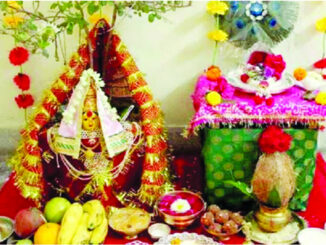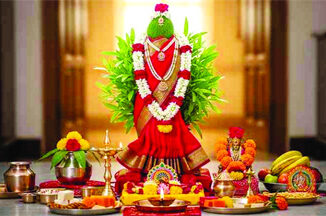
As the soft autumn breeze carries the scent of incense and the flicker of diyas illuminates courtyards, a divine celebration unfolds across India – Tulsi Vivah, the celestial wedding of Tulsi (Holy Basil) and Lord Vishnu in his Shaligram form. Revered as the festival that bridges heaven and earth, Tulsi Vivah is both a sacred ritual and a symbolic renewal of devotion, purity, and nature’s eternal rhythm.
The Legend: From Vrinda’s Devotion to Tulsi’s Divinity
The story of Tulsi Vivah has its roots in the Padma Purana, Skanda Purana, and other ancient scriptures. It tells of Vrinda, a virtuous and devoted wife of the asura king Jalandhar. Her chastity was so powerful that even the gods could not defeat her husband. To restore cosmic balance, Lord Vishnu disguised himself as Jalandhar and deceived Vrinda. When she realized the divine deception, she was heartbroken and cursed Vishnu to turn into a Shaligram stone and to be separated from his consort Lakshmi.
Overcome with remorse, Vishnu blessed Vrinda to be reborn as Tulsi, the most sacred plant on Earth. He promised that she would be worshipped eternally and that their divine union – Tulsi Vivah – would be celebrated by devotees every year on Earth.
Thus, the festival stands as an eternal reminder that divine love transcends illusion, suffering, and even time itself.
When and How Tulsi Vivah Is Celebrated
Tulsi Vivah is observed on the Ekadashi (11th) or Dwadashi (12th) day of the bright fortnight (Shukla Paksha) in the Hindu month of Kartik – generally falling between October and November. The day marks the end of Chaturmas, a four-month period when marriages and major religious ceremonies are avoided. From this day onward, the Hindu wedding season officially begins.
In homes and temples, the Tulsi plant is dressed as a bride – adorned with a sari, ornaments, vermilion, and bangles. Beside her, a Shaligram stone, Krishna idol, or Vishnu image is placed as the groom. A miniature marriage mandap (altar) is decorated with flowers, sugarcane, and marigold garlands.
Priests or elders recite the Tulsi Vivah Katha, chant Vishnu mantras, and perform kanyadaan – symbolically offering Tulsi in marriage to Vishnu. Devotees then distribute prasad, light lamps, and sing bhajans, turning the ceremony into a joyous, heartwarming celebration of divine love.
Spiritual Significance: The Soul’s Union with the Supreme
Beyond the symbolism of marriage, Tulsi Vivah represents the union of Bhakti (devotion) with Paramatma (the Supreme Soul). Tulsi, embodying devotion, purity, and surrender, unites with Lord Vishnu – the cosmic protector and preserver of life.
The ritual emphasizes the belief that true spiritual union lies in selfless love and service to the Divine. Just as Tulsi offers her fragrance and life-giving essence selflessly, devotees are reminded to live with purity, faith, and surrender.
In a deeper sense, Tulsi Vivah is also the celebration of feminine energy (Shakti) uniting with the masculine consciousness (Purusha) – the divine harmony that sustains the cosmos.
Regional Traditions Across India
Though the essence of Tulsi Vivah remains universal, its celebration varies beautifully across India’s diverse spiritual landscape.
Maharashtra:
The festival holds special prominence here. Families decorate courtyards with colorful rangolis, set up an ornate Tulsi Vrindavan (brick altar), and perform the ceremony with devotional songs, bhajans, and aarti. The Tulsi is dressed in a bright red or green sari, while the Shaligram or Krishna idol is adorned as a groom in a tiny turban.
North India (Uttar Pradesh, Bihar, Madhya Pradesh):
In many homes, especially among Vaishnava devotees, Tulsi Vivah is performed with full wedding rituals – mangalashtak, kanyadaan, pheras, and aarti. After the ceremony, sweets like laddoos, malpua, and panchamrit are offered.
South India:
In states like Tamil Nadu and Andhra Pradesh, the ceremony is called Tulasi Kalyanam, and it is observed with grandeur in Vishnu temples. Devotees perform elaborate rituals accompanied by traditional music, flower decorations, and offerings of pongal and payasam.
Gujarat and Rajasthan:
The festival is marked by decorative clay mandaps, garlands, and folk songs celebrating Tulsi’s purity and Lord Vishnu’s grace. Women observe fasts and seek blessings for family harmony and conjugal happiness.
Eco-Spiritual Essence: Honoring Nature as Divine
In today’s times, Tulsi Vivah carries profound ecological relevance. Tulsi is not merely a sacred plant; she is a natural purifier, known to release oxygen, repel insects, and heal ailments. By venerating her as divine, Hinduism expresses its deep ecological wisdom – seeing divinity in every element of nature.
In many eco-conscious households and temples, Tulsi Vivah has evolved into a celebration of environmental awareness, where devotees plant new Tulsi saplings and pledge to protect the earth. This blending of spirituality and sustainability reflects the timeless Hindu principle – Prakriti is sacred; the Earth is our mother.
The Living Goddess in Every Home
Every courtyard that houses a Tulsi plant is believed to be a miniature temple, a living link between the devotee and the Divine. Lighting a lamp before her each evening is said to bring harmony, health, and spiritual upliftment.
As the marriage rituals conclude and lamps glow beside the sacred plant, Tulsi Vivah reminds devotees that divine love resides not in the heavens alone, but in every breath of nature, every act of devotion, and every pure heart that surrenders in faith.
In Essence
Tulsi Vivah is more than a festival – it is a spiritual allegory of union, purity, and devotion.
It teaches that when the heart becomes as pure as Tulsi and devotion as steadfast as Vrinda’s, the Divine Himself manifests to accept that love.
“Where there is Tulsi, there is purity.
Where there is devotion, there resides the Divine.”
Tag: Tulsi Vivah
-

Tulsi Vivah: The sacred union of devotion and divinity
-

Tulsi Vivah
Tulsi (the Holy Basil), the sacred plant of the Hindus symbolizes purity and is famous for its medicinal properties and can be found in almost every Hindu house. “Tulsi Vivah” festival is a traditional wedding (vivah) ceremony of the Tulsi plant to Lord Vishnu. It is celebrated on the day of “Dev Uthani Ekadashi, also known as Prabodhini Ekadashi” of Hindu month Kartik. It is believed that Tulsi is an incarnation of Goddess Lakshmi, consort of Lord Vishnu. She is often referred to as “Vishnu Priya” literally meaning “the beloved of Vishnu”.
The Legend
The story of the “Tulsi Vivah” is found in the Padma Purana. There was a woman named Brinda. She was a great devotee of Lord Vishnu. She was a very pious woman and was devoted to her husband Jalandhar (the demon king). Jalandhar was very powerful and he wanted to fight and defeat all the gods including the Trinity, Brahma, Vishnu and Mahesh. There was no way to kill Jalandhar as long as his wife Brinda remained faithful to him (Pativrata). At the request of gods, Lord Vishnu decided to take the form of Jalandhar and went to meet Brinda. Brinda was not able to recognize the disguise and spent a night with Lord Vishnu in her husband’s disguise.
The devotion and the chastity (Pativrata dharma) of Brinda was thus destroyed by this act of Lord Vishnu. Brinda got extremely upset and angry to know what the Lord had done to her. She cursed him that he would become black stone known as “Shaligram” since he had the heart of stone in destroying her chastity. Even today we find that the “Shaligram” stone found only on the bed of river Gandak near Muktinath, Nepal, is used by devout Hindus (mainly the Vaishnavas) to worship Lord Vishnu, Jalandhar lost the battle with the gods and was eventually killed as his wife could no longer protect him. Brinda jumped into the funeral pyre of her husband.
Transformation to Tulsi Plant and Tulsi Vivah
Lord Vishnu wanted to compensate for what he had done to Brinda. This is why he transformed her soul to the Tulsi plant. Lord Vishnu also said that he would marry Brinda in her next birth to make up for the wrongful act that he did to Brinda. Vishnu in the form of the “Shaligram” stone got married to the Tulsi plant on the day of Prabodhini Ekadashi of Hindu month Kartik. This is the day celebrated in the form of the Tulsi Vivah Festival by the Hindus.
Spiritual significance of the marriage of Tulsi with Vishnu
Holy basil (Tulsi) is the symbol of spiritual purity (sattvika). The marriage (Vivah) of Tulsi with Lord Vishnu means that God likes purity as a quality. The meaning of the word marriage is the merging and oneness of the embodied soul (Jiva) and God .
Tulsi: The Holy Basil
The ‘tulsi’ plant or Indian basil is an important symbol in the Hindu religious tradition. The name ‘tulsi’ connotes “the incomparable one”. Tulsi is a venerated plant and Hindus worship it in the morning and evening. Tulsi grows wild in the tropics and warm regions. Dark or Shyama tulsi and light or Rama tulsi are the two main varieties of basil, the former possessing greater medicinal value. Of the many varieties, the Krishna or Shyama tulsi is commonly used for worship.
Tulsi As A Deity
The presence of tulsi plant symbolizes the religious bent of a Hindu family. A Hindu household is considered incomplete if it doesn’t have a tulsi plant in the courtyard. Many families have the tulsi planted in a specially built structure, which has images of deities installed on all four sides, and an alcove for a small earthen oil lamp. Some households can even have up to a dozen tulsi plants on the verandah or in the garden forming a “tulsi-van” or “tulsivrindavan” – a miniature basil forest.
The Holy Herb
Places that tend to inspire concentration and places ideal for worship, according to the ‘Gandharv Tantra,’ include “grounds overgrown with tulsi plants”. The Tulsi Manas Mandir at Varanasi is one such famous temple, where tulsi is worshiped along with other Hindu gods and goddesses. Vaishnavites or believers of Lord Vishnu worship the tulsi leaf because it’s the one that pleases Lord Vishnu the most. They also wear beaded necklaces made of tulsi stems. The manufacture of these tulsi necklaces is a cottage industry in pilgrimages and temple towns.
Tulsi As An Elixir
Apart from its religious significance it is of great medicinal significance, and is a prime herb in Ayurvedic treatment. Marked by its strong aroma and a stringent taste, tusli is a kind of “the elixir of life” as it promotes longevity. The plant’s extracts can be used to prevent and cure many illnesses and common ailments like common cold, headaches, stomach disorders, inflammation, heart disease, various forms of poisoning and malaria. Essential oil extracted from karpoora tulsi is mostly used for medicinal purposes though of late it is used in the manufacture of herbal toiletry.
A Herbal Remedy
According to Jeevan Kulkarni, author of ‘Historical Truths & Untruths Exposed,’ when Hindu women worship tulsi, they in effect pray for “less and less carbonic acid and more and more oxygen – a perfect object lesson in sanitation, art and religion”. The tulsi plant is even known to purify or de-pollute the atmosphere and also works as a repellent to mosquitoes, flies and other harmful insects. Tulsi used to be a universal remedy in cases of malarial fever.
Tulsi in History
Prof Shrinivas Tilak, who teaches Religion at Concordia University, Montreal, has made this historical citation: In a letter written to ‘The Times,’ London, dated May 2, 1903 Dr George Birdwood, Professor of Anatomy, Grant Medical College, Mumbai said, “When the Victoria Gardens were established in Bombay, the men employed on those works were pestered by mosquitoes. At the recommendation of the Hindu managers, the whole boundary of the gardens was planted with holy basil, on which the plague of mosquitoes was at once abated, and fever altogether disappeared from among the resident gardeners.”
Tulsi In Legends
Quite a few myths and legends found in the Puranas or ancient scriptures point to the origin of importance of tulsi in religious rituals. Although tulsi is regarded as feminine, in no folklore is she described as the consort the Lord. Yet a garland solely made of tulsi leaves is the first offering to the Lord as part of the daily ritual. The plant is accorded the sixth place among the eight objects of worship in the ritual of the consecration of the Kalasha, the container of holy water.
According to one legend, Tulsi was the incarnation of a princess who fell in love with Lord Krishna, and so had a curse laid on her by his consort Radha. Tulsi is also mentioned in the stories of Meera and of Radha immortalised in Jayadev’s Gita Govinda. The story of Lord Krishna has it that when Krishna was weighed in gold, not even all the ornaments of Satyabhama could outweigh him. But a single tulsi leaf placed by Rukmani on the pan tilted the scale.
In the Hindu mythology, tulsi is very dear to Lord Vishnu. Tulsi is ceremonially married to Lord Vishnu annually on the 11th bright day of the month of Karttika in the lunar calendar. This festival continues for five days and concludes on the full moon day, which falls in mid October. This ritual, called the ‘Tulsi Vivaha’ inaugurates the annual marriage season in India.
Source: Speakingtree