Tag: Turkey

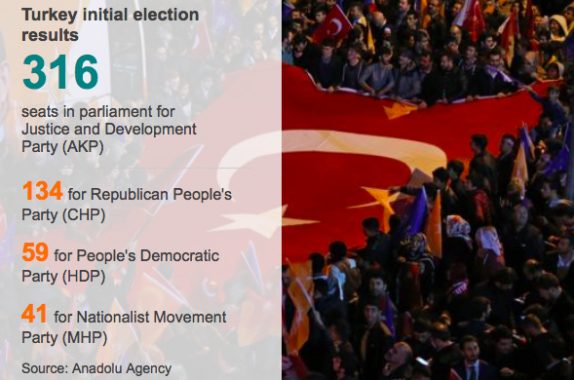
  • Turkey election: AKP wins back majority in snap election

    Turkey election: AKP wins back majority in snap election

    The Justice and Development Party (AK party) is set to lead Turkey alone once again after a five-month break, easily regaining its parliamentary majority in what Prime Minister Ahmet Davutoglu called a victory for democracy.

    With nearly all of the votes counted, the ruling party was leading Sunday’s general elections with 49.4 percent of the vote.

    The AK party was followed by the centre-left Republican People’s Party (CHP) with 25.4 of the votes, far-right Nationalist Action Party (MHP) with 11.9 percent and the pro-Kurdish left-wing Peoples’ Democratic Party (HDP) with 10.7 percent.

    With almost all ballots counted, the state-run Anadolu news agency said the AKP had won 49.4% of the vote, with the main opposition CHP on 25.4%.

    President Recep Tayyip Erdogan said voters had “shown that they prefer action and development to controversy”.

    The pro-Kurdish HDP crossed the 10% threshold needed to claim seats.

    The nationalist MHP will also take seats in Ankara.

    In a statement, President Erdogan said the electorate had “given proof of their strong desire for the unity and integrity” of Turkey.

    Early on Monday, he called on the world to respect Turkey’s national will.

    Mr Erdogan called the vote after the AKP lost its parliamentary majority for the first time in 13 years in June and attempts to form a coalition government failed.

    Speaking from the balcony of the AKP headquarters in the capital, Prime Minister Ahmet Davutoglu welcomed the new result, saying: “You saw the dirty games played in our country, and you have changed the game”.

    With almost all of the results counted, the AKP had won substantially more than the 276 seats needed in order to form a government alone.

    More than 54 million people were registered to vote at some 175,000 stations on Sunday. The participation rate stood at 86.1 percent.


  • INDO AMERICAN celebrates its success on the 10th Anniversary, Nov 7th

    INDO AMERICAN celebrates its success on the 10th Anniversary, Nov 7th

    RUTHERFORD, NJ (TIP): One of the largest distributors of Natural Stones, INDO AMERICAN is celebrating their 10th anniversary on Nov 7th 2015 at the Renaissance in Rutherford, NJ. Felicitating their key associates and partners in the growth of the Company

    INDO AMERICAN has acquired their new warehouse located in Kearny, just outside of Manhattan, comprising of 88000 sq ft warehouse of natural and artificial stones.

    They began their journey in 2005 from just one row of basic granite procured locally; the company has grown to one of the largest distributors of natural stones in the country with over 250 shades of colors from around the world.

    We directly import Material from all over the world, such as Italy, Brazil, China, India, Spain, Turkey, etc., and it is stored in our own warehouse and distributed to places around the country

    Devraj N Aiyar with his nieceOne long-term goal is to establish remote locations in North America and set up factories in (at least three) the exporting countries to facilitate material acquisition, processing and self-export onward to North America.

    To stay ahead of the curve, INDO AMERICAN is investing heavily in capital expenditure on its indoor and outdoor products. We are also continually expanding our fleet of trucks and manpower to extend the beat services to our clients.

    In addition to our current 2,400-square-foot office space and an equally spacious ‘state of art’ new showroom is being created for high-end designers and architects, which would be one of a kind in the Tri State.

    “The growth of the company could be largely attributed to the excellent teamwork, focus and 100% commitment of our key members and hence our team needs to be fighting fit, both physically and mentally” believes Mr. Devraj N Aiyar, CEO of the organization. Hence their new location is also being outfitted with a gymnasium and an indoor games room.

    “Work is Play” is the motto at Indo American.

    INDO AMERICAN delivers materials to destinations over 250 miles away, which is a testament to its commitment towards customer service and competitiveness. The company prides itself on maintaining a steady stream of loyal customers by offering quality products and service.

    According to Usha “The key ingredients to our growth are maintaining a client base with strong credit and keeping close tabs on receivables.”

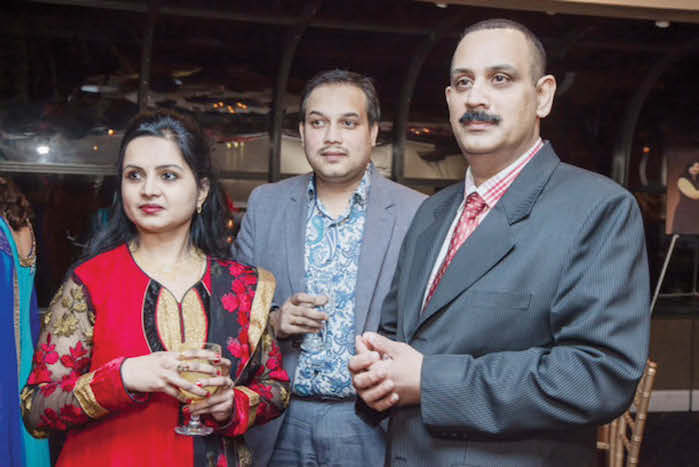
    INDO AMERICAN is celebrating their 10th anniversary on Nov 7th, 2015 at the Renaissance in Rutherford, NJ felicitating their key associates and partners in the growth of the Company.

  • A US-Pak nuclear deal would be a threat to India’s security

    A US-Pak nuclear deal would be a threat to India’s security

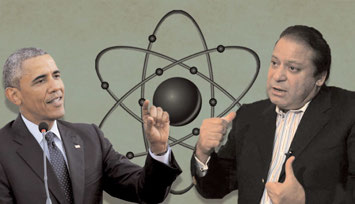
    If a report in a US newspaper is to be believed, a US-Pakistan nuclear deal might be on the cards. The report says that such a deal is being considered around Prime Minister Nawaz Sharif’s visit to Washington this month.

    The report would not have appeared credible but for the evasive comment of the State Department on the subject and the official reaction of the spokesperson of our Ministry of External Affairs cautioning the US authorities against any such decision.

    Ever since the India-US nuclear deal was signed, the Pakistanis, obsessed with the idea of parity with India, have been seeking a similar deal.

    Besides calling the India-US nuclear deal discriminatory, Pakistan has condemned it as threat to its security and warned that it would take all necessary steps to safeguard its interests. Pakistan’s Foreign Affairs Adviser Sartaj Aziz aggressively reiterated this on the occasion of President Barack Obama’s visit to India in January this year.

    By remaining silent, the US has only encouraged this absurd posturing by Pakistan.

    US soft on Pakistan

    Some western nonproliferation specialists have been advocating for some time a nuclear deal with Pakistan in order to remove its sense of grievance. They feel it would give Pakistan an incentive to limit the expansion of its nuclear arsenal and stabilize the nuclear situation in the sub-continent.

    Such advocacy is largely prompted by negative attitudes towards India which, with its historical opposition to the NPT, is seen as the one responsible for nuclearizing South Asia. In their eyes, this is one way of denying India any one-sided advantage in nuclear status.

    Until now, the US Administration has been differentiating India’s case from that of Pakistan and disclaiming any move to offer the latter a similar deal, thought the tenor of its statements has not been sufficiently convincing.

    In fact, both the US and China, to different degrees, have aided Pakistan in achieving its nuclear and missile ambitions.

    A US-Pak nuclear deal will erode the strategic importance of the Indo-US nuclear deal

    In the past, knowing the China-Pakistan nuclear and missile nexus, the US has waived the application of its laws for larger geopolitical reasons linked to the combat against the Soviets in Afghanistan. The Afghanistan factor has, unfortunately, continued to condition US thinking on Pakistan’s nuclear and other errant behavior.

    The US was remarkably soft with Pakistan on the AQ Khan case. It has tolerated Pakistan’s tactics to obstruct discussions on the FMCT at Geneva at a time when fissile material control was still on the US agenda.

    It has overlooked supplies of additional Chinese nuclear reactors to Pakistan in violation of China’s NSG commitments.

    One could speculate that having settled the nuclear question with India, this was one way for the US to allow Pakistan to be a beneficiary of external cooperation in its nuclear sector, as part of the traditional policy of “hyphenation”.

    US agencies and think tanks have been propagating information about the frenetic pace at which Pakistan has been expanding its nuclear arsenal, without any visible reaction from the US government.

    At one time, worried about the rise of radicalism in the country, the US was expressing concern about the security of Pakistan’s nuclear arsenal. But such fears are no longer being expressed.

    US conduct over the years suggests that it has favored the idea of a Pakistani nuclear capability to balance India’s. Remarkably, its complaisance towards the Pakistani nuclear program has continued long after the end of the Cold War.

    Adding to all this, US treatment of Iran’s nuclear ambitions contrasts strikingly with its handling of Pakistan’s nuclear transgressions. While draconian sanctions have been applied on Iran, in Pakistan’s case the US has argued that sanctions might hasten its slide towards failure as a state and increase the risk of its nuclear assets falling into the hands of religious extremists.

    This is specious logic as the US has not taken any precautionary step to curb the development of Pakistan’s nuclear assets, including its decision to introduce tactical nuclear weapons in the subcontinent. An expanded Pakistani nuclear arsenal is even more likely to fall into the wrong hands.

    US reaction to Pakistan’s loose talk about using nuclear weapons against India has been, moreover, notably mild. It could and should have been much stronger.

    The hesitation to impose sanctions on Pakistan contrasts also with the willingness to impose sanctions even on a powerful country like Russia, including its most senior leaders and functionaries.

    What inhibits the US to strong arm Pakistan despite its provocations remains unclear.

    The argument that for dealing with the situation in Afghanistan the US needs Pakistan’s assistance is not convincing. The US needs Russia even more for dealing with yet more complex and fraught problems as Iran and West Asia in general, including the rise of the Islamic State, not to mention the fall-out of mounting tensions in Russia-West relations.

    China-Pakistan axis

    It is mystifying why the US should want to politically legitimize Pakistan’s nuclear conduct through an India-like nuclear deal.

    In India’s case, the US wanted to make a geopolitical shift with the rise of China in mind. It saw India as a counterweight to China in Asia, but for this the nonproliferation issue which inhibited India’s international role had to be resolved.

    Pakistan is in fact China’s closest ally. The geopolitical purpose of a nuclear deal with Pakistan will only legitimize the China-Pakistan nuclear and security relationships and undermine India’s strategic interests vis-a-vis both these adversaries.

    The US has wanted to build a strategic relationship with India largely around shared interests in the Indian Ocean and Asia-Pacific regions in view of mounting signs of Chinese political and military assertiveness and its ambitious naval expansion program.

    Through the China-Pakistan Economic Corridor and the development of Gwadar, Pakistan is facilitating an increased Chinese strategic presence in the Indian Ocean, which contradicts this US strategy.

    Shocking rationale

    According to reports, the underlying reasoning offered by the US, if correctly reported, is almost shocking. In return for an NSG waiver, Pakistan will be asked to restrict its nuclear program to weapons and delivery systems that are appropriate to its actual defense needs against India’s nuclear threat, and not to deploy missiles beyond a certain range.

    This implies that the US accepts that India’s nuclear program is Pakistan-centric and that it poses a threat to Pakistan.

    The Chinese threat to India is being overlooked and the fact that India faces a double Pakistan-China nuclear threat – in view of the close nuclear collaboration between the two countries- is being ignored.

    The US, it appears, would be comfortable if only India would be exposed to the Pakistani nuclear threat, not others.

    US has been consistently soft on Pakistan’s errant behavior in matters like nuclear weapons

    But then, Pakistan’s nuclear arsenal, according to its own leaders, is India-centric. Pakistan is not threatening China, Iran or Saudi Arabia with its nuclear weapons. Which are the countries that the US wants to protect against the use of nuclear weapons by Pakistan?

    Pakistan is developing delivery systems to reach any point in India. The US would apparently be comfortable with that, but not if it developed missiles of longer range. But whose security is US worried about if Pakistan did that? US itself, Japan, Australia, Singapore, China, Iran, Saudi Arabia, Israel?

    China, we know, opposes India’s NSG entry without Pakistan. It would seem the US would be willing to accommodate both China and Pakistan if the latter limited its nuclear threat to India.

    By implication then, the US has no stakes in India’s security from an unstable and adventurous Pakistan, despite our so-called strategic partnership.

    A reward for Pakistan’s military

    The timing of a nuclear deal would be odd too. It is now universally recognized that it is General Raheel Sharif and not Nawaz Sharif who really hold the reins of power in the country. A nuclear deal will be a reward for the Pakistan military and not the civilian power, as Pakistan’s nuclear program is under military control.

    Does the US want to reward the Pakistan military for its operations in North Waziristan against the Pakistani Taliban and is this considered meritorious contribution to the fight against Al Qaeda and terrorism?

    One would have thought far more important for the US and the West is the rise of the Islamic State and its ideology. Compared to which North Waziristan is a side-show. In any case, the Pakistani military is not fighting the Haqqani group.

    Worse, while Pakistani is being accepted as an honest mediator in the Afghan reconciliation process, the Taliban showed its mounting force by occupying Kunduz.

    One hopes that the US report does not accurately reflect President Obama’s thinking.

    If it does, it will show how hollow is the strategic relationship between India and the US, and why it would not be wise to trust the US.

    The India-US nuclear deal will be eroded of much of its strategic importance bilaterally, as result. The US would have, in addition, administered a big political blow to Prime Minister Narendra Modi who has gone out of his way to improve strategic understanding with the US.

    But then, news reports are news reports, and they could merely be political kite-flying. In which case, the India-US relationship will not receive a big jolt for all the reasons mentioned in this article.

    (The author is a former foreign secretary of India. He has also served as India’s ambassador to Turkey, Egypt, France and Russia. He can be reached at sibalk@gmail.com)

  • Europe’s Refugee Crisis

    Europe’s Refugee Crisis

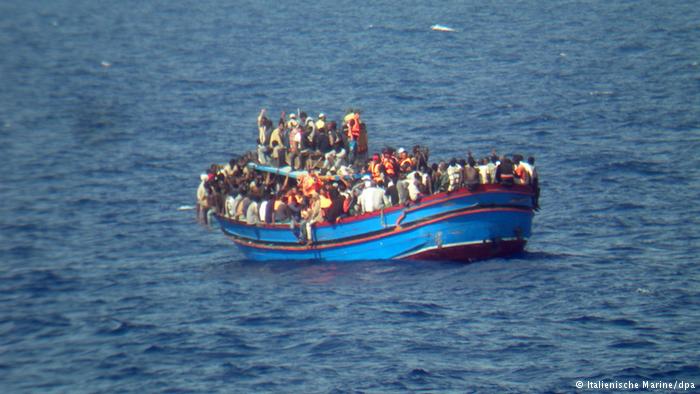
    Another major crisis is unfolding in Europe. Still struggling to find solutions for the Eurozone and Ukrainian crises, The European elite was hardly prepared to face a serious refugee and migration challenge. The problem has already been unfolding for some time. This year alone, more than 300,000 people have risked their lives to cross the Mediterranean Sea (including 200,000 to Greece). Over 2,600 did not survive this dangerous journey. More than 70 people were found dead in an abandoned truck in Austria. Even last year about 3500 people were reported dead or missing in the Mediterranean Sea. For years, these people were seen by many Europeans merely as economic migrants. The images of Syrian toddler Aylan Kurdi whose body was found on Turkish shores after a failed attempt to reach Greece finally shocked the Europeans and the world. Further, chaotic scenes in Budapest, where the Hungarian government tried to stop Syrian refugees’ journey towards Germany, forced the European media and its institutions to change the narrative. The UNHCR has clearly declared now that “this is a primarily refugee crisis, not only a migration phenomenon”.

    The way different EU governments have responded to the present crisis has again exposed structural flaws of common EU policies. The Dublin procedure established that the first EU country where a migrant or refugees enters, is responsible for processing his or her asylum claim. This obviously put tremendous pressure on countries like Greece and Italy where most asylum seekers arrived first. In recent months, Hungary has also joined frontline status as refugees are entering its territory from neigbouring Serbia. As most asylum seekers want to go to Germany, Sweden, France or Italy, questions are raised as to why register and house them in a country where they do not want to stay any way.

    To alleviate the problem, the EU proposed a quota system to distribute migrants among different nations. All 28 EU member states were required to accept asylum seekers in proportion to the size of their economy, unemployment rate and population. Although the plan was initially backed by Germany, France and Italy, they have now suggested many corrections. The UK was already out of the system. Many East Europeans say it will not work as most asylum seekers want to settle in West Europe. Spain has also rejected the plan. Some have objected to the principle itself. The Hungarian Prime Minister Victor Orban asserted that “the idea that somebody allows some refugees in their own country and then distributes them to other member states is mad and unfair”. Later he even added that “the problem is not European, it’s German. Nobody would like to stay in Hungary, neither Slovakia, Poland or Estonia”. The smaller nations in former Eastern bloc feel that policies are being imposed on them by bigger members.

    The number of asylum seekers in the EU has increased significantly in the last few years. Eurostat data shows that about 625,000 claimed asylum in the EU in 2014. The numbers were high but perhaps not as alarming as presented in European media. Europe has seen high numbers even before, particularly during the Yugoslav crisis. In 1992 alone, there were close to 700,000 applications. In the first half of 2015, close to 434,000 people have filed applications for asylum in Europe. Last year, the largest number of asylum seekers came from Syria (20%), followed by Afghanistan (7%), Kosovo (6%), Eritrea (5%), Serbia (3.5%) and Pakistan (3%). In fact, more people from Pakistan applied for asylum than from Iraq. About one third people applied for asylum in Germany only. One in four asylum seekers was a minor.

    As per the UNHCR, over 4 million Syrians are now refugees. It is not that all Syrians are moving towards Europe. About 1.9 million have taken refuge in Turkey. Similarly, about 1.1 million and 630,000 have found shelter in Lebanon and Jordon respectively. Only about 350,000 Syrians have applied for asylum in Europe.
    Europeans know that they cannot run away from their responsibility as many of these people have become refugees due to European involvement in shaping conflict outcomes in Syria, Iraq, Afghanistan, Libya and Kosovo. Both Russian and Turkish presidents have blamed the western world for their policies on this crisis.

    To tackle the crisis, the EU has urged member states to work out a common strategy based on responsibility and trust. So instead of accusing each other, can Europe’s nations agree on some joint action? Many new plans including EU-wide border protection force, destruction of smuggler ships, reallocation plan for already entered refugees, list of safe countries of origin (Balkan states, Bangladesh, Pakistan, Senegal etc) and reception centres closer to conflict areas will be discussed in the coming weeks. European Commission president Jean-Claude Juncker is soon going to outline his plans to relocate 160,000 asylum seekers across Europe over the next two years.

    In the meanwhile, Hungary is building 175 km fence on its border with Serbia. Germany has suspended Dublin rules for Syrian refugees. The Visegrad group (Hungary, Poland, Czech Republic and Slovakia) has declared that any proposal to introduce quota system is unacceptable to them.

    As political and military solutions to the conflicts in Syria and Afghanistan are nowhere in sight, the refugee crisis in Europe is not going to disappear in a hurry. UN High Commissioner for Refugees, Antonio Guterres has urged Europe to “reaffirm the values upon which it was built”. Many West European countries led by Germany have shown courage to accept large numbers of refugees this year. Still the message from the Hungarian prime minister to Syrian refugees was entirely different – “please don’t come. Why you have to go from Turkey to Europe? Turkey is a safe country. Stay there, it’s risky to come. We can’t guarantee that you will be accepted here”.

    (Gulshan Sachdeva is Chairperson, Centre for European Studies, School of International Studies, JNU)

    Views expressed are of the author and do not necessarily reflect the views of the IDSA or of the Government of India

  • Aunt had tried to sponsor family who drowned off Turkey

    Aunt had tried to sponsor family who drowned off Turkey

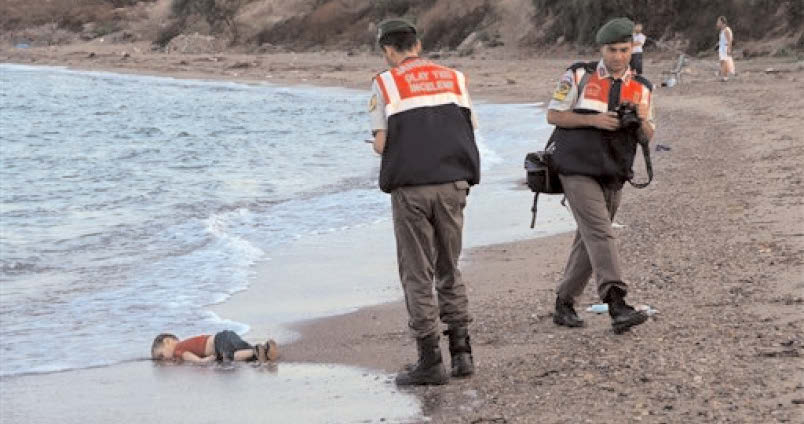
    ANKARA(TURKEY) (TIP): Aylan Kurdi, whose 3-year-old body was captured face-down in the surf in images that have horrified the world, set out for Europe only after Canada rejected his family’s refugee application, a Canadian lawmaker says.

    Images of Aylan’s body, clad in blue shorts and a red shirt on a Turkish beach, have heightened global attention to a wave of migration, driven by war and deprivation, that is unparalleled since World War II. They are also raising pressure on governments to be more welcoming to refugees fleeing the horror that Syria has become.

    Aylan’s aunt, who lives in the Vancouver area, had sought to get Canadian refugee status for her relatives in the Syrian town of Kobani, which was devastated by battles between Islamic State and Kurdish fighters, legislator Fin Donnelly told the Canadian Press. Donnelly submitted the application on the family’s behalf.

    Canadian immigration authorities rejected the application, in part because of the family’s lack of exit visas to ease their passage out of Turkey and their lack of internationally recognized refugee status, the aunt, Teema Kurdi, told the newspaper the Ottawa Citizen. It said she is a hair stylist who moved to Canada more than 20 years ago.

    Teema Kurdi said the family her brother Abdullah, his wife Rehan and their two boys, 3-year-old Aylan and 5-year-old Galip_ embarked on the perilous boat journey only after their bid to move to Canada was rejected.

    “I was trying to sponsor them, and I have my friends and my neighbors who helped me with the bank deposits, but we couldn’t get them out, and that is why they went in the boat,” she told the Citizen.

    The tides also washed up the bodies of Rehan and Galip on Turkey’s Bodrum peninsula Wednesday. Abdullah survived the tragedy. In all, 12 migrants drowned when two boats carrying them from the Turkish coast to the Greek island of Kos capsized.

  • Saudi Arabia opens first privatized airport for pilgrims

    Saudi Arabia opens first privatized airport for pilgrims

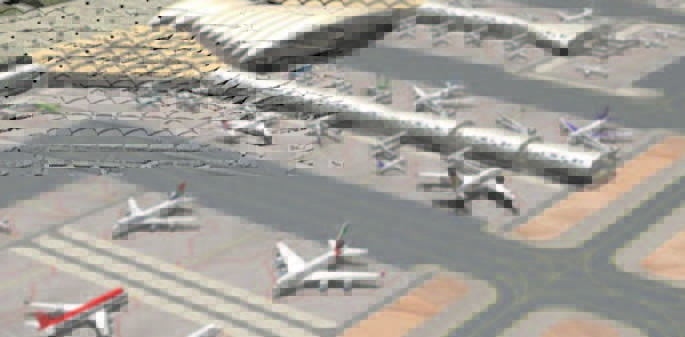
    RIYADH (TIP): Saudi Arabia on July 2 officially opens a billion-dollar aviation gateway aimed at Muslim pilgrims, in the kingdom’s first airport privatization. Local media said King Salman would inaugurate the Prince Mohammad bin

    Abdul Aziz International Airport in the holy city of Medina. About two million pilgrims annually visit the western cities of Mecca and Medina for the hajj, which this year takes place in September.

    Medina’s domestic airport was upgraded to international status because of “the importance and the role of the air transport sector in the service of pilgrims and visitors to the Prophet’s mosque,” the website of the airport operator says.

    TIBAH Airports Development Co won the bid and in October 2011 signed a build, transfer and operate agreement with the kingdom’s aviation regulator, the General Authority of Civil Aviation (GACA). The consortium includes Turkey’s TAV Airports along with local firms Al-Rajhi and Saudi Oger.

    TIBAH said the project “represents the first partnership between the public and private sectors in airports” in Saudi Arabia. Medina airport’s annual passenger capacity will rise from last year’s 5.7 million to eight million, before doubling to 16 million by the end of the 25-year agreement for operating the facility, TAV said.

    The project “represents a new direction” because it was privately built and will be run by the joint venture, said GACA, which operates 27 airports in the kingdom.

    Some of those are also targeted for privatization. Aeroports de Paris is among seven candidates invited to bid for a concession at the country’s busiest airport in Jeddah, south of Medina, GACA president Suleiman al-Hamdan told AFP last month on the sidelines of the Paris Air Show. A new terminal under construction in Riyadh will also be operated by an international company, said GACA.

    Saudi Arabia is the Arab world’s largest economy and is spending billions of dollars on building and upgrading its air terminals.

    National carrier Saudi Arabian Airlines announced at the Paris Air Show an order for 50 Airbus passenger planes worth about $8 billion.

    Carriers based in neighbouring Gulf states —Emirates, Qatar Airways and Abu Dhabi’s Etihad— have won a large chunk of global air travel, turning their airports into major transcontinental hubs.

  • Business leaders urge G20 to push digital economy, e-commerce

    ISTANBUL (TIP): An influential group of business leaders have urged the G20 to improve the global trade system for the emerging digital economy as well as focus on reforms to ensure strong and sustainable growth.

    The group known as B20, met in Turkey on the sidelines of the G20 sherpas meeting and discussed the recommendations which would be finalised for the G20 leaders meeting in November. It called for eliminating data flow restrictions and softening regulations on data privacy to decrease the cost of doing business. It said customs regimes must be harmonized to ensure that bottlenecks to e-commerce are minimized and transactions are made more predictable.The G20 comprises the largest and emerging economies, which account for 85% of global GDP and 75% of world trade. It comprises the US, the UK, the European Union, India, Argentina, Australia, Brazil, Canada, China, France, Germany, Indonesia, Italy, Japan, South Korea, Mexico, Russia, Saudi Arabia, South Africa and Turkey.

    “Harmonize customer protection rules, specifically on core issues relating to purchase processes, to better facilitate e-commerce efforts and eliminate costs and administrative difficulties,” it said in its draft recommendations.

    According to estimates, the digital economy is expected to contribute $4.2 trillion or more than 5% of GDP for the G20 countries in 2016 and is growing at 10% annually. Cross border e-commerce accounts for 10-15% of total e-commerce volumes, depending on the region. By 2025, annual global cross-border e-commerce revenues could swell to between $250 billion and $350 billion-up from about $80 billion now, according to Mckinsey Global Institute and BCG analysis. The B20 has six task forces on infrastructure and investment, trade, financing and growth, anti-corruption, employment and small and medium enterprises and entrepreneurship. Each of the task forces made specific recommendations to improve business prospects within the G20, which would help lift GDP growth.

    It called for reaffirming the commitment to rollback of existing protectionist measures, particularly non-tariff barriers and said the G20 must start taking distinct actions by eliminating localization barriers to trade as a first step. Numerous reports show that G20 governments are not adhering to their standstill and roll back commitments with regards to regular tariff barriers, the B20 said.

    “Non-tariff barriers can have a much greater negative impact on GDP growth than tariffs. The benefits of reversing all barriers introduced between 2008 and 2013 is at least $460 billion increase in global exports, a $423 billion increase in global GDP and 9 million jobs supported worldwide,” it said. The B20 strongly backed the creation of an enabling environment for increased flow of private funds into more sustainable infrastructure. It said there is a need to increase the number of projects developed through public-private partnerships (PPPs) and build capabilities of governments to deliver PPPs.

  • PHYSICS CAN HELP US UNDERSTAND RADICAL ISLAM

    It seems unlikely that ideas that have powered physics can also help us understand radical Islam. But let us not forget that the emergence of the so-called Islamic State has necessitated an urgent need for new ideas.

    Conventional wisdom on the radicalization phenomenon articulated by social scientist Omer Taspinar holds that the “root causes of terrorism and violent radicalism are extremely complex, multifaceted, and often intertwined. They resist simplification and easy categorization.”

    However, physics Nobel laureate Steven Weinberg has argued in his book Dreams of a Final Theory: The Scientist’s Search for the Ultimate Laws of Nature that the underlying “simplicity and rigidity” in an explanation of a phenomenon is “a means to the end of finding scientific explanations and judging their validity.”

    Indeed, unlike other religions, violence conducted in the name of Islam is not only far more prevalent, but it transcends ethno-cultural, linguistic, geographic and income boundaries. This observation and the time-tested physics insight favor a simple theme as the root cause, based on religion that many people understand and identify with.

    The defining trend of the past centuries is the worldwide embrace of modernity and the socioeconomic advancement brought by science. Religious ideologues felt threatened by this new influence, because science not only contests their worldview, but it also offers a credible alternative.

    Unlike most non-Muslim communities, starting about 40 years ago, many Muslim communities saw this trend reverse, with regressive Islamism increasingly taking the place of modernity. Manifestations of this Islamism trend range from growing of facial hair to the preference of sharia law over modern secular law.

    The trend change is mainly due to Wahhabi ideologues and others pushing the simple theme that Muslims would be true to their religion, if they follow sharia, compellingly portrayed as an all-encompassing “divine law.”

    Sharia laws as an interpretation of Islam -readily accessible via clerics or religious scholars – vary widely and in general, reflect the cultural norms of the Arab tribes of a bygone era because typical ideologues graduate from religious schools that adhere to centuries-old syllabuses.

    The discovery of oil largesse in the Middle East enabled sharia’s worldwide embrace. Although the regressive world view advanced by sharia narratives discourages wealth creation, the largesse did more than just sustain sharia-governed Saudi Arabia’s economy. In fact, thanks to this wealth, since the 1970s, the country – the birthplace of Islam and home to its two holy mosques – exported worldwide sharia and armed jihad emphasizing Wahhabism, an intolerant and conservative form of Islam.

    Apparently, this sharia push has been a huge success. According to the 2013 Pew Research Center report (The World’s Muslims: Religion, Politics and Society), in 17 out of 23 nations, the majority of the Muslims surveyed considered sharia to be the “revealed word of God” and in 25 out of 38 nations, the majority favored making it the law of the land. Among those who favored doing so, in 10 out of 20 nations, the majority supported the corporal punishment of cutting off the hands of thieves, similar to what Saudi Arabia enforces under its sharia laws.

    It’s no wonder then that militant groups such as the Islamic State, al-Qaeda and Boko Haram, that purportedly wage armed jihad to impose sharia as the law of the land, have little trouble finding sponsors and recruits.

    To be clear, in communities where sharia is popular, modernity and secularism retreat because conditions favor those who overemphasize religious education, push sharia as a counter-narrative to modernity and advocate regressive religion-based ideas, including armed jihad. This point is exemplified in the contrasting support levels for sharia in Turkey and Pakistan, Muslim-majority nations at the opposite ends of Islamist militancy and socioeconomic stagnation spectra.

    In an effort to combat what the White House has deemed “Violent Extremism,” President Obama has called on Muslims to “consistently reject the ideology of [militant] organizations.” But he has made no mention of sharia. However, by acknowledging sharia’s role in the radicalization process, the West could finally start managing the threat it understands.

    As in physics, simple explanations may hold the key to understanding emerging global phenomenon such as radical Islam.

    (The author is a physicist and a scholar of radicalism)

  • 2 Indian-origin Youths from South Africa Die Fighting for ISIS

    2 Indian-origin Youths from South Africa Die Fighting for ISIS

    Two youths belonging to the Muslim community of a small Indian township south of Johannesburg have died allegedly fighting for the Islamic State, becoming one of the first South Africans to have died in Syria.

    Articles in media outlets today said a confidential report had indicated that Fayaaz Valli, 23, had gone to Syria claiming to be working for an orphanage but ended up being killed while fighting with Islamic State.

    Mr Valli’s father Riyad told the weekly Sunday Times that he was heartbroken by the death of his son but did not believe he had joined the IS.

    “I would never have allowed him to go if I knew,” the father said, but the report claims that two South Africans from Roshnee have already died while fighting alongside the IS, while several more were planning to enlist with the group.

    According to the report, the families of both men were advised that they had died in car accidents.

    The second man, whose identity has not been made public, allegedly settled all his debts and distributed his assets before travelling to Turkey to cross the border into Syria to join IS.

    Although government sources would not comment on it, the reports said the Muslim community of Roshnee have closed ranks to protect the families of the duo.

    This came amid concern that a number of young people from the town were being recruited to join the militant group which claims to act in the name of Islam but has been decried by Muslim organisations across the country.

    The weekly claimed to have knowledge of at least 22 South Africans who had flown on their own or with their families to Abu Dhabi in the Middle East and then to Turkey to try to join the IS. About half of them had been deported by authorities.

    The report said Roshnee residents had believed men collecting funds for humanitarian efforts on the Syrian border were actually doing so for IS.

    The Syrian Embassy in Pretoria has previously warned against organisations pretending to be engaged in humanitarian efforts in the Syrian war being a front for IS fundraising and recruitment.

  • FBI cracks down ‘Islamic State’ in Orange County, California

    FBI cracks down ‘Islamic State’ in Orange County, California

    Two men accused of plotting to provide material support to “Islamic State” (IS) appeared before a court in California on Friday. The prosecutors charged Anaheim residents Muhanad Badawi and Nader Elhuzayel, both 24, after investigators tracked their communications on social media and found messages claiming their support for IS.

    According to court documents, on May 7 Elhuzayel used Badawi’s credit card to purchase a ticket to Tel Aviv, Israel, via Istanbul, Turkey. Police arrested Elhuzayel at Los Angeles International Airport on May 21 as he prepared to depart and Badawi in Anaheim, the home to Disneyland, on the same day. Badawi suggested that he, too, eventually planned to go to the region to join the fight, the Justice Department reported.

    Elhuzayel told authorities that he had planned on getting off the plane in Turkey and traveling to fight with IS in Syria, according to the complaint. However, his father, Salem Elhuzayel, told the Orange County Register that he had dropped his son off for the Israel-bound flight so that he could visit Palestinian aunts and cousins.

    “I think they’re looking for a victim,” he said. “He’s an innocent human being.” Officials searched the motel room where the family has lived since their eviction from their home, Salem Elhuzayel said.

    On Friday, IS claimed responsibility for a deadly mosque attack in Saudi Arabia.
    mkg/rc (Reuters, AFP, AP,DW)

  • European officials sing ‘we are the world’ at Nato meeting

    ANTALYA (TIP): In a distinctly different note for a military alliance meeting, European officials ended a Nato meeting with a spirited rendition of “we are the world.”

    Taking a break from issues such as the war in Ukraine and instability in the Middle East, Nato and other officials accepted an invitation by a Turkish band to sing a “last song for peace” at a dinner Wednesday hosted by Turkey as the alliance’s foreign ministers met near the Mediterranean city of Antalya.

    The foreign ministers of Greece and Turkey — Mevlut Cavusoglu and Nikos Kotzias — were seen singing and swaying arm-in-arm to the tune of the 1985 charity song. Nato secretary-general Jens Stoltenberg, EU foreign policy chief Federica Mogherini and others also joined in the sing-along.

  • Prince Harry to quit British army in June

    LONDON: It’s a soldier’s life no more for Britain’s Prince Harry.

    Royal officials said on Tuesday that the 30-year old prince will leave the armed forces in June after 10 years of service that included two tours of duty in Afghanistan.

    Harry’s final army duties will include a four-week assignment in April and May with the Australian Defence Force. The prince will spend time in Darwin, Perth and Sydney and attend centenary commemorations of the World War I Gallipoli campaign in Turkey.

    Harry said that leaving the army had been “a really tough decision” but he was excited about the future.

    In a statement, Harry said he felt “incredibly lucky” to have had the chance to serve in the armed forces.

    “From learning the hard way to stay onside with my Color Sergeant at Sandhurst, to the incredible people I served with during two tours in Afghanistan _ the experiences I have had over the last 10 years will stay with me for the rest of my life,” he said. “For that I will always be hugely grateful.”

    Harry, who is fourth in line to the British throne, graduated from Sandhurst officers’ academy in 2006 and joined the Household Cavalry as an armored reconnaissance troop leader. He served in Afghanistan as a battlefield air controller for 10 weeks in 2007-2008 until a media leak cut his tour short.

    Keen to return to the front lines despite fears he would be a top Taliban target, Harry retrained as a helicopter pilot and served in Afghanistan in 2012- 2013 as an Apache co-pilot gunner.

    Most recently he has served as a staff officer in the army’s London headquarters, playing a big role in bringing the Invictus Games _ an international sports competition for wounded troops _ to Britain.

    Kensington Palace said that after leaving the army Harry will volunteer with the British military’s Recovery Capability Program, which helps wounded service members, “while actively considering other longer-term employment opportunities.”

    Harry was the first British royal to see combat since his uncle, Prince Andrew, who flew Royal Navy helicopters during the 1982 Falklands War. His older brother Prince William also attended Sandhurst before training as a Royal Navy search-and-rescue helicopter pilot. He has since left the navy to become an air-ambulance pilot.

    Harry has often seemed more comfortable as a soldier than in his royal duties, although he has been visibly energized by his work with charities for wounded veterans.

  • CHINA NOW WORLD’S THIRD-BIGGEST ARMS EXPORTER: SIPRI

    CHINA NOW WORLD’S THIRD-BIGGEST ARMS EXPORTER: SIPRI

    BEIJING (TIP): China has overtaken Germany to become the world’s third-biggest arms exporter, although its 5 per cent of the market remains small compared to the combined 58 per cent of exports from the US and Russia, a new study says.

    China’s share of the global arms market rose 143 per cent during the years from 2010- 2014, a period during which the total volume of global arms transfers rose by 16 per cent over the previous five years, the Stockholm International Peace Research Institute said in a report released Monday.

    Its share of the world market was up from 3 per cent in the 2009-2014 period, when China was ranked ninth among exporters of warplanes, ships, side arms and other weaponry, said the institute, known as SIPRI.

    The data show the growing strength of China’s domestic arms industry, now producing fourth-generation fighter jets, navy frigates and a wide-range of relatively cheap, simple and reliable smaller weapons used in conflicts around the globe.

    China had long been a major importer of weapons, mainly from Russia and Ukraine, but its soaring economy and the copying of foreign technology has largely reversed the trend, except for the most cutting-edge designs and sophisticated parts such as aircraft engines.

    China supplies weapons to 35 countries, led by Pakistan, Bangladesh and Myanmar, SIPRI said.

    Chinese sales included those of armored vehicles and transport and trainer aircraft to Venezuela, three frigates to Algeria, anti-ship missiles to Indonesia and unmanned combat aerial vehicles, or drones, to Nigeria, which is battling the Boko Haram insurgency in its north.

    China’s comparative advantages include its low prices, easy financing and friendliness toward authoritarian governments, said Philip Saunders, director of the Center for the Study of Chinese Military Affairs at the US National Defense University.

    “Generally speaking, China offers medium quality weapons systems at affordable prices, a combination attractive to cash-strapped militaries in South Asia, Africa and Latin America,” Saunders said.

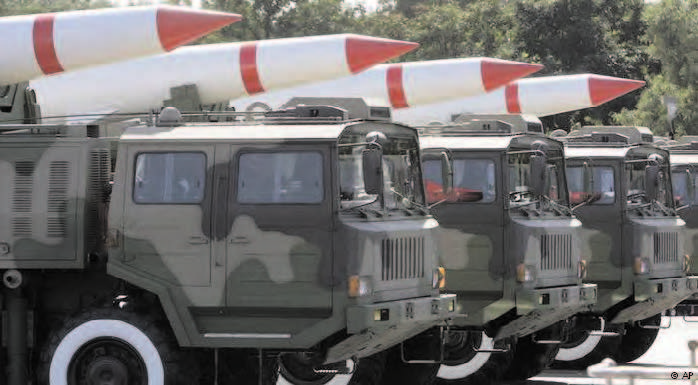
    Notable successes include a co-production deal with Pakistan to produce the JF-17 fighter, widespread sales of the basic but effective C- 802 anti-ship cruise missile, and an agreement to sell the HQ-9 air defense missile system to Turkey that has run into controversy over its incompatibility with NATO weapons systems.

    China also has exploited niche markets such as North Korea and Iran that the West won’t sell to, emphasizing its attractiveness to impoverished countries and pariah states, said Ian Easton, research fellow at The Project 2049 Institute, an Arlington, Virginia-based Asian security think tank.

    Both those US foes appear to have received satellite jamming and cyber warfare capabilities from China, along with technologies to break into private communications and spy on government opponents, Easton said.

    “All of these sales should be very disconcerting to American policymakers and military leaders,” he said, calling China’s rise to the third-place spot among exporters a “disturbing development” that could threaten the security of the US and its allies.

    China also offers leading-edge drone technology at competitive prices. One model, known variously as the Yilong, Wing Loong or Pterodactyl, has become especially popular with foreign buyers, although Chinese secrecy surrounding such sales makes it difficult to know how many are in service and where.

    Chinese state broadcaster CCTV quoted retired People’s Liberation Army Gen. Xu Guangyu saying at an air show two years ago that the unmanned aircraft, which can be armed with two guided missiles, would cost only about $1 million each. That is about 10 to 20 per cent of the price of a comparable US model such as the MQ-1 Predator. Rumored buyers include the United Arab Emirates, Uzbekistan and Saudi Arabia.

    However, China’s incremental growth and the yawning gap with industry leaders America and Russia show the limitations of its aspirations.

    The US retained a 31 per cent share of the global arms market, exporting to at least 94 recipients, SIPRI said. Countries in Asia and Oceania took 48 per cent of US exports, followed by the Middle East with 32 per cent and Europe at 11 per cent, it said.

    Russia was second with a 27 per cent global share, 39 per cent of which went to India — the world’s largest arms importer overall. China took 11 per cent of Russia’s exports, followed by Algeria.

    SIPRI uses a five-year moving average to account for fluctuations in the volume of arms deliveries from year-to-year and doesn’t provide monetary values, which are often distorted by governments providing weapons as gifts or at below-market prices.

  • PRINCE HARRY TO QUIT BRITISH ARMY IN JUNE

    LONDON (TIP): It’s a soldier’s life no more for Britain’s Prince Harry. Royal officials said on Tuesday that the 30-year old prince will leave the armed forces in June after 10 years of service that included two tours of duty in Afghanistan.

    Harry’s final army duties will include a four-week assignment in April and May with the Australian Defence Force. The prince will spend time in Darwin, Perth and Sydney and attend centenary commemorations of the World War I Gallipoli campaign in Turkey.

    Harry said that leaving the army had been “a really tough decision” but he was excited about the future.

    In a statement, Harry said he felt “incredibly lucky” to have had the chance to serve in the armed forces.

    “From learning the hard way to stay onside with my Color Sergeant at Sandhurst, to the incredible people I served with during two tours in Afghanistan _ the experiences I have had over the last 10 years will stay with me for the rest of my life,” he said. “For that I will always be hugely grateful.”

    Harry, who is fourth in line to the British throne, graduated from Sandhurst officers’ academy in 2006 and joined the Household Cavalry as an armored reconnaissance troop leader. He served in Afghanistan as a battlefield air controller for 10 weeks in 2007-2008 until a media leak cut his tour short.

    Keen to return to the front lines despite fears he would be a top Taliban target, Harry retrained as a helicopter pilot and served in Afghanistan in 2012-2013 as an Apache co-pilot gunner. Most recently he has served as a staff officer in the army’s London headquarters, playing a big role in bringing the Invictus Games _ an international sports competition for wounded troops _ to Britain.

  • IRAQ SAYS ISLAMIC STATE MILITANTS ‘BULLDOZED’ ANCIENT SITE

    IRAQ SAYS ISLAMIC STATE MILITANTS ‘BULLDOZED’ ANCIENT SITE

    BAGHDAD (TIP): Islamic State militants “bulldozed” the ancient Nimrud archaeological site near the northern Iraqi city of Mosul on Thursday using heavy military vehicles, the government said.

    A statement from Iraq’s Ministry of Tourism and Antiquities didn’t elaborate on the extent of the damage, saying only that the group continues to “defy the will of the world and the feelings of humanity” with this latest act.

    Nimrud is a 13th century B.C. Assyrian archaeological site located on the Tigris River just south of Iraq’s second largest city, Mosul, which was captured by the Islamic State group in June. The extremists, who control a third of Iraq and Syria, have attacked other archaeological and religious sites, claiming that they promote apostasy.

    Turkey rules out combat mission to to help Iraq retake Mosul

    Earlier this week a video emerged on militant websites showing Islamic State militants with sledgehammers destroying ancient artifacts at the Mosul museum, sparking global outrage.

    Last year, the militants destroyed the Mosque of the Prophet Younis – or Jonah – and the Mosque of the Prophet Jirjis, two revered ancient shrines in Mosul. They also threatened to destroy Mosul’s 850-year old Crooked Minaret, but local residents surrounded the structure, preventing the militants from approaching.

    Iraq’s national museum in Baghdad opened its doors to the public last week for the first time in 12 years in a move Prime Minister Haider al-Abadi said was to defy efforts “to destroy the heritage of mankind and Iraq’s civilization.”

    The Islamic State group has imposed a harsh and violent version of Islamic law in the territories it controls and has terrorized religious minorities. It has released gruesome videos online showing the beheading of captives, including captured Western journalists and aid workers.

    A U.S.-led coalition has been striking the group since August, and Iraqi forces launched an offensive this week to try to retake the militant-held city of Tikrit, on the main road linking Baghdad to Mosul.

  • California man charged with trying to join Islamic State

    California man charged with trying to join Islamic State

    LOS ANGELES(TIP): A 21-year-old man previously charged with lying on a passport application so he could fly to Syria to join the Islamic State terrorist group was indicted on a charge of trying to provide material support to a foreign terrorist organization.

    Adam Dandach was also charged in the superseding indictment with obstructing justice by trying to destroy records of his online activity to thwart investigators.

    Dandach was stopped in July in the Orange County airport while trying to board a flight to Turkey with an expedited replacement passport he got after he said he accidentally threw his old one away. Prosecutors said he knew that wasn’t true and that his mother had confiscated the passport when she heard about his plan to go overseas.

    The FBI said Dandach told agents he planned to pledge allegiance and offer to help the Islamic State in Syria any way he could. He told agents he believed the killings of American soldiers were justified.

    When told he could face criminal charges, Dandach said he was more disappointed about not going to Syria than about getting in trouble with the law, according to court papers.

    Dandach is in custody and scheduled to be arraigned March 16 on the new charges.

    “He’s going to plead not guilty and we’re going to fight them in court,” defense lawyer Pal Lengyel-Leahu said.

    The defendant, also known as Fadi Fadi Dandach, previously pleaded not guilty to lying on a passport application and using a passport secured through false statements. Prosecutors added in the new indictment that he committed those offenses to facilitate international terrorism.

    If convicted, Dandach could face up to 15 years in federal prison on the terrorism charge, and up to 25 years on each of the other counts, federal authorities said.

  • DEFLATION ALARMS RING LOUDER AS EU, CHINESE FACTORIES STRUGGLE

    DEFLATION ALARMS RING LOUDER AS EU, CHINESE FACTORIES STRUGGLE

    LONDON/SYDNEY (tip): European and Chinese factories slashed prices in January as production flatlined, heightening global deflation risks that point to another wave of central bank stimulus in the coming year.


    While the pulse of activity was livelier in other parts of Asia — Japan, India and South Korea — they too shared a common condition of slowing inflation.


    Central banks from Switzerland to Turkey via Canada and Singapore have already loosened monetary policy in the past few weeks.


    The European Central Bank also announced a near-trillion-euro quantitative easing programme in a bid to revive inflation and drive up growth, though much of the bloc’s Purchasing Managers’ Index survey was collated before that announcement.


    “There are a lot of places where central banks are focusing on easing rather than anything else. In the euro zone the ECB is going all-out now,” said Jacqui Douglas, senior global strategist at TD Securities.


    “Looking at the rest of Europe we are expecting more easing from Sweden and Norway, that is where most central banks are leaning right now. There is no real rush to move ahead with rate hikes.” 


    Markit’s final PMI reading for the euro zone, published on Monday, was 51.0, in line with the flash estimate. Although at a six-month high, it was only just above the 50 mark that separates growth from contraction. In December the index came in at 50.6.


    Worryingly for policymakers, firms cut prices in January at the steepest rate since mid-2013. Data on Friday showed annual inflation was a record-equalling low of -0.6 per cent in January across the 19 nations using the euro.


    In Britain, manufacturing grew slightly faster but factories cut prices at the fastest pace since 2009. The Bank of England will keep interest rates at a record low until at least October, later than previously thought, a Reuters poll found last week.


    “With oil prices having stabilised at around $45 per barrel now, it seems likely that lower oil prices should continue to enable manufacturers to lower prices and so support demand,” said Paul Hollingsworth at Capital Economics.


    Still to come later on Monday is a sister manufacturing survey from Markit covering the United States, as well as the Institute for Supply Management’s US factory index, which is forecast to have slipped to 54.5 in January from 55.1.


    Easing China? 


    Earlier, a pair of surveys from China showed manufacturing struggling at the start of 2015 in the world’s second biggest economy.


    The Chinese HSBC/Markit PMI inched up a fraction to 49.7. But of more concern the official PMI, which is biased towards large factories, unexpectedly showed activity shrank for the first time in nearly 2-1/2 years.


    The reading of 49.8 in January was down from December’s 50.1 and missed a median forecast of 50.2. The report showed input costs sliding at their fastest rate since March 2009, with lower prices for oil and steel playing major roles.


    Ordinarily, cheaper energy prices would be good for China, one of the world’s most intensive energy consumers, but many economists believe the phenomenon is a net negative for Chinese firms because of its impact on demand.


    The PMIs only fuelled bets on a weaker yuan and that more monetary easing was in store in Beijing too.


    “China still needs decent growth to add 100 million new jobs this year, plus China is entering a rapid disinflation process,” ANZ economists said in a note to clients.


    “We (think) the People’s Bank of China will cut the reserve requirement ratio by 50 basis points and cut the deposit rate by 25 basis points in the first quarter.” 


    The downdraft has also spread into China’s hitherto buoyant services sector, the lone bright spot in the economy last year. Service activity expanded at its lowest level in a year.


    Slightly better news came from Japan, where the central bank has been pursuing an aggressive bond-buying campaign for over a year in a bid to revive growth and shake the country out of decades of deflation.


    The final Markit/JMMA PMI edged up in January as the sustained weakness of the yen drove up exports. Improving exports were also a feature of South Korea’s PMI which returned to growth for the first time in five months.


    India’s manufacturing activity continued to grow, though the headline index eased a touch but importantly for the prospect of more policy stimulus, cost pressures were the mildest in 70 months as commodity prices fell.

  • Japan vows not to give up on 2 hostages till the very end

    Japan vows not to give up on 2 hostages till the very end

    TOKYO (TIP): Japan promised on January 23 not to give up “until the very end” on efforts to rescue two Japanese hostages threatened with beheading by Islamic militants demanding a $200 million ransom, after a deadline passed with no word from the captors.

    Militants affiliated with the Islamic State group posted an online warning Friday afternoon that the “countdown has begun” for the extremists to kill 47-year-old Kenji Goto and 42-year-old Haruna Yukawa. The extremists gave Prime Minister Shinzo Abe 72 hours to pay the ransom, and the deadline expired on Friday.

    The posting, which appeared on a forum popular among Islamic State militants and sympathizers, did not show any images of the hostages, who are believed to be held somewhere in Syria.

    Yasuhide Nakayama, a deputy foreign minister sent to Amman, Jordan, said he was working around the clock to coordinate efforts to save the hostages.

    “We will not rule out any possibility, and we are verifying all information thoroughly,” he said. “We will not give up until the very end to rescue the two so we can go home together.”

    Yet, the fate of the two men remained unclear on Saturday.

    Top government spokesman Yoshihide Suga was asked about Friday’s message and said Japan was analyzing it.

    “The situation remains severe, but we are doing everything we can to win the release of the two Japanese hostages,” Suga said. He said Japan is using every channel it can find, including local tribal chiefs, to try to reach the captors.

    He said there has been no direct contact with the captors.

    Abe met Friday with his National Security Council on the crisis.

    Japan has scrambled for a way to secure the release of Goto, a journalist, and Yukawa, an adventurer fascinated by war. Japanese diplomats had left Syria as the civil war there escalated, adding to the difficulty of contacting the militants holding the hostages.

    Worshippers at Tokyo’s largest mosque on Friday offered prayers for the two hostages.

    “All Muslims in Japan, we want the Japanese hostages to be saved as soon as possible,” said Sandar Basara, a worker from Turkey.

    Goto’s mother made an appeal for his rescue.

    “Time is running out. Please, Japanese government, save my son’s life,” said Junko Ishido. “My son is not an enemy of the Islamic State.”

    Ishido said she was astonished and angered to learn from her daughter-in-law that Goto had left for Syria less than two weeks after his child was born in October to try to rescue Yukawa.

    Suga said earlier the government had confirmed the identities of the two hostages despite discrepancies in shadows and other details in the ransom video that suggested it might have been altered.

    Japanese officials have not directly said whether they are considering paying any ransom. Japan has joined other major industrial nations in the Group of Seven in opposing ransom payments. U.S. and British officials said they advised against paying.

  • DEFENSE CONTRACTOR PLEADS GUILTY IN MASSIVE BRIBERY CASE

    DEFENSE CONTRACTOR PLEADS GUILTY IN MASSIVE BRIBERY CASE

    WASHINGTON (TIP): A Malaysian defense contractor pleaded guilty Thursday, January 15, in a corruption scandal of epic proportions, admitting that he bribed “scores” of U.S. Navy officials with $500,000 in cash, six figures’ worth of sex from prostitutes, lavish hotel stays, spa treatments, Cuban cigars, Kobe beef, Spanish suckling pigs and an array of other luxury goods.

    Leonard Glenn Francis, a businessman who charmed a generation of Navy officers while resupplying their ships in Asia, admitted in federal court in San Diego to presiding over a decade-long corruption scheme involving his Singapore-based firm, Glenn Defense Marine Asia. The investigation has steadily escalated into the biggest corruption case in the Navy’s history, with Francis admitting that he bilked the service out of tens of millions of dollars by overcharging for food, fuel and basic services. Five current and former Navy officials have pleaded guilty so far, and prosecutors have made it clear they are targeting others. The Navy has also stripped security clearances from two admirals, including the chief of naval intelligence, for their alleged involvement with Francis, although they have not been charged with a crime. Known in Navy circles as “Fat Leonard” for his girth, Francis, 50, agreed to forfeit $35 million in ill-gotten proceeds and could face up to 25 years in prison. But the most severe impact may turn out to be the blow to the Navy’s reputation, given the array of evidence that so many officers were corrupted so easily by a foreign defense contractor.

    “It is astounding that Leonard Francis was able to purchase the integrity of Navy officials by offering them meaningless material possessions and the satisfaction of selfish indulgences,” said Laura Duffy, the U.S. attorney for the Southern District of California, whose office has led the investigation. “In sacrificing their honor,these officers helped Francis defraud their country out of tens of millions of dollars. Now they will be held to account.” The criminal investigation has spanned eight states and eight Asian countries, with more than 100 law enforcement agents involved, court records show. In his plea agreement, Francis admitted that he and his firm defrauded the Navy by overcharging for hundreds of Asian port visits by U.S. ships and submarines. To ensure he didn’t get caught, he plied Navy officials with an array of temptations, including lavish meals, “top-shelf” alcohol, designer handbags, fountain pens, ornamental swords, computers, furniture and handmade ship models.

    Federal prosecutors disclosed Thursday that Francis has provided evidence against two more Navy officials who have yet to be charged: a lieutenant commander and a contract specialist whose names have not been made public. The unnamed contract specialist, a female civilian official based in Singapore for 20 years, was given a bottomless travel expense account, which she used to visit Bali, Bangkok, Dubai, Turkey and Greece, according to Francis’s plea agreement. In exchange, she worked as a mole for Glenn Defense Marine, handing over proprietary contracting information and advocating on the firm’s behalf. The scandal erupted into public view in September 2013, when federal agents lured Francis to a San Diego hotel and arrested him in a sting operation. The Navy says that it began scrutinizing Francis in May 2010 but that he was repeatedly able to thwart criminal investigators by bribing a senior agent with the Naval Criminal Investigative Service, who fed him sensitive files and helped to cover his tracks.

    Although Francis initially fought the charges against him, he agreed to cooperate with prosecutors in recent weeks.”Today Mr. Leonard Francis has taken accountability for his actions. He looks forward to a brighter future,” said Ethan M. Posner, one of his attorneys. Navy leaders have condemned the unethical behavior of officers involved in the case and have acknowledged that the scandal could grow even worse. Navy Secretary Ray Mabus has pledged to set up a special disciplinary process, led by a four-star admiral, to review allegations against Navy personnel who avoid federal criminal charges but may have run afoul of ethical regulations. “The Navy holds its personnel to the highest standards and those who fall short are held accountable,” Rear Adm. Dawn Cutler, a Navy spokeswoman, said in a statement. “NCIS uncovered the criminal activity associated with this case and continues to cooperate with the Justice Department.”

    Hours before Francis pleaded guilty Thursday, federal prosecutors won another conviction when a Navy captain, Daniel Dusek, admitted to disclosing military secrets to Francis and his firm in exchange for prostitutes, cash, and visits to luxury hotels in Hawaii, Hong Kong and the Philippines. According to a copy of his plea agreement, Dusek provided classified information about Navy ship schedules dozens of times to Glenn Defense Marine, which held contracts worth more than $200 million to supply Navy vessels throughout Asia. Dusek’s attorney, Douglas L. Applegate, did not respond to a phone call seeking comment. The Navy announced in October 2013 that it had relieved Dusek of command of the Bonhomme Richard for his alleged involvement in the scandal, but his appearance in court Thursday was the first sign that he had been under criminal investigation. According to court records, in October 2010, Dusek persuaded the Navy to send an aircraft carrier, the USS Abraham Lincoln, and its strike group to visit a port in Malaysia that was largely controlled by Glenn Defense Marine. As a result, the company was able to easily inflate invoices and overcharge the Navy for a variety of services. Dusek, then working as deputy director of operations for the 7th Fleet, provided the contractor with classified information about ship movements on dozens of occasions, further aiding the company in its scheme to gouge the Navy during port visits, the records show. Francis prized the arrangement so much that he called Dusek “a golden asset” in an email to another company executive, noting that he could “drive the big decks” – or aircraft carriers – “into our fat revenue” ports,” according to the records

    (Source: The Washington Post)

  • TURKEY WILL NOT ALLOW MOHAMMED TO BE INSULTED SAYS PM

    TURKEY WILL NOT ALLOW MOHAMMED TO BE INSULTED SAYS PM

    ANKARA (TIP): Turkey will not allow Mohammed to be insulted, Prime Minister Ahmet Davutoglu said January 15, describing the publication of cartoons of the prophet as an open provocation.

    “Freedom of the press does not mean freedom to insult,” Davutoglu told reporters in Ankara a day after leading Turkish daily Cumhuriyet and Turkish Internet sites published cartoons featuring the prophet from the special Charlie Hebdo issue.

    The newspaper produced a special four-page pull-out of cartoons and articles drawn from the French satirical magazine Wednesday in solidarity with the 12 people gunned down in an attack on its offices in Paris.

    “We do not allow any insult to the prophet in this country,” Davutoglu said. “As the government, we cannot put side by side the freedom of press and the lowness to insult.”

    Davutoglu said people were sensitive about their religion in the predominantly Muslim Turkey and could not be expected to show patience towards insults to the Muslim prophet.

    “If some print cartoons that insult the prophet — and this is the situation and there is a sensitivity in Turkey — it is a provocation… it is an open provocation,” said Davutoglu.

    “We are determined to protect the honour of the prophet the same way as we are determined in our stance against terrorism in Paris,” he said.

    A Turkish court on Wednesday ordered a block on access to websites featuring the latest cover of Charlie Hebdo, after a petition from a single lawyer claiming that the printing of the cartoon had the potential to endanger the public order.

  • Why this massacre of the innocents?

    Why this massacre of the innocents?

    It was a massacre of the innocents. Every report must admit this – because it’s true. But it is not the whole truth. The historical and all-too-real connections between the Pakistan army, the Inter-Services Intelligence (ISI) security police and the Taliban itself – buoyed by the corruption and self-regard of the political elite of the country – may well explain just how cruel this conflict in the corner of the old British Empire has become. And the more ferocious the battle between the military and the Islamists becomes in Waziristan, the more brutal the response of the Islamists.

    Miltary barbarity

    Thus when stories spread of Pakistani military barbarity in the campaign against the Taliban in Pakistan – reports which included the execution of Taliban prisoners in Waziristan, whose bodies were left to lie upon the roads to be eaten by animals- the more certain became the revenge of the Taliban. The children of the military officers, educated at the army school just down the road from the famous Edwardes College in Peshawar – were the softest and most obvious of targets. For many years, the ISI and the Pakistani army helped to fund and arm the mujaheedin and then the Taliban in Afghanistan.

    Saudis & weapons

    Only a few months ago, the Pakistani press was reporting that the Saudis were buying weapons from the Pakistani army to send to their rebel friends in Syria. Pakistan has been the tube through which America and its Arab allies supplied the anti-Russian fighters in Afghanistan, a transit route which continued to support the Taliban even after America decided that its erstwhile allies in that country had become super-terrorists hiding Osama bin Laden. Turkey is today playing much the same role in Syria.

    David Gosling, who was the principal of Edwardes College for four years until his return to Britain in 2010, believes that while individuals in the Pakistani army may wish for revenge after the Peshawar schoolchildren atrocity, the military may well now
    “soft-peddle their activities in Waziristan”. The Taliban, he says, “has always reacted to the army’s campaigns in Swat and Waziristan with bombs. The Pakistan army is going to be very disturbed by all this. Attacking civilian targets has a powerful effect on the population. These are soft targets. The army is going to be furious – but you have these close links between the ISI, the army and the Taliban…”

    Old loyalties

    For years, the Pakistani authorities have insisted that the old loyalties of individual military and security police officers to the Taliban have been broken – and that the Pakistani military forces are now fully dedicated to what the Americans used to call the “war on terror”. But across the Pakistan-Afghan border, huge resentment has been created by the slaughter of civilians in US drone attacks, aimed – but not necessarily successfully targeted – at the Taliban leadership. The fact that Imran Khan could be so successful politically on an anti-drone platform shows just how angry the people of the borderlands have become. Pakistani military offensives against the Taliban are now seen by the victims as part of America’s war against Muslims.

    But if the Pakistan security forces regard the Taliban as their principal enemy, they also wish to blunt any attempt by India to destroy Pakistan’s influence in Afghanistan; hence the repeated claims by the Afghan authorities – if such a term can be used about the corrupted institutions of Afghanistan – that Pakistan is assisting the Taliban in its struggle against the pro-American regime in Kabul. The army hates the Taliban – but also needs it: this is the terrifying equation which now decides the future of Pakistan.

    It may well be that the Taliban, knowing the dates of the American withdrawal in Afghanistan, now wishes to extend its power in Pakistan. More seriously, the greater the extension of Islamist rule in the Muslim Middle East – in Algeria and Libya, as well as in Syria, Iraq and Yemen, even in Lebanon – the more encouraged the Taliban becomes. As Sunni Muslims, they have often inflicted enormous carnage on their fellow Shia citizens in Pakistan -although without the headlines devoted to yesterday’s massacre.

    “You must remember,” Gosling says, “how enraged people were with the Israeli attacks on Gaza this year. People in Pakistan were furious at the casualty toll – more than 2,000 people, many of them children.” Needless to say, the phrase “massacre of the innocents” was not used about those children.

    Eight deadly years

    2014

    2 NOVEMBER: Taliban suicide bomber kills 60 people in an attack on a paramilitary checkpoint close to the Wagah border crossing with India.

    8 JUNE: A suicide bomber in the country’s south-west killed at least 23 Shia pilgrims returning from Iran.

    2013

    22 SEPTEMBER: Twin suicide bomb blasts in a Peshawar church kill at least 85 people.

    3 MARCH: Explosion in Karachi kills 45 Shia outside a mosque.

    10 JANUARY: Bombing in Shia area of Quetta kills 81 people.

    2012

    22 NOVEMBER: A Taliban suicide bomber struck a Shia procession in the city of Rawalpindi, killing 23.

    5 JANUARY: Taliban fighters kill 15 Pakistani frontier police after holding them hostage for more than a year.

    2011

    20 SEPTEMBER: Militants kill at least 26 Shia on a bus near Quetta.

    13 MAY: A pair of Taliban suicide bombers attack paramilitary police recruits in Shabqadar, killing 80, in retaliation for Osama bin Laden’s killing.

    2010

    5 NOVEMBER: A suicide bomber strikes a Sunni mosque in Darra Adam Khel, killing at least 67 during Friday prayers.

    1 SEPTEMBER: A triple Taliban suicide attack on a Shia procession kills 65 in Quetta.

    9 JULY: Two suicide bombers kill 102 people in the Mohmand tribal region.

    2 JULY: Suicide bombers attack Pakistan’s most revered Sufi shrine in Lahore, killing 47 people.

    29 MAY: Two militant squads armed with hand grenades, suicide vests and assault rifles attack two mosques of the Ahmadi minority sect in Lahore, killing 97.

    1 JANUARY: A suicide bomber drives a truckload of explosives into a volleyball field in Lakki Marwat district, killing at least 97 people.

    2009

    28 DECEMBER: Bomb blast kills at least 44 at a Shia procession in Karachi.

    9 OCTOBER: A suicide car bomber hits a busy market area in Peshawar, killing 53.

    2008

    20 SEPTEMBER: A suicide bomber devastates the Marriott Hotel in Islamabad with a truck full of explosives, killing at least 54.

    2007

    27 DECEMBER: Former Prime Minister Benazir Bhutto and 20 other people are killed in a suicide bombing and shooting attack in Rawalpindi.

  • ‘300 Chinese fighting for ISIS in Mideast’

    ‘300 Chinese fighting for ISIS in Mideast’

    BAGHDAD (TIP): About 300 Chinese people are fighting alongside the ISIS in Iraq and Syria, a Chinese state-run newspaper said on Monday, December 15, a rare tally that is likely to fuel worry in China that militants pose a threat to security. China has expressed concern about the rise of ISIS in the Middle East, nervous about the effect it could have on its Xinjiang region. But it has also shown no sign of wanting to join US efforts to use military force against the group.


    Chinese members of the East Turkestan Islamic Movement are traveling to Syria via Turkey to join the ISIS, the Global Times, a tabloid run by China’s ruling Communist Party’s official newspaper, the People’s Daily, said.

    “According to information from sources, including security officers from Iraq’s Kurdish region, Syria and Lebanon, around 300 Chinese extremists are fighting with IS in Iraq and Syria,” the Global Times reported.

    Chinese officials blame the ETIM for carrying out attacks in Xinjiang, home to the Muslim Uighur people. But the government has been vague about how many people from China are fighting in the Middle East.

    In July, China’s envoy to the Middle East, Wu Sike, cited media reports when he said about 100 Chinese citizens, most of them from the ETIM, were in the Middle East fighting or being trained.

    China says ETIM militants are also holed up along the ungoverned Afghan-Pakistani border and want to create a separate state in Xinjiang, though many foreign experts doubt the group’s cohesiveness.

    Instead, human rights advocates argue that economic marginalization of Uighurs and curbs on their culture and religion are main causes of ethnic violence in Xinjiang that has killed hundreds of people in the past two years.

    China has criticized the Turkish government for offering shelter to Uighur refugees who have fled China through Southeast Asia and said such a channel creates security risks.

  • 423 criminals from India living in Britain

    423 criminals from India living in Britain

    LONDON ()TIP): Around 423 criminals from India are presently living in Britain. Data revealed by Britain’s National Audit Office has shown that as of March 2014, 10,650 criminals from overseas have been living in UK. Shockingly, between January 2009 and March 2014, 151 foreign national offenders (FNOs) left prison without being considered for deportation. One in six FNOs in the community – 760 convicted criminals – had absconded with 400 of them had been missing since before 2010.

    Around 58 of them have been classed as “high harm” individuals including rapists, murderers and pedophiles. Poland dominated the list of top 10 nationalities of foreign offenders living in UK – 898 followed by Ireland 778, Jamaica 711, Romania 588, Pakistan 522, Lithuania 518 and Nigeria 468. India stands next with the number of offenders living in UK increasing from 402 to 423 between 2013 and 2014. Figures from the Home Office show that there are more than 700 murderers and 500 rapists among nearly 12,000 foreign offenders in UK. The full list, entitled the Foreign National Offender Caseload include 775 murderers, 587 rapists, 155 child rapists and 15 convicted terrorists.

    Also in the category of most serious offences are 99 other killers convicted of manslaughter and 228 paedophiles. The list also includes 88 criminals found guilty of attempted murder, 1,022 of serious violent assaults, 497 burglars, and 43 arsonists. NAO said “Removing FNOs from the UK continues to be inherently difficult and public bodies involved have been hampered in their efforts by a range of barriers, although poor administration has still played a part. The number and speed of removals can be restricted by law – typically the European Convention on Human Rights and EU law on the free movement of persons.” “Until recently, FNOs had 17 grounds for appeal that could delay removal.

    Administrative factors also form barriers with some FNOs exploiting legal and medical obstacles to removal. Many overseas countries are unwilling to receive FNOs back home. However, lack of joint working and administration errors have often led to missed opportunities for removal.” Just over half of the 2,710 persons arrested for terrorism-related offences since September 11, 2001 self-declared their nationality as British or of British dual nationality (1,420, or 52%). Of the remaining persons arrested and excluding those who declared a dual nationality, the most frequently selfdeclared nationalities were: Algeria (156 persons), Pakistan (135), Iraq (117), Afghanistan (75), Iran (63), India (59), Turkey (50) and Somalia (49). The most frequent principal offences for persons convicted since September 11, 2001 under terrorism legislation were preparation for terrorist acts (25% of persons convicted), collection of information useful for an act of terrorism (16%) and failing to comply with duty at a port or border controls (12%).

    In recent years the proportion of persons arrested who self-defined as either British or British dual nationality has been higher than the proportion since September 11, 2001. Of the 239 persons arrested for terrorismrelated offences in the year ending June 30, 2014, 181 (76%) self-defined as either British or British dual nationality.

  • Americans Together organizes Thanksgiving Celebrations and Awards Night

    Americans Together organizes Thanksgiving Celebrations and Awards Night

    Congresswoman Eddie Bernice Johnson graces the occasion

    Report/photos by Zia Khan/ 214-207-7922 DALLAS (TIP): Congresswoman Eddie Bernice Johnson of Texas presided over the proceedings of the 16th annual thanksgiving celebrations and awards night organized by Americans Together on Saturday, November 22, 2014. It was a bridge building event between communities. We ought to be thankful to Native Americans, who did not put the electric fence around Americas to keep the illegal aliens like Columbus and other Europeans from entering America without a visa.


    2
    Mike Ghouse, President of Americans Together and the chief architect of the Thanksgiving celebrations underscored the importance of sharing, caring and thanksgiving.


    Today, we are a nation of immigrants, other than the natives; almost all of us are immigrants from one to several generations. The event was organized by America Together Foundation, World Muslim Congress. And the Foundation for Pluralism, all committed to building a cohesive America where no American has to live in tension, discomfort, apprehension or fear of the other. The purpose of celebrating this event was to thank God for guiding us to learn to respect the otherness of others, and accept the God given uniqueness of each one of us. And more importantly it is to familiarize the new immigrants with the festivities.


    3
    The honorees with Congresswoman Eddie Bernice Johnson and Mike Ghouse


    You’ll be surprised to find that many of them have not even seen the thanksgiving meal and its fixings. It was not a part of their study for citizenship and apparently no one has done this as a public event. “Congresswoman Johnson represents the aspiration of fellow Americans; justice and liberty for every American in his or her pursuit of happiness, and she fights for that relentlessly – Is that the kind of congressperson we want?, well here she is.” Mike Ghouse welcomed her amidst a thunderous applause.


    4
    A view of the gathering


    To paraphrase Congresswoman Johnson, “we have made sacrifices to respect the human rights, civil liberties and freedom for our new generations and now they have those rights. On the map of the world, ours is still the best country. The immigrant community has always played an important role in the development of US.” It was a delight to watch the Congresswoman carve the symbolic turkey, and sharing what thanksgiving means to her; to count your blessings.

    For many a immigrants it is an introduction to the American way of life and who else can do a better job than the Congresswoman? Through her efforts and against all impediments, she has realized her American dream. Chef Ali of Spicy Cuisine in Irving prepared delicious vegetarian and non-veg meals with a fixing of thanksgiving delicacies. Congresswoman Johnson presented the awards to four community leaders and delivered a beautiful keynote address on gratitude,while highlighting the need for events like this to bring people together regardless of their political, religious, racial or and social affiliation to build a safe, secure and a cohesive America.

    Mike Ghouse, president of the foundation shared the real life stories that exemplify thanksgiving; stories about Appaiah and the hospitality in Saudi Arabia. How each one of us can restore the spiritual balance within and live a productive, meaningful and a purposeful life. The Appaiah story was published in Huffington Post Link , and the Saudi story, all pictures, and notes will be at www.ThanksgivingCelebrations.org The attendees were represented by people of different faiths, races, political orientations and other uniqueness’s. They cheered on when Mike Ghouse, chair of the event asked.

    Whether you are Jewish, Hindu, Muslim, Gay, Lesbian, Black, White, Native, Immigrant, Republican or Democrat, how many of you like to see your Congress person represent you with equal care and consideration? How many of you would like to see your congress person treat you with dignity and respect regardless of who you are? Well here she is, Congresswoman Eddie Bernice Johnson.” She delivered a beautiful key note speech about Gratitude. The following individuals were recognized for their outstanding contributions to building bridges in the communities we live – the title conferred upon all of them was “Pluralist” – meaning someone who respects the otherness of others. Every society has heroes – that is men and women who have gone beyond their normal self to serve the communities at large, and it is our responsibility as a society to acknowledge, cherish and honor them.

    Here is a brief introduction of the recipients; detail profiles will be available at www.thanksgivingcelebrations.org. Raja Zahid A. Khanzada –

    a Journalist for his “Commitment to truth in Journalism.” He reports for the top news media conglomerates in Pakistan and has been a catalyst in a process of “forgiveness” of the robbers – where they surrendered their guns in return for acceptance in the society to live and breathe a normal life, and be the contributors of the nation. It is sort of what President Obama is doing with the undocumented aliens, a noble thing to do. Raja is a relentless pursuer of education with three Master’s degrees and a degree in Homeopathic medical sciences and holds certification from American Alternative Medicine Practitioner Board in practice of alternative medicine. He amazed everyone when he asked his mother to receive the plaque.

    Amina Rab –

    a community activist and leader for “Building Bridges.” Amina is deeply committed to building bridges between the Muslim community and other communities. It is not her job, but a passion to build bridges. She is the President of the Council on American Islamic Relations- DFW chapter and is the first woman to serve on the North Texas Islamic Council, and is a founding Board member of Texas Muslim Women’s Foundation. She is a Scientist in the healthcare industry for 20 years. Amina is an entrepreneur with a home based business, a mother, a grandmother and a community Activist with a passion to promote peace and justice in the world.

    Anne Marie Weiss –

    a community leader for “Bringing the DFW communities together.” Anne Marie single handedly started the DFW international in early nineties – she had the vision for making the Dallas/ Fort worth an international Metroplex, even before it was declared as such. Today, DFW International has become an exemplary institution in America. There is nothing like it. Where can you find connections to every cultural, religious, social and ethnic group in one place? None in America! She has put Dallas Fort Worth on the world Map. If you see the demographic statistics of nationalities and ethnicities in Dallas, it was her effort. It is her selfless devotion to the belief that DFW should genuinely reflect its diversity.

    Sante Santhanam Chary –

    is a national figure in “Connecting the World Leaders.” Sante is one of the very few Americans, perhaps the only immigrant who has met, shook hands and shared a message with 7 American Presidents and 8 Indian Presidents/Prime Ministers. Sante is continuously forging political and business ties between the United States and India and in September this year, he got the US Senate to pass a resolution creating “2014 U.S.-India Partnership Day” to honor Prime Minister Narendra Modi’s visit to the US. He has set a new world record by collecting over 55 contemporary signatures in solidarity on a USPS issued First Day Envelope with Mahatma Gandhi’s stamp on it. Sante is a healthcare entrepreneur with a focus on physician staffing services to small towns in the US. He is a graduate of The Harvard Business School and the Thomas Jefferson School of Law.

  • Pope Francis pleads for dialogue to end extremism on Turkey visit

    Pope Francis pleads for dialogue to end extremism on Turkey visit

    ANKARA (TIP): Pope Francis on November 28 called for dialogue between faiths to end the Islamist extremism plaguing the Middle East as he visited Turkey on his first trip to the overwhelmingly Muslim but officially secular state. Turkish President Recep Tayyip Erdogan, who welcomed Pope Francis as the first foreign dignitary to his controversial new presidential palace outside Ankara, for his part issued a strong warning about rising Islamophobia in the world.

    The visit of the pope is seen as a crucial test of Francis’s ability to build bridges between faiths amid the rampage by Islamic State (IS) jihadists in Iraq and Syria and concerns over the persecution of Christian minorities in the Middle East. “Inter-religious and inter-cultural dialogue can make an important contribution… so that there will be an end to all forms of fundamentalism and terrorism,” the leader of the world’s Roman Catholics said after talks with Erdogan. He said the world “could not remain indifferent” to the causes of the tragedies in the Middle East and appeared to indicate military action could be permitted with the proper legal backing.

    While an “unjust aggressor” could be thwarted, the problem cannot be resolved solely through a military response, Francis said. Speaking in an overwhelmingly Muslim country which has a tiny but culturally significant Christian minority, the pope pointedly said all faiths should share the same rights. “It is essential that all citizens — Muslim, Jewish and Christian — both in the provision and practice of the law, enjoy the same rights and respect the same duties.”

    Turkey’s own Christian community is tiny — just 80,000 in a country of some 75 million Muslims — but also extremely mixed, consisting of Armenians, Greek Orthodox, Franco-Levantines, Syriac Orthodox and Chaldeans. Erdogan — long been accused by opponents of seeking to erode Turkey’s secular foundations with creeping Islamisation — chose the occasion to make a characteristically strong-worded warning against growing Islamophobia in the world. “Islamophobia is rising seriously and rapidly.

    We must work together against the threats weighing on our planet – – intolerance, racism and discrimination,” said Erdogan. He angrily accused the international community of “simply being spectators” in the face of the “state terror” of the regime of Syrian President Bashar al-Assad and Israel’s bombardment of Gaza earlier this year. “There is a double standard and an injustice,” he said. Turkey’s top cleric Mehmet Gormez went even further in comments after his meeting with the pope, expressing concern that Islamophobic “paranoia that has already been spread among Western public opinion” was being used as a pretext for discrimination against Muslims.