
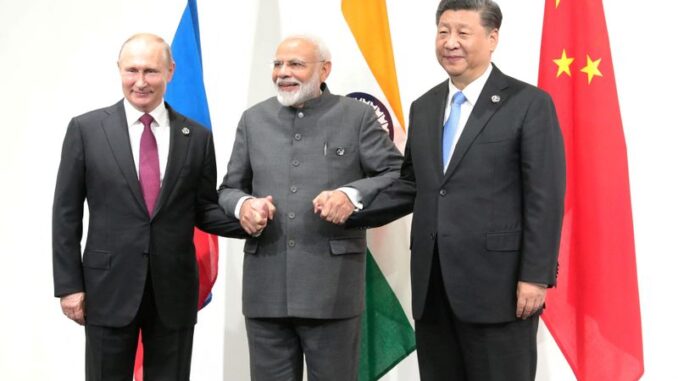

The Great Game: India’s presidency of BRICS may not signify that it is on board an alternative view of the global order
The problem with the current debate on foreign policy and national interest is that actually there’s no debate. Delhi’s policy elite is arrogantly dismissive of criticism on two counts — first, the view from the provinces is seen as being, well, too provincial — clearly, we don’t understand the big picture well enough.

Prime Minister Modi is readying to receive some of the world’s most powerful leaders at the BRICS summit on September 12-13 — not just by personally pushing to reduce the temperature at home over the GenZ protests with Instagram selfies that directly speak to his young audience, passing anti-paper leak legislation in record time in Parliament or by having cases dropped against protesters — but by willing to stand up against the tide and invite folks to New Delhi, including those being shunned by Washington DC.
One of those men is Russian President Vladimir Putin, against whose country the US Senate has this week passed the Lindsey O. Graham Sanctioning Russia Act of 2026, by an overwhelming 86-12 vote, permitting the slapping of 100% tariff against nations who buy Russian energy or its military equipment.
The Russia Act also invokes new sanctions against Putin and 20 other top people who work in the Russian defense industry.
First, some bald facts. China, India and Turkiye are among the top five buyers of Russian energy. And despite a defense framework agreement with the US that promises to strengthen “interoperability across all domains, including land, sea, air, space and cyberspace,” India remains a key customer of Russian arms. According to the US Congress, since 2008, 59% of India’s defense imports have come from Russia, 12% from France, 10% from the US and 9.5% from Israel.
Just two of those Russian pieces of equipment, the S-400 missile system and the BrahMos missile, were singularly helpful in tilting the balance against Pakistan during Op Sindoor. (It’s another matter that Donald Trump insists he brokered the end of the conflict between India-Pakistan, a fact that India strenuously denies.)
As for the purchase of Russian energy, Kpler, the real-time global data and analytics provider, says that the Indian purchase of Russian crude crossed 2 million barrels per day over March-June 2026 and is well on its way to touching 3 million barrels per day. (In this time, India bought 244.89 million barrels from Russia, 58.57 million barrels from the UAE and 57.62 million barrels from Saudi Arabia.) This means that Russian energy imports account for as much as an incredible 50% of India’s energy needs today.
Clearly, with the Strait of Hormuz still shut and tension in the Red Sea not abating in the wake of the prolonged standoff between the US and Iran, India has been forced to return to buying cheaper Russian oil, despite its earlier pleadings and promises that it will wean itself off this addiction in the face of looming US tariffs.
Question is, whether India is going to throw all this goodness away in order to evade US sanctions in the light of the recent passage of the Russia Act. Clearly, the answer is no. India needs Russian crude to keep the wheels of the economy churning so as to keep the evil forces of poverty and unemployment at bay. You don’t need to be a rocket scientist to understand that the GenZ protests were triggered not just by NEET paper leaks but also by a rapidly growing despair about rising prices and lack of jobs.
The problem with the current debate on foreign policy and national interest is that actually there’s no debate. Delhi’s policy elite is arrogantly dismissive of criticism on two counts — first, the view from the provinces is seen as being, well, too provincial — clearly, we don’t understand the big picture well enough.
So whether it’s Punjab and Gujarat’s trauma of deported illegals, bound hand and foot in chains; or the Centre’s refusal to open the Kartarpur Sahib corridor; or Myanmar’s army personnel crossing the border to take refuge in Mizoram; or Sikkim’s need to open up border trade with China; or Bihar’s angst over the denial of roti-beti relationships with the Nepal Terai — all these issues of India’s states and their neighborhood are seen as important, but not significant enough to influence foreign policy.
The second count may be dubbed the ‘Jurassic Age’ view — this means that if you don’t agree with the Delhi elite version of India’s national interest, or believe that India must be non-aligned, or that India must have the freedom to align itself depending on the issue at hand, then you are condemned to be a diplomatic dinosaur.
This is where the BRICS summit comes in. On the face of it, India’s presidency of this forum signifies that it is on board an alternative view of the existing US-led world order; in fact, India is nervous about China’s rise as a global power on a par with the US, remains transactional about the tie with Russia (on both energy and defense), and is more or less indifferent about both Brazil and South Africa.
Truth is, India is so concerned about the potential impact of the Russia Act on its relationship with the US, because it doesn’t want the all-important tie between Delhi and DC to be damaged in any way. Nor can it deny, however, that Russia has been bailing out New Delhi, especially on the energy front. That’s why the recent meeting between External Affairs Minister S Jaishankar and US Secretary of State Marco Rubio in Manila was crucial — we don’t know what came of it, except a bland comment that both discussed everything, including the T-word, tariffs.
That’s also why the next six weeks in the run-up to the BRICS summit will be critical — first, it will be interesting to see whether the big leaders, both Xi Jinping and Vladimir Putin, will show up; certainly, Xi is not confirmed and it’s not clear whether he thinks it’s worth his while. Second, even if Putin lands up, as he and PM Modi clearly have a personal equation, the question remains whether the PM can reorient India’s ship in favor of true multi-alignment — where India picks its friends and partners framed only by its national interest, one which is also defined by its citizens who live in the provinces and not just by the Nayi Delhi elite.
In the last few days, the PM has cut through the whirlpool of the BJP’s own making by directly reaching out to India’s despairing youth brigade. Perhaps it’s time to turn the scalpel towards foreign policy and run an honest appraisal of what’s what. What does India really want? And who are its trustworthy friends?
(Jyoti Malhotra is Editor-in-Chief of The Tribune group of newspapers. She has worked with India’s top newspapers, across print, TV and digital, both in English and Hindi media, and is a regular contributor on BBC Radio. Her X & Insta handles are @jomalhotra & email is jyoti.malhotra@tribunemail.com)

Be the first to comment