LONDON (TIP): Two nurses from India are in the running for a prestigious USD 250,000 Global Nursing Award, organized by Dubai-headquartered private healthcare service provider Aster DM Healthcare to honor the contributions of nurses worldwide.
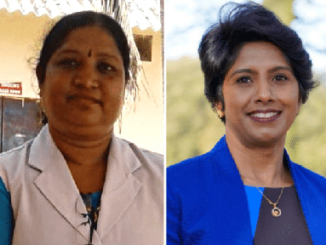
Shanti Teresa Lakra, who works among Particularly Vulnerable Tribal Groups (PVTGs) in the Andaman and Nicobar Islands, and Kerala-born and Ireland-based Jincy Jerry are among 10 worldwide finalists undergoing a public voting process before being evaluated by a grand jury judging panel for the award.
The winner will be awarded at a ceremony in London on May 12, which is marked worldwide as International Nurses Day.
“The Aster Guardians Global Nursing Award was started because we felt a necessity to celebrate the nurses and recognize them,” said Dr Azad Moopen, India-born Founder Chairman and Managing Director of Aster DM Healthcare, which operates healthcare services in India and the Gulf.
“We have about 8,000 nurses in our own organization, and we have seen the way in which they put their heart and soul into serving and saving the patients. Being a doctor, I have seen and appreciated their hard work for the healthcare system at large and most recently over the COVID challenges. They were the frontline soldiers in that fight,” he said.
Shanti Teresa Lakra, from the G.B. Pant Hospital in Port Blair and a Padma Shri recipient for her nursing service over the years, has spent considerable time within the tribal community of Andaman and Nicobar to gain their trust and assist with their healthcare needs.
In 2004, when the tsunami hit the Ongee Island habitat and drove them deep into the jungle, she made her home with them and lived in an open tent. She now works for all the major tribes in the region, something which brought her to the attention of the global award.
“I work as a grassroots level worker in a very remote area and my whole world belongs to the tribals residing in a very interior and isolated part of Andaman and Nicobar islands. To be a finalist in these awards is overwhelming because I never dreamt of it,” said Lakra, in an interview ahead of the award ceremony.
She pointed to language and other socio-economic barriers that make her work on the island quite challenging but fulfilling at the same time. “They are very shy by nature, and it isn’t easy for them to share information about their health problems. I strive to provide the best care I possibly can,” she said. The other nurse from India in the running for the public vote is Jincy Jerry of Mater Misericordiae University Hospital in Dublin, who serves as Assistant Director of Nursing for Infection Prevention and Control.
Her work in designing an appropriate software solution to cut down on the potential for human error while collating results from laboratories is among the factors behind her being shortlisted. Jerry, who is also part of the Infection Prevention Society UK, firmly believes that innovation is a way to increase quality and patient safety.
“In 2020, I introduced robotic process automation to the hospital. Our workload was very high at the time, so we introduced the system to counter that. Currently, I am working on around eight projects in the pipeline including work on using artificial intelligence (AI) to assist, train and modify behaviors on hygiene,” said Jerry, whose work has also been recognized by the Irish Healthcare Awards.
“If we have the right technology, we can save so much valuable time. It’s crucial that the nursing profession benefits from it,” she added.
Besides the nurses from India and Ireland, high-achieving nurses from England, the UAE, Kenya, Tanzania, Panama, Singapore, Portugal and the Philippines make up the finalists in the public vote stage of the vote before the winner is announced in London on Friday. Aster DM Healthcare said it chose the UK capital for the 2023 award ceremony for its strong healthcare tradition in the state-funded National Health Service (NHS) and as the birthplace of Florence Nightingale – the founder of modern nursing.
Tag: UAE
-

Two nurses from India shortlisted for Global Nursing Award
-

INVESTORS’ SUMMIT
Will ensure ease of doing business: Punjab CM
Mohali (TIP)- Underlining the government initiatives towards facilitating the ease of doing business for the new industrial units in Punjab, Chief Minister Bhagwant Mann On February 23 unveiled the roadmap for industrial growth with minimal government interference. He was addressing the inaugural session of the fifth Progressive Punjab Investors’ Summit at the Indian School of Business (ISB) here. The CM said, “We will abolish the necessity of obtaining the change of land use (CLU) and no objection certificates.” He said, “This summit is not about signing MoUs. This is a platform for learning and sharing ideas. We don’t want to repeat the habit of making big announcements about MoUs, as done in the past. Majority of those showed no result on the ground.”
He unveiled the new Industrial and Business Development Policy with incentives for investors undertaking expansion projects, setting up new MSMEs or large units, start-ups in service and manufacturing sectors. Punjab is developing 20 rural industrial clusters and 15 industrial parks. The state has received investment worth over Rs 40,000 crore since March 2022 and generated around 2.5 lakh employment opportunities. He also made a special mention of the investments received from Japan, UK, UAE, USA, Germany, South Korea, Singapore, Spain, France, Italy and other countries.
Investment Promotion Minister Anmol Gagan Mann said, “We are investing heavily in developing infrastructure to attract tourists with special emphasis on adventure and water tourism.” Medanta Group chairman Dr Naresh Trehan said, “We are coming to Punjab. We are working on establishing ourselves in Punjab as soon as possible.”
Mahindra and Mahindra executive director Rajesh Jejurikar said, “We have invested in Punjab for decades. We have grown five times since 2007. We have four manufacturing units in Punjab and are investing in the fifth one, which at present, is under construction.” Cargill (India) president Simon George said, “We have 13 manufacturing locations in the country. We made the first investment in Punjab in 2016. We are in the process of doubling our investment here over the next two years.”
RJ Corp chairman Ravi Kant Jaipuria said, “We have two large plants in Punjab at Phillaur and Pathankot. We are in the process of doubling our production at the Pathankot unit.” Source: TNS
-

India abstains on UNHRC resolution to investigate human rights violations, crimes in Russia-Ukraine war
The resolution was adopted with 32 votes in favor, two against (Russia and Eritrea) and 13 abstentions, including India, China, Pakistan, Sudan and Venezuela
GENEVA/ UNITED NATIONS (TIP): India on Friday, March 4, abstained in the UN Human Rights Council on a vote to urgently establish an independent international commission of inquiry to investigate alleged human rights violations and related crimes following Russia’s military operation in Ukraine. The 47-member Council voted on a draft resolution on the ‘Situation of human rights in Ukraine stemming from the Russian aggression.’ The resolution was adopted with 32 votes in favor, two against (Russia and Eritrea) and 13 abstentions, including India, China, Pakistan, Sudan and Venezuela.
The countries voting in favor included France, Germany, Japan, Nepal, UAE, UK and the US.
The resolution, which strongly condemned Russia’s aggression against Ukraine, decides to “urgently establish an independent international commission of inquiry” to “investigate all alleged violations and abuses of human rights and violations of international humanitarian law, and related crimes, in the context of the Russian Federation’s aggression against Ukraine, and to establish the facts, circumstances, and root causes of any such violations and abuses.”
A day before the resolution was adopted, India said at the Urgent Debate Thursday regarding the human rights situation in Ukraine at the 49th Human Rights Council Session in Geneva that it is greatly concerned over the steadily worsening humanitarian situation in Ukraine.
India urged for an immediate cessation of violence and an end to hostilities. “No solution can ever be arrived at the cost of human lives. Dialogue and diplomacy are the only solution for settling differences and disputes,” India said.
India called for respect and protection of human rights of people in Ukraine and safe humanitarian access to conflict zones.
“We are also deeply concerned over the safety and security of thousands of Indian nationals, including young Indian students, who are still stranded in Ukraine. We are working together with neighboring States for their evacuation,” it said.Three human rights experts will be appointed to the Commission of Inquiry by the President of the Human Rights Council for an initial duration of one year. The Commission will be mandated to “identify, where possible, those individuals and entities responsible for violations or abuses of human rights or violations of international humanitarian law, or other related crimes, in Ukraine, with a view to ensuring that those responsible are held accountable.’ The resolution expressed grave concern at the ongoing human rights and humanitarian crisis in Ukraine and calls on Russia to “immediately end its human rights violations and abuses and violations of international humanitarian law in Ukraine”.
It also calls for the “swift and verifiable” withdrawal of Russian troops and Russian-backed armed groups from the entire territory of Ukraine, within its internationally recognized borders. India has abstained on two resolutions on Ukraine in the 15-nation Security Council and one in the 193-member General Assembly in the last one week. The UN General Assembly this week overwhelmingly voted to condemn Russian aggression against Ukraine and demanded that Moscow “completely and unconditionally” withdraw all of its military forces from the territory of Ukraine. India abstained on the resolution, which received 141 votes in favor, five against and a total of 35 abstentions.
(Source: PTI)
-

Indian-origin Student Gets 10-Year UAE Golden Visa
DUBAI (TIP): An Indian-origin student has received the UAE’s coveted 10-year Golden Visa, which is mostly reserved for prominent global personalities, for her merit and excellent academic credentials, according to a media report.
Tasneem Aslam from Kerala received the Golden Visa in the exceptional student category and is allowed to stay in the country till 2031, media reported.
The UAE government in 2019 implemented a new system for long-term residence visas, enabling foreigners to live, work and study in the UAE without the need of a national sponsor.
These golden visas are issued for five or 10 years and will be renewed automatically.
“This is one of the best moments in my life. I feel privileged to achieve this and I am thankful to Almighty Allah. My parents ‘support has been enormous, and Insha Allah I hope to sponsor them in near future,” Tasneem told the media.
Tasneem studied Islamic Sharia from Al Qasimia University in Sharjah and topped her class, which consisted of pupils from 72 nationalities, with a grade point average (GPA) of 3.94 on 4.
Typically, the 10-year golden visa is targeted at wealthy individuals keen to offer the UAE significant investment in exchange for an opportunity to reside within the country.
Besides entrepreneurs, individuals with specialized talent like doctors, researchers, scientists and artists can also apply for the visa.
Exceptional high school and university students are eligible for a 5-year residency visa in the UAE.
Recently, Bollywood actor Sanjay Dutt also received the Golden Visa.
-

NRI tycoon Yusuffali pays nearly $1.5 million blood money to save Indian national in the UAE
ABU DHABI (TIP): A 45-year-old Indian, who was on death row in the United Arab Emirates for killing a young Sudanese boy in a road accident in 2012, can’t believe that he will be a free man and can return to the country to be with his family.
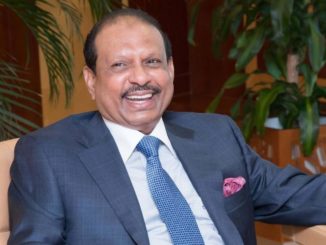
Becks Krishnan was saved by prominent NRI businessman and philanthropist M A Yusuffali who helped to pay his “blood money” amounting to nearly $1.5 million.
Krishnan, who hails from Kerala, was sentenced to death by the UAE Supreme Court after he was found guilty of killing a young Sudanese boy when he recklessly drove and rammed his car into a group of children in September 2012.
Ever since, his family and friends have been trying hard for Krishnan’s release without any success, especially as the victim’s family had already gone back and settled in Sudan, putting an end to any discussion or pardon.
The Krishnan family then approached Yusuffali, Chairman of Lulu Group, who went about getting the details of the case and got in touch with all stakeholders.
Ultimately, in January 2021, the victim’s family in Sudan agreed to pardon Krishnan. Subsequently, Yusuffali paid 500,000 Dirhams (Rs one crore approximately) as compensation in the court to secure the man’s release, the Lulu group said here in a statement.
Talking to the Indian embassy officials yesterday in Al Watba Jail in Abu Dhabi, a highly emotional Krishnan could not believe the turn of events.
“It’s a re-birth for me, as I had lost all hope of seeing the outside world, let alone a free life. My only wish now is to see Yusuffali once before flying to my family,” Krishnan was quoted as saying in the statement.
When asked for his comments, Yusuffali simply thanked the almighty for the release of Krishnan and the benevolence of visionary rulers of the UAE for the release of Krishnan and wished him a happy and peaceful life ahead.
All legal procedures related to Krishnan’s release have been completed on Thursday, and he is expected to travel back to his hometown in Kerala soon, putting an end to nine years of agony for him and his family, a senior official of the Lulu Group told PTI over the phone.
Abu Dhabi-based Lulu Group, that owns Lulu Hypermarkets and shopping malls, is one of the top retailers in the Middle East and North African region (MENA). — (Source: PTI)
-
UK bans direct flights from UAE, shutting world’s busiest international route
London/Sydney (TIP): Britain is banning direct passenger flights to and from the United Arab Emirates from Friday, shutting down the world’s busiest international airline route from Dubai to London. Britain said it was adding the United Arab Emirates, Burundi and Rwanda to its coronavirus travel ban list because of worries over the spread of a more contagious and potentially vaccine-resistant COVID-19 variant first identified in South Africa. “This means people who have been in or transited through these countries will be denied entry, except British, Irish and third country nationals with residence rights who must self-isolate for ten days at home,” UK Transport Minister Grant Shapps said on Twitter on January 28. Emirates and Etihad Airways said on their websites they would suspend all UK passenger flights from 1300 GMT on Friday when the ban takes effect.
Dubai airport, in a statement, advised passengers booked on flights due to arrive in the UK after the ban comes into effect to not go to the airport and instead contact their airline.
The UK Transport Department advised British nationals currently in the United Arab Emirates to make use of indirect commercial airline routes if they wished to return to Britain.
Due to border closures caused by COVID-19, Dubai to London was the world’s busiest international route in January with 1,90,365 scheduled seats over the month, according to airline data provider OAG. Emirates and Etihad normally carry large numbers of passengers connecting from Britain to destinations sucha as Australia through their airport hubs, meaning the decision to cancel those flights will have far-reaching implications. The Australian government said it would add more charter flights from Britain if needed as a result of the Emirates and Etihad cancellations. Eran Ben-Avraham, an Australian stranded in Britain due to strict limits on the number of arrivals in Australia, said his options for getting home were continually shrinking. “At the moment, it is only giving us three options of flying Qatar, ANA or Singapore Airlines,” he told the Australian Broadcasting Corporation. “Every day, it is making it more difficult to get home. The flights back are anywhere from like 4,000 pounds ($5,487),” he added. Reuters
-

Donald Trump takes full credit for peace deals between the UAE, Bahrain and Israel
- Trump has proudly announced that five other Arab countries have also lined up to sign similar peace deals
- The White House has emphasized that the historic breakthrough was made possible by Trump’s ‘leadership and expertise as a deal-maker
- There is an old saying: ‘There are no permanent enemies, and no permanent friends, only permanent interests’. Nothing illustrates this better than the evolution of Israel’s relations with Arab countries.
No doubt, the two peace deals are a further consolidation of an America-led alliance in countering Iran’s influence in the region. In fact, one factor that has drawn both UAE and Bahrain closer to Israel is the fear of Iran’s growing role in the region. In recent years, Israel-UAE informal relations have warmed considerably and they have engaged in informal cooperation based on their joint opposition to Iran’s nuclear program and regional influence.
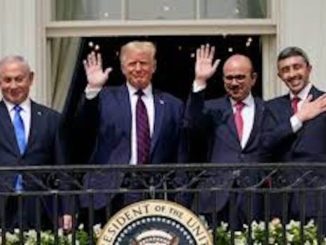
On 15th September 2020, a highly publicized event was held on the South Lawn of the White House in Washington DC. Donald Trump beamed proudly as the Foreign Ministers of UAE and Bahrain signed peace deals with the Prime Minister of Israel. Expectedly, Trump took full credit for these two historic peace deals which he had brokered, and which are being called the ‘Abraham Accords’.
The Abraham accords made me step back in time and see how things have changed in the Middle East. As a young Indian diplomat, I was sent to Egypt for my first overseas posting. Soon after my arrival in Cairo, Egypt and Israel had signed the historic Camp David Accords in September 1978. These had been brokered by US President Carter and paved the way for the Peace Treaty which was signed in March 1979.
The Egypt-Israel Peace Treaty ended the state of war that had existed between them since 1948. It made Egypt the first Arab country to recognize Israel, but for the same reason, it became unpopular in most of the other Arab countries. In their view, Sadat had betrayed the concept of Arab unity, and Egypt was suspended from the Arab League in 1979. Most Arab countries severed diplomatic ties with Egypt. It took several years to restore these ties, and as regards the re-admission of Egypt in the Arab League, this did not take place until 1989.
In sharp contrast with the Egypt-Israel peace treaty of 1979, no such outcry from other Arab countries has followed Israel’s peace agreements with UAE and Bahrain. Saudi Arabia is not officially a party to the agreements, but the kingdom’s close ties with the UAE and Bahrain and Saudi Crown Prince Mohammed bin Salman’s direct contacts with Trump’s son-in-law Jared Kushner do seem to indicate Saudi approval.
In fact, Trump has proudly announced that five other Arab countries have also lined up to sign similar peace deals, and though he did not name them, some are guessing that they might include Oman, Mauritania, Morocco, Tunisia and perhaps even Saudi Arabia.
Naming the accords after Abraham has more than symbolic significance, for Abraham is regarded as their patriarch both by the Israelis as well as by the Arabs; both believe that they are descended from him. Thus, the Abraham Accords are an exhortation to Arabs and Israelis–the descendants of Abraham– to live in peace with one another.
The deals are undoubtedly a diplomatic success for Trump .The White House has emphasized that the historic breakthrough was made possible by Trump’s “leadership and expertise as a deal-maker.” Soon after the UAE-Israel deal was announced, National Security Adviser Robert O’Brien told reporters that he wouldn’t be surprised if the President is nominated for the 2021 Nobel Prize. That has come true, with a right-wing Norwegian politician Tybring-Gjedde nominating Trump. Earlier, Tybring-Gjedde had nominated Trump for the 2018 Nobel Peace Prize for his efforts to bring about reconciliation between North and South Korea, but Trump did not win the Peace Prize. Whether he wins it or not this time remains to be seen.
No doubt, the two peace deals are a further consolidation of an America-led alliance in countering Iran’s influence in the region. In fact, one factor that has drawn both UAE and Bahrain closer to Israel is the fear of Iran’s growing role in the region. In recent years, Israel-UAE informal relations have warmed considerably and they have engaged in informal cooperation based on their joint opposition to Iran’s nuclear program and regional influence.
The two peace deals are also a diplomatic success for Israel, especially Prime Minister Netenyahu. For several years UAE and Israel have had many under-the-table contacts. There had been reports that Yossi Cohen, Director of the Israeli Secret Service Mossad secretly visited UAE several times for over a year to broker the accord. With the signing of the deal, all such contacts can now be conducted openly. The deal will lead to stronger economic, political and cultural ties between Israel and UAE. In a significant development, immediately after the deal was signed, the UAE Apex National Investment company signed a “strategic commercial agreement” with Israel’s Tera Group to conduct research into COVID-19 and develop a virus testing device. More such business deals would follow soon.
Bahrain’s relations with Israel have also strengthened slowly but steadily, partly due to Iran’s aggressive posturing. Although the royal family and many high-ups in the establishment in Bahrain are Sunnis, the majority of Bahraini Muslims are Shiites; it is one of three countries in the Middle East in which Shiites are the majority, the other two being Iraq and Iran. Shias have often complained of being politically repressed and economically marginalized; as a result, most of the protestors in the Bahraini uprising of 2011 were Shiites. Bahrain’s ruling family is believed to be wary of Iran’s propensity to foment sectarian trouble. Notably, Bahrain had hosted the Trump administration’s 2019 “Peace to Prosperity” economic summit to promote its Middle East peace plan. In this background, it was widely expected to follow the UAE in formalizing a peace treaty with Israel.
On its part, India has welcomed the US-brokered historic accord between Israel and the United Arab Emirates and Bahrain to normalize relations and establish full diplomatic links while also stressing on its traditional support for the Palestinian cause and an acceptable two-state solution.
The prelude to the Israel-UAE peace deal was a joint statement by these two countries and the US which referred to the suspension of the annexation of the West Bank by Israel, but this aspect was vague and lacked clarity. How long will this suspension be? Significantly, Trump administration officials have refused to clarify how long Israel will suspend annexation of Palestinian land in the West Bank as a result of this deal, and under what circumstances the U.S. would support Netanyahu returning to annexation plans. U.S.
Ambassador to Israel David Melech Friedman confirmed that the issue could be revisited, which means that the suspension could be revoked.
Not surprisingly, Iran has condemned these two agreements, as has Turkey. When the Israel-UAE deal was announced, Iran’s Foreign Ministry called the deal a “dagger that was unjustly struck by the UAE in the backs of the Palestinian people and all Muslims,” while Turkey said the peoples of the region “will never forget and will never forgive this hypocritical behavior” by the UAE. Iran’s President Hassan Rouhani has said that the United Arab Emirates and Bahrain will be responsible for any ‘consequences’ resulting from their normalization of relations with Israel. Iran’s relations with UAE and Bahrain had been on a down slide for the past several years. In 2016, Bahrain cut diplomatic ties with Iran and the UAE downgraded relations amid rising tensions between Saudi Arabia and Iran; predictably, these relationships have worsened even further.
The Palestinians, too have reacted with anger and have rejected the deals. When the UAE-Israel deal was announced, a spokesperson of Palestinian President Mahmoud Abbas called it “treason”. However, their options are quite limited. For example, Palestinian Prime Minister Mohammad Shtayyeh has said that Palestine would boycott the Dubai Expo scheduled for October 2020, but apart from any political points which might be scored, this boycott will not make much difference to the event.
Frankly, the Palestinian question is no longer central to the foreign policy objectives of many Arab countries, particularly those in the Gulf region. They are grappling with security issues where Iran and Turkey are perceived as playing the role of adversaries. They are also trying to keep pace with technological advances and preparing for the situation after their oil reserves run out. In this regard, they find it advantageous to deepen ties with the US and forge a relationship with Israel.
No doubt, many in the Arab world still care quite deeply about the Palestinians. However, in the policy formulations of many Arab Governments, the Palestinian issue has shrunk from representing a broader Arab cause to a tragedy that affects mainly the Palestinians.
Simply put, it may seem unbelievable how the Arab world has changed, but in the regional and global scenario, the changes were perhaps inevitable.
(The author is a retired career diplomat, now based in Gurugram, India. He can be reached at prabhu_dayal70@hotmail.com)
-

Indian -Origin Lawyer in UAE Helps Over 2,000 Fellow Citizens amid the Pandemic
DUBAI (TIP): An Indian -origin lawyer in the UAE has helped over 2,000 stranded and jobless blue-collar compatriots with free legal paperwork to facilitate their return back home, according to a media report on Saturday.
Sheela Thomas, 41, has opened 2,200 files of distressed Indians hailing from states of Telangana, Andhra Pradesh, Uttar Pradesh, and Bihar, who have lost their jobs due to the COVID-19 pandemic, to help them for their return to India, according to reports.
“Their paper-work needs to be sorted. Many of their visas have expired, passports still stuck with employers who are not releasing them for some reason or the other. I am taking care of all this work,” she was quoted as saying in the report.
Sheela Thomas, who has been residing in the UAE for the last 25 years, is doing all this work on a pro bono basis, it said.
Though originally from Kerala, she was born and brought up in Hyderabad.
“My mobile has turned viral. I am continuously receiving calls for help from stranded Indians and I don’t have the heart to say no,” she said.
Explaining her work, Sheela Thomas said she tries to understand the workers’ situation, talks to their employers to release their documents and passports so they can travel home, gets the paper-work in place and keeps it ready for their travel when enough flights are available.
“This land has given me so much. It is time to give back to the UAE and its people. These men are the people of UAE and they need help now,” Sheela Thomas said in the report.
She also feeds 300 people from her kitchen at home, the report said.
-

Indian social worker commits suicide in UAE
DUBAI(TIP): A 35-year-old prominent Indian social worker in the UAE has allegedly committed suicide by hanging himself from a ceiling fan in his apartment, a media report has said.
Sandeep Vellaloor, a staff surveyor in Ras Al Khaimah (RAK) emirate, suffered a huge financial loss after setting up a transport company, which is believed to have prompted him to hang himself, Khaleej Times reported on Sunday, December 9.
The father of three was a prominent social worker. His two roommates were not at home when he apparently committed suicide, it said.
Police have started an investigation into the incident, the report said.
“After coming back from work, they found the door locked from inside, and had to break open the lock to get in. To their shock, they found him hanging from the ceiling,” said Prasad Sreedharan, a social worker affiliated with a medical committee recently constituted by the Consulate General of India in Dubai.
Vellaloor was the general secretary of Yulan Kala Sahiti and team leader of the Friends Cricket Association.
“He regularly organized blood donation camps in RAK. The Ministry of Health and Prevention had honored him in 2016 with a certificate of appreciation and memento for the humanitarian act,” Sreedharan said.
“He contributed Rs 400,000 to the family of an Indian worker who was paralyzed and then died in a road accident here in RAK in 2017,” he said.
Vellaloor sent his family to India three years ago and was staying with two of his friends in a villa behind the RAK immigration department.
His body has been shifted to the morgue at the Ibrahim Bin Obaidulla Hospital and the repatriation process will be initiated shortly, said Nisham Noorudheen, president RAK Indian Relief Committee (IRC).
(Source: PTI)
-

Accepting help: on UAE’s aid to Kerala
Junk the precedent; taking aid from countries for disaster relief is no sign of weakness
The clearest indication so far that India would turn down offers of financial assistance from foreign governments for relief and rehabilitation work in Kerala came on Wednesday. And yet, it only added to the confusion. The Ministry of External Affairs spokesperson said that “in line with the existing policy”, the Central government would meet requirements in Kerala through “domestic efforts”. Various governments have made specific offers to Kerala, from about ₹700 crore from the UAE to about ₹35 lakh from the Maldives. The spokesperson added that only PIOs, NRIs or international foundations could send money from overseas to the Prime Minister’s or Chief Minister’s relief fund. But as Chief Minister Pinarayi Vijayan indicated, this clarity about existing policy is missing in the Central government’s National Disaster Management Plan. Put out in 2016, the Plan states that India will not appeal for foreign aid in the wake of a disaster. But it goes on to say: “… if the national government of another country voluntarily offers assistance as a goodwill gesture in solidarity with the disaster victims, the Central Government may accept the offer.” The condition applies that the Union Home Ministry would consult the MEA and assess the requirements “that the foreign teams can provide”. So, what exactly is government policy? Is it laid out in the NDMP document that has an opening message from Prime Minister Modi? Or is it based on the decision of the UPA government to refuse aid or assistance in the wake of the 2004 tsunami — a decision born out of a sense of false pride and a misplaced sense of shame — that became a sort of convention thereafter?
It is not only this mismatch between convention and written document that has created space for the current controversy. Irrespective of what was agreed upon in the past, democracies should be supple enough to respond to emergencies in ways that benefit the greater common good. It serves well no citizen of India for the government to stand on mere precedent or pride to turn down genuine offers of help, in terms of funds or expert teams — or to even ask for help. Offers of aid from foreign governments must naturally be scrutinized to see if they compromise national security and other interests. But to stand on notions of self-reliance in a multilateral world, to spurn a helping hand, is to be beholden to a strange pride. There is no shame in taking help, just as there should be no hesitation in offering it. India has a longstanding tradition of rushing help elsewhere. Leaving Centre-State politics, if any, aside, the government should not just gracefully accept the assistance for Kerala, it should junk the 2004 precedent.
(The Hindu)
-

Indian Origin Banker Found Dead In UAE
ABU DHABI(TIP): An Indian- origin banker working in UAE has been found dead, a week after he went missing, a media report said on July 18.
Jabar KP hails from Kerala. He stayed in Abu Dhabi city, but his body was found from Mussafah industrial area at city’s outskirts, as reported.
Jabar’s body was initially kept in the mortuary as an unidentified corpse. Later social workers and community groups stepped in to locate a relative.
On Monday his brother reached the mortuary and identified him, said the report.
“We hail from Kannur district of Kerala. Jabar was staying in Abu Dhabi for nine years and he went missing last week,” said Muneer, Jabar’s brother who works with the same bank.
“I don’t know about the day that the body was found on, but the location is Mussafah. Nor do I know the reason behind my brother’s death. He never had problem with anyone. I came to know about the news through social workers and identified the body. I have lost my brother,” he added.
Jabar is survived by his wife and two children. The cause of death will be known following an autopsy, the report said.
-

Indian Origin Woman Killed, Buried at UAE Home
SHARJAH (TIP): According to a local media report, a 36-year-old Indian Origin woman’s decomposed body was found by the police at her house in UAE’s Sharjah city on April 26th.
The woman’s body was hidden underneath the floor of her house and was only recovered after the police used sniffer dogs to help find the body. Police suspect the woman’s husband to have killed and buried her inside the house. The reports further said that the husband, who belongs to Kerala, had left the United Arab Emirates and returned to India leaving a ‘For Rent’ sign put up on the front door of the house.
Initial investigations by the police revealed that the accused husband, who also had another wife, had sent his other wife to India with his two children before committing the crime.
It was only after the woman’s brother could not find anybody at her house that the incident surfaced, according to Sharjah police.
The woman’s brother used to speak to her every day, according to police officials. When she had stopped responding to her brother’s calls, he had come to Sharjah from India to look for the woman.
He also filed a missing person complaint with the Sharjah police on April 9.
“A missing person report was received from the woman’s brother, who told police that he used to speak to his sister daily but one day, she stopped answering her phone,” Commander-in-Chief of Sharjah Police, Major-General Saif Al Ziri Al Shamsi was quoted by Gulf News.
It was further reported that the police acted on the complaint and sent a search team to the woman’s house in Sharjah’s Maysaloon area after receiving permission from the public prosecution.
During the search, the police found a few tiles from the floor of a room missing. It was then that the police brought in sniffer dogs and uncovered the woman’s body from underneath.
The woman’s body was sent to a forensic laboratory for an autopsy after the brother identified her.
The police have also identified the woman’s husband through an iris scan and fingerprints they recovered from the house.
An arrest warrant has been issued for the husband by Interpol, the police said.
-

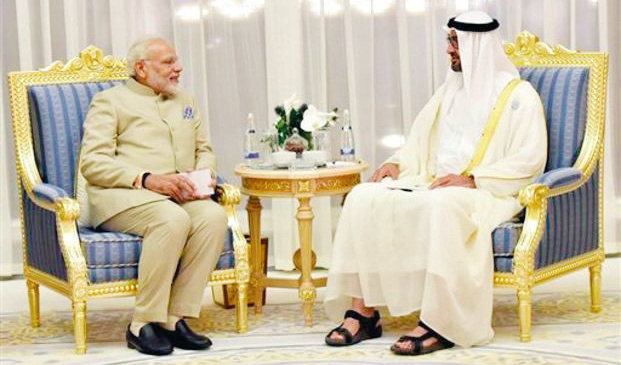
India, UAE sign five pacts as Modi meets crown prince of Abu Dhabi
ABU DHABI (TIP): Prime Minister Narendra Modi held wide-ranging talks with Crown Prince of Abu Dhabi Mohamed bin Zayed Al Nahyan on Saturday as the two sides signed five agreements including a historic pact awarding a consortium of Indian oil companies a 10% stake in offshore oil concession.
Modi, who arrived in Abu Dhabi from Jordan on the second leg of his three nation tour, was received by Mohammed Bin Zayed and other members of the Royal family at the airport.
The Prime Minister thanked the Crown Prince for the special gesture of receiving him at the airport and said his visit will have a positive impact on India-UAE ties.
An MOU between Indian Consortium (OVL, BPRL & IOCL) and Abu Dhabi National Oil Company (ADNOC) was signed for the acquisition of a 10% participating interest in the Abu Dhabi’s offshore Lower Zakum Concession, a statement issued by the Indian embassy here said. The concession will be for 40 years from 2018 to 2057. 60% of the participating interest will be retained by ADNOC and remaining 30% will be awarded to other international oil companies, the statement said.
“This is the first Indian Investment in upstream oil sector of UAE, transforming the traditional buyer seller relationship to a long-term investor relationship,” it added. To cooperate in the field of manpower, India and the UAE signed an MoU that aims to institutionalise the collaborative administration of contractual employment of Indian workers in the Gulf country.
Under the MoU, both the sides will work to integrate their labour related eplatforms for ending the existing malpractices, combat trafficking and organise collaborative programs for education and awareness of contractual workers. An MoU for technical cooperation in railways was also signed between the two sides. The MoU aims at cooperation in infrastructure sector especially railways.
“The MoU will facilitate development of joint projects, knowledge sharing, joint research and technology transfer.
The MoU envisages formation of a Joint Working Group for institutionalising the cooperation mechanism,” the statement said.
To deepen bilateral cooperation in the field of finance, an MoU between Bombay Stock Exchange and Abu Dhabi Securities Exchange was also signed. It aims at enhancing cooperation between both the countries in financial services industry. The MoU would facilitate investment in financial markets by investors from both the countries. An MoU between government of Jammu and Kashmir and DP World was also signed to establish multi-modal logistics park and hub in Jammu comprising warehouses and specialised storage solutions.