Tag: Ukraine

  • Mark Carney’s new package to Ukraine has Canadians divided

    Mark Carney’s new package to Ukraine has Canadians divided

    By Prabhjot Singh

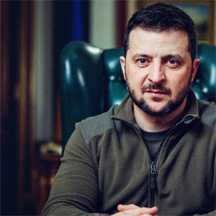
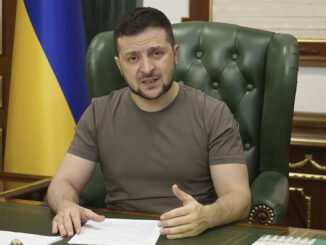
    TORONTO (TIP): When Canadian Prime Minister Mark Carney rolled out a new economic package for war-torn Ukraine as he and Volodymyr Zelenskyy met briefly at a Halifax-area airport, a chain of reactions, both for and against helping a nation in distress, started. The two leaders embraced as Carney welcomed Zelenskyy to Canada. Zelenskyy touched down for a brief stop on his way to Florida for planned peace talks with U.S. President Donald Trump this weekend, which he called “very important and very constructive.”

    Though the “intentions” behind aid or economic packages are seldom a subject of debate, this time the questions are being raised as the quantum of economic assistance offered looks beyond the means of the country that just managed to get its budget for 2025 ratified by the House of Commons by a couple of votes.

    Canada has been a staunch supporter of Ukraine since Russia’s full-scale invasion began in February 2022, committing $6.5 billion in military support along with humanitarian aid.

    The $2.5 billion that Canada committed to providing aid should enable the International Monetary Fund and the World Bank to lend nearly $10 billion to Ukraine to support reconstruction, the Prime Minister’s Office said in a news release. The funding will also be used to guarantee a loan of up to $322 million from the European Bank to assist Ukraine in reinforcing energy security.

    “Canada has committed new support to Ukraine, not only to help end this war, but also to help the Ukrainian people recover and rebuild,” said Carney in the statement.

    “Canada stands with Ukraine, because their cause—freedom, democracy, sovereignty—is our cause,” he said.

    The new economic package has evoked mixed reactions. While it may be a little far-fetched to link the revival of speculations that a section of the wealthy, perturbed by the rising tax slabs, including the wealth tax, plans to move out to safer tax havens, there is a certain undercurrent of discontent among average taxpayers over the government’s largesse to nations at war.

    They hold that with $2.5 billion in new “offerings” to Ukraine, it is no surprise that the federal government is looking at larger deficits. The 2024 fall statement projected a budget deficit of $42.2 billion this fiscal year. The 2025 budget pegged the deficit at $78.3 billion, with deficits exceeding $50 billion for the next five years. Ultimately, these growing deficits will transform into taxes, direct or indirect, besides accelerating rates of both inflation and unemployment.

    Some of the economic erosions may be due to conditions that have deteriorated since last year, but the bulk is from new spending. Overall, higher deficits are translating into more debt. As a result, debt servicing charges as a share of federal revenues are expected to increase from 10.5% last fiscal year to more than 13% by 2029–30.

    Nonetheless, given the increases in spending and deficits, the federal government has once again changed its fiscal anchor, which is a target that the government articulates to reassure markets, rating agencies, and the public that its finances remain responsible.

    An official communique said that since Russia’s unprovoked, unjustified, full-scale invasion, Canada has provided nearly $22 billion in multifaceted assistance for Ukraine, including over $12 billion in direct financial support—making Canada among the largest contributors to Ukraine’s recovery and reconstruction. As the Ukrainian people endure another winter of Russian aggression, Canada remains steadfast in its support for Ukraine.

    Building on Canada’s strong support for Ukraine, Mark Carney announced last weekend new measures to support a just and lasting peace. Canada has announced an additional $2.5 billion commitment for Ukraine, including financing that will enable the International Monetary Fund to lend Ukraine an additional $8.4 billion as part of an extended financing program, besides Canada’s participation in extended and expanded debt service suspension for Ukraine, for up to $1.5 billion in 2025-26.

    Canada’s new economic package also includes a loan guarantee of up to $1.3 billion in 2026 to the World Bank’s International Bank for Reconstruction and Development to support Ukraine’s reconstruction and a loan guarantee of up to $322 million in 2026 to the European Bank for Reconstruction and Development to support Ukraine’s gas imports and reinforce its energy security.

    In Halifax, Carney and Zelenskyy held a bilateral meeting to discuss the latest developments in ongoing peace talks. Mark Carney affirmed Canada’s full support for Ukraine.

    Since the beginning of 2022, Canada has committed $6.5 billion in military assistance to Ukraine. This funding will allow Canada to deliver military assistance to Ukraine through 2029.

    “The barbarism that we saw overnight—the attack on Kyiv—shows just how important it is that we stand with Ukraine during this difficult time,” Carney said.

    Zelenskyy thanked Canada for its support and called the new attacks “Russia’s answer to our peace efforts” and said it showed that Russian President Vladimir Putin “doesn’t want peace.”

    Zelenskyy also called Putin a “man of war.”

    Moscow has said the new strike was in response to Ukraine’s attacks on “civilian objects” in Russia.

  • Zelenskyy says Ukraine war will end ‘sooner’ with Trump in office

    Zelenskyy says Ukraine war will end ‘sooner’ with Trump in office

    KYIV (TIP): Ukrainian President Volodymyr Zelensky said Friday, November 15, 2024, that Russia’s war against his country will “end sooner” than it otherwise would have done once Donald Trump becomes U.S. president next year. “It is certain that the war will end sooner with the policies of the team that will now lead the White House. This is their approach, their promise to their citizens,” Mr. Zelensky said in an interview with Ukrainian media outlet Suspilne. Trump promises to end wars with a ‘strong military’

    “The war will end, but we don’t know the exact date,” he added.

    Mr. Zelensky said he had a “constructive exchange” with Mr. Trump during their telephone conversation after his victory in the U.S. presidential election.

    “I didn’t hear anything that goes against our position,” he added.

    Throughout the election campaign, Mr. Trump criticized the tens of billions of dollars in aid provided for Ukraine since the start of the Russian invasion in February 2022, and he promised he would resolve the conflict “in 24 hours”, without ever explaining how.

    Russia is open to hearing Trump’s proposals for ending the war, an official says

    Speaking at his Mar-a-Lago resort in Palm Beach, Florida on Friday, November 15, 2024, Mr. Trump said “we’re going to work very hard on Russia and Ukraine. It’s got to stop.” Ukraine fears U.S. support will flag just as its troops are struggling on the front, or that it will be forced to make territorial concessions to Russia.
    (With input from agencies)

  • Trump has an opportunity to create a legacy of unity and peace

    By Prof. Indrajit S Saluja
    By Prof. Indrajit S Saluja

    Donald Trump’s return to the White House has stirred intense debates and expectations across America’s diverse political spectrum. His supporters view his leadership as a way to address what they see as pressing issues, from illegal immigration to foreign conflicts, while those on the left call for more compassion, equity, and diplomacy. These contrasting views reflect not only America’s deep political divisions but also a broader expectation that Trump would need to balance conflicting demands across the country.

    One of the most divisive issues in Trump’s previous administration, and one that remains in the spotlight, is immigration. For his base, addressing illegal immigration is paramount. Many of his supporters feel that uncontrolled immigration contributes to a loss of jobs, increased crime, and burdens on public services. They believe Trump’s firm stance on border security and his earlier policies, such as building the wall along the southern border, are essential steps toward tackling this issue. They expect him to continue implementing strict policies and taking decisive action to curb illegal immigration.

    On the other side, however, are millions of Americans who view immigration through a more humanitarian lens. These citizens see the issue not just as a matter of law and order, but as one requiring compassion and empathy. They believe America’s identity has been shaped by immigrants and that, while reform is needed, there should be pathways to citizenship for those already living in the country, especially for children and those who have contributed positively to society. Liberals call for a balanced approach that addresses security concerns without compromising the humane treatment of individuals. Navigating these polarized viewpoints will be a key test of Trump’s leadership.

    Another area where Trump’s policy agenda will come under scrutiny is taxation. Traditionally, Republicans have favored tax cuts for corporations and the wealthy, believing that these policies stimulate economic growth by incentivizing investment and job creation. Trump’s tax reform during his presidency largely adhered to this philosophy, and his base expects him to continue with similar policies, favoring the business class and promoting wealth generation.

    But there is a growing chorus within America that calls for a different approach to tax policy. Many Americans, especially those facing financial hardships, believe that the tax system should be structured to benefit middle- and lower-income families. They argue that tax relief for the poor and greater investment in welfare programs and social security could create a more equitable society. In a nation where wealth inequality continues to widen, Trump would face pressure to either stay loyal to his party’s traditional tax stance or consider measures to support broader segments of the population. Balancing these contrasting expectations could determine how effectively he appeals to the wider electorate.

    One area where Trump’s outlook appears to align with public sentiment across the political spectrum is foreign policy. The idea of reducing U.S. involvement in overseas conflicts has gained traction among Americans who are weary of endless wars. Many want a strong U.S. military, but they would prefer it to serve primarily as a deterrent rather than engage in protracted conflicts that drain resources and often yield uncertain outcomes. Trump has previously criticized American interventions abroad, expressing a “peace through strength” philosophy that resonates with many who feel the U.S. should focus on domestic priorities rather than entangle itself in other nations’ disputes.

    The ongoing conflict between Russia and Ukraine is one arena where Trump’s non-interventionist stance might play out. Trump has suggested that he could negotiate an end to the conflict, potentially capitalizing on his previous rapport with Russian President Vladimir Putin. He has stated that he would push for an end to this war, likely by using U.S. leverage to halt military aid to Ukraine if it facilitates negotiations. With the U.S. as Ukraine’s principal backer, a shift in its support would likely prompt Ukraine to consider peace talks with Russia. While some view Trump’s approach as pragmatic, others fear it could undermine Ukrainian sovereignty and empower Russia. Nonetheless, his stance reflects a broader desire among Americans for a more restrained and calculated foreign policy.

    Another geopolitical hotspot where Trump could exert influence is the Israeli-Palestinian conflict. Currently, the Israeli government, led by Prime Minister Benjamin Netanyahu, has adopted a hardline stance, which critics argue escalates tensions and prolongs hostilities. Netanyahu’s political survival is often seen as tied to the conflict’s continuation, as it helps him consolidate support among right-wing factions. Trump, however, has the potential to play a mediating role. Given his established ties with Israeli leadership, he could leverage his influence to encourage a balanced approach that addresses Israel’s security concerns while also creating conditions for dialogue and peace with neighboring countries. Successfully brokering peace in both Ukraine and Israel could not only elevate Trump’s legacy but also position him as a serious contender for the Nobel Peace Prize, a symbol of his impact on global diplomacy.

    For Trump, however, the challenge lies in choosing his battles and approaching them with a sense of diplomacy. While he has strong convictions and an assertive style, bringing about meaningful change in such contentious areas requires more than rhetoric—it demands tact, empathy, and a willingness to listen to diverse perspectives. Many of his critics fear that he may instead focus on pursuing his perceived political adversaries, which could further divide the country and overshadow critical policy needs. However, a more measured approach could help unify Americans across the ideological spectrum and address issues that matter to all citizens, regardless of party affiliation.

    Ultimately, Trump’s second term will be shaped by his ability to navigate America’s polarized political landscape and deliver on his promises. To truly serve as a leader for all Americans, he would need to balance his commitment to his supporters with the needs of those who oppose him. From immigration reform to tax policy and foreign diplomacy, he has an opportunity to create a legacy of unity and peace. If he focuses on these lofty goals, rather than divisive politics, Trump could achieve what many see as nearly impossible: bridging divides at home and fostering peace abroad.

  • Suozzi on the ground in Ukraine, Poland , and Moldova

    Suozzi on the ground in Ukraine, Poland , and Moldova

    Gets Private Briefing from President Zelenskyy

    WASHINGTON, DC (TIP) : Congressman Tom Suozzi (D-NY), joined by a bipartisan group of congressional members, met with Ukraine President Volodymyr Zelenskyy and top-ranking Ukrainian, Polish, Moldovan, and US military and civilian officials during his trip last week to war-weary Eastern Europe. The delegation included Senator Joni Ernst (R-IA) and Congress Members Chuck Edwards (R-NC), Ashley Hinson (R-IA), Wiley Nickel (D-NC), and Mike Quigley (D-IL)

    The trip began on Monday, April 1, 2024, and for security reasons, details were not released or publicized until the Congress members left for home. This is the only Congressional Delegation that stayed overnight and for multiple days in Ukraine since the war started. The delegation stayed in Kyiv for two days and visited Odessa and multiple other sites throughout the country, as well as neighboring Poland and Moldova.

    “It is vital that the United States act quickly to support Ukraine in every way we can,” Suozzi said.

    “Putin is stepping up his attacks and he must be stopped. The Ukrainians are running out of time, and we must act within the next two weeks. Helping Ukraine is not only a moral imperative but also in America’s strategic and financial interests,” Suozzi explained.

    “My week-long meetings with the Ukrainian President, his military advisors, journalists, prosecutors, farmers, local leaders, and civilians on the ground convinced me more than ever of how courageous the Ukrainians are amidst so much pain, suffering and terror Russia’s Putin has rained down upon Ukraine,” he added.

    “100,000 soldiers and civilians have been killed, 10 million people forced to leave their homes, 20,000 children kidnapped and sent to Russia,” Suozzi emphasized.

    On Saturday, April 6th, in Kyiv, Suozzi was awoken by the searing sound of air-raid sirens in the middle of the night. Three Russian missiles and 28 bomb-carrying drones targeted the city. Anti-aircraft defenses were deployed, and they were successfully shot down, but Ukraine is running out of ammunition.

    Zelenskyy met with Suozzi and the delegation in the Chernihiv region in Northern Ukraine, liberated from the Russians exactly two years ago on Friday, April 5, 2022.

    The President briefed the group on the latest events on the battlefield, his army’s urgent needs, and the scale of the illegal deportation of Ukrainian children to Russia.

    Suozzi said that Zelenskyy began the meeting by saying, “We are grateful to everyone in the United States, to every American heart that, like ours in Ukraine, refuses to succumb to evil and cherishes life.”

    “While meeting with President Zelenskyy, he first and foremost expressed his gratitude to the American people. He then made it clear that the situation now in Ukraine is dire. Ukraine must be resupplied, and if they are, they can and will stop Putin,” said Suozzi.

    Suozzi and the delegation saw the tragic toll taken by Ukraine’s civilian population, during the Russian invasion.

    He visited the Ukrainian city of Bucha, the site of civilian massacres and brutal killings first suffered by Ukraine, where hundreds of civilians were murdered and buried in mass graves.

    He spent time learning more about the Russian siege from Mayor Anatoliy Fedoruck and War Crimes Prosecutor General Roman Avramenko. “I visited with residents held hostage, with families whose apartment buildings were bombed, and churches destroyed, with farmers removing mines before planting, journalists reporting in dangerous conditions while over 70 of their colleagues have been killed, prosecutors attacking corruption, and with officials and civilians responsible to keep ports operating,” said Suozzi.

    “I heard from liberated hostages held in dark, cold, and wet basements with little food and no room to move or sleep for a month. Hundreds of children, seniors, and infants were confined without a single toilet; buckets were used. And when people died, their bodies were stacked up against the wall. When people asked for help, they were scolded by Russian soldiers and told, ‘This is war,’” Suozzi retold.

    He toured previously liberated battle-scarred towns and cities that have been the victims of Russian assault and destruction. He spoke with the Governor of Odessa, Oleg Kipper, and his team working to keep the port operating while under constant bombardment.

    Suozzi visited fellow NATO member Poland and met with Foreign Minister Radoslaw Sikorski, U.S. Ambassador Mark Brzezinski, and several of Poland’s defense officials, as well as with the President of Moldova, Maia Sandy, to better understand Russia’s threat to all of Eastern Europe.

    Suozzi also met with U.S. Army Brigadier General Jerry Baird and other service members of the 82nd Airborne Division stationed in Poland and responsible for shipping all arms and supplies into Ukraine.

    “It’s clear to me that America must continue its leadership in NATO to stand against any further Russian aggression,” Suozzi said.

    Suozzi was unable to fly from Poland to Ukraine as flights have become impossible. He and the delegation took a 12-hour overnight train to reach the embattled country,

    The Congressman returned home on Monday, April 8th. He promised to provide a more extensive description of his visit in the coming weeks.
    “The people of my district would be appalled by what Putin has done. I am more convinced than ever that he must be stopped, and that aiding Ukraine is central to the United States strategic and financial interests,” concluded Suozzi. “I will carry that message forward in Washington this week.”

  • Russia is ready to use nuclear weapons if threatened, Vladimir Putin tells state media

    Russia is ready to use nuclear weapons if threatened, Vladimir Putin tells state media

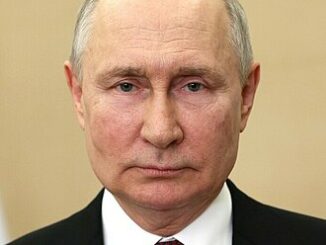
    MOSCOW (TIP): President Vladimir Putin said Russia is ready to use nuclear weapons if there is a threat to Russian statehood, sovereignty or independence. Speaking in an interview with Russian state television released early on Wednesday, March 13, Putin said he hoped the US would avoid any escalation that could trigger a nuclear war but emphasized that Russia’s nuclear forces are ready for it. Asked if he had ever considered using battlefield nuclear weapons in Ukraine, Putin responded that there had been no need for that. He also voiced confidence that Moscow would achieve its goals in Ukraine and held the door open for talks, emphasizing that any deal would require firm guarantees from the West.

  • Officials report at least 13 dead in shelling of a market in Russian-occupied Ukraine

    KYIV (TIP): At least 13 people were killed January 21 by shelling at a market on the outskirts of the city of Donetsk in Russian-occupied Ukraine, local officials reported Sunday.
    A further 10 people were injured in the strike on the suburb of Tekstilshchik, said Denis Pushilin, head of the Russian-installed authorities in Donetsk. He said that the shells had been fired by the Ukrainian military.
    In a preliminary toll the Donetsk mayor Alexei Kulemzin had earlier reported eight dead in the shelling on the northeast of the city.
    The Ukrainian city fell under the control of pro-Moscow separatists in 2014 and is regularly targeted by Kyiv’s forces.
    During the night of January 1 four people died and 13 were wounded, including journalists, in strikes on Donetsk, the Russian-controlled authorities said.
    Kyiv has not commented on the event and the claims could not be independently verified by The Associated Press.
    Emergency services continue to work on the scene, Pushilin said. (AFP)

  • Former Secretary General Ban Ki-moon, three veteran diplomats honored with 2023 Diwali ‘Power of One’ Awards at UN

    Former Secretary General Ban Ki-moon, three veteran diplomats honored with 2023 Diwali ‘Power of One’ Awards at UN

    “The ideals of Diwali are the ideals of UN Charter” : Chair of Diwali Foundation USA Ranju Batra

    UNITED NATIONS (TIP): Former UN Secretary General Ban Ki-moon and three veteran diplomats were honored with the annual ‘Diwali Power of One Awards’, hailed as the ‘Oscars of diplomacy’, for their selfless efforts to “help form a more perfect, peaceful, and secure world for all”. The former UN chief was honored with the Lifetime Achievement Award at the 2023 Diwali Stamp — The Power of One Award ceremony organized by the Diwali Foundation USA. The other awardees for the year 2023 are former permanent representative of Bosnia and Herzegovina to the UN Ambassador Mirsada Colakovic, former permanent representative of South Korea to the UN Ambassador Kim Sook and 72nd UN General Assembly president and EU Special Representative for the Belgrade-Pristina Dialogue Miroslav Lajcak. They were honored at a special ceremony held in the UN Headquarters on Monday, December 11.

    Former Secretary General Ban Ki-moon addressing the gathering after receiving the award. Seen, among others, are India’s Permanent Representative to the United Nations, Ambassador Ruchira Kamboj ( extreme left) , Ranju Batra (4th from left), and Ravi Batra (behind Mr. Ban Ki-moon) (Photo : Mohammed Jaffer / SnapsIndia)

    Ban commended the work and “forward-thinking vision” of the Diwali Foundation USA “for advancing vital light in a world of increasing darkness”.

    Ban said the world of today “seems fractured like never before” as he cited the COVID-19 pandemic, climate crisis and regional conflicts, particularly “regional crisis as we see today in the Middle East and Ukraine”.

    “But it is exactly at times such as these that the work of the United Nations is indispensable. The United Nations and its pursuit of peace, human rights and sustainable development exemplifies the values and principles that we should all espouse to replicate,” he said. Ban was the eighth Secretary-General of the United Nations, serving two terms as the world’s top diplomat from January 2007 to December 2016.

    He said that as the world moves into 2024 and beyond, “we share a common destiny illuminated by peace, sustainability and prosperity. Let us work together and expand our unified efforts to realize this shared destiny for all. This is your political responsibility and for me, my moral responsibility as a former Secretary General” and as an awardee of the Power of One honor.

    India’s Permanent Representative to the UN Ambassador Ruchira Kamboj, in her address to the event attended by UN diplomats, envoys, civil society members and policy experts, said that Diwali is a celebration that holds a very special place in the hearts of over a billion Indians across the globe.

    Diwali “is more than just a festival. It is a sentiment that embodies the triumph of light over darkness, knowledge over ignorance and hope over despair”, she said.

    Kamboj said, “as we light the lamps of Diwali, let us remember that every small light, no matter how small, can make a significant difference in dispelling the shadows”.

    Sri Lanka’s Permanent Representative to the UN Ambassador Mohan Pieris said “Deepawali has become truly a secular festival in the world, since its message is not exclusively restricted to any religious creed.

    “This festival has united the global community with the central message that we need more than ever the humanistic ideals to engage the inglorious wars, which are bleeding the innocence of humanity,” he said.

    Pieris underscored that for the world to have peace, it is important that the whole world must be united to save the higher ideals of humanity, which have evolved since the millennium in various religious traditions.

    Chair of Diwali Foundation USA Ranju Batra, who had spearheaded efforts for over seven years to get a commemorative ‘Forever Diwali’ stamp issued by the US Postal Service in 2016, said: “Diwali is a message of peace.” She said her journey for the Diwali stamp is seen as a “metaphor of peace and harnessing its power to promote excellence in diplomacy. The ideals of Diwali are the ideals of UN Charter”.

    She noted that the 2023 Power of One awardees have clearly demonstrated that “one person can make a difference”. The Diwali stamp celebration is not of a religion or nation but of the spirit of harmonious inclusiveness and cross-cultural understanding that all religions deserve, she said.

    Eminent Indian-American attorney and Chair of National Advisory Council South Asian Affairs and moderator of the award ceremony Ravi Batra said the UN transcends borders and boundaries.

    “The need to acknowledge excellence is critical, generally, but in diplomacy, which is on life support in today’s world, it is essential and that’s how these awards are – the Power of One,” he said, adding that they honor “world class diplomats who have changed the world by what they did”.

    Awardees and organizers of Power of One Awards (Photo : Mohammed Jaffer / SnapsIndia)

    Hailed as the ‘Oscars of Diplomacy’, the awards are presented to former Permanent Representatives or former high-level members of the UN Secretariat or member state, or soon to be “former”, who have “toiled selflessly to help form a more perfect, peaceful and secure world for all”.

    The 2023 Award ceremony was co-organized by the Diwali Foundation USA and Delegation of the European Union to the United Nations, and the Permanent Missions of Chile, Eritrea, Georgia, India, Kazakhstan, Kiribati, Morocco, Oman and Sri Lanka to the United Nations. The co-sponsors included the Permanent Mission to the United Nations of Albania, Armenia, Austria, Azerbaijan, Belarus, Bhutan, Cyprus, France, Germany, Ghana, Hungary, Iraq, Israel, Kuwait, Kyrgyzstan, Malaysia, Mexico, Nepal, Philippines, South Korea, South Africa, Spain, Tajikistan, Thailand, Turkiye, Turkmenistan, Ukraine, United Kingdom, United States, Uzbekistan, Vietnam and Palestine, and International Atomic Energy Agency (IAEA-NY) among others.

    Diwali Foundation USA was established in 2017 to promote a peaceful and consensus-based process to achieve societal “good, as befits the high hopes and ideals of humanity enshrined in the United Nations Charter”.

    The Foundation established ‘The Power of One’ awards to celebrate and highlight the important work done in a peaceful manner, especially at the United Nations.

    Previous honorees include former UN assistant secretary general and deputy executive director of UN Women, Lakshmi Puri, former UK Ambassador to the UN, Matthew Rycroft, former permanent representative of Georgia to the UN, Kaha Imnadze, and former permanent representative of Grenada to the UN Keisha McGuire.
    (Source: PTI)

    The traditional lamp lighting . Mr. & Mrs. Ban Ki-moon with organizers of Power of One Award lighted the lamp. (Photo : Mohammed Jaffer / SnapsIndia)
  • As Ukraine war drags on, US arms firms make a killing

    As Ukraine war drags on, US arms firms make a killing

    The US sold military hardware, services and technical data to its clients worth $153.7 bn in 2022, up from $103.4 bn the year before.

    “With the deterioration of global security, particularly after the commencement of the Ukraine war, US arms sales have been on the rise. Last year, US defense companies reaped huge dividends selling their weapons and defense platforms to their clients in Asia, Europe and Africa. Latest data shows that 2022 saw an increase of $51.9 billion in the sale of weapons. Most of it is largely due to the Russia-Ukraine war, where the US is backing Ukraine.”

    By Maroof Raza

    Russian President Vladimir Putin made a candid admission at Sochi in June. He acknowledged that Moscow’s troops were experiencing a shortage of modern weapons and expressed hope that the country’s military industry would soon be able to meet their growing demand amid the Ukraine war. One of the critical reasons for the shortage is the global sanctions that have imposed curbs on the acquisition of sophisticated parts used in the production of a variety of weapons and their auxiliary systems. This has led to a shortfall of main battle tanks and ballistic missiles. Besides, using cruise missiles is a costly affair. Thus, the recent visit by North Korean leader Kim Jong Un to Russia attracted much attention. Apart from North Korea, Russia is getting help from Belarus, China and Iran in maintaining its ammunition stocks.

    Manned and unmanned aircraft, missiles and electronic warfare equipment require modern, high-tech components such as microchips and ball bearings. Russia faces challenges in sourcing these components adequately from domestic suppliers and importing them — as it did before the present conflict — from North America and Europe due to the sanctions. Now, Russia is forced to replace imports of critical components with supplies from China or Malaysia, which do not match the quality standards of those from the West. Another significant reason for Moscow’s urgent need to go shopping for ammunition from sources other than the usual ones is the extensive and disproportionate use of artillery by the Russian military.

    Swarms of Shahed 136 drones have been supplied to Moscow from Iran, and these have wreaked havoc on Ukrainian cities. China has repeatedly denied sending military equipment to Russia since Moscow’s all-out invasion of its neighboring country, even though the two nations signed a ‘no-limits’ partnership in February 2022. The US Secretary of State, Antony Blinken, warned China earlier this year that there would be ‘consequences’ if Beijing were to provide materiel support to Russia for its conflict in Ukraine.

    Russia can also fall back on its ammunition stocks and older weapon systems from the Cold War era. Battlefield losses and Western sanctions have left the Russian military in a state of decline, but Moscow will still have enough firepower to extend the war in Ukraine, according to the Centre for Strategic and International Studies (CSIS). It gives stark numbers of Russian military losses — almost 10,000 units of key equipment, such as tanks, trucks, artillery pieces and aerial drones, according to one estimate.

    But it also says that Russia can utilize Cold War-era and older stocks on the frontlines to make up in numbers what it may have lost in terms of technology. “The quality of the Russian military in terms of advanced equipment will likely decline, at least over the near term,” the CSIS report says. “Moscow is under pressure to adapt, often turning to less-reliable and costlier suppliers and supply routes, lower-quality imports, or trying to reproduce Western components internally. This is likely hampering the rate and quality of Russian defense production,” the report says.

    It cautions that Ukraine and its Western supporters should not expect a swift resolution to the hostilities due to these supply issues. Russia still retains numerical advantages over Ukraine, the report adds, because it has large inventories in reserve. “Russia’s military capabilities still greatly outnumber those of Ukraine on most indicators of air, land and naval power,” the report says.

    “While an accurate count of Moscow’s current military stocks is not available publicly, it has been roughly estimated that, as of February 2023, the total number of aircraft at the Kremlin’s disposal has been 13-15 times more than Kyiv’s. Russia has nearly seven to eight times more tanks and four times more armored fighting vehicles, while its naval fleet is 12-16 times larger than Ukraine’s,” it says. These numerical advantages will enable Moscow to run a war of attrition over the next year, throwing numbers on the battlefield until Ukraine, even with fewer losses, runs out of hardware, the report observes.

    While Russia’s military-industrial complex is struggling, its US counterpart is reaping the benefits. This can be ascertained by a recent report published by the Congressional Research Service (CRS) titled, ‘US Security Assistance to Ukraine’. The United States has been a leading provider of security assistance to Ukraine, particularly since Russia launched its renewed and expanded invasion of Ukraine on February 24, 2022. From 2014, when Russia first invaded Ukraine, to August 22, 2023, the US has committed more than $46 billion in security assistance “to help Ukraine preserve its territorial integrity, secure its borders and improve interoperability with NATO”, according to the State Department.

    With the deterioration of global security, particularly after the commencement of the Ukraine war, US arms sales have been on the rise. Last year, US defense companies reaped huge dividends selling their weapons and defense platforms to their clients in Asia, Europe and Africa. Latest data shows that 2022 saw an increase of $51.9 billion in the sale of weapons. Most of it is largely due to the Russia-Ukraine war, where the US is backing Ukraine.

    Several European countries have started arming themselves as they perceive a threat from Russia. American defense companies are on a high. They have received new orders for military equipment as these nations strengthen their defenses. As the data shows, the US sold military hardware, services and technical data to its clients worth $153.7 billion in 2022, up from $103.4 billion the year before. The State Department data claims that the increase in the sale of defense products is attributed to the crisis in Ukraine, where the US government has authorized massive supplies. The Ukraine war has also caused huge insecurity among European nations like Germany, Poland and Spain, which have started arming their defense forces, fearing the unintended consequences of this long-drawn-out war could very well spill over to their borders.
    (The author is a Strategic Affairs Analyst)

  • U.S. to send $250 million in weapons to Ukraine

    U.S. to send $250 million in weapons to Ukraine

    WASHINGTON, D.C. (TIP): The Biden administration announced on August 29 that it will send an additional $250 million in weapons and ammunition to Ukraine as part of its ongoing support of Kyiv’s counteroffensive.

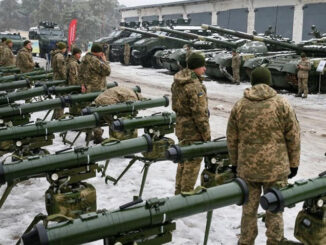
    The weapons will be drawn from existing U.S. stockpiles and will include mine-clearing equipment, artillery and rocket rounds, ambulances and medical gear, among other items and spare parts, according to the State Department. “The package will help Ukrainian forces on the battlefield and support its air defenses as Russia continues to launch brutal, brutal strikes against the people of Ukraine, including attacks this past week,” White House spokeswoman Karine Jean-Pierre said Tuesday. The State Department said the package contained AIM-9M missiles for air defense, High Mobility Artillery Rocket System munitions, 155mm and 105mm artillery ammunition and more than 3 million rounds of small arms ammunition.

    The U.S. would have already run out of funding for the year to provide additional stockpile equipment to Ukraine but earlier this year realized the Pentagon had overvalued the equipment it had already sent, which freed up an additional $6.2 billion in funding. Ukraine has already received more than $43 billion from the U.S. since Russia invaded last year. Those funds have provided weapons systems like howitzers and millions of rounds of ammunition to fight back against the much larger Russian military. Due to the intense and bloody land war, now in its 18th month, much of the ammunition and weaponry has already been used up.

  • Russia targets Ukraine’s farm storage sites after days of hitting Black Sea port facilities

    Russia targets Ukraine’s farm storage sites after days of hitting Black Sea port facilities

    KYIV (TIP): Russia followed its withdrawal from a grain export deal by expanding its attacks from port infrastructure to farm storage buildings in Ukraine’s Odesa region on July 21, while also practising a Black Sea blockade. Other Russian missiles damaged what officials described only as an ‘important infrastructure facility’ southwest of the port city of Odesa, in what appeared to be an effort to cripple Ukraine’s food exports.
    Attacks in recent days have put Odesa in Russia’s crosshairs after Moscow abandoned a wartime deal that allowed Ukraine to send grain through the key Black Sea port.
    In the attack on the storage site, two low-flying cruise missiles started a blaze, then another struck during firefighting efforts, regional Gov. Oleh Kiper said.
    The barrage injured two people, damaged equipment and destroyed 100 metric tons (110 tons) of peas and 20 metric tons (22 tons) of barley, Kiper said.
    Russia targeted Ukrainian critical grain export infrastructure after vowing to retaliate for what it said was a Ukrainian attack that damaged a crucial bridge between Russia and the Moscow-annexed Crimean Peninsula.
    “The enemy is continuing terror, and it’s undoubtedly related to the grain deal,” said Natalia Humeniuk, a spokesperson for the Ukrainian military’s Operational Command South.
    Both Russia and Ukraine have announced they will treat ships travelling to each other’s Black Sea ports as potential military targets.
    Russia’s Deputy Foreign Minister Sergei Vershinin clarified the Defense Ministry’s announcement earlier this week that Moscow has declared wide areas in the Black Sea dangerous for shipping.
    The ministry said it would consider incoming vessels as laden with weapons and treat the country of its flag as a participant in the conflict on the Ukrainian side.
    Vershinin said the Russian navy will inspect the vessels to make sure they aren’t carrying military cargo before taking any other action.
    “There is no longer a sea humanitarian corridor, there is a zone of increased military danger,” he told a news briefing.
    Vershinin added that Russia will fulfil the needs of African countries despite the deal’s termination.
    President Vladimir Putin has promised to provide poor countries in Africa with free grain.
    The Institute for the Study of War, a Washington-based think tank, said the recent strikes against port and grain infrastructure and threats of escalation at sea “are likely part of a Kremlin effort to leverage Russia’s exit from the Black Sea Grain Initiative and exact extensive concessions from the West.”
    In Turkey, President Recep Tayyip Erdogan said Western countries should address Russia’s demands to restore the Black Sea grain corridor.
    “Russia has some expectations. If these are overcome, Russia is in favour of the active work of this grain corridor,” said Erdogan, who helped negotiate the deal.
    “We know that (Putin) has some expectations from Western countries. Western countries need to take action on this issue.”
    He reiterated he would talk to Putin by phone and hoped to meet him in Turkey next month.
    In comments reported by state-run news agency Anadolu and other media, Erdogan warned that the end of the grain initiative would raise global food prices, increase famine and unleash new waves of migration.
    Ukrainian President Volodymyr Zelenskyy said he spoke with Erdogan by phone Friday, and they “coordinated efforts to restore the operation of the Black Sea Grain Initiative.”
    “Unlocking the grain corridor is an absolute priority,” Zelenskyy said on the Telegram messaging app.
    The Russian Defense Ministry said the navy conducted drills that simulated action to seal off a section of the Black Sea.
    In the manoeuvres, a missile boat fired anti-ship cruise missiles at a mock target.
    The ministry also said it fired long-range sea-launched weapons on facilities “used for the preparation of terror attacks against the Russian Federation involving drones,” adding that “all the designated targets have been hit.”
    It didn’t elaborate. (AP)

  • Russia, Ukraine report drone attacks as Zelensky visits International Criminal Court

    KYIV (TIP): Kyiv and Moscow reported drone attacks on May 4 including two that sparked fires in Russian oil refineries, as Ukrainian President Volodymyr Zelensky visited The Hague to lobby for more support.
    Zelensky’s surprise visit to meet top officials of the International Criminal Court, which has issued an arrest warrant for Russian leader Vladimir Putin, came a day after Moscow accused Kyiv of a drone attack on the Kremlin.
    Russia has accused Ukraine of trying to kill Putin, but Zelensky denied his country was behind the Kremlin strike. (AFP)

  • Biden expected to tap Air Force general as next Joint Chiefs chairman

    Biden expected to tap Air Force general as next Joint Chiefs chairman

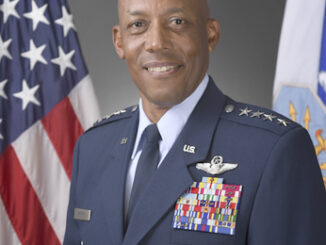
    WASHINGTON, D.C. (TIP): President Biden is expected to nominate the chief of staff of the Air Force, Gen. Charles “CQ” Brown Jr., to serve as chairman of the Joint Chiefs of Staff, choosing a deeply seasoned officer and fighter pilot with experience commanding troops in the Middle East and the Pacific to be his next senior military adviser, according to three people familiar with the matter, a report in the Washington Post says.
    If confirmed by the Senate, Brown would replace Gen. Mark A. Milley, whose tenure as chairman coincided with a tumultuous period in history, one that included the U.S. Capitol attack, the deadly evacuation of Afghanistan, and the American-led effort to train and arm Ukraine as it fights invading Russian forces. The pugnacious Milley clashed frequently — and sometimes publicly — with the man who tapped him for the assignment: President Donald Trump.
    Biden zeroed in on Brown as his preferred candidate after also interviewing Gen. David H. Berger, the commandant of the Marine Corps. Berger has recently told colleagues that he intends to retire, a senior military official familiar with the matter said. Like others, this person spoke on the condition of anonymity to discuss the high-profile personnel move. A Marine Corps spokesman could not immediately be reached for comment.
    It was not immediately clear when Biden intends to make an announcement. The White House did not immediately respond to a request for comment.
    News of Brown’s expected selection was reported earlier by Politico.
    The next chairman’s portfolio will include regularly interfacing with Ukraine’s senior military leaders and U.S. allies with a stake in the war, preparing the United States for potential conflict with China, and attempting to steer the military, with its nonpartisan tradition, through the nation’s frequently toxic politics. American confidence in the military has plummeted in recent years, according to several surveys, drawing concern from Defense Secretary Lloyd Austin and other senior defense officials.
    Air Force Chief of Staff Gen. Charles Q. Brown Jr. said the speed with which China has been able to develop disruptive technological capabilities gives him pause. “That becomes a concern because it upsets the kind of rules based International order that has actually kept the world in a well, security, pretty stable over the course of the past 70 years.” (Video: Washington Post Live)
    Brown became the first African American to lead a branch of service, and he acknowledged when taking the job that doing so came with “immense expectations.” If confirmed as chairman, he will become the second African American to serve as the Pentagon’s top military officer, following in the footsteps of Gen. Colin Powell, who ascended to the job in 1989 after serving as President Ronald Reagan’s national security adviser. It would mark the first time the Pentagon’s top two jobs are held by African Americans.
    Even keel and affable, Brown has led the Air Force since June 2020. In that time, he has warned that the service must accelerate how quickly it modernizes or risk losing its superiority. To that end, he has pressed for the retirement of aging warplanes in favor of more advanced aircraft, stressing that U.S. dominance in the sky may not apply in the future. He has also prioritized improving working conditions for Air Force personnel, and put an emphasis on diversity and racial justice.
    The new Air Force chief wasn’t sure how to address George Floyd’s killing. Then he talked to his son.
    “I want these things to be enduring well after I’m gone — if someone wants to look back and say CQ Brown was part of that, fine — but I just want to make our Air Force as capable as possible,” Brown said during a recent appearance at the Brookings Institution.
    While awaiting his confirmation to become Air Force chief of staff, Brown memorably released a video describing his experience as a Black man in the military after the police killing of George Floyd. He said in it that he was aware of the “immense expectations” that came with his historic promotion, “particularly through the lens of current events plaguing our nation.”
    Brown served previously as the top U.S. Air Force officer in the Pacific, and before that oversaw U.S. forces in the Middle East as deputy commander of U.S. Central Command and commander of Air Forces Central Command.
    The son of a retired Army colonel, he split his childhood between California, Virginia, Oklahoma, Germany and Texas, and attended Texas Tech University on a Reserve Officers’ Training Corps scholarship.
    (Source: Washington Post)

  • Quad to sharpen focus on counter-terrorism, soft-peddles Ukraine conflict

    Quad to sharpen focus on counter-terrorism, soft-peddles Ukraine conflict

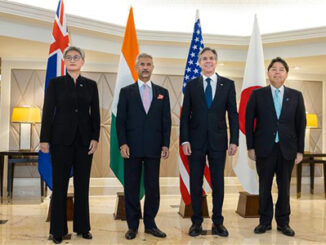
    New Delhi (TIP)- The Quad grouping of India, the US, Japan and Australia has decided to sharpen focus on counter-terrorism even as a joint statement avoided mentioning Russia and took no stand on the Ukraine conflict though it condemned North Korea’s ballistic missile launches. On its main remit of the Indo-Pacific maritime domain, a meeting of Quad Foreign Ministers here on Thursday issued a joint statement that “strongly” opposes any unilateral actions to change the status quo or increase tensions in South and East China Seas. It also expressed “serious concern” at the militarisation of disputed features, the dangerous use of coast guard vessels and maritime militia, and efforts to disrupt other countries’ offshore resource exploitation activities.

    In a broadside at Pakistan, the joint statement denounced the use of terrorist proxies and committed to promote accountability for terrorist attacks including 26/11 Mumbai, “which claimed lives of citizens from all Quad countries”.

    At the Raisina Dialogue shortly after their Quad meeting, Foreign Ministers S Jaishankar, Penny Wong, Anthony Blinken and Hayashi Yoshimasa were unanimous in stating that the Quad is not a military grouping. Their disclaimer came weeks before all the four will participate in their fourth successive joint naval exercise, this time off the Australian coast for the first time. A meeting of the Quad Maritime Security Working Group will also be hosted by the US this month.

    The same line-up of Quad Foreign Ministers which had met last September in New York, reiterated their backing for reforms of the UN Security Council and support for the general principles of freedom, rule of law, sovereignty and territorial integrity, peaceful settlement of disputes without resorting to threat or use of force.

    It noted that terrorism has become increasingly diffuse and adapted to technologies such as drones and the internet to commit and finance terrorist acts. Discussions at the Quad Counter-Terrorism Policy Meeting and tabletop exercise in Australia has led to the establishment of the Quad Working Group on Counter-Terrorism which will hold its first meeting in the US this year.

    It will have an open architecture and will also explore cooperation with Indo-Pacific partners with the purpose of countering new and emerging forms of terrorism, radicalisation to violence and violent extremism. The Quad also took a step forward in disaster relief and humanitarian assistance with the first tabletop exercise held here. The next step is to finalise the Standard Operating Procedures (SOP) for a coordinated response mechanism.

    With India and Japan acting as the brakes, the Quad did not condemn the Myanmar junta but sought an end to violence and detentions.

    On Ukraine, the joint statement said they “continued to discuss our responses to the conflict in Ukraine and the immense human suffering it is causing, and concurred that the use or threat of use of nuclear weapons is inadmissible”. Source: TNS

  • Quad to sharpen focus on counter-terrorism, soft-peddles Ukraine conflict

    Quad to sharpen focus on counter-terrorism, soft-peddles Ukraine conflict

    NEW DELHI (TIP): The Quad grouping of India, the US, Japan and Australia has decided to sharpen focus on counter-terrorism even as a joint statement avoided mentioning Russia and took no stand on the Ukraine conflict though it condemned North Korea’s ballistic missile launches, says a TNS report.
    On its main remit of the Indo-Pacific maritime domain, a meeting of Quad Foreign Ministers here on Thursday, March 2, issued a joint statement that “strongly” opposes any unilateral actions to change the status quo or increase tensions in South and East China Seas. It also expressed “serious concern” at the militarization of disputed features, the dangerous use of coast guard vessels and maritime militia, and efforts to disrupt other countries’ offshore resource exploitation activities.
    Powered By
    VDO.AI
    In a broadside at Pakistan, the joint statement denounced the use of terrorist proxies and committed to promote accountability for terrorist attacks including 26/11 Mumbai, “which claimed lives of citizens from all Quad countries”.
    At the Raisina Dialogue shortly after their Quad meeting, Foreign Ministers S Jaishankar, Penny Wong, Anthony Blinken and Hayashi Yoshimasa were unanimous in stating that the Quad is not a military grouping. Their disclaimer came weeks before all the four will participate in their fourth successive joint naval exercise, this time off the Australian coast for the first time. A meeting of the Quad Maritime Security Working Group will also be hosted by the US this month.
    The same line-up of Quad Foreign Ministers which had met last September in New York, reiterated their backing for reforms of the UN Security Council and support for the general principles of freedom, rule of law, sovereignty and territorial integrity, peaceful settlement of disputes without resorting to threat or use of force.
    It noted that terrorism has become increasingly diffuse and adapted to technologies such as drones and the internet to commit and finance terrorist acts. Discussions at the Quad Counter-Terrorism Policy Meeting and tabletop exercise in Australia has led to the establishment of the Quad Working Group on Counter-Terrorism which will hold its first meeting in the US this year.
    It will have an open architecture and will also explore cooperation with Indo-Pacific partners with the purpose of countering new and emerging forms of terrorism, radicalization to violence and violent extremism. The Quad also took a step forward in disaster relief and humanitarian assistance with the first tabletop exercise held here. The next step is to finalize the Standard Operating Procedures (SOP) for a coordinated response mechanism.
    With India and Japan acting as the brakes, the Quad did not condemn the Myanmar junta but sought an end to violence and detentions. On Ukraine, the joint statement said they “continued to discuss our responses to the conflict in Ukraine and the immense human suffering it is causing and concurred that the use or threat of use of nuclear weapons is inadmissible”.
    “We underscored the need for a comprehensive, just and lasting peace in Ukraine in accordance with international law, including the UN Charter. We emphasized that the rules-based international order must respect sovereignty, territorial integrity, transparency and peaceful resolution of disputes,” it added.

    (Source: TNS)

  • India abstains in U.N. vote underscoring need for just, lasting peace in Ukraine

    India abstains in U.N. vote underscoring need for just, lasting peace in Ukraine

    • The resolution got 141 votes in favor and seven against; India was among the 32 countries that abstained

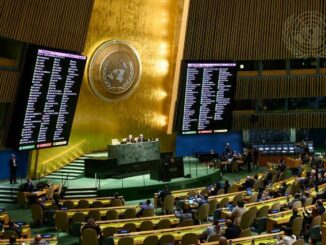
    UNITED NATIONS (TIP): India abstained in the U.N. General Assembly on February 23 on a resolution that underscored the need to reach as soon as possible a “comprehensive, just and lasting peace” in Ukraine in line with the principles of the U.N. Charter.

    The 193-member General Assembly adopted the draft resolution, put forward by Ukraine and its supporters, titled Principles of the Charter of the United Nations underlying a comprehensive, just and lasting peace in Ukraine. The resolution, which got 141 votes in favor and seven against, “underscores the need to reach, as soon as possible, a comprehensive, just and lasting peace in Ukraine in line with the principles of the Charter of the United Nations.” India was among the 32 countries that abstained.

    The resolution called upon member states and international organizations to redouble support for diplomatic efforts to achieve a comprehensive, just and lasting peace in Ukraine, consistent with the Charter.

    It reaffirmed its commitment to the sovereignty, independence, unity and territorial integrity of Ukraine within its internationally recognized borders, extending to its territorial waters and reiterated its demand that Russia immediately, completely and unconditionally withdraw all of its military forces from the territory of Ukraine within its internationally recognized borders, and calls for a cessation of hostilities. In the year since Russia’s February 24, 2022 invasion of Ukraine, several U.N. resolutions — in the General Assembly, Security Council and Human Rights Council, have condemned the invasion and underlined the commitment to the sovereignty, independence, unity and territorial integrity of Ukraine.

    India has abstained on the U.N. resolutions on Ukraine and consistently underlined the need to respect the U.N. Charter, international law and the sovereignty and territorial integrity of states.

    New Delhi has also urged that all efforts be made for an immediate cessation of hostilities and an urgent return to the path of dialogue and diplomacy.

    In September 2022, External Affairs Minister S. Jaishankar said in his address to the high-level U.N. General Assembly session that in this conflict, India is on the side of peace and dialogue and diplomacy.

    “As the Ukraine conflict continues to rage, we are often asked whose side are we on. And our answer, each time, is straight and honest. India is on the side of peace and will remain firmly there. We are on the side that respects the UN Charter and its founding principles. We are on the side that calls for dialogue and diplomacy as the only way out,” Jaishankar had said, adding that it is in the collective interest to work constructively, both within the United Nations and outside, in finding an early resolution to this conflict.

    India has also consistently underlined that in the conflict, the entire global South has suffered “substantial collateral damage” and developing countries are facing the brunt of the conflict’s consequences on food, fuel and fertilizer supplies.

    Jaishankar had said that India is on the side of those that are “struggling to make ends meet, even as they stare at the escalating costs of food, of fuel and fertilizers.” The UNGA resolution called for an immediate cessation of the attacks on the critical infrastructure of Ukraine and any deliberate attacks on civilian objects, including those that are residences, schools and hospitals.

    It urged all member states to cooperate in the spirit of solidarity to address the global impacts of the war on food security, energy, finance, the environment and nuclear security and safety and underscored that arrangements for a comprehensive, just and lasting peace in Ukraine should take into account these factors.


    U.N. Secretary-General Antonio Guterres told the emergency special session of the General Assembly that resumed on February 22 that Russia’s invasion of Ukraine is “an affront to our collective conscience” and said it is “high time” to step back from the brink.


    “The one-year mark of Russia’s invasion of Ukraine stands as a grim milestone — for the people of Ukraine and for the international community. That invasion is an affront to our collective conscience. It is a violation of the United Nations Charter and international law,” Mr. Guterres said adding that the invasion is having dramatic humanitarian and human rights consequences.

    In a strong message, Mr. Guterres said the war is fanning regional instability and fueling global tensions and divisions while diverting attention and resources from other crises and pressing global issues. “Meanwhile, we have heard implicit threats to use nuclear weapons. The so-called tactical use of nuclear weapons is utterly unacceptable. It is high time to step back from the brink,” he said.

    (Source: PTI)


  • Willing  to talk directly to Vladimir Putin and not via intermediators, says Zelensky

    Willing to talk directly to Vladimir Putin and not via intermediators, says Zelensky

    DAVOS (TIP) : Ukrainian President Volodymyr Zelenskyy said on Wednesday, May 25,  that he was only willing to talk directly to Vladimir Putin and not via intermediators, according to AP. He said if the Russian President “understands reality, there is the possibility of finding a diplomatic way out of the conflict”. Speaking to an audience at the World Economic Forum in Davos, he also said Ukraine would fight until it recovered all of its territory. “Moscow should withdraw its troops back to the lines in place before Russia began its invasion on February 24. That might be a first step towards talks,” he said, adding Russia had been playing for time in its talks with Ukraine.

  • Advanced economies to be back on track by 2024: IMF

    Advanced economies to be back on track by 2024: IMF

    DAVOS (TIP): Advanced economies will be back on track by 2024 but developing economies will be 5% below where they would have been otherwise, IMF’s Gita Gopinath said on Wednesday, May 25. Economies worldwide have been adversely impacted by the coronavirus pandemic and are slowly coming back into the recovery path.

    The First Deputy Managing Director of the International Monetary Fund said the war in Ukraine has been a major setback to the global recovery. “We had a serious downgrade to the global growth rate and the world continues to face headwinds because we have a cost of living crisis. Prices of commodities, including fuel and food, are going up around the world,” she said. Gopinath said central banks are trying to tackle this high level of inflation and are raising interest rates sharply, which they need to do, but that will also have consequences for global finance and trade.

    She was speaking at a special session on ‘What next for global growth?’ during the World Economic Forum Annual Meeting 2022. Gopinath said there are very divergent recoveries around the world.

    “While advanced economies, as per our estimates, will basically get back to where they would have been in the absence of pandemic in 2024, but emerging and developing economies would be 5% below where they would have been in the absence of the pandemic,” she said. The panelists discussed that the recovery from the Covid crisis has been deeply uneven within and between countries, depending on their access to fiscal resources and vaccines. As food, fuel and resource crises now risk further derailing an equitable recovery, they discussed how a broader set of foundations for growth can ensure long-term economic prosperity and a return to international convergence.

    (Source: PTI)

  • Red Cross visits prisoners of war from Ukraine, Russia

    Red Cross visits prisoners of war from Ukraine, Russia

    Geneva (TIP): The international Red Cross says it has been visiting prisoners of war on “all sides” since the start of the war between Russia and Ukraine almost three months ago. The International Committee of the Red Cross didn’t specify what “all sides” meant, but it is believed to mean Russian and Ukrainian government forces, as well as pro-Russian separatists who have been waging an armed struggle in eastern Ukraine against the Kyiv government since 2014. It could also include foreign fighters who might have been captured. A Red Cross statement Friday said the POW visits had enabled it to pass on information to hundreds of families about their loved ones.

    The ICRC did not specify how many families had been informed about their relatives, or where the visits took place. It said only that the visits had taken place “in recent months.” The statement came a day after the humanitarian agency broke its silence about prisoners of war in the nearly three-month-long conflict, announcing it has registered “hundreds” of Ukrainian prisoners of war this week from the Azovstal steel plant in Mariupol who ended their defense against a weeks-long siege by Russian forces.

    “Many more families need answers; the ICRC must have full access to POWs and civilian internees, wherever they are held, in order to provide those answers,” the Geneva-based organisation said. Some humanitarian law experts have questioned why the ICRC took so long to announce its POW visits, a key part of its mandate.

    The ICRC often operates confidentially in its role to help protect civilians, prisoners of war and other noncombatants in conflicts, and ensure the respect of the rules of war. AP

  • Ukraine accuses Russiaof forcibly deporting over 2 lakh children

    Ukraine accuses Russiaof forcibly deporting over 2 lakh children

    Kyiv (TIP): Ukraine said on May 13 Russia had forcibly deported more than 210,000 children since its invasion on Feb. 24 and accused Moscow of wanting to make them Russian citizens. Human rights ombudswoman LyudmylaDenisova said the children were among 1.2 million Ukrainians who Kyiv says have been deported against their will.

    Reuters could not independently verify the figure given by Denisova or her allegations, for which she did not provide supporting evidence. The Kremlin did not immediately respond to a Reuters request for comment on Denisova’s allegations concerning the deportation of large numbers of children and other Ukrainian nationals.

    Moscow has denied intentionally targeting civilians since launching what it calls a special military operation in Ukraine and says it is offering humanitarian aid to those who want to leave Russia. “When our children are taken out, they destroy the national identity, deprive our country of the future,” Denisova said on national television.

    “They teach our children there, in Russian, the history that (Russian President Vladimir) Putin has told everyone.” Russia has referred to “refugees” coming to Russia to escape fighting, particularly from the southern Ukrainian city of Mariupol, which is in Russian hands after weeks of siege and bombardment. The 1949 Geneva Conventions, which define international legal standards for humanitarian treatment in conflict, prohibit mass forcible transfers of civilians during a conflict to the territory of the occupying power, classifying it as a war crime. Reuters

  • Ukraine pushes Russian forces back, restricts gas flow to Europe

    Ukraine pushes Russian forces back, restricts gas flow to Europe

    Kyiv/Vilhivka (TIP): Ukrainian forces reported battlefield gains on May 11 in a counterattack that could signal a shift in the momentum of the war, while Kyiv shut gas flows on a route through Russian-held territory, raising the spectre of an energy crisis in Europe. Following days of advances north and east of the second largest city Kharkiv, Ukrainian forces were within just several kilometres of the Russian border on Wednesday morning, one Ukrainian military source said on condition on anonymity. Before the advance, Russian forces had been on the outskirts of Kharkiv, 40 km (25 miles) from the border.

    The gains appear to be the fastest that Ukraine has achieved since it drove Russian troops away from Kyiv and out of the country’s north at the beginning of April. If sustained, it could let Ukrainian forces threaten supply lines for Russia’s main attack force, and even put rear logistics targets within Russia itself within striking range of Ukrainian artillery.

    In Vilhivka, a village east of Kharkiv held by Ukrainian forces, the thump of near constant artillery and swoosh of multiple rocket launchers could be heard from fighting at the front, now pushed substantially further east, where Ukraine has been trying to capture villages on the banks of the Donets river and threaten Russian supply lines on the far side.

    Further east, Ukrainian forces seemed to be in control of the village of Rubizhne, on the banks of the Donets.

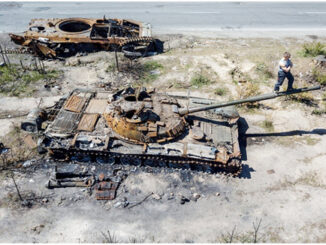
    “It is burned out, just like all Russian tanks,” a Ukrainian soldier told Reuters near Rubizhne next to the ruins of one Russian tank. “The weapons are helping a lot, the anti-tank ones.”

    KHARKIV ADVANCE

    Kyiv has so far confirmed few details about its advance through the Kharkiv region, maintaining secrecy about the positions of its own forces near the frontline while speaking in general terms about overall gains.

    “We are having successes in the Kharkiv direction, where we are steadily pushing back the enemy and liberating population centres,” Brigadier General OleksiyHromov, Deputy Chief of the Main Operations Directorate of Ukraine’s General Staff told a briefing, providing no specifics.

    President VolodymyrZelenskiy said successes were putting Ukraine’s second largest city – under constant bombardment since the war’s early days – beyond the range of Russian artillery.  (Reuters)

  • Russian spy boss compares US to German Nazi propaganda machine

    Mariupol, Ukraine (TIP): A Russian spy chief on May 11 compared the US State Department to the World War II Nazi propaganda machine constructed by Joseph Goebbels, saying Washington had launched an anti-Russia messaging campaign across social media.

    Sergei Naryshkin, head of Russia’s foreign intelligence agency (SVR), said the United States was encouraging the spreading of fake information on the popular Telegram messaging service in an attempt to “discredit” and “dehumanise Russia’s political and military leadership in the eyes of the Russian people”.

    “Their actions have a lot in common with the traditions of the Third Reich’s ministry of public education and propaganda and its head Joseph Goebbels,” Naryshkin said in a statement published on the SVR website.

    Naryshkin provided no evidence to support the claims of a US-backed information campaign. Russia regularly accuses the West of funding and supporting anti-Kremlin movements and has labelled dozens of independent human rights groups and media outlets in Russia “foreign agents” over recent years. (Reuters)

  • Russia-Ukraine War: Indian embassy to resume operations in Kyiv from May 17

    Kyiv (TIP): India on May 13 announced that its embassy in Ukraine would resume its operation from the Ukrainian capital Kyiv from May 17. The embassy was temporarily operating from Warsaw in Poland since mid-March.

    “The Indian Embassy in Ukraine, which was temporarily operating out of Warsaw (Poland), would be resuming its operation in Kyiv with effect from May 17,” the Ministry of External Affairs said.

    It said the embassy was temporarily relocated to Warsaw on March 13. The decision to resume operation of the embassy from Kyiv came amid decisions by several Western powers to reopen their missions in the Ukrainian capital.

    India had decided to temporarily relocate the embassy to Poland in view of the rapidly deteriorating security situation in the war-torn country, including the Russian military offensive around Kyiv.

    India relocated the embassy after bringing back over 20,000 of its nationals from across Ukraine under its evacuation mission ‘Operation Ganga’ that was launched on February 26 in the wake of the war in Ukraine. (PTI)

  • Ukraine can attack Russian logistics, unlikely to use its weapons: UK

    Ukraine can attack Russian logistics, unlikely to use its weapons: UK

    London (TIP): British Defence Secretary Ben Wallace said on April 28 it would be legitimate for Ukrainian forces to target Russian logistics to cripple their supply of food, fuel and munitions but they were unlikely to use British weapons to do so. Tensions between Britain and Russia increased this week when Moscow accused London of provoking Ukraine to strike targets inside Russia, saying there would be an immediate “proportional response” if it continued.

    Wallace said under international law Ukraine had every right to defend itself.

    “Part of defending itself in this type of invasion is obviously where Ukraine will go after the supply lines of the Russian army because without fuel and food and ammunition, the Russian army grinds to a halt and can no longer continue its invasion,” he told BBC TV.

    Britain has been a vocal supporter of Ukraine since it came under attack in late February, sending aid and arms to help it repel its larger neighbour.

    Wallace said Britain had sent artillery to Ukraine that was being used within Ukraine on Russian forces, but he added that it had not, and was unlikely, to send weapons that could be used for longer-range attacks.

    He said that it was not clear if attacks seen in Russia in recent weeks had come from the Ukrainian state. He added that Ukraine did not have British weapons that could do that.

    Ukrainian forces, he said, tend to use mobile launchers while the British army would deliver them from the air or sea.

    “They currently don’t have British weapons that could do that, so it’s unlikely that it is our weapons,” he said. “We’re very unlikely to supply that to anyone simply because of the technology and also the scarcity we have of those capabilities.

    So it is very unlikely.”

    Wallace also denied that NATO was locked in a proxy war with Russia but said the West would provide increasing support to Ukraine if the Russian attacks continued. “Sometimes that will include planes and tanks,” he told Times Radio.

    Russia on Wednesday reported a series of blasts in the south of the country and a fire at an ammunition depot.

    Russia has repeatedly criticised Britain’s military support for Ukraine, accusing it of wanting to prolong the conflict to weaken Moscow.

    Responding to a similar British statement on Tuesday which said Russian military targets inside Russia were fair game for Ukraine, Russian Foreign Ministry spokesperson Maria Zakharova suggested that British logic meant Russia was also theoretically entitled to strike targets in NATO countries like Britain if they were related to arms deliveries for Ukraine. Reuters

  • USCIRF recommends to designate India, 14 others as ‘Country of Particular Concern’

    USCIRF recommends to designate India, 14 others as ‘Country of Particular Concern’

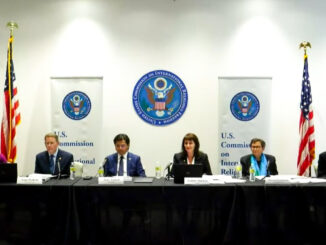
    WASHINGTON, D.C. (TIP): A US Congress-constituted quasi-judicial body on Monday, April 25,  recommended to the Biden Administration to designate India, China, Pakistan, Afghanistan and 11 other nations as “Country of Particular Concern” in the context of status of religious freedom. India has in the past said that the American body on international religious freedom has chosen to be guided only by its biases on a matter on which it has no locus standi.The recommendations of the US Commission for International Religious Freedom (USCIRF) are not binding on the US Government. Other countries recommended for this designation by the USCIRF in its annual report are Burma, Eritrea, Iran, Nigeria, North Korea, Russia, Saudi Arabia, Syria, Tajikistan, Turkmenistan, and Vietnam.

    The USCRF had made a similar recommendation to the US government last year which was not accepted by the Biden Administration.India has previously rejected the reports by USCIRF.

    “Our principled position remains that we see no locus standi for a foreign entity to pronounce on the state of our citizens’ constitutionally protected rights,” the ministry of external affairs had said in the past.

    “We have a robust public discourse in India and constitutionally mandated institutions that guarantee protection of religious freedom and rule of law,” the MEA had said.

    Among its recommendations last year, five countries — Afghanistan, India, Nigeria, Syria, and Vietnam – are not designated as Country of Particular Concern by the US Government.

    “In 2021, religious freedom conditions in India significantly worsened. During the year, the Indian government escalated its promotion and enforcement of policies—including those promoting a Hindu-nationalist agenda—that negatively affect Muslims, Christians, Sikhs, Dalits, and other religious minorities,” USCIRF said.”The government continued to systemize its ideological vision of a Hindu state at both the national and state levels through the use of both existing and new laws and structural changes hostile to the country’s religious minorities,” it said.

    Established by the US government in 1998 after the inaction of the International Religious Freedom Act, recommendations of USCIRF are non-binding on the state department. Traditionally, India does not recognize the view of USCIRF. For more than a decade, it has denied visas to members of the USCIRF.

  • Block off…so that not even a fly comes through, Putin after Mariupol takeover

    Block off…so that not even a fly comes through, Putin after Mariupol takeover

    Kyiv (TIP): Russian President Vladimir Putin ordered his forces not to storm the last remaining Ukrainian stronghold in the besieged city of Mariupol on April 21 but instead to block it “so that not even a fly comes through”. His defence minister, Sergei Shoigu, said the rest of the city beyond the sprawling Azovstal steel plant where Ukrainian forces were holed has been “liberated” – as Russian officials refer to areas of Ukraine they have seized. Putin hailed that as a “success”. But leaving the plant in Ukrainian hands robs the Russians of the ability to declare complete victory in Mariupol, which has seen some of the most dramatic fighting of the war and whose capture has both strategic and symbolic importance. The scale of suffering there has made it a worldwide focal point, and its definitive fall would deprive Ukraine of a vital port, complete a land bridge between Russia and the Crimean Peninsula, and free up Russian troops to move elsewhere in the Donbas.

    Shoigu said the plant was “securely blocked”. Putin and Shoigu’s comments appeared to reflect a change in strategy in Mariupol, where the Russians previously seemed determined to take every last inch of the city. But it was not clear what it would mean in practical terms.

    Ukrainian officials did not comment on the latest remarks, but earlier said four buses with civilians managed to escape from the city after several unsuccessful attempts. Thousands more remain the city, much of which has been reduced to a smoking ruin in a nearly two-month siege, with over 20,000 people feared dead.

    Ukraine’s Deputy Prime Minister IrynaVereshchuk said another attempt to evacuate civilians from Mariupol would be made on Thursday – though it was not clear how the latest comments would affect that.

    In Kyiv, Spain’s Prime Minister Pedro Sánchez and Denmark’s MetteFrederiksen became the latest European leaders to show support with a visit to the capital.

    They were due to meet with President VolodymyrZelenskyy, who warned in a video address overnight that the Russians were not “abandoning their attempts to score at least some victory by launching a new, large-scale offensive”.

    “The West stands together to support the Ukrainian people,” Frederiksen, the Danish prime minister, said in a statement. Meanwhile, the Kremlin said it submitted a draft of its demands for ending the war, and the West raced to supply Ukraine with heavier weapons to counter the Russians’ new drive to seize the industrial east.  (AP)