Tag: Ukraine

  • Ukraine claims 3 soliders killed, 2 wounded in Russian attack on nuclear plant

    Ukraine claims 3 soliders killed, 2 wounded in Russian attack on nuclear plant

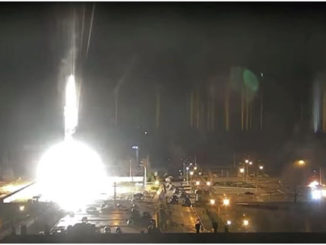
    Kyiv (TIP): Russian troops are shelling Europe’s largest nuclear power station in Ukraine.  “We demand that they stop the heavy weapons fire,” AndriyTuz, spokesperson for the plant in Enerhodar, said in a video posted on Telegram. “There is a real threat of nuclear danger in the biggest atomic energy station in Europe.”    The plant accounts for about one quarter of Ukraine’s power generation. Tuz told Ukrainian television that shells were falling directly on the Zaporizhzhia plant and had set fire to one of the facility’s six reactors. That reactor is under renovation and not operating, but there is nuclear fuel inside, he said. Firefighters cannot get near the fire because they are being shot at, Tuz said. A live-streamed security camera linked from the homepage of the nuclear power plant showed what appeared to be armouredvehicles rolling into the facility’s parking lot and shining spotlights on the building where the camera was mounted. There are then what appear to be bright muzzle flashes from vehicles and then nearly simultaneous explosions in the surrounding buildings. Smoke then rises and drifts across the frame. (AP)

  • 4,000 luxury cars like Lamborghinis, Bentleys sink in the Atlantic Ocean as the cargo ship catches fire

    4,000 luxury cars like Lamborghinis, Bentleys sink in the Atlantic Ocean as the cargo ship catches fire

    NEW YORK (TIP): Nearly 4,000 luxury cars like Porsches, Lamborghinis, Bentleys and Volkswagen — along with several high-end electric vehicles — have sunk aboard a cargo ship in the Atlantic that caught fire last month.Felicity Ace ship was carrying both electric and non-electric vehicles, and a fire broke out on the ship as it was travelling from Germany to the US, reports Insider.While it’s unclear exactly what started the fire, captain Joao Mendes Cabecas of the port of Hortas said lithium-ion batteries in EVs aboard the ship caught fire.

    A salvage team was able to board the ship over the last weekend but to no avail. The ship management company, MOL Ship Management Singapore, said the ship sank about 253 miles off the coast of the Azores, an archipelago in the mid-Atlantic that’s an autonomous region of Portugal. All 22 crew members were evacuated from the ship and were safe. “The 22 crew members did not need medical assistance on arrival, having been taken to a local hotel. The owner of the ship ‘Felicity Ace’ is in contact with the logistic agent in order to draw up a plan for the towing of the ship,” the navy had said. The Felicity Ace ship was heading from Germany to a port in Rhode Island, the US, when it issued distress signals this week. According to Importinfo.com, the electric vehicles may have been Audi E-tronSportbacks.

    (Source: IANS)

  • 4 Russian fighter jets violate Swedish airspace

     Russia (TIP): The Swedish Armed Forces said that four Russian fighter aircraft have violated the country’s airspace. In a statement, the Forces said that it conducted an operation with JAS 39 Gripen aircraft of the rapid readiness unit, which documented and photographed the incident. “This demonstrates that our readiness is good. We were on site to secure the territorial integrity and Sweden’s borders. We have complete control of the situation”, said Air Force Commander Carl-Johan Edstrom. The Swedish airspace was violated by two Russian SU 27 and two Russian SU 24. The incident was brief and took place east of Gotland, out at sea. “With the current situation as backdrop, we take this incident very seriously. Russia’s conduct is unprofessional and irresponsible”, says Air Force Commander Edstrom. IANS

  • More than 200 gunmen killed in Nigeria security operation

    Kaduna (TIP): At least 200 gunmen were killed in the past three days in Nigeria’s central-northern state of Niger during a security operation to clear armed gangs from the area, a state commissioner said on March 3. Gunmen have terrorised citizens in the north and northwest of the country and have gained notoriety for kidnapping hundreds of students and villagers for ransom and killing dozens. The Niger regional commissioner in charge of internal security, Emmanuel Umar, said some leaders of the armed gangs, known locally as bandits, were among those killed during an operation led by the army and volunteers from local vigilante groups and community leaders. In a statement, Umar said 60 motorbikes, which the gangs use to raid villages, weapons and cattle, were recovered from gunmen operating from camps deep inside the vast forests in the state. An army spokesman did not immediately respond to questions. At least four Nigerian security personnel were killed when their patrol vehicle detonated a landmine in Niger last month, and gunmen killed an unknown number of people. Niger regional authorities said last year that Islamist militants had established a presence in one locality for the first time. Last month, President MuhammaduBuhari said the military had begun a major offensive against militants there. Reuters

  • Sydney braces for flash floods as rain disaster moves south

    Sydney braces for flash floods as rain disaster moves south

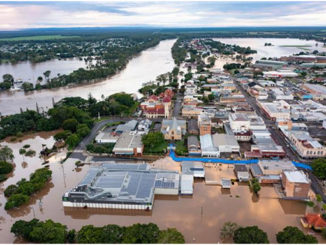
    Sydney (TIP): Sydney was preparing on March 2 for dangerous flash flooding as population centers farther north began a massive cleanup operation after record floods that have claimed at least 14 lives along Australia’s east coast in recent days.

    The torrential rain — as much as 20 centimeters (8 inches) — is forecast for Australia’s largest city and surrounding areas late March 2 and early March 3, Australia’s Bureau of Meteorology said. “In the Sydney area, we have minor to major flood warnings current,” meteorologist Dean Narramore said. In the New South Wales town of Lismore, 600 kilometers (370 miles) north of Sydney, a fourth death was confirmed on Wednesday as floodwaters drain from homes and searchers knock on doors.

    The body of a man, aged in his 70s, was found ion a flooded apartment, a police statement said.  A man’s body had been found floating in a main street earlier on Wednesday. The population of 28,000 people was inundated when Wilsons River peaked Monday afternoon at its highest level since records began in 1880. Authorities expect the death toll to rise in Lismore and its surrounding areas.

    Dozens of suburbs remain flooded in Brisbane, Australia’s third-most populous city 750 kilometers (470 miles) north of Sydney, after the river that snakes through its center peaked on Monday. The Queensland state capital had  received 80% of its average annual rainfall within a few days. The cleanup effort is underway and 8,000 volunteers had enlisted for what is known as the Mud Army, which helps those who were inundated. Queensland has accounted for nine of the deaths from the flooding disaster that has resulted from a low-pressure system that is moving south.   (AP)

  • US stance on Russia’s security interests hypocritical: Bernie Sanders

    MOSCOW (TIP): Independent US Senator Bernie Sanders recently called out the US for being “hypocritical” in not accepting Russia’s argument of “spheres of influence.” For the last 200 years, recalled Sanders in the US Senate, America had operated under the Monroe Doctrine which gave it the right to intervene against any country that might threaten its alleged interests. Under this doctrine, the US undermined and overthrew at least a dozen governments. In 1962, it came to the brink of a nuclear war with the Soviet Union in response to the placement of Soviet missiles in Cuba, which the Kennedy administration saw as an unacceptable threat to US’ national security. In 2018, Donald Trump’s Secretary of State Rex Tillerson called the Monroe Doctrine “relevant today as it was the day it was written”. In 2019, former Trump National Security Adviser John Bolton declared “the Monroe Doctrine is alive and well”. “To put it simply, even if Russia was not ruled by a corrupt authoritarian leader like Vladimir Putin, Russia, like the US, would still have an interest in the security policies of its neighbours. Does anyone really believe that the United States would not have something to say if, for example, Mexico was to form a military alliance with a US adversary?” asked Sanders. (TNS)

  • ‘Will be 10 times larger than Chernobyl’, Ukraine warns Russia on nuclear-plant attack

    Kiev (TIP): Ukrainian Foreign Minister DmytroKuleba on Friday warned against Russian troops firing at the Zaporizhzhia nuclear power plant, which is the largest in Europe, saying that if it blows up then the disaster would be “10 times larger” than Chernobyl. In a tweet early March 4 morning, the Minister said: “Russian army is firing from all sides upon Zaporizhzhia NPP, the largest nuclear power plant in Europe. Fire has already broke out.

    “If it blows up, it will be 10 times larger than Chernobyl! Russians must immediately cease fire, allow firefighters, establish a security zone.”  Citing Ukrainian officials, the International Atomic Energy Agency (IAEA) said that there has not been any change in the radiation levels at plant site in the wake of the fire.

    The IAEA also said that the fire has not affected “essential” equipment and personnel at the nuclear power plane were “taking mitigatory actions”. The global nuclear organisation further said that it is consulting with Ukraine “and others with a view to provide maximum possible assistance to the country as it seeks to maintain nuclear safety and security in the current difficult circumstances”.

    But in the wake of the “serious situation” at the plant, IAEA Director General Rafael Grossi has warned Ukrainian Prime Minister Denys Shmygal and the country’s nuclear regulator and operator of the severe danger if the reactors were hit by the ongoing Russian firing. Ukraine currently has four active nuclear plants, including Zaporizhzhia which reportedly accounts for some 25 per cent of the country’s power, the BC reported. It also deals with nuclear waste at sites like Chernobyl, which is now under Russian control. The latest developments come on the ninth day of Russia’s continuous military assault on Ukraine. Since the Russian invasion began on February 24, intense shelling and bombing has continued across Ukraine, including capital Kiev and the second largest city of Kharkiv. On Wednesday, Russian troops seized the port town of Kherson, a provincial capital home to about 250,000 people, making it the first major Ukrainian city to fall. Ukraine has so far reported over 2,000 civilian casualties and UN estimates have revealed that over one million people have fled to neighbouring countries such as Poland, Romania, Slovakia, Hungary and Moldova.

    At least 160,000 others are currently displaced within Ukraine. Meanwhile, the European Union believes that figure could climb to seven million, and that 18 million Ukrainians will be affected by the war. (AP)

  • Crypto gains currency as Russia-Ukraine conflict escalates

    Crypto gains currency as Russia-Ukraine conflict escalates

    New Delhi (TIP)-Although several countries have banned cryptocurrency, the decentralised money has become a mainstream component of the global financial system. This means that it will inevitably become a part of international conflict, for better or worse and as Russian armies enter Ukraine, this is on full show.As the war with Russia rages on, Ukrainian officials urged netizens on Twitter to send cryptocurrency. Since then, according to reports, cryptocurrency investors have given the Ukrainian government and a foundation backing the country’s military, more than $22 million in digital assets.

    The turmoil in Ukraine has brought the burgeoning industry under increased attention, with politicians and regulators concerned that the cryptocurrencies could be used by Russian firms and government officials to circumvent sanctions. However, as more traditional crowdfunding techniques face challenges, cryptocurrency has created a way for investors all across the world to quickly shift funds to Ukrainian soldiers. In the case of crypto donations, Ukraine’s Vice Prime Minister Mykhailo Fedorov on February 26 shared wallet addresses on Twitter, urging people to “Stand with the people of Ukraine”, while adding that “now accepting cryptocurrency donations. Bitcoin, Ethereum and USDT”. Later, in the same Twitter thread, he wrote: “The people of Ukraine fighting for our freedom are forever grateful to Gavin Wood @gavofyork for the generous donation of $5M of @Polkadot $DOT as promised publicly. Thank you from all of us here in Ukraine working for a peaceful future.”

    As of now, some reports have claimed that Ukraine has received at least $11 million through anonymous Bitcoin donations.

    Separately, Come Back Alive, a Kyiv-based organisation that raises funds to arm and train Ukrainian military men, had a page taken down by the crowdfunding platform Patreon, which stated that the page had broken its rules prohibiting support of military activities. But now the organisation is getting funds from a crypto collective called UkraineDAO, which was formed last week by some crypto enthusiasts.

    According to a report it was said Come Back Alive had pledged to use the funds to provide medical assistance to war victims rather than armed soldiers.

    Additionally, it was also reported that Since Kremlin launched its attacks on the neighbouring country, cryptocurrency donations to Ukrainian volunteer and hacktivists groups have increased dramatically.

    Sam Bankman-Fried, the billionaire CEO of crypto exchange FTX US, revealed in a tweet that they had given $25 to each Ukrainian on their platform.

    These activities highlight the fact that at this time of crisis, donors who might have otherwise given their money to huge charities have turned to cryptocurrencies as an alternative.

    But in a separate scenario, cryptocurrency exchanges have refused Ukraine’s request to suspend all Russian accounts.

    As reported recently, major cryptocurrency exchanges such as Coinbase and Binance have refused to comply with Ukraine’s request to freeze all Russian accounts, claiming that doing so would damage people and go against their values.      Source: News18

  • Oil surges to $111/barrel as Russian supply woes rise

    London (TIP)-Oil prices surged on Wednesday, March 2,  as supply disruption fears mounted following hefty sanctions on Russian banks amid the intensifying Ukraine conflict, while traders scrambled to seek alternative oil sources in an already tight market.

    Brent crude futures rose by more than $8, touching a peak of $113.02 a barrel, the highest since June 2014, before easing to $111.17, up by $6.20 or 5.9% by 0950 GMT.

    US West Texas Intermediate (WTI) crude futures also jumped more than $8 a barrel, hitting the highest since August 2013 before losing some steam to trade up $5.86 or 5.7% to $109.27 a barrel.

    “Due to limited diversification options, any disruption to Russia’s energy exports will result in another energy crisis in Europe,” said Kaho Yu, principal Asia analyst at risk consultancy Verisk Maplecroft.

    “Although the US has called for a global oil reserve release, oil prices are likely to remain above $100 unless significant alternative supplies enter the market.” Russian oil exports account for around 8% of global supply.

    Exxon Mobil on Tuesday said it would exit Russia oil and gas operations as a result of Moscow’s invasion of Ukraine. The decision will see the firm pull out of managing large production facilities on Sakhalin Island in Russia’s Far East.

    While Western powers have not imposed sanctions on energy exports directly, US traders at hubs in New York and the US Gulf are shunning Russian crude.           Source: Reuters

  • INDIAN DIASPORA COUNCIL CONDEMNS THE RUSSIAN ATTACKS ON UKRAINE

    INDIAN DIASPORA COUNCIL CONDEMNS THE RUSSIAN ATTACKS ON UKRAINE

    NEW YORK (TIP): The Indian Diaspora Council International (IDC) joins in solidarity with others globally in its unequivocal condemnation of the unprovoked Russian invasion and attack of Ukraine, a sovereign country, resulting in unwarranted deaths, destruction and displacement of countless innocent citizens fleeing from their homes. IDC considers the invasion and attack by Russia to be unjustified, reckless and inhuman, without regard for the lives of innocent civilians. IDC supports the peaceful resolution of disputes and urges Russia and the international community to bring this war to a quick and peaceful resolution.

  • Key takeaways from Biden’s 2022 State of the Union speech

    Key takeaways from Biden’s 2022 State of the Union speech

    WASHINGTON , D.C. (TIP): Only a little more than a week ago, President Joe Biden’s first State of the Union address was focused largely inward, looking at the economic and public health woes besetting the U.S. But Russia’s invasion of Ukraine and the war that has ensued changed all that, says an AP Report. The speech and the war in Ukraine gave Biden both the platform and the urgent reason to talk about the fight between democracy and autocracy not as an abstraction but as an urgent reality.

    Biden has repeatedly talked about the battle of between the values of liberal democracies and autocrats like Russian President Vladimir Putin as the greatest foreign policy test facing the world.

    But Russia’s invasion of Ukraine — and the surprising unity that U.S. and European allies have shown in response — gave the president a chance to speak about the issue in a visceral way to a global audience. “In the battle between democracy and autocracy, democracies are rising to the moment, and the world is clearly choosing the side of peace and security,” Biden said “This is a real test. It’s going to take time. So let us continue to draw inspiration from the iron will of the Ukrainian people. “

    He celebrated the West for coming together on hard-hitting sanctions that are “choking off Russia’s access to technology that will sap its economic strength and weaken its military for years to come” he announced news sanctions to close off U.S. air space to all Russian flights. and he paid tribute to Ukrainian people for “fighting back with pure courage.”

    Biden found himself caught in the middle of culture wars for much of his first year in office. With his State of the Union, the president who has made his long career in politics living in the ideological middle — had moments where he sought to pivot to the center.

    He dismissed those on the left of his party who have advocated for reducing funding of police in the midst of national reckoning on policing in Black communities. “We should all agree: The answer is not to defund the police. The answer is to fund the police with the resources and training they need to protect our communities.”

    After months of Republicans beating him up on immigration, he allowed that “we need to secure the border and fix the immigration system.” But he also called on Republicans — and the American public — to look at the issue in a pragmatic way, alluding to the country’s worker shorter as the nation emerges for coronavirus pandemic.

    “It’s not only the right thing to do — it’s the economically smart thing to do,” Biden said. Even as he appeals to the higher ideals of democracy, Biden believes that many Americans would process the war through prices at the pump instead of geopolitical risks.

    It’s a jarring contrast in priorities as Ukrainians beg the U.S. and its allies for weapons to protect themselves, while the U.S. and Europe are focused first and foremost on energy costs in their own economies that are generally experiencing growth instead of an existential threat. “I’m taking robust action to make sure the pain of our sanctions is targeted at Russia’s economy — and I will use every tool at our disposal to protect American businesses and consumers,” Biden said as he announced the planned release of another 30 million barrels of oil from the U.S. petroleum reserve. Gasoline prices are averaging $3.61 a gallon, according to AAA. But most of that increase occurred over the past year, rather than the machinations of Russia. It’s a sign that Biden sees his own political fortunes resting on family budgets and reducing inflation, perhaps even more than a land war in Europe.

    Biden almost said it — the motto that disappeared with his political agenda: “Build Back Better.” Or, BBB. West Virginia Sen. Joe Manchin, the decisive Democratic vote in the evenly split Senate, has pronounced BBB dead with nary a eulogy.

    Biden in outlining his agenda said instead, “I call it building a better America.” So, what does that look like? It looks a lot like his prior agenda, except it’s been slimmed down.

    Capping prescription drug prices stays in the mix. So do anti-climate change policies — which are now being portrayed as ways to lower energy costs for families. Financial support to limit childcare costs is still in, though the expanded child tax credit from the coronavirus relief package is out. Universal pre-kindergarten remains a priority, but the primary goal of all of these policies is no longer to win the future as Biden once claimed. It’s all about reducing inflation, the problem dogging Biden’s popularity in the here and now.

    Biden said the country has moved beyond the pandemic, even if it still needs to stay vigilant against mutations. His big argument is that the country can’t change its past divides, though it must address the pandemic with a united front.

    He noted that most of the country can now be mask-free. Most Americans are vaccinated, and more vaccines are available if needed. Schools are open and workers can return to offices. “COVID-19 need no longer control our lives,” said Biden, echoing statements he made last July 4 when the disease similarly appeared to be in the rear-view mirror.

    The difference this time compared to the summer of 2020 is not only the increase in vaccinations but the lessons from the omicron and delta waves that caused infections and deaths to accelerate.

    His remarks include variations on the word “job” more than a dozen times as it applied to people working. Inflation netted half a dozen mentions and forms of the word “price” in terms of costs charged were mentioned 10 times. “Pandemic” was mentioned eight times and COVID-19 appeared a dozen times.He tried to highlight partisan unity by deploying the phrase “Democrats and Republicans” three times. Russia’s invasion of Ukraine (20 mentions) supplanted China as a geopolitical rival, as China got just two mentions. And there was a clear villain: Putin was named 12 times. As Russian invasion of Ukraine grinds on, lawmakers showed their support for Ukrainians with their sartorial choices of blue and yellow. House Speaker Nancy Pelosi wore a blue suit adorned with a lapel pin of Ukraine and U.S. flags. Rep. Eric Swalwell made do with a blue scarf.

    Sen. Mitt Romney of Utah, who appeared to have a large paper Ukraine flag pinned to his suit, had a bit of wardrobe malfunction. (His Ukraine flag fell off as he waded through the packed aisle to make his way to his seat.)

    Many lawmakers — and guests — also had small Ukrainian flags. In a sign of support for the Ukrainian people, the First Lady Jill Biden has an embroidered appliqué of a sunflower, the national flower of Ukraine, sewn to the sleeve of her dress near her wrist.

  • UN seeks US$1.7 billion as humanitarian needs soar in Ukraine and neighboring countries

    UN seeks US$1.7 billion as humanitarian needs soar in Ukraine and neighboring countries

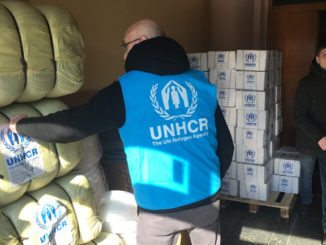
    UNITED NATIONS (TIP): The United Nations and humanitarian partners, on March 1, launched coordinated emergency appeals for a combined US$1.7 billion to urgently deliver humanitarian support to people in Ukraine and refugees in neighboring countries. The escalation of conflict has triggered an immediate and steep rise in humanitarian needs as essential supplies and services are disrupted and civilians flee the fighting. The UN estimates that 12 million people inside Ukraine will need relief and protection, while more than 4 million Ukrainian refugees may need protection and assistance in neighboring countries in the coming months.

    UN humanitarian chief Martin Griffiths said: “Families with small children are hunkered down in basements and subway stations or running for their lives to the terrifying sound of explosions and wailing sirens. Casualty numbers are rising fast. This is the darkest hour for the people of Ukraine. We need to ramp up our response now to protect the lives and dignity of ordinary Ukrainians. We must respond with compassion and solidarity.”

    The Flash Appeal asks for US$1.1 billion to assist 6 million people inside Ukraine for an initial three months. The programme includes multipurpose cash assistance for the most vulnerable people, food assistance, water and sanitation, support to health care and education services, and shelter assistance to rebuild damaged homes. The plan also aims to deliver support to authorities to maintain and establish transit and reception centers for displaced people and prevent gender-based violence.

    Aid groups will need safe and unimpeded access to all conflict-affected areas according to the core humanitarian principles of humanity, neutrality, impartiality and operational independence.

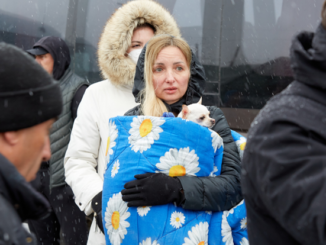
    With more than half a million refugees having fled Ukraine to neighboring countries in the past five days alone, and many more expected, support is also required to meet the critical needs of those seeking protection outside the country.

    The UN High Commissioner for Refugees, Filippo Grandi, said: “We are looking at what could become Europe’s largest refugee crisis this century. While we have seen tremendous solidarity and hospitality from neighboring countries in receiving refugees, including from local 2 communities and private citizens, much more support will be needed to assist and protect new arrivals.”

    An inter-agency Regional Refugee Response Plan (RRP) for the Ukraine situation asks for a preliminary US$550.6 million to help refugees in Poland, the Republic of Moldova, Hungary, Romania and Slovakia, as well as in other countries in the region in order to help host countries provide shelter, emergency relief items, cash assistance, and mental health and psychosocial support to those who fled Ukraine, including people with specific needs, such as unaccompanied children.

  • Reactions on social media to Russian bombing of Ukraine

    Worms that create silk are better than the guys that make bombs
  • What does the military offensive in Ukraine mean for women and girls?

    What does the military offensive in Ukraine mean for women and girls?

    By Alia El-Yassir, UN Women Regional Director for Europe and Central Asia

    The military attack in Ukraine is undermining access to rights for all, and UN Women is deeply concerned about the rapidly mounting humanitarian crisis inside Ukraine and in the neighboring countries. We know that women and girls will be impacted differently and disproportionally, and we will seek to ensure that their specific needs are adequately met.

    UN Women will use its expertise in Ukraine and neighboring countries to identify and respond to women and girls’ specific needs as they evolve. We will redirect our programming on the ground and share our gender expertise with the UN System and our humanitarian partners to help make humanitarian response plans and their implementation more gender responsive.

    UN Women has been present in Ukraine since 2015, including with offices in the east. Even before the recent escalation, conflict raged in eastern Ukraine and women and girls were severely impacted. More than 1.5 million people – two-thirds women and children – were internally displaced and suffered from impeded access to healthcare, housing, and employment.

    UN Women has been supporting social mobilization amongst women in the conflict-affected areas of eastern Ukraine, advancing their resilience, livelihoods and boosting their capacities and confidence, including by helping them to form self-help groups. We’ve also been working closely with civil society partners and women peacemakers, supporting them with their advocacy needs to ensure their voices are heard in decision-making on humanitarian aid provision, recovery, reconstruction and conflict resolution.

    Since starting our work in Ukraine, the resilience of women and girls, as well as of other groups often left behind such as young people and members of the LGBTIQ community, have greatly impressed us and guided our efforts. We aim to continue to support the efforts of our partners, calling for their rights to be protected, including to benefit equally from aid and the allocation of resources, and to participate in decision making.

    As the number of Ukrainians fleeing to neighboring countries rises, we will also engage in the refugee response there. With our field presence in Moldova, UN Women plans to conduct a rapid gender assessment. A similar needs assessment of Syrian women refugees in transit in the Western Balkans in 2015 laid bare the specific challenges facing women including, family separation, psychosocial stress and trauma, physical harm and injury, lack of access to sexual and reproductive health, exploitation and gender-based violence. Our work with Syrian refugees since 2015 and the internally displaced women of Ukraine has taught us good practices to help women and girls while they are in transit and as their displacement becomes more permanent. I join our Executive Director in her call to the international community “to keep women and girls at the center and to ensure that the humanitarian assistance planned and provided is gender-responsive.” I also echo statements by the UN SG and the High Commissioner for Human Rights who have called for an end to the military action which undermines human rights and humanitarian law. But no matter how the war evolves, we will continue to identify and respond to the needs of women and girls, ensuring their voices are heard, and work closely with our UN System and humanitarian partners, as well as women’s civil society organizations on the ground to help meet these needs.

    (Originally published on UN Women’s Regional website for Europe and Central Asia)

  • India’s Response to Russian Invasion of Ukraine legitimizes rape of a democracy

    India’s response to Russian invasion of Ukraine has surprise and shocked  democracies and Indians living in democratic countries of the world. India’s abstention from UNSC and UNGA resolutions to condemn Russia for its invasion of Ukraine is being interpreted as legitimizing Russian rape of democratic Ukraine. The Hindu scriptures say that the person who does not object to a wrongdoing to another person is equally guilty as the person doing wrong. Going by that high moral standard, India in siding with the wrongdoer is guilty of being an accomplice of Russia in the genocidal act.

    If one closely studied the mind of the present rulers in Delhi, one would clearly see that Modi government believes in choosing  interests over principles, notwithstanding the declarations of high moral standards and “Ram Rajya” of Modi and his company.

    Suddenly the age-old support to Palestinians disappeared and Israel became a darling of India. What was the motivation? One, Israel offered defense equipment and training to Indian commandos to fight insurgency in J & K. Two, Israel offered technology, including the spying  equipment, and of course, technologies in other fields including agriculture. However, the most gluing factor between Modi and Netanyahu was the latter’s autocratic style of functioning. It was for the same reason that Modi felt drawn to Trump who he endorsed as India’s choice of the President of America in 2020 when at a rally of Indian Americans in Houston  on September 22, 2019  he gave the slogan “Abki bar Trump Sarkar” (Next it is Trump administration), which was an utter violation of the US laws which prohibit a visitor to the US interfering in the internal political affairs of the country. But Modi, as Prime Minister of India, a country that the US considersits  “strategic partner” committed the violation and got away with it.

    India’s response to Russian invasion of Ukraine, some foreign policy experts will argue,  is guided by the harsh geopolitical circumstances. India has to deal with China, a growing and ambitious power in India’s neighborhood. India needs the support of both the US and Russia. Hence, India treaded a path whereby it will not annoy either. However, by abstaining from the US vote to condemn Russia for aggression against Ukraine, India has clearly indicated its preference for now, whatever explanation the foreign ministry of India may give.

    Once again, it has become clear to the world where the sympathies of the present government of India lie. Not with democracies. Surely not. The pattern we have seen of Modi’s preference for autocrats holds.

    One of the reasons which most India watchers either deliberately keep quiet about or have failed to see is the history of the political party governing  India. It is the party that admired Adolf Hitler. It is the party that considers Nathuram Godse, the assassin of Mahatma Gandhi as a patriot who rid India of a man who , according to the perception of this party, was pro-Muslim and responsible for the division of India in 1947. It is the party that wants a theocratic Hindu state by 2025 when the Rashtriya Swayamsevak Sangh ( the party’s volunteer corps) celebrates centenary of its foundation.

    The government of India’s foreign policy is not only guided by the tough geopolitical conditions but also by the desire to have the nations on its side when it goes in for a declaration of a theocratic state. Democracies of the world, including the US are not going to be supportive of the anti-democratic move of the Indian rulers. In fact, they will oppose any such move. India will then need Russia, a country that has no qualms about democratic decencies or human rights.

    Modi and his people have long been preparing to realize their dream of a Hindu Nation. They want to amend the constitution and act democratically, for now, but the way they are losing power in State after States , they may fail to have the required  numbers in the Rajya Sabha (the upper house, much like the US Senate) to carry out the constitutional amendment and fail in their democratic bid. So,  they have plan  B to ensure they achieve their dream. And that will not be a democratic way. It is then that they will need Putins of the world.

    Does the scenario frighten you? I wish the world is spared  another genocide.

  • Russia, Ukraine agree on  setting  up evacuation corridors

    Russia, Ukraine agree on  setting  up evacuation corridors

    Negotiators also discussed maintaining a temporary ceasefire in areas where the humanitarian corridors will be located.

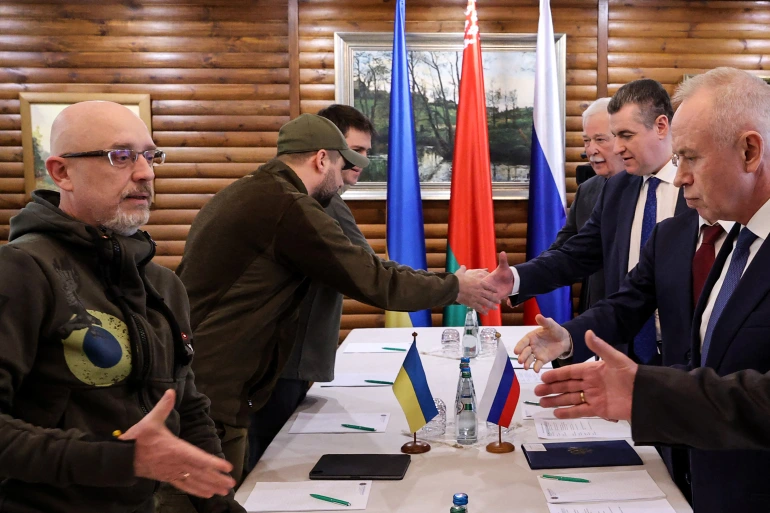
    BREST, BELARUS (TIP): Russia and Ukraine have agreed on the need for humanitarian corridors to deliver aid and help civilians exit besieged Ukrainian cities, in the first apparent sign of progress in talks between the warring sides, according to an Al Jazeera report.

    Russian negotiator Vladimir Medinsky reported “substantial progress” at Thursday’s talks –  the second round of negotiations since Russia launched its invasion of Ukraine – saying the “main issue that we settled today is the salvation of people, civilians who have found themselves in a zone of military clashes”.

    However, he did not indicate when the safe corridors may be established. The tentative agreement, reached in Belarus, came as Russian forces continued to surround and attack Ukrainian cities, including the capital, Kyiv, and the second-biggest city of Kharkiv.

    Thousands are thought to have died or been wounded in the eight-day conflict, while more than one million people have fled the fighting in what the United Nations has called the swiftest exodus of refugees this century.

    Ukraine’s negotiator, Mykhailo Podolyak, said the two sides have agreed to set up “communication and cooperation lines” as soon as possible to facilitate the evacuation of civilians. A temporary halt to fighting in select locations was also possible, he said.

    “That is, not everywhere, but only in those places where the humanitarian corridors themselves will be located, it will be possible to cease fire for the duration of the evacuation,” he said. The two sides also saw eye-to-eye on the delivery of medicines and food to the places where the fiercest fighting was taking place, Podolyak said, adding that the two sides will continue the work at “the third round at the earliest possible time”. The delegations also discussed “the military aspect” and “a future political settlement of the conflict”, according to the Russian negotiators. The third round will take place “in the coming days”, also in Belarus, they said. John Herbst, a former United States ambassador to Ukraine, called the agreement on humanitarian corridors a “positive sign”. “If the political will is there to make it happen, it could be a matter of one day or two days,” he told Al Jazeera. “It’s interesting that even as Moscow is dictating unconditional surrender terms to the conflict, they are willing to consider this. I think that may be because of the pounding they are receiving globally for their barbarous campaign,” he added.

    (Source: Al Jazeera)

  • India abstains on UNHRC resolution to investigate human rights violations, crimes in Russia-Ukraine war

    India abstains on UNHRC resolution to investigate human rights violations, crimes in Russia-Ukraine war

    The resolution was adopted with 32 votes in favor, two against (Russia and Eritrea) and 13 abstentions, including India, China, Pakistan, Sudan and Venezuela

    GENEVA/ UNITED NATIONS (TIP): India on Friday, March 4,  abstained in the UN Human Rights Council on a vote to urgently establish an independent international commission of inquiry to investigate alleged human rights violations and related crimes following Russia’s military operation in Ukraine. The 47-member Council voted on a draft resolution on the ‘Situation of human rights in Ukraine stemming from the Russian aggression.’ The resolution was adopted with 32 votes in favor, two against (Russia and Eritrea) and 13 abstentions, including India, China, Pakistan, Sudan and Venezuela.

    The countries voting in favor included France, Germany, Japan, Nepal, UAE, UK and the US.

    The resolution, which strongly condemned Russia’s aggression against Ukraine, decides to “urgently establish an independent international commission of inquiry” to “investigate all alleged violations and abuses of human rights and violations of international humanitarian law, and related crimes, in the context of the Russian Federation’s aggression against Ukraine, and to establish the facts, circumstances, and root causes of any such violations and abuses.”

    A day before the resolution was adopted, India said at the Urgent Debate Thursday regarding the human rights situation in Ukraine at the 49th Human Rights Council Session in Geneva that it is greatly concerned over the steadily worsening humanitarian situation in Ukraine.

    India urged for an immediate cessation of violence and an end to hostilities. “No solution can ever be arrived at the cost of human lives. Dialogue and diplomacy are the only solution for settling differences and disputes,” India said.

    India called for respect and protection of human rights of people in Ukraine and safe humanitarian access to conflict zones.

    “We are also deeply concerned over the safety and security of thousands of Indian nationals, including young Indian students, who are still stranded in Ukraine. We are working together with neighboring States for their evacuation,” it said.Three human rights experts will be appointed to the Commission of Inquiry by the President of the Human Rights Council for an initial duration of one year. The Commission will be mandated to “identify, where possible, those individuals and entities responsible for violations or abuses of human rights or violations of international humanitarian law, or other related crimes, in Ukraine, with a view to ensuring that those responsible are held accountable.’ The resolution expressed grave concern at the ongoing human rights and humanitarian crisis in Ukraine and calls on Russia to “immediately end its human rights violations and abuses and violations of international humanitarian law in Ukraine”.

    It also calls for the “swift and verifiable” withdrawal of Russian troops and Russian-backed armed groups from the entire territory of Ukraine, within its internationally recognized borders.  India has abstained on two resolutions on Ukraine in the 15-nation Security Council and one in the 193-member General Assembly in the last one week. The UN General Assembly this week overwhelmingly voted to condemn Russian aggression against Ukraine and demanded that Moscow “completely and unconditionally” withdraw all of its military forces from the territory of Ukraine. India abstained on the resolution, which received 141 votes in favor, five against and a total of 35 abstentions.

    (Source: PTI)

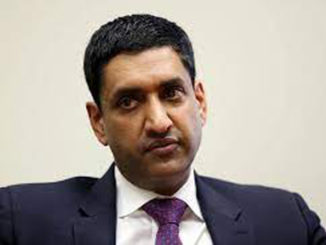
  • Indian American Congressman Ro Khanna expresses disappointment over India abstaining UNSC resolution on Russia

    Indian American Congressman Ro Khanna expresses disappointment over India abstaining UNSC resolution on Russia

    WASHINGTON, D.C. (TIP): Prominent Indian-American Congressman Ro Khanna has expressed disappointment over India’s decision to abstain from the UN Security Council resolution on Russia’s aggression against Ukraine, saying it is the US and not Russia that will stand with New Delhi against China’s current expansionist plans. India, China and the United Arab Emirates on Friday, February 25,  abstained from the US-sponsored resolution against the Russian aggression which was vetoed by Moscow. As many as 11 of the 15 members of the UN Security Council voted in favor. Five countries—the US, the UK, Russia, China and France—are permanent members of the council and have veto powers. India is a non-permanent member and its current two-year term expires this year.

    “In 1962, President (John F) Kennedy stood with India against China’s invasion. It is the US, not Russia, that will stand with India against China’s current expansionist plans,” Khanna tweeted on Friday, February 25. “This is the time for India to stand with the free word against Putin. Abstention is not acceptable,” said the three-term Democratic Congressman from California.

    Echoing Khanna, Congressman Eric Swalwell also termed India’s move as “disappointing”.

    “Rep Ro Khanna and I represent the largest Indian-American districts and this vote is contrary to what we hear from our constituents. Indian-Americans believe in territorial integrity and human rights,” said Swalwell, who is serving as representative for California’s 15th congressional district that covers most of eastern Alameda County and part of central Contra Costa County.

    Abstaining from the UNSC resolution that “deplores in the strongest terms” Russia’s “aggression” against Ukraine, India on Friday said dialogue is the only answer to settle differences and disputes. In the country’s explanation of vote in the Council, India’s Permanent Representative to the UN Ambassador T S Tirumurti said New Delhi is “deeply disturbed by the recent turn of developments in Ukraine and urge that all efforts are made for the immediate cessation of violence and hostilities”.

    He said that no solution can ever be arrived at, at the cost of human lives. “Dialogue is the only answer to settling differences and disputes, however daunting that may appear at this moment. It is a matter of regret that the path of diplomacy was given up. We must return to it. For all these reasons, India has chosen to abstain on this resolution,” Tirumurti said.

  • Tears, anger at airport as Indian students return from Ukraine

    Tears, anger at airport as Indian students return from Ukraine

    Family members of Indians trapped in Ukraine wait for their arrival at Delhi airport. (Photo: [Bilal Kuchay/Al Jazeera])

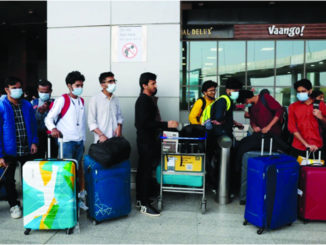
    As soon as Chahat Yadav walked out of the airport and saw her family, she tossed away her luggage and ran towards them, crying inconsolably. Yadav’s father Narendra Kumar and other relatives had reached Delhi’s Indira Gandhi International Airport on Wednesday, March 2,  to receive the second-year medical student studying in Ukraine’s Ternopil city. The relieved family could not hold back their emotions as they saw Yadav and huddled around her, hugging, kissing and in tears. Yadav was among nearly 200 Indian students who had just landed in New Delhi from Poland on Wednesday after trying for days to escape the Russian invasion of Ukraine that began last Thursday, forcing nearly 20,000 Indian students to flee the former Soviet nation. “The Ukraine military was only letting the Ukrainians and Europeans across the border,” Chahat told Al Jazeera as she held a bouquet of red flowers handed to those returning from Ukraine by Indian authorities at the airport. “But I don’t know why Indians were being stopped and pushed back,” the young student said, alleging many Indians were beaten by the Ukrainian forces as they tried to cross the border.

    ‘Sleepless nights’

    When a Russian attack on Ukraine became imminent, Yadav’s father Kumar tried to book a ticket for her. But it was not easy with high demand and few flights. Kumar, who lives with his extended family in Gurugram on the outskirts of the Indian capital, bought an online ticket for Yadav for February 20 but the airline did not confirm the ticket. He later booked a transit flight to India via Qatar for February 23 at a steep cost of 50,000 rupees ($660). Yadav, who was double-vaccinated against coronavirus and was carrying her RT-PCR report along with her, was not allowed to board the flight to Qatar, Kumar said.

    The problem: Yadav had taken an Indian-made Covaxin shot, which, Kumar said, was only “partially approved [by Qatar]”. “They refused to consider her RT-PCR report… A serology antibody test [was required] to board the flight,” he said.

    When Russia invaded Ukraine the next day on February 24, Kumar said the thought of losing her daughter “gave him sleepless nights”.

    “I would be lying if I said the thought of losing my daughter in Ukraine did not cross my mind. It happened several times and took away my sleep,” Kumar told Al Jazeera. “When I saw my daughter today, I couldn’t believe that she was finally back.”

    Getting home was not easy for Yadav and other Indian students. On the evening of February 25, a day after Russian troops entered Ukraine, Chahat and her friends left Ternopil for Poland on a private bus they had hired for the trip.

    They reached the Poland border around midnight, only to find a 35km line of vehicles desperate to leave the country. They had no choice but to cover the remaining distance on foot. Many students threw away some of their luggage to be able to make the journey.

    They walked all night in bone-chilling cold and reached the border the next morning. But crossing into Poland was not easy, with thousands camped there. Yadav spent two nights at the border in sub-zero temperatures before she was allowed to cross.

    ‘Near-death experience’

    Another medical student, Rajarshi Shyam, 21, reached Delhi on Wednesday. He had travelled from Ukraine’s Vinnytsia to Romania. “We faced problems at the border. It was very crowded. It was a near-death experience,” he told Al Jazeera.

    Like Chahat, Rajarshi also had to walk for several kilometres on foot to reach the Romania border. He was also forced to dump some of his luggage, including his clothes, on the road.

    Still, says Rajarshi, he was lucky to have crossed the border in his first attempt, unlike many of his friends who were either turned back or forced to spend days at the border.

    Many Indian and African students have alleged facing racial discrimination and violence from Ukrainian officials at the borders.

    Meanwhile, thousands of Indians remain stranded in Ukraine as Russia escalates its attack on cities such as Kharkiv, Ukraine’s second-largest, where many Indian students study medicine.          -Source: Al Jazeera

    No food, water: Over 600 students stranded in Ukraine city cry for help

    Even as the Indian government has successfully evacuated thousands of citizens from war-torn Ukraine, over 600 students from the country stuck in the northeastern city of Sumy are crying for help. A student asserted that hope they will soon be evacuated as “continuous firing and bombing” by the Russian forces has left them completely terrified. They also complain of an acute shortage of food and water. Considering Sumy lies in the northeastern peninsula of Ukraine, it is difficult for the students to travel to the western border, from where they can reach neighbouring Poland, Hungary, Romania, Slovakia and Moldova, under the current circumstances.

    Not a single Indian student has been evacuated from the Sumy State University, located close to the Russian border has been evacuated. “More than 600 Indian students are stuck here in Sumy university. The embassy has neither evacuated us nor given any assurance to that effect. Since the last five days, there has been continuous firing, shelling and bombing in the city,” Viraj Walde, who hails from Nagpur in Maharashtra, told news agency PTI.

    “Before Russia’s invasion of Ukratine, temporary advisories were given to the students and the university informed us that those having exams can wait. Hence, we waited for the exams to start,” Walde added.

    “But now, the students are terrified and their mental state is deteriorating. Food and drinking water supplies are depleting. Even the banks and ATMs are running out of cash,” he said.

    Meanwhile, the Indian embassy has sent advisories asking them to use only the western border of Ukraine and reach the neighbouring countries of Poland, Hungary, Romania, Slovakia and Moldova. Since Sumy city is located in the north-eastern part of Ukraine, it is impossible for them to travel all the way to the western part of the country amidst the current situation.

    “The border in Ukraine’s western part is located almost 1,500 kms away from Sumy, whereas the Russian border is just 50 kms away. The railway station in Sumy has also been closed due to bombing, and traveling via road is like committing suicide since Russian and Ukrainian forces are fighting against each other at such places,” he told PTI.

  • After Pandemic Corona JLF starts again in Jaipur from March 5

    After Pandemic Corona JLF starts again in Jaipur from March 5

    Jaipur Literature Festival to pick up topical issues of Ukraine-Russia Conflict, climate Change

    Dr. Yashpal Goyal,
    Special Correspondent

    JAIPUR (TIP): After Pandemic Corona outbreak since 2020 in India, Jaipur Literature Festival’s 15th edition beginning in Pink City from March 5 will pick up a some of the topical issues of Ukraine-Russia Conflict, Geo-politics of war, Climate Change, new world order besides holding a whole range of literary sessions.

    Sanjoy K Roy, Managing Director of Teamwork addresses the press conference in Jaipur on March 2.

    Sanjoy K Roy, its Managing Director of Teamwork, told a press conference here on March 2 that finally the JLF organizer has chosen a five star hotel by leaving the old heritage ‘Diggi Palace’ due to traffic problems and other administrative regulations. It will be in a hybrid mode, March 5 to 9 on virtual mode, and from March 10 to 14 the sessions would be on ground and visitors would be allowed to witness the live discussions among noted writers, Roy added.Like the previous years’ edition, JLF will have 500 speakers, including four Nobel laureates and will have sessions covering art of fiction, poetic imagination, travel, science, history etc. The prestigious festival will showcase a variety of exhibiting numerous dialects of Rajasthan-Centric literature.

    In a statement, Rajasthan Tourism Minister Vishvendra Singh said he was delighted to note that JLF was returning on-ground in the Pink City after two years. The festival will truly provide an exceptional platform for both Indian and global authors and thought leaders to engage and strengthen literary heritage and culture.

    This time both the literary sessions as well as music in the evening will be held in the hotel campus, Apurav Kumar, MD of the Clarks Group, told the joint press conference. On a question on the impact of the Ukraine-Russia war, they said, “We may lose a few good speakers as two writers have already cancelled their visits to India”.

    The rich programme will feature, among others, a session with Bruno Maçães, decorated author, international commentator and advisor to some of the world’s leading companies on geopolitics and technology, who will be exploring the study of an emerging world order that is competitive and driven by the need to adapt and survive in increasingly hostile natural environments. In conversation with former diplomat and author Navtej Sarna, Maçães will discuss book Geopolitics for the End Time: From the Pandemic to the Climate Crisis. On clean energy, Rahul Munjal, the Chairman & Managing Director at Hero Future Energies, one of India’s leading Independent Power Producer, is committed to positive environmental impact by increasing the share of renewables. Joining him will be, Amitabh Kant, the CEO of the National Institution for Transforming India (NITI Aayog) and a key driver of initiatives such as Make in India, Startup India, Incredible India and God’s Own Country and academician Siddharth Singh, author of The Great Smog of India. Munjal and Kant will discuss the future of clean energy and climate action. Simon Mundy, Financial Times journalist and author of Race for Tomorrow: Survival, Innovation and Profit on the Front Lines of the Climate Crisis, will speak on the question of what impact a single person can have in the face of the global climate crisis. The earth has witnessed five major mass extinction events over the last 500 million years – responsible for the erasure of nearly three-quarters of its species each time.  A series called The Urgency of Borrowed Time will feature Pranay Lal, natural history writer, biochemist and public health advocate who is also author of the celebrated books Indica: A Deep Natural History of the Indian Subcontinent and Invisible Empire: The Natural History of Viruses. The session will explore the fate of dinosaurs and species sealed by extinction events, and the role of humankind in the surging climate crisis.

  • NRIs worried as Russia-Ukraine conflict delaying flights

    NRIs worried as Russia-Ukraine conflict delaying flights

    AMRITSAR/TORONTO (TIP): While the conflict between Russia and Ukraine has worried the families of those stranded in Ukraine, it has also troubled the NRIs ready to return to Canada after spending their winter in Punjab. The NRIs said flights, especially those connecting via Montreal and Toronto were getting delayed. They, however, said that flights going via Vancouver were comparatively less troublesome.

    Kanwaljit Singh Sekhon of Wadala village, near Baba Bakala, who took the flight to Canada via Vancouver on Wednesday, March 2  morning, said he had to wait for six hours at the Delhi airport as the flight was late.” He said due to delay from Delhi, he would now have to spend eight hours extra at the Vancouver airport. Sekhon had to go to Edmonton, but now there was no flight available from Vancouver to Edmonton. So, he had booked a ticket for Calgary, from where he would take another flight. “Those travelling via Montreal and Toronto have to face delay of almost 25 to 26 hours,” said Gurjant Singh, who took a flight from Delhi on February 2 after a 24-hour delay. Gurjant said as the airlines did not provide boarding during the delay, they had to sleep at the airport itself. With such stories of hardships, those who had plans to return to Canada shortly are worried. Some are even planning to leave children and women behind.

    “It is very difficult to travel in such crisis especially with small children,” said Gurpreet Singh, who was scheduled to travel next week. He said he was making calls to his travel agent and co-travelers, but nobody had any concrete information.

    (Source: TNS)

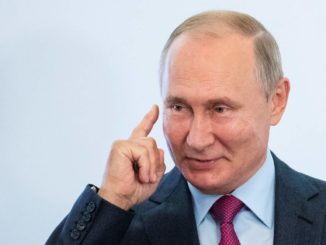
  • What is going oninside Vladimir Putin’s head? 12 experts weigh in

    What is going oninside Vladimir Putin’s head? 12 experts weigh in

    By Brendan Cole

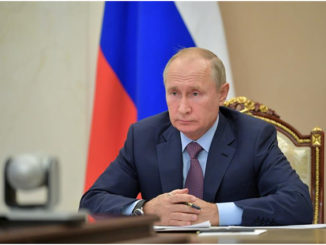
    Nearly a week into the largest military campaign in Europe since World War Two, Russian forces have encountered fierce resistance from Ukraine while global condemnation has spurred sanctions that have roiled the Russian economy. Before the invasion, Putin humiliated his spy chief, Sergei Naryshkyn in a Russian Security Council meeting which showed the president relishing being in control. But now with the status of global pariah, Putin’s invoking of his country’s nuclear threat has raised alarm at what his actions might be if he felt cornered.

    Newsweek spoke to a selection of experts about what they believed could be going through Putin’s mind. Their responses varied widely—from those who said his apparent erratic behavior was part of a calculated grand strategy, to others who  believe his increased isolation since the COVID pandemic has made him more emotional and unstable.

    Questions surround the state of mind of Russian president Vladimir Putin. After his invasion of Ukraine, there are concerns at how far he might go to secure victory.

     Michael McFaul, former U.S. ambassador to Russia

    “Putin listens to no one inside Russia. He’s been in power for over two decades, so does not take advice from anyone anymore. He also is very isolated. He is the only decision maker that matters. He alone can end this war.

    “[Chinese President] Xi is the only leader in the world he respects.”

    Rose Gottemoeller, ex-deputy Secretary General of NATO

    “Vladimir Putin has always cultivated a cool and calculating demeanor, but now he is showing increasingly erratic and emotional behavior—so there is a shift. “From our perspective, it certainly looks irrational, but no doubt that is not how Putin sees it. He’s considering himself a figure of destiny, to bring the Russian-speaking peoples together again. For him, it seems, it is a vital historical objective.”

    Steve Pifer, former U.S. ambassador to Ukraine

    “We are seeing a different Vladimir Putin from 10 or 15 years ago. He now seems more emotional, particularly when it comes to Ukraine, and he is taking a much larger risk with the invasion than one would have expected from him earlier.

    “One also has to wonder about the effect of the isolation in which he has lived and worked the past two years, apparently out of concern about COVID.”

    Gustav Gressel, senior policy fellow, European Council on Foreign Relations (ECFR)

    “He sees himself as the recreator of imperial Russia. The thing is with the ‘madman’ theory, he is playing a bit with that.

    “He is rational if you know his mindset and that is a social Darwinian mindset, where military power and military strength form the core essence of the state and the core momentum of Russian identity. “If you know his mindset, what he does is perfectly rational. It is not mad, is just that you have to adopt to this mindset. “Everything he does today, at some point, he has written or said. It is just that we have continuously excused him for doing so, in saying, “that’s just basically rambling, he’s a hobby historian, he meant that as a joke,’ etc. No, he didn’t. He was serious and we are seeing it now. “

    Douglas Page, assistant professor of political science at Gettysburg College, Pennsylvania

    “While evidence may emerge about Putin’s mental instability, we also should consider the persona that Putin may be willingly crafting during this intense crisis, even when that persona reflects desperation. “The idea that one’s opponent is irrational and crazy is enticing, but this idea also can serve an important purpose for an opponent like Putin. An irrational opponent is more unpredictable and can be viewed as more willing to incur absurdly high costs in a conflict. “For example, nuclear war would doom Russia, but an irrational Putin could raise more questions in the West about his willingness to use nuclear weapons. This perception in the West may follow Putin’s objectives regarding nuclear deterrence and limiting Western involvement in Ukraine.

    Ian Johnson, assistant professor of military history at the University of Notre Dame, South Bend, Indiana

    “His historical rhetoric suggested aspirations beyond Ukraine, restoring Russian primacy over areas formerly in Russia’s orbit across Eastern Europe. “Putin is well-versed in history. He clearly believes that he has an opportunity for a historic legacy, one that puts him in line with those figures he cites so frequently in his speeches—Peter the Great and Stalin, among them — both of whom expanded the borders of the Russian or Soviet state at the expense of their neighbors.”

    William Muck, political science professor, North Central College, Naperville, Illinois

    “It does appear that Putin has shifted how he understands and engages with the international community. The tone and language from his recent speeches are particularly telling. Putin has been much more aggressive, provocative, and nationalistic. “One gets the sense that he now sees himself as a historic figure. That his war in Ukraine is about rewriting the end of the Cold War and making Russia great again. “People talk of Putin as this brilliant chess player who skillfully outplays his rivals in the international system. That may have been the case in the past, but I think the better current metaphor for his mindset is poker. Putin is a gambler, and his invasion of Ukraine suggests he is all-in on this hand.

    “If he wins, it is possible he goes down in history as the figure who restored Russian greatness. However, if he loses, this may be the beginning of the end of the Putin regime in Russia.”

    Matt Qvortrup, political science professor, Coventry University, U.K.

    “He is very out of touch and that is why he expected things to go differently.” “Rationality means you get what you want and what is good for you. For Vladimir Putin, what is good for him is not good for Russia, it is not what is good for the world, it is what will keep him in power. “He does not want to suffer the fate of [Ex-Serbian leader] Slobodan Milosevic, or [Ex-President of Zimbabwe] Robert Mugabe, and for that reason, he would want to use any available means. “The shocking thing is that he will be willing to go all the way. It is conceivable that he will use nuclear weapons if he is desperate and for him that might be a rational thing because that might keep him in power.”

    William Hague, former British Foreign Secretary

    “While it is clear that a great many Russian diplomats and officials think he has made a terrible mistake, there will be nothing they can do now to restrain their isolated, paranoid, obsessive and increasingly angry president.

    “Tragically for the people of Ukraine, he will have no doubts about what he must do. He will be telling his generals to go deeper, faster, more brutally and destructively if necessary.” — The Times of London

    ‘This Madness Must be Stopped’. – Lord Owen, former British Foreign Secretary

    “He is a very able, intelligent person, never underestimate people who you are dealing with who you don’t agree with…it’s easy to dismiss them as being mad. I don’t believe that is a reasonable judgement of him. But he does seem to be more imperious.

    “There is no check on this leader of Russia. In the old Communist days, there was a Politburo, in which you could see collective decision making. That’s all gone for Putin.

    “He’s one single autocratic dictator and he’s isolated for the last two years under COVID…you get the feeling there’s nobody to even argue with him, let alone contradict him.”— Channel 4

    Fiona Hill, former U.S. National Security Council advisor on Russia.

    “I think a lot of people are noticing that something seems to have flipped somewhat with Putin almost as if he’s made a rather emotional and, on the surface, a somewhat unexpected decision.

    “He’s usually pretty cynical and calculating and very calm. Always very sarcastic and kind of harsh in the way that he talks about things. But the announcement that he was basically going to invade Ukraine, he was viscerally emotional.

    “This is what happens if you have got the same person in power for 22 years, he’s been in a bubble, especially over the last two and a half years.” — MLive

    Tatiana Stanovaya, founder of analysis firm R.Politik firm.

    “There are people who go crazy and believe that they serve some higher power, God, or something else, perceiving themselves only as a…tool in the hands of great forces. “Putin is not there yet, but there is something in common. For him, this higher power is the State, as it has been historically understood and he sees himself as its servant.

    “The problem is that personal responsibility is diminished and you feel that you are acting on behalf of history.

    “With such a vision you can go very far without remorse.”— Telegram

    (Source: Newsweek)

  • Hard times for the state of the union

    Hard times for the state of the union

    Foreign policy challenges and domestic hurdles confront U.S. President Biden in his quest for a policy legacy

    By Narayan Lakshman

    “At the end of the day the old adage of “It’s the economy, stupid”, continues to resonate deeply across the country as the tagline for the American Dream. The realization of this — the Biden administration appears to concede — will require the adoption of strong self-interest as a guiding value for policymaking even when it comes at the cost of a gradual erosion of the global rules-based order and the globalization consensus, and the repudiation of older, constitutional values such as equal protection of the laws.”

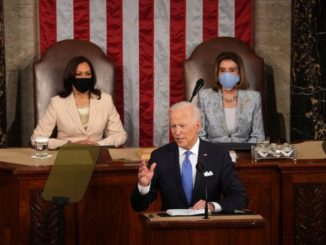
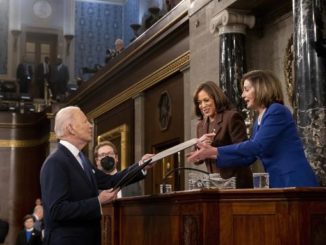
    When U.S. President Joe Biden stepped up to the podium to deliver his first State of the Union address before both houses of Congress this week, it was a historic moment for several reasons. Not only have none of his successors since 1945 delivered this address during an ongoing ground war of a similar magnitude to Russia’s invasion of Ukraine, but the optics of his speech captured another rare event. The two top Congressional officials who stood behind Mr. Biden as he spoke, the Speaker of the House of Representatives and the Vice President, were both women for only the second time in the country’s history.

    The hurdles, Ukraine too

    Notwithstanding the epochal times marking this event, the reality is that Mr. Biden faces grim challenges on the foreign policy front and a steep upward climb to overcome domestic hurdles before he can claim credit for any policy legacy that purports to improve the lot of his fellow citizens. On the foreign policy side, Russian President Vladimir Putin’s move to call the West’s bluff and kick off a military assault of Ukraine has posed complex strategic questions to the Biden administration, which are difficult to explain away to a U.S. domestic audience. Why did Mr. Biden leave Kyiv hanging in the balance without North Atlantic Treaty Organization (NATO) membership and with a virtual target on its back vis-à-vis Moscow’s guns, when many among Ukraine’s neighbors are treaty allies of NATO? Why, despite so many explicit signs that Russia would invade Ukraine if NATO carried on expanding its footprint eastwards across Europe, did Mr. Biden’s administration not do more to either make it harder for Moscow to act in this regard or at least buy more time by persuading Mr. Putin to engage diplomatically?

    Shadow of midterm elections

    Now that the sweeping economic sanctions that Washington has slapped on Russian political elites and institutions associated with Kremlin have roiled the Russian economy and brought the rouble down to historic lows, how will the Biden administration contain the spill-over effects of economic collapse and prevent them from causing a broader global recession? With the conflict intensifying and the human toll rising fast as Russian troops march on Kyiv, the U.S.’s capabilities as a superpower nation will be scrutinized closely on the world stage in the days and weeks ahead. They will almost certainly be attacked by Republicans back home as the midterm election cycle gains momentum — former U.S. President Donald Trump has already set the tenor for the debate by describing Mr. Putin’s Ukraine invasion as “genius” and “savvy”.

    At home, much depends on the outcome of the midterm elections, especially regarding the prospects for a Democratic White House to carry out any meaningful policy reform in the two years that the Biden administration will have from the time the midterms are complete. Democrats and Republicans are evenly split in the Senate with 50 seats each, while Democrats are clinging on to a narrow 221-212 margin in the House of Representatives, both of which advantages could be lost to Democrats if the 2022 midterm election results do not favor them.

    Critical issues

    The keystone issues that Mr. Biden needs to convince voters on, if he is to stave off a deleterious shift in the balance of power on Capitol Hill this November, include jobs and economic recovery in the post-COVID-19 climate of uncertainty, preventing the pandemic from wreaking further havoc in future waves, if any, inflation, and social security and education reforms to ease the financial burden on middle class budgets. Almost without exception, Mr. Biden will need the support of Congress to get the heavy lifting done in these policy areas, particularly where budgetary apportionments require lawmakers’ sign off. Certainly, it will matter in the foreign policy space. A recent example demonstrating the importance of Congress here is the fact that negotiations over a $6.4 billion security and humanitarian aid package for Ukraine hit a stalemate in the Senate over the source of these funds — military spending allocation already agreed, or emergency provisions above and beyond that level. Similarly, on the domestic front, Mr. Biden’s omnibus mega-bill in late 2021, seeking $1.85 trillion for social security and climate change, came to naught in the face of cohesive opposition from Senate Republicans and some rebel Democrats who voted across the line.

    The Trump impact

    At the heart of the Democratic conundrum is the fact that the Mr. Trump’s term in office unleashed forces that have tectonically shifted the ground under Washington politics. Whatever the charges of criminality or wrongdoing by the 45th President of the U.S., whether in terms of tax evasion or his role in spurring on the January 6, 2021 assault on the buildings of Capitol Hill, Mr. Trump’s nativist call to white America to reassert its purported supremacy has firmly embedded itself in the broader discourse and heralded a new era where political correctness is eschewed, and facts sometimes matter less than opinion.

    Indeed, it is evident that Mr. Biden is seeking to walk a tightrope between traditional mainstream Democratic values and the new paradigm when he spoke at the State of the Union of “the rebirth of pride” and “the revitalization of American manufacturing”, which, if it materializes, could help his administration “Lower your cost, not your wages”, and ensure the U.S. builds “more cars and semiconductors in America. More infrastructure and innovation in America. More goods moving faster and cheaper in America. More jobs where you can earn a good living in America. Instead of relying on foreign supply chains, let’s make it in America”.

    At the end of the day the old adage of “It’s the economy, stupid”, continues to resonate deeply across the country as the tagline for the American Dream. The realization of this — the Biden administration appears to concede — will require the adoption of strong self-interest as a guiding value for policymaking even when it comes at the cost of a gradual erosion of the global rules-based order and the globalization consensus, and the repudiation of older, constitutional values such as equal protection of the laws.

    (The author is an editor with The Hindu)

  • The anatomy of India’s Ukraine dilemma

    The anatomy of India’s Ukraine dilemma

    New Delhi has taken a subtle pro-Moscow position on the question of Russian attacks against Ukraine

    By Happymon Jacob

    “New Delhi has taken a subtle pro-Moscow position on the question of Russian attacks against Ukraine. This pro-Russia tilt is not just the position of the Indian government, but is something, somewhat surprisingly, shared by much of the Indian strategic community as well. More notably, one is increasingly hearing subtle, though indirect, justifications of the Russian military actions from the doyens of the Indian strategic community. India’s Russia tilt should be seen not just as a product of its time-tested friendship with Moscow but also as a geopolitical necessity.”

    New Delhi’s response to the Russian aggression against Ukraine appears to have been shaped by harsh geopolitical circumstances, that it is in the middle of, than its normative beliefs or preferences. Late last week, India abstained from a United Nations Security Council (UNSC) resolution which called for condemning the Russian military action against Ukraine, but it went on to note its uneasiness of the Russian action in writing (a first).

    Prime Minister Narendra Modi, who spoke to Russian President Vladimir Putin as the war broke out, called for an “immediate cessation of violence” and has so far refused to pay heed to Ukrainian Ambassador to India Igor Polikha’s impassioned pleas urging Mr. Modi to mediate with Mr. Putin to halt Russian military advances. With the UNSC deadlocked, friends with both the United States/West and Russia, and passionately urged by Ukraine, New Delhi is uniquely placed to undertake some much-needed mediation between the rival sides. But it has chosen to stay on the margins and do no more than the unavoidable minimum. New Delhi just wants this to be over with. Let us call it what it really is: New Delhi has taken a subtle pro-Moscow position on the question of Russian attacks against Ukraine. This pro-Russia tilt is not just the position of the Indian government, but is something, somewhat surprisingly, shared by much of the Indian strategic community as well. More notably, one is increasingly hearing subtle, though indirect, justifications of the Russian military actions from the doyens of the Indian strategic community. India’s Russia tilt should be seen not just as a product of its time-tested friendship with Moscow but also as a geopolitical necessity.

    The Russia tilt

    There are four potential options India can/could choose from: Condemn Russian aggression, support Russian aggression, stay silent on Russian aggression, or express displeasure (short of condemning) and call for diplomacy. The first option will pit India against Russia, the second will pit it against the U.S. and its allies, the third option will be read as pro-Russia, and the fourth option — which it has taken — is the least harmful. And yet, a position that does not condemn Russian aggression and one that abstains from voting on a UNSC resolution calling for “condemning Russian aggression and withdrawal of Russian forces from Ukraine” is indeed a pro-Russia position. There are understandable reasons for India’s (subtle) pro-Russia position. Let me put it this way: an aggressive Russia is a problem for the U.S. and the West, not for India. North Atlantic Treaty Organization (NATO) expansion is Russia’s problem, not India’s. India’s problem is China, and it needs both the U.S./the West and Russia to deal with the “China problem”. I would view India’s response to the crisis in Ukraine in the light of this rather simple logic.

    Let us look at the big picture first. There is today a sobering recognition in New Delhi about the weakening of the U.S.-led global order and the rise of China as a counter-pole, geographically located right next to India. U.S. withdrawal from the region and its decline as the principal system shaper has complicated India’s place in regional geopolitics. Neighboring China as the rising superpower and Russia as its strategic ally challenging the U.S.-led global order at a time when China has time and again acted on its aggressive intentions vis-à-vis India, and when India is closest to the U.S. than ever before in its history, throws up a unique and unprecedented challenge for India. Therefore, having Russia on its side is crucial for India, more than ever. Moscow may or may not be able to moderate Chinese antagonism towards New Delhi, but an India-Russia strategic partnership may be able to temper New Delhi’s growing isolation in a rather friendless region. Second, there is an emerging dualism in contemporary Indian strategic Weltanschauung: the predicament of a continental space that is reeling under immense pressure from China, Pakistan and Taliban-led Afghanistan adding to its strategic claustrophobia; and, the emergence of a maritime sphere which presents an opportunity to break out of the same. Herein lies the dilemma for India. New Delhi needs Moscow’s assistance to manage its continental difficulties be it through defense supplies, helping it ‘return’ to central Asia, working together at the Shanghai Cooperation Organization (SCO) or exploring opportunities for collaboration in Afghanistan. Russia, to put it rather bluntly, is perhaps India’s only partner of consequence in the entire Asian continental stretch.

    On the other hand, when it comes to the vast maritime sphere, the Indo-Pacific to be precise, Russia is not of great consequence to India. That is where its American and western partners come into play. India is simply not in a position to address the China challenge in the maritime space without the active support of American and western navies and, of course, the Quad. This unavoidable dualism in the contemporary Indian strategic landscape necessitates that India balances the two sides, but doing so without a subtle Russia tilt may not be feasible at this point of time.

    That said, the war on Ukraine could have major implications for India’s strategic calculus. For one, Russian action in Ukraine dismissing the concerns of the rest of the international community including the U.S. will no doubt embolden China and its territorial ambitions. Second, the new sanctions regime may have implications for India’s defense cooperation with Moscow. Third, the longer the standoff lasts, the closer China and Russia could become, which certainly does not help India. Finally, the more severe the U.S.-Russia rivalry becomes, the less focus there would be on the Indo-Pacific and China, which is where India’s interests lie.

    Impact on foreign policy

    India’s responses to the Russian aggression on Ukraine underline the fact that India is operating from a position of geopolitical vulnerability. While the Indian stand does reek of realpolitik, it reeks more of strategic weakness. Here is a country located in a hostile neighborhood trying to make the best of a terrible situation it finds itself in. This then means that, going forward, India’s ability to be a “swing state”, “major power” or a “leading power” stands diminished. So, we must expect more middle-of-the-road behavior from New Delhi rather than resolute positions on global strategic developments. India’s position also shows the unmistakable indication that when it comes to geopolitics, New Delhi will choose interests over principles. This is nothing new: New Delhi has chosen interests over principles even in the past — for instance, India has violated the principle of non-intervention in the domestic affairs of neighbors. The difference this time may be that India is choosing interests over principles even though the issue at hand is not directly pertaining to India. And yet, a careful reading of India’s statements and positions taken over the past few days also demonstrates a certain amount of discomfort in having to choose interests over principles. There is perhaps a realization in New Delhi that a dog-eat-dog world, where rules and good behavior do not matter, does not help India in the long run either.

    Going forward, if tensions between Russia and the West persist, balancing extremes will be a key feature of Indian diplomacy. India is perhaps already mastering the art. Consider India’s “explanation of vote” during the recent vote on Russia’s aggression against Ukraine: even though New Delhi abstained from voting on it (thereby siding with Moscow), it made its unhappiness about the Russian action clear in the written note.

    On strategic autonomy

    Finally, what does this mean for India’s ‘strategic autonomy’? For sure, India’s strategic autonomy has been under a lot of stress for some time now. However, New Delhi’s response to the recent crisis, especially its “explanation of vote” at the UNSC indicates a careful recourse to the principle of strategic autonomy: India will make caveated statements and will not be pressured by either party. In that sense, India’s indirect support to the Russian position is not a product of Russian pressure but the result of a desire to safeguard its own interests. Therefore, while we may witness a steady erosion of India’s strategic autonomy in the longer term – primarily as a function of the need to balance against China — we will continue to witness instances where Indian diplomacy will take recourse to the principle of strategic autonomy.

    (The author teaches India’s Foreign Policy at the School of International Studies, Jawaharlal Nehru University, New Delhi)

  • Australia announces first tranche of sanctions on Russia over Ukraine crisis

    Australia announces first tranche of sanctions on Russia over Ukraine crisis

    Sydney (TIP): Australia on February 23 joined the United States, the European Union, Canada, Germany and Britain to impose sanctions on Russia after Moscow ordered troops into separatist regions in Ukraine and recognised them as independent entities.

    Australia will immediately begin placing sanctions on Russian individuals it believes were responsible over the country’s actions against Ukraine, Prime Minister Scott Morrison said during a media briefing. “Australians always stand up to bullies, and we will be standing up to Russia, along with all of our partners,” he said. “I expect subsequent tranches of sanctions, this is only the start of this process.”

    Japan sanctions Russia, separatist Ukraine areas

    Tokyo: Japan’s prime minister has announced sanctions targeting Russia and two separatist Ukrainian regions recognised as independent by Russian President Vladimir Putin, joining an international effort seeking to pressure Russia to return to diplomatic solutions.

    Prime Minister Fumio Kishida said Wednesday that his government will ban new issuance and distribution of Russian government bonds in Japan in response to the “actions Russia has been taking in Ukraine.”

    He said Japan will also suspend visa issuance to the people linked to the two Ukrainian rebel regions and freeze their assets in Japan, and will ban trade with the two areas. Kishida repeated his “strong condemnation” of Russia for violating Ukrainian sovereignty and territorial integrity as well as international law.

    He added: “We strongly urge Russia to return to diplomatic process in resolving the development.” — Agencies