WASHINGTON, D.C. (TIP): The United Nations says that beyond the social media announcement from the United States government on Jan. 7 about its withdrawal from 66 international and UN entities, the information has not been officially communicated to the world body. Washington has also not followed the legal process required for a country to dissociate from binding international treaties it has signed and ratified, such as the UN Framework Convention on Climate Change.
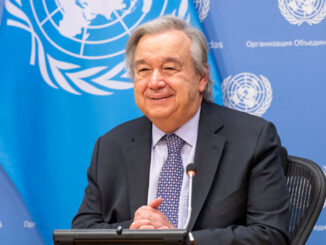
“I checked with our legal counsel earlier today, we had not received any official letter,” Stéphane Dujarric, the spokesperson for UN Secretary-General António Guterres, told journalists on Jan. 8. “We have not received any further official communication beyond what was posted on the White House website.”
Washington announced in the evening of Jan. 7 on social media that it is withdrawing from a broad slate of international organizations and UN bodies, substantiating the threat by President Trump to separate with UN bodies that do not serve his country’s interests or that the US considers a waste of Americans’ taxpayer money.
The decision by the US to cut ties to 66 international organizations, treaties and UN entities was apparently a result of a review conducted under Executive Order 14199, one of the wide-ranging executive orders signed by Trump in February 2025. The review could be a prelude to the US Congress releasing more funding to the UN general operating budget now that the review is done.
UN reacts
On Jan. 8, when the UN released its first official response to the news, Guterres expressed “regrets” over the US announcement but added that “all United Nations entities will go on with the implementation of their mandates as given by Member States.”
“The United Nations has a responsibility to deliver for those who depend on us,” the statement, conveyed from Dujarric by email to the media, continued. “We will continue to carry out our mandates with determination.”
Of the 66 organizations, 31 are linked to the UN. They include the Department of Economic and Social Affairs, an organ led by a Chinese national; various regional economic and social commissions; the Office of the Special Representative of the Secretary General for Children in Armed Conflict and the Office of the Special Representative of the Secretary-General on Sexual Violence in Conflict; the UN Framework Convention on Climate Change; and peace-building agencies as well as others that promote international law, sustainable environmental practices and gender rights, such as UN Women. The UN Population Fund, also listed, was severed by the US in early 2025. (A list of the UN bodies and their roles is explained at the end of this story.)
Since the Trump administration has taken the reins in 2025, the US has turned its back on matters at the UN related to gender equality, climate change, diversity/equity/inclusion as well as the Sustainable Development Goals.
Vanessa Frazier, who leads the office on children and armed conflict, which aims to protect children’s rights amid war, said in a post on X that “ it is quite unfortunate that the US now seems to be of the opinion that children being collateral of war is OK”
According to the US, “withdrawal” from UN entities is defined as ceasing participation and/or funding to the extent permitted by law.
“Poorly run”
US Secretary of State Marco Rubio said in a statement on Jan. 7, as the White House released the list of 66 entities it was cutting off, the organizations were “redundant, mismanaged, unnecessary, wasteful, or poorly run,” and in some cases “captured by the interests of actors advancing agendas contrary to US national interests.” He added that continued participation in such bodies was incompatible with American sovereignty and prosperity.
The move marks a major escalation in Washington’s shift from multilateral engagement, prompting concern and bewilderment across diplomatic, legal and academic communities. Trump pulled out of some high-profile UN agencies during his first term and again in the beginning of his second term, such as the Human Rights Council and the World Health Organization, but the Jan. 7 actions are more far reaching in scale. And the moves will worsen the dire financial crisis the organization is struggling to manage.
The US released $2 billion at the end of 2025 to fund UN-coordinated humanitarian aid for a select list of countries as the US is still withholding at least two years of mandated dues to the organization’s regular budget, totaling approximately $1.3 billion.
It is unclear whether the withdrawals from UN bodies will impact the US paying its assessed contribution — if it does so — but Dujarric said Washington is obligated to pay regardless of unilateral withdrawal from a UN agency or program.
Many of those the US said it would withdraw from are funded by UN assessed contributions paid by member states. Dujarric said some of the agencies rely on funding from “the regular budget, with the vast majority of their work then being funded voluntarily.”
“Member states who signed on, joined this club have to pay the dues,” he said. “We can, we can, the Charter is not à la carte, as we said, and . . . we know we’re not going to renegotiate the Charter. The UN is an organization of 193 member states, two observer states [the Holy See and Palestine]. It is in the interest of all these member states and the two observers to defend the principles that they themselves have created.”
According to Article 19 of the UN Charter, a member state risks losing its vote in the 193-member General Assembly if its arrears equal or exceed the amount due for the previous two years, but it is unclear what happens in the Security Council when a permanent member runs afoul of Article 19. A European diplomat told PassBlue, however, that even small US contributions to certain entities over the last few years could mean it is meeting some level of its legal financial obligations.
Picking and choosing
Ronny Patz, an independent analyst on the UN, said that while US engagement with the UN peace-building architecture has historically been limited, the departure of a permanent member of the Security Council from peace-building work represents a symbolic, practical setback for collective conflict-prevention efforts.
Patz warned that the move risks normalizing what he described as “à la carte multilateralism,” whereby states choose which international organizations to support. “Once selective disengagement is tolerated,” Patz said in a post on LinkedIn, “all member states could refuse to fund or participate in the parts they dislike, weakening the UN’s role as a multipurpose organization built on cross-domain compromise.”
Theodoros Rousopoulos, president of the Parliamentary Assembly of the Council of Europe, expressed concern over the withdrawal from the Council’s Venice Commission, an advisory body on constitutional matters, as the rule of law is pressured globally.
In the US, Democratic members of the House Foreign Affairs Committee criticized the Trump decision, saying that participation in international organizations allows Washington to shape global norms, strengthen alliances and counter adversaries. “America first = America alone,” the committee posted on its X page.
Ben Saul, the UN specialist on human rights and counterterrorism, said that the withdrawal from the International Law Commission “weakens efforts to forge cooperative global solutions to common human challenges.”
He added: “The US will weaken global counterterrorism efforts by withdrawing from the Global Counterterrorism Forum and the International Institute for Justice and the Rule of Law.”
Dujarric summed up Guterres’s attitude despite the latest US setbacks, saying on Jan. 8: “I spent quite a time with him this morning, and he is determined as ever to continue his work and continuing to defend the Charter and continuing to defend this international institution.”
What the UN organizations do
Department of Economic and Social Affairs (DESA): Acts as the UN’s policy engine on global development, producing data and analysis on population trends, inequality, sustainable development goals and public administration. Governments rely on its statistics and guidance to shape domestic policy.
Economic Commission for Africa (ECA): Supports African governments with research and policy advice on economic growth, industrialization, trade integration and climate resilience, often shaping regional development strategies.
Economic Commission for Latin America and the Caribbean (ECLAC): Known for its economic research, ECLAC analyzes inequality, growth and fiscal policy in Latin America and the Caribbean and advises governments on development planning.
Economic and Social Commission for Asia and the Pacific (ESCAP): Works on inclusive growth, infrastructure, disaster risk reduction and digital connectivity across the Asia-Pacific, the world’s most populous region.
Economic and Social Commission for Western Asia (ESCWA): Focuses on development challenges in the Arab world, including economic reform, social protection, water scarcity and post-conflict recovery.
International Law Commission: A body of legal experts tasked with developing and clarifying international law, including treaties governing diplomacy, state responsibility and the laws of war.
International Residual Mechanism for Criminal Tribunals: Handles remaining legal responsibilities from the Rwanda and former Yugoslavia war crimes tribunals, including appeals, witness protection and sentence enforcement.
International Trade Centre (ITC): Helps small businesses and exporters in developing countries access global markets, providing technical assistance on trade rules, quality standards and supply chains.
Office of the Special Adviser on Africa: Advises the UN Secretary-General on political, security and development trends in Africa and helps coordinate international support for the continent.
Office of the Special Representative for Children in Armed Conflict: Documents and advocates against the recruitment, abuse and killing of children in war zones, pressing governments and armed groups to comply with international law.
Office of the Special Representative on Sexual Violence in Conflict: Works to prevent sexual violence used as a weapon of war, supporting survivors and pushing for accountability in conflict and post-conflict settings.
Office of the Special Representative on Violence Against Children: Addresses violence against children beyond conflict zones, including abuse, exploitation and harmful practices, often working with national governments on child-protection laws.
Peacebuilding Commission: Brings together donors, governments and regional actors to support countries emerging from conflict, aiming to prevent relapse into violence.
Peacebuilding Fund: Provides rapid, flexible funding for peacebuilding efforts in fragile states, often filling gaps where traditional aid is too slow.
Permanent Forum on People of African Descent: An advisory body focused on addressing racism, discrimination and development challenges faced by people of African descent worldwide.
UN Alliance of Civilizations: Promotes dialogue across cultures and religions, aiming to counter extremism and reduce polarization through education, media and youth programs.
UN Programme on Reducing Emissions from Deforestation and Forest Degradation (REDD+): Helps developing countries protect forests by linking conservation to climate finance and sustainable land use.
UN Conference on Trade and Development (UNCTAD): Provides research and policy advice on trade, debt, investment and technology, often advocating for fairer global economic rules for developing nations.
UN Democracy Fund: Finances grassroots projects that support democratic participation, civil society and human rights, particularly in fragile democracies.
UN Energy: Coordinates the UN’s work on access to affordable, reliable and clean energy, aligning agencies around global energy goals.
UN Entity for Gender Equality and the Empowerment of Women (UN Women): Leads UN efforts on women’s rights, gender equality and violence prevention, advising governments and supporting programs on the ground.
UN Framework Convention on Climate Change (UNFCCC): The treaty body that oversees global climate negotiations, including the Paris Agreement, and tracks countries’ emissions commitments.
UN Human Settlements Programme (UN-Habitat): Focuses on sustainable urban development, housing policy and slum upgrading as cities grow rapidly worldwide.
UN Institute for Training and Research (UNITAR): Trains diplomats, civil servants and emergency responders, particularly from developing countries, on governance, diplomacy and crisis management.
UN Oceans: Coordinates UN action on ocean conservation, fisheries management and marine pollution across multiple agencies.
UN Population Fund (UNFPA): Works on reproductive health, maternal care and population data, often operating in fragile or humanitarian settings.
UN Register of Conventional Arms: Encourages transparency in international arms transfers to build confidence and reduce the risk of conflict escalation.
UN System Chief Executives Board for Coordination: Brings together the heads of UN agencies to align strategy, budgets and policy priorities across the system.
UN System Staff College: Provides professional training for UN staff and partners, focusing on leadership, coordination and complex crises.
UN Water: Coordinates global efforts on freshwater access, sanitation and water management across UN agencies.
UN University: A network of research institutes producing academic work on peace, sustainability, technology and development, often advising governments and the UN itself.
(Source: Pass Blue)