Tag: UN General Assembly (UNGA)

  • Permanent UNSC membership for India — mirage or achievable?

    Permanent UNSC membership for India — mirage or achievable?

    By Prabhu Dayal
    • PM Narendra Modi advocated India’s inclusion among the permanent members of the UNSC during the 75th session of the UN General Assembly
    • The only increase in the membership of the Security Council came in 1965, when the number of non-permanent members was increased from six to 10
    • Any reform to the Security Council would require an amendment to the UN Charter

    There have been expressions of support for India’s candidature from four out of the five permanent members–USA, UK, Russia and France. But what about China? Given the nature of Sino-Indian relations, it is not surprising that Beijing does not support India’s case. China’s close friendship with Pakistan is a compounding factor in this regard.

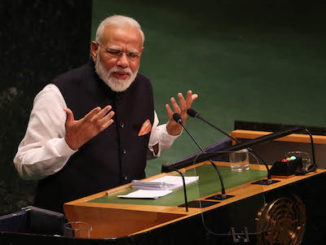
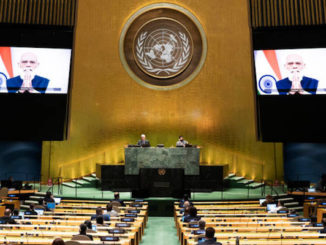
    On September 26, Prime Minister Narendra Modi delivered a virtual address during the General Debate of the 75th session of the UN General Assembly in which he made an impassioned and forceful plea for India’s candidature for permanent membership of the UN Security Council. His speech was brilliant, but when he had finished I was still asking myself this question: Is India’s quest heading anywhere, or is it just a pipe dream?

    The composition of the Security Council was established in 1945. The victors of the Second World War shaped the UN Charter in their national interests, giving to themselves the veto power in the Security Council. Since then the geopolitical realities have changed drastically, but the Council has changed very little. The Prime Minister did well to stress this when he said that the world of 1945 was significantly different from today’s world; the global situation, sources-resources, problems-solutions; all were quite different. Keeping this in mind, he urged that “Reform in the responses, in the processes, and in the very character of the UN is the need of the hour”.

    This was not the first time in recent months that PM Modi had urged the need for UN reforms. It would be recalled that while speaking at the high-level dialogue of the U.N.’s Economic and Social Council (ECOSOC) on July 17 this year, he had said that “Only reformed multilateralism with a reformed United Nations at its center can meet the aspirations of humanity.”

    PM Modi put forward several arguments that make India’s case for permanent membership appear quite strong. Highlighting India’s achievements and role in 75 years of the United Nations, he called for reforms with “changing times” and India’s inclusion in the decision-making process within the global body. He mentioned that India is the largest democracy of the world, with more than 18% of the world population; it had sent its soldiers for about 50 peacekeeping missions; it is also the country that has lost the maximum number of soldiers in the course of establishing peace; even during these very difficult times of the Covid 19 pandemic, the pharma industry of India has sent essential medicines to more than 150 countries. In this context, PM Modi assured that India’s vaccine production and delivery capacity will help all humanity in fighting the COVID-19 crisis.

    Thus, articulating the role being played by India for lending a helping hand to other nations, and putting forward cogent arguments for India to be given a permanent membership of the UN, he asked the General Assembly a very pointed question: “For how long will India be kept out of the decision-making structures of the United Nations?”

    It may be recalled that the only increase in the membership of the Security Council occurred in 1965 when the non-permanent membership was increased from six to 10 members, thus increasing the total strength from 11 to 15 members; fifty-five years have elapsed since then. Thus, PM Modi was right on target when he pointed out that the United Nations in its present form is out of date: “The international community today is faced with a very important question: Whether the character of the institution, constituted in the prevailing circumstances of 1945, is relevant even today”?

    However, the challenges which lie in India’s path should not be underestimated. Any reform of the Security Council would require an amendment to the UN Charter. In this regard, it is useful to remember that Article 108 of the UN Charter states:

    ‘Amendments to the present Charter shall come into force for all Members of the United Nations when they have been adopted by a vote of two thirds of the members of the General Assembly and ratified in accordance with their respective constitutional processes by two thirds of the Members of the United Nations, including all the permanent members of the Security Council’.

    Thus, any reform of the Security Council not only requires the support of at least two-thirds of UN member states, but also all the permanent members of the UN Security Council must also agree to this as they have veto powers. Assuming that India can get the support of two-thirds of the members of the General Assembly, the question which arises is simply this: Will all the Security Council’s permanent members give their nod for adding India as a permanent member?

    India’s quest has to be viewed in a broader perspective. The need for Security Council reform has been actively discussed among the UN member states for quite some time. By 1992, Japan and Germany had become the second and third-largest financial contributors to the United Nations , and they started to demand a permanent seat; so too did Brazil (the world’s fifth largest country in terms of territory) and India (the largest democracy and the second largest country in terms of population) which had emerged not only as the most important countries within their regional groups but also key players in the emerging global scenario. These four countries formed an interest group which came to be known as the G-4.

    On the other hand, their regional rivals opposed the idea of G4 countries becoming permanent members. Italy, Pakistan, Argentina and South Korea formed an interest group, known as the ‘Uniting for Consensus’ (also nicknamed the ‘Coffee Club’) which later grew to around 40 members. The Coffee Club members are opposed to increasing the number of the Security Council’s permanent members while wanting an increase in the non-permanent members category.

    Simultaneously, the African countries also started to demand two permanent seats for themselves, arguing that historical injustices had been done to them, and also that much of the Council’s agenda related to their continent. All these developments have further complicated the situation.

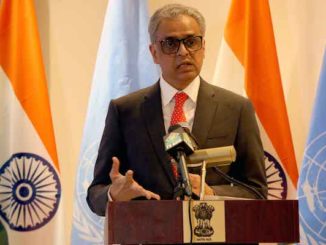
    On their part, the G-4 countries have shown flexibility on the veto issue in their bid to get the United Nations reform process moving. In a joint statement on their behalf delivered by India’s Permanent Representative to the UN Ambassador Syed Akbaruddin at an inter-governmental negotiations meeting in March 2017, the G4 nations– India, Brazil, Germany and Japan–stated that while the new permanent members would in principle have the same responsibilities and obligations as the current permanent members, they shall not exercise the veto until a decision on the matter has been taken during a review. Despite this flexibility, there has not been any progress in regard to the G4 demands.

    There have been expressions of support for India’s candidature from four out of the five permanent members–USA, UK, Russia and France. But what about China? Given the nature of Sino-Indian relations, it is not surprising that Beijing does not support India’s case. China’s close friendship with Pakistan is a compounding factor in this regard.

    There are many who believe that in actual fact, all the P-5 countries have reservations about adding any other country including India to their privileged group. The support extended to India by the US, UK, Russia and France has to be viewed against the background of their being fully aware that in any case, the process of Security Council reform is making no headway whatsoever. Many analysts think that they only render lip service by way of support to India in order to derive political mileage as they are fully aware of the Chinese position. In other words, whether their support is genuine is a matter of debate, for it is extended whilst knowing full well that the Chinese will oppose India anyway.

    Meanwhile, China, the world’s biggest dictatorship sits on the high table as a permanent member of the UN Security Council while India, the world’s largest democracy has to be content with getting a seat on that table from time to time as a non-permanent member. We can raise our voice against this injustice, as Prime Minister Modi has done. However, one cannot say when the winds of change will actually reach the UN Security Council, for diplomacy, like politics is only the art of the possible.

    Prime Minister Modi said in his address: “Today, people of India are concerned whether this reform-process will ever reach its logical conclusion”. He asked:” How long would a country have to wait particularly when the transformational changes happening in that country affect a large part of the world?” His words had a ring of anguish as well as disappointment.

    As I reflect on Prime Minister Modi’s address at the UN, I cannot help reminding myself of a verse from the Rubaiyat of Omar Khayyam:

    “Could thou and I with fate conspire,

    To grasp this sorry scheme of things entire,

    Would we not shatter it to bits–and then

    Remold it nearer to the heart’s desire.”

    (The author is a career diplomat. He can be reached at prabhu_dayal70@hotmail.com)

    (Courtesy OPOYI)


  • India’s engagement with the United Nations- past, present, future

    India’s engagement with the United Nations- past, present, future

    By Asoke Mukerji

    Special article on the occasion of the  75th anniversary of the United Nations

    UN Member States agreed in June 2019 that the UN will mark its 75th anniversary with a one-day, high-level meeting of the UN General Assembly on Monday, 21 September 2020 on the theme, ‘The Future We Want, the UN We Need: Reaffirming our Collective Commitment to Multilateralism’.

    India was among 26 countries that participated in the January 1942 Conference of Allied Nations at the invitation of President Franklin Delano Roosevelt of the United States. The Conference issued a “Declaration by United Nations”, which committed its signatories to the objective of creating what we today call the United Nations (UN).

    India raises importance of Economic and Social Cooperation for UN, April 1945
    Sir. A. Ramaswami Mudaliar, Supply Member of the Governor General’s Executive Council, Leader of the Delegation from India, addresses the Third Plenary Session. T. V. Soong (China), on stage, Minister for Foreign Affairs and Chairman of the Delegation of the Republic of China presiding the Third Plenary Session, 25 April 1945, San Francisco.
    Photo / Courtesy UN

    The UN was conceptualized as a post-Second World War global governance structure, which would rest on three pillars: political, economic and human rights. The UN General Assembly (UNGA) would oversee the functioning of the political pillar of the UN, entrusted under the Charter to the UN Security Council (UNSC), while its socio-economic work, including upholding fundamental human rights and freedoms, would be handled by the Economic and Social Council (ECOSOC).

    The intention of the countries creating the UN was to both “secure” and to “sustain” the peace that would come once the Second World War ended.

    The San Francisco Conference, 25 April – 26 June 1945: India Signs the United Nations Charter
    Sir A. Ramaswami Mudaliar, Supply Member of the Governor-General’s Executive Council; Leader of the delegation from India, signing the UN Charter at a ceremony held at the Veterans’ War Memorial Building on 26 June 1945. Sir V.T. Krishamachari, standing behind him, also signed the Charter on behalf of India’s Princely States.
    Photo / Courtesy UN

    The first structures to “sustain” the peace were created in July 1944 when 44 countries participated in the UN Financial and Monetary Conference held at Bretton Woods in the United States. The International Monetary Fund (IMF) and International Bank for Reconstruction and Development (World Bank) were established to coordinate a supportive role for monetary and development policies.

    India played an active role in the negotiations at Bretton Woods. Sir C.D. Deshmukh and Sir R.K. Shanmukham Chetty, both of whom were to become Finance Ministers of independent India, were part of the Indian delegation. They are widely credited to have placed “poverty and development” into the mandate of the World Bank and secured for India permanent membership of the Executive Board of the IMF and World Bank because of her economic profile.

    Madame Pandit, First Woman President of the U.N. General Assembly, 1953
    The eighth session of the United Nations General Assembly elected Madam Vijaya Lakshmi Pandit, of India, as its first woman President. Madam Pandit is photographed here with U.N. Secretary – General Dag Hammarskjöld.
    Photo / Courtesy UN

    Between April and June 1945, India joined 49 other countries in negotiating the provisions of the San Francisco Treaty, known as the UN Charter. The leader of the Indian delegation Sir A. Ramaswami Mudaliar played a prominent role in chairing the discussions on economic and social issues to “sustain” the peace.

    Decolonization Resolution of UN General Assembly, 4 October 1960
    Leading statesmen from all over the world are attending the UN General Assembly. The historic Decolonization Resolution was adopted unanimously by the Assembly.
    Seen here, left to right, are: Gamal Abdel Nasser, President of the United Arab Republic; Dr. Sukarno, President of the Republic of Indonesia; Jawaharlal Nehru, Prime Minister of India; Dr. Kwame Nkrumah, President of the Republic of Ghana; and Mr. Saeb Salaam, President of the Council of Ministers of Lebanon.
    Photo / Courtesy UN

    The San Francisco Treaty (the UN Charter) was signed on 26 June 1945. India became the first country to be elected President of the ECOSOC in 1946. Under India’s presidency of the ECOSOC, several major initiatives were taken by the newly formed UN. These included the creation of regional UN bodies for coordinating socio-economic policies, such as the Economic and Social Commission for Asia and the Pacific (ESCAP). India was elected the first Executive Secretary of ESCAP from 1947-1956.

    Among the significant initiatives taken under India’s Presidency of the ECOSOC for upholding fundamental human rights and freedoms, three stand out. The first was non-discrimination. In 1946, India successfully inscribed the need to abolish the discrimination based on color against Indians in South Africa, a UN member-state. This metamorphosed into the wider Anti-Apartheid Movement, which culminated with the successful multi-racial elections in South Africa in April 1994 and the election of President Nelson Mandela, who led South Africa’s delegation to the UNGA in September 1994. The second was the outlawing of mass atrocity crimes.

    Security Council Holds First Summit-Level Meeting, 31 January 1992
    At a time of momentous change, the first summit-level meeting of the United Nations Security Council was held on 31 January 1992. The meeting reaffirmed the central role of the Security Council in maintaining world peace and upholding the principle of collective security as envisioned in the United Nations Charter. Attending the meeting were 13 Heads of State and Government, as well as two Foreign Ministers, representing the members of the Security Council.
    Shri P.V. Narasimha Rao, Prime Minister of India, addressed members of the Council.
    Photo / Courtesy UN

    India joined Cuba and Panama to co-sponsor the 1946 UNGA resolution mandating the negotiation of the UN Genocide Convention in 1948. The third was gender equality. India’s delegate Hansa Mehta, who became the first Vice Chancellor of MS University in Baroda, successfully replaced the words “all men” by “all human beings” to expand the scope of the first UN document on human rights (the Universal Declaration on Human Rights) in 1948. Article 1 of the UDHR reads: “All human beings are born free and equal in dignity and rights.”

    The principle of democracy in international relations, contained in the provision of one-country one-vote in Article 18 of the UN Charter, was given substance following the independence of India in August 1947. Along with leaders of other newly independent former colonial countries, India spearheaded the unanimous adoption in December 1960 of the historic Decolonization Resolution in the UNGA, opening the doors for scores of newly independent countries to join the UNGA.

    Prime Minister of India Addresses Summit on Sustainable Development, 25 September 2015
    Shri Narendra Modi, Prime Minister of India, addresses the United Nations summit for the adoption of Agenda 2030 on Sustainable Development.
    Photo / Courtesy UN

    This resulted in a prominent Indian role in two platforms within the UNGA. The first was the political grouping of 24 member-states that created the Non-Aligned Movement (NAM) in September 1961. Today the NAM has 122 member-states in the UNGA. The second was the creation of the Group of 77 (G-77) developing countries in 1964, which turned the focus on accelerated development priorities as the focus of the UN and its ECOSOC. In turn, this led to the convergence of development issues with the growing concerns on environmental protection, which is today encapsulated in the ambitious UN Agenda 2030 for Sustainable Development with its 17 Goals. The G-77 today has 134 out of the 193 member-states in the UNGA.

    Eradication of poverty, articulated by India at Bretton Woods in 1944, is the over-arching Goal of Agenda 2030, which counts as a major achievement of the UN after 1945.

    At the heart of India’s current and future engagement with the UN is the objective of “reformed multilateralism”. Essentially this means making the UN, its specialized agencies such as the World Health Organization (WHO), and sister institutions like the IMF, World Bank and World Trade Organization (WTO) more responsive to the challenges facing mankind.

    An anomaly in the UN Charter has allowed decision-making without democratic participation. This anomaly gives the five militarily dominant powers of June 1945 (the Republic of China, France, the United Kingdom, the United States and the Soviet Union) permanent non-elected membership (P5) in the UN Security Council, and the privilege of the “veto”. The veto provision allows any of the P5 to oppose proposed UNSC decisions without giving any reason at all. This is an anachronism in 2020, and primarily responsible for the UNSC’s ineffectiveness today in maintaining international peace and security,

    Since June 1945, the world has undergone a “surge to democracy”, illustrated by the membership of 193 member-states in the UNGA. As a British colony in June 1945, India had not been able to amend the UN Charter provision giving privileged powers to the P5. Those provisions had been agreed to before the San Francisco Conference by the United States, United Kingdom and Soviet Union at Yalta in February 1945. These privileges were extended to the Republic of China and France before the San Francisco Conference.

    The key to reforming multilateralism lies in ensuring the equal and effective participation of member-states in decisions and policies that have a global impact. In the political sphere, this means reforming the UN Security Council to make it effective in “securing” the peace, by replacing its anti-democratic “veto” provision with majority voting using the one-country one-vote principle of the UN Charter. In the socio-economic sphere, this means closer coordination to ensure that monetary, development and human rights policies can sustain development.

    To be effective, the scope of reformed multilateralism will have to expand beyond the narrow inter-governmental provisions of the UN Charter. It must also take cognizance of the rapid emergence of a digital world order. By including relevant stakeholders in global issues, including businesses, academia and civil society, reformed multilateralism would be able to provide a coherent and sustainable global response to global challenges. The UN is already moving towards such a “multi-stakeholder” structure through the implementation of the Agenda 2030 for Sustainable Development. This process needs to be reflected across the board to make the UN “fit for purpose”.

    (The author  is a former Indian diplomat and writer. He was Permanent Representative of India to the United Nations from April 2013 to December 2015)

  • Harmony and Peace : Modi’s Message  to the UNGA

    Harmony and Peace : Modi’s Message to the UNGA

    By I S Saluja

    I.S. Saluja

    UNITED NATIONS(TIP): Prime Minister Narendra Modi, in his address to the 74thUNGA, September 27, was not the man the world saw and heard at Howdy Modi, Houston  on September 22. Nor was he anywhere near his usual self  when he addressed rallies of thousands  back in India. Here was a calm and relaxed philosopher Narendra Modi speaking about the age-old Indian culture  which looked upon the world as a family and believed in Mahatma Gandhi’s principles of “Truth and Non-violence”.

    Modi said  that the whole world was celebrating this year the 150thbirth anniversary of Mahatma Gandhi  who gave the message of “Truth and Non-violence” . He exhorted the international community to embrace the message of the Indian Spiritual Master Swami Vivekanand who delivered a message of Harmony and Peace a hundred years ago on the US soil, at the World Parliament of Religions in Chicago.

    Listing the achievements of his government, he said the Indian example will inspire many developing nations. He said the dreams for the realization of which his government is working are the dreams of  the whole world.

    He began with the initiative “Swachh Bharat” (Clean India)  which he described as the biggest cleanliness drive of the world. Under the initiative, 110 million toilets have been made in less than 5 years, which, he said must be an inspiration to the whole world. Incidentally, Bill and Melinda Gates Foundation honored Modi with Global Gatekeeper Award for his “Swachh Bharat” initiative two days before he addressed the UNGA.

    The other achievements he listed  included the health insurance scheme  under which 500 million are benefitted annually,  the financial inclusion scheme under which 370 million poor people have opened bank accounts. These schemes give the poor allover the world a new hope.

    Digital identification program, containing corruption which saved  the country $20 billion are some other initiatives of his government which may well be emulated by other nations. Of late, inspired by  the UN ‘s recommendation of end to single plastic use, India has launched an initiative in this respect.

    From the past achievements of his government Modi moved on to some plans in the future. Water conservation and water supply to 150 million homes in the next 5 years is one of the priorities of his government . There are plans to build in far flung rural areas 60, 000 miles of roads.

    By 2022, when India will be celebrating 75 years of Independence, 200 million homes for the poor will have been built.

    So much has been possible, Modi said because of the cooperation of all. Together we progress has been the principle his government followed. Mutual Trust, mutual cooperation and development.

    India’s successful initiatives may well encourage other nations to follow suit.

    Turning to India’s age-old culture , Modi said that India has always believed in peace, not in conflicts. His country has taken initiatives for the benefit of the whole world because India believes the whole world is a family.

    India has been a leading nation in dealing with the issue of global warming. In order to contain damage from natural disasters, India took the initiative of setting up “Coalition for Disaster Resilient Infrastructure” which will create an infrastructure which will be resilient to natural disasters.

    Prime Minister Modi mentioned next the extraordinary  contribution of Indian soldiers to UN Peacekeeping. He said the sacrifices made by Indian soldiers are unparalleled.

    Modi waned the international community of the  threats from terrorism. He called upon member nations to come together to put down terrorism.

    He said the 21stcentury modern technology is bringing about many changes in the spheres of social life, personal life, economy, security , connectivity and international relations, and added that under the circumstances a divided world is in nobody’s interest. Nor does the world have the option to stay confined to national boundaries. “In this new era, we will have to give new strength and direction to multilateralism and  to the United Nations”, Modi said.

    He reminded the world community of the message of Swami Vivekanand who a hundred years ago, at the World Parliament of Religions in Chicago had said: “Harmony and Peace; Not Dissension”. Modi said, “India’s message to the world today is similar to Swami’ Vivekanand’s – Harmony and Peace.”

  • India’s outreach, engagement at 74th UNGA session to be unprecedented: Amb Akbaruddin

    India’s outreach, engagement at 74th UNGA session to be unprecedented: Amb Akbaruddin

    NEW YORK CITY(TIP):  India’s engagement and outreach at the 74th session of the UN General Assembly, set to begin here next week, is unprecedented and Prime Minister Narendra Modi’s visit to the world organization will result in concrete, tangible, action-oriented outcomes, India’s Permanent Representative to the UN Ambassador Syed Akbaruddin said.

    Akbaruddin, briefing reporters at the Permanent Mission of India to the UN Thursday on India’s priorities and engagements at the United Nations during the high-level session said the extent of India’s outreach at the General Assembly this year is unprecedented. He said a total of over 75 Heads of State and Foreign Ministers will be meeting with Modi, External Affairs Minister S Jaishankar and Minister of State for External Affairs V. Muraleedharan during the week across various platforms.

    “We have, as of today, more than 75 Heads of State or Foreign Ministers going to be engaged intensively,” he said adding that these will not be pull-asides or brush-asides but would be events where either the Prime Minister and his counterparts or the External Affairs Minister and his counterparts will engage in the same room, discussing substantive issues for at least 30 minutes. “And that’s what I call when I say that the breadth is unprecedented. We have never, ever had this sort of an engagement of this intensity during the General Assembly session with such a broad number of countries,” Akbaruddin said.

    He underscored that there is willingness of a large group of countries to engage with India together.

    “In past engagements at the UN, we’ve had plurilateral meetings like the G4 or BRICS at the Ministerial level, but never have we had this engagement of India and a group of countries together, wanting to work collectively with India,” he said adding that all the engagements are very action-oriented. “It’s very different from normative talking. The UN is known to be sometimes derisively referred to as a talk shop. Talking is important. I don’t think that we should deride talk shops because jaw-jaw is better than waw-waw. So talking is important. But more important is that we need to walk the talk and …What you will see distinctively coming out of the visit this time is concrete, tangible, action-oriented outcomes that we are working on with our partners globally.”

    Modi, who will be addressing the General Debate for the first time in five years, has a packed bilateral and multilateral agenda beginning September 23 till September 27, when he will address world leaders from the iconic podium in the General Assembly hall. In all, he will be delivering nine key speeches at high-level summits and plurilateral engagements. With Modi making his first visit to the UN after his resounding election victory in May, Akbaruddin said the Indian leader will “articulate his vision of how he sees India’s place in the multilateral arena, based on his past experience, but a forward looking vision.”

    Modi arrives in New York on the evening of September 22 from Houston, where he will address a massive community event along with President Donald Trump. On the morning of September 23, he will be among the first set of speakers at UN Secretary General’s high-level Climate Action Summit in the UN General Assembly chamber along with Prime Minister of New Zealand Jacinda Ardern, President of Marshall Islands Hilda Heine and German Chancellor Angela Merkel. Over 63 countries have been invited to speak at the Summit, which will demonstrate solutions by governments, the private sector and civil society to reduce emissions and build climate resilience and adaptation. Immediately after this session, Modi will address the first-ever High-level Meeting on Universal Health Coverage, which will launch new efforts to provide access for all to affordable, inclusive and resilient health systems.

    Later in the day, Modi will address the ‘Leaders’ Dialogue on Strategic Responses to Terrorist and Violent Extremist Narratives’, organized by a group of countries, along with the UN Secretariat, which deals with the Office of Counterterrorism. The meeting is led by King of Jordan Abdullah II, President of France Emmanuel Macron and Ardern. Akbaruddin said Modi has made a call for international conference to counter terrorism and he will make that pitch in his meeting. Addressing the challenges of terrorism will always be a theme in India’s external orientation, because “our people have suffered enough. And we would like the international community to act in unison to address these issues.”

    He further said that “climate change, health, terrorism and violent, extremist narrative are all areas that India is interested in on a global platform.”

    On September 24, India will be highlighting a new feature of its approach at the UN through the plurilateral ‘India-Pacific Islands Leaders’ Meeting. India and the Pacific nations have met under the Forum for India-Pacific Islands cooperation (FIPIC), first in Fiji in 2014 and then in Jaipur in 2015. Leaders of Fiji, Kiribati, Marshall Islands, Micronesia, Nauru, Palau, Papua New Guinea, Samoa, Solomon Islands, Tonga, Tuvalu and Vanuatu will attend this high-level meet.

    “The Indo-Pacific is a major area in which we are focused and these specific small-island countries are a very close partner that we are working on a whole host of issues,” Akbaruddin said.

    Modi has been invited by Bloomberg L.P. and Bloomberg Philanthropies Founder Michael Bloomberg to deliver the keynote address at the Bloomberg Global Business Forum in the morning of September 25. Following this, there will be a large number of interactions with CEOs. Later in the afternoon, India will engage with the CARICOM group of countries at the first leaders’ level summit expected to last about two hours. Leaders from Antigua & Barbuda, Bahamas, Barbados, Belize, Dominica, Grenada, Guyana, Haiti, Jamaica, Saint Kitts and Nevis, Saint Lucia, Saint Vincent & the Grenadines, Suriname, Trinidad and Tobago will attend this summit. Modi will have several bilateral meetings during his visit and will address the General Debate on September 27. He could have a bilateral meeting with Trump between September 23 and 25th.

    Jaishankar too has a packed schedule of meetings and engagements and he will participate in the BRICS, G4 and SAARC Foreign Ministers meet on the sidelines of the General Assembly session. Muraleedharan will engage with the countries of the NAM, the Group of 77, the Conference on Interaction and Confidence Building Measures (CICA), Commonwealth and SAMOA Pathway. (Source: PTI)

  • Reaffirming the UN’s collective “faith to multilateralism”

    Reaffirming the UN’s collective “faith to multilateralism”

    By Asoke Kumar Mukerji

    “India is expected to be a key partner for the new President of the UNGA in achieving progress on his priorities. As a country increasingly dependent on international cooperation for her growth (with her international trade contributing as much as 40% to her GDP), India’s national interests today are aligned with multilateralism. Her foreign policy is active on a multi-polar level, balancing the demands of India’s accelerated national development with the over-riding requirement for peace and security”, says the author.

    India’s Prime Minister Shri Narendra Modi is expected to visit New York twice towards the end of September 2019. First, he is scheduled to participate in the special Climate Action Summit of the UN Secretary General on 23 September 2019. The Prime Minister initiated a visionary platform for Climate Action during the 2015 Paris Conference on Climate Change, which has resulted in the establishment of a 121-country International Solar Alliance in India. India’s leadership in the use of renewable energy to mitigate the adverse effects of Climate Change will be underscored by the inauguration of a solar panel system for supply of energy to the UN Headquarters Building in New York during the Summit.

    Prime Minister Narendra Modi is expected to return to the United Nations in New York on Friday 27 September 2019 for his address to the UN General Assembly (UNGA). During his absence from the High-Level Segment of the UNGA debate between 2016-2018, the international situation has become more polarized. One of the biggest challenges to the principle of international cooperation which drives multilateralism in the United Nations is from growing unilateralism, especially among the major powers.

    In response to this challenge, the 193 member-states of the UNGA adopted on 14 June 2019 a unanimous resolution reaffirming their collective “faith to multilateralism” as the theme of the 75thAnniversary of the United Nations next year. The newly elected President of the 74thSession of UNGA, Professor Tijjane Muhammad-Bande of Nigeria, was given the mandate to appoint two co-facilitators to “lead and conclude inter-governmental negotiations on the declaration” to be adopted by the 75thanniversary UN Summit scheduled for 21 September 2020.

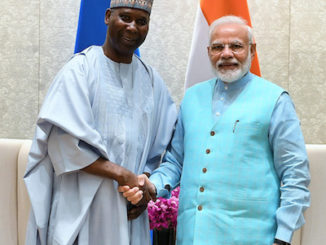
    Professor Tijjane Muhammad-Bande visited India in the first week of September this year. He called on Prime Minister Shri Narendra Modi, had discussions with External Affairs Minister Dr Subrahmanyam Jaishankar, and interacted with Indian policy makers in renewable energy, technology and sustainable development. He delivered a lecture at the prestigious Indian Council of World Affairs in New Delhi, during which he focused on the priorities ahead of him during his Presidency of the UNGA.

    Reaffirming the relevance of the UN, and focusing on eradication of poverty, quality education, inclusion and partnerships to overcome global challenges, were among his top priorities. Each of these areas will play a critical role in reaffirming the mandate of the UNGA to respond to challenges to multilateralism today. At the heart of this activity will be the need for effective international cooperation.

    India is expected to be a key partner for the new President of the UNGA in achieving progress on his priorities. As a country increasingly dependent on international cooperation for her growth (with her international trade contributing as much as 40% to her GDP), India’s national interests today are aligned with multilateralism. Her foreign policy is active on a multi-polar level, balancing the demands of India’s accelerated national development with the over-riding requirement for peace and security.

    To meet this requirement, India needs to catalyze an early conclusion to the decades-long inter-governmental negotiations in the UNGA on reforming the primary UN organ responsible for peace and security, which is the UN Security Council. The objective of the reform is to make the Security Council more equitable in decision-making, more transparent and more representative, so that it can respond more effectively to challenges to international peace and security.

    India’s decades-long experience of confronting threats to peace, security and sustainable development from cross-border terrorism drives her objective to work within the legal committee of the UNGA to make it obligatory under international law for UN member-states to either prosecute, or extradite for prosecution, alleged terrorists. This is the heart of the proposed Comprehensive Convention on International Terrorism or CCIT, which has been gridlocked in the legal negotiations of the UNGA for many years, despite India having provided a first draft of a possible CCIT in 1996. An early harvest of the CCIT also impacts on India’s reported interest in hosting a global counter-terrorism conference during the coming months.

    However, the heart of India’s engagement with the United Nations remains the creation of a responsive multilateral framework for eradicating poverty and accelerating socio-economic development for the transformation of India. She is therefore expected to provide critical support for the UNGA to operationalize the commitments made during the negotiations of Agenda 2030 on Sustainable Development, adopted unanimously by world leaders during Prime Minister Modi’s last visit to New York in September 2015. Foremost among these commitments is support for financial flows from multilateral financial institutions, and a functional technology facilitation mechanism.

    The UN Secretary General’s ambitious High-Level Report on Digital Cooperation, issued on 10 June 2019, will play an important role with respect to the use of technology for sustainable and inclusive development. With her own ambitious Digital India program for empowerment and development, India is well placed to bring the calls for increased multilateralism and international cooperation through multi-stakeholder partnerships contained in the Report into the UNGA’s preparations for the 75thanniversary Summit of the UN in September 2020.

    (The author is a former Permanent Representative of India to the United Nations , and Distinguished  Fellow, Vivekananda International Foundation)


  • Priorities for the United Nations in 2018

    Priorities for the United Nations in 2018

    By Asoke Mukeji
    The author, who was India’s Permanent Representative to the United Nations in New York from April 2013 to December 2015, takes a close look at the issues before the United Nations, and lists the priorities for the World Body in 2018. The three priorities, according to him, are “Completion of process of reforming the UNSC”; “accelerated implementation of the socio-economic goals of Agenda 2030”; and “reforming the Human Rights Council to uphold fundamental human rights and freedoms”.

    As the United Nations (UN) approaches its 75th anniversary in 2020, the world it represents has changed beyond recognition. From its original 51 founding members, the UN General Assembly (UNGA) today has 193-member countries. While the three “pillars” of the UN continue to be global governance in the political, socio-economic, and human rights areas, there is growing restiveness among the majority of the UNGA member states for reforming the UN to reflect ground realities.

    The UNGA’s new assertiveness in influencing decisions on UN functioning was on display during the November 2017 vote in the UNGA on electing judges to the International Court of Justice (ICJ). The unscripted situation, in which India’s candidature enjoyed majority support among the countries in the UNGA, was offset by the power play in the UN Security Council (UNSC), orchestrated by the solidarity of its five permanent members, which prevailed on several other non-permanent members to consistently back the candidate of the United Kingdom. This deadlock was finally resolved through mature diplomacy, with the United Kingdom deciding to concede the election in view of the overwhelming preference of the UNGA. India remained the sole candidate for the fifth ICJ seat, which it duly won, being the only name left on the ballot. This outcome has been greeted in many countries as a harbinger of reforming the UNSC itself by the UNGA.

    The issue of “UN reforms”, articulated by the UN Secretary General Antonio Guterres and endorsed by President Donald Trump of the United States at their joint meeting in New York in September 2016, has received prominence. However, these are reforms of the UN Secretariat, and reflect the interests of the main financial contributors to the UN budget. The intention is to get more “value” for money, with a parallel attempt to ensure that the interests of financial contributors are reflected in the key managerial positions of the Secretariat.

    Member states of the UN represented in the UNGA, on the other hand, are acutely conscious that the UN faces a larger test of its credibility related to its decision-making process and the priorities it gives to its negotiated agendas. In these areas, the impetus for UN reform has to come from the UNGA, and not the UN Secretariat.

    The linkage and inter-dependence between peace and development has been woven into the UN Charter since 1945. The perception that the world needs to “sustain” the peace arrived at after the end of the Second World War by “securing” the peace, created the two main organs of the UN under the UNGA. Realpolitik determined that one organ, the United Nations Security Council (UNSC), mandated by the UN Charter with the “primary responsibility” for maintaining international peace and security, operated on non-democratic principles. This was essentially due to the privilege given by Article 27.3 of the UN Charter to the five permanent members (China, France, Russia, the United Kingdom and the United States of America) to veto any decision of the UNSC without giving any reason or accountability. The other organ, the Economic and Social Council or ECOSOC, responsible for global socio-economic development, was imbued by the democratic principle of one-country one-vote, and adherence to the UNGA’s process of taking decisions by majority voting.

    Due to this dichotomy, the focus of UN reform in the UNGA has been on the UNSC. The emergence of new challenges and threats to international peace and security in the 21st century has been accompanied by the mushrooming of crises across all the continents of the world. These include Europe (Ukraine and Cyprus), Asia (Syria, North Korea, Yemen, Iraq and Afghanistan), Africa (South Sudan, the Democratic Republic of Congo, Central African Republic, and Mali) and Latin America (Haiti and until recently Colombia). The UNSC has been singularly ineffective in resolving these crises, often looking to the UN peacekeeping operations it mandates to perform the role of preventive diplomacy.

    The first priority of the UNGA in 2018, therefore, must be to complete the process of reforming the UNSC. The mandate for this reform was given to the UNGA by world leaders at the 2005 UN Summit thirteen years ago. The Summit had declared that “early reform” of the UNSC was needed to “enhance its effectiveness and the legitimacy and implementation of its decisions.”

    How can the UNGA implement this objective in 2018? The UNGA has made incremental progress in implementing its mandate for UNSC reform. It has already agreed on five key areas for UNSC reforms, as well as on inter-governmental negotiations to conclude these reforms. In September 2015, the UNGA unanimously agreed to consider a text submitted by 122 countries (including permanent members France and the UK) containing proposals on each of the five areas, which would be integrated into a UNGA resolution.

    Before 14 September 2018, when the 72nd Session of the UNGA ends, a minimum of 129 members of the UNGA must table and adopt a resolution amending the UN Charter to reform the UNSC. This will set the timetable for implementing the reforms holding elections to the new seats of the UNSC in 2019, enabling a reformed UNSC to begin operating by 2020, when the UN marks its 75th anniversary.

    The opposition to any such attempt will continue to come from the five permanent members of the UNSC. However, in the UNGA these five countries do not have the veto. A two-thirds majority is needed to adopt such a UNGA resolution. This will set the stage for applying the moral power of the UNGA, based on its broad-based interest in reforming the UNSC, to prevail over the status-quo position of the five permanent members. In this context, introducing a multi-stakeholder campaign, including global thought and business leaders, in favor of a UNGA resolution on reforming the UNSC would accelerate the acceptance of such a resolution by the permanent members. Such an approach paid dividends in the UNGA’s success in September 2015 on agreeing on the ambitious UN socio-economic development objectives contained in Agenda 2030 on Sustainable Development. A multi-stakeholder approach is also built into the UN’s implementation of the Tunis Agenda for a digital global society.

    A second major priority for UNGA member states in 2018 will be to accelerate implementation of the socio-economic goals of Agenda 2030. The overarching goal of this Agenda is the eradication of poverty by 2030. While individual members of the UNGA have agreed to focus on their national socio-economic programs to achieve the targets of the 17 Sustainable Development Goals at the core of Agenda 2030, the time has come for the UNGA to focus attention on two critical “means of implementation” which have been agreed to by all countries to catalyze this process.

    These two areas are financing for development and the application of technologies for development. The way forward has been identified by the Addis Ababa Financing for Development Conference of July 2015, and the UNGA High-Level Review of the Tunis Agenda for a World Information Society in December 2015. At its High-Level Political Forum meeting in July 2018, the ECOSOC and the UNGA will have an opportunity to convene a dedicated forum to assess how global commitments on these two areas are being implemented on the ground in individual member states of the UNGA. This effort must be driven by member states, to ensure that the UN is responsive to their aspirations on the ground.

    A third priority for the UNGA in 2018 is in the area of human rights. Already, calls have been made by the United States for reforming the HRC. These calls should be addressed within the UNGA framework. The UNGA has demonstrated its ability to address concerns expressed by some countries at the profile of countries represented in the HRC. For example, in 2015, Pakistan was unable to get re-elected to the HRC, as was Russia in 2016.

    Reforming the HRC needs to go beyond the representation of countries, and address the ability of the HRC to uphold fundamental human rights and freedoms, as set out in the UN Charter. The UNGA in 2018 must address the actual work being done in the HRC, especially in its Universal Peer Review or UPR process. This process is critical to ensure adherence to the UN Charter’s human rights standards. The fact that the HRC devotes only three hours to the UPR of each of the 193 members of the UNGA is one such issue, since this limited time applied uniformly to all countries being reviewed does not allow either the country being reviewed or the countries reviewing the scope for a focused interactive discussion. Making such reforms in the HRC will enable it to become the main body under the UNGA for human rights issues. This, in turn, will mean that any concern on human rights issues by UN member states should be raised in the HRC, and not in the UNSC, which has been the practice for more than two decades now, resulting in “perilous interventions” in the words of a distinguished Indian envoy to the UN.

    While these three priorities should engage the UN in 2018, the fact that the world is impacted by violent conflict and degrading poverty will ensure that “securing” the peace will have to precede “sustaining” the peace. The experience of multilateral diplomacy over the past seven decades has shown that to sustain peace, the focus has to be on resolving disputes peacefully, as set out in Chapter Six of the UN Charter. Any optimism about the success of the UN to become “fit for purpose” must be based on the convergence of the efforts of the UN Secretary General and the UNGA for preventive diplomacy, giving primacy to the diplomacy of peace over the diplomacy of war.

    (Asoke Mukerji is a former Ambassador and Permanent Representative of India to the United Nations in New York. He can be reached at  1955pram@gmail.com)