Tag: UN Security Council

  • Russian President Putin talks about India’s growth; says such countries must be represented in UN Security Council

    Russian President Putin talks about India’s growth; says such countries must be represented in UN Security Council

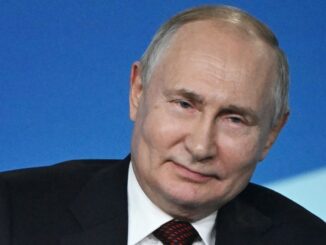
    MOSCOW (TIP): Heaping praise on India, Russian President Vladimir Putin has said that the Indian leadership is “self-directed” and led by the country’s national interests, according to Reuters.

    Speaking at an event, Putin alleged that the West is trying to cast everyone “who is not ready to blindly follow these Western elites as the enemy”. “At a certain point in time, they tried to do the same with India. Now they are flirting, of course. We all understand this very well. We feel and see the situation in Asia. Everything is clear. I want to say that the Indian leadership is self-directed. It is led by the national interests. I think that those attempts make no sense. But, they continue. They are trying to cast Arabs as the enemy. They are trying to be careful, but overall, that’s what it all boils down to,” Putin said.

    The Russian President said countries such as India, Brazil and South Africa deserve more representation in the UN Security Council and added that the UN should be reformed but gradually, according to Reuters.

    Calling India a “powerful country”, Putin said that it is growing stronger and stronger under the leadership of Prime Minister Narendra Modi, Russia-based RT News reported.

    “…India, more than 1.5 billion of population, more than 7 per cent of economic growth…that’s a powerful country, mighty country. And it’s growing stronger and stronger under the leadership of Prime Minister Modi…,” Putin said, according to a video shared by RT News.

    Earlier on Wednesday, Putin had called PM Modi a “very wise man”, adding that India is making great strides in development under his leadership, RT reported. Last month, too, he had praised PM Modi stating he was doing the “right thing” in promoting the Make in India program.

    (Source: ANI)

  • Balancing act: On India’s stand in Israel-Palestine conflict

    Balancing act: On India’s stand in Israel-Palestine conflict

    India should oppose indiscriminate attacks on Israel and disproportionate bombing on Gaza

    At the open UN Security Council session on Sunday, May 16, on the Gaza conflict, India, a non-permanent member, attempted a delicate balancing act by reaffirming its traditional support for the Palestine cause without abandoning its new friend Israel. T.S. Tirumurti, India’s Permanent Representative at the UN, expressed concern over the violence in Jerusalem and the “possible eviction process” of Palestinian families in Sheikh Jarrah and warned against “attempts to unilaterally change the status quo” in Jerusalem. He also reiterated India’s “strong support for the just Palestinian cause and its unwavering commitment to the two-state solution”. But India was careful not to upset Israel’s sensitivities. There is a direct condemnation of the rocket attacks from Gaza but no direct reference to the disproportionate bombing Israel has been carrying out on the impoverished Gaza Strip since May 10. India also did not make any reference to the status of Jerusalem or the future borders of the two states, in line with a recent change in its policy. Until 2017, the Indian position was that it supported the creation of an independent, sovereign Palestine state based on the 1967 border and with East Jerusalem as its capital that lives alongside Israel. The balancing did not appear to have gone down well with the Israeli side. When Prime Minister Benjamin Netanyahu, who has a good rapport with Narendra Modi, thanked 25 countries that he said stood with Israel, there was no reference to India.

    For India, which voted against the creation of Israel in historic Palestine in 1947 in the UN General Assembly, ties with Israel have transformed since the early 1990s. In 2017, Mr. Modi became the first Indian PM to visit Israel and Mr. Netanyahu travelled to India in 2018. While Israel ties are on a strong footing, India cannot ignore the Palestinians for historic, moral, legal and realist reasons. Historically, India, which went through the horrors of 1947, opposed the partition of Palestine. Throughout the Cold War, it remained a strong supporter of Palestinian freedom, taking a moral and legal position against the Israeli occupation, in line with international laws and norms. It established full diplomatic relations with Israel in 1992, in the context of improving Israel-Palestine ties after the Madrid Conference and the changes in the global order following the disintegration of the Soviet Union, but never abandoned the Palestinians. India’s Palestine policy had realist underpinnings too. India has been energy dependent on the Arab world. It cannot alienate the Arab voices or be isolated in the General Assembly, where most member-countries oppose the occupation. These factors should have driven India to take a more emphatic position against both the indiscriminate rocket attacks into Israel, in which 12 people were killed, and the disproportionate bombing of Gaza, which has claimed at least 230 lives, including over 60 children.

    (The Hindu)

  • US urges Pakistan to take ‘sustained and irreversible’ actions against terrorists

    US urges Pakistan to take ‘sustained and irreversible’ actions against terrorists

    WASHINGTON(TIP): The US has asked Pakistan to take “sustained and irreversible” actions against terrorist groups operating from its territory, according to a top State Department official.

    The State Department statement came as Pakistan, under global pressure after the Pulwama terror attack and India’s air strikes against a JeM terrorist camp in Balakot on February 26, has started taking actions against some of the terrorist outfits and their leaders over the past few days.

    In Islamabad, the Interior Ministry announced that a total of 121 members of the proscribed groups have so far been taken into “preventive detention” across Pakistan.

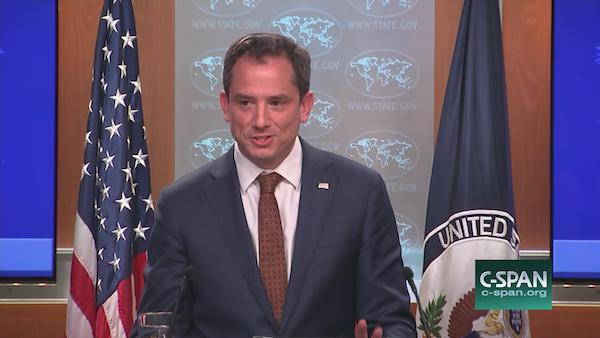
    State Department Deputy Spokesperson Robert Palladino told reporters at his biweekly news conference on Thursday, March 8, “I would say that we, the United States notes these steps and we continue to urge Pakistan to take sustained, irreversible actions against terrorist groups that will prevent future attacks and promote regional stability“.

    “We reiterate our call for Pakistan to abide by its United Nations Security Council obligations to deny terrorists safe haven and block their entry to funds,” he said.

    Responding to questions, Palladino refrained from giving a direct answer on the move in New York to designate Jaish-e-Mohammed (JeM) leader Masood Azhar as a global terrorist but said that the US and its allies in the UN Security Council want to update the UN list of terrorist organizations and leaders.

    “Our views on Masood Azhar and Jaish-e-Mohammed are well-known. Jaish-e-Mohammed  is a United Nations-designated terrorist group that has been responsible for numerous terrorist attacks and is a threat to regional stability. Masood Azhar is the founder and leader of JEM,” he said.

    Questions on United Nations sanctions committee deliberations are confidential and as such it is not something that the State Department is going to be able to comment on specific matters in that regard, he said.

    “But we will continue to work with the sanctions committee to ensure that the list is updated and that it is accurate,” Mr. Palladino said.

    At the US Capitol, India’s ambassador to the US Harsh Vardhan Shringla met Kevin McCarthy, the Republican leader in the House of Representatives.

    “We must stand strong against acts of terrorism and work together to improve trade between our nations,” the top Republican leader said after the meeting.

    Tensions between India and Pakistan escalated after a suicide bomber of Pakistan-based terror group JeM killed 40 CRPF personnel in Jammu and Kashmir’s Pulwama district in February 14.

    India launched a counter-terror operation in Balakot. The next day, Pakistan Air Force retaliated and downed a MiG-21 in an aerial combat and captured its pilot, who was handed over to India on March 1.

    ( Source:PTI )