Tag: UN Women

  • 1 in every 10 women in the world lives in extreme poverty

    1 in every 10 women in the world lives in extreme poverty

    NEW YORK (TIP): On International Women’s Day, UN Women calls for the world to “Invest in Women, Accelerate Progress” as the best way to accelerate economic growth and build more prosperous, equitable societies. This is particularly urgent when war and crisis are eroding the achievements of decades of investments in gender equality. From the Middle East to Haiti, Sudan, Myanmar, Ukraine, Afghanistan, and elsewhere, women pay the biggest price for conflicts that are not of their making. The need for peace has never been more urgent.

    Climate change is accelerating persistent poverty gaps. As competition for scarce resources intensifies, livelihoods are threatened, societies become more polarized, and women bear an increasingly heavy burden:

    1 in every 10 women in the world lives in extreme poverty.
    The number of women and girls living in conflict-affected areas doubled since 2017, now, more than 614 million women and girls live in conflict-affected areas. In conflict areas, women are 7.7 times more likely to live in extreme poverty. Climate change is set to leave 236 million more women and girls hungry by 2030, twice as many as men (131 million).
    At prime working age, only 61 per cent of women are in the labor force versus 90 per cent of men.
    We cannot continue to miss out on the gender-equality dividend. More than 100 million women and girls could be lifted out of poverty if governments prioritized education and family planning, fair and equal wages, and expanded social benefits.

    Almost 300 million jobs could be created by 2035 through investments in care services, such as provision of daycare and elderly care. And closing gender employment gaps could boost gross domestic product per capita by 20 per cent across all regions.

    The current reality is far from this. Programs dedicated to gender equality represent only 4 per cent of official development assistance. An additional USD 360 billion in developing countries is needed per year to achieve gender equality and women’s empowerment. This is less than one fifth of the USD 2.2 trillion spent globally on military expenditure in 2022, for example.

    The areas needing investment are clear and understood. First and foremost, there must be an investment in peace. Beyond this, the investments needed include laws and policies that advance the rights of women and girls; transformation of social norms that pose barriers to gender equality; guaranteeing women’s access to land, property, health care, education, and decent work; and financing women’s groups networks at all levels.

    UN Women is also calling on Member States at the Commission on the Status of Women, starting in New York on 11 March 2024, to back up their commitments on gender equality with resources. The world’s leaders have this opportunity to develop concrete and progressive agreed conclusions that reflect the crucial need for financing gender equality, women’s empowerment, and women´s organizations. They must seize it for the sake of equality, our planet, and the Sustainable Development Goals.

  • Change up the pace: women at the table

    Change up the pace: women at the table

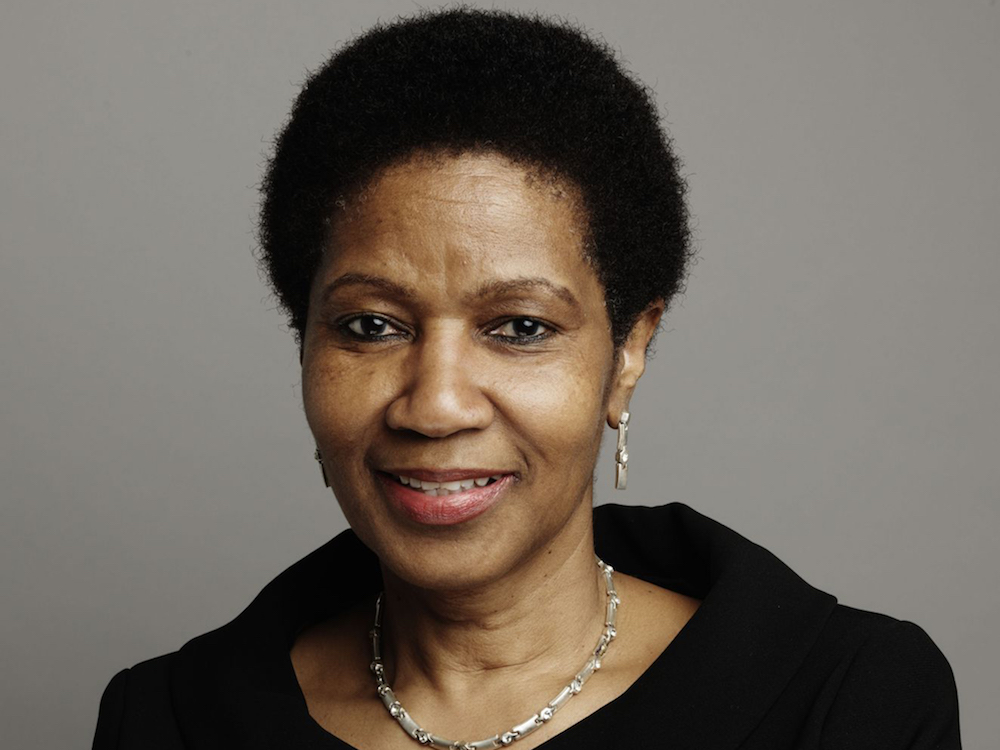
    Phumzile Mlambo-Ngcuka
    UN Women Executive Director
    Flicker photo /Courtesy UN Women

    MESSAGE : On the Occasion of International Women’s Day, March 8

    The universal and catastrophic lack of representation of women’s interests has gone on too long.

    International Women’s Day this year comes at a difficult time for the world and for gender equality, but at a perfect moment to fight for transformative action and to salute women and young people for their relentless drive for gender equality and human rights. Our focus is on women’s leadership and on ramping up representation in all the areas where decisions are made – currently mainly by men – about the issues that affect women’s lives. The universal and catastrophic lack of representation of women’s interests has gone on too long.

    As we address the extraordinary hardship that COVID-19 has brought to millions of women and girls and their communities, we also look ahead to the solid opportunities of the Generation Equality Forum and Action Coalitions to bring change.

    During the pandemic, we have seen increased violence against women and girls and lost learning for girls as school drop-out rates, care responsibilities and child marriages rise. We are seeing tens of millions more women plunge into extreme poverty, as they lose their jobs at a higher rate than men, and pay the price for a lack of digital access and skills. These and many other problems cannot be left to men alone to solve. Yet, while there are notable exceptions, in most countries there is simply not the critical mass of women in decision-making and leadership positions to ensure that these issues are tabled and dealt with effectively and this has affected the pace of change for women overall.

    There are breakthroughs to celebrate, where women have taken the helm of organizations such as the World Trade Organization, the International Monetary Fund and the European Central Bank and we look forward to more such appointments that help to change the picture of what a leader looks like. Yet this is not the norm. In 2020, as a global average, women were 4.4 per cent of CEOs, occupied just 16.9 per cent of board seats, made up only 25 per cent of national parliamentarians, and just 13 per cent of peace negotiators. Only 22 countries currently have a woman as Head of State or Government and 119 have never experienced this – something that has important consequences for the aspirations of girls growing up. On the current trajectory, we won’t see gender parity in the highest office before 2150. This can and must change. What is needed is the political will to actively and intentionally support women’s representation. Leaders can set and meet parity targets, including through appointments for all executive positions at all levels of government, as has occurred in the few countries with gender equal cabinets. Special measures can work; where countries have put in place and enforced quotas, they have made real progress on women’s leadership, as have those that have policies to address representation. Where these measures do not exist, progress is slower or even nonexistent and easily reversed.

    No country prospers without the engagement of women. We need women’s representation that reflects all women and girls in all their diversity and abilities, and across all cultural, social, economic and political situations. This is the only way we will get real societal change that incorporates women in decision-making as equals and benefits us all.

    This is the vision of the 2030 Agenda and the Sustainable Development Goals and the vision of the Beijing Declaration and Platform for Action. It is the vision of civil society and multitudes of young people who are already leading the way and of all those who will join us in the Generation Equality Action Coalitions. We need bold decisive action across the world to bring women into the heart of the decision-making spaces in large numbers and as full partners, so that we can make immediate progress on a greener, equitable and inclusive world.

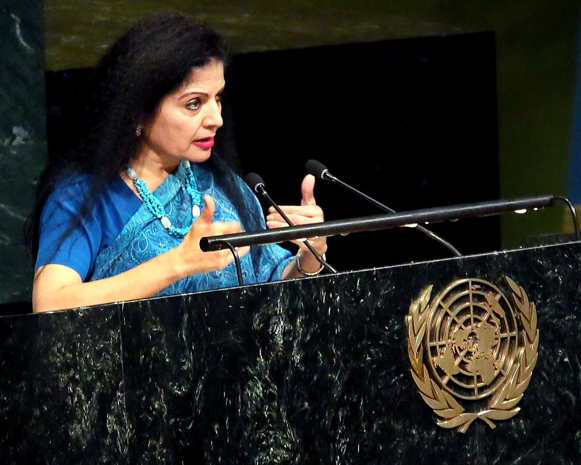
  • THE POWER OF ONE: AN INTERVIEW WITH AMBASSADOR LAKSHMI PURI ASSISTANT SECRETARY GENERAL & DEPUTY EXECUTIVE DIRECTOR, UN WOMEN

    THE POWER OF ONE: AN INTERVIEW WITH AMBASSADOR LAKSHMI PURI ASSISTANT SECRETARY GENERAL & DEPUTY EXECUTIVE DIRECTOR, UN WOMEN

    INTERVIEW BY PROF. INDRAJIT S SALUJA, CHIEF EDITOR, THE INDIAN PANORAMA
    “The power of one is about passion, commitment and indomitable courage and keeping faith with the causes we serve no matter the difficulties and setbacks. It’s about not giving up ever.” Ambassador Lakshmi Puri, Assistant Secretary General & Deputy Executive Director UN Women, had said, receiving her Diwali Power of One Award at the United Nations on December 11, 2017. The only woman among five diplomats to be honored, Ambassador Puri made her resolve known: “I will power on believing in the infinite possibility of all of us to achieve our infinite potential for good”.
    As this champion of gender equality prepared to leave the UN Women towards the end of January 2018 to go back to India, after having served the apex women’s body of the United Nations since its inception in 2011, The Indian Panorama succeeded in securing her nod for an interview.
    So, on a January 2 cold morning I reached her office in the iconic Daily News building on 42nd Street in New York City to speak with her. In a candid conversation with me she spoke passionately about her work at the UN Women – how much needed to be done, how much has been done, and how much more needs to be done – for gender equality, for emancipation of women, for empowerment of women. I could see a tigress in her when ready to pounce if she thought she was being challenged. During the conversation, at one or two points, she flipped at some remark which she considered was sexist or discriminatory.
    I tried to wean her away from the subject so dear to her, to her personal life and succeeded but only briefly because she was possessed with thinking only of women and their rightful and dignified place in society.
    Here are excerpts from the interview.

    TIP: You have put your heart and soul in your work to care for the dignity of women as guided by your parents and that’s what,Ibelieve, you have instilled in your children. You are known to be a fiercely feminist personality. I would like my readers to know what is the role of UN Women when it comes to emancipation, ending bias and grant women their rights as human beings I will then come to my other question.

    AMB: Un Women was founded in Jan. 2011, and I joined in March 2011. So, Iam in the leadership team since the beginning and this forum is the only global advocate for gender equality, women’s empowerment and women’s right in every area. So, what does that mean? It means for us that international agreements and commitments made by govts. to uphold and advance gender equality and empowerment, norms and standards. And that has been UN women’s and my own contribution.Because we have in place today historic gender equality compact on the part of international community which is reflected in the Beijing platform for action not only recommitted but taken forward.

    Similarly, the UN’s sustainable development agenda has made gender equality central to the agenda. And there is a sustainable goal on achieving gender equality and empowering all women. So, we mobilized all countries tostrongly support and take forward the goal.

    And that goal is about ending all forms of violence against women, child marriage, women trafficking, harmful practices like honor killing, sex selection, and everything. apart from that all harmful practices that we have in, includingIndia, south Asia. So, this is a strong sustainable target.

    Similarly, ending all forms discrimination, laws and practices. Women’s economic empowerment equal ownership over productive resources. Similarly, parity in voice participation and leadership in all public life, economic and political life. That means in parliament, in the executive, in judiciary, in law enforcement, in public service, in corporations, everywhere. and, then it also involves universal access to sexual and reproductive health and reproductive rights. Women need control over their bodies and their reproductive role. And, then, the goal also recognizes that women have to bear disproportionate role in domestic care. This is really frontier pushing. 2/3rds of such work is done by women and in places like in India, it is higher which is without compensation and it also without opportunity, cost on education, income and employment, economic empowerment. So, valuing that, reducing that, redistributing that and provisioning that. so, these goals are something that were very hard to attain and that’s something that I count that as my legacy – the whole gender equality, climate change, peace and security, the new urban agenda. My husband is the urban affairs minister in India,but we have been advocating before the govt. of India and implementing smart cities program and all the urban programs that they are doing. PM Modi is very much supportive of gender equality program and his new India campaign.

    Receiving the Diwali Power of One Award, in recognition of powerful advocacy and leadership
    in ensuring the adoption of a dedicated goal on gender equality and women’s empowerment
    (SDG 5) within the Sustainable Development Goals, and championship of the cause, December
    11, 2017 Photo /Jay Mandal

    But sexual harassment in work place is very pervasive. It is challenging to women who are coming out and participating in different sectors of political life and professions. So, all these stories are now coming out like “metoo” movement.

    TIP: I concur with what you are saying but centuries old cultural, social and patriarchal norms take time to change. Compared to US, there are not many women rising to top in Punjab or Africa. How tough do you think your ground is whether in Punjab or Africa?

    AMB: Well, cultural,social, and patriarchal norms are critical and that is why we believe in movement building. and that is why I believe govt. of India’s – bibi bachao, beti padhao – unless you start building culture and social norms around valuing the girl child that she is of equal value and also you dismantle all the patriarchal institutions and norms that devalue the child and aversion to the girl child, you are not going to get any change. So, movement building has to be done. This movement building has been going on through village councils. UN women has been working in India through women village councilors and zilla parishad councilors. Because they have got elected on quota and there are 1.5 million women councilors who are acting as staff. What we have do is to work with them, train them and demand rights and public services from authorities and also implementation of the programs that have been approved, money to be spent on programs that have been approved. So, our governance program is very successful program.

    Women’s economic empowerment, access to energy and water and sanitation are really important. But you have to target gender equality when you target these programs. And equally these programs will benefit gender equality in return. For example, the jan-dhan program, the access to finance, women’s disadvantage in terms of owning property, lands and in Punjab this is prevalent in spite of having a law that prevents it and also to disincentivize the discrimination. So effective laws and policies and their effective implementation, movement building, and youth have to be part of all this.

    On the youth side, we have this LEAP program – Leadership, empowerment, action and prevention of violence against women and partnership with women’s organization, young men’s organization and intergenerational dialog. So that is the youth part.

    We are very successful in our “he or she” programs. men and boys have to be made champions of gender equality. Women have to stand up for their rights. I have seen in India women are transmitting harmful, discriminatory patriarchal norms. So social transformation by women themselves is important. but men and boys have to be taught from the beginning.

    With Prime Minister of India, Narendra Modi, October 2017 Photo / PMO

    TIP:That is where the problem is. When there are many women in the family, only then men are sensitive to feminist issues.

    AMB:Yes, it has to begin when youare a boy. Every father and mother must bring up their children in a gender equal way. Boys must learn in their textbooks in the way their teachers teach them about how women and girls are lower in dignity. The other day PM Modi said in “swacha Bharat abhiyan” – he talked about how everybody in the house leaves the woman to do the cleaning work. Why? It should be the responsibility of each one. So that kind of new culture respecting the dignity and equal rights of women has to be developed. Education is an important part, but prevention, protection, prosecution of perpetrators, ending violence against women and provision of multisectoral services- in all of that again, changing mindset and educating from the beginning is needed. We are now dealing with generations of people who have grown up on gender unequal basis and mindset that have stereotypes. So, we have to change that and to change that we have to work with them. and we have been working with them.

    90% of the world is governed by men leaders and they are leading from the front. You asked about Africa. We have worked with tribal leaders, advocating and championing. It  has been successful.

    Faith is another important thing. In Sikhism, women are always seen as equal. And, what has happened now? it is with all other religions including Hindus that we worship them on one side and on the other, we devalue them.

    Farewell call with the Secretary-General of the United Nations, Antonio Guterres, December 2017 Photo/ Mohammed Jaffer-SnapsIndia

    In order to build 50/50 progress by 2030, we have to take some measures. We are leading not only in India but many parts of the world, “Gender parity Democracy” movement.

    TIP: Do you think, likereservation system, we should have a similar system in political and corporate world?

    AMB: I entirely advocate what is in the Beijing platform and what is in the convention for ending all forms of discrimination against women. There is a rule for special temporary measures. it is not that these measures will be there forever, but when you levelthe playing field, you need some special measures to take those who are at the position of disadvantage now to the position of equality and once that has been achieved, then those measures will become irrelevant. So thatis what we should aspire for.

    Now to your question, even before going to corporate, we have been advocating, and achieved constitutional amendments in many countries whereby quotas have been set for parliaments but not yet in India.We are strongly advocating for “reservation bill” in India. There are electoral system challenges and diverse community cultures, but we are advocating reservation bill strongly and parliamentary seats for women for some time. I remember one case in a village panchayt near Jaipur when she stated that she was first nominated and now she defeated 15 other contestants on her own strength. She said people voted for her because she delivered -“I built roads, got schools opened, got projects opened”.

    It is not only women and girls that we do reservation for; it is for good governance.

    Accepting the Eleanor Roosevelt Human Rights Award In recognition of her contribution to furthering the mission of the United Nations, her deep-seated commitment to human rights, as well as the global impact of her work, November 2016

    TIP: So those girls are advocating requirements for themselves.

    AMB: So, you need to bring us up to a level when we don’t need any more help and also to a point where people recognize women’s equal participation in governance.

     That brings me to the corporate world. It is a major challenge. There are many countries – like Norway – that have special measures which state that any company that wants to be listed on stock exchange has to have 50 percent women on board. China and Japan are also working towards having women board members. So, it is a mandatory movement. There are movements  in India, European union and Germany as well.

    In Australia, women owned business companies are given certain preferences. These kinds of incentives build women’s management and governance capacity in the corporate sector as well.

    So, you need some measures to achieve that.

    With Prime Minister of Canada, Justin Trudeau, global champion of gender equality and UN Women; and Executive Director of UN Women, Phumzile Mlambo-Ngcuka. June 2016

    TIP: Even though India had Lady PM and President in politics, what about corporate sector?

    AMB: We have women CMs, ministers etc. We are taking many steps but not enough.This is a very slow progress. In order to build 50/50 progress by 2030, we have to take some measures.We are leading not only in India but many parts of the world, “Gender parity Democracy” movement.

    We have great women’s movement in India, many NGO leaders are women.

    As UN organization, we have our first MOU with NYC and we have partnership program on all aspects of gender equality. Like NYC, we are working with many cities in in the world. We also have safe and sustainable cities program which include 66 cities in the program and India has about 8 or 9 cities that participates in the gender equality program which includes many areas like transport, business etc.

    Regarding your earlier question on women, apart from this norm setting and movement building, one major project has been how to build a knowledge hub. we want to bring out the facts for a “gender statistics revolution”.

    We need to know and bring out what is happening with women and girls – whether economic empowerment, violence etc. and we have this program called “making women and girls count”.

    India is a pathfinder country. There are about now 20 countries that participating in this program. Now social media is also helping in that – gender statistics revolution.

    We need to bring out the facts to make people outreach to bring about the emancipation of women. As Swami Vivekananda said -“arise, awake and stop not” – this whole knowledge is important and that is the basis of the revolution.

    TIP: Is there a time frame for that?

    AMB:We have set a time-frame of 2030. That is why the slogan is – “planet 50/50 by 2030”. We are asking every country to step up.

    We are very strapped and under-resourced. Original target was 1 billion, then it became 500 million and now we are struggling to reach 300 million. It has been a big challenge. We have tried to raise from philanthropist and private sectors, including India. We are doing everything, but governments are not forthcoming.

    TIP: Just like any country that violates UN resolutions, are there any sanctions for the country that violates the gender equality?

    AMB: UN women is intergovernmental organization. There are no sanctions that can be placed but we work with every country to make them speed up the gender equality. In UAE we have opened an office. We are having dialog with Saudi Arabia and we have a very strong Arab office in Egypt that oversees all of the Arab world.

    We are working in conflict countries, natural disasters, refugee countries, we are working on humanitarian response and resiliencebuilding, making sure that whateverhumanitarianresponse is provided, there is a very strong focusing on differential and disproportionate response on women as they are more prone to exploitation.

    TIP:Regrading your 2030 target, do you think your organization needs more resources and extra power to meet the target?

    AMB: Absolutely. This has been one of my regrets that the international community has been very strong in committing in terms of norms and standards to women’s empowerment and gender equality, they have not setup institutions to take this forward. So, the financial commitment part has not been commensurate with declared political commitment. We are very strapped and under-resourced.

    Original target was 1 billion, then it became 500 million and now we are struggling to reach 300 million. It has been a big challenge. We have tried to raise from philanthropist and private sectors,including India. We are doing everything, but governments are not forthcoming.

    “Making Women and children count” is supported by Gates Foundation.

    With the godmother of feminism, Gloria Steinem at the launch symposium of the Women, Peace and Security program at Columbia University, October 2017

    I would like all women to come forward and claim their rights which are equal to all the men and boys. And to all men and boys, join the gender equality cause, because this is not only good for your mothers, sisters, colleagues etc.; it is good for you.

    TIP: US president has decided to cut back funding for UN. So, are you also affected?

    AMB: No, we were in fact very happy that in 2017 contribution from US increased by a million.

    TIP: What about now?

    AMB: In 2017 US govt. gave 8.5 million, 1 million more than the previous year.

    TIP:How is India performing?

    AMB: India, from the inception, has played a very stellar role and they are the only country contributing 1 million every year.

    TIP:One last question. Your husband, Mr. Hardeep Singh Puri has been a wonderful diplomat. Now that he has chosen to go into politics, how do you look at the new avatar of your husband.

    AMB: He always wanted to be in politics. He was in politics during his student days. He always wanted to break out of his civil service mantle and go into politics. After retirement, he chose to go into politics. I am very happy that he has assumed the role of minister for urban and housing development which is very critical in order to achieve all the 17 goals of sustainable development and he has my full support.

    TIP: Before we close, would you like to say something to The Indian Panorama readers?

    AMB: I would like all women to come forward and claim their rights which are equal to all the men and boys. And to all men and boys, join the gender equality cause, because this is not only good for your mothers, sisters, colleagues etc.; it is good for you.


  • Phumzile Mlambo-Ngcuka appointed to a second term as Executive Director of UN Women

    Phumzile Mlambo-Ngcuka appointed to a second term as Executive Director of UN Women

    UNITED NATIONS (TIP):  The United Nations Secretary-General Antonio Guterres, on July 5, appointed Phumzile Mlambo-Ngcuka for a second term as Executive Director of the United Nations Entity for Gender Equality and Empowerment of Women (UN Women) for a period of four years.

    “This renewed term is our opportunity to reflect constructively, build our momentum, and surge ahead. In these years we are going to be putting our new Strategic Plan 2018-2021 into practice, supporting Member States and our diverse partners to accelerate their implementation of the 2030 Agenda with gender equality and women’s empowerment and full realization of their rights at its heart; we will celebrate the 10th anniversary of our establishment; and we will drive hard towards this and the other key milestones of 2020 as a firm platform for the achievement of the Sustainable Development Goals by 2030,” said Ms. Mlambo-Ngcuka.

    The Secretary-General’s decision came following consultations with Member States and the Executive Board of UN Women. The two-day annual session of the Executive Board had met earlier the previous week to fine-tune the strategic planning for the next four years, expressing its confidence in UN Women’s vital mandate and strong leadership.

    Commenting on progress to date, Ms. Mlambo-Ngcuka emphasized the high caliber and commitment of UN Women’s staff: “Their energy and dedication keep us going through all the challenges, and make our organization what it is. Together with Member States and all our partners, we are fiercely ambitious for the women and girls of this world, and positive that greater equality bears fruit for all,” she said.

    Under Ms. Mlambo-Ngcuka, UN Women has played a significant role in ensuring that women were put front and center of the 2030 Agenda for Sustainable Development and that the responsibility of ending gender inequality became everyone’s responsibility. She established game-changing movements such as HeForShe that engages men and boys.

    She has been influential in transforming conversations and knowledge on the most important issues affecting women’s lives such as discriminatory laws, unequal pay and unpaid care work, violence against women, disenfranchisement, and conflict and humanitarian crises through flagship programming that coordinates response through the UN system. Through this she has broadened the base of both state and non-state actors that influence transformative and irreversible change.

    Before joining UN Women, Ms. Mlambo-Ngcuka worked with women and girls in different capacities in civil society and as a public representative. Her work has focused on political and economic rights as well as girls’ education; her experience includes promoting gender equality for women in both the private and the public sectors. She was involved in her country’s struggle against Apartheid. As World YWCA coordinator for young women’s programs, she worked with young women all over the world.

    Ms. Mlambo-Ngcuka was the first woman to hold the position of Deputy President of South Africa from 2005 to 2008.  She initially became a Member of Parliament in 1994, chairing the Public Service Portfolio Committee.  She was Deputy Minister in the Department of Trade and Industry (1996-1999), Minister of Minerals and Energy (1999-2005), and briefly served as acting Minister of Arts, Culture, Science and Technology in 2004. In all her portfolios she was actively involved in policy and legislation that impacted positively on the lives of women and girls. She holds a PhD in technology-based education.

    UN Women is the UN organization dedicated to gender equality and the empowerment of women. A global champion for women and girls, UN Women was established to accelerate progress on meeting their needs worldwide. For more information, visit www.unwomen.org. UN Women, 220 East 42nd Street, New York, NY 10017, New York. Tel: +1 646 781-4400. Fax: +1 646 781-4496.