Tag: UN

  • UN: Record 193 million went without enough food last year

    UN: Record 193 million went without enough food last year

    The figures appeared in the Global Report on Food Crisis

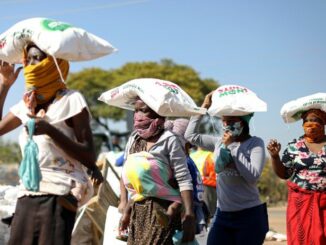
    ROME / NEW YORK (TIP)): The United Nations (UN) said on Wednesday, May 4,  that the number of people without enough to eat on a daily basis reached all-time high last year and is poised to hit “appalling” new levels as the Ukraine war affects global food production. Almost 193 million people in 53 countries suffered acute food insecurity in 2021 due to what the UN said was a “toxic triple combination” of conflict, weather extremes and the economic effects of the coronavirus pandemic.

    The UN said the total number of people without adequate food every day increased by 40 million last year, confirming a “worrisome trend” of annual increases over several years.

    The figures appeared in the Global Report on Food Crisis, which is produced jointly by the UN Food and Agriculture Organisation, the World Food Programme and the European Union. The report forecasts that Somalia will face one of the world’s worst food crises in 2022 due to prolonged drought, increasing food prices and persistent violence. The various factors could lead six million Somalis into acute food crisis, the UN said.

    “Today, if more is not done to support rural communities, the scale of the devastation in terms of hunger and lost livelihoods will be appalling,” the UN said. “Urgent humanitarian action is needed on a massive scale to prevent that from happening.” The war in Ukraine poses further risks for Somalia and many other African countries that reply on Ukraine and Russia for wheat, fertilizer and other food supplies.

  • India abstains from UNSC resolution against Russian aggression

    India abstains from UNSC resolution against Russian aggression

    Draft resolution fails as Russia exercises veto

    WASHINGTON, D.C. (TIP): With Russia exercising its veto, a draft resolution sponsored by the U.S. and Albania, condemning Russian aggression and calling for the country’s withdrawal from Ukraine, has failed to pass the United Nations Security Council (UNSC).

    India, along with China and the UAE, abstained, while 11 members voted in favor of it. The U.S. vowed to take the issue to the General Assembly, where Russia does not have a veto. Government officials said India has been speaking to all parties including Russia and Ukraine to return to the negotiating table  “By abstaining, India retained the option of reaching out to relevant sides in an effort to bridge the gap and find the middle ground with an aim to foster dialogue and diplomacy,” a source said.

    The vote at the UNSC had to be postponed twice, for an hour at a time, as U.S. and Albanian diplomats, the “penholders” of the resolution, negotiated with other countries, trying to build a consensus for the draft.

    However, according to officials who saw the draft, the original version was too strong, as it invoked UN Chapter VII, which authorizes the use of force against Russian troops in Ukraine. After several rounds of heated negotiations, the U.S. agreed to soften the resolution and drop the Chapter VII reference, which is believed to have ensured that China also abstained along with India and the UAE, while Russia was alone in voting against the resolution.

    “Let us never forget that this is a war of choice. Russia’s choice,” Linda Thomas-Greenfield, the U.S.’s permanent representative (PR) to the United Nations told the Council. “To those who say all parties are culpable, I say that is a clear cop out. One country… one country is invading another,” she said, adding that countries who based their position on Russia having a historical relationship with Ukraine should think about whom that label would apply to next.  “Vote ‘no’ or abstain if you do not uphold the charter and align yourselves with the aggressive and unprovoked actions of Russia,” she said.

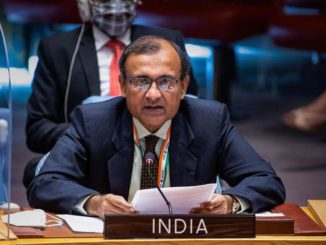
    Delivering India’s explanation of vote, PR T.S. Tirumurti said India was “deeply disturbed” by the developments and called for the “immediate cessation “of violence. Mr. Tirumurti said that the global order had been built on the UN Charter and the respect for the territorial integrity and sovereignty of states. He called on states to respect these principles and for dialogue to settle their differences.

    During his speech, as with his other UNSC speeches relating to the Ukraine crisis, Mr. Tirumurti said India was “deeply concerned” about the welfare of Indians in the country. Ukraine’s PR Sergiy Kyslytsya took a shot at India on this count, when it was his turn to speak. “And I may say to some: It is exactly the safety of your nationals right now in Ukraine that you should be the first to vote to stop the war – to save your nationals in Ukraine. And not to think about whether you should or should not vote because of the safety for your nationals,” he said.

    Mr. Kyslytsya said he was “saddened” that a “small handful of members” seemed to be “tolerating” the war.

    China’s PR Zhang Jun backed diplomatic negotiations between the parties, saying, “Ukraine should become a bridge between the East and the West, not an outpost for confrontation between major powers.”

    Russia’s U.N. Ambassador Vassily Nebenzia called the resolution not just anti-Russian but also anti-Ukrainian, saying the document (draft resolution) ran counter to the interests of Ukraine’s people as it sought to keep the existing government in power.

    With reference to Russian President Vladimir Putin asking the Ukrainian army to depose its government, Mr. Kyslytsya, addressing his Russian counterpart in the Security Council Chamber, asked, “Are you crazy?”

    In post-meeting remarks to the press, U.N. Secretary-General Atonio Guterres said the meeting’s objective had not been achieved.

    “Today, that objective was not achieved. But we must never give up,” he said. “We must give peace another chance.”

  • Foreign investment flow into India down 26% in 2021: UN

    Foreign investment flow into India down 26% in 2021: UN

    UNITED NATIONS (TIP): Foreign Direct Investment (FDI) flows to India in 2021 were 26% lower, mainly because large M&A deals recorded in 2020 were not repeated, the UN trade body has said. The UN Conference on Trade and Development (UNCTAD) Investment Trends Monitor published on Wednesday said global foreign direct investment flows showed a strong rebound in 2021, growing 77% to an estimated $1.65 trillion, from $929 billion in 2020, surpassing their pre-Covid level.

    “Recovery of investment flows to developing countries is encouraging, but the stagnation of new investment in the least developed countries in industries important for productive capacities, and key Sustainable Development Goals (SDG) sectors — such as electricity, food or health — is a major cause for concern,” said UNCTAD Secretary-General Rebeca Grynspan.The report said developed economies saw the biggest rise by far, with FDI reaching an estimated $777 billion in 2021 — three times the exceptionally low level in 2020.

    FDI flows in developing economies increased by 30% to nearly $870 billion, with a growth acceleration in East and South-East Asia (+20%), a recovery to near pre-pandemic levels in Latin America and the Caribbean, and an uptick in West Asia.

    (Source: PTI)

  • PM Modi did well to commit India to its democratic traditions at UN General Assembly

    For the third consecutive year in a row, and his fourth such speech since he was elected in 2014, Prime Minister Narendra Modi addressed the UN General Assembly, outlining his outlook on India’s place in the world. Referring to India’s large population, he said that the world grows when India grows, and transforms when India reforms, pointing to examples of the country’s progress and impact: in the area of vaccines and pharmaceuticals, particularly to counter COVID, green technology and the promise of 450 GW of renewable energy by 2030, and poverty alleviation. He also enumerated how many Indians had been provided water connections, banking access, insurance coverage, health services and homes, although his claim that these “all-inclusive” development goals had been achieved only in the “last seven years”, struck a politically partisan note that was out of place. Moving to regional matters, Mr. Modi pointed to the contrast between India’s actions and those of Pakistan and China in veiled references. In an apparent message to Pakistan, he linked events in Afghanistan, where the Taliban have taken control, to the problem of “regressive thinking” that leads to the use of terrorism as “a political tool”. He also called for safeguarding the maritime sphere from the “race of expansion and exclusion” and referred to the need for investigating the “origins of the coronavirus”, subjects China is sensitive about. Addressing the UN directly for its own shortcomings, the PM said that time waits for no one, urging the UN to speed up the reforms process that has been flagging for more than a decade, which would include an expanded Security Council. This, he explained, is the only way to restore the credibility of global governance institutions.

    Mr. Modi’s strongest words came at the beginning of his speech, where he launched a defense of the state of Indian democracy, which has come in for some criticism over the past few years. He said India had been named the “mother of democracy” for its adherence to democratic values, symbolized by its diversity, pluralism, inclusivity, and equality, that allowed someone like him, who had once worked at his father’s tea stall, to become the country’s leader. The PM’s words appeared to be a response to comments made during his Washington visit, where U.S. President Joe Biden and Vice-President Kamala Harris stressed the need to strengthen democratic processes internally. Even as he addressed the UN, protesters outside criticized his government for actions against activists, NGOs, the laws on agriculture and citizenship, and incidents of lynching and mob violence. While the PM’s commitment to India’s “great tradition of democracy” was heartening, it will be measured not by words at the world body, but by answers and actions on the ground in India.

    (The Hindu)

  • Earth Day 2021 Is Set to Galvanize Climate Action

    Earth Day 2021 Is Set to Galvanize Climate Action

    UNITED NATIONS (TIP):  Earth Day, celebrated annually on 22 April, will again see more than 1 billion people participating in activities around the world to draw attention to the urgency of the climate crisis and environmental degradation and the need for immediate action. This year, it also presents a major opportunity for significant climate action announcements. Many important environmental events have happened on Earth Day since its inception in 1970, including the signing of the Paris Agreement in 2016. The theme for this year – the second Earth Day Live digital event – is: Restore our Earth. 22 April is also International Mother Earth Day, as proclaimed by the United Nations in 2009. In a statement to mark the Day, UN Secretary-General, António Guterres, called for decisive action to protect our planet from both the coronavirus and the existential threat of climate disruption: “Mother Earth is clearly urging a call to action. Let’s remind more than ever on this International Mother Earth Day that we need a shift to a more sustainable economy that works for both people and the planet,” he said.

    Several major climate-related events will take place in parallel on 22 April, including the Leaders’ Summit on Climate, hosted by the United States, and ‍an Exponential Climate Action Summit on Financing the Race to Zero emissions.

    US Leaders’ Summit

    As the US reenters the global climate fight, US President Biden is convening a virtual Leaders’ Summit on Climate from 22 to 23 April with the participation of 40 world leaders. The central aim of the Summit is to galvanize efforts by the world’s major economies to keep the vital Paris Agreement goal of limiting global warming to 1.5 degrees Celsius within reach.

    Major economies are expected to announce their new national climate action plans – known as Nationally Determined Contributions or NDCs.

    The Summit will reconvene the Major Economies Forum (MEF) on Energy and Climate, a US-led initiative that played a major role in delivering the Paris Agreement.  In addition to the major economies, leaders of countries that are key stakeholders in the climate fight will participate. These include countries that have demonstrated strong climate leadership, are especially vulnerable to climate impacts, or are charting innovative pathways to a net-zero economy.

    Financing the transition to net zero emissions

    UN Climate Change Executive Secretary, Patricia Espinosa, will be among the participants at the second virtual Exponential Climate action Summit – Financing the Race to Zero – where transformers, disruptors and enablers will focus on how to finance The Race to Zero carbon emissions by 2050.

    The Exponential Climate Action Summit is a collaboration between We Don’t Have Time, the world’s largest social network for climate action, communications technology firm Ericsson and The Exponential Roadmap Initiative, whose mission is to halve emissions before 2030 through exponential climate action and solutions.

    Upcoming installments of the series in 2021 are:” Sustainable Consumption” at Climate Week NYC in September and  “Exponential Solutions” at COP 26 in November.

    Earth Day is an opportunity for climate education

    Recognized as the planet’s largest annual civic event, Earth Day has spawned a range of environmental actions and campaigns, including the passage of landmark environmental laws and reforestation projects. Ahead of this year’s crucial United Nations Climate Change Conference in November in Glasgow, a Climate Literacy campaign has been launched, urging governments attending the conference to make climate literacy a core feature of school curriculums across the globe. It will also be an occasion for UN Climate Change and other UN agencies to explain how the Paris Agreement works, and for example what NDCs are and what the concept of net zero emissions is.

  • UN’s largest gathering on women’s rights calls on enhancing women’s leadership in public life in the run up to the 2021 Generation Equality Forum

    UN’s largest gathering on women’s rights calls on enhancing women’s leadership in public life in the run up to the 2021 Generation Equality Forum

    Against the backdrop of the COVID-19 pandemic, the 65th session of the Commission on the Status of Women called for increasing women’s participation and leadership in decision-making to solve global challenges.

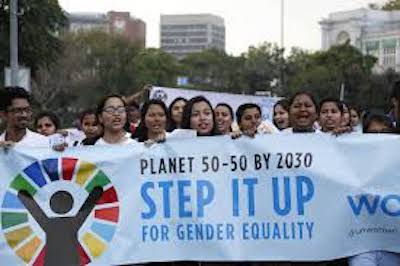
    NEW YORK (TIP):  The 65th session of the Commission on the Status of Women (CSW65), the UN’s largest gathering on gender equality and women’s rights, opened March 15,  as an almost entirely virtual session, with the devastating impacts of the COVID-19 pandemic in the foreground, and preparing the ground for the forthcoming Generation Equality Forum, which will kick off in Mexico City from 29-31 March.

    The two-week long gathering for UN Member States, civil society organizations, gender experts, and other international actors aims to build consensus and agree on a roadmap to advance gender equality, with the focus this year on the theme, “Women’s full and effective participation and decision-making in public life, as well as the elimination of violence, for achieving gender equality and the empowerment of all women and girls”.

    Recent reports on the theme have reconfirmed that the glass ceiling remains for women around the world, restricting their participation in decision-making, with women serving as Heads of State and/or Government in only 22 countries; women holding just 25 per cent of parliamentary seats, and 12 countries having no women ministers in cabinets at all. The COVID-19 pandemic has exacerbated existing inequalities – from increased reports of domestic violence, unpaid care responsibilities, rates of child marriage and millions of women plunging into extreme poverty as they lose their jobs in higher numbers than men.

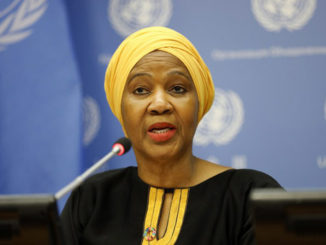
    UN Women Executive Director Phumzile Mlambo-Ngcuka said: “This pandemic has been the most directly discriminatory crisis the world has ever seen. It has treated most harshly those most deprived, and affected women’s lives across the world. But with firm political will to achieve fast-tracked, equal power-sharing, women and men can together address this and the other urgent challenges of our time, from climate change to conflict.”

    “This is the vision of the 2030 Agenda and the Sustainable Development Goals and the vision of the Beijing Declaration and Platform for Action. It is the vision of civil society and multitudes of young people who are already leading the way, and of all those who will join us in the Generation Equality Action Coalitions. It is surely also the vision of those assembled for the Commission on the Status of Women,” she added.

    As the UN Secretary-General report published on this year’s theme underlines, for power-sharing to become today’s reality, violence against women in public life must be significantly eliminated, and social norms, access to financing, and legal and institutional frameworks, have to be transformed, so that they support women’s equal participation and decision-making. Governments should also strengthen normative, legal, and regulatory frameworks, especially the implementation of gender quotas. Enhancing women’s civil society activism is also critical for transformative change at national and global levels.

    High-profile speakers including US Vice-President Kamala Harris, France Minister for Gender Equality, Diversity and Equal Opportunities Élisabeth Moreno, Mexico Vice-Minister for Multilateral Affairs and Human Rights Martha Delgado Peralta, European Commissioner For International Partnerships Jutta Urpilainen, among others, are expected to address the Commission this year. The full list of speakers is available here.

    CSW65 is an important bridge to the Generation Equality Forum, convened by UN Women and co-hosted by the Governments of Mexico and France, in conjunction with youth and civil society. The Forum will kick-off in Mexico City from 29 – 31 March, and culminate  in Paris from 29 June – 2 July.  It is designed to inspire urgent action, commitments and investments in gender equality. An interactive virtual side event on 19 March will be a curtain-raiser to the Generation Equality Forum kick-off in Mexico.

    As part of its efforts to catapult progress on gender equality, leaders of the Generation Equality Forum Action Coalitions – new and innovative partnerships including governments, feminist and youth movements and organizations, the private sector and international organizations – have unveiled the concrete action steps that they see as central to a new and bold feminist agenda within the next five years. These range from the accelerated introduction and implementation of laws and policies prohibiting all forms of gender-based violence to protect 550 million more women and girls worldwide, to introducing policy measures to recognize, reduce and redistribute unpaid care work and create at least 250 million decent care jobs or doubling the annual growth rate of funding for feminist, youth-led and grass-roots women’s groups.

    The opening session of CSW65 on March 15 featured statements from global leaders, including the Chair of the 65th Commission on the Status of Women MherMargaryan; the UN Secretary-General António Guterres; UN Women Executive Director Phumzile Mlambo-Ngcuka; civil society representative VirisilaBuadromo and youth leader Renata Koch Alvarenga.

    Along with the 18 official meetings that include Ministerial Round Tables, the general discussion and interactive dialogues, hundreds of side events and parallel events hosted by UN Member States, UN Agencies and civil society organizations will take place in the coming two weeks, mostly in a virtual format.

    Ahead of CSW65, UN Women supported partners to organize regional consultations with Ministers, gender equality experts and civil society organizations in Latin America and the Caribbean, Africa and Arab States, to build consensus and action priorities towards the Commission’s outcome, which is expected to be adopted at the conclusion of the second week.

  • Gandhi Memorial Observes Gandhi Punyatithi

    Gandhi Memorial Observes Gandhi Punyatithi

    CHICAGO, IL(TIP): Mahatma Gandhiji 73rd death anniversary was observed with singing of Gandhiji’s favorite hymns, release of a book, swearing in of New Gandhi Memorial Board,powerful tributes by community leaders and floral tributes to the Mahatma Gandhi Statue in the National Heritage Park on McCormick Boulevard in Skokie, Illinois. The homage ceremonies opened with garlanding of Gandhi’s Statute followed by singing of the American national Anthem followed by the Indian national Anthem sung by Mrs Bharti Desai, renowned Gujarati singer. Suresh Bodiwala, Chairman of Gandhi Memorial Foundation, Chicago welcomed the guests and announced the new officers of the Board of Directors: Chandrakant Modi MD, Founder, Suresh Bodiwala, Chairman, Dr. Mrs. Santosh Kumar, President, Dr. Sriram Sonty & Dr. Vijay G Prabhakar Vice Presidents and Mrs. Bharti Desai, Treasurer. Chairman Suresh Bodiwala applauded the Founder of the Gandhi Memorial, Chandrakant Modi MD who personally donated over $150,000 dollars in 2005 to facilitate this Gandhi Statue in Skokie. Chairman Suresh Bodiwala hoped that the new Board will expand the organization’s activities to be more global in outlook and involve all other communities in cherishing Gandhi’s vision.

    India’s Consul General at Chicago Amit Kumar administered the Oath of Office to the new Board of Directors of Gandhi Memorial Foundation, Chicago headed by Dr. Mrs. Santosh Kumar.

    Dr. Mrs. Santosh Kumar in her presidential remarks said, “I am honored to be part of this noble institution, the Gandhi Memorial Foundation, Chicago. With all humility, I accept this great responsibility as your President. Mahatma Gandhi inspired me as a teenager to choose Law as my career rather than being a physician for what I studied for. GandhiJi ‘s freedom struggle and the injustice done to our motherland emboldened me to become an Attorney to fight for the oppressed. Gandhiji’s words: “Be the Change” is the words of reckoning that still guide me every step of the way and are relevant even today in this digital age. Our Consul General Amit Kumar and his wife Mrs. Surabhi Kumar are very Godfearing and Simple people called to serve with a smile. We look forward to seeking his guidance as our new Board builds on the legacies of our past presidents and boards in realizing GandhiJi vision in our daily lives. I am fortunate to have three very creative, energetic and dedicated leaders: Dr. Sriram Sonty, Dr. Vijay Prabhakar, Mrs. Bharathi Desai to join me on the new Board with our Chairman Bodiwala. Today we seek Mahatma Gandhi blessings in all our endeavors as we strive to incorporate Gandhiji ideals into our everyday lives by embarking on life transforming projects that can make a difference in our lives and in the lives of our communities., She added”.

    Dr. Vijay G. Prabhakar, the Master of Ceremonies introduced India’s Consul General Amit Kumar and his wife, Mrs. Surabhi Kumar as an action couple who has endeared themselves to the community. Dr. Prabhakar recalled the key assignments held by Consul General Amit Kumar which included Deputy Chief of Mission at Washington D.C., Chief of Human Resources Management at Ministry of External Affairs, Delhi, Deputy Chief of Mission at Tokyo, who also had previously served in PMI, UN, New York, Beijing, China, Berlin, Germany, and Ankara, Turkey. Career Diplomat Amit Kumar is an alumnus of IIT Kanpur, India and had worked with the Spiritual Guru Dalai Lama, when he as Director of Protocol, External Affairs Ministry, Delhi. Dr. Prabhakar commended the work of the Consul General Amit Kumar along with his Consuls P.K. Misra, Ranjith Singh and L.P. Gupta during this pandemic time for their effective response to the Midwest Community needs.

    Speaking on the occasion, Consul General Amit Kumar traced the different significant initiatives of Gandhiji during India’s freedom struggle and extolled Gandhiji’s services to the Nation. Consul General Amit Kumar congratulated the new board of the Gandhi Memorial Foundation and was pleased to note that Mrs. Santosh Kumar and Dr. Vijay Prabhakar was involved in several Gandhi initiatives in Delhi and Chicago. He also commended Dr. Sriram Sonty’s efforts for a U.S. Gandhi Stamp. Consul General Amit Kumar exhorted the Indian diaspora to translate Gandhi’s vision into action by undertaking meaningful and purposeful projects here in Chicago. Consul General Amit Kumar honored Dr. C.M. Modi and his wife Mrs. Dina Modi with a silk shawl. Mrs. Surabhi Kumar presented the MAFS Gandhi Global Icon Medallion to Dr. C.M. Modi, Founder Gandhi Memorial, Chicago for all his efforts in nurturing the Gandhi Memorial Foundation, Chicago.

    Consul General Amit Kumar released a Book: “Lasting Legacy of Gandhiji -Ma Santosh Kumar” and Dr. Sriram Sonty received the first Copy of the book. Dr. Sriram Sonty said that 7 June 1893, the day young Gandhi was thrown out of the Durban to Pretoria train at the Pietermaritzburg Railway station was the turning point in Gandhi’s life. From that date, Gandhi took up the fight against racial oppression and Gandhiji’s    nonviolence movement was born, he added. Dr. Sonty said that when he personally visited that Railway station in 1983, it led him to become a staunch Gandhi follower.

    Ms. Nisha Modi daughter of the Gandhi Memorial Founder Dr. C.M. Modi acknowledged the honor bestowed on her parents at the event. Dr. Sreenivas Reddy, President, American Association of Multiethnic Physicians, Chicago read the message U.S. Congressman Raja Krishnamoorthi sent for the occasion. U.S. Congressman Raja Krishnamoorthi in his message reminded us of a Gandhi quote,” It is not just words. Action expresses priorities.” That defined Gandhi’s own life, as well as your work to honor him and his legacy. Americans for generations to come can learn from Gandhi’s example as we strive to create a more perfect Union. A Union that shuns violence and promotes civil rights, equality and liberty for all its people, Congressman Krishnamoorthi added.

    Community leaders Sohan Joshi, Trustee FIA-Chicago, Dr. Suresh Reddy, AAPI Past President, Chandini Divvuri, Chairperson, Nari Global Foundation, Palatine, and Smitesh Shah, UMAS Coordinator, Chicago paid glowing tributes to Mahatma Gandhi on the occasion. Gandhi’s favorite songs were sung by the MAFS Senior Chorale Group led by Anthony Rathor, Urvashi Bhatt, Himali Bharucha, Promila Mehta and Pankaj Patel while floral tributes were placed at the Gandhi Statue.

    Ms. Bharti Desai, Treasurer of Gandhi Memorial Foundation, Chicago proposing a vote of thanks appreciated the presence of all the guests who attended this event despite the chilling cold weather. Ms. Desai said “We the people are eternally indebted to Dr C.M. Modi and his family for a generous gesture that is remembered in posterity. The presence of our Honorable Consul General Amit Kumar with us on this cold morning is a testament of Government of India’s support for propagating Gandhi’s ideals throughout the world. Sir Amit Kumar Ji, thank you for being with us and we look forward to your continued support to our new board with all the exciting plans ahead.  Your presence here is a great source of inspiration to our new board and we count on your continued support. Refreshments were served by Volunteers of Metropolitan Asian Family Services to all.

    (Photograph and Press release by Asian Media USA)

  • Reforming the UN system after Covid-19

    Reforming the UN system after Covid-19

    By Ambassador Asoke Mukerji

    The current global crisis demands global leadership. This is a major opportunity for India, together with a coalition of member-states whose national aspirations in a post-Covid19 world depend on effective international cooperation, to rise to the challenge.

    When the United Nations (UN) was conceptualized during the Second World War to “save succeeding generations from the scourge of war”, its two major objectives were to secure and to sustain international peace and security. Among the six principal organs of the UN, the UN Security Council (UNSC) was mandated by all signatory states of the UN Charter with the “primary responsibility” for securing international peace and security. The Economic and Social Council (ECOSOC) of the UN General Assembly (UNGA) was entrusted with sustaining international cooperation to achieve socio-economic progress, including upholding human rights and fundamental freedoms for all. As the UN commemorates the 75th anniversary of its establishment in September 2020, it is apparent that the implementation of this holistic vision of the UN Charter has been fragmented. That is the basis for calls for reform of the UN.

    On the positive side, the ECOSOC and the UN General Assembly have succeeded in responding to the single biggest change in international relations since the end of the Second World War. Decolonization enabled hundreds of millions of people in former colonies to be integrated into the UN system based on freedom and equality. Their aspirations have become the focus of the work of the UN and its specialized agencies.

    In the past four decades, these two organs of the UN have succeeded in creating a vibrant framework for upholding human rights. They have converged the twin objectives of climate change and accelerated development into Agenda 2030, with its 17 Sustainable Development Goals. Adopted unanimously by world leaders in September 2015, Agenda 2030 is the first multi-stakeholder universally agreed global framework for socio-economic progress. The adoption of Agenda 2030 signaled an awakened hope in ordinary people for better health, education, infrastructure, employment, and equality of opportunity.

    A crucial sentence in the Preamble of Agenda 2030 encapsulates the inter-linked nature of the global challenges of the 21st century. World leaders unanimously agreed that “there can be no sustainable development without peace and no peace without sustainable development”. This can only be ensured if there is a supportive global environment of peace and security, which requires an effective UNSC.

    However, the UNSC’s ineffectiveness in responding to challenges to international peace and security has become a major factor behind the fragmentation of international cooperation. Such challenges include the increased recourse to unilateral policies by its five permanent members (China, France, the Russian Federation, the United Kingdom and the United States of America, known as the P5), the increasing number of intra-state conflicts within UN member-states, the unfettered activities of designated terrorist entities and individuals, and the lack of a coherent political direction by the UNSC to support the UN’s response to global challenges, including the current Covid-19 pandemic. More than 70 million people across the five continents are currently impacted by the breakdown of international peace and security. This is the largest such number since the Second World War ended. The responsibility for this disaster lies squarely with the UNSC.

    The main reason for the UNSC’s ineffectiveness is the ‘veto’ provision of the P5 applied to decision-making by the Council. Although used in public as a measure of last resort during voting on a UNSC resolution, the P5 have consistently leveraged their ‘veto’ power to pursue their increasingly narrow self-interest. Most recently, China used this power during its Presidency of the UNSC in March 2020 to prevent any discussion on the impact of Covid-19 on international peace, security, and sustainable development. The United States used this power to prevent the adoption of a UNSC resolution supporting an all-of-UN response to Covid-19 on 8 May 2020.

    Fifteen years ago, at the 60th anniversary of the UN in 2005, world leaders had unanimously agreed that a malfunctioning UNSC needed to undergo early reform. They mandated such reform to make the UNSC “more broadly representative, efficient and transparent and thus to further enhance its effectiveness and the legitimacy and implementation of its decisions.” In 2007, the UNGA unanimously agreed to establish an inter-governmental negotiating platform to implement this mandate. In 2008 the UNGA unanimously agreed on five specific areas for reform of the UNSC including the question of the veto. In 2015, the UNGA unanimously agreed to use written proposals by over 120 member-states on these five areas to negotiate a resolution to amend the UN Charter.

    Since then, the momentum in the negotiations has been stymied by the P5, led by China. At the core of the status quo position of the P5 is their shared interest in keeping intact the provision of Article 27.3 of the UN Charter that confers on each of them the power to ‘veto’ substantive decisions of the UNSC. Historically, the ‘veto’ provision was agreed upon between the United States, United Kingdom and USSR at Yalta in February 1945. Despite calls to discuss this provision during the San Francisco Conference held between April-June 1945, the permanent members resisted any attempt to reopen the Yalta agreement on the veto.

    Participating countries at the San Francisco Conference eventually acquiesced with the P5’s veto provision in the expectation that this would ensure a supportive framework of peace and security for their reconstruction and development after the war. Their view was facilitated by the understanding, contained in Article 109 of the UN Charter, that the provisions of the treaty would be reviewed ten years after the Charter was ratified (i.e. by 1955) by a General Conference of the UN.

    Despite this provision, such a General Conference has never been convened. The last major opportunity for the UN to do so was following its 60th anniversary Summit in 2005. In the Summit declaration, world leaders had unanimously agreed to amend provisions of the UN Charter to delete references to “enemy state” (Germany, Japan and Italy), the Trusteeship Council (which had “no remaining functions”) and UNSC reforms.

    Since 2005, the UN has undertaken significant activities which need to be integrated into the provisions of its Charter. These include the establishment of the UN Human Rights Council (2006), the creation of UN Women for gender equality and the empowerment of women (2010), the agreement on Agenda 2030 on Sustainable Development (2015), a coordinated approach to countering terrorism through a Global Counter-Terrorism Strategy (2006) and Office of Counter-Terrorism (2017), and the ongoing impact of digital technologies on peace, security and development. Only a General Conference can enable a review of the provisions of the 1945 UN Charter to bring these initiatives into the context of making the UN “fit for purpose” in the 21st century.

    During the last decade, any initiative to implement Article 109 of the UN Charter and convene a General Conference has been deflected by pointing to the ongoing inter-governmental negotiations on UNSC reforms, which were expected to result in amending provisions of the UN Charter. Today, the hard reality is that these inter-governmental negotiations on UNSC reform are deadlocked with no end in sight.

    World leaders meeting at the UN’s 75th anniversary Summit on 21 September 2020 therefore must address this paradoxical situation, which holds the key to any reform of the UN. To do so, they must agree to convene the General Conference provided for in Article 109 of the UN Charter. Any proposal to hold such a Conference can be put on the agenda of the UNGA “if so decided by a majority vote of the members of the General Assembly and by a vote of any seven members of the Security Council.”

    The current global crisis demands global leadership. This is a major opportunity for India, together with a coalition of member-states whose national aspirations in a post-Covid19 world depend on effective international cooperation, to rise to the challenge.

    (Ambassador Asoke Mukerji served in the Indian Foreign Service for more than 37 years, retiring as India’s Ambassador and Permanent Representative to the United Nations in New York in December 2015)

  • Observance of World Human Rights Day 2019

    Observance of World Human Rights Day 2019

    NEW YORK (TIP): The Indian Diaspora Council International (IDC), in collaboration with its global membership and affiliates is  joining  with other organizations, associations, agencies and individuals in observance of the 71st anniversary of World Human Rights Day on December 10, 2019 stipulating universal values and a shared standard of achievement for everyone in every country, Mr. Ashook Ramsaran of IDC said in a press statement.

    Human Rights Day “commemorates the day the General Assembly of the United Nations adopted and proclaimed the Universal Declaration of Human Rights. The UDHR is one of UN’s major achievements as well as the first enunciation of human rights across the world. Adopted on 10th December 1948, the Declaration stipulates universal values and a shared standard of achievement for everyone in every country”.

    “The Declaration of Human Rights has inspired over 60 human rights instruments making it a common standard of human rights and is the most translated document around the globe in over 500 languages.

    “The year 2018 of Human Rights Day marked the beginning of a year-long celebration of 70 years since the international community adopted the Declaration – celebrating all our inalienable rights and freedoms including a right to education, a decent living, health care and a right to live free from any form of discrimination among others. Despite the efforts to protect human rights, the hostility toward human rights and those who defend them continues to rise.

    “As a result, this year’s Human Rights Day advocates for everyone to stand up for their rights and those of others – civil, economic, political and cultural rights. Additionally, the day aims to enlighten us about how our rights are a foundation of sustainable development and peaceful societies. The day also acknowledges the advocates and defenders of human rights around the world.

    2019 Theme: Youth Standing Up for Human Rights

    “After a year marked by the 30th anniversary celebrations of the Convention on the Rights of the Child, which culminated on 20 November, 2019, our plan is to capitalize on the current momentum and spotlight the leadership role of youth in collective movements as a source of inspiration for a better future. Under our universal call to action “Stand Up for Human rights,” we aim to celebrate the potential of youth as constructive agents of change, amplify their voices, and engage a broad range of global audiences in the promotion and protection of rights. The campaign, led by the Office of the High Commissioner for Human Rights (OHCHR), is designed to encourage, galvanize, and showcase how youth all over the world stand up for rights and against racism, hate speech, bullying, discrimination, and climate change, to name a few”.

    IDC’s focus on: Human rights for children, women, gender equality, religious and political rights, ethnic origin ad heritage, senior and the elderly, social equality and justice, guaranteed legal protection and rule of law, refugees and displaced populations, persons with disabilities and compliance with guaranteed rights under own constitutions and UN Charter (Human Rights), human rights for Romani people.

    For more information, please contact Ashook Ramsaran @ ashookramsaran@gmail.com

    Indian Diaspora Council International (IDC), established in 1997, is an international non-profit organization with global affiliates and membership in 21 countries with the objective to embrace, engage, and enhance the shared heritage, aspirations, and interests of persons of Indian origin with optimum inclusivity.

  • Reaffirming the UN’s collective “faith to multilateralism”

    Reaffirming the UN’s collective “faith to multilateralism”

    By Asoke Kumar Mukerji

    “India is expected to be a key partner for the new President of the UNGA in achieving progress on his priorities. As a country increasingly dependent on international cooperation for her growth (with her international trade contributing as much as 40% to her GDP), India’s national interests today are aligned with multilateralism. Her foreign policy is active on a multi-polar level, balancing the demands of India’s accelerated national development with the over-riding requirement for peace and security”, says the author.

    India’s Prime Minister Shri Narendra Modi is expected to visit New York twice towards the end of September 2019. First, he is scheduled to participate in the special Climate Action Summit of the UN Secretary General on 23 September 2019. The Prime Minister initiated a visionary platform for Climate Action during the 2015 Paris Conference on Climate Change, which has resulted in the establishment of a 121-country International Solar Alliance in India. India’s leadership in the use of renewable energy to mitigate the adverse effects of Climate Change will be underscored by the inauguration of a solar panel system for supply of energy to the UN Headquarters Building in New York during the Summit.

    Prime Minister Narendra Modi is expected to return to the United Nations in New York on Friday 27 September 2019 for his address to the UN General Assembly (UNGA). During his absence from the High-Level Segment of the UNGA debate between 2016-2018, the international situation has become more polarized. One of the biggest challenges to the principle of international cooperation which drives multilateralism in the United Nations is from growing unilateralism, especially among the major powers.

    In response to this challenge, the 193 member-states of the UNGA adopted on 14 June 2019 a unanimous resolution reaffirming their collective “faith to multilateralism” as the theme of the 75thAnniversary of the United Nations next year. The newly elected President of the 74thSession of UNGA, Professor Tijjane Muhammad-Bande of Nigeria, was given the mandate to appoint two co-facilitators to “lead and conclude inter-governmental negotiations on the declaration” to be adopted by the 75thanniversary UN Summit scheduled for 21 September 2020.

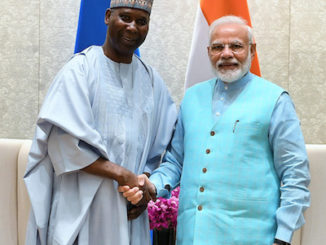
    Professor Tijjane Muhammad-Bande visited India in the first week of September this year. He called on Prime Minister Shri Narendra Modi, had discussions with External Affairs Minister Dr Subrahmanyam Jaishankar, and interacted with Indian policy makers in renewable energy, technology and sustainable development. He delivered a lecture at the prestigious Indian Council of World Affairs in New Delhi, during which he focused on the priorities ahead of him during his Presidency of the UNGA.

    Reaffirming the relevance of the UN, and focusing on eradication of poverty, quality education, inclusion and partnerships to overcome global challenges, were among his top priorities. Each of these areas will play a critical role in reaffirming the mandate of the UNGA to respond to challenges to multilateralism today. At the heart of this activity will be the need for effective international cooperation.

    India is expected to be a key partner for the new President of the UNGA in achieving progress on his priorities. As a country increasingly dependent on international cooperation for her growth (with her international trade contributing as much as 40% to her GDP), India’s national interests today are aligned with multilateralism. Her foreign policy is active on a multi-polar level, balancing the demands of India’s accelerated national development with the over-riding requirement for peace and security.

    To meet this requirement, India needs to catalyze an early conclusion to the decades-long inter-governmental negotiations in the UNGA on reforming the primary UN organ responsible for peace and security, which is the UN Security Council. The objective of the reform is to make the Security Council more equitable in decision-making, more transparent and more representative, so that it can respond more effectively to challenges to international peace and security.

    India’s decades-long experience of confronting threats to peace, security and sustainable development from cross-border terrorism drives her objective to work within the legal committee of the UNGA to make it obligatory under international law for UN member-states to either prosecute, or extradite for prosecution, alleged terrorists. This is the heart of the proposed Comprehensive Convention on International Terrorism or CCIT, which has been gridlocked in the legal negotiations of the UNGA for many years, despite India having provided a first draft of a possible CCIT in 1996. An early harvest of the CCIT also impacts on India’s reported interest in hosting a global counter-terrorism conference during the coming months.

    However, the heart of India’s engagement with the United Nations remains the creation of a responsive multilateral framework for eradicating poverty and accelerating socio-economic development for the transformation of India. She is therefore expected to provide critical support for the UNGA to operationalize the commitments made during the negotiations of Agenda 2030 on Sustainable Development, adopted unanimously by world leaders during Prime Minister Modi’s last visit to New York in September 2015. Foremost among these commitments is support for financial flows from multilateral financial institutions, and a functional technology facilitation mechanism.

    The UN Secretary General’s ambitious High-Level Report on Digital Cooperation, issued on 10 June 2019, will play an important role with respect to the use of technology for sustainable and inclusive development. With her own ambitious Digital India program for empowerment and development, India is well placed to bring the calls for increased multilateralism and international cooperation through multi-stakeholder partnerships contained in the Report into the UNGA’s preparations for the 75thanniversary Summit of the UN in September 2020.

    (The author is a former Permanent Representative of India to the United Nations , and Distinguished  Fellow, Vivekananda International Foundation)


  • Women at the UN General Assembly 2018

    Women at the UN General Assembly 2018

    Top priorities include bringing the voices of women and girls to the global forum, and solutions to advance the 2030 Agenda for Sustainable Development

    NEW YORK (TIP): The 73rd United Nations General Assembly (UNGA 73), is set to open on 18 September 2018 at the UN Secretariat in New York. Presiding over this session is Ecuadorean Foreign Minister María Fernanda Espinosa Garcés, under the theme: “Making the United Nations Relevant to All People: Global Leadership and Shared Responsibilities for Peaceful, Equitable and Sustainable Societies”. Garcés is only the fourth woman President of the UNGA in its 73 years.

    For two weeks, leaders from governments, civil society and the private sector, as well as experts, activists, celebrities and other change-makers committed to global good are gathering to discuss a range of challenges—from gender equality to addressing poverty, climate change and inclusive urbanization. The High-level General Debate is scheduled to begin on Tuesday, 25 September, and run until 1 October.

    Three years on from the adoption of the Sustainable Development Goals (SDGs), UNGA 73 is an opportunity for countries to renew their commitments to gender equality and to accelerate progress towards the SDGs. As the recent UN Women’s flagship report “Turning promises into action: Gender equality in the 2030 Agenda for Sustainable Development” shows, gender inequalities prevail in every dimension of sustainable development. In many areas, progress for women and girls remains too slow to achieve the SDGs by 2030. Women’s equality and empowerment is not only one of the SDGs (Goal 5), but also integral to all dimensions of inclusive and sustainable development.

    Throughout the session, a wide range of pressing topics for the gender equality agenda is being discussed, such as the pandemic of violence against women and girls, equal pay, gender-responsive migration policies, and the role of men and boys in advancing gender equality. A key pledging event will examine opportunities for the private sector and philanthropists to accelerate progress.

    Goodwill Ambassadors from many UN agencies are also participating in events and advocating for specific issues. UN Women’s Goodwill Ambassador Anne Hathaway is speaking at the HeForShe IMPACT Summit on 26 September, and Kristen Bell, an advocate for the Women’s Peace and Humanitarian Fund, is attending the 27 September event on Accelerating the Women’s Movement for Peace and Humanitarian Action.

    Later in the session (on 5 and 8 October), the General Assembly is paying particular attention to ending all forms of violence against women and girls, trafficking in women and girls, and female genital mutilations. Three reports (A/73/294, A/73/266, and A/73/263), prepared by UN Women and being discussed at the international gathering, aims to present best practice examples and make concrete proposals for further action to tackle the scourge of violence and sexual harassment.

    UN Women is the UN organization dedicated to gender equality and the empowerment of women. A global champion for women and girls, UN Women was established to accelerate progress on meeting their needs worldwide. For more information, visit www.unwomen.org. UN Women, 220 East 42nd Street, New York, NY 10017, New York. Tel: +1 646 781-4400. Fax: +1 646 781-4496.

  • Cross-section of people share stories of yoga transforming lives at Yoga Day event

    Cross-section of people share stories of yoga transforming lives at Yoga Day event

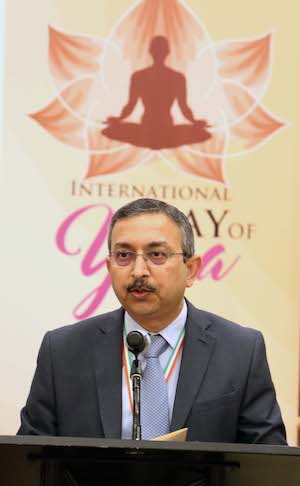
    UNITED NATIONS(TIP):  An incredible event where people from various walks of life shared their stories on how yoga transformed their lives during a session here to mark the 4th International Day of Yoga.From renowned yoga masters, a war veteran to a yoga teacher who suffered from epilepsy and later founded a yoga organization for the hearing-impaired, there were many inspiring stories on the healing power of yoga.

    India’s Permanent Mission to the UN organized a panel discussion ‘Conversation with Yoga Masters’, on the theme of ‘Yoga for Peace’ at the world body’s headquarters yesterday.

    Dr. H.R. Nagendra, Chancellor S- VYASA University speaking at Conversations with Yoga Masters for Peace at UN on 21st June
    Photos / Mohammed Jaffer-SnapsIndia

    Speakers at the event included Yoga therapist, academic, writer and Founder Chancellor of Swami Vivekananda Yoga Anusandhana Samsthana (S-VYASA) Deemed University, Bengaluru H. R. Nagendra, peace activist and author Eric Bowman, yoga teacher & founder of DeafYoga Foundation Lila Lolling, Acharya of the International Sivananda Yoga Vedanta Centre, Srinivasan, war veteran John Bennett and Founder and Virtual Reality Director at MYSTICS Madhusudan Balasubramanian.

    The event was attended by yoga practitioners, spiritual leaders, diplomats and members of civil society. Panelists shared their wisdom and experience to enrich collective understanding of how practicing Yoga can foster peace and harmony in wider society.

    Nagendra underscored the message of sharing with fellow human beings and said people should give back to “create a wonderful society.” He said yoga teaches mankind to share and give and if a person is at peace within, he will impart peace to others. “This creates harmony, love, affection between people,” he said adding that the mindset of people wanting more and more should change and they should give back to society as much as they can. “Yoga makes this possible,” he said. Calling on people to perform karma yoga and seva yoga, he said “the more you give, the more you get enriched. Whatever you receive in life, you should give more back,” he said.

    Lolling shared with the audience that she was diagnosed with epilepsy when she was 15 years old and she grew frustrated as no amount of prescription medicine or exercise helped her. “I was frustrated for years and then finally I found yoga. Yoga greatly impacted me,” she said adding that for the last 13 years she has had no seizures and she does not take any prescription. Lolling said she worked as an American Sign Language (ASL) interpreter and was inspired to reach out to the deaf community by teaching them yoga and enabling them to enjoy its mental and physical benefits.

    Lolling said no matter what type of yoga one practices, “yoga reunites us and reinspires us to connect to the essence of who we are. Who we are at the core of our being is peace.” Bennett also shared his story of how yoga helped him manage stress and find peace and harmony in any situation.

    Later, talking to PTI, Nagendra also appreciated the work done by Jaipur Foot USA and its Chairman Prem Bhandari for helping people in need. He said such service is also an embodiment of yoga and its message of giving and sharing. Appreciating Bhandari’s service through the Jaipur Foot USA organization, he said “giving free (prosthetic services) to so many people is something very unique and unparalleled. This type of service brings about peace on earth and builds harmony and love. The theme of yoga and of giving back to society is also promoted by such service.”

    (Source: PTI)

  • Taking the UNHCR report in stride

    Taking the UNHCR report in stride

    The killings of Bukhari and Aurangzeb were meant to provoke New Delhi, which decided to be seen as tough

    By KC Singh
    If India and the US let domestic politics color their approach to the protection of human rights in the 70th year of the Universal Declaration of Human Rights, it would prove that terrorism and illegal immigration have succeeded in making the two major democracies less liberal, says the author.

    The 47-member Geneva-based UN Human Right Council and the UN High Commissioner for Refugees (UNHCR) have been in focus the past week. First came an unprecedented report by the UNHCR Zeid al-Hussein on Jammu and Kashmir (J&K), Pakistan Occupied Kashmir and Gilgit Baltistan. While Pakistani knuckles were rapped mildly, the report, as conceded in its executive summary, is really about “widespread and serious human rights violations’’ in J&K from the death of militant Burhan Wani in July 2016 to April 2018.

    Under separate headings it holds India guilty on account of lack of access to justice and impunity; military courts and tribunals blocking this access, excessive use of force and pellet-guns, arbitrary arrests, including of minors, torture and enforced disappearances, and sexual violence, etc. All through, even UN-listed terror outfits are referred to as “armed groups”. A former Indian diplomat writing elsewhere calls it more akin to a report by Organisation of Islamic Conference than a UN high official. India strongly rebutted it and could have probably ignored it, except that Zeid is on record saying he would recommend to the UN Human Rights Council (UNHRC), which convened on June 18 for one of its three annual sessions, an investigation.

    Two events impinge on this development. One, Jammu and Kashmir has been placed under Governor’s rule with the BJP withdrawing from the coalition government. Two, US Ambassador to UN Nikki Haley announced, at the State Department, US withdrawal from the UNHRC, alleging lack of reform and it having become a “protector of human rights abusers and cesspool of political bias”. Both need closer examination.

    The Trump administration has been threatening to withdraw from the UNHRC for some time, but the decision came a day after Zeid slammed the US for separating children from parents on border with Mexico when apprehending illegal immigrants. The media is also reporting illegal immigrants from India, many from Punjab, held in detention centers under sub-human conditions.

    Republican Senator John McCain, terminally ill with brain cancer but combative as always, tweeted that the “administration’s current family separation policy is an affront to the decency of the American people, and contrary to the principles and values upon which our nation was founded’’. He later went on to oppose Trump’s nomination of Ronald Mortensen to lead the US refugee and migration policy, alleging he lacked empathy for people fleeing oppression. Thus, while the US is right that election to the UNHCR of nations like Venezuela and Congo (though the US omitted mentioning China) hardly makes it the custodian of global conscience on human rights, but neither does the US by its xenophobic immigration control creating gulags for apprehended illegal immigrants qualify it to lecture the council.

    The J&K imbroglio raises many similar questions about India’s trajectory in dealing with terrorism at home. The PDP-BJP alliance raised hope that their Agenda of Alliance would provide a template for resolution of the Kashmir issue. The death of Mufti Sayeed at the beginning of 2016 and a long hiatus before his daughter Mehbooba effectively took charge probably doomed the experiment, if at all had any chance to succeed.

    At the root of the problem was the Modi government’s Pakistan policy of “no dialogue” unless terror ends. On the contrary, the PDP had got elected promising dialogue with Pakistan, more political space even for separatists and improved trade and people-to-people links with Kashmiris across the Line of Control (LoC). The Pakistan army exacerbated these fault lines by keeping up support to militancy, provocatively killing Indian soldiers and turning the LoC into free-fire zone. The Governor’s rule now denies India the argument that J&K has a popularly elected government which is a guardian of people’s rights scrutinizing, if not overseeing, counter-terror operations of security forces. Pakistan, currently a member of the UNHRC, shall use the High Commissioner’s tendentious report and collapse of the alliance to pillory India in coming weeks.

    The Modi government must surely have assessed the profit-loss outcome of its decision. The domestic implications would dominate New Delhi’s thinking as the government heads into literally the last six months of effective rule before the Lok Sabha election process kicks-in. It needs to ensure that no major breakdown of security order in Kashmir occurs till election, particularly during the Amarnath pilgrimage.

    There may be information that leading to parliamentary election in Pakistan in July its army, having a freer hand than normal with a caretaker government in position, is planning to fling every last terror asset across the LoC in a make-or-break gambit. The targeted killing of moderate journalist Shujaat Bukhari and the taped torture and execution of soldier Aurangzeb were intended to provoke New Delhi. A big attack on pilgrims, as has happened in the past, could make the Union Government look extremely ineffective. Governor’s rule is the counter-move to ensure that despite the debate in Geneva on India’s human rights record the Modi government is seen as strong at home.

    If India and the US let domestic politics color their approach to the protection of human rights in the 70th year of the Universal Declaration of Human Rights, it would prove that terrorism and illegal immigration have succeeded in making the two major democracies less liberal. The latest survey by Freedom House, a US think-tank, is called “Democracy in Crisis”. Last year was the 12th consecutive year when nations suffering democratic setbacks outnumbered those gaining. According to Democracy Index of The Economist Intelligence Unit, 89 countries regressed in 2017 and only 27 improved. Globalization and technology in the West and Pakistan-sponsored terror in South Asia are derailing the quest for liberal, law-based democratic rule. If a four-year political alliance between the PDP and BJP, representing disparate views on Kashmir, cannot develop a consensus for bridging the divide, the future is indeed bleak. A fresh attempt at reconciliation seems unlikely until after parliamentary elections in Pakistan and India. Till then, geopolitical haze in South Asia will be thick as the dust that enveloped northern India a week ago.

    (The author is a former Secretary, Ministry of External Affairs, India)

  • Interview : 4th International Day of Yoga

    Interview : 4th International Day of Yoga

    The Fourth International Day of Yoga is just a few days away. Since June 21, 2015, when International Day of Yoga was first celebrated, IDY celebrations have multiplied, spreading over a couple of days. This year, with quite a few celebrations already scheduled, we will be seeing the celebrations starting as early as June 15 and going up to the end of the month. However, among all other celebrations, there are two which are official and more noteworthy. The one is organized by Permanent Mission of India at the United Nations, and, the other, by the Indian Consulate.

    The Indian Panorama Chief Editor Prof. Indrajit S Saluja spoke with Consul General of India in New York, Ambassador Sandeep Chakraborty, and Ambassador Syed Akbaruddin, Permanent representative of India to the United Nations to know from them how the historic event was planned this year.

    Here are excerpts from the interview with Ambassador Syed Akbaruddin.

     Prof: As I had requested, we want you to focus on the great event that is coming up. Congratulations to you, in the last 3 years it has become such a popular event having the whole world celebrate it at the UN. It does bring credit to you as India’s representative here and it does bring a lot of honor and respect for the country. This is the 4thone and every year the bar has been rising. So, this year the expectations are also very high. My readers would like to know what are the preparations for the event from 19 to 21stJune with regard to celebration of International Day of Yoga?

    Amb:Well the international day of Yoga as you know is perhaps the most significant effort that India has launched globally in promoting through soft power its culture and heritage. It’s an approach that started at the UN because we felt that the UN is the right platform to go global rather than do it in individual countries. We use the global platform to go global. As you said, every year the effort is to try and improve it and consolidate what we have done before. As in previous years we will have 2 events, one is the event of Yoga demonstration and another will be a conversation with the people who have benefitted from Yoga. So, there will be event on the 20thwhich will focus largely on the outside aspect of the UN where we expect more than a 1000 people to join us. They will be diplomats as well as some non- diplomats and we are working with various UN clubs as well as other organizations to get Yoga enthusiasts. And there are several Yoga masters who will also be participating in that with their supporters and those who are interested in joining in. In addition, the focus will be what we call Yoga for peace. Given today’s world where there is a lot of turbulence & violence in various parts of the world, the effort is that can Yoga contribute through its multifaceted approaches to a more peaceful world.  So, the outside event will be followed by an inside event on the 21stwhere we will have people who have benefitted from Yoga in various aspects for example, war veterans, disabled who have benefitted. Also, those who have served prison terms and how yoga has helped them reintegrate with world. So, we are trying to bring in different perspectives of people who have benefitted from yoga and how they have reintegrated with the society using Yoga as a pole along which they have constructed their lives.

    Prof: Well, very well said. But why are we so particular about spreading the message of Yoga?

    Amb: Well, Yoga is an ancient Indian heritage which has gone global because of its appeal in helping us tackle some of the most difficult issues that we have confronted. Because Yoga is not only an exercise; it is an approach to living in harmony with Nature. So, in today’s world where we have used and abused Nature in so many ways, living in harmony with Nature provides us a strong underpinning to reorient our lives. Look at the fear that we have in terms of a damage to the environment. Yoga is a philosophy of life which helps us in ensuring that man and environment are not in antagonism with each other. So, there are multifaceted benefits in terms of philosophical approach, in terms of controlling our emotions, in terms of living in harmony with Nature that Yoga helps us achieve and therefore the emphasis on promoting Yoga as a lifestyle approach in turbulent times.

    Prof: You mean that Yoga restores a balance in the health – Mental, Physical & Societal Health?

    Amb: It is one of the tools.

    Prof: And you want the world to know about this lifestyle?

    Amb:  It is a tool that helps human beings to confront the multifaceted issues that they face. .Like  various other tools are available. Meditation is a form; Anger management is one. So, there are multifaceted tools, and all must be used. In today’s world, every tool is useful in fostering harmony, fostering nonviolence, fostering peace, because we are in very turbulent times. We look around the world and we see around us a dissonance which many of us have not seen in our lifetimes. Change of such unprecedented nature is impacting on us and we need a pole that could help us stabilize in such turbulence.

    Prof:  Which means Yoga can be a very powerful business proposition also?

    Amb: Obviously, in today’s world anything to succeed, if it cannot manifest itself as a business proposition, it cannot succeed.

    Prof: Coming back to celebration of main event, is all set?

    Amb: Yes.

    Prof: Who all are coming this year?

    Amb: Dr. Nagendra from Bengaluru is coming. There will be an exhibition organized by Sehaj Yoga.

    Prof: What is your message to the readers of The Indian panorama?

    Amb: I want to invite readers of The Indian Panorama to come in large numbers to celebrate the historic day. I hope the message of Yoga is reflected from the global platform.

    Prof. How do participants get entry to the venue?

    Amb: They need to go to our website www.pminewyork.organd register.


  • India intensifies development cooperation with Commonwealth countries

    India intensifies development cooperation with Commonwealth countries

    PM launches US$50 million dedicated Commonwealth window to the India-UN Development Partnership Fund

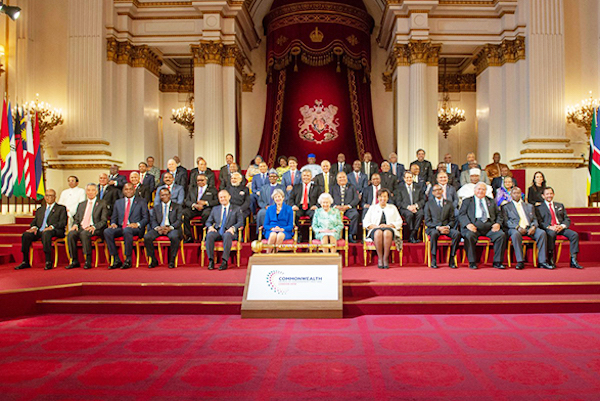
    NEW YORK(TIP): At the Commonwealth Heads of Government Meeting 2018 in London, April 19, Prime Minister of India, Narendra Modi, announced the launch of a US$50 Million Commonwealth window to the India-UN Development Partnership Fund.  This contribution is in addition to US$100 million pledged in 2017 for the India-UN Development Partnership Fund, thereby increasing India’s multi-year contribution to US$150 million. The India-UN Development Partnership Fund is managed by the United Nations Office for South-South Cooperation (UNOSSC).

    The new Commonwealth window of the India-UN Development Partnership Fund aims to catalyze the achievement of the Sustainable Development Goals (SDGs) in developing countries of the Commonwealth. The countries supported by this fund are located in various parts of the world and include some of the most vulnerable Member States of the Commonwealth.

    Grenada, Tuvalu, and Vanuatu are the first three development partners engaged under this newly created Commonwealth window.

    The India-UN Development Partnership Fund Commonwealth window supports demand-driven, country-owned, and concrete initiatives that focus on the implementation of 17 SDGs.

    The establishment of the Fund and the dedicated Commonwealth window has been widely welcomed. Ms. Amina Mohammed, Deputy Secretary of the United Nations stated, “South-South cooperation is one of the world’s most important pathways to prosperity. I am therefore delighted that India is demonstrating such strong leadership to helping others through the India-UN Development Partnership Fund. India’s commitment is also timely, as the world strives to advance the 2030 Agenda for Sustainable Development. India’s focus on multilateral action generates genuine hope that we can build a world where no one is left behind.”

    Ms. Fekita Utoikaman, United Nations Under-Secretary General and the Secretary-General’s High Representative for the Least Developed Countries, Landlocked Developing Countries and Small Island Developing States stated, “India’s leadership and dedication to improve the living conditions of people living in the countries that are most affected by poverty, hunger, and impacts of climate change, bring us closer to achieving the ambitious Sustainable Development Goals. I am pleased to work together with India in advancing sustainable solutions in the countries of the Global south and in enhancing the opportunities for a prosperous and sustainable future for all.”

    Ambassador Syed Akbaruddin, Permanent Representative of India to the United Nations stated, “The establishment of a dedicated Commonwealth window of the India-UN Development Partnership Fund is a unique model of South-South Development Cooperation. The Commonwealth membership is built on a shared past, respect for common values, broadly similar government structures, and institutions.  We are, therefore, excited to initiate this partnership to contribute to our collective efforts to implement Sustainable Development Goals.”

    “Over the past two decades, India has made huge economic strides and lifted millions out of poverty,” said UNDP Administrator, Mr. Achim Steiner. “It has shown itself again to be a leader in South-South cooperation with this new opportunity to support vulnerable countries in the Commonwealth achieve the Sustainable Development Goals and fulfill the central promise of Agenda 2030 to leave no one behind.”

    “The Commonwealth Window of India-UN Development Fund is an admirable example of South-South cooperation,” said Mr. Jorge Chediek, Envoy of the Secretary-General on South-South Cooperation, and Director, UNOSSC. “UNOSSC is pleased and gratified to collaborate with the Government of India in bringing this initiative to fruition.”