Tag: UNICEF

  • Death toll from Pakistan floods reaches 1,186

    Death toll from Pakistan floods reaches 1,186

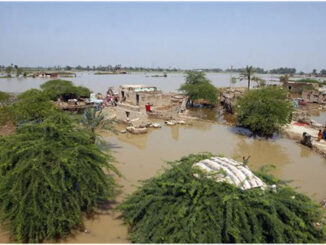
    Islamabad  (TIP): The death toll from flash floods triggered by record monsoon rains across much of Pakistan reached 1,186 on September 1, as authorities scrambled to provide relief materials to tens of thousands of affected people. Record monsoon rains in the last three decades triggered floods which inundated one third of the country, including most of Balochistan and Sindh provinces.

    “So far 1,186 people have died and 4,896 injured while 5,063 kms of roads damaged, 1,172,549 houses partially or completely destroyed and 733,488 livestock killed,” said the National Disaster Management Authority (NDMA), the main body dealing with calamities.

    On Thursday, the army said that some 50,000 people have been evacuated since rescue efforts began.

    Foreign Office spokesperson AsimIftikhar Ahmed said that more than 33 million people have been affected due to “colossal scale of devastation”.

    During a media briefing here, he said Pakistan mounted coordinated rescue and relief operations mobilising all possible resources but the sheer scale of the calamity “stretched our resources and capacities to the limit, thus necessitating support from the international community”.

    The cash-strapped Pakistan government on Tuesday teamed up with the United Nations to issue a flash appeal for USD 160 million to deal with the disaster in the country that has become the “ground zero” of global warming.

    “The Flash Appeal launch was well attended by Member States both in Islamabad and Geneva, Heads of UN agencies in Pakistan, representatives of international organizations, among others. Participants offered condolences and expressions of solidarity, and assured continued support for Pakistan,” the spokesman said.

    He also said that Pakistan faced a “climate-induced calamity” because the monsoons were not ordinary, “as the UNSG termed them ‘monsoons on steroid’.” UN Secretary-General Antonio Guterres will be visiting Pakistan on September 9-10 on an important visit to “express solidarity and international community’s support for Pakistan at this difficult time,” he said.

    Talking about the outpouring of relief supplies, he said till last night, Pakistan received flood relief goods through 21 flights notably from Turkey, UAE and China.

    He said a large number of countries and international organisations pledged to support and are extending cash or in-kind assistance including Australia, Azerbaijan, Canada, China, EU, France, Iran, Japan, Kazakhstan, Kuwait, New Zealand, Norway, Palestine, Qatar, South Korea, Saudi Arabia, Singapore, Turkiye, the UAE, United Kingdom, the United States, Uzbekistan, along with various international organisations including World Bank, Asian Development Bank and other UN Agencies. He said Pakistan on Wednesday signed the Green Framework Engagement Agreement with Denmark in Copenhagen, which marks the first step in creating stronger collaboration in areas such as climate change mitigation and adaptation, and a just and sustainable green transition.

    Separately, Prime Minister Shehbaz Sharif while addressing lawmakers of his Pakistan Muslim League-Nawaz asked them to visit the flood victims with relief goods. The prime minister said that he had never seen such a calamity before. “Water has wreaked havoc everywhere,” he said.

    He also asked Finance Minister Miftah Ismail to devise a plan to give relief to the flood-affected people with electricity bills. Army chief General Qamar JavedBajwa visited the Rohjan area of Punjab and met flood victims whom he assured that the Pakistan Army will help them to overcome their problems in these difficult times, the army said.

    He also directed ground troops to “take this responsibility as a noble cause and spare no effort to lessen the burden of flood-affected brothers and sisters”.

    Advisor to the Prime Minister on Kashmir and Gilgit-Baltistan Affairs Qamar Zaman Kaira said that Prime Minister Sharif would visit Gilgit-Baltistan on Friday and announce a relief package for the flood victims.

    Separately, the United Nations International Children’s Emergency Fund (Unicef) said in a statement that more than three million children were in need of humanitarian assistance in Pakistan and at increased risk of waterborne diseases, drowning and malnutrition due to flooding.

    “These floods have already taken a devastating toll on children and families, and the situation could become even worse,” the statement quoted Unicef representative in Pakistan Abdullah Fadil as saying.

    To add to worries, the Pakistan Meteorological Department (PMD) has forecast more rain in September, saying that La Nina conditions — responsible for recent spells of flood-triggering deluge in the country — would persist in September but become less intense.

    “Tendency for normal to above normal precipitation is likely over the country during September,” the Met Office said, predicting above-normal rainfall in northeastern Punjab and Sindh. (PTI)

  • Indian American policy advisor Gautam Raghav elevatedto key White House position

    Indian American policy advisor Gautam Raghav elevatedto key White House position

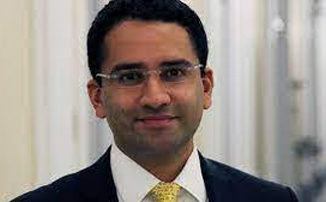
    WASHINGTON, D.C. (TIP): US President Joe Biden has elevated Indian-American political advisor Gautam Raghavan as the head of the White House Office of Presidential Personnel.

    White House Presidential Personnel Office (PPO), also written as Office of Presidential Personnel, is the White House office tasked with vetting new appointees. The PPO is one of the offices most responsible for assessing candidates to work at or for the White House. President Biden on Friday elevated Raghavan, who was currently posted as the PPO Deputy Director, to the key White House post after UN Secretary-General Antonio Guterres announced his intent to appoint Cathy Russell as the next executive director of UNICEF. Russell is currently the head of WH PPO. Under Cathy’s leadership, the PPO has broken records in both speed and diversity of hiring, working relentlessly to ensure that our federal government reflects America and delivers for the American people, Biden said. “I am also pleased that Gautam Raghavan, who has worked in tandem with Cathy from Day One, will become PPO’s new director — a seamless transition that will enable us to continue building a federal workforce that is efficient, effective, dependable and diverse,” he said in a statement.

    A first-generation immigrant, Raghavan was born in India, raised in Seattle and graduated from Stanford University. He is the editor of the book ‘West Wingers: Stories from the Dream Chasers, Change Makers, and Hope Creators Inside the Obama White House’.

    Raghavan, in his 40s, is openly gay. He lives with his husband and their daughter in Washington, DC.

    Raghavan has served as deputy assistant to the President and deputy director of the White House Office of Presidential Personnel since January 20, 2020. Previously, he was the first employee hired by the Biden-Harris transition team where he served as deputy head of Presidential Appointments.

  • Shortfall of 190 million doses by June as Covid surge in India affected supply: Covax

    Shortfall of 190 million doses by June as Covid surge in India affected supply: Covax

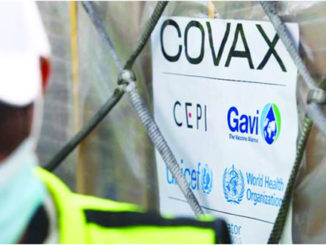
    United Nations (TIP): The “terrible” surge of the coronavirus cases in India has severely impacted Covax’s vaccine supply in the second quarter of this year to the extent that there will be a shortfall of 190 million doses by the end of June, according to a joint statement by the WHO, UNICEF, GAVI and CEPI. The joint statement was issued on Thursday by Coalition for Epidemic Preparedness Innovations (CEPI) CEO Dr Richard Hatchett, Gavi, Vaccine Alliance CEO Dr Seth Berkley, World Health Organisation (WHO) Director-General Dr Tedros Adhanom Ghebreyesus and UNICEF Executive Director Henrietta Fore.

    “Countries that are advanced in their vaccination programmes are seeing cases of Covid decline, hospitalisations decrease and early signs of some kind of normality resume. However, the global picture is far more concerning,” the statement said.

    Giving a call to action to equip Covax to deliver 2 billion doses in 2021, the statement said, “We are seeing the traumatic effects of the terrible surge of Covid in South Asia – a surge which has also severely impacted global vaccine supplies.”

    It added that Covax has proven it works as the global mechanism for equitable access to Covid vaccines, having delivered over 70 million doses to 126 countries and economies around the world since February – from remote islands to conflict settings – managing the largest and most complex rollout of vaccines in history. Over 35 countries received their first Covid vaccine doses thanks to Covax.

    “However, the terrible surge of the virus in India has had a severe impact on Covax’s supply in the second quarter of this year, to the point where, by the end of June we will face a shortfall of 190 million doses,” the joint statement said.

    It said even though Covax will have larger volumes available later in the year through the deals it has already secured with several manufacturers, it warned that “if we do not address the current, urgent shortfall, the consequences could be catastrophic.”

    It said the pandemic has just taken a frightening new turn, as a deadly surge of cases rages across South Asia and other hotspots.

    The global agencies called on nations to share doses “now”, saying the United States and Europe have collectively pledged to share 180 million doses.

    Govt expects speedy India launch of single-dose Sputnik Light

    The government is hopeful of a speedy launch of single-dose Covid-19 vaccine Sputnik Light in India and all stakeholders, including the Russian manufacturer and its Indian partners, have been directed to fast-track the application and regulatory approval procedures for the jab to boost the country’s vaccination drive.

    An application seeking regulatory approval for Sputnik Light is expected to be filed in the next couple of weeks and it could become the first single-dose vaccine to be launched in India, sources said citing high-level discussions held among top government officials in the recent days to boost domestic availability of Covid-19 vaccines.          Source: PTI

  • “The UN: if it doesn’t exist, we would have to invent it”

    “The UN: if it doesn’t exist, we would have to invent it”

    By George Abraham

    Here is a special article on the occasion of the diamond jubilee of the United Nations. The United Nations officially came into existence on 24th October 1945 when the Charter was ratified by China, France, the Soviet Union, the United Kingdom, the United States of America , and a majority of other signatories.

    George Abraham who has had a long association with the United Nations underscores the relevance of the world body  in the past, in the present, and in the future. -EDITOR

    Today, thousands of Indian citizens are employed by the United Nations around the world. The Asian Headquarters for the World Health Organization is located in New Delhi. UNICEF is highly active in India, helping Children in responding to emergencies and providing them essentials to survive. India’s own contribution to the regular budget assessment is less than half of what the Netherlands pays. Therefore, all the casual talk about getting out of the UN from certain circles are not only ludicrous but a disservice to the people of India.

    Peace, dignity and equality on a healthy planet.
    The San Francisco Conference: Egypt signs the UN Charter. A facsimile copy of the Charter is superimposed on the photo. The Charter of the United Nations was signed on 26 June 1945, in San Francisco, at the conclusion of the United Nations Conference on International Organization, and came into force on 24 October 1945. Preamble to the UN Charter was read out by Sir Lawrence Olivier. Photo / Courtesy UN

    “The International Community must ask if the UN is still relevant 75 years after its founding”, said Prime Minister Narendra Modi addressing the General Assembly in a virtual conference in its 75th session. He demanded that a UN reform is the need of the hour and questioned whether the Organization has been effective in tackling Covid-19. Some commentators even went further to say that India should get out of the UN, and it no longer serves any purpose. Sir Brian Urquhart, a former Under-Secretary-General of the United Nations with special responsibility for peacekeeping operations, once quoted as saying, “to be called irrelevant is, I suppose, the most biting insult you can possibly give to anything, a person or an institution, and it’s been used quite a bit about the UN. But it is still here. And for better or worse, I think that its demise is somewhat unlikely, certainly in the near future”.

    It again shows the United Nations’ predicament, where it is a challenging job to get everybody to agree on any single issue. If we look back at history, the United Nations was founded in 1945 to save the succeeding generations from the scourge of another war just as the world was emerging out of World war II. It is also important to remember that the UN Charter and the UN’s whole concept was the brainchild of Franklin D. Roosevelt. The assumption then was that the Allies who were on the way to victory then would continue to observe the peace and, if necessary, enforce it.

    The World war has led to the cold war between the United States and the Soviet Union, resulting in proxies fighting all over the globe. However, the United Nations may still take consolation because it has succeeded in thwarting a large-scale war between nuclear-armed superpowers. Moreover, in the Cold war era, peacekeeping became a strategic tool in the UN’s hands in containing regional conflicts in places like the Middle East, Kashmir, Cyprus, Congo, Sudan, and so forth.

    The critics are often eager to paint a negative view of the UN primarily because of its failures on the political front. However, if one closely examines the structure of the Security Council, the most important organ of the United Nations, it still reflects the status quo in the immediate aftermath of World War II.  It is almost as if it was built to fail. All permanent members of the Security Council have one time, or another misused their right to veto in preventing a potential solution to a crisis and often leaving the UN remain largely paralyzed with expanding rifts and mounting tensions. Although the challenge is to shake up the Council’s structure, most governments continue to pay lip service to the need for reform, and the public seems to direct their fire and fury at the Organization.

    There is great merit to the argument that Security Council is woefully ill-prepared to deal with the contemporary challenges, and the chamber should accommodate countries like India, Germany, Japan, and Brazil with or without veto powers. However, it is a tall order that would require two-thirds of the votes in the General Assembly and the endorsement of all five permanent members. The growing ideological division among council members in dealing with sanction regimes or protracted regional conflicts may not give any ray of hope that the status-quo may change anytime soon. Nevertheless, it provides an excellent forum for the global community to air their grievances and let off steam.

    Apart from the political front, the United Nations and its Specialized Agencies have done a phenomenal job, especially in the Social and Economic arena. Having worked for the Organization on two different continents, I have had the opportunity to view the UN activities from a front-row seat. UN personnel have been directly involved as advisors and technical experts in many projects in many developing countries, especially in Africa. I have witnessed some of those valuable contributions from dedicated civil servants around the world, often under very trying conditions, working with the local officials, whether in the areas of food security, land use planning, deforestation, water, sanitation, or preventive medicine.  Of course, these efforts may not make headlines anywhere but have made an incredible difference in the daily lives of those ordinary folks who live in some of the remotest parts of the world.

    India played a seminal role in the early history of the United Nations. Although not part of the Security Council, India focused its attention on the General Assembly and worked with the newly independent nations in Asia and Africa on decolonization and socio-economic development. India may have a lot to do with the Organization’s evolution from a security-driven one to a developmental and promotional body.

    India was also one of the leaders that led the campaign against Apartheid resulting in the General Assembly adopting a resolution against racial discrimination in South Africa. Sanctions were also imposed on South Africa and Rhodesia (now, Zimbabwe) as part of the continuing opposition to Apartheid, and India played a significant role in that effort. India was also at the forefront in advocating reforms for the global economic order and was instrumental in setting up the UNCTAD to provide developmental assistance to developing countries.

    India is a major contributor to the UN’s peacekeeping efforts across the globe. As per the 2019 data, it has provided about 240,000 personnel in 49 of the 71 peacekeeping operations. Currently, Indian Military personnel is participating in 9 out of 14 peacekeeping missions. More than 160 Indian peacekeepers have paid the ultimate price in service to peace, losing lives serving under the UN flag.

    UN  is also known for its work on behalf of democracy and human rights.  With so much pride, India can remember that it has contributed significantly to the Universal Declaration of Human Rights content. Indian leadership – represented by Indian National Congress – articulated its concern for human rights and called upon the world body to learn from the coalescing of ideas and vision learned from India’s freedom struggle and urged for peoples’ self-determination everywhere.

    India truly deserves to be in the Security Council, given the demographics and its rising economic might. However, it is worth remembering that India has influenced and changed the UN’s trajectory from a security organ to a developmental body and has been a trailblazer for emerging nations towards a path forward in freedom and self-sufficiency. It was all done without having a seat at the Security Council.

    Today, thousands of Indian citizens are employed by the United Nations around the world. The Asian Headquarters for the World Health Organization is located in New Delhi. UNICEF is highly active in India, helping Children in responding to emergencies and providing them essentials to survive. India’s own contribution to the regular budget assessment is less than half of what the Netherlands pays. Therefore, all the casual talk about getting out of the UN from certain circles are not only ludicrous but a disservice to the people of India. “The UN: if it doesn’t exist, we would have to invent it.”

     (The author is a former Chief Technology Officer of the United Nations)

  • PRIYANKA TO ATTEND UNICEF GALA IN SA

    PRIYANKA TO ATTEND UNICEF GALA IN SA

    Actress Priyanka Chopra will attend a UNICEF’s gala fundraising event to highlight the challenges faced by children affected by violence here this week.

    The May 6, inaugural event plans to bring together some of the biggest names from across the globe to leverage their support to enhance care and protection of children affected due to violence, abuse, neglect and exploitation.

    Priyanka, 34, served as a UNICEF national Ambassador in India for nearly ten years and was recently appointed a UNICEF Goodwill Ambassador.

    “The visit of UNICEF’s Goodwill Ambassador Priyanka Chopra to South Africa will highlight the challenges faced by children affected by violence. Her visit is providing UNICEF with a unique opportunity to profile our mandate and values that guide our daily work for every child in South Africa,” a statement from UNICEF read.

    It will also feature a fashion show by the country’s most renowned Indian-origin designer Gavin Rajah.

    There will be a live auction as well, funds raised from which will go towards the child protection programmes of UNICEF South Africa.

    Source: PTI

  • Priyanka Chopra named UNICEF Global Goodwill Ambassador

    Priyanka Chopra named UNICEF Global Goodwill Ambassador

    NEW YORK (TIP): Priyanka Chopra was appointed as UNICEF global Goodwill Ambassador at UNICEF’s 70th Anniversary celebration at the United Nations headquarters in New York, December 11. The ‘#Quantico’ actress celebrated her appointment alongside Ambassadors David Beckham and Orlando Bloom. The actress has served with the United Nations International Children’s Emergency Fund in India, where she has been a longtime girls’ rights advocate.

    The 'Quantico' actress poses with David Beckham at the United Nations headquarters in New York
    The ‘Quantico’ actress poses with David Beckham at the United Nations headquarters in New York

    “My involvement with UNICEF began almost 10 years ago in India. Today, I stand here humbled, enriched and committed, because of it. Thank you, UNICEF, for the amazing journey so far as well as this huge honor. Along this decade old journey, with UNICEF, I have been on many field trips to villages and centers across India. On those trips, I spent time with numerous young girls and their families and experienced firsthand the transformative power of empowering young girls with opportunities that are rightfully theirs”, said Priyanka.

    The actress also took to Twitter to express her joy. She wrote, “Can’t believe it’s been 10 years! Honored to now serve as UNICEF Global Goodwill Ambassador along with this amazing group For Every Child.”

  • Blockade has left quake-hit Nepal in dire straits

    Blockade has left quake-hit Nepal in dire straits

    KATHMANDU (TIP): Large white tents and tin shacks scatter the hills near Kathmandu. They house some of the thousands who lost their homes in the devastating earthquake in April -and are the most visible sign of lagging recovery efforts.

    Those efforts have slowed even further recently . For the past two months, Nepal’s southern ethnic minority , the Madhesi, has been barring the entry of trucks of fuel and essential goods from India as part of protests demanding greater rights under Nepal’s new constitution. The blockade has left this Himalayan-locked country with shortages of fuel and cooking gas, medicines, and increasingly , basic relief supplies like tents and blankets -even as winter approaches.

    “It’s been one thing after another (holding up relief). First the monsoon, then the holiday season, and now the fuel blockade,” said Bhushan Tuladhar, a regional technical advisor to UN-Habitat, whose sanitation programme in quakehit areas has been affected by shortages in construction material. If the crisis continues, warned Oxfam, Unicef and other relief groups recently, relief could grind to a complete halt. Quake relief aside, fuel shortages have affected every aspect of daily life.

    Kathmandu has become a city of queues -mile-long lines for petrol and diesel, winding snakes for LPG cylinders.Commuting is a challenge: Public buses are overcrowded, taxi prices have shot up and many schools have shut. A black market in petrol is flourishing, and is the main reason you still see private vehicles on the road. One journalist told me that her family lives near the border and drives over into India to get fuel. A young pharmacist at Sumeru Hospital in Lalitpur said he pays `250 for a litre of petrol, three times the gas station price.

    Like other hospitals, Sumeru is running low on injectable antibiotics and lifesaving drugs. “If this continues, we’re going to be in real trouble,” the pharmacist said. Tourism, an economic mainstay, has also been hit. At Club Himalaya, a resort in Nagarkot, a hill station one hour from Kathmandu, many rooms are empty .

    The resort manager blamed higher transport prices and fewer vehicles plying. In Kathmandu, the government is selling discounted firewood for cooking but that doesn’t help apartment-dwellers or small cafes.At a tiny eatery in the Patan area, dishes disappear from the menu every day . Noodles are difficult to procure so no more noodle dishes. A cup of tea costs five rupees more now -sugar prices are up, said owner Mahesh Panday .

    A few other eateries display “no gas” menus and one institutional canteen even labels theirs the “The Modi Menu”-a reflection of how much Nepalis blame India for the crisis.

    The Indian government supports the demands of the Madhesis, who are culturally tied to India, for greater rights and representation. But Indian officials have denied helping the blockade. No body here believes that; Nepal PM K P Sharma Oli even described India’s role as “more inhumane than a war”.

    Remarkably , Indians still encounter little hostility or anger on the ground. One local journalist asks what regular Indians think of the situation: I don’t tell him that most are oblivious to the crisis in relations with one of their closest neighbours -a crisis that comes just a few months after India earned enormous goodwill for its help in post-quake rescue and relief.

    “Relations between India and Nepal were at such a high (after the quake)… all that is lost,” Swarnim Wagle, a recent member of the National Planning Commission, told me.”Nepali people just cannot reconcile such generosity then with the level of interference today .” Still, he blamed both governments for botching up, and downplayed Nepal’s turn to China for fuel and emergency supplies. “There is feeling that we need to wean away from excessive dependence on India,” Wagle said. Yet “there’s no option but to salvage the India-Nepal relationship,” he added. “We have a shared future.”

  • 11-year-old Indian student to represent UAE at World Education Games

    11-year-old Indian student to represent UAE at World Education Games

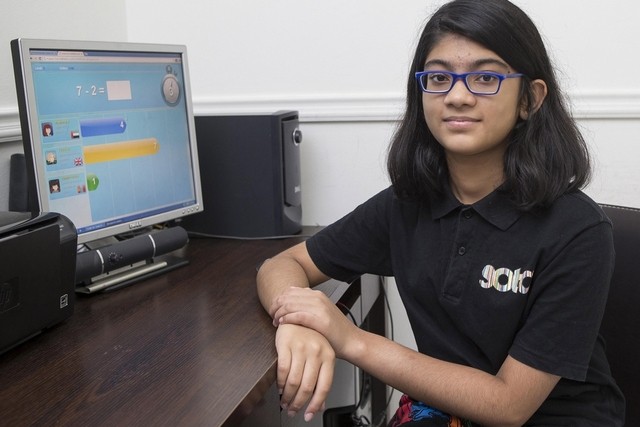
    A Dubai-based Indian student will represent the United Arab Emirates (UAE) in the World Education Games (WEG) – a contest in literacy, math and science, a media report said.

    Maathangi Anirudh, 11, from the Millennium School, Dubai, is one of the very few ambassadors who have been chosen to represent UAE and the Middle East at WEG – a two-day gaming contest which will kick-off on October 13.

    Maathangi will pit her skills against five million pupils from 200 other countries and regions this week in the World Education Games (Weg) – described as the largest online education competition. She is encouraging other children to participate in a global maths, literacy and science competition to help provide education to the less fortunate.

    President of Arts and Culture of Dubai-based youth group Students for the Earth – involved in humanitarian and environmental activities, Maathangi supports the cause of “learning” and “education for all”, Emirates 24|7 News reported on Friday.

    Earlier this year, she organised an old book collection drive and gifted 900 books to Dubai Public Library. She has also been recognised as the Expo 2020 Dubai Youth Ambassador.

    WEG was established in 2007 and is an online game contest. It currently has nearly 6 million students participating worldwide.

    It has started practice sessions on October 1 and will run until October 12. Students aged 4-18 are eligible to participate for free.

    The first 20 games of the total 50 games will be marked.

    The WEG supports Unicef’s initiative “School in a Box” where points earned by students will be given to the organisation in the form of school supplies.

    The supplies will then be donated to needy schools and students in different parts of the world, the report said.

  • Yuvraj Singh ties up with Delhi Daredevils for cancer awareness

    Yuvraj Singh ties up with Delhi Daredevils for cancer awareness

    NEW DELHI: Delhi Daredevils’ biggest star Yuvraj Singh on Tuesday announced a tie-up with his IPL franchise to promote awareness about fighting Cancer and the May 1 match against Kings XI Punjab will be dedicated to those who are fighting the dreaded disease.

    Yuvraj’s cancer foundation ‘YouWeCan’ in alliance with Delhi Daredevils and Max Hospitals announced free cancer detection clinics on May 1.

    Similarly the Delhi Daredevils players will be wearing lavender colour jerseys on that particular day.

    “When I came back after recovering from cancer (rare germ cell disease), I struggled a bit with my lung capacity. When I successfully came back, I knew that battle to fight cancer comes from within. For me, more than responsibility, it is a duty. I have been fortunate to come out of it and it is my endeavour to inspire people to fight the battle,” Yuvraj said at the launch of new-look lavender jersey.

    Delhi Daredevils CEO Hemant Dua said that around 100 children, who are fighting cancer will be watching the IPL match live from the Feroze Shah Kotla stands.

    “Delhi Daredevils has been part of various initiatives under the aegis of DD Care. We have had tie-ups with Unicef. Yuvi’s fight against cancer is an inspirational story and we thought why not use the platform to spread awareness. For that particular match, our jersey colour will change from blue to lavender,” Dua told the mediapersons.

  • Pakistan remains neutral in Yemen fight

    Pakistan remains neutral in Yemen fight

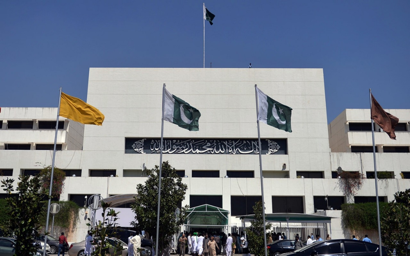
    Pakistan’s parliament on Friday voted against joining the Saudi-led coalition of Sunni-majority Arab states launching airstrikes against Iranian-backed Shia rebels in Yemen, dashing Riyadh’s hopes for support from outside the region in its fight to halt the fighters’ advance.

    Saudi Arabia had asked Pakistan, a fellow Sunni-majority country, to provide ships, aircraft and troops for the campaign, now in its third week. Instead, Pakistan adopted a resolution calling on all sides to resolve their differences peacefully.

    “[Parliament] desires that Pakistan should maintain neutrality in the Yemen conflict so as to be able to play a proactive diplomatic role to end the crisis,” the resolution states, while expressing “unequivocal support for the kingdom of Saudi Arabia” and promising to “stand shoulder to shoulder with Saudi Arabia and its people” if Saudi territory is violated.

    The Saudi-led coalition launched its military campaign against the rebels, dubbed Houthis after their late leader Hussein Badreddin al-Houthi, on March 26 after they advanced from the capital, Sanaa, which they seized in September, toward the southern port city of Aden.

    Saudi Arabia is concerned that the violence could spill over the border it shares with Yemen and is also worried about the growing influence of Iran, which has denied Saudi allegations it has provided direct military support to the Houthis. Many analysts fear the conflict is quickly spiraling out of control into an all-out regional proxy war.

    Iran’s Supreme Leader Ayatollah Ali Khamenei has called the Saudi-led coalition’s involvement in Yemen “genocide” and said that a diplomatic solution was needed to resolve the crisis.

    ‘Catastrophic’ situation

    Coalition missiles rained down on Yemen for a 16th straight day on Friday, targeting weapons depots used by soldiers loyal to former President Ali Abdullah Saleh, a powerful supporter of the Houthis.

    He is still influential in the military — despite giving up power in 2012 after mass protests against his rule — complicating efforts to stabilize the country.

    Troops loyal to Saleh are backing the Houthi rebels in their fight against his successor, President Abd Rabbu Mansour Hadi, a former general seen by the Shia fighters as a pawn of Sunni-majority Gulf Arab monarchies and the West. Hadi has fled to Saudi Arabia.

    In Aden, residents said electricity and water have been cut in several districts, trash has been left uncollected and hospitals have been unable to cope with the influx of wounded fighters and civilians.

    “The humanitarian situation in Aden is catastrophic and disastrous, both in terms of the rising number of killed and injured as well as in declining capabilities of medics, along with shortages in water and electricity,” said Al-Khadr Lawsar, a local Health Ministry official.

    “We call on fighters to adhere to international law and respect the work of ambulances and medical staff in the field,” he added, citing the fatal shooting of two brothers working for the Red Crescent while evacuating the wounded last week.

    Aden residents reported heavy explosions from coalition airstrikes and naval bombardment on Houthi positions, which shook windows throughout the city.

    An Indian ship captain working in Aden was killed in shelling on the city’s dockyard overnight, his company announced, and local news outlets reported that Houthi and allied army units fired mortars into the area.

    An airstrike hit a local government compound in the northern suburb of Dar Saad, and fires in Aden’s outskirts sent plumes of smoke into the air.

    Two planes carrying emergency medical aid landed in Sanaa on Friday, the first deliveries from international aid groups since the heavy fighting began. They were brought in by the International Committee of the Red Cross and UNICEF, which had been trying for weeks to gain access to the country.


  • Global Citizen Forum Launches New York Chapter

    Global Citizen Forum Launches New York Chapter

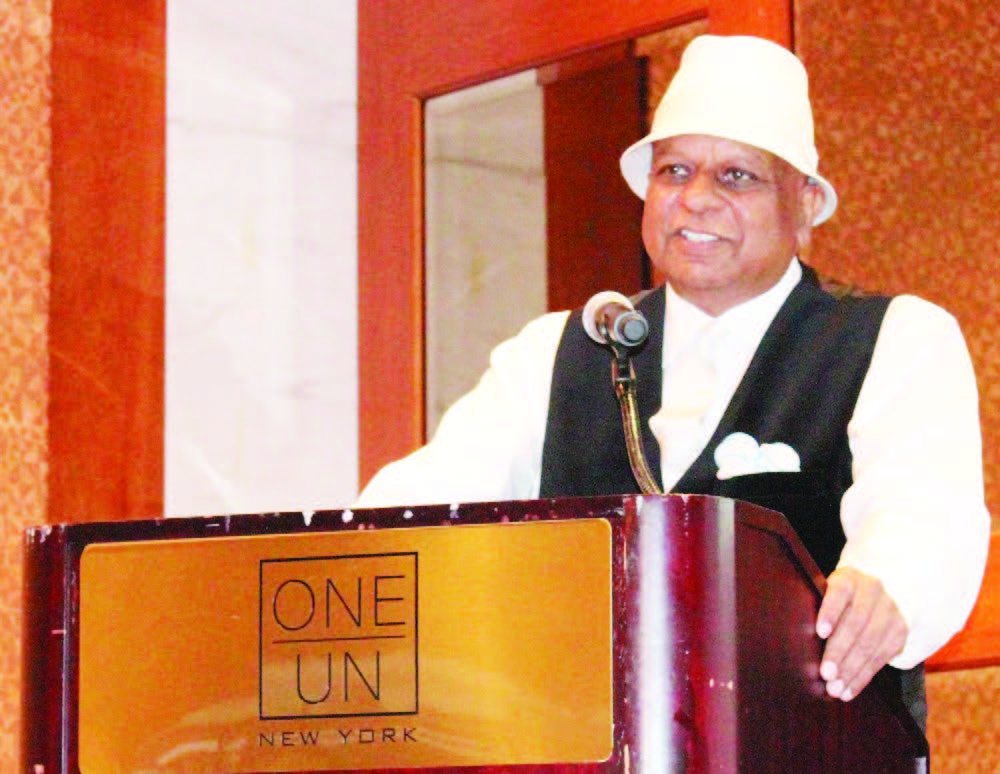
    NEW YORK (TIP): The Global Citizen Forum, New York branch was launched here on August 23. Addressing prominent members of the Indian-American community and representatives of some American think-tanks at the launch, at the UN New York Millennium Hotel, the founder and chairman of the GCF, Indian industrialist Bhupendra Kumar Modi said that the world today is not defined by countries, but by cities and metropolises, thereby heralding a big change in the world order.

    Modi talked about laying the foundation of a new world order under India’s leadership, and promoting understanding between India, China and the U.S., under the leadership of India’s Prime Minister Narendra Modi. The world has changed rapidly in the past decade, and so have the people of India, Modi, said. “There is not a single city in the world where there is no ‘Little India,” he said, noting how the Diaspora has made its presence in every part of the world.


    15
    Bhishma Agnihotri, former Ambassador at Large, Government of India, in his keynote address congratulated B.K. Modi for taking the age old Indian message of “Vasudhaiva Kutumbakam”- the whole world is a family – to every nook and corner of the world. He also said India had now an opportunity to be the world leader under Prime Minister Narendra Modi.


    It was with this growing change in mind that Modi founded the GCF in January 2013 to create a world without boundaries. Modi, lived in New York City from 1999 to 2004, before moving to California and then to Singapore and is currently based in New Delhi. Modi is also the chairman of Spice Global, an Indian conglomerate headquartered in Singapore as well as the council and chairman of Asia Crime Prevention Foundation’s India chapter. He was appointed by the United Nations as the coordinator for the Indian subcontinent for the Millennium World Peace Summit. Modi became a citizen of Singapore in 2012 and ranks 23rd in the Forbes list of Singapore’s richest people.


    16
    A view of the gathering at the launch of Global Citizen Forum in New York on August 23, 2014.


    On Feb. 17, 2004, the U.S. House of Representatives issued a proclamation in appreciation of Modi’s efforts to promote deeper understanding between the two countries and congratulated him on his innovations and humanitarian efforts worldwide. Author of many books, including “One God, Hinduism – The Universal Truth” and “Performance – A Manager’s Challenge and Whispers of Peace”, Modi is essentially a man of ideas and vision. On the idea of establishing the forum, Modi said, one of the main reasons was to make sure that humanity remains the number one priority of people around the world.

    “Over the years one has seen a change in the business and spiritual leadership”, Modi said, adding that what is lacking is political change. “One first needs to be a global citizen and then a citizen of his or her respective country he said. “How many take the world as a family,” he questioned. Elaborating on the concept of ‘one world,” Modi told the gathering that India, under the leadership of Narendra Modi, could be the answer to bring the world closer. Narendra Modi has taken Indian psyche, and is bringing changes according to that and is seen as a man of wisdom and has thus raised hopes for a global change, Modi said.

    The philosophy of a global India, Modi said, is based on Gautama Buddha’s teachings, which expounded the virtues of compassion and giving. “When you give [something] to somebody, you receive more happiness than the man who receives it,” Modi said. While striving for being a global citizen, one should not forget the “poorest people” in the world, and should find ways in connecting with them, he warned. “Wisdom to see world as one, courage to go to any part of the world and live there, and compassion”are the three main qualities of a global citizen, he said. A film on Gautam Buddha was screened.

    It depicted Buddha’s disillusionment with princely life and his search for enlightenment. The Creative Producer of the film which is telecast in episodes on a TV channel in India, Ms. Ridwana was also present on the occasion and spoke with the media about the making of the film. Some more notable guests at the event included Bhishma Agnihotri, former Ambassador at Large, Government of India, who was the keynote speaker, and Swami Chidananda Saraswati, president and spiritual head of the Parmarth Niketan Ashram in Rishikesh, India, and co-founder of the Global Interfaith WASH Alliance (GIWA) at the UNICEF Headquarters at the United Nations.

  • GOPIO-CT HONORS FIVE INDIAN AMERICAN ACHIEVERS AND CONGRESSMAN JIM HIMES AS FRIEND OF INDIA

    GOPIO-CT HONORS FIVE INDIAN AMERICAN ACHIEVERS AND CONGRESSMAN JIM HIMES AS FRIEND OF INDIA

    GOPIO-CT honors 5 Indian American achievers

    Congressman Jim Himes is honored as Friend of India

    STAMFORD (TIP): The Connecticut Chapter of the Global Organization of People of Indian Origin (GOPIO) honored five Indian American achievers and those who provide service to the community or the society at large. Several dignitaries attended the event including India’s Consul General in New York Dnyaneshwar Mulay, Rep Jim Himes (D, CT 4th District), Stamford Mayor David Martin, Norwalk Mayor Harry Rilling, New Jersey State Assembly Speaker Upendra Chivukula and Connecticut Assemblyman Dr. Prasad Srinivasan.

    The program started with a welcome by GOPIO-CT President Shelly Nichani who said the chapter initiated several new programs including a cancer walk fundraiser, participation in the Thanksgiving Day Parade in Stamford, interactive session with elected officials in addition to the regular program such as sponsoring and volunteering in soup kitchens, India Independence Day flag hoisting and Diwali. Stamford Mayor David Martin extended a warm welcome to everyone and complimented GOPIO-CT for its outstanding community work.

    This year, GOPIO-CT had selected U.S. Representative from Connecticut 4th District Congressman Jim Himes as Friend of India. A member of India Caucus, Jim has been a supporter of Indian American community. Congressman Himes had traveled several times to India while he was working for Goldman Sachs. As a Congressman Himes is committed to provide all children in America, access to a first-rate public school, affordable and effective health care, a decent and safe home, and a supportive community. An undergraduate from Harvard, Jim earned a Rhodes Scholarship, and attended Oxford University in England.

    There Indian Americans are honored for their achievements in business and profession. Dr. Subbarao Bollepalli, MD FAPA, is honored for his achievement in medicine. Dr. Bollepalli is a leading psychiatrist in the State of Connecticut. He retired as a Colonel from United States Army Reserve, which was activated during the Iraqi War. He is a member of the Governing Council of Connecticut Medical Society(CSMS). He is currently the President of Connecticut Association of Physicians of Indian Origin (CAPI). His interests include philanthropy, social service, spiritual reading and playing tennis.

    A husband and wife team in business, Ashok and Meera Vasudevan, have been selected to receive entrepreneurship award. Ashok is ‘corporateur’ turned entrepreneur who has co-founded with his wife Meera, Preferred Brands International, which makes Tasty Bite, a leader in the specialty food industry. He is the CEO of Tasty Bite and serves also on the Board of several NGOs both in India and the US. He is the Adjunct Professor of International Entrepreneurship of Great Lakes Institute of Management in Chennai, India.

    Ashok attended the University of Agricultural Sciences, Bangalore, Bajaj Institute Bombay and the Harvard Business School. Meera Vasudevan is a co-founder and Principal of ASG-Omni, a strategy-consulting firm that designs and develops entry strategies for large US corporations looking to do business in India. She has also worked closely on social research projects with the Indian government and UNICEF. She has a Bachelor in English with post-graduate qualifications in Marketing from the University of Madras and INSEAD, France.

    Arati Sureddi received an award for young achievers. Arati is the Founder of Lotus Alliance, a social enterprise addressing human trafficking and forced labor through the responsible tourism industry. She has also helped in launching the Not My Life Awareness Initiative, whose goal is to increase awareness of human trafficking among individuals who are in a position to influence policy and advocate for change. She is a graduate of Boston University’s School of Management.

    Prasad Chirnomula, an avid restaurateur, received a special award for promoting India cuisine to American society by helping community groups through media. Chirnomula creates delectable and imaginative food in each of his four Thali restaurants and Mexican in his latest venture – Oaxaca Kitchen. In addition to running his five restaurants, Chef Prasad leads tasting tours of India, hosts private tasting dinners, teaches cooking classes and offers his services at multiple charity events for such groups as the American Liver Foundation, Varli, James Beard House, the American Red Cross, Share Our Strength, the Connecticut Food Bank and the Food Bank for New York City.

    He has studied at the Food Craft Institute of Poona, including culinary arts and hotel management. Connecticut Senator Blumenthal in a message complimented GOPIO-CT for its outstanding community service and advocacy work and presented certificate of appreciation to all award recipients. The program ended with an entertainment by Bollywood dancers and a dinner.

  • PEACE STATUE OF SRI CHINMOY dedicated at Timor-Leste Parliament

    PEACE STATUE OF SRI CHINMOY dedicated at Timor-Leste Parliament

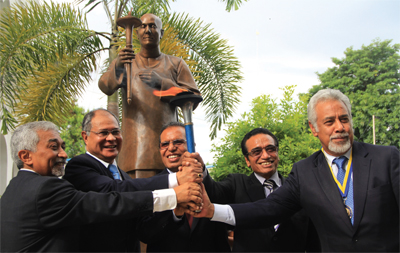
    NEW YORK (TIP): A beautiful bronze statue of Dreamer of World-Peace Sri Chinmoy was dedicated inside the grounds of the Parliament of Timor-Leste (East Timor) by President Taur Matan Ruak, Prime Minister Xanana Gusmão and first Prime Minister Dr. Mari Alkatiri, February 3, a late report says. Sri Chinmoy was an enormously creative peace leader who offered peace meditations at the United Nations headquarters in New York for leaders of all nationalities, delegates and staff members twice-weekly for 37 years at the invitation of Secretary- General U Thant. He created a wide range of cultural and athletic programs involving millions of peace-lovers throughout the globe.

    During the ceremony, Timor-Leste President Ruak stated, “Sri Chinmoy dedicated his life to seeking Harmony and Unity…and visited our country in 2004 to encourage our people’s effort to try to build Harmony after so many years of war and suffering…It is a great honor for the people of Timor-Leste to be awarded this Peace Statue which recognizes the Timorese people as peoples of Peace, and Timor-Leste as a World Peace symbol…”

    Prime Minister Xanana Gusmão and the nation’s first Prime Minister Dr. Mari Alkatiri were each presented with the Torch-Bearer Award by Mr. Salil Wilson, Executive Director of the Sri Chinmoy Oneness-Home Peace Run. Mr. Wilson hailed the supreme sacrifices and everlasting contributions by both leaders before presenting their medallions.

    After both leaders offered their gracious comments, they embraced warmly and then Prime Minister Gusmão ran with the Peace Torch from the entrance of the Parliament to Dr. Alkatiri-who then carried the torch to President Taur Matan Ruak. The top national leaders proceeded to the statue of Sri Chinmoy, which the President officially inaugurated by cutting the ribbon. The national luminaries-also including President of the Parliament Mr. Vicente Guterres and Deputy Prime Minister Fernando de Araújo-held the Peace Torch together in front of the statue in which Sri Chinmoy is offering the Peace Torch to the people of Timor Leste. The national leaders were each presented a large painting created by Sri Chinmoy and offered on behalf of Ranjana Ghose, Curator of the Jharna-Kala (Fountain-Art) Foundation, by Mr. Gangane Stefánsson, Head of UNICEF Iceland. Singers from an international choir performed a song written by Sri Chinmoy on Timor-Leste just prior to his visit in 2004. As a special treat, local Timorese children performed beautiful songs of peace in their native language of Tetung. The stirring ceremony was an official supplementary session of the Timor-Leste Parliament and attended as well by cabinet ministers, interfaith leaders and other luminaries of the nation. This statue created by British sculptor Kaivalya Torpy is the second of its kind-the first being inaugurated at a festive ceremony with Olympians and peace leaders in London as part of the Summer Olympics.

  • Taliban Leaders Send Their Girl Children To School : UN

    Taliban Leaders Send Their Girl Children To School : UN

    NEW DELHI (TIP): A top UN official today claimed that some Taliban leaders, who issued fatwa against girls’ education during their rule in Afghanistan, have themselves sent their female children to schools run with the support of the international body. Louis-Georges Arsenault, who was Unicef representative in Afghanistan from 1998 to 2001, also claimed that Taliban issued fatwa against girls’ education during their regime (1996 to 2001) as the group feared that “movement” of women and girls on the streets would “distract the focus” of their fighters from their “task ahead”.

    Arsenault, who took over as Unicef India representative a couple of months ago, made these remarks this while addressing the National Consultation on Education in Areas Affected by Civil Strife here. During their rule, Taliban issued Fatwa against girls’ education and declared that there will be no girl education in the country, Arsenault said. He said top Taliban officials had “openly” told UN officials who were talking to them at that point of time that the fatwa was issued because they needed their troops to focus the task ahead and not be distracted by the movement of women and girls. Despite the diktat, there were NGOs, community leaders and teachers who were in hiding providing some kind of education to the children in some parts of the country.

    The Unicef went about quietly without attracting media attention in working on school education in collaboration with these segments of population and taking expertise from Government officials and academicians. “Some of the Taliban fighters were sending their girls in schools any way,” said Arsenault, who is credited with managing one of Unicef’s largest humanitarian operations, including the coordination of relief and rehabilitation services to over 250,000 women, children and men displaced by Afghan conflict. According to the Unicef, Arsenault, despite Taliban’s edicts against girls’ education, initiated several projects to arrange private schooling for them.

  • Aishwarya Rai Bachchan appointed UN Goodwill Ambassador

    Aishwarya Rai Bachchan appointed UN Goodwill Ambassador

    UNITED NATIONS (TIP): The United Nations Program on HIV/AIDS (UNAIDS) has appointed global Indian icon, Mrs. Aishwarya Rai Bachchan as International Goodwill Ambassador. UNAIDS Executive Director Michel Sidibe announced Aishwarya as the Goodwill Ambassador at a press conference in New York on Monday, September 24.. Ash will raise global awareness on protecting children from HIV infection & increasing access to antiretroviral treatment.

    In her acceptance remarks, Aishwarya said, “I am honored to accept this appointment. Spreading awareness on health issues especially related to women and children has always been of concern. And now as a new mother, I can personally relate to this – the joys and concerns of every mother, and the hopes that we have for our children. I pray and strongly believe that no baby should be born with HIV. And I wish that every woman living with HIV stays healthy and has access to treatment. I promise that with UNAIDS, I will do my utmost to make this happen. My father-in-law Amitabh Bachchan had served as the International Goodwill Ambassador for UNICEF.”

    Dressed in black outfit and clearly happy about her appointment, Aishwarya said that she does not just want to be a poster girl but will work at the grassroots level to eradicate the social barriers and stigmas attached with the disease. Ash also said she would be going to sites across India and other countries, interact with people, appeal to governments and talk with pharma companies to see what works need to be done in the area.

  • Renita Bakshi receives the “Best President” Award

    Renita Bakshi receives the “Best President” Award

    Renita was presented the award by the world acclaimed innovator, Sam Pitroda

    NEW YORK (TIP): New York based Renita Bakshi, the Co-President of Network of Indian Professionals New York 2012 (NetIP-NY) was recognized as the “Best President-Large City” and “Best Officer” out of 20 chapters and 167 officers that are a part of the Network of Indian Professionals across North America. Renita was presented the award by the world acclaimed innovator, Sam Pitroda. Renita has been instrumental in revitalizing and rebranding the New York chapter. When she had stepped up to the Co-President role in January, the chapter was on the verge of collapsing. Since then Renita has more than tripled the number of paid members for the chapter and is hosting four events a month. She is focused on making the NetIP-NY the premier professional networking organization out there that unites the community to create an impact.

    Under Renita’s leadership, NetIP-NY has introduced some fantastic initiatives that include NY’s first everyearlong charity campaign in partnership with UNICEF’s School’s for Asia program to raise funds to build educational environments for children in need. The chapter has re-strategized its efforts with regards to pillar-focused events. NetIP-NY is partnering with established professional development organizations such as SAMBA (South Asian MBA Association) and TIE NYC (The Indus Entrepreneurs’) to help attendees build lasting business relationships. Furthermore, NetIP-NY is dedicated towards educating the community about how political decisions can impact their lives and what this year’s elections will mean. The political awareness series was launched with Preet Bharara , the U.S. Attorney for the Southern District of New York in a conversation about ethics.

    About NetIP

    The Network of Indian Professionals (NetIP) is a professional, non-profit organization dedicated to the overall achievement and advancement of South Asian professionals. The primary focus of the organization is to foster a bond among South Asian professionals to unite and support each other locally, as well as to give back and contribute positively to the communities in which they live and work. Today, the organization includes over 5,000 members and more than 40,000 subscribers in 24 cities across United States and Canada. NetIP has become a premier networking brand over the years. It is the unequivocal voice for an emerging group of South Asians who excel in every aspect of western society, from business to politics to the arts. The rise of NetIP and its affiliated chapters reflects a general “Coming of Age” by South Asian professionals.

    For more information
    visit www.newyork.netip.org or contact Renita Bakshi at president@netip-ny.org
    (Based on Press Release)