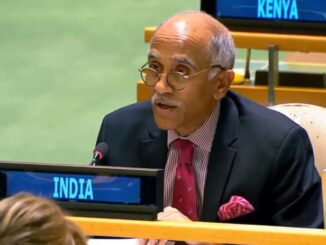
United Nations (TIP)- Pakistan has sought to project India’s decision to hold the Indus Waters Treaty (IWT) in abeyance as an “unprecedented crisis” for its water security, raising the issue at the United Nations months after New Delhi took the step in the aftermath of the Pahalgam terror attack carried out by Pakistan-backed terrorists.
Addressing the Global Water Bankruptcy Policy Roundtable at the UN, Pakistan’s Acting Permanent Representative Ambassador Usman Jadoon said India’s decision last April to put the 1960 treaty in abeyance had impacted downstream water security and regional stability.
India had announced the move following the Pahalgam terror attack that killed 26 civilians, triggering a series of diplomatic and strategic measures against Pakistan. The decision to suspend participation in the decades-old treaty was framed by New Delhi as part of a broader response to cross-border terrorism emanating from Pakistan.In his statement, Jadoon claimed that India’s action, followed by what he described as disruptions in downstream flows and withholding of hydrological data, had created a crisis for Pakistan’s water security. He asserted that the treaty remained legally intact and did not permit unilateral suspension, while accusing India of “weaponising” water.
Indian officials have underlined that the Indus Waters Treaty cannot be insulated from sustained acts of terrorism and hostile conduct, and that the April decision followed years of Pakistan’s refusal to address India’s concerns, even as New Delhi remained bound by a treaty that allocates a disproportionate share of waters to Pakistan.
Signed in 1960, the IWT allocates the western rivers — Indus, Jhelum and Chenab — to Pakistan and the eastern rivers —Ravi, Beas and Sutlej — to India, while allowing each side specified uses of rivers allocated to the other. Under the treaty framework, India is entitled to about 20 per cent of the waters of the Indus River System, with the remaining 80 per cent flowing to Pakistan. Source: TNS
Tag: United Nations
-

Indus Waters Treaty suspension created unprecedented crisis: Pak envoy at UN
-

UN chief calls on Israel to reverse NGOs ban in Gaza
Israel says the new regulation aims to prevent bodies it accuses of supporting terrorism from operating in the Palestinian territories
UNITED NATIONS (TIP): UN Secretary General Antonio Guterres called on Friday, January 2, 2026, for Israel to end a ban on humanitarian agencies that provided aid in Gaza, saying he was “deeply concerned” at the development, a Reuters report says.
Mr. Guterres “calls for this measure to be reversed, stressing that international non-governmental organizations are indispensable to life-saving humanitarian work and that the suspension risks undermining the fragile progress made during the ceasefire,” his spokesperson Stephane Dujarric said in a statement.
“This recent action will further exacerbate the humanitarian crisis facing Palestinians,” he added.
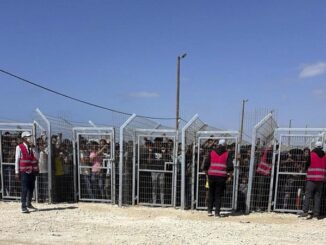
Israel on Thursday suspended 37 foreign humanitarian organizations from accessing the Gaza Strip after they had refused to share lists of their Palestinian employees with government officials.
The ban includes Doctors Without Borders (MSF), which has 1,200 staff members in the Palestinian territories — the majority of whom are in Gaza.
NGOs included in the ban have been ordered to cease their operations by March 1.
Several NGOS have said the requirements contravene international humanitarian law or endanger their independence.
Israel says the new regulation aims to prevent bodies it accuses of supporting terrorism from operating in the Palestinian territories.
On Thursday, January 1, 18 Israel-based left-wing NGOs denounced the decision to ban their international peers, saying “the new registration framework violates core humanitarian principles of independence and neutrality.”
A fragile ceasefire has been in place since October, following a deadly war waged by Israel in response to Hamas’s unprecedented October 7, 2023, attack on Israel.
In November, authorities in Gaza said more than 70,000 people had been killed there since the war broke out. Nearly 80 percent of buildings in Gaza have been destroyed or damaged by the war, according to UN data, leaving infrastructure decimated.
About 1.5 million of Gaza’s more than two million residents have lost their homes, said Amjad Al-Shawa, director of the Palestinian NGO Network in Gaza.
-

A Christmas Wish for a World at Peace

By Prof. Indrajit S. Saluja As the world prepares to merrily celebrate Christmas on December 25, with carols, candles, gifts and gatherings my kids have been so enthusiastic about, my thoughts drift, inevitably and uneasily, to people across continents who will mark this season not with joy, but with fear, deprivation and grief. When one surveys the globe today, a grim common thread binds distant lands and diverse societies: conflict. It manifests in many forms—economic, political, ethnic, ideological and military—but its consequences are uniformly cruel. Peace, despite humanity’s bitter experiences, continues to elude us.
History offers no shortage of warnings. The twentieth century alone witnessed two World Wars whose scale and savagery reshaped the world. World War I, sparked by nationalism, imperial rivalries and diplomatic failure, left nearly 20 million dead and shattered empires. Instead of ushering in lasting peace, it sowed the seeds of resentment and economic despair that gave rise to fascism and World War II. That second conflagration, the most destructive in human history, claimed over 60 million lives, devastated Europe and Asia, and culminated in the nuclear annihilation of Hiroshima and Nagasaki, grim reminders of humanity’s capacity for self-destruction.
In the aftermath of World War II, leaders vowed “never again.” Institutions such as the United Nations were created to resolve disputes through dialogue, not arms. Yet the decades that followed tell a sobering story. The Cold War divided the world into hostile blocs, bringing proxy wars in Korea, Vietnam, Afghanistan, Africa and Latin America. While nuclear deterrence prevented direct confrontation between superpowers, millions perished in regional conflicts fueled by ideological rivalry.
The end of the Cold War briefly raised hopes for a “peace dividend.” Instead, the world entered a new phase of instability. Ethnic conflicts tore apart Yugoslavia. Genocide scarred Rwanda. The Middle East remained trapped in cycles of war and retaliation. The US-led interventions in Iraq and Afghanistan, launched in the name of security and democracy, produced long wars whose human and economic costs far outweighed their gains. Terrorism emerged as a global threat, feeding on unresolved grievances and failed states.
Today, conflict has returned with alarming intensity to Europe itself, a continent that once prided itself on having learned the lessons of history. The war between Russia and Ukraine has inflicted immense suffering on ordinary people: cities reduced to rubble, millions displaced, families torn apart, and an entire generation growing up amid sirens and uncertainty. Whatever the geopolitical arguments advanced by either side, the human cost is undeniable and indefensible.
This is not an isolated tragedy. From Gaza to Sudan, from the Sahel to Myanmar, violence continues to uproot lives. Economic conflict, too, is pervasive: trade wars, sanctions, debt crises and widening inequality pit nations and classes against one another. Even societies not directly at war feel the consequences through inflation, refugee flows, energy shortages and a growing sense of global insecurity.
One might ask: how, after centuries of bloodshed, does humanity still fail to learn? Part of the answer lies in the persistence of ego, power politics and short-term thinking among leaders. War is often justified in the language of national interest, honor or security, yet it is invariably paid for by civilians. Children lose schools, the sick lose hospitals, and the poor lose whatever fragile stability they possess. Reconstruction takes decades; trauma lasts generations.
Christmas, at its core, is a celebration of peace, compassion and goodwill. The image of a child born in a manger has endured precisely because it speaks to humility and humanity, not conquest. At this moment, therefore, it is worth articulating a simple, perhaps unfashionable wish: that this Christmas brings wisdom to leaders who command armies and shape destinies.
In particular, one hopes that Russia’s President Vladimir Putin and Ukraine’s President Volodymyr Zelensky pause, even briefly, to reflect not on strategy or prestige, but on their people, the soldiers in trenches, the civilians in bomb shelters, the parents who bury their children. History will not judge them by how long they fought, but by whether they found the courage to stop.
Peace, contrary to popular belief, is not weakness. It requires moral strength to shed ego, to compromise, and to accept that no victory built on ruins can truly be called a triumph. Europe learned this lesson after 1945; it must not be forgotten now.
In this context, any genuine effort toward peace deserves encouragement, regardless of who undertakes it. If President Donald Trump seeks to play a role in ending the conflict, one can only wish him success. The world has seen enough failed wars and broken promises. A negotiated settlement, however imperfect, is infinitely preferable to endless bloodshed. If peace were to come to a ravaged region through such efforts, it would indeed be a gift worthy of global recognition.
One might even indulge in a Christmas metaphor: Santa Claus, bearer of goodwill, presenting the Nobel Peace Prize not as a personal accolade, but as a symbol of what humanity values most, the saving of lives. Such symbolism matters, because it reminds leaders that history honors peacemakers long after warriors are forgotten.
Ultimately, however, responsibility does not rest with leaders alone. Citizens, media and institutions must resist the idea that war is something normal. We must question narratives that glorify violence and demand accountability for decisions that destroy futures. Future generations will inherit the world we leave behind. They should not look back on us as idiotic warmongers who knew the costs of conflict yet chose it anyway.
As candles are lit this Christmas, let them illuminate not just homes, but consciences. Let the season renew our collective commitment to dialogue over destruction, empathy over enmity, and peace over pride. For without peace, no celebration—Christmas or otherwise—can ever be complete.
Merry Christmas, and may it bring the world closer to the peace it so desperately deserves!
-

Canadian, Indian foreign ministers meet on the sidelines of the United Nations

By Prabhjot Singh NEW YORK / TORONTO (TIP): A couple of months after they talked to each other on the phone, foreign ministers of India, Subrahmanyam Jaishankar, and Canada, Anita Anand, met on the sidelines of the United Nations General Assembly in New York.
It was an Ottawa-based diplomat-cum-journalist, Bhupinder Singh Liddar, who put up a picture of the two foreign ministers on his social media page yesterday.
Both Indian and Canadian foreign ministers held a wide range of discussions with foreign ministers of many other countries. Canadian PM Mark Carney also addressed the General Assembly of the United Nations.
During their meeting, the ministers discussed strengthening Canada and India’s bilateral ties, following productive discussions between Prime Minister Mark Carney and Prime Minister Narendra Modi at the G7 Leaders’ Summit in Kananaskis, Alberta, in June this year. The ministers also agreed to advance shared priorities, including economic prosperity, security and global governance.
The ministers acknowledged recent progress in the two countries’ relationship through the appointment of high commissioners in India and Canada. Minister Anand noted that Canada’s high commissioners play a key role in promoting Canadian trade and investment, providing services to Canadians abroad and enabling dialogue between countries.
Minister Anand emphasized that Canada remains committed to supporting and growing the well-established commercial ties shared by Canada and India, including agricultural products, critical minerals and energy products.
The Indian Foreign Minister expressed the hope that he would greet his Canadian counterpart in India soon. There are speculations on social media that she may visit India next month. In June, Prime Minister Narendra Modi had at the invitation of Canadian PM Mark Carney, visited Canada to attend the G7 summit.
The two ministers agreed to remain in contact.
-

India Reaffirms Commitment to Afghanistan at UN, Calls for Fresh Policy Approach
- I.S. Saluja
UNITED NATIONS (TIP)– india has reiterated its “paramount interest” in ensuring peace and stability in Afghanistan while urging the international community to adopt a “fresh approach” beyond punitive measures to support the Afghan people reeling under poverty, disease and hunger.
Speaking at the UN Security Council session on the United Nations Assistance Mission in Afghanistan (UNAMA), India’s Permanent Representative, Ambassador Parvathaneni Harish, praised outgoing UNAMA chief Roza Otunbayeva for her leadership and reaffirmed India’s readiness to work closely with the mission.
Harish underlined India’s long-standing civilizational ties with Afghanistan and said New Delhi continues to prioritize humanitarian aid, development cooperation and capacity-building initiatives. Since August 2021, India has delivered 50,000 tons of wheat, 330 tons of medicines and vaccines, 40,000 liters of pesticides, and other critical supplies, he noted. Following the devastating earthquake earlier this month, India dispatched more than 36 tons of relief materials, including tents, food supplies, medicines and generators, with more aid on the way.
He also highlighted India’s development footprint through over 500 projects across Afghan provinces and pointed to scholarships provided to 2,000 Afghan students, nearly 600 of them women, since 2023. India has additionally supported drug rehabilitation programs with the UN Office on Drugs and Crime, particularly targeting women.
On security concerns, Harish stressed that Afghanistan must not become a safe haven for international terrorist groups. He urged strict adherence to UN Security Council sanctions against ISIL, Al Qaeda, Lashkar-e-Tayyiba, Jaish-e-Mohammed and their affiliates. India, he said, welcomed Kabul’s condemnation of the April 2025 Pahalgam terrorist attack in Jammu and Kashmir.
Arguing that “business as usual” is insufficient, Harish called for international efforts to combine incentives for positive behaviour with disincentives for harmful actions. He said the Afghan people, after more than four years under sanctions, have seen limited development opportunities, and humanitarian needs have worsened after the recent earthquake.
“This is the time for compassion, a time for lending a helping hand,” he told the Council, reaffirming India’s “non-negotiable” commitment to Afghanistan’s development and its support for international efforts towards a stable, peaceful and prosperous Afghanistan.
-

UN backs Abbas video address after US visa refusal
UNITED NATIONS (TIP): The UN General Assembly on Friday adopted a resolution allowing Palestinian President Mahmoud Abbas to address next week’s high-level debate by pre-recorded video after the United States refused to issue visas for Palestine’s delegation. The resolution was passed with 145 in favor, five against (Israel, Nauru, Palau, Paraguay, and the United States) and six abstentions (Albania, Fiji, Hungary, North Macedonia, Panama, and Papua New Guinea).
It sets out procedures for the delivery of pre-recorded statements, authorizing President Abbas to submit his address via video in the General Assembly Hall, introduced by one of Palestine’s New York-based representatives.
The measure also allows for statements via a live link or pre-recorded video to the high-level conference taking place on the two-State solution, and other high-level meetings.
The arrangements apply only to the current 80th session. In another action, the 193-member Assembly adopted without a vote a Saudi Arabian-proposed decision allowing the Saudi Crown Prince and Prime Minister, Mohammed bin Salman, to deliver a statement by video or pre-recorded message at the high-level conference on 22 September 2025.
The US Department of State announced on 29 August that it was denying and revoking visas from members of the Palestine Liberation Organization and the Palestinian Authority on national security grounds, stating that they had failed to comply with past commitments, and “for undermining the prospects for peace.”
(Source: UN News) -

UN Security Council rejects resolution to extend Iran sanctions relief
Iran calls action by UN Security Council ‘unlawful’ as nine member countries vote against nuclear sanctions relief
UNITED NATIONS (TIP): The United Nations Security Council has voted not to permanently lift economic sanctions on Iran over its nuclear programme, delivering a major economic blow that Tehran claims is “politically biased”.
A resolution on Friday to block the sanctions fell in the Security Council by a vote of four to nine, meaning sanctions will return by September 28 if no significant deal is reached beforehand.
Russia, China, Pakistan and Algeria voted to stop the sanctions from being reintroduced.
Nine UNSC members voted against sanctions relief – the United States, Britain, France, Sierra Leone, Slovenia, Denmark, Greece, Panama, and Somalia, according to Iran’s official IRNA news agency. Guyana and South Korea abstained.
The vote follows a 30-day process launched in late August by Britain, France and Germany – known as the E3 – to reinstate sanctions unless Tehran meets their demands.
“Today’s action is hasty, unnecessary and unlawful. Iran recognizes no obligation to implement it,” Amir Saeid Iravani, Iran’s permanent representative and ambassador to the UN, said at the session on Friday. “Any attempt by the E3 to reimpose sanctions already terminated is not only baseless but a direct assault on international law and the credibility of the Security Council itself,” he said.
“This travesty unfolds against the backdrop of blatant aggression,” he added, referring to Israel and the United States’s attacks on his country’s nuclear facilities during June’s 12-day war.
The council, Iravani added, had “squandered an opportunity for dialogue and consensus”.
Iran says Europeans ‘misusing JCPOA mechanism’
Iranian officials have accused the European trio of abusing the dispute mechanism contained in the 2015 Treaty on the Non-Proliferation of Nuclear Weapons (NPT), which allows for the application of sanctions under a “snapback mechanism”.“What Europeans are doing is politically biased and politically motivated … They are wrong on different levels by trying to misuse the mechanism embedded in the Joint Comprehensive Plan of Action (JCPOA),” Deputy Foreign Minister Saeed Khatibzadeh said before the vote.
The Europeans offered to delay the snapback for up to six months if Iran restored access for UN nuclear inspectors and engaged in talks with the US.
Iran’s Foreign Minister Abbas Araghchi claimed that Tehran had presented a “reasonable and actionable plan” and insisted Iran remains committed to the NPT.
But the E3 accuse Tehran of breaching their nuclear commitments, including by building up a uranium stockpile of more than 40 times the level permitted under the JCPOA. The UN’s nuclear watchdog board also ruled back in June that Iran was not respecting international nuclear safeguards.
“However slim, there is still a possibility of diplomatic engagement to fix this already complicated issue,” said Al Jazeera’s Tohid Asadi, reporting from Tehran.
But today’s vote adds another “layer of complexity” and puts Iran “on the very brink” of deeper sanctions that would compound pressure on its economy, he added.
‘Clock is ticking for high-level diplomacy’
The UNSC vote allowing sanctions to snap back is not the complete “end of negotiations,” as the parties have just over a week to come up with a last-ditch deal, said Al Jazeera’s diplomatic editor James Bays, reporting from the UN.“It’s the week where world leaders are all here in New York for the high-level meeting of the UN General Assembly, so it sets the stage for high-level diplomacy between Iran and particularly the three European countries,” said Bays. But “we’re reaching the end of this high-stakes diplomacy, and the clock really is ticking.”
Iran has repeatedly denied pursuing nuclear weapons but affirmed its right to peacefully pursue nuclear energy.
Under the JCPOA – signed by Iran, the United States, China, Russia and the EU – Tehran agreed to curb its nuclear programme in return for sanctions relief. But the agreement unraveled in 2018 after then-US President Donald Trump pulled out and reimposed unilateral sanctions.
Tensions escalated further earlier this summer, when Israel launched a 12-day war on Iran, with Israeli and US forces striking several nuclear facilities.
“It was the United States that unilaterally tore up the agreement in 2018, reimposing sanctions in open defiance of this Council. It was the E3 that failed to meet their obligations, hiding behind empty promises while quietly following Washington’s lead and instructions,” said Iravani.
“This contradiction between their rhetoric and actions proves, once more, their real intention is not diplomacy but escalation,” he added.
(Source: ALJAZEERA) -

Past and present crises UN has dealt with
When the United Nations (UN) was born in October 1945, the world was still reeling from the devastation of the Second World War. Its founders pledged to “save succeeding generations from the scourge of war” and to promote peace, security, and cooperation among nations. Over nearly eight decades, the UN has confronted numerous crises-some it helped resolve, others it could not prevent. Its record is a mixture of remarkable successes, painful failures, and continuing struggles.
Historical Crises
The Korean War (1950-1953)– Background: Following World War II, Korea was divided at the 38th parallel into Soviet-backed North Korea and U.S.-backed South Korea. When the North invaded the South in June 1950, it sparked the first major postwar conflict.
– UN Role: With the Soviet Union temporarily boycotting the Security Council, the UN authorized a multinational military response under U.S. command.
– Impact: The war ended in stalemate, but it was the first demonstration of UN collective security.
The Suez Crisis (1956)
– Background: Egyptian President Gamal Abdel Nasser nationalized the Suez Canal, provoking military action by Britain, France, and Israel.
– UN Intervention: Under Secretary-General Dag Hammarskjöld, the UN deployed the first large-scale peacekeeping force (UNEF) to supervise ceasefire and withdrawal.
– Significance: This established peacekeeping as a core UN function.
The Congo Crisis (1960-1964)
– Background: Congo’s independence from Belgium descended into chaos with secessionist movements and Cold War rivalries.
– UN Response: The UN Operation in the Congo (ONUC) was deployed to stabilize the country, protect civilians, and prevent foreign intervention.
– Outcome: Though criticized, ONUC laid the groundwork for later large-scale peace operations.
Arab-Israeli Wars (1967, 1973)
– Background: The Six-Day War (1967) and the Yom Kippur War (1973) deepened tensions in the Middle East.
– UN Actions: Security Council Resolution 242 (1967) called for Israeli withdrawal from occupied territories in exchange for peace-a cornerstone of later peace efforts. After 1973, the UN deployed peacekeepers (UNDOF, UNEF II) to monitor ceasefires.
The Rwandan Genocide (1994)
– Background: Longstanding ethnic tensions between Hutus and Tutsis exploded, leading to the massacre of nearly 800,000 people in 100 days.
– UN Failure: Despite warnings, the UN mission (UNAMIR) was poorly equipped and restrained by a weak mandate. Peacekeepers could not stop the killings.
– Legacy: The genocide led to widespread criticism of UN inaction and prompted reforms in peacekeeping and the development of the “Responsibility to Protect” doctrine.
The Balkan Wars (1990s)
– Background: The breakup of Yugoslavia triggered violent conflicts in Croatia, Bosnia, and Kosovo. Ethnic cleansing and mass atrocities shocked the world.
– UN Response: Peacekeepers were deployed, but they lacked authority to prevent atrocities like the Srebrenica massacre (1995), where 8,000 Bosnian Muslims were slaughtered.
– Aftermath: Eventually, NATO intervened with UN backing. The International Criminal Tribunal for the Former Yugoslavia (ICTY) was created, setting a precedent for international justice.
Present Crises Confronting UN
Russia-Ukraine Conflict (2022-present)
– Background: Russia’s full-scale invasion of Ukraine in February 2022 violated the UN Charter’s principles of sovereignty and territorial integrity.
– UN Response:
– The Security Council has been paralyzed by Russia’s veto power, blocking condemnation or enforcement actions.
– The General Assembly passed multiple resolutions (with overwhelming support) demanding Russian withdrawal.
– The International Court of Justice (ICJ) ordered Russia to suspend its military operations, though unenforceable.
– UN agencies like UNHCR and WFP are providing humanitarian aid to millions of refugees and displaced persons.
– Significance: The conflict underscores the limits of the UN when a permanent Security Council member is directly involved in aggression.
Israel-Palestinian Conflict (intensified 2023-2025)
– Background: The Israeli-Palestinian conflict remains unresolved after decades. Violence escalated dramatically in October 2023 with Hamas’ attacks on Israel, followed by Israel’s large-scale operations in Gaza.
– UN Role:
– The Security Council has been blocked by U.S. vetoes on resolutions calling for ceasefires.
– The General Assembly has passed symbolic resolutions urging humanitarian access and Palestinian rights.
– UNRWA (UN Relief and Works Agency) continues to provide aid to millions of Palestinian refugees but faces funding crises.
– Challenges: The UN’s credibility is undermined by political divisions and accusations of double standards.
Sudan and Sahel Conflicts
– Civil wars in Sudan (especially in Darfur and since the 2023 power struggle) have created humanitarian catastrophes. The UN is struggling to deliver aid amid violence.
– The Sahel region (Mali, Niger, Burkina Faso) faces insurgencies, coups, and terrorist threats, stretching UN peacekeeping operations.
Myanmar Crisis
– After the 2021 military coup, Myanmar has descended into civil war, with the junta committing atrocities.
– The UN has condemned the violence, but Security Council action is blocked by China and Russia.
Afghanistan under Taliban (since 2021)
– The Taliban’s takeover has rolled back women’s rights and plunged millions into poverty.
– UN agencies remain the primary providers of humanitarian aid, but face restrictions from Taliban authorities.
Climate Change and Global Disasters
– Unlike traditional conflicts, climate change is a slow-moving crisis threatening peace and security.
– Through the UNFCCC and annual COP summits, the UN leads global climate negotiations.
– Small island nations rely on the UN to advocate for survival against rising seas, while Africa and Asia face climate-driven famines and displacement.
Achievements and Limitations
– Achievements: The UN has pioneered peacekeeping, delivered humanitarian aid on an unprecedented scale, and established international law institutions like the ICJ and the International Criminal Court (ICC).
– Limitations: Political deadlock in the Security Council, particularly due to the veto power of permanent members (P5), often paralyzes the organization. Critics argue that the UN is only as strong as its members allow it to be.
The history of the United Nations is one of ambition tempered by political realities. It has played a central role in mediating crises-from Korea to Congo, from Suez to Rwanda, from Bosnia to Gaza and Ukraine. Its peacekeepers, agencies, and diplomats have saved millions of lives, yet its inability to prevent wars and genocides continues to tarnish its reputation.
As the UN confronts today’s crises-Ukraine, Gaza, Sudan, Myanmar, Afghanistan, and climate change-its founding promise “to save succeeding generations” remains both relevant and elusive. The organization’s future effectiveness depends on whether the international community can reform its structures, particularly the Security Council, and renew its commitment to genuine multilateralism in an increasingly divided world. -

United Nations: History, membership, objectives and structure
The United Nations (UN) is the world’s foremost international organization dedicated to peace, security, cooperation, and development. It was founded on 24 October 1945, in the aftermath of World War II, when 51 nations signed the UN Charter in San Francisco. The devastation of the war and the failure of the League of Nations highlighted the urgent need for a stronger global institution to prevent conflicts and promote collective security. The UN officially came into existence when the Charter was ratified by the majority of signatory nations, including the five permanent members of the Security Council. Since then, 24 October is celebrated annually as United Nations Day.
From its modest beginnings, the UN has grown into a near-universal organization, serving as the world’s largest forum for multilateral dialogue and international cooperation.
Current Membership
As of 2025, the United Nations has 193 member states, encompassing virtually every recognized sovereign nation in the world. South Sudan, which joined in 2011, is the most recent member. The UN also recognizes two observer states: the Holy See (Vatican City) and the State of Palestine.
Membership in the UN signifies equal sovereignty of states, regardless of their size, wealth, or political system, under the principle of “sovereign equality” enshrined in the Charter.
Objectives of the UN
The purposes of the United Nations, as laid down in its Charter, include:
– Maintaining international peace and security by preventing conflicts, mediating disputes, and deploying peacekeeping missions.
– Promoting friendly relations among nations based on equal rights and self-determination.
– Encouraging international cooperation in solving global issues-economic, social, cultural, and humanitarian.
– Promoting and protecting human rights and fundamental freedoms for all, without discrimination.
– Serving as a center for harmonizing the actions of nations to achieve common goals.
Over the decades, these objectives have expanded to include sustainable development, climate action, gender equality, and humanitarian relief.Composition of the UN- The General Assembly (GA)
The General Assembly is the deliberative organ of the UN where all 193 member states have equal representation, each with one vote. It meets annually in regular sessions, usually beginning in September.
– Functions: Debates major issues, approves the UN budget, admits new members, and elects non-permanent members of the Security Council.
– GA President: The Assembly elects a President annually, on a rotational basis among regional groups, to preside over sessions and guide discussions.
The Security Council (UNSC)
The Security Council is the executive organ responsible for maintaining international peace and security.
– Membership: It has 15 members – 5 permanent (China, France, Russia, the United Kingdom, and the United States) and 10 non-permanent members elected by the General Assembly for two-year terms.
– Powers: The Council can impose sanctions, authorize military action, and establish peacekeeping missions. Each permanent member holds veto power, allowing them to block substantive resolutions.
The Secretary-General
The Secretary-General is the chief administrative officer and the symbolic leader of the United Nations. Appointed by the General Assembly on the recommendation of the Security Council, the Secretary-General serves a five-year renewable term.
Duties and Powers:
– Acts as the head of the UN Secretariat.
– Brings attention to threats to peace.
– Mediates disputes and undertakes “good offices” diplomacy.
– Oversees peacekeeping operations and humanitarian programs.
– Serves as a spokesperson for the international community on global issues.
The Secretary-General thus plays both a political and administrative role, embodying the values and vision of the UN Charter.
Major Organs and Specialized Wings
Besides the General Assembly, Security Council, and Secretariat, the UN system encompasses various organs, specialized agencies, and programs:
International Court of Justice (ICJ)
Based in The Hague, Netherlands, it is the principal judicial organ of the UN, settling legal disputes between states and giving advisory opinions on legal questions.
UN Peacekeepers
Often called the “Blue Helmets,” they are deployed to conflict zones to maintain ceasefires, protect civilians, support elections, and aid post-conflict recovery.
UN Women
Established in 2010, it is the UN entity dedicated to promoting gender equality and empowering women worldwide.
UNICEF (United Nations Children’s Fund)
Focuses on child welfare, health, and education.
WHO (World Health Organization)
Directs international health efforts and coordinates responses to global pandemics.
UNHCR (United Nations High Commissioner for Refugees)
Protects refugees and stateless people, providing aid and seeking durable solutions.
UNDP (United Nations Development Programme)
Works to eradicate poverty and promote sustainable development.
WFP (World Food Programme)
Addresses global hunger and food security.
These specialized agencies and programs reflect the UN’s wide-ranging role in global governance-beyond security, into development, rights, and humanitarian aid.
The United Nations, despite criticisms and challenges, remains the most important global forum for dialogue and cooperation. With 193 members, it is both a symbol and a mechanism of collective responsibility. Its organs-General Assembly, Security Council, and Secretariat-along with specialized agencies like the ICJ, UN Women, and peacekeeping forces, illustrate its multidimensional mandate.
In an era of climate change, pandemics, migration crises, and geopolitical conflicts, the UN’s objectives of peace, cooperation, and human dignity remain as vital today as they were in 1945. -

United Nations at 80 – The 80th Session of the United Nations General Assembly
The 80th session of the UN General Assembly (UNGA-80) began on 9 September 2025 in New York, with Germany’s Annalena Baerbock elected as President. Baerbock has emphasized the theme “Better Together: 80 years and more for peace, development and human rights,” arguing for reform, inclusivity and stronger multilateral cooperation. During the High-Level Week (starting 22 September), dozens of heads of state and government will descend to present priorities, engage in diplomacy and debate global challenges.
Key issues expected to dominate include:
– Enhancing and reforming the UN system, including financial sustainability and governance transparency.
– Gender equality and women’s empowerment, especially in light of the 30th anniversary of the Beijing Declaration.
– Climate action, ahead of COP30: new climate pledges, accelerating sustainable development, clean energy transitions.
– Global health issues: non-communicable diseases (NCDs), mental health and universal health coverage.
– Conflict and peacebuilding: the war in Gaza, Palestinian statehood recognition, tensions in Ukraine, and calls for stronger international response.UNITED NATIONS (TIP)- The 80th session of the United Nations General Assembly (UNGA) was declared open by Annalena Baerbock, the new president of the General Assembly, at the UN headquarters in New York on Tuesday, September 9, afternoon.
The theme of the 80th session of the UNGA, which marks the 80th anniversary of the founding of the United Nations, is “Better Together: 80 years and more for peace, development and human rights.”
“The 80th session of the General Assembly is no ordinary session,” Baerbock said in her opening remarks at the first plenary meeting of the 80th session.
“80 years. Longer than the average human lifespan. Normally this would be a moment to celebrate, but are we really in a mood for celebration?” the new UNGA president asked.
Parents in Gaza are watching their children starve, Afghan girls are banned from school, women in Darfur are hiding their daughters from being raped, Pacific Islanders are watching seas rise and waves lap against their homes, and 808 million people are still trapped in extreme poverty, she said.
“Instead of celebrating, one might rather ask: where is the United Nations, which was created to save us from hell?” Baerbock asked.
However, the world needs the United Nations, and it remains the only organization capable of bringing together every country in the world, and the only one capable of acting on a truly global scale, she pointed out.
This is the year to adapt, to evolve, and to build the United Nations we need for the next 80 years — for the lifetimes of our children, said the UNGA president. “It is a moment to show eight billion people why this organization still matters.”
Speaking at the meeting, UN Secretary-General Antonio Guterres said that eight decades ago, the founders of the United Nations gathered in San Francisco, U.S. state of California, and envisioned “something different” — a global-problem-solving body that could not only prevent calamities like war, but could forge solutions to other age-old problems haunting humanity — poverty, hunger, illness and inequality.
These efforts, built by the world for the world, and grounded in the values and principles of the UN Charter, are what this Assembly is all about, Guterres said.
“The United Nations provides the place. The Charter provides the tools,” stressed the UN chief, adding that the Pact for the Future, adopted last September, provided a shot in the arm for the multilateral system and the values that have defined this organization from day one.
The UN Charter “is not self-executing,” Guterres pointed out, adding that by design, it requires countries looking beyond their national interests and re-building trust and faith in one another, and in what the international community can accomplish through collaboration and solidarity.
“And it requires realizing that, while we cannot solve all the world’s problems here, we can unite behind solutions that will ultimately move humanity closer to a better, fairer, more peaceful and equal world for all,” he said.
A high-level week will kick off on Sept. 22 and run through Sept. 30, during which world leaders will gather to attend the General Debate and a series of conferences, including the High-level Meeting to Commemorate the 80th Anniversary of the United Nations, the SDG Moment, the High-level Meeting on the 30th Anniversary of the Fourth World Conference on Women, the Climate Summit, and the High-level Meeting to Launch the Global Dialogue on AI Governance.
India’s Prime Minister Narendra Modi will not speak at the General Debate during the annual high-level session of the United Nations General Assembly (UNGA) later this month. The update comes after the UN released a revised provisional list of speakers in New York, news agency PTI reported.
US President Donald Trump will address world leaders on 23 September, delivering his first speech at the UNGA since starting his second term as US President.
According to the updated list of speakers, India will be represented by External Affairs Minister S Jaishankar. He is scheduled to address the Assembly on 27 September. -

French President Macron says France will recognize Palestine as a state
PARIS / NEW YORK (TIP): French President Emmanuel Macron announced Thursday, July 24, that France will recognize Palestine as a state, amid snowballing global anger over people starving in Gaza, according to an Associated Press report. Macron said in a post on X that he will formalize the decision at the United Nations General Assembly in September. “The urgent thing today is that the war in Gaza stops and the civilian population is saved.″
The French president offered support for Israel after the Oct. 7, 2023 Hamas attacks and frequently spoke out against antisemitism, but he has grown increasingly frustrated about Israel’s war in Gaza, especially in recent months.
France is the biggest and most powerful European country to recognize Palestine. More than 140 countries recognize a Palestinian state, including more than a dozen in Europe.
France has Europe’s largest Jewish population and the largest Muslim population in western Europe, and fighting in the Middle East often spills over into protests or other tensions in France.
The Israeli Foreign Ministry had no immediate comment. France’s foreign minister is co-hosting a conference at the U.N. next week about a two-state solution. Last month, Macron expressed his “determination to recognize the state of Palestine,” and he has pushed for a broader movement toward a two-state solution, in parallel with recognition of Israel and its right to defend itself.
Thursday’s announcement came soon after the U.S. cut short Gaza ceasefire talks in Qatar, saying Hamas wasn’t showing good faith.
Momentum has been building against Israel in recent days. Earlier this week, France and more than two dozen mostly European countries condemned Israel’s restrictions on aid shipments into the territory and the killings of hundreds of Palestinians trying to reach food.
The Palestinians seek an independent state in the occupied West Bank, annexed east Jerusalem and Gaza, territories Israel occupied in the 1967 Mideast war. Israel’s government and most of its political class have long been opposed to Palestinian statehood and now say that it would reward Hamas after the Oct. 7, 2023, attack. Israel annexed east Jerusalem shortly after the 1967 war and considers it part of its capital. In the West Bank, it has built scores of settlements, some resembling sprawling suburbs, that are now home to over 500,000 Jewish settlers with Israeli citizenship. The territory’s 3 million Palestinians live under Israeli military rule, with the Palestinian Authority exercising limited autonomy in population centers.
-

India Hosts High-Level Side Event on “SDGs Keeping up the Momentum for Agenda 2030”
UNITED NATIONS (TIP): Permanent Mission of India to the United Nations, in collaboration with NITI Aayog, Government of India, hosted a high-level side event titled “SDGs: Keeping up the Momentum for Agenda 2030” on 18 July 2025 at the United Nations Headquarters on the sidelines of the High-Level Political Forum on Sustainable Development (HLPF).
Delivering the keynote address, Mr. Suman Bery, Vice Chairman of NITI Aayog and Head of India’s Delegation to HLPF 2025, outlined India’s achievements in reducing multidimensional poverty, expanding social protection, and improving health outcomes. He emphasized India’s twin approach of strengthening safety nets for vulnerable populations while advancing reforms that drive growth, innovation, and climate resilience. Mr. Bery also highlighted India’s efforts to localize SDGs through state-level indicator frameworks and active community participation. He showcased India’s pioneering work in building world-class Digital Public Infrastructure, promoting financial inclusion, and enabling data-driven governance as transformative tools for sustainable development.
Ms. Kanni Wignaraja, Assistant Secretary-General and Regional Director Asia Pacific UNDP, called for intensified local development efforts that deliver tangible benefits to people. She stressed the need for robust, trusted data systems and the bold application of digital and AI technologies to accelerate development gains. Highlighting UNDP’s partnership with India and other countries, she underscored the importance of sustained political will to address lagging targets, close gender gaps, and advance climate action and green transitions.

Ambassador Parvathaneni Harish, Permanent Representative of India to the UN, reaffirmed India’s strong commitment to the 2030 Agenda In his opening remarks, Ambassador Parvathaneni Harish, Permanent Representative of India to the UN, reaffirmed India’s strong commitment to the 2030 Agenda. He highlighted India’s integrated approach to sustainable development, which combines the convergence of flagship programs, SDG localization, advances in digital infrastructure, and proactive climate action and the valuable lessons that can be learnt from India’s experience.
The event also featured presentations from international partners sharing their national experiences: Mr. Héctor Francisco Ochoa Moreno, 2030 Agenda Director General, Ministry of Economy, Mexico, Mr. Pungkas Bahjuri Ali, Senior Advisor to the Minister on Social Welfare and Poverty Reduction, Indonesia; and Mr. Samuel Addis Alemayehu, Deputy Director General, International Organizations Directorate General, Ministry of Foreign Affairs, Ethiopia.

Participants in the discussion on “SDGs Keeping up the Momentum for Agenda 2030” A panel discussion also explored cross-cutting approaches to create catalytic, multiplier impacts across multiple SDGs. Mr. Ulrich Nicklas, Head of 2030 Division, Federal Ministry for the Environment, Germany, emphasized climate justice as a critical pillar of sustainable development. Mr. Jay Jayaraman of iSPIRT highlighted the transformative potential of Digital Public Infrastructure, while Mr. Pranay Dasari, Youth Representative, underscored the vital role of youth in leading community-driven SDG initiatives.
The event fostered rich discussions on inclusive, sustainable, and data-driven pathways to development and inspired global partnerships aimed at sustaining momentum towards achieving the 2030 Agenda.
(Based on a Press Release issued by Eldos Mathew Punnoose, Counsellor/ Media Officer, Permanent Mission of India to the United Nations) -

Global Leaders Unite to End Childhood Blindness
- Lord Rami Ranger and Dr. VK Raju to Lead Historic Campaign Declaring January 31 as the ‘International Day for a World Without Childhood Blindness’
- Landmark Launch Set for January 31, 2026, at the House of Lords, UK
LONDON / NEW YORK (TIP): In a defining moment for global child health, Lord Rami Ranger, FRSA, Member of the UK House of Lords, and Dr. VK Raju, globally renowned ophthalmologist and humanitarian, have been appointed Chair and Co-Chair respectively of a worldwide campaign to designate January 31 as the International Day for a World Without Childhood Blindness.
This high-impact initiative, led by the Eye Foundation of America (EFA), Eye Foundation of the UK, Goutami Eye Institute, Rotary International, and a coalition of global partners, calls on the United Nations and the Commonwealth of Nations to recognize childhood blindness as a global health emergency—and to rally international efforts to eliminate it.
“No child should be condemned to darkness when proven, cost-effective solutions already exist,” said Lord Rami Ranger.
“This campaign is not just about vision—it is about justice. I’m honored to help make January 31 a beacon of global action and hope.”
The Crisis: Preventable, Yet Ignored
Over 1.4 million children around the world currently live in blindness—most of it avoidable or treatable. Each year, this results in over 70 million “blind person years”—a devastating burden on families, communities, and national economies.
The leading causes? Retinopathy of Prematurity (ROP), congenital cataracts, vitamin A deficiency, and infections—conditions that are often preventable with timely intervention.
“With today’s advances, over 90% of childhood blindness can be prevented or treated,” said
Dr. VK Raju, Founder-President of EFA.
“And because 80% of learning happens through vision, this is also an education and
inclusion issue. It’s time to align global action with the UN’s SDG 3 (Health) and SDG 4 (Education).”
The Movement: Fueled by Global Alliances
This campaign is already backed by a powerful and growing alliance of international leaders and organizations, including:
- VK Raju, Co-Chair, IDWCB Campaign; Founder, Eye Foundation of America; Chairman, Eye Foundation of UK
- Leela Raju, Secretary-General, IDWCB Campaign; Secretary, EFA; Leading Ophthalmologist, Louisiana
- Rtn Sandeepp Saxena, Chair, ROP Program, Rotary District 3011; Global Director, EFA
- Rotary International District 3011, leading a $1 million “Hope For Tomorrow” fundraising campaign, matched by EFA
- Rotary Clubs, NGOs, and health institutions across Asia, Africa, Europe, and the Americas
- 25+ Global Campaign Ambassadors, with support from UN agencies, the
Commonwealth Secretariat, and health ministries worldwide
Why January 31? A Date with Global Significance
January 31 commemorates the tireless efforts of Dr. VK Raju, whose four-decade-long mission since 1977 has transformed pediatric eye care from India to Africa to the United States.
Designating this day will:
- Elevate international awareness of childhood blindness
- Catalyze public policy, funding, and innovation
- Promote global collaboration in line with the UN Sustainable Development Goals
- Inspire governments, institutions, and citizens to take meaningful action
A Global Day, A Shared Responsibility
A formal petition is being submitted to the United Nations General Assembly and the Commonwealth Secretariat. Governments, ministries, parliaments, medical bodies, and civil society are invited to endorse the declaration and organize awareness programs each year on January 31.
“Lord Ranger’s leadership brings international gravitas and unmatched momentum to this mission,” added Dr. Raju.
“Together, we can prevent a lifetime of darkness for millions of children—and give them the light of opportunity.”
Join the Global Movement
A dedicated campaign portal and participation toolkit will launch in July 2025, offering resources for institutions, Rotary clubs, schools, and individuals to host coordinated global events and advocacy efforts.
About the Campaign Chair
Lord Rami Ranger, FRSA is a distinguished Member of the UK House of Lords, founder of Sun Mark Ltd., and a global advocate for education, diversity, and social progress. His leadership will bring scale and stature to the global campaign.
About the Campaign Co-Chair
Dr. VK Raju is the Founder-President of the Eye Foundation of America and Chairman of the Eye Foundation of UK. A tireless advocate since 1977, he also serves as Adjunct Professor at the Wilmer Eye Institute, Johns Hopkins University.
“A world without childhood blindness is not a dream. It is a decision.”
#Jan31ForSight | #VisionForEveryChild | #WorldWithoutChildhoodBlindness
Media Contact & Inquiries
Rtn Sandeepp Saxena
Vʌ□•□ sandeepp.saxena@eyefoundationofamerica.org
www.eyefoundationofamerica.org
! +91 70659 68122
Campaign Secretariat
VʌV•□ □ worldwithoutchildhoodblindness@eyefoundationofamerica.org
-

Amnesty International says Israel using starvation to commit Gaza genocide
WASHINGTON, D.C. (TIP): Amnesty International issued a report Thursday, July 3, 2025, claiming a controversial Israeli- and U.S.-backed system to distribute aid in Gaza uses starvation tactics against Palestinians to continue to commit genocide in the Gaza Strip during Israel’s war with Hamas.
The U.K.-based human rights group condemned Israel and the Gaza Humanitarian Foundation, which the U.S. and Israel have backed to take over aid distribution in Gaza from a network led by the United Nations.
Israel’s foreign minister denounced the Amnesty report, saying the organization has “joined forces with Hamas and fully adopted all of its propaganda lies.” Gaza’s Health Ministry says more than 500 Palestinians have been killed at or near GHF distribution centers over the past month. The centers are guarded by private security contractors and located near Israeli military positions. Palestinian officials and witnesses have accused Israeli forces of opening fire at crowds of people moving near the sites.
The Amnesty report said Israel has “turned aid-seeking into a booby trap for desperate starved Palestinians” through GHF’s militarized hubs. The conditions have created “a deadly mix of hunger and disease pushing the population past breaking point.”
“This devastating daily loss of life as desperate Palestinians try to collect aid is the consequence of their deliberate targeting by Israeli forces and the foreseeable consequence of irresponsible and lethal methods of distribution,” said Agnès Callamard, Amnesty’s secretary general.
The Israeli army says it has fired warning shots to control crowds and only fires at people it says are acting suspiciously.
The Foreign Ministry and COGAT, the Israeli defense body in charge of coordinating aid to Gaza, said Israel has facilitated the entry of over 3,000 aid trucks into the Gaza Strip since May 19 and GHF has delivered boxes of food with the equivalent of 56 million meals.
Humanitarian organizations say that amount is not nearly enough to meet overwhelming need in Gaza. GHF did not immediately return requests for comment.
The World Food Programme says despite the new Israel-backed initiative, food consumption reached a critical low last month, with food diversity reaching its worst level since the conflict began.
“The continued closure of crossings, intensified violence since March, soaring food prices, and extremely limited humanitarian and commercial supplies have severely restricted access to even basic food items,” the WFP said in a June report.
Amnesty’s report follows a statement earlier this week from more than 165 major international charities and non-governmental organizations calling for an immediate end to the foundation. They say the new mechanism allows Israel to use food as a weapon, violates humanitarian principles and is ineffective.
It’s the latest sign of trouble for the GHF, a secretive initiative headed by an evangelical leader who is a close ally of President Donald Trump. Last month, the U.S. government pledged $30 million for the group to continue operation, the first known U.S. donation to the group, whose other funding sources remain opaque.
GHF started distributing aid May 26 following a nearly three-month Israeli blockade that pushed Gaza’s population of more than 2 million to the brink of famine.
Palestinian witnesses have described scenes of chaos around the distribution sites, and two contractors in the operation have told The Associated Press that colleagues fired live ammunition and stun grenades toward crowds of people. Palestinians often must travel long distances to reach the sites.
In a statement Tuesday, GHF rejected criticism of its operations and claimed it has delivered more than 52 million meals to hungry Palestinians.
“Instead of bickering and throwing insults from the sidelines, we would welcome other humanitarian groups to join us and feed the people in Gaza,” GHF said.
GHF has called for Israel’s military to investigate the allegations from Gaza’s Health Ministry, but last month the organization said there has been no violence in or around its centers and its personnel have not opened fire.
Israel demanded the alternative plan because it accuses Hamas of siphoning off aid. The U.N. and aid groups deny there is significant diversion.
Amnesty accused Israel last year of committing genocide in the Gaza Strip during its war with Hamas, saying it has sought to deliberately destroy Palestinians by mounting deadly attacks, demolishing vital infrastructure, and preventing the delivery of food, medicine and other aid.
Israel, which was founded in the aftermath of the Holocaust, has adamantly rejected genocide allegations against it as an antisemitic “blood libel.” It is challenging such allegations filed by South Africa at the International Court of Justice and has rejected the International Criminal Court’s accusations that Prime Minister Benjamin Netanyahu and his former defense minister committed war crimes in Gaza.
(Source: AP)
-

India must cash in on its economic edge
The US is facing a slowdown owing to the fallout of Trump’s tariff policies, compounded by Moody’s unprecedented decision to downgrade its credit rating.
The big worry is the prospect of a prolonged conflict. Given the fact that Operation Sindoor has only been paused, tensions with Pakistan might flare up again. This raises the grim possibility of disruption to normal economic activity. A revival of hostilities could bring industrial and trade activities to a halt, especially in the northern and western regions.

By Sushma Ramachandran Cross-border tensions, geopolitical headwinds and US President Donald Trump’s fast-changing tariff policies — the Indian economy is facing a slew of challenges. Yet, India continues to be viewed as an outlier in the global arena, performing better on the economic front than many other countries.
The United Nations has confirmed the perception in its latest report on the global economy. While downgrading India’s growth prospects from 6.6 per cent to 6.3 per cent for 2025, the UN still sees it as the fastest-growing major economy. In contrast, China is expected to grow by 4.6 per cent (from 5 per cent earlier), while the US is set to decelerate from 2.8 to 1.6 per cent this year. Emerging economies such as Brazil, Mexico and South Africa are also facing growth downgrades owing to factors like depressed trade and investments.
In this backdrop of a slowing world economy, India stands out. The Reserve Bank of India sounds similarly upbeat in its latest report, noting that the country is poised to surpass Japan this year to become the world’s fourth largest economy. Though it describes the outlook as one of cautious optimism, it points to easing of inflation pressures, while a normal monsoon forecast is expected to spur rural consumption.
The central bank has already downgraded its projection for the ongoing financial year to 6.5 per cent from 6.7 per cent, but it has pointed to the multiple strengths of the Indian economy. These include the fact that it is ringfenced by monetary, financial and political stability along with a congenial business environment and strong macroeconomic fundamentals.
This positive affirmation comes in the midst of global uncertainty, with the UN expecting global growth to touch only 2.4 per cent from the earlier forecast of 2.8 per cent. It attributes a dip in investments to uncertainty over trade and economic policies linked to the volatile geopolitical landscape. What is more worrying is that this is a broad-based scenario affecting both developed and developing economies. Even the US is facing a slowdown owing to the fallout of Trump’s tariff policies, compounded by Moody’s unprecedented decision to downgrade its credit rating.
As far as India is concerned, the big worry is the prospect of a prolonged conflict. Given the fact that Operation Sindoor has only been paused, tensions with Pakistan might flare up again. This raises the grim possibility of disruption to normal economic activity. A revival of hostilities could bring industrial and trade activities to a halt, especially in the northern and western regions.
Maharashtra and Gujarat, for instance, are among the most industrialized states in the country and any war-like situation could have a serious impact. Key energy installations are also located in both onland and offshore areas of these states as well as in Rajasthan. Any curbs on operations could affect energy security and thereby overall economic development. In the long run, the country is likely to rebound from any crisis as the economy’s resilience has been demonstrated in the post-Covid era as well as after facing external headwinds that have plagued most other economies. But there is bound to be a short or medium-term setback to the pace of growth. As it is, growth is set to fall from 7.1 per cent last year to 6.5 per cent in 2025-26.
Another element that could upset the applecart is the worsening of geopolitical fissures. Both the Russia-Ukraine war and the Israel-Gaza conflict continue despite peace efforts. Global supply chains may no longer be fractured as at the outset of the Russia-Ukraine war, but energy-related issues remain mired in uncertainty owing to Western sanctions. Oil prices have fallen but Western curbs on Russian energy have created logistical issues.
In West Asia, too, the problem is of logistics as trade flows through the Suez Canal have been hampered by Houthi attacks on merchant shipping. India has also had to face the brunt of higher trade costs as a result of ships opting for the longer route via the Cape of Good Hope.
Despite these headwinds, the UN report argues that resilient private consumption and strong public investment along with robust services exports will support economic growth in India. Its views have been buttressed, interestingly enough, by Moody’s, which says India is better placed to face the vagaries of trade disruptions owing to its large domestic economy and low dependence on exports. The ratings agency may have cut its growth forecast to 6.3 from 6.7 per cent, but it feels that India could benefit from higher US demand after the conclusion of the bilateral trade pact.
Neither of these institutions, however, have taken into account the full effect of Trump’s fast-changing tariff policies on the Indian economy. Much will depend on the outcome of ongoing negotiations. Their criticality cannot be downplayed as the US is India’s biggest market, accounting for 17 per cent of the total merchandise exports. The principle of reciprocity may mean that India will have to provide greater market access in areas earlier considered sacrosanct, such as agriculture and the dairy sector. It would be worthwhile to open up some selected segments where farmers’ livelihoods are not under threat. Similarly, tariffs raised in recent years can be reduced without an adverse impact as the domestic industry is strong enough in most areas to meet global competition.
The evolution of the final agreement will take some time, even as exporters continue to face an uphill task owing to recessionary conditions in world markets. The latest data shows a 9 per cent rise in exports in April, but this could be due to frontloading of shipments to avoid impending US tariff hikes.
The economy thus has to navigate multiple challenges at a time when growth needs to be brought to higher levels. If India is to avoid the middle-income trap that has constrained many developing economies, it has to move towards 8-9 per cent growth annually. It is only at this pace that the country can achieve the goal of becoming a developed economy over the next two decades. It may be a bright spot in the world right now, but the ambitions need to be even bigger.
(Sushma Ramachandran is a senior financial journalist)
-

U.N. cuts India’s 2025 growth forecast to 6.3% from 6.6%, in line with slowing global growth
UNITED NATIONS (TIP): The United Nations has lowered its growth projections for India for this year and the next, to 6.3% and 6.4%, respectively. These are both 0.3 percentage points lower than its earlier projections. This is also in line with the slower growth projected for the global economy due to heightened trade tensions and with policy uncertainty. The U.N.’s mid-year update of its World Economic Situation and Prospects 2025 report released on Friday (May 16, 2025) has projected global growth to slow to 2.4% in calendar year 2025 and to 2.5% in 2026, both of which are lower by 0.4 percentage points than the projections made in January.
IMF’s April Outlook projects India to become fourth largest economy in 2025.
For India, as well, the data is based on calendar years rather than financial years, which is what India uses. The report also noted that, despite uncertainties on account of trade and tariff discussions, India can remain reasonably resilient.
“Despite a projected moderation, India remains one of the fastest-growing large economies, supported by resilient consumption and government spending,” the report noted.
The report also noted that “robust services exports” will also support economic growth. This is in line with the latest government data as well. According to data released by the Ministry of Commerce and Industry on Thursday, while India’s merchandise trade deficit widened in April, so did its services trade surplus — basically meaning that services exports were extending their lead over services imports.
“While looming United States tariffs weigh on merchandise exports, currently exempt sectors—such as pharmaceuticals, electronics, semiconductors, energy, and copper—could limit the economic impact, though these exemptions may not be permanent,” it added.
World Bank lowers India’s FY26 growth forecast to 6.3%. The report further said that unemployment in India “remains largely stable amid steady economic conditions” but highlighted persistent gender disparities in employment and the need for greater inclusivity in workforce participation.
“In India, inflation is projected to slow from 4.9% in 2024 to 4.3% in 2025, staying within the central bank’s target range,” the report added.
On global growth, the United Nations portrayed a dismal picture, saying that the global growth outlook “has deteriorated significantly” since the January 2025 forecast.
“Sweeping United States tariff announcements and counter-announcements, along with heightened policy uncertainty have eroded global growth prospects, already weaker than the pre-pandemic trend due to high debt levels, sluggish productivity growth and geopolitical tensions,” it said.
Fitch cuts India growth estimates by 10 bps to 6.4% amid escalations in global trade war
It further said that declining consumer and business confidence, increased financial market volatility, and potential disruptions in manufacturing and supply chains are weighing on economies worldwide.
-

IRS nears deal with ICE to share addresses of suspected undocumented immigrants
The move toward information-sharing comes as President Donald Trump pushes his administration to use every resource to conduct what he hopes will be the largest mass deportation of immigrants in U.S. history
WASHINGTON, D.C. (TIP): A Washington Post report says that the Internal Revenue Service is nearing an agreement to allow immigration officials to use tax data to confirm the names and addresses of people suspected of being in the country illegally, according to four people familiar with the matter, culminating weeks of negotiations over using the tax system to support President Donald Trump’s mass deportation campaign. Under the agreement, Immigration and Customs Enforcement could submit names and addresses of suspected undocumented immigrants to the IRS to cross-reference with confidential taxpayer databases, said the people, who spoke on the condition of anonymity out of fear of professional reprisals.
Normally, personal tax information — even an individual’s name and address — is considered confidential and closely guarded within the IRS. Unlawfully disclosing tax data carries civil and criminal penalties.
However, tax information may be shared with other federal law enforcement under certain, limited conditions — and typically with approval from a court. It would be unusual, if not unprecedented, for taxpayer privacy law exceptions to be used to justify cooperation with immigration enforcement, the people said.
The proposed agreement has alarmed career officials at the IRS, the people said, who worry that the arrangement risks abusing a narrow and seldom-used section of privacy law that’s meant to help investigators build criminal cases, not enforce criminal penalties.
According to portions of a draft of the agreement obtained by The Washington Post, ICE access to tax data would be limited to confirming the addresses of immigrants with final removal orders. Requests could be submitted only by Homeland Security Secretary Kristi L. Noem or acting ICE director Todd Lyons, the memo says, and must include the name and address of each taxpayer, the date of their order for removal and other identifying information that would allow the IRS to verify the taxpayer’s identity. The agreement would authorize data verification for people “subject to criminal investigation” for violating immigration law.
Representatives for the Treasury Department and DHS, the parent agencies of the IRS and ICE, respectively, did not immediately respond to requests for comment.
If approved, the agreement would represent a significant shift in how federal agencies manage both taxpayer information and immigration enforcement. The IRS has for years reassured undocumented workers that their tax information is confidential and that it is safe for them to file income tax returns without fear of being deported. About half — possibly more — of the roughly 11 million undocumented immigrants in the country file income tax returns to document their payments to the U.S. government, according to researchers.
“It is a complete betrayal of 30 years of the government telling immigrants to file their taxes,” one former IRS official said, speaking on the condition of anonymity out of fear of retribution. The move toward information-sharing comes as Trump pushes his administration to use every resource to conduct what he hopes will be the largest mass deportation of immigrants in U.S. history.
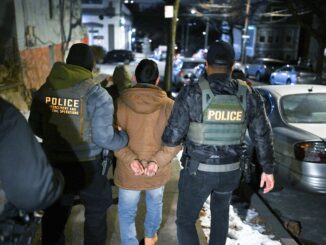
For weeks, immigration enforcement officials have tried to dramatically ramp up arrests, aiming for at least 1,200 to 1,500 per day, using a series of aggressive and unconventional tactics. Among them: recruiting the help of agencies not usually involved with immigration enforcement, invoking the centuries-old Alien Enemies Act to send Venezuelan migrants to a prison in El Salvador and expanding the government’s power to expel migrants without a court hearing.
While Trump and his top aides vowed to focus on immigrants in the country illegally or convicted of committing a violent crime, recent enforcement actions have ensnared thousands of migrants and immigrants who have authorization to be in the country.
Meanwhile, DHS on Friday eliminated three internal watchdog agencies that advocated for immigrants and investigated complaints about detention conditions, the care of migrant children and delays in processing applications for green cards or citizenship. DHS officials said the offices created bureaucratic hurdles that obstructed the agency’s work.
The potential agreement with the IRS would probably to mark the first time immigration officials have turned to the tax system for large-scale enforcement assistance. Undocumented workers’ wages are subject to the same tax withholding and reporting requirements that apply to other U.S. residents. Many immigrants file tax returns and save them in hopes that a record of paying taxes will one day help them make a case to apply for legal residency. The 1986 Immigration Reform and Control Act granted permanent legal status to undocumented migrants who had paid back taxes, among other requirements.
On its website, the IRS says undocumented immigrants “are subject to U.S. taxes in spite of their illegal status.” Because most are ineligible for Social Security numbers, the IRS allows them instead to file with individual taxpayer numbers, known as ITINs.
If approved, the agreement to share taxpayer information with ICE would mark a sharp reversal from just a few weeks ago. Last month, IRS leadership rejected a DHS request for the names, addresses, phone numbers and email addresses of 700,000 people the Trump administration suspected of being in the country illegally.
The acting IRS commissioner at the time, Doug O’Donnell, and agency attorneys concluded both requests were unlawful. O’Donnell retired the next day, after 38 years at the tax agency. His successor, Melanie Krause, quickly signaled an interest in collaborating with Homeland Security officials, The Post has reported. Two weeks later, the Trump administration also replaced the IRS’s top attorney, who had voiced opposition to attempts to share taxpayer data across agencies, including by Elon Musk’s U.S. DOGE Service.
Krause and the IRS’s new acting chief counsel, Andrew De Mello, have since met multiple times with Treasury and DHS officials to hash out an agreement, three of the people said.
-

Trump strips security clearance from political foes, including Tish James, Alvin Bragg
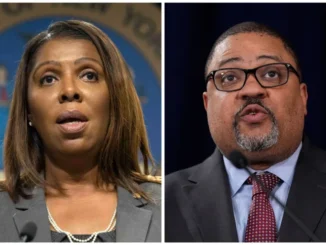
WASHINGTON, D.C. (TIP): President Trump has revoked security clearances and access to classified information from a slew of his political opponents, including New York Attorney General Letitia James and Manhattan DA Alvin Bragg.
“I have determined that it is no longer in the national interest for the following individuals to access classified information,” Trump announced in a presidential memo issued late Friday night before directly naming 15 of his most vocal critics, as well as the entire Biden family.
The list notably includes all three Democrats who ran against him in the 2016 and 2024 elections: Hillary Clinton, Joe Biden and Kamala Harris. It also names former U.S. representatives Liz Cheney and Adam Kinzinger — two high-profile, anti-Trump Republicans — along with the two top law enforcement officials in New York, both of whom took the president to court and won. Attorney General James has brought multiple lawsuits against Trump and his businesses. In February 2024, a judge ruled in favor of her office in a civil fraud case against Trump, his sons and the Trump Organization, ordering them to pay more than $450 million she said they illegally obtained.
When celebrating the “tremendous victory” for New York and the nation, James criticized the then-former president’s “fraudulent” and unjust ways to enrich himself and his family.
“While he may have authored the ‘Art of the Deal,’ our case revealed that his business was based on the art of the steal,” James said at the time.
Three months later, a jury in Manhattan found Trump guilty of falsifying business records in a hush-money scheme to conceal damaging information during the 2016 presidential election.
“Trump went to illegal lengths to lie repeatedly in order to protect himself and his campaign,” Bragg said when announcing the all-count trial conviction, adding his office has a “solemn responsibility to ensure equal justice under the law regardless of the background, wealth or power of the accused.”
On Friday, Trump appeared to remind James, Bragg and several of his opponents that he may, indeed, use power against his perceived adversaries — even if symbolically.
In the memo, the president instructed the heads of federal agencies to “take all necessary actions, consistent with existing law,” to immediately revoke security clearances and access to classified information from those individuals.
Along with preventing them from receiving classified briefings and obtaining information from members of the intelligence community, the action also revokes their “unescorted access to secure United States Government facilities.”
While it’s unclear what type of security clearance those individuals had, the revocation is largely being perceived as symbolic.
“It’s another petty, performative move designed to punish his perceived enemies, regardless of reality,” Kinzinger said Saturday, calling out the president’s “latest stunt.”
“Reports are circulating that he’s decided to revoke my security clearance. The only problem? I don’t have one.”
-

‘Frequent references’ to J-K will not validate Pakistan’s claim on territory: India at UN
UNITED NATIONS (TIP): India has slammed Pakistan for its “unjustified” reference to Jammu and Kashmir in the UN General Assembly, with New Delhi asserting that such remarks will neither validate the country’s claim nor justify its practice of cross-border terrorism. “As is their habit, the former foreign secretary of Pakistan today has made an unjustified reference to the Indian Union Territory of Jammu and Kashmir,” India’s Permanent Representative to the UN, Ambassador P Harish, said in remarks on Friday, March 14, in the General Assembly at the informal meeting of the plenary to commemorate the International Day to combat Islamophobia. Harish said frequent references by Pakistan will “neither validate their claim nor justify their practice of cross-border terrorism”.
“The fanatical mindset of this nation is well known, as also its record of bigotry. Such efforts will not change the reality that Jammu and Kashmir was, is and will always be an integral part of India,” he said.
Harish’s strong retort came after Pakistan’s former foreign secretary, Tehmina Janjua, made references to Jammu and Kashmir in her remarks at the informal meeting to commemorate the International Day to Combat Islamophobia.
(Source: PTI) -

All will lose : U.N. chief warns amidst growing global trade war
UNITED NATIONS (TIP): United Nations Secretary-General Antonio Guterres has warned that “all will lose” when countries get into trade wars, against the backdrop of tariff wars unleashed by the Trump administration.
“I think we live in a global economy. Everything is interlinked. And obviously, one of the great advantages of having a situation of free trade is to create conditions for all countries to benefit. When we enter into a trade war, I believe all will lose,” Mr. Guterres said in United Nations on Wednesday, March 13, 2025.
He was responding to a question on the growing global trade war. U.S. President Donald Trump, in his second term in the White House, has said America will impose reciprocal tariffs on nations that charge high levies on U.S. goods.
The Trump administration’s global tariffs on steel and aluminum have come into effect, prompting the European Union (EU) and Canada to also announce levies on U.S. products. The administration has also announced tariff on imports from Canada, Mexico and China. In a retaliatory action, these countries have also announced tariffs on goods imported from the United States.
Trump has said America is “going to take in hundreds of billions of dollars in tariffs”, and “we are going to become so rich, you are not going to know where to spend all that money. I am telling you; you just watch. We are going to have jobs. We are going to have open factories. It is going to be great”.
Trump has repeatedly called out India for the high tariffs that it imposes on American products. Last week, he criticized the high tariffs charged by India and other countries, terming them “very unfair”, and announced that reciprocal tariffs will kick in next month on nations that impose levies on American goods. Trump has said America has been “ripped off” for decades by nearly every country on earth, and “we will not let that happen any longer”.
“If you do not make your product in America, however, under the Trump administration, you will pay a tariff and in some cases, a rather large one. Other countries have used tariffs against us for decades and now, it is our turn to start using them against those other countries. On average, the European Union, China, Brazil, India, Mexico and Canada…. And countless other nations charge us tremendously-higher tariffs than we charge them,” Trump has said.
“It is very unfair. India charges us auto tariffs higher than 100%. China’s average tariff on our products is twice what we charge them. And South Korea’s average tariff is four times higher…. This is happening by friend and foe,” the U.S. President has said.
(Source: PTI) -
Arab leaders gather in Saudi Arabia to hash out recovery plan for Gaza
RIYADH (TIP): Arab leaders were gathering in Saudi Arabia on Feb 21 to hammer out a recovery plan for Gaza aimed at countering President Donald Trump’s proposal for US control of the territory and the expulsion of its people.
Trump’s plan has united Arab states in opposition to it, but disagreements remain over who should govern the war-ravaged Palestinian territory and how to fund its reconstruction.
“We’re at a very important historic juncture in the Arab-Israeli or Israeli-Palestinian conflict… where potentially the United States under Trump could create new facts on the ground that are irreversible,” Andreas Krieg, a King’s College London expert said.
Trump triggered global outrage when he proposed the United States “take over the Gaza Strip” and relocate its more than two million residents to Egypt and Jordan. A source close to the Saudi government told AFP that Arab leaders would discuss “a reconstruction plan to counter Trump’s plan for Gaza”.
The Gaza Strip is largely in ruins after more than 15 months of war between Israel and Hamas, with the United Nations recently estimating that rebuilding would cost more than $53 billion.
During a meeting with Trump in Washington on February 11, Jordan’s King Abdullah II said Egypt would present a plan for a way forward.
The Saudi source said the delegates would discuss “a version of the Egyptian plan”.
The official Saudi Press Agency, citing an official, confirmed on Thursday that Egypt and Jordan were participating in the Riyadh summit along with the six country members of the Gulf Cooperation Council (GCC).
It also said decisions issued by the “unofficial fraternal meeting” would appear on the agenda of an emergency Arab League summit to be held in Egypt on March 4.
An Arab diplomat told AFP the meeting was supposed to start at 3 pm (1200 GMT).
Egyptian President Abdel Fattah al-Sisi arrived in Saudi Arabia on Thursday, his office said. (AFP) -

Natural disasters that rocked the world in 2024
The year 2024 has seen a horrifying variety of natural disasters resulting in tragic deaths and destruction that have shocked the world. Events, including everything from earthquakes to hurricanes and landslides, have left in their wake grieving survivors and destroyed homes and livelihoods. Of course, natural disasters have afflicted humanity since the dawn of time—but now we have a sinister extra factor to contend with: climate change.
Noto Earthquake
A powerful earthquake struck on New Year’s Day, heralding a disastrous start to 2024 for the people of the Noto Peninsula in western Japan. NASA’s Earth Observatory reported, “The 7.5 magnitude main shock was followed by dozens of strong aftershocks in the following minutes, hours, and days.” The principal quake struck at 4:10 in the afternoon.Just to make a bad situation worse, there was heavy snowfall in the immediate aftermath of the earthquake and the resulting fires, hampering rescue efforts. NASA geophysicist Eric Fielding said that some areas of the Noto Peninsula were lifted as much as 13 feet (4 meters). Around 84,000 homes were damaged, leaving a repair bill that may be as high as $17.6 billion, with 14,000 people directly affected by the destruction. And grimly, 281 people lost their lives, with many more badly injured.
Spain Floods
On October 29, as much as 20 inches (51 cm) of rain fell on the southeastern Spanish province of Valencia in just eight hours. Unsurprisingly, this massive deluge resulted in flash floods and devastating destruction. The city of Valencia, which lies on the Mediterranean coast, and the surrounding towns and farmland were heavily flooded, and a total of 216 people died, almost half of them over the age of 70. The rain turned streets into rivers, and cars were tossed aside as if they were toys.NASA’s Earth Observatory reports that the exceptionally high levels of rainfall “came from a high-altitude low-pressure weather system that became isolated from the jet stream.” This happened when a cold front collided with warm air over the Mediterranean. In the aftermath of the floods, public outrage at a perceived lack of warning and poor response from rescue services spilled over into angry demonstrations. When King Felipe VI and Queen Letizia visited Valencia, angry survivors pelted the royal couple with mud as they toured the streets.
Uganda Garbage Landslide
The Kiteezi garbage dump, clearly visible on Google Maps satellite view, is the only place to dispose of garbage in Uganda’s capital city, Kampala. The satellite pictures also reveal the fact that there are homes nestled cheek-by-jowl with the festering mountain of trash, which covers a 36-acre site in the city. Some of the residents of those homes were the victims of a garbage landslide in August when torrential rain caused a substantial portion of the trash mountain to collapse.Around 1,000 people were forced to leave their homes, but it turns out that by escaping with their lives, they were the fortunate ones, even though many lost everything. Meanwhile, rescuers dug their way through tons of garbage in a desperate effort to locate survivors. A few days after the Kiteezi disaster, the Kampala police announced a confirmed death toll of 35, with 28 people still unaccounted for.
Hurricane Helene
Helene, the deadliest hurricane since Katrina 20 years ago, swept in from the Atlantic in late September, making landfall in Florida. From there, it worked its way across Georgia, both Carolinas, Virginia, Tennessee, and Alabama. As it tracked across the southeastern states, it left a terrible trail of destruction in its wake. Rescue and recovery efforts continued for days after Helene had completed its bout of devastation.More than a week after the hurricane had blown through, the Associated Press reported that more than 230 people had lost their lives in the fearful storm. Those who survived Helene had to cope with widespread power outages, intense flooding, and massive destruction of infrastructure. North Carolina’s Governor Roy Cooper highlighted the ferocious strength of Helene, saying, “We knew storms could cause damage, but we weren’t expecting the magnitude of this one – water raging in rivers all over in a way we’ve never seen before.”
Wayanad Landslide
In July, it was the Wayanad district in India’s Kerala region on the country’s southwestern coast that experienced just how devastating the forces of nature can be. Torrential rain, 22 inches (56 cm) in two days, caused landslides, and by early August, the grim death toll had risen to 392, with 150 people reported as being missing. The casualties came in small villages on steep hillsides where many of the inhabitants worked on local tea plantations.The Hindu website told the tragic story of two of the villages that were engulfed by the landslide, Mundakkai and Chooralmala, both places previously best known for their “scenic landscapes and waterfalls.” However, in the massive landslide, which originated in a nearby mountaintop and barreled some 5 miles (8 km) down the course of the Iruvaniphuza River, these two villages were virtually wiped out. Weeks later, the gruesome task of identifying bodies continued, with some of the dead only identified with the use of DNA testing.
Indonesian Volcano
Volcanic Mount Lewotobi Laki-Laki on Indonesia’s Flores Island erupted in early November, sending hot ash soaring 6,500 feet (1,981 meters) into the skies. A flow of deadly lava and cascading rocks hit villages on the mountain’s slopes, about 2 miles (3.2 km) from the eruption. The Indonesian Center for Volcanology and Geological Disaster Mitigation called for a complete evacuation for all those living within a four-mile radius of Mount Lewotobi Laki-Laki “due to the ejection of incandescent material.” The evacuation came after ten people had already lost their lives.BBC News reported that a video shot by people at the scene of the eruption showed survivors “covered in volcanic ash, rock showers and homes ablaze, as well as the scorched aftermath of the disruption.” In fact, there had been considerable advance warning of a likely eruption as Mount Lewotobi Laki-Laki had been emitting clouds of smoke and ash since December 2023. As a result, many people had previously left the area or the casualty level would almost certainly have been higher.
Typhoon Yagi
Typhoon Yagi raged across several Asian countries in early September, including Laos, Thailand, and Myanmar, but Vietnam was the worst affected country. The overall death toll of Yagi was 600, with 42 fatalities in Thailand, 242 in Myanmar, and 300 in Vietnam. The majority of the casualties were caused by flash floods and landslides resulting from the extreme rainfall that Yagi brought to the region. The Center for Disaster Philanthropy (CDP) reported that there were “still people missing who are presumed dead.”CDP cited the case of one especially tragic incident in the Vietnamese village of Lang Nu in Lao Cai province. There, the torrential rain caused a landslide, which overwhelmed the hamlet’s population of 158. At least 48 of the villagers lost their lives, while a further 17 were injured. Some 39 were missing and assumed to be dead, so that less than half the people of the village had survived to tell the horrifying tale. As well as a high death toll overall, Vietnam also suffered the destruction of around 237,000 homes.
Drought in Zambia
A severe drought got underway in the African nation of Zambia in January 2024, and the following month, the African country’s president, Hakainde Hichilema, declared an official national disaster. The United Nations has said that the landlocked South African nation experienced the worst water shortage during the growing season in three decades. This has caused food shortages in Zambia, but it’s not just the agricultural sector that has been damaged.Up to 80% of Zambia’s electric power is generated by one hydroelectric scheme, the Kariba Dam, with its mighty 420-foot (128-meter) wall creating the world’s largest man-made lake. But thanks to the drought, water levels have fallen too low to power the turbines fully, severely curtailing the electricity supply. In November, the Guardian reported that the drought continued with no sign of rains, and that meant the Kariba generator might have to close altogether. Already, Zambians are reduced to just three hours of electricity each day.
Ethiopian Landslide
It was on July 21 and 22 that two massive landslides, triggered by torrential rainfall, engulfed several Ethiopian villages in the Gofa Zone region. Within a couple of days of the catastrophe, the death toll stood at 257, with the UN warning that the total number of fatalities was likely to increase to perhaps as high as 500. Some 15,000 people were evacuated from the Kencho Shacha Gozdi district as further landslips were a distinct possibility. Harrowing reports emerged of survivors desperately digging through deep mud with their bare hands in an effort to find those buried by the disastrous landslides. Speaking to Agence France-Presse, survivor Tseganesh Obole told how she and her six children had been buried in the mud. Although she had escaped with two of her youngsters, a distraught Tseganesh explained that “four of my children died and remained buried.”
Las Vegas Heat Wave
Las Vegas residents know that summer inevitably brings high temperatures that can be hard to bear. But the heatwave that baked the city in 2024 was way beyond normal. During the three summer months—June, July, and August—the average daily temperature was 96.2°F (35.7°C), the hottest summer Las Vegas has experienced since records began in 1937. Weather service meteorologist Morgan Stessman told the Las Vegas Review-Journal that, “We blew [the summer] record out of the water.”In December, the Las Vegas Review-Journal reported that the Clark County coroner’s office had confirmed that 491 deaths could be attributed to the exceptionally hot summer, up from 309 heat fatalities in 2023. Grimly, the coroner’s office also pointed out that nearly all of those killed by heat and aged under 40 had a contributing cause of death of drug or alcohol abuse. -

The rise and contributions of the Indian diaspora
The Indian diaspora is one of the largest and most diverse global communities, with an estimated 32 million people of Indian origin living across the world. From the shores of the Caribbean islands to the bustling cities of North America, Europe, the Middle East, Southeast Asia, and beyond, Indians have built thriving communities that are often key to the economic, social, and cultural fabric of their host nations. Over the past few centuries, the Indian diaspora has experienced remarkable growth, playing an influential role in shaping the world’s geopolitical landscape, global markets, and cultural exchanges. This article aims to explore the rise of the Indian diaspora, their historical journey, the factors contributing to their migration, and their diverse and substantial contributions to their host countries and to India itself.
Historical Background of Indian Emigration
Early Waves of Migration
Indian migration has a rich history that spans centuries. The earliest recorded instances of Indian emigration occurred during the ancient and medieval periods, with Indians settling in Southeast Asia, Africa, and the Arabian Peninsula. Traders, scholars, and missionaries often traveled across the Indian Ocean, leaving behind traces of Indian culture and religion.
During the British colonial period (18th–20th centuries), however, emigration from India significantly increased. The indentured labor system, implemented by the British after the abolition of the transatlantic slave trade, became the primary mechanism for the large-scale migration of Indians. Millions of Indians were transported to various colonies such as Mauritius, Fiji, the Caribbean islands, and South Africa to work on sugar plantations, railways, and in other industries. This wave of migration laid the foundation for the development of vibrant Indian communities in these regions, some of which still maintain strong cultural ties to their Indian roots.
Post-Independence Migration
After India’s independence in 1947, migration patterns began to shift. Many Indians sought better economic opportunities abroad, especially in Western countries such as the United States, the United Kingdom, Canada, and Australia. The 1960s and 1970s saw the rise of skilled Indian professionals, including doctors, engineers, and IT specialists, migrating to meet labor shortages in these nations. By the 1980s and 1990s, the expansion of India’s global footprint, coupled with economic liberalization, further accelerated the migration of professionals seeking better opportunities in growing economies.
Factors Driving Indian Migration
Economic Opportunities
The most significant factor driving Indian migration has been the search for better economic prospects. As India’s population grew and its economic landscape evolved, many Indians faced limited opportunities for career advancement, education, and financial stability at home. Countries with burgeoning economies and labor shortages, such as the Gulf states, the United States, Canada, and the United Kingdom, offered higher wages, better living standards, and improved career prospects.
In the post-1991 liberalized economy, India’s economic growth allowed many to take advantage of international opportunities. The rise of the Indian information technology (IT) sector also played a crucial role in facilitating the migration of highly skilled professionals to countries like the United States and Canada.
Educational Pursuits
The pursuit of education has also been a driving force for migration. Indian students have flocked to institutions abroad for higher education, particularly in fields like engineering, medicine, management, and the sciences. The United States, United Kingdom, Australia, and Canada remain top destinations for Indian students, who not only benefit from quality education but also gain exposure to international networks, knowledge, and skills.
Political and Social Factors
In some cases, migration was driven by political instability, persecution, or limited opportunities in India. For example, during the period of political turmoil in India during the 1970s and 1980s, large numbers of people sought refuge or better prospects abroad. In countries like Uganda, Fiji, and Kenya, political events (such as Idi Amin’s expulsion of Indians from Uganda) forced many to leave.
Additionally, factors such as religious intolerance, caste-based discrimination, and economic inequalities led to waves of migration from certain regions within India to more developed countries, where better social mobility and opportunities were available.
Indian Diaspora’s Contribution to Global Economies
Economic Impact and Remittances
One of the most important contributions of the Indian diaspora has been in the form of remittances. According to the World Bank, India has been the largest recipient of remittances globally, receiving over $87 billion in 2020 alone. Remittances sent by Indian expatriates to their families back home have been a vital source of income for millions, contributing significantly to poverty alleviation, education, healthcare, and overall economic growth.
The economic footprint of the Indian diaspora extends beyond remittances. Indian entrepreneurs and professionals have made substantial investments in their host countries, contributing to the growth of industries ranging from technology to real estate, hospitality, and retail. The Indian diaspora has played a key role in the global technology boom, especially in sectors like software development, finance, and telecommunications.
Business and Entrepreneurship
Indians have been instrumental in the development of several industries worldwide. In countries like the United States, the United Kingdom, Canada, and Australia, Indian entrepreneurs have built successful businesses that employ thousands of people. In Silicon Valley, Indian-origin entrepreneurs have become some of the most prominent figures in the tech industry, with individuals like Sundar Pichai (CEO of Google), Satya Nadella (CEO of Microsoft), and Vinod Khosla (co-founder of Sun Microsystems) leading major global tech firms.
In the United States, Indian immigrants have made their mark in the healthcare sector, particularly in the fields of medicine and biotechnology. Indian-origin doctors, researchers, and health professionals are highly respected for their expertise and have contributed to the development of cutting-edge medical technologies.
Indian businesses have also flourished in the Gulf states, where large communities of Indians work in construction, retail, and hospitality. Moreover, successful Indian businesspeople, such as Lakshmi Mittal, who heads ArcelorMittal, the world’s largest steel producer, and Mukesh Ambani, the chairman of Reliance Industries, have become global symbols of entrepreneurship.
Contributions to Culture and Society
Cultural Diplomacy and Soft Power
The Indian diaspora has been a powerful vehicle for the spread of Indian culture across the globe. Whether through Bollywood films, traditional dance forms like Bharatanatyam and Kathak, or global cuisine, the Indian diaspora has brought India’s rich cultural heritage to the forefront of global consciousness. Cultural festivals, such as Diwali and Holi, are celebrated by communities of Indian origin in many countries, fostering a greater understanding of Indian traditions and values.
In countries like the United States, the United Kingdom, Canada, and Australia, the Indian diaspora has been at the center of intercultural dialogues, promoting diversity, tolerance, and understanding. The popularity of yoga and meditation in the West is also largely attributed to the Indian diaspora’s efforts in sharing these practices with the world.
Philanthropy and Social Causes
Indian diaspora communities have also made significant contributions to charitable causes and social development, both in their host countries and in India. Many members of the Indian diaspora have been involved in philanthropy, supporting causes such as education, healthcare, and disaster relief.
The Indian diaspora has also been active in promoting educational initiatives, providing scholarships to students in need, and supporting schools and universities in India. The contributions of Indian-origin individuals to international organizations such as the United Nations and the World Health Organization further highlight the global impact of the Indian diaspora.
Political Influence and Advocacy
Engagement in Host Country Politics
The Indian diaspora’s political engagement has grown significantly over the years. In countries like the United States, the United Kingdom, Canada, and Australia, Indian-origin individuals have been elected to high political offices, contributing to the political landscape of their respective nations. Notable figures include Kamala Harris, the Vice President of the United States, and Priti Patel, the Home Secretary of the United Kingdom, both of whom have Indian heritage.
Indian-origin politicians have advocated for the interests of the diaspora, building bridges between their home country, India, and their adopted nations. In the United States, for example, Indian-Americans have emerged as a significant voting bloc, influencing political campaigns, policy decisions, and international relations.
Strengthening India’s Global Presence
The Indian diaspora has also played a crucial role in strengthening India’s global influence. By acting as a bridge between their host countries and India, the diaspora has contributed to enhancing India’s diplomatic, economic, and cultural ties with the world. Indian-origin politicians, business leaders, and community organizers have often acted as ambassadors for India, lobbying for greater trade and investment, fostering bilateral partnerships, and promoting India’s interests on the global stage.
The Future of the Indian Diaspora
As the world becomes increasingly interconnected, the role of the Indian diaspora is expected to grow even further. In the coming decades, the Indian diaspora will continue to be a critical factor in fostering India’s global standing. The rise of India as an economic powerhouse, along with its expanding influence in global politics, will provide new avenues for the diaspora to contribute to their home country’s growth.
Moreover, as the Indian diaspora becomes more integrated into the societies in which they live, their contributions will likely become more visible and impactful. The focus will likely shift from simple remittances and labor to more complex forms of collaboration, such as joint ventures, innovation partnerships, and global research initiatives. -

First World Meditation Day in the United Nations

Attendees at the United Nations. NEW YORK CITY (TIP): Permanent Mission of India to the United Nations in New York organized “Meditation for Global Peace and Harmony” to mark the First World Meditation Day at the United Nations Headquarters in New York on 20 December 2024.
The landmark event was attended by H.E. Philemon Yang, President of the General Assembly, Under Secretary General Mr. Atul Khare and several other dignitaries. Keynote address on the occasion was delivered by Gurudev Sri Sri Ravi Shankar, who also gave a special meditation session during the event to more than 600 enthusiastic participants.

Gurudev Sri Sri Ravi Shankar is being received by Permanent Representative of India to the United Nations, Ambassador Parvathaneni Harish Permanent Representative of India to the United Nations, Ambassador Parvathaneni Harish, in his welcome address, underscored the importance of the ancient Indian practice of Dhyana as an instrument for personal fulfillment and inner peace, rooted in the civilizational dictum of Vasudhaiva Kutumbakam – the whole world is one family. He added that the United Nations General Assembly resolution on World Meditation Day acknowledged the link between yoga and meditation as complementary approaches to health and wellbeing. President of General Assembly noted that meditation cultivates compassion and respect for people. Speaking on the occasion, Under Secretary General Mr. Khare outlined the inherent connect between mental health and meditation and the profound impact of meditation on United Nations Peacekeepers. Gurudev Sri Sri Ravi Shankar highlighted multiple benefits and dimensions associated with meditation in his keynote address.

Permanent Representative of India to the United Nations, Ambassador Parvathaneni Harish at the United Nations It may be recalled that on 6 December 2024, the United Nations General Assembly unanimously adopted the resolution, declaring 21st December as World Meditation Day. India was instrumental in the unanimous adoption of the said resolution. Adoption of the resolution at such a time highlights the importance of promoting calm, peace and overall human wellbeing when the world is facing conflicts and suffering. It also marks a significant milestone in global recognition of meditation’s transformative potential.
21 December marks the Winter Solstice and in the Indian tradition, Uttarayana begins with the Winter Solstice and is considered as an auspicious time of the year, especially for meditation and inner reflection. It also falls exactly six months after the International Day of Yoga on 21 June, which is the Summer Solstice.
-

President-elect Donald Trump’s transition says several of his Cabinet picks and appointees have been targeted by bomb threats and “swatting attacks.”
WASHINGTON, D.C. (TIP): Several of President-elect Donald Trump’s Cabinet picks and appointees have been targeted by bomb threats and “swatting attacks,” Trump’s transition said on Wednesday, November 27, 2024, an AP Report said.
“Last night and this morning, several of President Trump’s Cabinet nominees and Administration appointees were targeted in violent, un-American threats to their lives and those who live with them,” Trump transition spokesperson Karoline Leavitt said in a statement.
She said the attacks “ranged from bomb threats to ‘swatting.’ In response, law enforcement and other authorities acted quickly to ensure the safety of those who were targeted. President Trump and the entire Transition team are grateful for their swift action.” Swatting entails generating an emergency law enforcement response against a target victim under false pretenses.
The FBI said in a statement that it is “aware of numerous bomb threats and swatting incidents targeting incoming administration nominees and appointees, and we are working with our law enforcement partners. We take all potential threats seriously, and as always, encourage members of the public to immediately report anything they consider suspicious to law enforcement.”
Among those targeted was New York Rep. Elise Stefanik, Mr. Trump’s pick to serve as the next ambassador to the United Nations.
Her office said that, Wednesday morning, she, her husband, and their 3-year-old son were driving home from Washington for Thanksgiving when they were informed of a bomb threat to their residence in Saratoga County.
“New York State, County law enforcement, and U.S. Capitol Police responded immediately with the highest levels of professionalism,” her office said in a statement. “We are incredibly appreciative of the extraordinary dedication of law enforcement officers who keep our communities safe 24/7.”
In Florida, meanwhile, the Okaloosa County sheriff’s office said in an advisory posted on Facebook that it “received notification of a bomb threat referencing former Congressman Matt Gaetz’s supposed mailbox at a home in the Niceville area around 9 a.m. this morning.”
While a family member resides at the address, they said “former Congressman Gaetz is NOT a resident. “The mailbox however was cleared and no devices were located. The immediate area was also searched with negative results.”
Gaetz was Trump’s initial pick to serve as attorney general, but he withdrew from consideration amid allegations that he paid women for sex and slept with underage women. Gaetz has vehemently denied any wrongdoing and said last year that a Justice Department investigation into sex trafficking allegations involving underage girls had ended with no federal charges against him.
The threats follow a political campaign marked by unusual violence. In July, a gunman opened fire at a Trump rally in Butler, Pennsylvania, grazing the then-candidate in the ear with a bullet and killing one of his supporters. The U.S. Secret Service later thwarted a subsequent assassination attempt at Trump’s West Palm Beach, Florida, golf course when an agent spotted the barrel of a gun poking through a perimeter fence while Trump was golfing.