Tag: United Nations Security Council (UNSC)

  • Indian American Democratic Congressman Ro Khanna asks India to condemn Putin, stop buying Russian oil

    Indian American Democratic Congressman Ro Khanna asks India to condemn Putin, stop buying Russian oil

    WASHINGTON, D.C. (TIP): Indian American Democratic Congressman Ro Khanna has reiterated his call to India to give up its neutral stance and condemn Russian President Vladimir Putin for the invasion of Ukraine.

    Going a step further, he wanted India to stop buying oil from Russian and China and get weapons from the US instead of Russia even as he acknowledged that the US needed India to ultimately contain China.

    “I’ve been clear actually on India, and I think India ought to be condemning Putin and India ought not to be getting oil from Russia or China,” Khanna said in an interview with Fox News Sunday.

    “We ought to rally the world around to isolate Putin,” said Khanna, who is also the vice chair of the US India Caucus, the largest country-specific caucus in the House of Representatives. “First India should condemn Putin in the UN for the blatant human rights violations,” he said. “Second, they need to realize, they have to pick sides.” “We, the United States, were with them when China invaded India. Putin wasn’t there,” he said.

    “And it’s time for them to buy weapons from the United States, not Russia,” said Khanna, who represents Silicon Valley in the House. “We’ve got to look at how we can facilitate that and make that easier,” he said noting, “We need India as an ally ultimately to contain China.”

    In a recent interview with the American Bazaar too, Khanna had asked India to clearly pick sides with a free enterprise democracy over Vladimir Putin’s dictatorship. “I think my position is supported by most Indian Americans. They believe and understand what I do,” he had said. “We have to strengthen the relationship,” Khanna said. “We have to have the defense relationship even more strengthened so that they’re not reliant on arms from Putin, but that they are more building and buying from the United States.”

    “And most people in Silicon Valley at least want to strengthen the US India relationship,” Khanna told the American Bazaar. “Want to see them clearly pick sides with a free enterprise democracy as opposed to dictatorship which is what Putin is.”

    In the interview with Fox News, Khanna also defended President Joe Biden’s off the cuff remarks that Putin “cannot remain in power” even as he made clear that the US policy is not regime change, but a negotiated end of war.

    “US policy is not regime change. It’s negotiated end of this war,” Khanna said noting that the White House had been quick to clarify the US position.

    “They have been disciplined and said there has to be negotiated end of this war,” he said. “It’s a Democratic house and it has been Democratic policy for the last 20 years.” Defending Biden, Khanna said any human being would express frustration over the bombing of women and children in Mariupol. “The President was speaking from the heart. But it’s not the US policy to seek the regime change,” he asserted. Biden’ ad-libbed words — “For God’s sake, this man cannot remain in power” — in Warsaw Saturday at the end of a European visit – created a firestorm around the world and sent US officials scrambling to clarify the US position.

  • Saudi Aramco storage facility targeted by Houthi attack causing fire

    Saudi Aramco storage facility targeted by Houthi attack causing fire

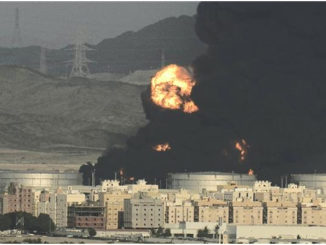
    RIYADH (TIP): Yemen’s Houthis said they launched attacks on Saudi energy facilities on March 25 and the Saudi-led coalition said oil giant Aramco’s petroleum products distribution station in Jeddah was hit, causing a fire in two tanks but no casualties. A huge plume of black smoke could be seen rising over the Red Sea city where the Saudi Arabian Grand Prix is taking place this weekend, an eyewitness said. Unverified videos shared on social media showed fire raging in oil tanks in an Aramco facility on the outskirts of Jeddah. There was no immediate comment from Aramco or the energy ministry when contacted by Reuters. The Iran-aligned Houthi movement that has been battling a coalition led by Saudi Arabia for seven years launched missiles on Aramco’s facilities in Jeddah and drones at RasTanura and Rabigh refineries, the group’s military spokesman said. He said they also targeted “vital facilities” in the capital Riyadh. Saudi state media had earlier reported that a string of drone and rocket attacks by the Houthis was foiled by the coalition. Saudi air defences also intercepted and destroyed a ballistic rocket launched towards the port city of Jazan, which caused a “limited” fire to break out at an electricity distribution plant, state media reported. Saudi Arabia, the world’s largest oil exporter, said earlier this week it would not bear responsibility for any oil supply disruptions to global markets as a result of Houthi attacks that have intensified in the past three weeks. – Reuters

  • North Korea fires suspected missile into sea

    North Korea fires suspected missile into sea

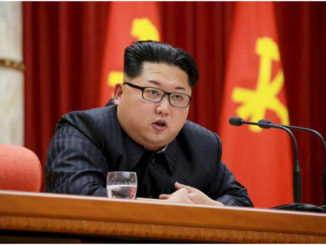
    Seoul (TIP): North Korea fired at least one suspected ballistic missile towards the sea on March 24, its neighbours’ militaries said, apparently extending its barrage of weapons tests that may culminate with a flight of its biggest-yet intercontinental ballistic missile. South Korea’s Joint Chiefs of Staff didn’t immediately say whether the weapon involved in the launch was ballistic or how far it flew. Japan’s Prime Minister’s Office Defence Ministry said the North fired a possible ballistic missile. It was North Korea’s 12th round of weapon launches this year and came after it fired suspected artillery pieces into the sea on Sunday. Experts say the North’s unusually fast pace in testing activity underscore its dual goal of advancing its weaponry and applying pressure on Washington, over a deepening freeze in nuclear negotiations. The North has also tested a variety of new missiles, including a purported hypersonic weapon and its first launch since 2017 of an intermediate range missile potentially capable of reaching Guam, a key US military hub in the Pacific.

    It also conducted two medium-range tests from near its capital area in recent weeks that the US and South Korean militaries later assessed as involving components of the North’s largest ICBM, the Hwasong-17, which they said could be tested at full range soon.

    North Korea’s official media insisted that those two tests were aimed at developing cameras and other systems for a spy satellite. Analysts say the North is clearly attempting to simultaneously resume ICBM testing and acquire some level of space-based reconnaissance capability under the pretence of a space launch, to reduce international backlash to those moves. The launch may possibly come around as a major political anniversary in April, the birthday of state founder Kim II Sung, the late grandfather of current leader Kim Jong-Un. The North’s previous ICBMs demonstrated potential range to reach the American homeland during the three flight tests in 2017.

    Its development of the larger Hwasong-17, which was first revealed in a military parade in October 2020, possibly indicates an aim to arm it with multiple warheads to overwhelm missile defences, experts say. (AP)

  • Zelenskyy appeals to NATO for more weapons

    Zelenskyy appeals to NATO for more weapons

    Lviv (TIP): Ukraine’s president has pleaded with NATO to provide his embattled nation with military assistance. In a video address to the NATO summit March 24, VolodymyrZelenskyy said Ukraine needs “military assistance without limitations”, as Russia is “using its entire arsenal” against the country. Zelenskyy urged NATO to provide Ukraine with “1% of all your planes, 1% of all your tanks”. “We can’t just buy those,” Zelenskyy said. “When we will have all this, it will give us, just like you, 100% security.”    Ukraine is also in dire need of multiple launch rocket systems, anti-ship weapons and air defense systems, Zelenskyy said. “Is it possible to survive in such a war without this?,” he asked.

    Zelenskyy said Russia used phosphorous bombs on Thursday morning, killing both adults and children. He reminded NATO leaders that thousands of Ukrainians have died in the past month, 10 million people have left their homes, and urged NATO to give “clear answers”.

    “It feels like we’re in a gray area, between the West and Russia, defending our common values,” Zelenskyy said emotionally. “This is the scariest thing during a war—not to have clear answers to requests for help.”          Zelenskyy did not reiterate his request for a no-fly zone or ask to join NATO, according to a senior Biden administration official.

    Germany says it has sent about 10,000 metric tons of essential aid to Ukraine using a recently created “rail bridge” of trains shuttling back and forth between the two countries.

    Transport minister Volker Wissing told the Funke media group in an interview published Thursday that the rail link was established two weeks ago to bring much-needed food, drink and hygiene products from Germany to Ukraine. Speaking at a Berlin cargo terminal Thursday, Wissing said many of the goods being sent to Ukraine by train had been donated.

    “We hope this war is over soon and will do everything to ease the suffering,” he said.

    German rail company Deutsche Bahn has separately organised additional trains to bring refugees from the Polish-Ukrainian border to Germany.

    The Czech Republic’s Parliament has approved a plan to deploy up to 650 Czech service members to Slovakia as part of an multinational NATO force set up in response to Russia’s invasion of Ukraine.

    Parliament’s lower house approved the deployment Thursday after the upper house gave the green light last week.

    The United States, Germany, the Netherlands, Poland and Slovenia will also contribute troops to the unit, expected to include up to 2,100 soldiers.

    The plan is part of the NATO initiative to reassure member countries on the alliance’s eastern flank.

    The alliance stationed troops in the Baltic countries – Estonia, Latvia and Lithuania – and Poland after the 2014 annexation of Ukraine’s Crimean Peninsula by Russia. After Russia attacked Ukraine, NATO decided to boost its presence along the entire eastern flank by deploying forces in Bulgaria, Romania, Hungary and Slovakia. AP

  • Ukraine president pleads for worldwide show of support

    Kyiv (TIP): Ukraine President VolodymyrZelenskyy called on people worldwide to gather in public on March 24 to show support for his embattled country on the one-month anniversary of the Russian invasion that he said breaks the heart of “every free person on the planet.”Zelenskyy — whose video messages have repeatedly riveted the world’s attention — also said he would speak to NATO members by video to ask the alliance to provide “effective and unrestricted” support to Ukraine, including any weapons the country needs to fend off the Russian onslaught.

    “Come to your squares, your streets. Make yourselves visible and heard,” Zelenskyy said in English during an emotional video address late on Wednesday that was recorded in the dark near the presidential offices in Kyiv. “Say that people matter. Freedom matters. Peace matters. Ukraine matters.”

    When Russia unleashed its invasion on February 24 in Europe’s biggest offensive since World War II, a swift toppling of Ukraine’s government seemed likely. But with Wednesday marking four full weeks of fighting, Moscow is bogged down in a grinding military campaign.

    NATO estimated that 7,000 to 15,000 Russian soldiers have been killed in four weeks of war in Ukraine, where fierce resistance has denied Moscow the lightning victory it sought. By way of comparison, Russia lost about 15,000 troops over 10 years in Afghanistan. A senior NATO military official said the alliance’s estimate was based on information from Ukrainian authorities, what Russia has released — intentionally or not — and intelligence gathered from open sources. The official spoke on condition of anonymity under ground rules set by NATO.

    In its last update, Russia said on March 2 that nearly 500 soldiers had been killed and almost 1,600 wounded.

    Ukraine has released little information about its own military losses, and the West has not given an estimate, but Zelenskyy said nearly two weeks ago that about 1,300 Ukrainian servicemen had been killed. Ukraine also claims to have killed six Russian generals. However, Russia acknowledges just one dead general. Putin has warned the West that an attempt to introduce a no-fly zone over Ukraine would draw it into a conflict with Russia. Western nations have said they would not create a no-fly zone to protect Ukraine.

    Zelenskyy appealed to Western countries to stay united in the face of Russia’s efforts to “lobby its interests” with “some partners” to bring them over to its side, and noted during his national address that Ukraine has not received the fighter jets or modern air-defence systems it requested. He said Ukraine also needs tanks and anti-ship systems.

    “It has been a month of defending ourselves from attempts to destroy us, wipe us off the face of the earth,” he said.

    In Kyiv, where near-constant shelling and gunfire shook the city on Wednesday as the two sides battled for control of multiple suburbs, Mayor VitaliKlitschko said at least 264 civilians have been killed since the war broke out. The independent Russian news outlet The Insider said Russian journalist Oksana Baulina had been killed by shelling in a Kyiv neighbourhood on Wednesday. (AP)

  • Ukraine claims Russia is preparing chemical attacks

    Kiev (TIP): The Centre for Counteracting Disinformation of the National Security and Defence Council of Ukraine has warned of possible chemical attacks being prepared by the Russian forces. “Russian channels tell their audience daily about mythical laboratories that allegedly create chemical weapons in Ukraine.” “This is how the enemy ‘grooms’ the population of the Russian Federation regarding the use of chemical weapons by ‘nationalists against the civilian population’. We emphasise that there are no such laboratories in Ukraine,” the Council said, Ukrayinska Pravda reported. Earlier, experts from the Russian Armed Forces have revealed new evidence of the involvement of the US Department of Defense in the development of biological weapons in Ukraine.

    This was stated at a briefing by the official representative of the Russian Defense Ministry Igor Konashenkov.

    Experts from the Russian troops of radiation, chemical and biological protection, in the course of studying documents, revealed new facts proving the direct involvement of the US Department of Defense in the development of biological weapons components in Ukraine, he said, RT reported.

    According to Konashenkov, in the near future the Ministry of Defense will publish original documents that demonstrate that the Pentagon developed and approved the U-Pi-2 biological project.

    It is noted that the main goal of this project was to conduct a molecular analysis of especially dangerous infections that are endemic to Ukraine.

    “This work involved sampling the pathogen in old cattle burial grounds in order to obtain new strains of anthrax,” a Russian defence official said. –IANS

  • 7,000 to 15,000 Russian troops dead in Ukraine: NATO

    Kyiv (TIP): NATO estimated on March24 that 7,000 to 15,000 Russian soldiers have been killed in four weeks of war in Ukraine, where fierce resistance from the country’s defenders has denied Moscow the lightning victory it sought. By way of comparison, Russia lost about 15,000 troops over 10 years in Afghanistan. A senior NATO military official said the alliance’s estimate was based on information from Ukrainian authorities, what Russia has released — intentionally or not — and intelligence gathered from open sources. The official spoke on condition of anonymity under ground rules set by NATO. (AP)

  • India holds its own: Justified in resisting US pressure over Russia

    Singling out India among the Quad members, US President Joe Biden has said that New Delhi has been ‘somewhat shaky’ in acting against Russia over the invasion of Ukraine. There is nothing ‘shaky’ about safeguarding national interests – and that is exactly what India has been doing, holding its own amid relentless pressure from the US and its allies. The country’s ‘independent foreign policy’ has won praise from an unexpected quarter — Pakistan — but it is obvious that America is not happy with New Delhi’s assertion of strategic autonomy. India’s decision to import Russian oil at discounted rates to meet its urgent needs has also riled the US, again unreasonably.

    India’s diplomatic tightrope walk underlines a pragmatic response in view of its time-tested relationship with Russia. The enduring strength of the bilateral ties was witnessed during an in-person summit meeting between PM Modi and President Putin in December last year, when the two nations signed a pact on military cooperation for a 10-year period. What heightened the summit’s significance was its timing: it was held in the golden jubilee year of the historic Indo-Soviet Treaty of Peace, Friendship and Cooperation, which had stood India in good stead during the 1971 Bangladesh liberation war.

    Russia continues to be the topmost arms supplier to India, even though its share in the total imports has dropped from 69 per cent to 46 per cent over the past half a decade, according to a report released recently by the Stockholm International Peace Research Institute. Wedged between China and Pakistan, both dodgy neighbors, India cannot afford to compromise on its defense preparedness. It’s here that old ally Russia has been playing a critical role with its unstinting military-technical support. The threat of US sanctions did not stop India and Russia from going ahead with the S-400 missile deal. With America having a finger in virtually every multilateral pie — be it Quad, AUKUS or the prospective alliance with Pakistan, Uzbekistan and Afghanistan — New Delhi is adopting a wise course by keeping its options open and not abandoning its time-tested ally.

    (Tribune, India)

  • Is Victory for Ukraine Worth Risking Nuclear War?

    Is Victory for Ukraine Worth Risking Nuclear War?

    By Patrick J. Buchanan

    “The Ukrainian war, now a month old, has demonstrated the utility of nuclear weapons. Putin’s credible threat to use them has caused the U.S. and NATO to flatly refuse Kyiv’s request to put a no-fly zone over Ukraine.And as Russia’s threat to use nuclear weapons has deterred NATO from intervening on Ukraine’s side in this war, other nations will not miss the message: Possession of nukes can deter even the greatest nuclear powers.The longer this war goes on, the greater the suffering and losses on all sides. Thousands of Ukrainian soldiers and civilians are already dead, with 10 million uprooted from their homes, a third of that number having fled into neighboring states of Eastern Europe.The longer the war goes on, the greater the likelihood Putin resorts to indiscriminate bombing and shelling to kill off the resistance, and the greater the possibility that the war expands into NATO Europe.”

    Yet, today, because of a month-old war between Russia and Ukraine, over who shall control Crimea, the Donbas and the Black and Azov Sea coasts of Ukraine, America seems closer to a nuclear war than at any time since the Cuban missile crisis of 1962.

    The question remains: “When did the relationship between Russia and Ukraine become a matter of such vital interest to the U.S. that we would risk war, possible nuclear war, with Russia over it?  How did we get here?”

    During the 70 years that the Soviet Union existed, Ukraine was an integral part of the nation.

    Yet this geographic and political reality posed no threat to the United States. A Russia and a Ukraine, both inside the USSR, was an accepted reality that was seen as no threat for the seven decades that they were united.

    Yet, today, because of a month-old war between Russia and Ukraine, over who shall control Crimea, the Donbas and the Black and Azov Sea coasts of Ukraine, America seems closer to a nuclear war than at any time since the Cuban missile crisis of 1962.

    Why? Time to step back and reflect on what is at stake.

    Exactly what threat does Russia’s invasion of Ukraine present to us that is so grave we would consider military action that could lead to World War III and Russia’s use of battlefield nuclear weapons against us?

    Russian President Vladimir Putin has repeatedly hinted at the use of such weapons, should NATO intervene in the Ukraine war and Russia face defeat, or in the event of an “existential” threat to the Russian nation.

    We hear from our moral elites that morality commands us to intervene to save the Ukrainian people from the ravages of a war that has already taken thousands of Ukrainian lives.

    But what would be the justification for U.S. military intervention in Ukraine, absent a congressional authorization or declaration of war?

    Consider. The year the Liberal Hour arrived in America with the New Deal, 1933, a newly inaugurated Franklin D. Roosevelt formally recognized Joseph Stalin’s murderous regime as the legitimate government of a Russia-led USSR. FDR met personally with Soviet Foreign Minister Maxim Litvinov even as the Holodomor, the forced starvation of Ukrainian peasants and small farmers, the kulaks and their families, was far advanced.

    Walter Duranty, the New York Times reporter in Moscow, won a Pulitzer for covering up that crime of the century with its estimated 4 million dead.

    The question remains: When did the relationship between Russia and Ukraine become a matter of such vital interest to the U.S. that we would risk war, possible nuclear war, with Russia over it?

    How did we get here?

    We got here by exploiting our Cold War victory as an opportunity to move NATO, our Cold War alliance, into a dozen countries in Central and Eastern Europe, up to the borders of Russia. Then, we started to bring Ukraine into NATO, the constituent republic of the old Soviet Union with the longest and deepest history with Mother Russia.

    Thus, while Putin started this war, the U.S. set the table for it.

    We pushed our military alliance, NATO, set up in 1949 to contain and, if necessary, fight Russia, 1,000 miles to the east, right into Russia’s face.

    In the 1930s, when Britain’s Lady Astor was asked if she knew where Hitler was born, she answered: “Versailles.”

    At the Paris Peace Conference of 1919, which produced the Versailles Treaty, millions of Germanic peoples and the lands they had inhabited were severed from German rule and distributed to half a dozen nations across Europe.

    When we get back on our feet, we will take back all that we have lost, said Gen. Hans von Seeckt of the German General Staff. We hear warnings that if Russia uses chemical weapons in Ukraine, NATO will react militarily. But if no NATO ally is attacked, why would NATO respond to a Russian attack on Ukraine? Though outlawed today, chemical weapons were used by all the major participants in World War I, including the Americans.

    As for atomic weapons, only Americans have used them.

    And while we did not introduce the bombing of cities — the British and Germans did that — we did perfect the carpet-bombing of cities like Cologne, Hamburg, Berlin, Dresden and Tokyo.

    The Ukrainian war, now a month old, has demonstrated the utility of nuclear weapons. Putin’s credible threat to use them has caused the U.S. and NATO to flatly refuse Kyiv’s request to put a no-fly zone over Ukraine.

    And as Russia’s threat to use nuclear weapons has deterred NATO from intervening on Ukraine’s side in this war, other nations will not miss the message: Possession of nukes can deter even the greatest nuclear powers.

    The longer this war goes on, the greater the suffering and losses on all sides. Thousands of Ukrainian soldiers and civilians are already dead, with 10 million uprooted from their homes, a third of that number having fled into neighboring states of Eastern Europe. The longer the war goes on, the greater the likelihood Putin resorts to indiscriminate bombing and shelling to kill off the resistance, and the greater the possibility that the war expands into NATO Europe. Meanwhile, in the secure American homeland, 5,000 miles from Kyiv, there is no shortage of foreign policy scholars beating the drums for a “victory” over Putin’s Russia and willing to fight to achieve that victory — right down to the last Ukrainian.

    (The authoris an American paleoconservative political commentator, columnist, politician and broadcaster. Buchanan was an assistant and special consultant to U.S. Presidents Richard Nixon, Gerald Ford, and Ronald Reagan, and was an original host on CNN’s Crossfire).

  • Ukraine and Russia Closer to Ending War as Understanding Reached in Four Areas: Erdoğan

    Ukraine and Russia Closer to Ending War as Understanding Reached in Four Areas: Erdoğan

    NEW YORK (TIP): A March 25 Newsweek report has quoted  the  Turkish President Recep Tayyip Erdoğan as saying that Ukraine and Russia have reached an understanding on four of the six main topics of disagreement, including NATO, partial disarmament, collective security and Russian language, bringing the two warring countries a step closer to resolving the conflict.

    Ragıp Soylu, Turkey bureau chief of Middle East Eye, reported the news in a tweet on Friday. However, there is still no agreement on Crimea and Donbas, two eastern areas of Ukraine that Russia sees as its own territory. In 2014, Russian troops annexed Crimea before claiming it as Russian land. Newsweek said it has contacted the ministries of foreign affairs of both Russia and Ukraine for comment on the peace talks. Turkey has been in contact with the negotiating teams from the two countries. The NATO member shares a maritime border with Ukraine and Russia in the Black Sea and has a strong relationship with both states. Although it has imposed some sanctions on Moscow since the war started on February 24, it has also offered to mediate the conflict. Erdogan was speaking at a press conference following the extraordinary summit of NATO leaders on Thursday and Friday.

    “We will continue our talks with both Mr. Putin and Mr. Zelensky from now on as well,” Erdoğan said, according to a statement from his office. “All our efforts aim to create an atmosphere of peace by bringing together the two leaders.”

    “As is known, there is almost a consensus regarding such issues as NATO, disarmament, collective security and using Russian as official language in the technical infrastructure works during the ongoing process in Belarus,” Erdogan added. “However, there is the issue of Crimea and Donbas, which is impossible for Ukraine to consent to.”

    The Turkish leader called Ukrainian leader Volodymyr Zelensky’s move on Monday to declare that Ukrainian compromises with Russia will be decided on by a referendum was “wise leadership.”

    “Turkey’s strong support for Ukraine’s territorial integrity and sovereignty since 2014 is known by everyone. We have stated at every opportunity that we never have and never will recognize Crimea’s annexation, and we continue to do so,” Erdogan said.

    “The destruction and humanitarian tragedy caused by the war are evident. The war-torn cities, hospitals, schools and houses that have nearly turned into wrecks, and weeping refugees, who packed all their assets in one suitcase, have all reminded us once again of the bitter face of wars.” Erdogan is due to tell Russian President Vladimir Putin: “Make an honorable exit in Ukraine and become an architect of peace,” Soylu reported. The Turkish president met with U.S. counterpart Joe Biden and other NATO leaders in Brussels on Thursday to discuss further sanctions on Russia and bolstering the alliance’s eastern flank. Biden will travel to a Polish town near the border of Ukraine later on Friday to show solidarity and show Western resolve against the Russian invasion.

    (Source: Newsweek)

  • Foreign Secretary Shringla calls for alignment between UN, League of Arab States

    Foreign Secretary Shringla calls for alignment between UN, League of Arab States

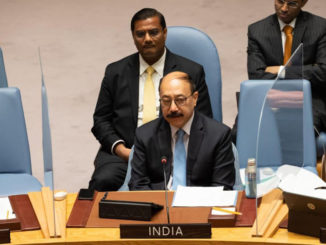
    UNITED NATIONS (TIP): Speaking at a United Nations Security Council (UNSC) meeting on cooperation between the United Nations and the League of Arab States (LAS), Foreign Secretary Harsh Shringla said India and the Arab world share a “civilizational relationship”, as he welcomed the normalization of relations between countries in the region and reiterated India’s support for a two–state (i.e., Palestine and Israel) solution. Officials said the Foreign Secretary’s visit to the United Nations to attend the meeting was an indicator of the close relations India shares with the United Arab Emirates, given that the session about the U.N. cooperation with the League of Arab Nations is a “signature event” of the UAE ‘s presidency this month at the Security Council.

    However, Mr. Shringla’s visit to New York amidst the ongoing war in Ukraine has fueled speculation that he would also take part in the discussions at the United Nations about the way forward in the crisis.

    At the UNSC meeting on the LAS, Mr. Shringla called for greater policy alignment between the U.N. and the LAS, fostered by regular and frequent consultations. He also suggested comprehensive coordination at the field level and emphasized post–conflict peace building via reconstruction and economic development. Mr. Shringla suggested that all efforts ensure regional stability with a special focus on the welfare of women and minorities. “Both organizations must take concerted efforts to support the reactivation of the Middle East [West Asia] peace process in line with a two–state solution based on the internationally agreed framework and previous agreements between the parties,” Mr. Shringla said. “India welcomes the agreement for normalization of relations between countries in the region, which we believe will contribute to greater peace and stability in the region.” The UAE, along with several other Arab countries, began normalizing its relations with Israel, particularly with the signing of the Abraham Accords — a trilateral agreement among the U.S., the UAE and Israel, signed in 2020, during the administration of (former) U.S. President Donald Trump.

    Even as the UNSC meeting was under way on Wednesday, a parallel session of the UNGA (a resumption of the Emergency Special Session from earlier in March) began. Ukraine introduced a draft resolution, proposed by France and Mexico, “Human Consequences of the Aggression Against Ukraine”, which holds Russia responsible for the crisis in Ukraine. Another draft UNGA resolution, sponsored by South Africa, a BRICS member–country, calls for “an immediate cessation of hostilities by all parties in the conflict”, without naming Russia.

    New Delhi has received a large number of foreign leaders and delegations over the past week, and more are expected to follow, mostly from countries that are part of the sanctions regime against Russia, seeking to shift India’s position on the Russia–Ukraine issue. The Modi government has refused to support any resolution at the U.N. bodies that criticizesRussia and has suggested that it is considering a Russian offer of more oil at discounted prices.

    Diplomatic sources confirmed that the surge in the number of visitors to Delhi by European and U.S. allies was mainly aimed at trying to ensure that the Modi government shifts its position on the Ukraine issue. NATO and the E.U. countries hope that New Delhi will consider voting in favor of at least one or both of the resolutions on the humanitarian situation before the UNGA.

    “A vote in favor of one of the resolutions would be a sign that New Delhi is willing to shift its position,” said a diplomat, speaking on the condition of anonymity, adding that if India remains committed to the U.N. charter, territorial sovereignty principles and a need for a stop to the violence, it must also hold Russia to account for “being the aggressor”. A third resolution, sponsored by Russia, is in the works at the UNSC and faces widespread opposition for not referring to its invasion of Ukraine.

    (Source: The Hindu)

  • MEA says Russia not major supplier of crude oil, India exploring all options

    New Delhi (TIP)-The Ministry of External Affairs (MEA) on Thursday said Russia is not a major crude oil supplier for India and it “is always exploring all possibilities in the global energy markets” to bring home oil. The statement came amid reports that India is taking up Moscow’s offer of discounted crude oil and inching closer to setting up an alternative payments system to maintain its trade with Russia, even as the United States and its Western allies impose massive sanctions on the Kremlin for invading Ukraine. “We are always exploring all possibilities in global energy markets because of the situation of importing our oil requirements. I don’t think Russia has been a major supplier,” news agency ANI quoted MEA spokesperson Arindam Bagchi as saying. India is a major oil importer and as the war between Russia-Ukraine enters the fourth week, pressure on India to stop oil imports from Russia may increase with the West expected to slap another round of sanctions on Moscow. Speaking about the evacuation of Indians from war-torn Ukraine, the MEA spokesperson said India has brought back more than 22,500 of its citizens via alternative routes.

    Source: HT

  • Russia bogged down, blasting Ukrainian cities as war enters 4th week

    Russia bogged down, blasting Ukrainian cities as war enters 4th week

    Kyiv/Lviv, Ukraine (TIP): Russian forces in Ukraine are blasting cities and killing civilians but no longer making progress on the ground, Western countries said on March 17, as a war Moscow was thought to have hoped to win within days entered its fourth week.

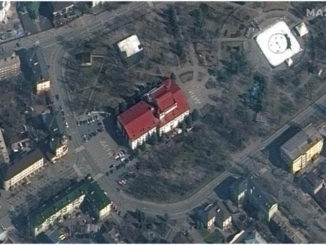
    Ukraine said Russian forces had destroyed a theatre where women and children had been sheltering in the besieged southern port of Mariupol. An official in the Mariupol mayor’s office said a bomb shelter at the theatre had “withstood” and there were survivors, but details of casualties were still not known. Russia denied striking the theatre, which commercial satellite pictures showed had the word “children” marked out on the ground in front before it was blown up.

    ViacheslavChaus, governor of Chernihiv, a northern city that has been intensely bombarded, said 53 civilians had been killed there in the past 24 hours. The toll could not be independently verified.

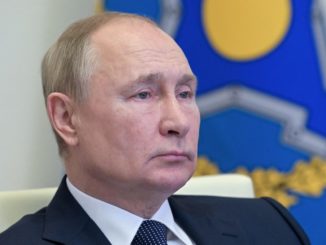
    Although both sides have pointed to limited progress in peace talks this week, President Vladimir Putin, who ordered Russia’s invasion on Feb. 24, showed little sign of relenting. In a vituperative televised speech, he inveighed against “traitors and scum” at home who helped the West, and said the Russian people would spit them out like gnats.

    Kyiv and its Western allies believe Russia launched the unprovoked war to subjugate a neighbour that Putin calls an artificial state carved out of Russia. Moscow says it is carrying out a “special operation” to disarm it and “denazify”. Heavily outnumbered Ukrainian forces have prevented Moscow from capturing any of Ukraine’s biggest cities so far despite the largest assault on a European state since World War Two. More than 3 million Ukrainians have fled and thousands of civilians and combatants have died.

    ‘STALLED ON ALL FRONTS’

    Russia has assaulted Ukraine from four directions, sending two massive columns towards Kyiv from the northwest and northeast, pushing in from the east near the second biggest city Kharkiv, and spreading in from the south near Crimea.

    But British military intelligence said in an update on Thursday that the invasion had “largely stalled on all fronts”, and Russian forces were suffering heavy losses from a staunch and well-coordinated Ukrainian resistance.

    Northeastern and northwestern suburbs of Kyiv have been reduced to rubble by heavy fighting, but the capital itself has held firm, under a curfew and subjected to deadly nightly rocket attacks. At least one person was killed and three were wounded when a residential building was struck by a downed Russian missile, emergency services said on Thursday.

    Amid the unrelenting fighting, both sides have spoken of progress at talks. Ukrainian officials have said they think Russia is running out of troops to keep fighting and could soon come to terms with its failure to topple the Ukrainian government. Moscow has said it is close to agreeing a formula that would keep Ukraine neutral, long one of its demands. Moscow said peace talks resumed on Thursday by videolink for a fourth straight day, discussing military, political and humanitarian issues. (Reuters)

  • Russia says air defence systems for Ukraine would destabilise situation

    Kyiv/Lviv (TIP): Russia’s foreign ministry said on March 17 that giving Ukraine air defence systems, as requested by Ukraine’s president in the U.S. Congress a day earlier, would be a destabilising factor that would not bring peace to the country.

    Ukrainian President VolodymyrZelenskiy urged American lawmakers on Wednesday to do more to protect his country from Russia’s invasion, pushing for the imposition of a no-fly zone and asking for aircraft and defensive systems. “Such deliveries … would be a destabilising factor which will definitely not bring peace to Ukraine,” foreign ministry spokeswoman Maria Zakharova told a news briefing.

    “In the long term, they could have much more dangerous consequences,” she added.

    The United States and its allies want to avoid NATO being drawn into the Ukraine conflict, but they have supplied Kyiv with military aid since Russia invaded Ukraine on Feb. 24.

    Moscow calls its offensive in Ukraine a “special operation” to destroy its southern neighbour’s military capabilities and capture what it regards as dangerous nationalists. Slovakia’s Prime Minister Eduard Heger on Sunday said NATO could discuss sending his country’s Soviet-made S-300 air defence system to Ukraine. Reuters

  • Ukraine legalisescryptocurrency to fight Russian invasion

    Kiev (TIP): Ukraine has legalisedcryptocurrency as the country received donations worth tens of millions of dollars from individuals and groups to help it fight the Russian invasion. Ukraine President VolodymyrZelensky has signed the law that creates conditions for further formation of the legal field in the market of virtual assets. The new market will be regulated by the National Commission on Securities and Stock Market. The signed law determines the legal status, classification and virtual assets ownership rights and determines the list of providers of virtual assets and conditions of their registration. Until now, the Ministry of Digital Transformation has been developing the legal framework in this area. “The Ministry of Digital Transformation is also actively working to amend the tax and civil codes of Ukraine to fully launch the virtual assets market,” the government said in a statement. The signing of the crypto law is an important step towards bringing the cryptocurrency sector out of the shadows and launching a legal market for virtual assets in Ukraine. (IANS)

  • Zelenskyy urges Germany to tear down wall dividing free and unfree Europe

    Berlin (TIP): Invoking the fall of the Berlin Wall, Ukrainian President Volodymyr Zelenskyy on March 17 urged German Chancellor Olaf Scholz to tear down what he called a wall between “free and unfree” Europe and stop the war in Ukraine. Speaking to the Bundestag by video link, Zelenskyy appealed to Scholz to restore freedom to Ukraine, tapping Germany’s collective memory with reference to the historic 1948-1949 Berlin Airlift and the fall of the Berlin Wall in 1989.

    Zelenskyy described a new wall “in the middle of Europe between freedom and unfreedom”, which he said Germany had helped build, isolating Ukraine with its business ties to Russia and its previous support for the Nord Stream 2 gas pipeline.

    “And this wall is getting bigger with every bomb that falls on Ukraine, with every decision that is not taken,” he added. Germany last month halted the Nord Stream 2 Baltic Sea gas pipeline project, designed to double the flow of Russian gas directly to Germany. Recalling former U.S. president Ronald Reagan’s appeal to Mikhail Gorbachev, the last Soviet leader, to tear down the Berlin Wall, Zelenskyy told German lawmakers: “That’s what I say to you dear Chancellor Scholz: destroy this wall.” “Give Germany the leadership role that it has earned so that your descendants are proud of you. Support freedom, support Ukraine, stop this war, help us to stop this war,” he added.

    Lawmakers in the Bundestag welcomed Zelenskyy with a standing ovation and the chamber’s vice president, Katrin Goering-Eckardt, told him: “Your country has chosen democracy, and that’s what (Russian President) Vladimir Putin fears.” She said Putin was trying to deny Ukraine’s right to exist, adding: “But he has already failed with that.”  (Reuters)

  • 2 Democratic lawmakers urge India to condemn Russian invasion of Ukraine

    2 Democratic lawmakers urge India to condemn Russian invasion of Ukraine

    WASHINGTON, D.C. (TIP): Observing that India walks a difficult middle ground on the Ukraine crisis, two Democratic lawmakers Wednesday urged India to condemn Russian military operations against Ukraine which they said have no place in the 21st century.

    In a letter to India’s Ambassador to the US Taranjit Singh Sandhu, Congressman Ted W Lieu and Congressman Tom Malinowski said, ”Though we understand India’s relationship with Russia, we are disappointed with your government’s decision to abstain from the UN General Assembly’s March 2 vote.” They said Russia’s unprovoked invasion of Ukraine undermines the rules-based order, ”and by invading Ukraine, Russia is trying to destroy a set of rules that protect India as well”.

    ”India’s historic support for the UN Charter and the principles of territorial integrity gives us hope that India will join other democracies to support Ukrainian sovereignty in the face of Russian aggression,” the two Democratic lawmakers wrote.

    They said they ”deeply value” the relationship between the United States and India. ”Ät the same time, we are disappointed that India has taken this approach in response to Russia’s actions.”

    ”We understand that India walks a difficult middle ground, but Russia’s actions have no place in the 21st century. Many countries who have relationships with Russia did the right thing and condemned the Russian government – they chose the right side of history and so should India,” they said. “We hope that India will move away from its current position that places blame on both sides and acknowledge that Russia is the aggressor in this conflict,” Lieu and Malinowski wrote in the letter dated March 16. The two lawmakers wrote a separate letter to Pakistan Ambassador to the US, Majeed Khan urging Islamabad to condemn the Russian invasion of Ukraine. ”We are disappointed with your government’s decision to abstain from the UN General Assembly’s March 2 vote. We are also disappointed that Prime Minister Imran Khan announced bilateral trade agreements with Russia following its invasion of Ukraine,” they said. ”The Prime Minister’s decision to proceed with his visit to Moscow, at a moment when the world was uniting in support of Ukraine, ran counter to the international community’s efforts to reaffirm Ukraine’s territorial integrity and call out Russia as the aggressor,” the two lawmakers wrote.

    (Source: PTI)

  • US working towards global coalition far beyond G7, NATO partners: White House

    US working towards global coalition far beyond G7, NATO partners: White House

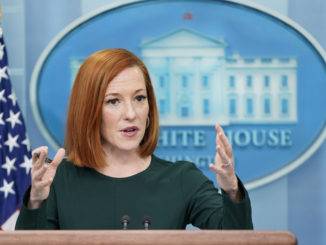
    WASHINGTON, D.C. (TIP): The Biden administration is working to build a global coalition far beyond G7 and NATO partners, the White House has said. Some of the biggest countries like China, India, Brazil and Mexico are not part of America’s economic warfare against Russia, but that does not undermine the efforts of the Biden administration against Moscow, White House Press Secretary Jen Psaki told reporters on Monday, March 14. “Not just China, but some of the biggest countries in the world like India or Brazil, some countries in Latin America like Mexico, they are not part of this economic warfare against Russia. Is this something that undermines the effort from the White House and European countries?

    “I would say it doesn’t undermine our efforts. We have been working to build a global coalition far beyond the G7 and our NATO partners and had a great deal of success in that. And every country has to decide where they want to stand, where they want to be as we look and the history books are written,” Psaki said during her daily news conference.

    “As we have seen, the impact of the president’s leadership on the global stage and the economic consequences that have been put into place have led Russia and the Russian economy to be on the brink of collapse. And there’s no question that over time, that will have an impact,” she said in response to a question. China is unlikely to be very helpful to Russia during these economic sanctions, Psaki said.

    “I think what we are looking at here, one is if China were to decide to be an economic provider or to take additional steps there to Russia, they only make up 15 to 20 per cent of the world’s economy. The G7 countries make up more than 50 per cent. So, there are a range of tools at our disposal and coordination with our European partners should we need to use them,” she said.

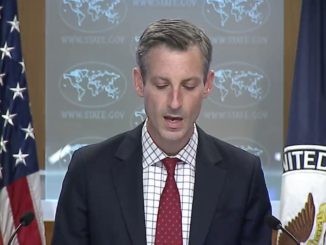
    But this is an area that the United States is watching closely, Psaki said, asserting that there would be consequences for China if it provides military supply to Russia. At the Foggy Bottom headquarters of the State Department, its spokesperson Ned Price said the US was watching very closely the extent to which China or any country in the world provides materials, economic, financial, rhetorical or otherwise, to this war of choice that Russian President Vladimir Putin is waging against Ukraine and its people.

    “And we have been very clear, both privately and publicly, with Beijing that there would be consequences for any such support,” Price told reporters. “Russia and China, when you combine their GDPs, it’s something like 25 per cent of global GDP. When you combine the GDP, the economic might of the United States, the European Union, our allies in the Indo-Pacific, our other allies and partners that have joined us, well over 50 per cent,” he said. “So, there is not a country out there that would be able to fully extricate Moscow from this. The only thing that could relieve the pressure, which could extricate, in a meaningful way, Moscow from the morass it has created for itself, is for Putin to change course, to de-escalate and to end the violence,” Price said.

    (Source: PTI )

  • Biden calls Russian President Vladimir Putin ‘war criminal’

    Biden calls Russian President Vladimir Putin ‘war criminal’

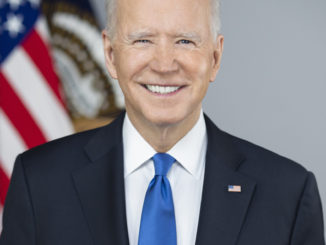
    WASHINGTON, D.C. (TIP): US President Joe Biden Wednesday, March 16,  called his Russian counterpart Vladimir Putin “a war criminal”, as Russia’s invasion of Ukraine continues with devastating consequences for civilians. “I think he (Putin) is a war criminal,” Biden told reporters at a White House event. He was responding to a question if Putin is a war criminal. In response to another question, he ruled out calling Putin. “No,” he said. Soon thereafter White House Press Secretary Jen Psaki said the president’s words speak for themselves.

    “I think the President’s remarks speak for themselves. He was speaking from his heart and speaking from what we’ve seen on television, which are barbaric actions by a brutal dictator through his invasion of a foreign country,” she said. Earlier in the day, Biden announced another USD800 million security assistance to Ukraine taking the total to USD1 billion in less than a week.

    “Putin is inflicting appalling, appalling devastation and horror on Ukraine, bombing apartment buildings, maternity wards, hospitals. I mean, it’s God awful. I was speaking about this with our commander behind me here, General Milley. I mean, it just is amazing. Yesterday, we saw reports that Russian forces were holding hundreds of doctors and patients hostage in the largest hospital in Mariupol,” he said. “These are atrocities. They’re an outrage to the world, and the world is united in our support for Ukraine and our determination to make Putin pay a very heavy price. America is leading this effort, together with our allies and partners, providing enormous levels of security and humanitarian assistance that we’re adding to today, and we’re going to continue to do more in the days and weeks ahead,” Biden said. The United States, its allies and partners, he said, are crippling Putin’s economy with punishing sanctions.

    “That’s going to only grow more painful over time with the entire NATO and EU behind us, and many other countries. What’s at stake here are the principles that the United States and the United Nations and across the world stand for. It’s about freedom,” he said.

    “It’s about the right of people to determine their own future. It’s about making sure Ukraine will never be a victory for Putin, no matter what advances he makes on the battlefield. The American people are answering President Zelenskyy’s call for more help, more weapons for Ukraine to defend itself, more tools to fight Russian aggression, and that’s what we’re doing,” he said.

    The new security package to Ukraine includes 800 anti-aircraft systems to make sure the Ukrainian military can continue to stop the planes and helicopters that have been attacking their people and to defend their Ukrainian airspace, he said.

    “At the request Of President Zelenskyy, we have identified and are helping Ukraine acquire additional longer range anti-aircraft systems and the munitions for those systems. Our new assistance package also includes 9,000 anti-armor systems. These are portable high accuracy shoulder mounted missiles that the Ukrainian forces have been using with great effect to destroy invading tanks and armored vehicles,” he said. It will include 7,000 small arms, machine guns, shotguns, grenade launchers, to equip the Ukrainians, including the brave women and men who are defending their cities as civilians and around the countryside as well, he added. The security assistance also includes drones. “We are not doing this alone. Our allies and partners have stepped up to provide significant shipments of security assistance and will continue to help facilitate these deliveries as well,” he said.

    (Source: PTI)

  • Encourage Indian leaders to work closely with US to stand up against Putin’s invasion of Ukraine: WH

    Encourage Indian leaders to work closely with US to stand up against Putin’s invasion of Ukraine: WH

    WASHINGTON, D.C. (TIP): The United States remains in touch with Indian leaders and continues to encourage them to work closely with it to stand up against the Russian invasion of Ukraine, the White House said Wednesday, March 16. “As you know, we remain in touch through a range of channels from our national security team with leaders in India and continue to encourage leaders to work closely with us to stand up against President Putin’s invasion of Ukraine,” White House Press Secretary Jen Psaki told reporters at her daily news conference. Over the past two weeks, the Biden administration has shown an understanding of India’s position on Russia given the complexity of its ties with Russia and over-dependence on Moscow for military and security needs.

    During a Congressional hearing last week, Admiral John Christopher Aquilino, Commander of US Indo-Pacific Command, described India as a tremendous partner and said that the mil-to-mil relationship is probably at its highest point.

    “From the US perspective, I think India is an absolutely essential partner as we think about our strategy in the Indo-Pacific, and both in terms of how we’re building coalition partners as well as dealing with potential adversaries.

    “We recognize that India has a complicated history and relationship with Russia,” Ely Ratner, Assistant Secretary of Defense for Indo-Pacific Security Affairs, told members of the House Armed Services Committee during a separate hearing.

  • Indian judge votes against Russia in world court for invading Ukraine

    Indian judge votes against Russia in world court for invading Ukraine

    WASHINGTON, D.C. (TIP): The United States on Wednesday, March 16,  welcomed an International Court of Justice order that asked Russia to immediately suspend its military operations in Ukraine. Describing it as a significant ruling, State Department Spokesperson Ned Price said that the ICJ “clearly and unequivocally” ordered Russia to immediately suspend its military operations. “The Russian Federation shall immediately suspend military operations that it commenced on 24 February on the territory of Ukraine,” presiding judge Joan Donoghue told the International Court of Justice, pending the final decision in the case.

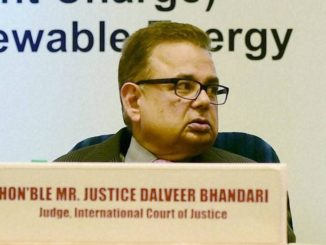
    India’s judge, Justice Dalveer Bhandari, voted against Russia. The court order was supported by 13 judges while two voted against it. This includes Vice-President Kirill Gevorgian from Russia and Judge Xue Hanqin from China.

    “We welcome the court order and call on the Russian Federation to comply with the order, immediately cease its military operations in Ukraine, and to establish unhindered humanitarian access in Ukraine,” Price said. In its ruling, the court – which plays a vital role in peaceful settlement of disputes under the UN Charter – stressed the need for States to act in conformity with their obligations under international law, including the laws of war, Price said. “And the Court expressed deep concern about the extreme vulnerability of the civilian population of Ukraine, the numerous civilian deaths and injuries that have resulted from the Kremlin’s actions, and the significant material damage, including the destruction of buildings and infrastructure,” he said.

    The Court further noted its profound concern with the Russian government’s use of force and emphasized the Court’s acute awareness of “the extent of the human tragedy that is taking place in Ukraine as well as the “continuing loss of life and human suffering”.

    The Court also observed that it did not possess any evidence substantiating Russia’s claims that genocide had been committed by Ukraine in the Donbas region, he said. Judge Xue Hanqin from China opposed the order.

    Ukraine’s contention that the Russian Federation’s allegation of genocide against Ukraine is just “an excuse for Russia’s unlawful aggression” raises doubt that this is a genuine case about genocide,” she wrote in her dissent note. “It appears that the acts complained of by Ukraine namely Russia’s recognition of the independence of the Luhansk and Donetsk regions of Ukraine and Russia’s military operations in Ukraine cannot be directly addressed by the interpretation and application of the provisions of the Genocide Convention, as the issues they have raised are concerned with the questions of recognition and use of force in international law,” she said. Meanwhile, India’s   Ministry of External Affairs on Thursday, March 17,  said judges at the International Court of Justice vote in their individual capacity, a day after Indian judge Dalveer Bhandari voted against Russia at the United Nations’ highest court.

    (With inputs from PTI)

  • Fragmenting World Order, United Nations

    Fragmenting World Order, United Nations

    The impact of the Ukraine war on global interconnectedness is a cause for worry in the post-World War order

    By Suhasini Haidar

    Nearly three weeks into the Russian war on Ukraine, the cost to India is still to be counted. While some are focusing on how India’s refusal to criticize Russia’s actions, and the string of abstentions at the United Nations, would affect its relations with the West and its Quad partners (the United States, Australia and Japan), others are watching the economic costs that the unprecedented sanctions of the U.S. and the European Union will have on Indian trade, energy and defense purchases. However, the outcome that should worry New Delhi and other like-minded countries the most, apart from the devastating consequences for the Ukrainian nation, is the impact the Ukraine crisis is having on the global world order, which is fragmenting in every respect of global interconnectedness — in terms of international cooperation, security, military use, economic order, and even cultural ties.

    The UN and Security Council

    To begin with, the global order has broken down and events in Ukraine have exposed the United Nations and the Security Council for their complete ineffectiveness. Russia’s actions in Ukraine may, in terms of refusing to seek an international mandate, seem no different from the war by the United States in Iraq in 2003, Israel’s bombing of Lebanon in 2006 and the Saudi-coalition’s attacks of Yemen in 2015. But Ukraine is in fact a bigger blow to the post-World War order than any other. The direct missile strikes and bombing of Ukrainian cities every day, exacting both military and civilian casualties, and the creation of millions of refugees, run counter to every line of the UN Charter preamble, i.e., “to save succeeding generations from the scourge of war…”, “to practice tolerance and live together in peace with one another as good neighbors”, as well as Articles 1 and 2 of the ‘Purposes and Principles’ of the United Nations (Chapter 1).

    The fact that Russian President Vladimir Putin broadcast his decision to “launch military operations” on Ukraine at the same time the Russian envoy to the United Nations was presiding over a UN Security Council discussion on the Ukraine crisis, speaks volumes for the respect the P-5 member felt for the proceedings. A vote of the international commons, or the UN General Assembly (UNGA), that decried Moscow’s actions, was brushed off in a way that was even easier than when the U.S. did when it lost the UNGA vote in 2017 over its decision to move the U.S. Embassy to Jerusalem.

    Meanwhile, in their responses, other P-5 members such as the United States, the United Kingdom and France did not seek to strengthen the global order either, imposing sanctions unilaterally rather than attempting to bring them to the UN. Clearly, Russia would have vetoed any punitive measures, but that should not have stopped the attempt. Nor are the surge in weapons transfers to Ukraine a vote of confidence in the UN’s power to effect a truce.

    Whither nuclear safeguards

    The next point is Russian recklessness with regard to nuclear safety in a country that has suffered the worst impacts of poor safety and planning following the 1986 Chernobyl disaster (when Ukraine was part of the Soviet Union), which is a challenge to the global nuclear order. Russian military’s moves to target areas near Chernobyl and shell buildings near the Zaporizhzhia nuclear power plant ( also Europe’s largest), show an alarming nonchalance towards safeguards in place over several decades, after the U.S.’s detonation of atomic bombs over Hiroshima and Nagasaki in 1945 led to the establishment of the International Atomic Energy Agency (IAEA) in 1956. The world must also consider the cost to the nuclear non-proliferation regime’s credibility: Ukraine and Libya that willingly gave up nuclear programs have been invaded, while regimes such as Iran and North Korea can defy the global order because they have held on to their nuclear deterrents. There are also the covenants agreed upon during the global war on terrorism, which have been degraded, with the use of non-state actors in the Ukraine crisis. For years, pro-Russia armed militia operated in the Donbas regions, challenging the writ of the government in Kyiv. With the arrival of Russian troops, the Ukrainian President, Volodymyr Zelensky, has invited all foreign fighters who are volunteering to support his forces to the country. This seeks to mirror the “International Brigades” in the Spanish Civil War of the 1930s, comprising foreign volunteers from about 50 countries against forces of Spanish military ruler Francisco Franco.

    However, the role of foreign fighters has taken on a more sinister meaning after 2001 and al Qaeda, when western recruits joined the Islamic State to fight Syrian President Assad’s forces. British Foreign Secretary Liz Truss’s recent statement that she would “absolutely support” British veterans and volunteers joining the Ukraine war against Russia has since been reversed by the British Foreign Office, and it is hoped that other countries around the world, including India, make firm efforts towards preventing such “non-state actors” from joining a foreign war.

    Economic actions

    Economic sanctions by the U.S., the U.K. and the European Union (EU) also point to a fragmentation of the global financial order. While analysts have pointed out that the sanctions announced so far do not include some of Russia’s biggest banks such as Sberbank and Gazprombank and energy agencies (in order to avoid the disruption of oil and gas from Russia), the intent to cut Russia out of all monetary and financial systems remains. From the eviction of Russia from SWIFT payments, to the cancellation of Mastercard, Visa, American Express and Paypal, to the sanctioning of specific Russian businesses and oligarchs and pressure on Western businesses (McDonalds, Coca-Cola, Pepsi, etc.) operating in Russia to shut down, the arbitrary and unilateral nature of western sanctions rub against the international financial order set up under the World Trade Organization (that replaced the General Agreement on Tariffs and Trade, or GATT).

    The obvious fallout of this “economic cancel culture” will, without doubt, be a reaction — a pushback from Russia and an exploration of alternative trading arrangements with countries such as China, India and much of the Eastern Hemisphere which continue to trade with Moscow. For the S-400 missile defense deal, for example, New Delhi used a rupee-rouble mechanism and banks that were immunized from the U.S.’s CAATSA sanctions (or Countering America’s Adversaries Through Sanctions Act) for advance payments. Russian banks will now use the Chinese “UnionPay” for online transactions. Gradually, the world may see a “non-dollar” system emerge which would run banking, fintech and credit systems separately from the “dollar world”.

    Isolation by culture

    Finally, there is the western objective, to “isolate” Russia, socially and culturally, that rails against the global liberal order. While several governments including the U.S., the U.K. and Germany have persistently said that their quarrel is not with Russian citizens but with their leadership, it is clear that most of their actions will hurt the average Russian citizen. The EU’s ban of all Russian-owned, Russian-controlled or Russian-registered planes from EU airspace, and Aeroflot’s cancellation of international routes, will ensure that travel to and from Russia is severely curtailed. Some of this isolation of its citizens will work to the favor of an increasingly authoritarian Kremlin. Mr. Putin’s response to the banning of Russian channels in Europe and its allies has been to use the western media ban as a pretext to ban opposition-friendly Russian channels as well. The “isolation” extends to art and music: in the past two weeks the Munich Philharmonic fired its chief conductor and New York’s Metropolitan Opera let a Russian soprano, Anna Netrebko, go because they would not criticize the war. The Bolshoi Ballet’s performances in London and Madrid were similarly cancelled. The perils of this comprehensive boycott of Russia are not without historical precedent. Speaking to his Parliament this week, Mr. Zelensky invoked British Prime Minister Winston Churchill’s “Fight to the End” speech, delivered at the House of Commons in June 1940, to speak about Ukraine’s commitment to fight Russia. European onlookers would do well to also remember Churchill’s other famous speech, “The Sinews of Peace”, delivered in the United States in 1946, when he first referred to the “Iron curtain coming down” between Soviet Russia and Western Europe. “The safety of the world requires a new unity in Europe, from which no nation should be permanently outcast,” Churchill had warned, although his words went in vain, and the world suffered the consequences of the Cold War for the next four decades.

    New Delhi needs to ponder

    The events over the past two weeks, set in motion by Russia’s declaration of war on Ukraine, have no doubt reversed many of the ideas of 1945 and 1990, fragmenting the international order established with the UN, ushering in an era of deglobalization and bringing down another Iron Curtain. India’s abstentionist responses and its desire not to be critical of any of the actions taken by the big powers might keep Indians safe in the short term. But in the long term, it is only those nations that move proactively to uphold, strengthen and reinvent the global order that will make the world a safer place, even as this war that promises few winners rages on.

    (Source: The Hindu)

  • Russia says air defense systems for Ukraine would destabilize situation

    Russia says air defense systems for Ukraine would destabilize situation

    MOSCOW (TIP): Russia’s foreign ministry said on Thursday, March 17  that giving Ukraine air defense systems, as requested by Ukraine’s president in the U.S. Congress a day earlier, would be a destabilizing factor that would not bring peace to the country, a Reuters report says. Ukrainian President Volodymyr Zelenskiy urged American lawmakers on Wednesday, March 16,  to do more to protect his country from Russia’s invasion, pushing for the imposition of a no-fly zone and asking for aircraft and defensive systems.

    “Such deliveries … would be a destabilizing factor which will definitely not bring peace to Ukraine,” foreign ministry spokeswoman Maria Zakharova told a news briefing. “In the long term, they could have much more dangerous consequences,” she added.

    The United States and its allies want to avoid NATO being drawn into the Ukraine conflict, but they have supplied Kyiv with military aid since Russia invaded Ukraine on Feb. 24. Moscow calls its offensive in Ukraine a “special operation” to destroy its southern neighbor’s military capabilities and capture what it regards as dangerous nationalists.Slovakia’s Prime Minister Eduard Heger on Sunday said NATO could discuss sending his country’s Soviet-made S-300 air defense system to Ukraine.

    (Agencies)

  • India’s envoy to UN Tirumurty  gets extension

    India’s envoy to UN Tirumurty gets extension

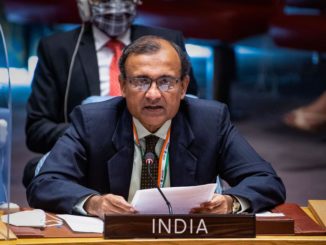
    UNITED NATIONS (TIP): Amidst the ongoing crisis in Ukraine, the government has decided to extend the tenure of India’s envoy to the United Nations T.S. Tirumurti for three months. According to an announcement by the appointments committee of the Cabinet, Mr. Tirumurti, who was due to retire on March 31, will now remain in the position at the rank of Secretary to the government from April 1 to June 30, 2022. At least two officials aware of the decision said the extension was granted due to the government’s desire to keep a “steady hand” and “ensure continuity” in India’s presence at the United Nations Security Council during a crucial period with the Russian war in Ukraine, where India is completing its two-year tenure this year. Another official also cited a precedent, as India’s former UN envoy Hardeep Puri (now Union Minister for Petroleum and Housing) had been given a year’s extension by the previous UPA government led by then Prime Minister Manmohan Singh. At the time, India had completed a year in its two-year tenure at the UN Security Council (2011-2013), and Mr. Puri’s tenure was extended, so as to maintain continuity in India’s position at the UNSC. However, it is unclear why Mr. Tirumurti’s tenure has not been extended till December, when India’s current term at the UNSC will end. An official said the extension appeared to have been made in a “phased manner” and that a further extension could not be ruled out, if required.

    Mr. Tirumurti, a 1985-batch IFS officer assumed the UN Permanent Representative post in May 2020 and has been a prominent voice on issues including the COVID-19 pandemic, the Taliban takeover in Afghanistan, Russian war in Ukraine, and more recently, for a strong speech criticizing a UN resolution adopting an “International day to combat Islamophobia”, which, he said, “elevated phobia against one religion” while ignoring other “non-Abrahamic” religions. In the past month, he has articulated India’s position on the Ukraine conflict, where despite considerable pressure from the U.S. and European allies, the government has refused to vote for any resolution criticizing Russia’s actions and abstained from three votes at the UNSC and two at the UN General Assembly on resolutions brought by them. In the next few days, the UNSC is also expected to vote on a resolution brought by Russia on humanitarian issues pertaining to Ukraine’s eastern provinces which are under Russian control, and India’s vote and the UN envoy’s Explanation of vote (EoV) will be watched closely.

    During its present tenure at the UNSC, India has been asked to head two important committees, the Taliban Sanctions Committee and Counterterrorism Committee, which Mr. Tirumurti has chaired, and he also happened to be President of the UNSC in August 2021, during the Taliban takeover of Kabul, when an Indian-drafted UNSC resolution 2953 was adopted. India will again assume the rotating presidency of the UNSC for the month of December 2022.

  • Germans offer up 300,000 private homes for refugees from Ukraine

    Germans offer up 300,000 private homes for refugees from Ukraine

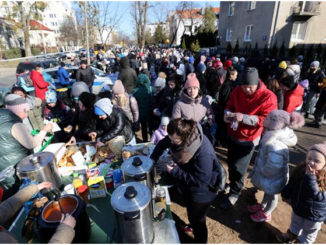
    Berlin (TIP): Germans have offered up 300,000 private homes to house refugees from Ukraine following Russia’s invasion of the country, Germany’s interior ministry said on March 10. The ministry is cooperating with the non-profit gut.org AG and home rental company AirbnbInc’s non-profit arm Airbnb.org to assign refugees to housing offers, it said on March 10. More than 2.3 million people have fled from Ukraine since the invasion, according to the United Nations Refugee Agency (UNHCR). Most are women and children, as able-bodied men have been ordered by the Kyiv government to stay home to fight. As of Wednesday, just over 80,000 Ukrainian refugees had been registered in Germany, with more arriving every day. Many of them arrive in Berlin by train or bus, which has prompted the German capital to set up temporary accommodation at its shuttered Tegel airport to house up to 3,000 people. From there, refugees would be distributed to longer-term homes, in Berlin or elsewhere in Germany.

    Reuters